Ask ChatGPT


 Legally Speaking Podcast
9 Nov 2026 · 47m · 24 chapters
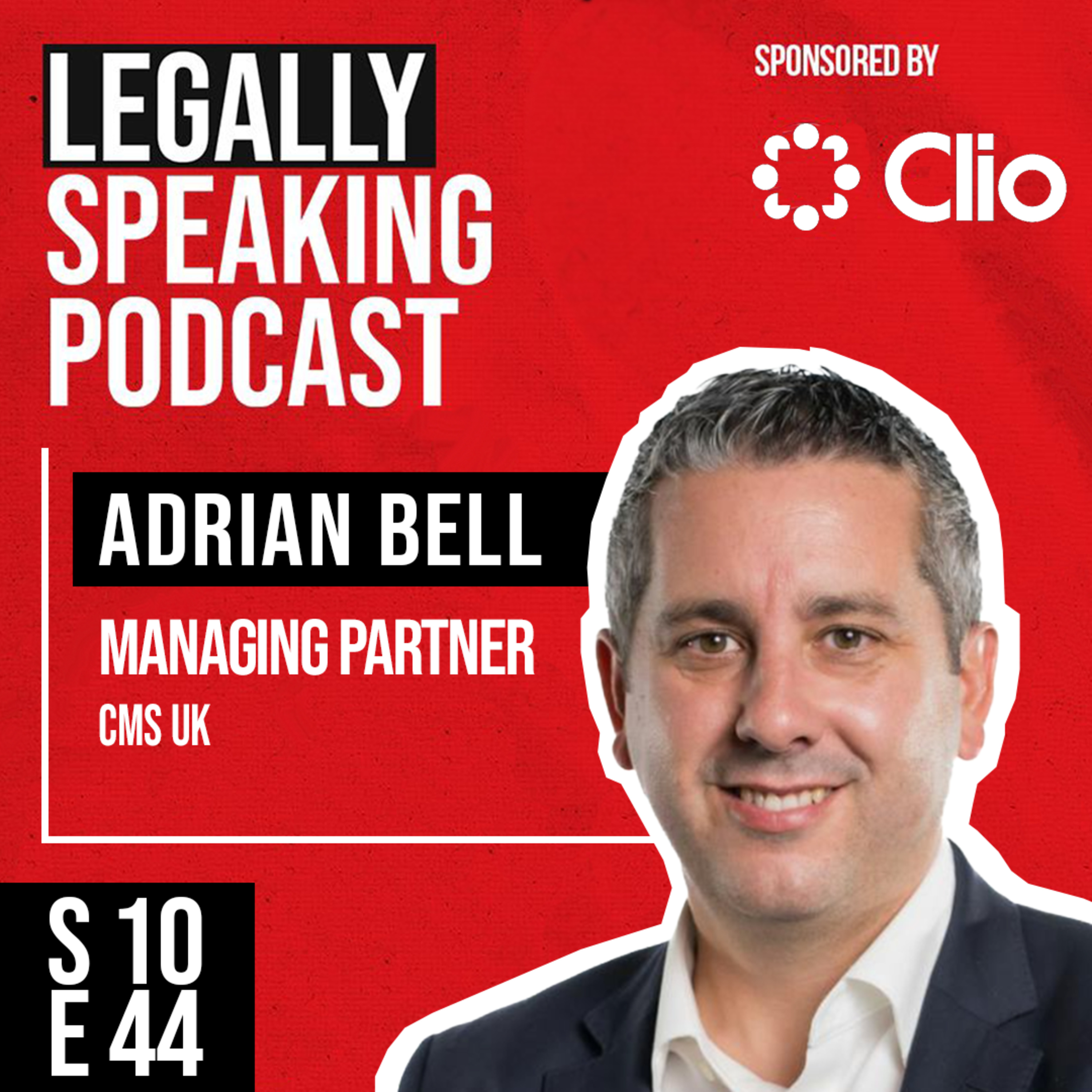
Adrian Bell, CMS managing partner (starting April 2026), discusses leadership lessons from building an international disputes career, how to run a law firm as a business, sustainable growth, client responsiveness, international expansion, and embedding AI across operations (moving from “adoption” to “adaptation” and “co-working” with AI). He argues for investing in long-term relationships, focusing on high-potential clients, and making big decisions then learning fast if they fail.
Adrian Bell (CMS managing partner; joined CMS in 2002; co-head of Infrastructure, Construction and Energy Disputes; managing director for Asia and the Middle East; helped open Abu Dhabi and Riyadh offices; now oversees UK, Middle East, Asia, Central Europe, Eastern Europe). Host: Rob (Legally Speaking).
Managing partner should be “on the business, not in the business”; prioritize people, shared ambition, and clear vision; respond quickly to clients (e.g., acknowledge emails within 30 minutes); AI should refine work, not replace judgment.
Construction arbitration work with site visits; “sliding doors” moment answering a Friday call that led to a best-client referral; hiring Clifford Chance veteran James Abbott to raise Middle East standards; using AI analytics to target best “share of wallet.”
Written by AI. May contain mistakes.
Learn the importance of investing in long-term relationships in the legal field.
“Not every relationship is going to give you an instant return.”
Adrian shares personal insights about his favorite drink and footwear.
“Today, we'll explore Adrian's journey from practicing lawyer to managing partner, leading an international law firm, the challenges of balancing commercial success and his vision for the future of CMS.”
Explore Adrian's path from law student to managing partner at CMS.
“First things first, what's your favourite beverage and your preferred choice of footwear on a typical workday?”
Discover why Adrian chose law, business, and his specific legal focus.
“Yeah, well, I was saying to someone the other day, I think sort of when I started out, my dad was a magistrate.”
Adrian discusses his reasons for staying loyal to CMS for over two decades.
“I've sort of had approaches from other firms.”
Understand how Adrian's previous roles prepared him for leadership at CMS.
“for you, it presents the opportunities, you put your hands up, you have that ambition, and good things happen.”
Adrian shares his initial reactions and motivations for taking the managing partner role.
“There's a lot of work out there and it's only going to continue to grow.”
Learn the steps Adrian took to prepare for his leadership roles in law.
“You know, you're a city executive at the top of your profession.”
Learn about the journey from partner to managing partner and the preparations involved.
“at Port Isaac and Fisherman's Friends and all of that.”
Discover what a typical day looks like for a managing partner and the variety of tasks involved.
“Well, I'm in sort of the, at the moment I'm building a lot of the big cars.”
Explore the misconceptions and tough decisions faced by managing partners in law firms.
“I try not to spend all my life getting drawn into the operational parts of the business.”
Understand the value of coaching in enhancing leadership skills and business focus.
“running a successful law firm are very different, aren't they?”
Learn how to prioritize opportunities for sustainable growth in a law firm.
“So what does sustainable growth mean to you in practice and how do you decide which opportunities the firm should prioritize rather than simply pursuing growth?”
Gain insights on managing a law firm's growth across international jurisdictions.
“Let's stick with the international expansion then, because you've obviously been managed director for Asia, Middle East.”
Explore what sets CMS apart from other major law firms in a competitive landscape.
“I think it's about the power of the people.”
Discuss how client expectations have changed and how CMS adapts to meet them.
“I think it's creating that really sort of dynamic environment that people feel they're able to thrive in.”
Explore how client expectations in the legal field are changing and what CMS is doing to adapt.
“They stayed, they've had opportunities, they've progressed.”
Learn about strategies for attracting, integrating, and retaining top legal talent.
“It's something I'm very passionate about and indeed retention, because I think that's the key point as well.”
Understand the role of AI in transforming legal services and the importance of integration.
“So of course we have to, we can't get away from it.”
Learn about the multifaceted approach to growth in law firms.
“my point about AI and embedding it everywhere.”
Discover essential skills aspiring leaders should develop early in their careers.
“What three skills would you encourage them to develop very early on in their careers?”
Explore the importance of confidence and relationship-building in law.
Understand the necessity for agility in the future of law firms.
Hear final thoughts and insights from Adrian Bell on legal leadership.
“any social media handles for yourself the firm we'll also make sure we share them as episode for too.”

Get the gist, explore an idea or ask about something said.
 Claude
On Legally Speaking Podcast, what are the key points of this episode?
Searching your listeningAutomatic transcript. May contain errors.
0:00Adrian Bell: Not every relationship is going to give you an instant return. You're talking about CMS, you've got really good expertise, but people are just really responsive and they get back to us and they give us the quality of service, the responsiveness that we really value. Invest in relationships, some of them for the longer term, be inquisitive. People should try new things. It's not just AI and innovation. It's new ways of doing things, get people to push the boundaries and to fail fast. You won't get everything right, but learn from what you don't get right and develop and pick yourself up and move forward.
0:28On today's Legally Speaking podcast sponsored by Clio, I'm delighted to be joined by Adrian Bell. Adrian joined CMS in 2002, building a career spanning international disputes, business development and law firm leadership. Before becoming managing partner, he was co-head of CMS's Infrastructure, Construction and Energy Disputes Group and managing director for Asia and the Middle East. During his leadership of the Asia-Pacific and Middle East regions, CMS expanded its international presence, opening offices in Abu Dhabi and Riyadh. In April 2026, Adrian began his four-year term as the managing partner at CMS, overseeing the UK, Middle East, Asia, Central Europe and Eastern Europe.
1:08Today, we'll explore Adrian's journey from practicing lawyer to managing partner, leading an international law firm, the challenges of balancing commercial success and his vision for the future of CMS. So a very big warm welcome to the show, Adrian. Thanks, Rob. Great to be here. Absolute pleasure to have you on the show. Before we get into your illustrious career and all the great stuff you're doing at CMS and beyond, we've got a couple of serious icebreaker questions. First things first, what's your favourite beverage and your preferred choice of footwear on a typical workday?
1:38Adrian Bell: Oh, I think beverage is a tricky one. It's very much seasonal dependent for me. So now we're moving into the autumn. It's a glass of Malbec. Like if you'd asked me a few months ago, it would have been a nice, cool glass of lager. Again, very much dependent. I'm working from home today, so I'm wearing a pair of Crocs. I am amazed, and I'm not just saying this, Adrian, the amount of guests that we've had on that are flashing the Crocs. They are definitely winning, I think, on the typical football. So easy, though. They're very versatile, aren't they? I mean, you can just slip them on and off as you go in and out.
2:08Adrian Bell: And I think, well, if I was in the office, I've got a trusty pair of Hugo Boss black leather shoes that have lasted me definitely since pre-COVID. So I feel it's probably time for an upgrade, but they're very comfy. So, yeah, I alternate between the Crocs and those shoes. Good for you. OK, another quick fire before we get into it. What's one piece of legal technology or everyday technology you now rely on that you would have thought unthinkable at the start of your career? um my latest bit of technology is hardware i know sort of some of your guests give the usual harvey answers but i've just invested in a remarkable pro and the sort of a5 version so i've replaced my trusty notebook and it fits in my suit in a pocket which is very handy so i wouldn't be anywhere without it these days love that yeah that's a great tip i'm sure people will be uh catching up on that one uh thanks for sharing okay adrian let's let's talk about you your journey from obviously studying law and business at the University of Warwick to then joining CMS in 2002, building a very successful international disputes practice and ultimately becoming managing partner of the firm.
3:12Talk us through it.
3:14Adrian Bell: Yeah, well, I was saying to someone the other day, I think sort of when I started out, my dad was a magistrate. So when I was from about 14, decided it would be a good idea to go into the law, albeit obviously that's more the criminal side. I quickly realised there wasn't as much money in that side of things. So I'm separated away from it um but it gave me a sort of taste for the law early stage and then did a law a level again many people do because they want to sort of test out whether actually they're going to like it um did quite like that a bit but but also i did an economics a level i realized at an early stage i found actually the business much more interesting than the law um so i went off to warwick and it was one of at the time one of the only universities that did a sort of joint honors in law and business um i was conscious i didn't want to spend too much time doing the law but equally I wanted to make sure it was a qualifying law degree so I didn't need to do an extra year at law school so it's quite sneaky in that respect and but really enjoyed the business side of it so I think you know again fairly uniquely came into CMS as a trainee always even from that early stage in 2002 thinking yeah one day I might want to be a managing partner so I haven't necessarily sort of fixated and designed my whole career around it but I think yeah I did have that early indication that sort of the business of the law was much more interesting to me than the sort of law itself.
4:31Yeah and obviously I appreciate that so we'll talk about that a bit later on a huge part of what your role as a managing partner will be around. Just sort of going back just to get our listeners to understand a bit about your decision making and thoughts at the time you've kind of touched on what inspired you to have a career in the law that sort of family connection but why did you choose your area of law specifically because you've been very successful in infrastructure construction and energy disputes and perhaps just give us a bit of a flavor of that for some of our guests who may not be too familiar with that part of law yeah again it wasn't sort of intentional so
5:01Adrian Bell: um i started off my training contract actually um doing a seat in corporate which i really enjoyed um i was lucky enough to um go overseas so i did um what was supposed to be a first six months in prague but actually turned out to be nearer a double seat so i did about 10 months in in prague in Bulgaria doing a bank privatization. So I had a lot of responsibility from a very early stage and worked for a great partner out there who sort of trusted me to run the team on the ground. So from then on, I thought, right, I'm going to be an M &A partner. I'm going to come in. I'm going to do the big deals.
5:34Adrian Bell: I'm going to be a big hitter. And at the time, I'm not sure if it's still the case, but you had to do six months in a contentious seat. So I left my contentious seat to my fourth seat at CMS because I thought, you know, I don't really want to do it. I want to be this big, big, big transactional lawyer. And then when I went into my fourth seat to do disputes, I just absolutely loved it from day one. Again, worked with a really good supervisor. We worked really hard. So we were in the middle of a big construction arbitration. He was an absolute workaholic, which, you know, probably could have put you off as much as making you love him.
6:09Adrian Bell: I remember we were sat there on New Year's Eve preparing for this arbitration hearing we had coming up. and I plucked up the courage to say to her at half 11 at night, is it okay if I go out and meet my mates because they're in the pub? He said, yeah, yeah, fine, fine. And then the next day when I went in or two days later, whenever it was, I said to him, what did you do to celebrate sort of New Year at midnight? And he said, well, you know, after you left, next thing I realised it was three o 'clock in the morning and I went home. So, you know, we worked on, we worked really hard, but it was really fulfilling.
6:40Adrian Bell: And I think the thing I particularly like about sort of construction and infrastructure is you can you can feel it and you can see it I think which is quite unusual for many of the sort of laws that we practice you know the big sort of ticket disputes work obviously is a bit sort of hard to visualize whereas you know we were working on roads and railways and airports in some quite unusual countries so often got to do some site visits and that's really what gave me sort of a taste for getting into that area of law. Yeah and obviously you've been hugely successful throughout your career and I can see you've had you know strong ambition you've had good people around you that have inspired you perhaps pushed you as as well and upon joining CMS in 2002 obviously you've been with the firm you've experienced the evolution over more than two decades now what attracted you to CMS originally what was it about the firm that's also kept you there the honest answer is I made 25 training applications and that was the only offer I got so it's fair to say that I wasn't necessarily sort of honing in on CMS at that time you know I've been through university I just wanted a training contract albeit that when I did go for an interview there I did get a number of interviews I did have a sort of particularly positive feeling about it that's why I joined the firm it's the only option but I'm really pleased I didn't over the years you know like many people I've had opportunities to move elsewhere.
8:03Adrian Bell: I've sort of had approaches from other firms. But having sort of carefully considered those at the time at particular junctions of my career, you know, I've always come back to the fact that I really like CMS. I really like the people, the DNA. I think it's an ambitious firm. And for me doing sort of the international construction work, yeah, we managed to get it to tier one in terms of what we did. So there was sort of no better firm for the type of work I was doing in my mind, which is pretty exciting but you know as I said to people I don't think I lack ambition just because I'm still here I did sort of look at other opportunities some pretty seriously but always came back to the sort of better the devil you know in a sense.
8:41And there's something in that for loyalty you know my older brother you know is in the property space and he's been with the same organization since a graduate first job and now director does all the various things and I think you know obviously I talk a lot about building blocks actually with your career moves and every move you make, you know, as a building block, you're adding skills and transferable experience. But actually, if you find the environment, you find the firm that's right for you, it presents the opportunities, you put your hands up, you have that ambition, and good things happen.
9:06And you're a great success story for that. I want to talk from lawyer now to leader, because before becoming managing partner, you were co-head of the CMS infrastructure, energy and construction disputes practice. How did that specialist practice prepare you for the role of managing partner, if at all?
9:22Adrian Bell: Yeah, so that was a sort of feature of the three way merger that we did with Nabarra and Old Swang I was running essentially I was the only partner in doing construction disputes at sort of the legacy Cameron McKenna firm we merged with Nabarra and Old Swang and sort of ended up co-heading that so it was a sort of merger of three teams albeit there was only one person from Old Swang and I think bringing all those people together I think needed quite a lot of planning and I think it brought quite a lot of leadership skills because we had to lots of people didn't necessarily see sort of the overall prize that we were trying to achieved so we we came into it setting some pretty ambitious targets yeah we we told people what we wanted to get the revenue to in three years and we really tried to inspire people and get them brought in to this context so I think you know in that sense it was good and also at the same time I was doing a sort of overseas leadership role so I had the two that complemented each other I was looking after Middle East and Asia and and again sort of the the reason I was given that role is because I sort of helped set up the office in Dubai and that was really sort of led by my clients who were very active in the Middle East and they said, you know, we really need CMS here on the ground.
10:27Adrian Bell: So that was the sort of background to setting up that office. So wearing or having those two leadership roles, I think, complemented each other very well. I think there's a very different skill set in leading people remotely. People in the Middle East and APAC wasn't on the ground. So you have to you have to sort of get people brought into a very strong vision so they can coalesce around that. because I think otherwise the risk is that particularly kind of that remote leadership that people just go off and do their own thing. Yeah, I think that's a really important point. And you make a big point, you know, the MENA disputes some businesses.
10:59It's big business. You know, you've got to get out there. There's a lot of work out there and it's only going to continue to grow. OK, becoming managing partner now, you know, you began your four year term, I think, in April 2026. So what was your initial reaction when you were appointed? What appealed to you about taking the role?
11:14Adrian Bell: What appealed to me about taking the role is just the business of law. I think I'm much more interested in sort of running a law firm and the mechanics and the sort of fundamental sort of business skills that you need to essentially make money. You know, I would regard myself as being pretty entrepreneurial. I think if I hadn't become managing partner and this is a sort of plan B that I was looking at pretty actively with others, I probably would have left the firm and set up my own firm. Because, you know, I have that entrepreneurial instinct. I'm always looking to build business. And I think, you know, in that sense, that's why I wanted to go into this role, because having invested so much of my career and time and energy in CMS, I felt it had immense potential to move up a level and to be a better version of itself.
12:00Adrian Bell: So that was kind of why I wanted to do it. It was a pretty tough process, I think, in terms of it was a contested election. There were four candidates before it officially started, obviously, kind of unofficially started. so the contest itself probably went on for about six to eight months um and the way it worked is sort of the person who had the fewest votes got knocked out and then kind of moved to the next phase and the phases were kind of a week apart so when i um in the first round i knew sort of it was five o 'clock on this wednesday we were going to find out one way or another i was actually in cornwall because it was half time with my family um and my partner had booked this restaurant she was very delighted with herself she's like i've booked this restaurant at five o 'clock at night I'm like, oh, no, that's fine.
12:42Adrian Bell: Find out. So this meal could have gone one way or another. And I was looking at my phone waiting to ring, and the senior partner rang about 20 past five and said, oh, good news and bad news. Good news is you're through. Bad news is there's another round. So then sort of fast forward a week around the same time the week after. It was actually my daughter's birthday party, and I came home early to attend it. I was upstairs getting changed, and it sort of got to around the same time. I thought, well, the phone hasn't run. That's weird. Maybe I'm not through this time. Maybe the senior partner's going through the people in order to get to me at the end.
13:18Adrian Bell: And then finally, the phone rang and he was like, congratulations, you made it through. At the same time, everyone was shouting at me downstairs saying, what are you doing upstairs? We need to meet. And the party started. So I had to sort of, obviously, exceptionally delighted, but then had to sort of go down and flip into being dad mode and be the sort of, you know, the fun maker at the your own smarter party. And I think that's refreshingly honest. And thank you for sharing. That is the reality. You know, you're a city executive at the top of your profession. And sometimes that is real life balancing.
13:49You know, then you are dad. You know, you want to be there for you. You want to be present. The fact that you're there, I think is fantastic given the other demands. So I think that's a great story. And great that you mentioned Cornwall. Shout out to Cornwall. My mum used to run a tea shop down there at Port Isaac and Fisherman's Friends and all of that. So very fond of Cornwall. So yeah, before we go down that rabbit hole, I'll leave that there. New level, new devil, right? You've kind of gone from partner to managing partner. But just before we talk a bit more about what a day in life looks like, what did you actually do to prepare to get through those levels?
14:17For people who might have similar ambitions to you that might be thinking, I can go and do this myself. You know, boutique firms are easy to pop up and do nowadays. What did you do that got you there at one of the best firms in the world that would be helpful for other people to understand?
14:30Adrian Bell: I think it's a sort of combination between sort of lived experience. So I always look at all those roles that I could take on and demonstrate my kind of leadership and managerial experience. They obviously started off being much smaller roles, but they were things that I could still do. You know, even sort of the very early stages, I offered, for instance, to sort of take on a particular BD initiative and to show leadership. So I think one thing I would encourage people to do is to take those early opportunities, even if they're fairly small, prove you kind of worth and you can do it. And then sort of the bigger ones, I think, will sort of lead from there.
15:02Adrian Bell: In terms of actually preparing for the job, also I did quite a bit of going off and reading. So, you know, I'm in my home office now. I've got, if you can see it to my left, a bookcase full of lots of management and leadership books. Well, actually, it's half management, half leadership and half Lego models because I'm a big Lego builder. So, you know, every year I build myself a big model and now I've got somewhere to put it on my bookshelf. So it's a combination of things. I enjoy reading. I enjoyed listening to podcasts about management and law firm leadership. But also, I think going back to the day job, it was about creating a solid business.
15:41Adrian Bell: And I think, you know, if you are going to take on a role such as this managing partner, I think you have to have a credible client following. I think you need to be building up that really strong core business. So when I said I didn't like the law too much, I still did a lot of it. I built up these kind of relationships and I built a strong practice that went up the rankings and other things. I think it's much easier to have a lot of the more complicated, difficult discussions and conversations you need to have with partners when you're a leader. If you've had that strong practice in the outside, I think it gives you that kind of authority and credibility.
16:14Well said. And I'm loathe to say the corny phrase, but it's such a true example of your network is your net worth. You've been building right at the start of your career and you've been very intentional about that. and it's almost become habitual. And as a result of that, you've probably been operating at the level. I always say to people, if you're looking to try and go for the promotion, operate at the level already. So it's almost a no-brainer and you're ready for the next level and the next level, the next level. And you were clearly doing that. Before I completely sideways this podcast, Lego, what's been your favorite model that you've built?
16:43Got to ask, I'm a Lego fan over here as well.
16:45Adrian Bell: Well, I'm in sort of the, at the moment I'm building a lot of the big cars. So this Christmas I built the AMG four-wheel drive, the big orange Mercedes. which is good although last year i was sidetracked i had to build the home alone house because my one of my kids got it and he was like oh dad can you help me and then i sort of get in the zone over christmas and do a sort of two or three day build so vehicles are my thing at the moment um although one of them i'm just as you said sort of what's only but i kind of looked aside one of them's gone missing so i suspect one of the kids has taken it so i'm gonna have to go and reclaim that from a bedroom later on hopefully it's still in one piece yeah and i'm sure the lego land visits are fun for all the family literally and talking of amgs i'd encourage folks to check out we did a legally on the move drive to thrive series last year at mercedes-benz world and we did track days we did some interviews with amgs and with some of the um the bigger cars so go and check that out on our previous minisodes on the legally speaking podcast okay back to life as managing partner what does a typical day look like for you there isn't a typical day i think that's that's part of the excitement of it i was saying to someone the other day i mean i can wake up thinking I'm going to do this this this and this at the end of the day it's been completely different I think it's complete variety and one of the things I'm trying to do is make sure that I still remain very accessible so you know I've enjoyed traveling around the offices I want to hear from both the partners the fienders the business services colleagues but there is no one day that's the same I think you know some days I'm lucky enough to get some food to eat some days I'm desperate for the toilet at the end of the day because you just literally and back to back and get a lot of curveballs thrown in during the day you know you have to reschedule I've got a terrific PA who's constantly juggling my diary in a way that I couldn't possibly do and yeah even to the extent sometimes I'm going to join a call and it's a different call to the one I was expecting because she's had to sort of move things around but I think the thing that is constant is yeah there is a lot of human interaction particularly with partners I do spend a lot of my time talking to partners and particularly about you know how I could help them grow, how I can help with clients.
18:50Adrian Bell: I try not to spend all my life getting drawn into the operational parts of the business. And I think one thing I've done different from the previous managing partner is introduce a COO. So I brought somebody in to look after the operational side because it is quite a complex business. I didn't want to spend all my time doing that. I wanted to make sure I had somebody doing that to also free me up to spend time with partners, clients and other stakeholders. It's a really important point. It leads nicely to where I wanted to go next in terms of actually the realities of running a law firm, because being an excellent lawyer and running a successful law firm are very different, aren't they?
19:25So what do you think are some of the misconceptions or the biggest misconceptions individuals have about the role of managing partner and what challenging decisions does a law firm leader have to make that others may not necessarily be overly aware of?
19:38Adrian Bell: I think some of the most difficult decisions relate to partners. I mean, you know, whilst you'd like to think that sort of it's all plain sailing, we've got 538 partners that inevitably issues come up. It's a people business. It's not just partners, it's Vianos or other people. Some of them are nice, joyful things you can get involved in and you can celebrate. Some of them are tricky things that, you know, not many things keep me awake at night. I think the people things do, you know, when you know some of the decisions you're going to have to make for the right reasons in the right interest or best interest of the business.
20:10Adrian Bell: but have such a personal impact on people. I find it quite challenging. And that obviously is one of the toughest parts of the job. But I mean, the other thing is that I think I have a coach now, which we may come on to in a bit. But my coach said to me, you know, the key thing is managing partner is to be on the business, not in the business. So don't get too drawn into all of this operational details. You know, you don't need to know every single point, which for a disputes lawyer is quite difficult, because I think particularly my background, you need to know all the details of the case. Whereas now for me, it's taking much more of a kind of helicopter view and knowing who to ask and who I can rely on and who I can get support from for particular pieces of information as and when I need them.
20:54Yeah, and I love that you talked about having a coach as well. You look at any professional sports athlete, you know, any team, they've got great coaches, right? And they bring out the best in them. So I love that you've mentioned that. And perhaps this has helped you with your vision and your focus, because your CMS profile describes your focus as delivering sustainable growth through focused, consistent and intentional execution. So what does sustainable growth mean to you in practice and how do you decide which opportunities the firm should prioritize rather than simply pursuing growth?
21:26Adrian Bell: Yeah, and I think sort of picking up first on the coach piece, because it has been really helpful. And I was very clear with people that I didn't want a coach who'd been another managing partner or another senior partner of a law firm. I wanted to make sure that my coach could bring a different perspective. So my coach is actually someone from commerce who's run big businesses and startups, but nothing to do with the law. And so we have a lot of conversations around business as opposed to partnerships and law firms. But in terms of the prioritization, I think one thing I observed when I came in is that we had lots of projects.
21:58Adrian Bell: You know, our list of projects was immense. And I think, in a sense, my observation was kind of it was quite hard to achieve a lot of them because we almost had too many and people were getting too distracted easily. So I wanted us to focus really on what mattered and what would enable us to grow. I think probably the best example of it is with our clients. So, you know, historically, we've had a very big roster of clients. Some of them we can build, you know, hundreds of millions. other than we can bill you know hundreds of pounds and traditionally they've all kind of had a similar level of attention and care which isn't a sustainable way to run a business you need to make sure you're focusing your support and your energy and your efforts on those higher potential clients I think where there is that opportunity to grow so I've come in and I've tried to be more focused and more disciplined put in place those kind of analytics and again using a lot of AI these days you're looking at our client base where do we get the sort of best addressable share of wallet?
22:57Adrian Bell: Where are the opportunities for our footprint? Where can we serve as these clients in multiple jurisdictions? And diverting more partner and business development and other time to those opportunities to grow, as opposed to just giving everybody the same level of service internally. Today's episode is brought to you by Clio. If you're spending more time managing your practice than practicing law, it's time for a change. Clio is the intelligent legal work platform built for modern solicitors. Combining context-aware AI with trusted legal research to help you work smarter, not harder. Switching is easier than you might think.
23:33Clio's dedicated migration teams handle your client and case data every step of the way so you can focus on what matters most, your clients. Plus, award-winning support 24-5 via live chat, phone, and email means help is always on hand when you need it. Visit clio.com forward slash UK to find out why thousands of UK solicitors trust Clio. Now back to the show. Let's stick with the international expansion then, because you've obviously been managed director for Asia, Middle East. CMS has obviously expanded its presence in the UAU as you're talking, Saudi, Australia, et cetera. What lessons did you learn from growing a firm across different jurisdictions?
24:14And how do you go about balancing the opportunities of international expansion with the practical challenges of building a very cohesive firm across very different legal systems?
24:24Adrian Bell: I think it comes back to the people again. So our Middle East business, when I took it on, was doing okay. It wasn't spectacular. It wasn't growing particularly rapidly. There was profitability issues in certain parts of it. It wasn't particularly highly ranked for anything. So we did quite a lot of planning and discussions as a group. And I remember sort of probably about two years into the role, I sat down with the partners. And for the first time, And it was clear there was this shared ambition in the room that they wanted to grow and they wanted to move the business to the next level. And I think without that, it's difficult to do.
24:57Adrian Bell: You know, if there's splits in the room, different people, some people prefer the status quo, other people want to grow, then it's more difficult to do. But having got that shared ambition, we then went out to find people. And I think the first person we brought into the business, a partner, a guy called James Abbott, he'd been at Clifford Chance nearly 20 years in the region. he was head of their disputes um i actually met him through a colleague who introduced him um who i know um read a few beers or sort of courted him he decided to join us i think that really set our level high and on the back of that we have managed to attract sort of many more laterals to come into the business and i think frankly people that we wouldn't have got um had we not got james in um i mean to illustrate the point i got a message from i think two recruiters uh the day that we announced today James had joined us what one of them said to me how that F did you get James Abbott that just having brought James in is really set the bar high and I think it is all about people because then one thing that we did in the Middle East and we're looking to replicate this now in Asia is have a really sort of big regional play you know it's not about the different offices and the different silos and the people working in their own practices about how do we lift the region as a whole how do we work together cross office cross border to really sort of you know So I know it's a bit cliche, but two plus two is five, not four.
26:19Adrian Bell: I think it's about the power of the people. Yeah, and collaborations, dominations say it all the time. And we is greater than me. If you can bring the team together and you bring the right people, it sticks. And it's probably going to be your answer to this question, but feel free to share. It's a competitive market. It's all sounding rosy, but it is very competitive international legal business services. So what do you believe differentiates CMS from the other major law firms out there? I think it is the culture and it's having that sort of shared ambition because, you know, frankly, we're not the biggest payers.
26:50Adrian Bell: You know, when we entered the Saudi market, it's a very competitive market. There's a lot of US firms throwing money around to get the best talent. But we managed, we've got a very clear vision and we managed to sell people the vision. It goes back to the point you made earlier about sustainability. You know, we are building a firm that is heavily committed to being in those regions for a long time. We appreciate there will be ups and downs, there will be peaks and troughs financially. But, you know, I think giving people that clear message that we are here, you know, we are here for a long time and we have very clear plans about what to do.
27:21Adrian Bell: And if everybody, you know, it's not brainwashing as such, but if everybody sort of gets around that point, I think it creates a really sort of sticky environment for people. So we, you know, touch wood, I don't think we've lost anyone we haven't wanted to lose in those offices. And I think, you know, we continue to add to them, but it comes back, you know, it's all about people. It's a people business. I think it's creating that really sort of dynamic environment that people feel they're able to thrive in. But everybody else is sort of is doing so at the same time as well as sort of lifting them as a whole.
27:53Yeah. And you're obviously getting that momentum off the back of that. And, you know, putting my own legal recruiting hat on, you know, the people we put in CMS, they've always spoken very positively. They stayed, they've had opportunities, they've progressed. And I think it's great to hear that. OK, changing expectations, because we're in an interesting legal market at the moment. Clients are looking more now than just legal expertise and, you know, technology coming in has kind of put a foundational sort of view on legal knowledge, shall we say. So given your background in very complex international disputes, how have you seen client expectations evolve?
28:26And could you share how CMS specifically ensures its lawyers go above and beyond to meet those changing client expectations and demands?
28:34Adrian Bell: Yeah, I think clients are becoming, you know, there's obviously they have massive choice. I think sort of loyalty is in some places not as strong as it used to be. And I think they're expecting things much quicker, particularly with AI. So they're becoming even more demanding. I think we say to people, we want to be the leading relationship law firm. And what we mean by that is, you know, we're really focusing on building those ultra strong relationships with clients. I was speaking to some newly qualifieds the other day in their induction. I was saying it just means doing the basics, you know, absolutely spot on.
29:06Adrian Bell: Now, if a client emails you, you respond to it within half an hour. You don't have to respond substantively with all of the advice, but you need to acknowledge the email and you need to say, thank you. I'm going to look for this. I'll get back to you by X. And then you need to make sure you do get back to them by X. And, you know, they sound very basic points, but I think, you know, they are often overlooked or undervalued and clients really appreciate them. So when we do a lot of our client listing exercises, they say, you know, the one thing we like about CMS, you've got really good sort of expertise.
29:35Adrian Bell: but people are just really responsive and they're kind of normal people and they get back to us and they give us the quality of service and the responsiveness that we really value. I think that's so important. And I talk a lot about the importance of connection with communication. Like you say, stay connected and communicate. You know, like you say, maybe you're not going to get them the answer in half an hour, but at least make them feel seen. You know, they get that client-centered experience. You're at the heart of being their trusted advisor. You're on it. You're going to get back to them.
30:02You're going to give them some guidance about when potentially expect and like you say stick to the basis i could do with that my own job at times as well i think we over complicate things and sometimes forget the basics and actually if you just get the basics right verbatim you know everything else can sort of
30:14Adrian Bell: snowball from there to give you a sort of real life example of it which i'll give again to some of the to the nqs and things i was i remember very vividly i was driving someone a friday night about 6 30 i was probably going to pick one of the kids up my mobile rang it was a number i didn't recognize and the temptation was just to think oh you know it's the end of the week I can't be bothered it will be someone trying to sell me something and I answered it actually turned out now to be you know one of my best clients because you know they were in a distressed situation on the Friday evening it's someone that yeah they said it was a construction project they phoned up someone they said we need the best in the construction world who would you recommend rightly or wrongly they recommended me over the weekend and I think yeah that built a really strong trusted relationship and it's you know it's those sliding doors moments isn't it i sort of said you know had i not bothered answering the phone and you know that could have been you know millions of quid down the drain in terms of the client that then didn't join us and went somewhere else it's it's it's always that always on isn't it and i think that's that entrepreneur in you as well you know there's this could be an opportunity you know you've probably looked at it in terms of i'll take it i'm curious i'm understanding of it and that subconscious of you um took that and yeah there's a reason we wanted you on the show so we would agree with the people making that call that they definitely got the best out there.
31:29Let's go to talent and attraction again, because it's so important. It's something I'm very passionate about and indeed retention, because I think that's the key point as well. It's costly going out and getting talent. We ain't cheap, you know, legal recruiters. So, you know, getting the talent is important, but also retaining it and ensuring it progresses and, you know, you get the respective value is important. So as a managing partner, how do you go about attracting and retaining the very best lawyers in the marketplace? How do you create the opportunities for talented lawyers to develop into future partners and leaders?
31:57Adrian Bell: I think the attraction piece goes back to making sure you've got a really clear vision. So I've hired quite a few laterals in my time. I've always made sure that the recruiters we use are fully briefed. And the feedback I've had from the candidates has been, you know, we picked up the phone, again, similar to my sliding doors, we picked up the phone, we're not interested in moving, but we could tell from the outset that this recruiter was speaking on your behalf, not saying they were speaking on your bar they just had access to information they wouldn't have had you know had it not been a legitimate sort of inquiry and i think making sure people are fully briefed telling them the vision you know i do like to get in the recruiters and say to them yeah this is our strategy this is our plan they can talk much more authoritatively and convincingly and i think you know also getting them to meet a lot of people so i'm always very keen to um get laterals to meet a wide range of partners again without wanting to slow down the process and then the The other thing I like doing is I like contacting the references.
32:57Adrian Bell: So we take references from partners, obviously, laterals joining. But only fairly recently, maybe the last two or three years, I've actually given a call to the referees myself. And again, the feedback you get from the clients is really positive because a lot of the clients say, oh, wow, you know, you must be investing really heavily in this person, in this process. Because you, the head of Middle East or head of Asia or managing partner took the time to phone me up. And again, that's good for solidifying our client relationships. And I think then in terms of the integration, frankly, we haven't been great at it in the past.
33:29Adrian Bell: I think we are putting a lot more process around it. Again, it's one of my areas of focus. I think we invest so much time in laterals that we need to make sure that they do hit the ground running and you'll know through your work. But I think there is a limited window. You need to make sure when they start that they have all of those meetings and opportunities set up. Because if you miss that window, then they start suffering from confidence. I think people don't have the confidence in them and you can see things quickly go down here or at least not integrate at the rate that you would have liked.
33:57I think it's just keeping that energy up, isn't it? The positivity of coming in, the excitement, the experience, enhancing that experience and then the impact from that. And you bring a very important point. A mentor said to me, Rob, in order to, you know, in order to perform, you must inform, you need the information. And the fact that you're giving that information means the recruiters go out there and, you know, they're ultimately representing your extension of your brand, an extension of the opportunity. The more that they can give substantive information in terms of the insights about why different, because the best candidates are very busy.
34:27They're not sat on job boards hunting for jobs. Their partners are giving them promotions. They're dangling carrots and making them want to stay. Why on earth are they going to go and want to join your firm? And without that power for information, you can't really go out there and attract the best talent. So that's a really important point. And I think the other thing you've made very clear is you genuinely invest the time you make those phone calls you are invested this time is the most valuable thing that i can do as people as one of our biggest assets and commodities as a law firm i'm going to lead to more profitability i'm going to put in the time to ensure we get this talent and we do our due diligence and as a result of that you've had exceptional results and and i appreciate you being candid you know it's not always easy getting it right from the start but you're you're continuously working and finessing on it and okay i can't believe we've got to nearly over half an hour and we've touched on ai and tech but we haven't really got into it So of course we have to, we can't get away from it.
35:13It's the world, it's where we're going, it's not going to slow down. The ship has left the harbour. So AI and legal tech, very much changing how legal services are delivered. What role do you believe AI will play in the future of CMS?
35:30Adrian Bell: As you said, I mean, the ship has sailed, hasn't it? I think it's going to be sort of a core part of what we do. I think one thing we're moving away from these days is almost treating AI and innovation as a sort of special project. You know, I've been very keen to make sure it's embedded across everything we do, as opposed to just being, you know, go and speak to the AI people. You know, everyone should be an AI person. We're very much also moving from adoption, I think, to adaption. And that's the sort of phrase I've been sort of adopting internally. Because historically, we've been like, you know, how many clicks can you get on Harvey?
36:02Adrian Bell: And, you know, how much can you use Copilot? Whereas now it's actually about adapting the way you work to embed AI in it and sort of co-work. And I think the most powerful way that I use AI is in that co-working, co-designing capability. I'll do a draft of a note. I'll put it in AI. So how would you refine this? I'll go back to me. I think it's that working together in partnership. And I really want to see it embedded and ingrained in everything we're doing there. I think we're obviously having some quite interesting conversations with clients. I've got one tomorrow with a big client, you know, talking about value, risk sharing, you know, who takes the risk.
36:38Adrian Bell: And I think that differs according to what we're being asked to do, you know, how you do the pricing based on value. I think it's all about building those relationships and trust with clients. I think it is such a dynamic conversation that we keep having. And yet the other interesting thing that we're looking at is, again, the balance between build and buy. you know we're i think we're harvey's big biggest user or we were historically but also we're looking to build some of our own products internally we've got you know lots of people very keen to sort of productize their ideas so we're trying to bring in questions that can help us do that but i think it's just about making sure that we're agile and we're nimble and we're not too reliant on one particular piece of technology but we are making sure that we are ingraining it in everything we're doing as i said as opposed to treating it as a who's doing ai or who's doing innovation yeah i think that's a really important point and i love that you talk about working in partnership with the technology as well because these are tools and you don't want to be an ai user you want to be an ai operator um you know you don't want to outsource your thinking there's a reason you as the legal professional have been instructed to work on the matter be it from a partner senior partner managing partner um and from your clients and so i love that you're talking about actually how you're working with these tools and not outsourcing that thinking.
37:55Because I think that can lead to almost going backwards for certain law firms. If they start thinking they can just over rely as of today, I will put a caveat in as of today on the technology and actually using it to enhance the experience or efficiencies, whatever it might be. So I love that point. We touched a little bit on this earlier, but I want a chance just to get into your sort of mind when it comes to managing uncertainty, making difficult decisions, because it is a challenging market. I mean, there's loads of opportunities out there as well. But the times we live in at the moment, there is uncertainty.
38:25So you're responsible for making decisions affecting firms, people, clients, you know, long term direction, big, big things. So how do you approach difficult decisions when balancing competing priorities? And would you mind sharing your advice to other law firm leaders out there on making decisions that support the firm's long term success?
38:45Adrian Bell: Yeah, I think sort of the best recent example of that is we're currently sort of going through a very major change program for our business services team. That's in response to quite a lot of noise from the partners for quite some time about sort of the need to improve the level of service they get and to reduce what they call the amount of admin. So, you know, the easy thing for me would have been just to chip around the edges there and think, well, I'm going to just tweak here, there and everywhere. But, you know, I took the view that it hasn't really been looked at properly since mergers, so for nearly 10 years.
39:16Adrian Bell: And we needed to sort of do something on a sort of bigger scale. So it's about getting, I think, the expertise in. We've used one of the big four to help us design it, but also then not becoming too reliant on their advice. I think, you know, I'm very actively involved in it. I think, you know, there are difficult judgment calls you need to make. But again, I think the disputes background does help because, you know, we're used to making, not that we sort of gameplay everything, but you are used to sort of, I think, looking further ahead in a slightly different way to maybe some transactional laws.
39:51Adrian Bell: You know, the disputes is like one big game of chess. And I think in a sense, sort of running a law firm is the same. You need to think about the consequences of not just the next move you're making, but the move after that and the move after that and the move after that. And again, not the direct consequences, but the indirect consequences. So, you know, as I see it, it's about sort of looking at every possible outcome, assessing the severity, the ease of them, the cost of them. And ultimately, you do need to form the judgment. I think for me, it's about making the big decisions and then sticking to the big decisions.
40:24Adrian Bell: And I think ultimately, you know, not every decision I will make in my tenure will work out or will be a success. And I think you just have to, where that's not the case, you have to hold your hands up and say, you know, I made a mistake. and I'll learn from that I'll do things differently going forward hopefully they will be in the minority rather than the majority but I think inevitably not everything will work out as planned I think you need to be able to adapt and be agile and pivot away from things and change course if you need to quickly. I love the refreshing honesty of that as my late grandfather said who ran his own successful law firm for many years in the 1950s said a person who never made a mistake Rob never existed and I think it's so true you know but equally that self-accountability you set yourself there if it's meant to be it's up to me I will own these decisions and you know rightly or wrongly and like you say by and by and large most will hopefully go to plan but it's just it's almost unthinkable for anyone not to make a mistake when they're in a senior leadership position with so many variables so many things going on it's how you learn how you adapt how you improve as you say so sticking with that trail of thought then looking ahead for the remainder of your four-year term what would you like to have achieved what are the key priorities that would define your leadership and what your legacy would look like in terms of what you would look to try and lead well i think i'd like to sort of going back to my my last example i'd like to have fixed business services um but again i don't want to spend all of my time going back to my earlier point i want to make sure that we're growing i think you know i've just recently brought in a chief growth officer which is a new role the firm has never had before you know we've look very one or two dimensionally at BD and things like that.
41:58Adrian Bell: But to me, it goes back about my point about AI and embedding it everywhere. I think growth is the same. We need to be looking at where growth comes from. And this person I brought in is looking at it from every different dimension. It's a combination of BD, it's commercial finance, it's looking at rates, it's looking at new markets. So I want the firm to grow. I want the firm to be the best in market business services. I want it to grow i want it to be recognized and sort of destination of choice for laterals i think you have a really clear market narrative and proposition i want i want people to be sort of coming to us saying i want to join cms rather than me going to them and say you should join cms and these are the reasons why yeah be the magnet not the chaser and i think you're doing a great job of that undoubtedly um okay some advice now just before we look to close in a couple of questions time to maybe future partners managing partners or ceos or entrepreneurs but for our listeners who aspire to get to those levels.
42:56What three skills would you encourage them to develop very early on in their careers?
43:02Adrian Bell: We've touched on one of them already. I think networking, I always say to people, I think having that strong network or building your network from a very early stage, I think cannot be overvalued. I think it's absolutely cool that people do it. And as I said again to many people that many of my current clients are my associates of the past. I think, you know, always recognize when people leave, you know, keep in touch with people, work your alumni network. And just as you said earlier, I think the other thing is about not really, you know, not every relationship is going to give you an instant return.
43:36Adrian Bell: Invest in those relationships, some of them for the longer term. I think the other thing is to be inquisitive. You know, I think people should try new things. It's not just AI and innovation. It's new ways of doing things. I think people in law firms are traditionally quite conservative and I'm always keen again to get people to to push the boundaries and to fail fast you know you picked up again on that in the past you won't get everything right but learn from what you don't get right and sort of develop and pick yourself up and move forward and I think the third thing is confidence I think you know when I look at CMS and we've got some really great people but frankly I'm not sure we've necessarily got the confidence to match the expertise we have um we've recently recruited a lateral partner actually was in-house at amazon um and he said to me one of the reasons he wanted to join jit cms is because of the people but he also said um yeah the quality of work that he got at amazon from cms was of a much higher standard than some of the sort of bigger competitors and and i think people don't always realize that i think you know they they they think the sort of magic circle us firms are always going to have better quality people better lawyers but that that's not always the case i think we need to have more confidence as a firm agreed and i've always said if i could bottle up confidence and give it to everyone i'll be a trillionaire many times over i think it's so important and i always use the acronym for people when they've had challenges or setbacks you know lose you know it's not actually losing it's just life offering some experience and if you can flip that mindset i think it's very powerful and i always talk about nsn as well never stop networking and i think it's so true that you've referenced that point directly there and even in my own legal recruiting business which is now over a decade old you know i look at some of the nqs that are now partners you know candidate becomes client that customer lifetime value extrapolates over time it's just investing because contacts are good folks but relationships pay keep in touch with people sprinkle value on them be of service be relevant and good things will happen yeah love that okay final piece of advice it's been absolute masterclasses and it was going to be adrian really really enjoyed it today if you could complete this sentence how would you finish it the future of the legal profession will belong to the firms that are agile nice yep and i think you've had that sort of theme throughout today's discussion um really enjoyed it if our listeners want to know more um about cms in case they've been living underneath a rock or indeed yourself um feel free to share any websites or any social media handles for yourself the firm we'll also make sure we share them as episode for too.
46:01Adrian Bell: Perfect. Yeah. Well, if you Google CMS, you come up hopefully with the law firm. Sometimes it's some other acronyms, but, and on LinkedIn, I'm a big user of LinkedIn. So feel free to reach out Adrian Bell on LinkedIn. Awesome. Well, it just leaves me to say thanks ever so much. Once again, Adrian, it's been an absolute pleasure having you on the show. And I think this conversation has given us real insight into what it takes to lead one of the world's best international law firms as a managing partner. Adrian's journey from disputes lawyer to leader to the vision he has for CMS's legacy. And it's very clear.
46:32It's about building a clear strategy, sustainable growth, whilst balancing a lot of those commercial successes and about fostering collaborative partnership and culture and people and creating an environment where people can thrive. And it's about leading with purpose, making those difficult decisions, preparing the firms for the opportunities that lie ahead. So from all of us here on the League of Speaking Podcast, sponsored by Clio, thanks so much once again, Adrian. But for now, over and out. Thank you for listening to this week's episode. If you like the content here, why not check out our world leading content and collaboration of the Legally Speaking Club over on Discord.
47:07Go to our website, www.legallyspeakingpodcast.com. There's a link to join our community there. Over and out.
“There’s a very different skill set in leading people remotely.” - Adrian Bell
On today’s Legally Speaking Podcast, sponsored by Clio, I’m delighted to be joined by Adrian Bell. Adrian joined CMS in 2002, building a career spanning international disputes, business development and law firm leadership. Before becoming Managing Partner, he was Co-Head of CMS’s Infrastructure, Construction and Energy Disputes Group and Managing Director for Asia and the Middle East.
During his leadership of the Asia-Pacific and Middle East regions, CMS expanded its international presence, opening offices in Abu Dhabi and Riyadh. In April 2026, Adrian began his 4-year term as Managing Partner at CMS, overseeing the UK, Middle East, Asia, Central Europe and Eastern Europe. Today, we will explore Adrian’s journey from practising lawyer to Managing Partner, leading an international law firm, the challenges of balancing commercial success, and his vision for the future of CMS.
So why should you be listening in?
You can hear Rob and Adrian discussing:
- From Lawyer To Managing Partner: Adrian Bell’s Journey Leading CMS
- The Business Of Law: Driving Growth and Building Client Relationships
- Leading Through People: Attracting Talent and Building Strong Teams
- The Future of Law: Embracing AI, Technology and Innovation
- Building a Legacy: Leadership, Confidence and Learning From Failure.
Connect with Adrian Bell here - https://uk.linkedin.com/in/adrianjamesbell