Ask ChatGPT

 Legally Speaking Podcast
16 Nov 2026 · 52m · 19 chapters
How to use AI without outsourcing judgment; distinguishing “drift” (default, algorithm-led thinking) from “design” (consciously choosing when to use AI); implications for legal work, firm structure, and education; and the “seven super skills” needed in the age of AI.
Rahim Hirji is author of Super Skills (seven human skills for the age of AI). He’s a keynote speaker/advisor on AI work and human judgment. He founded EtonX (soft skills education), led international growth at Quizlet across 60+ countries, and previously built education technology over 20+ years. He’s researched AI’s impact across 200+ organizations and advised professional services firms including law firms (e.g., Linklaters).
AI removes tasks, shifting responsibility to human judgment (leaders must decide what to trust). Drift happens when defaults replace thinking; design requires agency/awareness. Junior “synthetic seniority” can create risk when people lack “scar tissue” and training.
Google Maps choosing the “first” route; Google Calendar defaulting to 30/60-minute meetings; summarization costs dropping from ~£35 (human) to pennies (LLM). Honest Burgers as “principle innovation” (celiac-friendly process).
Written by AI. May contain mistakes.
Discusses the importance of agency and awareness in using AI effectively.
“If you do have agency and if you do have awareness, you become this thing called a designer.”
Rahim shares personal preferences on beverages and technology, including a life-saving device.
“I will just say before we start, I did one other legal podcast.”
Rahim recounts his career path from university to founding EtonX and working with Quizlet.
“And so I had to figure out my my way out of out of it.”
Explains how AI is changing the nature of judgment in professional roles, particularly in law.
“And then I continue to do research to make sure that everything is still kosher.”
Discusses the shift in judgment calls based on AI tasks and the implications for professionals.
“So would you mind explaining what this actually means to our listeners?”
Learn about the differences between organizational drift and purposeful design in decision-making.
“And it's not necessarily the one that's going to be the quickest.”
Discover how legal professionals are adapting their judgment when integrating AI into their work.
“I've seen a few law firms and professional services firms and the whole gamut, right?”
Examine the implications of AI creating work that mimics seasoned professionals, affecting judgment and learning.
“okay synthetic seniority now is a situation whereby a junior can create work looking like it was produced by someone with 10 years of experience and that's through simple prompting or what have you.”
Discuss the need for law schools to adapt their curricula to focus more on soft skills and judgment rather than technical processes.
“Not yet, no, and the robotic revolution will have its moment.”
Explore the need for adaptability and human skills as technical skills rapidly evolve.
“Similarly, I, you know, I think I'm a bit older than you, Rob, but I remember when when Microsoft Excel came out, I was super excited about it and didn't use it.”
Learn about the seven essential human skills that become crucial as AI technology advances.
“So we're saying technical skills, knowledge is going to zero.”
Understand why curiosity is vital in a world increasingly dominated by AI.
“And so, you know, when you're doing that, you've got to figure out pattern matching, group things together.”
Discover the significance of big picture thinking in navigating AI's impact on law.
“Just want to go deeper on curiosity because I talk a lot about this in a lot of my discussions.”
Examine the enduring importance of empathy and human connection in legal practice.
“And it might come up as an agent and refer things back to you.”
Learn why building relationships is crucial in professional environments, especially with the integration of AI.
Explore how to integrate AI into law firm structures while maintaining human judgment and creativity.
Discover the key messages from the book 'Super Skills' and the importance of self-improvement.
“And there's this thing about building relationships, and that's where that might sit.”
Understand the critical advice on not outsourcing thinking to machines.
“okay final final piece of advice and you have to complete this sentence the professionals who thrive in the age of AI will not be the ones who?”
Wrap up the discussion on the future of the legal profession and the role of human skills amidst advancing technology.
“You had no idea that was coming your way.”

Get the gist, explore an idea or ask about something said.
 Claude
On Legally Speaking Podcast, what are the key points of this episode?
Searching your listeningAutomatic transcript. May contain errors.
0:00If you do have agency and if you do have awareness, you become this thing called a designer. When you want to figure something out, you've got to go through that learning motion. People have to do the difficult stuff to be able to learn something. And someone asked me the other day, if you came in to the legal profession now, would you have to do all of this? You know, the LLB and all of this other stuff, or could you just leverage one of these tools and get your way through? The augmented mindset is a skill that tells you to think before you use AI. You're making the decision on using AI and we're in a world that we will use AI.
0:38And so consciously we need to know when we should and when we shouldn't. And that's a designer. On today's Legally Speaking podcast sponsored by Clio, I'm joined by Raheem Herji. Raheem is the author of Super Skills, the seven human skills for the age of AI. a keynote speaker and advisor on AI work and human judgment. Having spent more than 20 years building education technology, he founded EtonX and led international growth at Quizlet across more than 60 countries. His research has spanned more than 200 organizations across more than 300 countries. Rahim has experience working with professional services firms, including law firms, exploring what AI means for the future of work and the human skills AI cannot replace.
1:26Rahim has a unique perspective on what AI means for the future of work with his concept, drift or design. Today we're talking about AI, the future of legal careers and the seven super skills professionals will need to thrive in the age of AI. So a very big warm welcome to the show Rahim. Thank you so much, Rob. I will just say before we start, I did one other legal podcast. And as soon as I came off that podcast, I had three people saying, you should go and meet Rob, go into Legally Speaking. That's the biggest one in the world. And I said, I'd never heard of it before, because obviously, I'm not a lawyer.
2:02then one of my very good friends recommended to me and we did the introduction and here we are and i have watched some of your your podcast in in preparation i will say it probably is one of the best ones in the world in this in this ilk so thanks very much for having me it's an absolute pleasure and you know the work you do is fantastic and it's so important for the legal community so that's why i'm really keen to have today's discussion but before we get into your career and all of that a few icebreaker questions what's your favorite beverage and your preferred choice of footwear on a typical work day i my favorite beverage is a weird one because um i've flip flopped between lots of different types of drinks um i am very much a water man these days pretty boring but specifically i i measure the ph and all of the things on inclusivity on water and i will tell you that fiji water is the best water and it tastes the best that's my first uh and you're not endorsed to say that not endorsed but if anyone wants to from fiji water wants to come and find me you know where i am yeah but where i wear i'm a trainer's guy i wear all birds everywhere i am the imelda marcos of all birds trainers i've got 10 10 pairs and different colors and different shades um and that's what i wear i'm not gonna apologize for it no absolutely and you do you you what you like okay one more quick fire question what's one piece of everyday technology you now rely on that you would have thought unthinkable at the start of your career?
3:32I have an aura ring and people don't think of that as technology so for those who don't know it tracks how many steps you do, it tracks whether you're stressed or not, it helps you with your sleep. I joined it very early actually like kind of five six years ago in one of the first earlier versions. The reason why I can't do without it now, I mean in the beginning my career these things didn't exist but the reason i can't do it do without it now is that i was um on death's door quite literally i was very very ill uh gravely ill to the point that i didn't realize that my oxygen levels had dropped this thing told me that my oxygen levels had dropped and i uh i had to listen to my wife then and we went we went to hospital but um it has saved my life so when you get a bit of technology that saves your life that's the thing that you would put on top of your i'm very addicted to my phone and lots of other things but um when you put a bit of technology and you say this thing saved my life without it i probably wouldn't be here i think that wins absolutely you know health is wealth and health tech for good could not agree more okay so let's get into to you then give us a bit of a short version of your journey from obviously studying computer science at loughborough university i'm a leicestershire lab myself so founding obviously eton x and then working with quizler and building technology ultimately give us a new journey i came out of uh loughborough a long time ago and i've only been back a couple of times recently but uh i had a very good time there but my my my first step out of university was to go for the best graduate schemes that they were at the time and i remember my parents saying to me okay you you know consulting finance you're not going to be a lawyer uh but i was you know i was a kind of techie geek, go and find those those best graduate schemes.
5:20It was great advice at the time. And I went to go and work in banking. And I absolutely hated it. And so I had to figure out my my way out of out of it. No disrespect to any bankers who are listening. But I had to figure out my way into a into a different different guise. And so I moved into e commerce consulting for a bit, primarily for the for the finance industry. And then I went back to study again, and did my MBA. And with that, I think it opened up a number of different areas for me to go down. I thought I found my calling within media. I worked for the government in Abu Dhabi, focusing on media.
5:59I did the same thing with News Corp, primarily focused on books, and to see kind of different moments and transitions and what was going on. That's the stuff I love, is like the transitional change. And when I was working at one of these publishers, education kind of came in and there was a moment happening with education where the internet you know which used to be the most exciting thing it's like hey I these things right the internet was this thing that was happening it was gonna change education and they called it edtech and they started calling it edtech and that's where some people call it edutech education technology but I started dabbling a little bit in this area and you know there are a number of different things I did one was I was CEO of one of the first online tutoring businesses in in the UK and you know you and me Robert are on on screen here it was in 2005 2006 that was a weird thing to happen and when you're trying to sell online tutoring to parents whose kids uh were gonna partake in this uh weirdness with this stranger on the other end of the internet they were thinking we're not gonna let that happen but we know that was the thing that we were trying to break in at that point in time now it's very normal for you to have online tutoring and it's it's pretty much a given so that's one of the businesses that i i ran and we exited that then i was involved in a business called eton x found founded this business out in china of all places to teach soft skills to teenagers there very difficult gig it was a great idea but i think in entrepreneurship if you have these ideas usually you have a bunch of friction that you've got to get through because you believe in the idea so much and i really believed in soft skills and i really believed in that for um that generation worked in china we scaled it out to the gulf and then and then globally um it's eton college uh bought that um and then and then i moved on um i moved to a place called quizlet uh those with parent those are those parents with kids who are between 11 and probably 16 will know the product is probably the best uh flashcard product in the world.
8:05And I joined there with a view to scaling it from the US where it was a San Francisco based app globally. So I set up the business in the UK and then looked at how do we do that across the world, which was a very exciting time, had a very exciting plan. And then COVID happened and it became even more important for these kinds of tools to be out in the world with with any kind of learner, whether they are younger in primary, where it was important to learn things like vocab, whether it was supporting GCSEs or SATs in the US and exams like that, but also for lifelong learners who are trying to learn different things.
8:45And I don't get any money for it. It was a great product. I'm not working there anymore. But I found my calling in education and ed tech and the betterment of people, which was what I really wanted to do. And I think that's where my calling has been. And now I'm in this place where I've advised companies and people in AI. And obviously I've got my book come out and that's where I'm trying to create a new category of skill, which is called super skills. And advise companies, individuals, and anyone who will listen. This AI world may be scary, but there's ways to position yourself, there's ways to position your business, the way you think.
9:27And really, it's about how do you use judgment appropriately in this new age? And so that's the area that I'm inhabiting now. It's an exciting place. It's a bit of an unknown. Some people are making things up. I've done a lot of research in this area with 200 companies before I wrote my book. And then I continue to do research to make sure that everything is still kosher. And you're doing such tremendous work. So let's jump into the sort of AI and judgment, because a lot of the conversations we have, particularly with the legal professionals here, AI isn't coming for your job, it's coming for your judgment.
10:02So often when we hear people, you know, hear AI is coming for your job, they think about the automation, they think about redundancy, they look at it from a very negative perspective. You outline AI is not coming for your job, it's coming for your judgment. So would you mind explaining what this actually means to our listeners? Yeah, there's a nuance behind it. And I used to get pretty peeved when I kept hearing that AI is coming for your job. And actually, technology has always been there in your job. It kind of comes in a little bit. You think, oh, that's easy to do. I'm going to farm that out to my tech.
10:38I'm going to farm that out to AI. And that's what's been happening. That's the thing that worries people over the last three, four years now. But also from a little bit before that. What I'd say is happening and why I position this on judgment is it's taking these tasks away. And sometimes we don't realize it. And sometimes we do it because we think things are easy and might be prompting and finding out information. I did a study whereby I looked at the amount of, you know, how much it cost to summarize a document and also a lot of different tasks. to summarize a document with a graduate in an old school way, you know, might cost 35 pounds.
11:22Now we say to ChatGPT, or we say to Claude, or Gemini, or Copilot, or whatever else, can't we bother to read this document? Can you summarize it for me? And if you look at the token price, depending on different models, that costs five pence, you know, seven cents to do. And that probably will go down. People say, oh, the price of tokens will go up. Actually, the models will go up and whatever else. And so a lot of this stuff is happening. And this is a long way of saying that things are happening to the world of work. What happens then is that you are making a judgment call, not based on the work that you have done necessarily directly yourself, but you're making a judgment call on things that a machine has done, or, which is happening all the time, that someone else has vouched for that a machine has done.
12:10You know, if you're in the world of work, oh, I've got this document I've got, here it is. how how sure are you that that document is completely legitimate and it's got being checked that you know there's no hallucinations and there's i know there's less hallucinations now but less hallucinations is it giving the right judgment within that who's taking the judgment as part of that and so that's my thesis that what i think is happening what's evolving to the point that where you get to the ceo the ceo's job or the senior leader is not sitting on this pile of great talent necessarily within their organization.
12:48He or she is sitting there and making a judgment call on how much he trusts the people within his organization to understand the technology and use it ethically and use it in the right way. So that's a judgment call on the CEO. That's a judgment call on senior leads. That's a judgment call on lawyers. That's a judgment call on anyone who's there. That's a judgment call for clients right so if a client doesn't believe in what the partner is saying because they don't trust them there's this judgment issue there that's going on there so I'm I'm trying to lay out this this new new piece or the new way of looking at it people talk about judgment all the time but I just want to lay this out in this in this way so you know it's not it's don't worry about the tasks the tasks are always gonna go away it's just happening quicker this time what's happening in your mind to think about what you should be doing and what you shouldn't be doing and that's some of the stuff i talk about in my book and that's some of the stuff i do keynotes about fascinating and one of the other things that you know builds on that is your core idea including drift or design so you explained most organizations are handing judgment to ai without deciding to drift is what happens by default one convenient shortcut at a time design is what you choose on purpose love that so what's the distinction then between drift and design and how does an organization know when it's drifting or designing i love it when people quote quote my quotes back to me because that's uh it's very very well uh very well articulated so well very well said so we're happy you've got the knowledge to share so so the um the concept of drift um and you know you could you could interpret drift in many different ways I kind of look at it as algorithmic drift and it's very easy to outsource your thinking to AI and that could happen I mean the very simple example is you're using Google Maps and what do you and me Rob do we get Google Maps we say hey we're going to go to St Paul's Cathedral and we've got to get there we look at the map and say okay pick the first one and is that the best one And I've looked at it, I've done this a number of times now.
15:02It's not necessarily the best one. And it's not necessarily the one that's going to be the quickest. It's the best one for everyone else or for the machine. Sometimes that is the same as you, but it's not always the case, right? Because in whose interest is this? And so I give you one, that's one example there. But we're doing this thing all the time. There's a story about Google Calendar is probably one of the largest online calendars. that is out there. It was programmed many years ago to have, when a product manager was developing this thing for the first time and said, what do people do for meetings?
15:40Oh, well, we have 30-minute meetings and we have 60-minute meetings. I said, okay, let's program that into the product. And so the easiest thing to do now is to do a 30 or 60-minute meeting. And that might be great for a podcast, right? But it's not necessarily the best or the most pertinent timing for a meeting because you might have a one-to-one meeting that is worth 17 minutes. And you know that from previous meetings that you've had. And this is the thing that gets to me, is that the default is not always the best thing. And the default is usually defined by an algorithm. And prior to that, it has been defined by a human that put this into the algorithm.
16:19So we are living on the judgment of someone else, which it goes back to judgment. And so my concept of drift, and I talk about this in significant detail in the book. There's a two by two for consultants who like that explains this. And if you don't have agency or awareness, I call you sleepwalkers. And that's my bottom left of my matrix. But if you do have agency and if you do have awareness, you become this thing called a designer. And a designer knows that they are making the decision. They know what's happening. but they are making that decision themselves so if that choice to use AI is theirs and as you'll know the seventh skill in my book is called the augmented mindset and you know there's a variety of skills within there some of them are very human curiosity is the is the first one empathy is one of those in there and you know they're very human skills the augmented mindset is a skill that tells you to think before you use AI.
17:25You're making the decision on using AI and we're in a world that we will use AI and so consciously we need to know when we should and when we shouldn't and that's a designer. The other thing I'd say in this area is that if you don't start to design your world you start to fall into these this bad practice and it's very difficult to get out and become into the come back into the into the world um of design and i feel like yeah that that erosion of thinking as well you sort of create a bad habit rather than create a good habit and you spent most of this year you joked about sort of leads being podcast very kind of you said nice words at the start but you know you have been inside you know professional services firms and indeed law firms and recently working with the likes of, you know, one of the world's best, Linklaters.
18:16So what are you seeing inside the legal profession and how are lawyers redesigning how they work with AI and are firms experimenting with tools without thinking about the human role that needs to change so they can better adopt it? I've seen a few law firms and professional services firms and the whole gamut, right? So what I would say about lawyers, and this is not countering to lawyers, lawyers have got good judgment. it's a funny thing right but um what i've seen is and i think the worrying thing about the legal profession and and you'll you'll tell me if i'm right is is probably one of the first um first verticals that said oh dear this is going to come at us in a big way yeah and so it was the first area that you've got these other great tools that um are being used it was one of the first areas where there was investment put in so like how do we solve this problem of ai coming to eat eat our jobs and so what i've seen is that i think that there is you know significantly good judgment in in legal firms on on a scale versus other other industries whereby in comparison there's that thinking of when to use and when not to use is instilled i think almost as an ethos within lawyers And, you know, I haven't got any reason to say anything positive about lawyers or negative.
19:46But what I will say is that in conversations with bigger firms, that they're already in a very good place. The other thing I'll say is they've also drawn a line of when to use it. And so this is the product that we are using. And this is how we are doing it. the small lenses i've seen like lower down in the organizations is that some uh you know some junior employees will come in and they want to learn that was my next question really how are we going to develop the judgment of the next generation there's this thing around you know call it friction or a hard graft right i think when you want to figure something out you've got to go through that that learning motion and you know as a i'm not an educator but for having been in education and ed tech for so long is that people have to do the difficult stuff to be able to learn something and someone asked me the other day if you came in to the the legal profession now would you have to do all of this you know the llb and all of this other stuff well could you just you know leverage one of these tools and uh to to kind of just get get your way through and i said you still got to go through the process you might be able to do it go through it quicker and there may be a different way to learn it but you still need to have a level of speciality to know the nuance and the intricacies of of what might change and the the other thing i'll say is that i've seen is different is that the smaller law firm is i think probably way behind probably hasn't got the resources um there'll be some i think some some of the very small ones are very like tech savvy and and are doing things because they work in that way but that medium-sized firm is struggling because they think that they've got the right tool they don't know how to use it they don't necessarily know how to implement it and i've seen that not just in the legal profession you might see that in the accounting in the accounting world and in professional services in general that they are they're struggling at that that end so that when you're at the top end of the larger firm you're kind of okay because a lot of people thinking about it a lot of people resourcing it you've got probably task force have figured this thing out and so this is what we're going to do right now and they've probably got one or two people whose prime job is really you know not just about the tools it's really about the judgment and kind of providing that advisory and i've seen that in firms and i also see that in this in the small ways i think you know an entrepreneur who is um you know maybe a very small firm it's quite binary so you get those that are way on top of the game and there's those who say i'm not touching ai today's episode is brought to by Clio.
22:18If you're spending more time managing your practice than practicing law, it's time for a change. Clio is the intelligent legal work platform built for modern solicitors, combining context-aware AI with trusted legal research to help you work smarter, not harder. Switching is easier than you might think. Clio's dedicated migration teams handle your client and case data every step of the way so you can focus on what matters most your clients plus award-winning support 24 5 via live chat phone and email means help is always on hand when you need it visit clio.com forward slash uk to find out why thousands of uk solicitors trust clio now back to the show okay synthetic seniority now is a situation whereby a junior can create work looking like it was produced by someone with 10 years of experience and that's through simple prompting or what have you.
23:15However, the underlying judgment is actually the AI's model. You've been referencing this. So could you explain the risks this has for the likes of legal services, processional services firms? The definition of it is as you said it. I'll give an example and this is the example that people resonate with is a lawyer with 20 years of contracts experience or commercial experience would have gone through this process of seeing all of the information, but also seeing all the clients, seeing all the nuance, getting through it and being really, really good at their game, top of their game. And then suddenly out of nowhere, there's this young upstart who's able to use the tools available and play at the same table.
23:55The thing that really restricts that situation, and this is one of the risks, is when things go wrong, where is that junior going to go they haven't been told no before they haven't been hit in the face they haven't had a client say what the hell are you talking about they are a bit lost and they inevitably would go back to the machine and say what is the solution for this but actually the solution doesn't live in the machine the solution lives in the scar tissue that someone with the experience has had. So the risk with this is that we say that it's normal for someone who is a junior to be given the tools and not necessarily the training.
24:38And they go through that and they're at the biggest tables. And you know, you do get talents, right? Talent is can go through organizations, and they always have done and always will. But this situation that we're in right now, companies are seeing it happen. And some companies are letting it happen. That's to the detriment of their client, right? Because they may not have seen all the nuance, they may not have seen all the bits and pieces, because the machine is only as good as the data that you've put into it. Absolutely. And look, if nothing changes, nothing changes. And there's risks that are associated with that, for sure.
25:15The missing part of the pyramid. So you've highlighted the missing rungs. So in early career development, so if AI is removing some of the traditional entry level work, and we're seeing that with a a host of different legal tech providers out there. What are the risks associated with this? I mean, the obvious one is when people move on, there won't be the next level of leadership. That's the obvious thing that's going on. The other thing, and this has come to the foray over the last few months, is there's this yo-yo effect. Okay, we're going to get rid of all of these people we're not going to recruit.
25:48So there's this, you know, it's almost this, I call it a kind of reverse pyramid, right? At the bottom of the organization is not very many junior people. What I've seen larger firms starting to do, I mean, EY is one of them, is that they're starting to invest, one, in human skills, and two, in these equivalents of these apprenticeship programs that develop individuals to actually go through the organization in a slightly different way. And so, you know, I think if we don't do that, you know, I love firms like stepping out and saying, we are going to try this. EY is one of them, and there's probably someone in the legal profession as well, saying, look, we've seen what's going wrong and actually want to nip this in the bud.
26:33And, you know, we need to reinvest in this area. I think there's going to be a point in time where if we let this happen, we will end up with these middle to senior managers within organizations, not just in law, but across the board, where we're just managing tools. That's a very different kind of life and work. If we're okay with that, then that's fine. I think tools and AI and all of that stuff is part and parcel of who we are and who we are becoming. it doesn't mean that we need to resign ourselves to one very simplistic model which means let's get rid of this uh this lower layer and you know i write extensively about the missing rungs and i find i find it sad that we're in this position and you know i've got my my eldest is at university now i worry about where she will whatever firm she goes to whether it's in law or elsewhere where I worry of what that entry-level position is going to be and whether there is anything there or whether she will have to do something with, you know, very entrepreneurial and builds her own firm or has to do something that uses her hands, which, you know, AI hasn't taken that yet.
27:45Not yet, no, and the robotic revolution will have its moment. Let's stick with the education point then. You're referencing your oldest, because AI and legal education, you're changing work for junior lawyers. Traditionally, you know, they used to learn. does the education need to be transformed and should law schools firms you've referenced a bit about ey there be teaching fewer technical processes and invest more in developing the judgment the curiosity communication adaptability obviously i'm biased but yes of course i think i think all of these firms need to invest significantly in this area i think the education system needs to invest in this area not just in in higher ed i think across the board i think the whole education system needs to be re-looked at and you know people talk about it a long time but it's usually a hot potato with government that no one's going to really take that risk.
28:36What I do believe is technical skills have a very short half-life and if you look at data from companies like IBM who've tracked this over many years that the half-life of technical skills have reduced significantly you know from you know may have may have been 15 years you know 10 10 years ago to you know maybe a year now right i'll give you a very very simple example you know when chat gpt first came out which was that chat gpt moment we all learned oh we've got to learn how to prompt and we learned to like a little framework we said this is how we're going to prompt you're using that framework now you're not getting the best out of the systems that are out there right because it's a completely different game you really need to use ai in the way that it needs you know it's asking to be used.
29:20Similarly, I, you know, I think I'm a bit older than you, Rob, but I remember when when Microsoft Excel came out, I was super excited about it and didn't use it. But, you know, I used to be able to write macros and things like that. And the half-life of that was, you know, 15 years at that point in time. But, you know, Microsoft Excel, Google Sheets, all of these things, you know, Airtable, you've got to be able to pick that up very quickly. You need to unlearn it. You need to relearn it you need to be adaptable to pick any of these other skills and the adaptability is more important than the actual technical skill i do realize that you need to have like some level of speciality in certain areas but there has been an underinvestment in the human skills and this you know people call it soft skills i call super skills and the things the the things above that are going to be critical over the next 10, 15 years.
30:15So let's build from there then. So we're saying technical skills, knowledge is going to zero. These are the super skills we need. So let's talk about the book. So the seven human skills for the age of AI, your book. So it identifies seven human capabilities becoming increasingly important as AI advances. And we must say exponential rates as well. So this includes, we've touched on them, but curiosity, change readiness, big picture thinking, empathy, global adaptability, principles, innovation and augmented mindset. So maybe just talk through them briefly. Just give us a bit of your thoughts generally.
30:50You've given them an absolutely correct order. It's just as part of this research. I spent a long time. I started this research maybe seven, 10 years ago when I was in China trying to figure out. I thought soft skills were the thing and then was in China and realized everyone was using AI, you know, as far back as 2013, 2014. And I thought the world is about to change. And that's when I started looking into this in a bit more detail. As part of that process, I spoke to a number of different organizations and 200 actual real organizations, real individuals who are making these decisions within these firms.
31:23And, you know, I got to a very long list. And so, you know, when you're doing that, you've got to figure out pattern matching, group things together. And if you look at the book, it's not it's very much not not a textbook. It's very readable in the way that it's very story driven. But these skills encompass all these these names. They encompass multiple skills within them without being too didactic. Curiosity is my first super skill, primarily because you need to ask questions. I think good lawyers ask good questions, but also because it's the thing that's most at risk. and if you think through your use of ai it's very easy to say tell me the answer right you don't think through it first i've got this concept which is called you know i think people talk about humans in the loop i've got this concept called humans at the start and humans at the end so hats and hate yeah the reason why i do that is you need to know what your problem set is first before you can farm out anything to AI, otherwise you might be answering the wrong question.
32:32And then ultimately at the end of it, when we go back into judgment, who's going to put their rubber standpoint? And so this is why curiosity is so important, because if you farm that out without thinking what the problem is, who knows what you're doing? So curiosity is the main one. I think we're in a world that is changing all the time, change readiness, and there's lots of different concepts within that. These other ones, big picture thinking, people say, oh, is that very similar to systems thinking and and it is you know encompasses systems thinking in the way that you might look at it but big picture big picture thinking allows you to think about what's happening on a day-to-day basis what's happening in the next month you know people talk about five-year plans we also need to think about what is the world going to be like in 10 years time and what is the punt that we're going to make in that for that new world because you need to have a north star and then obviously there's uh empathy which is the most human of all uh of all skills i think and i don't think a machine can have lived experience i can't see i can't see a situation in the future even with robots they can have a humanoid can have a real experience in the way that you might say that and you know I lost one of my friends recently who passed away and you know you can't go to someone's wife and say to them I'm really sorry for your loss and I had a very good connection with your husband etc etc I don't think you can say say that someone in the same way that a doctor that people say oh it's going to take over the medical profession you can't have a doctor say to a patient I'm really sorry you've got cancer or I'm really sorry you've only got you know a few months to live.
34:15The empathy that lives within that is very much a skill it's something that you build it's something that you have through experience from lived experience and actually something that you can hone quite well and actually through exposure and meeting with people. The principles of innovation and global adaptability are ones that I think are new and not new principle innovation you know if we had principle innovation when some of these large social media firms came about i think the world would be a very different place um i i use a i use an example in the book with principle innovation of honest burgers uh that's that's a very weird example to use and i said well i've got to keep it topical uh but burgers it might is um what one is it has great burgers so that's the first one again not endorsed if you if you eat meat um a lot of people hit back at me i'm a vegetarian but uh if you if you eat meat and like burgers honest burgers is a great place but what they what they did is created um it to be very celiac friendly for those who require gluten-free so you can go into honest burgers today and say i am a celiac and i can't eat gluten and if i if i have gluten i'll probably be very very ill and they have a whole way of preparing your meal and anyone could do that and only some some firms do that but they took the principle that that is important and i've got a few friends who are celiac and family who are celiac and if they're going for um if they go for a burger they will bring everyone with them to all this burgers and so that's an example of principle innovation and we talked about the augmented mindset which is really that choice to use ai or when to use AI and when not to use AI.
35:56And I think these skills are fundamental. Just want to go deeper on curiosity because I talk a lot about this in a lot of my discussions. I think it's so, so, so important. As you rightly say, it's the lead with this. And you describe curiosity as noticing what machines misses and asking the better questions. So why does curiosity become more and more valuable when AI becomes more and more capable? I look at AI as a massive autocorrect. So it's got a lot of data behind it. And it can ask great questions, but it doesn't know the nuance. It doesn't always know the context unless you've given it to it.
36:34And it hasn't been in all of those situations everywhere. Maybe in a few years' time, and I've sliced up everything that we're doing. It's listening to our podcast right now in five years' time. Hello, machine, we're friendly. But these things might happen. And it can't necessarily ask that right question. so i think it becomes really important when you're representing your firm and going to a client who's paying you money to say we have asked the right questions we've also supplemented that with this ai that encompasses the stuff that we might have missed but if you flip it and say okay the ai has done the work we've just we've just checked it that's a very different way of going about it and which is which is why my concept of curiosity is different there's this concept um you know if you know curiosity epistemic curiosity where you go where you go deeper and i ask people to prove that they are curious they go oh well i you know i i'm very well read and i'll go into this and i and i i curate my instagram so i only look at really good stuff i said okay prove it and i said because show me what you were doing so they showed me their instagram they'd go and say look i've got this information about technology and I said okay so you found out the found out the headline but have you gone to the next level down and they go well I read the article do you know why this became a headline and they're looking at me they go no they can just recite a headline and they don't really know this deepness and so that's just one example of that's news but it could be in any different guise and I say that you know I did a big thing for students on the other day and I was telling my curiosity and they go we're all curious We're young, but when you say prove it to them, they can't necessarily prove it.
38:17It's a different beast, isn't it? And like lawyers always used to say to me, Rob, do your due diligence. You know, you see something online, you've got to go deeper, deeper, deeper, and have that curiosity. I want to drill in a bit more on the big pitch thinking, because I really like this. You know, one of the risks with AI is that we become good at answering the questions we have been asking. AI does not always ask questions whether we are asking the right questions. So again, thinking from a legal perspective, what is the significance of big picture thinking for lawyers in this sort of AI enabled profession?
38:46I don't mention this in the book, but I've maybe I wish I had. But there's this concept. Well, you're saying it on the podcast now. So we'll share it. The supplement to the book is this concept of time. And you can with big picture thinking is one you can predict the thing about about time. You're asking a question. You can also send out agents to figure things out in a specific case. But let's say we're talking about a specific legal case right now. You know, you might have been in practice and then suddenly something comes out in the news and you go, wow, that affects what we're doing right now.
39:20And that might be out there and overt. But, you know, something might change now. Something might change before the verdict. Something might change after the verdict. You might still use this as precedence when it's no longer precedence. and so being being aware of of uh you know what the world is and and having that frame of big picture thinking and this is why it's different to just systems thinking systems thinking is is really important but big bigger picture thinking encompasses it it's about really being aware of that picture of what might change what the different nuances that might happen not just now but in the future things that we need to be aware of and you know the ai is not going to look look out for that that specificity it might be going out there looking for general changes but if you think hey i think this is a risk you might program it within your agent to go and search for you but also you might go three or four months down the line and go you know what i was i was at honest burgers again i was just thinking we need to do this and you know you know in the world of work and i'm not a lawyer but in the world of work you'll be in the middle of nowhere and you'll think you know we completely forgot to cover this this area that's not something that an AI will suddenly go and say, oh, we've forgotten something.
40:38It doesn't quite work like that. And it might come up as an agent and refer things back to you. But as a human, we are also growing as individuals. We think about these LLMs growing with the data that we are providing, and they're all consistently doing it and consistently getting more powerful. But us as humans, we are also seeing a different lens of the world. We're seeing, and hopefully people still read i'm seeing seeing lots of days of seeing people don't read anymore but in the legal profession you have to read but hopefully people are reading and seeing you know what this is relevant to us right now and they may see it from a completely different angle and like oh dear we missed this back in the day or we need to change how we position going forward you're so valuable and the other thing that i agree with you on the skills is is the empathy and sort of human context that that can't be understated you know i always say we're not in this b to b b to c we're in this h2h human to human connection that's where you're really going to build the value with your um with your clients and your peers so whilst ai can process huge amounts of information you argue empathy is going to remain essential again we've touched on this but this is because machines can produce answers without understanding human context and emotions so for lawyers where client relationships negotiation trust communication are pretty much key how is empathy remaining valuable i'm going to shift that question on a little bit because you mentioned relationships and i just wanted to touch on that because empathy is is absolutely important but the eighth chapter in the book which is not in the book but if you buy the book if you buy the book and email me i will i will send you that chapter which is it's like one of the bonus things that eighth skill is relationships it is that it is relationships and you know i i talked talked you know you thought very long and hard whether it's a skill or not a skill but i think it's part of parcel of who we are as humans you know i'm not sure if you've gone through that graduate recruiting process sometimes you get you know very bright individuals yeah you know they've got the you know the first from oxford cambridge or ucl or other great universities exist and they come to the interview and they they haven't got the some of the common sense they can't shake their hand they haven't got all of those things they don't understand the value of building that relationship up front and some some of them will turn into will come into the firm manage to make it in but think i'm just doing this job to okay what's the next thing i need to do what's the next thing i need to do and like stack these things up and i'm going to be 100 on each of these things as if it's an exam and the world of work doesn't doesn't happen like that the world of work more so now than ever where we have these other employees called agents and machines sitting with us it is important to have a relationship not only with humans but also with machines you know we're going to be in this world it's going to be a meldable world you might have an agent or a machine as your manager who's tasking depending on what role you're doing but relationships become the glue of a firm they become the glue with your clients and saying this is what what we do because sometimes you know we don't choose the firm based on you know how good they are and their results we choose the firm because we like the person yeah yeah it's and so and it happens in it happens in everything i'm not saying that you like me or i like you but like you might you might have chosen i don't like that guy to be on my podcast so i'm not going to have it that that is a a conscious choice and that is about relationships and the and the melding of people and the melding of ideas and being able to have rapport and all of the things that come with it and so like i didn't answer your empathy question because i think i kind of answered it before but it goes into this thing around relationships which are absolutely crucial i talk about all the time about rapport winning the war for example the more you can you can absolutely use that to to enhance a relationship and the contacts are good but it's the relationships that ultimately pay you need to be sprinkling value on them and nurturing them over time and they foster and develop so it's absolutely key stuff okay um a couple of questions before i let you go big questions really if you were designing a law firm from scratch in 2026 how would you implement ai to complement human capability i think the world of work needs to be be ripped up and so this is this is a prime prime scenario is that if you're if you are building a legal firm right now yeah i think you'd have um you know a layer of uh ai or machine or tech uh set up to do the busy work that we have always never wanted to do is the stuff that we hated doing let's list that out on a flip chart and say i hate right minutes i hate whatever it is that we're doing some of those things have already gone away and i would on the other side of that flip chart i would say what are the things that are most valuable in the world of work and the things that we need to own the way that i'm doing this with companies at the moment is I talk about this concept of custody and custody is the stuff that you have to own as a human within an organization and that happens whether you're a law firm or whether you're a tech firm even you have to know and you have to know where your line is and that's going to be different in different industries it's going to be different in different sized firms but you need to know those two two bits and then there's this bit in the middle which is called augmented and so you might figure out in that in that bit it's like okay well we're going to have you know minutes being taken by the ai note taker but we won't send them out unless senior partners look to that or someone who understands the subject area who is at the meeting can vouch for it and give it the rubber stamp of approval so that doesn't answer your question i'll get on to the question but there's this thing first that everyone needs to do whether they're in law or elsewhere the world of work now really needs a different kind of culture and i'd say that it's a culture of learning because uh you speak to anyone in any organization right now and they'll say it's crazy i need to do this and i have to learn this and i have to go they've got this new tool and i'm not even sure how to do it so i would embed that into everyone in the way that the way that they work i wouldn't necessarily have the type of like these kind of organizational structures that were very good for you know the last century and the early part of this century and i think there needs to be an org design that changes i i look at these things uh you know there'll be some org design specialists hopefully listening to this but i think about this thing as a hub and spoke you know you got humans in this main hub which are decision making deciding on final thing around judgment and then you have these spokes that come around some of these spokes might be you know 100 % AI one of these spokes might be a one single person working with a bunch of machines because they're very technical and they can deliver on these things but actually putting their stamp of approval on it some of these areas might be it might be in pre-sales or that kind of area where the relationship is important that might be 100 % with humans.
47:56And there's this thing about building relationships, and that's where that might sit. And so I would ask the difficult questions first before we get to this organization. And that's a hypothesis, right? That hypothesis of a hub and spokes model is something that I think could work very well, and it's not how any firm really is set up, especially if you're a large firm, you need to rethink what it is that you're doing, and you might have multiple divisions doing that, and it's not It's not easy when you've got offices around the world. And how do you deal with that? You may have some speciality and specialism in certain offices.
48:31There's a lot of knowledge that sit with certain individuals. How do you think about those? But those are the things that I would think about. Change is hard, but ripping up the rule book and rethinking, sometimes that's particularly in the age we live in today is so crucial. Okay, super skills, really impressive work, what you put together with the book. what do you hope readers will learn from reading it? I hope first that when people read super skills, that they realize that we have been in drift for quite a long time and that they will take the onus on themselves to say, I am going to improve myself and become a designer.
49:11Take, you know, take the onus and really build themselves up with these very human skills. to the betterment of themselves, their families, their organizations, and really about the world. And I've written that book. And initially, I thought I'd write it for organizations. But I've really tried to make it as simple as possible, but as applicable to as many people as possible. So that if you are a student at school, you know, 16 and thinking about the world, what it's going to be like, even 14 my youngest is 14 and she's read it and she loved it obviously she's she's biased but i you know even if you're in school you could read this if you're an educator you could read it if you're at university you could read it if you're starting your career you could read it if you are a you know middle manager you could read it if you're a ceo you could read it and there are messages for all of these people in there and hopefully someone in government will read it and say wow we need these things and in uh in our world of world of work and we need it in the world of education right now we'll use our influence as best we can to uh hammer that message as well i think you know it's very good in terms of the book in terms of the personal and the human side and highly highly recommend it and i love your point about self-accountability remember you know taking it on yourself remember a mentor said to me very early on rob if it's meant to be it's up to me you take that accountability of your career if things go wrong whatever whatever whatever it's on you okay final final piece of advice and you have to complete this sentence the professionals who thrive in the age of AI will not be the ones who?
50:43Professionals who thrive in the age of AI will not be the ones who outsource their thinking and judgment to the machine. Oh, I love that. Yes, absolutely bang on. And you was not scripted as well. You had no idea that was coming your way. This has been brilliant, Raheem. Really enjoyed the discussion. If our listeners and watchers want to follow you, learn more, or indeed get their hands on your Super Skills book, where should they go share any websites any social media handles resources we'll also include them in the episode for you too find me on google my name is rahim herji r-a-h-i-m herji h-i-r-j-i just so you can get the spelling my website is the superskills.com or just go to google and search for super skills and super skills book and you'll find me there you'll find me on linkedin love to hear from people who've read the book so please please get in touch and deliver keynotes so and talk about this area and do advisory in the same space.
51:32So AI and judgment is a big thing. And even if you don't come to me for it, it's something that you need to think about. And I hope you do read the book and think about that for yourself. Absolutely. Just leaves me to say thanks so much once again, Raheem. It's been an absolute pleasure having you on the show. I think this conversation has really highlighted just how much the future of a legal profession is more than just AI and technology. As you've just said there, it's about judgment. It's about human skills. It's about how we choose to adapt. So from all of us here on the LeadsBeam podcast sponsored by Clio, wishing you lots of continued success with your ability to shape the future of AI and human judgment and indeed the world of work.
52:07But for now, over and out. Thank you for listening to this week's episode. If you like the content here, why not check out our world leading content and collaboration of the Legally Speaking Club over on Discord. Go to our website, www.legallyspeakingpodcast.com. There's a link to join our community there. Over and out.
“Adaptability is more important than the actual technical skill.” - Rahim Hirji
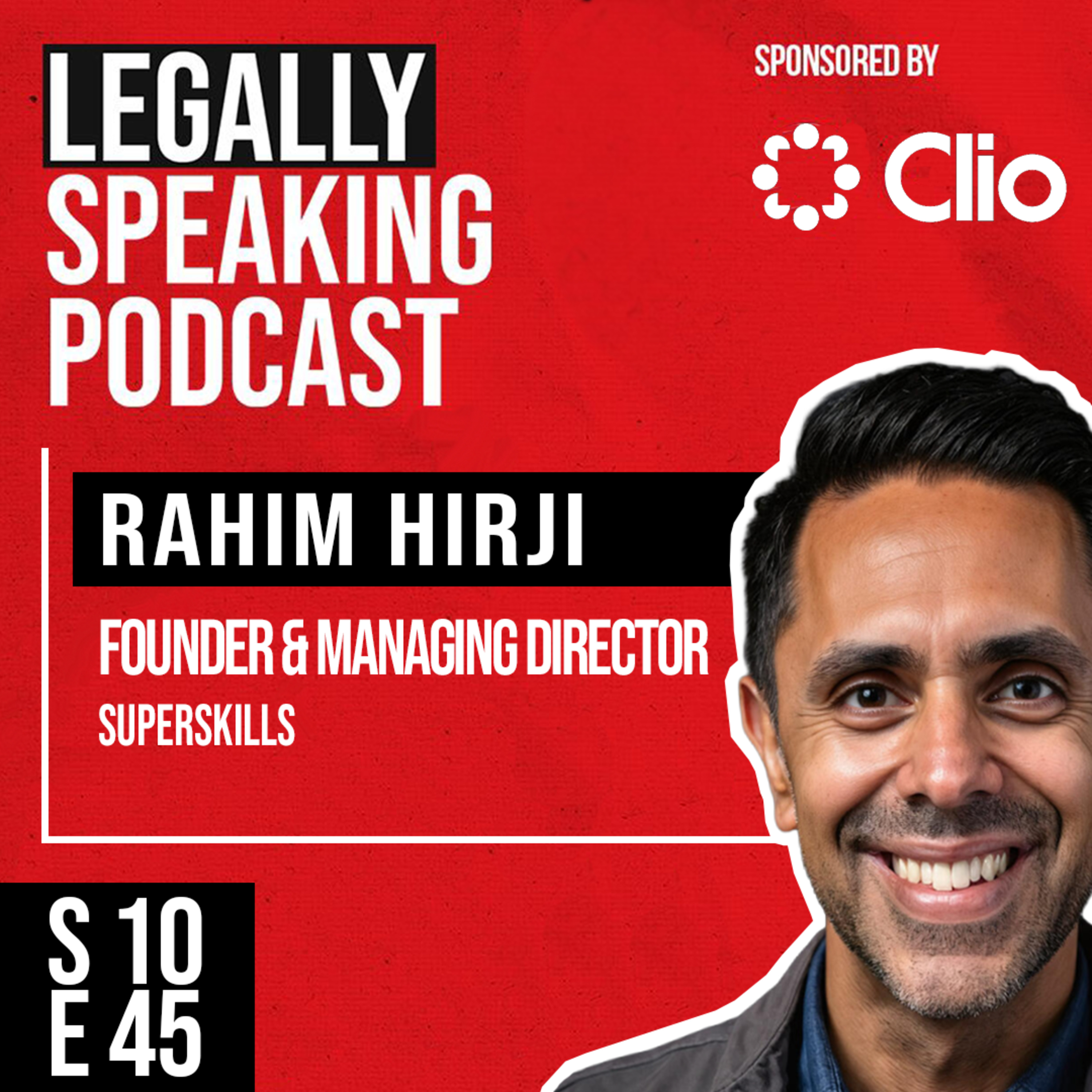
On today’s Legally Speaking Podcast, sponsored by Clio, I’m delighted to be joined by Rahim Hirji.
Rahim is the author of ‘SuperSkills: The Seven Human Skills for the Age of AI’, a keynote speaker and advisor on AI, work and human judgment. Having spent more than 20 years building education technology, he founded EtonX and led international growth at Quizlet across more than 60 countries. His research has spanned more than 200 organisations across 30+ countries. Rahim has experience working with professional services firms, including law firms, exploring what AI means for the future of work and the human skills AI cannot replace. Rahim has a unique perspective on what AI means for the future of work with this concept, ‘drift or design’. Today, we are talking about AI, the future of legal careers, and the 7 SuperSkills professionals will need to thrive in the age of AI.
So why should you be listening in?
You can hear Rob and Rahim discussing:
- Shifting From AI Automation To Human Judgment
- Recognising the Difference Between Drifting with AI and Designing a More Intentional Future
- Protecting Junior Legal Careers By Preserving Practical Learning
- Discovering and Developing the Seven SuperSkills
- Building AI-Ready Law Firms with Intelligent Technology and Human Expertise.
Connect with Rahim Hirji here - https://uk.linkedin.com/in/rahimhirji