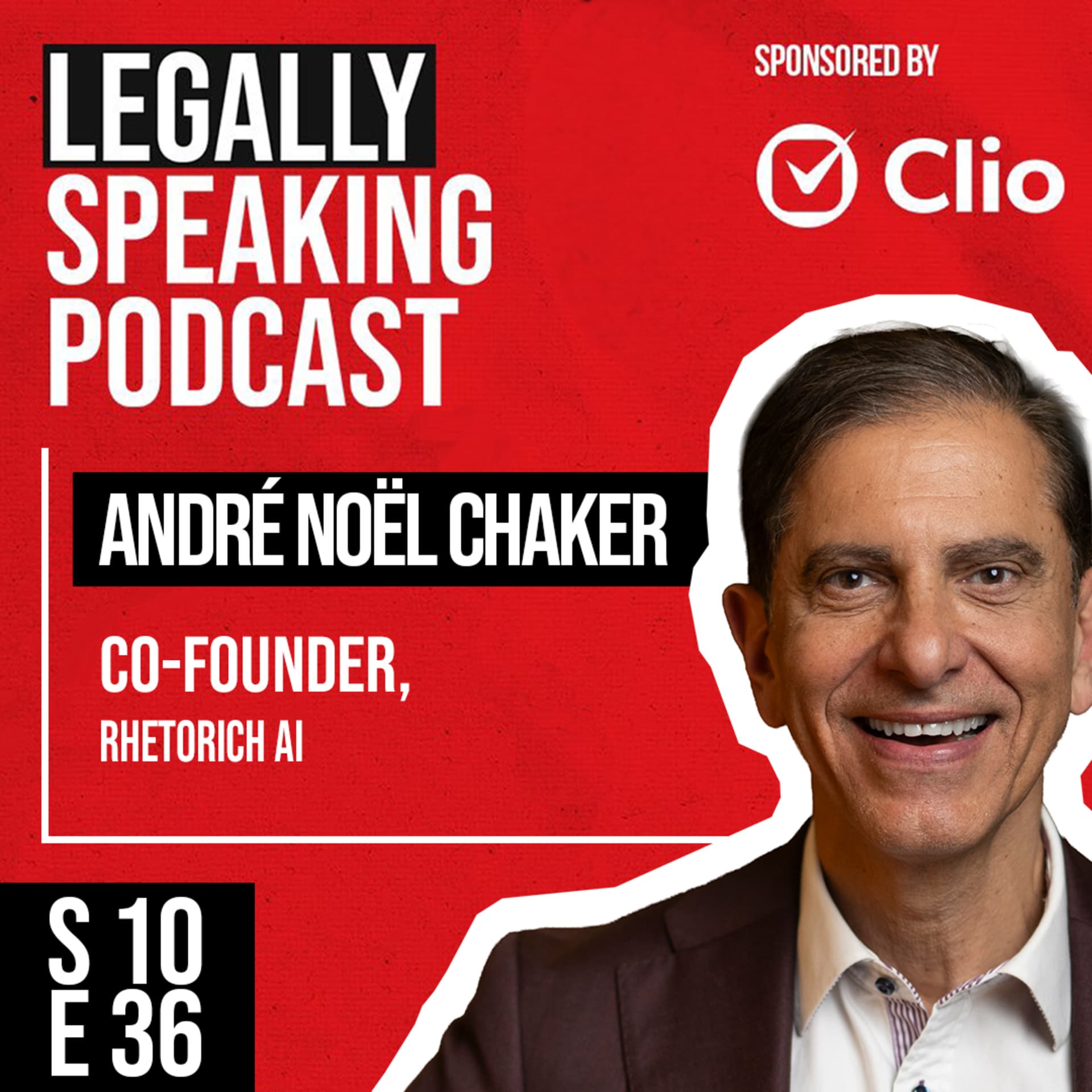

In short
Storytelling and authentic human communication as the key differentiator for lawyers and leaders in the AI age; how AI can improve speaking without erasing authenticity.
Guest
André Noël Chaker (André Noel-Shaka), Canadian-born, based in Finland; former corporate lawyer and executive in global legal services; internationally recognized keynote speaker, author (The Finish Miracle), co-founder of MySpeaker, and creator of Rhetoric AI. Background includes law, business, entrepreneurship, public speaking, and AI-driven communication tools.
Key claims
Impact comes from credibility, likability, perceived authenticity, human presence, and storytelling—not perfection. “Speaking will be the hard currency of the future” because written work is increasingly automated. Trust is a future currency (credibility = competence + character + caring). Leaders must be open-minded, humble, and aligned (words and actions consistent).
Notable examples
Mentions former Canadian Chief Justice Beverly McLaughlin praising AI to improve oral advocacy; uses British common law/case law as story-based persuasion; cites “5 to 20x” impact when facts are packaged as stories.
Written by AI. May contain mistakes. Listen to the episode to check what was said.
Chapters
Tap a time to open that second in VOUnderstanding Authenticity in Communication
0:46 to 2:10
Exploration of authenticity and its importance in communication.
“On today's Legally Speaking podcast sponsored by Clio, I'm delighted to be joined by André Noel-Shaka.”
Icebreaker Questions with André Noël Chaker
2:11 to 2:50
A fun segment engaging André with light questions.
“For the better or for the worse, my favorite beverage is black coffee.”
André's Career Journey from Law to Speaking
2:51 to 4:21
Discussion of André's unique career path and transitions.
“And on your footwear, typically on a workday?”
The Impact of Communication Skills
4:22 to 6:10
Why communication skills are vital for lawyers, especially in the AI age.
“I wanted to go on Wall Street and then the phone rang and I ended up in Finland of all places.”
Entrepreneurship Lessons in Communication
6:11 to 7:15
Insights gained from entrepreneurship about the importance of speaking skills.
“Oh, my Lord, that is the question of my life.”
The Future of Speaking in a Changing Landscape
7:16 to 8:25
How the speaking industry is evolving with technology and AI.
“A lot, not perfection, but actually things like credibility, likability, the perception of authenticity, persuasion, human presence, storytelling.”
The Power of Storytelling in Law
8:26 to 10:21
Explaining how storytelling can enhance the impact of legal arguments.
“And we need to take a hard look at this skill and how we can now develop this skill going forward, because it'll be at the core, at the epicenter of how we make a difference as lawyers going forward.”
The Power of Storytelling in Law
14:00 to 18:53
Discover how storytelling enhances communication and impact in the legal field.
“So when you are able to embrace this and use this to your advantage, it's fantastic.”
Authenticity and Leadership in the Age of AI
19:41 to 27:07
Explore what authentic leadership and communication look like in today's AI-driven world.
“Leadership in AI is going to be crucial.”
Storytelling Tips for Lawyers
27:07 to 28:00
Learn practical storytelling tips tailored for legal professionals.
“and they're all foundational in creating that trust that we need to be able to move forward with our partners.”
Show all 16 chapters
Understanding the Four P's of Storytelling
28:00 to 31:00
Learn about the four essential P's that simplify storytelling.
“And you may know the four Ps of marketing.”
The Importance of Reinvention in the Age of AI
31:00 to 32:52
Explore how personal reinvention is crucial for professionals today.
“Now you've openly said, you know, your career is unconventional.”
Advice for Young Professionals in a Changing World
32:52 to 34:21
Discover key strategies for young people to adapt to an AI-driven career landscape.
“I hear stories of a lot of consultancies, law firms that are not hiring.”
Common Mistakes in Communication
34:21 to 36:33
Identify common communication pitfalls and how to improve them effectively.
“I think the core of this conversation has obviously been a lot around communication.”
Future Developments in AI and Leadership
36:33 to 38:21
Gain insights into the future of AI and its impact on leadership and communication.
“Okay, so let's stick with the future then as we look to sort of close today.”
Leaders Who Thrive in AI
38:21 to 38:35
Curiosity and embracing humanity will define successful leaders in AI.
“So if you had to complete it, how would you finish it?”
Transcript
Automatic transcript. May contain errors.0:00This is the gift we wanted to give everyone. Authenticity and perceived authenticity is a question of alignment. Do you talk the talk? When you speak, are all the elements of voice, appearance, and the words you use align in a way that is authentic? Meaning that you don't speak like this today and then act like that tomorrow. There's consistency in your communication. The inquisitive mind has never had an opportunity of being nourished at this level in the history of mankind. The openness and the humility of asking questions, you will get a rich array of answers back. And finding with your own human judgment and creativity will still be very important for our leaders.
0:45Finding new ways, new opportunities has never been more exciting than it is today.
0:51André Noël Chaker:On today's Legally Speaking podcast sponsored by Clio, I'm delighted to be joined by André Noel-Shaka. André is an entrepreneur, internationally recognized keynote speaker and author. He is one of the leading voices on communication, leadership and artificial intelligence. Originally from Canada and now based in Finland, André has built a career spanning law, business, entrepreneurship, public speaking and technology. A former corporate lawyer and executive in the global legal professional services space, Andre has become one of the Nordic region's most sought-after keynote speakers. He is also the co-founder of MySpeaker, a leading speaker agency, and the creator of Rhetoric AI, helping professionals communicate more effectively through AI.
1:36André Noël Chaker:Andre is also the best-selling author of The Finish Miracle, exploring leadership, trust, and culture. Today, we're exploring what it takes to communicate with impacts in the age of AI. We will discuss leadership, entrepreneurship, public speaking, the future of communication, AI, and why authentic human connection is so significant in today's world. So, a very big warm welcome to the show, Angelique. It's great to be here. Thank you for inviting me. I've been waiting for this for weeks already. Oh, it's an absolute pleasure to finally get you on the show. Before we get into all the great stuff you're doing, a couple of icebreaker questions for you.
2:10André Noël Chaker:Firstly, what's your favorite beverage and what is your preferred footwear of choice on a typical workday? For the better or for the worse, my favorite beverage is black coffee. I'm slightly addicted to it. All the advice says that I should stop drinking this stuff. But for some reason, it reminds me of staying up all night at McGill Law School to pass my fourth exam. I hear you. I love this stuff. It works for me. And I don't it doesn't seem to hurt me too much. So yeah, I'm going to continue on drinking a beautiful black, beautiful black coffee every day. Good stuff. And on your footwear, typically on a workday?
2:55I have something that is a bit of a hybrid between a dress shoe and a sneaker shoe. I can show you if you like.
3:02André Noël Chaker:Yeah, show our listeners and watchers. So you see, it's various makers of these shoes, dressy sneakers, if I can call them that. Bugatti is one manufacturer that does this very, very well. I enjoy wearing these. I'm ready to run, but in style. Yeah, love it. Okay, and another quick fire question before we get rocking and rolling. What's one piece of legal tech or everyday technology you now rely on every day that would have seemed unthinkable earlier in your career? Oh my God, the Goro Harvey, these are amazing tools. They've inspired a lot of our work at Retherich. And my God, if we would have had this when I was a young lawyer, oh my God.
3:42I guess everybody says the same thing, but yeah.
3:45André Noël Chaker:Absolutely. Well, why don't we go back to when you were a young lawyer and perhaps give us a short version of your career journey from practicing law in Canada to obviously building a career as an entrepreneur, keynote speaker, leading a communication expert. Talk us through a bit of your journey? Yeah, well, as you are hinting towards, it's an eclectic career. So it's McGill Law School, the national program for French Canadians like myself. It was a great opportunity to immerse ourselves into British Canadian American law. And I became a lawyer in New York State. I'm still a member of the New York Bar.
4:22I wanted to become a lawyer. I wanted to go on Wall Street and then the phone rang and I ended up in Finland of all places. As a young attorney, the reason is this Finnish scientist, a sports science organization, was looking for an executive director and that executive director had to be, well, this was the criteria. Young lawyer, meaning cheap lawyer. This person had to be fluent in French and English and other languages. I spoke four and my native tongue is French and English was beaten into me as a child in Canada. So there I passed that test. And then this person and also needed, of course, be willing to move and immigrate to Finland.
5:18And they had hired a Belgian lawyer, and this Belgian lawyer came to Finland, and she left with her family six months later. And when asked, why did you leave? The answer was, it's too cold in Finland. Okay. So this person needed to be winter resistant. And I claim that the only place in the world you'll find perfectly bilingual young lawyers from a good law school who also is winter resistant. There's only one place in the world, and that is Montreal, Canada, where I come from.
5:52André Noël Chaker:Very well said. Very well said. Okay. So from there, you've gone on to speak to audiences across more than 30 countries. Unbelievable. From your expertise, what separates an average speaker from an individual who really, truly changes the way people think and has your own speaking style evolved over the years? Oh, my Lord, that is the question of my life. You've done your homework, Rob. Thank you. I've been a kid in my life to answer that question. And it starts with a father who is also a lawyer and then turned into a professor of language and literature at McGill, fascinated by the art of rhetoric.
6:35My father was somebody who, if you wanted to impress him, you had to speak well. You had to speak eloquently. In his case, it had to be French eloquence, l 'éloquence. Finding that his school of thought on what is truly impactful when we speak is not speaking perfectly. Perhaps the same fallacy as received pronunciation from your country and many other countries have something similar. And we now know from the evolution of AI and robotics and all the science that we have about speaking in the past 10 years, which is more than what we've had in the past thousand years, is that impact comes from different things.
7:17A lot, not perfection, but actually things like credibility, likability, the perception of authenticity, persuasion, human presence, storytelling. These are the things that drive impact, whether you're in the courtroom, or in the boardroom, or at home with your children. These are the things that make humans have a change of heart, a change of mind, and perhaps if you're lucky, a change of course of action.
7:49André Noël Chaker:And that's why we're so keen to have the conversation because going on from that, communication is such an important leadership skill. And it's often described as a soft skill, yet it underpins a lot of success of leaders. So why do you believe communication is one of the hardest and most valuable skills to master? I think that is such a misnomer to call this skill a soft skill, as you hinted toward that. I think that speaking will be the hard currency of the future. It'll be the hard currency of lawyers going forward. It'll actually be the only thing that differentiates us from AI, at least for the foreseeable future.
8:27And we need to take a hard look at this skill and how we can now develop this skill going forward, because it'll be at the core, at the epicenter of how we make a difference as lawyers going forward. Because a lot of our written work has now been automated, maybe not our thinking work completely, but definitely our written work. And we need to shift our energy towards becoming better humans, better spoken word professionals, because our written work has now been not taken away from us, but enhanced greatly. And we should be grateful for this. And we should be grateful for the opportunity of investing that time that we're saving into becoming better humans, better speakers, better communicators, because that's where we're going to add value into the society going forward.
9:17André Noël Chaker:Let's talk about speakers then, because you founded and built successful businesses, including my speaker. So what has entrepreneurship and business ownership taught you that no corporate career could have? One is that speaking is critical. It's crazy. But and still in our countries here in the Nordics, where I now move to, I could not believe that I have an LLB and a BC. I have all these law degrees and I'm a member of the New York bar. but I did my MBA. I wanted to deep dive into business. I did my MBA here in Finland, believe it or not, in finance at the time. And I was surprised that we had the token communication class.
10:01And now, believe it or not, they cut this class from the bachelor's program here. I cannot believe how we are disinvesting in a skill that will be critical for the future of our young students. I even went on a podcast, a colleague of yours at Legal Week. They asked me, shouldn't we give something like Rhetorich AI, which is a platform that helps young lawyers and lawyers in general become more impactful when they speak. Shouldn't we give this for free in law schools? And I said, I definitely will. And I made a public promise that the day Rhetorich AI hits a billion in valuation, we're going to give this for free into law schools.
10:41So how critical It is to take the written work, the written word and deliver it as something valuable in a verbal format is something that has been so underestimated in our in our education that still is. And we need to change course quite rapidly on that.
10:59André Noël Chaker:Yeah, because looking forward then with the future of public speaking, I talk very much about personal brand raising and getting on stages and going on podcasts and various other things. But one thing is happening, as we're seeing, is everything is changing, right? So the speaking industry has changed a lot over the last decade as well. With virtual events, hybrid conferences, AI-generated now content transforming expectations, how do you see that professional speaking evolving over the coming years? And particularly if you're in a leadership position or law firm partner or going out there and presenting, what do you see looking forward to given the world we live today?
11:35Well, I definitely see a boost in quality. I was speaking to our former Chief Justice of the Supreme Court of Canada. Her name is Beverly McLaughlin, and I'm probably not well known to your audience, but she's a legend in Canada. Canada. And believe it or not, she took a call from me on this question. And then she said, you know, Andre, I don't know much about AI, but I know that the oral advocacy of most colleagues has been so inferior to their written work over the years. I really hope that your little engine is going to help them get better, right? So I believe that AI injected into our speaking acumen will make us more impactful and better speakers across the board.
12:25I think our average speakers will become good, and our good speakers will become great at a faster rate, which will make it great for us. We're going to get a – we were training our speakers here at MySpeaker to become even better than what they are. But I think that the bar will just rise higher and higher and higher and higher. And therefore, audiences will be more inspired. They will get more insights. They will get what you want from a speaker is two things. So insight and inspiration, all the two eyes of the industry. So I want to get insights. I'm going to learn something I don't know and that you can open my eyes to something that is valuable coming into my life soon.
13:08And then you can inspire me, motivate me, play with the emotional threads inside of me that will make me want it more and have more energy and have maybe even the mindfulness to continue to pursue the objectives and dreams that I have.
13:27André Noël Chaker:And that's to your point about why being good at storytelling is so good at that. I remember when a mentor said to me very early on, Rob, yeah, the facts will tell, but it's the stories that will sell. They'll get people engaged, inspired and learn. The data on storytelling is so telling. Yeah, literally. We're talking five to 20x in terms of impact. And when I speak of impact, I say when a lawyer speaks in facts and theory or when a lawyer speaks in story and case examples. And from that perspective, British common law is fantastic from that perspective. Case law is a set of stories, isn't it?
14:06So when you are able to embrace this and use this to your advantage, it's fantastic. But we're talking in the science that measures impact. So impact defined by what people will understand, what they will on top of that remember, and on top of that believe. We're talking 5 to 20x more impact when you package your facts into a story format versus a list of facts and data right think about that it's not a minor issue it's not like a nice to have entertaining layer on communication it's whether people will actually believe you or not it depends on your ability of embedding those facts and figures into a story that is such a huge skill and we've developed the tools the algorithm of storytelling on rhetoric with tools that help people become better storytellers, help lawyers and associates especially who are quite timid in this regard to become more powerful in their storytelling.
15:08Yeah.
15:08André Noël Chaker:So let's go deeper then on Red Ridge AI because it's a wonderful platform. But for folks that might be new to it, I know you've been touching on it there, but just explain exactly what it is that you do, what inspired you to develop the platform and how can these professionals use AI to become better communicators without, very important point, losing that authenticity piece. That is so important. Look, for me, it's a life's work. My father was a passionate professor of language and rhetoric, and I became a lawyer because I wanted to be in court. I wanted to win cases. And I saw that the ability of speaking drove me to places that I never thought I could achieve and attain.
15:49I also saw that this gift of speaking was not equally distributed in the profession. So I wanted to help. It's in my nature. I wanted to help. But then I left the law to enter the world of technology as a CEO of a few technology companies using, of course, my legal background, but then going deep into the tech industry and led successful technology companies that were then bought by other companies. But I just fell in love with the tech. I fell in love with the law at one point and still am very much a lover of the law. And then I have this background in communications and rhetoric. So it all came full circle for me to bring technology to the world of verbal communication impact.
16:39And this is the gift we wanted to give everyone, that this will be the biggest gift that we can give to people in the age of AIs. How do we make them better humans, augmenting their ability to have an impact when they speak? And we started five years ago in a lab with a great company called Silo AI. They were bought by AMD, bought for$600 million a couple of years ago. Just a tremendous team of AI voice, AI audio. We had a great team of people that brought in the best possible knowledge on creating a platform that will make humans more impactful when they speak. And then we found that my old profession were the ones who were buying this the most from us.
17:27right wow uh they are already and they say hey we need this for all the associates in the firm we have like these these great law firms in the nordics that just kept on buying this and we saw that yeah well this is something that they can use immediately and actually why don't we create workflows work tools that will help them the same way lagora and harvey are helping you for your written work and your written use cases we have all these verbal use cases that we can use readily for professionals in the legal profession to make themselves better in the courtroom, better in negotiations, more effective in depositions, even more effective in consultations.
18:08And then you can do role play with our agents that will prepare you to be at your very best when that occurs. And of course, not speaking of things that are not legal specific, which are so critical nowadays, especially in the age of AI, when you're talking about an RFP and business development? How do you win these cases? How do you sell yourself as a lawyer? It's a handicap for us. Many of us don't know how to sell ourselves well enough. We believe that we are experts and selling doesn't feel that natural. But if you practice it and find your own way of doing it, AI and Rhetorich AI can help you become a better spokesperson for yourself and for your firm and a better salesperson, business development person for your firm.
18:53André Noël Chaker:Today's episode is brought to you by Clio. If you're spending more time managing your practice than practicing law, it's time for a change. Clio is the intelligent legal work platform built for modern solicitors, combining context-aware AI with trusted legal research to help you work smarter, not harder. Switching is easier than you might think. Clio's dedicated migration teams handle your client and case data every step of the way, so you can focus on what matters most, your clients. Plus, award-winning support 24-5 via live chat, phone, and email means help is always on hand when you need it.
19:34André Noël Chaker:Visit clio.com forward slash UK to find out why thousands of UK solicitors trust Clio. Now back to the show. Leadership in AI is going to be crucial. So leaders of today are facing constant disruption. So from your perspective, what qualities define exceptional leadership looking forwards? An open mind, definitely. The age of dogma is behind us. The inquisitive mind has never had an opportunity of being nourished at this level in the history of mankind. So if you have the openness and the humility of asking questions, you will get a rich array of answers back and finding with your own human judgment and creativity, which will still be very important for our leaders, finding new ways, new opportunities has never been more exciting, let's say, than it is today.
20:32I think these are the things that are going to distinguish our successful leaders from those who will just muddle through the AI age.
20:39André Noël Chaker:So let's bring the two together then. We've talked a little bit about these, but what does then authentic leadership and communication look like in practice? In practice, it doesn't look very authentic when you're reading a ready-made statement and you're publishing fairly sterile press releases about what you're doing. But when you are able to present yourself in a way that many people on this podcast have been, very transparent, also showing some vulnerability, also admitting things like, I don't know. And taking responsibility for that. That is, I think, key. And also a certain level of alignment.
21:25Authenticity and perceived authenticity is a question of alignment. Do you talk the talk? And then when you speak, are all the elements of voice, appearance, and the words you use align in a way that is authentic, meaning that you don't speak like this today and then act like that tomorrow and that there's consistency in your communication and in the way you behave. That's going to be important. That can also be rehearsed because sometimes we do it and we would like to be authentic, but we don't come across as authentic. by using this kind of language with this kind of nonverbal communication style might be more aligned with who you truly are.
22:13And you don't just realize it right now. So, oh, well, thank you. And then you can rehearse that.
22:18André Noël Chaker:And I think the other key point to sort of mention here as well is that the words are great, but they have to be matched by the actions, particularly with leadership as well. Because if you're saying all the right things and then the actions are different, then that trust will obviously go down. I want to move away now from the spoken word to the written word, because Your book, The Finnish Miracle, explores what makes Finland consistently perform so well internationally. I thought it was really interesting. So what leadership lessons do you think the rest of the world could learn from Finland?
22:47Wow, there are so many things. One is listening. Finns have a great word. It's called puhenvooro. It means that you have your turn to speak, which infers that it's the other's turn to listen. Could you say it again?
23:05André Noël Chaker:How do you pronounce that, sorry? The word? So it's a turn to speak. I want to practice that word. Everybody has a turn, and we have to respect the turn of others, which means we listen and we don't just try to talk aggressively against them or interrupt them. Finns will never interrupt each other when they speak. there's something sacred about the spoken word i mean we're talking about the written word but but this this spoken word i think is one beautiful part of of finnish culture is that it feels very silent and quiet but it's it's one where people are extremely well educated finish finish education is is one of the best in the world they're smart they they but they listen in in ways that i've never experienced anywhere else in the world.
Read the full transcript
24:01And I've learned this. I used to just want to be in our profession as well. You know, you, you, you, especially in New York city where, where, where I was a lawyer for a while. It's a very aggressive speaking culture, right? But, but there's so much to be gained in listening, learning, and then speaking. Then you, what comes out of your mouth usually is of higher quality.
24:24André Noël Chaker:yeah and it got drilled into me very early on with my first boss i think it was two ears one mouth rob use them in that proportion and if you can get around that i think you'll sound like the finished person well i think i've still got work to do but i love that and thank you for sharing that and that's the beautiful thing about having these conversations one thing i've touched on but i want to get your thoughts on this now is is trust because the theme of trust appears throughout the great work that you're doing. So why has trust become one of the most valuable currencies in both business but also leadership?
24:57Digitalization has created an opportunity to break human trust at a scale that is frightening. It polarizes our societies, it creates cybersecurity risks, you don't know who to trust in the digital age as much. And therefore, when trust is massively under attack, the value of trust just skyrockets. And I believe that that will be the currency of the future as well. And of course, coming back to my speaking argument is that I think that when you speak, you are able to create this. When you get written emails and posts on social media that are written, you can say, well, where is this coming from?
25:52Are these people real? But I can guarantee you that I am not an AI robot. I'm a human being talking to you, Rob, and I believe that we will still trust this interaction more than any other. And therefore, placing a premium on trust is so important. We see this when we measure people's impact. We measure credibility. And credibility is not only competence. Credibility is two other Cs, your character and your caring. These are the things that are part of the algorithm of credibility and trust. So not only are you able and competent, but you are also somebody that I can trust that has the character that I perceive as being trustworthy.
26:46And therefore I will give you my business because I trust you. And then the third one, the caring part is that I see that this is important to you. This is, there's a bigger purpose there for you. and makes me attached to you as another human being. These three Cs of credibility are important and they're all foundational in creating that trust that we need to be able to move forward with our partners.
27:15André Noël Chaker:Thank you for being so clear and giving some rich thoughts around that. And you're right, aren't you? Those other two Cs are so, so important. One thing that we've talked about, but I want to maybe give our listeners a practical tip, is storytelling because you're known for obviously using storytelling to ultimately simplify a lot of complex ideas i talk very openly in a lot of talks i give that say complexity fails simplicity scales kind of as a you know a simple simple mantra what would be one top tip again to our watchers listeners for lawyers people in the legal world for becoming a good storyteller what would be a sort of practical tip for them ah i i want to give it to you in the most simplistic way simplistic way as possible.
27:57We came up with this model at Rhetorich that is a cousin to another discipline, which is the discipline of marketing. And you may know the four Ps of marketing. Do you know the four Ps of marketing?
28:11André Noël Chaker:I do, but tell our listeners. All right. So it's about having a product at a certain price in a place, in a marketplace, and to which you attach some kind promotion. Marketing. In a nutshell, it made marketing simple. Well, we came up with the four P's of storytelling to make storytelling simple. Because people don't know what a story is. And when you ask them, tell me a story. I don't have any stories. Yes, actually you do. But you need to understand what a story is. What are the foundational parts and elements of a story? And to make it easier, we broke it down to four Ps. Are you ready? So the first P is critical.
28:57It's people. At the heart of stories is our humanity, other people. This is why advertising is full of people, other people. We identify with other people. It's the story of somebody, not something, not a theme, not an article in a newspaper, not a number, not a person. You can attach personality to certain elements that are not people, people. But generally speaking, our minds are triggered by people that are facing a problem, something to be solved. The problem is the engine of a story. There's no problem. There's no story. It's not important. We don't care. But, you know, and then you ask people, you know, do you have a story?
29:44No, I have no story to tell. Do you have problems? Yeah, I have a lot of problems. Yeah, tell me your problems. Wow, then you have 100 stories already. So the engine of a story is the problem to which you can find a solution that will then be played out in the course of a plot. You know, whether the timeline, the conditions, the time and place elements that are full of surprises and twists and turns and the plot. But then fundamentally, the purpose. Why are you telling me this? You know, it can be very interesting, but does it serve a purpose? I'm telling you this because you asked me that you needed a good toolkit for storytelling.
30:31So there's a purpose to my story. But these four Ps are the essence of storytelling. We were happy to extract them. And it's the model through which we teach storytelling to our corporate customers and to our lawyers and to their partners. is to make sure that you have in each one of these P categories, good content that fits together, then it'll be impactful. Otherwise, it'll be a weak story or not a story at all.
30:59André Noël Chaker:Love that framework. And I love the purpose bit at the end. It's sort of the so what, isn't it? It's like, you know, what is that? Yeah, yeah. The so what of storytelling. Exactly. Yes. Personal reinvention. Now you've openly said, you know, your career is unconventional. It's taken from lawyer, executive, entrepreneur, speaker, tech founder. How important is reinvention in today's professional world, particularly in the way of AI? I think it's critical. I think that people have the tools to reinvent themselves if they want to. That being said, I have colleagues who have been in the same silo for the past 20 years.
31:34They're very happy there. They became judges of the court of appeals. They're great. I mean, they've done really well in their own and that's fine. But even in that siloing sector, they've innovated and learned and so on. I mean, it's a question of personality and character as well, of course. I've always wanted to go out of the law into business. My father was a lawyer. My mother, they were Italian merchants in little Italy and in Montreal. I was fascinated by the world of law and the world of business. I wanted to combine them. It's a character origin story thing. So I wanted to reinvent myself in using these two backgrounds.
32:15I think that it's good for human beings. Even my father, a consummate educator at the end of his life said, you know, you shouldn't do the same thing for more than 10 years in your life. Otherwise, you lose the flame. Probably good advice.
32:28André Noël Chaker:Just as I sat here, there's things going through my mind with that advice, sort of 10 years on in certain projects and things thinking that that is very sage advice right there. Okay, we've talked a lot about looking forwards. We've talked a lot about sort of people in the now. We like to give a lot of giving back to the next generation advice. So young professionals entering a career which looked very different probably just a few years ago now given the AI revolution we're in. What advice would you give to a young student trying to build and future-proof a career? embrace ai with passion embrace it in a fun way embrace it in a in a way to multiply yourself i the the young people who are hiring here they're saying yeah well you're not just hiring me you're you're hiring like 12 agents that i've just coded and that's that's fantastic the same curiosity at open-mindedness that we talked about for our leaders i think has has to be there uh maybe at a at a multiple for our younger workforce.
33:29I hear stories of a lot of consultancies, law firms that are not hiring. And I think it's a big mistake because we're going to need leaders in the future. But I think that our young people need the response to take responsibility for embracing AI tools, to teach us something about AI that we still don't know. Experiment with it, multiply yourself. And as I said, we need a transformation of our educational system. Our universities are not preparing our young people the way they should be prepared. They're more fearful of AI and they're more concerned about plagiarism than just giving tools to our young people to make them the most valuable version of themselves using AI tools that will make them irresistible to hire.
34:18And then that's what we need to do.
34:21André Noël Chaker:Well said. I think the core of this conversation has obviously been a lot around communication. You know, a lot of things break down because of poor communications. A lot of things go well because of good communication. So after you coaching thousands of leaders, what are some of the most common mistakes you see for people that might land again with some of the people watching and listening with this that they could work on? And how can they work on this? A couple of things. One is prepare. There. This is something that has been the key driver of our profession is our written work. And we invest so much time in writing these great briefs and all these procedures within such stellar work on the written side.
35:01And then your day in court comes, oh, I'm going to wing it. right this is the same for our executives and they put so much time and in like it's a it's 170 slides on this new project this new pitch and then and then all of the written work and the the research is done and then the day before oh it's tomorrow uh i'll wing it right don't wing it prepare prepare improvise this is the slogan prepare prepare then improvise and then you will win that case. You will render justice to the written and research work that you have done. It's complete madness how little our people prepare for a verbal delivery of their written work in all industries, including the legal industry.
35:51That is definitely one. The other is the paucity of stories, shying away from story, feeling that if I tell a story, I don't sound as credible. But again, we're talking 5 to 20x more impact when you do use stories in an appropriate way. You have to be sensitive to your industry. But by finding a new way of including narratives in what you're doing, you will capture the imagination. You will make people remember you, trust you, do business with you, decide in your favor. You have to embrace a narrative structure to what you're saying, or at least to a greater degree, if you want to be successful in the future.
36:38André Noël Chaker:Okay, so let's stick with the future then as we look to sort of close today. What developments do you see in AI, leadership, communication, that individuals should be paying more attention to? There's so much on the horizon. I think that we will see the day where, good or bad, we will be confronted to the age of physical AI, which is the big growth right now. What physical AI may mean is that it may be intrusive into our body, into our ears, into our brains into our eyeglasses. This is scary, but when you look at how poorly we've done in terms of leadership, the leadership industry has sucked up tens of billions of dollars and pounds over the years and still our leaders are more miserable than ever.
37:36The working cultures are not doing much better. We haven't been very good at training our leaders. What if through some intrusive mechanism, whether it's a leadership coach in your glasses or in your ear saying, you know, maybe you should say this to this person right now, you know, sort of a full on, on the body, physical, a touch more intrusive direction to how I can become a better leader lawyer going forward might be where we're going and it shouldn't scare us too much.
38:13André Noël Chaker:Love it. Yeah, I love that confidence in sort of embracing this next wave of what's coming. Okay, final piece of advice. You have to finish this sentence. So if you had to complete it, how would you finish it? The leaders who thrive in the age of artificial intelligence will be those who are curious and embrace their humanity at a level that we've never seen before. Oh, that's lovely. That's definitely going to be one of our graphics, one of the quotes for the episode, I'm sure. Anjole, this has been an absolute masterclass. Really enjoyed today's discussion. It's just easy to say thanks so much once again for joining us on the Legally Speaking podcast.
38:52André Noël Chaker:It's been an absolute blast. Hopeful for more collaborations in the future, but for now, from all of us, over and out. Thank you for listening to this week's episode. If you like the content here, why not check out our world leading content and collaboration of the Legally Speaking Club over on Discord. Go to our website, www.legallyspeakingpodcast.com. There's a link to join our community there. Over and out.
From the publisher
The biggest gift that we can give to people in the age of AI is how do we make them better humans.” - André Noël Chaker
On today’s episode, I’m delighted to be speaking to Andre Noël Chaker.
Andre is an entrepreneur, internationally recognised keynote speaker, author and communication expert who brings together law, business, technology and leadership. Originally from Canada and now based in Finland, his career has spanned corporate law, executive leadership, entrepreneurship and professional speaking. As co-founder of MySpeaker and creator of Rhetorich AI, Andre is passionate about helping professionals communicate with greater impact while preserving authenticity and human connection. His work explores how AI can enhance communication, storytelling and leadership, while emphasising that curiosity, trust, credibility and authentic human interaction will remain essential in an increasingly AI-driven world.
So why should you be listening in?
You can hear Rob and Andre discussing:
- Communication Becoming the Hard Currency
- AI Amplifying Human Communication Skills
- Authenticity Depending on Consistent Alignment
- Storytelling Making Complex Ideas Memorable
- Curiosity Driving Exceptional Future Leadership
Connect with André Noël Chaker here - https://fi.linkedin.com/in/andr%C3%A9-no%C3%ABl-chaker-b50a883