

 Legally Speaking Podcast
26 Oct 2026 · 49m

 Add vo to ChatGPT or Claude to ask about everything you hear
vo listened to this episode to put together the overview and transcript, so there may be the odd mistake.
Quentin Solt argues AI will make legal “intelligence” cheap and immediate, triggering a “consumption paradox”: more people consume legal services while fewer lawyers are needed. He claims the traditional law-firm pyramid is unsustainable as juniors’ work becomes automated, leaving seniors to operate more like sole practitioners. He also proposes “good enough” legal outputs (reliable, fast, safe for the client’s decision) rather than perfect senior-partner judgment, and predicts legal work shifts toward ongoing “living contract” renegotiation instead of one-time risk drafting. He challenges the billable hour due to reverse incentives and suggests lawyers’ future value is client-relationship judgment and trusted advisory presence through transactions.
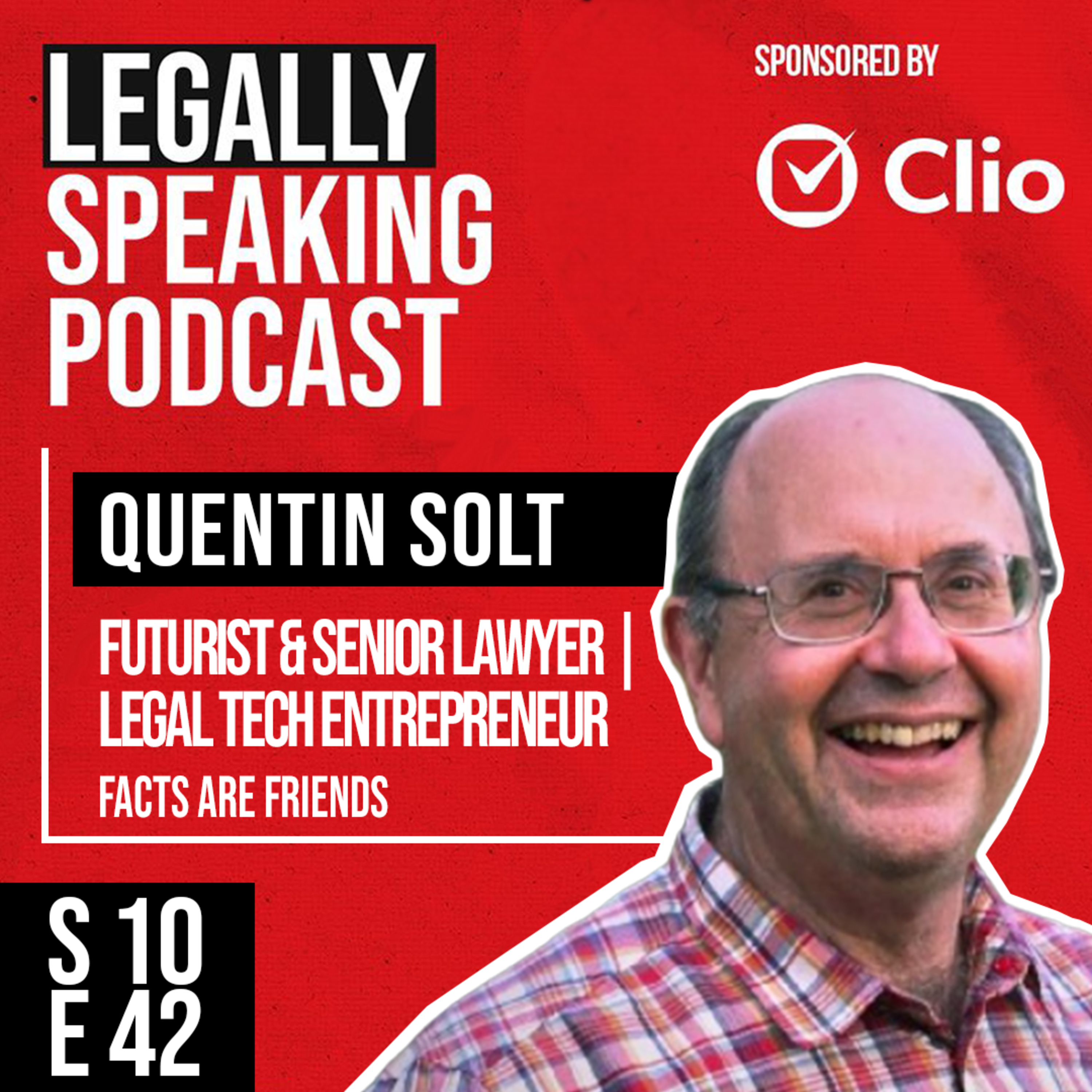
Quentin Solt, senior lawyer (40+ years) in corporate finance/M&A/tech-led businesses; co-founder of a pan-European VC fund; legal tech/AI/ethics/compliance advisor; author exploring “Facts Are Friends” and “consumption paradox.”
AI comparisons on a £6.5m revolving credit facility (Harvey vs others; “Fable” matched best results and produced redlines accepted after 10 days). Living-contract analogy using Apple/Gorilla Glass/Nvidia supplier shortfall trust.
0:00Clare Smith: You introduced me to a human who knows more than the internet knows, and I'm going to be fascinated. The reality is the client has a demand. They want an answer. Imagine going to a lawyer now. Firstly, you have to decide and frame what the question is. Then you need to go to the lawyer and ask the question. And you go through an entire engagement process if you're not already engaged, and that's painful. When I challenge lawyers by saying this profession is not going to exist, their responses always are, but we exercise judgment. And I say, OK, what is judgment?
0:38Quentin Solt: On today's Legally Speaking podcast sponsored by Clio, I'm joined by Quentin Salt. Quentin is a senior lawyer with more than four decades of experience across corporate finance, M &A and technology led businesses. He is also the co-founder of a pan-European venture capital fund and has been investing in technology for more than 25 years. Quentin is currently exploring the biggest questions facing the legal profession through his writing, Facts Are Friends. He is a strategic advisor on legal tech, AI, ethics and compliance. Quentin has developed the idea of the consumption paradox. AI makes law cheaper to deliver while simultaneously destroying the demand that pays for it.
1:17Quentin Solt: Today, we're going to explore the future of legal practice, the value of legal training, the collapse of the traditional law firm pyramid, and whether AI could help us move from working to live to living to work.
1:27Clare Smith: So a very big warm welcome to the show, Quentin. Thank you. And thank you for inviting me.
1:32Quentin Solt: It's an absolute pleasure to have you on the show. I know we've got mutual friends in and around the world of law, including the likes of Sean Jardine, who's featured on the show. Before we get into your journey and story, a couple of quick fire icebreaker questions for you. Firstly, what's your favourite beverage and what's your preferred choice of footwear on a typical work day?
1:50Clare Smith: I'm really boring. I don't drink and I probably go for a lemonade and lime. And my favourite footwear is really easy to answer, my Crocs. I've even got a pair of City Crocs, which are the same sort of things, but they're black.
2:05Quentin Solt: I like it. Actually, you'll be surprised. We've had a few folks that have said Crocs in recent episodes. Okay, one piece of legal technology or everyday technology you now rely on, which would have seemed unthinkable at the start of your career?
2:18Clare Smith: Oh, a keyboard. And when I started, we were still writing everything down. But that probably aids me. I'm a dinosaur.
2:28Quentin Solt: Not at all. You've got a lot of wisdom to share. So let's get into your journey and story, Quentin. Could you give us a short version of that journey from your beginning, I guess, career in law at Pinson Masons in Birmingham to investing in technology and indeed sort of business?
2:42Clare Smith: Absolutely. I started at Pinson's where I trained on qualification. They had this weird policy of not inviting you to join a seat until you'd been in for three months. And my last seat was corporate and I wanted to go into corporate. And I've been offered seats everywhere else, but they were waiting for that three months to expire. and I got itchy feet and I ended up going into London. I joined Bowen Layton, had an absolute ball there and it was an amazing firm. At one stage our insolvency team was headed to hunt it out and I was pulled in there so I ended up in charge of this insolvency group which was hysterical because I was a junior recruiting people who were far more senior and sophisticated and experienced than me and after I'd done that for three or four years I went back to my senior partner and said I've done this now and I was now a junior partner and I want to go back into corporate.
3:34Clare Smith: He said, what do you want to do? I said, corporate. And I didn't understand the question. And then it came out, what do you really want to do? And I had a friend who was working at McKinsey and he told me about this intraweb, intranot thing, which was really exciting. And so I got involved with the Internet at that point. And in the mid 90s, I went out to spend a couple of years with the ABA, the American Bar Association, sponsored by my firm, just going backwards and forwards from the UK. And I set up the first UK focused technology investment group in a city law firm headed out of corporate.
4:09Clare Smith: At that time, everything was headed out of commercial because it was all seen as techie stuff. Anyway, long story, I set up a small business, which we originally called Be Legal, which was hosted on an ASP, an application service provider. You and I would now recognize that as SAS. And we called it an expert system. It was the very earliest bits of the algorithms which acquire intelligence. And that leads to today's AI. We developed a suite for the employment lawyers. And in conscience, the employment lawyers told me they couldn't use it because they could do it this quickly and this cheaply. They couldn't justify the fees they were charging.
4:50Clare Smith: We teamed up with the wonderful Richard Punt and his team from Deloitte and changed from being be legal to be professional. And we sold quite a lot of rather large businesses. And then Sarbanes-Oxley hit, which you may remember, Sarbanes-Oxley must have been brought in in 98, 99. And that in effect said to Deloitte, either you keep these as audit clients, or you can service them through your joint venture company.
5:19Quentin Solt: Well, the audit was
5:20Clare Smith: always going to win. And there was quite a long football match between Deloitte and Permanente and Paisner, as it was then, during which I was kicked from side to side, one saying we're worth a lot, the other saying we're worth nothing unless you're out of the room. And eventually I got bored and left to set up my own thing. I didn't know what I was going to do. I signed a non-compete and set up a small venture fund and took one of the early stage technologies, which I found, which was intelligent agent. And we put that into the fund which we listed on the stock exchange. And we sold out from that earlier this year.
5:54Clare Smith: 26 years later, we did quite well on that. It was a really good journey. Then one of my erstwhile clients came back and said, Quentin, can you help me? He said, no, I've signed a non-compete. He spoke with the firm who very graciously let me off everything. They paid me a fortune to not compete. And then they said I could. and I set up on my own, ran that for a bit, did a couple of techie deals. I set up Shazam. Do you remember the music app?
6:16Quentin Solt: Yes, yes. Still use it today.
6:17Clare Smith: I was involved in setting up the legals on that. A couple of other businesses some people have heard of. And one stage I got involved with a U.S. business and we dealt with Pillsbury, Winthrop Shaw, Pittman and the partner on the other side graciously flew over and wanted to meet me and took me out for lunch and asked if I had joined them, which was very flattering, but I thanked them and declined. But I did go and sit in their office for two or three years doing some legal tech for them, which is kind of interesting. And then I came across a US-based, Silicon Valley-based memory chip company.
6:56Clare Smith: And I joined the board of that. We floated on the junior exchange here on AIM, and four or five years later took that to NASDAQ. And I jumped off the board at that stage. I didn't want to have the regulation of the US industry. I carried on running my own private firm, sold that to a West End practice, and then set up another business which was involved in investments and helping people to invest. That was quite fun. And then I carried on giving legal advice or commercial advice. And having sold my firm, the reason for selling it was to escape the shackles of the SRA and the insurance policies.
7:36Clare Smith: So from there on out, I just gave advice in the personal capacity. And there's a huge amount you can do without having to be regulated. My clients accept that.
7:47Quentin Solt: I think for our listeners, just hearing that, you can see why we were so excited to have Quentin on the show, just in terms of his entrepreneurial flair, his interest in technology, your legal acumen and everything else. So, you know, you touched on there back early, early, you know, you've been interested in AI and tech for much longer than most lawyers. When did you first realize technology was really going to change the tools lawyers use and the trajectory ultimately of the legal profession?
8:12Clare Smith: When I was doing my training contract with Pinson's, there was one of the secretaries who ran from floor to floor carrying a big floppy disk. And these things were a total misnomer because they weren't floppy at all. I realized that she was carrying entire documents around with her. And it was a lot of fun to or fun's the wrong word. I realized then that there was something which was so much faster about being able to replicate at speed into access. And, you know, I mentioned about having been involved in the insolvency group at Bowen Layton.
8:46Quentin Solt: Yes.
8:47Clare Smith: I was one of the first who demanded a laptop. And it was tremendous because I would take my laptop with a large screen to the client office when I was acting for the liquidator or the administrator. And we would literally sit there and type the contract as the clients were talking. and so the guy buying would say oh yeah i'll buy this and i accept whatever it was he wanted to accept and i literally typed his words in and they appeared on the screen and you could see my counterpart his lawyer say oh yeah well he doesn't actually mean that i'm sorry didn't he say that and then the liquidator would look and say guys time's clicking you know how long do you
9:24Quentin Solt: want to be here and we moved on and so we're literally able to do the deal then and there
9:30Clare Smith: And the hardest bit was getting the dot matrix printer to print out.
9:35Quentin Solt: I can imagine that.
9:37Clare Smith: And I think it was that that led me on to this idea of the Be Legal, the idea that we could do the professional services. Now, bear in mind, I was at Bowen-Layton, and it was a good Jewish firm. I'm not Jewish, but the firm was. And I remember on one occasion I was invited to Birmingham to the Law Society Conference, whatever it was. And there was a plenary session. And I stood there and said, look, if this is how much work we do, click, this much is of value. There I am on the front page of the Law Cite Gazette, giving a Hitler style salute with my fingers just visible underneath.
10:18Quentin Solt: Oh, wow. Wow, wow, wow. Well, let's build on your career because you've also become a very popular commentator on where sort of legal practice is heading. what inspired you to start writing and thinking publicly about the future of law?
10:33Clare Smith: So this is a really roundabout way. I was sitting in church with my men's breakfast group and we were talking about the future of society. And this is in 2022, I think. And I said, you know, of course, we're going to have societal unrest and we're going to have mass redundancy and people just don't see what's coming. and most of the guys stood there and or sat there around the bacon butties and nodded sagely and I thought this is an educated lot and I carried on going and one of them who's a senior director of a listed company looked over at me and said Quentin this was in church so Quentin what are
11:12Quentin Solt: you talking about it's a bit stronger language yeah yeah yeah and and I talked about machine
11:18Clare Smith: learning and artificial intelligence and how I could see it was going to substitute what we were doing and there was just disbelief and non-non-comprehension against all these men who'd been sitting there nodding and I thought gosh I need to educate so I wrote a book which is still to be published and the book was at that point based around Charlie and the Chocolate Factory and the idea of how Charlie's father who used to screw caps on the lids of toothpaste tubes was made redundant because a machine took his job. And then you saw how the Amazon lorries roll in and out of the chocolate factory, but never a worker.
12:00Clare Smith: And you see the Oompa Loompas. And of course, Rob, you know that the Oompa Loompas are AI. And they do their job cheerfully. They don't make mistakes because they just keep doing what they're told to do. If somebody gets in the way, they pick them up singingly, lovingly sling them out to make sure they're not hurt and carry on doing what they do. And so you then have Charlie, who is you and me and the other kids. Each of those kids have flaws. That was the genesis of the book. And I took it to a publisher who says, I love it, but you've got to be somebody. And I looked at myself and said, I am somebody.
12:37Quentin Solt: He said, no, no, you need to be somebody.
12:39Clare Smith: So go and get a social media presence. To me, social media was LinkedIn. And I went to Lincoln. So if you look back three years ago, I guess there's a month or two when I'm talking very generically, but I start getting sucked into the law. And then I was commentating on it and I got some feedback and it was really engaging with me and I felt I had some authority. So I carried on going. And then last year I published the Trojan horse built on sand series of articles, which got quite a lot of people talking. and what I've subsequently learned is that a lot of senior partners in a lot of law firms and actually accountancy firms are reading this stuff and they talk to me privately but you would not know from the footprint on LinkedIn that they're there at all.
13:30Clare Smith: Anecdotally I went to talk at a conference in Germany earlier in the year and they invited me for dinner in the evening and I was you know there were just tables with long benches on I'm sure you're familiar with this and And I went and sat down and the chap opposite me said, ah, and he called me by name and said, yes, we've done what you told us to do. I said, who are you and what have I told you to do? Yeah, it's quite. He turned out to be the head of the EY team in Germany. And he had read one of the articles and interpreted it in a way which, frankly, was far brighter than anything I'd written.
14:10Clare Smith: and was being really well out of it. So that's how I got engaged.
14:15Quentin Solt: Fantastic. And I talk a lot about the importance of a personal brand, particularly in the age of AI. And Quentin's given a fantastic professional example of how he was able to do it as well. One of your most important ideas I want to talk about is good enough. You've outlined that AI doesn't need to match the judgment of a senior partner at the likes of a magic circle firm. It needs to be good enough for what the client requires. Why is this distinction so important?
14:39Clare Smith: All right, it's absolutely critical bit because the client, I think you have to start by saying, what does the client want? The client wants an outcome. And this is all about supply demand side. As lawyers, we're looking at the supply side. The whole time we assume the client will come to us. How do we supply it better? The reality is the client has a demand and they want an answer. Imagine going to a lawyer now. Firstly, you have to decide and frame what the question is. Then you need to go to the lawyer and ask the question. And you go through an entire engagement process if you're not already engaged, and that's painful.
15:20Clare Smith: And when you ask the question, there are a whole load of unknowns, like how long is it going to take for the lawyer to give you an answer? How much more information is the lawyer going to want? How much is it going to cost? You don't know if it's£300,£3 ,000 or£30 ,000. I've just sold a business and we went to lawyers to get quotes. And I'm absolutely serious. This business, we got quotes between£120 ,000 and£600 ,000 for exactly the same work. And I did not want to instruct lawyers at all. But, and this is part of what's going to save the law firms for a while. The inertia in me said, it's a really big deal.
16:00I've got to get it covered, which is kind of interesting.
16:04Clare Smith: but the point is that the answer doesn't have to beat the best specialist in the country the answer simply needs to be reliable quick and safe enough the decision to be made and what you'll discover is that clients actually know their own businesses and they probably know what they want and what they want is somebody to say yeah actually this is fine or it's just another review. So that's why being good enough is sufficient. As lawyers, we look at the tech and attempt to say, oh, look, it hallucinated. It made a mistake. It's unreliable. How often in the course of drafting a SAS agreement, any agreement, is the opportunity to hallucinate on the law really there?
16:52Clare Smith: And I can tell you a story if you're interested about comparing different tools, which will explain why I say it's good enough.
16:57Quentin Solt: Please share that because do you think lawyers are underestimating the power of good enough?
17:01Clare Smith: Firstly, they're massively underestimating the power of good enough. And secondly, they are underestimating the power of AI. So just to give you an example, I was working for a client on a six and a half million pound revolving credit facility. And I had done the work and it's taken me eight or nine hours to work through the whole plethora of materials which they had presented to us. And there was the drawdown agreement, the facility, the security. It was quite a big package of papers. And I had a friend in the city. So with my client's agreement, I redacted everything and chucked them to the friend who had both Legora and Harvey available to him.
17:43Clare Smith: It was about the time that Aniti had put out his Laverne product and my co-ss was out there. And so I was going to parallel run these to see what they came up with as substantive comments on the suite of documents. I come up with about 14 comments. Harvey came up with about 16, of which 12 were the same as mine. It missed two of mine and it had another four, which were valuable and they were good. Lugora, let's simply say it wasn't quite as good, but it did OK. Now, this was the instance running by my friend. I have no idea how he ran it. I simply told him that I wanted the major headline points to get back with.
18:26Clare Smith: Laverne, I'm sorry, I couldn't get it to work. MyCOSS I had running on my OpenClaw device at the time, and it came up and it was respectable. It wasn't as good as the others, but then it's an open source just running and it was based on what I had. it happened to be that week when uh anthropic put fable out the first time and there were do you remember there were two days before the government closed it down when we could access fable yes i do vividly actually i put the redacted version into fable and ran it and it came back it got everything i'd got it got everything harvey had got there was nothing that any of the other engines had got that it didn't capture.
19:07Clare Smith: I then gave it instructions to annotate the core document base, and I put it into co-work in Word and said, implement. It went through, and it made all the red line changes as red lines, and it commented in my vernacular, which I've taught it, in the comment section, why we've made the changes. I sent that to the lawyers for the bank, and it took them 10 days and they came back saying we accept all your changes wow that's a powerful story that was fable out of the box on it was of course it was on my instruction set so i don't know how much it already has from what i've taught it but yeah it was quite impressive the only i guess point to mention today is obviously you had the
19:56Quentin Solt: wisdom and the know-how and the judgment to know what to to sort of be be putting in there but the end result and the product and the offering as a result of it was phenomenal. One thing you've shared is the consumption paradox. You know, in brief, AI makes law cheaper to deliver while simultaneously destroying the demand that pays for it. So would you mind explaining to our watchers, listeners around the world, the consumption paradox in more detail? Sure. As legal intelligence becomes cheap, and by the way, we have to understand why lawyers have
20:26Clare Smith: been so expensive in the past and that's because they've lived in a black box you have to buy their black box and the knowledge they had was scarce and their abilities were scarce so they were expensive and i can i will happily unpack that next but the consumption paradox is legal intelligence becomes cheap and immediate people and businesses consume far more of it the consumption goes up and someone who would never have paid for an answer now asks 10 questions because he can so the consumption is shooting through the roof the business currently takes legal input on nothing and it'll take hundreds of small decisions the total consumption keeps on going up but it's being served by the technology it's not being served by human and the paradox is as more people consume it, so the number of people required to serve it reduces.
21:29Clare Smith: Now, lots of people rely on the Jevons paradox, but they're missing the key point, and that is that the consumption is coming, or the production is at a different place. So you come back to what I was saying earlier about, is this supply or demand side? If we look at it as demand side, and it can be supplied, and one of the other things you'll see is my longer term projection, that law will be sold as a utility. And it is supplied then by the utility. So consumption paradox, lots more law being consumed, many fewer lawyers providing.
22:03Quentin Solt: That's interesting, because a lot of people, as you say, go the other way in terms of more demand, there'll be more need for lawyers and so forth and everything else. Let's talk about the law firm pyramid in traditional models now, because there's basically been a pyramid, hasn't it? A small number of partners at the top with associates, trainees, performing all the underlying work, if AI can do much of a trainee's work and if indeed sort of, you know, one, two year level associates, what happens to the pyramid?
22:27Clare Smith: So let's just, firstly, the pyramid is totally unsustainable because what we are seeing is the guys who were climbing the ladder previously have got the chainsaw out and saying, my word, what I was doing was just commodity stuff. I can commoditize it. And they're cutting swathes of the ladder away. While they're busy doing that, they're not noticing that somebody above them is doing exactly the same to the ladder that they're climbing up. And all the focus goes on the cheap, easy to do stuff. But actually where the value is going, and we saw this with the Harvey acquisition or the Harvey fundraising and the associated acquisition yesterday, is the technology is taking away all the pieces of the legal structure the pyramid relies on lots and lots of people being required to do the work you've already said the juniors aren't doing the work so there's no pyramid you now take away the juniors you are now left with a whole load of seniors who do the work on their own but they've got the legacy of the very expensive offices uh the infrastructure and they are all now looking after each other.
23:42Clare Smith: The guys who are going to be most successful are those who can do it on their own. So the sole practitioner is for various reasons in a much better place than the partner at the top of the law firm.
23:54Quentin Solt: Today's episode is brought to you by Clio. If you're spending more time managing your practice than practicing law, it's time for a change. Clio is the intelligent legal work platform built for modern solicitors. combining context-aware AI with trusted legal research to help you work smarter, not harder. Switching is easier than you might think. Clio's dedicated migration teams handle your client and case data every step of the way, so you can focus on what matters most, your clients. Plus, award-winning support 24-5 via live chat, phone, and email means help is always on hand when you need it.
24:33Quentin Solt: Visit clio.com forward slash UK to find out why thousands of UK solicitors trust Clio. Now back to the show. Let's stick with, because we've got a range of listeners, you know, right from people running law firms, legal tech CEOs, people aspiring to get into the profession, junior lawyers, etc. Just on the junior lawyers, because there is a lot of anxiety around this. Junior lawyers, you know, traditionally did learn by doing the work. But as we're sort of sharing here, AI can obviously do it at a rapid pace. You know, the research, doc review, due diligence analysis, arguably the stuff that people didn't particularly enjoy doing.
25:03Quentin Solt: How will the use of AI then specifically affect the role of trainees and junior lawyers?
25:09Clare Smith: There won't be a role.
25:10Quentin Solt: And your confidence level of that from a 0 to 100, just again to give our listeners some proof from your sort of experiences and being in law firms, running law firms, etc, etc. I think that's an important statement you've just made.
25:23Clare Smith: 100%. The question you want to ask is how long? That's the much harder question. And I'm anticipating that the transition will take longer than we expect and then will happen in a tsunami. I think that we're going to see a lot of waves rolling in and then it rolls out again. And the sand always looks clean until suddenly that tsunami hits.
25:49Quentin Solt: So let's talk about legal training then. You know, we're saying potentially eradication of roles, you know, but all things evolve, don't they? In every sort of revolution, there's roles that are redundant and roles that emerge. If AI is increasingly knowing the law, as I've mentioned, doing all of this fantastic work, how does the legal training come into play? What does spending years studying the law, then working through the traditional system, give lawyers?
26:11Clare Smith: My question to you is, why do you need to train a lawyer?
26:17Quentin Solt: Interesting.
26:17Clare Smith: My thesis is that the technology will be good enough and it will serve the law. I then say, what is it that a lawyer does, a senior lawyer does? Why do you pay so much more for the guy who probably doesn't know the current law as well as the junior who's just come through university, come through training and has done all those exams? Why do you pay him more than you pay the junior? And the answer is that he has loads of experience. So when I challenge lawyers by saying, you're moribund, this profession is not going to exist, their responses always are, but we exercise judgment. And I say, OK, what is judgment?
27:03Judgment is pattern matching, sophisticated pattern matching against a body of fact, the corpus of the law, the circumstances and my previous experience.
27:16Clare Smith: And there's probably also rolled into that some humanity, the ability to connect and have attachment with your counterparties. But actually, if I look at the law, that's the easy bit to commoditize. Much harder is the body of fact. But you introduced me to a human who knows more than the Internet knows. And I'm going to be fascinated.
27:45Quentin Solt: Yeah, fair comment. And, yeah, really enjoying the discussion. I'm sure our listeners are as well. And I'm sure you've got a lot of people sort of, OK, Quentin, some still not sure. So, you know, the lawyer's new value then. And, you know, we're going on the benchmark that, you know, juniors, forget it. Trainees, forget it. You know, what's the value of a lawyer? Why do we need lawyers, et cetera, et cetera? So if AI becomes better at knowledge work, value moves elsewhere, right? So what does the lawyer of a future sell? Could the best lawyers look like a lot less the traditional model that we've obviously had for years and years and move to like strategists, trusted advisors?
28:18Quentin Solt: What do you predict? Or none at all?
28:20Clare Smith: I predict that the lawyer of the future will do as much chemistry as a chemist does today. The chemist works in a dispensary. We still call them chemists because that is what they used to be. Yeah, I predict that there will be edge cases for a long time and there will be specialists who will continue to do specialist law. I'm not. I polarise for effect. So I accept that for a long time, there is evolution in the law and there will be lawyers. But the fact that you can show one lawyer probably proves the exception proves the rule, because the rest of them won't, or the rest of us won't be there.
29:05Clare Smith: What we do as lawyers is to facilitate transactions. And the valuable thing you have to do in order to bring your judgment and add your value is to be there through the entire transaction. So if you think about, I'm talking as a corporate lawyer, I'm not talking about criminal law or matrimonial law or even conveyancing, but if I'm involved in a share sale purchase agreement or an asset acquisition or a joint venture, the client invites me in, I go in and I advise on the heads of terms and memorandum of understanding and develop the documentation all the way through, and I'm walking the journey with the client.
29:42And then as we get towards the end, it's my assessment of what the valuable parts are.
29:49Clare Smith: Actually, I'm making commercial assessments, which of course I pass through the client. But what I'm really doing is saying, Rob, I remember when we started this deal, you were really worried about the tax consequences of this. That's still there, or we've boxed that off or, hey, you know what? There's a bit of environmental risk over here. Let's make a really big thing about that because that'll distract them. We can complain about this all day long. They haven't noticed over here. And it's unfair. The world is unfair. And that's why sometimes you pay a very high-powered lawyer to identify what the real risks are.
30:33Clare Smith: So what the lawyer should be doing is creating a relationship with their client, being the trusted advisor, because unlike the accountant and unlike the broker, they actually have a role where they can afford to say, you're paying me. And sometimes I'll tell you not to do the deal. And that's more valuable than me being on a contingent fee where if the deal doesn't happen, I don't get paid.
31:00Quentin Solt: Indeed. So the real long-term outcome is a bit of a shocker because I think we move from where we are now into living contract.
31:09Clare Smith: And have you read about my living contract thesis?
31:12Quentin Solt: Yeah, we're definitely going to come on to that, actually. So you probably should tell us more because, you know, that's flowing nicely. Tell us a bit more about the concept and, yeah, your ideas behind it.
31:22Clare Smith: So the idea of the living contract is really very simple. It is that today I sign an agreement with you that I'll provide you with widgets and the lawyers sit around saying what could possibly go wrong. And we legislate for every potential risk we can see. And then I start supplying you the widgets. But rather than supplying you with 100, I only supply you with 90. Every week I supply you 10 too few. Now, after a bit, you've got a question. Do I sue the guy or do I stop paying him or what do we do? And you go and look at your contract and you assess. And maybe you say, you know what? These widgets were really expensive widgets and 10 % loss.
32:05Clare Smith: It's just too much for me to bear. So I'm going to sue him. At that stage, you and I might have two or three years of fabulous litigation. The people who are guaranteed to win are the lawyers. the people who are guaranteed to lose are you and me now even if you are successful in the litigation and i lose i then have to pay you compensation i under english law i put you back in the position you would have been in but for the breach have you won you haven't won all you've done is to waste three years spend a lot of money on lawyers which you won't recover in full and being put back the position you would have been in if I hadn't reached.
32:44Clare Smith: So that's the current position. I'm saying actually you and I have an agreement where we say I'll supply you with 100 and you buy 100 and if as we run we see something is going to cause me to fail and I then communicate with you and we renegotiate. So it's a constant evergreen revolving, evolving agreement. We may have parameters around it but essentially you and I will transact on a moment-by-moment basis and there are lots of challenges which I go into in some detail in my writing but that's the basic premise people say it can't happen well it already happens Apple and Gorilla Glass do exactly this Nvidia has its largest chip supplier they according to Jensen and Hwan they don't even have an agreement between them for this multi-billion transaction which goes between the corporates they trust one another there's going to be a shortfall they talk about it and why is this going to happen it's because the technology is going to enable us to have accountability and that's going to change everything and this is why people were so excited by blockchain 10 years ago it just didn't work in the way then that we can now see it will start working yes and i think
34:02Quentin Solt: that's going to be a really exciting thing to play out actually just a couple of comments from what you said there i think i like that the idea that you're you're referencing there because you know as an entrepreneur myself business only the only constant in business is change isn't it so i think having that open dialogue you know being able to you know have that that that that conversation is important and back to your your earlier points as well about sort of you know the lawyers and acting for you know like you say life necessarily isn't fair i remember a mentor said to me very early on it hit me hard and i kind of was a bit rob you don't get what you deserve in this life if you get what you negotiate.
34:32Quentin Solt: And I think there's a lot of truth behind that as well. And so to that, they should always say never assume. I assume I know the answer to the next question, but I'm going to ask you your thoughts anyway. So we've lightly touched on it and I'm sure our listeners would love your views because I mean, pretty crystal clear, the billable hour. If a lawyer takes 10 hours to complete a task, AI can finish the same task in 10 minutes. What is the client ultimately paying for? And are we going to see the death of the billable hour?
34:59Clare Smith: Earlier, I said that we have to understand why the lawyer is so vulnerable and why the AI is coming to them. And you've put your finger on it. We have this perverse, reverse incentive. The less efficient we are, the more we charge. I first came across this when I was in a law firm and they were talking about two junior tax associates. And they were saying, which one should they promote? Now, one of them I knew really well, and I always chose that one because I'd send my tax indemnity to them with covenant and it would come back within a day with the key points. The other one I really did not enjoy using because I sent it off and it would come back three days later with all sorts of irrelevances.
35:46Clare Smith: And it was just painful. And guess which one was being sponsored for partnership? The one who was slow, but had the most amazing track record of billable hours. And at that point, I knew it was wrongheaded. So the billable hour was a convenient way for us on the supply side. And when we had a monopoly, we could demand it because everybody was doing it that way. so it unwinds very fast choice for you or you're employing somebody new you can go and run an agreement on the internet which will cost you 20 quid and it's good enough or you can go to your favored law firm and wait three weeks or even wait two days and pay something which will be more than
36:32Quentin Solt: 20 quid where you go exactly and you know i talk a lot about this in my in my my talks you know and I learned this from various people I've been around. Done is better than perfect. Perfect never gets done, to your point around good enough. One of the things I'm fascinated about, because I follow you online, I love your content, and as I say, I was really encouraged about you coming on the show today, is sort of the working to live to living to work. So you've written about challenging the idea that we should simply work to live. So if AI is going to take over the cognitive work, does this provide us with the opportunity to move more towards than live to work?
37:06Quentin Solt: And does this mean we can spend more time doing things that are meaningful to us?
37:10Clare Smith: I wish I could nutshell it the way you have. In fact, I'm glad this is being recorded because I'll probably use that. You feel free. Yes, absolutely. So first off, understanding working to live. That's where we are today. And people are in jobs which they don't enjoy, but they need a job because they need to pay to live. than they aspire to retire. And I don't know how many friends you have who say, oh, the thing I really want to do is to retire. I want to retire by in the certain age. And I always rolled my eyes and said, why? I simply didn't understand it. And that's because I think I already knew that you had a purpose.
37:50Clare Smith: You should have a purpose-filled life. And what was your purpose? And purpose for me was articulated in the job you do. And actually, as a society, we pigeonhole people by purpose. So when you meet someone, you might ask them their name. You might ask one or two personal details. But one of the various questions you ask is, and what do you do? And as soon as they tell you that they are a nuclear scientist doing something in a, wow, that's impressive. Or they say, oh, I'm a dustbin collector or operative or whatever they call you. You put them in a different box. You start to treat them differently and segregate them differently.
38:29Clare Smith: There is no inherent difference between people. We have different degrees of luck and different skills. And for many, many years, we have attributed high value to IQ. Increasingly, we're going to attribute high value to EQ. But as you put your finger on it, as AI does more of the cognitive jobs, AI will then be embodied and embodied AI will do more of the manual jobs as well. So, yes, we'll see the decline. We are already seeing the decline in cognitive jobs. People doubt it. I say, go and take a look at your bank. Oh, you can't go to the bank anymore because it's shut. Do you remember 30 years ago you went in and there were tills and staff and everything was done?
39:10Clare Smith: I remember having to call my bank manager to ask for money to be transferred. I do it all on my phone now. People say, oh, yeah, well, that's one example. I remember going to my local Sainsbury's. And even 10 years ago, there were checkout tills lined up with the till staff. And they were manually taking stuff and scanning it. Now I do the job myself. As I stand there with my phone, I've scanned all the food. I walk to the counter. I hold the phone to it. it transfers the basket i click and i walk out i think what would my grandfather say how would my grandfather understand that i walk around i pick up off the shelf what i want and i walk out won't he say aren't you going to pay he's missed that and i say look it's not just there do you remember as you went into the supermarket at six or seven o 'clock in the evening all the students piling in because they were going to do the restocking take a look they're not there anymore why because the technology is doing that for us and the people in the staff the staff in the store now have time to go around and they're doing it during the day yes at night they still restock but an awful lot of that work which was being done by casual labor has been replaced we're going to see this roll across society so that was the working to live now you come to living to work and that is if we don't have a purpose we are bereft and it is one of the worst not having a purpose and having perpetual life are two of the greatest damnations i can imagine people having so what i anticipate is that people will be passionate about what they are passionate about and they will be able to live in order to do what they're passionate about and this is why I absolutely support perpetual tertiary education.
41:02Clare Smith: Allow people to continue to educate, continue to learn, to continue to be passionate about the things that interest them. And that could be because you've been personally affected by it. It could be just because it interests you. But it is extraordinary how as humans, we have deep interests in things which we haven't been able to do because we haven't had the opportunity, we don't have the knowledge, or we don't have the money. And all this is my predication that the technology will substitute us, make us redundant, and will then allow us to be able to live without having to work. It's the abundance theory.
41:40Clare Smith: And some people don't buy the abundance theory. And that's very sad.
41:43Quentin Solt: And look, I don't think people are ready for the robotics revolution. I mean, we're still sort of in AI and not seeing, you know, the power of what that's going to be. We've had Dragons Den investors come on and talk about that. And I agree with you and just to a couple of your points you know i remember my late grandfather who was my inspiration really ran his own law firm in the 1950s and you know i used to listen to his stories about you know secretaries doing shorthand and various things you know and the fax machine and all these various things about how he was running his law firm which again to your point fast forward to where you are today if you're sitting in the law firm today in front of a claude for example that would just mind blow mind blow and absolutely passion that's one thing i'm passionate about as the host of the show and all the legal community work that I do is you know you should enjoy the journey of course there'll be challenging moments that is life I don't think there's a life full of you know every day you wake up and it's absolutely amazing but if you have that purpose and that passion and you have that within you then I think you you enjoy the ride and you accept those sort of adversities you have and it's actually more achievable to overcome them so you've kind of said the answer to the question but I want to put it on the record for you Quentin is AI going to give us the freedom to choose what we do with our time then what time frame are you predicting
42:50Clare Smith: it'll certainly have happened by the time my grandchildren are here uh or at least by the time my grandchildren are working and they're not born yet i'm hopeful we are talking a few decades we are going to have real pain and if we don't have strong social policymakers, we have social disruption on the way through and that assumes always that all the gloom and doom mongers about what AI may do to us are wrong. There is a small chance they're right and that is very sad and there is also the chance that we become the AI's dog. So we're given a great life until we get fleas which are challenging our owners and then we are entirely dispensable because the owner is in charge so that's why i say we become ai's dog that there is that risk
43:45Quentin Solt: i don't deny it to give young lawyers hope listening to this um you know for people aspiring who've always wanted to move into law or have always wanted to be a lawyer or is training right now what advice would you give to them in a world where ai is continuously growing taking on board what you've shared in this podcast already,
44:01Clare Smith: what skills should they be focusing on? They should absolutely focus on their client relationship skills and their own brand because they are going to have a greater longevity as a business, being able to provide the services that AI won't satisfy as soon. So those are things where the person you're dealing with actually wants to have another person to talk to. I suspect that if you are in an area providing matrimonial or advice to people who've been abused, you're as much a counsellor as you are an advisor on the law. Those human touch points, absolutely critical. The areas which are not beyond the reach of the AI, but are not going to be in the first wave of what the AI approaches because they're not big enough.
44:56Clare Smith: They're actually the safe enclaves where you can go and practice. The danger is to think that because the firm above you has flourished, and yes, it's getting knocked by AI from time to time, but basically the firm's still there and the partners at the top seem to be doing extremely well, you can assume that it will be safe for you. It's not. And the inertia will protect for a while. But I have I've endorsed Ted Tederopolisis, if I can say his name correctly, statement of slowly then suddenly. Inertia is the mechanism that produces the suddenly. It gives breathing space. It gives you permission to do other things, but you should be aware that it is breathing space that you're getting.
45:47Clare Smith: The system moves far slower than the technology. And that's probably one of the most valuable gaps or assets that the profession has and it's also the one asset that's guaranteed to disappear so the inertia is a runway and not a shelter and runways simply help aircraft to accelerate and so you want to put yourself on the right trajectory ready to take on and i'm so glad that
46:13Quentin Solt: you had um said those two points because they're two things that i bang on about religiously in terms of those client skills communication and the importance of building a brand and getting yourself out there to be that point of difference to be that trusted voice to be in that known voice um quentin final question this has been a fascinating conversation if you had to complete this sentence how would you finish it the lawyer of the future will not succeed because they know the law they will succeed because they know their client love it yep to the point and i think you articulated that very clearly throughout this discussion if our listeners want to follow you which I'm sure they're going to want to after the back of today, or learn more about your work or indeed your hashtag facts of friends.
46:56Quentin Solt: Where can they find out more? Feel free to share any websites or social media handles or resources. We'll also include them in this episode for you too.
47:03Clare Smith: Thank you. I really appreciate that. Obviously, hashtag facts of friends. I'm on Instagram where I talk generally about all sorts of stuff, mostly AI related. LinkedIn is the primary place where I'm talking about the law. I've got my sub stack. I've also got my factsourfriends.com website, which lies dormant, but it's there and it's got some bits and pieces on it. And I'm shortly likely to release a goodenoughlaw.com, another website, which are actually going to do. I'm putting my money where my mouth is. I'm going to say to clients, come in. I've set it up so it's all hosted in Azure it's all perfectly safe and you can load your documents up and run them and I will do the AI review for you and I'll even help you negotiate the deal
47:55Quentin Solt: There we go, that sounds like a pretty compelling offer to me Just leaves me to say thanks so, so much Quentin It's been an absolute pleasure having you on the show I think this conversation is a real reminder the future of law isn't simply about whether lawyers are going to use AI it's about how we use AI you know how we think about supervising it about how we're going to train the next generation of lawyers indeed what they might look like and what they need to be thinking about and so so much so from all of us here on the league is being podcast sponsored by cleo wishing you lots of continued success with your work in ai and development everything you're doing but it's been absolute pleasure thanks ever so much quentin and from me over and out thank you for listening to this week's episode if you like the content here why not check out our world leading content and collaboration of the Legally Speaking Club over on Discord.
48:42Quentin Solt: Go to our website, www.legallyspeakingpodcast.com. There's a link to join our community there. Over and out.
"The people who are guaranteed to win are the lawyers. The people who are guaranteed to lose, you and me." - Quentin Solt
On today’s Legally Speaking Podcast, sponsored by Clio, I’m delighted to be joined by Quentin Solt. Quentin is a veteran UK corporate and technology lawyer. He trained at Pinsent Masons, moved to a London firm where he ran an insolvency group, and became an early internet and legal-tech adopter. He now writes widely on LinkedIn about how AI will reshape law. In our conversation today, he lays out his main ideas.
Quentin believes that AI only has to be "good enough": reliable, quick, cheap and safe enough for a client to decide. He backs this with a story of an AI tool matching or beating several legal-AI products and his own review of a £6.5m credit facility. Second, his "consumption paradox": legal work will be consumed far more as it gets cheap, but fewer humans will be needed to supply it, and law may eventually be sold like a utility.
He sees the traditional law-firm pyramid as unsustainable and expects the junior and trainee role to disappear, though the timing is uncertain and the change may arrive suddenly, like a tsunami. He argues that lawyers' "judgment" is largely sophisticated pattern-matching. What stays valuable is being a trusted adviser who walks the whole transaction with the client. He also predicts the billable hour will unwind quickly, and he describes "living contracts": ongoing, renegotiated agreements built on trust and accountability.
So why should you be listening in?
You can hear Rob and Quentin discussing:
- What Makes AI Good Enough
- Expanding Legal Consumption
- Disrupting the Law Firm Pyramid
- Replacing the Billable Hour
- Successfully Building Client Relationships
Connect with Quentin Solt here - https://uk.linkedin.com/in/quentin-solt

Scan the code with your iPhone camera
Listen in the app.