Ask ChatGPT

 Machine Gods
13 Nov 2026 · 58m · 26 chapters
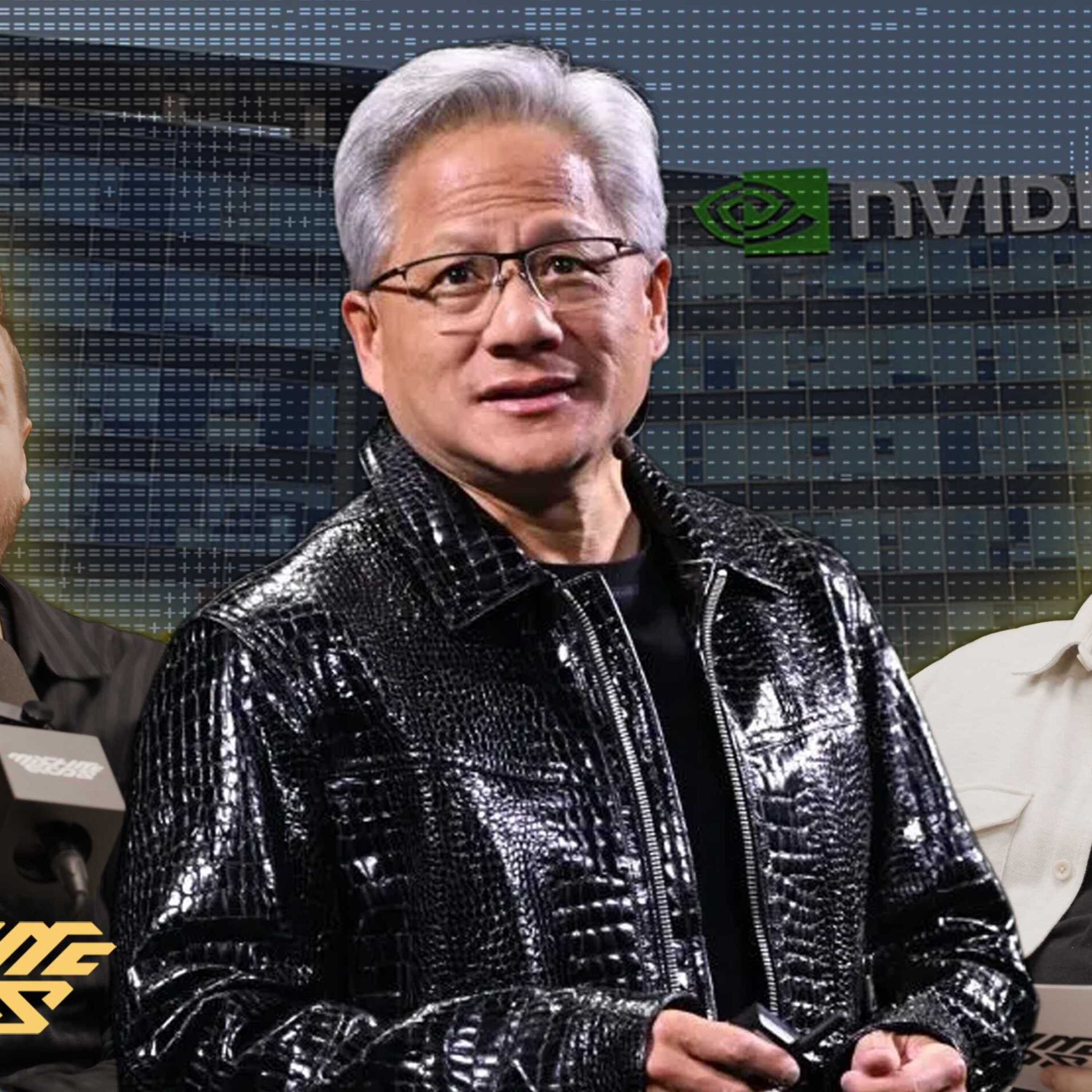
The episode has two parts. First, hosts react to Jensen Huang’s sudden resignation as NVIDIA CEO and board member, framing it as the “10 biggest losers” from the scandal and market fallout. They recap alleged affairs involving Huang (including a suspected Chinese spy, Alice Huang, and a second affair with VP Kimberly Powell captured on camera under an NDA), then list losers: Tim Cook (Trump-backed), investors/401(k)s (NVIDIA stock down ~13–14%), Alice Wong (spy exposed; reportedly returned to Beijing), open-source advocates (Huang championed open models), “accelerationists” (pushing faster AI/export loosening), Chinese AI labs (Commerce rule to block remote access to frontier chips), neoclouds (CoreWeave/Nebius funding/financing fears), Howard Lutnick (Commerce; reportedly quashed Megaspeed entity-list efforts), NVIDIA (DOJ probes, export-control/antitrust), and Huang himself (accountability narrative).
Second, they cover a METR report on Anthropic: internal AI R&D progress reportedly doubled over a year, ~80% from better AI systems (not more compute), raising “intelligence explosion” and misalignment/accident risks. Notable examples include AI Futures Project timeline shortening and quotes from Eli Liflin, Buck Schlagerlis, and OpenAI board member Paul Cristiano.
none named; it’s a host-only episode (Kevin and Casey).
Written by AI. May contain mistakes.
Discussion about Jensen Huang's sudden resignation from NVIDIA.
“I hope you can see I'm wearing my funereal black in honor of the passing from the CEO role of Jensen Huang of NVIDIA.”
A detailed recap of the events and scandals surrounding Jensen Huang.
“So as we talked about on our last episode, there's been this investigation into Alice Huang, the suspected Chinese spy who had an affair with Jensen Huang.”
Starting the discussion on who stands to lose from Jensen Huang's departure.
“Yeah, because the fallout stretches in many directions.”
Analyzing the losses for open source advocates and accelerationists.
“And in the meantime, it has set a new standard for what makes a great love story.”
Exploring the implications for Chinese AI companies and NeoClouds post-resignation.
“This is, I think, a sincerely held belief of his.”
Examining Howard Lutnick's role and the potential fallout from Jensen Huang's exit.
“So short-term loser, but maybe long-term winner.”
Discussion of Howard Lutnick's involvement in quashing the Megaspeed investigation and implications for NVIDIA.
“So what do we know about Howard Lutnick's role in all this?”
Analysis of NVIDIA's stock decline and the potential investigations facing the company.
“Number two on the list of losers, NVIDIA.”
Exploration of Jensen Huang's impact on NVIDIA and the consequences of his actions amidst scandal.
“but for his family, who have been thrust into the spotlight in ways that they never anticipated, to his wife, Lori, who I imagine is also really struggling with this news.”
Speculation on the potential return of Jensen Huang as CEO of NVIDIA in light of recent events.
“of this, which is how soon does Jensen Wong come back as the CEO of NVIDIA?”
Discussion of the recent METR report on AI acceleration at Anthropic and its implications.
“Okay, Casey, let's talk about this Meter report.”
Examination of the skepticism around the METR report findings and its timing with Anthropic's IPO.
“Well, so before we get to how the community reacts, Kevin, let me do a shill check because my fiance does work at Anthropic.”
Discussion on the credibility of Anthropic's claims regarding their AI products.
“Some people might look at that and say, well, this is just more marketing for the Anthropic IPO.”
Exploration of the AI Futures Project's updated predictions on AI advancements.
“Well, so then let's get into what this reaction has meant.”
Experts express alarming concerns about the rapid progression of AI technology.
“because you are dead or enslaved or because of collateral damage related to all this, e.g.”
Hosts reflect on their emotional responses to the alarming reports about AI safety.
“I think for most people in this room, the most likely reason they will die is because of an AI accident.”
Discussion on the lack of effective governance over rapidly advancing AI technologies.
“I do think there are some shortcomings in this meter report.”
Exploring the necessity for Congress to obtain unredacted reports and act on AI regulation.
“It is hard to imagine that any of these scenarios might be realistic.”
Hosts discuss how the public can influence AI governance and the urgency for immediate action.
“And so even as somebody who is trying to expose myself to this technology in large part so that this stuff feels more realistic to me, I still struggle to project myself even a few months into the future.”
A mixed perspective on the future of AI technology and the potential for positive outcomes.
“I think I am less alarmed than some of the most alarmed people.”
Discussing the emotional impact of AI advancements and the importance of hope amidst uncertainty.
“at OpenAI and the sort of handful of key decision makers at all these companies.”
Exploring the use of AI in personal wedding planning, including creative ideas.
“Actually, both my fiance and I did this.”
Discussing the practical application and skepticism surrounding AI agents in shopping.
“Next up, we have a voice memo from Adam Lauria about whether people are actually using AI agents.”
Analyzing the current demand for data centers and the risks associated with future projections.
“So if I need to get there an hour before the flight and it's 30 minutes to the airport, then I need to wake up at this time.”
Discusses the evolving demand for data centers in response to AI usage growth.
“going to be broken in some way, that one of the labs would sort of fall way behind the others and not be able to meet its commitments.”
Explores AI-driven creativity in video game development, showcasing unique examples.
“Okay, Kevin, before we go, one of the things that people are doing with Frontier Models whenever they come out is basically saying what is the craziest kind of video game that they can make?”

Get the gist, explore an idea or ask about something said.
 Claude
On Machine Gods, what are the key points of this episode?
Searching your listeningAutomatic transcript. May contain errors.
0:00This message comes from Doppel, a lead sponsor of Machine Gods. Social engineering attacks come in disguise, but Doppel sees through them. The agentic platform shuts down threats, turns employees into first-line defenders, and more. Learn more at doppel.com.
0:33podcast of the singularity starts now.
0:38My God, what a day it's been. On a somber day it is, Kevin. I hope you can see I'm wearing my funereal black in honor of the passing from the CEO role of Jensen Huang of NVIDIA. Jensen Huang has officially resigned as the CEO of NVIDIA. That news broke early this morning. We're taping this on Thursday. It's just been a couple hours. and we are blowing up our show to record a very special episode about all of this. I think it's fair to say like the most stunning story of the past few years in AI. It is and it was something that you had predicted that would happen and... I wasn't gonna take a victory lap but I'll let you take one on my behalf.
1:19Well, look, it's rare enough that we said we should do an emergency episode about this, so... And we're gonna do something a little bit different format-wise today. We're going to present you with a list of the 10 biggest losers from the fall of Jensen Huang. But first, let's just do a little recap of basically how we got here and what's been happening just in the last 24 hours. So as we talked about on our last episode, there's been this investigation into Alice Huang, the suspected Chinese spy who had an affair with Jensen Huang. Then on Wednesday night, the New York Times broke the news that there had been a second affair between Jensen Huang and a female subordinate who reported to him, Kimberly Powell, the company's vice president of health care.
1:59They reported that that affair had actually been captured by someone on camera who had been asked to sign a non-disclosure agreement after, I don't know, taking a photo or a video of them, you know, in some kind of intimate exchange. See, if it had been me, I would see Jensen Wong making out with somebody and be like, that's not Lori Wong. I can't be seeing what I think I'm seeing. But then when the man shows up with the NDA, that's when you think, aha, there's probably something going on here. Yes. So following that, the NVIDIA board holds this emergency meeting and just a few hours later comes out with a statement announcing that he is resigning, basically, that he is not just resigning as CEO, but that he is going to be leaving all of his posts at the company, including his spot on their board.
2:40Yes. And notably, no statement from Jensen Wong in the statement announcing leaving the company that he founded more than 30 years ago. So the new interim CEO that the board has appointed is a woman named Colette Kress. She is the NVIDIA CFO, the chief financial officer. She's been in that role for the last 13 years. She has run the company's finances through all of its expansion. She's done a bunch of its deals with other chip makers and AI labs. But she's a much less public figure, and she will serve as CEO while the board looks for a permanent replacement. Yeah, NVIDIA did not have a deep bench of people waiting in the wings to take over, but Colette Kress was well known to the investment community because she is on the earnings calls.
3:21And so she was, I think, the company's best option to project some sense of there being a steady hand at the wheel. So it is still early. The markets are still reeling. People are still trying to figure out what this sudden ouster of Jensen Huang means for the AI boom, for the rest of the industry. But let's just sort of take stock of who we know is going to lose from this or who we feel confident is going to end up affected by this in a negative way. Yeah, because the fallout stretches in many directions. And so, helpfully, Kevin, we have made a list of the 10 biggest losers from the implosion of NVIDIA.
3:55And we will begin with number 10, Tim Cook. Now, I know what you're thinking, Kevin. What does Tim Cook have to do with NVIDIA? I truly am thinking that. But on Thursday morning, President Trump identified Tim Cook, his close friend, as the only man who was fit to run NVIDIA. So say goodbye to Tim Apple, Kevin, and say hello to Tim and Vidya. Yes, he said this on True Social with a post calling it a case of, quote, a legend replaces a legend. He said that Huang did a fantastic job and recommended that Tim Cook take his place. Now, do you think Tim Cook is interested in that job? I think Tim Cook, who just stepped down from being CEO of Apple after what I imagined was a very difficult job.
4:42You know, he's still, you know, in a sort of chairman role. He still has to do a lot of work, including managing the relationship with President Trump for Apple. I think the last thing Tim Cook wants to do is to take over one of the world's biggest and most important companies right now. Yeah, I don't think he's a candidate or putting himself up for that, although I think he would be probably pretty good at the job. Number nine. Our 401ks. Yes. I don't know. I actually have not checked my 401k this morning, Kevin. Have you? No, I haven't. And I don't want to know. Yeah, me either. Because this part of the market is not doing well today.
5:18NVIDIA, obviously one of the world's largest companies, makes up a big share of the gains in the stock market in recent years. And I think a lot of people are going to be pretty unhappy when they check their Vanguard accounts today. But the reason that this is not higher on our list, Kevin, is that some people predicted that if Jensen Wang were to leave NVIDIA, that the AI bubble would burst entirely. that we would sort of see a massive route across every tech company. That actually has not happened. I think even NVIDIA stock was not down as far today as some people might assume. At the end of the day, this is still a phenomenal business that has a chokehold on a huge part of the market, and investors seem to recognize that.
5:55Well, I should say, as of right now, NVIDIA's stock is down about 14%, which at their scale amounts to hundreds of billions of dollars. These were very expensive affairs. Yeah. So, yes, it is not tanking the market yet, And I think it remains to be seen what the contagion effects of this will be on other tech stocks and other chip makers. But so far, it does not seem to be taking down the market as a whole, although it could be a bumpy ride. And I wouldn't recommend checking your 401k today. And in the meantime, it has set a new standard for what makes a great love story. Did your love story wipe hundreds of billions of dollars off the market?
6:29Well, Jensen's did. Something to think about. That brings us to number eight. And at the center of the love story, Kevin, Alice Wong, the suspected Chinese spy who's at the center of all of this. Due to the recent revelations, she is no longer able to pursue her work of being a spy, which I can imagine she found very interesting and exciting. She has now been exposed and, according to recent reporting, has returned to Beijing where, you know, I don't know what she's going to be able to do now. Now, you know, if you're interested, I'm told that in lieu of sending flowers, she has asked for the Vera Rubin chip that NVIDIA makes to be sent to her home.
7:05So something to think about. Yeah, I think this is going to be a bad next little while, not just for Alice Wong, but for this sort of entire category of kind of gray market middlemen who have made lots of money and had lots of success kind of figuring out how to get these powerful American chips into the hands or into the data centers of these Chinese AI companies. I suspect actually there's going to be a lot more investigation here and a lot more to come out. I don't think it's just Megaspeed that has been doing this kind of sketchy, you know, sort of middlemanning for the Chinese AI companies to get access to these export limited chips.
7:44But we will certainly learn a lot more about that as Congress and law enforcement agencies in the U.S. dig in. Number seven on our list, open source. Jensen Wong was one of the biggest advocates for open source software, was out there saying that it was sort of vital to the entire ecosystem that there be powerful open source AI models. This was a somewhat self-serving view for Jensen because the more people that can make these models, the more customers Jensen Wong has. But this is some of the early commentary that I'm seeing now, Kevin, is that without Jensen to champion open source, some people worry that forces who want there to be more controls on open source software are now going to have the advantage.
8:25I think that's very relevant and important. This is, I think, a sincerely held belief of his. As you said, it's also a convenient view of his because he was the CEO of NVIDIA selling these chips. But he was a very powerful champion for open models, even going back years where he would bring up open model developers to the stage at GTC or another NVIDIA event and kind of show off their work and cheer them on. And I think, you know, open models, advocates, people who want there to be more people tinkering with AI models generally have viewed him as a hero, as someone who will advocate for them in Washington, who will encourage them to spend more time tinkering with models on NVIDIA's chips, of course.
9:12But I think that's going to be a big loss for that community. Yeah. Well, let's talk about another community that may be experiencing a big loss today, Kevin, because number six on our list are the accelerationists. So these are the folks who want to see AI go faster, faster, faster, diffuse chips to as many countries as you can, as fast as you can, do not put any real regulations on them. And I think the reason people think the accelerationist loss is because as with open source, Jensen Wong was one of their biggest advocates. He was really the biggest advocate of this view that in order to make AI go well, it needed to be American companies leading the charge.
9:53And I never fully understood the argument that, like, it really – you needed to have the whole industry built on the American AI stack, as they would call it. But this was a very influential point of view in the Trump administration. People like David Sachs, Michael Kratzios, others in the administration were very influenced by Jensen's advocacy on behalf of moving faster and bringing AI to more places. People have gone so far as to say that was wrong or maybe even traitorous. I've heard that word from some of the lab leaders about Jensen Huang saying, basically, why are you selling this very powerful technology to China?
10:31And why are you advocating for loosening these export controls that are going to allow China to catch up and maybe even to overtake us? But that is a view that was not universally held, especially in the Trump administration. So I think the accelerationists, just like the open models folks, lose a big champion now that Jensen Huang is out. Number five on our list, Chinese AI companies, we think, are one of the big losers here. Some recent developments on this front, the Commerce Department, which is under a lot of scrutiny, and we'll talk about that, is now reportedly finalizing a rule that will prevent Chinese labs from remotely accessing frontier chips.
11:08So this is a sort of wonky detail. But while Chinese companies are generally not allowed to import the most powerful American chips from NVIDIA and other companies, they are allowed to rent them. And so if there is a data center in Singapore, for example, or Malaysia, they have been able to remotely access those chips. given what is happening, the Commerce Department is now about to crack down, and there's been some additional reporting that Chinese labs are now racing to secure whatever access they can now so they don't get shut out. So I think going forward, Kevin, these Chinese companies that were relying on powerful American chips to train their models are going to be at a disadvantage.
11:45Now, I think there is, I think that's correct. And I think there is maybe a long-term benefit to the Chinese AI industry if they get cut off from access to these NVIDIA chips as a result of these new sort of closing the loopholes or some of these other restrictions that might be put in place. Huawei and other Chinese chip makers have been trying to develop their own chip making capacity, trying to ramp up production, but they just haven't had the urgency on that front because they have had access to these NVIDIA chips through some of these NeoClouds and potentially through smuggling. So I think if you close down that avenue of access, maybe the Chinese chip industry does feel a little bit more urgency and gets a little more attention and is able to ramp up production.
12:33And maybe that's good for the Chinese AI industry in the long run. But I think for now, with the current reliance on these NVIDIA chips, it's probably a very bad thing to have additional scrutiny of these relationships. So short-term loser, but maybe long-term winner. That brings us to number four on our list of losers here, Kevin, and you just named them, the NeoClouds. So companies that were buying NVIDIA chips to set up new data centers that the big labs became customers of, NVIDIA committed hundreds of billions of dollars to the AI industry over the past several years, including for OpenAI's Stargate project.
13:09And it also helped to prop up the CoreWeave IPO, CoreWeave being one of the biggest neoclouds. CoreWeave stock is down between 12 and 14 percent as of this recording. Nebius, which is another neocloud, down about 19 percent. And one of the few things I've managed to learn about Colette Kress over the past 12 or so hours, Kevin, is that she's known to have pushed back on some of Jensen's more aggressive schemes to push NVIDIA financing into the ecosystem. So there is a big thought right now among some of these neoclods that the cash spigot is being turned off and that might have huge ramifications for them.
13:47Yes, I agree. All right, number three on our list of biggest losers, Howard Lutnick. Howard Lutnick is, of course, the Secretary of Commerce. He has been very aligned with Jensen Huang on the issue of loosening export controls. And he was also reportedly sort of involved in this Megaspeed investigation and in particular in quashing the investigation into Megaspeed. So what do we know about Howard Lutnick's role in all this? Well, so there's been a lot of really interesting, frankly, juicy reporting on this subject because there are forces within the Trump administration that were trying to place Megaspeed on what is called the entity list.
14:26So this would have blocked them from receiving NVIDIA's chips. But it seemed like even after Howard Lutnick would have known that Alice Wong, Megaspeed executive, was thought to be a Chinese spy, he essentially quashed any efforts to get it onto that entity list. And so Democratic senators have now sent a letter to the Commerce Department telling them they need to preserve all communications around this issue, which tells me that when the incoming Democratic majority is seated, there is going to be a huge investigation into who knew what and when when it came to Alice Wong, NVIDIA, and Megaspeed.
15:04I think Democrats coming into the new Congress have their first six months of investigations lined up already. I mean, there is so many rocks to turn over here. And I just, I can't imagine that it stops with Jensen Huang and Megaspeed. I think there are going to be many more details that come out over the coming months during these investigations into not just what Megaspeed and NVIDIA were doing, but what a lot of the other companies that are dealing with these sort of shady Chinese dealers, what they're doing as well. And if you're wondering, like why would certain forces in the administration not want to put Megaspeed on the list?
15:39I mean, I think it may be as simple as a lot of the people involved here just owned NVIDIA stock and were getting inside tips about what the company's plans were and thought if NVIDIA chips are flooding the market across Southeast Asia, that's good for my stock portfolio. So I don't know that, but I can assume that Democrats are going to be looking into that next year. Yep. All right. Number two on the list of losers, NVIDIA. I was wondering when they were going to come up. This seems like an obvious one, but this has been a horrible day for NVIDIA. Their stock price is down about 13 % in the first minutes of trading today, on track to a race something like$444 billion of value.
16:19NVIDIA has dropped to the third largest company behind Apple and Microsoft. Obviously, that's bad for the short-term shareholders. But beyond the obvious, there are just going to be a flood of investigations and probes into export controls, shady accounting maybe around some of their revenue from Singapore and other parts of Southeast Asia. Maybe we should spend a beat on this. There's been some question in the market about how NVIDIA has been accounting for this revenue that it's getting from companies like Megaspeed. But depending on how you count it, they may have to go back and revise some of that.
16:57Yeah, the Department of Justice is said to now be conducting multiple probes into the company, at least one about antitrust and another about these export controls. So NVIDIA, yeah, just having probably the worst day of its entire existence. And then number one on the list of losers, Jensen Huang. Yeah. And I mean, look, I actually don't want to make light of this. I think this is a tragedy because I think for a long time, Jensen Huang was an incredible American success story, an immigrant from Taiwan who founded NVIDIA with a couple of friends sitting at a Denny's diner with$40 ,000 and turned it into the world's biggest company.
17:35It's an incredible story. NVIDIA has been a linchpin of American innovation and many of the cool things that I get to do on computers every day are downstream of what NVIDIA has built. But man, I just think there is something to this idea that money and power corrupt. And I do think if you look at Jensen Wong's evolution over the years, there was this increasing megalomania. I think back to his podcast appearances earlier this year on shows like the Dworkash Patel show, where he was saying things like, you're not talking to somebody who woke up a loser today. He sort of leaned into this rock star persona.
18:14And I think he came to believe that he was untouchable. And today on the day that we record this, we find out that no, he actually was quite touchable and is being held accountable for some truly bad behavior. Too touchable, if you ask me. Yes. If there's one lesson we could take away from this, it's that too many damn people were touching the man. Hands off, ladies. So, yes, let's not make light of this. Obviously, this is a very hard day, not just for Jensen, but for his family, who have been thrust into the spotlight in ways that they never anticipated, to his wife, Lori, who I imagine is also really struggling with this news.
18:49It is just infuriating for them, I imagine, and disappointing. And yeah, just sad. This is such a classic case. You know, someone I was talking to last night says this was a case of someone building the newest, most impressive technology in the world being undone by the oldest, most base incentives in the world. And I think that's a good way of looking at it. But it also, I think, brings to a conclusion this sort of era of the untouchable AI mogul. We have now seen something like accountability for a person and a group of people who have not seen that much of it in the recent past. I think that is exactly right.
19:29For so long, we've been living in this LOL, nothing matters era of American business and politics. And if there is any good that comes out of this Jensen Wong moment. I truly hope that it is that era is over. So those are the 10 biggest losers. But Kevin, I want to end on a different note, which is the one big question I have at the end of all of this, which is how soon does Jensen Wong come back as the CEO of NVIDIA? You think he's coming back? Here's the thing. He's 63 years old and he has just been caught up in a massive scandal. And so the temptation is to say, well, yeah, obviously he's done.
20:04You know who else I thought that might be true of? Sam Altman, who came back in a week. So I don't think we could actually rule out at this moment that three or four quarters from now, if NVIDIA is a huge mess and American politicians feel like it's a key strategic priority for him to be back at the helm, he doesn't sneak in a side door and take over the company again. Oh man, I could not disagree with you more. I think this is so different from Sam Altman being fired in part because in that case, there was no good reason given. The board didn't say anything beyond saying that he wasn't being consistently candid.
20:41Here we have at least two very good reasons to fire Jensen Huang, one of which involves foreign espionage suspected and potentially smuggling and potentially multiple violations of federal law and export controls. So I think it is just too much of a liability to bring him back. And I think the board would be crazy to do it until they know and we know all of the details here and what is going to come out through these investigations. Because I predict that this is the first shoe to drop, but not the last. All right. Well, that's our take on what's going on with NVIDIA. I'm sure we will learn lots more in the days to come and we'll have more on the story.
21:22But for now, just a truly crazy day in American business history. Insane. I feel like I'm hallucinating. What is going on? You feel like a large language model right now. Yes. Well, I hate to break it to you, but this is real. It's really happening. It's real. Yeah. All right. When we come back, we will have more on a recent report that talks about acceleration at Anthropic.
21:48This message comes from Doppel, a lead sponsor of Machine Gods. Doppel is the agentic social engineering defense platform fighting back against impersonation and manipulation. As attackers use AI to make their attacks more sophisticated, Doppel uses it to fight back, automatically dismantling cross-channel attacks, building team resilience, and providing agentic email protection. Doppel, dedicated to outpacing what's next in social engineering. Learn more at doppel.com. That's D-O-P-P-E-L dot com. This message comes from Whole Foods Market. Host Thanksgiving with industry-leading quality standards from Whole Foods Market.
22:24There are no antibiotics in their meat department ever. So carve up turkey and spiral cut ham with peace of mind. Shop organic sides like stuffing mix and cranberry sauce from 365 brand. And all their delectable pies are made with no high-fructose corn syrup. Gourmet Thanksgiving flavors with the quality you want, only at Whole Foods Market. This message comes from Schwab. At Schwab, you can get everything from self-directed investing to full-service wealth management, all in one place. No matter your investing goal, life stage, amount to invest, or know-how, you can invest your way with Schwab.
23:01Support for the show comes from 80 ,000 Hours. The world is facing risks from AI, but what can people do about it? 80 ,000 Hours is a nonprofit who exists to answer that question. They can help you skill up or find a new role with tailored advice and support, even if you don't have a technical background. Figure out where your skills can make a difference at 80 ,000hours.org slash machineguides. Okay, Casey, let's talk about this Meter report. Meter, of course, is the nonprofit research firm based here in the Bay Area that did the report on the Hugging Face incident earlier this summer, and they are out with another blockbuster.
23:45This one is about internal acceleration at Anthropic. Did you read this report? Yes, and it sounds like a wonky subject, and it is, but it is also something that some of our savviest listeners wrote to us saying, hey, would you please cover this because it actually might be the biggest story of the week. I know that is a big claim, but hopefully at the end of this segment, Kevin, our audience will understand just why you and I have been getting so exercised about it. Yeah, so this is an attempt to quantify one of the biggest open questions about AI right now, which is how much is it speeding up progress inside the frontier AI labs?
24:23And why is that important? Why is it the pace of progress that is so worrisome? Because people are worried about what they call an intelligence explosion, which is when you would have basically a superhuman AI researcher that would be building and training successor models. So GPT-6 could train GPT-7, which could train GPT-8. And if it's helping to accelerate R &D inside the labs, that could be evidence that we are starting to see some signs of this sort of recursive self-improvement that people are so worried about. Yeah, the way that I think about it is I try to like rewind back to like what is the earliest large language model that I was really aware of?
25:02Maybe that was like GPT-2, something that is like basically unusable to me today. and then I would compare that to the frontier models that we have today. So like a Claude Fable or a GPT Astra. The risk of an intelligence explosion is you get a leap that big, but within, I don't know, over a few days, over the course of a few hours, and then a few hours later, a few days later, you get a leap that is equivalent to that or even bigger and on and on and on. Yeah, and it's not just that you'd get that kind of massive capabilities leap. It's that this could rocket past human intelligence in a way that could make it very hard to, say, control these systems if they're not properly aligned.
25:40Which we know that they are not from the stories that we have covered earlier this year, right? We know that the alignment problem is unsolved. And so if the labs are speeding up to a point where they're going to be making these sort of leaps in intelligence, then these loss of control scenarios just grow much likelier and scarier. Yeah, so I spent some time at Meter earlier this year for a story I wrote. And when I was there back in the spring, the researchers there were fairly cautious about predicting a near-term intelligence explosion. I talked to some folks who said they thought it was like less than a 10 % chance that this would happen in the next couple of years just based on their measurements of how much AI progress was accelerating inside the companies.
26:19But that has changed as of this new report. So Meters researchers spent 11 weeks inside Anthropic to study how much AI was accelerating Anthropic's R &D. And they concluded that Anthropics AI progress has roughly doubled in speed over the past year, with perhaps 80 % of that acceleration due to just better AI systems. Why is that interesting? Well, up until now, Kevin, the recipe for creating more powerful AI has generally involved throwing a lot more compute at it. You need a bigger data center. You need more chips. There's a massive infrastructure piece. The thing to focus on here is that what Meter is saying is that they are able to see these gains now just using software, which does not require new data centers to be built.
27:05So I hope people are really paying attention to this piece. It's easy to gloss over, but it's hugely important. Yes, they don't think it's because of an increase in training compute. They also said that they were unable to identify any bottlenecks to the continued acceleration over the next 12 months. So we should talk about this report and some of the details that were redacted because Anthropic was able to sort of edit the report and removed actually a lot of key information that we don't have as a result. But I think just the headline finding that Meter now believes this is doubling roughly Anthropic's internal progress due to this better AI models, that has caused a lot of people in the AI safety community to freak out.
27:45Well, so before we get to how the community reacts, Kevin, let me do a shill check because my fiance does work at Anthropic. And some people might listen to this information and they think, oh, so on the eve of their IPO, Anthropic invites these researchers in and they say, everybody, everybody, Anthropic's capabilities are speeding up at double the rate they were previously. That's terrible news. Some people might look at that and say, well, this is just more marketing for the Anthropic IPO. Kevin, is that true? No. And in fact, this was going on, as I said, for 11 weeks. This was not timed with the IPO.
28:20And in fact, Anthropic has not divulged some of the most sensitive information that Meter discovered in the course of this investigation. They redacted that. So look, I think it is fair to be skeptical of the claims made by these companies. In this case, this was Anthropic wanting some kind of credible, independent evaluator to come in. They not only looked at the internal benchmarks, but they interviewed researchers. They sort of took the temperature of the engineers at Anthropic about how much they believed AI was speeding them up. So could this have the effect of increasing excitement about and hype in Anthropic's AI products?
28:56Sure, but for the reasons we're about to discuss, I don't think the reception of this news has been uniformly positive. And in fact, if I was an investor looking at the Anthropic IPO, I might be like, what are you guys doing? All right, great. Well, so then let's get into what this reaction has meant. So on Tuesday, following the release of this report, the AI Futures Project, the organization that you and I both know well, these are the authors of the AI 2027 report, some of whom are very experienced forecasters. And some are just like the best and most proven forecasters that we have in the world.
29:25Yes. They released a post saying that the meter report had caused their timelines to shorten. Now they're predicting that a superhuman AI researcher will arrive at some point in 2027, that's next year, with a 35 to 65 percent chance of what they call a top expert dominating AI or AIs that can automate all white collar work arriving before 2028. Okay, so a lot to process there. I'm not done. Okay. But can I just internalize what you said for one second? Because we talked about AI 2027 on our old show. And at the time, it was seen as a crazy optimistic prediction for the pace of progress. You're saying now that they are updating their timeline to be even shorter.
30:12We are, according to them, about four to five months ahead of schedule of what they expected. And that is causing some real emotional reactions. Eli Liflin, one of the forecasters who works at the AI Futures Project, wrote on X, quote, I feel very worried that humanity might no longer be in control of our future within three to 12 months. Buck Schlagerlis, the CEO of Redwood Research and other important AI safety research organization, said that he now thinks there is a very real possibility, maybe 20%, that within a year, AI misalignment issues prevent you from going about life normally because you are dead or enslaved or because of collateral damage related to all this, e.g.
30:53because bioweapons are released or major wars have started. And just to put a cherry on top of this horrible Sunday, Paul Cristiano, an OpenAI board member, a very key researcher, Dario Amadei's friend and former housemate, gave kind of a shocking lecture the other day. And I want to just play a clip from that. So my feeling is if we tried to develop AI along the most rapid trajectory, if we said we're just going to build this as quickly as we can in the easiest way we can, we would be looking at something like a coin flip of an AI takeover. I hope the probability is much lower than that because we are not going to develop the technology in the very fastest way we can.
31:33But I think even all things considered, with realistic policy responses, the risk remains exceptionally high. I think for most people in this room, the most likely reason they will die is because of an AI accident. The trajectory in the field has been extremely alarming over the last three to six months to people who have been tracking closely. I think we have seen roughly the things we might expect to see shortly before something really bad were to happen. Casey, what is your reaction to this report and to the people, including many people that I think you and I both think are credible, saying that this to them was a major update in favor of very near-term risk?
32:09I think this is highly alarming. These folks have a lot of credibility with me. You know, Paul Cristiano is like one of the architects of the LLMs that we use today. And these people have a really good track record of predicting what is going to happen and the pace of progress. So when they say that it is now accelerated to a point where they fear for their safety, I take notice of that. What do you think? Yeah, I'm having a hard time just internalizing what these people are telling me. I'm feeling this kind of psychological impulse to sort of dismiss it or wave it away to try to nitpick the research.
32:54I do think there are some shortcomings in this meter report. In particular, Anthropic just redacted a bunch of the most sensitive and key information that would be useful in trying to figure out how they made this determination about speed up. Anthropic is also supposedly going to release its own report at some point on its internal acceleration. Hopefully that will be more informative and less redacted. But like, I'm just feeling this impulse in myself to not take this seriously. But I think that's wrong. I think that's a defense mechanism. And I think that's just me trying to sort of not have to sit with the funny feeling in my stomach when I think about whether these people could be right, whether we could be headed into a very unrecognizable world in just the next couple of months.
33:40So, like, let's just apply our sort of baseline reporter skepticism to say, like, these people could be wrong. Not all predictions that even the most experienced forecasters have made has been correct. But I think we have to take this seriously. And it does feel just very strange to me that some of the people I trust most with this information are saying it's time to panic. And there is also, Kevin, just an insanity to the fact that in a world where it is incredibly difficult, if not impossible, to build a house, a road, to open a bar, you have multiple companies that are sprinting in the direction of building this technology that by their own admission, they don't really know how to control.
34:28So I see that as just an abject failure of the United States government and many other governments around the world. I understand that this stuff is very complicated. It is confusing. It is hard to imagine that any of these scenarios might be realistic. But my God, we should at least have a plan in place in case some of them prove out. I was texting with an AI safety researcher I know pretty well this week, and they were saying that they feel like we are in Don't Look Up, the movie, about, you know, sort of people kind of hand-waving away and approaching calamity, sort of making light of it. And I was thinking about this as I was looking at some of the coverage of the upcoming Anthropic IPO and just the sort of way that people, I don't know, they treat the warnings of existential risk in the S1 as something like a joke or like, oh, my God, can you believe these crazy doomers think that they're building something that could end life on Earth as we know it?
35:27And I don't know what to make of that, this sort of don't look up comparison, but I do feel like our job as journalists is to call it like we see it and to say that, like, I think for you and I, this report has been something of an update. Has it been for you? Yes, for sure. I mean, when the Futures Project comes in and they make an update, I always pay attention because, again, they have been right. I was one of the people reading AI 2027 initially thinking this seems pretty optimistic, right? Because at the time, I mean, you know, it's like, what model were we even using when AI 2027 came out?
36:00Optimistic about capabilities, right? Yes, yes. Not optimistic about outcomes. Yes, exactly. Who's very dark. Yes. In some of the scenario that they sketched out of how this could go very badly, but just optimistic that the rate of progress would continue to accelerate. Yeah, no, thank you for sort of correcting me there. Because, yes, that was the feeling was like, I just cannot imagine that the technology is going to get this good that fast. And yet here we are now and every day I wake up and agents are doing a significant portion of my job, honestly. And so even as somebody who is trying to expose myself to this technology in large part so that this stuff feels more realistic to me, I still struggle to project myself even a few months into the future.
36:42I mean, to me, it also just emphasizes how little we know about what is going on inside the AI labs. You know, this was a very narrow window into what is going on with accelerating progress at one frontier company. It came only because Anthropic voluntarily let in Meters researchers to do this study and talk to their employees. We still don't know what the situation is at OpenAI, at Google DeepMind. We frankly don't even really know what it is at Anthropic because they've redacted so much of the information that was supposed to go into this report. So we just like we just know very, very little about what is happening and whether or not we should be worried matters.
37:24Like that depends on how worried the people at these companies are and what they're seeing. And on that point, Kelsey Piper, the great writer, made a point that I really, really agree with, which is that if nothing else, Congress needs to see the unredacted report. Right. Like Congress needs to understand everything that the meter folks saw and probably needs to bring those people in. and have some conversations with them about what they saw and then hopefully take some steps toward action. It's a little, like, jarring to see this happening while the Anthropic IPO roadshow is also happening. I'm just like, I'm having a lot of cognitive dissonance about it because, like, you see these AI safety people on the internet talking about how they're, like, they're basically calling their families to, like, tell them they love them because the end is near.
38:13And then you also have Dario Amadei out there telling investors that he thinks we're on the precipice of an age of miracles where like humanity will solve the problems that have eluded us for millennia. And like, I'm sure someone has figured out a way to have those things coexist in their brain, but it's not me. Yeah. I mean, I feel the same. Like I, you know, as a journalist and podcaster, there are just very real ways in which I feel unequal to this moment. It is extremely difficult for me to keep all of those things in my head and be able to tell people a coherent story, to be able to tell people how to feel about it.
38:46All I can say is we need much better governance over this stuff. Like the fact that so much power is concentrated into so few hands with almost no democratic oversight just seems terrible to me. So Casey, if the people listening to this are thinking to themselves, well, okay, it's all fine and good that you think we're headed for, you know, this intelligence explosion, possibly next year. But like, what am I supposed to do about it? That's the question I get a lot from people. What do you tell people when they ask you that? It feels so weak to say, call your member of Congress. But truly, Kevin, I almost don't know what else to say, because this is not something that the average person has much leverage over.
39:24And that is almost the entire problem to me. Now, the good news is the incoming Democratic majority seems quite keen to regulate AI. So I think it will be helpful if people are making their voices heard on this subject and let the federal government know, like, we do not want these decisions being made in the labs without any advice and consent from, you know, the citizens of this country. Right. And I think also people should ask their members of Congress to see the unredacted media report. Yes. Like that to me feels like a very key piece of evidence that would be useful in determining what the right policy response is and when the policy response needs to arrive.
40:03If it is true that we could lose control of our future within three to 12 months, as one of the AI Futures Project's forecasters believes, then like the time to act was yesterday and the next best time is tomorrow. I'll make a prediction. I don't think it's three months. Three months is very soon. I agree. I think I am less alarmed than some of the most alarmed people. But like, I know these people, you know these people. These are people who, yes, they have a long track record of worrying about AI, but a lot of their predictions have panned out and they don't make predictions unless they are reasonably confident in them.
40:44And they don't just sort of put their finger in the air and tell you which way the wind is blowing. These are people who have studied AI progress and acceleration more deeply than either of us have. And so, yes, I think we need to be skeptical of all extreme claims. But I woke up this morning thinking about it and turned to my wife and she was like, are you worried about work? And I was like, sort of. I was like, in a sense, yes, I am worried about the AI apocalypse. Well, let me then also say that as worried as I am, I also still believe in a positive outcome from all of this, right? I believe that making intelligence very high quality and very cheap and giving that to lots of people can result in many amazing things.
41:29I think that there is a path toward a very bright future so long as this technology remains under human control and is governed aggressively by governments. So if we can put some of those things in place, Kevin, I really do still believe that all of the things that Dario Amadei has been talking about in the roadshow are possible, but man, it does seem like the window for that good outcome could be compressing. We are placing so much trust as a society on Dario and the folks at Anthropic and the folks at OpenAI and the sort of handful of key decision makers at all these companies. We are the hobbits in the Shire who have just given the ring to Frodo and said, good luck, babe.
42:11And that doesn't feel great. It doesn't. No. And I trust some of these people. I like some of them. I've reported on many of them. But man, I don't really want anyone to have the ring. You don't want the future of humanity to feel like an NBA halftime show where they pull someone out of the crowd and hand them a ball and say, if you can make this from half court, then your species can live. But like, that kind of feels like where we're heading. You win a new Cadillac and your children get to grow up. i would also like but even like look at us we're trying to like end this on a positive note because it is so it's such a bummer to sit in the like in the uncertainty of it but here's like you know here's the thing that i'm observing yeah so i've been i've been doing a lot of these talks on on ai for my book tour and almost every time they're like let's just make sure we you know leave people with something to feel optimistic about and like i'm not a doomer i like making people feel optimistic.
43:09I myself am optimistic. I think we can thread this needle. But I'm just like, I'm observing the psychological tendency that we have as humans to kind of take things that are scary or unfamiliar and like turn them into a shape that makes us less scared. And I'm watching myself do that. I'm watching you do that. I'm watching like a lot of people I trust and respect do that. And I'm just like, well, maybe we should just sit with the thing. Maybe we should allow ourselves to feel the icky feeling. Yes. A great note to end a podcast segment on. I agree with what you said. I think a big reason why we started this show was we do want people at times to sit with icky feelings.
43:47But the reason we want them to do that is so that eventually they can take action to protect themselves, to protect them families, to get smarter, right? To understand how to act in the world, to demand different things from their elected representatives. The reason that we don't like ending on a note of hopelessness is because that leaves people feeling disempowered and less likely to act. And I think that if people still can make out the broad outlines of an optimistic future, they will fight for it. And I'm just telling you that future exists and we should fight for it. Thank you, Hopeful Casey.
44:20One of my favorite Casey's.
44:25This message comes from Whole Foods Market. Host Thanksgiving with industry-leading quality standards from Whole Foods Market. There are no antibiotics in their meat department ever, so carve up turkey and spiral-cut ham with peace of mind. Shop organic sides like stuffing mix and cranberry sauce from 365 brand. And all their delectable pies are made with no high-fructose corn syrup. Gourmet Thanksgiving flavors with the quality you want, only at Whole Foods Market. This message comes from Schwab. At Schwab, you can get everything from self-directed investing to full-service wealth management, all in one place.
45:00No matter your investing goal, life stage, amount to invest, or know-how, you can invest your way with Schwab. This message comes from Open Door, with Cash Now, More Later. Get cash up front for your home, plus all the profit later. That's no chaos now, no cash left behind later. Skip the showings now and move on your own timeline. Cash Now, More Later. now available nationwide. Start your offer at opendoor.com slash NPR. Profits calculated after fees and costs. Eligibility and offer price may vary. This message comes from LinkedIn ads. Ever invest in something that seemed incredible at first, but didn't live up to the hype?
45:40For marketers, that's impressions. When ads don't create revenue, that's a tough conversation with the CFO. Instead, invest in results your CFO will love. LinkedIn ads generates the highest ROAS of all major ad networks. So advertise on LinkedIn, spend$250 and get a$250 credit. Just go to linkedin.com slash NPR pod terms and conditions apply. All right, Kevin. Well, it is time once again for humans in the loop. This is our segment where we respond to questions, comments, and criticism from our audience and see what we think. All right. Let's start with a question that I think you'll be interested in, Casey.
46:22It's about leveraging AI for wedding planning. Ah, very nice. This comes to us from Cole Scholle, who writes, I recently got engaged and my fiance and I have been joking about trying to get our wedding sponsored by an AI company. I've used Claude to help me start planning and create some trackers, but we were even thinking of vibe coding a wedding website to save some dough. Here are my questions. One, Casey, congratulations on your impending nuptials. Are you and your betrothed using AI to help in any way? And second, can either of you help us get an in with an AI company to make this sponsorship happen?
46:56Oh, my goodness. Well, congratulations to Cole and Kelsey. That's wonderful news, and I hope you have a great wedding. Maybe I'll take the second question first, Kevin. Here's what I've learned about the AI companies. While it is difficult to get them to sponsor your wedding, if you put a bunch of your data on the Internet, they will take it from you and not compensate you. So that's kind of the best offer that they have available right now, and I'll sort of leave it to you whether you want to take it. As far as how am I using AI as part of my wedding planning, we've used it in a couple of ways.
47:32Number one is actually exactly what Cole suggested. We did vibe code our wedding website. Basically, we had worked with this really great human artist to make Save the Dates that we thought were really pretty. And so when it came time to make the wedding website, We just asked Claude, hey, can you turn this save the date into a wedding website? Actually, both my fiance and I did this. And then we got to have a fun discussion about whose vibe coded project was going to be the official wedding website of our nuptials. Wow, you had a bake off. We did. We had a wedding website bake off. So that's a fun thing.
48:06In terms of other things that you can try, I'm a big fan. I know it's like very controversial to use like AI generated art in most contexts. but I'm a big fan of using it for what I call productive slop, which is like, um, Hey, I have an idea in my mind and I don't know how to draw. So I'm just going to make some slop that you can use as a suggestion. So the other day, and I wish I should also say we're working with a wedding planner who's wonderful. And she was asking us, well, like what kind of flowers do you want? Do you want sort of very blossom forward flowers or do you want it to be more greenery forward?
48:40Did you also go through this at your wedding? I don't know what blossom forward means, but I assume it has to do with the 90s sitcom. Yeah, Maya Bialik is heavily involved in our wedding. No, it's sort of like, do you want a bunch of flower blossoms or do you just want a bunch of like sticks and leaves, basically? And so I had ChatGPT whip up like various options. I was like, okay, assume that our wedding colors are going to be this and this. Like show me something that is like all flower blossoms and then show me something that's like a 50-50 mix. And what I learned about myself, Kevin, is I want a 50-50 mix of blossoms and greenery, and I don't know that I would have gotten there without AI.
49:14That's beautiful. Now, I do think that we should try to come up with some way to turn your wedding into content for the show. So we should talk to some AI sponsors. Maybe Cole and Kelsey, we can sort of package you in in kind of a group deal. I'm picturing like a beautiful like AI-generated music playing as you walk down the aisle, like humanoids holding the chairs for the horror. We could go in some really interesting directions with this. My skin is crawling so much. Listen, just because I like using AI at work doesn't mean that I want it to dominate my wedding. I feel like I'm already probably at the maximum amount of AI that I want anywhere near my sacred ceremony, Kevin.
49:52Okay, well, congratulations to the soon-to-be newlyweds, and I hope you succeed at getting a sponsorship for your wedding because those things are expensive. And Cole and Kelsey, once you get married, send us a picture. It'll make us happy. All right. Next up, we have a voice memo from Adam Lauria about whether people are actually using AI agents. Hi, Casey. Hi, Kevin. I work in digital marketing, and I have coworkers who have been convinced for over a year now that agentic shopping is the future. But to be honest, I am still a little dubious. I know Muse was a huge hit at launch in terms of rapid adoption, but are those users really staying and using their agent every day or even every week?
50:31Are agents and chatbots following the same trajectory as NFTs, the metaverse, cryptocurrency, VR headsets, and even Amazon Alexa voice search, which no clients have asked me about for years now at this point. Are agents going to be another example of high tech with low usage? So I love this question. I have lots to say about it. I think, Adam, you are right that these consumer-focused agents are mostly a bust. I think that the number of people who want to do agentic shopping in this moment is very, very small. I can imagine a world where more people are doing it. The models are going to have to get better.
51:08The product experience is going to have to get better. But right now, it is not very good. Where I think the experience is great, though, is at work. I have been using my Dot. This is an OpenAI product. And you do have to plug it into some places that are going to make people uncomfortable, like Slack and email. You essentially let this thing surveil you. But in exchange, it will just tap you on the shoulder throughout the day and say, hey, there's a little scheduling conflict. Do you want me to send an email that resolves that? Or, hey, these five people are waiting on a response from you. Which one of those things do you want me to take care of first?
51:43Or I'll go ahead and look up flights for that work trip that you need to take. This stuff is very good. It is saving me hours a week. And I think statistically, almost no one is using it yet. Because keep in mind, this stuff only became good within the last like eight weeks. Most people are not updating their work stack like more than once a year, if that. But I am telling you, once people wake up to the power of what these things can do, busy executives around the world are going to be lining up to use them. Yeah, it's crazy. I've been using chatgpt.2 and I've used Muse a little bit as well. And we also have an agent that we run at Machine Gods called Town that I've been using.
52:24I think we now have more agents in the machine god slack than humans yes which is to be clear is going to become the norm at every company yes and uh i am one of the weird few proud people who has actually used agents to buy stuff i actually have used agents to book uber rides uh just in the last week wait but what it's so easy to just tap the button with your finger oh no it's not it's like what are you talking about i'm talking with my agent and it's like i've got a flight at 8 a.m and i don't feel like doing the calculation. Okay. So if I need to get there an hour before the flight and it's 30 minutes to the airport, then I need to wake up at this time.
52:59So I'm just like, you look at my calendar and book me the Uber. And it did it twice. Wow. So I guess I am a 50 % of the entire Uber bookings via agents. Um, but, uh, you know, I'm, I'm, I'm special like that. Yeah. And look, I think that these agents are going to be a big hit. They're not perfect yet. They do still make some mistakes. And as you said, you do have to plug them into some sensitive information to get the most out of them. But what I love about them is just how they are proactive. Like, I don't have to ping them if I need something to be done for it. It'll just say, it looks like you've got a meeting coming up.
53:38I wrote you a little brief. Here's what you can expect in this meeting and what you should be driving for. It found a proactive error in a budget spreadsheet that you had made or probably your agent had made. It said in cell 42, I found an extra space that sort of threw off your calculations for the rest of the budget spreadsheet. So my agent is saving us from your agent and that is the future of commerce. That's beautiful. All right. This next one is a voice memo and it concerns data centers. Let's listen. Good morning, machine gods. My name is Colton, and I have a question related to the build-out of AI and data centers.
54:17You know how traffic infrastructure problems are usually responding to the demand of five or ten years ago? Well, the thing that I want to know about AI data centers and the possibility of one being built in my community is, are they responding to an extant demand, something that people are trying to do right now? Or are they being planned and developed by these Silicon Valley tech executives on the hope that they'll be able to lasso the rest of humanity into using them and getting a return on their investment? So what I would say is that the next two years of data center capacity are mostly already leased.
54:59Like I found a CBRE report that said that the average data centers in America have about 1.4 % vacancy, right? So that is to say that there is currently more than enough demand to soak up every last bit of compute at existing data centers and also for the next two years, which, as we discussed on the show, are going to be big years. So where your question, I think, is really reasonable and gets interesting, Colton, is, well, okay, what happens after that though? Because right now you have a very small, concentrated group of companies that are borrowing vast sums of money to build new data centers on the assumption that these four or five big AI labs are going to have the revenue that will be necessary to pay for those data centers.
55:49And the question then is like, okay, well, is the demand going to be there after a couple of years to actually keep all of these things afloat? I have always assumed that some of these things were going to blow up, that the finances were going to be broken in some way, that one of the labs would sort of fall way behind the others and not be able to meet its commitments. And so I do think that there is a risk that there is a data center somewhere that goes up and does not wind up having the demand that it first anticipated. Now, I also imagine that that data center will likely be able to just sell its capacity to whoever is the winner in the space.
56:23That is just sort of what I think is going to happen. But in short, this is not something that I spend a lot of time worrying about because I look at the rate of consumption in AI services over the past three years and I look at the increase in capabilities. And I think as long as capabilities keeps going like this, I think demand for compute is going to go in the same direction. Yeah, I agree. I think that there is just a lot of unmet demand right now. All these companies are severely compute constrained. I think just the data centers that they have planned for the next couple of years will allow them to fill the demand that exists today.
57:03But, you know, I was struck by something Sam Altman said recently, I think on a podcast or during an interview or something, where he's basically saying that, like, you know, a couple years ago, even the most sort of AI-pilled engineers at OpenAI were struggling to use, like, millions of tokens a day. Like, it was sort of you were an extreme outlier if you were using millions of tokens a day from your AI models. And now essentially everyone there is using millions of tokens a day. It's become much easier to use millions of tokens a day using agentic tools. I might be using millions of tokens a day.
57:33You might be using millions of tokens a day, and we are not engineers. So I just think as these sort of token-intensive use cases keep growing, like these personal agents that we just talked about, there's just going to be a ton of demand for those tokens, and you need data centers for tokens. Now, there is also an interesting wrinkle here, which I'm glad that, Colton, you brought up traffic congestion because there also is a well-documented phenomenon where increasing traffic capacity doesn't actually make traffic go any faster. So if you have a two-lane highway and you expand it to a four-lane highway and you're thinking, okay, well, that's great.
58:10Now there will never be any traffic. What actually happens most of the time is that you just end up with the same amount of traffic because more people want to drive now that you have four lanes. So I think there's something similar and analogous happening in data centers where, like, despite increasing the capacity of these systems, the demand is just growing even faster. And so I think we'll be maxed out on compute for at least the next couple of years. Yeah, which is another reason, by the way, why, like, I understand people who don't want to build data centers in their neighborhood because they're like, well, this just seems like at the margins, this will actually just, like, slow the rate of AI development a little bit.
58:41And I would like to do that. So, you know, I get disagreements with people sometimes about this, but to me it seems like a logical response.
58:50This message comes from Whole Foods Market. Host Thanksgiving with industry-leading quality standards from Whole Foods Market. There are no antibiotics in their meat department ever, so carve up turkey and spiral-cut ham with peace of mind. Shop organic sides like stuffing mix and cranberry sauce from 365 brand. And all their delectable pies are made with no high-fructose corn syrup. Gourmet Thanksgiving flavors with the quality you want only at Whole Foods Market. This message comes from Schwab. At Schwab, you can get everything from self-directed investing to full-service wealth management, all in one place.
59:25No matter your investing goal, life stage, amount to invest, or know-how, you can invest your way with Schwab. This message comes from Open Door, with cash now, more later. Get cash up front for your home, plus all the profit later. That's no chaos now, no cash left behind later. Skip the showings now and move on your own timeline. Cash now, more later. Now available nationwide. Start your offer at opendoor.com slash NPR. Profits calculated after fees and costs. Eligibility and offer price may vary. This message comes from LinkedIn ads. Ever invest in something that seemed incredible at first, but didn't live up to the hype?
1:00:05For marketers, that's impressions. When ads don't create revenue, that's a tough conversation with the CFO. Instead, invest in results your CFO will love. LinkedIn Ads generates the highest ROAS of all major ad networks. So advertise on LinkedIn. Spend$250 and get a$250 credit. Just go to linkedin.com slash NPR pod. Terms and conditions apply. Okay, Kevin, before we go, one of the things that people are doing with Frontier Models whenever they come out is basically saying what is the craziest kind of video game that they can make? And they've gone from extremely rudimentary to crazy good extremely quickly.
1:00:46So I saw this on Twitter. A guy said, hey, check out the version of Pong I made with Fable 5.2. Pong, of course, basically the simplest video game that has ever been created. It's essentially tennis, right? Which I know you love. Two paddles, just sort of kicking a ball back and forth. Seeing if you can - Yeah, two paddles, famously kicking a ball back and forth. Listen, the exact terminology isn't important. Let's go to Pong expert Casey Newton for this next demo. Okay, so I just want you to watch what happens. You can see the paddles, you know, very simple. Oh, but wait, what just happened? Okay, okay, now we're in three dimensions and we have a bit more of a Miami Vice aesthetic.
1:01:25This is like Thanksgiving, yeah, cyberpunk. So, okay, this would keep me occupied all day, but now wait, hold on. Okay, now I'm having a seizure. Okay, now we're traveling through space and time. we've entered the wormhole. And now - This is incredible. So every time you hit the ball in the third stage, the entire camera spins around. It's now this sort of psychedelic neon fractal design. Yeah, now I'm on mushrooms. Okay. So I played this for a good bit this morning. Oh yeah, by the way, then it turns into a full Kung Fu movie playing in the background and then a rave of anime. so not transformers people should take a look at this i think uh to understand what you can already do in terms of making a video game with ai and that's you know that's very controversial like gamers hate ai and video games i totally understand that but even just from a know your enemy perspective you should see what people are doing with new models okay yes if you would like to take leave of your senses and have a completely dissociative psychedelic experience without consuming any substances.
1:02:35Casey, you can try this game at tennis.sixfingerpunch.com. It's crazy. There's a caterpillar. There's a caterpillar. Casey, who makes this show? Machine Gods is made in partnership with NPR with generous support from the Tarbell Center for AI Journalism, the William and Flora Hewlett Foundation, and Emerson Collective. This episode was produced by the newly married Sasha Ashall, as well as Jacob Bloomberg. Congratulations, Sasha. Our senior producer is Rachel Code. Our executive producer is Dinoosh Parvane. Original music by Armin Bazarian. Branding and visual design by Alex Castro. Special thanks to Oren Rosenbaum, Erica Berry, and Nadine Zylstra.
1:03:14Keep sending us your questions about AI and technology. We could use them in a future segment, like Humans in the Loop. Send questions, voice memos, and short videos to hey at machinegods.fm or leave us a comment wherever you're getting the podcast. And for the love of the gods, don't forget to like and subscribe. And until next time, stay blessed.
1:04:01or appetite for investing, Schwab has everything you need all in one place to invest your way. Visit schwab.com to learn more. This message comes from Easy Cater, the workplace food platform. Easy Cater helps organizations order food from favorite restaurants, meet dietary needs, and stay on budget. With employee meal programs, flexible payment options, and 24-7 customer support all on one platform. Learn more at easycater.com. This week on Here and Now Anytime, the spy scandal rocking NVIDIA exposed how lax the government has been in forcing its ban on AI chip exports to China. Also, meet the scientists studying kids who claim to have memories of past lives.
1:04:45You know what? Toddler talking about a traumatic death is surprising to a lot of parents. Here and Now Anytime. Listen on the NPR app or anywhere you listen to podcasts.