 Ask ChatGPT


The episode argues that NVIDIA CEO Jensen Huang’s sudden resignation will permanently reshape the AI industry, because he wasn’t just a chip maker—he controlled compute supply, promoted rapid AI progress, and influenced U.S. China chip policy.
No guests are mentioned; the host narrates and references prior interviews (e.g., Dario Amodei of Anthropic; Dwarkesh Patel).
Huang was the “compute kingmaker,” the “accelerationist-in-chief” versus “safetyists,” and a “China dove” who pushed against stricter export controls. The resignation is linked to alleged ties to Alice Huang, who ran Megaspeed, accused of exploiting a loophole to route NVIDIA chips toward China.
Megaspeed’s neocloud/data-center model (Singapore/Malaysia) allegedly enabling Chinese access; media timeline (NYT late October; Financial Times Nov 7; second affair Nov 11); corporate conduct parallels (HP Mark Hurd, McDonald’s Steve Easterbrook).
Written by AI. May contain mistakes.
An overview of Jensen Huang's influential role at NVIDIA and his recent resignation.
“Until this week, Jensen Huang was one of the most powerful men in the most powerful industry on Earth.”
Exploration of Huang's three pivotal roles in the AI industry and their significance.
“But to get there, you need to understand who Jensen Huang was to the AI world.”
Discussion on Huang's optimism about AI and his role in the industry debates.
“Jensen Huang is being savaged in the media, and none of NVIDIA's big partners have spoken out against him or said much of anything.”
The impact of Huang's personal relationships on his professional life and implications.
“And this is the one that I think set up Jensen Huang's downfall.”
Details of the events leading to Huang's resignation and the fallout from his actions.
“the accelerationist-in-chief, the China dove, Jensen Huang was doing all three jobs while keeping a secret.”
Explore the revelations surrounding Jensen Huang's affairs and their implications.
“The same day, NVIDIA's board announced an independent investigation into whether he had been the target of a foreign intelligence effort.”
Understand how personal scandals can impact corporate leadership and trust.
“I think the deeper reason Jensen had to go goes back to those three roles.”
Learn about the striking parallels between Jensen Huang's situation and WWII scientists.
“In short, it wasn't the sex that took down Jensen Huang.”
Speculate on the future of NVIDIA and the AI industry after Huang’s departure.
“This is a story about the most strategically important technology of our time, and the man at the center of it was the one who controlled the supply.”

Get the gist, explore an idea or ask about something said.
 Claude
On Machine Gods, what are the key points of this episode?
Searching your listeningAutomatic transcript. May contain errors.
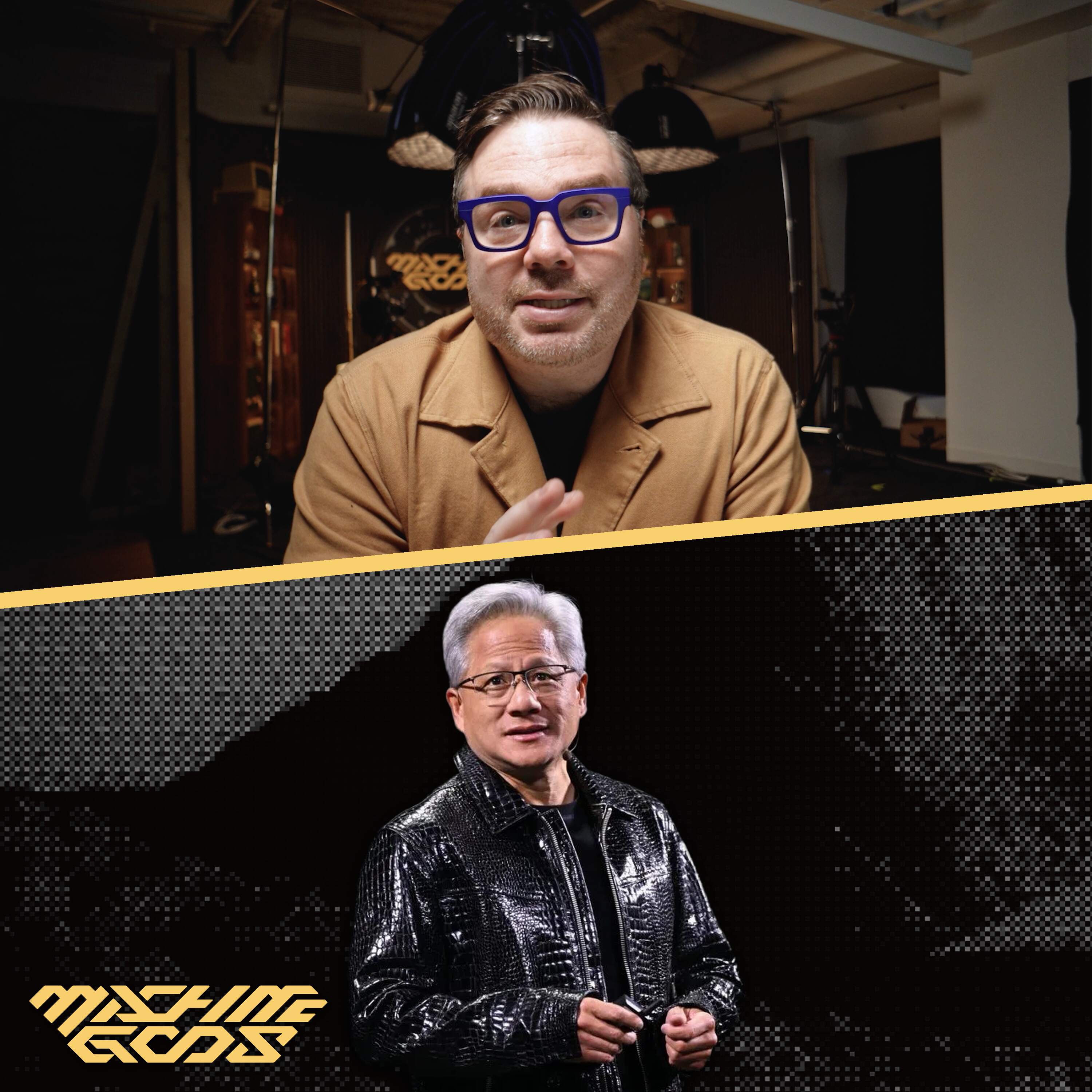
0:01All right, look, I know there is a lot of drama in the AI industry. I know that it feels like every day someone is grabbing you by the collar to tell you that what happened in AI today was the thing. No, really, this is the big one. This one changes everything. So I feel a little self-conscious about what I'm going to say, which is that this one, this story, may really change everything. Until this week, Jensen Huang was one of the most powerful men in the most powerful industry on Earth. He ran NVIDIA, the company whose chips have powered basically all of modern AI. And he had run the company for 33 years.
0:43His story was one of the great Horatio Alger tales in all of American capitalism, a Taiwanese immigrant who rose from washing dishes at Denny's to leading the most successful company in the world. And now it's over. Just a few hours ago, Jensen Huang resigned in disgrace. I've spent the last five years covering the race to AGI. I just wrote a book about how OpenAI, Anthropic, and Google DeepMind have been racing each other to build artificial general intelligence, meaning an AI that can do most things as well as or better than humans. While I was reporting that book, I spent a lot of time thinking about Jensen Huang.
1:20He came up so often in my interviews that I almost made him one of the main characters. NVIDIA isn't a frontier AI lab, and it doesn't make a chatbot. But its technology is what has made this entire boom possible. Without NVIDIA's bet on AI chips more than a decade ago, there would be no chat GPT, no Claude, no Gemini. You could argue that no single person has been more responsible for this boom than Jensen Huang. So I want to tell you why his resignation shocked me and what I think it changes. But to get there, you need to understand who Jensen Huang was to the AI world. Because he wasn't just a CEO.
2:01He actually had three different roles, and each one makes his fall more consequential. Let's take them one at a time. The first role is the simplest one. Jensen Huang was the AI industry's compute kingmaker. And to explain what that means, I have to take you back to a time when nobody thought of NVIDIA as really very important at all. 20 years ago, NVIDIA was a niche company that made graphics processing units, or GPUs. If you know GPUs, you probably know them from gaming. Or if you're like me, a child of the 90s, you might remember blowing your allowance money at Best Buy on an NVIDIA GeForce card, cramming it into your PC and praying that it would let you play Quake.
2:43For a long time, that was NVIDIA's business. They sold chips to gamers. It was a good business, but nobody was calling Jensen Huang the most important man in technology. But then in the early 2010s, AI researchers noticed something. The thing GPUs are good at, doing lots of small calculations at the same time, is exactly what you need to run a neural network. And from there, the story is pretty much a straight lineup. As more and more AI researchers started using NVIDIA's GPUs to power their models, Jensen Huang and NVIDIA kept doubling down, making more and more specialized GPUs that were good for the kinds of workloads that modern AI systems demanded.
3:24As AI grew, NVIDIA grew with it. Last year, it became the first company in history to be worth more than$4 trillion. And during this AI boom, Jensen's job changed. He stopped being a guy who sold video cards to gamers and became something more like the gatekeeper at the hottest restaurant in the world. Everyone wanted as many of NVIDIA's chips as they could get. Huge orders for billions of dollars would land before the chips had even gone on sale. And a lot of executives at the Frontier AI companies would be reduced to literally begging Jensen for bigger allotments, more chips to put in their data centers.
4:05If compute is the difference between winning and losing or having power and not, then the guy who controls the GPU supply isn't just another CEO. His decisions about which chips to release, which company gets how many, which long-term deals to sign can make or break entire companies. And incidentally, that's why you've heard so little from the rest of the AI industry this week. Jensen Huang is being savaged in the media, and none of NVIDIA's big partners have spoken out against him or said much of anything. That's because they're scared. All of them know that their next GPU shipment might depend at least a little on what they say about NVIDIA and Jensen Huang today.
4:49So that's role one. Jensen Huang controlled the hardware. Role number two is about ideas because Jensen Huang was also the AI industry's accelerationist in chief. I could spend a very long time walking you through all of the tribes and factions inside the AI world, and someday I might do that. But for today, you only need to know about two of them, the safetyists and the accelerationists. The safetyists are people like Dario Amadei, the CEO of Anthropic. They worry about how powerful these systems are getting and what could happen if we lose control of them. They've argued for slowing down, for adding stronger guardrails, for not just plowing ahead.
5:34It's not that they hate the technology, they're excited about AI, but they're also really nervous about it. To them, building powerful AI systems is like summoning a genie. It could go really well. It could also go badly, and you don't get to put it back. Jensen Huang was the opposite of that. He didn't lose sleep over AI risk. He was the industry's head cheerleader. He would go onto stage at events in his trademark black leather jacket and tell everyone that AI was going to deliver an era of abundance, diseases cured, endless entertainment, prosperity for everyone, all of it naturally running on NVIDIA chips.
6:14Jensen Huang's optimism made him one of the most popular leaders in AI, but it also put him at odds with a lot of his peers, and it created some strange moments. I keep thinking about this interview he did with Dwarkesh Patel earlier this year, and I want to play a clip from that interview because I think it captures the unique position Jensen Huang occupied in the AI debate. Not just someone who thinks that AI is probably going to turn out okay, but as someone who forcefully rejected all of the arguments that it might go badly. Why is it that we don't come up with a regulation that's more balanced so that NVIDIA can win around the world instead of giving up the world?
6:56Why would you want United States to give up the world. The chip industry is part of the American ecosystem. It's part of American technology leadership. It's part of the AI ecosystem. It's part of AI leadership. Now, obviously, some of what he's saying is self-interest. The more excited people are about AI, the more chips NVIDIA sells. But I don't think this was only a sales pitch. it also fit who he is. Jensen is a sunny optimist by temperament, and he was and is an unabashed believer in the idea that AI will change the world for the better. I've talked to people who know Jensen, who have worked with him over the years, who have said that this optimism is real.
7:40He really does think the future with AI could be amazing, and he believes that the doomers and the safetyists just haven't grasped how radically important this technology is going to be. And because he was the kingmaker, his optimism carried weight. Which brings me to the third role. And this is the one that I think set up Jensen Huang's downfall. It has the least to do with NVIDIA's products and the most to do with why he's gone. For years, Jensen Huang was the leading China dove in the AI industry. In Washington, a China hawk is someone who thinks that the U.S. should be freezing China out of advanced AI, making it as hard as possible for Chinese companies to get the most powerful chips made by NVIDIA and other American chip makers.
8:26The China hawks are the reason we have export controls. Starting in 2022, under the Biden administration, the U.S. has been blocking NVIDIA and other American companies from selling their most powerful AI chips to China. The Trump administration ended up keeping most of these rules, but some China hawks wanted to go further. Their logic was simple. Why would we sell any AI chips to China just so China can use them to catch up to us and maybe to surpass us? If this technology really is as dangerous as people say, why would we hand our biggest adversary the most important ingredient? Jensen Huang saw it differently.
9:05His argument was that China is going to build AI no matter what we do. So the real question isn't whether China gets AI, it's whether Chinese AI runs on American chips or Chinese ones. The Dove said if you cut China off, all you've really done is hand the market to a Chinese company like Huawei. I'll be honest, this argument never really made sense to me. I've asked a lot of people to explain why we should feel better if the cyber weapon that takes down the electrical grid or the rogue agent swarm that unleashes a novel bioweapon runs on American GPUs or Chinese GPUs. But Jensen Wang and Nvidia never wavered.
9:48They hired armies of lobbyists to fight the export controls. Jensen went on podcasts and TV shows to argue that selling China advanced GPUs was nothing like handing over a weapon. And here's the thing. He was winning. The Trump administration started out restricting almost all of NVIDIA's sales to China, then reversed course and let some of them resume. And Jensen Huang became very close to President Trump and ended up steering a lot of the Trump administration's AI policy. Hold that thought, because now I need to introduce you to someone else. Alice Huang, no relation to Jensen Huang, is a bit of a mystery.
10:29She started out as a Chinese TV journalist, moved into investing, and then in 2023 turned up running a company called Megaspeed. Megaspeed is what the industry calls a neocloud, a company that buys up AI chips, puts them in data centers, and rents out the computing power. Megaspeed was based in Singapore. It had been spun out of a Chinese video game company, and it ran data centers in places like Malaysia. Now, the export rules prevent NVIDIA from shipping its best chips to China. But a data center in Malaysia, full of those same chips, could be rented to a Chinese company without technically breaking the rules.
11:09It was a loophole. A legal one, somehow. I have asked many people why this loophole exists, and nobody has been able to give me a good answer. But according to U.S. investigators, companies like Megaspeed took advantage of this loophole. They bought billions of dollars worth of NVIDIA's chips. And then, well, nobody is quite sure what happened to them. Some of them may have ended up in Southeast Asian data centers, rented out to Alibaba and other Chinese AI companies. Some of them may just have gotten smuggled into China. We don't exactly know what Megaspeed was up to. But we do know what Alice Huang was up to.
11:47She was getting close to Jensen Huang. The two of them were photographed together in Taipei in 2024 and again in 2025. And according to some reports, Alice Huang bragged about her access to Jensen when she was raising money. I want to be careful here. U.S. intelligence officials have concluded that Alice Huang was working for China, but the Chinese government calls that a baseless smear. And while Jensen Huang has admitted that he was unfaithful to his wife, according to President Trump, he said he had no idea that Alice Wong was a spy. But here's what we do know. Months ago, senior officials in the Trump administration were briefed that the woman they suspected of spying for China was personally involved with the CEO of NVIDIA.
12:30And nothing happened. Megaspeed wasn't blacklisted. Jensen Huang kept making his case in Washington. Now put the pieces together. On one side, you have Jensen Huang publicly arguing for looser chip restrictions on China. On the other hand, you have Alice Huang running a company that has been accused of being a gray market pipeline for getting NVIDIA chips into China. Maybe that's a total coincidence. Or maybe you start to wonder whether one of the reasons Jensen was so dovish on China is that he was sleeping with the woman who ran Megaspeed. Either way, the fact remains. The compute kingmaker, the accelerationist-in-chief, the China dove, Jensen Huang was doing all three jobs while keeping a secret.
13:16That he was romantically involved with a suspected operative of America's main adversary on the one issue with the biggest military, economic, and political stakes. So how did a secret like that finally come out? And why couldn't Jensen Huang survive it? Well, the whole thing started to come apart in about two weeks. In late October, the New York Times reported that U.S. officials believed that Jensen Huang had a close relationship with a suspected Chinese agent. Then, on November 7th, the Financial Times reported on a classified U.S. intelligence memo that described the relationship as romantic.
13:54The next day, Jensen sent an email to NVIDIA's employees. He admitted that he had been unfaithful to his wife, and he said there was no excuse for what he'd done. The same day, NVIDIA's board announced an independent investigation into whether he had been the target of a foreign intelligence effort. The board said it had no reason to believe that NVIDIA's trade secrets or national security had been compromised. And for a few days, it looked like Jensen Huang might ride this out. But then, on November 11th, the Times reported a second affair, this one with an NVIDIA executive who reported directly to Jensen Huang.
14:31That second story changed the math. Because an affair on its own doesn't usually end a CEO's career. A relationship with someone who reports to you is different. It's a textbook violation of corporate conduct rules, and boards have forced out CEOs for getting romantically involved with their employees before. In 2010, Mark Hurd was forced to resign as the CEO of HP after it came out that he'd had an affair with a marketing consultant. McDonald's fired Steve Easterbrook in 2019 after reports that he'd had relationships with several female employees. But I don't think the affairs themselves were what forced the NVIDIA board to act.
15:10I think the deeper reason Jensen had to go goes back to those three roles. Let's start with the kingmaker. NVIDIA's power, its ability to sell its chips around the world, ultimately depends on Washington. Things like export licenses, trade deals, and the Trump administration's trust that NVIDIA's chips aren't ending up in the wrong hands. A CEO that is maybe compromised by Chinese intelligence can't walk into the commerce department and ask for anything. Jensen Huang also needed other American AI leaders to trust that he was treating them fairly. To know that when NVIDIA decided to reserve billions of dollars worth of GPUs for an overseas neocloud like Megaspeed, at a time when American AI companies need all the GPUs they can get, it wasn't because the CEO was being blackmailed or romanced by a spy.
16:04Then the accelerationist-in-chief. Jensen's whole pitch for AI optimism was that the world should trust the AI industry to go full speed ahead. That got harder to sell when it turned out that the industry's most important figurehead was hiding something this important from his own board. And finally, the China dove. Every argument Jensen Huang ever made for selling chips to China now looks suspect in light of his affair with Alice Huang of Megaspeed. Even if he believed every word, no one could ever hear those arguments again without wondering who was whispering in his ear. In short, it wasn't the sex that took down Jensen Huang.
16:47It was the secrets. For the past couple of days, I've been racking my brain trying to think of a historical parallel to explain how shocking and unexpected the Jensen Huang situation is. And the best I can come up with goes back to World War II and the last time that America raced to build a world-changing technology. Imagine it's 1944, and we discover that a top scientist on the Manhattan Project is having an affair with a German national, someone suspected of funneling American weapons to the Nazis. Now, make that scientist more than a government employee. Make him a close advisor to the president, someone whose influence gives him a window into what's going on at the very top of the American government.
17:33And now imagine that the whole time he was helping to gather the raw materials for the nuclear bomb, this scientist had been publicly arguing that we should sell enriched uranium to Germany. They're going to build a bomb anyway, he says. It might as well be built with our uranium. This is not a perfect analogy, and it breaks down if you push it too far, but it's the right scale. This is a story about the most strategically important technology of our time, and the man at the center of it was the one who controlled the supply. So what happens now? Honestly, I don't really know. NVIDIA has never had to imagine life without Jensen Huang.
18:13He co-founded the company, ran it for 33 years, and apparently never put a succession plan in place. There's a world in which not much changes. NVIDIA's chips are still the best in the world. The AI companies are still desperate for more of them, and somebody else could just sign the deals. Maybe the next NVIDIA CEO is more hawkish, or at least more careful. And maybe the fight over selling AI chips to China looks different a year from now. Or maybe the bubble pops. Maybe it turns out that a lot of the investor exuberance propping up this whole industry was really just Jensen Huang and his leather jacket.
18:52But I know one thing. An era of AI is over. It's the era that began when a company selling graphics cards to gamers bet that the same chips could power AI, and were vindicated in that bet bigger than anyone could have imagined. Jensen Huang spent more than 30 years building the world's largest AI empire. It came crashing down in a matter of days. And whatever happens next, the AI world will never be the same.