
In short
Podcast Notes: Making Sense with Sam Harris - Episode #447: The Unraveling of American Power
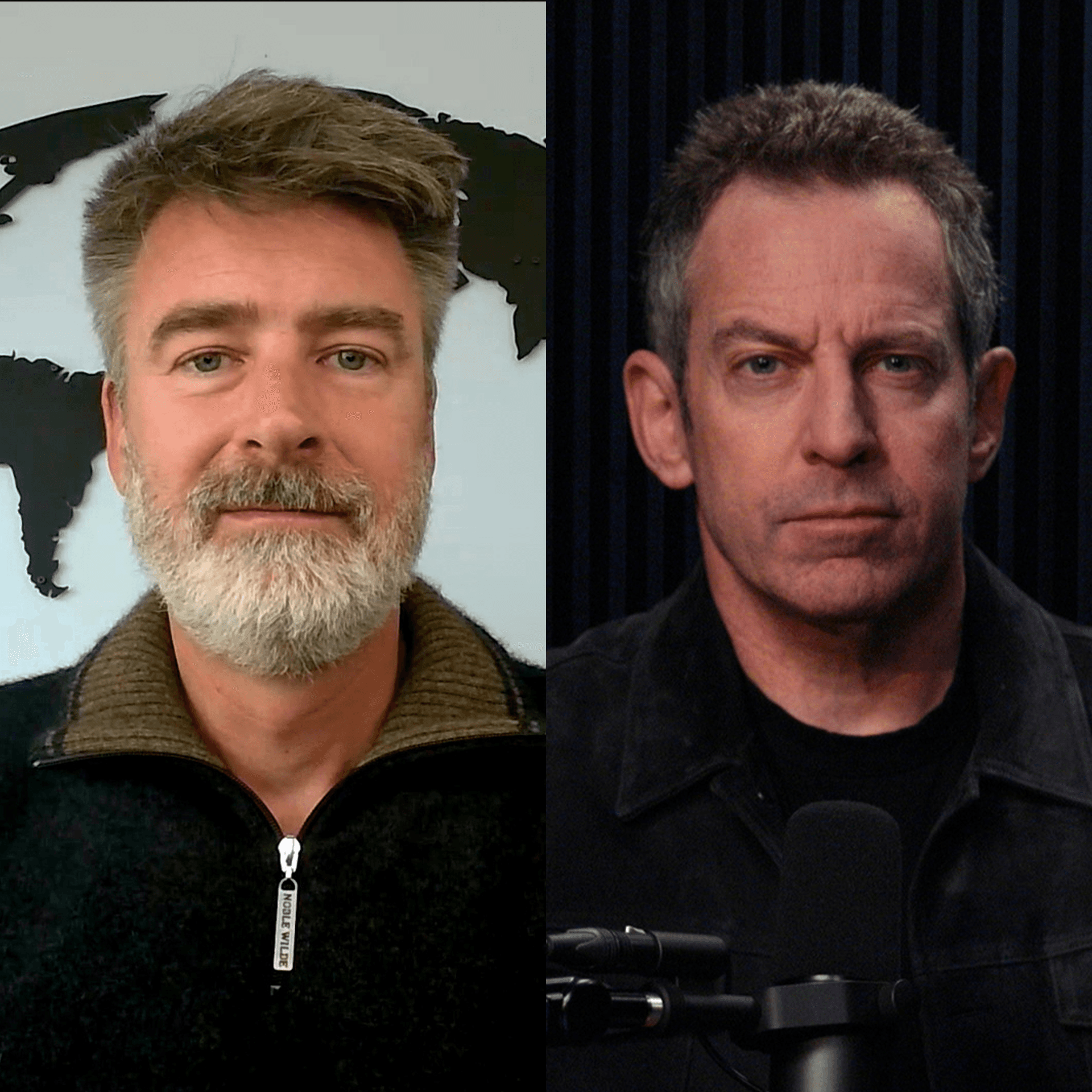
Overview In this episode of *Making Sense*, Sam Harris engages in a conversation with geopolitical expert Peter Zeihan about the implications of Donald Trump’s second term, particularly focusing on economic and geopolitical outcomes. The discussion covers several critical areas, including the unraveling of American power, Trump's tariff policies, the effects of deglobalization, and the impact of foreign policy decisions on global dynamics.
Key Themes and Discussions
- Predictions and Political Landscape
- Trump’s 2024 Election Prediction: Zeihan discusses his previous prediction regarding Trump's chances in the 2024 election, noting unexpected shifts in voter demographics and decisions.
- Independent Voters: The focus is on the 10% of voters who identify as independent and their critical role in past elections.
- Assessment of Trump's Second Term
- Initial Evaluation: Zeihan expresses skepticism about Trump's effectiveness in his second term, arguing that his policies have not led to the intended outcomes.
- Key Policies: Discussion on tariffs, reshoring manufacturing, and overall economic direction.
- Economic Consequences of Tariff Policies
- Impact of Tariffs: Zeihan explains the complexities of tariffs, especially related to manufacturing sectors.
- Simple products can be relocated more easily than complex ones, leading to deindustrialization and job loss in high-skilled labor sectors.
- Industrial Construction: The decrease in industrial construction spending since the implementation of tariffs indicates a stagnation in new projects and economic growth.
- Deglobalization and Supply Chain Issues
- Global Trade Dynamics: The conversation addresses how the U.S. is preparing for the decline of globalization and its implications for domestic manufacturing.
- China's Economic Outlook: Zeihan warns of an impending economic collapse in China due to demographic challenges.
- National Security and Foreign Policy
- Military Readiness: Concerns about the degradation of U.S. military preparedness under Trump’s leadership.
- Ambiguous Foreign Policy: The lack of a coherent strategy, particularly regarding Venezuela and Central America, is troubling for both national and regional stability.
- Drug Trafficking and Cartels
- Mexico's Cartel Situation: The discussion highlights the escalating violence and reorganization within Mexican drug cartels post-El Chapo.
- Economic Drivers of Drug Trade: The persistent demand in the U.S. for narcotics perpetuates the drug trade despite attempts to dismantle cartels.
- On the AI Bubble
- Investment in AI: Acknowledgment of a significant investment in AI technologies, followed by skepticism about whether this growth is sustainable or a bubble.
- Dependency on Global Supply Chains: The need for advanced semiconductors in AI development and the impact of potential supply chain breakdowns.
Key Takeaways
- Unraveling of American Power: Zeihan compares the current state of American power to the decline of the Soviet Union, highlighting unprecedented challenges.
- Economic Complexity: The interconnectedness of tariffs, manufacturing, and economic health underscores the complexity of current U.S. economic policies.
- Geopolitical Uncertainty: The unpredictability in U.S. foreign policy under Trump contributes to a chaotic global environment that impacts business and international relations.
- Long-Term Economic Forecast: Without substantial policy shifts, Zeihan warns of impending inflation combined with goods shortages, leading to further economic difficulties.
Conclusion This episode presents a critical analysis of the current political and economic landscape under Trump's administration, emphasizing the need for coherent policies to secure U.S. interests domestically and abroad. The conversation raises significant concerns about the future stability of American power, the economy, and global relations in a rapidly changing world.
For full access to this episode and more, listeners are encouraged to subscribe at [samharris.org](http://samharris.org/subscribe).
Written by AI. May contain mistakes. Listen to the episode to check what was said.
Transcript
Automatic transcript. May contain errors.0:16Welcome to the Making Sense Podcast.
0:30what we're doing here, please consider becoming one.
0:36I'm here with Peter Zion. Peter, thanks for joining me again. Hey, it's great to be back. Well, so first, you've been on the podcast several times and most people will have heard about you, seen you somewhere, if not here. But remind people briefly what you do, what's your day job when you're not doing podcasts like this? My job is to take demography and geopolitics and use it to paint a picture of the future and then show how it matters to the people who happen to be in front of me. So most of my clients are in the world of finance or manufacturing or agriculture, some sort of economic association or business, and I help them navigate the crazy that is to come.
1:12Speaking of predicting the future and actually on points that matter, at least to me and a few of us, last time you were on the podcast, you told me that there was no way that Trump was going to win the 2024 election. So I have to ask you what the fuck happened right at the top here. Yeah, fair enough. Sorry, I slept that day. My general feeling was that it was going to be America's independence that decided how things were going to go. Not people who said they were independent, but really were Republicans and everything but name, but the actual 10 % of the electorate that splits their vote. Because they had decided the last seven elections, so it felt pretty safe to me.
1:48And in the post-election polls, it looks like that group decisively voted against Trump. Everyone else shifted, however. With one exception, Washington state. Every state in every demographic shifted substantially towards Donald Trump and allowed him to win with the margin that he got. Well, how would you rate his second term so far? We're going to talk about tariffs and foreign policy and supply chain and specifics like China. But what most concerns you? Have there been any pleasant surprises? How would you rate the last 10, 11 months? Usually try not to be critical of presidents in their first terms because, you know, they're learning.
2:30It takes time for the policies to kick in. The world doesn't move on a dime. Second term is different because they should have learned from what happened in their first term. And by that measure, it has not gone well. Most of the stated aims of the Trump administration, things like reshoring, manufacturing, increasing its defense position, have actually taken the country in a significantly different direction. And I have not seen an unraveling of national power on this scale since the Soviet breakdown. So, so far, very impressed with how much damage is being done. this is some combination of zimbabwe argentine economic policy maybe with just a dash of french statism thrown in all right so let's talk about the unraveling what are you seeing because so over right of center in in trumpistan i can imagine many people believe that the tariffs are working we're on-shoring american manufacturing we're building up our manufacturing base jobs are going to be returning as a result of all this.
3:34We have China right where we want her. And it's really just a picture of American strength. I mean, Trump is the kind of guy you just can't screw around with. Finally, we have a president like that. How are you not seeing this? Let's start with the tariffs. When you do a flat tariff and you tax things at the border, no matter what they are, you need to break down manufacturing into two broad categories. First, you have your simple products, things like plastics or furniture, textiles, where there's only a half a dozen manufacturing supply chain steps. And in a high tariff environment, it's relatively easy to relocate some of those steps within the tariff wall.
4:14So we are seeing significant build out in the United States for things like furniture and glue and paints and all that kind of stuff. More complex manufacturers, the hundreds or thousands of steps are very different. So here's automotive, aerospace, electronics, computing. When there are thousands of steps and you only produce, say, half of the steps in country, you have to pay the tariff every time an intermediate product crosses the border. And the end product ends up costing significantly more. So simple math, it's easier to take the steps that are within your tariff zone, move them outside of your tariff zone, and then you only have to pay the tariff once.
4:48So what we're seeing right now is a steady deindustrialization of the value-added, high-skilled labor-intensive jobs, and instead replacing them with much lower value-added jobs and things like plastics, or maybe things that are automated because our labor force is too much. So we've seen contraction in the manufacturing sector for the last six months. And the number that I pay attention to the most right now is called industrial construction spending. It's a data point put out by the Federal Reserve, and it's been negative since tariff day. So people are finishing the industrial projects they had started before April, but no one's really launching much that's new.
5:27So what are you expecting to see in the economy over the next 12 months as a result? Is this synonymous with inflation, what you just described? Well, if you go back to before April, we knew we were preparing for the fall of the Chinese system. We were preparing for the end of globalization. We knew we needed to expand our industrial plant, probably needed to double it, and probably needed to increase the power plant by 50 % to go with that. There's no way you do that on anything less than a 40-year time frame without a lot of inflation. And I would argue we needed to do it in the next five to six years.
6:00So inflation was already part of my forecast. but now we have deindustrialization going on on top of that and so if we can't turn this around and get back to building things again and that requires a very different federal policy we're going to enter a period where we're going to lose the products from abroad at the same time we no longer producing very many of them here so we have to still go through that industrial build out but now against a backdrop of goods shortages so the debate now is do you want high inflation plus productivity or high inflation plus a goods shortage. Neither of these are pretty.
6:36So obviously there's been a huge build out with respect to data centers for AI. And progressing. Yeah. That's the one thing that has been a bright spot for the market. It remains to be seen whether it's a catastrophic bubble in the end. It's definitely a bubble, let's be clear. Whether it's catastrophic, yeah, who knows? Yeah, and it can be a bubble. We should be clear. It can be a bubble without AI itself being a bubble, right? I mean, there could be this overinvestment and a build out even if AI is in fact the future, right? Well, there's a lot of unknowns in that statement. So I don't want to overly come down on one side or the other.
7:1315 years ago, 10 years ago, people were aware of large language models, but I don't think there was anyone in the AI space who really thought that LLMs were the thing that was going to break open. And here it is. So expecting the model we're on right now to be what we use in five years or 10 years or 15 years is a bit of a stretch from my point of view. Technology doesn't go in a straight line like that. Also, LLMs require a massive amount of processing capacity with graphics processing units. And GPUs are the most advanced chips that humans make. And GPUs cannot be made without a fully globalized system.
7:48So I actually look at today's buildup and like, this is great because every data center needs power to go with it. We need the power regardless. And if we're entering a world where globalization breaks down, we won't be able to make the GPU. So anything that's installed now is all we have. So while I'm not a believer in the trajectory that we're on, I have no problem with any of the steps we're taking right now. Do you think we're in the process, however gradual, of on-shoring our dependence on Taiwan? Or is that not in the cards? No. There's 100 ,000 manufacturing steps for high-end semiconductors.
8:23The fab facility is an important one. It's an unavoidable one. But there's another 40 ,000 that are like that. And once you actually have your fab facility, the next step down is testing and packaging, incorporating into components. We do very little here. I'd argue that's much more important. And on the front end is the design and the logistics. We do do that. That's the highest value-added part of the process. So this obsession with fabs is actually taking one of the lower value-added steps that's most capital-intensive and putting it at the center of the conversation. And that's just bad reasoning from my point of view.
8:59We should be focusing on things that are downstream closer to the end consumer if you're worried about national security. Well, so I want to talk about national security and foreign policy and talk about China and Central America, South America. But just to close the loop on this, what do you think, if this process of what you're calling deindustrialization continues apace for the rest of Trump's term. What are you expecting to change over the course of four years? I mean, there's so little with this administration that goes straight line. So that's a really loaded question. Key thing to remember is that Donald Trump still hasn't fleshed out the government.
9:35He fired the top several thousand positions, filled very, very few of them, and then surrounded himself with a cabinet that has very little technical experience in anything. So if you think back to Obama, we had a cabinet that was all academics that had never done anything in the real world. Now we have ideologues who have never done anything in the real world. So to expect to get good advice going to the president, even if he was open to hearing it, is pretty thin. And we've now had major policy changes on drug policy, on illegal narcotics, on the Red Sea, on Israel, on Ukraine, on vaccines, on tariffs, because, and I quote, it's what I feel.
10:15We get no straight lines on that. And so you can imagine what's going on in the business community right now. This is the reason why industrial construction spending is falling. No one knows what policy set is going to be tomorrow or next month or next year. And without some degree of continuity or some degree of guide, everything is up in the air and everything is on hold. So if this sort of ambient chaos holds and we just hit our 600th tariff change since January 20, no one's going to put money to put anything in the ground because they don't know if it's going to be worth their time. So what's going on with Venezuela and Mexico?
10:49I know you focused on cartel violence. Yeah, yeah. Trump has obviously been threatening to deal harshly with the cartels. I think it remains to be seen what he's intending with respect to Venezuela. But how do you view our ramping up hostilities on both those fronts? Well, let's start with the understood reality on the ground. Venezuela is a very weak state where the state security services have been so focused on crushing political dissidents for so long that they've lost control of large tracts of territory. And so some of the cocaine smugglers in Colombia have now used Venezuela as a way to get their stuff to the wider world.
11:26It's a minority. It's less than 10 % of the flow. Most of it still goes north into Central America. and ultimately Mexico, especially Mexico before coming north to the border. But there is a flow that goes through Venezuela. I'd argue most of that flow eventually goes into Europe as opposed to coming to the United States, but it is real. And there is a degree of collaboration among members of the Maduro government in facilitating those flows. I don't know if calling the cartel is the right term that implies a degree of overarching control that probably doesn't exist, but it is a problem. So anything you want to do against Venezuela on a state security point of view, there's an argument to be made there.
12:06However, the Trump administration has yet to brief Congress about any of the details. So none of the intel that supposedly identified the ships has ever been shared with Congress. And what I'm hearing from the military is that there really wasn't any ever. And that's before you consider the legal implications of some of the specific decisions. We had both Trump and Hagseth brag about performing war crimes the week of Thanksgiving, because if you take out an enemy combatant and they've been completely disarmed of any sort of offensive capability, and then you shoot them, that's a war crime. Every treaty the United States has ever signed on international law codifies that.
12:48And so now they're backtracking. It's like, well, maybe that's not what we meant. In addition, we now have the USS Ford down there, which is our top super carrier, badass piece of military equipment. And it was only on the Monday after Thanksgiving that Trump convened a national security meeting with the Joint Chiefs, Secretary of Defense, Secretary of State, to begin the discussions about what the goals in Venezuela are. So to this point, the policy has been let's shake some sabers and see if Maduro will just leave. Now they're starting to have of the early discussions about what the policy might be very much course on the wrong side of the card.
13:29Yeah, it's remarkable that these kind of extrajudicial killings of people on boats in the Caribbean is, I mean, it's being kind of roundly condemned, but on its face, it seems like it has to be in violation of some law or past practice because, I mean, we don't even kill drug smugglers when we catch them and convict them of drug smuggling. I mean, that's not a capital offense. And yet now we're simply annihilating people who are alleged to be smuggling drugs. And we have been shown no evidence that that's even true. And as you just pointed out, there's this recent case of this really patent war crime where we've bombed the boat.
14:13Now people are scrambling in the water and we bomb them again just to make sure everyone is good and dead. I mean, that is just unambiguously a war crime. But the whole idea that we can be just killing people who are suspected of smuggling drugs, has that been a past practice? Is that in line with any of our laws? Certainly not officially. I'm never going to say that it wasn't done because there's a lot that happens with covert action in Latin America that maybe is distasteful, but is not technically illegal by U.S. laws. And really the limiting factor here is the War Powers Act. So that was something that was put in place by Congress, bipartisan, in the aftermath of Vietnam.
14:53Passed by a two-thirds vote. President vetoed it. It overcame the veto. It was like the biggest overcome of the veto that we've ever had in modern history. Every administration since then, including the Trump administration, has said that the War Powers Act is unconstitutional. It's an unconstitutional check on presidential authority, but it has never come up to the courts. And Congress since then has never called the president to account. So either the president has presented his case after 30, 60, 90 days to justify, and then Congress votes to authorize the military action. That's, for example, how Iraqi freedom happened.
15:31Or the president is done within 30 days and folds the situation down. This is the first time that the War Powers Act has been directly challenged over that 30-day threshold, but Congress has done nothing. And unless and until Congress actually decides to act, technically it's legal. Doesn't mean it's right, doesn't mean it'll work. Congress has been sitting on its hands on virtually every question. What about Mexico? So what's happening with our posture vis-a-vis the cartels and what are the implications of that? This is actually more of a Biden administration question than a Trump administration question.
16:10Under the Biden administration, a significant amount of progress was made at cracking down on the Sinaloa cartel, which for most of the last 15 years has been the most powerful organized crime group, not just in Mexico or in the United States, but in the world. and there was a general agreement that it was the most effective of the drug smuggling organizations because El Chapo ran it as business but El Chapo was eventually arrested and has now been put away and combine that with the effects of the last five years prosecution of his old organization his son's basically running the place like Uday and Cusay if you remember those Iraqi asshats and has it been two years is it only a year relatively recently one of los chapitos that's one of el chapo's sons convinced the guy who was the chief accountant of the organization to get in a plane and fly to el paso yeah yeah to look at some real estate yeah and the dea was waiting so we basically had a shattering of the organization at the top and there is no longer one sinaloa cartel there's like a dozen and they're fighting one another that sounds great but the second largest drug trafficking organization in mexico in the world is called the holistical new generation cartel and they are an order of magnitude more violent and now they are the most powerful entity and they are taking over a lot of former sinaloa territory so by taking out the big bad we've helped inadvertently to create a new big bad that by many measures is a lot worse because sinaloa their kind of guiding idea was you don't shit where you sleep you bribe local law enforcement, so they're on your side.
17:48Jalisco, their idea is that the shit is the point. And so the first thing they do when they go into a new territory is shoot the mayor, shoot the police chief, randomly shoot a bunch of people in town so everyone knows who's in charge, and so nobody stands against them. Different model, a lot more violent, not as effective in the long run, but it generates a lot more activity that we are now seeing, among other things, in the murder rate in Mexico. So has the Trump administration done anything new on that front? I know he's said that he wants to send in SEAL Team 6 to deal with the cartels. Have we done anything that's actually changed our posture with respect to them?
18:24Not hugely from my point of view, and I don't see that as a reason to love or hate the Trump administration. The core problem is demand-driven. As long as Americans like their cocaine, this is going to happen. and we've discovered that if you take out the kingpins in the case of the sinaloa you create a more fractious environment where there's a lot more competition that's for example one of the reasons why fentanyl has risen cocaine requires a supply chain that involves a half a dozen different countries and it takes about four man hours between the fertilizing the growing the processing and the smuggling for every dose of cocaine well fentanyl you can buy a bunch of precursors on the open market make a batch of a million doses in your garage in a week and it takes four man seconds to get the fentanyl in so we've by cracking down on cocaine to agree we've inadvertently created a new product set and taking out cartel leaders will have absolutely no effect on that and one of the things we've ironically seen with the border is by stopping the flow of illegals, it's made it very, very, very easy for all the drug smugglers to just ship stuff in containers.
19:33So again, I don't blame Trump for that switch. This is one of those things that as long as people want their narcotics, there is going to be an economic pipeline of some form for it. What do you know about the recent pardoning of the former president of Honduras who was a convicted drug smuggler? If you'd like to continue listening to this conversation, you'll need to subscribe at samharris.org. Once you do, you'll get access to all full-length episodes of the Making Sense podcast. The Making Sense podcast is ad-free and relies entirely on listener support. And you can subscribe now at samharris.org.
From the publisher
Sam Harris speaks with Peter Zeihan about Trump's second term and its economic and geopolitical consequences. They discuss Zeihan's failed 2024 election prediction, the unprecedented unraveling of American power, Trump's tariff policies, the AI bubble, deglobalization and supply chain vulnerabilities, China's demographic and economic collapse, the degradation of military readiness, Trump's incompetent foreign policy team, Steven Witkoff's role as a Russian propaganda conduit, Melania Trump's unexpected effectiveness as Ukraine's unofficial ambassador, the 28-point peace plan and its $100 billion bribe, the repatriation of kidnapped Ukrainian children, and other topics.
If the Making Sense podcast logo in your player is BLACK, you can SUBSCRIBE to gain access to all full-length episodes at samharris.org/subscribe.