
 Ask ChatGPT


 Making Sense with Sam Harris
13 Feb 2026 · 10m · 5 chapters
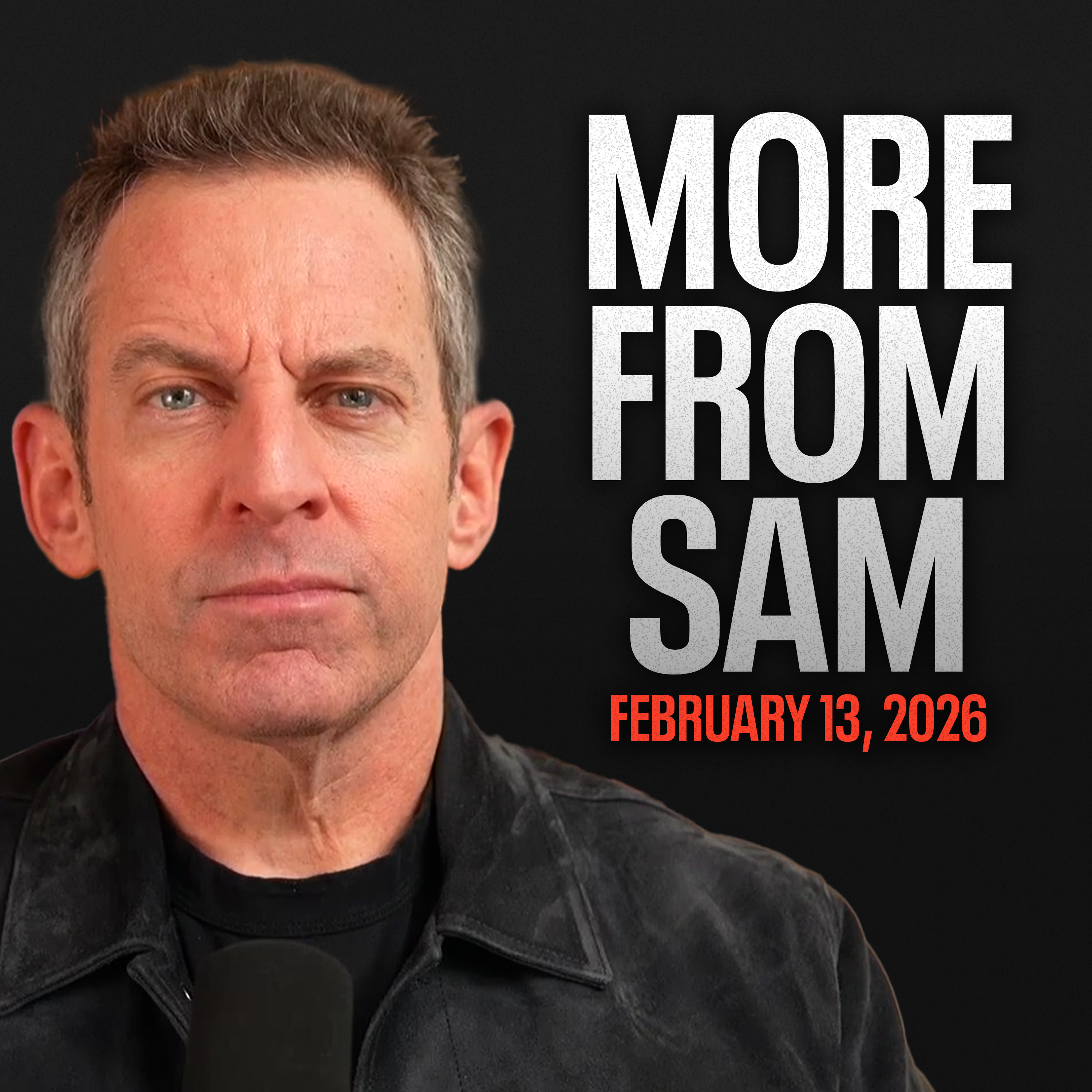
In this episode of the Making Sense podcast, Sam Harris engages in a thought-provoking discussion with Jaron Lanier, focusing on current events including political corruption, immigration issues, advancements in artificial intelligence (AI), and societal implications of workplace automation. The conversation highlights the intersection of morality, politics, and technology, drawing connections between recent events and broader societal trends.
Written by AI. May contain mistakes.
Sam and the host discuss their recent live event experience and audience engagement.
“It actually kind of surprised me that live still feels like something different, right?”
Sam reflects on his conversation with Tim Miller and Sarah Longwell, emphasizing common ground despite political differences.
“So I woke up this morning thinking about your conversation with Sarah Longwell and Tim Miller from the Bulwark, that media empire they have, and just thinking why it was so well-received by your audience.”
Discussion of potential collaborations with Tim and Sarah, including live events and crossovers.
“quarterly podcast crossover event where it appears on both podcasts.”
Sam analyzes the corruption surrounding Trump's dealings and the implications for U.S. politics.
“World Liberty Financial, it sounds so official, sold a$500 million stake to a member of the Emirati royal family shortly before his inauguration last January.”
Discussion of AI's impact on white-collar jobs and the potential disappearance of many professional roles.
“so as to profit and to have his family and friends profit.”

Get the gist, explore an idea or ask about something said.
 Claude
On Making Sense with Sam Harris, what are the key points of this episode?
Searching your listeningAutomatic transcript. May contain errors.
0:28Welcome to the Making Sense Podcast. what we're doing here, please consider becoming one.
0:35Welcome back to another episode of More from Sam. Hey, Sam, it was nice seeing you a few minutes ago and seeing you again here. A long time no see. Yeah, we just did a Substack Live. I thought that was really good. Yeah, yeah. It actually kind of surprised me that live still feels like something different, right? I mean, obviously the experience of looking at a camera and talking is identical, but just the knowledge that it's live and that you can't take any of your words back. It's somehow thrilling or gets your attention. So I like it. We didn't give subscribers much heads up at all. We will do that in the future, but we just had thought of it at the last minute.
1:11And anyone who would like to join us for one of those in the future, you can become a subscriber and join us over there. We will give you more time. And I thought it was really cool that we were able to take some questions from the audience and do that in real time. It's a different experience being live than recording, but we'll do more of those and we'll see where we can learn and figure out how to improve those. Yeah, it was fun. And I think we can record them. I don't know, like in this case, I think it was just if you were in the room, you were in the room, you know, which is frankly kind of nice, you know, to treat it like a live event as opposed to yet another podcast, you know, piece of content that we're just going to record and put out there.
1:50So, you know, I think we should give people a heads up so that they can they can be there if they want to be. All right. So I woke up this morning thinking about your conversation with Sarah Longwell and Tim Miller from the Bulwark, that media empire they have, and just thinking why it was so well-received by your audience. And I don't even know what their positions are on most issues, but I'm sure they're more conservative than yours. They're conservatives, correct? You know, I don't even know where there's daylight between us in interviews. I mean, yes, you would expect there to be differences because they're both formerly Republicans, right?
2:20So they're coming from the other side. They're both gay, so they're I mean, I don't know how conservative they could be socially, but - My point is it doesn't even matter. It seems like it didn't even matter anymore. There was such a sense of relief hearing you guys speak together. It's almost like we never really cared about some of those other differences. And we've realized that now we just care about decency, decorum, sanity, having somebody on the other side just see, at least see everything the same way that you see things. Yeah, yeah. And also they're much closer to the political history there.
2:52I mean, they're just obviously having spent all their time right of center. They see how Trump and Trumpism bent everything into this awful shape. And they have relationships, many more relationships than I had. They got distorted by these changes. So yeah, it's great to talk to them. I'm just a huge fan of both those guys. And they're just very fun. And they're so trustworthy and likable. They just feel like, you know, listening to the three of you talk, it just felt like, you know, three of my friends were getting together and I'm certain the audience felt the same way that there was this FOMO.
3:24Like I just, I wish I could have been in there with you guys. I saw a comment on YouTube and thought this was a nice note from them. It says, as a progressive, I probably don't agree on many policy issues with Sarah and Tim, but I have come to trust them to tell it straight over almost anyone else, including most of the progressive podcasters I listened to. So I don't know. I mean, it just seems that everybody liked hearing you guys speak. I can't help my mind thinking that perhaps we should make this a quarterly podcast crossover event where it appears on both podcasts. I think the audiences would enjoy it.
3:57And then even putting maybe a few live dates together. I'm getting ahead of myself, but I definitely think people would like to see the three of you guys. I think they're touring. I think they're touring right now. They're going to Minneapolis to do a live event there. I think I noticed, yeah, so people should check them. I mean, they're taking their podcast on the road to some degree. Oh, I am certain they are a lot of fun to hang out with. So good for them. According to the Wall Street Journal, President Donald Trump's cryptocurrency firm, World Liberty Financial, it sounds so official, sold a$500 million stake to a member of the Emirati royal family shortly before his inauguration last January.
4:33Months later, the Trump administration agreed to supply the UAE with highly coveted American-made AI chips. Now, we've talked about this before. Or is there anything to add with this latest information? No, it's just as tawdry and as dangerous and as self-serving and as corrupt as anyone could have imagined, right? I mean, the crucial detail here is that we're giving chips, our most advanced chips, to the UAE that does military exercises with China. And these are chips that, precisely the chips we don't want China to have. And we're not, we're relaxing those security concerns because Trump and his family managed to get hundreds of millions, arguably billions in the transaction.
5:12So what's wrong with that? If you pretended to care that Hunter Biden got some money serving on a board in Ukraine that he was not qualified to serve on because of the name association with Joe Biden, and you thought maybe even Joe Biden, in the worst case scenario, got some of that money, and you're looking at those emails, and when they say 10 % to the big guy, you thought, oh, that's a smoking gun. How awful. well, let's just destroy this guy's presidency and burn everything down because of how corrupt and unseemly this is. You're that person who cares about the integrity of our politics to that fine degree.
5:46Hunter Biden and his grifting are intolerable. And yet now, magically, you go look in the mirror, see how much you care about a president who's managed to extract billions of dollars over the course of months by materially undermining the leadership role and military preparedness and actual safety of our country on the world stage, right? I mean, it's just like everything. Our alliances have eroded all of these tariffs. You know, whether you believe that he's earned 1 billion or 4 billion, depending on whose estimate you trust at this point, you know, he has just sold out our country every which way he could, so as to profit and to have his family and friends profit.
6:28I know we keep talking about AI, but it seems like the timelines keep moving up daily. I want you to watch this clip from the CEO of Microsoft AI in a recent interview with the Financial Times. Let's play that clip for Sam. You talk about superintelligence. Most of your rivals talk about AGI, artificial general intelligence. Explain the difference between AGI and superintelligence. I prefer the definition that focuses first on what would it take to build a system that could achieve most of the tasks that a regular professional in a workplace goes about on a daily basis. Think of it as a professional grade AGI.
7:07How close are we? I think that we're going to have a human level performance on most, if not all, professional tasks. So white collar work where you're sitting down at a computer, either being a lawyer or an accountant or a project manager or a marketing person. Most of those tasks will be fully automated by an AI within the next 12 to 18 months. And we can see this in software engineering. Many software engineers report that they are now using AI-assisted coding for the vast majority of their code production, which means that their role has shifted now to this meta function of debugging, scrutinizing, of doing the strategic stuff like architecting, of you know, et cetera, et cetera, putting things into production.
7:53So it's a quite different relationship to the technology. And that's happened in the last six months. What do you make of that? Well, so I know Mustafa a little bit, a very nice guy. and obviously he's very close to this work. I mean, he came from DeepMind. He was one of the founders of DeepMind and moved over to Microsoft. So I think his prognostications are probably as credible as anybody's at this point. You know, it's pretty alarming when you think of the societal implications. If in a year we have the complete cancellation of the need for human cognition of the white-collar type, you know, I mean, that's, I don't know how many people that is, but it's a lot of people.
8:35And it's basically, certainly most of the high-status jobs, right? I mean, one of the ironies and surprises here is that the robots are coming for the lawyers and doctors and software engineers before they're coming for the janitors and massage therapists and nurses and plumbers. And so if you went to college and incurred$200 ,000 in debt, and that degree enabled you to get to the rung on the ladder where you're currently standing, it's very likely that part of the ladder is in the process of disappearing, right? And the entire ladder, I mean, Mustafa's saying that the ladder itself is evaporating.
9:19So what he's saying now is in principle already true of the bottom rung. If you'd like to continue listening to this conversation, you'll need to subscribe at samharris.org. Once you do, you'll get access to all full-length episodes of the Making Sense podcast. The Making Sense podcast is ad-free and relies entirely on listener support. And you can subscribe now at samharris.org.
9:55Thank you.
In this latest episode of the More From Sam series, Sam and Jaron talk about current events. They discuss Trump's cryptocurrency dealings with the UAE and their national security implications, AI timelines and the looming end of white-collar work, the impact of Trump's immigration crackdown on U.S. population decline, potential U.S. military action in Iran, the end of the Minnesota ICE surge, the Bad Bunny Super Bowl halftime controversy, and other topics.
If the Making Sense podcast logo in your player is BLACK, you can SUBSCRIBE to gain access to all full-length episodes at samharris.org/subscribe.


