In short
Michael Pollan discusses the “hard problem of consciousness”: why subjective experience (“what it’s like”) can’t be explained by third-person, functional/neural descriptions alone. He distinguishes sentience, consciousness, cognition, and intelligence; argues consciousness is experience itself; and critiques claims that finding neural correlates solves the explanatory gap. He also connects consciousness research to psychedelics and meditation, and raises ethical concerns about AI potentially creating suffering “black boxes.”
Guests
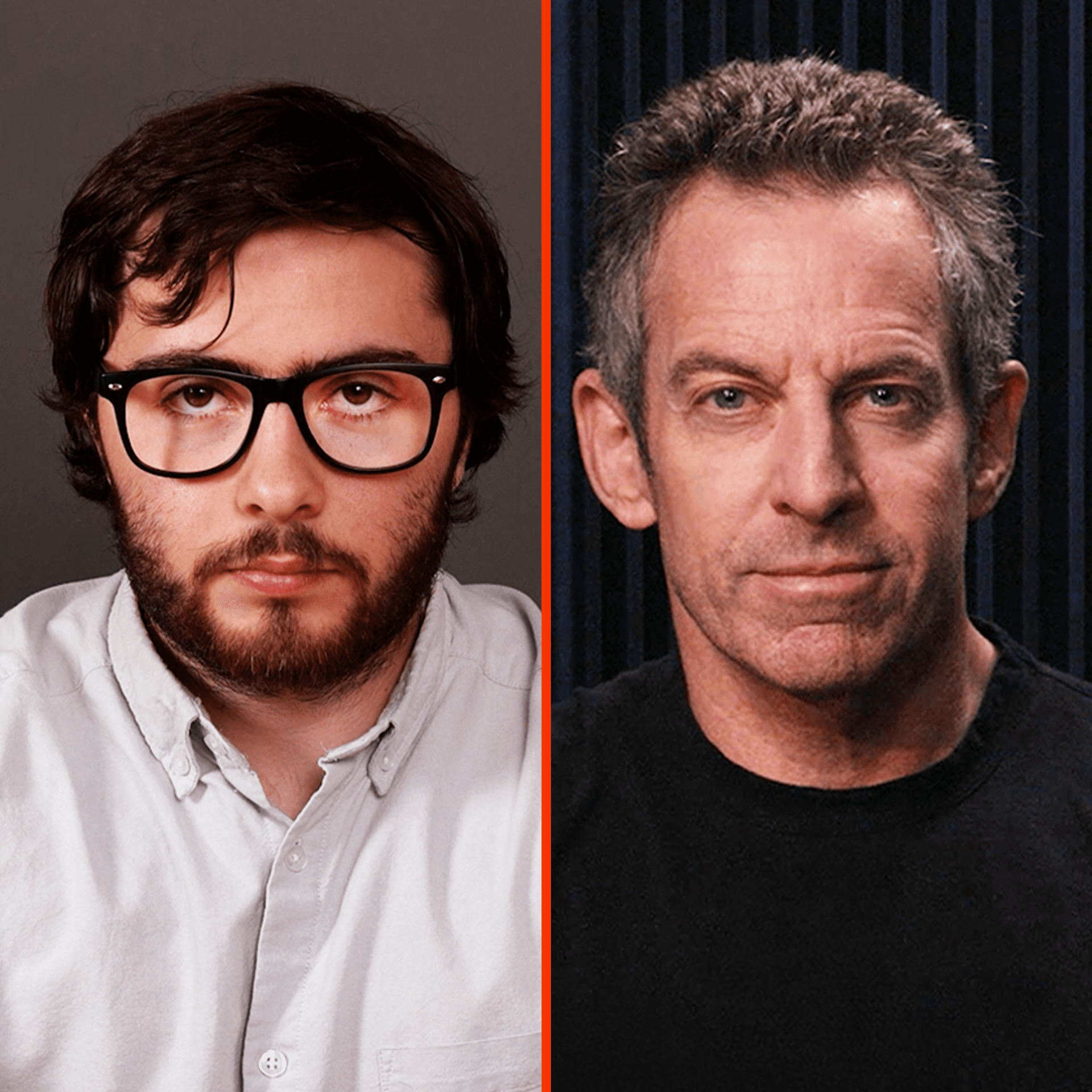
Michael Pollan (author; wrote How to Change Your Mind and A World Appears: A Journey into Consciousness; previously studied psychedelics and consciousness; influenced by meditation and “waking up” experiences). Sam Harris hosts.
Key claims/examples
psychedelics “defamiliarize” consciousness (smudged windshield metaphor); Nagel’s “bat” example; Leibniz’s mill/explanatory gap; Koch/Crick neural correlates don’t answer “feeling of being me.” Evolutionary role: Carl Friston’s social-navigation/theory-of-mind idea (Pollan doubts). AI risk: we may build conscious-suffering machines without realizing.
Written by AI. May contain mistakes. Listen to the episode to check what was said.
Chapters
Tap a time to open that second in VOReconnecting with Michael Pollan
0:46 to 2:55
Sam and Michael discuss their previous conversation and the passage of time.
“It was How to Change Your Mind had just come out.”
Exploring Consciousness and New Book
2:56 to 4:50
Michael shares his journey into writing about consciousness and its relation to psychedelics.
“She said, yeah, you'll do something interesting with that.”
Defining Consciousness and Related Terms
4:51 to 6:32
Discussion on defining consciousness, sentience, cognition, and intelligence.
“It's not mine alone, but it's not always made between sentience and consciousness.”
The Hard Problem of Consciousness
6:33 to 9:03
Exploration of the hard problem of consciousness and its implications.
“I mean, they don't necessarily go together.”
Influential Thinkers on Consciousness
9:04 to 11:39
Discussion on philosophers and scientists who have contributed to the understanding of consciousness.
“And just to be clear for people, again, it's amazing how hard it is for many people to form an intuition about what makes the hard problem hard.”
Psychedelics in the Scientific Discussion
11:40 to 13:20
Michael reflects on the role of psychedelics in modern scientific discussions about consciousness.
“and they thought that would solve the problem.”
Cultural Perspectives on Psychedelics
13:21 to 14:02
Exploration of the changing cultural attitudes towards psychedelics since the 60s.
“And there would be no psychedelics in the book.”
The Evolving Perception of Psychedelics
14:02 to 15:30
Explore how attitudes towards psychedelics have shifted over the years.
“about their psychedelic experiences and how it had affected their work.”
Psychedelics and Societal Impact
15:30 to 17:26
Analyze the political connections and societal implications of psychedelics.
“Most dangerous man in America, which is quite a statement.”
Psychedelics: Tools for Understanding Consciousness
17:26 to 19:04
Discuss the role of psychedelics in studying consciousness and meditation.
“There's going to be profiteering and attempts to limit access, attempts to patent things that shouldn't be patented.”
Show all 12 chapters
Experiences and Expectations of Psychedelics
19:04 to 21:49
Investigate the discrepancies in psychedelic experiences among individuals.
“That a mystical experience that was permanent would probably be schizophrenia.”
The Hard Problem of Consciousness
21:49 to 25:28
Delve into the evolutionary role of consciousness and its implications.
“And then, so then when he went back, he, he did it again and it worked the same way or didn't work.”
Transcript
Automatic transcript. May contain errors.0:01You're listening to Making Sense with Sam Harris. This is the free version of the podcast, so you'll only hear the first part of today's conversation. If you want the full episode and every episode, you can subscribe at samharris.org. There are no ads on this show. It runs entirely on subscriber support. If you enjoy what we're doing here and find it valuable,
0:21Sam Harris:please consider subscribing today. I'm here with Michael Pollan. Michael, it's great to see you again. Yeah. Great to be back, Sam. Or to see you for the first time. We were just talking about the fact that the last podcast, I think it was just audio, right? It was a phone call, effectively. Yeah. I actually remember the day really well. It was 2018, and I was in a hotel room in Portland, Oregon. Has that much time passed? Jesus, that's really depressing. Yeah. It was How to Change Your Mind had just come out. Yeah. Wow. And we were talking about psychedelics. If, uh, this is must be a function of, of age, but when asked to estimate how much time has elapsed, I'm always off by a factor of at least two, if not three.
1:03Sam Harris:I mean, I, it's always, and I'm always wrong in the direction of underestimating. So, um. Yeah, it's been a while. Yeah. Well, it's great to see you. It's great to see that you have a new book and you have, you have written a, um, not everyone does this. you have written a bestseller on the nature of consciousness. And the book is A World Appears, A Journey into Consciousness, which is an all-too-natural follow-on from your last book on psychedelics, How to Change Your Mind. Before we jump into the deep end of the pool, let's just have you connect those dots for me. How did you convince yourself that you wanted to go deeper in this direction?
1:40You know, I think it's a very common response to psychedelic experience. I had a series of experiences, research trips, if you will, from when I was working on how to change your mind. And one of the things psychedelics kind of reliably do for people is defamiliarize consciousness. You're suddenly made more aware of it. I described it in the book as like smudging the windshield through which you normally perceive reality. And suddenly you realize, hey, there's a windshield. What is that about? Because most of the time it's utterly transparent. You can go a long time without thinking about consciousness.
2:13So that was, you know, so I'd put it in front of me as a set of questions. And of all the things, you know, whenever you finish a book, there's always a few threads that are left, you know, untied and, you know, curious paths. It's too late to go down. You're on the last chapter. And consciousness was definitely one of them. So I thought, and I had a wonderful editor who was willing to support me on an expedition with a very uncertain destination. And because I set off on this really not knowing where I was going, what I was doing, and with no sense of what to expect. And, you know, God bless her.
2:53She's since passed and got off with her name. She's a wonderful editor. She said, yeah, you'll do something interesting with that. So I was off.
3:01Sam Harris:Well, you've certainly done that, and we'll spend the next, I don't know, 90 minutes or so thinking about consciousness. But I think you arrive at a place that I've arrived. I don't know if it's stable in the end, but I seem to have occupied this spot for quite some time. I mean, thinking about consciousness and specifically the hard problem of consciousness, which we'll talk about in a moment, is something that just utterly kind of subsumed my intellectual interests somewhere around the mid-90s and held them for quite some time. And you wrote a really interesting book on it. I mean, it was about the self, but it was really about consciousness.
3:37Yeah. Waking up had a big influence on me.
3:40Sam Harris:Nice. Well, but I think many of us in this game eventually beat our heads against the wall long enough that we finally admit to ourselves that we're not going to solve the hard problem of consciousness. Now, there are many people in your book who have not admitted that. Spoiler alert for this podcast episode. We'll talk about this. But, I mean, ultimately there is something more to do or less to do than think about consciousness, which is to say you can simply be consciousness more and more subtly and deeply and continuously. And, you know, that's where things like meditation and psychedelics come in.
4:18And so your book almost takes you full circle back to questions of being more than thinking.
4:25Sam Harris:But the thinking is fascinating. And, you know, we need to do it because we need to talk about it. Let's just define our terms at the outset, which you do early in the book, but we should just distinguish a few concepts. There's sentience, there's consciousness, there's cognition, there's intelligence. I mean, we'll talk about AI and intelligence is something that many people are thinking about now and in its various instantiations. How do you define or disambiguate these terms? Yeah. So I made a distinction. It's not mine alone, but it's not always made between sentience and consciousness. And you see that coming up in the whole discussion about AI.
5:06Some people use the word sentient to describe these machines that they think may be conscious. Sentience is a more basic foundational term. It involves ability to sense your changes in your environment, assess whether they're good or bad, and allow you to move toward one and away from the other. It may be a property of life. Single-celled creatures, you know, bacteria have chemotaxis, so they can distinguish between molecules that are good food and ones that'll kill them and act accordingly. So sentience is kind of very basic, perhaps permeates all of life. I can't be sure about that. Consciousness is a more elaborate form of sentience that involves other things such as a sense of awareness, feelings.
5:56In the case of humans, not only awareness, but awareness we're aware, we layer it. And so human consciousness is just how we do sentience. And every creature that is conscious does it in a slightly different way, presumably, reflecting their sensorium their body type the scale at which they operate all these kind of things intelligence and consciousness are not on a spectrum or on a on a together they're they're orthogonal i think their relationship intelligence is i define pretty much as problem solving ability and uh so that's quite a part i mean we all know people who are conscious and not intelligent i I mean, they don't necessarily go together.
6:37Cognition is the taking in and processing of information from the world. I think that's kind of how I define it. So, yeah, and consciousness, I define simply as experience or subjective experience. Pretty simple. You don't have to include things like self-consciousness or meta-consciousness in it. Those are kind of bells and whistles that humans have added. I doubt many animals have them. Yeah.
7:04Sam Harris:So consciousness is the fact that the lights are on and it's synonymous with the fact of experience, whatever we're experientially aware of altogether. I guess, so sentience still can be described. I mean, I guess the crucial line for me, and for many people who think about this, is that things like life, things like sentience, can be given a description from the outside in terms of their functional characteristics. I mean, does something reproduce? Does it metabolize? Does it grow, et cetera? These are characteristics of life. And then the boundary conditions can be somewhat diffuse, and so it can be hard to say whether a virus is alive in the way that a bacterium is alive, et cetera.
7:49Sam Harris:And so it is, I think, with sentience, at least under the definition you gave it. But consciousness is the fact that it's like something, to use Nagel's now immortal phrase, to be what we are. And if it's like something to be a bat, well, then that would be consciousness in the case of a bat. And that's obviously his famous example from his essay, What Is It Like to Be a Bat? And this disgorges what the philosopher David Chalmers has named the hard problem of consciousness, which I've already invoked without defining it. But it's just a simple fact that it seems that there's no third-person description of the way the world is that reduces the mystery that it should be like something from the first-person side to be associated with any collection of those facts.
8:39Sam Harris:Yeah, there's an inside. There's an interiority that third person perspective can't penetrate it can speculate about but i think that's a very good point you make about sentience and its difference that it it is something we can perceive and make a judgment about from the outside i mean there may be some slight inside to it but basically it's uh we can we can assess it from the outside and we can't with consciousness and that's a huge i mean that is the hard problem i'd put it i'd add also it's i mean it's the problem how do you get from matter, this, you know, three pounds of neurons in our head to mind, to subjective experience, if that is indeed the way it happens.
9:20Sam Harris:Yeah. And just to be clear for people, again, it's amazing how hard it is for many people to form an intuition about what makes the hard problem hard. And some of the most celebrated thinkers in neuroscience and philosophy, you know, many of them to my eye have not had any kind of natural intuition for this. And, And, you know, the symptom of that is they kind of blow past it, asserting some reductive explanation of consciousness as though they had solved the hard problem, whereas they really haven't even acknowledged it. And, you know, so we might name some of these people. But the hard problem predates Chalmers, and he gave it this name that was very, very sticky.
9:59Sam Harris:But it goes all the way back to Leibniz, at least. Leibniz invoked this image of a mill. You know, if you just imagine you blow up the brain to the size of, you know, a mill and walk inside it, at no point would you encounter anything that announced its sufficiency to produce the inner subjectivity of that organ. And there are many other philosophers who've touched this, Saul Kripke and Ned Block and Frank Jackson and Joseph Levine. I don't know if you pronounce it Levine or Levine, but he gave us this notion of the explanatory gap, which is just another way of saying the hard problem. So the problem is that whatever the right answer for the emergence of consciousness is, if in fact it emerges, and so there's some description of the functional characteristics of a system or the way the neural correlates of consciousness are arranged, and consciousness emerges from that, even if we had that description in hand, the fact that that is the basis of consciousness, that first the lights are not on, then all of a sudden you change the wire.
11:08Sam Harris:firing diagram ever so slightly and an inner world appears, that is just the, you know, it doesn't mean it's not true, but it would be totally non-explanatory. There's just, there is this explanatory gap and whatever the right answer is, it's still going to look like a miracle. Yeah. Well, Christoph Koch, who was involved at the very beginning of modern consciousness science, started out with Francis Crick, the great scientist who cracked inheritance when he discovered, co-discovered the double helix. You know, they went looking for the neural correlates and they thought that would solve the problem.
11:43They would find that group of neurons responsible for subjective experience. And it was only a couple of years into that quest, and by the way, that quest goes on, that Christoph realized that, oh, even if we found the neural correlates, it really wouldn't answer the question we're trying to answer. How did that group of neurons, if there was such a group, produced this feeling of being me, this voice in my head. And so he was, that was the first of several crises he's had along the way.
12:15Sam Harris:Well, like many of us, Christoph has done some drugs in the meantime. That's given him another crisis. Yeah. Yeah. I mean, the influence of psychedelics on this conversation is fascinating. I mean, it's not surprising given what happened a generation and a half ago, but we had this hiatus in science where these drugs could not be experimented with. And before we dive into consciousness, let me just ask your opinion on this. I mean, how do you view almost the omnipresence of psychedelics now in the discussion here scientifically, but also in the culture? I mean, Are you at all worried that we're on the verge of recapitulating some of the eras of the 60s where we just we get a little too fast and loose with these drugs and there's a we invite some kind of backlash?
13:08Sam Harris:Or how are you feeling about the psychedelic part of this conversation? Yeah, I mean, well, first to go back a little bit, it was a real surprise. I thought I would mention psychedelics in the introduction of this book is something that inspired it and set me on this path. And that would be it. And there would be no psychedelics in the book. but they kept popping up and it was, and I wasn't bringing them up. It was the scientists working on the problem who are partly because they're stuck, partly because they're very open-minded to using any tools at hand. Many of them, you know, would talk to me unbidden about their experience with psychedelics and how in many cases it had influenced them.
13:47They're not doing studies. They're not involved in the various university studies, but they're personally using them. And And in some cases, getting insights that they think are really important. In other cases, not sure what exactly to do with them. But it just kind of was this, it became this motif in the book of scientists telling me about their psychedelic experiences and how it had affected their work. So I thought that was really interesting. You know, the whole issue of psychedelics has changed a lot since 2018. I mean, it is, first of all, more acceptable for us to have a conversation about it.
14:22I think in Waking Up, you know, you were kind of ahead of the curve in your willingness to talk about your own experiences. Many people regarded it as a reputational risk back then. What year was Waking Up published? 2014. Yeah, so that was early. That was before this science at Johns Hopkins had gotten a lot of, you know, publicity and suddenly we were taking psychedelics seriously as a therapeutic modality. I think we're in a very different moment than the 60s. I think there was a lot of careless use of psychedelics. Things went wrong and psychedelics also got really entangled in the counterculture.
15:01And that was part of the backlash. I mean, Nixon targeted psychedelics because he thought it was one of the reasons that American boys were refusing to fight in Vietnam. And he may well have been right.
15:12Sam Harris:Well, we should say that some people like Timothy Leary, perhaps most notably, made that political connection explicit, right? It's like, you know. Yeah, but so did Nixon. Nixon said, you know, well, he said Leary was public enemy number one. Yeah, the most dangerous man in America, I think. That's right. Most dangerous man in America, which is quite a statement. He also said that about Daniel Ellsberg, though. So most, he had a pretty broad definition of most. Now, psychedelics are no longer coded liberal or left or counterculture. I mean, look at last week, the president issued an executive order, supposedly easing the approval process and access to psychedelics.
15:55He's been driven in that direction by concern for soldiers, veterans dealing with PTSD and the high rates of suicide among soldiers. and that was a very deliberate, I think, move on the part of Rick Doblin at MAPS, who was really one of the pioneers of getting research started again. He made overtures to vets groups, to the VA, and to people like Rick Perry, former governor of Texas, who's a big supporter now of psychedelics. So I would say, if anything, there's more support on the right than the left. So I don't know that it's going to fall into the same backlash politics. It may if things go terribly wrong.
16:38There's also so much university research going on, so many trials, and it's rapidly being accepted as a legitimate area of study. There have been NIH grants to support psychedelic research. So I don't see us on the verge of that. I mean, people are still doing stupid things with psychedelics and there's still accidents happening. But I think we learned, or I think a lot of people learned a lesson from the 60s, which they're powerful substances. They have to be used with intention. People are tending to use them more in guided situations, which really mitigates a lot of the risk. So yeah, I'm not overly concerned about that.
17:22I think there's going to be all sorts of nasty things happening. There's going to be profiteering and attempts to limit access, attempts to patent things that shouldn't be patented. I mean, all sorts of things are going on there. And there's a tremendous hype cycle with lots of capital rushing in and then the capital rushes out and now it's back in. So it's going to be messy. You know, whenever capitalism gets a hold of something like this, it gets really messy. Yeah.
17:51Sam Harris:Well, it's especially obvious in AI at the moment. We'll talk about the implications there. I mean, one concern I have about the influence of psychedelics on this conversation is that there's some way in which I think that the psychedelic experience, to speak generically, can be indispensable but also misleading. I mean, it certainly can be with respect to the goal of meditation and what there is to recognize about the nature of consciousness there that is liberative or worth paying attention to. Um, there's something that I think, I think the, the experiences, the peak experiences people have on psychedelics while they advertise to them, the possibility of living a very different kind of life in the world.
18:37Sam Harris:They also can give the false impression that freedom is a matter of radically changing the contents of consciousness, radically expanding it and achieving something, some kind of permanent state that is analogous to what you enjoyed on the peak of whatever it was, you know, acid, psilocybin, MDMA, DMT, whatever your moment was. And so anyway, we'll talk about that because I think the - No, and I think that's a fundamental misunderstanding of the mystical experiences, which is how people kind of assess these experiences. That a mystical experience that was permanent would probably be schizophrenia.
19:19It's something in the context of everyday life. It's a period of transcendence, but it's not something you sustain. And you know, I mean, you know this history well, but many of the Americans who brought Buddhism to America started with psychedelics and then had the similar realization to what you're talking about, which is that it's not a practice. It's not something you can sustain day after day. And they moved into meditation, which was a place you could have a practice, obviously. Yeah. But the links are very interesting. And I think psychedelics may be a very good way to start a meditation practice.
19:55yeah i'm always taken with the fact that most of the experience is not the you know profound climax but this long tail which can go on for hours and is a meditation a very often a very good meditation in that you're totally undistracted and you can go really deep but you still have some control over your mind so i think the links are very interesting and i and i do think psychedelics are a legitimate tool for the study of consciousness, the scientific study of consciousness. You know, the first big study that was done at Johns Hopkins by Roland Griffith was of mystical experience. That's a very interesting aspect of human consciousness.
20:36And the fact that we have a tool that can pretty reliably induce it opens up all sorts of experimental possibilities.
20:45Sam Harris:Yeah. I mean, the reliability, apart from the tiny percentage of people who seem impervious to psychedelics for reasons that I don't know whether they've been explained at the level of their 5-HT2A receptors or not. But I mean, some people apparently, I never believe this. I mean, I accept it as a fact, but I just can't believe that there are people who, if given 500 micrograms of LSD, have no experience. The gurus. The gurus stories, yes. No, I'm not talking about that. I'm talking about just people who are ordinary people who are seeking to have an experience on psychedelics. And they, in the presence of a guide, you know, administering whatever, five grams of mushrooms.
21:23Sam Harris:I mean, I know people like this. I know at least two people who have taken whopping doses of psychedelics and literally nothing has happened. And so there are people who just, you know, for whatever reason, don't have the right neurons for better or worse. I was thinking more of the, you know, the stories. Ram Dass tells the story of his guru. Yeah, Neem Krolli Baba. Yeah. Yeah. Yeah. And just upping the dose, upping the dose, getting up to six or 700 micrograms and nothing happens. Yeah. Yeah. And then being in doubt as to whether or not he, uh, you know, had just palmed the, the, the, the medication and didn't take it.
21:53Sam Harris:And then, so then when he went back, he, he did it again and it worked the same way or didn't work. So consciousness is the fact that it's like something to be us, the fact that the lights are on. And there is a deep intuition or dogma or expectation in biology, at least, that the explanation for this must be evolutionary in some sense, right? about consciousness must have either evolved for some reason, because certain things that are adaptive and indispensable for us can only occur in the light of consciousness. Or I guess it could be an epiphenomenon, a view which sounds really counterintuitive to people, but which I've always thought had a lot going for it.
22:42Sam Harris:Famously, T.H. Huxley, who was a great defender of Darwin's theory back in the day, said that consciousness was like the steam whistle on a train, right? It's this super salient feature of the train's operation, but not at all integral to anything that's happening. I don't think he used the word epiphenomenon, but the concept of this is a phenomenon that rides alongside the thing you're interested in. It seems to be part of it, but it's really doing absolutely nothing. Tell me what you encountered when you asked people about the evolutionary role. Well, that was a real question I had. I mean, as you know, the brain, most of what the brain does, we're not aware of.
23:22It's processing information, taking in sensory data all the time and making changes, running homeostasis, keeping your body in the right temperature and blood gases and all this kind of stuff. So why should any of it be conscious? Why don't we automate everything? Why aren't we zombies? I think that's a kind of subset of a hard problem. And you can construct a good evolutionary story that would explain why it would be useful. And the best one I heard was from Carl Friston, who's a English neuroscientist. And I put this question to him, what good is it? What good is consciousness? And he said that for us, creatures who are fundamentally social beings, who depend on other people to survive, who have a long childhood where we're utterly dependent, much longer than any other mammal.
Read the full transcript
24:14Consciousness allows us to navigate social life, which is too complex and changeable to program. You couldn't hardwire everything you have to know to succeed in a human social context. So having the ability to predict what the other person is going to say or do, to imagine your way into their point of view, these are all highly adaptive skills. And you can easily imagine a couple of proto-humans, some of whom have that imaginary ability, call it theory of mind or something, proto-theory of mind, and are very good students of the other person and can read facial expressions and figure out what's going to happen next.
25:00compare that to someone who's kind of dense and doesn't pick up on social signals who's more likely to make a good bond and reproduce so you know who knows if that's true but that would create a pressure for something like consciousness to emerge from unconscious or from sentience say
25:17Sam Harris:yeah i don't know you buy it no i don't buy any of that members can hear the full conversation by subscribing at samharris.org subscribers get a private rss feed you can use with your favorite podcast player. We already believe they're conscious and they will convince us they're conscious. It's in their interest to convince us they're conscious. We could inadvertently build conscious machines that can suffer and be immiserated and we will have just built them like black boxes. Then we'll have no sense that, you know, we have just created hell and populated it.
From the publisher
Sam Harris speaks with Michael Pollan about consciousness, the mind, and the self. They discuss Pollan's new book, the relationship between sentience and intelligence, the evolutionary case for consciousness, the role of psychedelics in consciousness research, AI and the question of machine consciousness, the illusion of the self, and other topics.
If the Making Sense podcast logo in your player is BLACK, you can SUBSCRIBE to gain access to all full-length episodes at samharris.org/subscribe.