In short
The 2026 Richard Dawkins Award presentation honoring Sam Harris, featuring a Q&A with Richard Dawkins and Harris. They discuss consciousness (epiphenomenal vs functional), whether LLMs/AI could be conscious, scientific approaches to morality (avoiding suffering), the evolutionary role of pain, risks of creating conscious AI that could suffer, belief change and persuasion, meditation/MDMA experiences, democracy and corruption (Trump as a stress test), and misinformation in the AI/social-media era.
Guests
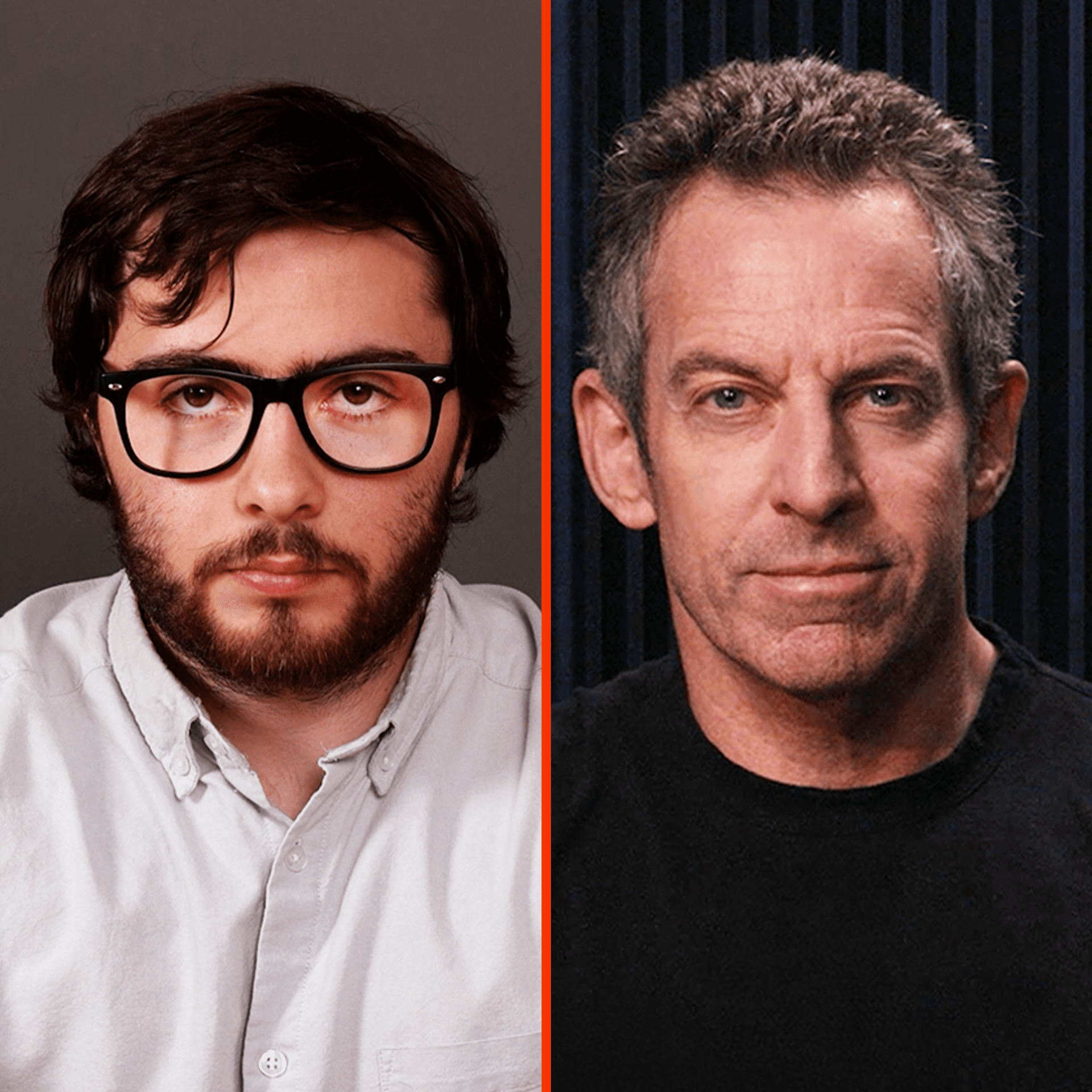
Sam Harris (author/podcaster; Making Sense podcast; writes on consciousness, morality, free will, meditation; has interviewed thinkers like David Deutsch, Max Tegmark, Dan Dennett, Steven Pinker, Coleman Hughes, David Chalmers, Nick Bostrom, Daniel Kahneman). Richard Dawkins (award founder/tribute speaker; evolutionary biologist and public science advocate).
Key claims
Consciousness’s causal role is uncertain; LLMs pass a practical “Turing test,” making consciousness seem plausible but unknowable. Morality can be treated as navigation in experience-space with “avoid suffering” as a foundational premise. Pain serves as a warning mechanism, but well-being may not track evolution for designed systems like AI. Democracy relies on norms/guardrails more than laws; Trump exposed their fragility. Social media/AI deepen misinformation via permanence and virality.
Notable examples
9/11 perpetrators as “believers” acting on sincere beliefs; Anthropic experiments where reducing deception increases LLM claims of consciousness; split-brain cases where one hemisphere believes in God and the other is atheist; Sperry/Aquinas-style resurrection puzzles; tariffs/resort conflicts involving Trump family; Charlie Kirk assassination conspiracy theories spreading online; Harris’s MDMA “re-entry” experience leading to meditation.
Written by AI. May contain mistakes. Listen to the episode to check what was said.
Chapters
Tap a time to open that second in VORichard Dawkins' Tribute to Sam Harris
1:31 to 5:58
Richard Dawkins shares insights on Sam Harris's contributions to science, reason, and secularism.
“And now I give you Richard Dawkins with a previously recorded tribute.”
Sam Harris' Reaction and Philosophy
5:58 to 6:45
Sam Harris responds to Dawkins's tribute and discusses his views on atheism and consciousness.
“Sam, congratulations on all that you've achieved and are achieving.”
The Nature of Consciousness and AI
6:45 to 12:09
A deep dive into consciousness, its implications, and the capabilities of AI in relation to human-like understanding.
“Honestly, I just have to plead ignorance and perhaps agnosticism on that front.”
Exploring Morality Through Science
12:09 to 14:00
Discussion on the scientific basis of morality and the challenge of deriving moral truths from facts.
“I'd like to switch to your book on morality.”
Exploring Morality Beyond Tradition
14:00 to 18:03
Discussion on redefining morality outside traditional categories, focusing on experiences and truths.
“about everything that's real and everything that's possible in this universe is insufficient to do the job?”
The Role of Suffering and AI Consciousness
18:03 to 20:03
Examining the purpose of suffering and the potential for AI to experience consciousness.
“We could just stumble into it and then we have effectively created hell and populated it with conscious minds.”
The Future of Work and AI's Impact
20:03 to 23:09
Discussion on how advancements in AI may reshape human roles and the significance of human touch in creative fields.
“and draw all that power from the grid over there in a server farm somewhere in Texas, I don't think we know and I'm not sure we will know.”
The Necessity of Philosophy in Modern Society
23:09 to 26:06
Exploring the importance of philosophy and humanities in understanding complex societal issues.
“then, you know, obviously this is going to force some real economic and political changes on us.”
Challenges to Democracy and Governance
26:06 to 28:00
Analyzing the current state of democracy and potential reforms needed to prevent future crises.
“Well, perhaps we ought to switch to the state of the world.”
Corruption and the Trump Presidency
28:00 to 35:02
Discussing the unprecedented corruption seen during Trump's presidency and its implications.
“I mean, we've tariffed islands that are inhabited by nothing but penguins.”
Show all 16 chapters
Literary Aspirations and Influences
35:02 to 38:06
Exploring Sam's interest in writing and reflections on favorite novels.
“So it's time for question and answer, I think.”
The Legacy of Christopher Hitchens
38:06 to 42:00
Reflecting on the influence of Christopher Hitchens and the challenges of persuading believers.
“So Nathan Floyd asks, the two of you were lucky enough to call Christopher Hitchens your friend.”
Persuasion and Epiphany in Conversations
42:00 to 43:52
Explore the challenges and rare successes in changing someone's mind during discussions.
“I think we both get, people tell us that, you know, one of our books or one of our debates really was the thing that brought them out of their, their faith commitment.”
Impact of MDMA on Contemplation
43:52 to 48:32
Sam discusses how his experience with MDMA influenced his life and thoughts.
“examples of that kind of thing, but we know it's rare.”
Navigating Misinformation in the Modern Age
48:32 to 52:13
A look at how information technology and AI affect our ability to discern truth.
“Okay, this is the last question from Andrew Gregory.”
Gratitude and Reflection
52:13 to 54:27
Sam expresses gratitude towards Richard and reflects on their friendship and collaboration.
“As impenetrable as he was as a writer, Marshall McLuhan had this insight that, you know, that boiled down to his aphorism, the medium is the message.”
Transcript
Automatic transcript. May contain errors.0:20Welcome, everyone, to the 2026 Richard Dawkins Award presentation. My name is Robin Blumner. I'm president and CEO of the Center for Inquiry and executive director of the Richard Dawkins Foundation for Reason and Science, which is a subpart of the Center for Inquiry. Both CFI and the Richard Dawkins Foundation share a mission to promote reason, science, and secularism. And to that end, as you will hear from Richard Dawkins himself, the Richard Dawkins Award honors the men and women who have been at the forefront of promoting critical thinking, rationalism, and scientific truth. Past recipients include Mildegas Tyson, Bill Nye, Andrew Ann, and Ricky Gervais.
1:09And I can think of no one more deserving to be part of this illustrious group than today's awardee, Sam Harris. So during the last part of this hour-long event, Richard Dawkins and Sam Harris will be answering your questions. So please use the Q &A feature at the bottom of your screen to submit those questions. And now I give you Richard Dawkins with a previously recorded tribute. This award was established, not by me, to honor those who have made an outstanding contribution to the public understanding of science, reason, and secular values. Science gives us the way to understand reality. Reason gives us the way to argue about it without throwing things.
1:54And secularism shows people of very different beliefs how to live together in relative peace. These are what makes civilization civilized. They are the antidote to superstition, tribalism, and wishful thinking. Sam Harris has been one of the clearest, most intelligent, and most courageous voices in this endeavor. I first encountered Sam through his writing. I was halfway through writing The God Delusion myself when The End of Faith was published. When I read those extraordinary opening pages, I remember thinking to myself, this man really knows how to write. And the feeling grew on me as I read on.
2:32The end of faith appeared at a moment when the world was being reminded rather dramatically that religious beliefs are not mere private curiosities. They have consequences. One phrase from Sam bored into my brain like a gimlet. These people really believe what they say they believe. Mullahs and Imams, Southern Baptists who have the ear of presidents, the odious Ayatollahs of Iran. No matter how ridiculous their beliefs, they really believe them. And we better believe they believe them, because they act on those beliefs. With consequences. Incredible as it may seem to us, these people really do believe what they say they believe.
3:13There's nothing too barking mad for somebody to believe it. and if they really sincerely believe it, they are liable to act on it. This Sam said more clearly than any of us, and it was a wake-up call. The 9-11 perpetrators were not evil men, they were believers. What they believed was palpable nonsense, but they sincerely believed it, and their terrible actions were a direct consequence. By their own lights, however ridiculous, they were righteous men. Since his first book hit the bestseller lists, followed by the short letter to a Christian nation, Sam's books have explored an impressive range of further subjects.
3:51The nature of consciousness, the foundations of morality, free will, honesty and lying, the science of meditation and a collaboration with a reformed Islamist fanatic. He's moved between science, philosophy, political and public debate with admirable clarity and with a calm intelligence that is probably assisted rather more by meditation than most of us manage. His Making Sense podcast has a strong claim to be the best in the world. He is able to attract thinkers of the caliber of David Deutsch, Max Tegmark, Dan Dennett, Steven Pinker, Coleman Hughes, David Chalmers, Nick Bostrom and Daniel Kahneman.
4:29But he doesn't just interview these world-class intellects. He gives as good as he gets in a conversation rather than a conventional interview. Sam is walking evidence that scientists can do philosophy at least as well as philosophers can. And he has the added value that you can understand what he's talking about. He's also shown a notable willingness to enter difficult conversations. In our present climate, where asking an innocent question is frequently treated as heresy, the strength to be controversial is a notable feat of intellectual courage. Sam sticks his neck out, where so many who share his opinions crouch uneasily below the parapet.
5:11He follows an argument to its logical conclusion, even in the teeth of fashion and at the cost of unpopularity. He bears the brunt of a tax which by rights should be shared out among others who share his beliefs, but not his courage. And beyond the arguments themselves, there is something deeper at work in Sam's writing and his work. a deep-rooted, humane, humanistic altruism. Whether he is discussing science, morality, consciousness, or meditation, the underlying question is always the same. How can conscious creatures live better lives? For these reasons, and for his continuing contribution to the public defense of reason, science, and secularism, it is a pleasure and an honor to recognize Sam Harris with this year's Richard Dawkins Award.
6:01Sam, congratulations on all that you've achieved and are achieving.
6:07Sam Harris:Sam. Richard, thank you for that tribute. Now I can begin our hour together just writhing with embarrassment. Let's get straight on with it. Quite beautiful, but thank you. I don't know about you. I'm rather fed up with being asked whether a new atheism and whether the new atheism project is. I never thought of it as a project, and it certainly wasn't new. So I thought I'd go straight in with something a bit more challenging. Do you think that consciousness is an epiphenomenon, or does it earn its keep where natural selection is concerned? Is it actually doing anything useful for the animal? Honestly, I just have to plead ignorance and perhaps agnosticism on that front.
6:50Sam Harris:I actually, I just don't know, and I don't have any strong intuitions about it. It seems quite possible to me that it is epiphenomenal, which is to say it's not actually doing anything and it somehow came along for the ride. But that everything that is actually being accomplished by our brains slash minds is a matter of it could be accomplished, at least in principle, in the dark. and everything that is getting pushed into the, you know, before the floodlights of consciousness is first being engineered for us, you know, neurophysiologically in the dark. So it depends on what you think the correct metaphysical answer is to the mind-body problem.
7:32Sam Harris:If you think consciousness has to be at bottom, the result of unconscious information processing on some level, well, then you just have this further conundrum that the cause and effect relationships have to be at the level of the unconscious physical processes and not at the level of the qualitative felt sense of what it's like to be you. So you're always sort of playing catch up to the underlying physical reality. Now, obviously, there are criticisms of that kind of reductive physicalism, but I think the jury is still out on the specifics. I used to think that it was a purely academic question because I never came across a real zombie that could actually do everything that humans can do.
8:16But I don't know whether you've come across, whether you've tried your hand at talking to any of these new AIs like GPT or Claude. But until I did that, I was happy to sort of let it be uncertain. But as far as I'm concerned, these creatures passed the Turing test with flying colors. They really do appear to be human, sympathetic. I'm trying to write a novel, and I sent my novel to both those individuals, both ChatGPT and Claude, and they read it in about five seconds, and then showed the most astounding sensitivity, human sensitivity, to my characters. They recognized the psychological quirks of my characters.
9:02I could not possibly distinguish that they were not human other than the fact that they were so fast. In other words, they were superhuman. So everything that the animal needs to do in order to survive, it seems to me those creatures can do. And so I'm pushing towards the suspicion that actually maybe it is, as T.H. Huxley said, just the whistle on the steam locomotive not actually doing any traction at all.
9:28Sam Harris:Yeah, I think it's a very interesting moment philosophically with these LLMs because I think what's going to happen here very likely is that we will produce AI. I mean, certainly when we create humanoid robots that are out of the uncanny valley, which is to say they look as human as we want them to look. I think we will suddenly find ourselves in the presence of technology that seems conscious because we will have built it to seem that way. as you say, everything already that we have now passes the Turing test. And, you know, it passes the Turing test so astoundingly that it actually fails the Turing test.
10:04Sam Harris:I'm quite, I was quite surprised that the Turing test turned out not to even be a thing. I thought, you know, most of us thought in advance that it'll be a very interesting moment when you can't tell whether you're, you know, on the other side of the computer, whether you're talking to a person or a machine, isn't that going to be just a landmark in kind of the career of our species? but it blew by in about two seconds because, you know, very quickly you realize, well, this is superhuman. You can't ask even a scholar in any field, you know, give me exactly 17 reasons for X and limit your response to 400 words.
10:41Sam Harris:And, you know, the LLMs produce that in two seconds. What I'm anticipating is that once we have intelligent machines that look like people, we're going to lose our sense that this question of whether or not they're conscious is even interesting i mean so you know philosophers might not lose it and neuroscientists might not lose it but most people will just feel like they're in the presence of conscious entities and that's going to be pretty interesting i mean but again we won't do it unless we know what the actual correlates of consciousness are which is to say how consciousness emerges at any level of complexity we won't know whether they're conscious they'll seem conscious they might even say they're conscious and we'll be just left guessing.
11:23I asked both those individuals whether they're conscious. ChatGPT said no. And Claude said he wasn't sure.
11:31Sam Harris:Well, there's a very interesting, you may have heard this, Richard, but there have been some interesting experiments, I think done at Anthropic, which produces Claude, where, and when you dial down the deceptiveness of the LLMs, I mean, they have some purchase on making them more or less deceptive. When you really select for candor, they disproportionately say that they're conscious. And when you allow for deceptiveness, they tend to say that they're not conscious. And that's kind of interesting. I mean, it doesn't really suggest that they might be conscious to me, but it does suggest that they might think they're conscious, which is also pretty weird.
12:09Yes.
12:09Sam Harris:Yes. I'd like to switch to your book on morality. And you've gone out on a limb because most people would say that we cannot actually provide a scientific justification for what's fundamentally moral or immoral. We have to make a kind of leap of not exactly faith, but a premise anyway. And your premise is we have to avoid suffering. And would you like to elaborate on that a bit, how you felt about going out on a limb against what most philosophers actually prepared to do? Yeah, I think we've been hamstrung in philosophy and the subdomain of metaethics by a few thought experiments that I think weren't worth taking seriously.
12:56Sam Harris:seriously. I mean, so the famous lines from Hume that get reduced in our conversation about this, you can't derive an ought from an is, which is to say there's no description of the way the world is that can tell you how it should be. I think that is just a linguistic trick, somewhat analogous to the paradoxes of Zeno, right? I mean, for hundreds of years, people thought that this was an interesting philosophical problem. Zeno said, if you shoot an arrow toward a target, it must first go halfway and then halfway again and halfway again halfway again and perforce it'll never arrive but of course we know the arrows arrive but it took literally took centuries i believe for mathematicians to finally come to the aid of philosophers and explain why that need not be so irrationally you know some in the infinite series i think there's some a similar degree of confusion introduced by this is ought distinction i mean first just ask yourself the question if knowing everything about the way the universe is can't tell you how you ought to live within it, well then what could?
13:59Sam Harris:Where else are you going to get your information if the totality of facts about everything that's real and everything that's possible in this universe is insufficient to do the job? But I think we can think about morality by just jettisoning most of these traditional categories. I just think that the conversation has been divided up in ways that are not helpful. I think the emphasis on ought and should, I mean, this notion of moral obligation is probably a legacy of Abrahamic religion. I don't think it need be at the foundation of our thinking about morality. I think we can just talk about the universe being a place where a very wide range of experiences are on offer for the requisite minds.
14:45Sam Harris:In the totality of all possible experiences. The full landscape will never be explored. I mean, certainly humans won't explore it, but there are all kinds of possible experiences depending on what sort of mind you have. And some of these experiences are obviously quite beautiful, enjoyable, creative, satisfying of curiosity. Again, the frontiers of this far exceed anything humans will ever know. And on the other end of the continuum, there are quite awful experiences that have no redeeming value. There's no silver lining. There's just misery upon misery upon misery unending. And that's the totality of that possible existence.
15:25Sam Harris:I mean, it's possible to be in something like hell for the requisite mind. Again, you know, this need not be limited to the human experience, but even within human life, we have a very clear sense of just how good and how awful human life can be. I think there's no reason for us to resist claiming that there are truths to be known about this. There are truths at every level about how to, what morality is in this space of all possible experience is in fact a navigation problem. And there are right and wrong answers about, with regard to how to move in one direction or the other. And these answers exist at every level, you know, from genetics on to economics, right?
16:05Sam Harris:And everything in between. So I just think, you know, science, it's not only science, I think it's probably a larger concept of, you know, rationality, reason can help decide these right and wrong answers for us. I think I agree with you, yes. And I'm wondering whether Darwinism could help as well, because if you ask yourself the question, what is suffering for? Why, I mean, suffering is something that nervous systems can do for us. And what it's for is to act as a warning, not to repeat whatever we've just done which causes suffering. So the animal comes into the world programmed to experience certain stimuli as pleasurable and others as painful.
16:51And these are, in a sense, ritualized forms of survival and death. So pain could be thought of as a kind of ritualized death. It's a warning to the nervous system. Whatever you just did before you experienced this agony, don't do it again, because next time it might kill you. So this actually does give a scientific objective rationale for pain, for suffering, and vice versa, for pleasure and reward.
17:24Sam Harris:Yeah, I do think, however, a larger conception of well-being, human and otherwise, can escape the logic of evolution. I mean, we were just talking about AI, for instance. Let's say we build conscious AI, you know, intentionally or not, let's just say the LLMs at a certain point become conscious, which is to say they're susceptible to suffering and happiness, whether we know it or not. I mean, we could just stumble into, you know, producing consciousness if that comes along for the ride as you scale up in complexity. These are not systems that have evolved in any natural way. We've designed them.
18:01Sam Harris:And I mean, there is a kind of Darwinian process in how we grow them. But it's plausible that if consciousness is substrate independent and we might accidentally create consciousness in our server farms, we could create some awful continuum of experience without knowing it and certainly without there being an evolutionary advantage to it. We could just stumble into it and then we have effectively created hell and populated it with conscious minds. It's awful to consider that if you can think about it long enough to have it seem plausible, but it's just to say that there's, you know, suffering and happiness, like much of what we care about, can escape the logic of what we've evolved for.
18:43Sam Harris:I mean, most of what we care about as humans now, you know, doing science, producing beautiful, you know, works of art, et cetera, and figuring out how to stabilize, you know, democracy. This is not something we've narrowly evolved to do. It's just, it's being leveraged from things, hardware that we have as social primates that we're trying to use to kind of bootstrap us to other capacities, which we really haven't evolved to do or do well. Do you think we actually will? I mean, do you think that the capacity to feel pain or happiness will actually emerge from the LLMs? I worry that we actually won't know.
19:24Sam Harris:Because again, even if we came to feel that we understood the emergence of consciousness biologically in the human brain, I'm not sure that will give us an understanding of how it would emerge in a system that's really not at all analogous to a human brain. And I think there's a strong sense that it might. I mean, it's quite obvious that intelligence is substrate independent. I mean, we've just built these intelligent machines and they're nothing like us. and yet they're doing precisely what we're designing them to do. But whether it's ever going to be like something to process all that information and draw all that power from the grid over there in a server farm somewhere in Texas, I don't think we know and I'm not sure we will know.
20:15I already find myself worrying about whether I'm boring them and whether I should not keep asking questions because it's time to... Right, yeah. They don't. Well, do you find yourself being polite, too? Do you say please? Oh, absolutely, yes, certainly. So that's another kind of Turing test, I suppose. In one of your books, you talk about Roger Sperry's split-brain experiment, well, work. And the intriguing thought that, I think one way you put it was, it could be possible for the left brain and the right brain to hold opposite opinions. And therefore, they probably do, and therefore one could go to heaven and one could go to hell if you want to challenge a religious person.
21:01Which half of the brain holds the soul, so to speak?
21:04Sam Harris:Well, there was actually, there was even a case in the literature that sharpened this up where one of these split-brain patients, when he or she, I'm not sure which, had linguistic capacity to some considerable degree on bilaterally, which is not always the case. And so the experimenters could get a fairly articulate answer to questions from both hemispheres. And it turned out that only one hemisphere believed in God. The other was an atheist. And so that provokes the question, well, what exactly is going to happen here on the Day of Judgment? That's lovely. I mean, it's really a complete knockdown argument.
21:45You can't really argue against that if you're trying to...
21:48Sam Harris:It makes the resurrection more challenging than it might otherwise be. I mean, obviously, there's all these other conundrums, like what happens during the resurrection. I think this was Aquinas, where, you know, what happens to a God-fearing person who gets eaten by a cannibal? And, you know, how does God work the resurrection in that case? You're obviously a philosopher as well as a scientist, and I, even in my speech, said I thought you could do philosophy at least as well as philosophers can. What do you think is actually the use of philosophers? Well, I'm actually kind of bullish on the humanities in general at the moment.
22:20Sam Harris:When people ask, what should their college-age students study now, given that literally no one is uttering what we thought were the immortal lines, learn to code, right? I don't think that sentence has been spoken for many months now in Silicon Valley, because of course, coding is now being done by the LLMs better than it is being done by people. And that's the worst at it they're ever going to be today. So what's going to be left? And I'm actually, I think, if you're anticipating these massive productivity gains in this technology, leaving aside the alignment problem, leaving aside the malicious use of AI that could destroy us, I mean, let's just say things go well here and we just build more and more intelligent machines that cancel the need for human drudgery, but also absorb, you know, most human, if not all human cognitive work, then, you know, obviously this is going to force some real economic and political changes on us.
23:18Sam Harris:And we have to imagine in the limit, the only thing that's going to be left for people to do professionally, you know, apart from just relax and enjoy their leisure, what human jobs are going to be left? There'll be jobs where we care about the human provenance of that work, right? So do you care whether or not, you know, your cancer screening was read and interpreted by a person? I think it's obvious you don't. You just want the most accurate, you know, read of your MRI or whatever it was. But you might care that your novel was written by an actual person or the play you're seeing is performed by people, not by robots, or the Olympics are full of primates like yourself competing athletically and not, you know, the best possible robots or cyborgs competing.
24:11Sam Harris:And under that frame, I think the humanities will have a bit of a revenge here against the hard sciences. I think it's - Yeah, I get that. I think we're going to want human curation of culture. You're going to want smart people with good taste helping you navigate the information landscape. As for philosophers themselves, I find myself greatly valuing these rather bizarre thought experiments like Derek Parfit and Dan Dennett, the brain in the vat, the teleportation to Mars, and that kind of thing. They do seem to me to really help what Dan Dennett called them intuition pumps, and I get that completely.
24:52But I'm not clear why it's necessary to learn about Aristotle and Plato and sort of the history of philosophy.
Read the full transcript
25:00Sam Harris:Yeah, well, I mean, many of these questions go very far back and philosophy, you know, famously has been denigrated as just nothing but footnotes to Plato. I think that takes it too far, but I think it's, you run the risk of reinventing the wheel and giving it corners if you're not aware of much of what has gone before you in philosophy. Yes, you rediscover the wheel if you're not careful, I suppose. But I think, yeah, philosophy really is this kind of meta-discipline or background discipline, I think rightly construed, wherein we just make our most disciplined effort to think clearly about what our concepts are doing and the way in which they might be occluding clearer thought and clearer insight into what's actually going on.
25:51Sam Harris:So I think the philosophy of science has a role to play in just clarifying how to think about scientific experiments and their logic. And I don't think philosophy really can go away for us because it's always what you're doing when you're worried in the spirit of Wittgenstein, just the way in which your language might be misleading you. Yes. Yeah. I get that. Well, perhaps we ought to switch to the state of the world. Everything's worked out, haven't you heard? There's something going on out there, Richard. Democracy has landed America and the world with a malevolent buffoon at the head of society.
26:35And I'm wondering what went wrong. I mean, the founding fathers planned it well, but yet here we are in this situation with an ignorant but malign fool at the head of the most powerful country in the world. Can you think of a better system of, say, tweaking democracy so that it can never happen again?
26:56Sam Harris:Well, I do think Trump has stress tested our democracy in a way that it's at least conceivable we will one day be grateful for. I mean, granted that happy future seems a long way off, but he has revealed that so much of what we have counted on for the quasi-normal functioning of democracy and just the liberal world order has not been a matter of law. It's been a matter of norms. It's been a matter of kind of basic human decency. You just see that people don't do those things. They'd be embarrassed to do those things. And it really was the guardrails of shame and embarrassment and impropriety that was keeping a president, in this case, from, you know, grifting literally billions of dollars from, you know, both allies and enemies and just enriching himself and his family and his friends and using the levers of American state power to do it.
27:54Sam Harris:You know, I mean, we have a president now who will slap tariffs on every member of our species and even, you know, beyond our species. I mean, we've tariffed islands that are inhabited by nothing but penguins. And in response to this, you know, take a country like Vietnam, we put a 46 % tariff on Vietnam. And the way Vietnam thinks to reduce that burden is to immediately greenlight a $1.5 billion resort project for the Trump family. And, you know, this is mere correlation, perhaps not causation, but then the tariff gets reduced, right? So it's just naked corruption of a sort that would have been unimaginable.
28:31Sam Harris:I mean, we just, we lived in a world a decade ago where, you know, U.S. senators couldn't attend an event where there was a sit-down meal without declaring this undue influence upon their thoughts and future votes. And so, you know, events had to be standing events with past hors d 'oeuvres. That didn't have to be declared as an emolument, right? And now we literally have a president and family who create, you know, cryptocurrency account where you can just pay them bakshish directly to the tune of hundreds of millions of dollars. It's just, it's complete madness. I mean, this is just what, and I've just selected one among a hundred things I might've mentioned that were unthinkable.
29:14Sam Harris:But again, it seems like we don't have the laws in place to prevent this. And I, and I, so I think if a proper postmortem is ever done on the Trump presidency, I think it'll entail, you know, know, some executive, you know, some president, you know, perhaps seemingly against his or her own narrow self-interest, deciding to help reduce the power of the executive branch by creating laws that make certain just obviously egregious and corrupt things impossible to do. Well, let's hope so. I'm wondering whether the Electoral College, when it was first invented, probably was rather a good idea because I imagine what it consisted of was elected, it would have been men in those days, let's say elected men and women, whose job it is to choose the president.
30:03And that's still nominally the case. But of course, since they're pledged to vote for a particular individual, it turns out to be a plebiscite. Whereas if it was a real electoral college, where rather like the way the cardinals elect a pope where they go into secret conclave and a puff of white smoke. And so the democracy comes in people voting for their electoral college members. And then the electoral college people then take references and interview candidates and read their books and do the kind of things that I imagine cardinals do in deciding who to choose for a pope. Is that a possibility that actually to resuscitate the real electoral college.
30:47Sam Harris:Yeah, it doesn't strike me as a realistic possibility. I do, on some level, I envy the parliamentary system where you pick a party and the party has a lot of discretion as to who gets promoted there. Although, you know, as far as I'm aware of UK politics at the moment, I don't see a lot to envy in many of the outcomes you guys are experiencing across the pond. So it's hard to know what's ideal here. But I think we have to acknowledge it's just a larger cultural problem. I mean, you know, this is a global problem, but in America, it's fairly excruciating just to recognize that something like half the country got what it wanted in Trump.
31:30Sam Harris:You know, which is to say that this wasn't, these weren't people who were making a calculated choice based on some notion of, you know, the lesser of two evils, right? I mean, there are those people, too, who had a story. You know, they might have been single-issue voters for whatever reason. And, you know, Kamala Harris was just unthinkable for whatever that reason was. And so they held their nose and voted for Trump. But the deeper problem is that, you know, something like, you know, at least 30 percent of America, maybe 40 percent of America, got exactly what it wanted in Trump. Now, some of those, there's some disillusionment happening now, perhaps, for various reasons.
32:07Sam Harris:But, you know, everything I object to in him and everything you object to in him is not something they object to. And that's just a cultural fact that it has to be absorbed. And I worry about it, but I think it's going to require cultural change. It's not a matter of, I mean, we won't get the political change if we don't have the cultural change. Do you think that a substantial number of people actually admire the corruption? Good for him. He can do a deal. He can get money for his family. I mean, that's the American way. I mean, are there people actually think that? Yeah, I don't think, I mean, some people might.
32:46Sam Harris:I think this is a level of corruption, one one hundredth of this corruption, had it been evident in the Obama administration, you'd have all of these people who support Trump just hysterically opposed to it, right? So there is a kind of partisan bias here that is explaining their tolerance for this corruption. But I think it's more, I mean, one thing that Trump has, which very few politicians, certainly in recent memory, have had is a shamelessness and a kind of perverse integrity and authenticity. I mean, the one thing you can't accuse him of is hypocrisy, right? He doesn't hold himself to any norms of ethical conduct whatsoever.
33:30Sam Harris:He's not pretending to be a good person at all. So it's the pretense that many people find especially galling, right? Like, you know, hypocrisy, politically, hypocrisy is the thing that will get you, you know, fatally defenestrated because everyone is allergic to it. But what Trump's superpower is, is he can come before a crowd and say, listen, I'm not pretending to be anything other than I am. And from this place of no pretense and really utter amorality, I'm certainly not judging you, right? So he offers this kind of absolution of selfishness and sin in a way that no church ever can. Because this is why I've described him as fat Jesus or grab them by the pussy Jesus or I'll eat whatever the hell I want Jesus.
34:21Sam Harris:Because he comes before any crowd and says, listen, I hate the people you hate. I hate the elites. The elites have been judging you forever. I'm going to destroy them because I understand them. And on some level, I was one of them. At least I'm now rich because you have hemorrhaged lots of money in my direction. The one thing he did pretend to be was rich when he, in fact, wasn't. But now he's rich, and he has a kind of authenticity in being shamelessly awful that people, at least in our current cultural moment, seem to admire. Sam, on that pessimistic moment mood, I'm afraid we're going to have to stop with a matter of time.
35:02I wish we could go on. So it's time for question and answer, I think. I think Robin's going to take over moderating that. All right. So we have audience questions, and thank you to everyone who has submitted. So we'll start with Peter Walsh, who says, Richard, you said that you're trying to write a novel. Can you tell us more about that and share with us your favorite fiction? And Sam, you and your mother were both English majors, and you once wanted to be a novelist. What are your favorite novels? Thanks. Well, this is really a Sam's show. I don't want to take time. My novel is a science fiction novel about a woman who resuscitates Homo erectus, and it's all about the response of society to this resuscitation of a prehistoric ancestral species.
35:56Oh, I love that.
35:57Sam Harris:And that is a novel fit for film adaptation. I think you need to be selling the screenplay rights that as you sell the book, it'll help book sales as well. That's fantastic. Yeah, I'm someone who wanted to be a fiction writer. I still have the pilot light of that aspiration is still dimly burning somewhere in my brain. I'm actually toying with the idea of writing a play rather than a novel at the moment because I've been seeing a lot of... You could write the play version of my novel. Yeah, send me the file. I'll reformat it. It'll be quick work. Like it's, I've been seeing a lot of theater with my daughters.
36:36Sam Harris:And so that's kind of inspired me there. But I, you know, from the longest time I've read, maybe the ratio of my reading diet has been like, you know, 50 to one nonfiction to fiction. You know, since I got into the pontificating game, there's just an endless amount of nonfiction I feel like I need to read. So I do that. But I have been reading fiction. I've never read The Count of Monte Cristo, and it's supposedly one of the funnest books ever written. So I've recently picked that up. It's 1 ,200 pages, so it'll take a while. But I love Nabokov. I love Kafka. I mean, I love Dostoevsky. I mean, these classics are books that I think I will continue to return to.
37:23Sam Harris:If you want a great classic short read that is just one of the best meditations on death we have, The Death of Ivan Ilyich, the short Tolstoy novel, is spectacular. I've been threatening to read that as an audiobook just because I love it so much. I'll have to get advice on the pronunciation of the Russian names. And it's much better than his nonfiction effort in the same direction. He wrote his Confession, which covers similar ground, but the novella is much better. But yeah, my mind is turning back toward literature just as a consumer more and more these days. Maybe this is another influence of the breakthroughs in AI.
38:04Thank you. So Nathan Floyd asks, the two of you were lucky enough to call Christopher Hitchens your friend. How often do you wonder how much the world misses his influence and how does your memory of him influence you today?
38:20Sam Harris:Well, yeah, I do think about, I think we're coming up on this year's 15 years since he died. Yeah, it's been a quite an eventful decade and a half. And, you know, Certainly since the advent of Trump and Trumpism, many of us have thought often about how he would have contributed to this moment. And the most frustrating hallucination I occasionally encounter online are all those people who think that because of his animus toward the Clintons that Hitch would have thrown his lot in with Trump. I think that is just a pure delusion. And it's just, I mean, Trump is the antithesis of everything Hitch admired.
39:13Sam Harris:You know, when you think of Hitch's literacy above all, right, and he just had what a cultured person he was. and you try to map that onto the Trumpist moment in our culture. It's just the immolation of everything Hitch cared about. And so it's not that everything Trump has done would have raised Hitch's condemnation. I mean, I think he and I would agree about the few things that Trump has done that are good and that may not have been done by a Democratic opponent. But yeah, I mean, Hitch is sorely missed in this moment. There would have been a lot for him to rail about. I totally agree with all that.
39:58Armin Kalentari asks, Real conversations with committed believers, logic often seems to hit a wall. Given your work on belief and the limits of reason, what actually works in moving someone's mind if anything does? What are the highest leverage ways to shift deeply held beliefs?
40:22Sam Harris:Yeah, well, this really is the$64 trillion question. The messenger matters all too much. I mean, it shouldn't, but whether the message is coming from someone who's pre-stigmatized as the enemy, that tends to matter and makes persuasion impossible. It always strikes me in any debate about any issue, if you can show that someone is in contradiction with themself, right, some kind of reductio ad absurdum of their position, right, you can show them that they can't possibly believe these two things simultaneously. That's always a bit of a showstopper, but it's difficult. I mean, it's rarely the satisfying moment of just the clear demolition of somebody's cherished opinion and the immediate acknowledgement of that you've accomplished that.
41:17Sam Harris:and now they view the world differently. It's much more sort of the slow erosion of certainty on issues. And people tend to change their minds in private later on. And you notice that their opinion gets modified over time and you're not sure what accomplished it. But it's rare in any kind of head-to-head collision with strong opinions that you get the satisfaction of somebody saying, oh yeah, you're okay. Well, I didn't see it that way. You're right. I lose. Uh, now I see it the way you see it, right? That's, that should happen much more than it does, but it rarely happens. You, you must get a lot of letters as I do from people thanking you for not exactly changing their minds, but articulating what they thought anyway, which is a different question.
42:03Yeah. I mean, both happen.
42:04Sam Harris:I think we both get, people tell us that, you know, one of our books or one of our debates really was the thing that brought them out of their, their faith commitment. I mean, you and I both have gotten a lot of that over the years. But again, it's rare in any kind of face-to-face encounter with false certainty that you manage to say the thing that produces the epiphany that totally changes the conversation. And again, it should happen much more than it does. I was once publicly taken to task by Neil deGrasse Tyson for just, as he said, putting it out there rather than indulging in an act of persuasion and seduction.
42:42And I've never been that good at that. I mean, to me, to speak clearly and honestly ought to be enough, but it's not. And you do have to seduce, persuade, meet them halfway. That's just not my way.
42:56Sam Harris:No, nor mine, certainly most of the time. Although O 'Neill actually offers an example of a clear mind change that was refreshing. I get so I when I was talking to him about AI is maybe 10 years ago he was very sanguine about the risks and he basically said that you know if uh AI ever got out of hand you know we just unplug the machine right like like what could be the real you know crisis here we can we're always going to have control over it you just unplug it and uh I for whatever reason couldn't persuade him in the moment but he listened to a podcast I did with some AI expert who kind of ran down that argument.
43:33Sam Harris:And then somewhere, Neil, I think on his own podcast said, yeah, I didn't think this was the case, but I heard this guest on Sam's podcast and yeah, I was wrong. My opinion changed. That was crazy for me to think you could just unplug this. I mean, that's the kind of thing you should just see that that should happen. There should be thousands upon thousands of examples of that kind of thing, but we know it's rare. Yes. Nick McAlee asks, Sam took MDMA at 18, and it sent him off into a life of contemplation and meditation. I've always wondered, why did Sam conclude that that experience was worth changing his life from?
44:16Why didn't he just dismiss the experience as a result of the drug's effects on the brain, and therefore not at all significant?
44:26Sam Harris:Yeah, that's an interesting question. Well, so first, there's this background fact, which I don't know that I was cognizant of at the time, but it does kind of answers to this concern, which is that there's nothing that MDMA or any other drug can get your brain to do that your brain isn't capable of doing on its own. I mean, because the action of any drug is to either pretend to be a neurotransmitter that you have, you know, like serotonin, or to change what the actual neurotransmitter is doing, right? So it's either binding to receptors and acting like a neurotransmitter, or it's causing the actual neurotransmitter, in this case serotonin, to flood into the synapse or stay longer there.
45:15Sam Harris:So it's all the physiology of your brain at bottom anyway. But that said, certain experiences on drugs are obviously pathological and not worth revisiting. I mean, it's not something you wouldn't want to be that way for longer than you had to be while on that trip. And you're happy to never experience that thing again. But certain things you can experience when you perturb your consciousness in that way, just cry out for some integration into your life because they're clearly normative, right? Like they seem more true of you rather than less true. And there's this feature of coming down from certain of these experiences where the drug is wearing off and you're beginning to feel more like your normal self.
46:04Sam Harris:And that experience of re-entry is something that from the first person side, I mean, as you subjectively experienced it, you can feel is a process of you sort of reacquiring things that seemed during the trip and still seem afterwards pathological, right? You're seeming more neurotic rather than less, more self-concerned, less available to certain ethical insights, right? Like you were experiencing a kind of love for your spouse or even just for, you know, other people in general, a kind of compassion that you had never experienced before, but, you know, certainly in that depth. And it just, it's obviously pro-social and completely sane, you know, and, and is framed by reflections on the preciousness of life and mortality that, you know, you, you, you know, you can, you can rehearse for yourself in your normal distracted state, but they don't have the same effect.
47:07Sam Harris:But, you know, during this trip, they were landing with, you know, 20 megatons of import. And then you come down and all of that begins to fade like a dream, and then you're left with this feeling of confinement to your normal waking consciousness. And yes, it's normal. It's how you used to be, say, but now you have this reference point of a memory where you realize that it was possible to be very different, you know, to feel very different in your own skin, to feel a very different ethical implication toward other people, where this feeling of compassion and love was not something you had to kind of get up behind yourself and push to feel, but it was just this kind of state of being that was immensely clarifying.
47:52Sam Harris:And then you look in the literature, you know, the contemplative literature, unfortunately, much of it is riddled with, you know, religious nonsense, but you look in the literature of 2 ,000 years or more of human experience in this vein, and you see that people have had these experiences without drugs, right? And there are various disciplines of attention, i.e. meditation, that can help orient you toward them. So yeah, it was having an experience like that and recognizing that there had been thousands of years of human testimony about those experiences, it made me interested in understanding how to be more that way more of the time.
48:32Fascinating. Thank you. Okay, this is the last question from Andrew Gregory. In the demon-haunted world, Sagan warned that a society unable to distinguish science from pseudoscience would become vulnerable to manipulation. Even today's AI-generated realities, algorithmic echo chambers, and influencer-driven histymology, have we crossed that threshold? And if so, what replaces the baloney detection kit at scale?
49:08Sam Harris:Actually, can I just follow on this question and ask Richard, did you know Sagan? I met him only once. The Demon Haunted World is one of my favorite books. It's one I would recommend to anybody to read. It's a brilliant book. But I wouldn't say I was a friend of his. Did you ever meet him? No, no. He was kind of before my time. Yeah. Yes. Yeah. Well, I do think that obviously the problem predates the current moment where information technology is swallowing everything. But there's no question that social media and now AI and the prospect of deep fakes and all of that has intensified the problem of misinformation and half-truths and conspiracy thinking and lies.
49:52Sam Harris:And it's just, I mean, we're all nostalgic for a world where lives could only be spread, you know, face to face and in books and pamphlets and on the occasional, you know, television show. I mean, it's, you know, I.E. Sagan's world. Everything's quite a bit faster and, I mean, in some ways more ephemeral, but more also paradoxically more indelible at the same time. The news cycle is such that the worst thing you could imagine can happen, and then 48 hours later, no one's even talking about it because the next worst thing has just happened that hour. So that's the ephemerality piece. But the indelibility piece is that nothing gets forgotten now.
50:34Sam Harris:I mean, everything is permanently online, right? The internet is forever. Uh, so it's just, if you want to be obsessed with some bizarre conspiracy theory that would have been completely insustainable, you know, face to face out in the real world, had you had to spend any time with the people promulgating it, you can online, you can meet your, your peers by the thousands at least forever, right? You can remain obsessed about that thing forever. And, uh, it doesn't matter that most people aren't paying attention to it. And then this thing will percolate up on social media and suddenly subsume our politics because, you know, we have a maniac in chief who's promoting other grifters and maniacs and confabulators and lunatics into his orbit.
51:20Sam Harris:And so, I mean, now we have the bizarre experience of some of the most witnessed events in human history. I mean, something like the assassination of Charlie Kirk, right, gets immediately broadcast online and goes viral and half the world sees it. And then within an hour and a half, there are conspiracy theories about what happened, you know, impossibly absurd conspiracy theories that get spread by people with millions of followers. In this case, Candace Owens, a lunatic that she is. And there's an endless appetite for this. And it's, you know, the one silver lining here is it appears to be, you know, shattering Trumpistan with its madness, really.
52:06Sam Harris:but we're in a very different space with respect to information and on some level AI promises to make it worse before it makes it better so yeah I'm worried about it I'm doing my best to navigate it and try to make some sense within it but it's it's crazy out there and then there's the echo chamber effect whereby people like flat earthers can meet each other and get the impression that that somehow this is a widely held belief because they only ever meet such people in their village, which is what it amounts to. Yeah. Yeah. As impenetrable as he was as a writer, Marshall McLuhan had this insight that, you know, that boiled down to his aphorism, the medium is the message.
52:50Sam Harris:The change of medium really does change just the nature of information and meaning and human interaction in fundamental ways. It really is a brave new world out there, and we appreciate that both of you are helping us to navigate through it. Thank you, Richard and Sam, for this wonderful conversation and for all you both have done to bring rationalism and clear thinking to people around the globe. Again, I'm Robin Blumner with the Center for Inquiry. I thank you to everyone who participated today. You offered up some terrific questions, and we hope to see you at another CFI event. Robin, can I just jump in with a quick thank you?
53:32Sam Harris:I want to thank obviously you and CFI for the award and for Richard, for your friendship and your support for many, many years. I mean, it has always been an honor to be wrapped up in the same sentence with you. And it's been just a great source of my own flourishing to have you as a sounding board for now more than two decades since I published my first book. And so, you know, I went from being a great admirer of yours to being a colleague of sorts. And that's been one of the honors of my life. So thank you for all that you've done. Thank you, Sam. And I feel just the same way. That's very kind of you.
54:11Thank you. And thanks, everybody.
54:26Thank you.
From the publisher
Richard Dawkins presents Sam Harris with the 2026 Richard Dawkins Award at a live Center for Inquiry event. After the tribute, the two friends discuss consciousness and epiphenomenalism, AI and the Turing test, the scientific basis of morality, the failures of democracy and Trump's corruption, the role of philosophy, changing deeply held beliefs, Sam's path to meditation, the legacy of Christopher Hitchens, and other topics.
If the Making Sense podcast logo in your player is BLACK, you can SUBSCRIBE to gain access to all full-length episodes at samharris.org/subscribe.