In short
Sam Harris “More from Sam” episode is a community-driven Q&A sampling topics: one-world government, physicalism vs unexplained phenomena, philosophy’s value, and how to handle “why are we here?” questions. He argues one-world government is not realistic soon due to political fragmentation; he can imagine dystopian AI-enabled totalitarianism but not a benevolent unification. On ontology, he’s a materialist-leaning physicalist but says consciousness remains a hard problem and may require revising physicalism. He defends philosophy as rigorous training for clear thinking, especially under AI. He rejects “why” as emotionally misleading; mystery can fuel curiosity. He discusses populism and debt: “we’re all in this together” should target truly wealthy people who can’t change lifestyles. He reassures a 26-year-old about becoming a doctor and a six-figure degree: AI will reshape roles, but human curation and some human layer will persist. No guests are named; the “guests” are community members asking questions.
Written by AI. May contain mistakes. Listen to the episode to check what was said.
Chapters
Tap a time to open that second in VOCommunity Engagement
0:45 to 1:49
Discussion about the Making Sense community and its dynamics.
“I really enjoyed many of the exchanges with so many thoughtful people there.”
Global Political Unification
1:49 to 4:40
Exploration of the concept of one world government and its feasibility.
“Is global political unification inevitable?”
Materialism vs. Unexplained Phenomena
4:40 to 7:27
Debate on the existence of unexplained phenomena within materialism.
“Are you a hard materialist or do you leave room for genuinely unexplained phenomena?”
Philosophy's Prestige
7:27 to 9:24
Discussion on the perceived value of philosophy in education and society.
“I feel like that question has it backwards.”
The Meaning of Life Inquiry
9:24 to 14:03
Exploration of questions regarding existence and meaning.
“I think there are corners of philosophy that are just word salad or mostly word salad.”
Exploring Curiosity and Life's Purpose
14:03 to 14:51
Sam discusses the importance of curiosity and exploration in understanding life.
“can i get more of that and again that's a failure to understand the attentional basis of these changes and experience.”
Wealth Inequality and Populism
14:51 to 16:40
The conversation shifts to the implications of wealth inequality and its relation to populism.
“Noah Smith says fixing the debt means cutting health care for the poor while the wealthy give up a vacation or two.”
The Future of Medicine in the AI Age
16:40 to 18:24
Sam shares insights on the future of the medical profession amidst advancements in AI.
“And I think he was saying, as many people have, that really it's going to require growth and inflation to get us out as well, right?”
The Value of College Education
18:24 to 19:58
Exploring the significance of college education in contemporary society.
“Well, it's, but again, we, then we've, we have to confront this at every level of employment, right?”
Critique of Miseducation and Its Effects
19:58 to 21:09
A critique on the outcomes of miseducation in institutions like Columbia University.
“But I think college is very useful for some people.”
Show all 11 chapters
Cultural Immersion and Life Stages
21:09 to 21:43
Sam advocates for a stage of life dedicated to cultural immersion and growth.
“case, I just don't think that's the outcome and it shouldn't be.”
Transcript
Automatic transcript. May contain errors.0:01Jaron Lanier:You're listening to Making Sense with Sam Harris. This is the free version of the podcast, so you'll only hear the first part of today's conversation. If you want the full episode and every episode, you can subscribe at samharris.org. There are no ads on this show. It runs entirely on subscriber support. If you enjoy what we're doing here and find it valuable, please consider subscribing today. Welcome back to another episode of More from Sam. Hello, Sam. Hey, good to see you. Good to see you as well. This time we're not taping live in front of subscribers. I'm traveling and didn't want the stress of whether the internet would hold.
0:37Jaron Lanier:So if you're hearing this, obviously it did. Making Sense community now has over 26 ,000 people in it and it's humming along nicely. I really enjoyed many of the exchanges with so many thoughtful people there. Everyone has been behaving and I think it's because they too wanted to see this succeed and you've been getting some good feedback and pushback in there. It's definitely not been an echo chamber.
0:59Sam Harris:No, no worries of that.
1:01Jaron Lanier:No, and you've been in there quite a bit yourself. It's almost like an Easter egg where I'm reading a thread and then I see a comment from you. We don't have a follow feature and I think that works out better because we didn't want to build this community to be dependent on you and it certainly hasn't been. So for today's episode, I'm going to try something a little different. Rather than running down a bunch of topics related to the news cycle, I'm going to grab a sampling from the posts in our community and get you to comment on them here. We'll also get your reactions to the Iran deal, whatever's happening over there, and to whatever current events are necessary.
1:35Jaron Lanier:So for those of you who are looking for that, don't worry. And just a quick note before we get going, if you want to join community or become a subscriber to the podcast, you can find subscription options by going to samharris.org slash subscribe. Okay, let's get started. One world government. Is global political unification inevitable? and would it be good? Should nation states eventually operate the way U.S. states do under a federal umbrella?
2:02Sam Harris:Yeah, actually, this is not something I've thought about recently, but now that you mention it, this is probably something I've changed my mind about. I think in my first book, The End of Faith, I wrote somewhere, probably in an end note, that it was just obvious that the end game for civilization is some version of one world government. What we want in the end, if things work out, is for the prospect of war between China and the U.S. to be just as ridiculous and therefore unthinkable as the prospect of war is now between Vermont and Massachusetts. It's just not going to happen. Nobody's worried about it.
2:37Sam Harris:And that's the case because they're unified under a single government that has a monopoly on the use of force. So something like that for the entire world must be where we're headed unless we're going to keep killing one another. I don't think I believe that now. Or if I do believe it, I think that goal is far enough away and quixotic enough that we really can't argue for it in the current environment. The idea that, in our case, the United States could ever be truly subordinate to the political whims of Europe or to say nothing of going further afield and greater cultural distance from us. Our own society is so dysfunctional politically at this point that the idea of a global version of this just seems genuinely unthinkable to me.
3:32Jaron Lanier:You don't think some super AGI of some kind would be able to solve that for us? Or you're saying maybe.
3:39Sam Harris:Well, I could imagine the dystopian version of this. I mean, you know, one world totalitarianism, like tech enabled, I could well imagine that being in our future. But in terms of a desirable future where we realize that we've converged so fully on our cultural priorities that we're just going to, you know, un-Brexit the whole world because it's just obviously good. And we really trust our brothers and sisters over there in Belgium and Congo and just everywhere else. I mean, it's just, it's not going to happen in the lifetime of our children or their children or any of their robots.
4:20Jaron Lanier:I just don't see it. Really? You just, you really think there's just no version where AI comes up with like all the best answers and we've all just gathered around and said, oh my God, this is just, this is not comparable.
4:31Sam Harris:You can't, if you're going to put it all an AI, then successful, perfect super intelligence, then I really don't know what the world looks like. And then the whole thing perhaps becomes a self-driving car and we forgot we ever wanted a steering wheel. But the dystopian versions of something like that are, I think, so much more numerous and easier to think about that I just don't see us overcoming our political fragmentation to a degree that makes even the aspiration for one world government something that you can talk about with a straight face.
5:04Jaron Lanier:Okay, next topic. Are you a hard materialist or do you leave room for genuinely unexplained phenomena? How do you handle people you trust who report experiences science can't account for?
5:14Sam Harris:Well, those aren't mutually exclusive. You could be a hard materialist and freely acknowledge that they're unexplained phenomena, right? You just think that the explanation, should we find it, will resolve itself within the materialist frame, right? So it's just not, I don't think there's anyone who's denying that they're unexplained phenomenon. I'm not a hard, I mean, I wouldn't consider, I'm certainly open-minded with respect to some other ontology other than materialism, or more commonly called physicalism at this moment, to remind people, you know, if you're a physicalist, you think that we live in a physical universe and that everything, including minds and their subjective experiences, are by some mechanism we don't currently understand, emergent properties of all of those physical forces and structures that really exist out there in the world.
6:05Sam Harris:I think it's totally plausible that physicalism, as currently thought about, can't explain consciousness in particular, and that consciousness either is just something we can't understand in terms of normal physical reductionism or it requires some other discussion about what is real. And maybe everything that we're considering physical has some mental properties or some interior dimension on some level. But if it is just in fact the case that there's really just a universe of quote physical and insentient fields and forces and consciousness emerges out of some combination of blind, unconscious events, information processing or otherwise, that may in fact be true.
6:56Sam Harris:That's not an explanation that is ever going to be intelligible to anyone. So I think the hard problem of consciousness is very real intellectually. And I don't know what the answer is to it.
7:09Sam Harris:So I I simply don't know how consciousness emerges out of the physics of things.
7:14Jaron Lanier:All right, I'm way out over my skis, so we're moving on. Does philosophy deserve its prestige, or is it mostly sophisticated opinion-making? Where's the line between genuine intellectual rigor and pseudoscientific hand-waving dressed up in academic jargon?
7:29Sam Harris:I feel like that question has it backwards. I don't think philosophy has much prestige in, neither in science nor in popular culture does, you know, certainly a degree in philosophy give you much gravitas, right? That's not, I mean, when on the list of, on the short list of useless degrees or degrees that are imagined to be useless by entrepreneurs and academics and, you know, just toss one out there, philosophy is usually on the tip of everybody's tongue. I mean, they just like, you're going to get a degree in gender studies or, you know, I don't know, dance or philosophy. Basket weaving. Yeah.
8:09Sam Harris:So as to be unemployable. I think it's actually one of the best degrees and selects for some of the best people in a university campus. And I think that's been true for a very long time. But increasingly, I think it's one of the best degrees if you want to be a generalist who can just think clearly and write clearly and speak clearly. I just think it's good training for all of that. Under the shadow of AI, I think it only becomes a better degree rather than worse. I think it becomes more practical. And we've talked about this. I just think we're going to want the human curation of digital products ultimately more and more.
8:47Sam Harris:If anyone's going to be left standing, it's going to be the massage therapists and the people with good taste intellectually who can kind of point in the right direction toward the robots that make more sense rather than less sense. I mean, I've always felt it was a good degree to get and prepared you for anything else that you might want to do pretty well, even if you're going to go into science. Because when you go into science at the graduate level, you basically have to relearn everything anyway. I mean, you take all the same basic courses to get started. So yeah, I don't think it has much gravitas.
9:19Sam Harris:I think it should have more. It's true that it depends what philosophy you focused on. I think there are corners of philosophy that are just word salad or mostly word salad. And yeah, those are, I think, rightly denigrated. But yeah, I've averted my eyes from most of that stuff. All right. Thanks for that.
9:40Jaron Lanier:Why are we here? Can you live a genuinely examined life without arriving at a satisfying answer to that question? Or is the asking itself the point? Or is neither the point?
9:50Sam Harris:I think it's the wrong question. I don't think you can extract much of value out of that question. It's certainly not the question that science asks. I mean, it's much more of a how question. How are we here? How did this happen? That's a scientific question. The why question attributes a, or seeks to attribute a reason behind all of this and perhaps an intention. I mean, it's a very theistic framing of the nature of the problem. What about the what? What is the meaning of life? Well, again, that just sort of smuggles in the same question under what. It's, there need not be a meaning to life. It's just, why should there be?
10:31Sam Harris:Without people, you would never be tempted to ask that question. It's like, let's say people become extinct. There's just a world filled with non-human animals. Look at that creation. Look at the wolves and the owls and the cockroaches. You would never be tempted to wonder, well, what's the meaning of this? Why did this happen? It's no less interesting to consider how it happened and what's actually happening and but um purpose that's just it's a very anthropomorphic lens to look at all of this through there's just the fact that the cosmos exists and you are part of it right and the whoa like why ask why in the face of that mystery the mystery isn't resolved let me just imagine the answer that if you could believe it if an answer were given to you, would it really resolve that mystery?
11:29Sam Harris:If a voice boomed out of the heaven saying, why? Because I wanted to? Or why? Because this is what I thought was beautiful? Does that really answer anything? Certainly, it just throws up more questions than you want to ask that maniac in the sky, what about smallpox? It can't possibly satisfy that it's not going to scratch the itch that anyone thinks it's going to scratch. So what is the right question to ask, or is there just no question to ask? Yeah, I think this questioning mode, So the emotional question, the feeling that there's a problem here emotionally that has to be solved, on the other side of which your happiness and tranquility will be found, that's an illusion and that's the cramp introduced by the question itself.
12:09Sam Harris:That's a failure of your attention to actually contact the mode of feeling good enough in the present moment. You're distracted enough, you don't recognize thoughts as thoughts, you don't recognize any space around thoughts. You don't know how to meditate. You don't know what your mind is really. You know, you're just being used by it in each moment. You know, you're effectively asleep and dreaming and now you're dreaming that you're sitting in a classroom wondering, you know, what's the point of it all. It's not the place from which you're going to answer this question and it's not the place where you could receive an answer that would be satisfying.
12:45Sam Harris:I mean, your problem is you just don't feel as good as you might feel if you paid closer attention to what it's like to be you in each moment, right? If you broke the spell of your identification with thought, it can actually rest, right? And you glimpse that kind of experience when you are really working out hard or thrown into some collision with the beauty of nature or you're having sex or you're appreciating art or something has moved you out of yourself or you've taken the right drugs, right? something has placed you in a quote, non-ordinary state of consciousness or a peak experience. And then you just, this, you've forgotten, you've certainly forgotten this question.
13:28Sam Harris:You're not asking any questions. You're just, you know, if the mind is going to come online again at that moment, it's going to, you'll be asking questions like, well, why can't I feel like this more of the time? Or how do I maintain this experience? Or maybe, you know, is it possible to move here where I can have this beautiful, beautiful view of the ocean or like the thing you think you that has moved you into that profound embrace of the present moment you think it's exogenous to yourself right again it's the landscape or it's the relationship or it's the you know whatever it is that the fun you're having in the company of friends it's you're going to attribute that as its cause and then you'll be left thinking how can i get more of that and again that's a failure to understand the attentional basis of these changes and experience.
14:15Jaron Lanier:So how do you answer this question if your seven-year-old nephew says, Uncle Sam, why are we here? What is the purpose of all of this?
14:25Sam Harris:Then I would say, I don't know, but the mystery isn't the problem. And the mystery can be the source of a very fun exploration of the world, right? That's everything, whether you're going to explore the mountains or you're going to explore a jungle or you're going to explore science or I mean, it's just your curiosity is not something you're ever going to get rid of. Right. So this curiosity is not a problem. All right.
14:50Jaron Lanier:In a recent episode of Making Sense, Noah Smith says fixing the debt means cutting health care for the poor while the wealthy give up a vacation or two. Is that the we're all in this together or is it obscene? And is this exact frustration what's actually driving the populist wave?
15:08Sam Harris:I guess I don't understand the connection there. We think the populist wave might, you're asking whether wealth inequality is driving populism?
15:16Jaron Lanier:Well, he's saying in the recent episode, I believe the question is, is that when Noah was talking about saying, look, we're all going to have to be in this together, the poor are going to have, not the poor, but the middle class are going to have to handle this and the wealthy are going to have to give up a vacation or two. And he's, I think he's, the question is, is that really what it means? We're all in this together that the wealthy are going to have to give up a vacation or two. And that's.
15:37Sam Harris:I forgot he said that. I mean, I would quibble with the definitions of the cohorts here. I mean, the wealthy, when you're talking about the wealthy, you're talking about wealth, the people who are not going to give up anything, right? No matter how much we tax them, they're not going to have to give up a vacation or two. I would draw the line at wealth where you're not, you're, there's not a conceivable change in your style of living that could matter. I mean, that most of your money is always just going to be numbers on a spreadsheet is never going to be implicated in how you spend your money, right?
16:09Sam Harris:That's the true, those are the truly wealthy people in our society.
16:12Jaron Lanier:The question I think is directly toward those people. Why can't those people bear more of the burden?
16:18Sam Harris:I think what Noah was saying though, is that even if you manage to tax those people quite onerously, it's still not enough money, right? We like the middle class is going to have to pay more in taxes too, right? And the, and the almost wealthy, right? The people who will feel it. It's just not, I mean, it's just, that's not, we're not going to tax our way successfully out of a$40 trillion hole. And I think he was saying, as many people have, that really it's going to require growth and inflation to get us out as well, right? It's just not, you can't redistribute your way out of it, but there's going to be, have to be a fair amount of redistribution too.
16:56Jaron Lanier:A 26-year-old is about to start medical school and wondering if it's a mistake. In eight years, will there still be a meaningful role for human physicians, or is this the wrong career bet at the worst possible moment?
17:08Sam Harris:It seems as good a bet as any, really. I mean, if you're going to worry that being a doctor is a dead end now, I think almost everything else is on that list at the same level. It's just as likely that there will be no lawyers and there'll be no, you know, even, you know, CEOs of companies, right? It's like, do you want to found a company? Well, what's to say that two years from now, that company won't even be more successful if a robot were running it, right? So it's not, I think, I don't think you can close the door on most professions like that at this point. It's just that there's going to be some way of being a doctor and using all the AI tools.
17:49Sam Harris:And if there's not, there's going to be some role for a person who almost became a doctor to use those, you know, use these tools better than most other people. I mean, there has to be some human layer to this. Otherwise, we're going to have to solve everybody's problem all at once by just spreading the trillions of dollars around that the robots have produced for us. So it's, yeah, I mean, I can't say that you should be pessimistic about whether being a doctor is even going to be a thing in a few short years. Because if that happens, basically everything is gone, I would say.
Read the full transcript
18:24Jaron Lanier:Well, but if the doctors are gone, that's probably, I mean, there's an upside to that. silver lining as well. That would, that would mean that.
18:30Sam Harris:Yeah. Well, it's, but again, we, then we've, we have to confront this at every level of employment, right? It's just, I mean, again, there'll be a few things that are probably more impervious than being a doctor. Again, things like being a massage therapist or, you know, something where you could just, there's this categorical difference between whether there's a human doing it or a robot doing it. And it's, you could imagine a preference for humans, but I mean, now that, I mean, maybe even that is not real, that preference.
18:56Jaron Lanier:I can just imagine where people would want the analog version still, and they'd want their doctor to show up with the black bag coming over like they used to many years ago. All right. With AI reshaping every career path, this is a related question. Is a six-figure degree still a reasonable bet?
19:13Sam Harris:I hope so. I mean, just culturally, it seems like we want our kids to still have that experience. There's something great about the college experience because it gives you four years to be a student and to just be interested in anything that you find interesting and to be surrounded by people doing the same thing. You know, so it's not that there's no pressure, but it's a very specific type of pressure. It's not the pressure to make your life work out in the world. It's not the pressure to find a career immediately. It's a very useful crucible and it's over far too fast for most kids, I think.
19:51Sam Harris:And culturally, I think it's valuable. I mean, there are other things that are valuable that I haven't experienced. Being in the military, I'm sure, is valuable and imparts its own lessons for people. And I think probably having mandatory public service that we've never had in my lifetime, which you can certainly make the case that that would be a good thing for our society as a way of overcoming hyper-partisanship and building culture intelligently and intentionally. But I think college is very useful for some people. You can certainly make the case that we have a lot of miseducated people out there now starting to run our institutions.
20:37Sam Harris:I'm sure we'll get into the Zoran Mamdani of it all, but I mean, the people who are finding the democratic socialists of America to be credible voices for the future of democratic politics, I mean, all of that's frankly terrifying and it is, you know, perfectly correlated with being a miseducated dummy coming out of a school like Columbia, right? So it's like, it's possible for the whole college experience to sum to something that's truly embarrassing intellectually and morally. But in the general case, I just don't think that's the outcome and it shouldn't be. And we can certainly guard against it.
21:16Sam Harris:And I think it's, if not college, I do think we want a stage in life that's kind of a monastic immersion in the good parts of culture for people. I think that's good.
21:30Jaron Lanier:So I wasn't planning to bring up Mondani, but do you want to get into that now? Members can hear the full conversation by subscribing at SamHarris.org. Subscribers get a private RSS feed you can use with your favorite podcast player.
From the publisher
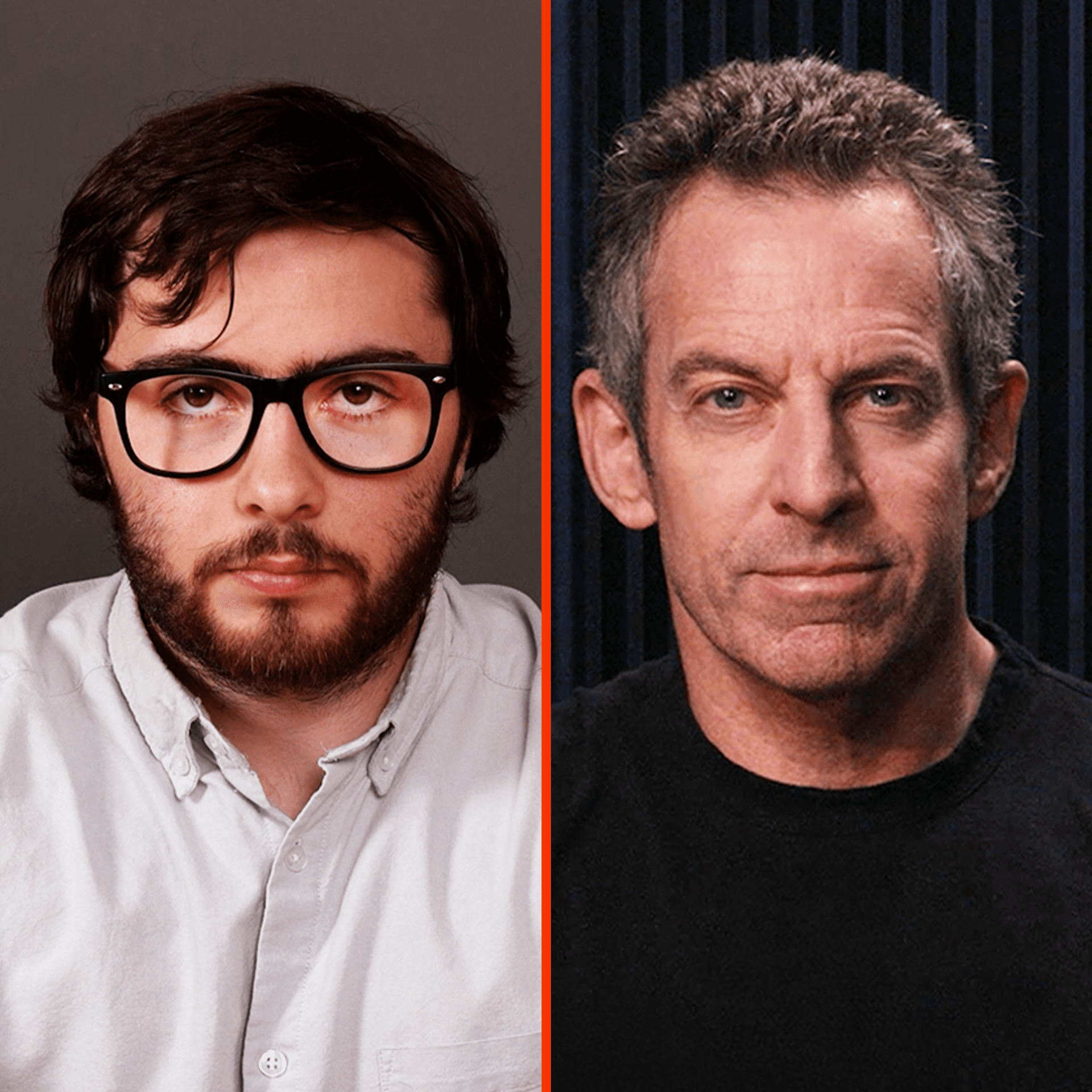
In this latest episode of the More From Sam series, Sam and Jaron talk about current events. They discuss topics from Making Sense Community, including one-world government, the value of a degree as AI reshapes careers, and factory farming ethics, along with Mamdani's DSA-aligned candidates, Trump's humiliating capitulation in the Iran deal, the Tulsi Gabbard guru story, and other topics.
If the Making Sense podcast logo in your player is BLACK, you can SUBSCRIBE to gain access to all full-length episodes at samharris.org/subscribe.