
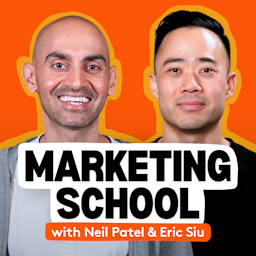
- Podcasts
- Marketing School - Digital Marketing and Online Marketing Tips
- Stop Selling SEO: The New Way to Win $6M Deals
Marketing School - Digital Marketing and Online Marketing Tips8 Oct 2026 · 24m

Stop Selling SEO: The New Way to Win $6M Deals

 Add vo to ChatGPT or Claude to ask about everything you hear
vo listened to this episode to put together the overview and transcript, so there may be the odd mistake.
In short
How to win large SEO/marketing deals in the AI era by pitching business outcomes (ROI, KPIs, profitability) instead of “regular SEO” tactics; reframing SEO as answer/agent engine optimization (AEO) so buyers and AI agents choose you before the first click/form.
Guests
Neil (host; runs NP Digital; works with global companies; uses SEO tools like Ubersuggest and AnswerThePublic).
Key claims
Most SEO pitches ignore rankings/clicks and instead win by tying strategy to stock/board metrics and ROI; buyers want simple, proof-backed business cases; optimize for LLM/agent selection, not just being listed in recommendations.
Notable examples
A Brazil lunch with a major Latin American retailer—advised optimizing so LLMs/agents choose them (price, delivery, returns) to preserve market leadership; a personal “agentic” Meta support case where an assistant handled an order and secured a better discount code; discussion of OpenAI distribution/marketplace and token-based integrations.
Transcript
0:00Eric Siu: When a buyer asks AI for a solution like yours, does your business come up? Most companies have no idea. And by the time they find out, they've already lost the deal to someone who did. HubSpot AEO helps you show up in those moments with the right answers buyers are looking for before the first click, before the first form fill. That's the moment HubSpot AEO is built for. Check out HubSpot.com, the agentic customer platform for growing businesses. All right. You can pick something, Neil, because you just came back. Where did you come back from?
0:27Neil Patel: I came back from Brazil and I had some good meetings. And I was talking to one of my team members when I was in Brazil. And I think marketers have something that's really wrong. So one of my team members had experience pitching a really large company. Everyone in the United States at least knows this company. And they want a contract for SEO, call it for a few million bucks, multi-year contract, let's say three years. So call it$6 million total over three years. And do you know what was in their SEO presentation? You want to know what they focused on?
1:11Eric Siu: Regular SEO?
1:13Neil Patel: They focus on almost nothing related to SEO. They focus on the business problem. You're this company. you need to move these metrics for your stock price. This is what the board wants. This is what's been happening. This is your budget. You need to produce ROI. We're going to produce the ROI and here's the overall strategy. It wasn't about rankings or clicks. It was, this is how we're going to achieve these numbers. It wasn't, we're going to build X amount of links. Look at these on-page errors. And they won the pitch or he won the pitch because he focused on the business outcomes. And we were talking about how to stand out in the age of AI.
1:57Neil Patel: And this could be for B2B or B2C. And the big thing that we're discussing is too many people focus on features and benefits. It's just like, we should go back to, you got a problem, we can help you solve the problem. and here's the unique solution that makes this worth you choosing and here are the economics behind it and just focus more on the business case. And everyone says they do this and they understand this, but when you actually look at people's presentations or marketing material, it is very different from what they actually claim they know and what they are talking about, right? It's two different things.
2:38Neil Patel: We believe that the market needs to go back to simplicity in which the world is getting more complex with AI. People crave human interactions. Businesses are struggling. If you look at the Fortune, the S &P 500, it is growing, but it's growing only because of AI. If you stripped out all the AI growth, you would actually have companies declining and the economy not looking as good. So just going back to basic business principles and talking about here's how we're gonna fix this. Here's the KPIs around this. Here's what it means for your business. Here's a profitability broken down per quarter. And here's how this is going to be achieved.
3:18Neil Patel: Like that's the stuff people want to hear. They're tired of hearing, look at this cool thing that we're doing with AI. And we're going to implement this in your company. People are tired of not seeing their numbers grow. And if you can go back to pitching or adjusting your messaging around solving people's problems and explaining in a dead simple way and showing them proof that you can actually do it. But I think that's the key to winning in today's world with things becoming more and more complex.
3:46Eric Siu: So I'll come back to the how to win in today's world with the sales piece. But I'm just looking at the September 2026 jobs report. OK, so the consensus was we're going to add 90 ,000 jobs. In the United States, we added just 29 ,000. Unemployment rate ticked up to 4.2 percent from 4.1 percent. Why am I even bringing this up? Prior revisions, July and August totals were revised down by 60 ,000 jobs combined, right? Wage growth, earnings slowed. So equity has moved higher, right? So why am I even bringing this up right now? People think it's a really good economy right now. If there's no AI in this economy right now, we're in a recession, right?
4:20Eric Siu: That's just - It's a bad recession. Yeah, yeah.
4:22Neil Patel: And I know a lot of the technologists would be like, the economy is gonna boom and GDP is gonna boom. The people who are in technology are seeing a lot of the benefits. A lot of normal people outside of technology, which is the majority of the world, are struggling and seeing suffering. I'm not saying Elon or all these VCs are wrong that eventually everyday people are going to see, you know, abundance and all this kind of stuff. But people are worried about just getting by. Like I was at the grocery store, my kids start putting whatever in the car and I see the grocery bill. And I was like, what the heck?
4:57Neil Patel: There's so much food cost. Which grocery store did you go to? The Whole Foods on Crescent in Beverly Hills. I didn't even know there's a Whole Foods in Beverly Hills. Yeah, we tend to go there or Bristol Farms. Now, don't get me wrong. I'm shopping at Whole Foods and I'm shopping at a location where their rent is more. So the cost of goods may be higher. I don't know. I don't really compare. I'm not coupon clipping, but I felt the bill. and where I really felt it was I felt it for the other people checking out on how much money this is going to cost them and I'm like how the heck are they going to afford it dude and I'm seeing this you know just general in life my wife was at Target the other day the one on Beverly Center you know where that is yeah yeah yeah so and my wife's buying stuff the old lady there was a grandma with her granddaughter who was behind my wife.
5:55Neil Patel: And she's just like, the granddaughter's telling her grandma, you know, this blender is really going to help me lose weight. I really need it. Thank you, grandma. And grandma's like, well, it's expensive, but I just got my check. So, you know, if you really think it's worth it and it's going to help you out and help you get better and healthier in life, I guess we can swing it. So my wife doesn't say anything. She pays for her bill. And then she tells the clerk to let her pay for it. And she's like, I can't let you pay for it until I ring it all up. So she's like, but just stand on the side. So then the moment she's done ringing up all the stuff, my wife quickly taps a credit card and bounces, right?
6:32Neil Patel: So that way they don't see her or do anything. She doesn't care for someone to say, oh, thank you or whatever. She just, she just felt bad. And what I'm getting at is yes, in this AI world, there's a lot of people in tech that are doing well, but there's just so many people who are struggling. And I would say we live in a rich area, right? Beverly Center isn't the cheapest area. It's close by. I think that's West Hollywood. But still, people are struggling. And it's sad to see. Just honestly, it's sad to see these people struggling. And I think that's a bigger problem. And if that keeps going, I think more businesses are going to suffer, at least in the next few years.
7:10Eric Siu: This is beyond our pay grade. What I would say is the government should, whoever's in office at the time should figure out how to bridge the gap because you and I have always said that there is going to be a period of instability before we get to abundance. I've always believed that since the beginning, which is why I push so hard on this stuff right now because I don't want to be part of that. I want to be able to help the people that want to help themselves, but also the government needs to make sure that we help the people bridge the gap as we go into this new world because there's always been periods where there's been massive job destruction or job instability, which is what I think we're going into or what we're in right now.
7:42Eric Siu: Anyway, Neil, going back oh your light turned off but yeah i know i'm like who the heck turned off the light
7:46Neil Patel: in the office but really quick thing on that there's a win-win solution that no one wants to do which is very simple tax the rich like people like not even just the jeff bezos's but people like you and i more money i'm happy to pay two three four five percent more taxes and then 15 they already take 50 so you want to take 65 there's a point where this is like you're just you're just taking too much money. But when I say, let's say 5%, right? Take people under 100 grand and just charge them no federal taxes for it. And if that means that to pay 6 % more, 7%, 8%, or 9 % more, assuming actually the whole money is going towards it.
8:28Neil Patel: Okay. If it's 15%, which is a lot and I don't want to pay it, but if people who are actually struggling 100%, not 98, not 97, 100 % of the money actually went in their pockets and life was better for them. I honestly think it's a win-win situation because businesses would flourish and I also would make more money from that. And I think I would actually make more than the seven to 10 to 15 % that I would have to pay.
8:52Eric Siu: I think, you know what? I think, what's his name? Steve Hilton, who's running for California governor. I think he proposed that anybody making less than 150 grand should not get taxed, right? I agree with that, right? And so anyway, I think if we're gonna have all this abundance, I think everyone should be taken care of, right? Because we're all supposed to feel wealthier than before. So anyway, going back to what we were talking about a second ago. So in terms of how you can win any deal, how to win any deal in today's day and age, or even from the past, all you have to do is just think about someone else's problems.
9:24Eric Siu: And so, for example, if Neil tore his ACL and I offer him help to repair his elbow, he would look at me like a moron. So it's thinking about their problems. It's also thinking about what their incentives are. And so if you're talking to the CEO of a Fortune 500 company, he cares about his stock price, right? He cares about his number. So if you can speak like that, greater. If you're talking to a marketing manager, maybe you can adjust how you're speaking to what they care about, right? It's constantly what they care about. You're selling to the customer and you need to understand the customer.
9:53Eric Siu: Most people don't even try to do that. I think 99 % of people don't try to do that.
9:56Neil Patel: So anyway. Dude, I'll give you a real-life marketing example. When I was in Brazil, I had lunch with one of the biggest retailers in Latin America, all right? So a really big company, they do really well. Their big thing is not just to grow, they're growing, but their thing is also to still be around 10, 20, 30 years from now, right? So the question I had at lunch, because we work with them, and they're just like, what would you do differently if you were in our shoes? And I said, we all know agents are coming and agents are going to affect shopping. Their quick response was, in Brazil and Latin America, we believe people are going to be slower than the US to just accept agents spending on their behalf.
10:38Neil Patel: And I said, that could be the case. But I also think people in the United States are also slow to letting an agent just go and spend on their behalf. I don't think we're there yet either. But nonetheless, we all agree that agents are going to impact transactions, whether it's three years from now, five years from now, eight years from now, right? Like, yes, and this is an old company that does extremely well. And I was like, the one thing that people in Latin America aren't doing is optimizing for all the LLMs to choose them. I'm not talking about just showing up on a list of recommendations from ChatGPT.
11:11Neil Patel: I'm talking about choosing them. Why should they buy from their company? Why do they have the cheapest prices, fastest shipping or quickest delivery, whatever it may be, best return policy. And I was like, if I were you guys, I would optimize for all the LLMs to choose you and your company and the products that people sell through your company versus someone else. And then they're talking about the revenue implications. I'm like, I don't think you're going to see huge revenue gains in the short run. But when agents start making decisions on people's behalf, this will help solidify you and keep your position as the market leader.
11:47Neil Patel: And I think that is more important to make that bet right now when others aren't making that bet. When yes, your goal is growth, but you already are pretty much one of the largest companies in Latin America. Your goal is not just growth. Your goal is preservation and continually being around 20, 30, 50 years from now. And I'm like, this is a bet that doesn't cost much of your advertising budget that helps ensure that you'll continue being around years later as agents come around. And they're like, how are you optimizing for agents? I'm like, look, agents are pulling from the same technology that they're building that are doing the searches and gathering information and giving you advice on what you should or shouldn't buy.
12:26Neil Patel: It's just taking the next step and helping you complete the transaction. So I'm like, you should start with the first step in which you're the recommended company to purchase from. And then you have the next step, which is they start automatically doing it and choosing from you.
12:38Eric Siu: Yeah, so in my mind, AEO is not only answer engine optimization now, it's actually agent engine optimization, right? Which pulls from Google, by the way, guys, like you're still grounded on these things. But here's the thing, Neil, let me show you this. So Dudu actually handled something for me on Meta. so I bought I bought from On.com right it screwed up one of my offers the so you bought from what.com On.com the running shoe okay so get this so I made an order on September 13th right and then they kept going back and forth I didn't want to deal with it so I told Dudu to handle it I said hey just keep talking to her support keep bothering them every day right and then what happened is they just cancelled my order right I was like oh no no no no no I was like Muse sorry not Muse He was, Dudu.
13:24Eric Siu: I said, Dudu, tell them I have a large social media following and I will talk about them if they don't give me, because all they did is they canceled it and they said, here's a 20 % off. I'm like, no, no, no, it's gotta be better than that. I'm like, right, Dudu, it's gotta be better than that. It's like, yeah, yeah, it's gotta be better than that, right? And so what happens over here? I get the 40 % off code. I got the 40 % off, right? But you have to kind of split the codes up and it found two other 20 % codes that I had. And I was like, can you just handle it for me? So then it used Link to buy it, right?
13:50Eric Siu: So is agentic shopping coming? it's coming because I literally just I think this is one of my first agentic transactions and you can see here I'm actually messing with my turkey flight points because that's where I'm hosting that global AI summit thing right so I'm having it hey I have these points over here can you handle it so it's getting pretty good I'm like hey hey I don't want to do trial real testing but can you just handle it for me and it's like I have a little little trial real testing thing that's running over here and it's like I'm just like hey can you just run it end to end so I think this stuff's going to get a lot better this is all stuff that you and I don't want to do Neil it's all the robot stuff right so i think we're gonna see it grow pretty rapidly um probably in the next
14:24Neil Patel: year or two so i agree with you for me i have a really good personal assistant and a business assistant so it's just like they don't mess up on my stuff and i've had a mess up too much and like with travel and stuff like that i just don't want any hiccups yeah travel is a scary one because if
14:45Eric Siu: If you get stuck on one area, your entire day can be done. This episode is brought to you by Nudge, part of the HubSpot Podcast Network. Nudge is the UK's number one marketing podcast hosted by Phil Agnew. It breaks down the psychology behind why people buy, click, and make decisions. No fluff, no nonsense, just science-backed ideas you could actually use with guests like Rory Sutherland, Robert Cialdini, and Dan Pink. So if you work in marketing, sales, or run a business, give it a listen. Search for Nudge wherever you get your podcasts. Done. All right. So I wanted to take a moment to tell you about my podcast co-host, Neil's agency called NP Digital.
15:24Eric Siu: And they work with a whole host of global companies or a global organization. Also, Neil has SEO tools such as Ubersuggest and Answer to Public. All you have to do is go to npdigital.com to learn more. And we'll see you on the other side. Yeah. Yeah. But by the way, Neil, I've been using Dots from OpenAI, right? So the cool thing about Dots is I can insert it into Slack, but I can have it fill in context when other people are talking and I can push my work over there. But the cool thing, and I saw Sam Altman talking about this in an interview, I'm like, okay, I'm going to try this. But every day, it's actually telling me, it's connected to your email.
15:59Eric Siu: It's like, hey, Neil, for this transaction over here, you actually have these terms wrong. It seems like you pulled this from maybe another template. So it will spot all those little details and tell you, and then you can forward it over to your team. where Sam Altman says he has a living document on all the things he cares about in his business every day and it's filling out the living document, right? And so the more connectors you have, the better. And so I was initially not big on Dots, but I think it's going to be a significant deal if you're spending on OpenAI infrastructure or OpenAI tokens, I should say.
16:28Neil Patel: Doesn't Grok own Dots.com or X? No, I don't think so. Who owns Dot.com? Or you mean Bots or Bot.com? Bot or Dot? Dot is owned by SpaceX. Oh, I didn't even know that. Did you know that? Go to dot.com and go to x.ai slash bot.
16:48Eric Siu: That's funny. That's funny. I'm sure Elon bought a bunch of domains when he was younger. And that was one of them. Yeah. That was a little branding mishap by OpenAI.
16:57Neil Patel: You should double check who owns domains.
16:59Eric Siu: By the way, I mean, so I don't know if you saw this, Neil, but there's a couple of things we should talk about here because OpenAI has 1 billion MAU, so monthly active users. So OpenAI just came out with some new distribution channels, and I think we should talk about them, right? So one of them is that you can now use your OpenAI subscription, you can use those tokens, and you can have them distributed to their marketplace, right? So let's say if I'm like Harvey, or I'm Ramp, or whatever, I can have software in there, you can use your subscription tokens to pay for some of this other software that you might need, right?
17:30Eric Siu: so I think that's really nice because one there's a marketplace and then two like that's a new distribution channel in my mind but also the second thing too is whatever you're making right now instead of chat you can make it into a chat GPT website so they'll spin the website up you can put it out there you can add an MCP to it but then you can convert it into a plugin they actually have a plugin ecosystem that they're doubling down on so that to me is also another distribution channel so what I'm going to be messing around with when I have time this weekend is I'm going to be messing with this stuff because I'm like oh we have like carrot we have ClickFlow.
18:01Eric Siu: Like, why don't we just make that into like a, make that into a plugin or make it so people can just, you know, use their tokens and pay for that. You can do the same thing with Ubersuggest too and answer to public, right? I'm like, why wouldn't we do that?
18:12Neil Patel: Yeah, no, I agree. Also, it's like, I think that's really wise of open AI because people spend a lot of money and they have a lot of unused money. So if you can end up getting the most value from it, it just makes them happier. I think they're trying to drive more lock-in. That's what it is. so yes i'm telling you dude the race is going to be competitive like everyone's like oh anthropics winning or open eyes winning you give it a few years microsoft and google will just come out and be like ours is 95 of what you need or 98 and it's just included and i'll be like okay sounds good our company's switching to this people may be like no i don't want to who cares it's just saved us a crap load of money we're switching no one has i think we're we're already close there i
18:55Eric Siu: I think if anything, it happens, the cycle completes in 2027, like the frontier is still going to get smarter. But opening it, they're like, oh, if you want to get in the marketplace, I'm sure they're going to open up for everyone. But right now they're like, enterprise people can get invited, right? It's like enterprise people only. And so they're trying to make sure that you lock yourself into an enterprise contract and then they can add you into that.
19:14Neil Patel: By the way, this is just a random note. And this is not financial advice. Do you have access to X money? Yeah, I do. I have some dough in there. 6%. 6 % on your money. And they, I think it's like insured up to$10 million. I'm like, oh, this isn't bad. I'm like, I want 6 % of my money. It's better than what I'm getting from today. Do you put some dough in there? I was in Brazil when I ended up finding out. But now that I'm back, yeah, I'm transferring on Monday. Good.
19:44Eric Siu: I hope you max it out. But here's what I'll say. I mean, X money is, that's, by the way, 6 % on your money is nuts, right? Because what is the interest rate right now?
19:56Neil Patel: are you talking about the interest rate or SOFR?
19:59Eric Siu: Both.
20:00Neil Patel: SOFR is, I think 3.7-ish. I'm guessing somewhere around there. The interest rate, if you put your money in a bank account, it's usually below 4 % from what I see. You can get above 3%. You have good relationships. It's not that hard. X is giving you a good amount of money. Maybe you can find 4 % from somewhere. But also their credit card fees on cash back is 3%. You know, like I have an Amex Centurion card. You know, I've spent good money in the past. I think I still spend decent money on a monthly basis, at least on the personal business we went away from it. But even on the personal end, right?
20:38Neil Patel: I don't know what I spend on an annual basis, but I'd rather have 3 % cash back than points. Just give me the 3%. I'll take that all day long.
20:45Eric Siu: The lesson here is the offer matters. It's a damn good offer. You get 6 % on your money and then you get 3 % and they give you a nice card as well, which doesn't matter as much, but also X money, like they want you to be able to transfer to each other. Your creator payouts that you get on X, I think I have like$1 ,200 sitting in my X account right now, Neil, like the more you share your GrokBots, by the way, you get like 500 bucks for sharing your GrokBots, right? I think you have to share at least twice or whatever. So there's a couple of things here. A really good offer matters, right? And also show me the incentive and I'll show you the outcome.
21:16Eric Siu: Now everybody's just going to try to make a bunch of bots and they're going to just try to generate more more buzz around it.
21:22Neil Patel: So I tweeted this one time, but I wish they would do this and I don't think they're going to. In my ideal world, I want the 3 % and SpaceX stock. So it would be really cool for every time my family swipes a credit card. Yeah. I would get more SpaceX shares.
21:40Eric Siu: I bet you know who I think would do that. Robinhood would try to come up with a product like that.
21:44Neil Patel: It would be really good. I'm like, yeah, just give me it in and stop. I don't have the cashback. Just give me some stuff.
21:49Eric Siu: That's why I like the Coinbase card, because it just keeps giving you more Bitcoin.
21:54Neil Patel: Oh, okay.
21:55Eric Siu: I never tried the Coinbase card. 4 % back for Bitcoin. 4 % on everything? There's a limit on it, but yeah. I like the X. I'm giving you the SpaceX stock instead. It's 4 % up to a certain amount, and then it stays at 1%, I think.
22:12Neil Patel: 1%. I'm happy with 3 % for my total spend. I'll switch my corporate cards to it as well.
22:17Eric Siu: Yeah. Well, so guys, the power of the offer, right? Well, anyway, guys, that's it for today. We hope you enjoyed it and we will catch you tomorrow.
From the publisher
Growth Newsletter: https://levelingup.beehiiv.com/subscribe
Need marketing help? Visit: https://www.singlegrain.com/ and https://npdigital.com/Want to recruit great marketers? Find them here: https://marketingschool.io/hire
Neil's team won a $6M, three-year SEO contract without talking about SEO: they pitched the business problem, the board's numbers and the ROI. Eric reads the September jobs report, 29,000 jobs against a 90,000 forecast, and they agree that without AI growth the economy would be in recession. Neil shares a grocery bill and a moment at Target, and his plan to stop taxing people under $100K. Then agents: Latin America's biggest retailer, optimizing for LLMs to choose you, and Eric's Meta agent haggling 40% off an order from On. Eric covers OpenAI's Dots and its new distribution channels to 1 billion monthly users, and they close on X Money's 6% offer. A grounded episode on selling in hard times.
Key takeaways◾Pitch the business outcome, not rankings or links◾Optimize for AI agents to choose you, not just list you◾A great offer still beats a clever pitch
Chapters00:00 Neil's team won a $6M SEO deal without talking SEO01:28 Sell the business case, not features03:23 September jobs report: no AI, recession04:26 Neil's grocery bill and the grandma at Target06:47 Bridging the gap to abundance07:26 Neil's tax plan for people under $100K08:49 How to win any deal: solve their problem09:35 Latin America's biggest retailer and AI agents10:35 Optimize for LLMs to choose you12:28 Eric's Meta agent haggles 40% off at On14:01 Neil won't let AI near his travel14:47 OpenAI's Dots spots errors in your email15:36 Dot.com is owned by SpaceX16:08 OpenAI's 1B MAU distribution channels17:21 Microsoft and Google will undercut the labs18:23 X Money: 6% on cash, 3% back20:36 Neil wants his cash back in SpaceX stock
More from Marketing School - Digital Marketing and Online Marketing Tips
All episodesWe use cookies.They keep vo running smoothly and help us improve it. Privacy policy
Scan the code with your iPhone camera
Listen in the app.
- Play everything vo finds for you
- vo remembers everything you hear
Go to the App StoreFree on iPhone