
 Ask ChatGPT

 Masters of Search
28 Sep 2026 · 1h 6m · 26 chapters
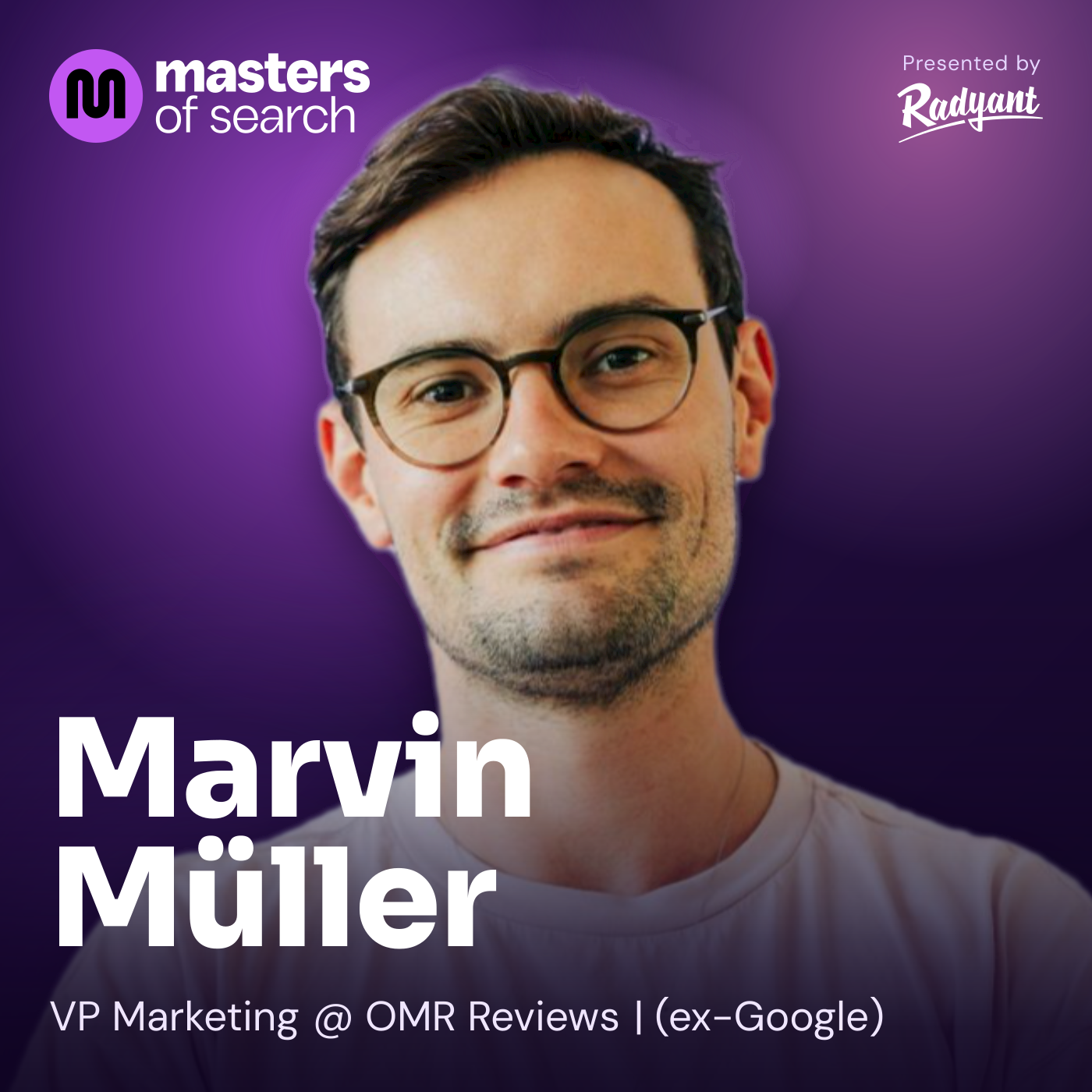
How OMR Reviews adapted from SEO-driven growth to AI-overview traffic loss, then leveraged AI search “citations” and off-site trust signals to become a top cited source for software queries in DACH (Germany/Austria/Switzerland).
Marvin Müller, VP Marketing at OMR Reviews; joined in 2021 as first marketing hire. Previously started career at Google in Ireland as a marketing strategist advising e-commerce, platforms, media publishers, and lead-gen models.
Written by AI. May contain mistakes.
Learn why German decision makers prefer local content over foreign perspectives.
“German decision makers, they want to see local content.”
Meet Marvin Müller and learn about OMR Reviews' growth and significance.
“My guest today is Marvin Müller and he's VP Marketing at OMR Reviews, the biggest software review platform in the DACH region.”
Discover the details of the Masters for Search conference and its significance.
Hear about Marvin's unique career journey and decision to join OMR Reviews.
“made any plans yet for october 22nd come to berlin if you're not in berlin yet uh get a ticket we We still have a few tickets left.”
Understand Marvin's experience at Google and his reflections during the pandemic.
“And that's where you are in the ZR space or search advertising space.”
Learn about the innovative SEO strategies implemented at OMR Reviews.
“And for me, then came the decision point, okay, even though Google is a great employer and you've got a lot of cool benefits, it's time for me to really focus on a known project.”
Explore how OMR's established brand authority contributed to the success of OMR Reviews.
“I remember, I don't know exactly which year it was, that someone from the OMR Reviews team reached out to me already then running an agency, obviously.”
Discuss the competitive landscape of software review platforms and OMR's position.
Learn how focusing on local content can create opportunities in a crowded market.
“So we see this quite actually quite often that people are now with AI trying to build another software directory and we even get sometimes offers.”
Discover how the pandemic led to innovative approaches in connecting software vendors.
“biggest and most revenue strong product of OMR cannot take place for two years.”
Explore the evolution of SEO strategies in response to AI changes in search.
“and also invested quite a bunch of money in search engine advertising, so paying to Google.”
Learn how the platform became the most cited source for software-related searches.
“and smart ways to work with this channel.”
Understand the strategic decision to embrace AI search rather than block it.
“All my reviews is for especially German speaking.”
Learn why blocking AI crawlers from review platforms is counterproductive.
“They find information that not a software vendor writes about himself, but also what users are writing about the tool.”
Discover how demand for OMR reviews has changed with AI search.
“And because this is such a cool and relevant and trustworthy information to basically get the information as an LLM bot from, it's a really, really stupid idea to block those from visiting our pages.”
Understand the significance of trust signals and offsite authority in AI search.
“But since last year and this year, we are growing faster than ever.”
Explore the transition from Google as a middleman to AI-driven search platforms.
“And this is exactly where we sit with our solution.”
Learn about the strategies OMR Reviews uses to combat fraudulent reviews.
“For example, we introduced an AI buying assistant, kind of like a chatbot that is taking his knowledge from all the information that is available on all my reviews.”
Find out how software vendors can benefit from creating a profile on OMR Reviews.
“Only 25 % on the reviews that are started on our platform actually makes it onto the platform because we filter out a lot of stuff that we think, okay, wait a minute, something is not checking here.”
Learn how to effectively use user reviews to boost your software's credibility and visibility.
“Germany Austria and Switzerland go ahead and list your software and all my reviews we list quite a lot of software in our research team anyway.”
Understand why mixed reviews can enhance trust and the importance of addressing user feedback.
“Also the ones that are probably not so happy because this is market feedback.”
Explore the potential shift towards modular software that allows customization while ensuring compliance.
“It will probably also happen in 2028 and so on.”
Discuss the necessity and implications of integrating AI tools like ChatGPT into software solutions.
“because what those companies have figured out is maintenance, is security, is compliance with all the market regulations and everything.”
Explore the complexities of agentic commerce and its future in B2B software.
“So I would say the relationship status is complicated with Argentic Commerce.”
Discuss the importance of accountability and trust layers in AI-driven decisions.
“You want to show them you've done your homework and you check this as well.”
Get excited for the Masters of Search conference and insights on AI search.
“I have read this very interesting post from Tim Solo, who's CMO at Atrius.”

Get the gist, explore an idea or ask about something said.
 Claude
On Masters of Search, what are the key points of this episode?
Searching your listeningAutomatic transcript. May contain errors.
0:00German decision makers, they want to see local content. When they check for software, they don't want to see, okay, what is some person in the US writing about the software? Overall, the trend is really clear that off-site signals and off-site authority trust signals are super important when you want to be successful in AI search.
0:21Marvin Müller: Do you remember the days when AI overview started to roll out in Germany and you saw that traffic is either flat or declining? How did that feel? We were at the beginning, I would say for sure, in a little bit of a panic mode. What are we doing now when this part of our business that is so important to us is shrinking a little bit? Before we dive in, you're listening to the Masters of Search podcast with me, your host, Niklas Buschner. Each week, I sit down with some of the smartest people around the world in SEO and AI search to bring you their strategies, mental models, and top pieces of actionable advice.
1:00Marvin Müller: If you enjoy this podcast, don't forget to like and subscribe and follow it in your favorite podcasting app or YouTube. It helps us get top-notch guests and create the best possible content for you. Let's dive into today's episode. My guest today is Marvin Müller and he's VP Marketing at OMR Reviews, the biggest software review platform in the DACH region. For everybody that has never heard of DACH, it's Germany, Austria and Switzerland. But here in Europe, we call it DACH. He joined as the first marketing hire in 2021 when the platform had around 4k reviews on it. And today it's past 85 ,000.
1:40Marvin Müller: So curious to see when they will reach 100K. All My Reviews is in a very interesting position. They grew a lot with SEO. But when AI overviews started to roll out, they lost quite a lot of their clicks. Now, after the dust settled, sort of, they are one of the most cited sources when an AI answers a software question. So all's well that ends well. We'll find that out today. very happy to have Marvin on the podcast and one quick note before we start into the conversation we have the great honor to have OMR Reviews as partner for our conference the Masters for Search conference we are hosting on October 22nd 2026 here in Berlin it will be a hand curated list of attendees around 175 maybe a few more let's see how much the location will allow us but we will have a lot of great talks from people like malte landwehr aleida sollis we have workshops from people like margus weber head of web at pipe drive um people from pki and marvin will actually also have a keynote there which is so cool i'm so much looking forward to it so if you have not made any plans yet for october 22nd come to berlin if you're not in berlin yet uh get a ticket we We still have a few tickets left.
3:02Marvin Müller: And yeah, we put the link to that inscription. But now enough with the intro. Welcome to the podcast, Marvin. Thank you, Niklas. Thank you so much for having me. I'm super excited to be on your show today. Yeah, so cool to have you. I feel like people from the OMR world always have such a positive vibe and are always so sharing with your knowledge. So it's very much appreciated. it um let's start for everybody that uh may not know you yet a little bit with your backstory how did you end up at omr reviews it's actually a fun story i don't think i've ever told this in english before but i've started my career at google in ireland after university as a marketing strategist so the idea was to you know learn a little bit more about marketing find out about different business models, basically.
3:55And that's where you are in the ZR space or search advertising space. And there I got to know a lot of different business models. I had the pleasure to advise from e-commerce to platforms to media publishers to lead generation business models. And that was actually fun and learning very much learnful. Is that a word? No, I learned a lot there. insightful that's that's true um but then uh the corona pandemic pandemic came and that was for me the chance to first of all travel build because um i then decided i don't want to spend the corona pandemic in ireland where it's rainy all the time and i'm not allowed to go outside so um i've been traveling around europe quite a bit i've visited my sister in italy then And I went to Greece, to Malta, did some diving there.
4:51And in this period of time, I also reflected a little bit on what I want to do and what I not want to do. And for me, then came the decision point, okay, even though Google is a great employer and you've got a lot of cool benefits, it's time for me to really focus on a known project. And there was also a time where I thought about maybe I should found something or maybe I should join a project that I'm really, really excited about. And it was probably the same time when I heard in the OMR podcast for the non-German speakers. This is probably the biggest German speaking business podcast there is of OMR founder, Philipp Westermeyer.
5:38he then at one point told in his podcast that they're having a new project and they're starting a new project it's called omar reviews and it's a software review platform for the german-speaking markets and i was like hey that sounds actually quite cool because i have the background in search i have the background in advising media companies as well as lead generation business models and actually fits quite well why don't i just shoot a text to philip westermeyer on instagram not hoping for any reply basically and i just did i was like okay what's the worst thing that can happen i just text him and at that time he was already i don't know at 30 000 followers or so so i thought okay there's not a chance i'm ever gonna get a reply from from him but then after 15 minutes or so i received a text it was like yeah actually yours profile sounds interesting please go and talk to over and then um over was with together with felix ralmeyer uh the ones that started the OMR reviews project in-house and then I got to know them and they invited me to come to Hamburg and they actually put up a big show for me so I was invited in the Hotel which is like a grand hotel for two nights and I was invited to the office to get to know all the people there are from Isa Gard who is the CMO of OMR to all the people from the team and in the end even philip westermeyer showed up and when we then sat together afterwards in a tapas bar that is quite just right across the office and had some some wines together i thought okay that feels right that sounds interesting to me um i want to join this project and then i started as the first marketeer at all my reviews so cool before we dive into omar reviews more can
7:26Marvin Müller: you give me a little sense of how it is to work in uh in dublin because i feel like there's this big uh hub of tech companies uh with google and meta and linkedin and and salesforce and all of them so like what's the vibe like there yeah that's a very good question i think it's perfect for the people that don't want to give up university yet because it feels like you're coming to those international office spaces with all the young people working for the tech companies that are all coming straight from university. And for me, I was one of those people. I didn't want to do a master's degree, but I still felt like, okay, I also don't want to leave uni quite yet.
8:16and then that gift gave the perfect uh the perfect place there so a lot of young people a lot of fun you do a lot of stuff afterwards you do sports you you go to pubs obviously and yeah that felt pretty cool and that's also the reason why all those benefits kind of yeah went away during the pandemic because then it was just dublin which is a beautiful city but it is also uh not so great when you are forced to stay inside and forced to not enjoy all the benefits. So that was for me the right time to then leave.
8:55Marvin Müller: Let's look a little bit at your first moves at OMR Reviews. I remember, I don't know exactly which year it was, that someone from the OMR Reviews team reached out to me already then running an agency, obviously. and they had this idea how I could contribute to Omar Reviews. And I felt like, and also when I reflect on this now, that you had a pretty, pretty smart SEO strategy back then. So my question is, who came up with that strategy? Was that you? And can you tell the audience a little bit about what you did there? So no, that strategy didn't come up for me. I think it was Katharina Eken or Andreas Schmunk who came up with this idea.
9:42But at the time, I was like, okay, this is quite genius. Let's do it. So at the beginning of starting the platform, we also talked a lot to SEO specialists. For example, Kevin Indig, by that time, already a big name in SEO. And he advised us also a little bit. because if you believe it or not, we didn't have one SEO specialist at the time at OMR and OMR Reviews. So everything we did there was basically self-learning, learning on the job from Andy, who was giving the... No, how do you say it? He got a special kind of incentivization. So for every 0.1 jump in the Systrix Visibility Index by then, he was forced in the early days to drink a small Jägermeister.
10:35And so that was kind of the spirit that we had back then by now. Different for sure, but it was quite fun. and he came up with this idea that um you know we are kind of we reach a we reach a level where we cannot produce more articles in-house because when we started the platform it was a lot about okay we need to create top of funnel content middle funnel uh content to basically get the traffic on the platform that then goes back to the profiles to the listicles and so on But we need to get the traffic first. So we need to write a lot about, you know, top of funnel content, how to do something, what's best for, I don't know, what are strategies for XYZ.
11:20And he realized that we can probably produce two to four articles per week with two people in-house. Or we reach out to this huge network of experts that are in the OMR atmosphere and in the OMR ecosystem anyway. And just ask them, hey, do you want to write an article on your favorite topic on OMR.com? which by then already had a really strong domain authority. So for them, it was basically, of course, I want to do this because I want to be seen as an expert if I'm getting the chance to write for OMR.com. And for us, it was the chance to basically write less own articles. But that's not a problem because we are not the experts in every field.
12:09It's actually a win-win situation if we really let people that are experts in their field from the OMR ecosystem write articles in the stuff they're good in. And so go from four articles per week to maybe two that are written in-house, but eight that are coming from the ecosystem. So basically getting from two to 10 articles per week to basically scale up content, but not just content because this is really good content, right? Because they are the people that really have that expertise are writing this content. And this helped us to scale quite a lot in the content production.
12:47Marvin Müller: I feel like for me back then, it was also the OMR brand where I felt like, yeah, okay, of course, I want to be associated with OMR and publishing something under my name on the OMR domain is something that we are proud of. And also when we got a backlink, for example, I think it was beneficial for domain authority. what would you say because i mean the concept of a review platform was not you when you started it so there were the other ones we don't want to name them now uh international players but what would you say how much was the contribution of the omr brand to make this uh project kick off the way you were able to kick it off and also make it the success it is now yeah um i said this a couple of times and I will say it again on a green field it would have never been possible to kick off a project with this ambition because basically you live from authority you live from trust you live from a network and all those things are attributes that OMR had already had in place.
14:02So we see this quite actually quite often that people are now with AI trying to build another software directory and we even get sometimes offers. So I have built this. You should buy it now for$1 million. Otherwise, you've got a problem in a year and we're like, you should learn a little bit more about this business model and what really counts in the end. So we're quite relaxed on that point. But we really saw the opportunity there when we focus on the Dach market. Because back in the days, there was a situation that the international markets were already quite crowded by G2, Capterra. You said you don't want to name them, but I will name them for sure, because they are really doing a great job and they are really, really doing cool stuff.
14:50But they were not really active on the German-speaking markets. And we really saw a chance there because also German decision makers, they want to see local content as well. So they don't want to check when they check for software. They don't want to see, okay, what is some person in the US or some person in India writing about the software. also because the local software stack is kind of different to the American ones. We have very good local solutions here and really cool local software players that are underrepresented on the English-speaking markets. And for German decision-makers, also other stuff that is important, like, for example, local GDPR compliance, where are servers located?
15:40Does it integrate with SAP or Datif? So things that are probably not top of mind for American software vendors when they list the software. But here in Germany, very important things and very important attributes that we can cover by being local and by having local reviews. Because you also want to get that trust from comparable people that have written a review platform. When you're a media agency of around 20 people, you want to know what other media agencies of 20 people in Germany are using and why they're using it and if the solution might benefit me. the other thing um sorry if the other thing was um that that was also a an omr reaction to the corona pandemic because definitely we were at a at the very difficult time as a company because we also had to think about how can we um still employ people when the omr festival so the biggest and most revenue strong product of OMR cannot take place for two years.
16:59And how do we keep software vendors connected to us? Because back then and still today, software vendors make around 50 % of the clients at the OMR festival as well. And then we thought about, okay, how can we basically connect them and stay connected with them, with a new product and a brand that basically does what software seekers do on a festival, namely going out, checking out software venues, seeing what other people are talking about them, talk to peers about them. This is stuff that happens offline at the OMR Festival, and we wanted to create a space in the digital world where this is more or less also possible.
17:40And we were not a fan of doing digital fairs where you walk around with weird avatars. We said, okay, in the end, it's basically reviews because it's connecting the vendors, it's talking about them, it's getting connected with them.
17:56Marvin Müller: So besides all of the bad that resulted out of the COVID pandemic, at least here also for you, it was a driving force of innovation. And that's obviously something that worked out quite well. Now, you had this great brand obviously behind you and you had, amongst a lot of other things, pretty smart marketing strategies. For example, the SEO strategy we talked about. What would you say before the whole AI overviews and AI search phase or era basically started? How important was search or was SEO to the platform? on the single most important um i would even say okay zeo back then was kind of our internal religion we were really like praying to the ceo god for every 1.0 jump in the visibility index so yeah because basically we said if we want to get relevance we need to acquire a lot of traffic with uh traffic comes reviews comes more vendors comes more users and so we focused a lot on on doing everything that we could in order to be strong in search.
19:09We even decided at the beginning we wanted to kick off all my reviews and also invested quite a bunch of money in search engine advertising, so paying to Google. But then at one point we really switched the strategy and said, okay, the resources that we invest there, we want to invest in organic content. So basically, getting more SEO strategists on board, getting more journalists on board that write content for us. So really full focus on organic content and SEO to make the platform bigger.
19:49Marvin Müller: And do you remember the days when AI overview started to roll out in Germany and maybe you looked at the search console or someone on the team looked at the search console or in some dashboards and you saw that traffic is either flat or declining and then it kept declining? How did that feel? Like, do you remember maybe a particular moment also where you had a discussion with the team, like what's going on? Yeah. Yeah. There are two moments. The first one is that chat GPT moment where we thought, okay, there is something along the way that could definitely play a role in the future. But the even bigger one is the one that you said, Google launching AI overviews in Germany, basically from one day to another.
20:39The crocodile mouth opened. So we saw, okay, on our impressions and our visibility, we're still growing. And we're still growing today. It's still we are on an all time high when it comes to our visibility and when it comes to our impressions. But the clicks that are resulting from them are getting lower. And we were at the beginning, I would say for sure, in a little bit of a panic mode. So what are we doing now when this part of our business that is so important to us is shrinking a little bit? And that even led to reactions that we at the beginning forced crawlers of LLMs out of our system.
21:22So we're really blocking them because we said, okay, we want to protect our content. We want to protect our reviews that we worked so hard to get them basically on a platform. And that was the first panic reaction. But it was also the time where then I learned a lot more about all this geo stuff and AI search that was coming up. So how is this actually working? How could we benefit from that? And it was also that time where all those software tracking tools like PKI, Otterly, RankScale and so come up. and I decided, okay, I should probably talk to them and see how big our influence is there and how often does our site actually get cited when people are asking for software-related queries.
22:18And I was quite surprised back then, but positively surprised, that our content is cited very, very often. We were on the number one first cited source for many, many software categories. When people are searching for what is the best CRM tool or what's the best project management tool, then our content is really, really strong and comes up. And I said, there's a chance because this is a channel that is currently coming up and nobody really understands it. We can be on the forefront there and we can really also go out and educate the market, especially software vendors, that AI search is getting more important and smart ways to work with this channel.
23:04And one smart way to work with this channel, I mean, we even did a study around there, is really also focusing on third-party platform, is focusing on media platform, is focusing on review platforms in order to strengthen your position in AI search. Not to get all the visibility because we are not a channel that you turn on and then you say on the next day you are suddenly visible. That's not how it works, But it is a really, really important factor that plays a role in your overall visibility in AI search.
23:36Marvin Müller: Yeah, on that note, also to the study, we will link it in the description. And you can also search for it if you go to Google and say OMR reviews radiant software study or something like which sources do LLM's site for software queries. and we actually ran around 20 ,000 chats across five models and eight software categories. Obviously, you could also make this bigger and I'm spoilering a little bit. We're working in the background on a new research project where we might try to bring this on a 10x scale, but let's see when we will pull this off. Yeah, but as Marvin rightfully said, all my reviews is actually the number one cited single source across all 8000 something domains analyzed ahead of youtube ahead of reddit um at that point also there was not gpt 5.6 uh already rolled out that has also now changed a little bit with how reddit is treated and there's some uh i would say a lack of transparency is reddit really not relevant anymore is it just not shown so chat gpt uh prevents like the manipulation of reddit etc I don't want to get into too much details of that, but it's absolutely correct.
25:00Marvin Müller: All my reviews is for especially German speaking. We did German speaking prompts here, but I would say probably in the German market, even if you ask in English, you will probably also have a very strong position. but we had stuff like IT, help desk software with asset management, all sorts of queries for eight different categories. Not just marketing related, also super technical and we were really proud of it. We had IT service management, HR software, project management, collaboration, intranet, CRM, SEO tools, time tracking, email marketing. and it was very, very interesting. So you can check out the study in the link description or just search for it, OMR reviews, Radiant software study.
25:47Marvin Müller: You should find it on Google or JetGPT or Cloud or whatever. But maybe let's go to that moment again or a little bit fast forward, the timeline between panic mode, which is, I think, absolutely understandable. I think a lot of people had this or maybe still have this if they are not like jumping on the AI search train already. and then you blocked the crawlers and what was the what was the moment when you decided okay this is probably not the right long-term strategy to block the crawlers and to basically create a create a walled garden of former reviews oh i think i think there wasn't then a single moment where we decided that but it came from basically also me but but um other parts of the leadership team as well, really diving deep in all this AI search stuff and learning a lot about this and talking to a lot of people about this.
26:44I talked to Thomas from Otterlie AI, I talked to Malte, I talked to you, and the more I learned about this, the more I realized, wait a minute, this is not a channel that is going away. Significant parts of the software research phase are going there, and they are probably not coming back because this is now how it works. You don't want to search in Google and click on 100 links to get your information basically extracted on your own to get all the information that you need. But you go into AI chatbots because it's so much more convenient to just check out there and say who you are, say what use cases you have, what are your limitations, what are features that are important to you.
27:29just go there and really get right in your context and then already get a shortlist figured out for you from AI chatbots. And this is exactly where content of OMR reviews is strong, especially in this creating the first shortlist stage of the software research process, because this is also where software vendors want to be. if somebody is asking for hey i know already what kind of solution i need i need an it service management platform i just don't know which vendors are there and i want to get a short list on the five that i that i want to check out more in depth this is exactly where you want to be because this is exactly where pipeline gets created and where opportunity gets created and this is where review platforms and especially we in the german-speaking markets are very strong And by realizing that, I said, wait a minute, it's a very stupid idea to block those crawlers, to block those bots from visiting our site because they want to go there because they find neutral information there.
28:38They find information that not a software vendor writes about himself, but also what users are writing about the tool. And this is also how the lists get built, how, you know, our lists that we are doing, we are doing also a lot of listicles in every software categories. And this is especially also a very, very attractive link source for AI chatbots. But they are based on user reviews. So basically no faking around this. If more users find one tool, good. This tool lands on number one. And because this is such a cool and relevant and trustworthy information to basically get the information as an LLM bot from, it's a really, really stupid idea to block those from visiting our pages.
29:32Marvin Müller: Now, given how your AI search journey started, basically, it started with this frightening moment of AI overview rollout. Where are you now? So is demand for OMR reviews still the same as it was back then when you already had a good position? Or has it increased because of your new relevancy given the whole AI search citations that you have? I think I know the answer already, but I'm still curious to hear. Then I'm curious. Take a guess. So my guess would be that a lot of people, especially in the software companies, have understood that this is a significant shift in user behavior and a lot of people are turning to JGBT Cloud, etc.
30:23Marvin Müller: And then if they made the realization that the answer there is not just completely random, but is in a lot of cases grounded in web search and you can check the citations and then smart people like you are able to tell these people, hey, look, OMI Reviews is a very relevant citation. So if you are visible on our platform, if you invest in your profile on our platform, if you invest in genuine user reviews, etc., it will not only give you authority and all this stuff, it has already given you pre-AI search, but now it's also given you this front door entry to being part of the AI search response.
31:01Marvin Müller: That would be my guess. So I think demand for your platform has probably spiked. Exactly right. Just as you said, I think we had a very difficult 2024. But since last year and this year, we are growing faster than ever. We are, as a platform, are going towards 10 million in revenue, which is quite amazing because it's really a significant part of OMR by now from starting as a little Corona side project five years ago. And as you said, demand is growing. We also invest a lot in thought leadership, doing webinars, for example, with you being active on LinkedIn and really trying to put out the word of AI search and really trying to help understand this whole new marketing discipline where this is a big black box still.
31:56So by every day we're learning much more and we need to be there in the forefront. And we're trying to really do this and share knowledge, share insights around this. And by doing so, we're getting more demand than ever. Because as you said back then, I think trust and authority is now with LLMs even more important because they, even stronger than Google back then, are now also looking into trust signals. They're really checking out what users are saying in the open web. It's not just important what you do on-site with your own content and how you structure that. The influence of everything that happens off-site.
32:42So what media writes about you, what users say on review platform, but also what users say on Reddit. I mean, of course, different from chatbot to chatbot, how this is weighted. But overall, the trend is really clear that offsite signals and offsite authority trust signals are super important when you want to be successful in AI search. And this is exactly where we sit with our solution. We stand for trust. We stand for user reviews that are verified by us. So we create basically this trust layer in between the user and the software vendor that uses AI search to get to the right software solution.
33:29Marvin Müller: I want to play not really devil's advocate, but a little bit like the critical interviewer here. So previously in the SEO era, so to say, you had Google a little bit as your middleman. And also other platforms had Google as the middleman, for example, let's say Amazon. And these platforms have historically always tried to cut out the middleman. So Amazon has tried to get people to start their search on Amazon if they want to buy some products. Quite successful. Quite successful, yeah. Now, all my reviews obviously very successfully made the shift from Google being the middleman to JGBT. And I think it also is a testament to a great platform with a lot of value will win in whatever ecosystem.
34:24Marvin Müller: But that set aside. Now, I'm wondering, do you also think about that? Can we also start getting users to start their software journey or building their shortlist right on OMR reviews? So not going to ChatGPT, having OMR reviews cited. Great. Good job. So they type OMR.com slash reviews, I think is the right domain. They type that into their browser bar instead of typing ChatGPT or Cloud. How do you think about that? for sure has always been important it also was a question that we already asked ourselves in 2021 and 2022 and when we decided to go big on our organic search it was always the question okay but how can we make the user experience as good that the next time users navigate straight to our reviews and not just go to middle way via Google or via chatbot.
35:31And this is still the question. We, of course, try to make the user experience on our platform better. For example, we introduced an AI buying assistant, kind of like a chatbot that is taking his knowledge from all the information that is available on all my reviews. So the user reviews, the content that is there, basically a more focused large language model behind this than when you go in the open web. And we think this could be a really cool way for users that are in the DAH region to chat directly with a chatbot that learns from content and learns from reviews that are also having this country context.
36:18So basically much more focused than a general LLM. But for sure, our path there is going two ways. For sure, trying to still gain the traction and gain the visibility in LLMs, but also when people are coming to our platform that they use our platform and use our platform more. And we see, for example, and I think many vendors see this, that people that are coming from an LLM chat, but they spend significantly more time and visit significantly more pages on OMR reviews than the ones that, you know, went to our platform from any other way.
37:04Marvin Müller: We talked about a lot of great aspects of LLMs and AI search where you really benefited. I would say one maybe potential downside is also that LLMs make it very easy for people to write convincing fake reviews. And also write them at scale and somehow try to manipulate. Because always, historically, every platform that does rankings and every platform that has influence, people try to manipulate it. I mean, if we have a bad mood on a day, we would also maybe say SEO is also somehow manipulating the algorithm. them obviously we would then say no we try to provide value to the user but how do you try to protect the platform against that influence that can obviously harm your standing significantly yeah for sure and we had a lot of cases where people tried to um try to circum comment our defense mechanics in order to to write a lot of fake reviews uh and profit from some incentives that vendors sometimes give in order to gain reviews on the platform.
38:14A number that I brought with me is 25%. Only 25 % on the reviews that are started on our platform actually makes it onto the platform because we filter out a lot of stuff that we think, okay, wait a minute, something is not checking here. And we do this mechanically, but as well, there's always a human in the loop. So when a review comes onto OMR reviews, the first thing that you did is we filter at the beginning because you can only write an OMR review when you, for example, sign in with your LinkedIn account or sign in with a business email address. So basically give us a way to check, okay, is there really a person behind this that is also somehow findable online, right?
39:13That we can say, okay, this is a person that exists that is writing a review. This is the first check. But then we also look into sickness and what this person is writing. And we have mechanics in place on our platform that gives us a score. so how by how much chance is there that this is somehow um somehow not not valid and it gives you a score from zero to a hundred percent and everything that is above i would say um i'm not quite sure about this but i think it's also 25 everything that has a score above 25 percent um gets blocked and gets um basically um a feedback to the user hey um we're not quite sure if you really use the software, can you please send us a screenshot of you logged in, for example, in this platform in order to make sure, okay, this is really a user that is writing about the software.
40:10And then we also check in the end, again, manually. So Christine from our team, she's our head of reviews. So basically really head of the user-generated content that comes onto the platform. So in the end, she's checking every single review that makes it in the pre-selection in order to make it on the platform. Again, checks it, sees, okay, is there a real person behind it? Does this look like valid content? Does it show signs of typical AI chatbot sentence structures? And if we say, okay, check, check, check, check, check, only then it gets onto the platform and there as i said the the rate is 25 okay sounds pretty
41:00Marvin Müller: sophisticated so i would actually say uh if you listen to this don't try to fake your way up to a good rating um but speaking of i'm curious so i i think a lot of people um sometimes think about review platforms like all my reviews as being um like expensive so they have to buy a certain package or something to start having a profile there um i know you know that this is a common misbelief but can you maybe um give for people that are interested and that have maybe not yet created a review profile or done anything in that sense can you maybe give them your top like two three actions on what should a software vendor what should a b2b SaaS marketing leader do if they want to benefit from the presence that all my reviews has gained in LLMs yeah for sure the first thing if you don't have a profile on all our reviews yet and you're selling software in Germany Austria and Switzerland go ahead and list your software and all my reviews we list quite a lot of software in our research team anyway.
42:15If we start new categories, we list the pre-selection vendors anyway. But if you're not there yet and you see, okay, I don't have a profile yet, go ahead and list it. And this listing is completely for free. So there is no money involved yet because we, as a platform, we profit from having a good market overview and having really the relevant players on our platform. And it's totally for free. The other thing that is totally for free is going out and start asking users to leave a review on all my reviews because we also profit if there's a lot of reviews on our platform and we will say this is also something that you can do if you don't pay a single penny to all my reviews and get your users and ask them to write send them your profile there and ask can you please write a write a review there what we monetize is basically the infrastructure behind this on making it easier for you as a vendor to collect reviews.
43:09We then provide personalized links. We provide, for example, incentivization budget because we as a platform we also don't want to have basically non-same reviews on our platform which separates us, for example, from big review platform generalists like Google where you can basically leave a review in one sentence. Say, good product, please buy this. But our reviews are really in-depth. They take approximately 15 minutes to complete because we ask a lot of stuff. We also ask for a little bit in-depth. And for this, basically, for this effort a reviewer takes, they can profit from a little incentive, for example, in a voucher.
44:00and this is the infrastructure that we then provide if you want to basically enforce this and amplify it and make it a lot easier for you in order to get reviews. But in the end, it's totally possible that you're a vendor that does not pay a single dollar to own more reviews but still are category leader and still are the number one most present tool in a listicle that we write, for example, only by working with the platform organically. And this is really important for us because the common misconception is it's a pay-to-play game and you get visibility if you pay. And this is really not true.
44:41You pay for getting the infrastructure behind it. You pay for getting a better chance to customize your profile even more, put more information there, put some white papers there, for example, put tutorials, so basically getting more content on your profile but in the end the visibility benefits is a working game and not a paying game you need to work in order to get your users review you and all more reviews and then you gain traction and then you grow in your software categories to better rankings
45:25Marvin Müller: then let's quickly cover the incentivizing review part because I know that some people say yeah but you basically pay people to give positive reviews I think this is also a common misconception what would you say to this we do not pay for good opinion but we pay for opinion and we really advise everyone One, ask all your user base to give your reviews. Also the ones that are probably not so happy because this is market feedback. And this helps you again, being more trusted and getting more authority. What I mean by that, because you also get the chance as a software vendor to answer to reviews and say, okay, if there's, for example, somebody who said, okay, I'm not happy with this in this part.
46:22that's the perfect chance for you as a software vendor to go into a conversation and say hey this is really great feedback that helped us a lot improving our product and we basically solve this problem now and here's the solution now you don't have to have the problem anymore and i think nothing is more trustworthy than really listening to user feedback and really um answering it and And there's also a study that says it is much more trustworthy if your profile has a score of 4.0 to 4.5 than a profile that has only five-star reviews. Because this is the first thing that people are looking into an essay.
47:05If this is only a five-star profile, wait a minute, there's something that is not right. And I actually don't want to look into this further because I'm really actively searching for those two and three star and four star reviews in order to really get a balanced view on a tool. And this is why when vendors ask us, how should we do it? What should we do? I say, okay, please get the full picture on board because this will actually help you. Then every department of your company will benefit from the review. Also product, customer marketing, customer success. Everyone knows then this is basically an action task for your company to get better if you get critical and constructive reviews.
47:54Marvin Müller: So a little bit counterintuitive takeaway for people listening. You might actually also want to get people to leave a review that are like mediocre happy. Like maybe just give three out of five stars or four out of five stars, because in the end, it will help you to have a more genuine and authentic and trustworthy profile instead of having 50 reviews, five out of five stars, where a lot of people will question, is this really legit? Correct. Yes, for sure. And I would say it helps, always helps, especially showing that you take this feedback seriously. I think this is something where probably a lot of people have a hard time accepting this, but it's good to hear it from someone that is very deep in the trenches.
48:41Marvin Müller: speaking of being deep in the trenches I have this this little thought I'm carrying with me since I was attending a very nice dinner actually hosted by OMA Reviews alongside the OMA Conference in this May in 2026 for everybody that does not know or is not aware of it OMA Festival OMA Conference, OMA Festival is the official name is also again happening in 2027. It will probably also happen in 2028 and so on. Yeah, yeah, yeah. But I'm pretty sure. In Hamburg in May. So also be sure to check this out if you've never been there. I think it's a very cool experience. But I've been at this great dinner and people were talking about Vibe coding.
49:33Marvin Müller: So building your own software, your own tools with Cloud Code or Lovable, etc. And then there was a sentiment, obviously, because there were a lot of software vendors, this might not be a good idea if you really rely on the software because you have to care about maintenance, about security, etc. And I totally get that. But still, I see some products getting bigger and bigger and bigger when you just still need a fraction of the tools that are provided. So these all-in-one tools and you actually only just need two or three parts of it. And then I had this crazy idea and I want to get your opinion on it.
50:10Marvin Müller: Wouldn't it be a feasible solution for software vendors to provide parts of their software, like modules? So let's say for HubSpot, for example, the sales module with pipeline and offers and all of that. The signature solution may be from Calendly or like these schedulers, maybe their module. so that someone can build their own software with CloudCode or Lovable, but then integrate these critical parts into their software, not having to rebuild something that has already been done and then paying for that, obviously, some sort of licensing fee or I don't know, period. What do you think about that maybe little crazy idea?
50:54I don't think it's a crazy idea at all. And we're already seeing signs in the market that exactly this is happening. I think Salesforce, the strategy two or three years ago was, okay, we are closed shop and we do not let everyone in. Now they completely changed and said, okay, we are building basically a headless solution here. This is basically what you said. This is going towards this headless modular solution. because what those companies have figured out is maintenance, is security, is compliance with all the market regulations and everything. And this is super, super hard to build on your own.
51:37And this is the biggest weak spot when you are now going out and saying, I'm bi-coding everything myself because then you have to also think about everything that those companies have done in the past in order to get where they are now. And this is huge. I mean, the total cost of ownership of creating your own bytecoded solution and basically scale with it and scale to international markets and so on and so forth is big. Then you have to do all those licenses, all the certifications and so on and so forth. And therefore, I think it is basically, and this could definitely be the future of software, to create parts of this functionalities that are then in compliant with all the laws, in compliant with all the GDPR compliances and everything, and basically offer those parts of your software headless in order to then Vibe code your own solution that fits a little bit better into your needs and then create it.
52:39Because I think the power of Vibe coding lies in customizability. so because you really can build exactly the os exactly the crm that you need for your um for your company for your background but you don't want to have in mind all those yeah all all those
53:01Marvin Müller: um these hygiene nerve-wracking yeah all those nerve-wracking and hygiene factors that the big software vendors had thought about years ago already. So I would say it's actually a really, really good idea and it's exactly where software could be going. Yeah, maybe you should buy the idea for a million dollars if you do not buy the other review platforms. No, just kidding. Ideas are cheap, execution is everything. We've learned that quite often. But even if we do not think about like web coding and integrating these software pieces as modules, from what you see and what you hear, do you also feel like that basically every software vendor now should have an MCP or a connector to ChatGPT and Cloud because people don't just use ChatGPT, Cloud, etc.
54:01Marvin Müller: for searching and for research, as we have already also talked about, but also for being their new go-to interface, like their daily driver instead of the software UI? I would say probably not for everyone, but for a majority of use cases, this is exactly what we are seeing. I think my colleague Felix said in our State of SARS keynote at the OMR Festival earlier this year that the interface is really going into the chat of those tools. And I think for many people out there, especially in the tech space, a typical day in the life of a marketer or in the life of a developer or everything is you open Claude at the beginning of your day.
54:53And then Claude already gives you basically a checklist of things to do on the day, what comes up. And this is basically where you organize yourself and where you're basically living now inside. And this is why for most software vendors, especially the ones that help you, for example, creating stuff, having an MCP or analyzing stuff, having an MCP is extremely beneficial because you basically open up your software solution to where people are actually spending time. and where people actually get their work done. But I think there are also exceptions from that rule. I just don't... I would have to think a little bit more about this, what those exceptions might be.
55:48I don't know.
55:50Marvin Müller: That's for an update episode. Yeah, for sure. But for sure, it makes sense to open up your software solution for those places where people are actually working and getting their stuff done. Now, before we wrap things up a little bit, I have a final thing in mind because when we were talking about, so not necessarily you and me, but the market also talking about agentic commerce, which is obviously something that was very hyped, then ChatGPT discontinued some of the things and then focus more on the ads product, etc. So I would say the relationship status is complicated with Argentic Commerce. But still, I think most of the conversation was around basically how can you connect your Shopify store to ChatGPT so people can buy a perfume, I don't know, a new iPhone case or something like that from ChatGPT.
56:50Marvin Müller: How do you see Argentic Commerce going into the B2B software? So will people say to Claude, hey, I need a new email marketing provider. Ideally, it has an MCP and we connect it to Claude. This is my budget. Please go and let me know when I have to sign the offer. Will this be the future? I mean, it definitely could be. But what I am really convinced about is, in the end, it is people having to sign the offer and it's people having to defend their decision in front of a board, in front of a leader, in front of their manager. So in the end, you still, as a person, you act, especially also here in the German-speaking markets, risk averse.
57:45And you want to say, okay, you've done your homework here as well. You didn't just go out and let the AI chatbot buy everything from you. And then in the end, everything breaks. And you're the one that is accountable for this. So, right. Who's accountable for this? It was Cloud.
58:02Marvin Müller: It wasn't me. Exactly. But your manager is going to say, okay. I'm not sure how I can now talk to Cloud about this. Let's talk about ownership and responsibility for a second here, my friend. Correct. Correct. And I think this accountability and ownership in the end, this is exactly where social proof comes in. You want to show them you've done your homework and you check this as well. And this is why I think this trust layer in between will still be totally important. the only scenario I think that is not important is when really everything is going agentic and nobody has to work anymore and nobody has to defend their decisions and buying decisions anymore but then we talk about a whole lot of future.
58:56So I think this trust layer in between a decision where you show you've done your homework where you've talked to people you've gathered social proof you've seen, you've written you've read reviews about the software solution, this in between, this will still be totally important. So this trust layer will not go away. And this is exactly where we sit. How our solutions look then in five to 10 years, maybe it could be completely different. But as long as this doesn't change, I think there's still a space for this infrastructure.
59:31Marvin Müller: Okay, this then obviously only becomes relevant if Claude's CEO has to argue with Claude's CMO about what the hell he just bought for software and why he approved a 5 million budget for it. But yeah, let's see what Claude's CFO will then say to that. So final question then. If you reflect a little bit on what we talked about, it's always my final question because sometimes it brings some interesting thoughts to the table. What didn't we talk about that we should have talked about? That's a really good question. Surprise! I would say currently the holy grail of geo and AI search is everything related measurement.
1:00:22Because basically influence of AI search is super hard to attribute. because of course you can run models and count your citations and count your mentions and so on and so forth. But right now there is no good solution for really measuring your influence on pipeline, on measuring your influence on leads. You're always, you know, you see an incremental uplift and you probably, when you do post-purchase studies or if you have self-reported attribution, So basically asking your user in place and they say it's probably from AI search, but there's currently no good way to really make this influence be measured very well and no good because also all those LLM providers are a blackboard yet and they don't even want to show how much searches and so on happened there.
1:01:23But the one that is figuring this part out, the measurement part, I would really love to talk to because this is exactly where I think this is right now that is stopping most teams that have not started with AI search yet. This is the thing that is blocking them currently because they cannot see the influence of AI search click-based because there is no click happening anymore. but they still need to find proof to say, okay, I know this is a channel that is important and it's attributed 230 ,000 euros in revenue only in the first quarter. The one that is figuring out how to do this, this is something that I would love to talk about.
1:02:12Marvin Müller: Perfect unscripted bridge to a final block of advertising for the Masters of Search conference. October 22nd in Berlin presented by Radiant in partnership with OMA Reviews and PKI I'm not 100 % sure if someone has this holy grail figured out but what I'm 100 % sure is that there will be people that share how they think about what they did what they tried how they try to come as close as possible to really proving this influence so I think it's very a very good lineup. I have read this very interesting post from Tim Solo, who's CMO at Atrius. He said, basically, I'm paraphrasing, the best rule of thumb for putting together a conference is having a speaker lineup that you would love to attend.
1:03:06Marvin Müller: And if you do this, basically, then mostly the conference will turn out great. I can say that everybody that's coming to the conference and sharing something on stage which I'm genuinely excited about. So would love to also see everybody of you listening or watching this there. But yeah, Marvin, thanks so much for the awesome conversation. Anything we should put in the description, anything left, anything where you would say if people want to take the thoughts and like the inspiration they got from this conversation, how they can continue with it, what's left to share. Yeah, very good question.
1:03:47I would say if you want to connect, I've started to be a little bit more active on LinkedIn. So reach out to me and we can get into a conversation there. I would love to. Also a thing that came through the AI search because before that I really didn't have any idea what to talk about on LinkedIn. Now I have a nice topic where I can connect to people like you and I actually love that. The second thing I would say, if you're intrigued by the study that we did together, where we basically, I think it was over 20 ,000 chats analyzed, over 8 ,000 prompts, and not so many prompts, but 8 ,000 answers analyzed, a lot of cool insight and value in there.
1:04:32So check it out. And then, of course, I'm also going to be part of the Master's Search Conference in the end of October. And I have the pleasure to talk a little bit how we as Omar Review shifted from traffic to citations as a North Star metric. So kind of a little bit of what I talked today about. But there's a whole keynote about everything, how we restructure our content production, how our prompt tracking is working, and so on and so forth. So if you want to come by there and have a chat with me there, I'd love to.
1:05:07Marvin Müller: Nice. if you spoiled too much today, you still have a little bit of time left to come up with new slides for the keynote. I would say I leave it there so that people come to the conference and check it out there. So cool. Marvin, thanks so much for taking the time. All the best. Greetings to Hamburg. And yeah, it was very great talking to you today on the Master of Research Podcast. Thank you so much for having me. I hope there was some new insights for the listeners. 100%, I'm sure. See you. Bye-bye. Bye-bye.
Marvin Müller joined OMR Reviews in 2021 as its first marketing hire, back when the platform held around 4,000 reviews. It has since passed 85,000, and the business is heading towards ten million euros in revenue. He came to it from Google in Dublin, where he spent his early career in search and performance marketing.
The interesting part is what happened in between. OMR Reviews grew on SEO — Marvin calls it the internal religion of the team — and then Google's AI Overviews rolled out in Germany. Impressions kept climbing to an all-time high. The clicks stopped arriving. Their first move was to block the LLM crawlers, and this episode is mostly the story of why they reversed that.
It worked. In the study OMR Reviews ran with Radyant — around 20,000 chats across five models and eight software categories, on German-language prompts — OMR Reviews came out as the single most-cited source of the roughly 8,000 domains analysed, ahead of YouTube and Reddit. After a hard 2024 the platform is now growing faster than ever and heading towards ten million in revenue.