
 Ask ChatGPT

 Materialism: A Materials Science Podcast
7 Aug 2026 · 1h 1m · 30 chapters
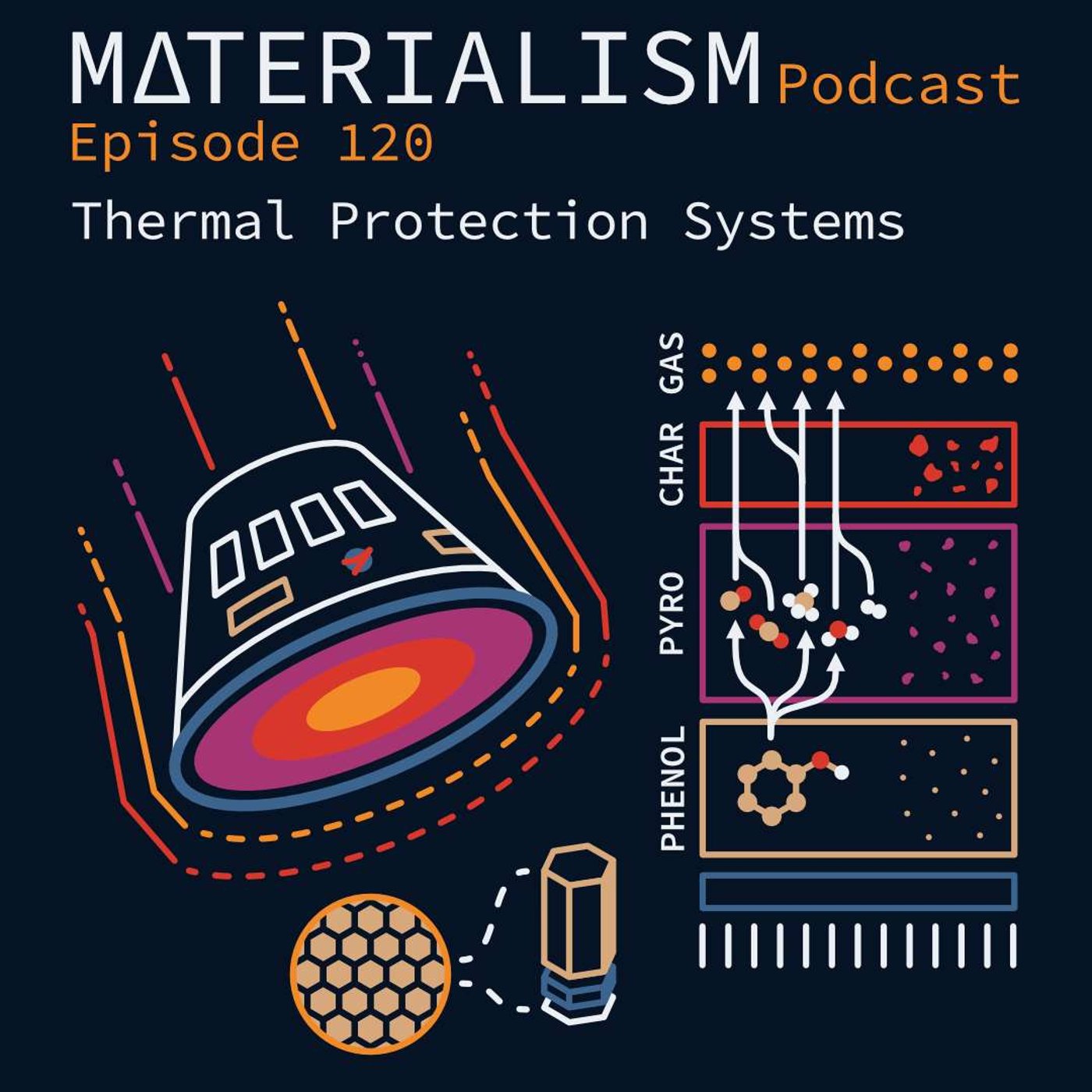
Thermal protection systems (TPS) for spacecraft reentry—how vehicles convert extreme kinetic energy into heat and how materials survive the resulting plasma, temperature gradients, and chemical reactions.
Written by AI. May contain mistakes.
Hosts discuss a unique sponsorship and introduce the guest expert.
“Obviously, we have our recurring sponsors for the show.”
Nate Olson shares his background and the significance of his work with thermal protection systems.
“Today we have a really exciting episode.”
Discussion on the challenges faced during spacecraft re-entry and the conversion of kinetic energy to heat.
“I mean, the stage is about his work, not me.”
Exploration of the extreme temperatures that spacecraft experience during re-entry.
“Obviously, you've got to convert a lot of energy to a lot of heat.”
Nate discusses the reactions that occur at high temperatures and their implications for materials used in thermal protection systems.
“And there's also a lot of really crazy things happening.”
Overview of the material properties required for effective thermal protection systems.
“All right, well, we're going to get into materials in a minute.”
Discussion on thermal expansion and how it affects the integration of thermal protection materials.
“It's after it lands, actually, which is wild.”
Exploration of the history and development of thermal protection materials and concepts.
“So yeah, if you're expanding on the surface, not expanding on the back, that is a strain.”
Nate explains the blunt body concept and its importance in spacecraft re-entry design.
“We know what materials properties we have as options to fix it.”
Learn how blunt body shapes enable safe re-entry into Earth's atmosphere.
“Um, so that actually made re-entry a solvable problem.”
Discover how ablative materials protect spacecraft from extreme heat.
“So without the blunt body concept, return to Earth would have been an impossible challenge.”
Examine the evolution of ablative materials from Mercury to Apollo missions.
“through your thermal protection system and actually being injected into the boundary layer.”
Understand the role of honeycomb structures in ensuring material consistency.
“and it's significantly faster, yes so what did they do for Apollo?”
Learn about the complexities of testing thermal protection systems on Earth.
“It's really awesome that just to imagine this material, right?”
Explore the trade-offs between safety, weight, and functionality in TPS.
“Most systems on a spacecraft, there's redundancy built in, but thermal protection systems, you have to rely on margin and it has to work.”
Discover the shift from ablative to reusable thermal protection systems.
“So when I jumped into material science, one of the demos that hooked me as a new perspective student was the space shuttle tile.”
Learn about the unique materials and construction techniques of shuttle tiles.
“But it never came to be and it was kind of put on the shelf.”
Understand the importance of material purity for thermal protection effectiveness.
“And the glass is stable in that, I guess, high heating oxygen atmosphere.”
Explore the critical role of silica purity in thermal protection systems.
“What was the motivation for trying to get it as pure as possible?”
Understand the unique challenges faced during the manufacturing of space shuttle tiles.
“So, you know, even despite the miracle of creating such incredibly engineered ceramics for this, there were still a lot of challenges, right?”
Learn how strain isolation pads address thermal expansion and vibration during launches.
“And the huge challenge is, The fact that you cast a block of this tile material and you machine your tile to shape.”
Discover the methods used to waterproof silica tiles for space missions.
“You've got these, like, remember the silicon is 94 % air.”
Examine improvements made to the thermal protection tiles throughout the shuttle program.
“So a major part of turning shuttles around was re-waterproofing.”
Learn about the advancements in materials used for thermal protection systems.
“It wasn't just they settled on this Lockheed developed material, which was called Lockheed insulation or LI.”
Discuss the reasons for transitioning towards ablative thermal protection systems.
“So the concept was you're ending up with higher strength without having to have that sacrificial aluminum borosilicate fiber.”
Explore how SpaceX utilizes thermal protection systems in their spacecraft.
“They work very well for returning and ferrying crew and cargo to and from low Earth orbit.”
Learn about the advancements and challenges in thermal protection from the Artemis missions.
“So we've sort of summed up where we're at today.”
Discuss ongoing efforts to develop reusable thermal protection technologies at NASA.
“So early on and throughout this, we talked about how dynamic of a system this is and also how complicated it is as well.”
Examine how lunar missions impact the design and function of thermal protection systems.
“It's the porous microstructure analysis software developed in NASA Ames.”
Learn about the life cycle of thermal protection tiles and their challenges.
“I'm just like, I'm thinking as an academic now, like, well, that's cool stuff.”

Get the gist, explore an idea or ask about something said.
 Claude
On Materialism: A Materials Science Podcast, what are the key points of this episode?
Searching your listeningAutomatic transcript. May contain errors.
0:01I would like to describe a field in which little has been done, but in which an enormous amount can be done. This field is not quite the same as the others in that it will tell us little of fundamental physics, but it will tell us much about the strange phenomena that occur just below our perception. In contrast to the natural philosophers of the past, the scientists of this field delve into the recesses of nature and show how she works in her hiding places. Their quest is to understand and create the imperceptible. Hey, everybody. Welcome to the Materialism Podcast, an exploration of the past, present, and future of material science and engineering.
0:35My name is Andrew Fulkowski. I'm the co-host of this podcast, along with my other co-host, Taylor Sparks. We're both having a great time. We just recorded a really awesome episode, and we're excited for you both to listen to it. Yeah, it's a bit unusual. Obviously, we have our recurring sponsors for the show. For example, Materials Today, excellent journal. Hope you check them out. Thank you all, Savir. But we also have the option to sponsor full episodes by people. And we had a first today on the podcast. We had somebody, a former person who sponsored an episode, actually sponsor an episode for somebody else.
1:03So this is Expert Lab Services. Thank you, Daniela, so much. He's actually sponsored an episode for NASA to have a NASA aerospace engineer come on and talk to us about their thermal protection systems. And I'm so glad he did because, as you're going to hear, Nate knows his stuff. It was one of those where you won't hear Andrew and I saying as much because we're both just like learning a ton from the conversation. Yeah, one of those where usually I come in and I have a pretty good idea of what's going on, but I just felt like a student this entire episode. So enjoy.
1:42Today we have a really exciting episode. We're joined by Daniele Paganelli from episode 55, covering real-time measurements for ceramics, and Nate Olson, an aerospace engineer at NASA. Do you guys want to introduce yourselves? Thank you, Andrew, for the introduction and for reminding me about that episode from four years ago. This was very fun to record. It's my first and only podcast episode ever recorded. I am Daniele Paganelli, I am the Managing Director of Expert Lab Service. My company designs and manufactures optical thermal analysis instruments, microscope, dilatometer and fleximeter, which are very useful in the ceramic sector.
2:31But this episode is not about me, it's about Nate Olson and the work his team is doing at NASA. I met Nate in November 2025 during the installation of one of our instruments, and I found his work extraordinary. And so I thought what he does should be explained on the Materialism podcast. And so I thought about sponsoring an episode and give the word to Nate. So I thank Nate for accepting the invitation and NASA for letting him speak in a public podcast. Now I give the word to you. I mean, the stage is about his work, not me. So thank you again and have fun. Well, thank you so much, Daniela. I think it's a first.
3:31I don't think we've ever had somebody sponsor somebody else to do an episode. Way to go, man. That's just awesome. And not only is it an episode, but it's with a pro. We have Nate Olson, who is actually working on aerospace as an aerospace engineer at NASA, like solving really hard problems. One of the problems that we're going to describe today that he's actually an expert in is dealing with heat. Now you might be wondering, what's the issue here? Let's sort of walk you through it. you send things out into space and when they re-enter you've seen it in cartoons you've seen it in movies they glow orange they glow red like it looks like it's pushing air out of the way well that's all true it is it's actually doing that and more fundamentally things in space when they're doing these low earth orbits or lunar missions they're moving very very fast and they provide us some numbers even in low earth orbit you're doing seven kilometers a second which is bonkers.
4:23And if you're coming back from the lunar missions, these are 11 kilometers per second. So you're cooking. And you had this interesting challenge where with all that kinetic energy, if you don't want to just like smack into the earth, you've got to turn it into something else. And heat is actually a compelling option via compression and drag. First off, it's unavoidable. You're renting the atmosphere and so there's friction, right, with the air. But it also takes advantage of this to slow it down. So in this process, Nate, what are the challenges we run into. Obviously, you've got to convert a lot of energy to a lot of heat.
4:54You have to do something with that heat and you've got challenges with materials that have to survive that atmosphere. Yeah, absolutely. First, thank you all for having me on the podcast. My background is in material science engineering and I've listened to the podcast in the past, actually. So I'm thrilled to now be on it. But yes, as you said, it's a tremendous challenge coming back to Earth, whether we're coming back from low Earth orbit, the International Space Station, or now with the Artemis program coming back from the moon, we are doing something with all that energy. And like you said, we're converting that to heat.
5:33So it's a materials challenge from many different perspectives. I mean, one, the material itself has to protect your spacecraft structure. Typically, the plasma that forms around the spacecraft may be, I've seen temperatures reported anywhere from 10 to 20 ,000 Kelvin. And on the backside of your thermal protection system, you're talking maybe 300 or 400 degrees Fahrenheit. I don't mean to mix units, but the temperature of your oven, so it's a huge temperature gradient over a very thin layer of material. This is crazy. I'm looking at just if Gen AI answer on Google search can be believed. It's telling me the surface of the sun on its temp, the sun's surface temperature is 5 ,800 Kelvin.
6:19So are we higher than that? Did you just say 10 ,000 Kelvin? Yes, that is correct. So in the plasma, which I'll get into this later, but there is a kind of, we form a shock layer. So that is separated from the surface of your vehicle. The surface of your vehicle is not that temperature, but just a few inches away. Yes, you are reaching temperatures as hot, if not hotter than the surface of the sun. Unreal. And there's also a lot of really crazy things happening. It's beyond just the heat, but there's different reactions that are happening that can also heat up your spacecraft, right? Yes, absolutely.
6:55So at those temperatures, your gas molecules, if you're coming back to Earth, the oxygen and the nitrogen in the air is becoming dissociated, is becoming ionized. And what can happen is your surface can actually act as a catalyst to cause those atoms to recombine. And that's an exothermic reaction. So you're releasing even more heat directly at the surface. So that ends up being a critical design parameter, basically minimizing the reactivity or what we call the catalystity of your material towards those gases. When you had this in the show notes, I assumed that you were worried about sort of free radicals like reacting and that this was going to be about corrosion.
7:39I didn't think about the fact that the catalysis would be exothermic and just add more heat to deal with. That's really interesting. Yeah, no, and that's a great point as well. So we'll talk about this later, but if you have ablative systems that are typically carbon-based, that is exactly a problem. So those free radicals can eat away at your material. But if you have a reusable system like the tiles on the space shuttle, which I'm sure we'll talk a lot more about, you know, those surfaces are prime for allowing for recombination of those species that are surface. All right, well, we're going to get into materials in a minute.
8:12Let's walk people into like some of the materials properties that any solution for this thermal protection system, TPS thermal protection system, anything that we sort of have as a system to protect it, it's going to have to have a couple materials properties requirements. You have heat. And if you don't want to just like eventually melt, then you got to get rid of that heat. We've got options, right? You can conduct it away. So like the heat sink in your computer is like a lump of copper, right? Great conducting, right? Okay. The next we've got is convection. Convection, if you got your hot bowl of soup, right?
8:43And for my sixth row, she's constantly making me blow on it, right? I'm taking something which is colder and via conduction, I'm actually via a form of air contact, as it were, it's pulling some of that heat off of it as the air sort of streams by. That's a crappy material scientist explanation of fluid transfer. But you get the idea. And then the last one is radiation, right? Radiation is a big one. If you stood next to a fire, this thing's glowing orange and you're getting heat from it, even when you're far away, it's not that the air like is blowing against you. No, it could be like steel. It can be vacuum, right?
9:12And space this can work. You can actually radiate heat away. These are your three options. We're going to have to rely on some combination of these to deal with the heat. Then there's this concept of thermal diffusivity. I did this in my whole PhD. I didn't know what this was when I learned about it. I knew what diffusion was, right? Atom matter can sort of diffuse. I'd never thought about heat diffusing. But yeah, absolutely. Thermal diffusivity is basically it's the constant of proportionality between how much heat gets stored and conducted in a material. That's, I think, a useful way to think of it.
9:41It's the ratio, how much gets conducted through versus actually stored by the material. And in practice, what you see is a heat front gradually moving through the material, which is important because heat transfer means that, okay, you're hot at the surface from the events happening as the scene reenters the atmosphere. That heat is going to propagate into your material. And something you point out here is that what that means is that the peak temperature at like the bond line is not happening as it's landing. It's after it lands, actually, which is wild. Absolutely. No, that is still kind of hard for even me to believe that, yes, for the space shuttle, the thermal diffusivity of those tiles were so low that it wasn't until it was sitting on the runway after landing that you ultimately saw peak temperature at the bond line between where the TPS is bonded to the actual aluminum structure of the space shuttle.
10:33So thermal diffusivity is a key parameter. Another key consideration is thermal expansion. Yeah, what does that mean? So thermal expansion is basically the response of the material as you heat it up. Most materials tend to expand. And with TPS, you're bonding some sort of material to a structure, and those two things are not the same. So they're going to be during reentry as they're heating, they're going to be expanding at different rates. And as it's sitting in space and seeing the sun and going behind the earth and being in night where it gets much colder, you have cycles of expansion and contraction.
11:19So controlling, knowing your thermal expansion behavior is very important. And then mitigating that through how you integrate your thermal protection material into your structure is also a means of controlling that. But ultimately, you end up with stack ups of materials, especially now when you consider the coatings that you apply to many of these thermal protection materials. Now you have a coating and then your primary material and then something between it and the structure. So there's many, I guess, elements to consider when thinking about thermal expansion as well. So yeah, not to mention as you're causing this heating and expansion, you're going to have internal stresses due to kind of the thermal shock of the sudden increase in temperature at the surface versus the interior, which the way you kind of mitigate that is just reducing your modulus or the stiffness.
12:08But for a ceramic, that's often really challenging, at least in the bulk form, right? Those are known for being super stiff. So this poses a lot of interesting material challenges. And they don't tolerate strain. So yeah, if you're expanding on the surface, not expanding on the back, that is a strain. and small strains can cause fraction ceramics. And that's a great reason why the tiles used on the space shuttle are truly an incredible material, that they can survive those sorts of gradients where it's temperature, typically we're working Fahrenheit, so about 23 to 2 ,500 degrees Fahrenheit on the surface of those ceramic tiles, and again about 200 to 300 degrees Fahrenheit on the backside.
12:50So that is the enormous temperature gradient in our ceramic. And the way that those materials can survive is because they have very low coefficients of thermal expansion and expand very little. So in the end, little stress is generated in those materials. My favorite response when people get annoyed that we use units like Fahrenheit, I'm like, oh, you mean been to the moon units? Yeah. All right, man. It's true. So we've set the stage. We understand the problem. We know what materials properties we have as options to fix it. Let's dive into the materials history because there's a lot here. Start with this idea of a blunt body concept.
13:27This was new to me. I didn't know what this was. Can you explain this? Absolutely. So if you go back to the 1950s when kind of the ideas of coming back from space were first being explored, most concepts had sharp edges because sharp edges on your spacecraft provide maneuverability, you know, control surfaces that you'd see on an airplane, for example. The problem with those is the flow, you know, when you're coming back from the moon at 25 ,000 miles an hour or 11 kilometers a second, the flow and all that hot gas is, you know, I guess what we call attached to the surface so the surface is seeing the full brunt of all of that heat and it was harvey allen he was a engineer at nasa ames research center in the 1950s he made the discovery that by making a what we call blunt body so basically you can think about it as like a there's different shapes but think about like half of a sphere is a blunt body um that when that returns at hypersonic velocities, the shock wave actually detaches from the vehicle and you build up, you can think about it as a cushion of air between your 10 or 20 ,000 Kelvin, uh, you know, plasma and your structure.
14:49Um, so that actually made re-entry a solvable problem. If you do the simple calculation of E equals one half MV squared, and you put in the mass of a spacecraft and the velocity of 25 ,000 miles an hour, you will see it will vaporize basically any known material if you look at it just on a per weight basis. So without the blunt body concept, return to Earth would have been an impossible challenge. Yeah, I had a little bit of trouble visualizing this at first, but if you kind of just think about like streamlines of air coming towards your object, right? Like if you have this blunt kind of round surface that it has to get around, they kind of have to pile up and start diverging a lot sooner than if you have this nice aerodynamic sort of shape.
15:33And so you can see why that shockwave front might be pushed away. And so that made it a solvable problem, but didn't necessarily make it an easy problem. So I think some of the first ideas for these materials was all around ablation. We're going to come up with some sort of material that's naturally going to degrade. And in that degradation process, that will provide our shielding. Why does that shield up? I understand the concept of ablation, that you can essentially like volatilize something, you're sublimating it, you're melting it, whatever you're doing. Why does that fix the problem? Yeah, that's a great question.
16:08So ablative thermal protection systems, actually, it's multifaceted. So on one hand, the material is being consumed, it's decomposing, it's pyrolyzing, it's charring, the various reactions, these are typically carbon-based materials, thermoset resin-based materials. So those materials are decomposing, which that is consuming some energy. And then that is also generating gaseous byproducts that are percolating through your thermal protection system and actually being injected into the boundary layer. that's the layer between your spacecraft and the shock wave. And that has two effects. One, it reduces the amount of heat that can convect over that shock wave or the boundary layer.
16:57And it also blocks from radiation from the shock layer. So basically, it's putting this kind of like, you could think about this. Like a smoke screen. Yeah, like a smoke screen almost against the radiation that would otherwise be coming from the glowing plasma in the shock. I never thought of it. I would have assumed the answer here. I expect you to say something about endothermic reactions. And that is part of it as well. Maybe that's not a majority part. What is the biggest component here? Have they done the analysis? What's the biggest benefit? I'm sure they have. To be honest, my experience lies more on the reusable side, so I don't want to...
17:43say something that isn't true. Ablative goes way back though, like the Mercury and the Gemini missions, right? Didn't they actually sort of innovate this? Yes, exactly. So Mercury used a ablative heat shield. It was, I think, a glass fiber reinforced epoxy phenolic, very dense, very heavy. At that point, they were just trying to get the fundamentals of returning from low Earth orbit and kind of paying the mass penalty. but then you go to Gemini and they switched to a silicone-based system that was lighter because the idea there was you could fit two astronauts and then as you go to Apollo mass became even more critical so we needed to further advance and it's faster too, right?
18:27The speed's gone up so more weight, higher velocities and it's significantly faster, yes so what did they do for Apollo? so for Apollo they used epoxy Novlak resin. It's called Avcoat is the name of the material. And it's still being used in the Artemis missions today on the Orion spacecraft. I can talk more about that. It's a thermoset resin that they added glass fibers and what are called phenolic microballoons. They're basically little hollow spheres that the fibers improve the strength of the material and the microspheres reduce the weight. and that was injected into a honeycomb structure.
19:09So there's around 300 ,000 individual cells on the Apollo heat shield and each one of those was filled by hand basically with a caulking gun with this Avco injected into each cell. I've never heard of this. As I was preparing for this episode, I was going back and trying to look for some of these materials and just going back to the Mercury for a second, there was an eBay listing for some slice, some cross-section of one of the returned materials. And you could tell they were just like, we don't know what's going to happen. So we're going to maximize the safety factors on this thing. It was this super thick material and only a small amount of it was charred.
19:45But I heard that there was a lot of issues with the unevenness of that charring in terms of where it was ablating and when, and some of the consistency of making such a large surface. So I thought that when I was then finding pictures of them filling up these individual honeycombs, It seems like, you know, that expense in terms of time and effort was worth it because they could make each one of those a lot more consistent. And it also kind of, you know, containerized the material as well to allow it to perhaps ablate a little bit more evenly and not have these local variations as much. yes absolutely so the honeycomb provides that consistency it also provides a way of retaining the material as it's charring and ablating because it kind of it becomes basically like charcoal so you know if you've picked up wood after it's been burnt in a campfire you understand that that's not the strongest material in the world so that's a that's an important consideration as well remind me what was the honeycomb material was that glass fiber then that was a it was a yes It was a fiberglass.
20:47It was a fiberglass honeycomb. It's really awesome that just to imagine this material, right? It's basically like a bring your own insulation where as it is vaporizing it, it's becoming basically like this charcoal, like you mentioned, which is nice and porous, which is not only going to have the advantage of carbon of just being like a very good ablative material, but also adding that porosity to further increase its shielding. So all that lies in... Oh, so go ahead. I was just going to add that that brings up another important point that your unablative material also has to be insulative, right?
21:29Because that is remaining there to protect the heat soak from the very hot layer that is being ablated to your structure. So going with this is, this is kind of strange. Usually you make your material and then you're going to characterize it in that state. But in a lot of ways, this isn't necessarily a static material. It's very dynamic. And, you know, you have to be able to measure this material, not as it was manufactured, but perhaps as it is going to be in some sort of transient state, you know, in operation. How, how do you overcome that challenge? Did they just, put a torch on it? You just simulate it, probably?
22:05Yeah, no, that is a great question. So that is an enormous challenge and it continues to be so today. It is a multifaceted approach of both ground-based testing that accurately represents different phases or different aspects of reentry, but also a lot of analysis. There's different codes. Material response codes have been written to model the ablative process. But for example, the best way of simulating reentry on Earth is in different types of plasma test facilities. So there are arc jets, such as the one at NASA Ames Research Center. There is also inductively coupled plasma torches or ICP torches.
22:51Those are popping up at more and more universities. And those can represent the heating that you would experience on reentry. But it's hard to, there's no one testing facility that can get you the heating, the pressure, the shear, all of those aspects at the same time. You just, you can't do it. So ultimately you do have to fly to prove out your material at the end of the day. Which is just tough because, you know, you want to have a certain level of safety, but each degree of safety factor that you add is adding more weight. Oh yeah. And it's a huge trade-off. so i'm sure that that's just like a huge kind of optimization problem and question of like how much how much safety do we need and you know what are we trading off in adding more safety on the heat shield versus something else absolutely no it's it's a very important trade because every pound of tps is less science less cargo it's it's a makes a huge impact and tps uh it's there's no backup.
23:51Most systems on a spacecraft, there's redundancy built in, but thermal protection systems, you have to rely on margin and it has to work. You have no choice. And when you go to the moon, you're coming back. There's no way out of that. So when I jumped into material science, one of the demos that hooked me as a new perspective student was the space shuttle tile. right and i think this is no longer an ablated material now we're moving towards reusables it was an actual ceramic object it was very fragile it had like a little can it's like an m &m if you picture an m &m it's got like the thin candy coating on the outside so it doesn't melt in your hand it was kind of like that the outside was a tough sort of durable i don't know what material it's made of i'm sure you're going to tell us but inside it was like a super airy foam material and i remember the example clear as day they took the torch and they get it white hot like glowing hot on the one side and they're like, put your hand on the back side and you couldn't feel a thing.
24:52And you could like let it sit there a very, very long time and I never felt a thing like getting hot onto the other side. It blew my mind that it could withstand that temperature, that it blocked the heat. This is the innovation as we move from ablative towards reusable thermal protection systems, right? Tell us about the history there. Sure. So this is close to my heart. These are the materials I'm working on actively at the moment and kind of my passion. So yes, it's an amazing class of material. The kind of original space shuttle tile was developed by Lockheed in the 1960s, actually, for the Apollo program for a separate application.
25:31But it never came to be and it was kind of put on the shelf. Oh, really? Yeah, exactly. And then I think they were looking for potential applications. But when NASA came out with the task and it was 1968. So still during the Apollo program, NASA came out and said, we'd like to begin to think about how we could design and build a reusable spacecraft. So at that point, they were trading a few different options. They were trading rapidly replaceable ablative panels. They were looking at metallic hot structures that could survive the heat. They and they were looking at lightweight ceramic tiles. So ultimately the ceramic tiles won out for most of the TPS.
26:19And I can talk about the carbon and carbon that was used later, but these tiles are amazing materials. They're made from, the original iteration was made from a very, very pure amorphous silica fiber. It's very simple manufacturing process. It's these fibers are blended in water. They're poured into what we call a casting tower, basically letting the water drain out and then applying pressure to cast it into a block that is then dried and centered. At that point, it can be machined to shape and you can apply the coating, which is called reaction-curred glass or RCG. The best analogy I can come up with is kind of like a chocolate chip cookie.
27:06So, you know, the chocolate chips are basically silicon hexaboride. What that provides is high emissivity that allows heat to be rejected from the coatings during reentry. And then what makes up the actual matrix or the actual cookie portion is a borosilicate glass. So it's encapsulating those small flecks of silicon hexaboride and it's protecting those from oxidation. And the glass is stable in that, I guess, high heating oxygen atmosphere. Yeah. And importantly, those fibers have a really low modulus, which meant that even if there was going to be some strain, despite them being, isn't this like 94 % air or something, these materials?
27:53Yes. Under those strains, they weren't necessarily going to be as susceptible to thermal shock. It's a really awesome material. What was the motivation for trying to get it as pure as possible? Is it just to reduce the thermal conductivity? Yes. Purity was critical for actually maintaining the amorphous phase in the silica. At these temperatures, silica wants to crystallize or de-vitrify and form crystallite. The problem with Cristobalite is it has a coefficient of thermal expansion that's, I think, roughly 30 times greater than amorphous zillica. Well, because quartz is basically zero. It's almost flatlined, right?
28:36Right, exactly. And Cristobalite has a reversible volume change around 200 degrees C. So those two things are not good and basically destroy the tile. So they were looking at like 99.7 or 99.6 % and higher purity was what they found was required to maintain that amorphous state for up to 100 flights. Was there even a supply chain for that sort of thing at the time, or did they actually have to purify it? Yes, it was created. So there was a company, John's Manville in Waterville, Ohio, that manufactured these fibers. And there's a great book actually on the development of the tile written by the wife of one of the inventors called The Shirt Sleeve Invention.
29:24And it discusses exactly this. And there was a large effort kind of collaboration between NASA, Lockheed, and Johns Manville in developing the process to get these fibers pure enough.
29:40So, you know, even despite the miracle of creating such incredibly engineered ceramics for this, there were still a lot of challenges, right? I think one of the big ones was maybe even just the sheer number that you needed. I think almost, and I think the first space shuttle, every single tile was unique and had to be manufactured to be unique for that. If you go to, I think it's either Maryland or Virginia, they have an extension of the Smithsonian Air and Space Museum. Why am I spacing on the name of it? But they have a space shuttle there, and you can go there, and it has all the IDs that are kind of printed in kind of like a dot font.
30:26I'm looking at that, the location code. Holy cow, there's a gazillion of them. I think there was 24 ,000. Yes. So, yeah, I think on Columbia, when it was first built, there were 30 ,000 tiles or thereabouts. And then they slowly, they backed that down as they replaced more and more tiles with, with blankets on the top side of the orbiter where the heating was not as extreme, but yes, the sheer number and the uniqueness of the tiles was a enormous challenge. If you imagine, especially in that era, computers were not what they are today. So programming your CNCs to machine each of those unique tiles, there's whole papers written on that subject as to what it took to machine all these to shape.
31:15And then from a manufacturing perspective, different lots of silica fiber had different shrinkage. So if you're looking at making the tiles and how they center, like when you apply the coatings, you had to, there's kind of a feedback loop where you're constantly adjusting your parameters based upon how that lot of silica fiber is behaving. And the huge challenge is, The fact that you cast a block of this tile material and you machine your tile to shape. And then you have to apply the coating once it's machined. But then there's another sintering step. So the tile shrinks during that sintering step as well.
31:51So you have to accommodate for that shrinkage. So tiles were made slightly oversized and actually a little convex so that when it finally was sintered, it would be installed to the proper tolerances on the vehicle. Another problem is the space shuttle itself. So you mentioned the Columbia, right? The alloy that the structure made of is basically an airplane, right? These things have like, it has its, it's just like the airplanes that we all fly in today. Most of them are aluminum. This was also aluminum. It's an aluminum 2024. So that thing has a thermal expansion of about 23 parts per million.
32:26That's the common unit, right? 23 divided by a million per Celsius. That's how much the strain increases. But you just said that this silica stuff is close to zero. So that's a mismatch. We mentioned that earlier. So you have to have something to mitigate that difference between the aluminum and this glass. So what's the name for this? Was it the strain isolation pad? Tell me what that is. How did you actually deal with this? Yeah, it's strain isolation pad or SIP. It's a Nomex felt. uh it's uh pretty thin but the idea is that you bond this sip or strain isolation pad to the tiles and then bond that whole assembly to the structure so now you have this flexible felt that is between your tile and your aluminum structure and that mitigates the issue of differential expansion as you just described, but also vibration on launch.
33:24Yeah, the ceramics are not as tolerant to that. No, they do not like vibration and launch is a very dynamic time. So that's also why there were gaps between the tiles as well. And that actually dictated in part the size of the tiles, basically how much internal stress would be generated if you made a very large tile. But also the gaps were dictated by the fact that you do have both expansion, but also some amount of vibration, and you can't have the tiles basically chattering into one another as you launch. The next problem you had to deal with is waterproofing. What a mess, right? You've got these, like, remember the silicon is 94 % air.
34:07Like these are, you can't get water in there because the air pockets are what provide the insulation. This is open porosity all the way through. Is it open porosity? I assume it's open porosity. Maybe it is. It is open porosity. Yes, it is. So you definitely can't get water in there. So you have to waterproof it. That's the candy coating on the outside. What is that about? So it's actually an infiltration that permeates the entire tile. So that candy coating on the outside is the reaction cure glass or the RCG. That is mainly there for emissivity and providing that heat rejection and providing some amount of structural integrity.
34:43It does prevent, like in the case of rain, it prevents rain from infiltrating the tile. But these things were launched in Florida and it's very humid there. So even just the humidity in the air would permeate these tiles and that water would absorb to the surface. And that causes two big problems. One is weight when you're looking at 24 ,000 tiles multiplied by all that surface area. so mass is a problem and then the second is that water would freeze on ascent and depending on the orbit and how much sun that it saw that that ice may survive while on orbit and then when you re-enter it gets hot it generates steam and it fractures the tile and that was a problem that was experienced on the first few shuttle flights so they developed a it's a vapor-based approach using silane.
35:39So this is basically a chemical species that reacts with the silica on the surface. And you can think about like capping it and it makes the surface hydrophobic. The problem with that coating or that treatment is it's an organic material and it burns out around 1000 degrees Fahrenheit, about 600 degrees Celsius. So every time you come back, Like any tile or area of the tile that saw that temperature, that waterproofing agent would be burnt out. So a major part of turning shuttles around was re-waterproofing. And they iterated on a few different ideas, but ultimately settled on this liquid-based silane that if you go look at one of these shuttles in the museum, I think I'm partial to the one at Kennedy Space Center.
36:26I think that one gives you a great view of the belly and of the full glory of the tile thermal protection system. but you'll if you look really closely there are little circles on every single tile and those are injection ports so basically a team of technicians would go around and inject this liquid into each tile that needed it and that liquid would vaporize and redeposit a silane on these tiles and re waterproof them so obviously it's not amenable to rapid reusability and that's a big challenge interfacing today. Yeah, I had no idea. That's rad. But these tiles weren't static from my understanding either.
37:07As the shuttle program continued through the years, they made a number of improvements, probably because they found problems, but also because they probably got really annoyed with having to replace all these tiles over and over. Can you tell us a little about some of the improvements they made and kind of the lessons learned and how that translated into new, better materials and processes. Yeah, absolutely. So there's a ton of great material science that was done throughout the shuttle program because it wasn't stagnant. It wasn't just they settled on this Lockheed developed material, which was called Lockheed insulation or LI.
37:39So you'll hear LI 900 or LI 2200. That refers to the number, just for context, because I'm going to be saying this a lot, that's the density in pounds per cubic foot. So it's nine or 22 pounds per cubic foot. So again, apologize for the units, but it was set 50 years ago. So basically there were material advancements throughout the shuttle program to focus on improved tile strength and also improve thermal stability. So the first generation of new tile was Fricke or Fibrous Refractory Composite Insulation. It was Fricke 12, so 12 pounds per cubic foot. Here they added a alumina borosilicate fiber to the silica fiber.
38:25So it wasn't much, I think, on the order of 10 or 20%. And the idea there is that the boron from that fiber can react with the silica and form basically a lower melting point compound that fuses those fibers together at the joints. So you're providing higher strength at a lower density. So that was used to replace some of the LI2200 tiles. So they went from 22 pounds per foot down to 12. And then later on, alumina fibers were added into the mix to increase strength and improve thermal stability. So basically took Fricke and made ATB or alumina enhanced thermal barrier. That's ATB8. that ultimately flew on the shuttle.
39:12So that was added in alumina fibers. That is now flying actually on the back shell of Orion. So I'm sure we'll talk later, but on the Armist 2 mission, that was used for the back, kind of the conical section of the command module. And then there was also HTP and BRIE. Those were materials, high thermal performance and Boeing refractory insulation developed later on in the shuttle program that just use silicon and aluminum fiber, and then they used a boron powder basically again to fuse those silica fibers together. So the concept was you're ending up with higher strength without having to have that sacrificial aluminum borosilicate fiber.
39:58That's rad. These are so much more complex than I thought. Much, much more complex than I realized. Something I think is kind of interesting is you have all this development and research going into these reusable tiles, but a lot of the focus, at least for certain types of missions, has shifted back to these ablative TPS tiles. Is that right? Yes, that is right. So there are certain missions like returning from the moon, where at those velocities, we have no other material technology other than ablative TPS that can survive that environment. So with the Artemis missions and the Orion vehicle, There just is no alternative currently available.
40:40But there's a material developed at NASA Ames Research Center in the 1990s called PICA. It's a phenolic impregnated carbon ablator. It's this carbon fiber preform that you infiltrate with a phenolic resin. It ablates really predictably. It's super lightweight, has very low thermal conductivity. It's a fantastic material. And it's found use in a few unique cases. I think a really cool one is Stardust. This was a mission where NASA collected samples of like a tail of a comet and returned it to Earth at 13 kilometers a second. That's the fastest ever entry of an object or man-made object into the Earth's atmosphere.
41:20A place where we also use a blade of TPS is delivering cargo or missions to Mars. So Curiosity and Perseverance, the rovers in Mars Science Laboratory and Mars 2020, those were delivered to Mars using a PICA heat shield. Those rovers, I mean, they're the size of a small car, so they're big objects. And the Martian atmosphere is not as dense, so you need really big aeroshells to slow you down in that atmosphere. and PICA just turns out it works very well in the kind of CO2 heavy Martian atmosphere. And then SpaceX has also adapted PICA for their Dragon capsule. So capsules are simple. They work very well for returning and ferrying crew and cargo to and from low Earth orbit.
42:11So SpaceX adopted PICA and has developed their own manufacturing methods for their Dragon capsule that NASA uses through our commercial crew program to deliver our astronauts to and from the International Space Station. Since we're chatting about SpaceX, I'm like the novice here. I know nothing about all this. My audio guy is going to be cringing when he hears me ask these questions because he's an actual aerospace engineer. But I mean, I see online and it's like these SpaceX shuttles are stainless steel and I'm not seeing the tiles. Or I'm looking at it now as I'm Googling it. It looks like they're just on one side.
42:42Can you explain this a little bit? Yeah, sure. So yes, on Starship, it is a stainless steel structure and they do only have tiles on one side. And that is the side that's seeing the brunt of entry. That's why on the space shuttle, it was originally designed with tiles on all sides. But what they found as they flew, it just wasn't necessary. So they switched to much thinner and lighter and simpler blankets on the top side of the shuttle. I don't have the knowledge to speak to whether or not that will be ultimately necessary on the backside of Starship. But certainly on the side that's hitting the atmosphere, they are using ceramic tiles very similar to what was used in the shuttle program.
43:32And steel offers some pretty big advantages, right? So for one thing, it melts at a much higher temperature, but it also doesn't lose its strength like aluminum does at a very low temperature. So it ultimately just lets the underlying structure get a lot hotter, which is great. So it tolerates more, meaning your TPS doesn't have to be quite as effective. But also its thermal expansion is lower, right? 17 as opposed to 23. That's a pretty significant reduction in thermal expansion, which fixes some of those problems we talked about as well. I think going back to the shuttle, the idea was exactly like you said, Taylor.
44:02It was leveraging the expertise that existed in building those structures for aircraft and leveraging it for a spacecraft. But now with Starship, we are seeing advancements into using stainless steel for these structures as well. Going back to the PICA uplaters for a second, are you guys still filling these by hand? Do you still have operators doing that? Or are there routes for alternative manufacturing approaches? Like is additive playing a role with that? Absolutely. So PICA is made using an infiltration process. So they make large billets or tiles that they can machine down to the shape. So it is a much less labor intensive process.
44:43But there was a project here at Johnson Space Center. Actually, when I was an intern here going back five years ago, I had the opportunity of working on it. The goal was to leverage add to manufacturing for ablative thermal protection systems. The idea being that you could use a direct ink write style at the manufacturing process and deposit your ablative material directly onto your spacecraft structure. So ultimately, there's a lot of great work done there, develop new material systems that not only could perform well as an ablator, but also could be printed. That was a huge challenge, getting the rheology right.
45:21And then the post-processing once you deposit that onto your structure. But it was a really exciting project and actually resulted in the first 3D printed heat shield to return from space in collaboration with the University of Kentucky, who facilitated the capsule build and delivery to the ISS via Cygnus, one of the cargo resupply vehicles. and then was built by Oak Ridge National Lab and returned kind of with the space station's trash. So as that burnt up in the atmosphere, these capsules also came back and were able to be tested and successfully reentered. That's rad. All right. So we've sort of summed up where we're at today.
46:04Where will we be in the future? We've got a little bit of time left. Let's sort of pivot there. Maybe starting with Artemis. That just happened, right? the Artemis program, what new innovations did that introduce beyond what we saw on Apollo? What have we learned from that that we'll do with the next mission? It's a very exciting time. It feels like it was yesterday that the crew of Artemis II came back, and it was an incredibly exciting time to be at NASA. So with Artemis I, there was a switch. We're still using Avcoat, the material that was developed for the Apollo capsule. But the idea now is that they're molding blocks of this material and machining it to shape and then bonding those blocks on.
46:46So it saves time over that manual gunning process. But it was in the news that Artemis 1, there was an unexpected phenomenon where chunks of this material basically fell off during reentry. And this was unexpected. And after extensive investigation, spanned multiple NASA centers, universities, we understood that in the switch to molding based process, you were eliminating too much of the porosity. And because of that, as those gases were building up, as the material pyrolyzed, they were trapped. That caused pressure buildup and then fracture and material loss. And that actually happens at a very mild condition.
47:34It doesn't happen at the extremes. It happens actually with Artemis 1. We dipped into the atmosphere, came back out, and then went back in. So that skip reentry had some kind of mild heating phases that allowed gases to build up without the material kind of pyrolyzing and charring to form that porous structure. So for Artemis 2, they modified the trajectory to minimize periods of that moderate heating. And so it was kind of a faster and quicker entry. It was extremely successful. The heat shield performed well. The crew returned safely. And now for RMS-3 and beyond, they're implementing manufacturing changes that maintain sufficient porosity to vent those pyrolysis gases.
48:16So yeah, really excited for what the future holds with RMS-3 and testing of our lunar landers in orbit and then ultimately landing on the moon in RMS-4. So early on and throughout this, we talked about how dynamic of a system this is and also how complicated it is as well. Something that I've seen a lot in the broader material science spaces, vast improvements in our ability to characterize materials and from those characterizations, then model those materials. And from those models, then get insights for how we design better materials. Can you tell us a little bit about some of that work that's happening at NASA?
48:56currently that's my my day job so to speak is uh i'm principal investigator and project manager on the protect it's production reuse of thermally efficient ceramic tps it's uh essential at nasa that you have a acronym for your project so that that was mine uh so protect is funded uh through nasa's space mission directorate and their early career initiative so it's basically putting together teams of early career engineers across NASA and really the nation, external partners to tackle key technology development challenges. And we're trying to apply that exact framework to the problem of reusable insulative thermal protection systems.
49:38So we're currently working with the University of Illinois Urbana-Champaign. They're developing new microcomputed tomography techniques to capture the microstructure of these fibrous materials down to the fiber scale. These are down to a micrometer in diameter, so that is quite a challenge. And we're also collecting data on the tiles themselves, like thermal stability, coefficient thermal expansion, quantifying key metrics like that using optical dilatometers, much like Daniele was describing with the ELS MDF and building up a database of shuttle air material property data that we can ultimately benchmark to the materials we're developing.
50:19And we're taking all that data and collaborators at NASA's Ames Research Center are developing new models to predict thermal transport and mechanical properties of these fibrous ceramic materials. It's an interesting material looking at radiative transport becomes really popular and they're developing new techniques using Monte Carlo ray tracing. It's really exciting work to look at thermal connectivity of these materials. And then ultimately what we want to do though is take those models and use it to inform our materials design efforts. So we're working with multiple NASA centers on this and also Oak Ridge National Lab to take inspiration from other refractory ceramic fibers and ultra-high temperature ceramics, take all the lessons learned from those fields and integrate them into the next generation of reusable ceramic TPS.
51:12Go ahead. Yeah, may I ask a tricky question? So before we talk about SpaceX having a reusable TPS, so I was wondering if there is collaboration and sharing of knowledge between NASA and SpaceX on this specific topic, if you can use their expertise to kickstart the new generation or if it is a closed box and you know nothing about what they are doing. Thank you, Daniele. It's a good question. And we're working very closely with the SpaceX team and all of our partners. Like in the Artemis program, SpaceX is a critical partner on the human landing system or HLS program, which is, again, developing the lunar landers.
52:01And because of that, we work very closely alongside their teams and really an extraordinary relationship and sharing lessons learned and making sure that all of us are successful in our shared mission of landing humans on the moon again. Wonderful.
52:22So with some of these models, there was a time when I worked a little bit on ultra high temperature ceramics for nuclear applications. And a big challenge is that so many of these systems are interacting, right? Just using like an ANSYS thermal model wouldn't give you necessarily enough information just because it's such a dynamic system and that you have mass transport at play in addition to heat transport. So are these, you know, multi-physics models that are being developed or is this still a lot of isolated systems that are giving us one perspective on the problem? I would lean towards it's at this point more isolated systems and you have to know the right tool to apply to the phenomena you're trying to study.
53:07But there are many specific codes that have been written for tackling the key challenges facing thermal protection systems. We use Puma. It's the porous microstructure analysis software developed in NASA Ames. We use that. There's Char, which was written here at JSC. Fiat. There's many more than that. But there are, you know, this is a very specific, very demanding challenge. And because of that, you know, we do have to develop capability often from the ground up to accurately represent the conditions that are faced by these TPS. All right. So, Nate, again, aerospace novice over here, but I follow the news and I see these kind of crazy sounding things.
53:53The U.S. is putting a base on the South Pole of the moon. What? Right. And we've actually begun the construction phase. It's happening between now and 2029, apparently. And then eventually we'd have a semi-permanent habitation by 2030. This is coming very soon. My question to you is, when it comes to these TPS systems, how is this going to have to change in the context of the moon? If you're coming and going from the moon, we did a previous episode just a couple ago on the spacesuit. We learned all about the horrors of lunar regolith, right? Like all these different things. how much does it change the TPS system?
54:26The fact when you sort of think about coming and going from the moon. Yeah, so with the moon, you don't have an atmosphere. So that helps. You don't have the entry heating. But what you do have is plume heating. So as you're approaching the surface, you have to slow down and you have to land. So you have rockets firing to do that. And that's generating enormous amounts of heat. and as you're getting closer to the surface, that plume is recirculating off the surface and you're kicking up regolith and it may be melting. Honestly, these are a lot of open questions we're still trying to grapple with in terms of how we can test that on the ground.
55:09But it's going to be an enormous challenge in terms of developing these systems to survive that environment. And the difference from the Apollo era, Why can't we just do what was done then? Fundamentally, the lander design is very different. Taylor, like you said, we're trying to build up, we want to build the moon base, and that will require delivering more mass to the lunar surface, whether it's infrastructure, supplies, science, whatever it is. So to deliver more mass, you need much bigger landers, and that requires much bigger engines. So it's going to be a very significant challenge in terms of developing the materials to withstand those environments, but also the testing infrastructure to accurately represent those environments on Earth.
55:59Who's doing that? What universities are doing that? I'm just like, I'm thinking as an academic now, like, well, that's cool stuff. Yeah, university wise, no one comes to mind immediately. This seems like new technologies, like new methods. It really is. In terms of NASA, it's Langley Research Center and Marshall Space Flight Center. They're kind of leading the way and evaluating plume heating and regolith impacts. But it is an enormous challenge. And I think it will take the full kind of power of the academic community as well to fully understand and capture this problem. Okay. So throughout this entire episode, we've been talking a lot about what happens to the tiles as they are entering the atmosphere.
56:42But just from our brief conversation, it sounds like there's a little bit more than that. Can you tell us a little bit about this? Can you paint a picture of the life cycle of one of these tiles from a materials perspective and maybe tie everything all together about why these are just amazing materials in general? sure so yes that's a great point that uh it's much more than re-entry eating at the end of the day it it's what we typically refer to as sequence of environments and you have to consider your material response to all of these phases so it's being manufactured it's being integrated onto your vehicle that is then being shipped to a launch pad it's sitting on the pad there's rain artemis one sat through a hurricane there are you know birds there's wildlife you have to consider all of that and then you're launching and there's ascent and and there's heating as you're speeding through earth's atmospheres you're leaving earth there's heating there's vibration and then you're on orbit you're in space and you're going through extreme cycles of you know not as hot as re-entry but cycles of heating and cooling that lead to expansion, contraction.
57:54And then after all of that, you then have to bear the heat of entering Earth's atmosphere, land, and the idea with the space shuttle with vehicles like Starship and even reusable launch vehicles like the Falcon 9, New Glenn. You have to repeat all of that all over again. And so it's an aspect, you have to consider aspects of how do you inspect that vehicle on the ground? How do you refurbish things? How do you repair in a way that fits your targeted mode of operation? So it is a materials problem at each step of the way. But altogether, I mean, these materials are incredible. They're extremely exciting to work with.
58:39There's nothing quite like the extremes of atmospheric entry. so I'd like to think it's the most extreme of all extreme environments and I think there are many unsolved challenges that we still face in trying to build the ARMIS program and return humanity to the moon and then only more once we start thinking about expanding our reach to Mars and beyond. Pretty awesome. Nate, thanks for joining us. that you are a wealth of knowledge on this topic. I know who I have to reach out to if I've ever got a question on anything like this. And Daniele, you're stud, man. Thanks for sponsoring this episode.
59:18This was really cool to learn about. We appreciate it. And we may have more from him in the future. So stay tuned, people. The Materialism Podcast is also sponsored by Materials Today. You can visit materialstoday.com to stay up to date on the latest happenings in the material science field and read some of the fantastic articles that they've published. You can also head over to elsevier.com to find out more about their journals, books, conferences, and related programs. And then lastly, thanks to the people that make the music for the show. Thanks for the listeners who reach out and suggest episodes.
59:48You can get ahold of us. We are materialism.podcast at gmail.com or the at materialism.podcast on Instagram or pretty much wherever else. We would love to hear what you want to hear next. So drop a comment, whether this is on Spotify or on YouTube or wherever you're listening to this, leave a comment. I try and get to all of those. Send us a message on Instagram. We try and respond to everything because we appreciate our listeners. We love that you're out there. And with that said, we'll wrap it up. See you, everybody. The inventors of fire, electricity, magnetism, iron, lead, glass, silk, cotton, the makers of tools, the captors of lightning, the architect, the engineer, the musician, are all beneficiaries of the materials of this world and are bound only by their imaginations in manipulating those materials.
1:00:38Thank you.
We have all seen the heat of atmospheric reentry depicted a thousand times in movies and TV shows, but how do we actually protect spacecraft from that danger? Taylor and Andrew sit down with Nate Olson, an aerospace engineer at NASA's Johnson Space Center, to explore the history of thermal protection systems. Nate unpacks the science of surviving atmospheric entry from the simple blunt-body design that made reentry physically possible, to the ~300,000 honeycomb cells hand-caulked with Avcoat on Apollo. We also touch on modern events like the Artemis I heat-shield anomaly and where he believes the technology could be headed.
This episode was sponsored by Expert Lab Services. Learn more about their services on their website [LINK]
The Materialism Podcast is sponsored by Materials Today, an Elsevier community dedicated to the creation and sharing of materials science knowledge and experience through their peer-reviewed journals, academic conferences, educational webinars, and more. [LINK]
Thanks to Kolobyte and Alphabot for letting us use their music in the show!
If you have questions or feedback please send us emails at [email protected] or connect with us on social media: Instagram, Twitter.
Materialism Team: Taylor Sparks, Andrew Falkowski, & Jared Duffy.