
 Ask ChatGPT

 Materialism: A Materials Science Podcast
5 Nov 2026 · 43m · 18 chapters
100-year history and future of point defects in crystals, focusing on how tiny, hard-to-observe atomic imperfections control semiconductor and optical properties, and how modern theory/measurement (“defect engineering”) can predict and tune them.
Mike Scarpula, a materials-science faculty member in the department; research includes defect physics and semiconductor/oxide defect modeling (mentions work on cadmium telluride solar cells and gallium-nitride-related defect issues). He also references collaborations and experts (e.g., Reese at Bell Labs; Philip in Helsinki for positron annihilation).
Frankel (1926) proposed interstitial “jump” defects; Schottky and Wagner developed charge-compensated defect models. Defects exist due to thermodynamic/entropic arguments above 0 K. Dopants at ~10^15–10^18 cm^-3 (vs ~5×10^22 cm^-3 atoms in Si) can change conductivity orders of magnitude; trace impurities (e.g., Fe, Au, Pb) can drastically reduce solar-cell carrier lifetime.
Ruby/sapphire color centers from Cr/Fe impurities; heat-treatment “reducing furnace” effects; blue LEDs from GaN with Mg acceptors requiring hydrogen removal/annealing; ion implantation damage requiring anneals; defect-driven “electrochemical push” affecting lithium solubility in doped silicon; DFT/hybrid functionals predicting defect optical/photon energies; measurement methods including EPR, DLTS, TEM, Raman/local vibrational modes, and positron annihilation spectroscopy (vacancies like Ga vacancies). Future: predictive, kinetics-aware defect engineering using faster ML potentials and better entropy/vibrational calculations; more controlled quantum emitters for sensing/quantum technologies.
Written by AI. May contain mistakes.
Discussion on the historical context and the discovery of point defects.
“In fact, today's, well today, it's a special year this year, 2026.”
Exploration of the differences between Frankel and Schottky defects in materials.
“There's a few ideas like dislocations and point defects.”
How point defects influence the properties and colors of gemstones.
“There's a reason they're named after them.”
The significance of point defects in semiconductor behavior and applications.
“Maybe we'll begin with this briefly, like why these things are interesting or useful.”
Discussion on how impurities impact solar cell performance and longevity.
“It's the local environment or the crystal chemistry.”
The development of blue lasers and the importance of doping in gallium nitride.
“effects on how well the solar cell works.”
Explore how hydrogen affects magnesium in gallium nitride and its implications for laser technology.
“reducing atmosphere which basically means like some hydrogen gas.”
Understand how manipulating point defects is crucial for developing effective semiconductor devices.
“I mean, we teach everybody about heat treating of steels, and that was kind of, you know, like we learned how to fire ceramics.”
Learn about the interactions of defects in silicon and their effects on lithium solubility.
“So you can sort of manipulate where things end up sitting based on the other types of defects that are there.”
Discover how thermodynamic forces affect defect positioning and semiconductor treatments.
“It's like, how much can I move the Fermi energy?”
Examine the difficulties in observing atomic scale defects and the techniques used for analysis.
“and then you have to cook it, you know, above 400 C.”
Explore modern techniques such as EPR and positron annihilation for analyzing defects.
“So I was looking through your list of ways that you said it's really hard to measure these things and it is, but we do have some tools, right?”
Learn about the significance of point defects in materials and different spectroscopy techniques used to study them.
“And the significance of that is that they're way outside of where all the normal vibrational modes sit.”
Discover details about a special issue on point defects and the exciting topics covered in it.
“So, yeah, we got to pick things that we were all interested in.”
Understand future directions in point defect research including AI advancements and quantum emitters.
“I've really been thinking about, like, how to calculate the numbers of defects and do this defect engineering in a more predictive and rational way than trial and error.”
Explore how understanding point defects is crucial for advancements in various technologies.
“which will, you know, just increase the amount of data we can store and process by.”
Enjoy the closing thoughts on the importance of point defects and the celebration of their centennial.
“that are helping us save energy and do things more efficiently.”
What will I learn? The impactful contributions of historical figures in materials science.
“and are bound only by their imaginations in manipulating those materials.”

Get the gist, explore an idea or ask about something said.
 Claude
On Materialism: A Materials Science Podcast, what are the key points of this episode?
Searching your listeningAutomatic transcript. May contain errors.
0:01Dr. Mike Scarpulla: I would like to describe a field in which little has been done, but in which an enormous amount can be done. This field is not quite the same as the others in that it will tell us little of fundamental physics, but it will tell us much about the strange phenomena that occur just below our perception. In contrast to the natural philosophers of the past, the scientists of this field delve into the recesses of nature and show how she works in her hiding places. Their quest is to understand and create the imperceptible. After all, there is plenty of room at the bottom.
0:35Hello and welcome to the Materialism Podcast, an exploration of the past, present, and future of material science. And today, we're going way back in the time machine to the early days of material science. In fact, today's, well today, it's a special year this year, 2026. 100 years ago, the point defect was proposed. We've got a whole episode on it. We're joined by none other than one of my great friends in the department, Mike Scarpula. Mike, how are you? I'm doing great, and I'm excited to see this come to pass. I've been thinking about this since about 2023. Was that when the idea for doing this 100-year anniversary of it came together?
1:12Yeah. I went to a conference on point defects in semiconductors and came back just kind of asking the question, like, who invented this? Who invented this idea? And it turned out, you know, like I could have missed it. It could have flown by and nobody even noticed. But it turns out Frankl, Yakov Frankl, was dreaming about how atoms and crystals vibrate thermally. And he was imaginative enough to see that, you know, every once in a while with this like very small probability, one of those atoms would move a little too far and sort of jump into the space that's in between other atoms. And we have to remember this is 1926.
1:59So to put that in sort of context of the characterization tools that they had to sort of look at stuff. Yeah. Bragg's Law, you know, the Nobel Prize, that was 1915-ish, 1913. Yeah, they'd figured out that crystals existed, that atoms arranged themselves. Yeah, they could solve like basic structures, but you had no way of analyzing an atom being off its site. The microscopy that would unlock that comes like decades later. Oh, yeah, yeah. This was pure imagination. This was, that was what was so cool about it. There's a few ideas like dislocations and point defects. There are people imagined it way before we had any way to see it.
2:35Does he do any preliminary or theoretical calculations in his paper? Oh, totally. Yeah. I mean, it's good stuff. I mean, it was such a treat when, I mean, I don't speak any German. I know you do. But, you know, so I found this paper. And, of course, like everywhere I looked at first, the citation was wrong. And, you know, I really had to look for it. And I found it. It's in Zeitstrift für Physik. I'm probably saying that totally wrong. But, you know, you can read the equations. But I had no idea what the language was saying. And this was actually, I mean, one sign of the times. Like at that time, I started asking people.
3:15I asked you, like, hey, do you speak enough German to translate this? Do you remember this? I do remember. I'm like, not exactly. A year and a half ago later, we just chucked it into, you know, ChatGPT. No problem. And gave a perfect translation for me. So, yeah, just reading this original paper that was about, like, the movement of heat in warm bodies or something like that is what it approximately translates as. So nowadays we know that point defects sort of have to exist because there's an entropic argument for them. If you're basically above zero K, they have to exist. Did he actually use that argument in this early paper?
3:53Or what was his rationale for why they should exist? No, this was purely thinking about like how an individual atom would move. No, he didn't. I'm not quite remembering where these ideas of like the statistical thermodynamics came in. but definitely, you know, the next sort of important group was Schottke and Wagner. I think they were the ones that actually did the Stamick approach. Yeah. The quasi-chemical sort of relationship there. By the way, if you're a material science student, you're hearing these words like Frankel and Schottke. You better reckon it. These are the guys. There's a reason they're named after them.
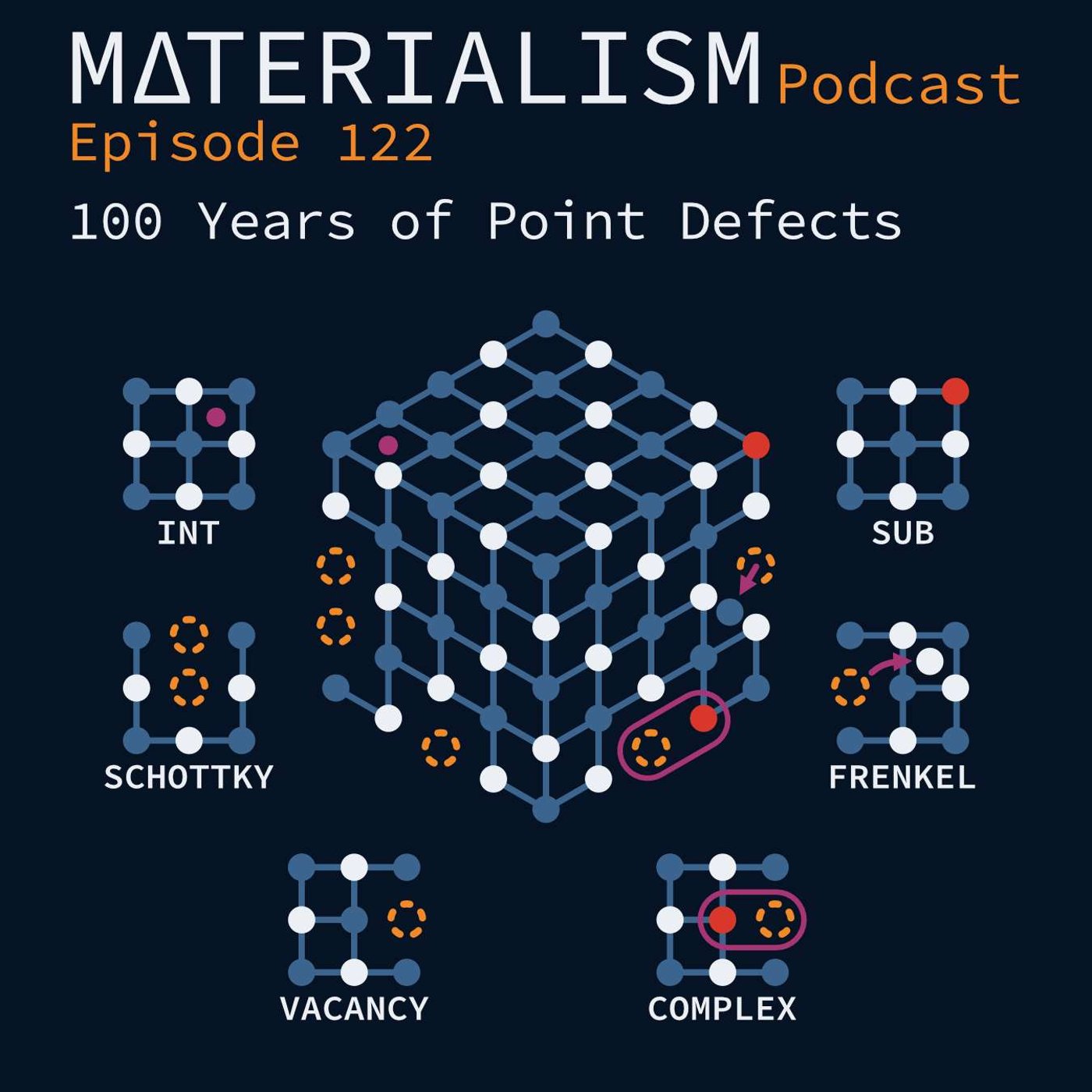
4:33Pretty cool. One thing I noticed, like, in your notes you put together for this, it was Wagner and Schottke's paper. Yeah. And Wagner must have been, I guess, the grad student, but Shockey gets the credit. Well, they were both working at Siemens, if I'm not mistaken. So, yeah, there was actually a commemorative issue of, I think it's annual reviews of material science that celebrated Wagner's contributions to sort of make up for the fact that he didn't get the naming rights. So just to remind people, a Frankel versus a Schottky defect, the difference is, right? So the Frankel defect, you take an atom and it just leaves its site.
5:20It gets nudged off, thermal vibrations, whatever. It goes to a nearby adjacent interstitial site. That's your Frankel site. And then the Schottky is when you have a missing – this can mean you're like ionic crystals, right? You have a missing cation and it has to be compensated by the appropriate number of missing anions for charge neutrality. So it's a pair. Now this is a pair of defects. Right. And that was – so Frenkel was just talking about like atoms can't be destroyed. He just said like if it moves, it's got to go next door. And then, yeah, Wagner and Schottke realized that charge compensation, charge neutrality is a super important part when you have insulators and semiconductors.
6:06So in the 100 years since these things were sort of discovered, clearly they've been important. There's loads of applications. We're going to talk about a few today. And your whole point of your sort of 100 years of point defects, part of it is sort of future looking. We're going to talk about where it's going. Oh, yeah. Maybe we'll begin with this briefly, like why these things are interesting or useful. And the most obvious one that comes sort of historically is gemstones. And we did a whole episode. If you look back on episode 111, you can hear us talk all about it. And we talk about things like, you know, corundum, right?
6:35So alumina, you dope it with a little bit of chromium and it's ruby. You dope it with a little bit of iron and titanium and it is sapphire. Two totally different colors, completely dictated by these defects. So just from like an optical perspective, there's lots and lots of examples in gemstones, of course. And that's probably, I mean, that's, you know, people for thousands of years have been picking up these pretty stones. But it really wasn't until like mid-century, mid-20th century that people figured out that they had these color centers inside. And that could be understood by impurity atoms.
7:11Like you just mentioned chromium and iron being sort of added into a material where they're not supposed to be there. Like there might only be like a couple of parts per billion of iron or of chromium that makes a sapphire or ruby. And we – turns out like one of the reasons I care about it so much is because that level of impurities like completely dictates the properties of semiconductors. Like that is like a major, major part of semiconductor engineering. Yeah, and more than even just picking up them, much in the same way of blacksmithing, where people were using pretty advanced material science well before they actually understood it.
7:55They were doing heat treatments to a lot of stones to enhance their color well before they understood what those heat treatments were doing. And even today, a number of gems, if you buy natural ones, they're not necessarily scientifically engineered, but it could just be still a pretty rudimentary heating process. Well, I remember going to a sapphire. There's a sapphire pebble mine up in Montana that I visited with my family. And you could pay a little bit extra. So we found these sort of vaguely colored green and blue sapphires. And they were like, well, for a little extra money, we'll throw it in our reducing furnace for a couple days and you can come back.
8:28Just trying stuff. So the guy that we interviewed for our Gemstone episode, they've now got a company they call it Stemzy. You know, Stemzy Y. their whole business is actually understanding the heat treatments to get sapphire to turn any color of the rainbow basically and it is it is so cool it's informed by sort of dft calculations of these actual defects and something i thought was interesting is that is the you know the same ion it's not like the same ion will always give you the same color because the same ion let's say chromium in one lattice will give you maybe a red color and in a different one it'll give you a totally different color because it's it's like the surrounding atoms around it right It's the local environment or the crystal chemistry.
9:03If you, you know, crystal chemists out there, you understand what's going on with the crystal field splitting that changes based on the coordinating atoms around it. It is a very complex and subtle field. Something you said, Mike, is wild about semiconductors. You've got some awesome numbers in your notes here. This is crazy. Silicon, when we dope silicon, right? CMOS, you know, very popular basis material for electronics. It has something like five times 10 to the 22 atoms in a cubic centimeter. And they only dope it at something like 10 to the 15 or 10 to the 18. And what that means is that there's only one dopant per every, let's say, tens of thousands of silicon atoms.
9:38Maybe like parts per million. Yeah. And yet that can be like orders of magnitude difference in conductivity, like many orders of magnitude. That's crazy. That is one of the fascinating things that it really hits home for me in terms of like if you look across, you know, the wide spectrum of materials properties. conductivity is wild a lot of things a lot of things are sort of like oh i put a couple atomic percent in and it made the strength change or it put a couple of atomic percent in and it you know it made the diffusion a little faster or something like that and here we're talking about like parts per million and parts per billion completely dictating whether you have a transistor or nothing yeah it is absolutely wild and yet in the world of solar cells it's it's like even more sensitive because you're talking about minority carrier recombination.
10:29Yeah. You want to talk a little bit about that? You mentioned, I think it was lead or something present in the, oh, I can't remember what it was in your notes, but you say that it kills the carrier lifetime. I assume that's sort of minority recombination. Yeah, exactly. Right. So the, you know, when folks started making solar cells in the 1950s or so, you know, they're figuring out the silicon technology and it didn't take long for them to figure out that if they had especially especially like iron and gold inside the silicon or kind of two notorious ones you know numbers like 10 to the 12 per cubic centimeter so you know we're talking one-tenth of a one part in a billion can be like measured.
11:19They'll have measurable effects on how well the solar cell works. And what's it actually doing? Is it, so those free electrons that the donors are donating or the holes, this is trapping those? Is that what's happening? Yeah, but it's, how to say this quickly? It's like, Like it gives an energy stepping stone. I think that's a good way to think about it. Like the electron can fall into that trap and kind of be held there long enough at a lower energy where then a hole comes along, which is really equivalent to saying like an electron falls down from that trap. And you're basically putting a ladder down the hole that it can easily escape.
12:04Yeah. And you can look at it either way. It's like you can go up the ladder step by step or you can fall down the ladder step by step. And it makes the process much more efficient, which is in that case bad for solar cells. So for electronics, they've given us conductivities, the tunable conductivity, right? The reason that we can have pathways in your circuits where the electricity travels along a channel is because you can dope that channel. It's all about defect engineering. Yeah, this is like, well, what else has it given us? You know, you and I both went to UCSB. And at the time when I went there, the dude didn't yet have the Nobel Prize.
12:38But they were, when I already graduated, saying, we hope to be able to give you all a blue laser when you graduate because this is just such cool technology. Tell us the blue laser happened. Well, yeah. Okay. So we talked about silicon before. There's another semiconductor made out of gallium and nitrogen. And Shuji Nakamura, who you were talking about. really like you know really almost like a one-man effort pushed that material to be the answer for for blue light emitters and in order to make that happen electrically you have to have n-type doping and p-type doping so you have to like add atoms like silicon that give you extra electrons and you have to add atoms like magnesium which is like a two plus ion it's going to sit on the gallium site and effectively it gives you like a relative negative charge compared to what was there before so you have donors and acceptors like you have to be able to put those those extra doping elements into the gallium nitride effectively and it turned out you know there's a little more this story even like we were talking about what happens when you heat treat sapphires in a reducing atmosphere which basically means like some hydrogen gas.
14:05It turns out they have to do a similar heat treatment to gallium nitride devices if they have that p-type doping with magnesium. How come? What's going on there? Yeah the hydrogen goes in there and it sticks right to the magnesium. Like the hydrogen ends up being, you know, a bare proton. So is it a coupled defect? Like you have the magnesium is a substitution, and now you've got the hydrogen in the vicinity modifying it, and that's what gives it the magic, basically, that you need for this laser? Well, no, it's the other way around. Like if the hydrogen is there, you have trouble. Oh, so you have to strip it away.
14:39So you grow, like the best way to grow these devices is called MOCVD, which is Metal Organic Vapor Deposition, but another name that was used by our colleague who departed us last year, Jerry Stringfellow. He always said it has to be OMVP, Organometallic Vapor Phase Epitoxy. but the point is you have to do that in a reducing atmosphere or else you get oxygen in there and oxygen ruins things so you have all this hydrogen around and then after you grow it you have to anneal it to drive the hydrogen out to make the devices work so the dude won the Nobel Prize for annealing that's pretty cool material scientist it's part of it I mean, a very obviously tricky version of it.
15:38I mean, we teach everybody about heat treating of steels, and that was kind of, you know, like we learned how to fire ceramics. We learned how to heat treat steels. And, like, we're kind of doing similar things with semiconductors in a sense. You have to figure out exactly what sequence of adding atoms and subtracting others that you have to do to manipulate these pointy effects so that you get blue LEDs that work. So even then, a lot of these are pretty coarse manipulators in terms of your ability to place atoms. Like site occupancy really does seem to matter, and those probably don't give you very direct control over that.
16:18So are many of the effects that we're seeing really just enough defects around the right sites to cause the effect, or do some of the ones on other sites just not play as much of a role? Let's see. So, I mean, what you said resonates. Like, for example, you know, a lot of silicon CMOS technology is based on ion implantation. So you're literally just shooting these extra atoms into the crystal. And on the way, it blows up the crystal and totally destroys it. So, like, the sites aren't even there anymore. There's so much randomness. Like, the sites haven't figured themselves out. so then you have to kind of do the heat treatment under the right atmosphere which might be you know a certain partial pressure of oxygen or it might be like in the case of silicon carbide like you have to do this annealing after ion implant after you've created a very thin layer of like carbon or like graphite on the surface somehow and when you do that it injects extra carbon as interstitials, which in a sense apply chemical pressures to the defects.
17:34So you can sort of manipulate where things end up sitting based on the other types of defects that are there. And it really is, it's like, I think about it as like a chemical push, and then you can apply electrostatic pushes also in the form of like where the Fermi energy is. So for one of the coolest papers that I uncovered in the last couple years was work by Reese at Bell Labs. The experiments that he analyzed were the first ones to show that thing I was talking about, like the electrochemical push. What he showed was that if you have silicon doped with extra electrons like phosphorus versus extra holes like boron, you get two different solubilities or two different ranges of solubilities for a third thing, lithium.
18:34So you can basically put in something that does the opposite effect to lithium. So lithium acts as a donor. And if you put in phosphorus, it makes the crystal not want so much lithium. If you put in boron, it wants more. That's interesting. So like, these are all like, I don't know, second order is not the word, but like it's coupled interactions of defects is essentially like that you could have much, much more complexity available to you. Yeah. So what I'm describing can be, so I usually think in like electron volts and the magnitudes of those sort of generalized forces for where the thermodynamic pushes and pulls that are acting on the crystal and telling atoms where to sit can be electron volts per atom.
19:29It's like, how much can I move the Fermi energy? I can move it through the whole band gap. So it's really neat. In silicon, that means you have a dynamic range of like one electron volt, which is kind of equivalent to an electrochemistry, like one volt. Yeah. But in something with a huge band gap, like magnesium oxide, you have 10 volts worth of range that you can push things around. Yeah. Like these thermodynamic forces are enormous if you start to calculate how big they really are. Yeah. So in a lot of ways, just designing the right thermodynamic driving force to push that defect into the right spot.
20:09Right. So, you know, there's, you know, a concept called defect engineering that, you know, in the late 20th century, you know, people who were working on, you know, mostly silicon developed this very, very sophisticated understanding of how to do that with different chemistries or different thermal treatments. It's like, you know, you go to 400 degrees for this thermal treatment. So I can give you another example in cadmium telluride solar cells that I work on. You know, there's one step where you have to, you know, we call it activating the solar cells, where you have to have cadmium telluride thin film, you add cadmium chloride, and then you have to cook it, you know, above 400 C.
21:05but if it's 420, it might be too much for some solar cells that are a little too thin. And if it's 450, you get away with it if your cell's a little thicker. So there are these incredibly fine delineations between a process that works and one that doesn't because you're moving around numbers of defects that are exponentially sensitive on those thermodynamic forces. What role is DFT and molecular dynamics playing in trying to tune some of these processes? So, yeah, the big problem with atomic scale defects is you can't see them very easily. So, yeah, a lot of the last century was based on physical intuition and imagination about how things should work as we started out the story.
22:13and what's neat in my in just the time of my career like when I was in graduate school I was kind of fascinated by those kind of calculations because there were things that I wanted to know about the system I was working on which was putting manganese into gallium arsenide or gallium phosphide and some neat things happened the defects started talking to each other and you got ferromagnets. I wanted to know how it all worked. So the only way to know that is for somebody to calculate it. And when I started in grad school around 2001, it was like almost equivalent to throwing darts at a dartboard.
22:51It's like, yeah, this person got this and somebody else got that. And just since about the 2010s, when I started as a faculty member, a little earlier than that, but just around that time frame, people developed what are called the hybrid functional formulation or formalism. And once we had those hybrid functionals that correct the band gap, it turns out they also are extremely good at figuring out what the quantum mechanics of these localized states are also. and so the role that they're playing now is is really like okay we see this signature of a defect in experiment like a certain color of light that comes out of it and at this time in history now the calculations are actually good enough to to really be getting those you know predicted colors right on or the predicted photon energies right on and that goes for things like electrical measurements as well as, as I mentioned, like optical measurements.
24:02Yeah. So I was looking through your list of ways that you said it's really hard to measure these things and it is, but we do have some tools, right? Light for one thing. Yeah. You can look at how absorption changes or how they luminous afterwards. Yeah. There are certain things like, let me, let me just say for, for, for something like the colors of let's go back to like sapphires. Yeah. Yeah. The colors of sapphire or ruby, like that chromium emission, we were working in gallium oxide, which is chemically kind of similar to aluminum oxide, and we found these laser-like lines. There's no other way to get it except for chromium.
24:39So you know chromium's in there. So it doesn't necessarily tell you where it is, but based on the intensity might tell you something about the concentration. Yeah, things like that. But then there are other types of emission that are just like very wide spectrally. They're just kind of like, you know, rather than like a laser light, it's kind of like analogous to white light coming out. Oh, yeah, yeah. And those are the transitions that actually involve the sort of valence electrons of these defects, whether it's like an impurity atom or a vacancy or an interstitial atom of the same material. So, there is some, you know, the really well-defined spectroscopic signatures kind of come from internal, like, D transitions.
25:29And then these other ones are a little harder to figure out what they are because they tend to be broader. Yeah, yeah, I could see that. You've got listed here that we can do magnetism measurements, so electron paramagnetic resonance. I will admit I don't know what that means. But I get the idea that you're basically looking at the unpaired spin of the defect itself. And if that contributes to the magnetic moment, you can measure it. Yeah, that's a really important one. So I can think of a few electrical techniques where you can measure, you know, some, like, energy level in the band gap. And, you know, you measure the signature, like, in the time that this technique called DLTS was invented.
26:11You know, silicon and gallium arsenide were sort of the hottest materials. and people started finding these signatures. It's like, well, we got the signature of an electron trap, and it's so many hundred millielectron volts below the conduction band. Yeah, I was just going to say that capacitance, that's DLTS, that's another way to measure it. So it's awesome because you know how much charge is there, so you know exactly how many. Because the capacitance measurements, yeah, you're counting charge, okay. You count charge, you know exactly how many are there, but you have no idea at the first what it is.
26:42You have to do a whole bunch of experiments like, okay, we took this gallium arsenide crystal and we cooked it in extra arsenic and the signal went away. So, okay, maybe it's an arsenic vacancy. You sort of play detective like that. But that takes years to do. Nowadays, like when these DFT calculations are getting better, you can nail it down. But the combination of all these techniques is really what does it. And the thing about EPR, coming back to that one, it's one of the only techniques that tells us that structural information. Like, what are my nearest neighbors? Right, because they're influencing the defect and it gives you information about them.
27:23Exactly. So that resonance. It seems like the vibration techniques. So Raman should also give you kind of similar information because the bond vibrations are impacted by the defect. It's complementary, I suppose. Yeah. There are cases where, so there's a phenomenon called localized vibrational modes. So that example we were talking about before of hydrogen attached, bonded to magnesium and gallium nitride. For the blue laser. Yeah. So hydrogen is really light, forms pretty strong bonds. So you get these vibrational modes that have really high frequency. And the significance of that is that they're way outside of where all the normal vibrational modes sit.
28:09So you can see them, and they're like really sharp spectral features. And you do the calculations, like this can only be hydrogen sitting against magnesium. Okay, okay. Very cool. The math is like high school physics math about bound objects vibrating against each other. Two other techniques. One, microscopy has come so far. We can actually see these things in some TEMs, which is wild. You can see atoms and not only see atoms, but see missing atoms. And then the other one's interesting. I wasn't familiar with this one. It's antimatter. So positron annihilation spectroscopy. I understand one of your co-editors on the special issue, this 100-year anniversary, is an expert in this, right?
28:53Do you understand this well? I don't know anything about this. Yeah, you got to wrap your head around it for a little while. that my friend Philip from Helsinki runs the positron annihilation lab there. So when a positron meets an electron, it gives out a very well-defined gamma ray. I forget the energy, but there's only one energy it happens at. Now, I should say that energy can get shifted a little bit. what's called the Doppler broadening and you know the people who study this have really got this down to a real quantitative science. What you see though is especially when you can look at something like the lifetime like how long the positron sits there in the material before it annihilates with electrons.
29:52Well imagine a place in the crystal where there are no atoms so the electron density goes down a lot so a vacancy a missing atom especially if it has the right charge to attract positrons so negative charged vacancies now we're talking about cation vacancies in like you know somewhat ionic crystals so things like you know gallium vacancies and gallium nitride gallium vacancies and gallium arsenide or oxide are really amenable to study with these positron techniques and um yeah sort of the rate of the rate of uh positron decay like how long the lifetime is um as well as some of these doppler broadening um features can can tell them about what kind of defect was it was it a shocky defect that had an oxygen vacancy right next to it also or was it just a single isolated gallium defect i'm talking about gallium oxide yeah yeah that's sort of your world.
30:54They can tell the difference between those things. It's pretty amazing. Remarkable. Takes years to do it. It's one of these one of these techniques that is not easy and you really have to. But it gives you uniquely. Yes. There's no other there's no other thing that you can do that tells you these answers. Well, Mike, we know you're a busy person. We don't want to take too much of your time, but I do got to know, like, give me a teaser for this special issue. It's got a couple articles you guys commissioned for and you're going to have a symposium with a bunch of talks. Tell us what people expect about it.
31:24I'm so excited about this. So the issue of MRS Bulletin is out. It's the May issue, May 2026 issue of MRS Bulletin. And it was so fun to put together. I got to call up a bunch of my colleagues and friends and say, like, hey, you want to do this together? Let's get this celebration going. So, yeah, we got to pick things that we were all interested in. um so some of the frontiers of of calculation um i tried to make sure there was an article there on what what i what i told them to write about was defect kinetics so a lot of the time we okay these days we're thinking about like the energetic stability of defects but how do those concentrations of defects change in time like that's what you need to understand to answer these questions of Like, how do we design the optimal process?
32:19So quit thinking about them as static. Realize that they are also subject to evolution, just like all materials. Yeah, yeah. Radiation damage during, you know, during these heat treatments we've been talking about, during growth. You know, one of my favorite topics is, like, how defects might move around and change their concentrations inside something like a solar cell while it's operating. Like, all these things, you need to understand the dynamics. and the kinetics of what happens to these defects, just like chemical kinetics. So we had all these really interesting articles in there. And then I had a really wonderful opportunity.
33:01We got approved to have a symposium at MRS Fall in Boston. Big meeting, by the way. Congrats, dude. Yeah, yeah. I mean, this topic, you can't say no to. It only comes around once a century, and I'm so glad. So are you going to do them proud? Well, I think that our incredible speakers are going to do all of us proud. It is such a great lineup we got. I got to send emails to all these leading experts from sort of like physical chemistry standpoint, people who work on batteries and ion conductors, as well as quantum emitters in semiconductors and oxides. I really tried to bring together these research areas that usually end up going to different symposia.
33:57and that was the most fun is like we get to sit in one place and get the perspectives from you know people who would call themselves electrochemists or physical chemists as well as pretty hard spectroscopists and pretty hardcore physicists and and there always has been this somewhat somewhat of a tension between the like statistical mechanics view of things versus the sort of quasi-chemical physical chemistry approach. The people who measure versus the people who make devices out of them. How cool to get everyone in the same room. Yeah, this is going to be so fun. And what a treat to get everybody talking about these subjects and learning from each other.
34:40Well, Mike, just five minutes before we go, what does the next hundred years of point defects look like? Give me some teasers. What can we expect? What are the grand challenges? And is there hope to sort of solve them? when you think of point defects for material science? I mean, my goal, what I am thinking about, you know, in recent years, I've really been thinking about, like, how to calculate the numbers of defects and do this defect engineering in a more predictive and rational way than trial and error. and I'm going to translate that into figuring out what defects are there that's sort of almost like figuring out where the peaks are in an x-ray diffraction spectrum.
35:30What I'm talking about is telling you exactly how tall each of those peaks is going to be and that's hard because you've got to get all the pre-factors right on all the theory. You think that'll happen? You think we'll get there? Yes, I do. I do think we're very close to there. And some of the exciting things that we talked about in that issue of MRS Bulletin are the massive speed-ups of computations that are possible using machine-learned interaction potentials. So it turns out one of the pre-factors is this entropy term that has to do with the vibrational modes that are localized around those defects.
36:19We spoke about this already a little bit. If you look at all these old books from 50, 70 years ago, they knew it was there. They're always saying, yeah, this vibrational entropy thing, it's really hard to calculate. We don't know what to do with it. And now the last decade or two, you talk to computational people, it's like, we know what to do, we just can't do it because it would take essentially infinite time on the supercomputer and we don't have it all the sudden and all the sudden and we have another episode coming in the near future probably released in the same time as this on m lips with nvidia yeah which we're going to cover this exact same topic yeah so this is a really exciting thing because you can like people are demonstrating you know there's like papers every day nowadays on something like this where you can show the fidelity to the most precise ab initio calculations but at you know 10 000 x speed ups so it's making what was impossible just a few years ago possible so that's one of the really exciting things i think we're going to get a lot of insight i'll tell you what i'm excited about in in my world ai for materials where we're coming up with representations and algorithms to do all sorts of things classification, regression, generation, it's overwhelmingly been on pure materials.
37:35And the frontier is going to be representations that allow us to represent, you know, a material like alumina, but also understanding that alumina was going to have these very specific defects and representations for that and algorithms that are going to be sensitive to something at the part per million level that radically changes properties. Like that is a frontier for us on the AI world, which I'm, I think that we will tackle in the next 10 years, probably realistically. Because usually, yeah, usually, I mean, you can make nonlinear models, but like your models usually are not sensitive to little tiny changes at parts per million levels.
38:11What else is coming? I think there will be real developments in how to intentionally make quantum emitters inside materials. So as I sort of outlined, one of the ways I know to make these NV centers is you do this ion implantation. So it's sort of just like a shotgun approach. You just like slam all these atoms in there, you heat it up and anneal it, and you hope for the best. And as people develop more experience with it and as they develop more predictive models about how to do it, we'll be able to give those sort of processed recipes more precisely. Like you heat up at this ramp rate, you cool down at this ramp rate, you hold for exactly this much time, and so on and so forth that will lead to incredibly fine control over where those quantum emitters are spatially as well as sort of like how many of them form where you want them.
39:22And that will allow us to do things like three-dimensional arrays of these so we can hold memories. We can hold memory in those states in a 3D cube, which will, you know, just increase the amount of data we can store and process by. And what comes to my mind is quantum sensing, right? There's always talk about quantum computing, but I think one of the coolest things we're going to see is quantum sensing. And these are all, well, currently the most popular ways are these NV centers and diamonds. Yeah, they are so sensitive. Being able to control and engineer those point defects and then make devices based on them is going to be a big part of our future as a species, which is really exciting.
40:02Yeah, one of the things I was just thinking about is like you can literally like read somebody's brainwaves with these things. They can detect the magnetic fields from your neurons firing. It's wild. Yeah. And that's all defects. It is reliant right now on defects. Yeah, yeah. So I think we'll see things like that. And I don't know how to, you know, the future is always surprising. There's so many great people out there working on these things. and they're coming at it from all these different angles that I don't even know about. We're just going to see levels of understanding and completely new applications.
40:45It turns out if you want to make better batteries, you have to know about defects. If you want to make better optical fiber communications, you have to know about defects. If you want to make better lasers, you need to control defects. All of these technologies that we rely on for our internet, our Netflix, recording this podcast, efficient solar cells and LEDs that are helping us save energy and do things more efficiently. All of these technologies come down to point defects. Yeah. Well, Mike, we got a bug out. I appreciate it. I love having you in the department. Mike's my best buddy in the department.
41:23It's fun to have somebody who you get along with and share the same interests in. It is always fun to hang out with you, Taylor. And, you know, we can do skiing and climbing as well as nerd out on Pointe-Tex together. Talk about Pointe-Tex together. And happy 100 years, Pointe-Tex. I hope the symposium goes awesome. Thanks for joining us, man. Happy birthday, Pointe-Tex. Yeah. All right. The Materialism Podcast is also sponsored by Materials Today. You can visit materialstoday.com to stay up to date on the latest happenings in the material science field and read some of the fantastic articles that they've published.
41:58You can also head over to Elsevier.com to find out more about their journals, books, conferences, and related programs. And then lastly, thanks to the people that make the music for the show. Thanks for the listeners who reach out and suggest episodes. You can get a hold of us. We are materialism.podcast at gmail.com or the at materialism.podcast on Instagram or pretty much wherever else. We would love to hear what you want to hear next, so drop a comment, whether this is on Spotify or on YouTube or wherever you're listening to this. Leave a comment. I try and get to all of those. Send us a message on Instagram.
42:29We try and respond to everything because we appreciate our listeners. We love that you're out there. And with that said, we will wrap it up. See you, everybody.
42:38Dr. Mike Scarpulla: The inventors of fire, electricity, magnetism, iron, lead, glass, silk, cotton, the makers of tools, the captors of lightning, the architect, the engineer, the musician are all beneficiaries of the materials of this world. and are bound only by their imaginations in manipulating those materials.
What do a ruby, a transistor, a blue LED, and a quantum sensor have in common? They all work because of point defects. To celebrate the 100th anniversary of the point defect, we sit down with Dr. Mike Scarpulla, a professor at the University of Utah and co-editor of a special MRS Bulletin issue on the topic. We explore how a single missing or misplaced atom can change everything. From the history, to the measurement techniques that let us finally see what Frenkel could only imagine, and where defect engineering is headed next.
MTS Bulletin on 100 years of point defects [LINK]
The Materialism Podcast is sponsored by Materials Today, an Elsevier community dedicated to the creation and sharing of materials science knowledge and experience through their peer-reviewed journals, academic conferences, educational webinars, and more. [LINK]
Thanks to Kolobyte and Alphabot for letting us use their music in the show!
If you have questions or feedback please send us emails at [email protected] or connect with us on social media: Instagram, Twitter.
Materialism Team: Taylor Sparks, Andrew Falkowski, & Jared Duffy.