Ask ChatGPT

 Media and the Machine
4 Sep 2026 · 33m · 9 chapters
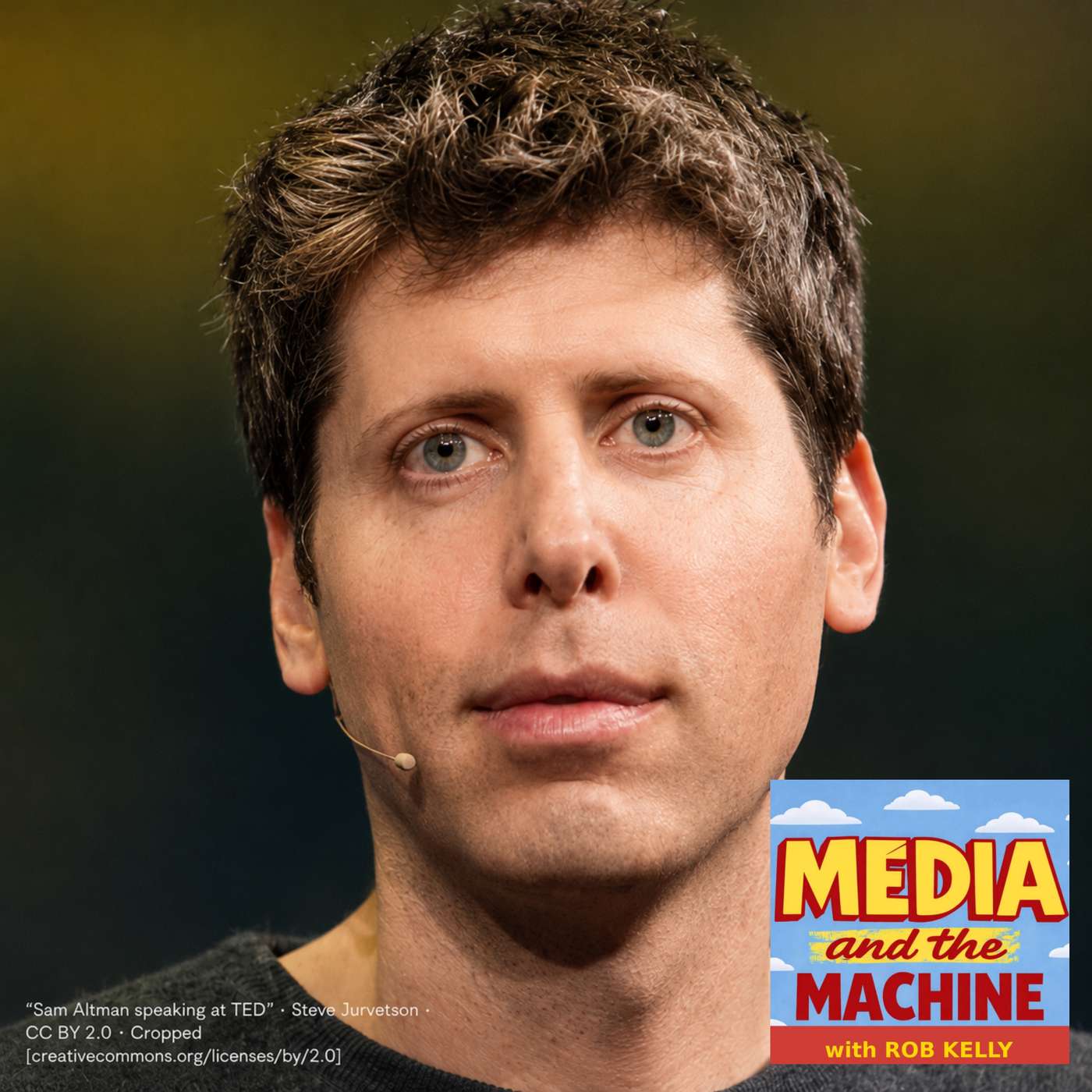
A biography-based look at Sam Altman’s rise—how he gains influence “without looking like he’s grabbing it”—and the trust issues that followed at OpenAI.
No separate guests. The episode is narrated by Rob Kelly and draws on interviews and quotes from Peter Thiel (investor), Paul Graham (Y Combinator), Elon Musk (SpaceX/Tesla), and others (e.g., Patrick Collison, Reid Hoffman, Jessica Livingston, Ilya Sutskever, Greg Brockman, Helen Toner, Adam D’Angelo, Tasha McCauley, Dario Amode, Mira Murati).
Altman sells belief as much as technology; he’s “the god of fundraising” and a “root node” connector; he took no OpenAI equity and promised governance accountability; yet people close to him felt he moved fast, leveraged YC, and sometimes misremembered or misrepresented events, culminating in the board firing him for not being consistently candid.
YC “Manhattan Project” AI pitch to Musk; Altman convincing Brockman to reject Musk as CEO; Senate testimony about having no OpenAI equity; fireside chat where Hoffman says he’d fire Altman; board dispute over “Decoding Intentions” and a reported lie about Toner; 2023 board firing and later NDA/clawback threats.
Written by AI. May contain mistakes.
Exploring the personality traits and early insights into Sam Altman's character.
“Each week, I talk with the founders and CEOs closest to AI and content.”
Discussing how Sam's unique traits and experiences contributed to his rise in power.
“What is it about Sam that makes people respond so strongly to him?”
Analyzing how Sam Altman's connections facilitated his success and influence.
“How did Sam turn all of that into power?”
Explore how Sam Altman navigated power dynamics in the tech world.
“Sam's relationship with open AI gets even more interesting when you look at what he chose not to take, ownership.”
Delve into the trust dynamics and controversies around Altman's leadership.
“Reading from the book, as Altman's power grew, he promised the world that he was no Mark Zuckerberg.”
Discover Sam Altman's vision for a post-AGI world and his beliefs about technology.
“And the questions about trust actually go back to OpenAI's earliest days.”
Explore Sam Altman's views on technology and human progress through his personal beliefs and possessions.
“caring for each other, making incredible gifts to give each other.”
Discover the complexities of Sam Altman's journey and the competitive landscape he faces.
“in human progress at his home on Russian Hill.”
Delve into the philosophical ideas that underpin Sam's vision for the future and technological advancements.
“while Sam famously still has zero equity.”

Get the gist, explore an idea or ask about something said.
 Claude
On Media and the Machine, what are the key points of this episode?
Searching your listeningAutomatic transcript. May contain errors.
0:01The first thing people notice about Sam Altman, and something that comes up again and again in early stories about him, is how small and thin he is, about 5 '8". The second is his intense green-eyed stare. He looks directly at you in a way that makes you feel like you're the most important person in the world. He apologized at his last meeting, which was still listed on the conference room scheduling screen as AI Manhattan Project, had run long.
0:43I'm Rob Kelly, and this is Media and the Machine, a show about the biggest technology shift of our lifetime and how to profit from it. Each week, I talk with the founders and CEOs closest to AI and content. In every few episodes, I go deeper on one of the people shaping the AI race through the best book biography I can find. I want to understand the human behind the hype. These books represent years of reporting and hundreds of hours of interviews. I read them, take detailed notes, and bring you what matters most. I'm talking about people like Sam Altman at OpenAI, Dario Amodei at Anthropic, Demis Hassabis at Google DeepMind, and Elon Musk of SpaceX, the leaders behind the companies training the models buying the chips and shaping the rules of AI.
1:26Where'd they come from? How'd they get this powerful? What do they believe? What do the people closest to them really think? And what kind of future are they trying to build? After all, their decisions are shaping the future of business and humanity. That's an excerpt from The Optimist by Keach Heiji, a reporter for the Wall Street Journal, my favorite newspaper. Heiji did more than 250 interviews for the book with Sam's family, friends, teachers, mentors, co-founders, colleagues, investors, and portfolio companies, and spent hours interviewing Sam himself. I've organized what I pulled from this book around four questions about Sam.
2:06What is it about him that makes people respond so strongly? How did Sam turn that into power? What does he actually believe about AI in the future? And what happens to us if Sam gets the AGI future he's trying to build? So let's start with the first one. What is it about Sam that makes people respond so strongly to him? Because that reaction comes up again and again in this book, even from some very powerful people. When the journal asked Peter Thiel about Sam's idealism, Thiel said, we should treat him as more of a messiah figure. Sam calls Thiel one of his top two mentors. Thiel's also an investor in OpenAI.
2:43Heiji writes, quote, that Altman was at OpenAI not so much to sell technology as to sell belief. As it turns out, the signs that Sam was different were there from childhood. Here's Sam's mom, Connie, reading for the book. When Sam was three, as a family was trying to call Peggy, that's Sam's grandma, in St. Louis one day, Connie realized he grasped the concept of area codes. He said, what numbers do you have to dial before I call grandma? And my other kids probably understood that when they were like 10. To her, it seemed like, quote, he was kind of born an adult. Sam's parents bought him his first computer, a boxy beige Mac LC2 for his eighth birthday.
3:21It was technically a computer for the whole family, but for a few years before his father started using it for work, it resided in Sam's room. He had taught himself to program in his elementary school's computer lab. Here's Connie sharing a memory. The teachers would go find Sam in third grade and tap him on the shoulder and be like, we need him for a minute. We don't know how to do this. And he would go to their classroom or the library and show them how to do what they didn't know how to do. His elementary school teachers began giving him separate, more advanced lessons. Connie adds, I always used to say you could drop him in New York City at age 10, and he could have figured out his life, figured out how the whole city worked.
3:58While Sam was obviously smart and had tech skills at an early age, Sam himself knew he was different from other kids at around 12. Reading from the book, By the time Sam was 12, he knew he was gay. Till he came out to his mother at age 16, she thought he was just a bit antisocial. To not be part of the junior high male group who's making boob jokes and stuff, I think Sam had a hard time, she said. Here's this memory from Sam. Growing up gay in the Midwest in the 2000s was not the most awesome thing, Sam said. And finding AOL chat rooms was transformative. Secrets are bad when you're 11 or 12. There's something about Sam that is Peter Panish.
4:37I found it in this book, The Optimist, also in other interviews he's given, in other books about OpenAI's founding and AI in general, which I'll cover some other time. But anyway, from this book, The Optimist, I found this one story interesting. It's from his high school boyfriend, Nathan Waters. I'm not sure if this is his first ever boyfriend or not. Here's what Nathan had to say. Sam was so obsessed with the book, The Picture of Dory Gray by Oscar Wilde, that Waters bought him a leather-bound hand-illustrated edition decorated with gold leaf for his birthday. In the book, considered one of the greatest homoerotic novels of all time, though there is no overt homosexuality in it, a beautiful young man makes a deal with the devil that makes his portrait age instead of him.
5:19He chases youth a lot, Waters said of Sam, pointing to his boyfriends later in life who were often around a decade younger than Sam. I think he's always chased youth. By college, Sam went to Stanford. He was thinking very big. Grabbing a loose piece of paper, he scribbled a list. These are the things he wanted to work on in life. Topping it in order were AI, nuclear energy, and education. Shortly after this, Sam would meet Paul Graham, who founded Y Combinator. Paul Graham, or PG as most people who know him call him, would become Sam's second top mentor, in addition to Peter Thiel, mentioned earlier.
5:58This is Paul Graham's memory of when Sam first interviewed with Paul Graham and the rest of the Y Combinator team to try to get into the Y Combinator incubator. Here's what Paul Graham said. Within about three minutes of meeting him, Sam, that is, I remember thinking, ah, so this is what Bill Gates must have been like when he was 19. Then Sam gets into the working world and you start to see what those traits look like in practice. Here's Brian Marciniak, a seasoned tech sales executive who worked with Sam at Loopt, Sam's first startup. Quote, he always makes it sound like he knows everything. He really doesn't.
6:34His level of knowledge might be a three, but he talks and makes it sound like it's a 10. But still, Marciniak found Altman kind and collaborative and didn't mind that he multitasked for every meeting, his laptop open and his Palm Pilot, its keyboard stripped of paint from constant use, operated by feel. And here's Lowell Weiner's take on Sam. Lowell was the Director of Innovation and Business Development at Boost, a partner of Looped at the time. Anyone who came across Sam at that time wished they had some of what he had. There was a sense that anything was possible. He's quite optimistic, decisive and optimistic.
7:09Rarely is he skeptical about anything. Here's co-founder of Stripe, Patrick Collison's take on Sam. This is during the Y Combinator days, he's recalling. He knows a lot about a lot of things and did then, Collison said. I was pretty interested in some obscure programming topics at the time. I guess I still am. And he knew a surprising amount about those topics, even though I don't think they were his hobbies to the extent that they were mine. Altman would end up investing$15 ,000 in Stripe, earning him a 2 % interest at the time. That stake is widely believed to be worth well over$600 million.
7:44A couple more takes on Sam. Peter Thiel says, and I'm reading from the book again, Altman is very, very smart, as well as, quote, very principled, very strict, very balanced, but, quote, maybe a little too optimistic. And then here's Steve Lemon, an engineering colleague of Sam's back in the loop days. Quote, he thinks faster than any human being I've ever met, and he doesn't tend to bring people along, especially if he thinks they'll slow him down. So Sam seems to be one of the best in the world at something. But at this point in the book, I still couldn't quite put my finger on what it was. Which brings me to my second question.
8:21How did Sam turn all of that into power? One way is through connections. Here's Paul Graham again. He knows everyone. He has not only done countless introductions for alumni, this is at Y Combinator, but did most of the initial intros in Silicon Valley for YC itself. YC now does many intros per day, but if you follow the tree back to the beginning, Sam was the root node. Remember, Sam is part of the first set of portfolio companies for Y Combinator. Paul Graham co-founded Y Combinator along with his friends. And those connections led to money. And remember, Sam's startup with Y Combinator was called Looped.
9:00And Looped did fine. It sold for$50 million. Investors got their money back. Sam made a few million dollars. But that's nowhere nearly as much money as Sam made through investments that he made in other Y Combinator portfolio companies, such as Stripe and Reddit. Sam would go on to head up Y Combinator, and he also personally invested in the Y Combinator companies, somewhere in the ballpark of 100 plus companies. And for many of these companies, it was Sam's ability to fundraise that was one of the reasons they wanted him to invest. He could raise extra money beyond his own personal investments, which were often only tens of thousands of dollars, like we saw in Stripe.
9:40Paul Graham referred to Sam as, quote, the god of fundraising. And of course, one of the reasons Sam was so awesome at fundraising was all of his connections, his ability to be back to, quote, the root node of many of the deals in Silicon Valley. And maybe the best example of Sam's ability to put himself at the center of things is Elon Musk. So now we're going back to May 2015. Google now owns DeepMind, the major AGI startup by far. I covered all this in my biography about Demis Haspis a few months back. So we're in May 2015. Sam's still the president of Y Combinator at this point. But Sam catches wind that Elon is super worried and upset that Google's got all the power for potential AI and AGI.
10:30I remember no ChatGPT has come out, no chatting with AI or anything, but Google basically acquired the most important company in AGI. So I'm reading from the book here. Altman wrote Musk that he had been thinking a lot about whether it's possible to stop humanity from developing AI. I think the answer is almost definitely not. If it's going to happen, it seems like it would be good for someone other than Google to do it first. Altman proposed that Y Combinators start a, quote, Manhattan project for AI, the same term Haspis had used in pitching DeepMind in 2010 to Google. Adding that, quote, we could structure it so the tech belongs to the world via some sort of nonprofit, but the people working on it get startup-like compensation if it works.
11:13Obviously, we'd comply with and aggressively support all regulation. Here's Elon's response. Probably worth the conversation. And what I love about that story is somehow Sam, through all his connections, and you know, he knew Elon Musk and they would have dinners periodically. But through all that, he somehow knew the exact button to push, Elon's exact button to push, at exactly the right time. And this is Elon Musk, who obviously is going to become the richest person on the planet. And by the way, as part of this, Sam talks Elon into committing$1 billion to this organization. Elon ended up putting in around, depending on who you ask, in the tens of millions, roughly about 45 million.
12:00But Sam got Elon to commit to a major check, a major endorsement of this new venture. And I want to read another excerpt just showing Sam's prowess at working with Elon, against Elon, depending on how you look at this. Once OpenAI was rolling along, it's still in the early days, this is way pre-ChatGPT, There was another sort of interaction involving Sam and Elon that I think just says a lot about Sam. So two of the co-founders, Ilya Setskiver and Greg Brockman, this is talking about them and their feelings, thoughts about Elon and Sam at the time. As they mold the transition of becoming for-profit, this is OpenAI, they're still a non-profit, the co-founders had a long negotiation with Musk about who would lead it.
12:49Musk wanted to be fully in charge with majority equity, board control, and the CEO title. Can't blame him. He had committed$1 billion and put in tens of millions. But Susquevur and Brockman were concerned he would only be able to dedicate a small fraction of his time to the company. He was obviously doing Tesla and the boring machine and other things, SpaceX. Back to the book. The decision of who would be CEO was ultimately left to Brockman and Susquevur as the more senior full-time co-founders. And they initially chose Musk. Then Altman called Brockman and convinced him to change his mind, arguing that Musk would be difficult to work with.
13:23Just a little side note, and this is Rob speaking, not coming from the book, but related to all this. When I look more closely at who Sam actually brought into OpenAI, I notice something interesting. The book calls Sam the ultimate connector, I have to agree. OpenAI had 11 original founders. And when I looked at who recruited the tech talent among them, most of that came through Brockman and Musk. Ilya Suskever only joined because Elon was there. That's been widely reported. Two other folks who did not join, Dario Amode and Chris Ola, both said no to Sam and said went to Google Brain, the other part of Google that wasn't Google DeepMind.
14:00So it seems like Sam's pull, it works best on investors and power players, but not AI researchers. And that distinction matters later. Sam's relationship with open AI gets even more interesting when you look at what he chose not to take, ownership. Before we get to the famous no equity story, some context. OpenAI launched as a nonprofit. The public story has always been the idealistic one. But even at the time, that was a surprising choice for Sam. Here's Michael Moritz of Sequoia. Now, Sequoia and Moritz invested in Sam's first startup, Looped, in YC's funds, and also in OpenAI. Moritz counseled Altman against the idea of a nonprofit.
14:41In his view, it just went against Altman's nature. Quote, he's a very mercantile character, he said. He's a man wired for the market. So it seemed to me that setting up OpenAI as a nonprofit was pitching his tent in a foreign pasture. So why do it? The idealistic answer is right there in the founding documents. A lab built for humanity whose technology would benefit the public. We're talking about AGI. And here's Paul Graham's take. Now remember, at this point in 2015, Sam is still president of Y Combinator. Paul Graham's sort of called it like an executive chairman role. But Sam is, he's appointed Sam as the day-to-day guy running Y Combinator.
15:21And this was new to me reading this in this book. Key, key nugget, if true, and it's quoting Paul Graham. As Graham saw it, Altman had little choice but to set OpenAI up as a nonprofit because he already had a job. He could not very well co-found a for-profit company while running YC. Quote, people think he's pulling some bait and switch operation by starting OpenAI as a non-profit and then converting it into a for-profit. But this would be the worst bait in the world. Does anyone think that if he could go back in time and start it as a for-profit company, he wouldn't, Graham said? Quote, he's the god of fundraising, so he could easily have raised enough money.
15:57The reason he did it as a non-profit was because he already had a job, end quote. Keep that in mind as you hear what comes next, because what comes next sounds very idealistic. And then there's Sam himself. Because OpenAI is unusual board rules, Altman chose to forego taking any equity in the company he co-founded and was about to run. The situation the author calls, quote, virtually without precedent in the history of American business. At the time, Heiji writes, it seemed he was simply foregoing money for power. And Sam kept making the same point publicly. I can read an excerpt here from when Sam testified in front of the Senate Judiciary Committee.
16:34When Senator John Kennedy, a Republican from Louisiana, asked if he might know anyone who could run the new AI regulating agency that Sam Altman had suggested, hinting that Altman might do it himself if he wasn't making so much money, Altman's reply left the senators nearly speechless by explaining he had no equity in open AI. Here's the exchange. Senator Kennedy says, Are there people out there that would be qualified? Sam says, we'd be happy to send you recommendations from people out there, yes. Kennedy says, okay, you make a lot of money, do you? Sam says, no, I get paid enough for health insurance.
17:08I have no equity in OpenAI. Kennedy says, really? Sam Altman says, yeah. Kennedy says, that's interesting. You need a lawyer. Sam Altman says, I need a what? Kennedy says, you need a lawyer or an agent. Sam says, I'm doing this because I love it. And Sam also pointed out that it wasn't just about equity. Reading from the book, as Altman's power grew, he promised the world that he was no Mark Zuckerberg. Quote, no one person should be trusted here, Altman told Bloomberg TV in June of 2023. I don't have super voting shares. Zuckerberg does. Many others do too as well in Silicon Valley. I don't want them.
17:43The board can fire me. That's important. He also invited insiders to hold him accountable. This is a wild story here. So Reid Hoffman, founder of LinkedIn, had joined the board for OpenAI. And Altman invites him to a fireside chat at OpenAI. This is inside the company. In front of an audience of OpenAI employees, Altman surprised Hoffman with a jarring question. What will you do if I'm doing the wrong thing as CEO of the organization? Hoffman, who is broad-shouldered, affable, and easy to smile, paused for a beat. Well, he replied, laughing nervously. Obviously, first, I'd try to fix it. But if I couldn't fix it, I'd fire you.
18:21Altman nodded approvingly. Yep, Altman said. That's why I wanted everyone here to know. But who actually oversees Sam? I'm reading from an excerpt at a time when some of the board members had to leave for various reasons. The departures made Altman very anxious, especially because a remaining board member, Adam D 'Angelo, the Quora CEO and former Facebook exec, had grown increasingly interested in improving OpenAI's corporate governance over the last year. setting aside a considerable amount of time to work on board issues. D 'Angelo was concerned about the board's basic structure, in which two employees that reported to Altman, Brockman and Sutkver, sat on the board that was supposed to have oversight over Sam.
19:02And here's the author's own verdict on all of it. For all the no equity, no super voting shares talk, quote, Altman really called the shots. Which is when I finally put my finger on it. The thing Sam might be best in the world at, It's getting power without ever looking like he's grabbing it. And that scale is exactly what started making the people closest to him uneasy. The first way trust starts to break is when Sam's ambition outruns the people around him. Reading from the book, back at Y Combinator, the news that Altman would become CEO of OpenAI's for-profit arm, angered Jessica Livingston.
19:34She's married to Paul Graham and a key leader at Y Combinator. Livingston asked Sam to find a successor at YC if he's going to be devoting himself to running another for-profit company. The change was not exactly voluntary, but Altman did not protest. It was actually Jessica who suggested he should find a successor at YC after OpenAI created its for-profit arm, and he was going to be CEO of it, Graham wrote in an email. So if anyone fired Sam, that's in quotes, it was Jessica, not me. But it would be wrong to use the word fired because he agreed immediately. Still, Altman wanted to stay in the mix and suggested he step back for a more hands-off role as chairman of YC.
20:12Jeff Ralston, the longtime YC partner that Graham, Livingston, and Altman ultimately agreed should be his successor, thought a cleaner break would be better. Livingston had been surprised and hurt when she learned the full extent of Altman's moon length for open AI while ostensibly running YC. For years afterward, they did not speak. Graham was also angry, but quicker to forgive. Part of their anger stemmed from the chaos resulting from Altman's departure from YC. While Altman had increased the size and scope of YC, he had not meaningfully professionalized its governance. YC had no true board of directors and no official process in place to search for a replacement for Altman.
20:49Just one more part of the book that maybe explains why Jessica was so upset with Sam. I'm reading here. Altman had leaned on the YC brand to build OpenAI, using YC equity to create a compensation pool for OpenAI researchers, offering up YC buildings in early emails with Musk, even using YC companies' data to train OpenAI's models. But because Musk demanded from the beginning that OpenAI be set up as a separate nonprofit whose funds would not bleed into YC research's other projects, this fluidity started to look to some partners at YC more and more like a conflict of interest, or at least an unseemly leveraging of the YC brand for Altman's personal projects.
21:29Altman's supporters say he was simply moving fast and breaking things. Quote, Sam's a good person that means well, said one longtime YC partner. He is moral. He tries to do the right thing. But he is conflict avoidant, not a great communicator. And sometimes he moves so quickly that he breaks trust. The second trust pattern is stranger. These aren't big scandals. They're small stories. but Heiji, the author, includes several examples where other people remember things Sam said or did, and Sam remembers them differently. I kept thinking about Steve Jobs' famous reality distortion field. Not necessarily dishonesty, but a recurring gap between Sam's version of events and other people's.
22:07Heiji gives a handful of small but strange examples. I'll give you two. Patrick Chung, an investor at NEA, and his partner Matthew Byrd, vividly remember going with Sam to Stanford's full moon tradition during Sam's junior year. Sam says he doesn't remember bringing them to the event or even attending junior year. And Nathan Waters, Sam's ex-boyfriend, says Sam told him in person over coffee that if Hillary Clinton lost, Sam said he was going to run for president. Sam disputes that and says he never wanted to run. Neither is a huge deal on its own. What caught my attention is the pattern Hagee documents.
22:41People who knew Sam remember very specific things, and Sam remembers them differently. And finally, the book moves from those small discrepancies into much more serious questions about trust. And the questions about trust actually go back to OpenAI's earliest days. Here's an email that Ilya and Brockman are writing to both Sam Altman and Elon Musk. This one's directed right at Sam. We haven't been able to fully trust your judgments. We don't understand why the CEO title is so important to you. Your state of reasons have changed, and it's hard to really understand what's driving it. Is AGI truly your primary motivation?
23:15How does it connect to your political goals? Years later, Ilya described it this way, reading from the book. It had taken Sutskiver, that's Ilya Sutskiver, years to be able to put his finger on Altman's pattern of behavior. How open AI CEO would tell him one thing, then say another, and act as if the difference was an accident. Oh, I must have misspoken, Altman would say. Sutskiver felt that Altman was dishonest and causing chaos, which would be a problem for any CEO, but especially for one in charge of such potentially civilization-altering technology. Then the board encountered something much more concrete.
23:50Reading from the book, Toner, board member, published a paper in October that Altman did not like, titled Decoding Intentions, AI and Costly Signals. Buried deep inside it, though, were a few sentences that appeared to praise Anthropic, OpenAI's competitor, praised Anthropic's decision to hold back releasing its chatbot, Claude, until OpenAI had broken the AI seal with the release of ChatGPT. Toner wrote, Antropic was showing its willingness to avoid exactly the kind of frantic corner-cutting that the release of ChatGPT appeared to spur. Altman called Helen Toner calm but angry. Meanwhile, Sutskiver spoke to Adam D 'Angelo and Tasha McCauley, other board members.
24:30It was only because the board members were having so much regular contact with each other that they caught Altman in the lie that ended up being the nail in the proverbial coffin. During Susquefort's conversation with McCauley in late October, he mentioned that Altman had told him that McCauley had told Altman that Helen Toner should obviously leave the board over the article. McCauley knew she had said no such thing. She called D 'Angelo and explained what had happened. That's very concerning, he said. In the minds of the company's three independent board members, the incident seemed to crystallize Altman's M.O.
25:00of placing his true wishes in the mouths of others in order to continue to be liked by everybody. To prove his point, Susskiver emailed Toner, Macaulay, and D 'Angelo two lengthy documents using Gmail's self-destructing PDF function. One was about Altman, the other about Brockman. The Altman document consisted of dozens of examples of lying or other toxic behavior, largely backed up by screenshots from Marati, an executive at OpenAI, from Marati's Slack channel that Susskiver had compiled. By this point, the trust issue had exploded. In 2023, OpenAI's board fired Sam as CEO, saying he had not been consistently candid with them.
25:38He was back within days, but the trust questions didn't disappear. OpenAI later threatened departing employees with losing already vested equity unless they signed restrictive, non-disclosure, and non-disparament agreements. This is virtually unheard of in Silicon Valley. If you equity vest, you got it. This is saying claw back the equity. Sam took responsibility saying, this is on me and one of the few times I've been genuinely embarrassed running open AI. I did not know this was happening and I should have. He later called it, quote, definitely the one I feel the worst about, end quote. Remember these questions about trust because they're important how Heiji ends the book.
26:14But first, and just as important, what does Sam actually believe? One clue to how Sam thinks about AI is one of his favorite science fiction stories. It's called The Gentle Seduction by Mark Stiegler, which is kind of a great phrase for what happens in the story. Instead of AI changing humanity all at once, it happens one small step at a time. A skeptical woman first accepts nanobots to repair her aging body, then technology that augments her thoughts, and eventually a computer in her skull that expands her consciousness to a cosmic level. The author Stiegler says humanity can only, quote, step across one small threshold at a time on the way to the singularity and our species' ultimate place in the universe.
26:56That's a future Sam seems drawn to, enormous change arriving one small step at a time. And Sam has actually described what this post-AGI world might look like. After years of rolling his eyes at his fellow Valley Denison's enthusiasm for the Burning Man Festival, held each August in the Nevada desert, Sam decided to go, sharing a friend's RV. He ended up falling asleep soon after he arrived, waking up in the evening after his compatriots had donned their costumes and heading out onto the playa. He put on his hiking boots, headlamp, and little backpack and trekked across onto the black desert sky.
27:29He could not quite believe the illuminated temporary city that greeted him. Temples, art, installations, dancers, fire, thousands of people bicycling in costume through the desert dust. Quote, this is the most beautiful man-made thing I've ever seen by far, he thought to himself. But more than that, he noticed how present everyone seemed. He would go on to have numerous psychedelic experiences at Burning Man. He later told the Life in Seven Songs podcast, quote, this is one possible part of what the post-AGI world can look like, where people are just focused on doing stuff for each other, caring for each other, making incredible gifts to give each other.
28:05And underneath all this is Sam's deep belief in human progress. In his 2024 essay, Sam writes, quote, technology brought us from Stone Age to the Agricultural Age and then to the Industrial Age. And from here, the path to intelligence, or the intelligence age, is paved with compute, energy, and human will. But his optimism has always had a doomsday prepper side too. Sam once told The New Yorker that preparing for the apocalypse was one of his hobbies. I have guns, gold, potassium iodide, antibiotics, batteries, water, gas masks from the Israeli Defense Force, and a big patch of land in Big Sur I can fly to.
28:42Sam has since sold his big surplus for a place in Hawaii. And as a side note, if you want to check out one of the most popular episodes I've done, check out the data center experts ride or die plan for when AI turns. It's my interview with data center hardware engineer, Jennifer Elliott. Maybe the best physical expression of what Sam believes is sitting inside his own home, his primary home in San Francisco. Reading from the book, Altman has built a shrine to his faith in human progress at his home on Russian Hill. The first objects one encounters upon entering are three hand axes, including one of the oldest ones that's ever been found.
29:17The only tool that hominids had for most of the last 1.5 million years of their existence, a single object for building, killing, and cooking. Among the dozens of other objects are swords from various moments in tech history, a vacuum tube, space program souvenirs, a blade from the Concord engine, an early Apple computer, a replica of his first computer, a Mac LC2, and one of the robot hands built by OpenAI. So that's what Sam seems to believe. Next question is, what happens if he gets what he wants? And that's essentially where Heiji's story ends. But Sam's story obviously didn't, so a quick epilogue.
29:51The book ends with Altman standing alone, but Brockman comes back. He and Sam square off against Elon Musk in court and win. And Brockman reveals his OpenAI stake is worth about$30 billion, while Sam famously still has zero equity. Meanwhile, the people who left OpenAI are now some of Sam's biggest competitors. Sam's former head of safety, Dario Amode, runs Anthropic and is battling Sam for what could be the world's largest IPO. And two more frontier AI models are being built by former OpenAI folks, Safe Superintelligence from Milius Sutskover and Thinking Machines from former CTO Mira Mirati.
30:26But on one hand, something that gets back to Sam himself is a book Sam recommends to almost everyone he meets, The Beginning of Infinity by physicist David Deutsch. Its core idea is that anything not forbidden by the laws of nature is achievable with the right knowledge. Deutsch even argues that death is a solvable problem. That's the faith Sam is operating on. And that brings me to Sam's own words near the end of Heiji's book. Quote, here is one narrow way to look at human history. After thousands of years of compounding scientific discovery and technological progress, we have figured out how to melt sand, add some impurities, arrange it with astonishing precision at extraordinary tiny scale into computer chips, run energy through it, and end up with systems capable of creating increasingly capable artificial intelligence.
31:13Sam continues, this may turn out to be the most consequential fact about all of history so far. It is possible that we will have superintelligence in a few thousand days. It may take longer, but I'm confident we'll get there. Sam wrote that back in September 2024. Well, this is Media and the Machine. A few things about you and me. If you want to hear about the next new episode, make sure you hit follow on the show on your podcast app. If you want to go a little deeper, head to mediaandthemachine.com and subscribe. When you share your email with me, you can see handcrafted transcripts, read the essays in my newsletter, and be the first to hear about who the guest is on the next show.
31:50You can also email me directly from there. Maybe you want to recommend a guest. I'll give you a shout out if you do. I love paying it forward. From time to time, I also open up office hours and host small meetups for subscribers, just to meet, talk, and build things together. And if you're creating something of your own or thinking about it, I'd love to help. Maybe you've got a podcast in you. Finally, I don't have a marketing budget for this show. So if it's finding you and others, it's because someone like you passed it along. I'm genuinely grateful. If you have a moment, an honest rating helps me make this better for you.
32:19You can just go to the show page and click one of the stars. And I'd rather you give me a low rating than no rating at all. I mean it. It pushes me to get better. Thanks again and see you next time.
The Optimist: Sam Altman, OpenAI, and the Race to Invent the Future by Keach Hagey is one of the best windows I’ve found into the human being behind OpenAI.
Hagey, a Wall Street Journal reporter, conducted more than 250 interviews with Sam’s family, friends, teachers, mentors, co-founders, colleagues, investors and portfolio companies—and spent hours interviewing Sam himself.
So who is Sam Altman, and how did he get here?
• Why Peter Thiel says we should think of Sam as “more of a messiah figure”
• Why Paul Graham compared 19-year-old Sam to Bill Gates—and later called him “the god of fundraising”
• How a $15,000 investment in Stripe turned into a stake believed to be worth more than $600 million
Then there’s the question of how Sam actually accumulates power.
• The 2015 email where Sam pitched Elon Musk on a “Manhattan Project for AI”
• The early OpenAI power struggle where Elon wanted the CEO title, majority equity and board control—and Sam convinced Greg Brockman to change his mind about putting Elon in charge
• How Sam built enormous power at OpenAI while taking zero equity and no super-voting shares
And the book gets much more uncomfortable when it turns to trust.
• Why one longtime YC partner described Sam as moral and well-intentioned—but also “conflict avoidant,” a poor communicator, and someone who moves so fast he can break trust
• The tensions with Ilya Sutskever and OpenAI’s board that eventually led to Sam’s firing—and extraordinary return just days later
Then there’s the future Sam is trying to build.
• His favorite sci-fi story about humanity being gradually seduced into merging with technology
• His view of Burning Man as a glimpse of what life after AGI could look like
• The “shrine to human progress” inside his San Francisco home, from a 1.5-million-year-old hand axe to an OpenAI robot hand
• And the belief underneath it all: superintelligence may be only “a few thousand days” away
What fascinated me most is the contradiction.
Sam's an optimist with a doomsday-prepper streak.
He's a man with immense power who owns no equity in OpenAI.
And he's a connector who helped assemble OpenAI but repeatedly left some of the people closest to him questioning whether they could trust him.
Thx,
-Rob Kelly