
 Ask ChatGPT
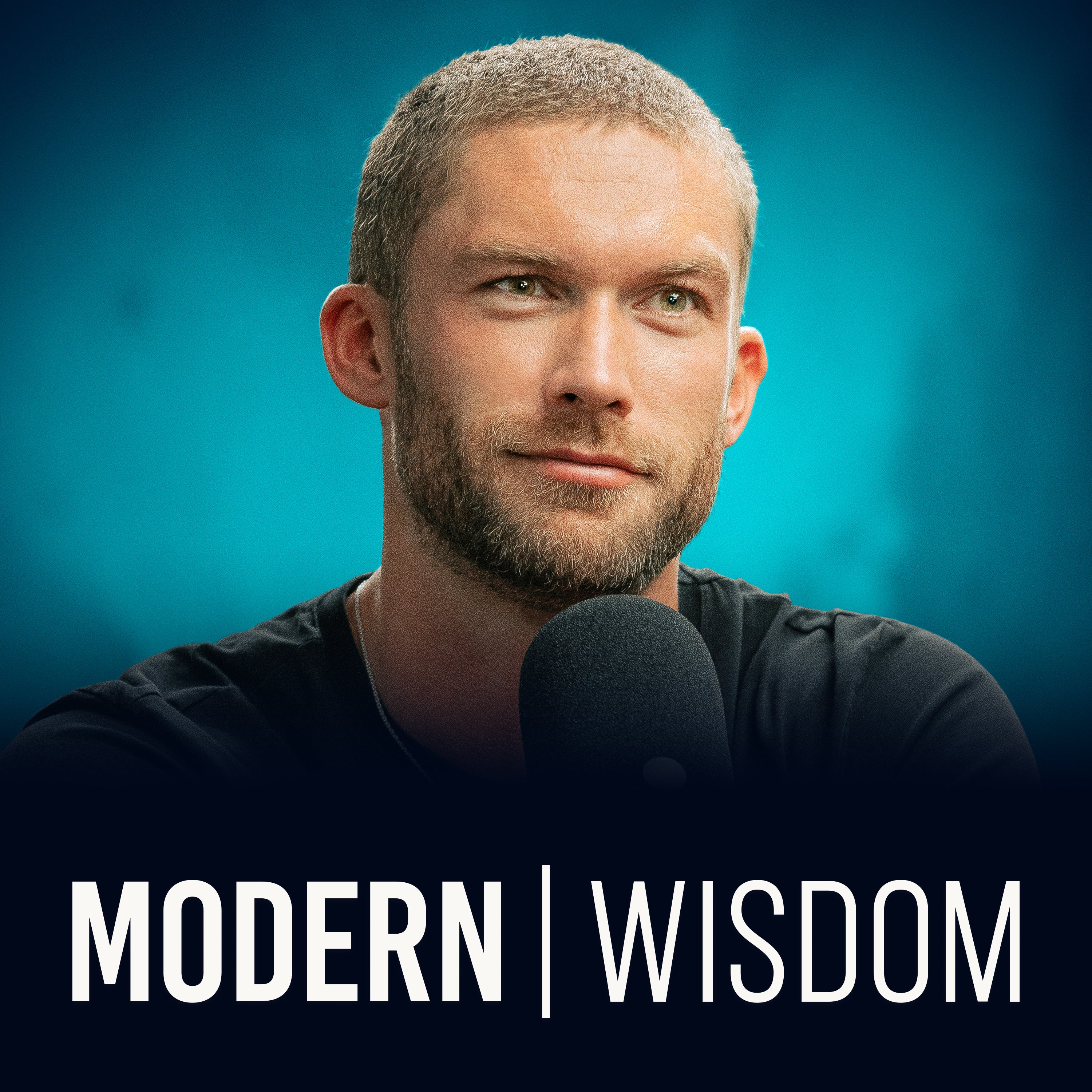

- Podcasts
- Modern Wisdom
- Why Pessimism Makes Dumb Ideas Sound Smart - David Deutsch - #1164
Modern Wisdom17 Oct 2026 · 1h 12m · 19 chapters

Why Pessimism Makes Dumb Ideas Sound Smart - David Deutsch - #1164
In short
David Deutsch (father of quantum computing) discusses Popper-style epistemology: knowledge grows from within the learner via conjecture and error-correction, not “downloading” facts from authority. He argues optimism means treating failures as evidence of missing knowledge, not as barriers. He criticizes “weaponized certainty” online, bucket-theory education, and pessimistic doom narratives (AI and climate) as barrier-thinking.
Guests
One guest is David Deutsch, a quantum computing pioneer and philosopher of knowledge follower of Karl Popper. The host is Maxim (Chris Williamson’s Modern Wisdom episode), who prompts questions about optimism, education, discipline, and AI risk.
Key claims
Certainty is not a guide to truth; judge ideas by how well they explain and correct errors. Belief/disbelief are “corrupt categories”; aim to be baffled and ready to revise. LLMs lack creativity modules, so AGI-by-scale is not justified by current evidence. Education over-measures examable proxies and rewards filling buckets, not understanding.
Notable examples
sandwich-shop “poisoning” reasoning; Fermi problem conjectures framed as science fiction; nuclear-reactor fear leading to climate harm; chess engines vs grandmasters as different “types of computation”; mountaineering discipline vs forced GCSE studying; “deus ex machina” vs solving the problem in fiction.
Written by AI. May contain mistakes.
Chapters
0:21
Exploring Worldviews and Optimism
Discussing the importance of optimism and personal worldviews.
“I'm kind of fascinated in your worldview from a personal perspective, from a person's perspective.”
1:13
Philosophical Foundations of Knowledge
David Deutsch introduces Karl Popper's philosophy of knowledge creation.
“By the way, I think I agree with that, Maxim.”
2:29
Understanding Misunderstandings
Discussing the nature of misunderstanding and the process of learning.
“and one of the tenets of his philosophy is that there is only one way of creating knowledge.”
4:04
The Fallibility of Human Convictions
Exploring the relationship between certainty and knowledge.
“has not pitched it to meet your problem situation.”
6:01
Critical Thinking in Everyday Decisions
How to apply critical thinking to everyday choices without overthinking.
“How should someone hold strong convictions if we all kind of need to remember that we can be completely mistaken at all times and we're vast in our ignorance and partial in our knowledge?”
8:13
Aspiring to Uncertainty
The value of embracing uncertainty in life and scientific research.
“very malevolent, and yet on a particular thing, they might have the truth and you might not.”
14:01
The Nature of Belief and Idea Exchange
Explore how belief is perceived in different contexts and the challenges of sharing ideas in today’s digital landscape.
“I think belief is a corrupt kind of category that has come down to us from Plato and later from from Christianity and Islam and so on.”
21:29
Navigating Criticism and Optimism
Delve into the relationship between optimism, criticism, and the Fermi problem, emphasizing the importance of knowledge in overcoming adversity.
“So you're saying that if you have this nascent, early stage idea and you put that out, somebody comes in with a certainty in criticism, which cuts off at the knees the progress of this particular idea of yours.”
28:00
The Complexity of Storytelling
Exploring why pessimism often masquerades as sophistication in narratives.
“But again, that's not a formula for correcting it yourself in the tent.”
31:30
Understanding Current Fears: AI and Climate
Discussing prevalent pessimistic views on AI and climate change, and their implications.
“And that's true, whether it's a happier or a sad ending pulled out of a hat.”
Show all 19 chapters
37:26
The Limitations of LLMs and AI Risks
Analyzing the shortcomings of large language models and their implications for AGI.
“I spent a good bit of time over the last few months in SF and talking to people on every side of the fence, including sort of with the fence up inside of them as well, straddling both sides.”
42:05
Understanding Grandmaster Chess vs. AI
Explore the differences in reasoning between human chess grandmasters and AI.
“we do not know how to write the program of a grandmaster.”
53:35
Rethinking Education and Learning
Discussion on the flaws of the current education system and alternative approaches.
“But technically, we do now, with the internet, we do have the means of completely upending the system and not having any compulsory education, certainly for children.”
56:03
Mountaineering as a Learning Analogy
Learn how the mountaineer's experience serves as a metaphor for the learning process.
“So, for example, take a mountaineer who enjoys climbing Mount Everest or difficult mountains, who looks for difficult climb where other people have failed perhaps, other people have been killed.”
58:21
Rational Society and Personal Alignment
Explore the importance of aligning personal goals with societal structures for fulfillment.
“It should be something that you would pay the price to have it, just like the mountaineer does.”
1:01:17
Diversity in Life Choices
Understand how individual differences shape people's approaches to achieving a good life.
“So, so, um, first of all, the answer is to get, get it over with.”
1:06:31
Progress vs. Destruction
Discover the paradox of progress feeling like destruction in personal and societal contexts.
1:09:17
David Deutsch's Upcoming Works
Hear about David Deutsch's new projects, including a textbook on quantum theory.
“Have you got anything else that's in the pipeline as well, or is that it?”
1:10:08
David Deutsch on His Upcoming Works
David Deutsch discusses his upcoming books and their titles.
“The subtitle at the moment is How Thinking Works and What the Obstacles to It Are.”

Ask about this episode
Get the gist, explore an idea or ask about something said.
 Claude
On Modern Wisdom, what are the key points of this episode?
Searching your listeningTranscript
Automatic transcript. May contain errors.
0:00People of the UK and Ireland, I'm coming to you live. Imagine that, me on stage in your city. Dublin is completely sold out, but everywhere else has got limited tickets left and you can get yours now at chriswilliamson.live. This is a custom-built live show. I absolutely adore it. I've spent over a year working on it. So if you're a fan of everything Modern Wisdom, come and see me on stage this October around the UK and Ireland. chriswilliamson.live. I'm kind of fascinated in your worldview from a personal perspective, from a person's perspective. You know, we can talk about how important it is for a society or for civilization or for humanity as a whole to think about the importance of optimism and our capacity to solve problems and stuff like that.
0:39I'm kind of interested in how an individual takes that as well. I think that might be an interesting tension. Obviously, we've had all of this most recent stuff about anthropic researchers leaving and over fears of AI and super intelligence and recursive stuff. I don't know if you're interested in that or if you're kind of a little bit bored of it. I've been talking about it a lot. I'm also interested in how your worldview has changed over the last 15 years since the last book, human potential and stuff like that. So we can start off and then scurry down whatever rabbit holes sound interesting if that seems good to you.
1:13Sure. Wonderful. By the way, I think I agree with that, Maxim. So, you know, whenever someone doesn't understand you, it's your fault, not theirs. Unless they're a golden retriever. Literally. Are you telling me that I've got to get out of jail free card today? Yeah, yeah. You're human. Yes. Say more on that. Why is it the fault of misunderstanding? why does that lie in an odds direction? So I'm, as you will know, I'm a follower of the philosopher Karl Popper. And he has a theory of knowledge, which is, in my view, streets ahead of everyone else in the 20th century. He's a strange kind of reputation, because he's very well known, highly respected.
2:11You know, people always put him on the list of the 10 top philosophers or something like that. And in science especially, they always talk about Popper's criterion for distinguishing science from philosophy or from pseudoscience. And yet, his actual philosophy is not very well understood. and one of the tenets of his philosophy is that there is only one way of creating knowledge. The details are different, but knowledge as created by the process of evolution, as created by a scientist, a mathematician, a child learning to speak their first language, those processes are all more alike than they are different.
3:02The differences are pretty inessential. And in particular, the process of learning something new, like learning a new law of physics that one has discovered, or learning an existing piece of knowledge, like from someone else, that is all the same process mentally. In all of them, the knowledge that is learned comes from within the learner. So you're learning something. You can't download it like a computer. You have to guess what the other person means. And at first you will guess wrong. And so you will have to test those guesses and so on. So if that process goes wrong, it is because the teacher or the professor or the communicator has not pitched it to meet your problem situation.
4:16So, yes, go ahead. Why? What is it that most people misunderstand about being wrong? I think we all have this aversion to making mistakes, to not understanding, to putting errors into the way that we understand the world or how it is that we're interpreting something else. Is there a better framing for how people should think about wrongness? Yes. So as Popper said, I'm going to have to stop me quoting him every minute or two, we are all alike in our infinite ignorance or longer. We may all know different things, different pieces of knowledge, but in our infinite ignorance, we are all alike. So this all comes from the idea that since there's an infinite distance to go, and we all have different finite amounts of knowledge, we are all at, like I say in my book, we're all at the beginning of infinity.
5:24We're only ever at the beginning. And so we have something in common with everyone else who is also at the beginning. And to hold oneself up as an authority is a philosophical mistake as well as a, what can you call it, a sociological mistake or a cultural mistake. It's a power play rather than a participation in the growth of knowledge which we should all be participating in. How should someone hold strong convictions if we all kind of need to remember that we can be completely mistaken at all times and we're vast in our ignorance and partial in our knowledge? Yes. Well, as you're suggesting here, it's a psychological matter.
6:20So we should not be looking for certainty. We should be looking to correct errors. So sometimes when people say, oh, I'm certain about something, it means that they have investigated all the possible ways it could be different and they satisfied themselves that those are all wrong and they have their reasons. But more often, certainty is regarded as a virtue in past times. Faith, obedience, that sort of state of mind was regarded as virtuous. And people judged not only each other, but themselves according to how much of that they had. Now, in modern times, especially with the growth of knowledge accelerating more and more in the last couple of hundred years, everyone's had the experience of, well, every adult has had the experience of being proved wrong about something that they were sure was right, or something happened that they were sure would never happen.
7:37And so one should infer from that experience, people don't, but one should infer from that experience that the subjective sensation of being certain is no guide to the truth. It's no guide at all. And neither is, and this is a bit even harder to internalize, neither is the extent of knowledge or ignorance, because somebody can be very ignorant or even very malevolent, and yet on a particular thing, they might have the truth and you might not. So it's no good saying, that's a bad person, I won't listen to them, because you might be missing the one truth that would save you. So, again, like I say in the book, if your enemy says that he's going to come and kill you, it might be advisable to believe your enemy when you disbelieve your friend who says, oh, don't mind him, the bark is worse than his bite.
8:55So you see, it has nothing to do with being knowledgeable. It has nothing to do with being benevolent. We are all alike in our fallibility. So the only way to judge ideas is not by someone's authority or by one's own authority or by how sure one is, but only by the criterion of whether you have a good explanation for why that truth has had its errors corrected better than all the other truths you've heard or can think of. I can imagine a situation where this becomes, or at least it feels to an individual, very effortful to go through the entire working of the equation in order to arrive at the truth, as opposed to using the shortcuts, as opposed to saying, well, this person seems to be from an illustrious background and they have been right about other things before seemingly, or other people seem to respect their opinion, or they're saying it with a level of fervor that implies that they know what they're talking about.
10:01What is a practical way for people to not take half of the afternoon to decide which sandwich they want or which would be a more optimal yogurt to purchase. How can people sort of apply this to life without it becoming clunky and slowing them down? So we have a theory about situations that we're in. You know, you talk about sandwiches. So I go into town and buy a sandwich from a sandwich shop. and how do I know it's not poisoned? How do I know it's not off? How do I know that I haven't been handed the wrong sandwich and so on? Well, as you say, if I went back to first principles to work all that out, it would take all afternoon and I would be starving to death by the time I ate anything.
10:57So the rational thing to do, as I said, is to form a theory. I have a theory about how chains of sandwich shops work, how they are regulated, for example, by the government or by the market, or the shop may have a particular ethos that I think they really do have rather than are pretending and so on. In the case where I can't say that, then I will have to use different criteria. And in that particular case, I myself would not buy a sandwich unless I had that kind of history and that kind of idea of where this is coming from, where it's coming from intellectually as well as where it's coming from physically in mind.
11:51And so you don't have to go through the whole thing because, in short, not only am I able to criticize ideas myself, I'm able to formulate and criticize ideas about other people. It's just that when I formulate an idea about the knowledge of the doctor or the airline engineers who prepared the airplane that I'm going to fly on, I don't go by their reputation. I go by that theory. And a small fact can destroy a large reputation. Like if I'm due to fly and then I read in the newspaper in the morning that that airline has had a scandal where their engineers have been shoddy in preparing the plane, I may well not fly.
12:54even though I may also think that the chance of the plane going wrong with me on it are actually tiny. But, you know, maybe now they're only one in a thousand and ideally I'd like it to be one in a million. But I could be wrong, always. Does that mean, is certainty something that we should ever aspire to? No, we should aspire not to have any. Should we aspire to uncertainty then? Yes. I mean, if you want a life of scientific research, then it's highly desirable that you enjoy the sensation of being baffled, of being in a state of conflict, of thinking, well, now it looks like this is true, but it can't be true.
13:48And that sensation is, for example, what attracts me to scientific research. I don't think one should even aspire to believe anything. I think belief is a corrupt kind of category that has come down to us from Plato and later from from Christianity and Islam and so on. Most religions don't value belief. They value ritual and conformity and ways of life. Belief was something introduced by Christianity. And it's rather weird if you think about it. As Percy Shelley said in the essay for which he got expelled from Oxford University, he pointed out that you can't believe or disbelieve something by an act of will.
14:49It's got to become via your reason. Therefore, calling disbelief an immoral thing doesn't make sense. Yeah. Do you know Oscar Wilde's idea of the Oxford Manor? Have you come across this? Don't think so. No. Beautiful. It's just this one line. He refers to the Oxford manner as the ability to play gracefully with ideas rather than sort of falling into violent or rigid opinions. And I think in my world, which is significantly less salubrious than academia, but maybe just as cutthroat and as much backbiting, the internet is really quick to show its own smarts by pointing out the flaws of others. and one of the problems that I've found is that the ability to put on a hypothetical hat or in my parlance, a bro scientist hat.
15:51Look, I'm just, I'm trying to play gracefully with ideas. Please give me enough degrees of freedom here to maybe be wrong. But because, how do you say it? Like production and publication of ideas are one and the same on the internet. So you're coming up with things in real time and then they're kind of broadcast out into the world, which means there is no scratch pad. There is no whiteboard that's not publicly available. The whiteboard and the lecture kind of become one and the same. And that means that's been lost, at least in a way that a lot of people consume ideas and understand information and sort of see the debate go on.
16:27And I get the sense that kind of what's happened over the last decade or so is a slow increase in the seductivity of certainty and a derogation of uncertainty or incongruence or lack of coherence or something like that because it becomes a target immediately for people on the internet or critics or naysayers or enemies or whatever to kind of point the finger. look, he doesn't know that much about this thing because he was pontificating and playing in, trying to play gracefully with ideas. Therefore, that means that he must be wrong about da-da-da-da-da-da-da-da as well, which is, I guess in one way, we could call this weaponized uncertainty, that it is being used as a tool to kind of dismiss someone as a wider thinker, as opposed to, hey, like, this is cool.
17:23He's prepared to, I mean, he missed the mark with that, but it's fun. He's able to try and play gracefully with ideas. I thought that kind of related here. Yes. Ideally, Twitter or X is the ideal medium for conjecture, for just throwing ideas out and then having them criticized and come back to you and so on. But because of the phenomenon you're talking about, you can't really do that. And I have long ago stopped doing that on Twitter. So I think twice and three times and four times before putting something on Twitter, on X. And one thing that's possible, it's possible to take a middle ground and say, either ask it as a question, does anyone think so-and-so is true?
18:17Or you could say, I guess so-and-so might be true. or if so and so were true, then it might answer this other question. Look at the throat-clearing land acknowledgement that we need to do before we actually put an idea out in a desperate attempt to dampen its impact. Yes, yes. Well, I think it's inevitable. I mean, there are plenty of other places to publish conjectures. The dinner table, maybe. Yes, in private or in a private chat or in a more public thing where one labels it as conjecture. For example, I'm just finishing a book on the Fermi paradox or the Fermi problem. And I have some conjectures there, which I think are, well, it's slightly strange.
19:18I think they're possible solutions to the Fermi problem, but I am sure, certain, which I shouldn't be, that they are not true. But I just would like to put them out there in the form, look how easy it is to make up ideas about this and for them to be wrong. That's the idea. So I've written it as a science fiction story set in another universe, not in our universe. So I don't have to answer for the discrepancies between this universe and our universe. So I just mentioned that because that's one of many ways one can get criticism of conjectures. But also, one should think carefully about when to expose an idea to criticism.
20:14if one does it too early it may cut off lines of um lines of thought which although false would lead to something true if oh that's so cool that is so cool a quick aside you probably heard me talk about element before and that's because i've started every single morning the same way for the last five years now which is a cold glass of water with elements in it element is an electrolyte drink mix with everything that you need and nothing that you don't it's a science SPACC electrolyte ratio of sodium, potassium, and magnesium. No sugar, no coloring, no artificial ingredients. It reduces muscle cramps and fatigue, supports brain function, and helps to regulate your appetite throughout the day.
20:54I genuinely notice the difference when I take it versus when I don't, which is why I don't shut up about it and also why it's used by everyone, from Dr. Andrew Huberman to Olympic athletes and FBI sniper teams, the good sniper teams, not the bad ones. Also, they have no questions asked for refund policy. So if you don't like it for any reason, they'll just give you your money back. Plus, they offer free shipping in the US. Right now, you can get a free sample pack of Elements' most popular flavors with your first purchase by going to the link in the description below. You're heading to drinklmnt.com slash modernwisdom.
21:24That's drinklmnt.com slash modernwisdom. So you're saying that if you have this nascent, early stage idea and you put that out, somebody comes in with a certainty in criticism, which cuts off at the knees the progress of this particular idea of yours. You rob yourself from the opportunity of being wrong in a new way or wrong in multiple new ways, which would give you the idea. That is so fun. Also, I've got to call you out for this. The fact that you have been able to deal or try and play gracefully with ideas with regards to the Fermi problem by constructing an entire new fictional universe in an attempt to get yourself a few million light years of distance away from potential criticism is kind of hilarious.
22:18What have you come to believe about the, it's also cool that you call it the Fermi problem, not the paradox, I suppose. What have you come to believe about the Fermi problem? We don't know the answer. You could also call it the Fermi mystery, but it's not so unusual. We don't know most things. So we don't know whether we are alone in the universe. We might be or we might not be. The point I wanted to make is that
22:52it's easy to come up with explanations for why the aliens or their robots are not here yet. it's um so this is this is not of the form like i said of the form of problems i like namely it looks as though it must be so and so and yet it looks also looks as though it can't be so and so so that that that's the kind of thing that i i enjoy thinking about because there are two things which appear to be in collision, like quantum gravity. And no matter how you think about it, no matter whatever angle you look at it, it still seems like a collision. But the Fermi problem is not really – it's really a collision between one fantasy and another fantasy.
23:47We just don't know. Get over it. Okay, getting back down to terra firma, is it fair to say that you hold optimism as a philosophical stance? Yes, yes, although by optimism I don't mean having a cheerful outlook on life or thinking that everything is going to be all right as a matter of principle. I mean that whenever something goes, it's more of an explanation for failure than a prophecy of success. It's like whenever something goes wrong, it's because we had not yet created the knowledge to make it go right. It's always a matter of knowledge. So what you asked earlier about when you fail to persuade someone of something or when you fail to teach someone something, it's because you haven't yet thought of the way of meeting their problem.
24:49and of whether you really should be meeting that problem or maybe you should both go and do something better. So, you know, why is it really necessary for this other person to agree with you on this thing?
25:07So that's a uniform application of optimism. And pessimism is the opposite. It's where you regard failure as a barrier, as a barrier to ever getting out of the situation or solving the problem or going from bad to good. Going from bad to good is always possible. And when we fail, it is always because we don't yet have the knowledge to succeed. Should this broader worldview around optimism, should that extend to how we feel about our own lives individually? Because I have to assume that if you see failure as a way marker en route towards success, that's quite agentic. It's sort of personal determination.
26:06I have some sovereignty here. I imagine it must be difficult because you mentioned it's not just having a sort of cheerful, rosy outlook on life, but I imagine in some ways it must be quite difficult to maintain a non-rosy, non-cheerful outlook on life if you have a worldview that is predicated on this kind of optimism because you're going to see your own personal struggles through the lens of, well, I just need some more knowledge and I'm sure that I can overcome this thing or I can make the decision that I don't need to overcome this thing. I'm interested in how this sort of relates to the individual and how they do deal with adversity and challenges in their own life.
26:43So optimism is no guarantee that you will solve the problem. You might have a terminal illness and the doctor says to you, you've got X time to live. And you might think, well, you might think correctly. That's because we don't yet have the medical knowledge. Okay, that doesn't mean that there exists a way of you to quickly bone up on all the relevant medical knowledge, solve that problem, cure that disease, and then survive. Although that has happened remarkably often. Somebody who's been diagnosed with something that's supposedly terminal has just speedrun the solution for it and fixed themselves.
27:24Yes, it has happened. So it's not impossible. That's like those wartime medics where they were the only medic available in the tent and somehow they got shot. And you see these guys without anesthetic with a scalpel out operating on himself. It feels a little bit like that. Yes, yes. And the lack of knowledge there might extend further than just the knowledge of how to perform an operation on yourself. I mean, you know, there's a war going on. That in itself should not have happened. With better knowledge, it would not have happened. But again, that's not a formula for correcting it yourself in the tent.
28:08so on the other hand you can't say what what you will solve you you you might you might you might solve it but the in regard to what you do you do not think this is insoluble you do not think this is how far reason can reach and from now on reason doesn't have any access that's always false yeah I wonder why do you think it is that pessimism so often masquerades as sophistication ah um I thought you're going to ask a different question yeah why it why it masquerades as sophistication because it so um say you're writing a story uh about some characters who who the you You're making the reader like the characters, and suddenly one of the characters is going to get killed.
29:12And you're thinking, can they be saved? Can they be saved? And in the last chapter, they're not saved. Now, that is easy to write because knowledge in fiction is very hard to create just as in real life. To make a realistic story about how this situation, which you've set up to look as though that favored character is going to die, how that can end up with them being saved is hard. It's similarly hard to solving it in real life. So, some authors just pull the solution out of a hat. this deus ex machina, as the ancient Greeks presumably didn't say. So if you do that, the audience will be disappointed.
30:12They'll say, oh, we've been had. I've just spent two hours watching this movie or several days reading this long novel. and the author has led me along and then he's tricked me at the end. It was all a dream. For example, yeah, that's another way of doing it. So it's all a dream. But similarly, what is not really realized is that the opposite tactic of saying not only does he die, but everybody dies, like in Hamlet. That is equally a cop-out. Anyone can write that ending, just like anyone can write the Deus Ex Machina ending. What you need to do is to solve the problem so that you will have told the reader some knowledge.
31:12And if it's a good novel, it should be knowledge about life in general, which they can use to understand the world and their own life and their friends and and so on. It should enrich the person. But having it end unhappily is always a cheat. And that's true, whether it's a happier or a sad ending pulled out of a hat. What's a current problem that you think people are most unnecessarily pessimistic about right now? um well i guess it's the uh ai doom uh scenario um it might be the it might be the climate catastrophe scenario uh i'm not sure exactly whether it's the same people who who are worried about both or different i think the venn diagrams probably got a good bit of crossover yeah yeah Yeah, they are both examples of looking at a problem and thinking of it as a barrier.
32:21So you say, so-and-so could happen, we could all die. You're not taking into account that that is true, that is always true, that has always been true every day that the human species has existed. It's always been true that we could be hit by a comet and all die. In fact, just recently, the probability of that has gone down drastically because we have finally turned our attention as a species to the problem of diverting comets and asteroids. But if they're big enough, we still can't do it. But still, the probability of it has gone down. People used to worry about things like the oxygen will run out of the air because we're consuming oxygen and, you know, where's it going to come from?
33:10And people have worried about things that aren't even a rational fear, like the apocalypse, or the world is going to end on such and such a day and we'll all be judged wanting and so on. so yeah at the moment I think it's the AI thing and and the climate catastrophe thing it's not that those fears couldn't come true it's that when you see them in perspective you see that it's an arbitrary choice to pick those things in in in a slightly different universe where we're still worrying about something else or we're worrying about whatever the next thing is which we can't predict yet you hold i would imagine a uh rather unpopular opinion in the modern world which is that agis aren't going to pose much greater risk than than humans already are what's your what's your perspective at the moment on this agi thing i mentioned to you earlier on this jacob coxson guy who was at um open ai i think for about three years and he was at anthropic recently and he tweeted yesterday uh i resigned from anthropic today i spent the last three years doing pre-training research at both OpenAI and Anthropic.
34:32Neither company is acting responsibly. They are racing towards self-improving superintelligence and gambling with our lives. Some other safety researcher from Anthropic said there's a more than 10 % chance that advanced AI could kill all humans within the next decade. Models potentially have a low risk at the moment, but future systems could become more capable, et cetera, et cetera. How do you come to, given your background, quantum computing, et cetera, how do you come to think about this conversation? So I think it's not a justified fear, as I just said, for reasons I've just said. But, you know, I'm old.
35:09And I remember when people were saying this about nuclear reactors. And they said it so loudly and so often that people stopped making nuclear reactors, thereby causing the present climate problem. So they
35:29didn't know. They picked, from my point of view, they picked at random one of the many bad things that could happen, but we don't know whether they will or won't. But there's no particular reason to think that they will, even though they could. And they picked that one at random, and they alarmed everybody. And people took drastic action to avoid that alarm with catastrophic results. The worst effect on the environment that our species has ever had was the turn away from nuclear power. So if we turn away from artificial intelligence because of a similar fiction, will it be? No, I was going to say it might well be a bigger catastrophe I think I was a bit tempted to say something dramatic.
36:23No, I think it would be a big catastrophe, but not as big. Tell me if this sounds familiar. You train regularly, you eat reasonably well, you feel fine, but you're just kind of going off vibes. Most people have absolutely no idea what's going on inside their body. And that is why I partnered with Function. Function gives you access to more than 160 advanced lab tests, spanning hormones, heart health, kidney function, and even detects early signals linked to more than 50 types of cancer. To put that in perspective, your typical annual physical might test 20 markers. Function runs over 160. It's huge.
36:57Best of all, you test twice a year and everything lives inside of a simple dashboard. So you track trends over time, make sure you're moving in the right direction. And this level of testing would usually cost thousands, but with Function, it is$365 per year. Just$1 a day to actually know what's happening inside of your body. And right now you can get$25 off, bringing it down to 340 bucks. Get the exact same blood panels that I use and save$25 by going to the link in the description below or heading to functionhealth.com slash modern wisdom. That's functionhealth.com slash modern wisdom. I don't know.
37:27I spent a good bit of time over the last few months in SF and talking to people on every side of the fence, including sort of with the fence up inside of them as well, straddling both sides. Certainly, at least a relatively uncontroversial opinion seems to be LLMs are not the architecture that can get us to something that is very scary, that is going to be able to take over the world. Is that something that you would agree with? Absolutely. I think that follows directly from Popper's epistemology, because the LLMs do not have a module in them capable of creativity. So they are, I mean, they can do remarkable things.
38:22And a few years ago, I wouldn't have guessed that this kind of functionality is on the horizon for another 50 years. And yet it came all at once and everything worked, one after the other. and the people who did it think that AGI is going to work as well for the same reason. But the present LLM-based AIs, not only have they not shown any sign of AGI, but we know how they work, or at least some people know how they work. I don't. But we do know that the people who designed them did not say, now we know what creativity really is. Now we can program it. And all we need is some supercomputers. And they didn't say that.
39:13They said, now we can build a language model which will be able to speak English properly. And I would be like, good luck with that. And they did. But it's one thing to achieve functionality that makes sense epistemologically and to achieve it much faster than was thought. And it's another to achieve a functionality that violates our best theory of what knowledge is. And that's another thing. People who think that LLMs are going to deliver AGI don't say, for example, well, Popper had only an approximation to the true theory of knowledge. He didn't realize that there's a gap in his theory. And this gap, we have filled.
40:09We know how to fill that gap. And so if you just use his old theory, you'll say that AGI is impossible this way. But if you know what we know, then you'll see why it's possible. They're not claiming that. They're saying it'll just happen if they have more compute, if they have more computer power available. But a previous kind of slight blip of the same type was when chess engines first started defeating the best grandmasters at chess. So a lot of people were saying, well, some people were saying, no, they'll never do it because humans have got some special thing in their brains and whatever. and other people were saying, no, it's just a matter of giving it more computer power.
41:05But that's different because they had a theory of why it just requires more computer power. And when they achieved it, this is the thing that's hardly ever mentioned. When a chess engine beats a grandmaster, they're doing it in a different way. The computation that is going on in the chess engine It's a radically different kind of computation from the computation that's going on in the Grandmaster. The Grandmaster is doing only like one millionth of the amount of computing power, of computation, than the chess engine does. and yet can reach a very high level, not quite as high as the machine, as the program.
41:55But still, they are doing a completely different thing. And although we know how to write the program of a chess engine, we do not know how to write the program of a grandmaster. and this is um this is why grandmasters can write a book you know my greatest games and how i won them or you know something like that and a chess engine can't if you ask a chess engine how it won it will say well if you do this move then that will happen and if that happens this will happen And if that happens, this will have down to, you know, however many steps it can do nowadays. And a grandmaster will not say that.
42:41A grandmaster can't follow it down to anywhere near as many steps as a chess engine can. But a Grandmaster will say something like, well, I thought that if I give up this pawn, it's going to create a weakness on the G file. And by weakness, he doesn't mean that he's followed down all the possible continuations. Whereas something that can follow down all the continuations, and by the way, some of those continuations may not lead to victory. He might say, I thought this might work, but then five moves later, the bastard found a way out of it. And that can also happen. That also can't happen to a chess engine.
43:38So there are different types of program. We do not know how to write the Grandmaster type of chess program, let alone an AGI. You know, when the Grandmaster gets up, he then starts performing computations of orders of magnitude greater complexity than playing chess. It's just that he's not engaging competitively in something that requires insight. What is creativity, in your opinion? How do you think about explaining that simply? The way I use the term is perhaps different from the way philosophers and others use it. Creativity, I think, is not that impressive a thing, just creativity by itself.
44:29I use that word to mean the ability to create new knowledge. So evolution is creative, is a creative process in that sense, in that it starts off with an animal that can't fly, and then a few million years later, it has created an animal that can fly. And it can fly because its genes encode knowledge of how to fly, including implicitly knowledge of aerodynamics and all sorts of things that we don't even have a handle on yet. So it has created knowledge. The thing that humans have, and that no existing other species has, although there were species in the past that had this, is explanatory creativity, where we can, like with the chess master, not only we can say, I prefer this move to that move, you can say why.
45:29So I want to pick up this burning branch from the wildfire, like, say, the first person who invented a campfire. I was just writing about this in my forthcoming book, actually.
45:54I want to pick this up because I want to carry it with me. And if I carry it with me, maybe the predators who might otherwise attack me, and I'm carrying food from the latest kill, will run away from me instead of me running away from them. Now that idea, that's not induction, that's not any of the pre-popper ways of thinking of the growth of knowledge. He's not doing something he's seen before. He's imagining something that he's never seen before, that no one has ever seen before, namely carrying a branch for protection against the predators. And then as he walks home with it, then he'll say, oh, well, it's getting dark, but I can still see.
46:46Maybe if I get this all the way home, we'll all be able to be protected from the wild animals. And so on. That's the kind of thinking that is not, cannot be characterized as optimizing for a given outcome, like checkmate, or like proving a mathematical theorem. It's more like discovering a new mathematical object, which is interesting. But you can't give a computer a criterion of interesting.
47:24so humans can change the axioms to better axioms and that's that humans are not just meeting a fixed criterion and also humans can change their mind he might decide well we might we might scare off the the the predators this way but we're getting burnt by the flames and it's not going to last us all the way home, so we better throw it away now and run home. That's the sort of thing you can think if you have a genuine problem situation in mind rather than a criterion to meet. What do you make given the importance of understanding education, modesty, or sort of nobility, humility when it comes to learning?
48:15What do you make of the current education system? So I think that our society's present attitude to education, both for children and for in universities and for everybody in their own life, is based on a wrong theory. It's what Popper calls the bucket theory of the mind, of the mind, which is that knowledge is a kind of fluid, which some people have and some people don't have of a particular kind. And the task is for the person who has it to pour it into the bucket. That is, the recipient is a kind of bucket for knowledge, which is initially empty, and you pour the knowledge in. So that is very bad in a number of ways.
49:08In fact, education is the last holdout of pre-enlightenment theories of knowledge. Everywhere else, we at least give lip service to enlightenment theories, like you don't give someone authority to override the wishes of someone else. You don't necessarily respect the opinion of someone else just because of their status and so on. We may not enact this perfectly, as we were saying earlier in this conversation, but it's largely agreed that this is what we should be doing. In education, it's the other way around. We judge education by how well and how accurately you fill the bucket. And so one of the things that's wrong with that is that when something goes wrong, which it nearly always does, then you will immediately jump to the conclusion.
50:06So what has gone wrong? Well, the bucket, it's either leaky or it didn't want to receive the fluid. But there can't be anything wrong with the fluid because the fluid is knowledge. That is by definition what we want to transfer. By definition, transferring it is success. So we measure success according to, say, exam results or something. And then because of the natural arms race or the self-sustaining situation that happens in many human situations that aren't rational, the incentive is to spend more and more time on meeting the criterion and less and less time on things that can't be measured which are the important things so at least with chess you can measure how good a grandmaster is although you cannot easily measure how good a grandmaster is at explaining or at teaching or at giving a running commentary on chess games.
51:20There is no criterion for that. There's no mechanical way you can say, well, I've got 93 % on the explaining my moves test, so I must be good at explaining my moves. There is no such thing. And everything that is important in education is of that type and not of the testable type. I omit things where being able to execute the criterion perfectly is the task, like being an airline pilot. But even an airline pilot, an airline pilot who doesn't know what the different controls do is not going to be a good airline pilot. But even with an airline pilot, understanding is extremely important may not be as important as being able to operate the controls but it is extremely important but things that we learn in school and in most university courses are not like that the the course and the exam are designed as proxies for the thing that you actually want and they are very poor proxies the only reason they are proxies at all is that people who really want to do the thing are willing to waste their time learning to pass the criterion.
52:45Before we continue, how many times have you found yourself hugging the toilet, throwing up? Not because you drank too much alcohol, but because the non-alcoholic beers that you drank tasted like garbage. And that is why I'm such a huge fan of Athletic Brewing Co. Their non-alcoholic brews taste just as good as the real thing. And the best part, there's no hangover, no headaches, no more ruining your daughter's dance recital. I didn't want to stop enjoying tasty drinks. I just want you to stop paying for it the next day. And you can too. Find Athletic Brewing Co.'s best-selling lineup at grocery or liquor stores near you, or, best option, get a full variety pack of four flavors shipped direct to your door.
53:18Right now, get 15 % off your first online order by going to the link in the description below or heading to athleticbrewing.com slash modernwisdom using the code modernwisdom at checkout. That's athleticbrewing.com slash modernwisdom and modernwisdom at checkout. Nearby a terms and conditions apply. Athletic Brewing Company, fit for all times. what is a better approach then for somebody who wants to learn a lot from people who know a lot should people exit formal education as quickly as possible we presumably can't append the entire system right now immediately what's your advice i uh i up ending is outside my wheelhouse like you know i don't i don't know how to formulate good political policies that will gain wide acceptance.
54:05But technically, we do now, with the internet, we do have the means of completely upending the system and not having any compulsory education, certainly for children. But I think there are more and more ways of adapting university education to technologies like the internet and also collaborative technologies where you have, for example, access to somebody. Access to somebody can be very valuable, where compulsory subordination to that very same person would be very bad for you. so you uh today you know you can write an email anyone can write an email to any famous person and have a reasonable chance of getting an answer if even if it's only read my book you dolt yes yeah but but but even that even that is uh is is a lot better than than what things used to be like say even 30 years ago.
55:17But even 30 years ago, it would have been better, in my opinion, not to have compulsory subjects and not to have compulsory education of any kind. What do you think about discipline and forcing yourself to do things? I've seen that you appear to be very anti this, despite it being kind of the one of the most popular worldviews at the moment to put your feelings to one side and push through and sort of ignore how you feel? What's your perspective on discipline? Like many things in epistemology and in psychology, the same words, the same terms can be used to describe absolutely opposite things. So, for example, take a mountaineer who enjoys climbing Mount Everest or difficult mountains, who looks for difficult climb where other people have failed perhaps, other people have been killed.
56:18And he goes on the climb, and on the climb he undergoes severe privation and what would be suffering to almost anyone else. But to him, it's just privation. It's getting cold. Every fiber of his being wants to go back down and get back in the warm. But he wants to get to the top. And all the pain and suffering and discomfort, it's not that he overrides it, though in a sense he does, but what's really happening is that that's what he's there for. That's why he chose this climb. If it were easy, he wouldn't have chosen it. so what is for one person the very this is the reason he's alive this is the reason he gets up in the morning it is in anticipation of doing this thing for almost anyone else it would be torture what's more almost anyone else couldn't do it well enough they would eventually fall off it's only because he loves it that he has put in the amount of practice and work and thinking and analysis and so on that allows him to reach the top of this difficult climb.
57:45This is, in the case of mountaineering, we're talking about actual pain and so on, but most things don't have actual pain, physical pain, but they do have psychological pain, boredom, despair, fear, and all that kind of thing. So in that sense, I think the mountaineer is a good analogy to all learning. All learning should be like that. It should be something that you would pay the price to have it, just like the mountaineer does. Or like I was talking the other day to a Formula One driver, and I was saying, God, you know, in Formula One racing, you have to have reactions that are approximately one-half the length of a human reaction time.
58:51so that means that you you must start doing the the thing before you have the information in front of you because you have understood the course and the vehicle and so on well enough and you must do that again and again and again during the race and every so often you will spin off and you will risk your life and so on and so most people again would hate to do that you know most people would pay a lot to not have to do that. But also, if they were forced to do it, they wouldn't do it well, because they do not love it.
59:32So, I think having discipline and forcing yourself could be a form of words that describes this mountaineer. And in that case, it is wonderful. It is, in a sense, the best thing in the world. Whereas somebody forcing themselves to get the GCSE maths thing and spending the whole summer preparing for the GCSE maths and just scraping through and then starting the very next day forgetting everything they knew, that is the epitome of something bad. That's something that shouldn't happen. In a rational society, that would never happen. If that happened even once, it would be headline in the newspaper and heads would roll.
1:00:31So from an individual's perspective, obviously, we are still contending with and navigating the world. And it is in some ways scarce or misaligned to what it is that we want to do. so sometimes you have to do that you have to use your i will get it done muscle you don't want to take the you don't want to take the trash out the trash sucks and it smells and you don't want to do it but you have to do it so you're going to do it your perspective here is that if we were to construct a rational society it would be people doing things that are in alignment with what they want to do and in the interim between where we are now and hopefully a future world where that's the case you're going to have to apply some of this but the goal is to use less and less of it over time Less and less.
1:01:13That's less and less over time, but also less and less in your life. So, so, um, first of all, the answer is to get, get it over with. So you should be leading your, your good life, not, not, um, uh, not being overwhelmed by the bad things. And then once you've, once you're getting it over with, you can improve the situation. There are no situations or almost no situations in everyday life that cannot be improved a little. So you can apply knowledge to getting it over with a little, you know, I don't know, buy a better rubbish bin, which is not so disgusting to empty, or live in a place where the rubbish bin emptying is easier or is a shorter way.
1:02:12By a different type of bags that you enjoy seeing briefly as you take it toward the yeah exactly exactly um so um and then there's there's also the opportunity to just learn to enjoy it so uh they're they're even taking the rubbish out has aspects that one can enjoy you for example if one has been working on the computer all day and and uh one's one's limbs have forgotten how to move, then at least going out with the rubbish takes you into the fresh air. And you can see the neighborhood and you can say hello to the person across the road who is also taking out their rubbish and so on. So there's nothing that can't be improved at least a bit.
1:03:08And it's bad to be in the state of mind that I should have discipline and therefore reducing it is reducing the good thing. It's not. Reducing the thing you don't like is always good. You mentioned the good life. What have you come to believe about how people should prioritize their focus in order to achieve something that resembles a good life? Like with many things, diversity is the key. So I don't think there's a formula which applies to everybody. In fact, I don't think there's a formula that applies to any two people. Any two people are very different, in fact, more different than we are really capable of understanding.
1:04:00Individual humans are as different from each other as humans in general are from other species. A person is like a different species. So some people like to live a life of intellectual problem solving. There is a wonderful passage in Popper's autobiography where he says that the thing to do in life is to find a problem, fall in love with it, live with it for the rest of your life, get married to it, live with it for the rest of your life until death do you part. And if you happen to solve it, the tone in which he says that is, if you're unlucky enough to happen to solve it, then there will be delightful problem children.
1:05:00And it's quite interesting that he uses the phrase problem children deliberately to highlight the fact that problem in his philosophy has these two opposite meanings. So we can say, you know, problem children is a term, a sort of euphemism that was invented for children that you would not want to live with, whereas he is using it for something that you really ought to live with. and a lot of people who are the survivors of doing unusual things and then advocate that people should do these unusual things, they often gloss over the difference between good discipline and bad discipline, good problem and bad problem, and they will say things that are exactly right for them because they were following the good path, if I can put it that way.
1:06:03But it's often taken to mean that you have to knuckle down and do your chores and then your homework and then go to bed, which is the opposite of what you should be doing, even though it can be described in the same words. Yeah, there's this line from John Steinbeck, which is pretty fun. He says, I wonder why progress looks so much like destruction. and when doing a little bit of thinking about my golden retriever translation of your worldview on mass civilizationally across time individually you know existentially um it kind of i think that's that's probably that's not a bad summation i wonder why progress looks so much like destruction or you could say feels so much like destruction or is accused of being so much of destruction Yes, the last one is perhaps the best because it could feel either way.
1:07:01That's the trouble. You can't really tell from the outside necessarily because people can force themselves as well as being forced by other people. And they can be pursuing a very hard path, which they want to pursue, which is joyful to them, without that being noticeable either. The only time that that's noticeable the only times that that's noticeable is when the thing they're pursuing happens to have a good reputation like like if somebody spends 10 hours a day practicing chess or or practicing some martial art or whatever it is people will see what they're doing that they they are adopting the discipline and making themselves power through to being good at this thing, which society thinks is a good thing.
1:07:57But a very similar thing, like a video game, which is almost the same thing psychologically, but which is socially frowned on, people will say that's not a good thing to be devoting yourself to. They will be blind to the effort and creativity that's going into it. And they will instead try to apply a discipline in the opposite direction. I've learned from over a thousand podcast episodes, the easier that you make your health routine, the more consistent you'll be. It's like golf, right? You want to keep it simple and not makes a bunch of pills. You want the eye of the tiger, not the DUI of the tiger.
1:08:34That's why I'm such a huge fan of AG1. One Scoop contains 75 vitamins, minerals, probiotics, and whole food sourced ingredients in a single daily drink. And that's why I've been taking it every single morning for nearly five years now. And they've taken it a step further with AG1 NextGen backed by four clinical trials. And those trials that were shown to fill common nutrient gaps, improve key nutrient levels in just three months, and increase healthy gut bacteria by 10 times, even in people who already eat well. Plus, if you're still unsure, they've got a 90-day money back guarantee. So you can buy it and try it every single day for three months.
1:09:02And if you don't like it, they will give you all of your money back. Right now, you can get 20 % off a welcome kit and that 90-day money-back guarantee by going to the link in the description below or heading to drinkag1.com slash modern wisdom. That's drinkag1.com slash modern wisdom. You mentioned that you were working on a book. That's a fiction book. Have you got anything else that's in the pipeline as well, or is that it? Yes, at least two other books. One is a textbook on quantum mechanics, quantum theory rather, which I'm writing with Sam Kuypers and Chiara Maletto, my colleagues, because we think that existing textbooks and existing ways of teaching quantum theory are just misconceived in many ways, and we want to get it right.
1:09:51So that's one thing. Another thing is I'm writing the third book in my sort of sequel to my first two books, fabric of reality in the beginning of infinity i'm writing another one very difficult it's i i i i think i think it's an example of mountaineering rather than um uh being forced but yeah um but it's um uh tentatively called irrationality though i don't quite like the title because it gives the wrong impression, at least at first. The subtitle at the moment is How Thinking Works and What the Obstacles to It Are. So that's, I think, a better title, but it's a bit clunky. And whilst doing textbook plus difficult third album to previously quite complex initial two books, you also got the fiction book put together as well.
1:10:59Yes, I've also got my day job. So apart from those three, yes. Well, at least you're keeping yourself busy. David Deutsch, ladies and gentlemen. David, you're awesome. I appreciate you. It's very nice to hear a fellow accent as well. What should people be looking out for over the next couple of months? Is there something going to drop before the end of the year? One of the books, one of the fiction books? Do we know when that's going to come out? I think that's unlikely in the next couple of months, but in the next year, fingers crossed, yes, one of them may drop. Beautiful. David, I appreciate you very much.
1:11:31Thank you for today. Thank you for having me. Very pleasant. Mr. Monopoly here. Miss me? Monopoly is back at McDonald's with millions of prizes, a 2027 cheap charity a carnival cruise vacation gift cards from DoorDash and Best Buy He'll then play in the McDonald's app Get your bag! No purchase necessary 50 US and DC age 18 plus See play at mcd.com for rules and play at mcd.com slash amoe for info and playing without purchase by mail by November 2nd Chance card game ends November 8th Game ends November 22nd, 2026 See rules for prize details Monopoly is a registered trademark of Hasbro
From the publisher
David Deutsch is a British physicist, a pioneering researcher in quantum computation, and author.
Expect to learn how David has changed his views on the limits of human potential in recent years, why people should have an optimistic view of the world, which current problem most people are unnecessarily pessimistic about right now, what the largest issues are in modern education, why AGI will not pose a great threat to humans, what makes for a good life and much more…
Sponsors:
Get a Free Sample Pack of LMNT’s most popular flavours with your first purchase at https://drinklmnt.com/modernwisdom
Get 160+ lab tests for just $365 and save an extra $25 at https://functionhealth.com/modernwisdom
Get 15% off your first order of my favourite Non-Alcoholic Brew at https://athleticbrewing.com/modernwisdom
Get a free bottle of D3K2, an AG1 Welcome Kit, and more when you first subscribe at https://ag1.info/modernwisdom
See discounts for all the products I use and recommend: https://chriswillx.com/deals
Get ChatGPT to explore ideas, solve problems, and learn faster at https://chatgpt.com
Timestamps:
(00:00) How Is Knowledge Created?
(04:19) Do We Misunderstand Being Wrong?
(10:01) Why We Should Never Aspire to Be Certain
(21:29) Will We Ever Solve the Fermi Paradox?
(23:53) Is Optimism the Most Rational Worldview?
(28:41) Why Does Pessimism Masquerade as Sophistication?
(31:42) Should We Be Afraid of AI?
(37:27) Why LLMs Can’t Take Over the World
(44:08) What Is Creativity?
(48:05) Is Our Education System Built on a Mistake?
(53:35) How Should We Reinvent Education?
(55:27) Can Too Much Discipline Hold You Back?
(01:03:24) The Philosophy Behind a Good Life
(01:09:16) What Is David Working On?
Extra Stuff:
Get my free reading list of 100 books to read before you die: https://chriswillx.com/books
Try my productivity energy drink Neutonic: https://neutonic.com/modernwisdom
Episodes You Might Enjoy:
#577 - David Goggins - This Is How To Master Your Life: lnkfi.re/SN-Goggins
#712 - Dr Jordan Peterson - How To Destroy Your Negative Beliefs: lnkfi.re/SN-Peterson
#700 - Dr Andrew Huberman - The Secret Tools To Hack Your Brain: lnkfi.re/SN-Huberman
-
Get In Touch:
Instagram: https://www.instagram.com/chriswillx
Twitter: https://www.twitter.com/chriswillx
YouTube: https://www.youtube.com/modernwisdompodcast
Email: https://chriswillx.com/contact
-
Learn more about your ad choices. Visit megaphone.fm/adchoices
More from Modern Wisdom
All episodes

We use cookies.They keep VO running smoothly and help us improve it. Privacy policy