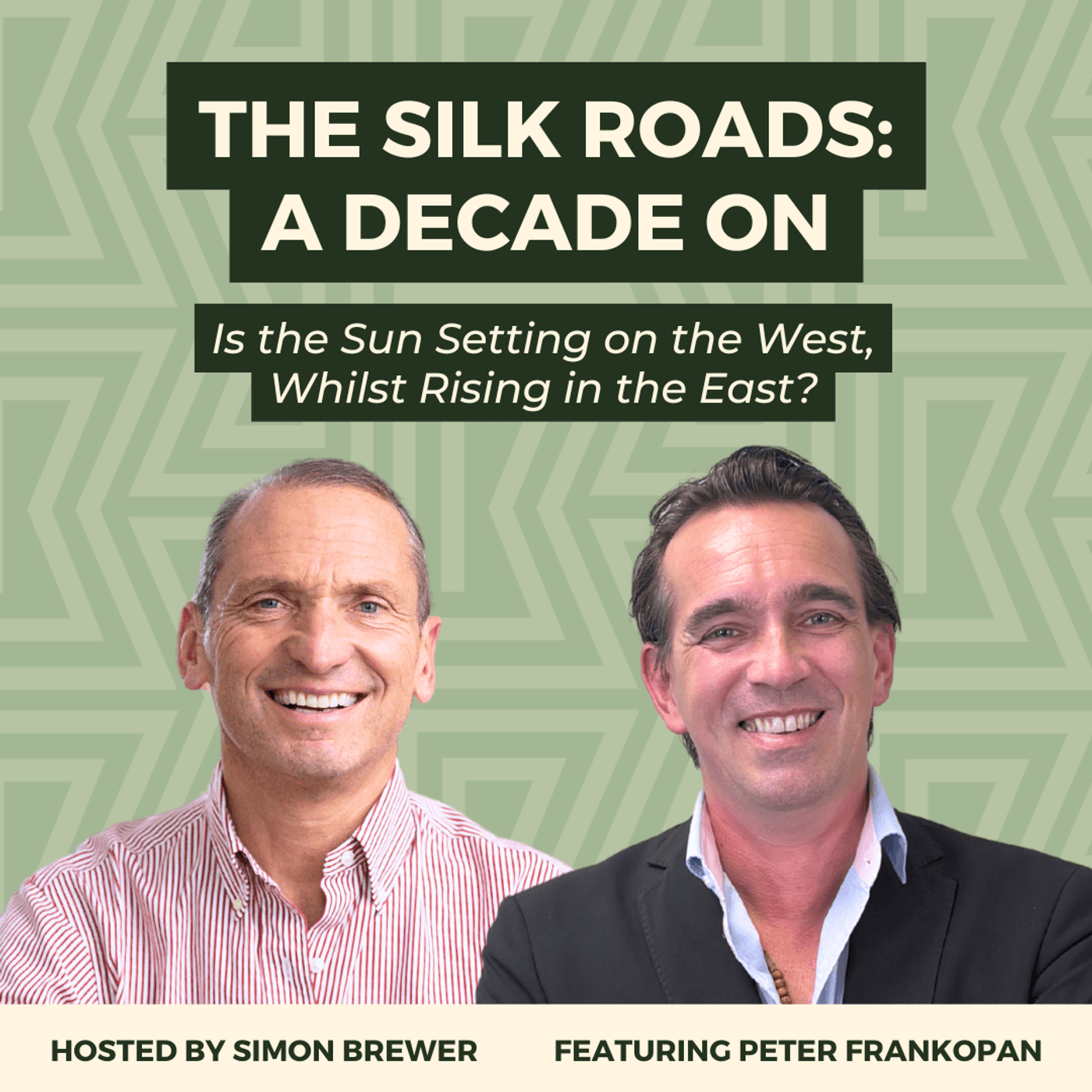
In short
Peter Frankopan reflects on The Silk Roads “10 years on,” arguing that Western focus on Europe/US is too narrow and that Asia’s connectivity, resources, and demographic weight drive today’s geopolitical and economic shifts. He updates his thesis amid heightened tensions (including the Iran/Israel-Gaza context) and discusses how infrastructure networks across Asia are being rebuilt, not replaced.
Guest
Peter Frankopan, Professor of Global History at Oxford (Worcester College), Director of the Oxford Centre for Byzantine Research; historian focused on the Byzantine Empire, Mediterranean/Balkans/Caucasus, Russia, and Islam-Christianity interdependence. Author of The Silk Roads.
Key claims
The West responded too late to China’s rise and Belt and Road, misreading it as uniformly malign and failing to “benchmark” or build comparable guardrails. Multipolar competition is accelerating due to news-cycle speed, technology, and underpriced risks (energy, water, critical minerals). China is cautious and risk-averse militarily (few bases), while Russia is more disruptive and uncertain in aims. Europe is slow to respond and has misallocated energy spending versus Ukraine support.
Notable examples
Belt and Road debt narratives vs actual scale; Sri Lanka’s Hambantota port; China’s rare-earth/energy concentration; India’s Iran ties (Chabahar) and Russia oil rerouting; Indonesia/Malaysia boycotts of US brands; Central Asia glacier melt impacts; Europe’s energy imports from Russia since 2022; Trans-Caspian transport corridor cutting freight times by half.
Written by AI. May contain mistakes. Listen to the episode to check what was said.
Chapters
Tap a time to open that second in VOIntroducing Peter Frankopan
0:36 to 2:24
Overview of Peter Frankopan's background and his book 'The Silk Roads'.
“And then in the interim period, we had the dual attack on Iran and so we asked Peter to come back and just to give us a top up.”
The Silk Roads and Global Population
2:24 to 3:36
Discussion on the significance of the Silk Roads and the global population dynamics east of Istanbul.
“You've just joined our advisory board, which we're very excited about.”
Expectations and Inspirations for the Book
3:36 to 6:20
Peter discusses his motivations for writing 'The Silk Roads' and his initial expectations.
“I was about to turn 40 and had the position at this wonderful university at Oxford and quite a wide range of interests.”
Navigating Modern Turbulence
8:32 to 10:46
Peter and Simon discuss perceptions of change and historical context in today's world.
“And I think that many of us fall prey to the daily noise and feel that change is greater than we've ever experienced than a higher level question.”
China and the Belt and Road Initiative
10:46 to 14:02
In-depth examination of China's Belt and Road Initiative and its implications.
“But I promise you it could be a lot, lot worse.”
China's Investment Challenges and Globalization Impact
14:02 to 16:59
Explore how China's investments affect global economies and the misconceptions surrounding them.
“of the host country and some of those have created strategic military potential problems so for example the port of Hambantota in Sri Lanka is the kind of the poster boy poster child of a kind of bad project.”
China's Historical Context and Military Presence
17:00 to 19:34
Learn about China's historical non-colonization and its rising military presence globally.
“So one of the questions is, how should we be regulating to stop similar kinds of problems come towards us?”
China's Cautious Approach to Global Power
19:35 to 22:18
Understand China's strategic caution in global affairs and military engagements.
“So 100 years ago, just before the First World War, Belgium controlled most of West Africa.”
India's Geopolitical Maneuvering and Economic Landscape
22:19 to 26:49
Examine India's geopolitical strategies and its evolving economic landscape amidst global tensions.
“There is a large group, particularly with young people in China, that keep looking at the maps of Russia and talking about what land was taken by the Russians over the course of the last 200 years.”
Indonesia's Strategic Role in Global Supply Chains
26:50 to 28:01
Discuss Indonesia's significance in global supply chains and its balancing act between great powers.
“median age is much lower than China, the opportunities are much greater.”
Show all 36 chapters
Geopolitical Tensions in Indonesia
28:01 to 29:08
Explore how U.S. actions impact businesses in Indonesia amid global tensions.
“And that is a kind of reality, I think, that affects multi-billion dollar corporations that if you're not paying attention, then things start to look complicated in a country with 230 million people.”
The Fragility of Global Security
29:09 to 30:26
Discuss the rise of state-on-state violence and the volatility of global security.
“So it doesn't just work where the US will say, this is the price for being my friend.”
Supply Chains and Resource Risks
30:27 to 31:37
Examine the importance of material supply chains and their vulnerabilities.
“that's illuminating as to the whole supply chains and unexpected sources of these.”
Iran's Regime Stability and Tactics
31:38 to 33:15
Analyze Iran's political strategies to maintain regime stability amid protests.
“I think it's fair to say that the clouds are either going to part or they're going to converge because of what's been playing out in Gaza and in Palestine.”
Central Asia's Water Crisis
33:16 to 34:35
Understand the critical water issues facing Central Asia due to climate change.
“has fought three Cold Wars for the last 40 years, with about 2 % of the US defence budget concurrently taking on Israel and Saudi Arabia and the great Satan, the US.”
Russia's Strategic Positioning
34:36 to 36:08
Evaluate Russia's geopolitical strategies and its implications for Europe.
“And of course, that brings us to Russia, because they were all part of the sort of, you know, all certainly connected for so long.”
Trump's Impact on Global Alliances
36:09 to 37:31
Discuss how Trump's leadership affected America's image and alliances in Asia and Europe.
“I mean, by the time again this comes out, the United States might have annexed Greenland.”
The Shift in Trade Relationships
37:32 to 39:21
Explore how nations adapt their trade partnerships in response to U.S. volatility.
“Hasn't gone down that well in Europe, I think.”
Europe's Defense and Cooperation
41:47 to 42:05
Investigate Europe's defense spending and the need for efficient cooperation.
“I think you said it's going to cut journey time for freight between Europe and Central Asia by half.”
Europe's Defense Spending Challenges
42:05 to 43:32
Discussing the inefficiencies in European defense funding and dependency on NATO.
“Look, we've got whatever, 13 battle tanks in Europe.”
Impact of Brexit on Higher Education
43:32 to 45:00
Exploring how Brexit has affected the recruitment of talent in UK universities.
“one simple fact, which is that Europe spent more money importing energy from Russia since 2022 than supporting Ukraine.”
The Need for Global Talent Attraction
45:00 to 46:34
Discussing the importance of attracting global talent in various disciplines post-Brexit.
“So that puts us out of position, I think.”
Demographic Shifts and Economic Implications
46:34 to 47:44
Analyzing demographic trends in aging populations and their economic effects.
“actually making an interesting statement, which is he would prefer to own emerging market debt rather than G7 debt because of all sorts of the dynamics that are at play.”
Challenges of Global Stability and Health
47:44 to 48:47
Examining global health risks and their potential impact on economies and societies.
“I mean, that presents lots of different problems and opportunities, right?”
The Shifting Global Power Dynamics
48:47 to 51:27
Discussing the changes in global power dynamics and the implications for the West.
“I'm very worried about emerging infectious diseases and pandemics, not just for zoonotic and jumping into human chains, but also into food supplies.”
Investing in Africa's Growth Potential
51:27 to 54:00
Highlighting Africa's rapid population growth and investment opportunities despite underinvestment.
“You can build very nice country houses in Lincolnshire and wherever you wanted.”
Military Innovations and Future Capabilities
54:00 to 56:00
Exploring the changing nature of military capabilities and the implications for defense strategies.
“in ways that will pay different kinds of dividends to different people.”
Strategic Importance of the Chagos Islands
56:00 to 57:40
Learn about the geopolitical significance of the Chagos Islands and their military value.
“I got asked about the Chagos Islands about 20 years ago.”
Exploring the Silk Road: Key Sites to Visit
57:40 to 59:40
Discover important historical sites along the Silk Road and their cultural significance.
“said for a history buff who wants to visit parts of the Silk Road and see history and culture at work, what would be top of the list to visit?”
The Joy of Podcasting: Moderating vs. Being Interviewed
59:40 to 1:02:30
Understand the dynamics of podcasting from the perspective of both hosts and guests.
“And, you know, you do it so well week after week.”
Personal Preferences on Sports Events and Alcohol
1:02:30 to 1:04:10
Delve into preferences for sports events and favorite drinks, revealing personal anecdotes.
“I mean, funnily enough, it's almost as good a question, Simon, which is what's the best invention of the last 50 years?”
Analyzing Recent Developments in Iran
1:04:10 to 1:10:07
Gain insight into recent geopolitical developments in Iran and their implications.
“If it was a little bit later in the day, I'd crack them up.”
The Changing World Order and Iran's Position
1:10:07 to 1:12:09
Explore the implications of a shifting global landscape on Iran and nuclear policy.
“Does it matter if in fact we discover in the next, you know, in the next few months that it wasn't such an impressive bunker busting expedition?”
Historical Reflections on U.S. Intervention
1:12:13 to 1:13:10
Discuss the historical perspective on U.S. interventions and their consequences.
“It all depends what happens in the coming weeks and months.”
Advice for Aspiring Writers
1:13:16 to 1:14:24
Get practical advice on writing and the importance of different communication mediums.
“And two questions I didn't ask you outside of this, which I'm going to now ask you, which is lots of would-be aspiring authors and writers will have enjoyed watching and listening to you in the whole episode.”
Upcoming Events and Closing Remarks
1:14:24 to 1:15:06
Learn about future events and wrap up the conversation with final thoughts.
“And just as a reminder to our audience, in fact, your own podcast is terrific.”
Transcript
Automatic transcript. May contain errors.0:02Welcome to the Money Maze podcast. If this is your first time joining us, I'm the host, Simon Brewer. And in this show, we talk to proven leaders and thinkers from the worlds of business, investing from beyond. To stay up to date with every episode, please do sign up to our newsletter via moneymayspodcast.com. Episodes are also published on our YouTube channel and we're active on all major social media platforms. Thank you for listening. So if you're watching on YouTube or listening to this podcast, it's a little bit different in that we recorded Peter Frankopan, the author of The Silk Roads, a few weeks back and he's been reflecting on The Silk Roads 10 years on.
0:50And then in the interim period, we had the dual attack on Iran and so we asked Peter to come back and just to give us a top up. And if you stay with the episode, which we hope you will, there's a short update of Peter's thinking as we all try and process the implications of this and whether there are conclusions being reached that in several months may turn out to be hopelessly optimistic or unrealistically pessimistic. So I hope you enjoy the great Peter Frankoban. As we move into an era where the political, military and economic dominance of the West is coming under pressure. The sense of uncertainty is unsettling.
1:27And while we ponder where the next threat may come from, the network and connections are quietly being knitted together across the spine of Asia, or rather they are being restored. The Silk Roads are rising again. Those are the closing lines of the majestic opus that is the Silk Roads. The author, Peter Frank, a band of Oxford University, created a profound and enduring book that has been devoured around the world and with it has made its own mark in history. It's been translated into more than 45 languages, sold almost 3 million copies worldwide, been a New York Times bestseller, described as breathtaking and addictively readable and read by leaders East and West, including Chinese leader Xi Jinping.
2:09It's also available on audio and an inspiration for exhibitions at the British Museum. So Peter Frankopan, A pleasure to welcome you back in person to the Money Maze podcast. I was here four years ago, I think, but those are the days of COVID. So we were all kept far apart, but I'm in your fantastic new studio. So thank you for having me. It's great. You indeed appeared in December 2021. You've just joined our advisory board, which we're very excited about. And as a recap, you're a professor of global history at Worcester College, Oxford, the director of the Oxford Centre for Byzantine Research.
2:40and your focus historically has been on the Byzantine Empire, the Mediterranean, the Balkans, Caucasus, Russia, as well as the interdependence of Islam and Christianity. All very topical and explains why you're very much in demand. And our friend and co-founder, Will Campion, tells me that you are not only a great cricketer, but you're also a very handy fives player. It's a little bit niche, I think. Even for those with the great variances of interest in the money maze, and maybe do separate podcasts, maybe a live broadcast of Fives Court running around hitting balls with our hands. Well, a few things stay with me because I came and listened to you at the Cliveden Literary Festival several years ago and you made this comment that 75 % of the world's population live east of Istanbul and we in the West have a propensity to live with our eyes stitched closed.
3:30And I'd like to start with this question, which is when you began this book, What was the inspiration and what was the expectation? I didn't have any expectations. I was about to turn 40 and had the position at this wonderful university at Oxford and quite a wide range of interests. I mean, geographically, I'm broadly speaking, anything east of the Vistula, anything east of Istanbul has been things that I'm interested in, partly because of that's where global populations are based, partly because of networks and connections and exchange of religions and so on. all the world's great religions by and large are from Asia.
4:08You know, we think of Christianity as being quintessentially European, but I can promise you Jerusalem, Bethlehem and Nazareth are not in Europe. And I think the process of trying to think about how to join up big history in a way that was both readable, engaging, but also emphasised what happens when you connect to each other. You know, we live in a network age, we talk about that word sort of easily, and we think that digital networks are changing everything but infrastructure connections hard resources new technologies ideas from the past are key so that that figure of 75 you know you could keep escalating so it's about 75 of the world's hydrocarbons sit in that region about 85 of the world's rice production rare earths both in availability and in processing and rare earths are not all rare and so on that's a whole other story but you see the concentrations of of what we should probably be looking at and some of it, like you said in your very generous introduction that made me heat up a little bit with pride and embarrassment, is that Asia is home to more than all the other continents combined.
5:11And that means that things like climate change, things like consumption, things like energy, things like water, that's probably where we should be looking to for opportunities and challenges. So when I wrote the book it was how to join up lots of bits and pieces together, how to take a long view that covers a couple of thousand years and to do it with enough detail that my academic colleagues would be happy with. And my expectations were more or less zero, because I'd been to enough drinks parties with, well, not with you and with Will, because you're much too interesting and engaging and much too polite.
5:43But when I'd say I worked on Central Asia, or I worked on Chinese views of the West, or worked on what Iran meant in history, people thought I didn't think I was mad, but they thought it was a strange way to spend my life. it turns out that those kind of fault lines crossroads networks uh you know india pakistan china southeast asia those have always been incredibly important and it's very clear to me that that's where our current you know mainstream challenges opportunities whether you're an investor listening to this geopolitics security national security otherwise but also all these escalating um ways we should think about the world but i didn't expect anyone would read it and in fact when I got my book dummy book cover back from my American publisher which had a picture of a dump truck and a picture of a Persian relief and I didn't quite I'm not emotional not very emotional but I did have a gut lump in my throat thinking well that means no one's going to read it but Emma Eubank is my cover designer here in the UK I sent her a few ideas or few images that I thought were great and the images on the cover of the book is from the great mosque in Isfahan and it captures exactly the kind of the richness, the colour, the wealth, the vibrancy so that when you start conversations, for example in the introduction I say you know 500 years ago or a thousand years ago the great universities weren't at Caltech or MIT or Harvard or Oxford or Cambridge but they were places that are very obscure and exotic so places like Isfahan or Merv or Bukhara, Samarkand, places that people might have heard of but don't quite believe you know, that this is where these are the engines of global intellectual thought power and trade and commerce.
7:21So before we continue this conversation, we're going to take a short break to have a note from our sponsors. In times of economic and geopolitical volatility, investors will look to gold. Today, as the world navigates uncertainty and heightened risk, investors of all sorts will look to safeguard their wealth. We're thrilled to welcome the World Gold Council as one of our sponsors. Tap the link in the show notes to learn more or visit goldhub.org on your browser for comprehensive research, insights and analysis on the global gold market. The Money Mates podcast is proudly sponsored by the London Stock Exchange Group, a global leader in financial markets infrastructure.
8:02LSEG has a rich history of facilitating capital flows, empowering businesses and connecting investors to opportunities. Today, they provide world-class technology, data and analytics, playing a critical role in shaping modern finance. From their role in sustainable investing to their contributions to financial innovation, Elseg is helping to build a more connected and efficient market. Visit elseg.com via the link in the show notes to see how they're driving the future of finance. So you have the benefit of the historian's lens. And I think that many of us fall prey to the daily noise and feel that change is greater than we've ever experienced than a higher level question.
8:43Is that because of our age or is it because of the age in which we live? Look, I think we all think we're living in a world of extraordinary turbulence. But I wouldn't swap 2025, however dangerous it might seem, with 1939 or with 1914 or 1917. Pick a date in the past. I think it is hard because we're bombarded with news sources. We're very personality driven. So people know the name of the leader of China, but they can't tell you the name of any other pollock you remember. Same in Russia. Probably Lavrov has a high enough profile. But beyond that, Russian prime minister, minister of economics, let alone pick a state, pick a country, including really important ones.
9:23I think some of it is that the news cycle is a self-fulfilling prophecy. So, you know, in the world of finance, you know, you have the US, you have Europe and then you've got emerging markets which means everybody else right and that's probably 85 percent of the world's population and probably it's time to break away from some of those kinds of designations where things like the rate of change in Latin America and particularly the trade with places like China have been on a scale that has been absolutely biblical in in the growth you know or just China on its own so in 2000 when China joined 2001, China joined the WTO, its economy was about a trillion dollars.
9:59Now it's 16, 17, touching 18 trillion. And so those changes, they really do make a difference in real time. Accelerate into that, the highest population we've ever seen in history, the new technology we've got that allows to connect quicker, move around quicker, move bits of information faster. Then you go to accelerate some of those pressures because decision making when you're going at speed is more dangerous and difficult than when you're going slowly. So, you know, we know that when we drive our cars. I'm not a pilot, but I suspect flying planes is the same thing. And those margins for error start to become narrower.
10:33So the world, as Kevin Rudd calls it, the decade of living dangerously, regardless of one's political persuasion or where you are listening to the world of this, it's quite hard to not think past that. But I promise you it could be a lot, lot worse. So let's talk about some specific stops on the Silk routes, which you have examined. I mean, over the last 50 years, I would observe we've moved from two power blocks, US and Russia. We had the fall of the Berlin Wall. For a moment, it seemed like it might be unipolar. And now we're in a world that appears to be multipolar with China, India, you know, the malevolent thorn that is Putin's Russia and these other immense countries.
11:14And I'd like to talk about a few of them. And the logical place, I guess, for me is to start with China and the Belt and Road Initiative, which didn't seem so long ago that Cameron and Osborne here in the UK were cozying up to China. And now we've gone, you know, into a very different environment. What appeared to some as a sort of laudable appears now to others as maybe more insidious. How do you reflect on the Belt and Road Initiative? Well, as usual, we started asking maybe the right question years too late. So people have heard of Belt and Road and think it's a terrible thing. Major funding stopped in about 2018, which is quite a long time ago.
11:52You know, that's long before Covid. That was the Russian World Cup in football, where perhaps looking back on it, that should have had a boycott attached to it as well. So, look, I think Belt and Road was designed as a signature of China's foreign economic policy to achieve lots of different things. And there is a master plan element to it, but it's also pretty disparate. So some of it was about developing the western parts of China, which are economically undeveloped, home to minority populations, some of whom have had a lot of exposure in the levels of persecution, like Uyghurs, for example.
12:25Some of it was about moving China's manufacturing capacity into neighbouring countries, which is not in itself necessarily a bad thing. China switches its economic model or tries to switch its economic model, finding new markets. That doesn't seem to me entirely implausible. And then the idea of galvanising infrastructure to increase connectivity is familiar to anybody who works in development economics. The challenge was that because the Belt and Road seemed to present like it was monolithic, it started to attract commentary and criticism, sometimes justifiably and sometimes otherwise, particularly for things like debt diplomacy, that China was somehow lending in order to trap.
13:06And that became a narrative that managed to get away from Beijing, I suppose. And I'm not here to say whether that's good or bad, but just to say that that's what happened. In fact, if you look at the continent of Africa as a whole, about 12 % of total debt is owed to China or Chinese entities or state-owned entities, which is reasonably modest. So the challenge in emerging parts of the world, developing parts of the world, and middle and low-income countries is there's an almost insatiable appetite for infrastructure, for roads, for railways, for clean power, clean energy, renewables, for sanitation, for schools, for facilities.
13:40And that money's got to come from somewhere. And I can promise you, in almost every single country I work on, it would be great if that came from the UK, or from Europe, or from the US, or from the World Bank. but in a lot of cases country risk attached is either too high or the returns are exorbitant so China's left as the only show in town so there have been a few blow-ups some of quite high profile where China has lent perhaps irresponsibly perhaps thoughtlessly but always at the invitation of the host country and some of those have created strategic military potential problems so for example the port of Hambantota in Sri Lanka is the kind of the poster boy poster child of a kind of bad project.
14:20But it was a project where the developers defaulted pretty much straight away. Sri Lanka struggles to attract foreign direct investment anyway. Dollar denominated loans, it all went wrong. And China was left holding a port that Sri Lanka wanted, that potentially has some long term use. But you as a financier, you don't want to be holding a distressed asset that has no value. And if it's suddenly in 20, 30, 40 years time, you can renegotiate and you can put in Chinese naval vessels, which you can't currently do, then maybe there's a value. But bad debt is bad debt. Someone sits at the end of that.
14:55And sometimes we can think that China doesn't mind, doesn't operate by the same rules of money that normal lending institutions do. But most of the projects, the economist evaluating 10 years of Belkin Road in 2023, most of the projects have been pretty good. Most of them have worked quite well. Most of them have invested in infrastructure reasonably, sensibly. And that doesn't seem to me, if you are a rising power, to look for alliances, to look for friendships, to look for networks that can enhance your own economy, that doesn't look to me that it's necessarily threatening. The problem is I think we didn't benchmark what China was doing.
15:28We didn't think about what our response would be. We did a lot of finger wagging saying don't do this and don't borrow. But we haven't invested in any way or shape or form in a way that would be meaningful. So we don't teach children about other parts of the world, for example, in schools. We talked about that before. And I think we don't, And I think we don't think about what these other places mean to us beyond how can we boost our UK economy or the global economy. And it turns out that there's no such thing as a regional economy anymore. Everything is globalised. All supply chains have heavy global components.
16:04And here we suddenly find ourselves asking questions about resilience of basic supplies. Not just critical minerals and rare earths, but the fact that China has a monopoly position in a lot of industries that mean that we in the West are potentially very highly exposed. And the only way out of it, which is what Trump is trying to do, force manufacturing back to the US, which triggers inflation and makes goods certainly more expensive, possibly worse. So, you know, I think we're at that point where those ideas about globalization that Cameron and Osborne seem to embrace, you know, maybe they weren't wrong to do that, but we should have thought about what the guardrails should be.
16:40And I suppose to put it in a wider context, We didn't think about that with social media. We didn't think about it with climate. You know, the cheap goods that have helped European and Western economies grow for the last 20 years came at huge pollution and warming risks and costs to countries with lower labour forces and lower environmental protection. We didn't put those guardrails in place with what Russia meant. So one of the questions is, how should we be regulating to stop similar kinds of problems come towards us? I spent this morning doing AI stuff. And these conversations look very familiar around, are we going to spend 10 years down the line, are we going to say we were too late with that too?
17:19But China, I think, charting its rise, seeing Belt and Road, I think we misdiagnosed, didn't understand what it was. And when we did, we then got it wrong by assuming everything was malign rather than picking apart the bits that really do matter, and perhaps the bit that were less important. So I note in your epilogue to the update to the salt roads, You make the point which surprised me. In fact, the biggest investor in Africa in the last decade has been the Gulf and Middle Eastern countries, which... Not by a bit, by substantial. Last year, UAE invested three times more, almost four times more than China did.
17:50So there are new players. And in the international relations community, the current vogue is called middle powers, which means they have capacity to behave in ways that allow them to use their leverage. Old-fashioned historians like me just say that's what diplomatic policy looks like. You work out what it is you want and what you need. You work out what the future is going to look like. You make sure you're not caught out of position and you prepare. And I think a lot of the countries that I write about in my book, Kazakhstan, Vietnam, Malaysia, India, have forward-looking plans. Like in a business plan, it doesn't mean you're going to get it right.
18:25Sometimes a business plan means you get it wrong because you don't course correct. But here in Europe, I think our default is we would just like time to stand still. We're not comfortable with these new threats. But if you were to say to any frontline European politician, what do you think Europe in 2040 looks like or Europe in 2050? They'd struggle to recognise what that question is. And that's not because we're democracies and we have elections to worry about. It's that we've forgotten that process of thinking ahead. I don't want to leave China without asking you one question, because as I re-listened to that interview, you made the observation that China historically wasn't a colonising nation.
19:03when we look at some of the stats. Chinese shipyards built more tonnage, as you've written, in 2024 alone than the US has built since the end of the Second World War. We've got military exhibitions, shall we say, going on around the Taiwan Straits, etc. Is that still right? China was a coloniser for what's now mainland China. So 300 years ago, China was about half the size to what it is now. The Qing moved into Xinjiang and into Tibet, into Mongolia. but it didn't build a grand global empire in the way that European states did. So 100 years ago, just before the First World War, Belgium controlled most of West Africa.
19:40The Portuguese had a global empire across multiple continents. So the Ottomans, you know, lots of people did. China, I think, had a different trajectory. So are there pinch points now? Hong Kong, Macau, Xinjiang, Tibet, Mongolia, and of course, Taiwan, the kind of, I said, from a Chinese perspective, I guess, a missing piece. But I think by and large, there's a single Chinese military base abroad in Djibouti, in the Red Sea. But otherwise, you don't find Chinese military bases. Now, it might be that changes. There are places which could potentially be dual use. There'll be lots of anxiety about Port of Piraeus, for example, in Athens, controlled by a Chinese state-owned enterprise.
20:19But that may have some kind of dual use military capacity. But that would require the Greek government. And I find it hard to imagine that China will start parking aircraft carriers in the Mediterranean. but you know you never know but I think that that from the I spent a lot of time trying to understand things from other people's perspectives but by and large the Chinese default position is the West is here to manage or stop the rise of China and therefore the ways in which that's likely to happen are by compromising energy imports food imports and have strategic leverage over China which Taiwan from a Chinese perspective looks like a sort of forward attack base now that might sound crazy to all of us.
20:57That might sound beyond the realms of conceivability that there might one day be a Western attack on mainland China using Taiwan. But Chinese IR specialists, when they talk about it, they're not stupid, will say, look at interventions in the Middle East, look at interventions in Afghanistan, look at what happens in Ukraine. Actually, the West quite often weighs in on decisions that it thinks preserve its own stability or its own advantage. And we exclude the idea that the US fleet that's been in the Indo-Pacific may turn out to be not just conducting freedom of navigation operations. And I think what we're missing is how to allay those fears while keeping a strategic balance.
21:36So I think that China, in terms of its willingness to invest militarily in other countries, it's willing to sell its hardware. It's willing to do that quite aggressively. We've seen drain raids over Sudan in the last month using Chinese kits, Very heavy militarization of pretty good quality stuff in the engagement between India and Pakistan recently, where Chinese military kit outperformed Russian kit that India relied on and outperformed what we can tell, think outperformed French Rafale jets. That's China's quite a good marketer of high tech kit and a military kit too. But I don't think it's the same type of power, at least not yet, that looks in terms of how does it go to take over space territory and so on.
22:23That might change. There is a large group, particularly with young people in China, that keep looking at the maps of Russia and talking about what land was taken by the Russians over the course of the last 200 years. Very lively debates about names of cities and whether those should be changed. So that might well be something that comes in the future. but for now China looks to me like a country that is pretty cautious, it's very risk averse, it doesn't engage in a malign way within global institutions, it tries to blend and build alliances, it's not averse to finding the dark arts to convince people to vote alongside it, but it's keen to say that it wants reform within its own terms and that doesn't mean it's not a threat but that looks very different to me to what Russia does for example.
23:09So let's shift down to India, the other great population power, they watched much of this. They have enacted their India East Act policy. They've got a much better demographic profile. And I think more home to more billionaires after the US and China than anywhere else with an interesting investment dimension because accessing their equity markets has proved to be more tricky for Western investors. And certainly the valuation, you know, India looks expensive. China looks cheap. One's got more geopolitical risks. And how do you assess India's ambitions? I think it's a very good question. I've already given quite long answers.
23:52Look, I think India quite rightly wants to play, wants to be in every club it can join. I think it wants to play at every table. And that doesn't seem to me to be either a bad idea. In fact, it looks like a very good one. So India's got very close relationships with Russia. It currently has become Europe's largest source of oil because of imports that come from Russia and recycled through India. It's allowed and enabled and put mechanics in place to allow Russian capital to find homes through Indian banks, which some of the West are very unhappy about, perhaps not surprisingly. It has quite a close relationship with Iran, investments in Chabahar in particular.
24:29It's looked to increase its investments and its relationships with the Middle East as a whole, with the Gulf region. has the IMEC, the India-Middle East corridor, ending up in Haifa. And, you know, you don't need to be a geopolitical specialist to work out that a Hindu country, well, predominantly a Hindu country with lots of minorities, but the largest one being Muslim ones who are under pretty severe pressure in political mainstream and through the rule of law, to be able to have relationships with Shia Muslim country in Iran, with Sunni Muslims in the Gulf, with what looks like now almost exclusively Jewish leadership in Israel, where minorities are being pushed out as well, that requires quite an ability to stay ahead of oncoming traffic.
25:14It's a difficult set to play. But India is looking eastwards as well, as you mentioned. It's trouble spots, I think, its relationship with China. But that very tense relationship that has gone back many decades, actually, to the war in the early 1960s, and has seen military confrontation at the border in the last five years, has largely dampened down primarily because of very heavy lobbying by Indian business interests to try to find a channel through, because India and China are both extremely important trade partners to each other. So I think that there's lots of the geopolitical stuff that India wants to be friends with everybody while playing its own course.
25:54But, for example, it's quite tricky if you're taking top-level military hardware from Russia, but to then be a cornerstone of US-Indo-Pacific relationships through the Quad. So at some point, you probably have to try and navigate whether you're being forced to take sides. And it looks to me that that world of the US are being very insistent of saying this is the price of friendship, this is what you get in return. That may not necessarily be a crazy policy that Trump is pursuing either. But it's very clear that that's what the US are trying to do, is to say you either pick me or you pick our competitors, China, to some extent Russia, Iran and so on.
26:33And the question would be what decision the government in India will take on that. And it doesn't look to me clear. And you've looked at India as an investor for a long, long time. Those walls and barriers have stayed up. It's a tricky place to invest for lots of different reasons. And probably although the demographics, median age is much lower than China, the opportunities are much greater. The climate factor is obviously something to think about for the short and midterm. But there's lots of positive signs on infrastructure investment that means that India today looks very different to what it did 10 years ago.
Read the full transcript
27:05Well, before we leave Asia, only because I'm on a plane to Indonesia on Saturday to hopefully meet up with my son who's traveling around that part of the world. So that's a serious... I hope he's there for work. Yeah, I hope that since it's a year between school and university... Okay, he's allowed, no, good for him. He's getting ready for work. But Indonesia, 280 million people, largest country in the world, absolutely central to nickel, you know, electric car battery sort of, you know, equation. Again, it's so easy just to forget these huge populations and countries. And when you think about those others, how are they siding with the great powers?
27:46Well, Indonesia is one of my favourite countries. The island of Java has a bigger population than Russia, right? That would tell you, if you're thinking of it as an investor, you might make your calculations slightly differently. But, you know, we miss all this stuff, I think, most of the time here. So in a place like Indonesia and Malaysia, there've been major, major boycotts of McDonald's, of KFC, of Starbucks, because these are perceived to be American businesses, and the way in which the US is behaving in Gaza and Israel's support they're giving to the government of Netanyahu has led to public protests and to shuttering of these shops.
28:22And that is a kind of reality, I think, that affects multi-billion dollar corporations that if you're not paying attention, then things start to look complicated in a country with 230 million people. And then you mentioned their importance in nickel in particular, battery supply. Indonesia, like other countries, is trying to play both ways. So they've got a reasonably close relationship with the US and with Australia. They've just conducted naval operations, joint naval operations. A couple of weeks after that, they conduct their first naval operation with the Russian Navy. Talk about having a Russian air base and possibly a Chinese air base in parts of Indonesia set the feathers flying.
28:59And, you know, if you're Indonesia, feathers flying and local neighbouring governments or governments far away getting in a flat probably gives you leverage if you know what you want in return. So it doesn't just work where the US will say, this is the price for being my friend. Other states are going to play that game too. And I think one of those questions about global security is what does that envelope look like? And who is providing comfort in a world where we are probably back in an age of state-on-state violence, where states are going to look to use their competitive advantage against each other through the use of force?
29:34And that architecture that we grew up with of the UN of an ability to try and dampen things down, maybe the threats of nuclear weapons was like that. but now the problem is the costs and the ability to conduct sub-threshold attacks on infrastructure sabotage through cyber etc those costs are so low that we probably go into a world that's more volatile and volatility is great if you're a hedge fund volatility is obviously more difficult if you're long only and you're trying to think about long long long trends and how those play out because small things can have major and catastrophic impacts one of the things i've been working on recently is on fragility and why is it the big empires can be brought down by little pinpricks but that it's not just can happen that's usually what happens.
30:24And just in the context of Indonesia and nickel I am in the process of reading that terrific book Material World by Ed Conway and that's illuminating as to the whole supply chains and unexpected sources of these. Right you know Ed's book is great you know it reminds us that although we're all very excited about software and capabilities of our tech, if you don't have the kit to build it, then you're in trouble. And, you know, we've seen the kind of energy demands that AI have. I mean, I've put in the same category things like water in a warming world. The ability to cool, the ability to keep servers running, you know, means that there are risks.
31:01And I think that there's a whole host of risks from the natural world, a whole host of risks from the geopolitical world that are not just underpriced. underpriced, I think they're unpriced and they're not built in at all. And I'd be much more worried about shocks than I would be about opportunities. You know, we're talking a time when the markets are nice and full. We're past the threshold of Liberation Day. Everybody thinks that Trump is back in the saddle and we're going to be OK. And all these deals are going to be all right with the penguins, uninhabited islands, as well as with China. But there are lots and lots of things that can go wrong and small shocks can have magnifying impacts.
31:38And one country that you've written about know well, and I did just want to ask a specific question, and that's Iran, Asian theocracy, I think youngest population in the world, but, you know, with maybe a mismatch of expectations, you know, fabulous history. How might that play out? I think it's fair to say that the clouds are either going to part or they're going to converge because of what's been playing out in Gaza and in Palestine. mine. Iran's primary concern of the theocrats, the mullahs who run it, is regime stability. I mean, that's the signature that keeps China, Iran, Russia, North Korea, very different countries, keeps them all together, which is that they have the same three aims, which is regime stability, regime stability, and regime stability.
32:23And if you can find tools that you can help that through surveillance, for example. But, you know, those things are easy if you can control all the airwaves, literally as well, as well as all the networks. So for example, when there were protests in 2022 and 2023, the Iranian leadership saw those as opportunities to work out where pockets of resistance were, right? So you can identify who's unhappy and you can deal with them, sometimes through force, but also through high levels of intimidation, surveillance, or whatever. So if your aim is to stay in power, then you've got unlimited flexibility of what that posture might look like.
33:02And I think Iran is more pragmatic than often we think about here. It's not just people sort of thinking that there's a religious conviction. It's about how do you make sure that the structure stays in place. And, you know, Iran, as I write in my book, has fought three Cold Wars for the last 40 years, with about 2 % of the US defence budget concurrently taking on Israel and Saudi Arabia and the great Satan, the US. And at some point, you have to recognise that they are quite good at what they do. There's a huge human prize for it. But there are question marks, I think, about how Iran sees itself in the wider world.
33:36That's something I'm going to spend a lot of time later this year working on about, you know, reading through better what Iranian IR scholars, business people, and as far as you can, to work out what does Central Asia look like to Iranian scholars? It's really important that we understand that better here in the West. Well, we can't leave this area without talking about those Central Asian countries. I think you probably travel more than anyone I know to that point. How many flights have you taken to Central Asia in the last two years? I've been there a bit. I just got back from Tajikistan, where the question is all about water and glacier melts.
34:11And that's a real critical problem. Central Asia is warming twice as fast as most other parts of the world. Kyrgyzstan has lost 1 ,000 glaciers in the last 20 years. And so water availability, I think, is something that we should all be thinking about. And it's not just Central Asia. These are countries we don't really know. That's India, Pakistan. It's critical. And Colorado, you know, places in the United States. It's something which I think the alarm bells are ringing pretty loud. And we should be thinking quite hard about what those cascaded impacts might be. But yeah, I know Central Asia well.
34:39And of course, that brings us to Russia, because they were all part of the sort of, you know, all certainly connected for so long. You made a, put a lovely expression in the last interview, which is Russia has historically played a weak hand well. How do you appraise their hand now? I would never disagree with myself. I'm too polite to disagree with anybody. I think that's probably about right. That sounds very, that sounds very, very wise. Maybe I said it. I think that's, I think that's right. I mean, you know, I think the challenge is that, is that I think Putin is not quite sure what it is that he wants.
35:13but he has unlimited resources and time to be able to disrupt and we have to work out what that means for us here in the UK and in Europe how much we're willing to lean in to work out what implications it has for us directly as well as indirectly and the fact we're still fuzzy about that three years into this invasion and more than ten years after Russia occupied Crimea tells me that our speed of response here out of analysis same same with belton road you know that you need to be addressing these geopolitical things a bit like you're doing business which is when there's a when there's something that's new you've got to get your a team on it straight away to try and work out what you're seeing what might you be getting wrong and to decide your response and we're very very slow but i mean it's interesting i was i was in the baltic states last year where in the summer the russian ministry of foreign affairs put up on its website at five o 'clock on a friday evening a statement that said we demand the right to revisit all territorial boundaries in the Baltic region within half an hour the Finnish Prime Minister President and Defence Minister had had a conference call put up on the Finnish Ministry of Foreign Affairs a statement going we welcome that because we've got long-standing grievances about Finnish territory that's been taken by the Russians and then it got taken off the MFA site in Russia so that kind of constant testing of the fences you need to have a mechanic in place you can respond in real time I mean I say that on a day where Macron's announced that he's going to go to Greenland, which probably should have done six months ago when Trump first mentioned it.
36:43I mean, by the time again this comes out, the United States might have annexed Greenland. But I think that that speed of recognising that where response matters, we need to be better at lining up our ducks. You know, a couple of days ago, we've had Fiona Hill say that the UK is currently in a state of war with Russia. And that got almost no coverage anywhere in the mainstream press. It was currently The Guardian, to be fair. But that should be setting anybody in front of a trading terminal, anybody who's in geopolitics, anybody in the NGO, anybody who lives near Russia, to ask whether she's right.
37:18But what does that mean for them? So you referenced some of Trump's positioning a couple of times, and you write in the epilogue that you sent me that his abrasive derogatory and overconfident language has gone down badly in many parts of Asia. Not surprisingly. Hasn't gone down that well in Europe, I think. But, you know, he has, to be fair, meant that Europe now is going to invest in its defence rather than get American taxpayers to fund it. And you can't, you know, the way he's done it has been terrible. But, you know, that's an outcome that probably we should put in the plus column. Well, we're going to come back to Europe, you know, in a minute.
37:52But I wondered, you know, I wondered referencing your earlier comments about Trump, whether he is forcing many of those other nations outside of China and India to take sides, or whether they're all going to try and play both sides of the equation? I think from many of their perspectives, there isn't another side of the equation. That's the problem. The US seems to have degraded its global position. And reputations can be rebuilt, but it just takes a long time. So I think if you gut the State Department, as is happening, if you shut down Voice of America, if you kill off USAID, that according to Oxfam will lead to 3 million extra deaths, 20 million children without food and schools, then you look like a less attractive partner as well as a less reliable one.
38:40So Trump is very impulsive. He says things, he then scrolls back. We're getting used to the fact, second time round, that it's a kind of Netflix box set, that there's always a cliffhanger. It's quite tiring. It's maybe narcissistic. Maybe it's his personality disorder. Maybe it's his skill, whichever way you want to look at it. But that noise is very unhelpful. But I think some of the discussions it's provoked is, What does the world look like where we can't rely on the US for defence, where we need to look for different trade partners? And, you know, a lot of the growth we've seen in the last 10 years has been, for example, into ASEAN trade.
39:13How Southeast Asia is growing together without competition or without trading with the US. And I think that those will now accelerate. So, you know, if I was Tim Cook and I had 70 percent of my sales or whatever, 75 percent of my sales outside the United States, I'd be thinking quite hard about do I repatriate the whole of my business operation and costs back to the US where there might be a new regime or a democrat president or a different personality who changes things those costs to build what I need take time it's it's having that volatility but when you when you're confronted with a volatile leader you probably do try to enhance your corporations with your closest trading partners and with your neighbours and that does obviously opened the door to China.
39:59It opened the door for lots of conversations. I mean, I think ironically it opened the door for us here in the UK. And if we were more nimble, we would have enhanced, boosted up trade missions and senior politicians doing the rounds. But I don't see them. So I was in Kazakhstan last week. And apart from the fact that my plane was filled with French ministers, Georgia Maloney turned up the next morning on Friday, eight o 'clock in Kazakhstan. and it would be great to see Brits lean in as well. But I think we see ourselves as a financial centre where we don't need to play hardball with hard resources, but we should probably wake up and recognise that we do.
40:38IFM Investors is a global asset manager, founded and owned by pension funds with capabilities in infrastructure, equity and debt, private equity, private credit and listed equities. They believe healthy returns depend on healthy economic, environmental and social systems, and these are evolving on a scale never experienced before. To find opportunity, build value and meet the needs of future generations, you need scale, skill and expertise. That's what IFM Investors has built up over 30 years. Schroder is a leading provider of active asset management, advisory and wealth management services, recognized as a leader in sustainability.
41:20Few investment managers can match the combination of capabilities and global reach that Schroder's offer. Across public and private markets, Schroder's offers distinctive investment solutions for the diverse needs of wealth, pension and insurance clients and the other owners of long term assets, providing excellent long term investment outcomes when Schroder's succeeds for clients, society and the wider world benefit too. So in that European context, you know, I think 10 billion has been committed to the Trans-Caspian transport corridor. I think you said it's going to cut journey time for freight between Europe and Central Asia by half.
41:58Europe has been given opportunity to re-engineer itself on a scale of one to 10 in terms of optimism and ability to cooperate. Look, we've got whatever, 13 battle tanks in Europe. Probably we should. There's one American one. The problem with the amount of money that's been announced for spend into defence, you know German investment will go to German companies Spanish investment go to Spanish companies and probably that's not the most efficient way to be investing capital it should be what's the best of breed and how do we work out who's best at what and maybe we should be specialists rather than all trying to be generalists so you know I think that the European project looks to me shaky I mean I was in with the Baltic Defence Forces 10 years ago and I said I you know the risks in Russia are quantifiable they're known the responses that you would have are things that you've rehearsed time and time again.
42:43But I said, what I'd be worried about if I was you would be the dependency of NATO and the dependency of your European partners. And, you know, I've been in Spain and Portugal, as I know you have recently. And some of those discussions in the defence corridors and the foreign affairs is, look, we're sympathetic to what's happening in Ukraine, but it's a long way from us and it doesn't involve us. And the way to correct that is to say when Ukraine got invaded, food prices spiked. So we're now globally about 20 % above pandemic, pre-pandemic prices. lots of different reasons there's some of it about supply some to do with climate stress Russia's harvest been terrible this year for lots of different crops um unusually high spring unusually warm spring followed by terrible frosts um but these so these things are global the global energy prices mean that we're all in it together so I think I'm I'm sanguine about what Europe's faults are I don't want to talk it down but in terms of how do we respond I mean I'll give you one simple fact, which is that Europe spent more money importing energy from Russia since 2022 than supporting Ukraine.
43:43And probably that's the wrong way around. If you're really serious about trying to support a country on the side, on the edge of Europe, Ukraine, that's what it means, or whether you think that Russia is not going to be a long-term competitor or threat that's going to go away, you can let the inhabitants of Ukraine cope. My view is that that world of great power competition involves all of us and how we get onto that kind of footing, we should be talking about more. And education, when you sit in the heart of it, accounts for three quarters of STEM graduates, there's disaffection with US universities.
44:18I mean, you set up in Oxford, you know, is this a great chance to grab some intellectual capital from the US? And, you know, we're not China, we're not the US. I'd like to say yes. And, you know, I tend to try and pull my punches when I'm talking about it, particularly with education, because it sets people off. But Brexit hasn't killed higher education, but it's made the barrier much harder for places like mine or universities like mine to recruit the best talent in Europe because it now costs three times more for a European to come and do their PhD or to study in Oxford than it did before Brexit when we were part of the European Union.
44:51So that means that obviously the best talent will try to find the home that will be the most rewarding and the least financially damaging. So that puts us out of position, I think. We still have some of the very best in the world across multiple different disciplines. So we are attractive net talent. But probably if I was an enlightened government and had a magic wand and could sell it to the public, which are beyond my skill set and definitely above my job competence, finding ways to attract global talent to the UK and to university sectors would seem to me like an open goal that we're going to probably fluff.
45:27because it requires a bit of political bravery and it avoids steering into the winds where it looks like you're looking after the elites rather than everybody else. But yeah, those opportunities are absolutely there. But again, I write in my book, the level of talent across STEM, engineering, AI, hard sciences, and the productivity of new papers and new research available to critical materials. It paints a pretty telling picture of the direction of travel. So 10 years ago, there was one Chinese university in the top 10. And that's why the United States has done so well in the 20th and 21st centuries.
46:02You know, Harvard's endowment we look at with some jealousy, even if Trump goes for them, $65 billion or whatever it is, a pretty good cushion to fall back on. So you need to stay competitive and you need to live on your wits rather than just assume that, you know, because we televised the boat race, that that's enough on its own. So I'm very proud of my colleagues and the work that they do, they are world class across so many different areas. But, you know, we need to preserve that pipeline and build it up rather than let it thin out. When we think about the investing lens, we had Chris Wood on the other day actually making an interesting statement, which is he would prefer to own emerging market debt rather than G7 debt because of all sorts of the dynamics that are at play.
46:47You invest yourself. What are your priorities and preferences? I'm risk averse. So I've got a few sort of attempts to try to pick out what I think might happen with quantum and emerging technologies, with edge technologies in particular, but things that are sort of moonshots because that I think is important to think about tomorrow as well as today. but you know as a historian i think i i know what lethality looks like and high mortality rates and population collapse but you know so i look at the big long distance trends i'm much more useful i think to think about those and you know when you read through what's coming some of it is reasonably straightforward to predict i mean last year in north in sorry last in south korea more strollers for pets were sold than strollers for infants right more adult diapers were sold in japan and in South Korea than for kids.
47:42So you've got that demographic problem coming towards you. That's fixable. I mean, that presents lots of different problems and opportunities, right? If you want to fix pensions, if you want to fix social care and so on, there are all sorts of ways you can do it. And in fact, someone like you, Simon, would relish looking at these big numbers because you can trim those budgets reasonably efficiently. But, you know, for example, I was doing something yesterday on how the world has changed in the last 30, 40 years. In Baltic states, it's nearly 10 years greater life expectancy than since the end of the Soviet Union.
48:11Not match men and women. Women live 10 years longer than men. Once you know that, then you might think about pension age, you might think about reform and care in different ways. In the UK, we've again exponentially got much healthier, much fitter. So retirement age 100 years ago made much more sense than today. So I think it's how do you address those kinds of problems? And those look like they're quite a challenge, but quite exciting. But I think those fundamentals are probably going to drive the main motors of the 20th, 21st century, but it's subject to global stability, lack of war. I'm very worried about emerging infectious diseases and pandemics, not just for zoonotic and jumping into human chains, but also into food supplies.
48:58And so I'm extremely cautious about what downside looks like. If I wake up a couple of quid richer tomorrow than today I'm very happy what I don't want to do is lose my shirt so I have a pretty negative view of what might happen and that means you miss the the great upswings but you know there are people smarter than me who work out how to ride that that wave and I look at them with great admiration because you've got to be brave to take risks but I much rather look at those big long distance trends and try and anticipate what they mean. And if I draw some of this together is it too simple to say that the sun rising in the east means that it's gradually setting on the west?
49:39No, I think it's not an either or. But the idea that the United States has lost position, that it's a failing economy that, you know, looks completely crazy to me when you look at the fundamentals, when you look at the size of the US economy. I mean, I'd be worried about the, I am worried about the national debt and the debt ceilings and the ability for, you know, what that means for the dollar and for treasury bonds and so on. But, you know, I think that the idea that we want to make things and turn the clock back, it tells you that you feel that things are going against you. So again, in my epilogue, I have comments from people like Marco Rubio saying that the world order acts not just only not in America's interest, it acts against it.
50:18We've seen the US voting alongside Russia at the UN, refusing to condemn a declaration against the aggression of Russia and Ukraine. And it's bewildering to see that world order seemingly go up in flames but I think in in large parts of Asia it's kind of if you work hard the the world of tomorrow will be better than the world of today and that makes you invest in a different way that makes you look for friendships in different ways that makes you benchmark your risks in slightly different ways so I don't think it's an either rule but you know here our lack of productivity our lack of being able to scale up businesses in a way that allows us to attract IPOs that doesn't doesn't look like the most natural home for really ambitious entrepreneurs money isn't everything although I suspect if you're listening to this podcast and have got this far in, you might disagree.
51:03But that tells you that engaging with what the global reality looks like means that we will sit in the shallow waters rather than head out into the open seas. And the open seas are where you can scale, you can frame arguments, you can win and also lose great fortunes, but you're part of the mainstream. And my worry is that Europe feels that it's becoming peripheral again, which is what its role was by the way I mean if you read the Silk Roads you know we weren't the center of learning you know the dark ages in Europe where nothing happened between the Romans and the Battle of Hastings and then as far as I could tell nothing really happened after that until Henry VIII then it all got exciting if you were European because it certainly turned out that if you were in Spain and Portugal or France or Britain had access the Atlantic the Americas you could extract almost unlimited amounts of silver and gold you could export almost unlimited amounts of manpower and women across the Atlantic as slaves, as enslaved labour to work for free.
52:00And that can make you rich. You can build very nice country houses in Lincolnshire and wherever you wanted. That world is now fundamentally changing. And I think it's been doing that for quite a long time, maybe 100 years, but certainly the last 20 or 30, it's accelerated. Before I move to my rapid fire, put you on the spot questions, we can't miss out Africa, Population growth, I think, faster than anywhere else in the world. It's an important part of the equation that is often overlooked in investing circles. Yeah, and I think we're asleep. I mean, last year, UAE put four times more money into Africa than China did.
52:36And that's part of energy transitions. That's part of metals. That's part of agriculture. That's part of being part of global questions and answers. I think that we're forgetting a continent that is young, has enormous amounts of potential and significant, massive underinvestment. There are lots of historic reasons for that that have deep, deep roots and often very painful ones. But I'm sort of quite optimistic about the level and pace of change. Digitization and renewables can accelerate some of these opportunities in lots of different parts of Africa very quickly. The question is whether governance can keep up.
53:13But I mean, China's been looking at Africa as a Russia for a long time. So I think we've now got, what, 10 defence ministers who've been trained at the Chinese military academy. We've got about 10 heads of African nations armed forces who've been trained with Chinese technologies and again through the Chinese armed forces. And those investments are ones that I think the British used to do, you know, at Santos. You bring in leaders from other parts of the world, you try and headhunt who you thought would be important for the future. We had lots of those pipelines through our great universities, not just Oxford and Cambridge, but to try to build up long term alliances.
53:51And I think we've got used here in the West to people coming to us rather than going out and looking for consolidation. So that story of different parts of Africa, I think, is a really important one to factor in about how those Silk Roads are reaching into to help build up capacity. in ways that will pay different kinds of dividends to different people. Okay, so here we go. We're going general, we're going broad. You're very much in demand. Who wants you most and how do you prioritise? The people who are most responsive and the most interesting are always in defence because they have very limited budgets and they are ravenous for ideas and extremely engaged in listening and they're great to talk to.
54:33I've never met anybody across any country where the questions aren't great and also they listen. Corporates, likewise, they've got their P &Ls to protect. So they're looking for competitive advantage and looking for curiosity of ideas, particularly the more senior you go, because you've got people like you with this broad span of interests. And so they're great. Governments, by and large, are polite, but inert, and take a long time to make things run through the system. As you know, I love my academic colleagues, but we struggle sometimes to break through into the public debate and into shaping policies.
55:10So I think there's always a degree to which when there's a, as in fact, as a colleague of mine put it this morning, the closer you are to getting shot, the more innovative you are. And I think the people who are at the front end of pressure are being pretty quick to innovate and to think about different ways of doing things. So, you know, some of the discussions about what do soldiers in the future look like, probably being handy with a video controller and wearing flip-flops and being able to stay awake for 22 hours in front of a screen is probably quite a good capability that soldiers of the past didn't need to have.
55:44They need to run up Snowden with 40 kilos on their back. Those things are changing. So I think those kinds of discussions are interesting ones. It was Churchill. I think he said the most exhilarating thing in the world is to be shot at without being hit. Chagos Islands, lousy deal? Do you know what? I got asked about the Chagos Islands about 20 years ago. So Ed Miliband was running to be Labour leader. And I know him a little bit, not well. And we were talking about the kinds of questions he got asked and what he'd be prepped on. And he said, I keep getting asked about the Chagos Islands. This was more than 10 years ago.
56:19And I said, funny you mentioned that, because I know quite a lot about the Chagos, because Diego Garcia, apart from being home to a military air base, is the only proper source of natural water in the Indian Ocean. So you can run your logistics, because you don't need to be constantly bringing either desalinating or importing vast amounts of drinking water. So I think that the long term is how do you keep that as a Western base that is very important for the US, UK and others? And how do you keep other competitors out? But I think it looks to me that that's the kind of the first of many similar kinds of questions we're going to have.
56:54It's got a natural parallel, by the way, with the Red Sea Corridor, where Qatar, Turkey, you know, you name it, China, US, UK, France, Saudi, all are militarizing. So choke points, areas that look like they are strategically significant, we're suddenly in an age of new competition. So our friends in Beijing, I say, you know, figuratively, were very invested in helping Mauritius dislodge a Chagos deal. Mauritius was the first free trade deal that China did with any country in the world, because it pays great attention to what those strategic points of interest look like. So it didn't come as a great surprise to me that it suddenly hit the news a year ago, but it's something I've been looking at for a while.
57:38Ravi Joseph, who's chair of Man Street Capital, a friend of the show, said for a history buff who wants to visit parts of the Silk Road and see history and culture at work, what would be top of the list to visit? Well, I should probably get that right. People sometimes talk about the Silk Road like it's the M1. there's a start in the beginning you know silk rose was it was an idea of about how networks work primarily about between india china and central asia you know thousands of years ago so you know you could take your pick and my view is that when we're talking about connections and long distance ones you know when you start to find images of buddha in graves in stockholm or outside stockholm from from more than a thousand years ago then then stockholm can fit as part of the silk rose if you wanted to but i mean the kind of the jewel sites i guess are in samarkand in Uzbekistan, Bukhara, Kiva.
58:26I wouldn't ignore the glorious natural beauty of the mountains of Kyrgyzstan and Tajikistan. You know, all those sites in northern India in classic Central Asian style, the Taj Mahal, you know, the tomb of Humayun, all recognisable. But, you know, I think one would try and pick the highlights. It's quite hard to beat Registan, partly because there's still not that many people there. Registan. Registan is the main square in Samarkand, and it's absolutely mind-blowing in terms of the scale, the wealth, the world that once was. So it's a bit like, but you know, go to Venice, it's the same thing, which is, particularly as an investor, why did anybody think building a palace on a canal would be a good long-term investment?
59:08So when you go to see places that were big in the past and good in the past, you know, I dare say it might make you think twice about those nice big mansions in Notting Hill and whether people are going to walk around London in 100 years time from different parts the world and say, God, did people really think that that was a smart way to invest their wealth? And why would they pay 30 or 40 million quid or whatever David Beckham's house costs, or others who live around that part of town? Could they not see that the world was changing? Could they not see that it's going to be American tourists who are going to come to buy goods to take back to the US because the trade tariffs suddenly make Louis Vuitton much more expensive in the US than outside?
59:45That instead of seeing Chinese visitors at Vista Village, maybe it's going to be Americans or Brits coming to buy cut price bargain luxury goods so I think I think I'd head to Samarkand and Bukhara but you know there are so many parts it's it's unlimited the amount of fun you can have you run a podcast which side of the microphone do you prefer to be your side asking questions much better because you've got I mean I've I've learned it's I love moderating because you need to think you need to be on your toes as you always are with your guests but you know also i know how much research you do the first time you interviewed me you were carrying like an a4 ring binder and i was like is that your memoirs you're writing my first three months they would be short and you know so you know to do your research so you can get someone to talk it's a real skill so i i love doing that i i'm not mad about being put on the spot which is why i give quite long long answers but um you know i don't write books very often and i also don't come out to play and talk about my work to anybody and all the time but you know what Money Maze has done, which has been so fantastic, is to focus on such an important part of not just investing, but to try to globalise, to try to think about these big picture stuff.
1:00:53And, you know, you do it so well week after week. So now I'm very happy to come here, but I'd probably on balance prefer your job of asking the questions because, you know, getting someone to talk is also, you know, it's a joy. Well, that's very nice of you. I'm very honest of you. So the last two questions, of course, come from Will Campion. I don't know why he thinks they should concern sport and alcohol. I don't know if that's any reflection of him or you, but he did say, you know, drinks cabinet. We have one here in the studio now. Were you offered a martini, a Negroni or a Walsh-McCummel?
1:01:22Which would it be? I think I'd take a martini, but I wouldn't let Will Campion mix it because I think when we had the first time we were out of, unlocked in lockdown, I had a very bad martini experience where I like to blame Will. I'm sure he'd blame me and probably he's right thinking about it. so one of those and I was talking even more gibberish than usual so no I martini is my go-to I mean I know Kummel there's a bit of a bit of a thing going on at the moment but I think when I when I'm in an airport lounge and I've got a flight that's what'll knock me out and that's because we have the Wolfschmidt Kummel brand that has been you know brought back to life by Will Camp and a few other shareholders which I declare to be one and it's coming to a store near you um so finally given your sports skill and enthusiasm i've been oversold but yeah you can only have two tickets roland garrow next year world cup football final or the olympics oh i think the olympics i mean i would take any of those if anybody out there can't make it and has tickets i mean i love going to sports events um but the olympics has been a very important part of our family life i mean all these sports i mean we're very lucky our kids love watching sports i I mean, funnily enough, it's almost as good a question, Simon, which is what's the best invention of the last 50 years?
1:02:37I'd put Sky Sports or Televise Sports right up there because it's a joy to watch people who are the best in the world giving everything. And we've been lucky enough to go to a few Olympics as a family group. And I love the fact that the level of competition is not just with the Olympics. It's not just about winning or losing. The placing is important. whereas in football and with tennis there's always a winner and a loser which is brutal i mean that's life i suppose but i i've got a real soft spot for them because we did a great job here when it was in london i went last year in paris and loads of events including uh the women's golf we went to the water polo finals you know we we were i was on the computer as soon as tickets were released and it was it was a real joy so i think i think olympics i mean that's god has blessed trump i mean this is his words by the way not mine uh when he said that maybe he thought twice that maybe didn't win the election 2020, because now he gets to be president for a Football World Cup in the US, for Olympics in the US, and for the 250th anniversary of United States independence.
1:03:39And as a kind of legacy moment to preside over, as though Trump didn't like the camera enough, that puts him in a kind of amazing place to be able to get the tickets to everything he wants. So that's one reason I'm jealous of Donald J. Trump. Well, we are going to close. I sometimes, you know, conclude, but I mean, I'd be taking notes that would run to pages if I had to bring all these conclusions. I'm just going to say it's been four years since you were on. So nice to see you. You make the world a better place by your writings, thinkings and sharing your thoughts. So thank you for being here.
1:04:12It's very generous. If it was a little bit later in the day, I'd crack them up. Next time. Great. So, Peter, we recorded our conversation only a few weeks ago. If a week is a long time in politics, certainly in your area of expertise, there's been a lot of change. So we wanted to come back and just do an update with regard to Iran. I think it's particularly topical what's happened. And you have just been at the NATO summit at The Hague with President Trump. So you're extremely well placed. So let's just keep it a really simple opening question. How do you appraise Iranian related developments of the last week?
1:04:47We recorded before Israel had launched its attacks on Iran. I mean, last September 2024, before Israel had basically wiped most of Iran's air defences out of action. And so there was a kind of obvious window of opportunity where the military in Israel had been planning for this for years. I think in the expectation that they might have one or two shots at different bits and pieces as it happened, as the kind of nuclear talks kept on going between Trump and Iran, as we spoke about, it looked to me that it was a chance, a reasonable chance of a breakthrough. They were due to meet in Oman for the sixth round of talks.
1:05:20And I think that all the military plans then got pushed forward by Israel to say, if an agreement got made with the US and Iran, that would take away any opportunity that Israel would ever had. So that window was closing. So the attacks took out all of what was left of Iran's defences. The embedding of Mossad and Israel's security services, military intelligence, was absolutely critical, so that they knew where everybody was at all times. So that has given operational superiority that allowed over the course of the following 12 days, Israel to knock down every single thing it thought it could do, except for hitting the three big installations at Fordow, at Isfahan and at Natanz.
1:05:59There's been a lot of discussion about how bad the damage was. I think the fact that Trump was willing to use force and to put B2s in the sky and hit Iran has shown that he is not perhaps always chickening out, as everybody's been saying, but he understands what you do when you've got a counterparty who is defenceless. So Iran then put missiles back into the sky over Doha in a pre-coordinated attack to sort of show that it needed to do something back in return. But Iran has been teetering at the knees. So now Israel's probably achieved all it needs to. We're at the delta where there's not much point of going even deeper into Iran sort of society and senior figures.
1:06:39It's what's a new a new deal look like and all those moving parts because it's 3d chess the bits i've been following paying attention to and you know this might all change um in the few days before this comes out is trump saying it's okay for china to buy iranian oil and that there's a bigger three-dimensional chess game going on where russia's part of the equation india's part of the equation china's part of the equation and you know what what now needs to be done is a delicate threading of the needle that gives Iran an off-ramp, but allows for de-escalation, not just of nuclear, but allows perhaps some of those more bigger reforms that people will be looking for in Iran, that those might come forward too.
1:07:21But my guess would be that, in fact, Iran will now go through a period of repression, of looking for dissidents, trying to iron out the kind of loose stones in the wall that allowed so many of their movements of the scientists and the military to be known. It's very much a position in flux. But the US use of force is absolutely critical. So there are always quantum leaps of conclusion from many so-called experts. But there has been this groundswell of opposition to this ageing theocracy in Iran for some time. Do you think that this might stir up those Iranians, of whom there appear to be many, who are cross at this regime pursuing the sort of the ideological dogma they've had about the destruction of Israel and that the nuclear status had to be the sort of, you know, the golden ambition?
1:08:11Look, the Iranian world is very young, median age, very tech savvy. Lots of ways of getting around past through VPNs to understand what's going on in the world. I think there's been a lot of discussion, a lot of fear, obviously. But, you know, I think there are lots of voices that are saying that just because the Iranian regime is repressive and difficult, that actually being knocked out like this by Israel and by the US is, you know, it's shameful that Iran is in this position. So the idea that there maybe should be, that Iran does need a bomb, that the idea that Iran does need better military forces is something that finds a lot of support.
1:08:50Having said that, you know, don't underestimate if you have full control of state media and of basically the digital connections. You can both influence public opinion, but also monitor what's going on. So, I mean, in fact, one of the discussions about the network worlds are when there were revolts in 2022, 2023, about whether women should have to cover their hair after dissidents were put in prison and killed. When you find protests, if you're a surveillance state, it's quite useful to know where those pockets of opposition are. So I think it's a split world. There's lots of social media activity in Iran as the bombings who are going on saying if Iran had spent more time thinking about its defence rather than persecuting women, then maybe they'd have had a better chance of standing up to Israel.
1:09:31But being kneecapped and humiliated by one of your neighbours who you've been told is the great Satan is also suboptimal for young people as well. So, you know, lots of people have been predicting the rise of a rebellion that would overthrow the regime. But, you know, probably slow reform probably is better than revolution. But let's see. And how do you weigh up? I mean, the assertions that came out of the administration very quickly were of the unquestionable success. And then we get this leaked report, followed by so much discrediting by Trump that you think the sort of, you know, the man protested too much.
1:10:07Does it matter if in fact we discover in the next, you know, in the next few months that it wasn't such an impressive bunker busting expedition? I think not really. I mean, you know, over the coming months and years to rebuild, like we all know, it's just a question of time, leadership and money. But there are plenty of, maybe not friends of Iran, but plenty of other states around the world who think that two nuclear states launching a first for pre-emptive action against Iran, claiming it to be self-defense, that that's not what international law should look like. So Iran will find lots of corners where it'll find sympathy.
1:10:44I mean, what's interesting is that China and Russia both issued statements condemning the violence, but didn't offer meaningful support, logistics or otherwise. But I think it's a changing world. I think any state in the world right now is worried that they may be next on the menu. And you have lots of voices in the Asian world that we spoke about when we recorded it, how they see the West, rightly or wrongly, and possibly rightly, is that we are very keen to shoot first and ask questions second. And that the interventions when you tot up Iran now, Iraq, Afghanistan, the ways in which we try to reshape the world in the order that suits us, that is in a state of change.
1:11:23So Marco Rubio, Secretary of State, when his confirmation hearings, he said the post-World War II order is not only obsolete, but it's used as a weapon against the United States. So that forging of a new world order means lots of different things to lots of different people. And we shouldn't kid ourselves in the West that we're just trying to keep the rules of the club and of the game in our favor. You know, those are all, I think, ways in which people are going to sit up and work out what do they want and need. But the message of Iran is if you want to be independent, have a nuclear bomb because people don't attack you.
1:11:55If you look like you nearly have a nuclear bomb, then you're in trouble. So the final question I have to ask since I found myself in heated debate with my son was about the end justifying the means. How, as a historian, do you think we will reflect on U.S. intervention? It all depends what happens in the coming weeks and months. You know, turning points are very easy to pick out, you know, in real time. And in fact, they don't turn into much. The bit that I'm worried about is always about what happens on the periphery, the kind of black swan events, you know, like Sarajevo in 1914, where two weeks beforehand, one of the senior British diplomats had said he'd never seen the waters of Europe so calm.
1:12:35And then Austrian Archduke gets shot by a totally random person or, you know, by a Serbian nationalist. and then the seismic shocks that lead to the Russian Revolution, collapse of empires, you name it. I think that those are the things I'm paying a lot of attention to of a sudden bump in the road. At the moment, we're talking markets have all recovered. They're within 1 % of their highest ever marks. The markets didn't react at all to what's happened. And so we all think that it's business as usual. But some of those undercurrents, I think, are much more severe and serious than we're pricing in.
1:13:10So it's what might go wrong that suddenly throws things off is what I think we should be thinking about. Well, I really appreciate you coming back for that top up and sharing those thoughts. And two questions I didn't ask you outside of this, which I'm going to now ask you, which is lots of would-be aspiring authors and writers will have enjoyed watching and listening to you in the whole episode. What advice would you give to a young person who thinks that they might have a future which involves writing? Get on with it. You know, right. Lots of people, lots of authors have an idea up their sleeve.
1:13:44You know, put it on the page. Then worry about it. I think that that's the first thing. And sometimes the academic world, you know, my horror when I was a graduate student was that the people who were the cleverest had never written their magnum opus. You know, they were always waiting for it to be perfect because I guess they were worried that it would be, you know, how it would be judged or reviewed. But just, I think, get on with it and give it a go. And also podcasts, podcasts. Nothing wrong with those, Simon. The way of communicating complex ideas in a way that's interesting, digestible, and not everybody's got time on their hands.
1:14:16So finding different ways to communicate, maybe writing books goes alongside being able to give lectures and come on podcasts and talk about their ideas. And just as a reminder to our audience, in fact, your own podcast is terrific. And I hate to get people drawn away from the Money Maze podcast, but it is. Money Maze is the only show in town. Everybody knows that. They wouldn't have got to this part of the podcast to hear that. So yeah, keep listening. Don't listen to anything else. OK, so the final, final question is, is there a summit for Peter Frankopan still to scale? Yeah, there's the Money Maze conference coming up in end of September that I've been tentatively lined up and I've seen my name in pencil.
1:14:55In fact, I've even seen my name in ink. So I'm hoping that that's not just you being polite to me, but that's the next feather in my cap. Well, fantastic. You've done our PR. We're going to let you go. Peter, thank you once more. Thanks a lot.
1:15:38warranty regarding the accuracy, timeliness, or applicability of any of the content. Guests, presenters, and other individuals involved in the production of this podcast may have positions in any of the investments discussed.
From the publisher
His work has been both profound and enduring, with the book being translated into more than 45 languages and selling nearly 3 million copies worldwide. The updated version has just been published.
In this conversation, Peter reflects on the potent forces at work both within and outside of Asia.
He assesses the changing world order and discusses if the complexity of interplays which may appear uncomfortable to us, are actually less violent and dramatic when viewed through a historic lens.
From China to Iran, India to the Baltics, this globe-trotting conversation discusses, hot-spots, malevolent actors, animosities, frictions and fallacies.
They also shine a light on his favourite cocktail and top sporting event!
The Money Maze Podcast is kindly sponsored by Schroders, IFM Investors, World Gold Council and LSEG.
Sign up to our Newsletter | Follow us on LinkedIn | Watch on YouTube