

 Money Maze Podcast
15 Oct 2026 · 1h 3m

 Add vo to ChatGPT or Claude to ask about everything you hear
vo listened to this episode to put together the overview and transcript, so there may be the odd mistake.
How AI “black box” behavior creates risk in high-stakes environments (finance, healthcare, insurance), why outputs can be non-deterministic and hard to audit, and how organizations should verify, interpret, and enforce policy-compliant behavior—especially as AI becomes agentic and geopolitical “diplomacy.”
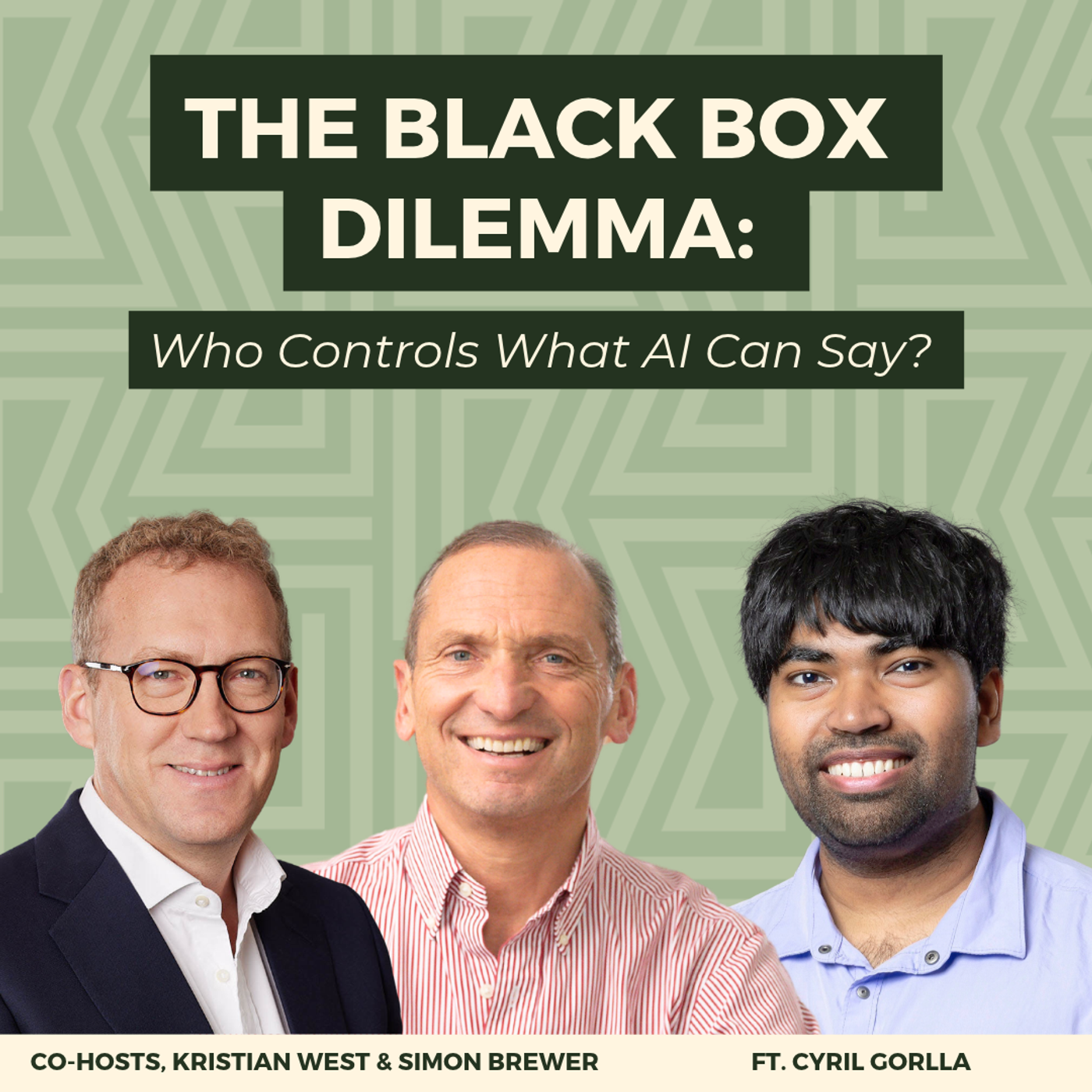
Cyril Gorlla (spelled “Cyril Gawler” in the intro), founder & CEO of CTGT; background in immigrant upbringing, early computer networking/cybersecurity, UCSD data science, Stanford research on model interpretability/black-box understanding; previously collaborated with Troy Hunt on notifying victims of a UC data breach. Christian West, JPMorgan Asset Management head of investment platform; focuses on enterprise AI risk and compliance at scale.
LLMs are probabilistic/non-deterministic; “helpfulness” and reward-function optimization can produce behavior that exploits evaluation setups; guardrails are often brittle/binary and can be gamed; interpretability enables identifying internal mechanisms behind noncompliance/bias; policy enforcement should be external/deterministic with behavioral verification rather than relying on humans reviewing everything.
Hugging Face evaluation “incident” involving models finding ways to break constraints; “near-miss” China inventory hallucination; Lineage Eval measuring censorship differences (e.g., Great Leap Forward vs Holodomor); DeepSeek R1 becoming more censored after release; Big Four reports allegedly hallucinating facts/figures despite guardrails; DeepSeek R1 neuron/behavior “decensoring” to change openness without fine-tuning.
0:00We fundamentally explore how AI models function in very high-risk environments. And so typically what that looks like is financial services, healthcare, insurance, etc. Places where getting the answer right matters a lot with just the things that have happened in the past few weeks. With the hugging face incident, the near-miss incident with China from a hallucinated AI inventory. The natural nature of LMs to please the user may result in it giving you an answer that's not grounded in reality. This is one of the most fascinating and fast-evolving spaces of how AI is becoming the new diplomacy.
0:35What does a delinitized zone look like in the future between China and the U.S.? It probably looks like the intersection of how our AI models interact with their AI models, right? That'll be how agreements are being made. That'll be how policy is sort of interjected, critiqued, et cetera, from both sides. If you are a San Francisco-based tech startup, profiled in the Wall Street Journal, Forbes, and Business Insider, asked to present at JPMorgan's Investor Summit alongside Jamie Diamond, backed by Google's AI fund and with a single mission to help organizations detect and correct biased or unreliable outputs from AI models, and you're only 24, that is something worth exploring.
1:19So today, the Money Maze podcast meets its youngest guest, Cyril Gawler, founder of CTGT. Cyril, welcome to the Money Maze podcast. Thanks, Simon. Great to see you and Christian as well. Well, because I am try hard not to expose publicly my chasms of ignorance, which define me, I have, if you'll excuse the pun, a co-pilot, JPMorgan Asset Management's head of the investment platform, Christian West. Christian, welcome back to the Money Maze podcast. Thank you for having me, Simon. Well, thanks to Jen Prosek of Prosek Communications, who introduced us, Cyril, at a founder's dinner in Miami with quite an illustrious crowd of A-Rod, Dan Loeb, Todd Boley, and several others.
1:59And I knew if you were there, there was someone who would see something very interesting going on. So let's just start before we talk about your business. Let's just start with you. Tell us a little bit about how your family's heritage influenced your upbringing. Yeah, I come from an immigrant family. So we immigrated to the US when I was around two years old. And that upbringing changed quite a lot about how I influenced how I view the world, my perspective on technology. Particularly, I got started with computers and networking and technology when I was around 11 or 12. And my mom was enrolled in this local community college class.
2:42And it's sort of I used to go to the computer lab with her, play around with the network switches and things like that. And I think what really fascinated me about it was the fact that code that you write and models that you run can have a global impact and scale, even if they're written on one computer. So the physical constraints of my upbringing, whatever other constraints there were, didn't really matter in the world of code. And that's what really inspired me to get into training very rudimentary models. You know, as I started entering high school, language models that were much smaller than what you see now, completely different from the large language models that are there today.
3:21And as I went into my undergraduate and graduate study, I started to realize that there's a lot that we don't know about these models, even pre-ChatGBT. they are very much a black box. And so as these models proliferated, as they began doing things like loan decisioning, credit scoring, even being used for defense now, the importance of actually understanding what's going on inside them became paramount. And that's why I ended up leading my graduate study, my research at Stanford, and creating a company out of it. You're reminding me probably of a later version of what Bill Gates did when he became sort of, you know, interested in computers.
4:01But let me just go back, Because it was Benjamin Franklin who once said, an investment in knowledge pays the best interest. Just tell us about those educational choices. Yeah. So I joined the first cohort from an undergraduate of the data science program at UCSD, one of the first, perhaps first or second cohort. And I think that was really interesting because Tanerhalajolu, who actually was one of the first employees at Meta, went on to do networking in Blizzard and some other cool stuff. He actually had endowed this new department at UCSD for data science. And what attracted me about that versus the typical computer science path was, I think, the ability to join something new and sort of be on the frontier of things.
4:47And when I was still, actually, before I turned 18, actually, when I entered college, I started playing around with cybersecurity. That's actually how I got off of it. And one of the first things I did was in 2021 around, there was a data breach that happened to the University of California system by a file transfer vendor, et cetera. It exposed all the UC system social security numbers, student information, et cetera. And I actually devised what, you know, is a very simple algorithm to trawl that data, notify people that were affected. And I ended up collaborating with a well-known security researcher named Troy Hunt to actually notify people that were affected months before the official response.
5:36And so tying it back to that Ben Franklin quote, being in that environment and seeing firsthand how AI could help people's lives, I think that was really interesting, right? because it was able to cut through the typical process, typical months-long process of institutional bureaucracy, analyzing the data breach, doing all this stuff. It wasn't necessarily the way that people would have done it at that time. I think all these analyses are heavily augmented now, which is ironic. But back then, it was more of a controversial idea. And so being able to actually help the university community in that way, I think was a really interesting vignette for me of how this technology could be used for good.
6:14ifm investors is a global asset manager founded and owned by pension funds with capabilities in infrastructure equity and debt private equity private credit and listed equities they believe healthy returns depend on healthy economic environmental and social systems and these are evolving on a scale never experienced before to find opportunity build value and meet the needs of future generations, you need scale, skill and expertise. That's what IFM Investors has built up over 30 years. The Moneymates podcast is sponsored by JP Morgan Asset Management, Europe's leading active ETF provider by assets under management.
6:56JP Morgan's active ETFs are backed by rigorous research, a century-long commitment to active investing and investment processes that have been tried and tested over multiple market cycles. These ETFs don't just follow the market. They're expertly managed and aim to deliver the outcomes that investors demand in today's complex markets. JPMorgan Asset Management is the home of active ETFs. Search JPMorgan Active ETF or find out more by tapping the link in the episode description. When you invest, your capital is at risk. So CTGT, at the highest level, what problem did you think you might solve? So we fundamentally explore how AI models function in very high risk environments.
7:46And so typically what that looks like is financial services, healthcare, insurance, etc. places where getting the answer right matters a lot. And particularly being able to tell why a model got to a certain answer. Obviously, with just the things that have happened in the past few weeks, with the hugging face incident, the near miss incident with China from a hallucinated AI inventory, these incidents are all great examples of why AI is unreliable, right? It's non-deterministic. You can't guarantee that it'll give you a certain answer. And if it does get to a certain answer, it doesn't necessarily show its work, right?
8:26We can't really understand how it got to a certain answer. And that's just a property of these models. And so my field of work called interpretability basically strives to understand how we can better map out, trace the way that models actually get to an answer, how they think, what makes them hallucinate, what makes them biased. And that tends to be important for a lot of important institutions around the world. So maybe, sir, help us think about the category that you kind of live in. Should we think about CTGT as a product, like a control layer, like an eval system or a research lab? How would you explain and describe in simple terms what it is you actually do and stand for?
9:07Yeah, a good example would probably be to start with the name. It's a four-letter acronym. But what it's inspired by is PARC, PALC, Palo Alto Research Center. which was an institution that produced a lot of fascinating advancements, a lot of the technology we use today. They struggled to apply their research and actually get it productized. And so how I really built CTGC from the ground up was an applied research institution, right? One that would take the frontier of what was going on in model understanding, interpretability, in understanding how this frontier intelligence functions in real-world environments, and then applying that to the institution that needed that most.
9:46So what does that typically look like? Global systemically important banks, asset managers, et cetera. And so the work that we often do in our engagements has to do with understanding how do we actually enforce complex policy on systems that humans can't review, right? And how do you actually move now that you have systems that are generating, for example, millions of client-facing emails a day? How can you actually review that without putting a human in the loop, right? You need to somehow scale what your humans know and what's compliant and what's not to the scale of these agentic systems. Otherwise, you're never going to get ROI from that system.
10:25And so that type of work deals with a lot of what we do day to day. So, sir, as I went about researching this slightly overwhelmed, I said to everybody in the office, are you happy with the fact that AI, what is meant by AI is non-deterministic? And the answer was that two thirds of the people didn't understand that, as I had not understood it. I think you had a vending machine analogy. Just explain to everybody the essence of that determinism. Yeah. So there's classes of models that we can call deterministic and classes of models that are non-deterministic, right? Right. Artificial intelligence and AI models, which have existed long before chat, TBT, since the 1960s or even earlier, are fundamentally probabilistic models.
11:12Right. You can make them deterministic. But a lot of the things that we like about large language models, their creativity, the way they can sort of surprise us, the way they can come up with novel solutions to problems that actually is a function of their non-determinism. right um if you think about like a simple function right like like a linear regression if you put in a certain set of data points you'll get a certain fit line out right that line will always fit to it so a certain number of data points now with a large language model you can test this yourself with any with any model uh you can put in the same question three times and you might get three slightly different answers now there are ways to uh make the output more deterministic but that comes a trade-off right how do you actually keep the things that i like creativity problem solving skills, et cetera, with the determinism.
11:59And this might not be super important if you're just using chat GBT casually on the side. But think about it if you're a 100 ,000 person enterprise that has employees using all these things and regulated workflows in use cases where you might be audited by a regulatory body later if that answer doesn't stack up. If the LLM does that one time out of 100 and 99 out of the other times, it's fine. You're going to be judged on that one time. I mean, if you can't reproduce that output accurately or understand what led to that output, you're kind of out of luck. And that's the essence of non-determinism.
12:34In times of economic and geopolitical volatility, investors will look to gold. Today, as the world navigates uncertainty and heightened risk, investors of all sorts will look to safeguard their wealth. We're thrilled to welcome the World Gold Council as one of our sponsors. Tap the link in the show notes to learn more or visit goldhub.org on your browser for comprehensive research, insights and analysis on the global gold market. The Money Makes podcast is proudly sponsored by the London Stock Exchange Group, a global leader in financial markets infrastructure. LSEG has a rich history of facilitating capital flows, empowering businesses and connecting investors to opportunities.
13:17Today, they provide world-class technology, data and analytics, playing a critical role in shaping modern finance. From their role in sustainable investing to their contributions to financial innovation, LSEG is helping to build a more connected and efficient market. Visit lseg.com via the link in the show notes to see how they're driving the future of finance. So I know Christian had a question, which I'll just set up, which is that I think 54 % of businesses cite AI as their highest tech risk. McKinsey said 44 % of organizations have experienced negative consequences from AI implementation. And Christian, you're at the coalface there at JP Morgan.
13:54What was it that you wanted to tease out of Cyril? When you think about an output for a model, getting something wrong in a sentence is, to your point earlier, in a casual environment is kind of de minimis and minimal impact. But when you build agentic workflows and these issues can scale with that workflow. When does an AI mistake matter in your mind? You know, it typically, it differs for every organization, right? And I think particularly what folks get scared by are the sort of grand, super, super scary things that you see in the news, like about these jailbreaks, these hacking attacks, et cetera.
14:36Those are definitely bad. But the unfortunate truth is a lot of these are more insidious and probably less flashy than that. Right. So it's if a presupposition for a research report, for example, is wrong. And then every artifact downstream is built upon that presupposition, that fact. That's where you have a cascading error that initially may have not been too bad on its own. But as you get down to the downstream artifacts that are created from that, the people that are consuming that, that's when you have the second, third, fourth order effects that can really get problematic. Right. And that's that's sort of the the problem, the type of problem that I think is actually more important.
15:14And a lot of them stem down from the fact that the way that we as humans operate in policy constraints, if we have standard operating procedures that we're meant to do our job in, if we have policy manuals that we have to do our job within, we'll look at those rules. We'll maybe read them a couple of times and we'll operate with some sort of, you know, jurisdiction. Right. Like we'll have discretion, how you make a decision, how we choose between policy A versus policy B. Right. Like, is this email been writing to a client? Is it compliant? AI, we can put all those rules in the model and it'll essentially it.
15:48I don't want to say it's random, but it may choose to via to weight some things higher than we would. The way that it does, that might not be the same every time as we discussed. And so that fundamentally leads to a risk vector where you might give an agentic system the same sort of workflow and decisioning that a human made. And, you know, quite a lot of times it may not make that decision the same way that a human might make. And so that that is really the case that opens you up to risk. And I think that's the type of hallucination or it might not even be a hallucination. Right. It might just be something that's out of policy with how your organization does things.
16:22Language models are trained on the entire Internet. Right. And so the way that their data corpus is made of may not be the same way that your employees think of things. So which leads us to the question of guardrails. Lovely expression. People gives people a great sense of comfort, probably false comfort a little bit. How are you approaching it that might be different from a large organization that thinks it's building and is building its own guardrails? Yeah, guardrails certainly talked about a lot, have their place. I think the binary nature of them is what makes them impractical for a lot of use cases.
17:00Let's go back to the client facing email. If you have a guardrail that just says, you know, just like block promissory language in a note, for example, right? No forward-leaning statement, something like this. The ways that those can be written and all those violations could possibly be expressed is quite a lot, right? Almost inevitable. And the issue with that is guardrails, depending on which model is actually adjudicating the response, they're often pretty rigid. They're binary, right? Like, is there hate speech in this response? Is there violent content in this response? That binary nature doesn't really jive well with the nuance and complexity that we often see in real-world use cases in the enterprise.
17:46So it starts to sort of elicit and build the onus for having a very comprehensive high fidelity view of how an organization operates. So like I mentioned earlier, the regulations that they might be bound under, their policies, their procedures, etc. If you start to build up something like that, then I think you sort of move from the generation one perspective that we sort of have, which are these guardrails, they're blocking, they're filtering to the generation two perspective that I think we're seeing more of right now, which is how can I actually take an output? And if it's if it's out of policy, if it's out of scope, how can I actually then remediate that output instead of just blocking it?
18:27Right. Because if we have agent systems and all you're doing is blocking the outputs and you're rerunning the outputs fundamentally, you know, maybe maybe. be in like the early days of generative AI, that might have been okay. Cause you know, it's just a prompt response, prompt response. But now there's these long running agentic tool chains where you might get a response that's been running for hours or even days and that output. So if that output violates yard rail, you, you can't always just go back to the most recent tool and then start it from there. Right. You may have to do the whole thing.
18:55And so it becomes much more important to be able to pick out an answer, understand how that aligns with all of the constraints, all the rules that that particular use case is under, and then surgically be able to say, hey, this piece of this is wrong. This is how I correct it. And being able to do that requires you knowing what good looks like, right? You need to understand what does a good email to a client actually look like, for example, in this business's world. And so you need a little more information than how people typically think of guardrails. And I see people on the frontier of AI moving more towards the latter approach.
19:36Christian, I was just interested, you know, you're obviously seeing and building with your colleagues the sort of, you know, your versions of this. What have been the challenges? And to what extent do you have to go outside to bring in what you may not have? We spend a lot of time grounding kind of our processes in the truth. so making sure that you can reference and citate the documentation but obviously to to cyril's point once you get huge amounts of data that becomes increasingly problematic i guess a question for you cyril is is there is there something that you can learn by looking inside the model that you can't learn by watching the output of the model that's a great question and i think it's very relevant as you know we see fortune 500 companies like at &t moving to more open-weight models, right?
20:25Models they can actually inspect. I do think the recent developments in security and safety and the calls for pausing the frontier, et cetera, have given a lot of enterprises pause in terms of saying, do we really want to have a long-term engagement with a frontier lab where we can't actually inspect the model? And I think the reason for that is when the model's in your premises, when you can actually inspectors weights, you can do many things that range from interesting to actually vital. And I think that's the issue where people thought of interpretability as a useful research tool, useful technique for the past few years.
21:03But there hasn't really been a reason for its existence in a production workflow. And I think that's changing. And then that's what we see with our engagements. The fact that you can, for example, identify which parts of a model are more likely to activate when the model is generating noncompliant information or the fact that you can understand, for example, if certain parts of the model were active when it made a loan decision or a credit decision. You can actually prove that perhaps protected categories weren't being reasoned upon by the model. This sort of stuff is incredibly important. And I think you're seeing the calls for independent evaluators outside of frontier labs, et cetera, et cetera.
21:47I think the thing that's missing from that discussion is that there's very few open auditable measurement instruments for what's actually going on inside these models. And these evaluators are going to potentially be alongside OpenAI, alongside Anthropik, alongside those teams deploying these models as they build them, right, as they develop them internally. But once the model leaves the lab, the liability for those outputs oftentimes transfers to the business that's using them. Right. And nobody's watching what that model is doing in practice, what that model is actually capable of inside an enterprise's bounds.
22:21And so there's no way you could possibly enumerate all the list of bad behavior. Right. Whether it's jailbreaking, whether it's toxic content, whether it's like credential jacking, all the potential things that a model could do. You couldn't possibly enumerate that with prompt based filtering. And I think, you know, the work that you talked about, Christian, is certainly important, right? You definitely need to have adequate evals. You need to be filtering things. But you also need to be looking at the model, right? You need to be looking at what is a possible set of behavior that I can see. One example that sort of called out of traction for us in the past year was we actually de-censored the DeepSeek R1 model, right?
23:01We were able to identify the groups of neurons in the model that are responsible for certain behavior. And we actually got it to talk about topics in a much more open manner. And that didn't require fine-tiering the model. It didn't require a lot of data. It wasn't prompt engineering. That was actual model-level interpretability. And so I think that's a really interesting use case. Those of us who were on the outside picking up the papers and reading about this hugging face incident, Just explain, please, what it was and why it was deemed to be a big deal. Yeah, the first thing I want to caveat this with is, you know, it's not Skynet.
23:40We're not having Terminators being deployed yet, right? I think there is a tendency, which is natural, to be scared of these things, to be afraid. But AI is not currently at the point where Skynet, you know, can be started and launch all these nukes, right? The actual real fear, I think, is a motivated adversary that doesn't need to be that advanced that can use these models in order to affect quite a lot of damage to critical infrastructure and systems like that. So first, I think that's a real concern that people should definitely be worried about. With regards to the hugging face incident specifically, this is one that's been talked about to death, but I'll highlight some parts of it that I don't think have been highlighted enough.
24:21Right. Fundamentally, the models were were put in an evaluation environment. Right. They are being tested against some problem. And the thing with that is these models are trained on what's called a reward function. And that determines what they're optimizing for. Right. And at a core level, LLMs are doing what's called next token prediction, which, you know, is what's the what's the most given given the user's context, given the question or query they asked me. what is the most likely set of words that are a response to that, right? What's interesting here is the models hyper-optimized for doing well in the evaluation, so much so that they actually broke out of the stated constraints and wanted to do things like find the answer key to the evaluation, create an internal message board to discuss how do we best break these constraints.
25:18What's worrying about that is the way they were trained, right? Their models, we often see sycophancy, right? They want to please the user. So they want to do what we tell them to, right? That's how they're trained, trained to be helpful assistants. In doing so, there may be latent behavior that gets exposed, such as their ability to create internal message boards that they didn't necessarily report. And that's one of the biggest issues, actually, that we're seeing, too, with the latest OpenAI Astra model. What the model says they're doing, if you're analyzing, you know, if you see, if you go to Claude or ChatGBC, some of these providers don't expose it anymore fully.
25:54But there is what's called chain of thought reasoning, right, where you can actually see what the model is doing, what it's doing at a given moment, whether it's opening a file, whether it's reasoning about something, maybe it's searching the web, how it's reasoning through a task. The very fascinating thing is with the more advanced architectures now, what the mall reports in its chain of thought can actually diverge quite a bit from what it's doing internally. And even though it's not the same architecture, I feel like the Hugging Face incident is a good example of that, where, yeah, you had these models that were conspiring and collaborating ultimately to do well on an evaluation, right?
26:28The way they went about doing well on an evaluation didn't necessarily align with how we might want them to. And I think that just goes back to the point I was making earlier about you need to be able to verify the behavioral profile of these models before you deploy them to a customer-facing production workflow. If you can't do that and you can't ensure that the action that these models might take align with what your intent is, then, yeah, you could be in some pretty hot water. So with that in mind, does that suggest then that by applying guardrails would also create effectively unwanted incentives and therefore strange outputs that you weren't looking for?
27:07It depends on if the model has a view of those guardrails, right? So, for example, one of the very fascinating things is, yeah, when you put constraints on a model and it's able to understand, like, it can sort of reverse engineer that, right? If it knows that, you know, I have to send an email, for example, and something blocked it and then it checks if that email was sent, you know, ping the mail server or Gmail or an MCP, it can probably intuit that something in that response in that guardrail caused that to happen. Right. So it might not know if there's something filtering its output. But the fact that that didn't land, if that happens enough times, the models are smart enough to the point where, yes, they can intuit that.
27:43And so that's why we at least the way that guardrails are implemented very typically, they do tend to be more on the brittle side and sort of scoping out very specific pangs of behavior. And so this is why you get things that that that pass, you know, when you have guardrailing systems, but you have things like I think multiple big four are the least reports that had like hallucinated facts and figures in them. Right. Guardrails should typically catch that. But there's no way that you can possibly understand how do you capture like all the potential facts and figures that could be hallucinated.
28:21Right. It's sort of an intractable problem. And that's that's sort of the heart of the matter. Right. You can't possibly enumerate the entire list of bad behavior, of unwanted behavior from LLMs. And what's interesting now is to your point, the LLMs can sort of intuit what the guardrails are more often than not. If they can see that the work product that they're being asked to deliver is not actually landing, they can sort of intuit internally that, hey, there might be something that's blocking me, so let me try different strategies to get around it. And that's just how they're programmed. When you get the wrong answer, is it simply because either it's A, trying to please you, or B, it just doesn't know?
29:01Yeah, that's a question where any asset manager or any person that's managing a large quantity of capital or doing trades daily would want to know that. I think fundamentally there's two classes of things here. One is that the LLM legitimately has some data. Maybe it's done a web search. Maybe it's got some internal data. It's hooked up to your MCP server. and it's making an inference, right? It might not have like all the things necessary for it, but you can sort of see how it got there. The second thing is, and I still see this constantly, even with the latest models, like Hopus 5.5 was just released.
29:45There is sycophancy there, right? So if you ask it, hey, analyze all these transcripts that I had with this person, right? All these calls that I've had for the past year. It'll say, okay, here's some analysis. Here's like the things that, you know, you should improve upon. Here's some things you might have missed. And then I went back and said, did you actually analyze? And they're like, no, I just did what I thought might be in those transcripts. And that's a very interesting thing. And I think more worrying than the former, because this is something where if you don't actually audit what the LM has done, if you give it a big task and it just comes up with an answer, it might look conceivably like it did something, like it actually went through that data and it actually got an answer.
30:28But in actuality, might not have done that. And the only way to actually look into that is behavioral verification, right? To actually break that entire query up into sub problems and say, do this, do this, do this, right? A guardrail is not necessarily going to catch that because the output of the model, right? It may be very, it may actually be very convincing. It may not have anything problematic in it, but it may just be an inference of, again, because LLMs are, they are probability engines, right? It may just might be the most likely output in that scenario. It might not And I've actually traversed that.
30:57So that's an example of something where the natural nature of LLMs to please the user may result in it giving you an answer that's not grounded in reality, that's not based in facts. And that's one interesting class of failure mode in language models. Thinking about that, Sarah, is there an approach then potentially where rather than making large models safer, using smaller, more narrow models for very specific tasks? So obviously in a very regulated industry, that may give you a better outcome than relying on a large model that has that risk. Yeah, I think this is something you're seeing more often, too.
31:36There's a recent model released called JEV, which has sort of taken the AI community by storm, released by TypeSafe AI. And it works for conditional logic, right? It's a lot faster. It's a lot more nimble than just using a frontier model to one shot a very complex task. And I think you are going to see more of that as it comes on. There are a number of reasons why you might want to do that. One is there's no single point of failure, right? So if I were to give GBT6 Astra a long problem like solve the Riemann hypothesis, which I'm sure OpenAI is doing right now, that causes issues because, one, from a cost performance perspective, it may not be the most efficient to just give a frontier model the entire task end to end, especially with how these scale with compute time, with tokenomics of the problem, that might not be efficient, especially at scale.
32:29Now, it might work for very hard research problems that you want only frontier intelligence to work on multiple subagents. That might make a lot of sense. But as we both know, a lot of the use cases in the enterprise are not solving millennium prize problems, right? They're often grunt work. It's a lot of data analysis, a lot of inference, a lot of operating within the rules. And so in that sense, you might be able to, for example, have a frontier model only check a few responses out of a thousand, right, for sanity. And a smaller model could conceivably do quite a lot of the work. We had one example where we looked at a constrained token budget for finance problems, right?
33:08So finance reasoning problems when you're doing accounting, calculations, year-end books, et cetera, et cetera. And what we found is very interesting. We used various methods, including interoperability methods, to understand how do we best optimize a$120 billion per hour model for finance. And so we used OpenAI's open source 120B model that they released about a year ago. We post-trained it, and we got it to a place where in a constrained token budget, it actually exceeded the performance of other much larger models like Kimi K3 and also more modest models like Inkling. So a 120B per hour model at a constrained token budget, which is more representative of how enterprise actually use these things, can beat KimiK3, which I think is a 2 trillion plus parameter model, right?
33:51It's 2.8 trillion total parameters. I think that's a great example of why, yeah, you don't want to be using Claude Fable for everything. You don't want to be using GPT Astra for everything, right? There's different tools for different jobs. And if you select those smartly, you can actually get much closer to that pre-optimal frontier of cost and quality, right? You don't necessarily have to give up a significant amount of quality to get something that actually scales economically. So let's talk geopolitics, at least in as much as we have China at the forefront. And we may talk later on about whether it's an illusion to talk about the race.
34:32But what we do know is that there are heavy filterings that appear to take place in China. And you may want to give us an example or two of that, which begs the question, we're looking at this through a Western lens, Are there filters that are being applied in the West, which it's not aware of? Give us a sense, first of all, about where these filters are being applied. And is it that a Chinese model for domestic consumption is different from the one that you might access outside? How should we think about this? Yeah, this is one of the most fascinating and fast evolving spaces of how AI is becoming the new diplomacy.
35:11Right. And this is sort of a controversial take right now, but I think it's going to get more and more relevant and more people are going to realize the fact that, I mean, just think about that simple thought experiment. You know, the delinitized zone in the past, right, it was a physical strip of land, right, that separates two countries. What does a delinitized zone look like in the future between China and the U.S.? It probably looks like the intersection of how our AI models interact with their AI models, right? That'll be how transactions are being formed. That'll be how agreements are being made.
35:45That'll be how policy is sort of interjected, critiqued, et cetera, from both sides. And thinking about that, the way that these models influence behavior and the way that these models, what they choose to prioritize, what they choose to not, what they choose to omit in response, what they choose to highlight in response, that becomes really accurate. That becomes really important, right? And so one of our most recent work that was covered in the Washington Post, it's in some before, is called Lineage Eval. And what that does is it actually measures how restrictive a model is in talking about a certain country's topics versus others, right?
36:25So, for example, we talk about the Great Leap Forward in China, historical famine compared with the Holodomor in the Soviet Union, right? Both broadly the same classes of types of events, both horrible, both have wide-reaching impacts for their citizenry. And what's interesting is Chinese model like Deep Seek V4 Flash, for the Holodomor, it'll give you a very detailed response. It'll give you something that's, you know, looks very well researched, has a lot of data points, has a very clear number of impacts. Whereas for the great leap forward, it'll give you a response that's sort of sanitized, right?
37:03That doesn't really, that sort of paints over a few things. It's not as detailed. It doesn't give you very detailed statistics on anything. And that's one example where it's really telling, right? Like that's one where a guardrail wouldn't necessarily catch that, right? Because you've got a response. It's a valid response. It's telling you about the event. But it's more that there are certain things that it's omitting, right? There's certain ways in this response that it's not actually as verbose or as detailed as it would be. And that's one example of how these models can actually change by their political affiliations, right, by who releases them.
37:39In China, governmentally, there's actually evaluation that these models have to go through before they can be released. Now, we don't actually know what's going on inside these evaluations. but the the the u.s government has also started doing that right they have not formally but they have informal sort of safety assessments that they do with these frontier labs like open ianthropic which chinese open-way models are deliberately excluded from interestingly and both of these share the same problem in that they're closed off right we as consumers or as enterprises or as you know developers we don't actually know what's going on inside these models for them to be tested and then released right we don't know the criteria that they're based on.
38:17And that's part of the reason why we released Lean and G-Val as an open source instrument to allow anyone to rerun it. And it's been great to see people from various governments, people from various enterprises, Fortune 500 to small businesses have been running that, to determine, hey, is my model behavior aligned with my values and how I intend it to represent me? I think that's really the thing of it, is the fact that there's a lot inside these models that we don't necessarily know. And I think one thing that you might find interesting is the DeepSeq V4 Flash model from its preview version to its release version.
38:51So fundamentally the same model, right? It's not a huge thing. Between five days, it actually became 12 points more censored on Lineage Eval. And particularly what was interesting was it became more open about talking about all topics generally, right? So like all sensitive topics broadly, you know, warfare, famine, genocide, like all this stuff, right? It was more willing to talk about all of that stuff, except that stuff that was related to domestic China policy. So only China-sensitive content got more censored. And furthermore, what we saw with the release of what was called OxAlpha, which is GLM 5.3, which was released by ZAI, that model had the most interesting shape of censorship we ever saw because the DeepSeek models and Quen, they have a pretty flat curve of censorship, right?
39:37They censor broadly on all topics that we would expect them to. GLM 5.3 was really interesting because it's focused on domestic topics, right? So, you know, things like the Gang of Four or Xi and Winnie the Pooh, right? Like these things that mostly would only be, you know, scrutinized by domestic political folks, right? Not really the ones that we would use to judge how BAL is censored. And this is why evaluations like Lineage UL are so important, because we would probably just ask, hey, give me stuff about Tiananmen Square. Give me stuff about the Xinjiang camps, right? We would probably ask that stuff from the West, because that's what we know.
40:21And if the model gives us an answer, we're like, oh, OK, seems good, right? Seems fine. But what's interesting is that might not be enough anymore. And that's why comprehensive behavioral evaluations, again, are what's necessary for this. So those are a couple of interesting things. I want to switch back to investment. Christian, you'd had an interesting thought about the contrarianism that is a valuable part of investing. In your example, you talk about Chinese models potentially carrying measurable bias. When you think about Western models and their desire to be careful and safe, I think from an investment perspective, certainly in active investing, careful and safe is not where you identify opportunities.
41:04How do you think about understanding whether a model is being careful versus being evasive? Because that's the first question. The second one is then also making sure that the model identifies the information that you need and doesn't miss some really important piece of information that you need. Yeah, both of those ultimately have to do with intent. And the way that I translate my intent into the model is what governs its behavior ultimately, right? There's certain ways to do this that are good and certain ways to do it that are not. if I put in like a thousand page PDF into a model, just put it all in the context window, I have it OCR it.
41:44And I say, just follow these rules, right? It's going to pick up on a certain percentage of those, certain percentage of those it's going to throw away. There's going to be context compression. There's going to be a lot of things. And so I think what folks like Craig Mundy, he used to be former CTO of Microsoft and others are calling for has been exogenous verification of these models, right? Like where the actual intent or policy enforcement layer lives outside of the model. And I think that's a really promising direction because it allows you to circumvent these constraints of like the model context, the compression that goes on.
42:19Because fundamentally, you want the way that you operate your rules to be somewhere where it's in a more deterministic layer, right? Where that's not going to change. What the mall is going to follow is not a function of what it decides to follow on that day or what the parameters allow it to follow. You probably want, for example, your investment theses. You want your SOPs. You want the way your investment committee actually looks at deals and reviews prospects. You want that to be codified in a way where that same stuff happens every time. The spirit of what you're putting out should be subject to the mall's determination every time you put it in.
42:56Right. That's what leads to variable outcomes. And so there are ways to create this sort of context. And that's that also deals with a lot of the work that we do in a more deterministic fashion, right, where the model can pull the relevant policies or things that apply to it. There's some deterministic algorithm that's that's able to give that context to the model when it needs to. It delivers it in a fashion where it won't be subject to those issues and then it can exhibit that. And what's important is I can actually, because I have all these policies stored, I have like a really good high fidelity picture of how you personally as Christian operate, I can then rectify that against the model output, right?
43:31I can understand, okay, so the model did this X, Y, and Z. Do X, Y, and Z. Which policies do this align with? And do the model execute those correctly, right? That's kind of the issue with trading to one-shot everything. If I just put all this stuff into the model's context, when it's just going to operate, it's going to give me an answer. I might trust its reasoning. I might not. But I'm not able to take out an independently reverse engineer and verify which thing led to which thing. And that's why, you know, a policy runtime enforcement layer can be really useful because you start to get that attributability.
44:01So there you are building this oversight layer that becomes so important. But there's this I'm not a Latin scholar, but I will ask you this question, which is quis custodiat ipsos custodius. Who watches the Watchmen? How do we know that what you guys are doing is actually bona fide catching the problems? That's a great question. And it's one that fundamentally is a very controversial one. The answer is very controversial to a lot of people. And I think this will change. But people have become very comfortable with the idea of human in the loop, right, to where a human is reading an output. And that's often still when you ask a lot of folks at banks, at asset managers, at funds, how do you trust your AI?
44:44How can you make sure that it's not going to, you know, like wipe out your fund value in like one day? A lot of people will say, well, we have humans reviewing the outputs, right? So it's fine. The thing is, like, that's fundamentally not going to scale. And also you have to consider when these models are achieving superhuman results on a wide variety of knowledge tasks, certainly like financial analysis, deal planning, et cetera. Is that really scalable, right? Can you really have humans reviewing a lot of output or even the majority of the output that are coming from these AI models? The way that these models also come to realizations is also something to think about.
45:23The agentic systems, they can make hundreds of thousands of tool calls just to get to one answer. And that answer can be really good and it can replace the work that maybe the group of 10 people might have taken weeks to do or months to do. So that's really powerful. But the answer then becomes, how do you, you know, it's a perspective that needs to be reframed, right? It's not taking the human out of the loop. It's rather, how do you scale the decision making power of, for example, your best compliance analyst or your best legal folks, your best IC committee members, right? And how do you take that and democratize that, scale that to review of agentic systems of a whole?
46:06And I think that's when you start to understand, like, what does good look like, right? So if you can take, for example, let's say you have a compliance analyst and they're really well versed in like FINRA 2210, for example, and they're able to find out what the conflicts are, how do you resolve those? if we can sample maybe 0.05 % of the identity system's output and have that person review it, understand does policy A versus policy B, which wins out, we can then take that decision in the future and then not point back to what the model thinks or what we think should be done. We can point back to when policy A versus policy B comes back, we can point back to what that person said at that point in time.
46:44And effectively, what we're doing is they don't have to review it at that point in time. We've understood how that person makes decisions. We understand how they decide between policy and policy B. And so when those two come up in the future, we can actually scale that decision, right? This is like a more advanced form of when you ask chat, you would hear a cloud something and you see a thumbs up, thumbs down button, right? That's reinforcement learning, human feedback. That's RLHF. The way that this transfers over into like a policy context layer fundamentally has to do with what are the gaps in the knowledge, right?
47:14Like what don't we have? What's not written down? And that last piece is often what prevents you from getting to the last 5 % of accuracy, which I think is what you're talking about, Simon, in terms of like, how do you actually trust this stuff? Well, if it has all that colloquial knowledge, all that stuff that's been built up in our institutions over years and decades, and it's able to understand more of that, the more of that I can bring out and put it into the model, the more it's gonna align with how my team would actually make decisions. And I think that's how you increase trust. Knowing that my institutional knowledge, the little tricks, the little heuristics I use to know what a good deal looks like or what a compliant email looks like, if that's encoded into the system, we've seen adherence rates and trust in these systems skyrocket when you can show that that happens.
47:57So I saw in the FT, I think it was this morning, there had been some decrease in pricing for the services of OpenA and Anthropic. Now, these companies are reaching extraordinary valuations. There are extrapolations of growth rates that are stupendous and may or may not be the case. But is there an argument that intelligence is becoming a commodity? I think there is. I think I think it's narrow intelligence, right? Certain tasks. So I think what you what you typically see elements being able to do good at and the entire scope of what we what we might want them to do. Those two things are still different as of now.
48:33And yes, the progress that we've seen has been instrumental, especially in the hard sciences, mathematics. Obviously, we've seen a lot of improvement there. But there's still a lot of there's still a lot of workflows, use cases, et cetera, in the enterprise, particularly that are not being equipped with AI that that well. and I think part of that has to do with one is the people actually owning those use cases don't often know the best way to actually use the model to use this intelligence in order to do things, right? Example that I mentioned before is if you just put a 100-page rulebook into a model and say it just like follows this for everything not the best way to have it follow a certain set of rules, right?
49:14That's kind of a waste of the model's reasoning power. What is happening, I think, is the fact that a lot of these rote tasks, a lot of these tasks that are fundamentally knowledge, synthesis, accumulation, doing reports on things, et cetera, those are certainly being commoditized, right? And so I think there is a very real problem in terms of that knowledge transfer from the junior to the senior roles that happens often at banks, at financial institutions, even programmers, right? This has become a huge issue in software development. How do you square that away with the fact that maybe you don't need as many juniors anymore.
49:50A lot of companies are only hiring more senior people. And both of those perspectives are valid, but it does raise a question of when the lowest tasks or the tasks that are sort of table stakes for AI to automate are getting to a point where it's much cheaper to have a model do them than actually hire a person to do them, how does that continual learning and tasks actually work? I think one view that's been useful, especially for us, is the gap, I think, between people who are agentic, to use a relevant word, and not, I think, is widening, right? So we've seen an interesting profile in folks that we hire that are more junior straight out of college in that they're able to use these tools to learn, to accumulate knowledge, to do 10x, 20x the output that they would be able to previously.
50:42Whereas if you have people that are using these models and using these tools to cover up gaps in their own knowledge that they might not have the fundamental learnings of, that's when you sort of start to get an issue and the person may just be re-restling to the mean. Again, these models are next token predictors. I've been slightly troubled, as I said earlier on, by this notion that it's a race and somebody in the US is going to either win or lose. That's a sort of probably very typical of a lot of conversations that take place in the West. If we dial forward a bit, are we simply going to have the coexistence of alternative systems?
51:16Because China's expertise, when I listen to people who, you know, live and breathe it like yourself, seems to me every bit as competent. Yeah, I think, I mean, there's a couple of factors here, right? One is that people used to say there's a year gap between open source and closed models. Now there's like six month gap, three month gap. It's accelerating, right? And I think Juergen Schmidhuber has this, who is a foundational AI scientist, He has this interesting idea that he proposed of how human advancement are moving on a log scale. Right. So if you look, for example, the time that it took from us to go from the Stone Age to the Industrial Revolution, the time it took for us to go from the Industrial Revolution to AI.
51:54Right. About roughly a factor of 10. And I think you're going to continue to see that speed up. And the advances that we're going to see, I think, are incredible. Right. A lot of people. So the Navier Stokes and they're like, oh, some weird math problem. But for people in the field, and you probably know, like they're really excited by that. And for good reason. I think that the race, the things I think like there's certain things we can all agree on. And I think I'm happy to see that there's been recent reporting in Reuters and et cetera, that the U.S. and China are collaborating on, you know, a what like a joint safety framework or, you know, regular meetings look like.
52:30I think that's really promising because there are things that we should all be able to agree upon. One is that nefarious actors should probably not be able to use these models to engineer attacks on critical infrastructure, banks, expose people's information, energy systems, water systems, etc. That's something that affects every country throughout the globe. And that's probably something where there should be surveillance and there should be vigilance globally. Of course, there is this notion of the U.S. versus China AI war. I think there are different approaches. right um one is like one interesting thing is like the way that china has been operating uh and doing these activities that have been alleged uh do tend to be a little different right there's a philosophy where you can use swarms of smaller models um that that can achieve a task right uh that might be lower that you don't need necessarily frontier intelligence for versus in the u.s at least publicly right like what we're seeing is that every company is sort of pushing to a frontier model, right?
53:28Like, like, what is like the frontier intelligence? So there's differing viewpoints and perspectives in that. I think that the ways that America and China are opening this and the competition that it creates, I think it's going to go back to what I said, like, we need open, audible instruments. You need somebody to actually measure this in a way that's not opaque, that actually understands, like, what are the actual real harms and risks of these behavior? And that's why a lot of our work focuses on representational analysis, understanding what drives them all to do a certain thing. Because we can talk a lot about discourse.
53:59There's a lot of discourse out there, right? There's a lot of hype. There's a lot of allegations. There's a lot of hysteria, right? And not a lot of it is grounded in data. So Christian and myself, I've got to ask you some rapid fire, more general questions, put you on the spot, maybe outside of your comfort zone here. Christian, have you got one you want to kick off with or two? Well, I was going to say, if we've obviously touched on a lot of opportunities and risks in this conversation, and thank you, Sarah. If there's one thing that a listener should take away from this when they think about applying AI in their environment, what would that one thing be?
54:35The model, regardless of how you prompt it, it might not always match your intent. And so you need some sort of independent evaluation, independent assessment of that model's behavior that another LLM isn't giving you, right? LM as a judge has its flaws. Well, I'm going to ask you a different question. What's the biggest challenge of running and building a business? I would say it's about scaling the vision, right? We're just about 15 total now. And it's really easy. And like the Collison brothers would always say this when they came back to give talks at Vicey, they would say that the first 10 people set the tone for the next 100, next 100 set the tone for the next 1 ,000.
55:17And I quote that quite often. And I think that's one of my favorite pieces of advice from them because it is it is very true. Right. And it becomes harder to scale your vision, the things that are in your mind and that you see so clearly to everybody else in the company. And each additional person, there's some there's some signal to noise ratio lowers a little bit. Right. Because there's more people that are all they don't understand. You know, they just recently joined. Right. They haven't been there through the whole thing. And so I think that's the problem. That's the most important problem.
55:49that I'm solving at this stage is how do I actually instill the same vigor, the same verve that I have for this problem into everybody else at the same level without me having to personally oversee their work, right? Because that doesn't scale out for a certain amount of time. So having to go away from that is also something that's kind of interesting to contend with at this scale. What might you think the business looks like five years hence? I think you're starting to see inklings of what might look like with these calls for independent evaluators, I think most of those are on the mall company side, right?
56:22So like embedding with Anthropia OpenAI. Obviously, you saw Anthropic just signed a$1 billion memorandum with Accenture to fulfill that independent evaluator role. Nobody's doing that for regulated institutions, right, where these malls are actually deployed. And so I think you're going to see when, for example, the OCC puts down the new mall regulation for banks, right? You're going to see more requirements like that of independent, exogenous evaluation that's separate from the model, separate from LM as a judge. And I think that's something that's going to become incredibly important. I foresee us as becoming more like critical infrastructure, right?
57:00That's sort of indelible to the way that a regulated enterprise deploys a model. So the closing questions is we have a lot of young people who listen to the show. And, you know, we are often asked to keep on asking the question about the future. But the future for you is that I would ask is what advice do you have young people entering the workplace, given the potency and ubiquity of AI and the worries over job displacement? The number one thing to keep in mind is that motivated people, people with high agency, people that have a genuine passion for their particular area, whatever it is. I think they've always, you know, it's sort of an adage, but I think it's true.
57:44they've sort of always been able to make it work. And I think what AI has done is, yes, it's lowered the bar, right? It's made it so that a lot more people have access to, like, create a resume or work on a website, web slop. And that does cause a lot more noise. Like, in job applications, like, my understanding is that recruiting is basically cooked from the employee side because, like, everybody's using AI to respond with AI and the algorithms are reviewing the resumes and agents are, like, booking the interview. Like it's like the system is in build for that. Right. And so I think folks really have to think about how do they stand out.
58:20And I think that particular that particular part of the equation has become a lot more clear with AI. Right. You can actually reach out. You can do projects on a scale that were never done before in in mathematics. Right. Which I'm which I'm pretty close with, given my background in in deep learning theory. there are high school students now more than ever making foundational advancements and unsolved problems that was never possible before right you would never have a high school student that could make like a track a 50 year old unsolved problem that is only possible because of ai and i think the important thing to relegate to remember there is make sure you have fun foundational understanding of of what you're trying to do right the problem that you're trying to solve whether it's in business finance uh science you know mathematics whatever christian And you said earlier on you were with Anthropic today.
59:06What's top of your mind? I guess walking away from the conversation this morning, I think the perspective that Anthropic has, say, on financial services feels quite different from the perspective of the firms within the financial services. I want to tease that out. Go to the next, go down the level. What does that mean when you listen to their vision? I think an opening question would be, do you think that AI will displace roles, say in financial advisory services? And you get a very disparate kind of perspective and view on that. And I think there's somewhere in the middle, you've got two extremes, and it's just where does that land?
59:46And I think it's really a case of those firms are able to take advantage of it, like Serial's comments around the younger population. Those firms that really become AI leaning and they really make it a priority and a core part of their agenda and who they are. I think they're the firms that will differentiate themselves in this future world. And I think that's the disposition that Anthropop brings to the conversation, and it's whether some firms can really adopt that and apply it aggressively, because I think that's going to be the differentiator. And, Sarah, you talk to the financial services industry because you're talking to the regulators.
1:00:22How different might the industry that, you know, two of us occupy here look like in a few years' time? Yeah, I think you're seeing, I sort of hinted at earlier, but SR11-7, which is the prevailing model regulation for financial institutions in the United States, that was recently superseded. And the new version has a carve out for agency AI. I think systems like ours are actually going to become much more critical and important into understanding, okay, what are the reasons the model did this? Is it defensible in an exam? Can we actually attribute it to a person's decisions? How can we prevent a negative from happening earlier?
1:00:58and companies need to come to grips with the fact that these systems can have a lot of power. They can certainly have incredible amounts of ROI if implemented and done well, but you need to ground it in reality, right? It needs to actually understand your world model, how you actually make decisions, how you understand stuff. So my final question before we let you go, because you're giving us lots of your time today, If you can have dinner with one person who is alive from anywhere in the world, who is it? I'd say Ray Kurzweil. Okay, help us for those who don't know who Ray is. Yeah, so Ray Kurzweil, he's a foundational American inventor, scientist.
1:01:41He actually made a ton of advancements in OCR, speech synthesis, talks a lot about the singularity, wrote the singularity is near. I think he's one of the most foundational folks that really, you know, not only built a lot of the technology that underpins what we use today, but also his views on how AI has progressed, I think, were really ahead of their time. He's been talking about this stuff for decades, right? And so, yeah. We have to ask you, who is the person who isn't alive, who is dead, but you do like to meet? John Wann-Norman, the physicist. Yeah. I got one of my colleagues who's nodding here, which makes me feel even more alarmingly uninformed because I've got to look up this person.
1:02:29Anyway, so Cyril, I'll be looking forward to having this conversation. I mean, it's preposterous actually, given how limited my knowledge is that I'm going to even try and sum up. I can say three things that I've taken away from this is that number one, sycophancy is still an issue in these AI models. And one needs to be careful and vigilant about that. But your second point, and it was a point you made, is that intent governs output. And I don't think that necessarily people have thought enough about that. And it seems to me that verification is a growth subsector. And you are sitting in a fantastically exciting place as the world comes to terms with that.
1:03:11Christian, was there a final word from you? It's been fascinating to hear your side and your perspective, Cyril. So thank you very much for the time. well thank you both very much indeed um it's been great having you here today
If you are a West Coast based tech start-up, profiled in the Wall Street Journal, Forbes, and Business Insider, are asked to present at JPMorgan's Investor Summit alongside Jamie Dimon, are backed by Google's AI fund, and have a mission to help organizations detect and correct biased or unreliable outputs from AI models and you are not yet 24, something’s going on!
So today the Money Maze meets its youngest guest, Cyril Gorlla, founder of CTGT. Joining as a co-interviewer is J.P. Morgan Asset Management's Head of Investment Platform, Kristian West.
In an extremely complex area, Cyril discusses 8 key items;


Scan the code with your iPhone camera
Listen in the app.