In short
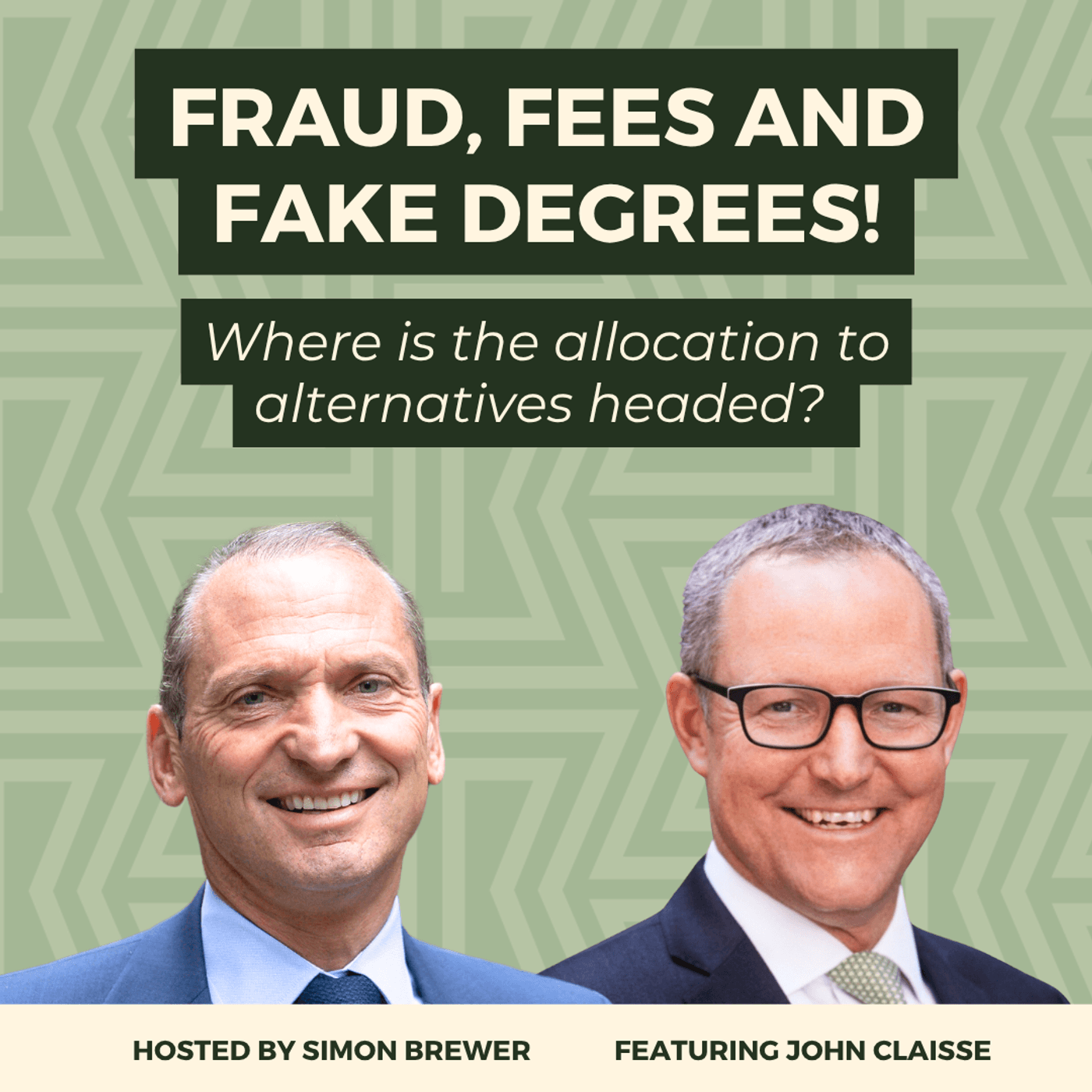
Albourne CEO John Claisse discusses where allocations to alternatives are headed, arguing “retailization” and wealth transfer are secular forces, and that due diligence must evolve to address fraud, fees, and fake credentials. He also covers private markets liquidity stress, hedge fund role changes, benchmark concentration risks (including tech names like SpaceX/OpenAI), and how AI is being adopted in operational due diligence.
Guest backgrounds
John Claisse is Albourne’s CEO, originally British and now based in California for 23 years. He studied mathematics at Sussex, pursued PhD work sponsored by Albourne, and joined Albourne after a rejected PhD path. Albourne is a non-discretionary alternatives advisory firm founded by Simon Ruddick and Guy Ingram, former hedge fund managers.
Key claims
Retailization/wealth transfer will keep expanding private alternatives participation; alpha is compressing as more capital enters; quantitative due diligence (QDD) and “value bridge” analysis are essential to separate leverage/beta tailwinds from true manager skill; Albourne’s model is fixed-fee and non-discretionary; AI adoption requires governance and human oversight.
Notable examples
A fraudulent fund with a non-existent “fund one”; fee errors recouped for clients by validating thousands of line items; fake diplomas generated from pulled-down online documents; Q1 VC benchmark lag estimated at 2–3% plus 3–5% uplift from SpaceX; private credit evergreen funds facing stress from 5% quarterly liquidity gates; hedge fund “portable alpha” and beta-one products; AI adoption surveys updated via a 14-question ODD questionnaire completed by 500+ funds.
Written by AI. May contain mistakes. Listen to the episode to check what was said.
Chapters
Tap a time to open that second in VORetailization of Investment
0:00 to 0:11
Exploration of the new retail investor phenomenon in the market.
“There's a force at work right now in terms of a new or newer kind of investor in town, meaning kind of retailization as a driver, which I definitely don't think is cyclical.”
Understanding Investment Diligence
0:11 to 0:26
Discussion on the importance of different types of diligence in investments.
The Emergence of Albourne
0:26 to 0:57
A look back at Albourne's beginnings and its significance in investment advice.
John Claisse's Early Career
1:38 to 2:52
John discusses his background and experiences leading to his role at Albourne.
“The thing that's confused me, and you have to help me, is that you told me you're British, you live in California, and you have an Australian accent.”
The Founders' Vision
2:52 to 4:47
Explaining the problem Albourne's founders aimed to solve in investment allocation.
“And you know how things come back to you.”
Albourne's Global Impact
4:47 to 7:02
Overview of Albourne's current operations and global footprint.
“Well, maybe to give a bit of context to the kind of provenance of Allborn.”
Albourne's Global Impact
7:06 to 7:28
Overview of Albourne's current operations and global footprint.
“They champion the role gold plays as a strategic asset through expert research, commentary, and insights.”
Evolution of Institutional Allocators
7:28 to 11:34
Discussion on how institutional investors' allocation strategies have evolved.
“Just give us a sense, having spanned a quarter of a century, how institutional allocators have evolved in their thinking.”
Challenges in Private Assets
11:34 to 14:00
Exploration of the challenges and changes in private equity and credit allocations.
“Can you distinguish between cyclical and secular forces?”
Analyzing Private Equity Allocations
14:00 to 16:52
Discussion on demand and allocation adjustments in private equity by major institutions.
“But when the Yales and others are reducing allocations, that's what I also want to get at, because there's disappointment in returns, would that be fair to say?”
Show all 32 chapters
Understanding Alpha and Manager Selection
16:52 to 17:15
Exploration of the importance of manager selection and the challenges of generating alpha in private markets.
“Yeah, so decomposing an IRR into the different component parts that kind of contribute.”
Understanding Alpha and Manager Selection
17:58 to 19:36
Exploration of the importance of manager selection and the challenges of generating alpha in private markets.
“LSEG is where ideas meet capital, enabling sustainable growth and opportunity.”
The Changing Landscape of Hedge Funds
21:08 to 23:09
Insights into the shifting role of hedge funds in institutional portfolios and alpha generation.
“And so they deliver essentially something that can sit in an equity portfolio and consistently deliver an excess return because of the quality of the alpha stream that their market-neutral strategy delivers.”
Investment Dilemmas and Market Concentration
23:09 to 26:04
Discussion on concentration risks in public and private markets and their implications for investors.
“That's not a bad thing necessarily because you're actually seeing dispersion across strategies.”
Due Diligence: Fraud, Fees, and Fake Degrees
26:04 to 28:00
Exploration of the importance of due diligence in investment decisions and the risks associated with bad actors.
“it's sitting there as a, now, what might be larger than expected position in a private portfolio.”
The Importance of Due Diligence in Investments
28:00 to 29:40
Learn why due diligence is crucial for investors and how it helps protect their capital.
“Well, I love talking about due diligence.”
Identifying Fraud and Fee Errors
29:40 to 31:20
Discover how to spot fraud and errors in fee agreements that can cost investors millions.
“So just in the last year, a fund came to market, pitching to institutional investors, where we are certain that fund one did not exist.”
The Challenge of Fake Degrees
31:20 to 32:00
Understand the prevalence of fake degrees and the importance of thorough background checks.
“every year, you know, at the manager level, fund level, you know, key people.”
Integrating AI into Due Diligence Processes
32:00 to 33:00
Explore how AI enhances due diligence through improved technology and efficiency.
“Well, yeah, so AI for us, we've been benefiting from technology for the last 30 years.”
Organizational Change Through Technology Adoption
33:00 to 34:40
Learn about the organizational changes required for successful technology integration.
“being able to kind of, you know, incorporate those into our business processes.”
Observations on AI Implementation in Fund Management
34:40 to 37:00
Gain insights into how fund managers and allocators are using AI in their operations.
“and the task force or the working groups that sit within each investment function.”
Navigating Challenges in AI and Due Diligence
37:00 to 42:00
Understand the challenges faced by allocators in adopting AI while ensuring due diligence.
“And as you scrutinize the external environment, what observations do you have about how fund managers and allocators are implementing AI?”
Data-Driven Insights in Allocations
42:00 to 43:12
Learn about the importance of data and expert insight in investment allocations.
“we've had a human in the loop from day one, right?”
Evaluating Client Relationships and Performance
43:12 to 44:14
Discover how the company measures its performance and client satisfaction.
“and we can have a whole separate interview about it.”
The Rise of Digital Assets
44:14 to 47:08
Understand the evolving interest in digital assets among institutional investors.
“And, you know, we live and die by process.”
Future Trends in Institutional Investments
47:08 to 48:56
Explore the future trends and potential shifts in institutional allocations.
“The challenge over this timeframe is that many of those have not been able to really reach critical mass.”
Opportunities in Asian Markets
48:56 to 50:54
Learn about the unique opportunities and challenges in Asian institutional investments.
“And I'd love to understand what you are seeing in terms of what Asian institutional investors are thinking.”
The Importance of Currency in Investments
50:54 to 52:40
Examine how currency fluctuations affect international investments.
“So India has certainly benefited from a pickup inflows over the last three plus years.”
Personal Insights and Advice for Young Investors
52:40 to 56:00
Gain personal insights and advice for aspiring finance professionals.
“And yet how you measure your performance in terms of your currency, you know, reference, you know, flatters or deceives.”
Investment Philosophy and Commitment
56:00 to 56:55
Learn about the speaker's unwavering commitment to alternatives and client service.
“which I think is going to be much more interesting than it sounds.”
The Importance of Non-Discretionary Capital
56:55 to 57:50
Discover why non-discretionary capital is crucial for trust and freedom in investment.
“What's the question that you typically aren't asked, business or non-business?”
Key Takeaways and Book Recommendations
57:50 to 58:59
Explore the main conclusions from the conversation and get book recommendations.
“As I said, Allborn has been sort of there on my map for as long as I can remember.”
Transcript
Automatic transcript. May contain errors.0:00John Claisse:There's a force at work right now in terms of a new or newer kind of investor in town, meaning kind of retailization as a driver, which I definitely don't think is cyclical. I think this is clearly this wealth transfer and the ability for many investors who've been excluded from the private asset classes for a significant time and the growth in those private asset classes, that ability for a broader range of investors to participate. you can see which managers were just using financial engineering and leverage and or there was a tailwind of beta because we take you know portfolio company data and then can create a value bridge for all of their you know these these managers that realized investments and understand exactly how they added value we talk about idd and odd quite often investment diligence and operational diligence but qdd quantitative diligence is essential and actually you can do so much more now in terms of evaluation of the underlying investments and assets.
0:57At some point in the 1990s, I attended an investment gathering where a firm that was only just emerging on the investment scene was setting up its stall in the provision of investment advice on the world of alternatives, at that stage a fairly new concept. Their name was Allborn, and one of their founders, Simon Ruddick, made a comment which has stayed with me to this day. He said, if you don't have a benchmark, be prepared to be shot by the arrow whose name is Hindsight. 30 years on, that business, Allborn, is one of the most important providers of specialized investment advice globally on alternative assets.
1:33Over today, welcome to CEO John Clace over from California. John, welcome.
1:37John Claisse:Fantastic to be here. Thank you, Simon. The thing that's confused me, and you have to help me, is that you told me you're British, you live in California, and you have an Australian accent. So how do I square that circle? Well, I'm originally British, but I am American now. I've been in the Bay Area for 23 years, and so American kids. And so I'll probably be there for a foreseeable future. But it's great to be back. Great. Well, as I looked at your career, you are a mathematician, and you are not just an ordinary mathematician because you appear to have gone back and, I believe, taken a PhD on your journey.
2:13It also appeared to me, and correct me if I'm wrong, that you've only had one job, which is all born now.
2:17John Claisse:Well, I had some jobs before I started with all born, but they were kind of in factories or removals. Actually, I haven't asked this question for a long time, but how did you earn your first pound or dollar? Oh, well, first pound or dollar, was it? I feel probably in the body shop factory, filling the boxes with the plastic containers so that during the day I could train because I used to be sort of semi-professional windsurfer. And so, yeah, that's how I earned money at one point in time. Wow, we're discovering more about you than I was able to discern. And you know how things come back to you.
2:53John Claisse:I earned money from my parents because my brother and I used to clean our house, and we'd alternate upstairs and downstairs. So that was probably the first dollars was actually as the cleaners because my mom was working. And so, yeah, that was the first dollar. I remember coming to Sussex to meet Anita and Gordon Roddick, who of course founded the body shop way back when. So, but Auburn essentially has been your home. So just explain to me, you study maths, what drew you to Auburn? Yes, well, so UK degrees are three-year degrees. End of my second year, one of our professors who sort of straddled economics and math, and I was sort of, I did math with a minor in math, which is controversial at Sussex.
3:38John Claisse:They wanted an interdisciplinary, but she sort of singled out myself and a couple of other students and said, you would be interested in a career in finance. And I didn't know much about finance. And I said, but I'm interested in a career. And they said, well, maybe you could do an internship with an organization, you know, and had a few options. And I was introduced to Simon Roddick. So Professor Carol Alexander, who's still now at Sussex, made that connection. And we met Simon and I interned in 1995. And then a year later, I was actually going to do a PhD sponsored by Allborn, but the Research Council deemed it to be too commercial.
4:17John Claisse:It was going to be focused on the kind of the concept of traded volatility futures. And so unfortunately, it got rejected by the Research Council. And I said, well, in that case, I'm looking for a job. And I joined Allborn and worked for 18 months before then going back to do a different PhD. So let's talk about Allborn. What was the problem the founders were seeking to address in allocation and evaluation? Well, maybe to give a bit of context to the kind of provenance of Allborn. So Simon Ruddock, who you referenced earlier, and Guy Ingram were actually hedge fund managers before starting Allborn.
4:58John Claisse:They ran Westminster Equity here in London, which was a Japanese warrant arbitrage firm and actually a satellite of Paloma, which is still an organization in existence in Connecticut, run by Donald Sussman and Mark Jurisch. And they actually ran it at the same time. They started about the same time as David Shaw, started D-Shaw. But they were trading in Japan, and it wasn't the best environment for trading their strategy, so they actually returned the capital. But they had this network, knowing all these investors who invested in hedge funds and so many who really respected Simon's insights and guys from his background, Simon's background, in the derivatives market in Japan with Japanese banks and then at his fund.
5:41John Claisse:And so, recognized that there was a group of investors who would benefit from their expertise, understanding the risk in hedge funds. And so, I was really looking at the province of not necessarily that we understood that there was a consulting market out there. Got it. And today, just give us a quick recap of the footprint. Yes. So, look, you know, 32 years on, we advise over 400 investors globally, with our website says 750 billion in alternatives, but it's substantially higher than that, because we don't include the sovereign wealth funds and other groups that we advise. But you have 650 employees, 10 offices around the world, footprint on the ground in Asia, Middle East, and obviously North America, where I'm based.
6:28ifm investors is a global asset manager founded and owned by pension funds with capabilities in infrastructure equity and debt private equity private credit and listed equities they believe healthy returns depend on healthy economic environmental and social systems and these are evolving on a scale never experienced before to find opportunity build value and meet the needs of future generations, you need scale, skill, and expertise. That's what IFM Investors has built up over 30 years. I'm thrilled to share that the Money Maze podcast is sponsored by the World Gold Council. They champion the role gold plays as a strategic asset through expert research, commentary, and insights.
7:13And it's not just your portfolio that may benefit from gold. Learn how gold mining is supporting female economic empowerment and small businesses via their new documentary series called Gold, The Journey Continues. Tap the link in the show notes to start watching. Just give us a sense, having spanned a quarter of a century, how institutional allocators have evolved in their thinking.
7:38John Claisse:Well, so there are numerous ways that we see kind of like the evolution. What I would say is hard to generalize. And I say that in the sense that we talk about kind of institutions as a group, but the reality is when we think about the other allocations to alternatives, there's a kind of a, we think from a top-down perspective first, sort of alpha and beta cost and liquidity, thinking about how they access active management. And obviously, there's a whole range of ways that alternative investments can complement an asset allocation. So we provide some asset allocation advice to investors how to use alternatives in their overall asset allocation.
8:17John Claisse:And you really can't generalize because on a regional basis, there are those different considerations. So when it comes to the cost of alpha, if you're a pension plan in Australia, it's very different from the US in terms of the scrutiny around how much you pay external managers. And then we look between pension plans and sovereign wealth funds or insurance companies with very different kind of outlets. So from a top down perspective, that's a consideration. From a bottom-up perspective, we're really kind of working with these investors, how they're kind of screening the landscape, how they invest with those managers, and then on an ongoing basis, the monitoring of those investments.
8:55John Claisse:And over time, obviously, there's been significant evolution. There's a lot of investors who have been investing in alternatives for 30-plus years, very mature in their allocations. But even now, we're working with investors that are putting their first dollars to work. I was chatting with a healthcare group yesterday. The team moved from one healthcare organization to another in the last couple of years and started with a fixed income portfolio and have rolled out a new portfolio. And there, we're helping them to build up that exposure. And so they're very different tools from what you're seeing with mature portfolios and how they're allocating to different managers.
9:36So I get it's a complicated jigsaw, but is there a particular recurring theme when people call you about what it is that they want help with?
9:45John Claisse:So we advise across the landscape of all alternatives. So not just hedge funds, we started in that space. That's the provenance of Simon and Guy and Sam Lewis, who actually joined before me, he was their prime broker. but about 20 years ago, we had clients who asked us to allocate, to advise them on private markets because they saw other consultants starting to run product. And we have never, so for 32 years, our business model hasn't changed. So part of the reason I think investors come to us is to be a trusted partner. So for 32 years, our business model has always been non-discretionary, unlike almost all other consultants.
10:25John Claisse:And we charge a fixed fee independent of assets. So being able to kind of be that extension of an investor's team to help them with the top-down advice, the research on underlying managers, but also supporting with the data that they need to make informed decisions. So any investors coming to us will have certain pain points. And really, we are a solution provider, blending together advice, research, data, and implementation. And so really it's every client who comes to us, we work with them the way they want to be engaged. Well, I was on the other side of Longstani because we were figuring out how we might expand our private markets back.
11:04And we engaged with you to have that conversation. Let's talk about the investment. I've written dilemmas, but maybe it's just challenges. and there are a number of them, and sitting there right in the center stage are private assets, and particularly we've got private equity and private credit. We all know the allocations, we know with the Swenson kind of route, we know now the backtracking that appears to be going on. Can you distinguish between cyclical and secular forces?
11:41John Claisse:Well, look, I mean, there's definitely a kind of, you know, there's a force at work right now in terms of a new or newer kind of investor in town, meaning kind of retailization as a driver, which I definitely don't think is cyclical. I think this is clearly this wealth transfer and the ability for many investors who've been excluded from the private asset classes for a significant time. And the growth in those private asset classes, that ability for a broader range of investors to participate, that is an important force that we see. And that's going to probably have one of the biggest impacts as we go forward.
12:19John Claisse:And then similarly, like AI as a driver, you know, in terms of changing the dynamics. But on that kind of that retailization perspective, that's impacting. You referenced private credit. You know, obviously that's an area that's grown very rapidly. And we certainly see that many of these evergreen semi-liquid funds lend themselves to private credit assets because they're self-liquidating and they can align with some of the liquidity profiles. But this has been tested recently with some of those 5 % quarterly liquidity provisions that are present. and that creates some stress in the industry. What's interesting in the private credit space is investors thinking about how they kind of allocate on the institutional side.
13:02John Claisse:There's definitely a trend there in response, looking at larger managers and allocating to SMAs and broader kind of allocations with larger allocations where they are almost like a proxy for an evergreen fund, but institutional in vehicles. On the private equity side, the similar progress, And you can see it, you know, it's coming, this wall of kind of capital, which will clearly impact alpha over time, and particularly in some of the larger cap names that, you know, where a lot of institutional investors have been allocating. There, we're seeing a move, speaking with a Texan investor yesterday, and they're, you know, confirmed over the next year, their continued expectation to go down market, I don't think it's the greatest term, but more middle market and smaller funds.
13:44John Claisse:So more managers, allocating to more managers, but smaller names. And actually the introduction of kind of retail investors will end up providing more liquidity as you think about the progress of kind of private companies that move up the scale and into larger cap names and then out in that context. So I see where that's new demand. But when the Yales and others are reducing allocations, that's what I also want to get at, because there's disappointment in returns, would that be fair to say? And there has been a large allocations which are being reviewed. Yeah, there's definitely managing liquidity.
14:24John Claisse:Going back to my point about kind of alpha, beta cost liquidity, recognizing that you want to be on the front foot. And so there's been secondary transactions, but there's significant demand for those secondary transactions. So right-sizing private equity portfolios through the secondary market. Some of the universities clearly have been in the media in that regard, but that's fed into a really robust demand for secondaries. And so it's actually been kind of, you know, worked quite effectively over the last couple of years. And do you think the thesis, which always intrigues me because we have much less data and time about private markets than we do in public markets, that private equity can offer superior returns to the beater of the equity market?
15:06Do you think that that is being challenged?
15:11John Claisse:Well, look, clearly it's important. Manager selection is critically important. So, you know, being in the top quarter funds and allocating there. So it's I've said the same thing on hedge funds for the last 30 years, which is it, you know, you it's really important that, you know, manager selection is essential. And so when you look across the industry, there are absolutely managers that have have underperformed. And as you look, as we go forward, there will be pressure. And there's compression on alpha in the same way as more money came into hedge funds. There was compression on alpha over the last 20 years.
15:42John Claisse:And so I think it's inevitable that's the same in private markets. But there are so many levers that private market managers can pull to generate excess return. But what's also key is you have access to so much data now. So you really, going back to your point, absolutely you can see which managers were just using financial engineering and leverage. and or there was a tailwind of beta because we take portfolio company data and then can create a value bridge for all of these managers' realized investments and understand exactly how they added value. And so that's a key part of our due diligence process.
16:20John Claisse:We talk about IDD and ODD quite often, investment due diligence and operational due diligence, but QDD, quantitative due diligence, is essential. And actually you can do so much more now in terms of evaluation of the underlying investments and assets in private markets. As I say, in hedge funds, there's always been talk about the challenges with alpha. Institutional investors have done very well from their hedge fund portfolios over a long period of time, but the roles have changed as you look more recently. You use one term I'm not familiar with, value bridge. Just explain that. Yeah, so decomposing an IRR into the different component parts that kind of contribute.
16:57John Claisse:So it's not just about, you know, leverage, but also EBITDA expansion. So there's a number of ways, but also the beta of a particular kind of sector. So you can decompose the value that a manager has brought. Does your investment portfolio need an active boost? The Money Mears podcast is sponsored by J.P. Morgan Asset Management, Europe's leading active ETF provider by assets under management. JPMorgan's ETFs are powered by a century-long commitment to active investing and a truly global investment platform. They're designed to be active, not reactive, so investors can target enhanced returns and achieve better long-term outcomes.
17:38Discover why JPMorgan Asset Management is the home of active ETFs. Search JPMorgan Active ETF or tap on the link in the notes to this episode to find out more. When you invest, your capital is at risk. I'm excited to announce that the Money Maze podcast is sponsored by the London Stock Exchange Group, known as LSEG. At the heart of the global economy, LSEG provides data, analytics and infrastructure that connects investors, businesses and economies. LSEG is where ideas meet capital, enabling sustainable growth and opportunity. Tap the link in the show notes to learn more. So you mentioned hedge funds and that's next on my list because we've seen, we saw the, you know, they were the first out of the gates.
18:20in terms of what constituted your alternatives, people were then put in real estate and everything else followed. Tell me a little bit about what that landscape looks like because hedge funds stopped appearing in allocations. I was in an asset allocation meeting not so long ago where a very senior person at Goldman said, oh, you don't need hedge funds. And I'm thinking, really? You know, you fall in love with the S &P 500, you know, be prepared for some other arrow
18:42John Claisse:to shoot you down the road. Tell us what you're seeing and how you're approaching the world of hedge funds. Yeah, well, look, I think I'm surprised. Yeah, there's definitely kind of a view of, you know, Fokke, Goldman, who probably, you know, still feel quite bullish on the hedge fund space. There's a, you know, I think broadly across what we see across the world is like there's great alpha opportunities. And you look at kind of the hedge fund allocations, they've been increasing across institutional investors over the last several years. But the role has also been changing. And I say that if you come out of the financial crisis, at that point in time, there's been heavy emphasis on fixed income replacement type strategies.
19:20John Claisse:So sitting in the diversifier side of an institutional portfolio. But more recently, with rates rising, the last five years, increased dispersion, alpha has improved. And so when you look at that in the context then of maybe some of the challenges of generating alpha in directional equity markets because of the concentration of performance in a small number of stocks, actually being able to take what hedge funds is a business model, not an asset class. Just to restate that, we've been saying it for 30 years. And so it's different tools for generating alpha. And so there's a concept of portable alpha that was in vogue 20 plus years ago.
20:04John Claisse:And actually, the Canadians never stopped doing that in the pension plans, using hedge funds as an overlay. They just were very cautious about what betas were present in those portfolios. Others got called out during the financial crisis. But portable alpha is certainly back in vogue as a way of bringing the hedge fund alpha sources and then porting those on top of risk-seeking assets. Not all investors can do that because it's essentially taking on some leverage at the portfolio level when you overlay on top of synthetic equity exposure or fixed income exposure. And so there's also a trend of managers offering beta one products.
20:49John Claisse:This is not new, but kind of active extension, 150-50 type products, but also quite popular in the last few years are some of the beta 1 portal alpha at the fund level. So the manager might run a market neutral strategy and then offer that with the beta 1 version, which is linked to often a cap-weighted index. And so they deliver essentially something that can sit in an equity portfolio and consistently deliver an excess return because of the quality of the alpha stream that their market-neutral strategy delivers. Okay, but the hedge fund topography has changed, has it? Tell me a little bit about whereas you could set up a hedge fund with$250 million and get going and cover your fees and regulatory costs, etc.
21:34John Claisse:That no longer exists. So what are you seeing? Great concentration? Well, there's definitely, there's always been some level of concentration. I mean, for the last three or four years, there's been so much talk about the platform funds and how much money they manage. So platforms being multi-PM, portfolio manager models, in the multi-strat space. That continues. There's a limit on how much they can manage because there's a limit of counterparty risk that the street can bear from some of those managers. So we may have kind of reached sort of peak assets in some of those names. So there's continued to be growth away from those managers, but it's always been the case that there's, it may be, going back to my point, There are thousands of hedge funds, but the reality is the majority probably shouldn't exist.
22:22John Claisse:There's an element of the quality names that are generating consistent alpha, which have got the kind of critical mass to deliver their strategies. And you see that in institutional portfolios, which are consistently performed, allocating to high-quality firms. But the concentration is there. We do a lot of work on some of those platform funds, which has obviously been very topical. Actually, my colleague Ronan was on the Odd Lots podcast last year. And I think if anyone's going to be interested in more about our thoughts there, just thinking about the multi-strat space, which I think is an important kind of ecosystem.
23:00John Claisse:And we actually put out a paper, several papers recently, but one on center books within those firms. Because we've seen across the hedge fund space quite a bit of dispersion and a little bit more volatility. That's not a bad thing necessarily because you're actually seeing dispersion across strategies. So in a portfolio, one of the biggest challenges for hedge fund portfolios for the decade after 2008 was it was actually not taking enough risk. Yes. So you had portfolios that were coming in with very low vol. And actually that was a source of frustration to a lot of investors that their hedge fund portfolios perhaps could have taken more risk.
23:36John Claisse:Now they delivered what they said on the tin, but part of that was they could have done more. Now, let's move to the third of those investment dilemmas, which is the S &P highly concentrated, you know, with all of the attendant risks. And we know what passive has amplified that. Although you are operating in the alternative assets, you are conducting conversations, I imagine, with people who are thinking about that. How do you weigh up the state of play that investors are faced with, concentration and more risk than perhaps anybody imagined when benchmarks started to evolve? Well, look, I think what's interesting there goes back to why is it so compelling to pour alpha on top of a cap-weighted index?
Read the full transcript
24:24John Claisse:Because deviating from the cap-weighted benchmark can be very painful. But if you can bring a pure alpha source and couple those, That's actually been an area we've spent a lot of time on. It's very topical. Recently, some of the concentration coming from new entrants to many of these indices. I mean, it's generated a lot of return in the last month for index rebalancing strategies. But with SpaceX entering so many indices, but also for a lot of investors, some of these concentrations are a big concern, right? So, you know, concentrations in their private books that might be moving into their kind of public books.
24:59John Claisse:And, you know, we spent a lot of time talking to allocators about how they might hedge their SpaceX exposure, but also now thinking ahead with OpenAI and Anthropic and other exposures. And then on a look through basis, because you have that understanding of what's in their VC portfolios and how that's progressing. That's that's actually kind of for us very topical. Also very topical at the moment, because you reference benchmarks a few times. you know the VC benchmarks you know the first half of the year if you didn't have the exposure there's going to be a significant lag because Q1 probably kind of 2-3 % based on our estimates I know some other you know kind of stated numbers maybe even higher but based on our kind of primers indices so we have private market indices from the thousands of funds data that we have but on the VC side yes Q1 probably kind of 2-3 % and then 3-5 % of uplift from SpaceX alone in those indices in the first half of the year.
25:57John Claisse:So there's, you know, that's a concentration that impacts the private side, but also the public side. So just let's pause on that, because when we had our conversation last week, I was intrigued, you know, that SpaceX example, it's sitting there as a, now, what might be larger than expected position in a private portfolio. You're having that dialogue with the owner of that. How does that conversation evolve in terms of they've come to you for advice? Well, look, I mean, there's an element. We are not explicitly advising on the actual kind of like the hedging itself, but certainly the options of what people can do.
26:32John Claisse:Most important thing is understanding what you own and actually helping, you know, kind of investment teams, investment committees and stakeholders recognize that there's actually a big, if anything at the moment, I think there's quite a few governance concerns in the end because, you know, the FOMO of like, well, we didn't have exposure, we should be buying in versus we have these exposures. and how should we be handling them going forward? So just a reminder, we don't manage any money. We're not managing any for any clients, but also as a trusted partner, when we sit, we can be that sounding board to be able to kind of help them think through these situations.
27:07John Claisse:So that is an active dialogue right now with clients about the different options that they can employ. But clearly it's very expensive to hedge given the level of vol that you have. But there are a lot of entities out there that are kind of working with investors, helping them think through how to offlay some of that risk. Right. Well, we haven't, over six years of having these podcasts, talked much about due diligence, and most people would sort of go, well, okay, we can skip this part. But I've actually, I wrote down the three Fs. Okay. Fraud, fees, and fake degrees. I'd love to unpick some of those because there are bad actors always, skulking around every industry, particularly the financial services industry.
27:50And it's not that you are, you know, policing all of this, but just tell us a little bit about how you built the due diligence levers that you employ day in, day out.
28:00John Claisse:Great. Well, I love talking about due diligence. You know, at the end of the day, we, you know, we support, let's say, hundreds of investors to make informed investment decisions so they feel confident as they put money to work. You know, we do investment due diligence on thousands of funds every year. You know, our clients can access a platform with over 5000 investment due diligence reports across hedge funds, actually liquid alts as well, where we cover and private and private markets, but also the operational due diligence. So ODD. And it's interesting, you get compensated for investment risk, you're not compensated for the operational risk.
28:33John Claisse:And so we built the largest team in the industry in terms of doing operational diligence. And that team in 2025 did about 800 full ODD reviews on profit clients. It's a great proxy for the number of funds that our clients are allocating to putting fresh money to work on a given year. And that's that doesn't include I should say, open ended funds like hedge funds where we're doing ongoing monitoring, as it was another 500. So it's a huge kind of like breadth there. But that ODD, we're really evaluating the operational robustness of these firms, how safe is your capital in terms of the control environments that are present, the valuation controls, the, you know, kind of, it comes to data security, but there's so many things that are happening in, you know, from the point at which you decide to trade, you know, when you to, for those managers to be great stewards of capital.
29:28John Claisse:And so doing manager level ODD and fund level ODD and validating for our clients the quality relative to best practices. So we've been doing that for a long time. And look, fraud does happen, right? So just in the last year, a fund came to market, pitching to institutional investors, where we are certain that fund one did not exist. So you find an offering, a certificate of incorporation, that was certainly fraudulent. And then, look, very credible managers who just make mistakes. So, you know, on the fee side, we have a kind of a large business for many of the large institutional investors around the world where we help them understand exactly what they agreed to pay, what they did pay, and then whether there were any errors.
30:16John Claisse:And we've saved our clients tens of millions of dollars now in errors that we've helped them to recoup because we're validating thousands of line items of fund investments where there are errors. And often it's actually with the most sophisticated investors who have negotiated bespoke agreements. And when you unpick what's actually been kind of put in place, you know, the business can dream up, you know, bespoke terms. The kind of lawyers write it up and then someone screws it up down the line. And then so we go through and, you know, helping to validate. And so it's a way of kind of keeping the industry, you know, honest, but also, you know, protecting our clients' capital.
30:57John Claisse:And I think the other kind of was around fake degrees. I mean, I'm thinking, how is it possible in a world where almost everything is accessible? Well, because, you know, there's a lot of people who were hired quite some time ago. And, you know, best practice that you still do, ongoing kind of background checks of existing employees and refresh. But yeah, look, we, you know, we do background checks on thousands of individuals every year, you know, at the manager level, fund level, you know, key people. And yeah, that we've, you know, it's not uncommon to kind of find, I say uncommon meaning like, it's still, it's rare, but it does happen where people are loose with the truth, right?
31:39John Claisse:You know, in terms of, and then when you get to the point where someone gets called out, we've been sent documents where you can, we've could absolutely prove that this was pulled down from a, from a website where you can generate a fake diploma. So, yeah. Wow. Okay, so which nicely leads us on to technology, AI, and data. I guess at the highest first level, how are you finding AI's assisting you? Well, yeah, so AI for us, we've been benefiting from technology for the last 30 years. We've built all of our own integrated technology that supports our clients and our colleagues to do their work in a private cloud environment where we have our knowledge management system that feeds into a web-based and an app-based platform.
32:30John Claisse:So at the end of the day, AI is just the next iteration of this journey. We've had a machine learning team for now. It's close to the end of its 10th year, so almost a full decade, sponsoring PhDs that have been working in our office in Cyprus. It's our largest office. We have over 300 people there. And as part of our 80-strong development team, they've contributed massively to our workflow enhancements from a machine learning perspective. And then over the last several years with LLMs and generative AI, being able to kind of, you know, incorporate those into our business processes. I really like, so when I talk about how we adopt, you know, kind of AI into our business, I really like Ethan Mollick's model.
33:16John Claisse:He put out in a substack about a year ago, this sort of Venn diagram. So Ethan Mollick's a professor at Wharton. And yeah, it's sort of a three set Venn diagram with organizational leadership, labs and crowds. And I feel like you can also incorporate a fourth Venn diagram, which is your internal current IT. But the key point is that there's organizational, the tone from the top in terms of a vision of where we're going, that it's actually going to liberate folk from routine tasks so we can do more higher value-add work. But you empower your crowd, the average employee, the majority of employees with technology that helps them to do their jobs better.
33:56John Claisse:But you need an innovation hub, so a lab, which really thinks outside the box about how you can use these newer technologies to revolutionize what you can currently do, but also what you might be able to do as a business going forward. So our lab 1.0 was the machine learning team. Lab 2.0, about three years ago, we formed an AI task force, which was cross-functional. People had to apply to join it. There were already people in their spare time were doing a ton of experimentation. They joined that team. that was very successful for a couple of years of just driving innovation, onboarding different tools that we could all use.
34:34John Claisse:And now we have an AI support team that sits in between the machine learning team, that's Lab 3.0, and the task force or the working groups that sit within each investment function. So that AI support team is tasked with identifying any roadblocks and making sure that we work really closely, going back to the Venn diagram, not only with the business, but also with our CSO, with our CTO, to make sure that we, in a very prudent way, move forward so we can adopt best practices but also get access to new tools and new innovations. And also identify local maxima. One of the biggest challenges is that people, kind of maybe one function, discover a way to unlock, because the technology is changing so fast, and make sure that those local maxima propagate across functions, different investment functions, and if appropriate, get pulled back into the machine learning team to be rolled out in our private cloud implementation.
35:29John Claisse:And we actually have a fourth lab now, which is all the folk who at the weekends are running their open claw on different kind of Apple minis and then their gaming laptops, bringing those folk in so that we actually subsidize some of their innovation that they can do in a sandboxed environment in addition to the work we've been doing. So tell me how that's changing who you hire, where you hire them from and what you want to see. Well, it's early on that stage. We hire a lot of people into our technology team who have the background. The reality is this is a behavior change for everyone in the firm.
36:12John Claisse:At this stage, from a talent management perspective, this is really taking everyone on the firm on a journey rather than necessarily kind of at this stage hiring a different type of person. It's really a case of understanding where are different people. I'm a big believer in the kind of the, if you think about the kind of innovation curve, we've got a number of folks who are definitely kind of early adopters and innovators, but kind of who are the early majority and bringing people from late majority into early majority internally through training. Because we all need to be on that journey of using, being able to kind of create agents and apps and use them and use ones that are deployed across the firm.
36:54John Claisse:And that's really, so at the moment, That's actually kind of the primary point within talent management is actually kind of bringing people on that kind of that comfort level of feeling really empowered by this new technology rather than frightened of it. And as you scrutinize the external environment, what observations do you have about how fund managers and allocators are implementing AI? Well, look, we have very kind of strong opinions, but also great data in that space. and so on the on the allocator side we're benefiting from all the work we've done on you know fund managers and so for fund managers for the last 25 plus years we've done due diligence on their kind of IT stack and you know we actually had a report back in the day we used to have 12 different core reports that all went into our due diligence we combined them all into one ODD main report realized it was probably easier to kind of understand if you you know It does what it says on the tin.
37:52John Claisse:But within that, we've been doing due diligence on IT for 25 plus years. But over the last three years, we've actually done an additional survey of managers of their AI adoption. So as the generative AI kind of wave was sweeping through, we did that in Q3 of 23, 24, and 25. And so kind of had results at the end of last year for three years in a row. and actually that survey had about almost nine trillion in alternative assets across 300 managers and so clearly like the adoption you know it's been very significant and so there's a lot of kind of observations we could make there but what we've realized is it was kind of directionally accurate in the sense that it's primarily in investment research it's impacting coding all the things you might have expected but for individual managers it's hard to really kind to scrutinize where they are because it's often when you do a survey, it's being done by the IR teams rather than they're kind of as part of a kind of, you know, it's not the CSO or CTO necessarily that's completing that survey.
38:55John Claisse:Now, since around Thanksgiving, we did an update to our operational due diligence questionnaire, or ODDQ, there's 14 detailed questions. And now we're asking that alongside potentially a client allocating 100 million or hundreds of millions of dollars to a manager. So we're getting very robust responses. And in the first six months, over 500 managers, or sorry, in the first six months, over 500 funds have completed that questionnaire. And so we're getting really robust data now in terms of, you know, exactly the governance they have in place, the due diligence they're doing or third party vendors, which vendors they're using, and how it's impacting different functions within those firms.
39:36John Claisse:And so we're really excited. Actually, the week before your summit in the fall, we have our global client event, be able to provide a lot more insights on that data. And what's interesting is because the world is moving so fast, you know, month to month, like you just see kind of these changes. And we do so much due diligence every month. I mean, in January of this year, it was just shy of 100 due diligence commissions, like full ODD new reviews. So each of those has this data. And we were able to do like longitudinally how is that changing over time? And it's rapid and widespread. You also asked about allocators.
40:17John Claisse:So coming back around, it's informing how we support allocators because they can also answer those questions. Yes, yes, yes. And they are, in most cases, almost a little bit like you might expect. Well, we don't think we're as far ahead as the funds. But actually, just knowing on those 14 different dimensions where they sit relative to peers and also being able to provide feedback on a confidential basis to those clients to say, well, look, this is where you currently sit relative to peers, and these are the areas where it could have the biggest impact and how you might approach making changes in those areas.
40:51John Claisse:We've just been rolling that out. We did a summit in New York in April. We had about 60 investors who completed the survey then, and we've done it continuing now. Every call I have with clients, they do the survey, then we can bribe them back this sort of, you know, preliminary score of where they sit. And that's really helping to unblock. Lots of different investors are contaminated by where they sit within an organization. Like a Health Air group that I spoke to recently, you know, I heard this many times, like HIPAA in the US, some of the data protection issues contaminates how they can use their technology.
41:27John Claisse:You know, and it's true for some government entities. They're not in the regular Azure. They're in the government version of Azure. That delays the rollout of certain tools within Microsoft Suite and Copilot. And so if we can support them in how to navigate to optimize for what they do have available, we think we can add value there. Because otherwise you would think that your own practice is at risk from disintermediation because armed with these tools, others can carry out DD. Well, this is, at the end of the day, we've had a human in the loop from day one, right? And at the end of the day, we're always gathering data, processing data, and being that extension of staff.
42:07John Claisse:So absolutely, you can view AI as an opportunity or a threat. And so we have, for the last decade, realized you have to be on the front foot. We are a data business and an insight business, and we have to have the best data, and then we have to be able to develop insights that support our clients. We think it's critical to have an expert in every loop, an expert in the lead, to be able to make sure that if you are an allocator who works with any kind of third party that brings additional kind of perspective, the models need to be scrutinized. It's not magic. There's an element here of, and it's forward-looking.
42:49John Claisse:Investing, the past gives you a lot of data, but on a forward-looking basis, being able to kind of analyze that. And so to be that extension of staff, we still feel very confident, you know, in terms of the place where we sit because we don't manage money. We're a trusted partner with LPs and with GPs, but have that insight. We're just going to be made more efficient to be able to do more to empower LPs going forward. And we started with a conversation about benchmarks, and we can have a whole separate interview about it. But as you are evaluated by your clients, how would they typically judge you?
43:23John Claisse:Well, yeah, I mean, it's a great question. We don't have a track record, right, because we don't have a product. So we live and die every month by the value that we're on fixed retainers with our clients. And so from that perspective, you know, we are publishing research on a timely basis that's accurate. That's, you know, the breadth of our coverage across the industry. they can see day in, day out whether we're delivering. And we measure internally the quality of our analysis, our ratings. We're regular with the SEC, so we have to be cautious about what we say publicly or other than on a reverse inquiry.
44:01John Claisse:But we are proud of our track record internally that we can measure. And that's been, as we go forward, And I mentioned before, there's a lot of other kind of areas where, like Simon used to say, kind of, you know, we're not afraid to grab the nettles, do things that, you know, the tricky work that needs someone to kind of, you know, to dig in. And, you know, we live and die by process. I talked about nettles, right? So like grasping sort of the nettles. You know, we do hard things. and there are these areas where you know investors if you want to retain talent in an off-the-run capital city in the United States to do back office work or other kind of legal document diligence that can be challenging right so being able to kind of outsource that to us a bit like the fees due diligence that we do this is painstaking work and you need to be an expert in these fee structures to catch these errors and so these are areas where you know a track record ultimately speaks for itself in the sense that we've delivered for clients more value than we've charged.
45:04John Claisse:Got it. So let's look forward in the world of investing. One of the things that surprised me when we had our conversation was you said you're getting a lot of interest around digital assets from clients. Just explain what and why you think you're seeing this. Yeah, so So it's not a lot of dollars being put to work, just to be clear. But it's interesting with digital assets, if you go back to kind of sort of that 2018, 2019 timeframe, almost every client had a digital asset working group internally. And at the end of 2022, almost every client shut down their digital asset working group because of FTX.
45:48John Claisse:And so we had this sort of like, you know, abrupt halt to the progress there. But at that point in time, most investors were really just on an educational journey. Fast forward, you know, we have the Trump administration that's now kind of 18 months into this term. And that's been a strong tailwind for beta, you know, around, you know, not necessarily in the very recent past, but for flows into, you know, Bitcoin ETFs and the like, but it actually hasn't really supported material increase in liquidity in the space and institutional allocations. But we're starting to really kind of see a lot more interest in the space, sovereign wealth funds, making allocations.
46:36John Claisse:They can't get the capacity they might need to move the needle, but it's, I would say, education, putting money to work to really kind of support the ecosystem and endowments foundations. Again, I wouldn't say that kind of all endowments foundations or family offices are necessarily putting a lot of money to work, but it's an area that we're starting to see a lot more interest. And I think it's because there's a recognition that this is an area that will continue to grow. And we've met with hundreds of managers, done due diligence on dozens. The challenge over this timeframe is that many of those have not been able to really reach critical mass.
47:15John Claisse:And so a lot of funds have not necessarily outright failed, but they have returned capital and been absorbed into some of the platforms, which, you know, while it's been a bit more challenging kind of capital raising environment. But at this stage, we're definitely seeing, as I say, interest from some sovereigns, endowments, foundations, family offices that are renewed interest. They're kind of their digital asset working groups. They're kind of definitely live and well and really working with us. We've done a lot of work over the years in this space. And I think, you know, provided a lot of thought leadership working with industry bodies like, you know, Amer and others.
47:56John Claisse:helping them to write the papers that are out there now, thinking about where the industry is going as it relates to digital assets. Okay, well, maybe I need to read one of those papers. Yeah, yeah, yeah. I recommend the most recent AIMA. Okay. Staying with where is the investment part going, over the next three to five years, where might we see bigger changes in the investing world? I think the retailization is a theme that is not about to kind of go away. I think the wealth transfer, particularly in the US, you hear it talked about all the time, and the ability for folk to allocate. Putting retail up to one side, would you say that in the next five years, the institutional allocations to alternatives will be up or down?
48:47John Claisse:I think in aggregate, they will likely continue to increase. Right. We talk so much sitting here in the West about our markets and obviously the dominance of the US impacts that conversation. And there's this huge Asian GDP. And I'd love to understand what you are seeing in terms of what Asian institutional investors are thinking. and of course the flip side of that is having had these big underweights to Asia Western investors thoughts on Asia. We have a large on the ground presence as a team in Asia you know we've just celebrated and now in Singapore Hong Kong and Tokyo 20 year anniversaries for each of those offices and we do work with a lot of institutional investors and family offices in the region and they recognize the significant opportunities in terms of alpha generation from strategies present there, the dispersion and opportunities in many different markets.
49:46John Claisse:Looking from the US, there's definitely been kind of a pullback for several years now on allocation to Asia and a sort of a China contamination. So when they kind of think about the kind of the broader kind of allocation to Asia pulling back. And that said, in the last six to nine months, our team on the ground there have seen a lot more visits from U.S. institutions, particularly the endowments and foundations, who have large allocations to Asia and so present at meetings. but having said that just take Texas as an example they have legislation that really kind of explicitly kind of means they have to carve out any China exposure from their indices and therefore their underlying managers and so it's a challenge for some groups they can't actually visit Hong Kong or mainland China so from that perspective we advise a lot of investors also in the Middle East and they have never wavered in their support for pan-Asia exposure.
50:49John Claisse:But we cover the full investment landscape in Asia and South Asia and India. So India has certainly benefited from a pickup inflows over the last three plus years. Well, China, there was bipartisan concerns about China's position globally in spite of its such significant GDP. And in that investment silo of money going to Asia, which of the possible sub-asset classes, real estate, alternatives, private debt, private equity, do you think is likely to benefit most from flows? I mean, in terms of the, there's been a lot in liquid markets already, you know, it's, you know, Japan activism and other kind of areas there now, you know, Korean activism is an emerging area that we think is interesting.
51:46John Claisse:On the private side, locally, there's a lot of real estate interest across investors in the region. And more broadly, there's a vibrant private equity space there that has generated consistently some great returns. Currency can be an issue for US investors when you look at their experience over time. So that's actually been kind of probably one of the areas of concern for international investors is some of the currency impact. Do you find you are asked often to opine on currency? I ask that question because, you know, people love to talk about the dollar being the reserve currency. Well, it isn't.
52:28It happens to be the, you know, the currency of, you know, use and choice. But the erosion of purchasing power is ever, you know, is ever present. Hence the move to, you know, to real assets of, you know, being so important. And yet how you measure your performance in terms of your currency, you know, reference, you know, flatters or deceives. Do you get asked this much? Do you do much work on it?
52:49John Claisse:Well, I mean, I'd say I've been based in the US for the last 23 years and trying to kind of like almost mitigate some of those kind of considerations. But here in Europe, absolutely. When we're working with clients, thinking about currency is a consideration in terms of how they think about their allocations. So time to put you really on the spot here, John. Some closing rapid fire questions. when you've had them or had one how have you dealt with setbacks well um probably cliche to say look i view them as opportunities right you know at the end of the day you learn from from failures we are big believers in kind of a post-mortem about anything that we try we have a fixed fee business model we have to we it makes you restless as a business and so um we therefore kind of are constantly trying to kind of ensure that we remain relevant and and as a result we've tried a lot of things, some things we thought would have more impact or more adoption across clients.
53:41John Claisse:And if they don't, we move on. And I like to fail quickly. But but fortunately, as evidenced by, you know, being here today, and the growth we've had, you know, a lot of ideas have have resonated. And we've been fortunate. What's your most important daily habit? Oh, I do a gratitude journal every morning and every night, which I really find very helpful. And I also listen to a lot of audiobooks. And so that is kind of, you know, I found as someone who is a very slow reader, like exceptionally slow, audiobooks have been transformative for me, and just in terms of bringing more perspectives.
54:25Advice for young people thinking about joining our business?
54:30John Claisse:Well, I think if they're listening to this podcast, then they're doing something right, which is like ultimately trying to expose yourself to as many different perspectives. I think that's probably the biggest challenge for this industry is that people think about finance and don't recognize the breadth of roles and jobs that can exist and in different parts of the financial ecosystem. It's such a vital part of the fabric of the global economy but also just our lives. and so there's so many fantastic roles that someone could have and i think as a young person you don't often see that from the outside what book would you recommend to uh listeners that you've read in the last year that you that stayed with you oh um well my top rated for the year so far uh well equal top rate but one on finances i thought 1929 by andrew ross talking was awesome and I really enjoyed that.
55:27John Claisse:And then one that's not kind of finance-linked, The Science of Second Chances, which was kind of recently published, which really digs into providing economic analysis to the criminal justice system or criminal injustice system and understanding how you can actually prove what works and what doesn't work. We'll put it in our show notes. In fact, at the Money Makes Allocated Summit this October that you kindly mentioned, we're going to have one session which will be the best book you haven't read and we've got Simon Seabag Montefiore on his upcoming book, The Crucible on the Middle East. We have Robin Wigglesworth of the FT who's written this book on about the world of bonds, which I think is going to be much more interesting than it sounds.
56:04John Claisse:Theo Baker's book, How to Rule the World, which just came out like in the last month or two about Stanford and his expose on venture capital, I thought was great as well. So that would be another one to add to your list. Great. So last two questions. If you could only make one investment decision for the next five years, what would it be? all born I'm all chips in I've got to say because I'm bullish on alternatives and I'm bullish on kind of our ability to support allocators I look at the end of the day we've just done an EOT transaction so buying out Simon, Guy Sam and two retirees so we ensure that we're 100 % employee owned and as it stands right now our business model won't change as a result and so look I'm second largest shareholder but we are now just couldn't be more incentivized to deliver for our clients and our colleagues.
56:56John Claisse:And so, yeah, I'm all chips in. What's the question that you typically aren't asked, business or non-business? Why does being non-discretionary matter so much to us? And I think it's because being trusted and having this position means that you have so much freedom, right? As soon as you take$1 of discretionary capital, you become an asset manager. And so by not doing that, even though we've had countless kind of opportunities to kind of to run money, the reality is it's just so liberating to know that you only have one purpose, to serve our clients, and we never compete with them, never compete with the managers.
57:46John Claisse:The managers know that. So, John, it's been really good to have this conversation today. As I said, Allborn has been sort of there on my map for as long as I can remember. And congratulations to all of you on continuing to build out this business. If I were to take maybe three conclusions, we do forget. But you absolutely point out hedge funds are a business model, not an asset allocation. And that is often confused. And I do sit on investment committees where that conversation comes up. Number two is that you are very convinced that retail flows into the private asset world. It's secular. And I think that you are, you know, if when I held your feet to the fire, you think that institutional allocations overall continue to rise as well.
58:36So you're making quite a, you know, a rosy prognosis about fund flows, which might be very different from investment outcomes. and finally you've given us two book recommendations and The Science of the Second Chance will feature in our show notes because it looks like quite an interesting and different book so it's been great having you here today thank you so much
58:58John Claisse:I really enjoyed it and great to have this opportunity thank you
From the publisher
John Claisse explores the evolution of alternative investing, from private markets and hedge funds to AI, digital assets, due diligence and opportunities across Asia.
Albourne has expanded from its genesis in Sussex in 1994, to one of the most recognized global investment advisors in the world of alternatives. It is unusual both as an employee-owned organisation, and because it has adhered to its original vision of advising only and never to manage capital.
John Claisse frames the alternative industry today. He discusses institutional priorities, the change in allocating behaviour, the secular shift of retail flows into private assets, and what clients want across the alternative assets spectrum.
He discusses private equity and private credit trends in light of the current malaise, and why he expects further growth in these asset flows in the years ahead. He weighs some of the investment dilemmas facing allocators, why Hedge Fund interest is strong, why digital assets are being increasingly scrutinised for their potential appeal, and where investment allocations might be headed.
The Money Maze Podcast is kindly sponsored by J.P. Morgan Asset Management*, IFM Investors, World Gold Council and LSEG.
*During the episode we cite J.P. Morgan Asset Management as Europe’s leading active ETF provider by assets under management. This is sourced from J.P. Morgan Asset management and Bloomberg, data as of 30 March 2026.