In short
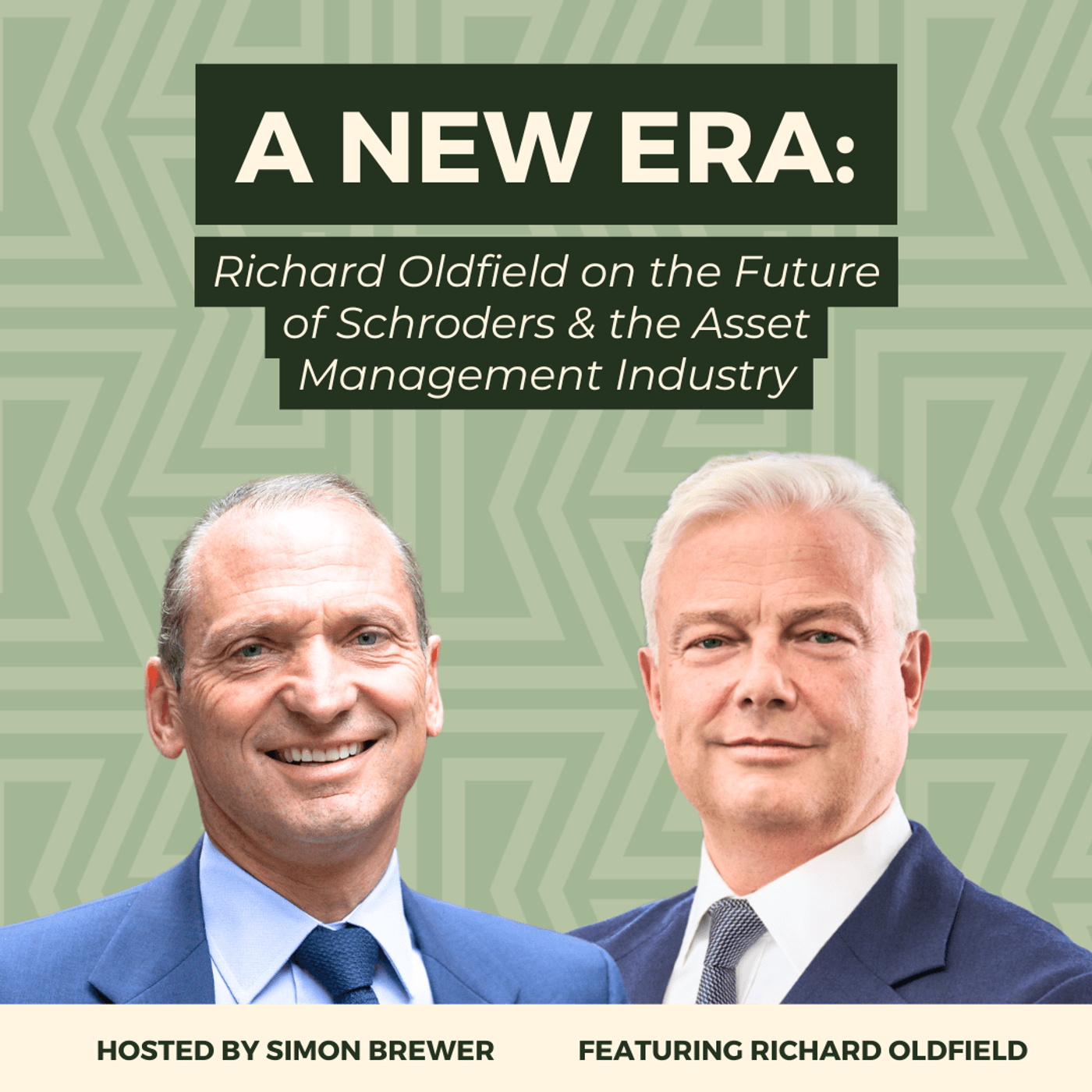
Richard Oldfield (CEO, Schroders PLC) discusses how asset managers should respond to shifts in passive vs active investing, the rise of private markets, and industry technology change (AI and tokenization). He also explains Schroders’ 2025 combination with Nuveen and what it means for public-to-private product building and wealth clients.
Guest backgrounds
Richard Oldfield trained as an economist, spent ~30 years at PwC (including roles such as chief controls officer for a European bank, restructuring a central bank in Africa, and running a futures business in Hong Kong), then joined Schroders (after earlier work for Schroders pre-separation). He became CFO before CEO.
Key claims
Passive is a “building block” but has become concentrated (e.g., MSCI exposure to US tech), so it shouldn’t be the only holding alongside private markets. Benchmarks are “the scourge” because they’re concentrated, depressing active outperformance. Asset managers must stay “relevant” to clients more than chase size. Private markets should be balanced by asset type (PE, real estate, private credit, infrastructure).
Notable examples
Schroders has ~$1.2T AUM; ~36 physical offices in 36 countries; ~$100B private markets via Casanova Capital/wealth; renewable infrastructure investing. He cites US tech concentration risk, de-dollarization/allocation shifts, and Apollo partnership plans for UK wealth products with daily liquidity features. He highlights AI as “making people superhuman,” and tokenization/DLT as potentially removing fund-accounting/transfer-agent frictions.
Written by AI. May contain mistakes. Listen to the episode to check what was said.
Chapters
Tap a time to open that second in VOThe Importance of Asset Diversification
0:00 to 0:30
Learn why passive investments shouldn't be the sole focus in portfolios.
“No one should take my comments here as thinking I'm anti-passive because I think it's a really important building block in everyone's portfolios.”
Richard's Journey and Experience
1:30 to 4:30
Hear about Richard's extensive career and his roles at PwC and Schroder's.
“a warm welcome to the Money Maze podcast.”
Schroder's Business Overview
4:30 to 6:30
Understand the current state and global footprint of Schroder's today.
“The important thing is you deliver alpha for clients.”
The Investment Industry Landscape
6:30 to 9:10
Delve into the dynamics of size and relevance in the asset management industry.
“The large US private markets players, by definition of size, will always have some advantage in some parts of the market.”
Private vs Public Asset Management
9:10 to 11:50
Explore the balance between private and public assets in investment strategies.
“So the first thing I'd say is, as you know, Schroder's is unashamedly active.”
Navigating Active vs Passive Investment
13:10 to 14:00
Discuss the challenges of active management in a predominantly passive market.
“but almost the benchmark is now so concentrated and skewed.”
Active vs Passive Investment in Asia
14:00 to 15:37
Explore the dynamics between active and passive investment strategies in Asian markets.
“under the benchmark in other years but because everyone compares the benchmark i think it's been a real depressor on the active industry.”
Active vs Passive Investment in Asia
16:07 to 16:22
Explore the dynamics between active and passive investment strategies in Asian markets.
“At the heart of the global economy, LSEG provides data, analytics and infrastructure that connects investors, businesses and economies.”
Schroders' Growth Strategy
16:24 to 18:31
Discover the strategic decisions behind Schroders' focus on growth and market positioning.
“So let's talk about Schroeder's and Naveen.”
Cultural Fit and Brand Strategy
18:31 to 21:22
Understand how cultural alignment and brand strategy play a role in mergers.
“So we were at a disadvantage to our US colleagues and competitors because we didn't have that strong US wealth presence.”
Show all 26 chapters
Client Experience and Private Wealth Management
21:22 to 28:00
Examine the evolving client experience in wealth management amidst changing market dynamics.
“Okay, so Reuters reported that you'd, Nuvine had several attempts.”
Exploring Private vs Public Markets
28:00 to 29:00
Discusses the balance and evolution between private and public market investments.
“their desires, their families, to make sure that we build the right asset mix for them.”
The Role of Private Asset Firms
29:00 to 30:00
Examines the influence of smaller private firms in the asset management landscape.
“And so suddenly you had these smaller private asset firms encroaching, poaching, recognizing value.”
Innovation in Product Offerings
30:00 to 31:00
Discusses innovations in product offerings in response to evolving market demands.
“to try and create products for the wealth market in the UK, which had some direct lending exposure supported by liquid fixed income to allow more liquidity and daily pricing and daily entry into the product.”
AI's Impact on Asset Management
31:00 to 32:00
Explores how AI is transforming operations and client interactions in asset management.
“And look, we can talk, Simon, about wrappers because I think they're also going to change and technology is going to change the way these products are delivered to clients.”
The Future of Tokenization
32:00 to 33:20
Describes how tokenization and digital ledger technology will reshape the industry.
“I have a very strong belief that we are not moving to a world where all our portfolio managers get replaced by an AI box.”
Understanding Tokenization
33:20 to 34:20
Provides a clear explanation of tokenization and its benefits for asset management.
“So I'm excited about that, as well as the AI piece, in terms of what asset managers do.”
The Role of Public Markets
34:20 to 35:40
Discusses the importance of public markets and their role in capital access.
“And therefore, for end clients, the product ends up being cheaper and safer and quicker.”
London's Financial Landscape
35:40 to 36:40
Reflects on London's attractiveness for businesses and its financial ecosystem.
“And by the way, for capital markets, the increased transparency you get from the public markets is enormous.”
Navigating Career Transitions
36:40 to 38:00
Shares insights on adapting to career changes from audit to asset management.
“It's a great way for people to access capital rather than through the banking system.”
Future of Consulting in Finance
38:00 to 40:00
Speculates on how the consulting industry will evolve in the coming decade.
“Richard, I can ask you some more general questions.”
Exciting Investment Ideas
40:00 to 40:10
Richard shares his enthusiasm for investing in renewable energy.
“Well, I've got some very good funds that you might want to invest in.”
Advice for Future Financial Professionals
40:10 to 42:03
Offers valuable career advice for those entering the financial services industry.
“How big is the discount at menacing value?”
Saying Yes to Opportunities
42:03 to 43:32
Learn how embracing new experiences can shape personal and professional growth.
“how do you fancy going to Africa and restructuring a central bank?”
Appreciation for Past Partnerships
43:32 to 44:16
Acknowledging the support and collaboration of previous business partners in the podcast's journey.
“If you could take just one holiday anywhere in the world, where would you want to go?”
Investment Insights and Future Predictions
44:16 to 45:08
Exploring key investment strategies and perspectives on global markets.
“So thank you to everybody at Schroders who is behind that.”
Transcript
Automatic transcript. May contain errors.0:00No one should take my comments here as thinking I'm anti-passive because I think it's a really important building block in everyone's portfolios. But it shouldn't be the only thing you have alongside private markets. And so most people today would think, the average one on the street would think that if he invested in a passive MSCI product, that he's got a good diversified, currency diversified asset mix. And of course, what they're really invested in is the United States and the dollar, and in particular, a very small number of technology companies. When you look at the world, there's less public companies than there were historically, and they're seeing the rise of the private markets.
0:38It's actually making sure that even when you're thinking about private markets, you get the right mix of assets. So is that really private equity? Is it real estate? Is it private credit? for us in particular is that infrastructure investing, given we have a renewable infrastructure business.
0:57Richard Oldfield:Most CEOs take years to make their mark. But after three decades dissecting and helping other people's businesses at PwC, our guest today spent two years inside Schroeder's before deciding it was time to sell the 220-year-old business. Today, he joins us to explain why he was convinced it was the right decision to take. What are the irresistible forces changing the investment business? Priorities, profitability, private and public assets, passive and active, and if size matters more than ever. Richard Oldfield, CEO of Schroeder's PLC, a warm welcome to the Money Maze podcast. Thank you very much, Simon.
1:33Richard Oldfield:We've been trying to get a date in the diary to have this conversation, I think, since early February. And now we've got you. It's very hot. There are, in this office, There's no tired looking faces after England's successful adventure in Mexico. When this is released, we'll know a lot more. But anyway, it's great to have you here. I'd like to just sort of step back a little bit because, you know, I understand you studied economics at your university. You appear to have spent most of your life at one firm. Why? Well, it's a great question. I've been asked that several times, Simon. So I was trained to be an economist.
2:08That's what I thought I would do. and then I decided I would, after a summer internship, join one of the predecessor firms to PwC. I was very fortunate. I got to do a huge amount of different things while I was there. I was a chief controls officer for a European bank. I restructured a central bank in Africa. I wound up a futures business in Hong Kong I managed to live in six different countries through my time there so I've managed to do lots of different things and that's why I ended up staying there spent the last half of my 30 years in different leadership roles so it really prepared me for I think being able to work in in different locations and importantly a global business I I spent a lot of my time thinking about what was important to connect with different people in different markets and how people, international companies, grew their businesses.
3:08Had you worked with Schroder's prior to joining them? I did work for Schroder's, actually, before the asset manager and the investment bank separated. So I did a project for a year supporting Schroder's, thinking about its presence in each of those markets overseas. Okay.
3:27Richard Oldfield:So let's fast forward to Schroeder's today. Just give us a quick recap, global footprint, asset mix. Sure. Well, today we have about$1.2 trillion under management. It's broadly 25 % intermediary related and 75 % institutional. 27 % of our business is in Asia. 12 % is in the Americas and the rest is in Europe. We have about$100 billion of private markets assets,$100 billion of assets really through Casanova Capital and the wealth business. And the remaining is all our public markets and solutions businesses. Great. We're going to talk about probably all of those. Let's keep this high level to talk about the investment industry, first of all.
4:13Richard Oldfield:I mean, you along with others, and we'll come to you in a minute, are weighing the size and asset mix. Is there an optimal complexion? So I don't think size is actually the defining feature of an asset manager. There's always going to be room for nimble, focused asset managers. The important thing is you deliver alpha for clients. So if you deliver alpha, you've got a role in this world. now as i stand back and i look at schroder's um you know one of the other things that we didn't touch on earlier was today we have physical offices in 36 different countries uh we operate in another eight uh we uh have been in many of those markets for uh hundreds of years in some case and decades for others and there is a point if you want to be a global asset manager which is what we are, how do you remain relevant?
5:09Because I think size is less important than relevance to your clients. And if you want to be a global asset manager, you have to be bigger than we are today in the US, which is the largest asset pool. But I think it's important that all asset managers are really focused on who is their key client base, and how do they remain relevant to them as we go forward.
5:33Richard Oldfield:I suppose one of the hallmarks of the big US firms, Aries, Apollo, Brookfield, etc., has been their dominance, or certainly their almost omnipotence in the private asset space, which we can argue some of that might be courtesy of the zero rate policy. The European entities didn't, for all sorts of reasons, embrace that in the same way. Looking forward, how do you view that mix between those that are doing private versus public? So one of the things we've tried to do at Schroder's now over a quite a long period of time, and Peter Harrison did a great job of actually building out our private markets franchise to make sure that we could operate across the public to private spectrum, which I'm glad to say many of our private markets colleagues have now worked out you've seen all the partnerships that have been entered into.
6:22That's quite an important part of how they think about the business, particularly as you try and push into the wealth channels and the wealth market. I think this is a classic David and Goliath situation. The large US private markets players, by definition of size, will always have some advantage in some parts of the market. That being said, we have focused on where can we provide better product, demonstrate better alpha, and maybe it's in wealth in Europe where the regime means the product has to be smaller because we haven't got a unified regime. Maybe it's in providing asset-backed finance solutions rather than direct lending, whether it's in producing really high quality, small and medium-sized private equity investing.
7:10These are all places that aren't necessarily occupied by those big players where European players can stake out a presence. They've got an advantage and they can grow pretty aggressively.
7:22Richard Oldfield:ifm investors is a global asset manager founded and owned by pension funds with capabilities in infrastructure equity and debt private equity private credit and listed equities they believe healthy returns depend on healthy economic environmental and social systems and these are evolving on a scale never experienced before to find opportunity build value and meet the needs of future generations, you need scale, skill and expertise. That's what IFM Investors has built up over 30 years. Does your investment portfolio need an active boost? The Money Mays podcast is sponsored by JP Morgan Asset Management, Europe's leading active ETF provider by assets under management.
8:08Richard Oldfield:JP Morgan's ETFs are powered by a century-long commitment to active investing and a truly global investment platform. They're designed to be active, not reactive, so investors can target enhanced returns and achieve better long-term outcomes. Discover why JPMorgan Asset Management is the home of active ETFs. Search JPMorgan Active ETF or tap on the link in the notes to this episode to find out more. When you invest, your capital is at risk. The other, of course, dimension that is troubling, making us all think is the passive, the active. We all know the data in terms of the US, and we all, I suppose, accept the assumption that alpha is more accessible in less developed markets.
8:51Richard Oldfield:What I would like to understand is a recession at some point in the US will be inevitable, and with that recession could come the reversal of that passive tidal wave. How are you thinking about that and the fact that your business has such an important active machine? There's so much to unpack in that question, Simon, right? So the first thing I'd say is, as you know, Schroder's is unashamedly active. That is what we do. We do a little bit of passive to help clients from a solutions perspective. But actually, we wake up every day thinking about how we create alpha for clients. And our investors are super experienced in doing that without worrying about just attaching themselves to an index.
9:35Now, I think there was a very long debate, particularly when I joined Schroder's in the industry, around the infamous barbell. you know that people would either be investing passively or in private markets products but of course what that totally ignores is that you should be thinking about risk that sat in the portfolio as well as the return profile that you get and people of course thought passive was risk-free and and I shouldn't no one should take my comments here as thinking I'm anti-passive because I think it's a really important building block in everyone's portfolios but it shouldn't be the only thing you have alongside private markets.
10:13What started off as a very good diversified product has over time become increasingly concentrated. And so most people today would think, the average man on the street would think that if he invested in a passive MSCI product that he's got a good diversified, currency diversified, asset mix. And of course, what they're really invested in is the United States and the dollar, and in particular, a very small number of technology companies. So of course, what that exposes the investor to is a lot of downside risk, should that trade look like it unravels slightly. Now that might be today, it's not maybe as much about the recession impact in the States, but really about whether those technology companies can continue to justify their ascent and actually deliver the earnings that are already priced into the value of them today.
11:14So you're right. Actually, one of the things that we do is we try and balance that risk by broadening out the things that we invest in, even on our global equity products, to make sure that people are getting the right risk return trade-off. Of course, if you just wanted to focus on those high-tech US companies, probably the cheapest way to invest is through a passive product. But I think we have to have a debate with investors around balancing risk and reward. And how would you say investors are dealing with the fact that it's been so hard to outperform US indices
11:49Richard Oldfield:courtesy of this, you know, this concentration? And yet investment history, logic learning will tell us that such levels of concentration and, you know, and I suppose belief in the continued path typically end up, you know, being disappointed. Yeah. So, I mean, three things to mind. You'll remember 18 months ago, there was this de-dollarization and people moving their assets away from the US. Now, of course, we never saw any money move, actually, and certainly it showed us. What we did see was more new allocations going to assets outside of the US. What's happened in the last six months, of course, is really that that has stopped because actually the dramatic return in the US markets has outweighed pretty much, and I shouldn't say the US markets because again, the return profile is very concentrated in the technology stocks in the US.
12:42But they have meant people have not wanted to miss out. And that's always a balance. People will sit there and say they're too exposed, but what's the right time to diversify their holdings. So I do think people know that they're too exposed to the US markets, and it's actually about when some of that rebalancing happens. The second thing I'd say is I think benchmarks are the scourge of the industry. Because, of course, everyone asks us how we compare to the benchmark, but almost the benchmark is now so concentrated and skewed. unless you replicate the index, it's quite hard to beat that benchmark.
13:22And I think that's really important now for us to talk to clients about, well, what's the return profile you're expecting? And let's beat that, as opposed to necessarily comparing ourselves to the core benchmarks that the indices set, because they're not actually balanced in a sensible way for investing. That being said that is how we are assessed and managed often i think it results in performance being within quite a narrow band around the benchmarks and that's why i say it's the scourge of the active asset management industry because in some ways you'd want the industry to deliver significantly outsized returns for some years and accepting the fact they'll be slightly under the benchmark in other years but because everyone compares the benchmark i think it's been a real depressor on the active industry.
14:10Richard Oldfield:Got it. Well, I remember 89 when Japan was 40 % of the world's stock markets. And you know, it was viewed that it was justifiable on all sorts of measures. However, given your big footprint in Asia, what are the conversations about actively passive there? And of course, the Asian markets are generally managed actively, not passively, particularly when you get into places like China, where actually, I don't think you would choose to passively invest in China. But of course, when we think about Asia, we often talk about it as almost a single market. And you know better than I that it's actually a whole bunch of individual markets.
14:50The Japanese market is heavily dollarized. Whereas actually, when you get into other parts of Asia, you can definitely see a shift and more broadening out a diversification of that asset base. so we have seen um we have at schroder's a phenomenal um asian investing capability um we have an astonishing emerging markets investment capability and what we actually saw is lots of people shifting into global allocations but now you can definitely see a reigniting of demand for asian and em actually in that part of the world as i think people try and get more diversification away from the US.
15:35Richard Oldfield:I'm thrilled to share that the Money Maze podcast is sponsored by the World Gold Council. They champion the role gold plays as a strategic asset through expert research, commentary, and insights. And it's not just your portfolio that may benefit from gold. Learn how gold mining is supporting female economic empowerment and small businesses via their new documentary series called Gold, The Journey Continues. Tap the link in the show notes to start watching. I'm excited to announce that the Money Maze podcast is sponsored by the London Stock Exchange Group known as LSEG. At the heart of the global economy, LSEG provides data, analytics and infrastructure that connects investors, businesses and economies.
16:16Richard Oldfield:LSEG is where ideas meet capital, enabling sustainable growth and opportunity. Tap the link in the show notes to learn more. So let's talk about Schroeder's and Naveen. We started at the outset saying, you know, long-standing business, one of the unusually long-standing businesses with this unusual family shareholding, etc. You arrive CFO before CEO, have seen the company in and out. I guess, what would be the decisive factors that led you to go to the board and say, this is what we should be doing? So Schroeder's was really proud to be a UK headquartered company. By the way, the international business of the combined entity will still be headquartered here in London.
17:01It's a really important thing for us, for the board, for the family, that that was a factor of the transaction. But what we set out back in February 2025 was a plan to return Schroeder's back to growth. We'd had a number of years where profitability was declining. And that pretty much was based around simplifying the business, both in terms of what we did and where we operated, reducing our cost base, but investing to grow in areas that we thought we had a natural advantage in. And we felt pretty good about that plan. And we saw at the end of 25, we'd made really strong progress. I think we've made even more progress as we come up to our half year results later this month.
17:49So I can't say too much about that, but I feel pretty good about what we've done in the first six months of this year. so this wasn't a transaction born out of we felt we had a big problem and therefore had to had to do a deal it was actually driven by that point I made earlier about what being relevant to clients and what's important to clients going forward and I think there were three things that were on my mind firstly we had an undersized US wealth management market now that is the largest asset management market globally. And in the wealth channel, it's also very lucrative. I mean, margins in the US are much higher than they are in many parts of the world.
18:31So we were at a disadvantage to our US colleagues and competitors because we didn't have that strong US wealth presence. We equally needed a bigger US fixed income presence. That was because actually when we thought about being relevant to insurance companies around the world, being relevant in Asia, we needed a low-cost US fixed income product that we had to build. And the final thing was, when we thought of our private markets business, we may very well be one of the largest European players, but at$100 billion, we were quite small. And to grow it, I felt we needed access to more permanent capital and ability to seed and co-invest in those products to get them to a certain scale to allow more investors to come into them.
19:23So they were the things that were at front of mind in terms of the challenges that at Schroder's we had to deal with. As I talked to people around the industry, around how they were thinking about those challenges, I came across Naveen. And the thing that struck me was, one, we were quite similar from a culture perspective. Their heritage has been more than 100 years old. Interestingly, our founders were born in the same city 100 years apart and one mile in distance so the culture was important the history because that's all about long-term thinking I think but our businesses were super complementary they're much bigger in private markets so they have a platform of about 300 billion so we are significantly in excess of 400 billion when you add the two businesses together so if you like it was literally um uh two organizations identified could fit together really well and reposition schroders by dealing with all the challenges i knew we had to survive through the next uh the next hundred years on our journey so the families owned 44 percent give or
20:33Richard Oldfield:take they've had will have had that conversation running for i'm sure more than a decade what eventually pushed them across the line? Well, the family have, I think, one overriding thing in front of mind, which is they wanted to do the right thing for the business and the right thing for all the people that worked at Schroder's. In many ways, it does feel like a family business and people feel connected to it. So going through the analysis of what the deal could create, and I really do think we're creating a powerhouse here across public to private markets. They could see the real opportunity that we couldn't achieve as Schroder's on our own.
21:17And so I think it's the fact that they thought this was the best thing for the business and the best thing for our people that got them over the line.
21:22Richard Oldfield:Okay, so Reuters reported that you'd, Nuvine had several attempts. That may or may not be right, but you're a numbers guy. Putting valuation on these businesses is difficult. shows that the share price had been under pressure. We all know the sort of the margin challenges that existed. How did you think about price?
21:44That's a great question, Simon. Now, of course, the one thing I would say, by the way, is there was no unwelcome approach here, right? So this wasn't Naveen at the door trying to force us to sell. I think we both came to the conclusion this was a good thing for our businesses. and it's as good, I should say, it's an important thing for their business as well because it automatically internationalizes a business that today is actually very US-focused.
22:15And the number of approaches mentioned in Reuters, you know exactly how these things happen, that people make an approach and we negotiate on price, and that's why we have to get to the right answer. We were advised about, as you can imagine, about what the appropriate valuation ranges were. we had three investment banks ultimately give us a fairness opinion to make sure we got to the right price so we did all the things you'd expect a listed FTSE 100 board to go through in terms of if we wanted to do this deal making sure we got the right deal for all of the shareholders got it
22:53Richard Oldfield:so I think this entity is two and a half trillion in assets you know will be yep um as a perhaps that's my problem is i'm a brit i'm looking at nuveen and schroeder's and thinking schroeder's is a much better name tell me a little bit about what the what do you is that even a conversation but really perhaps as seriously more seriously is the cultural question and how you're going about that yeah well let's take the brand first uh you will have seen in the announcement that was made there's a commitment to retain the schroeder's brand and uh i'm actually quite passionate about that we've got the fifth best brand in the industry globally um and that's the benefit of being around for 224 years and being in uh in more than 40 countries so that will continue one of the things we have to accept is of course our brand in the u.s is not at what it should be um and therefore in the u.s world channel novena actually has a much better brand than shredders so i think actually by retaining the best of both brands what we've actually got is an enormous opportunity to show up in markets in the way that best represents an international asset manager for that market.
24:04So we'll be Schroders in many places around the world. In others, it may be better to be Naveen. And that's how we're thinking about using the brand in a really smart way. You wouldn't have paid this amount of money for Schroders. A lot of that value is actually in the brand. I've forgotten your second question.
24:22Richard Oldfield:The second one, that's why they say you should never ask two questions together in podcasting, and I've just done exactly that. A little bit of the cultural assimilation. Now, on the culture, one of the things that was really important was actually making sure that we could do a deal with people that we could see we could get along with and had a cultural resonance. That sense of history and legacy and long-term thinking was important. the focus on client service was really important at the end of the day we are here only to service our clients uh but actually a connection with people so we we know we can work with with the leadership team we're going well so i think that's all good signs that we've got the right culture at the end of the day we are a very british organization uh and and they are um from the but interestingly spread across the US.
25:20So it's not like we're entering a transaction with someone who's headquartered and everyone's in New York. The leadership team's currently spread over four different locations. But I think actually the fact that we're all clear that we have to serve clients, we've got to have fun doing that, which is quite important, that actually we've got a long-term business that we have to see through to the future.
25:46Richard Oldfield:So let's talk about the private wealth world. I have, you know, grew up at it originally. And so I've seen it sort of firsthand. And of course, I'd say the great deal of getting the Casanova name on board was, you know, I think to outsiders, you know, something to be treasured. All right. So let's talk about what it means to be a wealthy client of Schroeder's Naveen. But it's a broader question than that, because 60-40 was sort of the standard diet. We zero rates forced all sorts of unexpected behaviors and I think unintended consequences, some of which were not good. We've got private markets being, I was going to say, forced into the private channel in the US.
26:29Richard Oldfield:I'm saying that because I'm just wondering how much illiquidity introducing into a wealthy person's portfolio is really wanted. But that's my view. How do you see that client experience at an asset level evolving? Yeah. So I'm going to take a step back a second, if I may. So the first thing that we have done is take our wealth business at Shredders and focus it on that Casano segment. not high net worth ultra high net worth foundations of family offices and charities so that that's what we do and uh we sold our shredders personal wealth business back to lloydson this morning we announced that benchmark uh had been sold leaving us with that core high net worth um segment and the reason we focus on that is i think that's that's where we can add value it's where advice is really important um it's where that human touch is really important and I think that will survive the onslaught of technology which we're about to experience in the next in the next five years and it's central to that advice element is actually making sure that all of our clients have got the right investment profile for their particular needs so I actually don't even think it's on one level I would say it's a size thing so obviously the bigger the bigger your asset pool the more you can have in illiquid products but actually that sort of depends on what your plans are for the future in terms of where you are in your accumulation journey, actually other big events that you're planning for where you need more liquidity.
Read the full transcript
27:58Unfortunately, we have great teams who work with clients to actually understand their desires, their families, to make sure that we build the right asset mix for them. I think it's not a choice of public versus private. Undoubtedly, when you look at the world, there's less public companies than there were historically. And we've seen the rise of the private markets. It's actually making sure that even when you're thinking about private markets, you get the right mix of assets. So is that really private equity? Is it real estate? Is it private credit? For us in particular, is that infrastructure investing, given we have a renewable infrastructure business.
28:39So you have definitely seen an increase in recent years in the amount of people's portfolios that are invested in private assets. But it's not an excessive amount because most people don't want to look at liquidity for long periods of time. Right.
28:55Richard Oldfield:So let's get back to that looking ahead. Tigo Capital, who we also know very well, bought a 7 % stake in the end extremely well. And so suddenly you had these smaller private asset firms encroaching, poaching, recognizing value. So I'd like you to just sort of dissect how you view that future, particularly as it is the private firms, because wanting something that you and your competitors have. Yeah. So I love to say I'm glad I made TKO quite so much money, actually. They couldn't have bought it at a better time. And I always tell people it's because they recognize the great story that we had at Shrews in terms of how we're going to grow and transform the business.
29:39So I wish them well with their profits. I think the whole private markets and public market space is ripe for evolution. Different people in the market are undoubtedly going to think about how they access private markets with more liquidity. Of course, before the announcement with Novena, it announced that we were entering into a relationship with Apollo to try and create products for the wealth market in the UK, which had some direct lending exposure supported by liquid fixed income to allow more liquidity and daily pricing and daily entry into the product. So I think lots of people are going to be trying to work in partnership because what the market is demanding is evolving.
30:26And by the way, what they demand today is going to be very different to what they demand tomorrow. And so I think you're going to have more collaborations between private markets players, particularly smaller ones, where they've only got a single product as they try and plug into a platform and an ecosystem. But one of the reasons why the Naveen deal was attractive is literally the product shelf for public food to private is pretty full. We've pretty much got everything that you need in order to be able to create product for people which has the right balance of liquid and illiquid assets. And look, we can talk, Simon, about wrappers because I think they're also going to change and technology is going to change the way these products are delivered to clients.
31:10Richard Oldfield:Well, let's just take that technology and let's just say, what do you see to be the biggest impact of AI on the businesses we've been discussing? So we have been on the AI journey for years and we are using it in all the places that you would expect us to, that has made our operational capacity quicker, safer, and easier for people to access. Now, as we use more AI, it's not just automation. It's actually allowing clients to do things that they can't do today. So can they get different levels of reporting more quickly? The other area I think that's really important for AI as we now look forward is how we use it within portfolio construction.
32:01I have a very strong belief that we are not moving to a world where all our portfolio managers get replaced by an AI box. Frankly, that would suggest the industry is going to go down to the lowest common denominator if that happens. But importantly, I think individuals with experience overseeing whatever AI does is really important. AI is about making our people superhuman, and not replacing them. So what do I mean by that? Technology generally is trained to do something when often, you know, in investing, actually not doing something is actually quite important as well. And having the patience and desire to sit back and just let things move because you don't quite know which way you should be positioning.
32:48AI doesn't do that. It tries to make more decisions. So I think we'll be using it more in how we do research, how we help portfolio managers do allocation and selection. But importantly, we'll be thinking about what does it mean in wealth, in particular, what does it mean for the client interface? Or in our institutional sales team, how do we give them more information to make sure their conversations are more relevant to the client in terms of what that client's needs are? So it will change different parts of, I think, the asset management landscape enormously. but let's not forget all of that technology change is happening at a time when we should be focused on tokenization changing the piping that the entire industry operates on we are literally working on 1960s piping and actually that will be fixed through digital ledger technology it will be fixed through tokenization it will take over someone's lifetime billions of pounds of fees out of the system.
33:50So I'm excited about that, as well as the AI piece, in terms of what asset managers do.
33:55Richard Oldfield:Can you just take us down a level in that tokenization to help those of us less familiar with the term understand what that really means? So if we can change the way we create and deliver product to individuals, and I'm not talking about the last mile and ending it with a digital wallet on your phone that will ultimately come but actually how do we construct a fund today then of course um we go through the have we got a custodian do we have a transfer agent do we have a bookkeeper all of that disappears with a dlt effectively everyone is on a blockchain and you do need a custodian you need an asset manager but the security improves the speed improves and importantly you don't have all the fees taken out by the transfer agent the fund accountant, for example.
34:44And therefore, for end clients, the product ends up being cheaper and safer and quicker. And I think that's something that everyone should be seeking to achieve. And that's going to happen over, I think, the next few years. Got it.
34:59Richard Oldfield:So public markets, you have warned against the calling the death of the London equity market, you'll be delisted at some point, you know, ahead. What is their role going forward?
35:15well I think you've got to be careful not to think that actually life is a choice between private and public markets and you just look this year at the Russia companies in the US to go to IPO we saw the excitement about SpaceX but now we can see lots of technology companies filing to do IPOs. So let's not think let's not think these processes aren't still important. And by the way, for capital markets, the increased transparency you get from the public markets is enormous. And actually, for people like Schroeder's gives investors the ability to challenge management, see how they're doing. So it's a really, really important part of the capital market as we go as we go forward.
36:03I think it's important that we don't see the stock exchange as being the only measure by the way of a city's health, right? So I think it's important. Everything's not listed in New York. But actually, we've got to make sure that we have deep and liquid pools of capital for companies to list in other parts of the world, including in London. But I do think we've got to be careful in London not to say the health of the London economy is driven as a key indicator by the listings of the London Stock Exchange. But I feel really positive. You can definitely see a shift. We're leaning in in London definitely into trying to make it a more attractive place for people to list their businesses.
36:47It's a great way for people to access capital rather than through the banking system. It's great for entrepreneurs. So I'm a huge supporter of the capital markets and listings in particular.
37:00Richard Oldfield:Yeah, well, we had Alan Mason, senior partner from Freshels the other day, who said who would have thought 10 years old for Brexit that the City of London is in such great shape, which I thought was fantastic because the narrative has been just sort of incessantly gloomy with that unhelpful press. I think that the London Stock Exchange ability now to service private companies in terms of transactions through Pisces is another big step forward. So I'm absolutely with you. And it is ironic that the private markets firms want to be listed so they have a currency with which their employees can trade and exchange.
37:30Exactly. And Simon, do you know the reason why London is such an important place and why we're proud to be headquartered here is the talent that we have got across all aspects of financial services. You know, I'm very privileged as an asset manager. I have a big asset management pool, but that spreads across banking and insurance. across professional services. So I think we are in a relatively privileged and unique position globally to have all of those sectors with such deep town pools.
38:00Richard Oldfield:Richard, I can ask you some more general questions. I had one actually from a former colleague of the all, Julian Wakeham at PwC. He and I are about to do the airman's escape route in the second world over the Pyrenees. So anyway, he and I have known each other for a long time. Yeah, and his question was, you made the transition from a client-facing audit partner to a corporate CFO and then CEO. How did you have to adapt to your style? And if so, how? Well, actually, in many ways, I didn't have to adapt my style because some of the things that you're taught as a professional services person is to listen a lot and then analyze data and come up with an answer.
38:46And that's, I think, what I did as the CFO and then the CEO. You know, the difficulty, of course, is that you go into an organization that is 224 years old. They do things in a certain way. So I had to maybe have a lot more patience than I did in professional services.
39:08Richard Oldfield:As you look at the consulting business, and we've not done and had an episode on the world of consulting, you know, the PwC-style consulting. looks to me like a business ripe for disintermediation. Would you be bullish or bearish on a 10-year view? On a 10-year view, I think the consulting industry is going to be radically different than it is today. I think there could be different players, and it will be much more specialized, particularly not just around the technology aspects of AI, but actually how you build business models and people models around AI. Well, maybe one of the consulting firms will want to request to come on.
39:51Richard Oldfield:Okay, I've got some more rapid fire questions. In the investment world, what might be the single investment idea you're most excited about? Renewable energy. And how would you play that? Well, I've got some very good funds that you might want to invest in. Starting with green coat. How did you guess? How big is the discount at menacing value? But I think, look, personally, I'm a big fan of the energy sector. The world's demand for energy is insatiable. We're going to see that through increased energy output from fossil fuel providers. But I think the growth in renewable energy infrastructure is unstoppable.
40:38Richard Oldfield:When you faced the headwind in your career, how have you dealt with setbacks?
40:54My mother once told me that I should always remember how I felt when I was five. and the five-year-old person that's deep inside each of us knows they can take on the world they can conquer anything and so whenever you face setbacks uh i always dig into the what would
41:17Richard Oldfield:my five-year-old self say right um a lot of young people very kindly watch and listen to our show for those thinking about financial services what might be the advice you'd offer it's great it's a great career i mean you get to uh experience an industry that is the glue that makes everything else in the economy work whether that's in as i said banking insurance or asset management we make economies work and it's a huge privilege for us to be uh in that sector um for anyone who is starting their careers the other advice i give them is always say yes um i have done that. I have done some amazing things when someone picked up the phone and said, how do you fancy going to Africa and restructuring a central bank?
42:07Of course, I said yes. Do you fancy going to live in Hong Kong? Of course you say yes. Would you like to go to the States? Yes. So I think that sense of it's really easy to find lots of things in life as to why you should say no. But actually, if you are open to doing different things and saying yes, doors open, you have great experiences and you build yourself out not just professionally but as a human being
42:31Richard Oldfield:great three rapid fire quick closing questions most important daily habit um
42:44that's not very rapid is it um most important daily habit exercise right i'm gonna ask you what sort of exercise well i have a personal trainer three times a week and i love the um i fill in the gaps uh with the peloton i'm one of those individuals who bought one in the in lockdown of course never
43:04Richard Oldfield:gave it up oh unfortunately hopefully you own the bike with not the stock right um the best book you've read this year best book i've read this year um careless people uh which is a story by the former global public policy head of Facebook. Okay, that's right. Yes, I do, because we had had Nick Clegg on the show. So that suddenly he comes back to me. And final question. If you could take just one holiday anywhere in the world, where would you want to go? Well, this is a really easy one for me because I have agreed with my wife when I retire, I am going to go to Buenos Aires and learn how to do the tango.
43:52Richard Oldfield:Okay, fantastic. Well, nobody's ever said that before on the show. Six years in. Okay, well, I did want to say one thing that was, you know, on behalf of all the team at The Money Maze is that your predecessor, Prita Harrison, agreed to become a sponsor of The Money Maze podcast in our early days when, you know, we didn't know what we were doing. I'm going to say that we have learned a bit. And we were always and will be forever really grateful. You were a great business partner for three years. So thank you to everybody at Schroders who is behind that. In concluding, I would say that to the question asked about size, you make a very important point, which is size does not solve everything.
44:28Richard Oldfield:If you are nimble and capable of producing alpha, there is a place on the investment playing field for you, irrespective of assets. um number two that uh there is a habit of forgetting the asian opportunity set whilst the u.s seems you know omnipotent but worlds change and you know the investing opportunities and the active investing opportunity you know remain absolutely central and thirdly and we just did talk about it but london is alive and well despite commentary to the uh to the alternative and Schroeder's is going to be keeping its presence here for sure and I wish you the very best of luck.
45:08Thank you very much.
From the publisher
But after three decades dissecting and helping other people’s businesses at PwC, our guest today spent just two years inside Schroders before deciding it was time to sell the 222-year-old business.
In this conversation, Richard Oldfield explains why he was convinced it was the right path to take, and why the family-controlled business and its board were persuaded.
He describes the irresistible forces changing the investment business and specifically analyses the co-existence of private and public assets, the potential paths of passive and active, and if size matters more than ever.
He discusses the footprint, asset mix and culture which Nuveen offers and how the combined group will manage $2.5tn, becoming one of the world’s largest active managers.
He explains why public markets are essential, how AI is being implemented in their business, the important Asian opportunity, and why benchmarks can provide the wrong skew in understanding risks.
The Money Maze Podcast is kindly sponsored by J.P. Morgan Asset Management*, IFM Investors, World Gold Council and LSEG.
*During the episode we cite J.P. Morgan Asset Management as Europe’s leading active ETF provider by assets under management. This is sourced from J.P. Morgan Asset management and Bloomberg, data as of 30 March 2026.