In short
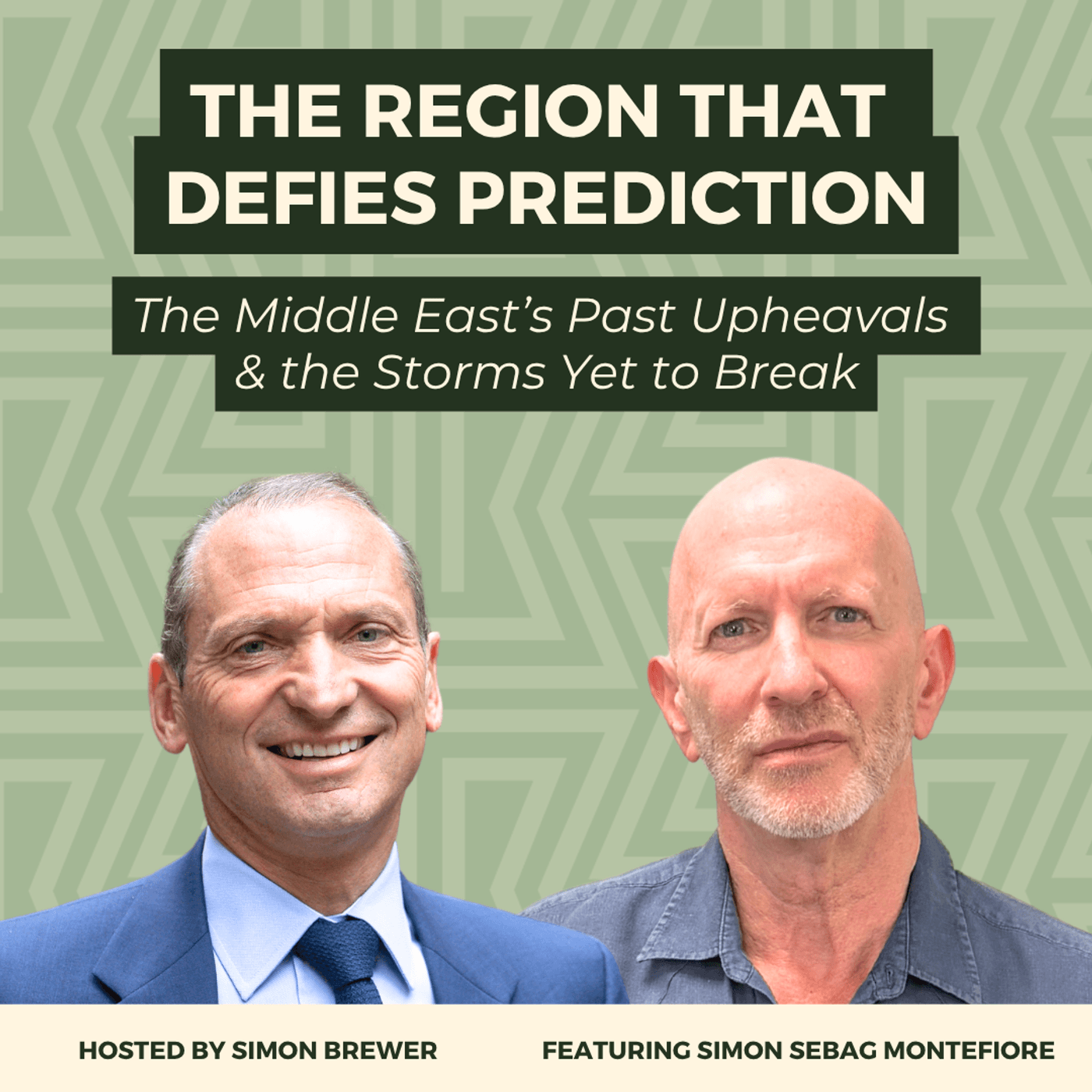
Simon Sebag Montefiore’s The Cauldron argues the “modern Middle East” should be traced from 1900 onward—especially the Ottoman and Persian empires and the rise of Saudi power (Prince Ibn Saud seizing Riyadh in 1902)—to explain today’s upheavals. He claims outside interference matters, but Middle Eastern leaders repeatedly bypass and manipulate great powers, and the region’s theaters are converging into one interconnected strategic system.
Guest
Simon Sebag Montefiore is a historian and author known for major works including Jerusalem (biography of the Holy Land), Stalin, and The World: A Family History. He previously appeared on Money Maze and is praised by figures including Henry Kissinger.
Key claims
Israel faces a “militia-ization” risk if settler extremists gain state control; Iran’s current leadership (generals from the 1980s) learned lessons from the Iran-Iraq War, the Gulf/Straits of Hormuz, and the Iraq War; Gulf states will re-plumb energy routes to reduce dependence on Hormuz; Turkey’s Erdogan expands Ottoman-style influence while repressing opposition.
Notable examples
October 7; Israel’s proportional representation and West Bank settlement governance; UAE formation after British “scuttles”; Turkey’s Kemalist-to-Erdogan shift; Iran-Iraq War and tanker war; Houthi seizure of Red Sea/Strait of Mandab; China’s infrastructure-first strategy and multi-domain fleet.
Written by AI. May contain mistakes. Listen to the episode to check what was said.
Chapters
Tap a time to open that second in VOMiddle East's Strategic Importance
0:00 to 1:00
Understand why global powers need a presence in the Middle East.
“Anyone who wants a planetary multi-domain presence, whether it's China or America or even a slightly weakened Russia, they need a presence in the Middle East.”
Introducing Simon Sebag Montefiore
1:00 to 2:32
Learn about the guest's background and previous works before the main discussion.
“appreciation from the late Henry Kissinger.”
The Writing Process and Challenges
2:32 to 4:52
Explore the author's thoughts on the challenges of writing about contentious topics.
“I mean, writing these books is a terrifying process, especially when it's the hottest, most contentious issue on earth at the moment.”
Defining the Modern Middle East
4:52 to 8:11
Discover the author's perspective on why the modern Middle East begins in 1900.
“Another one is that Islam and the West are in permanent and sort of natural confrontation.”
Defining the Modern Middle East
8:16 to 8:53
Discover the author's perspective on why the modern Middle East begins in 1900.
“JP Morgan's active ETFs are backed by rigorous research, a century-long commitment to active investing and investment processes that have been tried and tested over multiple market cycles.”
The Complexity of the Middle East
8:53 to 10:52
Understand the diverse cultures, languages, and dynamics in the Middle East.
“which is failing to distinguish between Arab and Islamic issues.”
Oil's Role in Global Interest
10:52 to 12:23
Analyze how oil influences geopolitical interventions in the Middle East.
“I mean, obviously, there are millions of books about the end of World War I.”
Geography and Historical Presence
12:23 to 14:10
Learn about the geographical significance of the Middle East throughout history.
“But I think one needs to understand a couple of other factors, which is, one is a geographical one.”
Geopolitical Importance of the Middle East
14:10 to 15:02
Explore the strategic significance of the Middle East in global politics.
“You know, that's why Alexander the Great took a route south towards Egypt.”
The Straits of Hormuz and Future Oil Politics
15:50 to 18:04
Discuss the geopolitical dynamics surrounding the Straits of Hormuz and oil pipelines.
“Well, you quote the late Shah of Iran, who said about the Straits of Hormuz, it's our jugular vein, we won't shrink from fighting it.”
Show all 24 chapters
Formation of the United Arab Emirates
18:04 to 20:56
Understand the historical context and formation of the UAE and its governance.
“Let's stay with oil because you write very nicely about the emergence of the Gulf states.”
Turkey's Historical Context and Future Ambitions
20:56 to 28:00
Examine Turkey's creation and its ambitions in the contemporary Middle East.
“And at that point, the main families, led by MBZ's father, had decided to create this new kind of state, which was a very unusual state.”
The Geopolitical Landscape of Turkey, Saudi Arabia, and Pakistan
28:00 to 33:04
Explore the dynamics of Turkey, Saudi Arabia, and Pakistan in the current Middle Eastern context.
“So what is happening now is a direct result of the way that Turkey was created.”
Israel's Political Challenges and Opportunities
33:04 to 38:16
Discuss the internal and external pressures facing Israel amidst rising extremism and potential for change.
“difficult to fulfill, which of course allows, you know, me guiding the questions here to turn to Israel.”
Iran's Historical Context and Military Strategy
38:16 to 42:00
Analyze the evolution of Iran's leadership and military strategies over decades of conflict.
“and it would ultimately, I believe, lead to the total isolation of Israel and possibly a civil war.”
The Lessons of Historical Conflicts
42:00 to 44:20
Explore the impacts of past conflicts in the Middle East and their lessons for today.
“They launched a tanker war bombing Saudi and Kuwait tankers in the mid-80s.”
The Future of the Iranian Regime
44:20 to 46:19
Discussion on the potential downfall of the Iranian regime and its implications.
“But before I leave Iran, this was again from your book, you say, ultimately, Iran will subside from within when no one expects it.”
Islamism: Radical vs. Liberal
46:19 to 49:21
An examination of the ideological battle between radical and liberal interpretations of Islam.
“If you're a Marxist or a progressive decolonialist, you'll see this as just another colonial intervention.”
Convergence of Global Theaters
49:21 to 52:47
Insights on the interconnectedness of regional conflicts and global powers.
“Are we still right to even use the term Middle East?”
The Impact of Trump's Foreign Policy
52:47 to 55:54
Analysis of Trump's legacy and its long-term effects on America's role in the Middle East.
“We get to some rapid fire questions right now, which are Middle East and then a few beyond.”
China's Strategic Pivot in the Middle East
56:00 to 58:04
Explore China's evolving interests and strategies in the Middle East.
“And as long as it wants to be, it will remain a decisive power.”
The CIA's Role in Iran's History
58:04 to 1:00:28
Discuss the complexities surrounding the CIA's influence in Iran's past.
“fleets that they sent, the six or seven Ming treasure fleets they sent under the Yunnuk admiral in the 15th century that went to the Gulf.”
Cultural Richness Amidst Conflict
1:00:28 to 1:02:16
Discover the cultural dimensions of the Middle East beyond its conflicts.
“What's the best book you've read this year?”
Final Thoughts and Book Recommendations
1:02:16 to 1:02:38
Listen to final reflections and recommendations on historical narratives.
“you do make a note towards the end of the book, which is it's hard to write history when it's being made, which of course it is by the hour and by the day.”
Transcript
Automatic transcript. May contain errors.0:00Anyone who wants a planetary multi-domain presence, whether it's China or America or even a slightly weakened Russia, they need a presence in the Middle East. There is this disaster in Israel, you know, one of several disasters. One of them is proportional representation, the system of democracy that Ben-Gurion brought in, never thinking that this would happen. There is a real danger now of the militia-ization of Israel. Israel could be, like Lebanon, captured by these settler militias. The Chinese have really concentrated on infrastructure, on investments, on trains, on ports. And so that's worked pretty well for them.
0:40But they're also, meanwhile, been building this massive multi-domain world fleet. and that enables them actually ultimately to exploit American weakness. Back in December 2022, our guest today made his first appearance on the Money Maze podcast to discuss his opus, The World, A Family History, a book praised from all corners with particular appreciation from the late Henry Kissinger. It followed on the heels of Jerusalem, the biography, Stalin, the record of the Tsar, Potemkin and many more. So Simon C. Bagman of Fiore, welcome back. Great to be back. Lovely to be talking to you. Well, Sea Bag, as I know you like to be called, we've known each other for nearly 20 years.
1:22And I still remember the first encounter I had was at the Royal Geographic Society. You were describing your book, but particularly you held the RGS audience enraptured because you described the night in November 1932 when Stalin's wife Nadia left the Bolshevik dinner, went to her private rooms, took a Mauser pistol from her drawer and shot herself. And it was a fusion of, I suppose, drama and history done beautifully. But today we're going to discuss your latest work, The Cauldron, The Making of the Modern Middle East. And I must confess, I was planning on speed reading this to be ready in time for our interview today.
2:01But that wasn't possible. The combination of history, violence, reversals, brutality, economic implications, geography, all set in their rightful chronology, meant I found myself reading a historic tract that actually became a thriller. So, we're going to talk about a few things today, particularly given we're the money maze trying to draw out some of the historic lessons that may give us some economic leaders. But on the way in here, you said something that surprised me. You said, every time I write a book, I get nervous. Yeah. I mean, writing these books is a terrifying process, especially when it's the hottest, most contentious issue on earth at the moment.
2:41and you know a lot of people say like why on earth did you i think the times reviewer said like walking on hot coals is the you know is the equivalent um so yeah one never loses even if it wasn't writing about the middle east one never loses that um trepidation when reviews come out and that's something that stays with you um for your whole life as an author from your from your first book to your latest. And this has been the most challenging book I've written. I mean, when I was writing Jerusalem, the biography, which is a history of the Holy Land over 5 ,000 years, and that was almost 15 years ago, that was incredibly difficult and an insane thing to attempt.
3:26I remember saying to my mother, how on earth, who was in her 90s, how on earth am I going to write this. I'm kind of can't hardly sleep. And she said to me, you know, Simon, you need a lot of, you need a lot of sleep, a lot of food, no stress. You're a very fragile character. And she said, so I said, well, what should I do about this? She said, give the money back. So if I'd taken her advice, I'd still, I'd still be living at home, basically. I'd never have done any of these books. So this one is another, you know, is another turn of the screw, but it's, It's a great challenge. And I've written it, I've rewritten it, and I've worked so hard on this to try and get it right.
4:03And I think it is just about right. So I've got two high level questions before we dive in. Why do you define 1900 as the starting point for the modern Middle East? The key thing is just, you know, there's a sort of, there's a sort of quite, there are a series of boring conventions that appear in all books about the Middle East. One is that all of them start with the end of World War I, with sort of Versailles, you know, the Balfour Declaration, and Lloyd George and Clemenceau dividing up the Middle East. And another one is that they ignore Turkey completely. Another one is that they treat Israel and the Palestinians as if it's the only issue in the whole Middle East.
4:49Another one is that Sunnis and Shia can never work together. Another one is that Islam and the West are in permanent and sort of natural confrontation. And there's a series of these themes. And I hope the book kind of defies all of them. So one of them is that they always start in 1918. But actually, this is a book about the Middle East that's about Middle East people. and it's not really about westerners and it's not really about imperial powers it's not about america and the soviets though they all play a big role and so first of all you can't understand the middle east without understanding the ottoman empire and so 1900 of course is a is a is a sort of um it's just a date it's chosen out of because of its nice round number could have been 1890 um but the point is you have to start with the two big empires that really existed then the Ottoman Empire and the Persian Empire.
5:49And then, of course, you have the presence already of the British and the French at that time. And I really begin with Prince Ibn Saud, Abdul Aziz Ibn Saud, or Al Saud, seizing Riyadh in 1902. And the reason why I start with the Ottoman Empire and with the Saudis founding their new kingdom in 1902, is that this is a book about the Middle East for the Middle East, of the Middle East. It's about the agency of the Middle Eastern peoples. And it's not completely based on the British and the French. And that's a theme that goes right the way through the book. And one of the themes of the book that I think is important for your listeners to understand is that even though there is a huge narrative in the book and a theme of outside interference.
6:42And we're seeing that now with the American war with Iran, for example. And it goes all the way through with the British and the French mandates, the creation of Turkey, the creation of Israel, all the way through the Cold War, the Soviets and the Americans and so on, the Gulf Wars, even though you see all of those things, actually one theme of this is that the leaderships of the powers in the Middle East from people like NASA and the Shah through to modern leaders have always pretty much done what the hell they liked. Wherever possible, they've bypassed and diverted, manipulated outside powers, but they're all experts at handling the mega powers that want to interfere.
7:29And ultimately, they do what they like. And we saw that on October 7th as well. So that's one of the big themes of this book. ifm investors is a global asset manager founded and owned by pension funds with capabilities in infrastructure equity and debt private equity private credit and listed equities they believe healthy returns depend on healthy economic environmental and social systems and these are evolving on a scale never experienced before to find opportunity build value and meet the needs of future generations, you need scale, skill and expertise. That's what IFM Investors has built up over 30 years.
8:11The Moneymates podcast is sponsored by JP Morgan Asset Management, Europe's leading active ETF provider by assets under management. JP Morgan's active ETFs are backed by rigorous research, a century-long commitment to active investing and investment processes that have been tried and tested over multiple market cycles. These ETFs don't just follow the market. They're expertly managed and aim to deliver the outcomes that investors demand in today's complex markets. JPMorgan Asset Management is the home of active ETFs. Search JPMorgan Active ETF or find out more by tapping the link in the episode description.
8:50When you invest, your capital is at risk. You are at pains to point out a Western sort of, you know, problem which is failing to distinguish between Arab and Islamic issues. Just help us all understand that. Well, I mean, when you look at the region, there are lots of ways to look at the region. You can look at this as a history of the Arab world, but that also includes the huge variety of dialects, of outlooks, of approaches. It's not a monolithic picture. You know, this book quite deliberately covers from Morocco to Iran, from Turkey down to Yemen and Sudan. Sudan is an entirely different realm to the rest of the region.
9:35It's half African and half Arab speaking or Arabized African. And so each of these regions, I mean, the states may be contrived and drawn originally by imperial powers. But the body politic in each of these places is totally different and is reflected in the book. And so you could only understand the region if you understand that there are Arabs, there are Iranians who are completely different and often opposed to the Arabs. There are Sunni, there are Shia, there are umpteen ethnicities and sects from Maronites to Berbers, to Druze, to Alawites, to Assyrians, Chaldeans, all of them appear in this book.
10:21And all of them have to be correct and correctly understood. But the two key thoughts, perhaps to start us off, is that the three main powers in the Middle East are not Arab powers. They are a Turkish-speaking, a Persian-speaking power. There's Pakistan has joined the group. And of course, there's Israel, a Hebrew speaking power. And so those are the power, those are the dynamic powers that are making the running at the moment. And so, you know, one of the reasons I wrote the book was because I couldn't find a book that covered this. I mean, obviously, there are millions of books about the end of World War I.
11:02There are millions of books about the Arab-Israeli wars and the Israel-Palestine conflict. There's a whole new industry about Gaza. And, of course, there are books on the Jews, the Arabs, the Iranians, etc. But no one has put them all together. and I always follow my hero, Benjamin Disraeli, who said, when I want to read a book and I can't find it, I write it myself. Right. If the Middle East didn't have oil, would people have cared as much? Not as much. And you can see that from, you know, the great, many of the great interventions, you know, have been caused by oil. I mean, the British interest in what was then Persia, for example, you know, was focused on the fact that they found oil there.
11:54And then ultimately, as you know, Churchill converted the Royal Navy to oil fueling. And, you know, at the same time, the world was embracing the internal combustion engine and the car was, you know, was going crazy. So oil became enormously important. And it's not a coincidence in our own time that all these wars, there have been three Gulf Wars now, and we're in the middle of the third. And so oil is enormously important, and it's changed the region. But I think one needs to understand a couple of other factors, which is, one is a geographical one. And, you know, one of the reminders of the Straits of Hormuz crisis that we're seeing today is that, you know, geography may be rather old-fashioned, You know, it's about sort of ports and straits and chokeholds and strangleholds and pathways at sea.
12:49But the fact is that that world still is hugely important. And it's funny, it's a funny, it's an irony of globalization that we expect in magic, what I call magical capitalism to have things delivered to our houses at all times, whatever we order. And we forget that, of course, this is coming by ships, in old-fashioned metal ships through straits all over the world, whether it's in the Far East or the Gulf or the Red Sea. And this whole kind of change is based on these quite old-fashioned facts. And therefore, geography is hugely important. And that's part of it. There's the seaways. But then secondly, there is a sort of a land fact, which is that the Middle East or what we call the heart of the Middle East is the bridge between Africa, Europe and Asia.
13:43And anybody from ancient times to now who wants a presence in those continents needs to have some sort of presence in the Middle East. And, you know, traditionally, even when the world was much smaller and we didn't have steam power and railways and all of that, you know, ancient powers from Akkad to the Persians to the Ottomans to the Mamelukes, all of them needed access, whichever part of the Middle East they came from, to this bridge. You know, that's why Alexander the Great took a route south towards Egypt. He needed Egypt. Egypt was traditionally the richest part of the region. And so before he went on to defeat Darius III, he took the Middle East, and that's why.
14:30And so that has not changed today. And anyone who wants a planetary presence, a planetary multi-domain presence, whether it's China or America or even a slightly weakened Russia, they need a presence in the Middle East. In times of economic and geopolitical volatility, investors will look to gold. Today as the world navigates uncertainty and heightened risk investors of all sorts will look to safeguard their wealth. We're thrilled to welcome the World Gold Council as one of our sponsors. Tap the link in the show notes to learn more or visit goldhub.org on your browser for comprehensive research insights and analysis on the global gold market.
15:16The Moneymates podcast is proudly sponsored by the London Stock Exchange Group a global leader in financial markets infrastructure. LSEG has a rich history of facilitating capital flows, empowering businesses, and connecting investors to opportunities. Today, they provide world-class technology, data, and analytics, playing a critical role in shaping modern finance. From their role in sustainable investing to their contributions to financial innovation, LSEG is helping to build a more connected and efficient market. Visit lseg.com via the link in the show notes to see how they're driving the future of finance.
15:52Well, you quote the late Shah of Iran, who said about the Straits of Hormuz, it's our jugular vein, we won't shrink from fighting it. But you also talk about the Iran-Iraq war, I think 700 ,000 dead. And of course, at that point, you saw the land alternatives, pipes being built across Saudi. And I wonder, because we had Rob Arnott on the show, who runs Research Affiliates,$90 billion. He says, you really think we're going to be talking about the Straits of Hormuz being blocked in three years time? What's your own sense? No, but that's the point. What we're going to see now is something that's been delayed by ideology, really, for decades.
16:28I mean, when you look at the British plans for the Middle East in World War I, they saw pipelines from Iraq and from Arabia. They hadn't found all in Arabia yet, but they wanted to see pipelines from Persia, from Iraq, through to Haifa. and that is the obvious place to have a to have a pipeline to the Mediterranean there are northern routes too which they're they're looking at now and some of them already exist um but what we're going to see in the next sort of two three years is a complete reap I mean almost like a re-plumbing it's like a house they're going to it's going to be completely re-plumbing the electrics are going to be completely redone and some of these things will never be built but many of them will be and if they're clever they're going to get over ideology um but there's a balance in all these powers between um pragmat pragmatic um utility which would be for god's sake build a pipeline to haifa or somewhere like haifa now and obviously the the the people that their own peoples which they're terrified of who are invested in the anti-Israeli narrative for all sorts of reasons.
17:44And so, you know, there's this kind of balance. But you're absolutely right. What we're going to see is now a complete redrawing. And everyone is going to make sure that they're not dependent on the marauding Iran in the future. And so the Straits of Hormuz is a vanishing asset for them. Let's stay with oil because you write very nicely about the emergence of the Gulf states. And we all know how much capital has flown out, but human capital that's moved in as these economies have developed. But of course, it wasn't like that. Just explain again how they buried their differences to create the UAE.
18:22Well, it's this very fascinating story because when you open in 1900, what people forget is the British were present in Egypt. They had the sort of veiled protector, the hidden protectorate of Egypt. Egypt was a sort of monarchy, but the British actually controlled it. But otherwise, the main British presence was in eastern Arabia with the Trucial states. And they were called Trucial because there was a truce in which they'd all signed. And so the British actually controlled Aden, Oman, and then what is now UAE, all those emirates up the coast towards Kuwait, which was entering into the British sphere at that point.
19:03And they remained British protectors until 1971. So though most of the Middle East became independent after World War II effectively, these only joined later. But the various families that control these emirates, they started to plan for a British departure. And the whole British theme of the British Empire in this book in the 20th century is a series of ignoble scuttles out of their possessions. And it really is a disgrace the way the British... I mean, even if you think that the British had a right or had imperial or national interests to take, to intervene in these countries, the way they left was unforgivable.
19:51And it's not just Israel-Palestine that is, you know, an outrageous British scuttle. Churchill used the word scuttle. But, you know, the British had sort of fled from Turkey in 1922, effectively, and that brought down the Loridge Gorge government. Then they had 1947, they had India-Pakistan, a partition that cost, you know, 12 million to 14 people displaced, about 2 million killed, extraordinary. Then Palestine. And then they had Aden, where they just left and gave the Marxists, Leninist Marxists, the control of what became the People's Republic of South Yemen. And then 1971, they left the Trusial States.
20:44And the Trusial States begged them to stay, which is pretty unusual for a colonial power leaving. But they begged them to stay. And they even offered to pay for British troops there. But the British left. And at that point, the main families, led by MBZ's father, had decided to create this new kind of state, which was a very unusual state. UAE because it's a presidency. It's an elected presidency, but with only six or seven voters, the emirs of each of these small emirates or monarchies. And it was a very clever idea. And it's a strange feature of the Middle East in our time that the best run, the best governed states have been these absolute monarchies.
21:33So you write about the Gulf countries, that they will continue to fear and loathe Iran, but it looms too large, too lethal, and too close to ignore. You describe these luxury monarchies will become Iron Dome monarchies. So I'm going to put an economic question to you. Would you be positive or negative about real estate in that part of the world? Good time to buy. Well, that was the Rothschild, wasn't it? Buy to the sound of gonfire. Let's turn to Turkey because I, maybe it's my own deficit of education, but I certainly had no idea that, you know, it almost didn't exist. And obviously, we know they're a member of NATO.
22:07Now we've got this Mecca joint defence agreement. Can you just explain the genesis? And what I'm really interested in now is their view of the future. Well, the interesting thing about Turkey is, you know, Turkey is one of the countries in the Middle East of which this accounts, all of them, except for Egypt and Iran. They're the only two ancient states that still exist. All the others, all of them were invented or created in warfare at the end of the world wars or between the world wars. And Turkey was really the first of them. Turkey was not created by the Western powers. Turkey was created in rebellion against the Western powers.
22:51And it was invented in a vicious ethnic war, huge massacres, hundreds of thousands of people, millions of people driven out of their homes, slaughter, burning cities, and the creation of a new nationality, a new nationalism, a new militarism. And of course, if that sounds familiar, it sounds very like the creation of Israel. So there are huge similarities between the creation of these states and huge differences, of course. But what happened was the Western powers, Britain and France, had decided to really to take, not to give the Turks anything more than a tiny rump state around Ankara. And this was punishment for what they regarded as the Turkish massacres of Armenians, of Maronite Christians, of Pontic Greeks.
23:48the Ottoman Empire, far from being the sort of lovely, tolerant, poetry-spouting Kumbaya Empire that often appears in Western historiography, had ended up as a brutal, proto-Nazi, eugenicist, social Darwinist narrative where they had believed that war and the massacre of outsiders and traitors from within, mainly the Armenians, was the only way to save the Ottoman state and to harden the Turkish people. And that had not ended well. They'd been defeated in 1918 and the empire had fallen apart. And the British and French then said, okay, we'll keep Constantinople and we'll give what is now Western Turkey to the Greeks and they can create a new Byzantine kingdom there.
24:49And the Turks would have a little bit in the middle and the Kurds and Armenians who had been persecuted by the Ottomans, they need to have states of their own. So that was the idea. And the French would come up from the south and have Cilicia. And actually what happened was Mustafa Kemal, the most talented Turkish commander of World War I, got control of an intact Ottoman army that was still in Anatolia. And he launched a series of wars against the French, against the Armenians, against the Kurds, and then against the Greeks. These were huge battles, which are completely forgotten now in 1922.
25:29And in the end, he defeated them. He drove out, he massacred, he took the city of Smyrna, which famously was in apocalyptic scenes was taken by the Turks. And he created a new state, the Turkish Republic, and a new nationalism linked to religion, which was the Turkish nation. And so that's how Turkey was created. But they weren't satisfied with what they got. And they then turned north towards Constantinople and they faced the British and they called the British's bluff. And that brought down the David Lloyd George government and ended Lloyd George's career. And out of that, they got the Turkish Republic.
26:10But this is relevant because they weren't really happy with the borders they got. They thought that they should get more like the Ottoman Empire. And they resented not getting northern Syria. They resented not getting Mosul. They wanted Mosul, which is now part of Iraq. And that is what is happening now to jump ahead, is that, you know, President Erdogan has recast Kemalism or the idea that Turkish nationalism must be secular. It was always secular, but a secular nationalism linked to the fact that the Turks were Muslim. And so it was natural that that could be turned into a religious nationalism, which is exactly what's happened with an Islamist version of Turkish nationalism, which is Erdoganism.
27:01And President Erdogan is an incredibly kind of shrewd veteran player who has got complete control of Turkey by repressing the opposition, by arresting people this week. He's arresting gay people and launching a purge of gay people. He's arrested the mayor of Istanbul. Most of the opposition is now in prison. But outside, he's proved a master at promoting a new version of Turkish influence. So there are Turkish advisors and troops in Somalia, in Libya. There's a Turkish presence in Sudan. And, you know, he regularly, him and his ministers regularly say that they want more power in former Ottoman cities like Aleppo, Damascus, Beirut.
27:48And of course, they want to retake Jerusalem. And even in Saudi Arabia, they want to rebuild the Hejaz Railway, which formerly linked Constantinople with the pilgrimage cities of Mecca and Medina. So what is happening now is a direct result of the way that Turkey was created. And the Mecca agreement is a very interesting moment. This has just been signed a month ago. And it brings in another interesting Islamic power, Pakistan, into the mix. And we can talk about that in a minute, because that is very significant. But Turkey, Saudi Arabia and Pakistan, you know, this is on paper quite a formidable lineup because you've got Turkey, which is like incredibly sophisticated society, massive population, large territory, interest everywhere, you know, an Ottomanist inheritance and legacy, very aggressive and prestigious leadership.
28:54you know, drone technology, sophisticated economy, links to the EU, NATO, you know, NATO membership, extraordinary. So that's quite a powerful mix. And a sort of new kind of supposedly moderate Islamism. Then you've got Pakistan, nuclear power, huge population, huge military, and an aspiration since independence to become an Islamic power. You know, that's why Ali Bhutto, the prime minister, called their nuclear weapon the Islamic bomb. And so they're very excited about this opportunity. And then you've got Saudi Arabia. Saudi Arabia, fascinating. You know, it's like the biggest country in the Middle East.
29:38You know, Saudi prestige of the family. And that family really comes from 300 years. This is the third Saudi state now. But also the fact that they are guardian of the two sanctuaries, Mecca and Medina, gives them immense prestige. Huge armaments, you know, but not that good at using them. But all of these reasons, and now, you know, has replaced Egypt as the leading Sunni power. So you've got this amazing alliance, but what does it really mean? And that's the million dollar question. I mean, it looks like it's not going to mean much. And that's because actually, it's a bit of a paper tiger. All of these states are actually extremely fragile.
30:23You've got Turkey, for example. I mean, much of it depends on the character of Erdogan himself and his survival, but also it depends on growing repression at home. It counts on the fact that Russia is out of the game for the minute, traditional rival of Turkey. And also it's slightly held back by its NATO membership. I mean, it's both an asset, but also a problem. then you've got the fact that a lot of Arab powers they're quite happy to get the help of Turkey now but actually everybody remembers that you know the Ottomans ruled the Arabs pretty brutally you've got to remember in World War I and I recount this in the book there were mass hangings of Arab notables and nationalists in Beirut in Damascus in Jerusalem in all of the main Arab cities.
Read the full transcript
31:16So, you know, how much under the thumb of Turkey do they actually want to be? And then, of course, you've got Saudi Arabia, actually extremely vulnerable. And now you see that it's got, you know, it's been bombed by Iran. Now you've got the Houthis who've kind of routed Saudi allies. So Saudi Arabia is actually quite a vulnerable giant. And then Pakistan is completely flawed. You know, its most popular opposition leader, Imran Khan, is being slowly murdered in prison. And they are hoping to kill him. There's no doubt about it. Then you've got, you know, two brutal insurgencies, which they can't defeat.
31:59And Pakistani troops have been killed all the time. It's only just over two years ago that they actually fought an actual war with their huge neighbour, nuclear-powered India. And then they've got another war that's going on with their ungrateful protégés, the Taliban, in Afghanistan. So they're actually extremely vulnerable, plus they're bankrupt and they need Saudi money. So actually, everybody now, what we're seeing this week at the moment we're talking, is the Houthis have sort of seized the coastline on the Red Sea and the Strait of Mandab. And, you know, Saudi is suddenly looking extremely vulnerable.
32:38And who are they turning to? Americans again, and secretly the Israelis. So we're going to come to both of those. But I think that maybe to mix my metaphors, the Achilles heel, of course, of the Turkish economy, of Turkey, is its economy, 95 % appreciation of the Turkish lira, which you've mentioned. a, you know, it's not a failed economic state, but it is a, it is not an economic model. So, you know, an absent, you know, economic success, we know these ambitions are very difficult to fulfill, which of course allows, you know, me guiding the questions here to turn to Israel. You have some fantastic quotations in there.
33:11You have the one that was called a mayor to a young Joe Biden, our secret weapon is that we have no place to go. And then as I read on and I paused and I wrote this down and I sort of, you said, post the Six-Day War, it gave rise to a reckless, talking about Israel, it gave rise to a reckless messianism and national supremacism that led to the building of Jewish settlements in the West Bank and Jerusalem and a movement of religious maximalism that ultimately threatens the very existence of Jewish democracy. These powerful worlds, just unpack those. Well, I mean, it's partly, over and over again, when you look at these things, you sort of realise that Israel is so separate in some ways and so typical in other ways.
33:52I mean, if you step back from the whole region, every single state in the Middle East is actually struggling to cope with minorities who don't necessarily want to be in these nation states or who do want to be but want more power. And every single state in the region is struggling with this at the moment. So look what's happening in Lebanon. Look what's happening in Iraq with the Kurds. Look what's happening with the Turks and the Kurds. It's actually typical. And another part of it is across the region, you see growing observance of religion and the importance of religion. And you see nationalisms turning religious.
34:36And I talk about in the book, there's a great scene in the 50s where Gamal Abdel Nasser, who's one of the great kind of characters in the book, is sitting in black tie, it's the 50s, talking to a group of men, I think in Alexandria, and they're all in black tie, which is kind of very, very much 1950s. And he's mocking the Muslim Brotherhood and he's mocking the Supreme Guard of the Muslim Brotherhood to say like, can you believe it? This guy wants us to make all the women in Egypt wear hijab. And he says, but we all know his daughter is studying medicine in Cairo and she won't wear the hijab. So if the leader of the Muslim brother can't get his own daughter to wear the hijab, how can I get 20 million Egyptian women to wear it?
35:18And everyone roars with laughter. And he also uses a very rude word for the hijab. And it's just interesting because, of course, Nasser couldn't imagine the world we're in today where, you know, the wearing of, you know, where everyone is observant. So in some ways, what's happened in Israel is actually typical in all sorts of ways. But in other ways, Israel is, of course, separate and isolated in the region. And the victory of 1967, it did, it seemed like a miracle. And of course, it inflamed a religious view of Jewish history. And we've seen that reach. It's taken 60 years to reach where we are today, but it has enabled, promoted, excited a messianic view of Jewish history and Jewish destiny and ended up with an extreme minority in Israel, represented by ministers like Ben Gavir and Smotrich.
36:26who represent about sort of 10 % of the Israeli electorate, but have now for the first time, I mean, it's taken a long time. In fact, for a long time, they had no kind of presence. They were an outcast. But there is this disaster in Israel. You know, one of several disasters. One of them is proportional representation, the system of democracy that Ben-Gurion brought in, never thinking that this would happen. And so that has meant that these people have managed to get a huge power in this government because of Netanyahu's weakness and his unforgivable sharing of power with these people. And, you know, handing them security ministries, West Bank, is an act of sort of insane self-harm.
37:13But that's where we are. And there is a danger. And again, this is a danger that is current throughout the region, which is what we're seeing is like, What is a Middle Eastern state now? Many of those states are dominated by militias. And the militias, in many cases, have more dynamism, more power, more ability to act than the states themselves. And we see that in Lebanon with Hezbollah, for example, and in Iraq with the popular mobilization units that are challenging the state this week as we're talking. And in Israel, everyone thinks of Israel as a sort of democracy flawed but thriving in some ways.
37:58But actually, there is a real danger now of the militiaization of Israel, that Israel could be, like Lebanon, captured by these settler militias. And of course, that would destroy Judaic democracy in the Jewish Republic. and it would ultimately, I believe, lead to the total isolation of Israel and possibly a civil war. But equally, we're on the verge of a new election in October and a new prime minister and a new government that doesn't include these extremists could halt this process instantly. They could reassert political control over those units of the IDF, the army that have been politicized.
38:46They could arrest a small number. There are literally a few hundred or few thousand of these extreme settlers who are persecuting, launching pogroms against Palestinian farmers and villages in the West Bank. They could all be arrested in a very short time by a functioning state. And that new government could then start the process of cashing in the chips of Israel's gains in the Middle East. It's actually a moment of great opportunity for Israel, great danger. We could see the disintegration of the Israeli state and great opportunity. There's never been a moment, ironically, in the history of Israel where more powers in the Middle East are actually keen to at least have a functioning relationship with Israel.
39:40And that is the challenge of any new government. We can't rephrase that. From Israel to Iran. has the West in its recent expeditions actually just replaced the theocracy with a military junta? Well, actually, I think that's a sort of mis-on that's repeated in many hot takes on X, etc. But actually, as I show in the book, I mean, I'd say sort of Iran is the dominating country in the cauldron that I recount. And what's interesting about it is the generals who are now in command of the Iranian state have been there all along. And I mean, it's true there isn't now a dominating supreme leader who is the sort of, who is the all powerful sort of sacred monarch, because we don't really know if Munchtaba Khamenei is alive, dead, occulted, comatose, we just don't know.
40:37But the generals, Fahidi, Jafari, all of these, this little group, they have literally been there. It's interesting that their rise is completely relevant to your question, which is like in 1980s, Saddam Hussein invaded Iran. Iran was in chaos after the revolution. Ayatollah Khamenei was trying to set up his concept of a sacred monarchy, the supreme leadership. in which a Islamic scholar would rule as basically as autocrat. And he was enormously helped by Saddam Hussein invading. And that launched the Iran-Iraq war in which a lot of things happened. A lot of young men, Islamists, formed their own regiments and went to the front.
41:26One of them was General Soleimani, later assassinated by Trump. And it included these other two generals that I just mentioned, who are the key figures now in Iran. They're not household names, but they invented the whole Iranian strategy that we are now seeing. And so the Iranian leadership now has learned a series of lessons from the history of the last 50 years, basically. So in the Iran-Iraq war, they realized that messianic fever, Mardiest fervor, could defeat a conventional army, in this case, the Iraqi army. They launched a tanker war bombing Saudi and Kuwait tankers in the mid-80s. They learned that the Gulf and the Straits of Hormuz could be used against the West.
42:16Then 2003, we had the Iraq war when America unwisely took Iraq out of the power structure of, knocked out Iraq, which was the main restraining factor on Iran. Very unwise move. But they also learned there that with IEDs and insurgents, with militias, they could hold down the greatest military power that had ever existed in world history, America. And that the Americans had a very short attention span, didn't like casualties, weirdly had a democracy where they changed government every four years or every five years. So that's what they learned, the lessons of today. And the other thing they noticed over the last 25 years is that the luxury monarchies or the boutique powers, as I also call them, the boutique empires, actually depended on peace and prosperity and safety and security to run their very successful economies and their successful states.
43:19And they could ruin that. They could use that to blackmail the world. So that was the basis. And now these tough old men, they were in their 20s in the 80s, as were all of us. And they're now in their 60s. And, you know, so they know what they're doing. The real problem with the Iranian regime will come if the Trump administration manages to turn the asset of the Gulf into a liability by properly blockading it, which is what they should have done earlier this year. And instead, they launched a sort of quixotic war, hoping that they would bring down their regime. And as we know, that failed. But what they're doing now could succeed.
44:06And that's the best hope for the Western interest and for the Americans to get out of this somehow in a way that maintains their power. But as we were talking about, in fact, everybody is still turning to America to help them. Well, we're going to come to the US. But before I leave Iran, this was again from your book, you say, ultimately, Iran will subside from within when no one expects it. Revolutions, said Hannah Arendt, seem impossible before they happen and inevitable after. Yeah. I mean, I think the regime will fall at some time. It's such a sort of brutal regime. And of course, the reason why the Iranians, to everyone's surprise in the West, but not if you've studied Iran, the Iranians hated the luxury monarchies of Saudi Arabia and the UAE, etc.
44:54They hated them almost more than America and Israel. And the reason for that is they are living rebuffs, repudiations of their system. After all, the misgovernance, the cruelty, the repression of Iran has turned this kind of country that should be the most prosperous country in the region. it's so sophisticated it's so big um it's so um brilliantly situated in terms of its geographical geostrategic position and they've turned it into this kind of wasteland where they've literally murdered 40 000 people in a few days um incidentally that is like more than 10 times what the czar just in those two days more than 10 times what who the number of people the Shah killed in 41-year reign.
45:40It's just fascinating perspective. So that's why they were desperately keen to attack those monarchies. And so, yeah, I mean, the revolution will come sometime. So on the subject of Islamism, you quote the Lebanese historian Nadim Shahadi, who said, the ultimate battle is not between Islam and secularism, but between radical and liberal Islam. How do you see this panning out? Well, I mean, that is if one steps back and one looks at the whole region and the whole of Muslim and Arab history, Middle Eastern history. There are lots of ways to look at this. If you're a Marxist or a progressive decolonialist, you'll see this as just another colonial intervention.
46:29but my whole theme in the book is that you know i emphasize the agency of of of the region and you know actually if one really studies it there's that is the overwhelming narrative that one needs to understand what is happening there and so um part of this is just an ancient struggle within the house of islam as to what islam would be like and it's been going on since the founding of Islam. And it's partly, you know, you could put it in Western in terms of church and state, but of course it's very different from that. I think what you're seeing now in one sense is a battle between two versions of Islam.
47:13And one is the Iranian version, which is anti-Western, doesn't care much about services to its own peoples, It is anti-Israel, it is anti-American. It is a resistance radicalism based on Islamism, in which Islam is the dominant guide. But it also encompasses radical nationalism in a way that if you read, for example, the Hamas Charter, you see that laid out there. It's very interesting. And then the other side is, you know, the pro-Western, mainly monarchies, but also Egypt. Jordan, the monarchies in the Gulf, and possibly one day Iraq. And you see this, and possibly one day Lebanon as well, hopefully.
48:09And you see that there's another kind of whole definition of how society should work. And that is, it still involves a lot of people who are observant of Islam, and it doesn't exclude Islam. And that's why it is different from Britain. It's not secular like we have in the West, but it is a different version, an open version. And you only have to look at Arab history and Islamic history to see that this is just as authentic and a legitimate, a strain of Islam. You have to look at the openness of the great Abbasid and Ummah kingdoms, empires in early Islam, for example, to see all the Mamalouks, for example, All the Ottomans at their height to see that this was a world which always had discussion about how Islam should work, but it always had rulers who ruled Islam, not the other way around.
49:06And it always had open traffic commercially and ideologically and philosophically with the West. And there's no reason why that tradition shouldn't win out. and frankly we need it to. Are we still right to even use the term Middle East? Well, I think this is the main lesson for analysts and investors and strategists of the future. We've got to look at it now in a much larger sphere rather than, in the Cold War and in the imperial times, we love to divide up the world into little theatres that could be manipulated by Britain and France or by the Soviets and the Americans, and they could make their arrangements in those areas.
49:57So there was the Middle East, there was Southeast Asia, there was AFPAC, there was South Asia with India and Pakistan, et cetera, et cetera. What's happening now is take a look at Arabia. You know, there are now Israeli troops in Arabia, Israeli troops. There are Iranian troops. There are Pakistani garrisons in Saudi Arabia. There are Ukrainians advising the Gulf states on how to repel Iranian missiles. And the Iranian missiles are Russian missiles with Russian advisors. So suddenly, like, wait a sec, what is happening here? And bear in mind, you know, there haven't been Jewish troops in Arabia since the time of the prophet.
50:41it. If not, you know, there was a Jewish kingdom of Yemen in, you know, in Byzantine times. So, you know, this is like, this is like a completely new era now. And what you're really seeing is a convergence of theatres. I mean, where you have Pakistani troops, you're going to have Indian troops. Where you have Ukrainian troops, you're going to have Russian troops, or at least advisors. you know then you then you look at you look at the other theaters many of the powers i saw that the trump's chief envoy to africa who's who's a relative of his of course but he you know he said there are 12 powers um fighting um or backing forces in the sudan civil war 12 and that includes all the powers of the Middle East.
51:31And that's why I sort of coined the expression boutique empires, because a lot of them are very tiny. You know, the Qataris, the Saudis, the UAE, the Emiratis, all of these people, the Turks, they all have presences in this brutal war, which is really the most terrible humanitarian disaster of our time, completely ignored by the Western press. But the point is, you've got East Africa, you've got Sahel, you've got South Asia with, you know, with India and Pakistan, you've got Ukraine and Russia, you've got South Europe, you've got the Byzantine sphere, where you've got Greece versus Turkey. And of course, the Israelis are backing the Greeks, who are back, who are also linked to the Indians.
52:20And you've got the Pakistanis and Saudi Arabia linked, they are linked to the Turks. So you can see that there's a convergence of about five or six theatres here. Now that could lead to World War III at its worst. But what it definitely leads to is a much broader theatre that we need to understand, and we need to think about, and we need to include in our analysis, both as strategists and also as investors. So that's fantastic. We get to some rapid fire questions right now, which are Middle East and then a few beyond. But first of all, are the Christians the quiet casualties of all of this? Yeah.
52:59I mean, one of the stories that isn't really told is the purging of the Christians from the Middle East and the increasingly, the tragically bleak kind of narrowing, binary narrowing of nationalisms that's created, is constantly kind of crushing minorities. And it really started, it started with the Ottomans murdering their Armenians, but it went on with Nasser throwing out his Lebanese, his Jews, his Greeks in 1956. And then when you look at Iraq, you know, in 2000, there were a million Christians in Iraq. There are now 100 ,000, just over 100 ,000. So yes. Trump, can't have a conversation without referencing him.
53:43Kissinger, you quoted saying Trump may be viewed as one of those figures in history appears from time to time to mark the end of an era. How does the Trump legacy change American presence? I mean, in some ways, I call sort of Trumpism neo-Zarism. It's sort of expansionist. It's personal. It's financial. It's transactional. But actually, the tragedy of his administration is that, I mean, in some ways he was right to take on Iran. But in other ways, he hasn't studied the region. You know, they fired the advisors who would have advised them about the Straits of Hormuz, which is bleeding obvious. And so there's a certain naivety in his approach too.
54:36And, you know, he's done a lot of damage to the alliances as well. You know, the irony about Trump is the 12-day war in which he joined in with Israel and hit Iranian nuclear sites was a kind of strategically and militarily tight operation, measured, controlled, disciplined, that would have delighted von Molker and Clausewitz. Then a year later, he gets overconfident and just launches this impulsive, impetuous strike on the 28th of February this year that failed to take out the Iranian regime and has led to a diminution of American power. I think the bigger question is, is America finished in the Middle East?
55:24No one will trust America now. And again, as Kissinger said, There's one thing worse than being America's enemy, and that's being America's friend. I mean, the Arab pals are literally putting their hair out with Trump. And yet, when it comes to it, witness this week again, the Houthi advance in Yemen. They're begging Americans to intervene again. America will remain the indispensable, irrepressible republic. And it will always have the ability to intervene in the Middle East. It's always got the muscle memory, the tradition, the military, the span to do so. And as long as it wants to be, it will remain a decisive power.
56:11But no one's ever going to trust it again. We've talked about every large country apart from China. What is it thinking about its role in the future? I think China, I think there's a couple of things that China's thinking. I think China will be thinking, why on earth did we put all our eggs in one basket with the Iranians? because now we're looking vulnerable with our supplies. So dependent on first Venezuela, then Iran. Let's spread our interests a little bit further. And of course, that's welcome to all the powers of the medium because as we just said, they're now all thinking, how well has America protected us from Iran?
56:46Not well. So everyone's thinking, let's also hedge our interests and let's open closer relations with China, which had already started with China brokering a Saudi-Iran sort of detente. So China is also thinking, let's spread our interests. And they've had a very different strategy to the Americans. When the Americans have put military bases everywhere, the Chinese have really concentrated on infrastructure, on investments, on trains, on ports. And so that's worked pretty well for them. But they're also, meanwhile, been building this massive multi-domain world fleet. And that enables them actually, ultimately, to exploit American weakness.
57:35And though they would have no wish to get embroiled in the sort of quagmire of the Gulf now, ultimately, that fleet could enable them to have a big presence in the Gulf, in this region. And of course, one thing that's super telling is that President Xi and everybody else is now, if you talk to Chinese diplomats and listen to their speeches, they keep mentioning the Ming treasure fleets that they sent, the six or seven Ming treasure fleets they sent under the Yunnuk admiral in the 15th century that went to the Gulf. the Gulf, the Persian Gulf, the Straits of Hormuz, the Red Sea, Arabia, Yemen, and the Red Sea coast, and the East Africa.
58:31And they keep mentioning those. So, you know, they're telling us something. So Sir Michael Moritz, who was a guest, wrote Auslander. I think he's coming to the Glyfton Literary Festival, which you co-run, had a question. He said, how much has the CIA been responsible for what's happened in Iran over the last 80 years? Much less than you'd imagine. There's a sort of narrative that is a sort of huge cliche that Iran's complete destiny was set by the CIA. And that all goes back to the Mossadegh coup. And of course, there was indeed a coup against Mossadegh. But when you study what Mossadegh was actually doing and how he actually fell, you realize that that there were actually two coups.
59:17There was a CIA coup that failed. There was then an Iranian coup. And the Iranian coup was run by the army and it was backed. And this is the interesting bit by the most powerful people in Iran, as usual, the Shiite clergy. They were the leaders of the coup. Ayatollah Khashoggi, look him up if you wonder, because it goes completely against the narrative. And the reason why that narrative has become complete conventional truth that everyone believes in is because it suits everybody. The CIA was desperate to show that it had pulled off with its amazing powers of intrigue a successful coup in the Middle East.
59:56But in fact, if you look at the details, it's a slightly different story. It's not that they didn't want to do a coup. It's not that they didn't plan a coup, but the actual story of that coup is very different. And of course, it also suited all the oppositions to the Shah, from the Islamists to the Socialists to the Marxists to say that the Shah's regime had been placed in power by the CIA. And again, the story is a little different. So I just recommend everyone to read that chapter in the cauldron. Okay. Rapid fire. What's your most important daily habit? Coffee. What's the best book you've read this year?
1:00:38Oh, oh my God. I'm reading a brilliant book about Admiral Cochran at the moment, who was known as the Seawolf, who was the basis for those Patrick O 'Brien, Aubrey, Maastricht, and Comordor novels. Read it. Your favourite Money Maze podcast episode? My own. Now, we have a certain similar vintage. Ian Jury and the Blockheads had a song, Reasons to be Cheerful. What's the one thing that makes you optimistic about this whole Middle East? Just the fact that there is another narrative that could triumph. I mean, this book, The Cauldron, it's filled with massacres and wars and coups, but it's also filled with poetry and the gorgeous richness of Middle Eastern culture, the poetry, the food, the writers, the novelists, the singers, and all the rest.
1:01:30And this book is also a celebration of that. and there's plenty to celebrate. And finally, I'm going to ask you, but I'm going to tell you what mine was. The biggest surprise is you did your research. Mine was when you quoted John F. Kennedy saying to Harold Macmillan, if I don't have sex once a day, I get a headache. I'd like to have known what Macmillan's response was. However, what was your surprise? Well, my surprise was the Shah saying the same thing when he said he couldn't really run Iran without having sex as often as possible with Madame Claude's, the same Madame Claude courtesans who were also very popular with Jack Kennedy.
1:02:07And of course, I think the irony, I think one thing that I enjoyed writing about was that how similar Jack Kennedy and the Shah were. Simon, I always conclude, you do make a note towards the end of the book, which is it's hard to write history when it's being made, which of course it is by the hour and by the day. But this is an extraordinary work. And my only advice to, you know, the listeners and watchers, you know, of whom we're very grateful is go out, buy it, read it. It's fantastic. Well done. Thank you very much. Thanks for having me as always.
From the publisher
Today we welcome a reappearance of author Simon Sebag Montefiore.
These few lines set the tone for an outstanding book and brilliant guest:
“But even in easier times, the Middle East has the ability to surprise even the most informed observers and intelligence maestros. After all, the experts failed to predict the emergence of Turkey in 1922, the crowning of Reza Shah in Persia in 1925, the creation of Israel in 1948, Gamal Abdel Nasser’s Suez gambit in 1956 and his union of Egypt and Syria in 1958, Israel’s victory in 1967, the fall of Shah Mohammad Reza Pahlavi and rise of Ruhollah Khomeini, 9/11, the Arab Spring, October 7, 2023, Midnight Hammer, and much that has followed.”
The Money Maze Podcast is kindly sponsored by J.P. Morgan Asset Management*, IFM Investors, World Gold Council and LSEG.
*During the episode we cite J.P. Morgan Asset Management as Europe’s leading active ETF provider by assets under management. This is sourced from J.P. Morgan Asset management and Bloomberg, data as of 30 March 2026.