In short
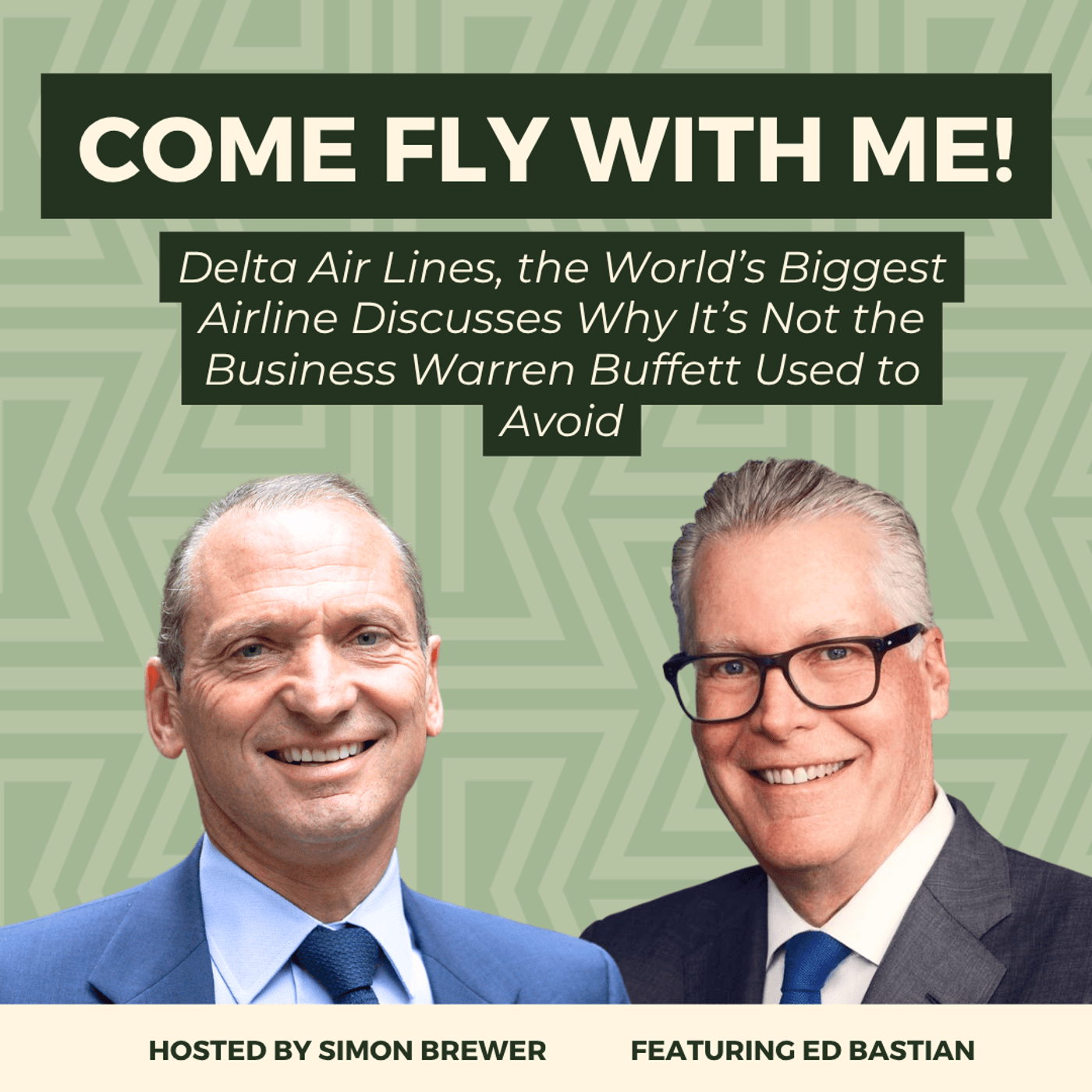
Delta Air Lines’ CEO Ed Bastian argues the airline business is becoming more investable than Warren Buffett’s past “terrible business” view, driven by premiumization, brand moats, higher customer willingness to pay, and rising barriers for low-cost entrants. He also discusses Delta’s international growth plan, loyalty economics (SkyMiles), and non-seat revenue growth (MRO, cargo, onboard retail/Wi‑Fi).
Guest backgrounds
Ed Bastian is Delta’s CEO; he joined Delta ~30 years ago as an accountant (PricewaterhouseCoopers), later became CFO, led restructuring after the 2005–07 bankruptcy following 9/11 and the Northwest merger, and helped restore investability. He frames Delta as a “virtual circle” of people → service → customer loyalty → capital.
Key claims
Delta has ~1,400 planes, 16,000 pilots, 1,000+ destinations, ~200M customers/year; ~80% of US customers now choose Delta for brand/service (not lowest price). Delta’s stock rose from ~$17 during COVID to ~$90; it regained investment-grade ratings. SkyMiles/Amex partnership is “sticky” and grew to ~$10B+ annual value; SkyMiles can be used as a currency across partners. Industry entry is harder post-COVID due to fuel, pilot shortages, airport costs, and aircraft/engine supply constraints.
Notable examples
Delta One premium cabin (about one-third of new aircraft); Atlanta–Riyadh launch; withdrawal from Dubai after Middle Eastern carriers lowered prices; Spirit bankruptcy; Jet Zero blended-wing fuel-efficiency concept; Amazon LEO Wi‑Fi deal starting 2028; MRO third-party maintenance as a growth lever.
Written by AI. May contain mistakes. Listen to the episode to check what was said.
Chapters
Tap a time to open that second in VOIntroduction to Air Travel Business
0:00 to 1:17
Explore the dynamics and challenges of the airline industry.
“The air travel business is a sexy business.”
Ed Bastian's Journey at Delta
1:56 to 4:09
Bastian shares his journey and the evolution of Delta over decades.
“which is an unlikely venue for anyone who has seen my golf.”
Delta's Market Position and Opportunities
4:09 to 6:14
Discussing Delta's market share and future growth opportunities.
“Just give us a sense of what I've written, the four Ps, planes, pilot, places, and passengers.”
Understanding the Airline Business Landscape
6:14 to 7:57
Exploring factors affecting airlines and understanding the competitive landscape.
“and commerce to certain countries and start to develop a real presence.”
Delta's Brand Loyalty Transformation
7:57 to 9:19
Examining how customer loyalty has shifted towards Delta's brand.
“And when I started at Delta 30 years ago, if you were to ask people in the U.S.”
The Current State and Future of Airlines
9:19 to 13:00
Analyzing the airline industry's recovery post-COVID and future prospects.
“We have grown our market cap when we went through COVID.”
Shifting Towards Higher Returns
13:00 to 14:01
Identifying the shift towards higher returns for successful airlines.
“So the problem for investors is they're often trapped by looking in the rearview mirror.”
The Shift Towards Premium Experiences in Airlines
14:01 to 18:10
Learn how Delta has focused on enhancing the customer experience to compete in the airline industry.
“And the reason why is those airlines are focused on the customer and they're focused on their brand and the service quality that they're providing, not just their transportation company.”
The Shift Towards Premium Experiences in Airlines
18:25 to 18:47
Learn how Delta has focused on enhancing the customer experience to compete in the airline industry.
“They're designed to be active, not reactive, so investors can target enhanced returns and achieve better long-term outcomes.”
Challenges and Opportunities in the Airline Industry
18:47 to 28:00
Understand the evolving landscape of the airline industry post-COVID and Delta's competitive strategies.
“I had written down reduced turbulence, by which I meant competition.”
Show all 18 chapters
Delta's Global Market Strategy
28:00 to 31:38
Explore Delta's expansion into various global markets and the challenges they face.
“We launched back into Hong Kong recently.”
Aircraft Manufacturers and Innovations
32:30 to 36:10
Discussion on aircraft manufacturers and the need for technological advancements.
“And if we look at the world of plane manufacturers, Boeing, Embraer, Airbus, and then you run out.”
AI and Augmented Intelligence at Delta
36:10 to 39:45
Insights into how Delta uses AI to enhance operations and decision-making.
“We had an episode a few weeks back with Kyle Clark of Beta Technologies, and he's running one of the top electric aircraft businesses.”
Future Revenue Streams for Delta
39:45 to 42:03
Examination of Delta's evolving revenue sources beyond traditional airline seats.
“Looking forward, five plus years, what percentage of your revenues might come from activities other than selling airline seats, and what will they be?”
The Future of In-Flight Connectivity
42:03 to 45:42
Learn about Delta's innovative strategies for enhancing in-flight services and customer experience.
“And now, any airplane you get on in the US and most parts of the world, people now are expecting.”
Rapid Fire Questions with Ed Bastian
45:44 to 48:22
Hear Ed Bastian's insights on the airline industry and personal reflections in a quick Q&A format.
“So as we make our final approach, I got six rapid questions for you.”
Complacency and Continuous Improvement
48:22 to 50:13
Understand how Delta's leadership maintains a culture of growth and innovation to avoid complacency.
“Well, Ed, maybe when future business historians discuss Delta's success, they'll conclude that you built a great airline and that you reinvented maybe what an airline actually is.”
Final Observations on Airline Industry Trends
50:19 to 51:03
Explore key trends affecting the airline industry and Delta's future prospects as discussed by Ed Bastian.
“So I'm going to conclude with four observations.”
Transcript
Automatic transcript. May contain errors.0:00The air travel business is a sexy business. It's a business that people pay attention to. My good friend Sir Richard Branson says the best way to become a millionaire is to start as a billionaire and buy an airline. They absorb a lot of capital and they can lose a lot of capital fast. We're the number one business partner of American Express and they are our number one business partner. Every plane we take today is generally about 25 % more fuel efficient than the planes that we retire. Aircraft manufacturers is probably more to the engine that many of their predecessors had. None of them have come out and announced what their new product is going to be.
0:36What's the next generation going to look like? I don't see the shape of air travel changing much because none of them are investing tens of billions of dollars it's going to take to create all new platforms. We need to continue to keep climbing. That's our tagline. It's keep climbing. We need to always get better because we know everyone is chasing us. Airlines are a terrible business. They're capital intensive, unionized and heavily regulated. There's very little moat. So said Warren Buffett at some point in the past. But is that still true? And if you look at the share price of our guest firm today, you might question that.
1:17So the aim here today is to examine the thesis for investability, to understand the direction and shape of flying, economics, competition, premiumization, the case for a moat or a structural advantage, what customers want, and the increase in price tiering and possibilities. And to seek these answers, we're extremely fortunate to welcome the CEO of the world's largest airline, Delta, a leader regarded as having driven one of the most successful aviation stories in what continues to be a fast-moving but fractured industry. Ed Bastian, a very warm welcome to the Money Maze podcast. Simon, good to be with you.
1:55Well, we met 11 months ago at the Irish Open Pro-Am at the K Club, which is an unlikely venue for anyone who has seen my golf. But Bob Bradway, CEO of Amgen, former guest and colleague of mine at Morgan Stanley, very kindly put us together. I think you might sit on his board or you know each other from board interactions. And in looking at Delta, I think you might be celebrating 100 years of age. this year or thereabouts. And I see that passenger operations began from Dallas, Texas to Jackson, Mississippi. You acquired Pan Am's transatlantic routes. You were the first airline in 97 to carry 100 million passengers in a calendar year.
2:33But the airline went through bankruptcy and restructuring in 05 to 07. And you arrived, as we're going to talk about, and the subsequent restructuring and takeoff has been quite some story, which seems to prove the investor conundrum that slogans are easy, but investing profitably is hard. But let's start in the control tower with you, Ed. Background, rise and reasoning. When did you develop your own flight plan? Well, it's almost 30 years ago when I joined Delta. I started as an accountant. I was a Pricewaterhouse. And from there, was recruited away by PepsiCo. I spent a lot of time traveling.
3:14And a friend of mine said, you've spent so much time on an airplane, you might as well work for the airlines. And coincidentally, six months later, Delta called and gave me that opportunity, which I gladly took. And I've been here ever since. Started in the finance world. I was CFO of the business, led the restructuring after the bankruptcy following 9-11, merger with Northwest Airlines, considerable amount of work in terms of trying to prove that this is an investable business. And it's great that you opened up with Mr. Buffett's warning about an investment, the Surgeon General's warning, as we like to call it, about it could be dangerous to your wealth.
4:00But Mr. Buffett and the Berkshire team just came back into Delta within the last number of months. So I think we're doing a good job. Fantastic. And I didn't know that. So that's great. So let's start high. I'd like to confirm the Delta data. Just give us a sense of what I've written, the four Ps, planes, pilot, places, and passengers. Well, we did celebrate our 100th anniversary last year. We're the first US airline to reach 100. There's a few European peers that are slightly ahead of us, KLM, I think being one of the oldest. But we have close to 1 ,400 planes, over 100 ,000 employees, 16 ,000 pilots.
4:43We fly to over 1 ,000 destinations. And we have about 200 million customers a year that we serve. Wow. So let's jump to my second vector, the economics of the airline business. And just help me, is this statistic right? that only one in five people around the world have been on a plane. It is right. And it's the opportunity for us in our second century of flight. Here in the States, we are a large airline in the US. About two thirds of our overall business is done in the US. So the opportunity for us is really not as much continued growth and expansion within the US, but continue to move outside the U.S.
5:31boundaries. And when you think about that stat that only one in five people have ever stepped foot on an airplane, it tells you there's ample opportunity for us to look to grow. And growing in some places that we today are not in. We're not in the Indian region in South Asia. We're looking to expand there, grow there. We're launching a new flight to Riyadh, direct flight from the U.S., from Atlanta to Riyadh in the next couple of months. We're growing into whether it's New Zealand or back into the Philippines and Manila, Africa, South America. So there's a tremendous opportunity for us to take this brand.
6:13And when you talk about moats in business and opportunities, those are real moats because you're able to capture your customers early in whether they're flying history or opportunities to bring unique adventure and commerce to certain countries and start to develop a real presence. So we're going to talk about a few of those. I mean, I guess the questions I went through aviation history briefly was Pan Am, TWA, Eastern Brand, America West Spirit, People's Express, Laker, Dan Air. I flew a few of them. You know, was there one or two reasons collectively that they all aren't around today? I think there's several.
6:55I think one that they are, the air travel business is a sexy business. It's a business that people pay attention to, they like to enjoy, can, as a result, attract capital. My good friend Sir Richard Branson says the best way to become a millionaire is to start as a billionaire and buy an airline. And so then they absorb a lot of capital and they can lose a lot of capital fast. So you have to be careful as to how you think about an investment strategy. In the U.S., the model for many, many years, unfortunately, and I think it's true to this day in parts of Europe, it's a commodity. Whoever has the lowest cost can offer the lowest price is going to win.
7:40That doesn't work in terms of building an investable model. You need to have a brand that has a premium offering, an opportunity to have consumers who are attracted and will invest alongside you, which will then bring the capital required by your investor base. And when I started at Delta 30 years ago, if you were to ask people in the U.S. why did they choose a specific airline, over 80 % of them would say whoever had the lowest price. price clearly was not just the number one, it was the number one, two, three reasons why individuals chose an airline. Today, if you ask an individual, why did they choose Delta?
8:21Over 80 % will say because it's Delta. It's a brand I'm loyal to. It's a brand I have an allegiance to because of the quality of the service, the quality of the performance, the reliability, and the opportunity to continue to build relationships outside, not just your flying, but whether it's loyalty or other opportunities that we bring. But before we leave the industry, is it fair to say that Delta is a strategically powerful airline inside a still fundamentally troubled industry? I would say the industry is doing a fair bit better. COVID changed a lot and COVID brought us all to our knees. And I think the airlines such as Delta who were consistent with the strategy about investing in a brand on the back end of COVID, not just previous to COVID, those airlines and Delta is the leader in that are doing quite well.
9:20We have grown our market cap when we went through COVID. I think our stock price dropped to about$17 a share. That's when our friends at Berkshire sold. today, our stock price is$90. So if you look at over the last six years, we're up 5x in terms of share price. So I think that's a pretty healthy gain. And it tells you that people see that we're disciplined about how we're running the business. We're continuing to pay our debt down. We've got our investment grade ratings back from all the big Wall Street houses, one of the only U.S. airlines that can say that. We are a leading brand, not just in the airline space, we're a leading brand in the consumer space within the US.
10:06And our demographic is the upper end, the premium end of the marketplace. We talk about the K-shaped economy in the US a lot. And the upper end of the K belongs to Delta. That's where our people live. So they have the means, they have the discretionary income and they have the desire to travel. So I hadn't had the chance to talk to Warren Buffett, clearly, because I didn't know he'd come and invested in your company. But when you talk about barriers to entry, it is interesting. I think the US beer industry, two corporations run 90 % of beer brands, half of the nation's banking assets are run through five banks, three out of four US households have only one option for high speed entries.
10:44Would it be fair to say that, if not monopolies, but regional control has become a hallmark of the airlines that tend to dominate in the US now? Well, you have four big airlines in the US, all who have within the US similar market share. You have Delta, you have United, American, and Southwest. Southwest is a little different. That's more of a local. That's more of a US, more of a discount model. But all four of us have similar market share, or somewhere between 20 % and 25 % market share. And the rest of the industry has somewhere between 10 % to 20%. So any market that you have four big players that are very competitive, that all take up kind of rough size, they have scale, and they have all similar opportunities, I'd say it's not by any means a monopoly or duopoly.
11:40I mean, it's really what we do with the assets. and how we perform that separates us in that. If you look at the market cap of Delta today, for example, the market cap of Delta is greater than United, American, Alaska, and JetBlue all combined. But yet we have a similar size network. Our revenue base are all fairly comparable. So what it tells you is the performance of the company, the performance of its people in terms of service, it's what's the differentiating factor, not the fact that we have big moats that we put up with walls around our airbots. Yes, we have a great franchise in Atlanta, great franchises in New York and Detroit, Minneapolis, Seattle, Salt Lake, Los Angeles.
12:28Those are all important markets for us, but those are markets others can access. In the airline industry, the only thing that separates one airline from another is the people and the culture of the brand, of the airline. And that's where we win. Our people are the very, very best. And they do the very best service and they get rewarded the best. And so we call it the virtual circle. You take care of your people. They take care of the customers who reward you with the loyalty to attract capital to continue to grow that business. So the problem for investors is they're often trapped by looking in the rearview mirror.
13:04and you can, you know, the aviation industry, I think, has never in aggregate earned its cost of capital. But now there are some differentiating factors. So I had a chat with Pete Davis of Lansdowne. You may know one of the UK's most successful investors. I've been with Pete, you know, for a long time. He has a position, you know, in your company, wrote about it in his quarterly report. He made a couple of really interesting, he showed some pricing, Pan Am's international fares in the 1950s. So London was$548, Zurich was$615. So, you know, We've had sustained price decreases in real terms for a long time.
13:39And are we now getting to the point, given where Delta's return on invested capital is, and you look at Orion Air for their financial operating model, which is very different at a customer level, but as an operating model, would you say that we might be on the threshold of a shift to higher returns for the winners? No question about it. And the reason why is those airlines are focused on the customer and they're focused on their brand and the service quality that they're providing, not just their transportation company. Transportation is what we do, but it's the experience we bring that defines who we are.
14:21And those companies that have that ability to continue to bust through the commodity aspect of a business so that we're not being shopped on price any longer, but we're being shopped on the experience, those are the winners. And we have let that charge, Simon, for the last 15 years in the US. So this is not an overnight sensation. As I mentioned, the pandemic knocked us back for a little bit, but we've recovered nicely. And actually, I think it propelled us as we came out the other end. And we've got a consumer base that's hungry for adventure. It's hungry for experience. And that's also a differentiator.
14:59You've never had the demand set to travel and the interest in travel at the higher end of the curve, particularly willing to invest and spend the monies required to be able to pay for all the service that we deliver. In the past, we've discounted it because we wanted to make sure that we were able to fill up the planes. We've moved the geography of the planes around, so we're providing a more premium experience, a more premium product. Delta One, every new plane we bring was one third of the entire plane is in the premium cabin sections. Very different than Orion Air, obviously, as you mentioned.
15:41And that premium model, we've had to shift our business model. So when you talk about the past to the present, we don't look anything like what we did 20, 30 years ago when I started this business. So this, I have written down premiumization. And I notice, I do fly a fair amount. I've noticed that the BA business cabin seemed to be longer. I've noticed that EasyJet allowed you to buy a middle seat so you could put your bag there and not have somebody right on top of you. Even Wizz Air, not that I've flown them, I think have business class. So you mentioned the K-shaped economy, but I wrote down what does the customer want?
16:18But I guess you have different customers. So how do you think about those people who use Delta? Well, the most important thing that customers want is the quality of the experience. They want from not just an airline, but particularly Delta, they want a highly dependable, reliable service. They want hospitality delivered, not just travel logistics. They want to feel like they matter to the airline and there's a relationship. That the brand brings more than just travel. The loyalty perks, for example, our relationship with American Express is a standout around the world. We're the number one business partner of American Express and they are number one business partner.
17:00This year alone, American Express will pay Delta$9 billion for use of the credit card and the miles that they put on the credit card. And you talk about a differentiating experience that never existed years ago. It doesn't exist in Europe because of the banking and the credit differences and the regulatory apparatus. So customers want experience. And if you can provide a great experience, they're willing to spend the money it takes to deliver that. IFM Investors is a global asset manager founded and owned by pension funds with capabilities in infrastructure, equity and debt, private equity, private credit and listed equities.
17:45They believe healthy returns depend on healthy economic, environmental and social systems. And these are evolving on a scale never experienced before. To find opportunity, build value, and meet the needs of future generations, you need scale, skill, and expertise. That's what IFM Investors has built up over 30 years. Does your investment portfolio need an active boost? The Money Mears podcast is sponsored by JPMorgan Asset Management, Europe's leading active ETF provider by Assets Under Management. JPMorgan's ETFs are powered by a century-long commitment to active investing and are truly global investment platform.
18:26They're designed to be active, not reactive, so investors can target enhanced returns and achieve better long-term outcomes. Discover why JPMorgan Asset Management is the home of active ETFs. Search JPMorgan Active ETF or tap on the link in the notes to this episode to find out more when you invest your capital at risk. I had written down reduced turbulence, by which I meant competition. Now, in reading your most recent report, I got the impression that the industry has changed and it's much tougher for new entrants now to gain a foothold. Just explain what's been going on. So, particularly in the US, but I think it's happened around other parts of the world.
19:12And a lot of this, again, is post-COVID, is the cost of entry has gone up substantially. Again, you can't be a commodity provider if your costs are going up. You look at what's going on with fuel alone. Fuel has gone up dramatically over the last number of years, and it's up again with the impact of the war going on, jet fuel particularly. When you look at the cost of pilots and people, the fact that we had in the US a real challenge, having enough qualified pilots, because a lot of the people retired during COVID. And what happened is those pilots that worked at the lower end carriers wanted a better experience after COVID to work for an airline like Delta.
20:00So many of them left their jobs and came to work for Delta, the higher end experience, which brought not just the the overall industry upscale, it brought wages up too across the industry. You look at the cost of airports, you call the investment required in airplanes. You look at the fact that the OEMs, Boeing and Airbus particularly, but also the engine manufacturers haven't been able to produce as much supply to the market for issues that are well documented. So there's been a bit of a cap on capacity coming in, new capacity to the marketplace. All of those things work to hurt a carrier that is built on high growth, low cost, and kind of a lower end product.
20:49In the US, now again, Ryanair is a different model in Europe than in the US. There's not really a comparable Ryanair within the US. But in the US side, and as a result, you've seen companies like Spirit go bankrupt and disappear, liquidate just a couple of months ago. So you've got to be disciplined. You've got to be able to get your cost met. You've got to be able to provide a product that people are willing to pay. And as Delta has been changing the consumer mindset, airlines are trying to now copy Delta to stay up with us so that they can make sure that they're getting the same returns and the same revenue share.
21:27And so whether it's United, American, even Southwest, we're all talking about becoming more premium as a brand. I got it. I want to go back to that SkyMiles, your frequent flow program, because it becomes such a big, you said, approaching 10 billion. I know that you've been commenting on that. Just talk us through what was the opportunity you spotted and exactly how it works and why it seems to be quite a sticky asset to have. Well, the US credit card industry and consumers in the US have a lot of choice for what cards they use to pay on. And many credit card companies give you cash back. They'll give you 2 % or 3 % off.
22:11There's an assortment of goodies that you receive. The thing that we know is that consumers value and want to travel more than just getting 2 % or 3 % back on their spend or any of the other bundles of things that credit card companies are offering. And our relationship with American Express has been for 30 years. So we've been at this for quite a while. But again, we started the program 30 years ago, 15 years ago. Maybe that comparable number was in the$1 to$2 billion range. Just in the last decade, it's gone close to$10 billion. And the reason for that, I believe, first of all, Amex as a brand is a highly effective brand.
22:55And it has an aspirational component to it. It's going to younger audiences. And all of our young consumers, Gen Z, Gen X, millennials, all these people that have entered into the workspace in the last 20 years feel like Amex is the brand that they want to carry as their credit card provider. And they identify with it. They also identify Delta as the aspirational brand, the premium brand in the travel space. One of the things that consumers that are younger is they want to travel. They want to explore and they can use their credit card to buy things and get the opportunity to then go travel as a result of that.
23:31We saw some during COVID when people were not allowed to travel, when the skies were closed, yet people were home shopping and buying things and using their credit card. We saw a big pop in our revenue base from the AmeriExpress SkyMiles program because people wanted to have that currency to utilize when they return. The currency is one of the things about air travel and currency is that it's priceless in a certain way. You can use that currency for whatever you want to use it for. We've made it so that we're agnostic as to you can use miles or dollars and made it very easy for people to use it as a free-flowing currency for our brand.
24:17And when people think about air travel, they think about the destinations and the places that they want to see or the friends they want to meet or the places they want to go and learn or play golf even in the UK. And they don't really attach that to kind of the cost per se, the dollars, because they have the miles. They have the miles in the bank that can go do it. And it accrues value to them. And many of the people will take those miles and they'll keep it in their wallet. They'll keep it in the bank and not spend it. And they're going to save it for a few. And then it compounds as they continue to grow and build more and more affinity with the brand.
24:56So it's a very, very sticky currency. We have many partners that we provide offerings, whether it's Uber, T-Mobile, the telecom company here in the U.S., others that we are working with, Starbucks, where you can actually get the currency and use the currency on their brands and bring their customers. into our ecosystem as well. So you see this growing sphere of influence that's coming in terms of where travel and Delta sits in the middle of it. And so as a result of that, the value, the performance, the power of the SkyMiles are much bigger than what Delta has. That's all the brands. And by the way, you can also use it on our international partners, Air France, KLM, Korean Air, Aeromexico, LATAM, go across the world, Virgin Atlantic.
25:45Well, you can use the SkyMiles on. So it's something, again, that has changed versus the old model. And it's one of the reasons why investors would look now at Delta and say, hey, this is not just an airline. This is also a loyalty play. And the loyalty play has real sticky value. And we've seen the stickiness. Even during COVID, when we were having a hard time raising capital for the business because of what was going on. we were able to go and raise a substantial over$10 billion against the currency, against the SkyMiles themselves. It's the first time we have done something like that. And at that valuation, I think they put the value of the currency at close to$30 to$40 billion currency alone.
26:31So that's very clear. Thank you. And if we get back to this international trajectory that you're on, there are a lot of places that you fly to. I've taken the Virgin, which I think you earn 49 % of. I've taken Delta from LA to New York. You're competing with some operators that don't appear to have the requirements of financial returns. I'm thinking about the Middle Eastern carriers, particularly because they're operating with other aims and ambitions. How do you prioritize where you want to allocate capital internationally? We want to go where our consumers and principally US consumers want to go since we are a global brand, but we're principally a US brand.
27:13The principal consumer base is US. 75 % of our international travel is purchased by US consumers. And that means they want to go places that they know and they've heard about. So, Europe for the last number of years continues. I was over in Europe a couple of weeks ago for visiting a lot of Americans. And I was in Croatia, I was in Portugal, the American health of the dollar and the strength of the US economy continues to push people out. People want to go to Asia. Asia was a place that I think a lot of Americans are starting to discover. Going to Australia, going to New Zealand, going back to Hong Kong.
28:00We launched back into Hong Kong recently. South America is another place there's a lot of interest going into whether it's Argentina or Brazil or Peru, Colombia, and we have partners that we work with and we fly directly to all those markets. So those are the markets. Middle East is a white spot for us. We're going to be launching into Riyadh. Tel Aviv, we do serve. And I think India is probably the next spot in that. We used to be in there. We haven't been there for a number of years. I think we're going back. And we do watch, you know, we go look at places where the Middle Eastern airlines, for example, are owned by their governments.
Read the full transcript
28:38We used to fly to Dubai. We don't fly to Dubai any longer because they ran us out. They just raised the cost of entry by lowering prices so deeply when they saw Delta come in and they could absorb it. And so we had to pull out, which is, by the way, a good thing and also a challenging thing about the industry. Our means of production has moved. It's not like we have a storefront or a hotel on a block or a factory in a certain market. All of our assets move around. So if we see something that's working, we go there. But guess what? The competition sees that and they try to move their assets there.
29:16So there's always this constant network game going on as to who can build a stronger local presence, who can get there first and sustain itself. And when you have governments competing against private capital, that misbalance, we try to stay out of those markets. So if we take the specific example, I think I'm right. You own 49 % of Virgin, correct me if I'm wrong, and other partners like KLM, et cetera. What have you learned from those partnerships? Oh, we've learned a lot. First of all, we're U.S. And we have a view as to what the U.S. consumer wants. But learning how to serve an international audience, a British audience, a French audience, a German audience, a Korean audience requires culture and learning and training that we do with our partners so that we can adapt our international service models.
30:09We're still going to be a U.S. airline and a U.S. carrier, but have better understanding as to how to sell on the market, how to deliver the experience, whether it's on board or in the marketplace. And they learn from us as well because their local consumers want to go back to the U.S. because that is the healthiest economy in the world. And that's still where they want to pull. The Chinese, for example, we've got an ownership stake in China Eastern, one of the big Chinese airlines. We've learned a lot out to how to serve within the Chinese market and vice versa. You don't have, you know, these partnerships are not there to try to replace one another.
30:53We're never going to try to copy what Virgin Atlantic does. Virgin Atlantic has its own unique brand, but they have to complement what we do so that we, you know, you see the Delta brand, you see the Virgin brand. I get it. It makes sense because we transition and transfer customers back and forth. Virgin will fly X number of routes to the US, will fly X number of routes to Heathrow. And many times, a consumer may take Virgin over to New York and Delta back. We provide that opportunity. In times of economic and geopolitical volatility, investors will look to gold. Today, as the world navigates uncertainty and heightened risk, investors of all sorts will look to safeguard their wealth.
31:38We're thrilled to welcome the World Gold Council as one of our sponsors. Tap the link in the show notes to learn more or visit goldhub.org on your browser for comprehensive research, insights and analysis on the global gold market. The Moneymates podcast is proudly sponsored by the London Stock Exchange Group, a global leader in financial markets infrastructure. LSEG has a rich history of facilitating capital flows, empowering businesses, and connecting investors to opportunities. Today, they provide world-class technology, data, and analytics, playing a critical role in shaping modern finance.
32:15From their role in sustainable investing to their contributions to financial innovation, LSEG is helping to build a more connected and efficient market. Visit lseg.com via the link in the show notes to see how they're driving the future of finance. So all of this requires planes, as you hinted at. And if we look at the world of plane manufacturers, Boeing, Embraer, Airbus, and then you run out. If Boeing, Airbus and Embraer each had to fix one thing to win more of your business, what would it be? Well, they're all different. Embraer is a smaller model, and Embraer doesn't have a lot of competition in the smaller model space.
32:59So they don't have a lot of—I told Embraer, just keep doing what you're doing, because we lost Stubb Bombardier to the manufacturer of the small plane. So they're doing quite well down in Brazil. Boeing's had a history of reliability issues. started 20, 30 years ago back to 777s and 787 and the MAX. And the thing that we always talk to Bong about is the delivery, is the reliability, the performance of the aircraft, then continued investment in the quality of what they're producing. And they're getting more stable. They're getting better in that regard. And for Airbus, we've become Airbus's largest customer in the world.
33:44I mean, we are, you know, this is 15 years ago, we didn't have any Airbus. And today we have almost 500 Airbus planes that we fly. So we've become quite close to Airbus. I'm always encouraging them to continue to build, you know, some new technologies to provide greater fuel efficiency. To be able to, every plane we take today is generally about 25 % more fuel efficient than the planes that we retire. We need that efficiency to continue to expand and grow. And the other thing with the aircraft manufacturers is probably more to the engine manufacturers than the aircraft themselves. Their ability to provide quality service from the Pratt-Whitney and General Electric, Safran is in the business.
34:32Rolls-Royce is in the business. Our industry has had a lot of difficulty with all the new engine platforms that have come forward. They don't have the longevity on wing that many of their predecessors had. And that's a problem when you're making the investment that we are in their product. And before we leave them, is there an argument that because they're, if you like, enjoying the luxurious position of there not being enough supply around, that they are not as thirsty for technological advancement as perhaps you would like? I, you know, none of them have come out and announced what their new product's going to be.
35:11What's the next generation going to look like? So when people ask me what the future of air travel is going to look like 20, 30 years from now, it's going to look a lot like it looks today. Hopefully, maybe better hospitality and better amenities, better technology deployed on board. But I don't see the shape of air travel changing much because none of them are investing the tens of billions of dollars it's going to take to create all new platforms to change. And there's a number of airline startups that are looking at a very different fuel efficiency model. You have a company called Jet Zero that looks promising using a different wing design, a blended wing.
36:00The plane looks a little odd, but it says they could deliver 50 % fuel efficiency. That's interesting to us. So those are the things that we need. Got it. I'm not sure. We had an episode a few weeks back with Kyle Clark of Beta Technologies, and he's running one of the top electric aircraft businesses. But of course, it's a long runway, but they're making some fantastically looking planes and efficiencies, et cetera. But I guess electric aviation isn't going to be transforming businesses like yours anytime soon. If we talk about technology and AI, you have coined the phrase, it's augmented intelligence, not artificial intelligence, that is most important sort of item you're dealing with in technology.
36:49How do you think it's going to help your business the most? I think AI can be an incredible opportunity for us to put better tools in the hands of our people to use. When you think about our business and just this course of the conversation, we've talked a lot about a lot of the complexities of air travel. And when you get to not just the fuel efficiency of the planes and managing large staffs of people, very expensive staffs of people. When you think about congestion in the sky, turbulence in the sky, the technology, the modernization that's required just from the air traffic control perspective, there's a lot of things our people have to deal with over the course of the day to make the 5 ,500 flights a day every day that Delta flies work.
37:41And every day is different. There's some things happening in the environment, in the world that changes. So more technology is going to help us make better decisions. I think a lot of the technology platforms we use today for analytical or decision making is based on backward looking data. What's the historical to try to predict the future? I think the opportunities for us are technologies that will be more predictive of what will happen, not just what's happened, but what's new and what will happen going forward to put our people in better decisions. So to make the flights fly smoother, whether it's turbulence, whether it's for us, more efficiency in terms of reducing the amount of congestion we run into, to be able to make scheduling work better for our people, to make consumers give them more choice and more control of the experience.
38:39Technology is an enabler, and it's our lifeblood. Our people are the reason we're number one, but it's the technology that's the lifeblood that they use to do what they do. If we can make them smarter, we're going to win. And I call it augmented intelligence because there's such a trust issue around AI and what AI really is and what's it going to do. And there's far more hype than there is actual proven cases of the amount and the amount of investment going in. And it dominates every news cycle that you look at. And I don't think it'll ever achieve close to its promise if they don't solve the trust concerns.
39:25Because people need to use the technology to improve the quality of their life, the quality of their job, the quality of what they're selling. And at Delta, I've said AI will never replace our people. Our people are our number one advantage, and we're going to use AI to make them smarter and augment their decision-making, but it's not going to replace them. You mentioned earlier on about other sources of revenue. Looking forward, five plus years, what percentage of your revenues might come from activities other than selling airline seats, and what will they be? Well, one of the big ones is our MRO, which is our maintenance and repair organization.
40:03We do third-party maintenance for many airlines today where business is already well over a billion dollars a year in revenue with a very nice margin. I could see that business tripling over the next five to 10 years easily in producing a significant margin contribution using our own assets, our own people, and being able to better utilize them. And again, technology is going to help us along those lines. We look at our cargo business, and we've been growing our cargo business. So it's not just the customers we serve on board, but it's the bellies that we fill. We're taking goods and services and product over.
40:43And AI actually has been a beneficiary for our cargo business because with all the investment going on in data centers and hyperscalers requiring a tremendous amount of material and product, We've been sourcing them from all around the world, bringing them together. And when I think about our total revenues, Simon, in the past, it was almost all principally in the main cabin of the aircraft. It was over 80%, 90 % of the revenues of the airline. Today, if I exclude the premium offerings, the premium product, the loyalty offerings, these other third-party sources of revenues, 60 % of our total revenues are coming from the non-main cabin part of our business.
41:29And these are all not commodity business. These are all premium product offerings of their own ilk. And that's another reason why we're more differentiated, we're more durable, and we have staying power in terms of our investment case to the street. And when we talk about retail, those of us who have flown forever, remember the trolley coming down, trying to sell us duty-free drink or a watch or whatever, all looks pretty amateurish right now. How might retail in the air or on the ground prior to going change as well? Well, we have brought free, fast Wi-Fi. We've been a pioneer in this space. And now, any airplane you get on in the US and most parts of the world, people now are expecting.
42:15Wi-Fi that works, Wi-Fi that's free. It's seen as a utility. It's not so easy because of the satellites and the technology deployments, and it's very expensive to provide that. We've announced a deal with Amazon where we're going to be going on their LEO platform, the low-Earth orbit platform, starting in 28. And one of the reasons we're doing that is not just to get the improved quality of satellite experience that Leo and Amazon will provide us, but you're doing this now with the backing of the largest e-commerce company in the world with Amazon. And so whether it's retail, whether it's bringing video, TV, entertainment to our customers, whether it's bringing education, all forms of offerings that can sit while you're a consumer.
43:09You think about how bad the experience is from the airlines as a marketing company. You've got your customers on your plane. No one can get access to them. You've got them seat belted in. They can't go anywhere. And they're all facing in the same direction. And they're bored out of their minds for anywhere than three to 15 hours, depending on the journey length. And how can you not figure out a way to actually better sell, better utilize, better serve customers? That's what Wi-Fi unlocks. And those are the products together with our partners at Starbucks and T-Mobile and Paramount Pictures and Amazon coming up and Uber.
43:53Well, there's just a host of things that we can provide services and opportunities in retail to while you're in that seat, which, you know, you don't need a trolley with bottles of liquor running down the aisle. You actually have your full platforms, which we want to be able to give you a chance then to use your currency, the SkyMiles, because you have to make it unique because you can do that at home today, right? You say, well, what's different in the sky? What's different in the sky is you can make unique offerings only while you're in the sky. You can bring new platforms like the Wall Street Journal, for example, or other news material that may require a subscription.
44:34We have those for free on board our systems for our customers. Or you can bring the opportunities for them to use the currency and only while they're on the plane. We're even starting something with DraftKings, which is a gaming model here in the US. And while the regulators are telling us you're not allowed to game on the plane, and we're not gaming on the planes, but people do like to game. They like to sell or compete against others and see if there's prizes they can win. And we're experimenting in that. You think about the international waters with cruise ships and all the casinos that go on.
45:11Well, technically, we probably could do that in the sky and provide offerings or live TV, flying internationally. Think about how great that would be on those long Asian trips if you had the opportunity to watch live TV from different parts of the world. I mean, so that's not the future future. That's in the next few years that we're looking at. And I think those are the things that, again, those that get there first with real quality, it's going to make that brand attachment, particularly with our younger consumers. all the more vital. That's very clear. Okay. We were on a tight timeline today.
45:47So as we make our final approach, I got six rapid questions for you. Number one, does the analytical community on Wall Street understand your business as well as you would like?
46:02What lessons have you taken when you've had to face adversity? I look within our people. I don't look outside for the answers. I look within our team. EasyJet, two bids, Apollo's taken them. What does that tell us about consolidation in the industry? It tells you that when you get private assets and smart, sophisticated capital coming in to buy airlines, it tells you that these assets are quite valuable. Got 100 ,000 plus employees. How do you build cohesion and culture? We do it face-to-face. I spend a lot of time on the road, spend a lot of time in front of my people. We spend a lot of time, and it's not just me, but our leadership team, building relationships.
46:49And that's why not only is our culture unique, our employees also largely are union-free. We only have one union, which is our pilots and everyone else. So we act as the shop stewards for our people. And that relationship is why the service reliability is so good for our customers. What would you say to young people thinking about joining the airline industry? I'd say it's an amazing and interesting opportunity. Probably not going to make you wealthy, but it's something that you'll grow in terms of far more wealth outside of the financial. You'll learn in terms of experience, you'll have challenges, you'll meet interesting people, and you'll go places that you've never dreamed of.
47:32And Ed, I know you're a golfer because that's how we started this conversation. Where's the golf course around the world that you most want to play but haven't yet? I think they probably sit close to where you are over in the UK. I mean, I know the golf, whether it's in England or Scotland or Ireland, there's quite a number. I've played only a few courses over there. So you could probably tell me some of those courses. My great business partner, World Champion, is both a member of Birkdale and Muirfield and St. Andrews. So, you know, we can, if you fly us there, we go play, okay? And my final question, which is, of course, the most selfish of the lot, is how do we get the money maze on your videos so people can watch it when they fly?
48:18I think you're talking to someone who can help you. Well, Ed, maybe when future business historians discuss Delta's success, they'll conclude that you built a great airline and that you reinvented maybe what an airline actually is. When I was looking through their expressions and I went to AI, it said, Ed Bastin didn't come up through the cockpit. He came up to the balance sheet, which I thought was a rather amusing way of describing your trajectory. But what I love most in everything that I read that you have said is you said, the moment we feel like we've succeeded, we've lost. and I appended to that, so don't cruise or the air pockets lie ahead.
49:01How do you avoid complacency with your colleagues? Well, we talk about it. We talk about being number one. It's far harder to stay there than to get there. And I use sports analogies and many times great sports teams and franchises will win the Super Bowl or win the championship of their league. But it's very hard to win it a second time or a third time, even though you have the same people that you're competing against many times. And so there's something in the human psychology that once you've won, you've declared that as a success and you think you somehow have the right maybe. And it's not consciously, but subconsciously, you're not as hungry.
49:50You don't work as hard. You don't put in the energy that it took to get to that position. I talk at every one of my sessions with our people, and I do many, many, many throughout the year about the fact that we need to continue to keep climbing. That's our tagline, is keep climbing. We need to always get better because we know everyone is chasing us. We know everyone is envious of us. Everyone wants to take the throne from us, and they're tired of hearing about Delta this and Delta that. And it's our challenge to our team is that we've got to be even better tomorrow than we were yesterday or else we're going to lose.
50:27So I'm going to conclude with four observations. Number one, there is an argument that notwithstanding cyclicality, returns might be moving structurally higher for a company like yours, given what's going on. Because number two, we've got fewer entrants because costs are up and complexity has gone up with it. Number three, consolidation is on the menu everywhere. And number four, we go back to the fact that only one in five people have flown planes. And so there is a secular growth story which should play out. Ed Bastian, thank you for flying with the Money Maze today. Thank you, Simon. Great to be with you.
From the publisher
In this episode, we examine the thesis for investability and try to understand the direction and shape of flying.
Ed discusses the economics, competition, premiumisation, the case for “a moat” or structural advantage, and what customers want.
He also explains why the competitive landscape has changed, why new entrants will find it much harder, the opportunity with retail-in-flight, the extraordinary partnership with American Express via Sky Miles, and the reason why future returns might well be higher than those of the past.
The Money Maze Podcast is kindly sponsored by J.P. Morgan Asset Management*, IFM Investors, World Gold Council and LSEG.
*During the episode we cite J.P. Morgan Asset Management as Europe’s leading active ETF provider by assets under management. This is sourced from J.P. Morgan Asset management and Bloomberg, data as of 30 March 2026.