In short
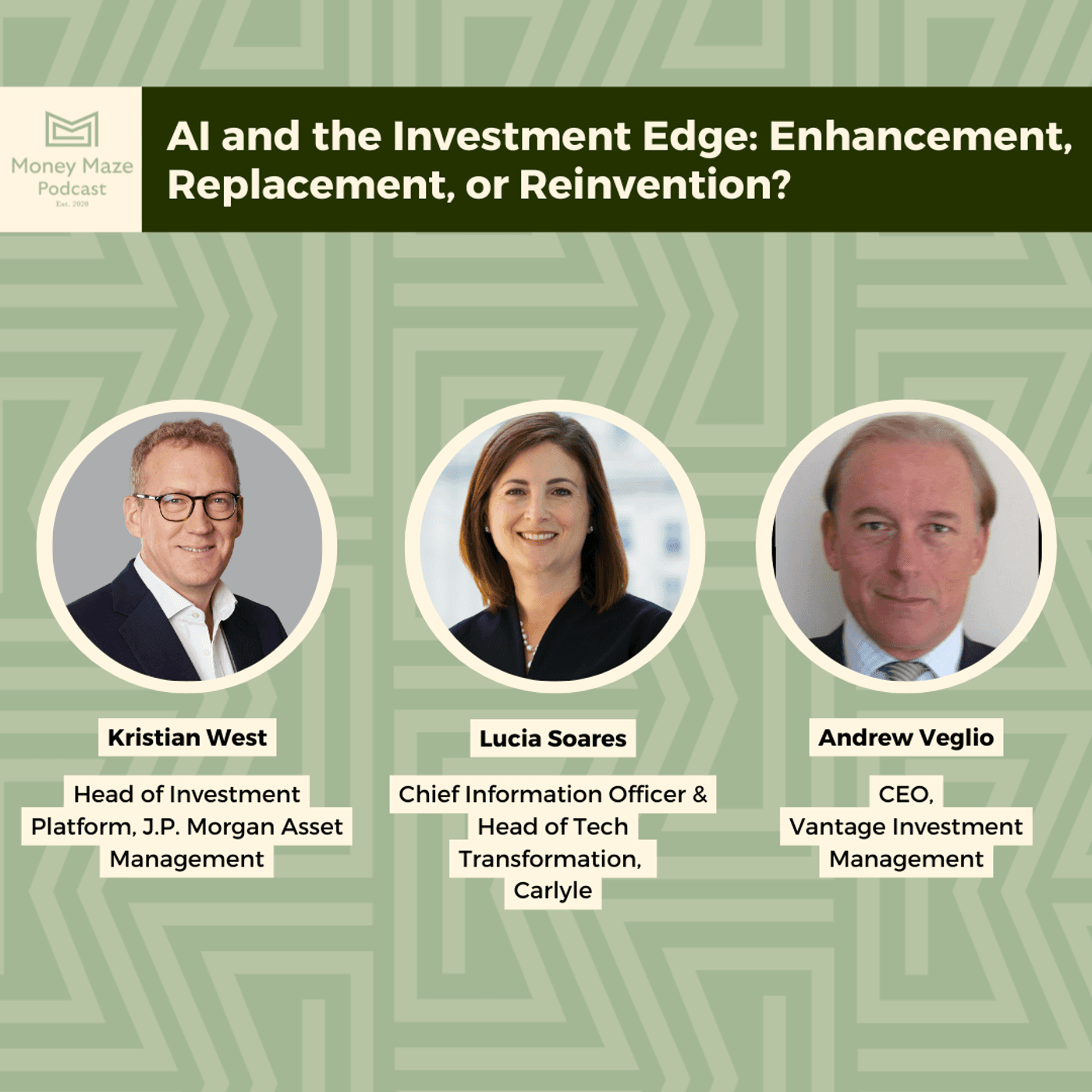
How AI may change investing—tool for productivity vs replacement of active managers—across public markets, trading platforms, and private assets; also how firms are adopting AI and measuring results.
Guests (backgrounds)
- Andrew Vega: former CEO of Vantage Investment Management; previously at Orbis; long-time contrarian investor and researcher.
- Christian West: Head of Investment Platform at JPMorgan Asset Management; background in equity trading (Barclays Capital, Goldman Sachs, JPMAM).
- Lucia Suarez: CIO and Head of Technology Transformation at Carlyle; leads AI rollout across Carlyle and its portfolio companies.
Key claims
- Vega: AI progression implies eventual replacement of asset-management controllers; public markets may see less persistent alpha due to ubiquitous information, while venture/private remain different.
- West: AI is mainly improving research consumption, critique, and trading workflows; “retrieval” is strong, “imagination” weaker; firms can amplify expertise via platform agents.
- Suarez: Carlyle trains employees from day one; AI value comes from faster deal speed, deeper expertise, and earlier risk/value-creation monitoring; use guardrails by combining generative AI with deterministic models.
Notable examples
- Vega cites Turing→Deep Blue→AlphaGo→LLM inference; also autonomous weapons doctrine shift as an analogy.
- West: JPMAM consumes ~7,000 broker research notes daily; uses agents to critique relevant research and runs simulations (“synthetic hypothetical” portfolios).
- Suarez: Carlyle uses generative AI to summarize loan tapes, then Python deterministic code for exact calculations (100,000+ loans per tape).
Written by AI. May contain mistakes. Listen to the episode to check what was said.
Chapters
Tap a time to open that second in VOInterview with Andrew Vega
1:27 to 2:22
Andrew Vega discusses the evolution of AI in asset management.
“I asked someone whose investment acumen around the big shifts of the last 50 years has been unusually and unerringly accurate, typically contrarian and ahead of the crowd.”
The Evolution of AI Technologies
2:22 to 6:12
A detailed look at the progression of AI from Turing to modern applications.
“And if I quote from the first paragraph, you said, I see an accelerating continuum from Alan Turing through Deep Blue, AlphaGo, the development of the Transformer and LLMs to inference through to the path by AGI.”
Implications of AI in Asset Management
6:12 to 10:26
Understanding how AI is changing decision-making in asset management.
“And so now it's getting quite difficult to determine whether these models have consciousness or intelligence or not.”
Implications of AI in Asset Management
10:39 to 11:00
Understanding how AI is changing decision-making in asset management.
“They're designed to be active, not reactive, so investors can target enhanced returns and achieve better long-term outcomes.”
Challenges and Opportunities with AI
11:00 to 14:00
Discussion on the risks and benefits of AI in investment strategies.
“Because there will always be niches where one can focus on intraday or high volume, high speed.”
The Impact of AI on Investment Decisions
14:00 to 21:08
Explore how AI influences investment strategies and market behavior.
“So I think that that is my one observation, that although these answers are, or the information that it produces, I find very impressive and quite reflective.”
The Impact of AI on Investment Decisions
21:39 to 21:56
Explore how AI influences investment strategies and market behavior.
“At the heart of the global economy, LSEG provides data, analytics, an infrastructure that connects investors, businesses, and economies.”
Implementing AI in Investment Management
21:56 to 28:00
Discover how AI is shaping research and investment management processes.
“I mean, you were very early in automating the research process.”
AI in Research Consumption
28:00 to 30:20
Learn how AI enhances the consumption and critiquing of broker research.
“they can also see the confidence scores based on all of the data we have in the application.”
Portfolio Construction Insights
30:20 to 31:40
Discover the challenges of multi-asset portfolio management.
“I mean, equity is probably from a data public market kind of space, one of the easiest to tackle.”
Show all 18 chapters
The Evolution of Trading with AI
31:40 to 36:00
Understand the role of AI in trading and its impact on execution.
“so the third bit and we haven't talked about this in our conversations you know on the money mazes in regards to AI is trading.”
AI's Role in Asset Management
36:00 to 40:00
Explore how AI changes the landscape of asset management and workforce needs.
“And if we take it all the way up to the asset management industry at a high level, this is looking across the spectrum.”
Adoption of AI Across Generations
40:00 to 42:00
Examine how age influences the adoption of AI tools in finance.
“What have you learned about building a platform that can help all of the constituents?”
AI Training and Adoption at Carlyle
42:16 to 44:28
Lucia discusses how Carlyle trains employees in AI and the importance of adoption.
“I read you on the materials that Carlyle now trains employees in AI from day one with 90 % using tools like Chat, GPT and Copilot.”
Measuring AI Impact on Investment
44:28 to 47:23
Lucia explains how AI improves investment processes and decision-making.
“Number one, how we're using AI to drive operational excellence, or I think about how we operate smarter.”
AI in Value Creation for Portfolio Companies
47:23 to 50:26
Discussion on how AI enhances value creation in portfolio companies.
“They are moving swiftly, using the tools, getting outcomes that would have taken much longer previously.”
Challenges and Guardrails for AI
50:26 to 52:47
Lucia addresses the challenges and safety measures associated with AI in investments.
“It's been able to speed services for patients that need to get access to, for example, benefit decisions and so on.”
The Future of AI and Career Advice
52:47 to 54:34
Insights on AI's future and advice for young professionals regarding AI.
“rep lines across multiple dimensions, perform interactive loan tape stratification on loan pools.”
Transcript
Automatic transcript. May contain errors.0:00Kristian West:Few topics are generating more debate among investors than artificial intelligence. Is it a genuine revolution in the way in which money will be managed? Or is it more a productivity tool to help offset areas where margins are under pressure and improve the investment industry's profitability? Can it really deliver more outperformance than the majority of those managing money? And if so, does it threaten to make sways of the active investment managers redundant? Are those managing publicly traded stocks and bonds more vulnerable than those dealing with private assets? And is venture capital the safest of them all?
0:35Kristian West:How are firms adopting and adapting to these challenges? To explore these questions, we brought together three different guests, each approaching AI and investing from a different perspective. Andrew Vega, former CEO of Vantage Investment Management and originally at Orbis, assesses where AI sits in the series of the technological revolutions that we all have seen. and now the one changing the investment industry, and he reaches some stark conclusions. I talked to Christian West, head of investment platform at JPMorgan Asset Management, to see how they are prioritizing and utilizing the vast data sets and capabilities at their disposal.
1:11Kristian West:And then turning to private assets, Lucia Suarez, chief information officer and head of technology transformation at Carlyle, shares what the journey actually looks like from the inside for Kalilah's business, their employees, and their portfolio companies. Welcome to the Money Maze podcast, deeper dive into how AI is transforming our industry for tomorrow. I asked someone whose investment acumen around the big shifts of the last 50 years has been unusually and unerringly accurate, typically contrarian and ahead of the crowd. He was a client of mine at Morgan Stanley for 15 years. At one point, the Wall Street Journal had his equity long short as one of the best performing funds in the world.
1:53Kristian West:And I left to join him at Vantage and worked there for 14 years. And I'm delighted that he's agreed to participate in this conversation today. So, Andrew, long-term friend and the person from whom I have learned most about investing, welcome to the Money Maze podcast.
2:09Andrew Veglio:Simon, thank you so much. And yes, I mean, what a glowing introduction. Totally undeserved, but thank you.
2:19Kristian West:So you sent me some thoughts ahead of today's conversation. And if I quote from the first paragraph, you said, I see an accelerating continuum from Alan Turing through Deep Blue, AlphaGo, the development of the Transformer and LLMs to inference through to the path by AGI. And you, of course, allude to Charles Darwin, evolution. But what's the takeaway? I think if you look at the continuum and the rate of progression, one has to, I feel the inevitable point that you end up with is a replacement.
2:59Andrew Veglio:The replacement of ourselves as the controllers of this, let's call it our industry being asset management. And by that, I make a distinction between venture capital, which is, you know, very early stage and entrepreneurial, and to this primary and secondary listed markets where information is generally very well distributed, disclosure is controlled. And so we're operating generally with the same available data sets. And really what we as portfolio managers have tried to do is process those data sets with different perspectives. You know, I'm just reminded of a couple of things. I mean, you know, if you want to take that continuum that you mentioned, you know, how Bissecturian in the 1950s and then fast forward, it took, you know, how long to IBM Deep Blue?
4:04Andrew Veglio:That was in the late 90s, I think, 97. But that was the kind of computing that I was used to. Deep Blue was a very powerful, dedicated computer. I think it had something like 200 million programming steps and specialized chips. And it was taught how to play all the potential moves of chess by programmers. And it took on Garry Kasparov and cleaned up. And that worked then. But moving on a decade later, and so you've got 50 years from Turin to a decade. to AlphaGo and Google. And that was a completely different problem to solve. The Go masters didn't really know. They didn't think through these issues.
5:04Andrew Veglio:They saw patterns. They said it was intuitive, and correctly so, because I think there are more potential Go moves than there are patterns in the universe. I mean, it's a big number. and so Google and Deep Blue didn't attempt to program all the potential music to some possible tasks. They just allowed the machine to study games after games, thousands and thousands of games, and make its own strategic decisions in time, and that's what it did. And so it did pattern recognition, it did deep learning, neural networks fused, and cleaned up again, 9-1, the world, a GO champion. And so that was 10 years.
5:54Andrew Veglio:And now we've moved on quite significantly and really deep into the inference level where these models slow down. They're not so reactive, and they think through the answers that they're about to deliver. They check their own assumptions. They hallucinate much less. and they infer. And so now it's getting quite difficult to determine whether these models have consciousness or intelligence or not. Let's go back to the mechanical valve computer that Turin developed to try and succeed to cracked the Enigma code and that was, you know, 70 years ago. But this thing's accelerating. You know, the Moore's law was, every two years, you know, the number of transistors doubled, 18 months to two years.
6:57Andrew Veglio:Well now it's every four to five months that the computing power of these LLMs is doubling. So this exponential curve of this evolution is increasing at rates that are fairly unparalleled. Take the use of autonomous weaponry. The British military leadership took a decision back in, I think, more than a decade ago, I think it was 2011, 12, that there was no way that they would allow a robotic or an autonomous weapon to make a decision to engage the enemy or a kill decision. And faced by the evolving threat of what was going around, that decision was smartly reversed in about three or four years ago.
8:01Andrew Veglio:And now the doctrine is very different, and they recognize that one can't hobble one's or one's ability to respond on the battlefield by getting a human to have to exercise judgment, you know, when the competition is not doing that. And I think that's very similar to my view of what's happening, what will happen in asset management. So I think from my perspective or my philosophical perspective, there are two stages here. There's the use of AI as a tool, as an agentic augmented tool to help existing portfolio managers do a better job. And that's how most, I think, portfolio firms will view it.
8:54Andrew Veglio:And I think it's also because none of us want to, you know, predict or recognize our own redundancy. So we find a reason to validate our own position of authority. But I think that if a necessary intervening stage, and there's a big if, I think it's a very short stage. I have no doubt that the machines will be superior to not only the average portfolio manager, but certainly to me. And I'm talking about me, you know, in an earlier stage of life where I was firing an auction in this.
9:46Kristian West:ifm investors is a global asset manager founded and owned by pension funds with capabilities in infrastructure equity and debt private equity private credit and listed equities they believe healthy returns depend on healthy economic environmental and social systems and these are evolving on a scale never experienced before to find opportunity build value and meet the needs of future generations, you need scale, skill and expertise. That's what IFM Investors has built up over 30 years. Does your investment portfolio need an active boost? The Money Mays podcast is sponsored by JPMorgan Asset Management, Europe's leading active ETF provider by assets under management.
10:33Kristian West:JPMorgan's ETFs are powered by a century-long commitment to active investing and a truly global investment platform. They're designed to be active, not reactive, so investors can target enhanced returns and achieve better long-term outcomes. Discover why JPMorgan Asset Management is the home of active ETFs. Search JPMorgan Active ETF or tap on the link in the notes to this episode to find out more when you invest your capital at risk. So the question I'm puzzling have been puzzling with is assuming increasing adoption um and accepted you know the path that you just described there's an element isn't there of a sort of a zero-sum game and in a world of alpha seeking alpha um everybody has the same tools doing the same things i'm not quite sure you know where's where does alpha lie it's a very good question simon
11:27Andrew Veglio:And so in the end, I think that's in the end, in secondary markets, listed markets, where let's say these agents have all been empowered to optimize returns over the medium to long term and not short term. Because there will always be niches where one can focus on intraday or high volume, high speed. But let's just say for wealth generation, where information is ubiquitous and the decisions that are made are made rationally with all the information that is available. and they should not be a particular agent that can generate huge alpha relatives to some other agent. The venture capital are different kettle of fish because that's where embryonic businesses are incubated and information is imperfect.
12:40Andrew Veglio:And some of these things are in the minds of the creator only and they're close buddies and connections. So I think the alpha in the intervening stage where portfolio managers successfully recognize the huge improvement in productivity and insight that can be generated by or gleaned by the use of these tools, there's a window of opportunity for people to fully embrace this technology and the information it produces and the perspectives it produces. And the only caveat that, having used it, that I would introduce is I think there is a bit of, what you might call it, sort of the Labrador bias to these systems.
13:41I think they are trained to be quite positive
13:46Andrew Veglio:and rewarding and to make the user feel, oh, you're pretty smart. And they give answers that, you know, sometimes are sugar-coated. So I think that that is my one observation, that although these answers are, or the information that it produces, I find very impressive and quite reflective. I think that they try to discern what is your intention, and they try to be quite positive about it. I think that's the training of these models. And I think one has to be quite aware that that could lead to a positive bias where one shouldn't have a positive bias to an action. But, you know, that's the sort of thing you can build in if you're building your own agentic AI.
14:38Andrew Veglio:So you can build in a contrarian ornery characteristic to the agent. and then what you've got is you know something that gets cleverer and cleverer doesn't get stupid and stupid doesn't rest you know it's not the old term but it doesn't you know we're all in this business we pick up things we look at them and we put them down we say I'd look back in three months and four months you know even if you've got your minds and things we don't necessarily act and we look back and say there was a signal there was a sign why not and then because I've banned this terrible word bandwidth with is very finite, and we have other things to do.
15:19Andrew Veglio:And these things, bandwidth is relatively infinite, and they have nothing else to do. As in a program to do this, they will do it. And they will do it accurately, and they will do it with sentience, and they will do it logically, and they will do it, they will pick up the signals that we might have picked if we were looking at things 24-7, but we're not.
15:42Kristian West:If the hallmark of public markets has been the polarity of greed and fear and therein lying opportunities for people who can be long and short, in and out, are you essentially saying that those extremes which have been with us forever disappear? Yes, I think that the logical conclusion of this discussion is that when the center of mass or center of gravity of the financial markets is run
16:20Andrew Veglio:by these systems, they will not be subject to the proclivities of homo sapiens, which is, as you say, you know, call it the madness of crowds, call it whatever you want, where we are generally late. We want to participate in things. We extrapolate. So when things are doing well, we initially are a little reluctant, and then we fold and participate, and then we become evangelical about it and tell our mates, and it gets to the taxi driver, and you know the story. And yeah, we're living through one right as we speak now, where this AI revolution is absolutely fundamental and very real. And people have been writing about it.
17:15Andrew Veglio:We wrote it about 2022, the first time, as a major, major threat. I think I called it a grand unifying theory that would push the markets up quite significantly. But here we are in 2026. and, you know, we've got stocks, and I could name them if you'd like, which are trading on levels which will never, their share prices will never, never is the long term, but unlikely to earn an economic return based on the current share price of these stocks because of this participation bias and wanting to be part of something that's going up. and the machine or properly trained, and we have to assume that these agents will be properly trained on all the data, would not allow that to develop to this extent.
18:11Andrew Veglio:So they would be progressively arbitraging this.
18:15Kristian West:Do you want to own any of those names attached to this space on a three-plus-year investing horizon?
18:23Andrew Veglio:It's a good question.
18:33Andrew Veglio:I suspect some of these big platform companies which own, particularly the ones that own the datasets and have huge user bases, are continuing to earn good profits out of this space for the foreseeable future and use it intelligently. The principle when you look at is alphabetical. But I think if you take all the big cloud operators, and that's Amazon, Microsoft, Facebook, and you'll find that
19:26They'll have the bigger businesses in two or three years' time than they are now.
19:32Andrew Veglio:And they're not ridiculously priced. It's expensive, but not crazy. But if you take some of these memory producers like SK Hynix in Korea, which I know very well, it's up six times in the last six months. it's got an 85 % gross margin and 75 % net margin. And it's, you know, at the moment, it's got a, there's a huge shortage of high bandwidth memory and it's maxed out into the ability to produce. And that's trickling down the food chain to people who are related to the game like samson electronics and of course micron also has also been but these are essentially cyclical businesses um and um there's nothing hugely proprietary about they just have an advantage in time but they don't have an advantage over time so to be trading at multiples of revenues or multiples of asset value that are, you know, only really finding hugely protected industries with huge, really wide moats when, you know, these are the archetype of commoditized businesses over time.
21:06Kristian West:I'm thrilled to share that the Money Maze podcast is sponsored by the World Gold Council. They champion the role gold plays as a strategic asset through expert research, commentary, and insights. And it's not just your portfolio that may benefit from gold. Learn how gold mining is supporting female economic empowerment and small businesses via their new documentary series called Gold, The Journey Continues. Tap the link in the show notes to start watching. I'm excited to announce that the Money Maze podcast is sponsored by the London Stock Exchange Group, known as LSEG. At the heart of the global economy, LSEG provides data, analytics, an infrastructure that connects investors, businesses, and economies.
21:48Kristian West:LSEG is where ideas meet capital, enabling sustainable growth and opportunity. Tap the link in the show notes to learn more. So my final question is, as somebody who built extensive research automation as the backbone of your investment process, I think at one stage that your firm was the largest user of data, at data stream by license in the UK. I mean, you were very early in automating the research process. How today or in what ways are you finding in managing your family's capital? So I use AI as I was using
22:27Andrew Veglio:the systems I developed as a tool to get wider insights into investment decisions that I think look attractive. and I recognize that that's because of where I am in my career and in my life and I'm you know I am part of the the the evolution but I'm on the wrong end of the scale so um it's useful but it's not the end product of where we're going. I use it to – and I find it very, very helpful. And in fact, increasingly, I don't use data services or news services. I ask because it's – the LLMs used to be trained or the inference models used to be trained up to an inventorizer. They're not anymore.
23:26They're trained up to the last five minutes.
23:29Andrew Veglio:In fact, they'll go out and scout available data on a query, so a large five seconds. So they are very useful for finding out why has something happened or what is happening or when is this data available. And those sort of queries mean that you don't need a proprietary database anymore because the whole internet is your database. it's a big challenge to to people who make a living out of proprietary databases and unless they're sort of locking the data down again you know it's a problem for them but that's how i use
24:09Kristian West:it got it well andrew very clear i didn't doubt for a second that you might be sitting in your office in mauritius and i might be here in undon but you are your finger is on the on these significant changes that are taking place right in front of us, as you always have been. And so I'm sure our listeners and watchers around the world will enjoy processing and ruminating over your opinions and views. So thank you very much for joining us today. But today we wanted to talk to JP Morgan Asset Management, and we wanted to understand the person who actually runs the investment platform whose background is unusually in equity trading, Barcap, Goldman Sachs and at J.P.
24:54Kristian West:Morgan Asset Management, to understand how they are employing it, what their priorities are, what their lessons have been and how they might look out to the future, given that we all are talking about the future, perhaps with trepidation, but if we're all honest, with a great deal of uncertainty. So Christian West, welcome to the Money Mates podcast. Thank you for having me. Maybe we can just kick off with a higher level question, which is at what stage and why were you entrusted with this task to examine AI in the context of the investing business? So as you rightly say, my background is in equity trading.
25:35and prior to my joining this firm,
25:38Kristian West:I had someone who I saw as a mentor and he worked at UBS at the time. And his comment to me was, if you see a process that you need to do more than once, you should automate it. And so that kind of stuck with me through my entire career. I think there are a number of different ways to think about the application of AI. We have a very distinct view on it, which won't be unique, But I think it's a unique combination in terms of our proprietary data, our proprietary platform and the way we want to implement it. So it's an exciting time. So if we start with one of those three, which is the research element, just to help us understand how you've applied it and perhaps more importantly, where it's yielding results.
26:26Kristian West:yeah so from a research perspective i mean if you think about what we do in fundamental research a large part of the um the process is gathering and ingesting data so a core foundation is our data foundations function where we are curating um research from our fundamental research teams that we have a well uh old process um but it's ensuring that we get that data into the platform as efficiently and as timely as possible. Then complementing that with third-party data, and this is something which has obviously changed enormously over the last 10 years, is getting unstructured and structured data into the ecosystem.
Read the full transcript
27:08Kristian West:And that could be company filings, could be earnings reports, could be research, central bank minutes, and then more esoteric kind of data around web data, getting that into the mix. It's not necessarily changing the research process per se, We have a well-structured mechanism for that, but it's complementing that process with a vast amount of data that not only the research teams can take advantage of, but then the portfolio managers. We then layer that with, I guess, a machine learning framework that says, okay, based on our historical data, we have 40 years of proprietary research data in the application.
27:47Kristian West:And we can say, okay, based on all of that information, what are our biases? Where do we think we're either too bullish or too bearish? And so the portfolio managers not only get access to the data and the research, but then they can also see the confidence scores based on all of the data we have in the application. Now, in terms of research consumption, AI is used extensively now in terms of critiquing, analyzing, consuming that data. I'll give you an example. On any given day, we will consume 7 ,000 broker research rules. It's just not possible for anyone to consume that in any normal way. So again, using an agentic framework based on your portfolio holdings, someone could go in and critique that information that's personally relevant to them and extract the research that is important.
28:41Kristian West:It's been observed, and I quite liked the comment that was made to me that one of AI's problems currently is it has a Labrador bias, by which was meant that it does tend to tell you some of the stuff that sometimes you want to hear. Have you observed that and how have you dealt with it? Yeah, so when, obviously this space is evolving and moving fast. When you speak to our core data science team, they would say that the vast majority of the work they're doing or in periods is around ensuring the accuracy of the output and the efficacy of the process. Where we are now is that individuals can curate agents that effectively replicate them.
29:31Kristian West:And it's intended. So you may have a portfolio manager that has a very distinctive style that complements other members of the team. and so you will want the agent to represent and reflect that because if you're trying to use agents to represent you in your process you want them to effectively behave as much as likely as possible and so therefore by training the process and giving the model the memory and the context of you you can take away some of those biases and that that kind of labrador experience by making them look and feel like you well i had a call this week with somebody who i think he appeared on stage with jamie diamond was certainly was at a jp morgan conference called cyril galler of ctgt who is one of the most brilliant minds on the west coast doing the sort of almost a verification process sort of above these great air engines and although it was firmly above my pay grade he's going to come on in september we're going to discuss that let's Talk about the portfolio construction because you've gone from having an equity trading background to being in the middle of a multi-asset framework.
30:41Kristian West:What have you learned? So it's been a journey. I mean, equity is probably from a data public market kind of space, one of the easiest to tackle. And then you go into multi-asset derivatives, currencies, fixed income. So I'd say what I've learned is that to build a platform where you've got one login that can service a variety of different kind of personas, say, research analyst, portfolio manager and trader, but also across those asset classes is in their own right challenging. managing but when you have a multi-asset manager who needs to look across all of these and have a consistent experience regardless whether you sit in taiwan or face taiwanese regulations whether you sit in hong kong london new york if you want to do something it should look and feel and act the same if you've got that framework and that structure that bit is actually relatively easy so the third bit and we haven't talked about this in our conversations you know on the money mazes in regards to AI is trading.
31:50Kristian West:And that's your background. And you and I both sat on equity trading floors and seen how very early on algorithms were at work and technology was deployed for the benefit of, you know, better execution and better knowledge and advantage. Tell us a little bit about how you've found it's helping you and what you're doing. Yeah, so I mean, this goes back some time now. We first started automating our equestrian flows, maybe 16, 17 years ago. And at that point, it was effectively a rather glamorous rules engine. Over time, it's become a lot more sophisticated than that. So you take our emerging markets business, for example.
32:30Kristian West:So a portfolio manager knows before the point of raising an order, how much it costs, how long it's going to take with a degree of accuracy. I can't remember how many orders we will trade in a given year, but it's something in the magnitude of like five or six million orders a year that we will execute. There's a lot of data there that goes back into the machinery to give us the insights that we need to give Apple phone managers that lift. So if we step back on one of the questions that we have addressed, and although it's not your day-to-day job, which is how AI may be allowing the creation of more alpha, and ultimately if that's a zero-sum game, What have you observed in that AI helping create alpha?
33:16Kristian West:And I'm specifically interested in AI right now is fantastic at retrieval, but it's less good at imagination. Great question. And I think this is something where I've certainly witnessed a complete change in the last, I'd say, even two months. and I would say that AI and its application that I've seen fundamentally changing the way that alpha is being identified and executed depending on how long what firm manager's been here you could potentially have 25 30 years of data around that individual and so if you are meeting a company and you want to ask really smart questions or want to know what to ask there's now an ability for an agent to help you prepare for their meeting in a way that you've never been able to do in addition to that this agent then as i say can see all of the portfolio detail so it can then analyze not only a security level and support the research process and really take that research we do and embellish it with a lot more information.
34:35Kristian West:It can see the portfolio holdings. It can see the objectives of the portfolio. And I think that speed and the ability to have a comprehensive portfolio of information across every single security in your portfolio or your universe and the ability to have much deeper and rigorous challenge and debate around positions, uh company uh objectives and thesis is something which i have to say having seen what is possible over the last few months has totally in my mind changed the landscape and if if you're not able or not taking advantage of that kind of capability i think there's a huge disadvantage but you know i was speaking to one portfolio manager only this morning around running a uh a synthetic hypothetical called portfolio is a basically a carbon copy of your portfolio but it's running multiple simulations at the same time based on a regime change and point being the discussion point this morning was okay well what let's say that that regime change has been identified at that point what do you want to do do you want do you want it to do something do you want it to notify you a certain way how do you want to take advantage of that and i think that's the bit that you answer your question a unwinded way, that's the bit we're trying to work out right now.
35:57Kristian West:That's a question we have in essence. And if we take it all the way up to the asset management industry at a high level, this is looking across the spectrum. It's been observed. I don't think that it's particularly controversial that given the immense powers now that can be harnessed, the asset management industry doesn't need the numbers of people doing active management that it needed, particularly in public markets, and that actually it means that you can become more efficient in running these businesses or you don't need to grow your headcount as much as you might have done whilst attracting more assets.
36:36Kristian West:Is there anything wrong with that thesis? Like in many instances, when you see technology change like this, there's going to be two core outcomes. Those firms that can take advantage and have a scale advantage in terms of the procurement of data, the ability to take advantage of this company ability, and the ability to then scale it across the organization multiple ways, to your point, across the asset classes and so on, that's going to be a real opportunity for them. The more specialized providers that can go deep into a particular theme or sector or region that can become really knowledgeable in a certain space, that will potentially growth a bit in the middle i would i would say this is going to be a challenge for them and in terms of like what does that mean for headcount what does that mean for margins what does that mean for how will you manage your business i guess it really depends on the individual company but i would say i know you mentioned about trading the the the time between 2000 and say 2010 with decimalization, electronification, there was in the specialized market and also in the OTC market, there was a huge number of individuals trading securities, making markets and securities.
38:06Kristian West:I remember a friend of mine who was a tech trader at Morgan Stanley phoning me and saying, time's up. I can no longer compete with machines. and I think if you look at the way the market operates now it's largely driven by machines I think we are at that point where there's going to be such a change in the way people process information make decisions and speed up decisions that I think that again either you take advantage of this kind of capability or there's some big questions to ask. there's an assumption by many that age is an obstacle whereas in fact i think we heard um from carlisle that it's almost been a mindset um so tell me a little bit about what you have observed because you are having these daily conversations with old and young and everybody in between yeah i'd say it's a fascinating question to ask and my observations are that age has very little to do with the application of ai but the mindset that comes with someone who's really curious and how they can improve their life and their experience and their client outcomes with these tools has absolutely nothing to do with age and so whilst the younger population are more minded or mindful to adopt learn train themselves on how to take advantage of these tools The other end of the spectrum is that there are seasoned portfolio managers and investors that have been in the industry for some time, but also are very intrigued at how to take advantage of these.
39:46Kristian West:And I'd say the most power that we've seen, I've seen from this ecosystem within our platform is from a combination of the younger population wanting to learn and the older population really seeing the value of how he can really empower and supercharge their ability to be effective. What have you learned about building a platform that can help all of the constituents? The exciting bit is where we are now, where you've got the foundations, you've got that data integration, you're all using the same tools. Now, how can you use AI to really amplify the collective expertise? the great thing is that within our ecosystem which we call spectrum we have 40 years of research we have more than 27 million documents stored across 90 000 securities we're ingesting 7 000 broker research boards a day and that is then able to be used across 600 stretches the four and a half trillion dollars worth of assets and and we traded 70 trillion dollars master the platform and then when you can when you inject ai and our ai platform is what we call spectrum iq it just takes all that capability across all those people and just amplifies their expertise and their ability to just drive a better outcome for our client and that is just an experience uh that i in a journey i've been on and really very excited by okay great well super having you here today and thank you very much for your time thank you very much today is the second part are our exploration of how artificial intelligence is being used by investment organizations to improve performance, efficiency and returns.
41:32Kristian West:In our first episode, Rob Arnott, chairman and founder of Research Affiliates, explained with considerable precision how and where it was contributing to their global public market investment process, and that's a firm managing 180 billion US dollars. In this second episode, we're taking snapshots from a handful of firms and wanted to have a specific conversation to incorporate the world of private assets, private equity, and private debt. And to do this, we approached one of the most established firms in this space, Carlyle. And we welcome the Chief Information Officer and Head of Tech Transformation, Lucia Suarez.
42:10Kristian West:Lucia, welcome to the Money Mates podcast.
42:13Andrew Veglio:Thank you so much, Simon. It's great to be here. Thanks for having me.
42:16Kristian West:I read you on the materials that Carlyle now trains employees in AI from day one with 90 % using tools like Chat, GPT and Copilot. But what does that training look like?
42:29Andrew Veglio:The easy part is making a tool available. The hard part is driving the change adoption around it. And Jeffrey Moore wrote, you know, Crossing the Chasm, that book that talks about the early adopters and then there's this gap to get to full adoption. And that was really on my mind when we were rolling this tool out, because in my view, I thought that rolling ChatGPT out in these generative AI tools were like trying to teach the organization a new language. And we wanted the organization to become fluent, to teach them a new way of working. And so we thought about ensuring that, first of all, all of our new employees are trained on AI.
43:08Andrew Veglio:We have a program. They're trained not just on the tools that are available, how to use them, but also the pros and cons, you know, the hallucinations, the compliance aspects of it. We have a network of AI champions that we established, people who were those early adopters that were excited to kind of evangelize for the news about what to do, that were tinkering with these tools in the evenings and on the weekends. And we also established an AI university site where we put in the best successful use cases, the resources, the webinars, the training. We did lunch and learns. We kind of spread the news around this.
43:43Andrew Veglio:And there's different levels of training. There's the generic training that everybody gets about the tools like ChatGPT, et cetera. But then depending on your role, if you're an investment professional, we might have some custom applications that use generative AI. And so we train them specifically for their role.
44:01Kristian West:So a firm like Carlyle has essentially two businesses, has its internal business, which is managing Carlyle. And you have all these portfolio companies, which I'm referencing as external companies. Has it been that you really kind of tested it internally before migrating it to external companies or has it been simultaneous?
44:20Andrew Veglio:It's definitely simultaneous. We have to move at speed here. Right. And I think about it in three layers. For the firm, there's two pieces that we're very focused on. Number one, how we're using AI to drive operational excellence, or I think about how we operate smarter. Number two, which I get very excited about, is how we transform our investment processes internally and supercharge our investors with AI. And then the third layer is this portfolio value creation piece, which is how do we arm our portfolio companies with the best AI resources for them to be able to deploy similar strategies inside of their companies?
44:59Kristian West:So as an old fashioned value investor whose expertise, if I'm even allowed to say I have expertise, is in public, not private markets. So what my question is, how are you measuring the results of AI? Is it more in the productivity of those companies or those projects, or is it in the performance as measured by you do superior returns?
45:30Andrew Veglio:Great question. It's definitely a combination of both. AI can make you faster. And when I first started working at Carlisle, because I didn't come from financial services, I've been here for seven years now. But when I first came to Carlisle, the very first thing I learned was how to work at quote unquote deal speed. AI can speed deal speed itself. Because AI can synthesize, aggregate patterns, give you more knowledge to make decisions earlier so that you're not looking at 100 targets, but maybe you've narrowed it down to five really good ones. That is one way to measure AI and its value. The second piece I would say is that another element of great investors is the depth of their expertise.
46:13Andrew Veglio:With AI, what we are seeing and we can measure this is when you avoid one making one bad deal, it equals making 10 good deals, right? The name of the game here is to make sure that we are investing in the right companies. With AI, and we have built a proprietary data lake with more than 30 ,000 companies over the last decade, when you have that depth of insight, and you can then apply those patterns at speed to detect your new target versus historical patterns with the judgment of the human investor because you can't replace the gut feel, the meetings with the management team that have all the qualitative elements, AI can actually drive a lot more depth in the expertise of that decision-making.
47:00Andrew Veglio:And finally, I think the other piece is great investors are great risk managers. Now with AI, you can synthesize all of that data. You can create portfolio monitoring triggers, allowing investors to be able to look and intervene earlier to be able to drive better value creation.
47:18Kristian West:So I could foresee a situation where the younger generation in a firm like Carlisle are AI increasingly proficient. They are moving swiftly, using the tools, getting outcomes that would have taken much longer previously. And the filtering then leads to an investment thesis proposition, a paper that goes up then to the next level, let's call it a partner, who might be less proficient with AI or might feel that then those human judgment factors, which are so important, you've touched on them, experience, gut feel, being in the trenches so you sort of know what hasn't worked. Now, is that a simplification?
47:57Kristian West:I'm trying to bring that bottom up and that top down experience levels and try and understand it?
48:04Andrew Veglio:Yeah, it's important to understand that when you deploy AI successfully in an investment firm, it has to be at all levels. And at Carlyle, it starts all the way from the top with the partners at the investment committee, how they're using AI to be able to review the investment committee memos, ask deeper questions, more thoughtful questions, and all the way down to the analysts. Now, one thing that we like to say is we're not deploying AI just to help people write investment committee memos. Like we want people to think and apply their judgments in the investment committee memos. And we want our partners in the investment committees to use the basic AI information that are given, but also apply their judgment to it.
48:44Kristian West:OK. Now, in the private equity model particularly has evolved and it was, you know, it started with applying a lot of leverage, stripping a lot of costs and good outcomes followed, etc. In the newer world, there's often reduced leverages, obviously, you know, an issue with backlog of deals that haven't been sort of, you know, exited, you know, right now. But whereas I could see an AI engine process being applied to help you manage costs, think about efficiencies, that is less controversial than the other part of how do you want to grow a business? you should be acquiring assets in another domain or you should be disposing of assets.
49:27Kristian West:How has the experience been in the, if you like, in the vision bit rather than the cost bit?
49:38Andrew Veglio:There's a lot of maturing, I think, to do is the answer to that question. There are some portfolio companies that embrace AI. And let's just say their value creation thesis is set up in a more ideal way to leverage AI. So as an example, if you have in your value creation thesis that pricing optimization is a key value creation lever, AI is a great way to drive pricing optimization. It can drive precision across customer segments, and that can directly impact expanding EBITDA. Because your data-informed pricing at the SKU customer level, those margin impacts compound quickly. But there are other portfolio companies that are challenged in different ways with different value creation theses where AI is still not mature enough to drive a ton of value.
50:25Andrew Veglio:And then there are some other examples like in health care companies, AI has been able to because it's so great at pattern detection, workflow automation. It's been able to speed services for patients that need to get access to, for example, benefit decisions and so on. So let's be honest, it's still an evolving technology and there are definitely areas that can be improved.
50:46Kristian West:And part of that, I don't know if it was your verb a few minutes ago, is the hallucinating that goes on. We had Rob Arnott referred to, I think it was actually in San Francisco, some book review that was done by an editor and he'd been in a hurry and he used AI. And one of the book reviews was of a book that had never been written by a person that didn't exist and yet it got all the way through. So, I mean, you sort of go, wow. I mean, how, you know, guardrails is a fancy term, but you know what? It's easy to make mistakes and get tripped up. How do you try and defend against that?
51:21Andrew Veglio:A couple of ways. The first way is that you can't use the out-of-the-box generative AI tools for what I call deterministic results. In the past, when I grew up and I learned how to code, if I coded something and then tested it, it would always give me the same result. But generative AI is not a deterministic system. If you ask the same question to a generative AI tool, it might answer in different ways, relatively in the same ballpark, but different ways. And so that is not great when you're trying to do valuations, calculations, and trying to get to a finite answer. So how do you deal with that challenge?
52:01Andrew Veglio:You deal with it by building on top of these generative AI solutions, deterministic models. So let me give you an example of what that means. in our fast-growing 10 billion AUM asset-backed finance credit business. In the past, our analysts would go through a very manual time that was very intensive to do early deal screening and modeling. So they'd get loan tapes, put it into spreadsheets, do macros, do all of these calculations. And our team thought, shoot, we can really reimagine this with AI, can't we? But we need to have perfect results. These are calculations. So we use AI models in a custom solution that we build to ingest and analyze more than 100 ,000 individual loans per tape, build hundreds of rep lines across multiple dimensions, perform interactive loan tape stratification on loan pools.
52:54Andrew Veglio:But we use generative AI to summarize the information, and then we build code, Python code, to do all of the calculations. That gives us the deterministic, testable, validated results.
53:08Kristian West:Where do you think the gap is right now between the theoretical potential of AI and the operational reality?
53:18Andrew Veglio:Wow, gosh, it's a good question because I don't know if three years ago I could have imagined where we are today. You know, I've been in technology for roughly 30 years and I've gone through many waves of transformation, but this wave feels very different. It feels faster. It feels more mature. It feels more unpredictable. And I say unpredictable in a good way. So it's hard for me to explain that. But what I would say to that question is that the gap between theory and reality is typically not related to the technology. We're seeing these models mature faster. We're seeing the technology more available than ever.
53:57Andrew Veglio:Really the gap to get from idea to concrete value usually is tied to an organization's capability. The creativity of their leadership team to imagine the art of the possible, to step back and say, wow, tomorrow our firm is going to operate in a completely different way. The gap is about data readiness as well.
54:20Kristian West:But if you were to say to a young person, we have lots of them, we sponsor 10 universities. it is. If you were to respond to my final question, which is what's your piece of advice to young people looking ahead and who are worried about AI's arrival, what would you say?
54:38Andrew Veglio:I have two daughters. One is a second year sophomore in college, and one is a junior in high school. And so I have these conversations a lot. So the advice I give is the advice I'm giving to my own two daughters. It's to not lean into fear, but to embrace the opportunity and the challenge. When I started my career, digital was here. People were talking about how bricks and mortar stores would disappear. Did they disappear? No. There was a disruption? Yes. Did business models change? Yes. But new jobs were created. And I think similarly, AI is going to give us a lot of opportunities to reinvent how we do things.
55:16Andrew Veglio:And those people who are more open to understanding it to leveraging, to being creative about how to use this technology, we'll find massive new opportunities to make our society a better place. So I'm very optimistic about it. Obviously, like I said, there's always risks. There's always risks of disruption. But we live in a world of constant change. That's constant all the time for us. And I think those who win are those who are willing to embrace the challenge ahead.
55:44Kristian West:So you're very clear. It's been great to hear your thoughts and to understand a little bit more about how Kyle is approaching it. Thank you.
55:50Andrew Veglio:Thank you so much, Simon. It's been a pleasure spending this time with you as well.
55:53Kristian West:Thank you for listening to the Money Maze podcast, Exploration of AI. This, of course, is work in progress. If you're also harnessing this seismic technology, we'd love to hear how you're utilizing it to improve your investing. We also invite you to share your broader thoughts on this episode or what you'd like to hear more of from the Money Maze podcast in the comments below. Thank you so much for listening and watching wherever you are.
From the publisher
It is already changing how firms conduct research, construct portfolios, manage risk, and make investment decisions.
In this special compilation episode, we bring together three perspectives from across public markets, hedge funds and private markets, to explore how AI is transforming investment management today and where it may lead tomorrow.
Andrew Veglio, founder and CEO of Vantage Investment Management, examines where AI sits in the evolution of technologies and argues the end game is replacement not improvement of much of what we, as investors, do.
Kristian West, Head of Investment Platform at J.P. Morgan Asset Management discusses how they are embedding AI across their global investment platform, sharpening research, investment process and execution.
Then Lucia Soares, Chief Information Officer and Head of Tech Transformation, shares how Carlyle is using AI to accelerate decision-making, improve portfolio and risk management, and create value across its portfolio companies.
Together, they discuss AI's impact on alpha generation, research, trading, portfolio construction, productivity, and the implications for the role of human judgement in our investing world.
The Money Maze Podcast is kindly sponsored by J.P. Morgan Asset Management*, IFM Investors, World Gold Council and LSEG.
*During the episode we cite J.P. Morgan Asset Management as Europe’s leading active ETF provider by assets under management. This is sourced from J.P. Morgan Asset management and Bloomberg, data as of 30 March 2026.