In short
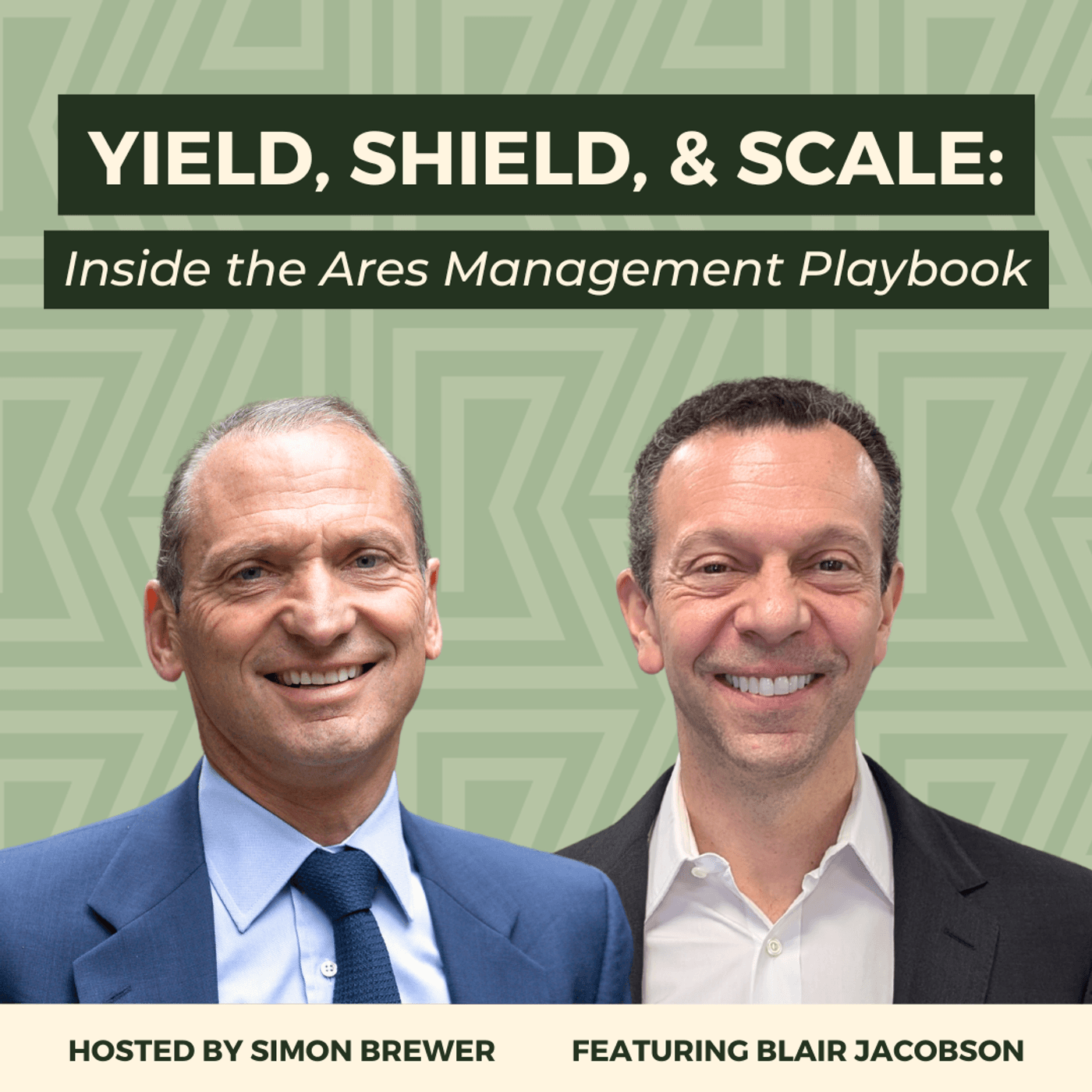
Ares Management’s “yield, shield, and scale” playbook—how the firm uses private credit and listed vehicles (especially BDCs) to deliver consistent income, expand in Europe, and manage risk amid worries about private credit.
Guest backgrounds
Blair Jacobson, co-president of Ares Management. Studied at Williams College (political science/economics; art history minor) and earned an MBA from Chicago Booth. Career includes Kidder Peabody, Lehman Brothers, and Citibank (private equity/credit from 2001; moved to London in 2005).
Key claims
Europe’s lending is overly bank-centric (about 80%); after the GFC and regulation, private capital has gained share (Ares claims ~60–65% penetration vs US 90–95%). Ares screens for capital preservation; underlying credit quality remains strong despite US bankruptcy headlines.
Notable examples
Ares’ flagship US BDC structure (listed vehicle yielding ~9–10%, distributing 90%+ of taxable income). Portfolio example: ~600 underlying US companies; loan-to-value approaching ~40% with ~60% equity subordination; profits growing high single digits/low double digits. Sports/media/infrastructure examples include Chelsea PREF equity, stakes in Inter Miami and Atletico Madrid, and infrastructure debt tied to long-term contracts.
Written by AI. May contain mistakes. Listen to the episode to check what was said.
Chapters
Tap a time to open that second in VOUnderstanding Europe's Banking Issues
0:00 to 1:10
Explore the fundamental problems facing Europe's banking system and its implications.
“There's a fundamental problem in Europe.”
Blair Jacobson's Background
1:42 to 3:06
Blair Jacobson shares his background and education, highlighting his career journey in finance.
“If I was going to start a financial services firm, I'm not sure I'd choose the name Aries.”
The Structure of Ares Management
3:06 to 7:54
Discussion on Ares Management's structure, focusing on the BDC model and its advantages.
“Interestingly, my father was from Pittsburgh, Pennsylvania, and he knew somebody named Blair Jacobson, if you can believe it.”
The Structure of Ares Management
8:32 to 9:25
Discussion on Ares Management's structure, focusing on the BDC model and its advantages.
“And it's not just your portfolio that may benefit from gold.”
The Role of Dividends and Public Companies
9:25 to 14:01
Analysis of dividend yields and the advantages of being a public company in the investment space.
“So it was interesting, I got into some conversation about dividend yields and their role in return.”
Ares Management's Focus and Innovations
14:01 to 15:26
Learn about Ares Management's strategic focus and recent acquisitions in data centers and fixed income management.
“And what we're not trying to do is be a financial supermarket.”
The European Financial Landscape
15:26 to 18:36
Explore the challenges and transformations in Europe's banking system and the rise of private capital.
“You see this, the juxtaposition of cultures between the US and the UK.”
Challenges in European Financing
18:36 to 22:07
Understand the barriers to financing in Europe and Ares Management's localized approach to overcoming them.
“And when we speak about risk appetite, how wide is the bid-off spread between the US and Europe?”
Challenges in European Financing
22:15 to 23:22
Understand the barriers to financing in Europe and Ares Management's localized approach to overcoming them.
“At the heart of the global economy, LSEG provides data, analytics, and infrastructure that connects investors, businesses, and economies.”
Targeting the Mid-Market
23:22 to 25:18
Learn why Ares Management focuses on mid-sized businesses and the investment opportunities they present.
“Remember, capital is at risk with investing.”
Show all 23 chapters
Investing in Sports
25:18 to 28:07
Discover Ares Management's investment strategy in sports leagues and their diverse portfolio in the sports ecosystem.
“In your case, you don't have that relationship.”
Investing in Sports Teams: A Strategic Overview
28:07 to 30:29
Learn how Ares Management evaluates opportunities in sports team investments.
“And we've been a part of this ecosystem for some time.”
Revenue Streams in Media and Entertainment
30:30 to 32:09
Explore the diverse revenue streams and investment opportunities in sports media and music.
“In addition to just general merchandise sales and other branding opportunities, we feel very good about where we're sitting in the capital structure.”
Infrastructure Investment Strategies
32:10 to 34:29
Understand how Ares Management approaches infrastructure investments amidst a super cycle.
“So I'd say that our music investing is a bit of a derivative of that trend.”
The Growth of Credit Secondaries and Continuation Funds
34:30 to 37:18
Learn about the evolution and utility of continuation funds and credit secondaries in private equity.
“Again, banks are doing a little bit less.”
Market Concerns and Credit Quality
37:19 to 42:00
Discuss the current market concerns affecting private credit and Ares' response.
“And again, as private credit has grown, it was only natural that over time, secondaries would start to play a bigger role in continuation vehicles.”
Understanding Investment Access for High Net Worth Individuals
42:00 to 43:24
Learn about the evolving access high net worth individuals have to investment products previously reserved for institutions.
“It's performed very well through some very difficult times, by the way, through the GFC, Brexit, COVID, high inflation, high rates.”
Outsiders Inquiry: Risks in the Direct Lending Market
43:24 to 45:51
Explore the potential risks of zombie companies in the context of direct lending and private equity.
“Well, I've asked you all my questions, and we've now introduced a section to the podcast.”
Tips for Young Professionals Seeking Careers in Finance
45:51 to 47:48
Discover what qualities make candidates stand out in interviews for finance roles.
“are three that were indicated, and again, potential fraud, this still needs to be investigated.”
The Value of Education and Mentorship in Business
47:48 to 49:56
Understand the importance of education and sharing experiences with the next generation in business.
“I see you're a fellow of the Saeed Business School up at Oxford.”
Observations on the UK Economy and Education System
49:56 to 50:59
Gain insights into the current state of the UK economy and its educational institutions.
“And despite the politics, despite the economics, it's very well situated globally.”
Book Recommendations and Insights from Fiction
50:59 to 52:16
Hear about a fascinating book that ties historical events to a beloved film character.
“Um, I'll give you a fiction book that I really liked.”
Final Thoughts on Global Investment Strategies
52:16 to 53:28
Reflect on the importance of local presence in global investing and the current investment landscape.
“I think I would actually err on the side of the beach in that regard.”
Transcript
Automatic transcript. May contain errors.0:00There's a fundamental problem in Europe. 80 % of lending is via the banking system. So Europe has got a fundamentally wrong way risk banking system. If there's a recession, what the banks start doing is they stop lending. Is it changing or is it so embedded it's hopeless?
0:18Blair Jacobson:Just to frame it for you, we have 700 people in Europe. We manage over$120 billion. And if you look at where the United States is, our market has penetrated 90-95%. If you look at where we are in Europe, we're probably 60-65%. It does vary obviously by country. We just raised in Europe a 30 billion euro fund. That's how much total capital we have. We're relevant to all different sized businesses. When you look at the state of the UK in education, that is one of the principal assets, despite Despite the politics, despite the economics, it's very well situated. It has a longstanding democracy, longstanding functioning economy.
1:04Blair Jacobson:Will it draw and continue to draw the best minds in the world to study here and produce? Absolutely. Welcome to the Money Maze podcast. If this is your first time joining, I'm your host, Simon Brewer. Quick word before we start. 95 % of viewers aren't subscribed. so miss out on future interviews with top business, finance and industry leaders. To support the show and ensure we can keep sharing high quality content, click subscribe and please drop a like. Plus, if you have any future guest ideas, do share your suggestions in the comment section below. Otherwise, thank you for watching and listening and enjoy the show.
1:42If I was going to start a financial services firm, I'm not sure I'd choose the name Aries. For those who enjoy history, Ares was the ancient Greek god of war, symbolizing the most brutal and destructive aspects of battle, once described as embodying raw aggression and bloodshed. However, it doesn't seem to have been an Achilles heel, since Ares was founded in 1997, completed its initial public offering in October 2004, and has marched relentlessly upwards and forwards. Today it's recognized as one of the leading global alternative investment managers, investing across credit, real estate, private equity and infrastructure.
2:174 ,000 employees, nearly 600 billion of assets, 48 billion market cap, New York Stock Exchange listed. But when some weakness in the stock prices of these US mega managers has been showing, and incipient worries over private credit, prompting even Jamie Dimon to come above the parapet alongside a cloudy economic picture, it seems a great time to welcome ARIES co-president Blair Jacobson to the Money Maze podcast. Blair, welcome today. Thanks, Simon. Great to be here. Well, Blair is a name with Scottish ancestry. Jacobson, a name frequently found in Scandinavia. Can you fill in your ancestral dots?
2:54Blair Jacobson:Absolutely. The origins of my family, actually, we immigrated from Eastern Europe to United States. My father's side in the late 1800s. My mother's side early 1900s. Interestingly, my father was from Pittsburgh, Pennsylvania, and he knew somebody named Blair Jacobson, if you can believe it. And I think that's where my name came from. Well, I note that you studied at Williams College and have an MBA from the University of Chicago School of Business, which was interesting because we just interviewed Todd Bowley live at our Investment Summit. He attended Williams College and last year had Cliff Asnes on, who's obviously very vocal about the private equity space, and he attended Chicago.
3:37So very good training. Now, on your career journey, I've observed Citibank, which was my alma mater, a short stint at Lehman and Stepstone. I wondered what those institutions armed you with.
3:51Blair Jacobson:Sure. Actually, I can even rewind a bit further on the education side. Williams College is a liberal arts school, and I firmly believe in the value of education. I believe it expands your brain. And for example, I double majored in political science and economics, but I minored in art history. So I really had a fulsome education. I think that prepared me for what lay ahead. I was always interested in finance, grew up sort of firmly middle class, knew that if I needed things, I had to be entrepreneurial and do things myself. And that got me interested in the banking world. So I started life at Kidder Peabody, which at the time was a great name, a storied firm founded centuries ago, Finance the Railroads, in the US.
4:40Blair Jacobson:That's really where I learned about finance and mergers and acquisitions in the first instance. That then inspired me to go to Chicago Booth for my MBA, as you cited. I said, if I like this, I really need to learn it for real from the place where it was invented. Then got a job at Lehman Brothers. I was there early on before things went too awry, but I got into the private equity and credit business in 2001 at Citibank. And it was a great learning ground for me. I was there for 10 years, five years in the US. Then I moved to London 20 years ago in 2005 to continue with them. Great. And you haven't left the UK.
5:19So there you go. That's a whole different conversation about London's continued magnetism despite the narrative. Let's talk about ARIES and this unusual structure, the BDC, a business development corporation, which I understand, and I didn't know about it before starting my research, was regulated under the Investment Company Act of 1940. And it allows firms to provide capital to small and mid-sized businesses while offering retail investors access to credit. But I think it has to distribute 90 % of taxable income. Fill in the dots for the non-experts.
5:54Blair Jacobson:Why a BDC? So this is really interesting because going back more than 20 years, this was Aries' first and flagship private credit direct lending offer, which, as you say, is a listed company in the United States where there are roughly 600 underlying middle market loans that have been originated and managed by Aries. So essentially, the listed vehicle hires Aries to be its investment manager. So one thing the U.S. did from a regulatory perspective is to encourage this type of investment. They said, if you meet the generous criteria, you mentioned one which is distributing over 90 % of your income to shareholders.
6:39Blair Jacobson:You have to do a couple of other things in terms of what you invest in. The U.S. government says that that income will not be double taxed. It will not be taxed at a corporate level and an individual level. So there's some advantages there. So that's really how we started in the U.S. direct lending business 20, 25 years ago when that industry was fairly nascent. So essentially, it's a public company. It's bought by investors for its yield. Obviously, its NAV might move around, but the primary return is that, again, it has to distribute its yield. and it currently yields between 9 % and 10%. It's been very, very consistent over decades and is now the single largest listed BDC in the market.
7:27Blair Jacobson:Now contrast that to Aries Management. That is also a listed company that we can talk about. That sits up top. That is the investment manager. That sits on top of what you said in the beginning, the$600 billion of assets that we manage on behalf of our clients. Roughly 60-70 % of that is in credit. We also have over$100 billion in real assets and real estate. We have private equity. We have secondaries. We do many different things. But Airees, the listed business, is really the fee stream collector. That is the general partner of our funds. And that is much more of a growth vehicle where the shareholders of Aries Management benefit from the growth of our fee streams and the cash generated by the business.
8:21So before we continue this conversation, we're going to take a short break to have a note from our sponsors. I'm thrilled to share that the Money Maze podcast is sponsored by the World Gold Council. They champion the role gold plays as a strategic asset through expert research, commentary and insights. And it's not just your portfolio that may benefit from gold. Learn how gold mining is supporting female economic empowerment and small businesses via their new documentary series called Gold, The Journey Continues. Tap the link in the show notes to start watching. ifm investors is a global asset manager founded and owned by pension funds with capabilities in infrastructure equity and debt private equity private credit and listed equities they believe healthy returns depend on healthy economic environmental and social systems and these are evolving on a scale never experienced before to find opportunity build value and meet the needs of future generations, you need scale, skill, and expertise.
9:22That's what IFM Investors has built up over 30 years. So it was interesting, I got into some conversation about dividend yields and their role in return. And although my figures might be slightly out of date, my recollection is that over 100 years of data, about 40 something percent of total return of US stock market investors come from dividends. So whilst people love growth, in fact, you know, dividends have been really important. So does that mean that the owners, the principal owners are more of the individual and income funds than maybe the holding company?
10:00Blair Jacobson:Yeah, I think that there's some truth in that. Again, you know, growing up in the United States, dividend funds used to be utilities and the like. However, their dividend yields might be in the mid, you know, maybe mid, slightly upper mid level single digits, whereas the BDC universe is firmly in the high single digits. And that's created a really attractive offering in particular for individuals. So today, when we talk more about the democratization of what we do, our products and services available to a broader group, whether that's high net worth, et cetera. Our view is we've had retail investors in Aries for over 20 years.
10:41Blair Jacobson:This is not new. It's developing. It's broadening. But as you say, the interest in yield, and especially when you compare that to long-term averages, say for stock market appreciation, also high single digits, low double digits, the yield on our BDC has been very, very attractive over time. Which, of course, begs an interesting question to me, which is higher level, is that you're advising and involved in the private space, debt and equity. We have the big companies like yours and KKR and Apollo, et cetera, as listed companies. And this debate between public-private rages. For you, what do you think the biggest advantage of being a public company is?
11:26Blair Jacobson:So we listed around 11 years ago. At the time, our firm managed about$75 billion. And it wasn't a decision we took lightly. However, when we thought about where we were as a company and where we wanted to go, we did see several advantages to being listed. First and foremost, what we were able to do was distribute ownership in our company. This was really critical because as we were getting bigger, we can talk about culture, but we wanted everyone not only to care about their individual business unit, maybe the funds that they manage, but we also wanted them to think more broadly about the firm and what was good for the company to reinforce collaboration.
12:12Blair Jacobson:So that was the first point. The second point was from a branding perspective, and you named some of our peers, for whatever reason historically, private equity firms enjoyed probably more brand recognition, more newspaper coverage than a firm like ours. So we did view, we thought we owned the credit universe. We viewed becoming listed as a way to improve our brand awareness. And third, we're quite growth-minded and growth-oriented. So we viewed being listed as a way not only to create capital, to enter into new businesses. And when you look at where Aries is today versus when we were listed, when we were listed, we had credit, some private equity, and real estate.
12:53Blair Jacobson:Well, now we've got all of that, but they've grown significantly, in particular real estate. We've got secondaries. We do all these other things. We've expanded geographically. But we've also been able to grow inorganically. Since we listed, now that we have this public currency, we've made something like 15 different strategic acquisitions for our firm to help us grow, expand and diversify. Got it. And it's so interesting to me because when I look through your materials or other materials, you know, of similar firms, it's very well organized and you'll clearly have a division of businesses that make sense.
13:29However, we know that business doesn't always work like that. And I wondered, you know, as the business grew and as you've been there sort of helping it, how often and how you think about going off plan?
13:42Blair Jacobson:So the way I would frame that is we're always thinking about how we can do the best for our investors, those who entrust us with capital. Again, that's pension plans, corporate pension plans, public pension plans. It's people's retirement savings, for example. It's insurance companies. It's sovereign wealth. And what we're not trying to do is be a financial supermarket. We're not trying to be everything to everybody. We've seen some of the peers in our space try that with, I would say, limited success or even detriment. So we're staying focused. That being said, we're always looking for new, exciting places to be involved for our investors.
14:23Blair Jacobson:And I can name a few which are interesting. We've recently gotten into, through acquisition, the data center development business. We're very big believers in digital. We've been investing in digital for 10, 15 years. But what we didn't have was data center development capabilities, a team to find land power, permitting, water, sign leases with hyperscalers. So that is new for Aries, not the team we brought on board. Secondly, we just announced that we completed the acquisition of a scientific fixed income manager. When you think about the impact of data, you think about the impact of AI on the investing space, in particular, the more liquid investing space, loans, bonds, investment grade.
15:09Blair Jacobson:Adding real rigor and analytics to how that's done has been a very interesting place to be. So we've now brought those capabilities inside. But again, it's more of an evolution from where we've been rather than a revolution. Got it. So let's talk about Europe. You've been here for a long time. You see this, the juxtaposition of cultures between the US and the UK. And I'm really interested in, as Europe deals, and the UK I include in that, as it deals with its sclerosis of growth, about the debt and equity setups and the mindsets. And we interviewed Colin Kelleher, chair of UBS, last year. And I'm going to quote him.
15:53He says, there's a fundamental problem in Europe. 80 % of lending is via the banking system, completely the inverse of the US, where 20 % is via bank loans, the rest via the markets, securization. So Europe has got a fundamentally wrong way risk banking system. If there's a recession, what the banks start doing is they stop lending. And Blair, you see this. Let's just deal first with that particular argument. Is it changing or is it so embedded it's hopeless?
16:24Blair Jacobson:So it is changing. As I mentioned earlier, I've lived in the UK for over 20 years, so I've seen the development. ARIES as well has been international with our headquarters here in the UK since 2006, 2007. And just to frame it for you, we have 700 people in Europe. We manage over$120 billion. And we have, I would say, seven major offices, but well into the double digits when you count all of them. So we do have some real perspective on this in terms of breadth, but also in terms of the development. And I think one of the exciting things that we saw was that the U.S. model for private capital could be successful in Europe.
17:11Blair Jacobson:That inspired us to enter Europe, as I mentioned, nearly 20 years ago. What changed everything was the GFC. The GFC not only shrunk the banking sector, and think about where we are now in the UK. You had Irish banks, Icelandic banks lending here. They went bankrupt. You had HBOS consolidating to Lloyds. You had RBS get subsumed by the government. You had Northern Rock go bankrupt. You had continental European banks go home, just like Barclays stopped lending in Germany. So the banking sector shrunk, and we were a beneficiary of that trend because we came, we had capital. By the way, we hired a lot of former bankers on staff who knew these companies and knew the owners of these businesses.
17:52Blair Jacobson:And then after that, we saw regulation really discourage banks from making these types of loans. So what have we seen? We've seen the market share of the banking sector lend to, frankly, very, very healthy middle-sized businesses decline over time, whereas the market share for firms like ours, institutional firms, again, investing on behalf of insurance and pension, sovereign wealth largely for yield, grows significantly. And if you look at where the United States is, our market has penetrated 90, 95%. If you look at where we are in Europe, we're probably 60, 65%. It does vary obviously by country, but we think there's a lot left to go.
18:35Blair Jacobson:So again, we are seeing the march of private capital alternatives be successful in Europe. And when we speak about risk appetite, how wide is the bid-off spread between the US and Europe? Yeah, it's a good question. And I think there are two sort of diverging views on this. One is always asked, why does Europe not have a Silicon Valley? Does that say something about risk and culture? On the other hand, what I point to is a lot of people think private equity started in the US with Kravis. But actually, if you look at post-war reinvestment in the UK, that's when 3i started in 1945. So it actually has a very, very longstanding history here as well.
19:18Blair Jacobson:So I think what we've seen, again, is a very strong acceptance. It took time, by the way. When we rocked up with Aries business cards, nobody knew what we were in 2006, 2007. But now everybody will speak to us, which is great. And that's on the borrower side. But also in terms of groups that entrust capital to Aries. Europe is a major market for us as a firm. Again, we have$120 billion of assets under management here. So we've seen increased adoption there. So I think that that is only improving. So overall, in terms of risk appetite, will it ever be exactly like the U.S.? That's a question mark.
20:00Blair Jacobson:But certainly, it's been very strong. So when we talk about execution and opportunity, I observed in some document that you had produced or been interviewed that something along the lines of you have as an entity, 1 ,400 conversations in Europe, but actually only make 50 loans. And I'm just intrigued about the blockages. Obviously, there's a screen presses, but what are the typical hurdles? Yeah. So I would say for us, one thing that we figured out early was we had to be local. So again, we've been in London for almost 20 years, but shortly thereafter in 2009, we opened up offices in Paris, Frankfurt, Stockholm.
20:48Blair Jacobson:We hired local people. They speak the language. They understand the culture. They understand the legal systems that we operate in. We added Amsterdam and Madrid. We've now added Milan. So we're really pan-European. So I think the first blockage to unlock is you just have to be there. You have to have local people, again, who know the companies, know the owners of these businesses. And then the second thing, again, we do have a filter. And remember, our goal in life is capital preservation. It's don't lose money. We're largely fixed income investors. So I say that's the second thing as it relates to the screening process.
21:23Blair Jacobson:But I think overall, and this is well documented and well described, Europe does have some wood to chop as it relates to its financial system, whether it's securitizations, whether it's harmonizing. But at the same point, Europe's 27 countries. We've had Brexit here in the UK. By the way, the vote was about 10 years ago. It's, you know, time's really flown. So I think that there are some inherent challenges to realizing some of that harmonization, which also is why from a private perspective, we can have people, we can have funds, we comply with all the regulations. So we're actually able to effectively address a lot of those blockages.
22:03So before we continue this conversation, we're going to take a short break to have a note from our sponsors. I'm excited to announce that the Money Maze podcast is sponsored by the London Stock Exchange Group, known as LSEG. At the heart of the global economy, LSEG provides data, analytics, and infrastructure that connects investors, businesses, and economies. LSEG is where ideas meet capital, enabling sustainable growth and opportunity. Tap the link in the show notes to learn more. Schroeder's Capital is the private markets division of Schroeder's. combining the experience of specialized local teams with the scale, rigor, and resources of a global institutional platform.
22:45Schroder's Capital provides its clients with global access to differentiated and specialized strategies encompassing all private markets' asset classes, from private equity to real estate, infrastructure, and the broad universe of private debt and credit alternatives. This approach enables Schroder's Capital to access opportunities and investments that are often difficult to find elsewhere, while also having the broad capabilities and perspectives needed to build holistic solutions and deliver tailored outcomes across private markets for both institutional and wealth clients. Discover more at schroderscapital.com.
23:22Remember, capital is at risk with investing. And your speciality, if I understand it correctly, is more around the mid-market. We also associate a lot of, you know, German, you know, Mittelstand and, you know, Europe having produced lots of that. Is that your sweet spot? If so, why?
23:41Blair Jacobson:So, really good question. The short answer is yes, we love smaller and mid-sized businesses. You know, maybe not mom and pops that are a little bit less credit worthy, have a little bit less reason for being. But if you think about the middle market, that is really what drives the economy. You know, it is such a high percentage of number of companies of economic activity. So it's a really fertile place to get involved. These businesses are growing. They're adding people. They're adding services. They're developing new plants. They're expanding in other European markets. However, the other thing to remember is that this is precisely the area where the banking system has challenges addressing because of some of these regulatory pronouncements that they now have to abide with.
24:31Blair Jacobson:So it's a mix of a large fertile market, which is looking for capital like ours. And if you contrast that with the large markets, maybe capital markets issuers, the good news is we just raised in Europe a 30 billion euro fund. That's how much total capital we have. We're relevant to all different sized businesses. But in terms of what our investors hire us to do, they want risk return that looks better than what's available in liquid markets. So if we can achieve that in times of market dislocation or stress with bigger companies, we'll absolutely do it. We've written billions of pounds of loans into single companies.
25:09Blair Jacobson:But we do find the mid-market to be a growth engine and really be more wanting of capital like ours. So if you're a bank, you have a bank account with lots of those corporates, so you've got a natural conduit into talking to them about this. In your case, you don't have that relationship. So just talk to me about the sourcing of those ideas. Sure. So going back to what I was mentioning earlier, sourcing what we call origination is really the most important thing we do. It's the front engine that drives our entire business. That's why we invest so much. So, for example, in Europe, we have about 100 people.
25:46Blair Jacobson:in all of our offices talking to these 1 ,400 companies every year that you mentioned before. In the US, you probably have over 200 people doing that. And if you think about that size and scale and scope of team, it's probably bigger than many, if not most, banks. That's the first piece. The second piece is, where do these people come from? Frankly, many of them come from banks. They're talking to similar clients, whether they're the companies, their advisors, their owners, their stakeholders, that they've talked to for their whole careers. The big challenge, again, is convincing them and educating them about why talking to Aries is a good idea.
Read the full transcript
26:23Blair Jacobson:And again, we've made so much progress on that in the last 20 years. But again, overall, finding these loans isn't the tough part. The tough part is what you mentioned earlier, which is screening them, making sure we're getting involved at the right companies with the right risk adjust to return potential in line with what we guided our investors to expect. Okay. So let's switch tack and talk sport. I was intrigued as I looked at your businesses, how this footprint of sport appears to become important. We've had Arctos on the show. I just interviewed Todd Boley at the Money Maze Allocator Summit.
27:01And then I see that you have, correct me if I'm wrong, but extended 500 million of PREF equity to the Chelsea structure. You've got Stakes and Inter Miami and Atletico Madrid. But of course, as somebody like myself who doesn't understand this ecosystem, so I'm going to need your help, is that it's one thing investing in a U.S. locked league where there's no promotion or relegation. It's quite another in Europe where you can be in the Champions League one week and out the next year. How are you targeting your sports investments?
27:33Blair Jacobson:So I think you have to rewind quite a bit. So we've been involved in this business for 10, 15 years. It's a major effort for our firm. We're currently invested, as you alluded to, in something like 15 different sports leagues. We originally got into sports in a major way during COVID when ticket revenues basically disappeared. And these leagues and these teams, which historically had been financed maybe by cheap bank financing or frankly wealthy people and owners, started to think that maybe they should start looking for institutional solutions. And we've been a part of this ecosystem for some time.
28:10Blair Jacobson:So the first thing is that we developed relationships with many of these. And this is a very relationship oriented business, as you can expect. And that's not three months. It's not three years. It can often be five or 10 years in importance. So the first thing is really understanding your counterparty, understanding the team. By the way, it's not all just teams. It's also investing in leagues. And it's not just leagues that you might be familiar with. It's women's volleyball. It's lacrosse. It's sailing. I mean, it's so disparate. It's youth leagues, for example. It's the whole ecosystem. It can be data analytics for sports.
28:45Blair Jacobson:It can be ticketing for sports. It can be equipment. I mean, it's very diverse. But again, when we evaluate team opportunities, another thing to mention is where are we in the capital structure? Go back to what we've been talking about quite a bit. Aries DNA is a credit DNA. It's our single largest business, as we've also mentioned. So therefore, from a downside perspective, how we invest in sports teams is rarely is a pure equity owner. Many of our investments, including some that you mentioned, are structured. Many of them come in the middle of the capital structure with a lot of equity subordination, equity value underneath our loans.
29:28Blair Jacobson:So when we run our downside cases, yes, do we look at if maybe some of the funds dry up due to either relegation or changes in league position? Absolutely. And we want to make sure that we're aligned with the best teams, not, for example, a team that was recently promoted and might be relegated in the next season. Some of the ones you mentioned have been in their respective leagues, in the top of their respective leagues for decades, if not longer. I would say on the team side, that's what we're focused on. So when, in the case of Chelsea, it's a PREF equity, you've got no security, you're taking a view on the likely cash flows and the growth of the franchise,
30:12and I guess it's a matter of public record what the coupon is on that PREF equity.
30:16Blair Jacobson:Put it this way, without getting too deep into confidential details, You know, where we are in the capital structure is different from where the equity holder is, the common equity holder is. And when we think about where our loan to value is based on the company, its revenue profile, not only tickets, a lot of the revenue, of course, comes from broadcasting revenue, comes from league, etc. In addition to just general merchandise sales and other branding opportunities, we feel very good about where we're sitting in the capital structure. And allied to this is the media and entertainment businesses that you're in.
30:53We just did a curated interview with Philip Moros, who runs Cutting Edge Group, which is a fascinating business that's just merged with Warner Brothers Music. How are you thinking about that space? Because, again, lots of variability, one would have thought, in revenue streams.
31:09Blair Jacobson:Yeah, I'm glad that you asked that question, because when we say SME, it's sports media entertainment. Most people stop at the S because it's most visible and really interesting for people. But it is a broad and diversified strategy. And again, go back to what I was mentioning before. We value very, very stable and diversified revenue sources. So to pick another example that should hopefully resonate, we very much like the music royalty space. Right. So for example, again, if we can make a loan to a diversified catalog where you've got a lot of historical operating history in diversification, that's something that we really, really like doing.
31:51Blair Jacobson:Again, probably more from a lending perspective, perhaps, than an equity perspective. But again, as we think about the broad swath of opportunities, everyone is consuming much more media, more broadly. Sports, by the way, is the only thing people still pay for live that's very important. But if you think about the amount of time that people spend on Spotify, streaming music, et cetera, that's another massive grower. So I'd say that our music investing is a bit of a derivative of that trend. I understand. There's other side of your business that's super important is infrastructure. And in reading some of your commentary, and I'm going to quote you, say infrastructure debt provides lower correlation and lower risk.
32:35But axiomatically, it also provides lower expected returns. So how do you think about infrastructure? And it sounds to me like the debt is the piece of the equation where your specialization is. How should investors think about the return of that piece?
32:50Blair Jacobson:Sure. I'd frame it in a couple ways. The first thing to mention is we are engaging in an infrastructure super cycle. The amount of capital that will be required, not only to satisfy mundane needs, fixing roads and bridges and airports and the like, but as we think about energy transition. I mentioned digital infrastructure a little bit earlier as we think about the explosive growth there. All of that will require capital, debt, and equity. I think what we've seen in particular in a European context is that given the fiscal position of the governments around Europe and the UK, the government won't be able to fully satisfy all that.
33:33Blair Jacobson:So the need for private capital is very, very significant. So when we think about pricing infrastructure debt, a lot of it actually goes back to what I was mentioning in the SME context as well, which is to say, if you're backing something with either a long-term contract or revenue visibility, where your counterparties are very, very strong and creditworthy, that makes for a very, very good investment thesis. Where we see infrastructure debt pricing, it's usually a little bit of a discount to sort of equivalent corporate debt. But a lot of that is based on the quality of the infrastructure asset itself and, again, its revenue profile, its contracts, which aren't always available in the corporate world.
34:19Blair Jacobson:So in terms of risk-adjusted returns, we're seeing a lot of interest from our clients who, again, want that yield to focus on infrastructure. And what we're seeing more broadly is the typical context of private credit is corporates. Again, banks are doing a little bit less. It's more in the fore. Private equity firms are big consumers of leveraged finance. They do a lot of business with us. What we're seeing is our asset classes are growing dramatically outside of corporate. That's asset-backed. It is infrastructure. It's many of these other areas. It's real estate debt that are growing dramatically.
34:54Blair Jacobson:So again, we see a big future in infrastructure debt. So having been in the business a long time, only in the last year or so did I hear the term continuation fund. And maybe only a few years before that, that I come across secondaries, particularly credit secondaries. Now, you are strong in both. The cynic will say, particularly when it comes to continuation fund, that's because, you know, the usual exits aren't there. Why are they wrong? Good question. So let's talk first about secondaries. As I think the audience will appreciate, the asset classes that we operate in are illiquid. We do get a premium for investing in illiquid assets.
35:37Blair Jacobson:We also require our investors to agree to a 10, 12 year fund construct in general that is in itself illiquid. However, decades ago, it was discovered that you could have secondaries, which in the original context meant the limited partner investors in the fund could seek to sell or exit their positions to a larger pool of secondary capital. It started with private equity, then moved on to real estate and infrastructure. But now we're starting to talk about credit secondaries. And the high level theme is that you think about the stock market turns over almost 100 % every year, whereas private investments, 1, 2, 3, 4%.
36:20Blair Jacobson:So again, there's some room to grow there. So let's talk now about continuation vehicles. I would say in private equity, they're used for different reasons than what we see in the credit space. In private equity, if you're a manager, you say to yourself, I've owned this company for five, six, seven years. I've built a lot of value. But Warren Buffett doesn't have to sell his companies. He likes to hold them for a long time, continue to benefit from that appreciation. So if I'm the private equity manager, I have this relationship, this sort of vested interest. If I can orchestrate a way for my investors to get liquidity, if they want to, by the way, if they don't, they can roll into this new vehicle.
37:02Blair Jacobson:well, I can continue to manage that company that I've invested so much time and effort into for a longer period of time. That's basically how the CV market works in private equity. Credit's a little bit different. Credit's only a few years old. And the reason for that is this always tracks the development on a lag of the primary business. And again, as private credit has grown, it was only natural that over time, secondaries would start to play a bigger role in continuation vehicles. What we've seen thus far in terms of continuation vehicles for credit is when investors say, I've been in a fund for eight or 10 years.
37:43Blair Jacobson:I've gotten back maybe all of my invested capital. I'm really playing for a little bit more, but maybe I want liquidity sooner. Maybe I have other obligations I need to meet, or maybe I want to reinvest capital in another area. So I think on On a credit side, it's been more of a liquidity management tool for investors. And again, for us as the fund manager, we can continue to manage those exits until they realize. Now, remember, the big difference between private equity and credit is in equity, you control your exit. You can hold something forever. Credit, every underlying loan does have a maturity, usually seven or eight years.
38:23Blair Jacobson:So in credit, those vehicles naturally will have to wind down over time, whereas in equity, they don't. Clear. Thank you. Now, all of this also points to the huge and burgeoning enthusiasm around the asset class. We know where spreads are. They're tight. We might come back to that. I believe you were in the House of Lords undergoing a sort of examination last week about the space. And at the same time, we've got the stock market beginning to maybe it's just a little a temporary loss of enthusiasm. The stock prices of these companies are all a bit weaker as well. What do you think the market's worrying about?
39:07Blair Jacobson:So I think from our perspective, you know, we're very focused on the long term. That's what we tell our investors. You know, do we watch things day to day? Yes. But again, we're much more focused on the long term. However, there has been a news cycle more recently concerning some significant bankruptcies in the United States. Are those related to private credit? Does it presage issues to come in the future? I think you mentioned Jamie Dimon earlier making some comments. And that's a narrative that as a firm we've come out strongly against. We do view these credit events in the U.S. as being a bit idiosyncratic.
39:48Blair Jacobson:Both actually had fraud allegations attached to them. And interestingly, neither had major private credit investors. Actually, the investors in these companies were the broadly syndicated loan markets and also bank balance sheets. So I think our perspective is, you know, these things will happen from time to time, but they don't presage any major issues with private credit, although I think the news is getting their minds around it. And that impacts the public markets. But in fact, what we've come out and said recently in our earnings announcements is the quality of our underlying loan portfolios remains very strong.
40:28Blair Jacobson:And as an example, in the United States, that's 600 underlying companies. It's a pretty good sample set. And what we've said is that profits are growing high single digits, low double digits. We're saying loan to value in those companies is approaching 40%. That means that there's 60 % equity subordination in these loans. And further, in terms of broader credit metrics, those are also trending in a positive way as the companies are growing. And also, as you said, rates are coming down a little bit. So actually, from a fundamental perspective, we think things are in pretty good shape. Maybe it takes the market some time to get their mind around.
41:08Blair Jacobson:That's why we're always very happy to tell the story. I told this story, as you said, last week in the House of Lords. So we understand the concerns. We just don't think that they apply to our business. But the concern that keeps on coming back for me, which is bigger than, you know, Aries, is that the new arrival on the buyer front is individual wealth. I know you said you've dealt with sort of the individual cohort for a long time. But typically, you know, the individual area gets to this stuff, you know, later. a lot of credit can behave like equity when we hit, you know, hit the skids. Do you worry about the sort of the flurry of excitement around private credit, particularly for the individual?
41:56Blair Jacobson:So overall, again, you know, we've offered our private credit vehicles to retail investors through to BDC for over 20 years. It's performed very well through some very difficult times, by the way, through the GFC, Brexit, COVID, high inflation, high rates. So again, I think we've shown over time performance is good. Loss rates are like low single digit basis points, incredibly low. That's now broadening out. It's broadening out first with high net worth investors. We think it's a good thing for them to get access to what institutions have primarily had access to before, but only in the right ways.
42:34Blair Jacobson:These are investors who are very, very carefully qualified. They have to meet many standards and requirements. They also receive significant education through their financial advisors in the first instance. So I think it is a knowledgeable investor who comes into these types of products. And hopefully we believe has been educated about the potential risks and understands those over time. The next wave which is being discussed is making it even broader, in particular, in the United States to 401k clients, I would say in some degree. And can that effectively be a small portion of their portfolio?
43:13Blair Jacobson:Similarly, again, if they're educated, if they're qualified, if they understand what they're getting themselves into, both the risk and the opportunities, we think that's a good thing. Well, I've asked you all my questions, and we've now introduced a section to the podcast. It's the first one today. We're calling it the Outsiders Inquiry. So we go and seek out some questions from folks who know much more than people like myself. And one of them is David Forbes Nixon, who I've known for a long time, founded Alcentra. So he knows the private credit space really well. So he said, given the huge growth in the direct lending market with loans originated by non-banks having bullet maturities and covenant light structures versus the bank originated syndicated leverage loans, isn't there a real risk that we're going to get a lot more zombie companies?
44:00Blair Jacobson:So take a step back. You asked earlier about our screen and our filter. Again, what we're trying to do is lend to the absolute best companies that we can find. We define that in a couple of ways. Number one, as I mentioned, they're growing. High single digits, low double digits. Very profitable. Average margins, 20%, 25%. Importantly, they're in sectors, in industries with good tailwinds. Things like healthcare, business services, telecommunications, software, really good businesses. And from that perspective, again, we've been with these companies for a very, very long time. We're not super worried about zombie companies.
44:41Blair Jacobson:Again, these are companies that have professional owners that are also driving results. One thing to mention as well is 80 or 90 % of the businesses we back have professional ownership in the guise of private equity firms in particular, who also have exit ambitions. So I would say that that's not the biggest risk that would keep me up at night, but I appreciate David's great question. Well, the other one was from Hugh Van Stenis, who was on a few weeks back. And of course, you know well, he writes a lot of it, vice chair of Oliver Wyman. He said, in the flurry of recent credit events, including frauds, is this just symptomatic of a paper cut or something deeper?
45:21Blair Jacobson:So, again, I would say paper cut at best. Going to what I had mentioned earlier, in particular around the U.S., by the way, fraud is really hard to detect. I think it always happens once or twice in everybody's career. We're, that's also why from a credit investing perspective, we have massively diversified portfolios. So if anything does happen, it doesn't impact the portfolio that much. But I should also, you know, go to some pains to mention that those businesses, now there are three that were indicated, and again, potential fraud, this still needs to be investigated. You know, all of those were entrepreneur companies.
45:59Blair Jacobson:None of them were backed by private equity. I think most of our industry faces private equity who are very responsible owners of businesses, very low correlation with fraud. So I think from our perspective, paper cut it best. So we can move to some general questions. And one of them, because we have a lot of young listeners, is when you interview a bright young person who wants to come work at Ares, what are the one, two, or three things that are most likely to make you ask them back for another interview? Sure. I think once you clear the bar of basic knowledge about our industry, our company, and by the way, you need to do some research on a firm that you're interviewing with specifically, you know, as well as basic financial competence and literacy.
46:48Blair Jacobson:I think we're trying to understand things like what motivates you? What gets you out of bed in the morning? Second thing would be, are you a well-rounded person? But it's great to have people who work 24-7, but we do want people to have some balance. I mentioned earlier in my career, in my education, I value this, you know, quite a lot personally. as well. I say third thing is, how much do you know about the world? I always ask people if they read a newspaper every day. By the way, the answer is usually no. I've had two hard copy newspapers delivered to my home for more than 30 years. I feel very strongly that you can't operate in your own silo or vacuum.
47:34Blair Jacobson:You really need to understand what's going on in the economic situation, different companies and politics, et cetera. So say those are sort of the extra ways that candidates can differentiate themselves. Different question. I see you're a fellow of the Saeed Business School up at Oxford. We know Jack Edmondson very well of OSE. And, you know, Will Campion has this great sort of network around Oxford. We've done a few interviews with some of the spin outs as well. We've got Steve Schwartzman, I believe, putting money into a humanities center. Larry Ellison's putting a vast amount of money. I've got two questions.
48:08One is, what does it give you and what do you think you give the audience, which is a cyber business call. And the other is, as there has been some disaffection with US politics, there has been a sense there is some brain drain growing on and Oxford and Cambridge might be beneficiaries. And I wonder whether that's just super marginal being extrapolated because these are big sums of money being invested as well.
48:30Blair Jacobson:So the answer to the first question, I've always valued education very, very highly. My mother was a teacher for 45 years. And, you know, I've always believed that when I have something to give back, given my station, educating that next generation is critical. and I've also believed that universities can benefit from practitioners in addition to academics sharing. So what I usually do is I go, I was actually there last night lecturing as well. I usually teach in a private equity module, but what I tell the students is that if you do not understand the L in the LBO, you don't understand anything and their eyes always light up like, wow, there's more than just the equity side.
49:14Blair Jacobson:So again, bringing the benefits of my 30-year-plus career to these students who are generally just starting to think about or embark on their careers, I think, can be very, very powerful. And I get a lot out of it, too. They always ask very interesting questions that are quite well-educated. Maybe they're getting them from ChatGPT. I'm not sure. I think it's for the Money Maze podcast. But anyway. They definitely get it from you, Simon. So again, I get a lot out of it. I sort of see the gears churning in their brains. And it's something that I'm very, very committed to. And I think when you look at the state of the UK in education, that is one of the principal assets of this country.
49:55Blair Jacobson:You actually mentioned at the very beginning the UK's situation. And despite the politics, despite the economics, it's very well situated globally. It has a longstanding democracy, longstanding functioning economy. But again, the university system here is incredibly powerful. And it would not be surprising in an international world where everything is fluid and people can move around that with additional funding, additional focus, will it draw and continue to draw the best minds in the world to study here and produce? Absolutely. Yeah. And on our summit, we reiterated this sort of, you know, these, if you call them green shoots of recovery, to use a former UK chancellor's expression, there's some really fascinating, outstanding, exciting stuff happening.
50:42Some of it's coming out of the universities, a lot of entrepreneurialism, you know, the narrative is relentlessly bearish around the UK, but, you know, perhaps, you know, it is. It means it's a good time to invest. Yeah, yeah, yeah. Well, you know, BlackRock and others as well has been doing it and you've obviously got this big footprint here. Um, what's the most interesting book you've read in the last year?
51:03Blair Jacobson:Oh, wow. Um, I'll give you a fiction book that I really liked. Um, hopefully everyone remembers the seminal movie Jaws that just celebrated, uh, its, its major anniversary. Um, a UK writer contacted, uh, the Benchley family, uh, who, who guy wrote Jaws and said, I would like to do the following. the most memorable character from everyone thinks it's Roy Scheider, but it was actually Robert Shaw's character, Quint, who was manning the boat. And he gives the seminal speech in the movie about being on the USS Indianapolis, the ship that went down in the Pacific delivering the atomic bomb in the 40s.
51:43Blair Jacobson:And the crew were then basically devoured by sharks. So this writer wrote a book called Quint, a first-person autobiographical novel from his perspective, and it is a fantastic read. Not only do you learn the background of this character, he takes you through what happened on the USS Indianapolis. And I will tell you, you will learn more about sharks than you ever cared to by reading this book. And that was a great fictional novel that I would highly recommend. It's called Quint, Q-U-I-N-T. okay well we'll put that and the link in a in our show notes and final question um you live here in the uk you've got this us sort of you know heritage and you know and actually you know more you know going back if you could only go to one place on holiday for the rest of your life where would it be by the way you're not allowed to say montana because you will have noticed when you came and got these fantastic pictures by davie arrow who is probably the world's most celebrated fantastic He's Ansel Adams quality photographer.
52:49Blair Jacobson:We have a big debate in my family. Some of us are mountain people. Some of us are beach people. I think I would actually err on the side of the beach in that regard. There's a little island 30 miles off the coast of Massachusetts called Nantucket where we often holiday. And if I had one place to go, I think that would be it. So I'm going to conclude because we've talked to quite a lot of the large entities such as Ares and everyone has a, you know, it's a different story angle perspective, you know, history. I mean, what's come through loud and clear to me is the fact that in going outside of the US and going global, you've put boots on the ground in physical locations because it is that being local, which might once have been a slogan of Citibank, but which is clearly happening, you know, with you guys, that it is credit that is your go-to, most comfortable area of expertise.
53:51And in fact, notwithstanding the, you know, some of the negative narrative that has been emerging around, you know, credit losses and these frauds, et cetera, you're feeling pretty comfortable about your, you know, your own, you know, position opportunity. And actually, if I read between the lines, putting the UK aside where, you know, I think we agree on the opportunity set, even in Europe, there is a shift in the structural provision of capital happening, which is, you know, and even Xavier Rowley in an interview we did way back when was bemoaning again that thing, but there is some sense of shift, which is absolutely what, you know, what is needed.
54:30So I've really enjoyed this conversation. I also took that, you know, when you were lecturing at Oxford Saeed Business School last night, you said that the L in the LBO, and for those who didn't quite pick it up, that's of course is leveraged. And that's the great enemy at times if you've not got it right. And, you know, understanding risk, as Todd Bowley said the other day, I'll do credit all day long. Indeed. You know, if I can get in the right position in the capital stack. It's been fantastic to have you here, Blair, today. Thank you very much.
54:56Blair Jacobson:Thank you so much, Simon. It was a great, great session. Thank you.
From the publisher
Listed on the NYSE, it has over 4,000 employees, $595billion in assets* and a substantial geographical footprint.
Blair explains the high yielding Ares-managed listed vehicle, ARCC, which as a business development company (BDC) structure must distribute 90% of taxable income and averages 9% of yields*.
He discusses how being a public entity gives them a “currency” which is highly valued by employees, and also how it has helped with brand recognition as its growth accelerated.
We discuss European capital markets and the structural reliance on bank debt versus private credit (the inverse of arrangements in the US). He explains how it is changing, as well as the current headwinds and opportunities ahead.
He discusses why over 1,400 conversations take place in Europe each year, but Ares makes less than 50 loan investments in direct lending, how they are deploying over $100 billion of dry powder firmwide, and the criteria that matter for them.
He explains their focus on the middle market, their ownership of sports assets – including a $500 million preferred equity stake in Chelsea FC – and their other media and entertainment investments.
Finally, Blair responds to the question around the growth of credit secondaries and continuation vehicles, assessing the motivation behind the growth, and risks associated with the wealth management sector’s increasing allocation to this space.
The Money Maze Podcast is kindly sponsored by Schroders, IFM Investors, World Gold Council and LSEG.
Sign up to our Newsletter | Follow us on LinkedIn | Watch on YouTube
(*AUM as of 30/09/25, BDC distribution stats as at 04/11/25)