In short
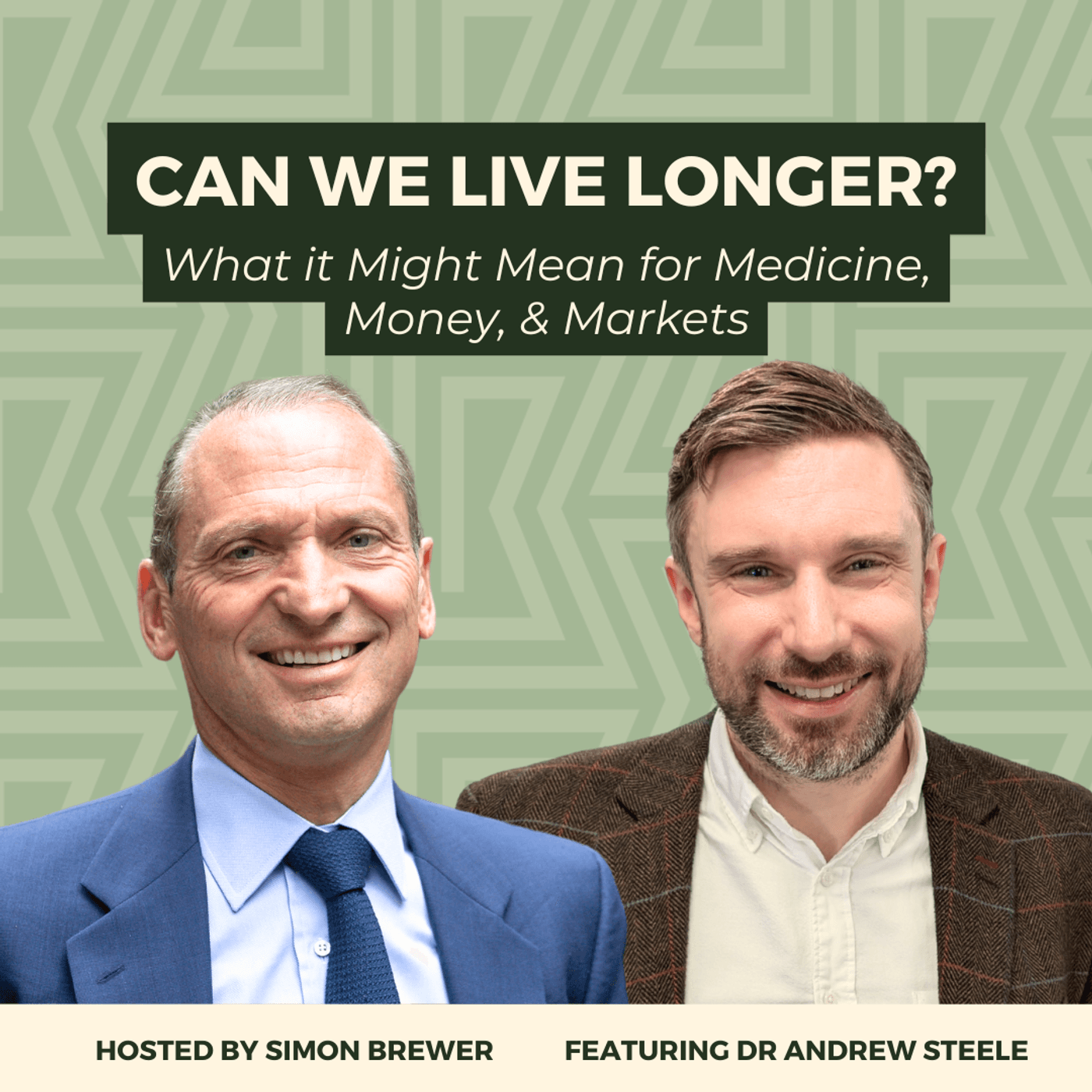
Whether humans can live longer in a way that improves health, and what that could mean for medicine and the economy/markets. The episode frames aging as an exponentially rising mortality and disease risk, argues that some animals show “negligible senescence,” and claims multiple drug approaches (especially senolytics) can slow aging in lab animals. It also discusses the scale of economic value from “healthy life extension” and the investment implications for pensions/insurance.
Guest
Dr Andrew Steele, lecturer/author/speaker and longevity-ageing expert. Background: PhD in physics (Oxford), studied magnetism; shifted to biology after being struck by a graph of age vs risk of death; worked as a biologist for five years. Personal: grew up with freedom and books; wanted to be an astrophysicist at age seven.
Key claims
mortality risk doubles about every eight years; aging is driven by shared “hallmarks” including senescent cell accumulation; senolytic combinations (asatinib + quercetin) rejuvenate mice (less heart disease/cancer/cataracts, less frailty, improved cognition); longevity therapies could reach humans within years, not decades.
Notable examples
rapamycin works across yeast/worms/flies/mice/marmosets; Galapagos tortoises and naked mole rats show flat mortality risk; CPR and coronary care emerged only in the 1950s–60s; “value of a statistical life” estimates ~$38T for slowing aging by one year (US).
Written by AI. May contain mistakes. Listen to the episode to check what was said.
Chapters
Tap a time to open that second in VOUnderstanding Mortality Rates
0:00 to 0:45
Learn about how mortality rates change with age and the implications for longevity.
“So if you're lucky enough to be born in a rich country, your risk of death in that first year of life is about half a percent.”
Introduction to Dr. Andrew Steele
0:45 to 2:32
Get to know Dr. Andrew Steele, his background, and his insights on longevity.
“Would I bet against there being a longevity gene therapy in the next 10 or 20 years?”
From Physics to Biology
2:32 to 3:50
Explore Dr. Steele's academic journey from physics to the study of ageing.
“Well I know you will explain that you were a physicist who jumped across to become a biologist and I think you have a PhD in physics from Oxford, but let's just talk about that academic route you took and the pivot.”
The Science of Ageing
3:50 to 7:40
Delve into the statistical and biological definitions of ageing and risk of death.
“In fact, my girlfriend at the time was a climate physicist doing a PhD.”
Complexity of Biology
8:31 to 10:38
Understand the complexity of biological systems and their implications for medicine.
“That's what IFM Investors has built up over 30 years.”
The Nature of Ageing
10:38 to 14:03
Investigate what ageing is and how different species exhibit varying aging processes.
“The first answer I often give is the statistical one that we've just talked about.”
Exploring Global Life Expectancy Trends
14:03 to 19:31
Learn about the historical changes in life expectancy and factors influencing it.
“Most people in most countries could expect to live 30 to 40 years.”
Medicine and the Future of Anti-Aging Treatments
20:45 to 28:00
Explore developments in anti-aging medicine and the potential impact on health.
“Remember, capital is at risk with investing.”
Advancements in Aging Therapies
28:00 to 28:40
Explore the potential of new therapies aimed at extending human lifespan.
“something you know we're necessarily expecting out of medicines so they really do have the potential to change the way that we do medicine.”
The Economic Impact of Slowing Aging
28:40 to 31:00
Discover the staggering economic implications of extending healthy lifespan.
“And by that, I really want us to laser in on the, you know, the economics for the ones of a, you know, for the ones of a sort of a simple high level term.”
Show all 22 chapters
The Costs of Aging-Related Diseases
31:00 to 33:40
Understand how aging-related diseases impose economic burdens on society.
“They worked out, it basically went up linearly.”
Funding Challenges in Aging Research
33:40 to 36:20
Learn about the discrepancies in funding for aging research and its implications.
“But about two of those billions go straight to dementia.”
Future of Longevity Treatments
36:20 to 39:00
Examine the potential timeline and advancements in longevity treatments.
“So there is an influx of private capital.”
Audience Questions on Longevity
39:00 to 41:20
Engage with audience queries regarding intermittent fasting and longevity.
“And as we cut our teeth, trying out these things in really serious conditions where people are at the end of the day, prepared to take a risk on, you know, experimental new treatments.”
Intermittent Fasting and Longevity
42:00 to 45:16
Explore the complexities and evidence around intermittent fasting and dietary restrictions for longevity.
Healthy Habits for Longevity in Your 20s
45:16 to 48:52
Learn about key lifestyle choices in your 20s that can significantly impact longevity.
The Fascinating Story of Rapamycin
48:52 to 51:54
Discover the intriguing history and implications of rapamycin in longevity research.
Epigenetic Clocks and Retirement Policies
51:54 to 56:01
Discuss the potential of epigenetic clocks in predicting lifespan and implications for retirement age.
“And Italy, for a while, has implemented a retirement age that's pegged to healthy life expectancy.”
The Importance of Strength Training Across Ages
56:01 to 58:14
Learn why strength and resistance training are crucial for maintaining health as we age.
“And it's all about building those early habits because I think when you're still in your 20s, you don't have too much to worry about.”
The Role of Social Connections in Longevity
58:15 to 59:39
Discover how family and social connections contribute to a longer, healthier life.
“So Andrew, we've just upped the average age at the microphone here.”
Exploring Policy and Science in Longevity
59:40 to 1:02:18
Understand the intersection of science, policy, and finance in the longevity field.
“and they're up at Cambridge University and they're partly funded by Michael Hintze of, you know, CQS.”
Investing in Longevity Science: A Financial Hedge
1:02:19 to 1:04:01
Learn why investing in longevity science could be a strategic move for future financial security.
“And so, you know, think twice before you spend randomly, twice I often give to my children.”
Transcript
Automatic transcript. May contain errors.0:00Dr Andrew Steele:So if you're lucky enough to be born in a rich country, your risk of death in that first year of life is about half a percent. And current 10-year-olds have this incredible title. They've got a less than 1 in 10 ,000 chance of not making their 11th birthday. So I'm 40 this year and that means my risk of death is about 1 in 1 ,000. By the time I'm 65, it'll be about 1%. By the time I'm 80, it's about 5%, so that's 1 in 20 per year. And if we're lucky enough to live into our 90s, but unlucky enough that none of the science we're going to talk about today has come to pass, you're going to have a risk of death of about 1 in 6.
0:29Dr Andrew Steele:but what I've come to believe is that actually biology has many of the same questions they're not fundamental particles or the depths of deep space but the fact is that our bodies are made up of somewhere between 30 and 40 trillion cells and this is the science of complexity the questions there are just as deep and just as fascinating but they also have a huge potential to make people healthier and if we can do gene therapies for longevity which are a potential thing we've discovered a gene in an Amish population in the US that makes people live 10 years longer We have loads of genes in animals that provide comparably exciting changes in lifespan.
1:02Dr Andrew Steele:Would I bet against there being a longevity gene therapy in the next 10 or 20 years? I probably wouldn't because the technology is advancing so fast.
1:09Mike Milken:To paraphrase the great Charles Darwin, species endure not by brute strength or vast intelligence, but by their capacity to adapt to shifting circumstances. As Mike Milken said on this podcast, the greatest achievement of humankind in the 20th century was the doubling of life expectancy. So if living longer seems a powerful goal, my caveat would be only if it goes hand in hand with being healthy whilst being older and in not running out of money. So to bring his petri dish, skull pool and stethoscope to this subject, we're delighted to welcome to a Dr. Andrew Steele, lecturer, author and speaker and expert on the topic of ageing, as we all think about the health and financial implications of what may lie ahead.
1:55Mike Milken:So, Andrew, over from Berlin today, welcome to the Money Maze podcast. Thank you very much for having me. Well, we had the pleasure of listening to you on this topic at the Money Maze Allocators Summit in October, ahead of the panel called Golden Dawn in Healthcare, where you created a palpable sense of amazement, curiosity and hope. Oh, thank you. And I'd like to dissect this conversation into four parts. Examination, diagnosis, treatment and side effects. but before that as if you were my patient may we have some of your own family history first of all
2:31Dr Andrew Steele:please was your family steeped in science not at all my mum uh left school at 14 back when that was possible and did a couple of o-levels at night school my dad was a purchasing manager um and then actually he got sick of that job and grew plants for a living so they both worked on a nursery until they retired a few years ago so there is um i was given a lot of freedom as a child they bought me a lot of books my mum tells me that from the age of seven I wanted to be an astrophysicist and I've slowly moved further away from that goal actually as I've progressed through my scientific career but ultimately I was just amazed by the universe around me and wanted to you know understand more about it and later on sort of make a difference with that understanding and that's what ended up drawing me to longevity science.
3:09Mike Milken:Well I know you will explain that you were a physicist who jumped across to become a biologist and I think you have a PhD in physics from Oxford, but let's just talk about that academic route you took and the pivot.
3:22Dr Andrew Steele:So it was quite late in the day, actually, that I got interested in biology. As I said, since I was seven years old, I wanted to be basically Stephen Hawking. I thought that was the sort of pinnacle of human understanding to cover the whole of the universe by digging into some of its incredible depths. But by the time I got to university, I was much more keen, although I was studying physics. It's always been my passion throughout school. I wanted to do something a bit more practical. my PhD wasn't in astrophysics it was in magnetism but still quite a long way from application these are little magnets that could have been in the quantum computers of the future or something like that but they only worked a few degrees above absolute zero you know we went to giant particle accelerators and pummeled them with things called muons to try and understand what was going on inside them and toward the end of my PhD I was thinking you know this is still some way from helping people and I was thinking you know what can I do with my life to maximize my benefit to the world I had for us this slightly naive you know wide-eyed PhD student view of these things I almost became a climate physicist, which would have been a much more logical use of my skills.
4:15Dr Andrew Steele:In fact, my girlfriend at the time was a climate physicist doing a PhD. But I ended up reading a bit about ageing biology. And I thought, this is remarkable, because I essentially changed career because of a graph, is the story I often tell. This is a graph of, it's a very straightforward graph. I've got a copy of it on my laptop here to show you. It's a graph of how old you are along the bottom, so your age in years, and your risk of death in any one of those years at the side. I think all of us know that older people are more likely to die, but just how much really shocked me. So the graph looks something like this.
4:43Dr Andrew Steele:And you can see it's this sort of wall of red coming at us as we move later into our lives. Let's try and put some numbers on that to make a bit more sense of it. So if you're lucky enough to be born in a rich country, your risk of death in that first year of life is about half a percent. But after that, you sort of run that gauntlet. That risk actually goes down and down and down. And current 10-year-olds have this incredible title. They are the safest humans in the history of our species. they've got a less than one in 10 ,000 chance of not making their 11th birthday which is just remarkable but unfortunately as you can see from this graph it's all downhill or rather uphill from there um so I'm 40 this year and that means my risk of death is about one in a thousand and I quite like those odds it's worth thinking about what that would mean if that were to continue for the rest of my life I'd live into my thousand and forties on average but unfortunately of course that isn't what happens humans have a risk of death that doubles about every eight years and that means if that carries on doubling and doubling and doubling and doubling by the time I'm 65 it'll be about 1 % by the time I'm 80 it's about 5 % so that's one in 20 per year and if we're lucky enough to live into our 90s but unlucky enough that none of the science we're going to talk about today has come to pass you're gonna have a risk of death of about one in six and that's life and death at the roll of a dice and there are two ways to look at this you can either look at it as a human and think this is terrifying you know exponential wall of mortality coming at me or you can look at it as a physicist trying to you know think of a way to have an impact on the world.
5:59Dr Andrew Steele:And you think, if we could understand this exponentially increasing risk of death, this ticking clock that's going on inside all of our biology, and potentially if we could do something about that ticking clock, we can make a really, really big difference. And so to sort of unpack that slightly further, the reason that our risk of death rises in this way is because the risk of diseases also rises in this way. So if you look at something like, this is the same graph essentially, but it's your risk of disease per year rather than your risk of dying um up the side of the graph there and so cancer heart disease stroke dementia these things all follow basically the same exponential-ish curve of massively increasing risk late in life and so although you know we all know people in their 30s who have tragically got cancer very early but most people who get cancer are diagnosed in their 60s their 70s their 80s and then obviously that disease can go on to take their life so that could be quite a depressing thought but this was also around the time I finished my PhD around 2011.
6:53Dr Andrew Steele:This was a time when we had various interventions that we could use to slow down the aging process in the lab. We had some drugs, we had some gene edits, we had dietary changes that we could make to animals, and we can talk a bit about those. But these things seemed to actually slow down the aging process. They reduced that exponential increase in risk of death. They also reduced the risk of disease, the risk of frailty toward the end of life. And so I thought, this seems like a really big deal. This could potentially hit the root cause of many of the biggest killers in the modern world and also the frailty the wrinkles the gray hair you know all the things that come along with it but i also thought i haven't studied biology since i was 16 maybe i need to you know go back to school and try and find out if any of this is actually possible maybe i'm just a naive physicist blundering into a new field and i ended up therefore going and working as a biologist for five years so before we continue this conversation we're going to take
7:40Mike Milken:a short break to have a note from our sponsors i'm thrilled to share that the money maze podcast is sponsored by the World Gold Council. They champion the role gold plays as a strategic asset through expert research, commentary, and insights. And it's not just your portfolio that may benefit from gold. Learn how gold mining is supporting female economic empowerment and small businesses via their new documentary series called Gold, The Journey Continues. Tap the link in the show notes to start watching. IFM Investors is a global asset manager founded and owned by pension funds with capabilities in infrastructure, equity and debt, private equity, private credit and listed equities.
8:21Mike Milken:They believe healthy returns depend on healthy economic, environmental and social systems. And these are evolving on a scale never experienced before. To find opportunity, build value and meet the needs of future generations, you need scale, skill and expertise. That's what IFM Investors has built up over 30 years. well as somebody who is seriously non-scientific and i would hate to share with the audience my academic or lack of academic you know a success in in the scientific disciplines what is it that attracts somebody to biology rather than physics it's a really interesting
9:03Dr Andrew Steele:question i've actually come to the conclusion there are a lot of you know it's kind of weird actually how fascinated people are by astrophysics and particle physics is even stranger like the Higgs boson back in 2012 when that was discovered, there was this huge media hubbub. And frankly, no one really understands what the Higgs boson is. Even physicists don't necessarily understand the Higgs mechanism and the underlying science behind that. And yet somehow there's this deep fascination about the sort of fundamental mechanisms of the universe. But what I've come to believe is that actually biology has many of the same questions.
9:32Dr Andrew Steele:They're not fundamental particles or the depths of deep space. But the fact is that our bodies are made up of somewhere between 30 and 40 trillion cells. Those cells are all interacting with each other. There are hundreds of thousands of different proteins buzzing around inside our cells, you know, all day, every day. And this is the science of complexity. It's not the science of boiling things down to the absolute most fundamental particles and understanding how the universe works from a handful of building blocks. It's saying if we get all those building blocks together, we get this sort of symphony of incredible beauty and complexity that is life.
10:01Dr Andrew Steele:And that also opens up the possibility of intervening in life in various ways. And of course, medicine has already been very successful in keeping us healthier, keeping us living longer and so on. and I think that by understanding some of this sort of complexity science which we are now newly able to do with advances in computing advances in you know the ways that we can do biology research in the lab the questions there are just as deep and just as fascinating but they also have a huge potential to you know make people healthier great so as I said examination
10:25Mike Milken:diagnosis treatments and side effects examination Andrew this is a really simple question but I I suspect the answer might be more complex.
10:36Dr Andrew Steele:What is ageing? That is a deceptively simple question. The first answer I often give is the statistical one that we've just talked about. And I think that's actually a really good way to get a handle on this. So humans have a risk of death, as I said, that doubles every eight years. And this is called our mortality rate doubling time. And every animal in the animal kingdom has a mortality rate doubling time. So if you look at a mouse, for example, mice live maybe two or three years in the lab. They have a mortality rate doubling time of months. so their risk of death is climbing much much faster than ours if you look at something like a dog it might have a mortality rate doubling time again more months but still only measured in months dogs live maybe 7 to 15 years depending on the size of the dog you know big dogs typically live less long than smaller dogs do but then if we look out more widely in the animal kingdom there are some animals that have a very long mortality rate doubling times and like a bowhead whale for example can live to 200 years and they're mammals you know they're obviously much bigger than us they live in the ocean they're not very similar biologically but they're in the same sort of broad family.
11:30Dr Andrew Steele:But the thing that I think is most fascinating is there are animals and other organisms that do not age by this statistical definition. So if you look at something like a Galapagos tortoise, these are animals that, you know, famously tortoises live a long time. They live perhaps 150, 200 years, depending on the species. But what interests me isn't so much how long they live, though obviously that is cool, is the fact that their risk of death is flat with time. So they literally don't have a mortality rate doubling time. And what's very interesting about them as well is that they essentially get older without getting old.
11:58Dr Andrew Steele:So they don't get frail as they get older. They don't get less reproductively active. They don't have an increased risk of disease. They've got all of these things that stay constant throughout their lives. And maybe in some ways tortoises aren't the greatest ambassadors for healthy aging. They're wrinkled, they're slow moving, they're toothless throughout their lives. But 150 year old Galapagos tortoise is probably pretty much as sprightly as he or she was aged 50. And that means they've got something going on inside their biology that allows them to escape this aging process that you know curses all mammals in fact having said curses all mammals there are even some mammals actually that have this this property it's called negligible senescence sometimes known as biological immortality so that's not true immortality tortoises you know all these animals do obviously die but they just have a risk of death that's flat and uh the example that we know of in mammals are these little animals called naked mole rats um these are beautiful creatures i sometimes describe them as like a penis with teeth right they're they're wrinkly um they aren't going to any beauty contest to be quite honest they're the same size as a rat or a mouse and i already mentioned mice live maybe two or three years in the lab but a naked mole rat can live into its fourth decade and we also know that these animals are very very well protected from cancer from cognitive decline from frailty and again they even stay reproductively active right until the end and this suggests that all of the systems in their body basically stay working until they fall off a cliff at the end of their lives and so it seems like aging is not a biological inevitability this is something that you know obviously it happens to humans it happens to a lot of our pets our farm animals things we encounter in everyday life but it's not an inevitable process of falling apart of disease and decay there are animals in lots of different places i suspect there are actually more because we just haven't done this or long you know hard studies it takes to find these animals that don't age at all so the question is can we learn something from their biology and apply that
13:39Mike Milken:to human beings and if you take that tortoise that lives 150 years why do they die well they die from
13:45Dr Andrew Steele:very similar so actually the the tortoise who live we think live the longest the galapagos tortoise harriet who was collected from the galapagos islands we think by charles darwin and then managed to survive him by over a century she lived to 177 she died of a heart attack and so the fact is it's very similar to being a human you know if you're 30 or 40 your risk of having a heart attack or getting cancer is much lower than someone in their 70s but it's not zero um you can still get hit by a bus obviously that's a bit less of a risk for a tortoise but there are you know there are external causes of death that can happen to you as well in the wild that might be predation that might be disease it's actually you know cold exposure can be a big deal as well if you're a tiny little animal like a mouse it's a cold winter's night you can just freeze to death so there are loads of different ways that these animals can die it's just that their risk of death doesn't change with time so that's very helpful we're going to
14:28Mike Milken:talk about the diagnosis you've established the 10 year old being the safest you know generation in history um can we just talk a little bit about global life expectancy and i'm intrigued in the variations or the dispersions as we would you know say when we're analyzing investment performance
14:46Dr Andrew Steele:yeah and it's really fascinating because the dispersion has expanded and then actually in recent years contracted quite a lot i think there's this real perception that um there's a very poor you know developing world out there they've got less access to sanitation and health care and various stuff and therefore they live you know impoverished lives not only in terms of money but also in terms of life expectancy but that is decreasingly true so if we rewind back to the beginning of the 19th century. Most people in most countries could expect to live 30 to 40 years. And it's worth unpacking quickly what that means.
15:15Dr Andrew Steele:I think when you hear that number, you kind of imagine that most people made it into their 30s and we all died of various stuff. But actually what that masks is two things. Firstly, it masks the terrible toll of infant and child mortality. So actually back in those times, and in fact, even if you were to rewind back 10 ,000 or 100 ,000 years into the past when humans were first emerging, you know, as a separate species, then that was basically the same picture you had about a 50 50 chance of making out of your teens because you're very likely to die of an infection or something as a very you know young child and you're vulnerable and your immune system hasn't fully developed but if you were fortunate enough to make it out the other side you know get into your 20s you might live another maybe 50 years so you know you'd see 50 60 70 year olds probably not so many 19 100 year olds as we have today but people who are relatively old by modern standards would still have been kicking around in you know 25 ,000 BC or in the UK in the 1800s or whatever.
16:06Dr Andrew Steele:What happened after that was we really got a lot of that sort of early life mortality under control. So starting sometime, depending on the country in the rich world in the sort of 1830s, 1840s, 1850s, you see life expectancy suddenly starts to climb. And it climbs in this sort of almost suspiciously linear fashion. If you were trying to predict how this would look, I mean, you'd think it might go one way or the other, maybe we're going to sort of top out and run out of benefits. Maybe it's going to climb exponentially as the technology feeds back on itself actually it just seems to go tick tock linear about three months every year since the middle of the sort of middle of the 19th century and it carries on increasing and increasing and increasing and you can look at this this measure called best practice life expectancy which is where we take the country in the world that has the highest life expectancy in any given year that has been going up by three months a year since records began in in a sense and that's truly remarkable because the constellation of of changes that has underpinned that that sort of revolution has been very very different at different times in history so in the 1850s we didn't have vaccines we didn't have antibiotics we had one vaccine we had smallpox but you know that wasn't a huge driver um it was mainly sanitation and things like that as you know cities were filthy filthy places in the early 19th century we started adding sewers we started you know things just started getting a bit cleaner and as people got wealthier and education started to kick in and that helps then we did get vaccines with a bit more of a vengeance toward the end of the 18th the early 20th sorry end of the 19th early 20th centuries we got antibiotics in the middle of the 20th century.
17:25Dr Andrew Steele:And that really did a number on infant and child mortality, and in fact, sort of young adult mortality as well. And that has a really big effect on life expectancy, because if you die when you're five, then that's going to drag the average down an awfully long way. So that was a sort of huge revolution. Prior to 1950, that's where most of the gains came from. But post-1950, we've seen a lot of gains in older life expectancy. So we haven't actually, in rich countries, got much more to wring out in terms of keeping kids and babies alive better, because as I said, there's only a half a percent chance of dying in your first year.
17:57Dr Andrew Steele:In fact, less than that in most rich countries in the world today. So we're having to get better and better at keeping people healthy so they don't get sick in their old age. And if they do get sick, curing them, or at least preventing them from dying, keeping them healthy that little bit longer. And it's kind of remarkable how recent some of these technologies, when I say technologies, one of the things that surprised me most when researching the book, I was trying to go through the example of coronary care and CPR, so the cardiopulmonary resuscitation, getting down you know chest compressions mouth-to-mouth resuscitation that sort of thing um you sort of think that's such a simple idea that must have been around forever it was developed in the 1950s and only really went into widespread use in the 1960s which is just so recent in human terms um in fact i was watching uh a drama sort of a rather silly german drama to practice my german a while ago with my wife set in the 1930s in this sort of fictional parallel universe and in one of the episodes a key plot point is that someone gets cpr and is brought back to life and that's just completely anachronistic that would not have happened because nobody knew that was a thing even as recently as the 30s which is which is which is crazy to me um so you know we've now got coronary care units we've got blood pressure medication we've got statins we've got all these different kinds of things which only came about in the relatively recent past and what that's meant is that people over the age of 50 are now living longer and longer and healthier lives so we go back to say the 1920s in the uk life expectancy was about 65 now my parents are over 65 and they can expect to have you know maybe another 10 15 maybe even 20 years ahead of them so it's really remarkable how much these things have changed and you know in recent times it has been by extending the lives of older people too so before we continue this conversation we're going
19:31Mike Milken:to take a short break to have a note from our sponsors i'm excited to announce that the money maze podcast is sponsored by the london stock exchange group known as lseg at the heart of global economy, LSEG provides data, analytics, and infrastructure that connects investors, businesses, and economies. LSEG is where ideas meet capital, enabling sustainable growth and opportunity. Tap the link in the show notes to learn more. Schroeder's Capital is the private markets division of Schroeder's, combining the experience of specialized local teams with the scale, rigor, and resources of a global institutional platform.
20:10Mike Milken:Schroeder's Capital provide its clients with global access to differentiated and specialized strategies encompassing all private markets asset classes from private equity to real estate infrastructure and the broad universe of private debt and credit alternatives this approach enables schroeder's capital to access opportunities and investments that are often difficult to find elsewhere while also having the broad capabilities and perspectives needed to build holistic solutions and deliver tailored outcomes across private markets for both institutional and wealth clients. Discover more at schroderscapital.com.
20:48Mike Milken:Remember, capital is at risk with investing. So let's move to treatments. Everybody of a certain age listening to the Money News podcast is now leaning in with their failing hearing to this question, which is how realistic is it to talk about developing medicines to counter-aging?
21:05Dr Andrew Steele:I think it's not just realistic. that we basically know it's possible. And the reason I say that is we have got an astonishing number of shots on goal in the sense that we've got dozens of ways to slow down aging in the lab and we just need to try some of these things in humans. And there's a sense in which it would be remarkable if they didn't work in people. So to take an example, there's a drug called rapamycin and that works in yeast. So that's the single-celled fungus that you use for bread and beer manufacture. It works in tiny little millimeter long worms that are commonly used in lab experiments.
21:35Dr Andrew Steele:It works in flies, it works in mice. it was recently demonstrated to work in marmosets which are little tiny primates sort of monkey-like creatures that um you know they only live about seven years so you can do this experiment a bit more quickly so we've seen it works across the tree of life and maybe it won't work quite as well in humans because we are longer lived creatures already and blah blah blah but it would be incredible if it worked across this enormous you know basically across the whole tree of evolution and suddenly stopped short you know it doesn't actually work in people um so we have a number of drugs like this number of other treatments which we've demonstrated work in mice in the lab some of them won't translate that you know mice are not tiny humans is a sort of classic thing that anyone in biotech will tell you but it'll be incredible to me if none of these things translated and that's because the mechanisms of aging are really fundamental and they're really shared across the evolutionary tree so one of the things that scientists have been doing over the last sort of 10 20 years is categorizing the types of changes that happen in our bodies and we've now got this list they're called the hallmarks of the aging process um depending on who you ask there are slightly different numbers.
22:33Dr Andrew Steele:I think originally there were nine, now there are 12, there are 10 in my book just because of how I chose to break it down for the narrative reasons. But you know, there's a broad consensus around them being the same kind of thing, depending on the scientists that you ask. And what these are, these are the fundamental cellular, molecular, biological underpinnings of what we grow old. So they're what happened inside our cells, they're what happened to our cells, they're what happened between our cells and whole organs in the body. And this collection of changes, we know that firstly they increase with age, so that's a sign that they're related to aging, but it doesn't necessarily show that they're causal.
23:04Dr Andrew Steele:But they also have to have this property that if you increase the speed at which they occur artificially, then that accelerates the aging process in various ways. And if you can slow down the rate at which they accumulate, then you can slow down the aging process in that way. So if it ticks all three of those boxes, it's a candidate for a hallmark of aging. And to make that a little bit less abstract, because that could sound, you know, quite high-end and scientific, I think the easiest one to explain is what's number five on my list, which is the accumulation of what are called senescent cells.
23:30Dr Andrew Steele:Now, we've already come across this word senescent. That's just the technical term for aging. So negligible senescence was the property of animals that have a risk of death that doesn't change with time. These senescent cells are basically old cells. Like the biologists, please don't write in. We can go into some depth about their sort of more nuanced properties. But they build up in all of our bodies as we get older. And they build up for two different reasons. Firstly, these are cells that might have divided too many times. So obviously, as you get older, your cells have divided more times because simply you've been alive for longer.
23:57Dr Andrew Steele:You can accumulate damage to your DNA. so the instruction manual at the center of those cells can get errors and sort of typos in that instruction manual and if there are too many of these typos your body will slam on the brakes and turn this into a senescent cell and we think that evolved as a cancer protection mechanism because cancer is just a disease where a single cell gains the ability to proliferate indefinitely and so if a cell looks like it's going down that path then the body will say hang on a second we don't want this and stop it dividing now the problem is that those cells once they stop dividing They don't just sit there, you know, chilling out, not causing any problems.
24:29Dr Andrew Steele:The first issue is, of course, because they're not dividing, they're not doing the thing they're supposed to do. So your body sort of slowly loses regenerative capacity, for example. The other problem is that they want to be cleared up. You know, we don't want these cells hanging around in our bodies. So they emit this cocktail of molecules, which are designed to call the immune system over and say, hey, I'm over here, you know, come and eat me, basically, and then clear me out of the system. The problem is that as we get older, these cells are accumulating faster and faster. Our immune systems are also aging.
24:52Dr Andrew Steele:That's one of the other hallmarks of aging. So it's getting less effective at collecting these cells up. And so they gradually increase in number. And it turns out that this cocktail of molecules they're emitting also accelerates the aging process. So it can accelerate cancer, it can accelerate heart disease. It can actually even cause this feedback loop where it causes other cells to become senescent. So it's this real sort of runaway process that can happen to us. And again, that might sound like quite a depressing thing to have found out. Apart from, we now have medicines, they're called senolytic drugs, that can take out these senescent cells while leaving the rest of the cells of the body intact.
Read the full transcript
25:24Dr Andrew Steele:And scientists did an experiment, I think it was published in 2018, where they got a couple of different medicines. There's something called asatinib, which is a chemotherapy drug, but they used it at much lower doses than you'd normally use it for cancer. And they combined it with a molecule called quercetin, which is often found in sort of colored fruit and vegetables, things like, you know, red cabbage and that sort of stuff, sometimes given as a supplement. And they found that by combining these two things together, it was very effective at killing the senescent cells. And they gave this cocktail to mice.
25:48Dr Andrew Steele:they found that it essentially made the mice biologically younger so it firstly made them live a bit longer which is a good start if you claim you're slowing down the aging process but it didn't drag out that period of frailty at the end of life it kept them healthier for longer too so they got less heart disease they got less cancer they got fewer cataracts which are the cloudy things in your lens of your eye that can can be one of the leading causes of sight loss as people get older um they were less frail so they basically send the mice to the gym in these experiments they've got little treadmills they've got little rotating rods that the mice have to dangle off.
26:16Dr Andrew Steele:And the mice that had these drugs, they were the same age as the other mice in the experiment, but they were running further and faster on the treadmill. They were able to dangle longer on these spinning little rods, little sort of crystal maze style challenges for the mice. They're just better at them. It seems to also have an impact on cognitive decline. So if you put a young mouse in a maze, it's very keen to run around, find the cheese, do whatever it is mice do in mazes. But if you get an older mouse, it's often a bit more anxious, a bit less willing to explore. And by giving them these senolytic drugs, they cleared out those senescent cells and they seem to rejuvenate some of that youthful curiosity and honestly these animals they just look great like i i actually never i was a computational biologist back when i was working you know in real science and i've never worked with a mouse in the lab you know i wouldn't know which end of it to pick up to be perfectly honest but you do not need to be an expert mouse biologist when you see a picture of these things side by side one of them's got you know thin fur it's got graying fur it's got little patches of missing fur or whatever the other mouse just looks like a younger animal.
27:13Dr Andrew Steele:It looks like it should be on the cover of Vogue, whereas the other mouse looks like it's aging quite poorly. So what this shows us is these hallmarks, for example, the accumulation of these senescent cells, they're fundamental drivers behind perhaps even all of the aging process, certainly a significant number of parts of it. And by targeting those early stages of the aging process before they become a problem, we could not treat cancer, but prevent cancer, or at least defer it until later in life. We can also defer the frailty the cognitive decline that wouldn't quite meet the threshold if you were being diagnosed for dementia the incontinence the impotence all of these things that come along that might not necessarily have a treatment you know sort of a way to deal with them in the medical system as it stands at the moment you know the wrinkles and the gray hair people are going to start taking these things for their heart disease and they might notice they start looking fantastic because it has these sort of other side effects these positive side effects which is not often something you know we're necessarily expecting out of medicines so they really do have the potential to change the way that we do medicine.
28:08Dr Andrew Steele:And even more exciting, there are now 20 or 30 companies trying to turn this from something that works in mice in the lab to something that actually works in humans. So this is something that's being invested in now. This isn't something that's 50 years in the future. And honestly, there are, you know, I've obviously given quite a long monologue there about that particular type of therapy. But we have, you know, I could give a similar monologue about maybe 10 or 20 other things that we think are promising aspects, promising sort of interventions in the aging process that work in mice. We just need to try some of these things in humans.
28:34Dr Andrew Steele:and, you know, who knows what the results might be.
28:36Mike Milken:So one other thing I'm clear on, Andrew, is had you been my biology teacher, I would have carried on studying it. Oh, wonderful. Now, let's talk about side effects. And by that, I really want us to laser in on the, you know, the economics for the ones of a, you know, for the ones of a sort of a simple high level term. We talk about in our market, the total addressable market, but let's just have a little sort of discussion about longevity economics and how we should think about it and putting some numbers on it.
29:04Dr Andrew Steele:Yeah.
29:05Mike Milken:I think you write in the book, or I've certainly heard you say that slowing the aging process by a year could be worth over$35 trillion. And for those who want a quick reference, that's over one year's US GDP.
29:19Dr Andrew Steele:Yeah. Yeah. These numbers really are remarkable. So let's sort of dive into that first. Actually, this is a number that's often quoted. It's from a paper by Andrew Scott, The Economist, and a couple of co-authors. And it's a study looking at the value of a statistical life. So this is a thing that's often used in policymaking around the world and you're trying to decide should we do a particular bit of road safety stuff or should we approve a particular medication at the end of the day these decisions are economic people often don't like to hear that but the fact is we've got limited resources you know what is economics if not the study of how we allocate limited resources so these kinds of decisions have to be made and so what they did was they looked at the value of a statistical life in various countries and the one they chose to highlight was the u.s and they said you know there are also these sort of these benefits that come along with slowing down the aging process because if you were to just extend people's life in ill health, then obviously that's expensive.
30:03Dr Andrew Steele:Those people, not only are they costing the system money in the sense of needing healthcare, needing social care, and perhaps needing to be supported at home, some of which could be by, you know, official channels in the sense that you have a paid care, you might move into a nursing home, but a lot of which is done by a sort of casual care economy where people give up work or go part-time in order to look after an elderly relative, which also has costs that come along with it. In fact, I think in the UK, that sort of casual care economy is estimated to be about as big as the NHS's government funding.
30:29Dr Andrew Steele:So it's a really remarkable scale it's like 100 over 100 billion pounds um they calculated if you sort of look at this if you have healthier people they then stay economically engaged they're gonna you know their consumption stays high they're not um costing the system anything or as much in terms of care and so the scenario they looked at was if we were to slow down aging by a single year what would that sort of be worth in this broad sense in this value of a statistical life in this willingness to pay framework so this isn't a sense in which us gdp is you know suddenly going to become twice as big this is looked at discounted in the long term what is this worth in the broadest possible sense to the economy and the number they came up with was 38 trillion dollars and that's just remarkable you know you don't hear figures like that every day there are not many interventions that we can talk about in the sort of global economic and policy sphere where those kinds of numbers are appearing and there's a sense in which that's a lowball estimate because that's that's slowing down aging by a year keeping people alive for an extra year and obviously healthy for that extra year as well.
31:23Dr Andrew Steele:They worked out, it basically went up linearly. So if they looked at a 10-year extension of healthy life, a 10-year slaying of the aging process, I think that was$367 trillion, which is just, you know, that's a large amount of money. And again, I'm not saying that that's the amount, that's not the total addressable market. That's not the right way to think about this. This is a willingness to pay calculation. But what it shows is it gives us an idea of the scale of the money that's sloshing around here. Like if you are able to access even a fraction of a fraction of that, and if a drug costs maybe a couple of billion dollars to develop, which is the sort of figure people throw around these days, there is still an enormous potential to make large amounts of money to improve huge numbers of people's lives, to sort of spread the positive externalities of this development throughout society to an enormous extent.
32:05Mike Milken:So, Andrew, when we just dig into those numbers, I think these are US numbers and they may be out of date. Cancer is costing nearly$280 billion, heart disease, 200 billion, stroke$110 billion. I mean, these are non-trivial numbers now.
32:20Dr Andrew Steele:Just sort of, how should we think about those? I think, so the first thing to say is, those are numbers that I've been using in my talk for a while. They are a few years out of date. But I do think, nonetheless, if you add up cancer, heart disease, stroke, and dementia, which are the four that are my sort of favourite, that's the wrong word, age-related diseases, that doesn't even capture the whole of the ageing process. There are many other age-related problems. There are the wider, as I said, things like the frailty, the cognitive decline that isn't necessarily bad enough to be dementia. These slow people down.
32:47Dr Andrew Steele:and they make them less economically active. They mean people suddenly need looking after rather than being able to provide services in the economy. So even if we're looking in this very narrow way, those four diseases cost the economy getting on for a trillion dollars. It's probably over a trillion dollars now per year. If you think about the US healthcare system, that's four or five trillion dollars a year. A huge fraction of that is chronic diseases of aging. And that's because something like dementia, actually you don't very often die of dementia. It's not necessarily in the top causes of death.
33:14Dr Andrew Steele:That's normally your cancers and your heart disease sort of statistics but it's very very expensive because people live with dementia for an awfully long time often until cancer or heart disease takes their life and they need very intensive care we haven't got very great treatments at the moment so there's not a great deal we can do and that means these figures again they're just enormous whatever way you cut this the economic cost of aging today or the potential of slowing down aging in future there are obviously different ways of looking at the same kind of thing and i think the way to think about this is to contrast it with the amount of effort we're putting in to try and do something about it um and to take the us as an example um the us has a an nia a national institute on aging and this is a government body a federal uh government body that is looking to try and you know do research basic research and applied research into the aging process now there are two problems uh that arise here the first is that there's this running joke in aging biology the nia actually stands for national institute on alzheimer's disease because of for various historical reasons that's where dementia research which is housed within the US system, it gets about three, three and a half billion dollars a year, this department.
34:19Dr Andrew Steele:But about two of those billions go straight to dementia. Now that's a very important disease. I'm not saying we should cut dementia research, but still this isn't the aging biology that I've been talking about today. If you look at what's called the division of aging biology within that, it gets about$350 million a year. That's a little bit north of a dollar per American. And that's remarkable given the trillions that are on the table here. and the fact that aging causes 85 % of American deaths because if you add up the cancer, the heart disease, the stroke the increased risk of dying from an infectious disease as you get older if you do all that stuff you get about 85 % in the US actually the US is a bit of a laggard in terms of high income countries over here in Europe I think pretty much every country is over 90 % of deaths are caused by aging and the reason that I chose the US as an example is I'm not aware of a European country or the UK that has a National Institute for Aging equivalent so to take the UK here, West Satin as an example we have research councils we have a biology research council we have a physics research council they're sort of split up by subject area there's not this sort of mission orientated feel in the way that research is funded over here um and so i actually you know i've written to the government and asked them how much do you how much aging research funding do you give out they just honestly don't know which is a political problem in itself because this is you know such a big deal we also need to be thinking about getting private capital and so there's this there's a slight myth that it's okay the silicon valley billionaires are all funding uh you know science and there are some high profile examples of that they they make a great media story if jeff bezos is sinking money into this this company called altos labs you're doing fascinating technology called epigenetic reprogramming which we can go into um but that company is worth between three and five billion dollars depending on the source that you read now bezos i haven't looked at what his net worth was this week depending on what particular gyrations are happening in the stock market but he's worth north of 100 billion dollars and we know he isn't the sole investor in that company so but even if he was let's say he invested three billion and he's worth 150 billion that's a couple of percent of his net worth and so he's not obsessed with longevity by any means like you know that's a maybe he considers that a savvy diversified part of his overall investment portfolio um and then you know the number of other billionaires who are really investing in this stuff probably under 10 globally and if you think about you know there are 3 000 billionaires in the world i think again depending on exactly what the stock market is doing on any given day um they're really not investing in longevity science.
36:33Dr Andrew Steele:So there is an influx of private capital. I think that's, you know, the sort of longevity biotech is increasing, but it's still only a few percent of overall biotech investment.
36:40Mike Milken:Well, you have a great grasp of the financial sort of, you know, equation, which not all scientists would have. But if you're sitting there and you're running a pension company, or you're sitting there and you're running an insurance company, what would be your one sentence of advice to each of those CEOs?
36:54Dr Andrew Steele:I think factor this in. I think that's something that really hasn't been very widely done. because what I'm talking about could all be moonshine. Science is like that. Science is, you know, you have to do these experiments. We have to try them out. I think it's very likely that some of this stuff is going to happen, but I cannot put my hand on my heart and say that even if we invest 100 billion in science, that I'm definitely going to get X years of life expectancy at the other side. The challenge is we live at a time now where life expectancy could be dramatically increased. We've got all these ideas that work in the lab.
37:21Dr Andrew Steele:And so if you're a pension fund, maybe you should be thinking, is there a 1 % chance that all my clients are suddenly going to live to 120? that you know 1 % isn't very likely but if it's that possibility and you're sitting on trillions and trillions of dollars in assets that you're trying to manage you're trying to work out how this pension fund is going to carry on into the indefinite future you need to be thinking about even these outside possibilities and one of the reasons this is less unlikely than it sounds because you know the oldest person in the world ever recorded lived to 122 and in fact no one else has exceeded 120 so you might be thinking 120 that's pie in the sky and this is science fiction let's think about the sort of timeline of the development of these drugs so we've already talked about senolytics i think there are maybe five or ten other categories of drug rapamycin i mentioned earlier as well um which are drugs that we've shown work in the lab they often have a precedent in human uh treatments because at the end of the day scientists they're publicly funded they often can't afford the most cutting-edge stuff so they've tried a bunch of drugs that we've had often sort of in the back of the closet they're out of patent they've been around for decades we've tried them in mice we've demonstrated they slowed down the aging process these are safe enough and well understood enough that we could try you know we could start a human trial today if someone you know handed me a hundred million dollars um which again tiny amount of money considering the potential benefit there um and say we did 10 of these trials i would be absolutely astounded if we didn't get at least a year of extra healthy human life so we've got these ideas that could work in humans um and five years is the sort of time scale we need for these trials so if you're alive today and you've got five years of life expectancy ahead of you you could be around in time for the first generation of longevity drugs now these aren't going to get you to 120 i'm pretty sure maybe i can put my hand on my heart and say that i'm pretty sure but if you're let's say the average person on earth today is under 40 that means you've maybe got 40 50 years of life expectancy ahead of you if nothing much changes um what then happens is you're around in five years of course for the first generation of longevity drugs that means you live a little bit longer scientists might have 50 years in the future now to develop whatever the next round of treatments is and maybe in 10 20 years time we've got ideas for things like gene therapies for longevity.
39:21Dr Andrew Steele:Now, these aren't things that I'm expecting to be around next year, but we've had some amazing stories in the news just this week of, you know, gene therapies being given to children with very, very serious, life-threatening, lifelong conditions. And as we cut our teeth, trying out these things in really serious conditions where people are at the end of the day, prepared to take a risk on, you know, experimental new treatments. We're going to understand the safety, we're going to understand how to make them effective, we're going to understand how to make them cheaper. In fact, you can deliver gene therapies using the same technology that was behind the mRNA COVID vaccines and they cost a couple of dollars per shot to produce um so you know the production costs on these things are very very small and if we can do gene therapies for longevity which are a potential thing you know we've we've discovered a gene in an Amish population in the U.S.
40:01Dr Andrew Steele:that makes people live 10 years longer um again there are lots of caveats with this maybe you have to be living an Amish lifestyle that maybe this doesn't generalize but we have loads of genes in animals that provide you know comparably exciting changes in lifespan would I bet against there being a longevity gene therapy in the next 10 or 20 years i probably wouldn't because the technology is advancing so fast it might not happen but if you've benefited from that first round of longevity drugs in five years you're almost certainly going to be around in time for the 10 or 20 year timeline on the gene therapies and the stem cell therapies and the more advanced stuff then ai is going to start crunching lots and lots of data and understanding the aging process in new ways and develop the next round of treatments and so on and so we do not need aging to be cured next week in order for people to make it to 120 you can sort of slowly push your funeral back into the future and it might be that someone who's age 40 today has a decent shot of making it to 100 or a decent shot of making it to 110 and if i was a pension company i'd be trying to model this in a slightly more serious way than i've just sketched out there and say you know what will happen to our balance sheet if there's a small probability
40:56Mike Milken:that some of this stuff actually comes to pass i think the lady in france who you may have referred to who lived to 120 was allegedly interviewed by a not surprisingly younger reporter and he said well i hope we're around to do it next year and she looked at him and said well you look quite
41:09Dr Andrew Steele:healthy to me she was told to quit smoking by her doctor and then outlived her doctor in spite of continuing to smoke until she's in 110 so she had some good genes we have a section of these
41:26Mike Milken:interviews which we call the outsiders inquiry where we get interesting questions and in fact the team around the money is podcast have been very keen having rachel burke to ask you some questions so i'm actually gonna get out of my chair and each in turn is going to come and ask you a question or two. We're going to see how that works because it might endanger my permanence in this chair after this interview. So we're going to start off with Maddie Campion. All right. Okay.
41:49Dr Andrew Steele:I would love to know, is intermittent fasting worth the hype? And can you clarify the differences between men and women? Gosh, nice, small, simple question to start with. So intermittent fasting, I think the evidence is still a little bit out there i think that to the extent that it causes you to eat less it can be a useful way both to lose weight and potentially to live longer but the challenge is the evidence is frustratingly piecemeal so we've actually known the first ever longevity intervention that we knew could make mice and rats live longer uh was discovered in the 1930s it's what's called dietary restriction this is where you cut back what animals eat all the time rather than you know fasting a certain number of days of the week they just eat less every single day and it was discovered by a scientist called clive mckay working in the us that rats fed about 40 less live about 40 longer and again as a sort of recurring theme with these aging biology interventions they stay healthier for that extra lifespan as well so that's super exciting and scientists have since discovered that works in loads of different species um so again you know the worms the flies the mice the classic um experiments that are done but also things like water fleas and there's even been an experiment in dogs that suggests that this works uh there was actually a couple of experiments done in monkeys that showed that maybe a calorie restriction can work in them and the outcomes are slightly complicated so it maybe suggests that it gets less effective as you approach humans in sort of lifespan and complexity but there is really an interesting signal there that it might keep you healthier for longer the question then is is fasting you know an easier way to do this because i don't know if you've ever dieted i've tried dieting uh once or twice in my life and it is hard yeah it's really hard i i find that when i
43:28Mike Milken:do i've tried fasting and i just always feel so faint in the morning and i'm like i need to eat
43:34Dr Andrew Steele:but i think other people really benefit from it yeah and i think there's there's an element of that is it becomes a bit of a personal decision it's like whatever works for you if this is a way that you can eat a healthy quantity and a healthy diet and that's part of that constellation it can be useful but the challenge is we haven't got great evidence for humans so that there has been a study called calorie and i can't remember exactly what that stands for it's a tortured acronym where scientists like worked their way backwards from what they wanted it to be um they they tried to get people to eat 25 less for two years um and what they found was firstly people didn't manage that even though these were being heavily supervised really helped by scientists they only managed to cut their calories back by about 12 they did notice that these people got healthier in a variety of ways their blood test results improved in the sort of direction of good health but it was only a two-year study so we don't know if they were going to live longer and this stuff also comes with side effects so for example it's thought that eating less can reduce your immune function for example it can get a couple of the people dropped out of the studies because of anemia so they had two little iron in their blood it wasn't carrying enough oxygen uh their bones might thin these are all side effects you'd rather not have and it might be that you know maybe it makes mice live longer in a perfectly controlled environment in the lab but we're a human we're you know where humans are out here in the messy real world we're coughing and sneezing on each other we're getting infections sometimes we fall over and you know if our bones are thinner they're going to break and that can often be a start of a downward spiral as an older person i just don't think we have amazing evidence as long as you're eating a good balanced diet and not getting too many of those burgers and fries and soft drinks and whatever um that's going to get you 90 of the way there and that calorie restriction that intermittent fasting if that's what works for you if that's what allows you to maintain a healthy weight if that's what allows you to stay healthy in other ways that's useful but i don't think everyone should think you know this is some magic key to living to 120 and actually what we need to do is more science to develop uh pills like rapamycin that can simulate the effects of fasting and have some of those beneficial biological changes but without being hangry all the time
45:21Mike Milken:i would love to know what three things can someone in their 20s do to help them live longer
45:29Dr Andrew Steele:so i think starting healthy habits early is a really useful thing to do i think it you know the obvious stuff is don't ever take up smoking that's it's it's kind of so obvious it often doesn't go it often isn't said but if you do smoke and you're already in your 20s or 30s actually quitting can more or less eradicate the fact you ever smoked from your biology your body will return to that normal so if you're if you're 13 you're smoking you're thinking you know it's too late i've already started you can actually gain most of the 10 years that you would otherwise have knocked off your life and healthy life back by quitting early in fact even if you're 60 if you quit that year i think you add about another three years to your lifespan even by quitting at that very late stage so it's never too late to stop a bad habit like smoking um but then eating well exercising and i think you know quite a lot of the the sort of expected things to do i think the single biggest impact you can have though and this is quite a strange counterintuitive piece of health advice is actually to campaign for more funding for longevity science because you're young enough i'm assuming you are in your 20s that you're going to be around in time to benefit for some of these treatments most likely in terms of something slightly less conventional because i think a lot of what i could tell you you probably basically already know although we can drill into the details of exercise or diet or any specific things if you want brushing your teeth is actually very important this is something i wish i'd been a bit more attentive to in my 20s sort of dental hygiene not drinking too many sugary drinks i used to drink a lot of orange juice and i wish i'd paid a bit more attention to that.
46:45Dr Andrew Steele:The reason being, back in the 90s, we did these studies where it looked as though people with worse oral health, so more tooth decay, more gum disease, that sort of thing, went on to have more heart attacks and more other problems later in life. And the problem at that stage was, this looks like a classic case in science where correlation doesn't equal causation. So it might be that if you've got poor oral health, it's because maybe you're poor, financially speaking as well. Maybe you've got less time to exercise, you're not eating such healthy food, you've got this constellation of bad health behaviors and as a result that means that you're living shorter you're living less healthy not because of your um unbrushed teeth but because of the other sort of health behaviors that come along with that however we now know there is a link and that link is inflammation so this is actually one of the hallmarks of aging is this sort of deregulation of the immune system as we get older as we get older our immune systems get paranoid they start um you know seeing threats that aren't there they sort of start running around um you know shaking their fist at clouds basically and that biological process causes accelerates aging throughout the body.
47:41Dr Andrew Steele:And chronic inflammation, this sort of low-level paranoia, even when you haven't got an infection, even when you haven't got something that needs dealing with by the immune system immediately, is one of the drivers of the aging process. Now, if you imagine having tooth decay or having gum disease, these infections in your mouth, basically they're caused by bacteria in your mouth. The reason, or one of the reasons dentistry is so archaic, they literally drill bits out of your teeth, it's almost medieval the way that they deal with our mouths at the moment, is because your immune system can't get on top of those infections.
48:10Dr Andrew Steele:Those are sort of chronic infections in your mouth. And so your immune system is constantly fighting. It's a background of chronic inflammation. And we now know that's the connection. The molecules these immune cells are secreting can increase the aging of your heart. They can increase aging throughout the body. And we've even found some of the bacteria responsible for gum disease in the brains of people who have dementia. Now, we don't know which way that causality runs just yet. We're still trying to understand it. It could be that the bacteria are sort of taking advantage of the diseased brain and sort of using that as a chance to break and enter or it could be that some of those bacteria making it from your mouth through the bloodstream going up into the brain are one of the things that drive that dementia process and that's evidence enough for me to pay more attention to what i think is sometimes a bit of a neglected part of our health and make sure i brush my teeth go to dental hygienist regularly and so on okay so when researching the book uh what were the sort of top three fun facts which surprised you about longevity oh top three fun facts i think it's it there are just some amazing stories in this science um i think one of the most amazing is the story of the discovery of rapamycin so this is a drug that i've mentioned a couple of times before extends lifespan in loads of different animals in the lab um and this is a drug that was discovered on easter island so it's the island of the massive stone heads and uh the reason it's called rapamycin actually is because the name of that island in the polynesian the local language is rapanui so it was named after the island it was discovered on um this story is just bonkers from start to finish it started in 1965 when the chilean government who owned uh who own easter island decided they were going to build an international airport and this island had been isolated in the yes it's one of the most isolated islands in the world it's thousands of miles into the pacific ocean um and so the canadians were looking at this thing this is fascinating this has been this isolated community for thousands of years can we go and collect some samples find out what it's like before western civilization and tourists come and pollute it thanks to having this international airport so they sent down a naval expedition to collect samples of the people of the island of the environment and so on and during this time um there was actually a revolution on the island the people of the island weren't very happy about this international airport being built and so on and there ended up being it was bloodless thankfully but there was you know there was a lot of sort of fighting and protesting going on and the guy who eventually became the mayor of the island at one point hid out in the scientist's camp and escaped dressed as a woman in order to avoid being avoid being caught incredible story but one of the soil samples they picked up during this trip had some bacteria in it which later were analyzed and it was discovered the bacteria had antifungal properties and a scientist in canada worked this out and thought it could be an amazing fungal treatment and so he gave it to one of his neighbors actually had athlete's foot got rid of the athlete's foot but they later discovered that it didn't just slow down fungal cells from growing it also slowed down many many other kinds of cells including human cells and so he thought this is going to be potentially an incredible cancer treatment if we can slow down the growth of cells it's going to be a really big deal but for various reasons he just couldn't make it work and ended up that the pharma company he was working for shuttered that program but thankfully he was very persistent he took home some of these bacteria put them in the freezer put them in an ice cream tub wrote do not eat in massive letters sellotaped it all together sellotaped the freezer together and then when his lab was relocated from canada to the u.s he essentially smuggled drugs across the canadian u.s border as part of his removal process eventually managed to convince his bosses to reinstate this program and they did so and it turned out rapamycin is now an approved cancer therapy it's also an approved immune suppressing therapy for people who've had a transplant it's also if you have a stent insert so this is one of the things they put in your arteries after you've had a heart attack and try and expand the artery back up again they're often coated in rapamycin as well to try and keep the artery open for longer and then it was discovered in 2009 this paper came out that showed that it slows down aging in mice so if that's the final outcome of this incredible sort of laborious ridiculous story it gets us to that point and that could be the first anti-aging drug that's ever proved in humans i thought that was just absolutely incredible okay i've got another question um could we ever have a test which works out approximately when you're going to die and therefore that could shift retirement ages uh to be dynamic so they say you're going to die at 90 you can retire at 80 you know you're going to die at you know so it's that kind of a new sort of policy experiment based off this approximate hypothetical test so i think on a on a sort of broad population level, that's actually a really good idea.
52:26Dr Andrew Steele:And Italy, for a while, has implemented a retirement age that's pegged to healthy life expectancy. I think it's pegged to overall life expectancy, but the ideal for me would be pegged to healthy life expectancy. And I think that would, firstly, you know, governments obviously target GDP. That's a very well-known figure. They very rarely target life expectancy. And if, you know, if GDP goes down, the Bank of England gets involved, you know, everyone in the economy is trying to work out things to do about it. There are policy levers that can be pulled. If life expectancy goes down, we don't really have a directed policy response and i think it'd be fantastic if governments had a legal mandate to you know have that as a target as part of this sort of broader economic and health and well uh sort of wellness of the population indicators i think that'd be a fantastic thing in terms of for individuals i think i can see some ethical issues with the way that might be applied but we actually already do have such tests so there was a test that was developed in uh 2012 2013 called an epigenetic clock and uh so your genetics your dna the sort of instruction manual inside your cells.
53:21Dr Andrew Steele:And if you imagine that analogy, the epigenetics are then the sort of notes in the margin, the little post-it notes, the sticky things, you know, the underlines you've made, telling the body which genes, which part of your DNA to use, and which cell at which time. So that's a dynamic thing that changes depending on the conditions, depending on which cell it is in the body, depending on the time of your life. And we found that initially in 2012, 2013, when they were first developing these things, they trained them against chronological age. So you could get someone's epigenetic data, and you could predict how old they were to within four years.
53:50Dr Andrew Steele:Now that's interesting, but we do already have a technology for that. It's called birth certificates, and it's much, much less laborious and much more accurate than plus or minus four years. But the question is, those people who've got an older epigenetic age than their birthday, you know, candles on their birthday cake age, so to speak, are they at increased risk of death? Are they at increased risk of disease? The answer turns out to be yes. So you can have an accelerated epigenetic age, which means you're older than your birthday cake candles, or you can have a decelerated epigenetic age, which is younger.
54:16Dr Andrew Steele:Now, these things were first trained on chronological age, which isn't really the right thing, but there have since been other clocks that have been trained on time to ill health or even time to death there's a clock called grim age which is rather appropriately named that was trained on how long it was until people in this massive collection of patient data died and so you can use these things and you can predict people's dates of death reasonably accurately you know to within a few years with these clocks so whether or not we should use it for pension age i think is an open ethical question whether we should be thinking about using these things in screening in hospitals for example because you know it often becomes the case you go past a certain age you start getting colonoscopies or you start getting mammograms if you're a woman.
54:52Dr Andrew Steele:And so maybe we should be tying these things not to your chronological age, but to your biological age. Because we know, and I think this is quite intuitive actually, all of us know someone who's just turned 60, who's vibrant, who's still hiking, who's still working, who's still loving life. And someone else who's just turned 60 and they're haggard, they're wrinkled, they're maybe suffering from a couple of chronic diseases. It is very clear that we age at different rates. And so I think that's a very intuitive demonstration of the fact that biological age is a thing. And so if we can come up with ways to quantify that, and I think we are getting slowly better at that in the lab, maybe we should be using that to better deploy healthcare resources as well.
55:28Mike Milken:My question is, if you could go back to your early, mid, late 20s and change one thing about your life, knowing what you know now, in order to increase your health or your longevity, what would it be?
55:39Dr Andrew Steele:That's an interesting question. I think I've already mentioned I wish I'd taken better care of my teeth. I do wish I'd got a bit more into exercise earlier and particularly strength training at something I've just turned 40 and so I've really started like trying to be a bit more serious about going to the gym and lifting weights that doesn't have to be how you do strength training by the way you can climb there's all sorts of things you can do but just not cardio because I think that I've always found cardio very accessible you know I can just go out for a run I can jump on my bike I can you know sort of almost not quite but no equipment required whereas the gym I've always found a bit intimidating I know there are certain people who grow up in the gym and they're pumping iron from you know back at school or university days I think we've really come to realize that strength training is super important in the long term.
56:16Dr Andrew Steele:And it's all about building those early habits because I think when you're still in your 20s, you don't have too much to worry about. And thankfully, you know, you stay strong almost regardless of what you do. As you start to move into your 30s and certainly your 40s, you're starting to lose something like 10 % of your muscle mass every single decade. And that isn't going to really affect you in your day to day life unless you're lifting heavy things all the time until you're hitting your 60s, 70s and 80s. But you want to start from that higher base and you want to make sure you've got more of that muscle mass earlier in life.
56:42Mike Milken:Yeah, I've heard with strength training and also resistance training, it's also really impactful for women as they age because we lose a lot of bone density, especially if you've been dieting your entire life. And that really helps.
56:53Dr Andrew Steele:And the other thing is that I think after menopause, as soon as your ovaries start producing fewer hormones, one of the big impacts is that your bones start to get thinner. And we are understanding more, I think, about the importance of replacing those hormones as you get older. And that science is very much developing. And I'm very excited to see that because I think historically women have been quite neglected in medical research. but I think one of the really good things you can do we know that when you do resistance training when you lift heavy weights your body senses those heavy weights are being lifted and the two things it does is it you know builds muscle in order to try and make you more effective at that but it also feels that pressure in the bones and that does seem to sort of beef up that bone density a bit as well so particularly for women that's super important but also it's never too late and one of the things that really struck me a study that I found while researching the book they got people in their 90s and they started them on a strength training program and this probably isn't you know what you and me are imagining pumping in the gym but through this strength training program over the period of a couple of months they got stronger they were able to lift more weights they were able to walk further and faster as a result of this muscle building it's kind of interesting because although muscle loss is driven by aging there's certainly a component of it which is driven by lack of activity yeah and it's kind of a psychological thing because as we get older we perceive ourselves as less able to exercise and obviously that's true you know don't go bonkers if you're in your 60s and suddenly start running out and you know pumping massive running marathons and pumping iron if that's not something you're used to but i think a lot of that decline is reversible.
58:10Dr Andrew Steele:So if you can start doing it, it's never too late, but it's also never too early. Great.
58:15Mike Milken:So Andrew, we've just upped the average age at the microphone here. I've returned and I have just a couple of closing questions, which of course is you. What is your most
58:25Dr Andrew Steele:important daily habit? I think my most important daily habit is actually building family and social connections. I've got a one-year-old baby at home and the evidence around this really shows us that people who maintain that social connection maintain that sense of community until later and later in life do tend to do better they tend to live longer they tend to live healthier but not only that you know i'm not seeing this baby thing as a purely reductionist way to expand my life expectancy i just think it's so important because you know what do we care about i think it's very easy you know we talk about lifespan we talk about life expectancy that's how long people live um there's a word that's really growing in popularity health span which is not just how long you live about how healthy you live how long you stay free from chronic disease how long you stay able to do you know the activities of daily living is the jargon but you know how long you're able to do your hobbies to travel to do the things you care about but i think the things that i really care about are the humans you know the people in my life it's my parents it's my friends it's my family and i think that's what makes life enjoyable and there's a bit of a movement actually you know we've done lifestyle we've done health span maybe we should start talking about joy span
59:26Mike Milken:and thinking how long we can stay happy for and finally there was an article in the times on November 28th on these two sisters who have been working on something called Link Jevity. Yes. I think it's Carina Lern and Serena Kern-Librera and they're up at Cambridge University and they're partly funded by Michael Hintze of, you know, CQS. You have been thinking about Think Tank. Just tell me a little bit about what are the next steps for Dr. Andrew Steele?
59:53Dr Andrew Steele:I've been thinking. I think the most important thing, my book came out in early 2021. I've been talking about this stuff to anybody who'll listen for the years that followed that. And I've really come to realise that the most important questions in this field, I'm fascinated by the science, I'm a scientist originally, but actually they're policy questions, they're finance questions, they're questions of getting policymakers and investors and members of the public interested in real longevity science. I think people, you know, some people read my book and they come away and they go, oh wow, you know, that's really cool Andrew, I'm going to start going to the gym or brushing my teeth more.
1:00:24Dr Andrew Steele:Those are important and worthwhile things and I don't want to denigrate public health at all. I think it's very, very, you know, it's critical and people can live longer and healthier lives as a result. But then I sometimes say to them, did you read the previous like eight chapters about medicines that literally slow down the aging process and might mean we have to worry slightly less about the lifestyle stuff, hopefully in the long run? And I think that particularly this word longevity, it's really come to mean a million different things to a million different people in the modern age. If you're scrolling down your social media feeds, you see, you know, people who used to be fitness influencers now talking about themselves as longevity influencers.
1:00:55Dr Andrew Steele:And there's a sense in which that's true. You know, I think exercise does literally slow down the aging process um looked at in the round and it's an incredibly effective form of medicine but i want there to be incredibly effective forms of actual medicine and i think that getting that message through to people is just so so important and the people i want to speak to about that are their politicians their policymakers their people who've got their hands on the lever of research funding they're also people who've got their hands on the levers of regulation because at the moment it's quite hard to get a drug approved for aging if you've got a drug that treats a specific disease then you know that's more straightforward you can often do the trial a bit more quickly because you can find a bunch of people with that disease and show that it improves their prognosis whereas if you need to do you know the first proposed trials on aging are probably going to be three to five years they're probably going to be 3 000 patients these are big phase three trials um and so maybe we need to have innovation prizes maybe we need to have accelerated approval pathways maybe we need to be thinking about integrating these uh trials into healthcare systems as they exist at the moment there are loads of big policy questions
1:01:49Mike Milken:the economic questions are vast so i'm not quite sure how how to even start my conclusion but i think that it is a subject that you um are deeply involved in and it deeply you know uh absorbs all of our you know not all of our time but a lot of our time particularly as we get older and you are pointing to some very significant steps that have been and are being made these uh you know these drugs around senescence and you know repairing the cell damage the importance of you know thinking about anti-obesity and i know in another talk you've you talked about you know why some of those compounds of the semaglutide for one being you know very you know beneficial that your point about dental health and inflammation is lost on a lot of people um and when we think about practically from an investment and keeping your finances in order i would remind everybody that savings are deferred consumption and we live in societies where debt where consumption is 65 to 70 % of GDP, and then I'm talking about those in the US and UK.
1:02:53Mike Milken:And so, you know, think twice before you spend randomly, twice I often give to my children. Eating less, there is definitely, you know, propensity gain in the West to eat more than, you know, is required. The reason that we own equities is that they're long duration assets. And as you think about your savings, the essential, you know, requirement to save, one needs to think about the components. And, a in a long-term asset portfolio but it isn't what generates those inflation you know beating returns and family and friendship is more important than fasting i would say so yeah and in terms of the
1:03:30Dr Andrew Steele:investing i think there's a fascinating case to be made here that investing in longevity science and longevity science company startups biotech it's a hedge because imagine this stuff works and you do suddenly find yourself staring down the barrel of 10 extra years of retirement if those companies are the reason that that's happened then you're going to have some money in order to fund those extra years of retirement. If the companies don't work, you're not going to live any longer and things come out in the wash. So I really feel like there's a case, perhaps on an individual level, but certainly for things like pension companies, if they can make some bets on these things, I think it'd be a fascinating financial hedge as well because the success of this is really the success of all of us in the long term.
1:04:04Mike Milken:So get your portfolio diversified. Andrew, it's been fantastic. Thank you for coming over to Germany. Maybe not exclusively for us, but we really welcome you here today and good luck with your great work.
1:04:14Dr Andrew Steele:Thank you very much indeed. Thanks for having me.
From the publisher
As Mike Milken said on this podcast, “the greatest achievement of humankind in the 20th century, was the doubling of life expectancy.”
If living longer seems a powerful goal, the caveat would be only if it goes hand in hand with being healthy whilst being older, AND in not running out of money!
In this conversation, Dr Andrew Steele examines, diagnoses, evaluates, and prescribes the implications, actions, benefits, costs and possibilities associated with living longer, healthier lives.
He examines the financial and health aspects, the drugs already breaking new ground, why reasons for optimism are well grounded, and the associated leaps in scientific understanding.
Subscribe to stay up to date with our range of fascinating interviews, featuring some of the biggest names in global finance and business!
The Money Maze Podcast is kindly sponsored by Schroders, IFM Investors, World Gold Council and LSEG.
Sign up to our Newsletter | Follow us on LinkedIn | Watch on YouTube