
In short
Money Maze Podcast Episode Summary
Episode Title
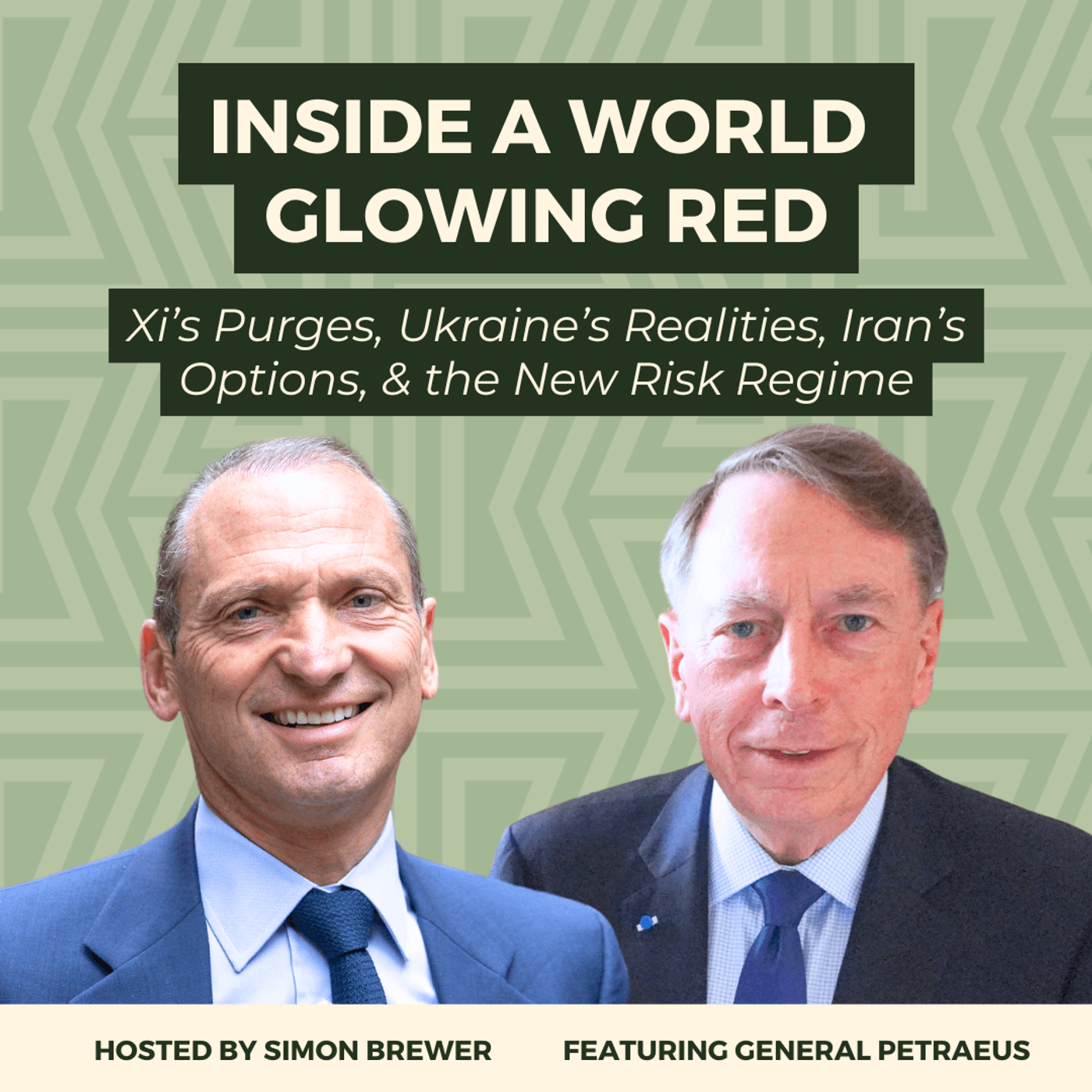
194: General David Petraeus: Inside a World Glowing Red
Podcast Description The Money Maze Podcast delves into the complexities of finance and investment through interviews with industry leaders and experts. The goal is to provide insights into capital allocation, business decision-making, and profiles of influential figures in finance.
---
Key Themes and Topics Discussed
- Geopolitical Landscape
- Current Tensions: General David Petraeus discusses the intensifying geopolitical and military tensions worldwide, particularly focusing on the Indo-Pacific and the relationship between the U.S. and China.
- Communication Breakdown: He highlights a concerning lack of communication channels between the U.S. and China, as exemplified by the Chinese spy balloon incident.
- China's Military Developments
- Leadership Changes: Petraeus notes the significance of President Xi Jinping removing senior military leaders, indicating a consolidation of power and potential implications for U.S.-China relations.
- Strategic Competition: The discussion emphasizes the need to manage severe competition with China to avoid military conflict.
- Russia and Ukraine Conflict
- Recent Insights: After a recent trip to Ukraine, Petraeus provides fresh perspectives, noting the high casualties on the Russian side and Ukraine's impressive technological advancements in warfare.
- Negotiation Challenges: He assesses the prospects for peace, suggesting that while a peace deal might be the best outcome, Russia's maximalist demands hinder genuine negotiations.
- Middle Eastern Dynamics
- Iran's Position: The episode explores Iran's options amidst ongoing unrest and the potential for a shift in leadership, while noting the challenges of achieving meaningful policy change.
- U.S. Military Presence: Petraeus discusses the U.S. military's positioning in the region and implications for the Iranian regime's survival.
- Advice for Business Leaders
- Logistics Shift: Petraeus advises business leaders to adopt a "just-in-case" approach to logistics in light of increasing global uncertainties, moving away from the traditional "just-in-time" model.
- Importance of Geopolitical Awareness: He emphasizes the necessity for businesses to integrate geopolitical, macroeconomic, and public policy considerations into their decision-making processes.
Key Takeaways
- Communication is Crucial: Petraeus stresses the importance of maintaining open lines of communication, especially in times of geopolitical tension.
- Innovation in Warfare: Ukraine's battlefield innovations highlight how technological advancement is essential for modern warfare.
- Caution in Iran: The potential for change in Iran remains uncertain, with the regime's structural challenges complicating prospects for negotiation.
- Business Adaptation: Businesses must adapt to a world characterized by geopolitical rivalry and uncertainties by integrating comprehensive risk assessments into their operations.
Conclusion General David Petraeus provides a profound analysis of the current global landscape, underscoring the interconnectedness of geopolitical events and their implications for business leaders. His insights offer a roadmap for navigating these challenges in a rapidly changing world.
Sponsorship Acknowledgment This episode is sponsored by Schroders, IFM Investors, World Gold Council, and London Stock Exchange Group (LSEG).
For further exploration of the topics discussed and access to additional content, listeners are encouraged to visit the [Money Maze Podcast website](https://www.moneymazepodcast.com/).
---
This summary encapsulates key discussions from General David Petraeus' insights, providing an overview of significant geopolitical issues and strategic advice for business professionals navigating an uncertain global landscape.
Written by AI. May contain mistakes. Listen to the episode to check what was said.
Chapters
Tap a time to open that second in VOAssessing Global Threats
0:45 to 3:00
Discussion on the communication failures in U.S.-China relations and their implications.
“probably at least a year and a half or so and enable them to double drone production from the staggering number of 3.5 million per year to 7 million per year.”
The EU's Support for Ukraine
3:00 to 6:00
General Petraeus talks about the EU's financial aid to Ukraine and its military production.
“I mean challenges, threats, issues that the U.S.”
U.S.-China Relationship Dynamics
6:00 to 11:15
An in-depth look at the complexities of the U.S.-China relationship and its global impact.
“I think it's crucially important that there actually be communication, that there's a floor established for the relationships, some guardrails.”
Chinese Military Leadership Changes
11:15 to 13:00
An analysis of the implications of the recent removal of senior Chinese military leaders.
“and now is gone along with a number of the others.”
Russia and Ukraine: Current Situation Analysis
14:59 to 17:03
General Petraeus discusses the state of negotiations and military dynamics between Russia and Ukraine.
“We were talking earlier on, as we just interviewed Jen Easterly, who grew up, I think, with your tutelage and she's achieved great things.”
Ukraine's Defense Strategy and Innovations
17:04 to 20:02
Explore how Ukraine is enhancing its military capabilities amid ongoing conflict.
“And it's not at all clear that the Ukrainians would agree to do just that.”
The Battlefield Dynamics and Drone Warfare
20:03 to 23:07
Insights into drone usage and battlefield tactics in the ongoing conflict.
“I'll tell you, it was also quite frigid.”
Ukrainian Naval Strategies and Long-Range Missiles
23:08 to 25:22
Discussion on Ukraine's naval strategies and development of long-range missiles.
“And the rest of it is tied up at a port down in southeastern part of the Black Sea and not sallying forth, just trying to keep it from getting sunk.”
International Support for Ukraine and Sanctions Against Russia
25:23 to 28:00
General Petraeus outlines the international response and economic pressures on Russia.
“And then I think there might be the prospect that Russia would negotiate seriously if President Putin recognizes that he's not going to be able to out-suffer the Ukrainians, the Europeans, and the Americans.”
U.S. Support for Ukraine
28:00 to 29:09
Explore the U.S. government's ongoing financial support for Ukraine amidst sanctions.
“they're taking and each country dramatically increasing its dispense spending.”
Show all 23 chapters
Iran's Political Landscape
29:10 to 30:57
Discuss the potential changes in Iran's leadership and the implications for regime stability.
“Is there a danger that negotiation leads to a new figurehead, but no change in policy of the Iranians?”
Challenges in Iranian Protests
30:58 to 32:46
Examine the recent protests in Iran and the lack of leadership in the movement.
“Keep in mind that the besieged militia alone number in certainly over a million, maybe millions.”
Iran's Nuclear and Military Capabilities
32:47 to 34:28
Analyze Iran's military capabilities and the challenges surrounding its nuclear program.
“Keep in mind that this demonstration, these demonstrations across the country, have had no real leadership.”
U.S. Military Presence in the Region
34:29 to 37:02
Insights into the U.S. military strategy and presence in the Middle East.
“And they're not going to relax all the sanctions the way Iran will seek, limits on missiles and the other activities, again, I think very difficult for the Supreme Leader to stomach.”
Potential Economic Impacts of Conflict
37:03 to 38:22
Discuss how potential conflicts could disrupt global oil and gas markets.
“There's a disruption of maritime freedom of navigation, etc.”
Israel's Response to Regional Threats
38:23 to 42:00
Examine Israel's military responses and strategies against regional threats.
“You know, the operation in Venezuela, people, I think, have sort of overlooked some realities here.”
Regional Stability and Economic Diversification
42:00 to 46:05
Explore the current state of regional stability and economic developments in the Middle East.
“But I guarantee that if that's there and they try to enrich it, we'll figure that out.”
NATO's Evolution and Global Defense Spending
46:05 to 49:14
Discuss the changes in NATO dynamics and the increasing defense spending among allies.
“And those are pretty tough terms, I think, for Iran to accept.”
Cybersecurity and Modern Warfare Challenges
49:14 to 54:22
Understand the complexities of cybersecurity and the evolving landscape of modern warfare.
“And having led the largest military coalition, actual fighting countries, I think it was over 60 in Afghanistan alone, over 35 or so in Iraq.”
The Challenges of Espionage in a Connected World
54:22 to 56:00
Learn about the difficulties and changes in spycraft due to advancements in surveillance technology.
“ensuring that it doesn't gradually creep up.”
Challenges of Modern Spycraft
56:00 to 59:42
Learn about the complexities and innovations in modern intelligence operations.
“It is exceedingly difficult to operate in eras of ubiquitous surveillance.”
The Impact of Technology on Intelligence
59:42 to 1:02:02
Discover how technology and open source intelligence are reshaping spy operations.
“And if you can mine that effectively, and of course, it takes vast algorithms and the rest of that to do it efficiently.”
Geopolitical Shifts and Business Strategy
1:02:02 to 1:05:52
Understand the evolving geopolitical landscape and its implications for businesses.
“In fact, during the time that I've been at KKR, 13, almost 13 years now, which is vastly longer than any job I ever had in government.”
Transcript
Automatic transcript. May contain errors.0:00General David Petraeus:Keep in mind that in the previous U.S. administration, when the Chinese violin floated over 49 of our 50 states, starting in Alaska and then the lower 48, before being shot down off the east coast of the United States, the Pentagon picked up the hotline to Beijing and no one answered. That is not a formula for success. That actually is really something that you do not want to have, an ability to communicate in a crisis. The EU has come through, UK has come through the additional sanctions. The EU did a 19th round a couple of months ago. Now they're going to have a 20th round. The EU came together and agreed to provide 90 billion euros, about 105 or$110 billion equivalent to Ukraine that will help them resolve their fiscal and economic issues for probably at least a year and a half or so and enable them to double drone production from the staggering number of 3.5 million per year to 7 million per year.
0:58We welcome back a guest for their third visit. The first of all, the invasion of Ukraine. Second was with Lord Andrew Roberts to discuss the military and strategic lessons in their brilliant book, Conflict. And today, as the heat map of geopolitical and military tensions is glowing red, to understand his perspective on these conflicts and challenges. And in addition, to hear his advice for business leaders, making decisions against the backdrop of uncertainty and unpredictability. General David Petraeus, once described by Simon C. Magmond of Fiore as the ultimate soldier scholar, chairman of the KKR Global Institute and chair of KKR Middle East, a very warm welcome back to the Money Maze podcast.
1:39General David Petraeus:Good to be with you again, Simon. Thanks. Well, your book Conflict referenced the Greek philosopher Plato, who observed over 2 ,000 years ago, only the dead have seen the end of war, and how prophetic, of course, that is. So let's at least run to the sound of gunfire, because there is a hierarchy of global threats. And it would be lovely just to start off with you assessing the priorities. And maybe even we could start with the Chinese, because in the last two weeks, General Chang Yu Sha has been removed. So that means I think Xi has removed all of his senior generals. How do you frame the Chinese dilemma?
2:19General David Petraeus:Well, let me start by saying that's exactly where you should start, where we should start, because that is the most consequential relationship in the world, the one between China, the U.S., and really the West, our allies and partners. But let me actually step back even more and just sketch out the broad landscape right now, because what we see, if you use the metaphorical image of the United States together with allies and partners as the guys in the circus trying to keep a lot of plates spinning simultaneously. There are more plates in the tent right now, absolutely, since the end of the Cold War, even arguably since the end of World War II.
2:59General David Petraeus:By the plates, I mean challenges, threats, issues that the U.S. and our allies and partners have to address and try to resolve where we can, or at least certainly keep them spinning. And so there are more plates in this tent. Again, the challenges are more complex as well. And the plate that matters more than all the others put together is that plate, which represents, again, the relationship between the U.S. allies, partners and China. That is the number one and number two economy of the world. There has been described as a relationship as severe competition. That was how Jake Sullivan, the previous national security advisor, used to explain it.
3:44General David Petraeus:And I think that's exactly right. But the overriding task of the U.S. military, other militaries, and our leaders is to ensure that severe competition doesn't erupt into true confrontation, true military conflict. Because you can de-risk a lot of developments in the world or possible developments. We de-risked back in 2014 our entire portfolio of companies at KKR for Ukraine and Russia and exposure to them. We did it again, by the way, in late 2021 with the possibility that Russia would invade, which, of course, they did a few months later in 2022. We de-risked in advance of the tariffs that were announced by President Trump.
4:29General David Petraeus:You can de-risk an awful lot. It's really hard to de-risk the global economy blowing up, which would be the result of honest, true conflict, military conflict between the U.S. and China and all of the consequences of that around the world. So that is where we need to start. There has been some progress in this relationship. We had, of course, a flurry of extraordinary tariffs imposed by President Trump. I think it was as high as 142 % at one point in time. It's been reduced quite considerably. Since then, China showed their tools, what they have in their arsenal, when they, in response to the tariffs and to other threats, cut off the supply of rare earths and strategics and brushless motors.
5:24General David Petraeus:Again, China has consolidated control. They have at least oligopolistic, if not monopolistic control over certain sectors and certain of these processed strategics and rare earths and other products where you can really only get them in large numbers from China. So there are vulnerabilities around the world to China's ability in certain of these sectors. There were phone calls at a summit meeting in Korea at the end of the year. And that helps. I think it's crucially important that there actually be communication, that there's a floor established for the relationships, some guardrails. Keep in mind that in the previous U.S.
6:09General David Petraeus:administration, when the Chinese spy Berlin floated over 49 of our 50 states, starting in Alaska and then the lower 48, before being shot down off the east coast of the United States, the Pentagon picked up the hotline to Beijing and no one answered. That is not a formula for success. That actually is really something that you do not want to have, an ability to communicate in a crisis. So a lot of that has been restored. There reportedly will be several summits this year, although President Xi is already starting to exercise some degree of influence where he said, well, really looking forward to meeting you in a few months, President Trump, but really concerned about the prospect of$11 or$12 billion worth of arms sales to Taiwan.
6:58General David Petraeus:So we'll see how that plays out. Could be that that's not actually announced or sent to Congress until after the first of the summits that are upcoming. But in general terms, I think the relationship is in better shape now than it was, say, six, eight months ago. And we'll see if that can, again, solidify a bit further. Yes, there is severe competition. Yes, there are structural issues here that make that relationship very fraught. But at the end of the day, it's one that has to be pursued assiduously to ensure that deterrence holds, keeping in mind that deterrence is a function of two elements, the potential adversaries assessment of your capabilities on the one hand, and we're constantly improving those in the Indo-Pacific in particular, although I'd like to see it faster when we get talking about innovation, what's going on in Ukraine.
7:56General David Petraeus:I'd like to see us moving with the kind of speed that they are moving, where they're providing tomorrow's technology for today's wars. And our procurement system is really handicapped by the military, industrial, congressional complex elements, each of which largely preserves the status quo. They want to get more of what it is that has already been made in their district, that keep their ships and aircraft and so forth in their ports and bases, and on and on. And we've got to move with much greater purpose in that regard, though there is a great deal of push in that direction. And then the other element is, of course, the potential adversaries assessment of your willingness to use your capabilities.
8:40General David Petraeus:And I'd submit here that the operation in Venezuela strikes against terrorists in East and West Africa, in Syria, on drug boats in the Caribbean and so forth. while not the kind of major combat operations that we're trying to deter, nonetheless show both capability and willingness to employ that capability on the part of President Trump. So touch wood, because again, this is the plate in that tent that is bigger than all the others put together. It's the one we have to try to avoid even wobbling. But there are serious structural differences here that should not be made light of. And we have to find a way to navigate this relationship while ensuring that the contingency we're trying to deter doesn't actually materialize.
9:33And as someone who's operated at the top of the military and the top of the CIA, when you saw the cleansing of that layer of generals, what was your immediate reaction?
9:44General David Petraeus:Well, it's truly extraordinary. There are likely several explanations for this. One is undoubtedly there is some corruption. Again, the system, as you well know, for decades has been built on that. It's very hard to get rid of it. Again, it's structural in many respects as well. It could be that there were some elements of rivalry here, perhaps some disagreements on intentions down the road. And then, of course, there's the further consolidation of power by President Xi that has been unprecedented since Chairman Mao. No one has been able to consolidate. Of course, no one had a third term in office, which he is currently in with the prospect for a fourth term, five-year terms each time.
10:34General David Petraeus:As well, you'll remember that his predecessor, again, it used to be that there were different camps within the Communist Party in China, and leadership would go back and forth between them. There were certain, in a way, checks and balances internally in that regard. Those are all gone. In fact, President Xi's predecessor, previous head of the party and also president, was escorted off the stage in the middle of the big party plenum a year or two ago. And he has now just completed the consolidation of power. But there's always additional actions that he apparently is taking to ensure that. So I think multiple explanations.
11:20General David Petraeus:But the idea that the president has now removed all of his senior military leaders, the only one left on the military committee, if you will, that he chairs, is the one that actually has to do with ideology and this kind of stuff, and actually corruption, as I recall, not the kind of hard military tasks that the chairman of the Joint Chiefs equivalent or chief of defense staff equivalent oversaw. and now is gone along with a number of the others. The question, of course, is will this give him greater confidence in his military because now his handpicked people will be in position, or does it give him pause about carrying out some operations, keeping in mind that he told his military that he wants them to be ready in 2027 to carry out an operation to forcibly reunify with Taiwan, not saying at all that that's his intention, but certainly he wanted that readiness.
12:21General David Petraeus:I can't think that this helps the prospects of that when you have a constant revolving door at the very top. And they're still in the midst, of course, of continuing completing the reorganization that they had, very similar to what the United States did with the so-called Goldwater-Nichols Act, which established very more significantly the geographic combatant commanders. There, the warfighters established the chairman of the Joint Chiefs as the principal advisor to the president and the secretary of defense and pursued jointness in a way that was not present prior to those reforms. And it took years, in our case, to establish all of that, consolidate.
13:05General David Petraeus:There's still tweaks going on for their prominence to the cyber, U.S. Cyber Command as a full-fledged combatant commander, Special Operations Command, and so on. That is what's going on in China, so that they have a unified command for the kind of operation that might be envisioned, which, again, we absolutely must do everything we can together with allies and partners to deter. IFM Investors is a global asset manager founded and owned by pension funds with capabilities in infrastructure, equity and debt, private equity, private credit and listed equities. They believe healthy returns depend on healthy economic, environmental and social systems.
13:49And these are evolving on a scale never experienced before. To find opportunity, build value, and meet the needs of future generations, you need scale, skill, and expertise. That's what IFM Investors has built up over 30 years. Schroeder's Capital is the private markets division of Schroeder's, combining the experience of specialized local teams with the scale, rigor, and resources of a global institutional platform. Schroder's Capital provides its clients with global access to differentiated and specialized strategies encompassing all private markets' asset classes, from private equity to real estate, infrastructure, and the broad universe of private debt and credit alternatives.
14:34This approach enables Schroder's Capital to access opportunities and investments that are often difficult to find elsewhere, while also having the broad capabilities and perspectives needed to build holistic solutions and delivered tailored outcomes across private markets for both institutional and wealth clients. Discover more at schroderscapital.com. Remember, capital is at risk with investing. So let's move west. We were talking earlier on, as we just interviewed Jen Easterly, who grew up, I think, with your tutelage and she's achieved great things. And she alluded to Russia being the hurricane, but China being the climate change.
15:15And I like to talk about Russia, and obviously in the context of Ukraine. And lots of words have been said about possible outcomes. But if I just condensed it, might a peace deal now be the best Europe can hope for?
15:32General David Petraeus:I think it might be. And by the way, I'm just back from Ukraine. a couple days ago, what was my ninth trip to Ukraine since the full-on invasion in early 2022. And that is probably correct, the problem being that I don't see the prospect of Russia negotiating in a serious fashion, even though they're under much greater pressure than before. And I can walk through, again, how I see the situation right now in a moment. But in essence, every time the Russians seem to be willing to negotiate, and of course, there was just a round of negotiations in Abu Dhabi. There will be another one apparently in Miami.
16:16General David Petraeus:Americans, right after that, usually Medvedev or one of the other party grandees in Russia comes out and says, of course, we are still insistent on getting the additional land that they haven't even approached, must have taken, which includes the fortified cities in the southeastern part of Ukraine. They really would like to replace President Putin with a pro-Russian figure. They want to demilitarize the Ukraine of the future. And they don't want to accept NATO forces on Ukrainian soil as part of a security guarantee. So it does not appear that they are negotiating in good faith the way that, frankly, Ukraine has.
17:02General David Petraeus:They've actually structured a variety of concessions, noting, of course, President Zelensky cannot agree to give up territory because the Constitution requires a popular referendum to do that. And it's not at all clear that the Ukrainians would agree to do just that. There are other ways around this, though. So Ukrainians, I think, are in good faith trying to figure out how to finesse these issues. You just don't see that at all out of the Russians. They continually cling to what are described as their maximalist demands and not falling off those. So what needs to happen? Well, I think there has to be more pressure on the Russian war economy.
17:45General David Petraeus:The EU has come through. UK has come through the additional sanctions. The EU did a 19th round a couple of months ago. Now they're going to have a 20th round. The EU came together and agreed to provide 90 billion euros, about 105 or 110 billion dollars equivalent to Ukraine. That will help them resolve their fiscal and economic issues for probably at least a year and a half or so and enable them to double drone production from the staggering number of 3.5 million per year to 7 million per year. And we visited some facilities, visited drone units and then also manufacturers that are just truly extraordinary and beyond state of the art.
18:25They are defining state of the art. Right. So if we also help Ukraine with more interceptors, the one area where they're not able to make what they need has to do with the anti-ballistic missile defense systems and the interceptors.
18:44General David Petraeus:So think of Patriot and the similar systems like that. That's where they really need help. And then anything else we can do to help them with what is already extraordinarily innovative counter drone capabilities. In fact, one of the nights that we were there, my team and I, we actually went out with a team that was training other pilots to take down the Shaheds with Ukrainian manufactured drones. And whether disappointing or good or what have you, there were no Shahids that actually continued into the airspace. We saw a number of them on the radar that were coming in what appeared to be the normal route they take to get into Kiev.
19:27General David Petraeus:But then they broke off. We did see some bombers on the Russian side of the border that actually launched glide bombs that were hitting around the area of Sumit in the northeast. But none actually penetrated the airspace that night. But what they can do is they can program their system to replicate a Shahed drone coming in, even doing some evasive maneuvers and so forth, and practice the techniques that they have for getting close enough to blow up or close enough to actually just strike the drone. It was really quite something. I'll tell you, it was also quite frigid. The winter in Ukraine is the worst in many, many years, And that is compounded by the horrific Russian attacks with missiles and drones on the energy generation system, transmission and so forth, and also on the heating systems.
20:22General David Petraeus:So as President Zelensky noted the other day, there are 1 ,400 high-rise apartments in the Keeve area alone. So again, many, many floors that have no heat and probably not the prospect of heat for what could be some months, because again, they're going to have to drain systems. There will have been huge damage to them as the water will freeze and so on. So very, very challenging. But just, I think, as the British did in London during the blitz of World War II, there's a defiance there. There's a determination. There's a resilience. However, noting the difficulty of the situation. On the battlefield, the Ukrainians have held the Russians to very incremental gains.
21:10General David Petraeus:There are incremental gains, though, but the Russians have paid an extraordinary price for it. 1.2 million over that killed and wounded. That's more than the United States took in all of World War II, to put it in perspective. And you do wonder what is the point where they cannot sustain the force. In fact, the Ukrainians contend that they killed or wounded as many Russians last month as were actually recruited, which would be very significant. And again, And a lot of this is the innovativeness. The drone systems, some of them now have fiber optic cable that spools out behind them because the jamming is so intensive.
21:49General David Petraeus:The efforts to cut off the link to GPS to command and control to the system that Elon Musk provides for communications, Starlink and so forth. They're using somewhere between 9 ,000 and 10 ,000 drones per day. There is ubiquitous surveillance over this battlefield. Nothing can move on it unless it's in really, really inclement weather. Either very, very high winds or fog when this surveillance is degraded. But otherwise, nothing can move on the battlefield. In fact, the Ukrainians actually have remotely driven vehicles that go from the rear to the front with supplies and take back casualties from the front, usually at night.
22:33General David Petraeus:Some of them have remotely controlled machine guns or remotely controlled mine lane systems. There are remotely controlled grenade launchers. And then in the air, all kinds of different systems, whether they're surveillance, bombers, suicide drones, what have you. And about 40 percent of the drones actually don't come back on a given day. They are either about a third of them are suicide drones. And then another percentage of what's used gets shot down. It's a very intense anti-air system on both sides. So that's what's going on on the front lines. And I should mention also, of course, on the maritime domain, the Ukrainians have used aerial drones to find the Russian ships and maritime drones to sink them so effectively that a little bit less than 40 percent of the Russian Black Sea fleet is on the bottom of the Black Sea.
23:27General David Petraeus:And the rest of it is tied up at a port down in southeastern part of the Black Sea and not sallying forth, just trying to keep it from getting sunk. And the Ukrainians actually snuck a maritime drone into that port and did enormous damage to a submarine. Also, the Ukrainians are taking the fight to the Russian Federation. They have now successfully designed and manufactured a long-range cruise missile, longer range than our particular Tomahawk, 3 ,000-kilometer range, larger warhead called the Flamingo. They're trying to scale up production of that. That could be very, very significant to their effort to attack the Russian energy refining facilities, storage facilities, and so forth.
24:13General David Petraeus:And they've done considerable damage to that. And if, again, the U.S. can come through with sanctions that match those of the EU, and there's a very tough sanctions package in the Congress, has 90 of 100 senators that approve it. Senator Graham is leading the charge. If that can be approved by the White House, if we can help them more with air and ballistic missile defense and keep the money flowing from the EU in particular and the UK, there's actually a prospect, I think, where down the road, given the fragility of the Russian economy, where inflation is taking off, interest rates are very high, there's not going going to be any borrowing and investing.
24:54General David Petraeus:And again, the huge loss of manpower. And they're running out of the National Welfare Fund. The intelligence chief in the CIA equivalent in Ukraine has been telling us this for a couple of years now. And this is the year apparently in which that fund will be exhausted. So if you can then also reduce the revenue that they're taking in, India apparently is going to reduce what it buys from Russia. They've been one of the biggest consumers as part of the tariff deal with the United States. They committed to reducing that. And then if we could go after those who are providing the components to the Russian war machine, the chips, the brushless motors, all the rest of this, largely coming from China, there could be real damage to the Russian war economy, real limitations on what they can do with their military industrial complex.
25:46General David Petraeus:And then I think there might be the prospect that Russia would negotiate seriously if President Putin recognizes that he's not going to be able to out-suffer the Ukrainians, the Europeans, and the Americans. He needs a cessation of hostilities. And then and only then, I think, do you get what you described up front as what's the best that could happen, a cessation of hostilities. That's when that prospect, I think, becomes real. but I suspect we're a number of months from that, given the Russians' actions at the negotiating table. I'm thrilled to share that the Money Maze podcast is sponsored by the World Gold Council.
26:27They champion the role gold plays as a strategic asset through expert research, commentary, and insights. And it's not just your portfolio that may benefit from gold. Learn how gold mining is supporting female economic empowerment and small businesses via their new documentary series called Gold, the journey continues. Tap the link in the show notes to start watching. I'm excited to announce that the Money Maze podcast is sponsored by the London Stock Exchange Group, known as LSEG. At the heart of the global economy, LSEG provides data, analytics, and infrastructure that connects investors, businesses, and economies.
27:04LSEG is where ideas meet capital, enabling sustainable growth and opportunity. Tap the link in the show notes to learn more. And you articulated that so often, you know, war is gives birth to these extraordinary technological progresses of which Ukraine has been, you know, astonishing in their efficacy. Will the administration, I'm talking about the US administration, be willing to continue on this journey as you have described?
27:32General David Petraeus:Here's where it's important to ask not just the administration obviously there are administration reservations about Ukraine frankly about even President Zelensky there's a conviction that the Europeans were never doing enough for their own defense which happens to be true I would contend and now they are though they're stepping up very much and the EU pace of diplomacy has accelerated dramatically as well I mentioned the commitment of again 90 billion euros the sanctions packages all the other actions that they're taking and each country dramatically increasing its dispense spending. And that hopefully will help with the White House.
28:11General David Petraeus:But there's another branch of government, that's the Congress. And as I mentioned, in Congress they have a very tough sanctions package, overwhelming support for it. And also when you dig into documents like the National Defense Authorization Act, which is the law that talks about the Pentagon and so forth, there are amounts of money in there. They're not billions, but they're many hundreds of millions for each of the next two years in support. This will be law provided to Ukraine. So there is very support in the United States as a whole and definitely in the U.S. Congress for continued support of Ukraine.
Read the full transcript
28:51General David Petraeus:We need to see if, again, the actions the Ukrainians have taken, the Europeans have taken, can persuade the White House to continue that support and indeed, above all, to approve the sanctions package, which could be a missing element. It is a missing element and could be the critical ingredient that could do the damage to the Russian war economy and then could get the Russians serious about negotiations. very clearly expressed so that chessboard we're discussing of course has one other big piece you sit there looking after kkr's middle eastern you know businesses and the iranian equation is uh as unresolved i went back to one of our early interviews when there had been riots in the streets four years ago in iran and you said don't hold your breath this is you know this is a a long-running movie um but uh is there an argument that just as syria was obama's red line so president trump has talked about regime change has encouraged the protesters who are unbelievably brave to be out on the streets in those numbers being massacred by what's i think rightly the butcher of Tehran.
30:07Is there a danger that negotiation leads to a new figurehead, but no change in policy of the Iranians?
30:20General David Petraeus:Well, I'm not sure negotiation will lead to a change of regime, even as you expressed it, just a new head. I mean, there's a new head coming anyway, in some fashion because the supreme leader is an ill octogenarian who has got to be closer and closer to death's door. The question is what replaces him? Is there another religious figure that steps up into that? Do the Revolutionary Guards Corps leaders take over? But none of that really postulates the concept that you'd have real regime change. What you'd have is different leaders of a regime that is so substantial. Keep in mind that the besieged militia alone number in certainly over a million, maybe millions.
31:06General David Petraeus:This is a national, provincial district and municipal headquarters for it everywhere. And when they go out on the streets, they're willing to swing pipes, even shoot fellow citizens. And they've shown no real backing off. There's not happening what happened in Cairo, where the military said, you know what, let's step back. Let's not shoot our own citizens. Mubarak's going under the bus. We'll see who's elected to replace him. If we don't like them, then we'll see what we do about it. And, of course, that's exactly what had happened. The Muslim brothers won. A couple of years later, the military was dissatisfied with them, understandably.
31:47General David Petraeus:And you now have a military man in charge in Egypt. That is not the prospect, I don't think, in Iran. You have the Islamic Revolutionary Guards Corps, essentially an Army, Navy, Air Force, Marine, in addition to the regular Army, Navy, Air Force, Marine, the Arteche. They're created for regime survival. And then there are other elements as well, the police, the Ministry of Interior Forces and so forth. And we saw all of them on the streets essentially crushing, ultimately, the demonstrators. I suspect we're going to find out that well over 2 ,000 or 10 ,000 have been killed and that tens of thousands more have been imprisoned.
32:33And most recently, they're going after the old figures that were leading the reform movement.
32:39General David Petraeus:Even they are brought into suspicion by the regime because of the possibility that they could lead. Keep in mind that this demonstration, these demonstrations across the country, have had no real leadership. And it's one of the shortcomings of it. In the past, the Green and so forth, you had some. And then, of course, the regime quickly took them down. There is the son of the Shah who has some degree of support, but I think that support is more just anti-regime than it is necessarily pro-return of a monarchy. Regardless, that has all been crushed. President Trump did indeed use language that's very much supported them, told the regime that if you don't stop, he's backed off that a bit by saying that, well, they didn't carry out the executions that had been ordered.
33:41General David Petraeus:Some other slight changes. And then there are negotiations going on. But the negotiations are about issues that the regime has shown very, very strong ideological conviction about. It's the nuclear program, missile program, support for these murderous proxies in the region, Hezbollah, Hamas, Shia militia in Iraq, Houthis in Yemen, and so forth. And these are very tough issues for Iran. And again, there's an ideological conviction about each of these that tends to suggest that they're not going to make the kind of concessions that President Trump could hold up and say, OK, we got what we wanted.
34:26General David Petraeus:no more ever enrichment or no more buried enrichment, only up to this, and it's all verified, and, and, and. And they're not going to relax all the sanctions the way Iran will seek, limits on missiles and the other activities, again, I think very difficult for the Supreme Leader to stomach. So then what happens? Well, the U.S. military is set in the region. The offensive capability, the aircraft carrier task force, which even includes a submarine and a bunch of other ships, many of which have sophisticated air and ballistic missile defense systems. F-15s in Jordan, the refuelers in one of the Gulf states, the prospect of B-2 stealth bombers flying all the way from the U.S.
35:15General David Petraeus:to carry out their missions over Iran, as they did during the 12-day war. All of that now is in place. And the defensive systems have been returned to the theater as well. So we're talking about Patriot ballistic missile defense systems that are tied into the Gulf states, Patriots and Terminal High Altitude Air Defense system. Keep in mind that the THAAD battery that was in Israel alone, that one, shot$1.2 billion worth of interceptors to help protect Israel just in the 12-day air campaign that Israel carried out. So, again, that capability is their offensive and defensive. And at a certain point, I think the Iranians have to expect that if they do not truly come to the table and truly make serious concessions, that they're going to see how defenseless they are against attack from the air.
36:11General David Petraeus:keeping in mind that the Israelis using U.S.-provided F-35 stealth fighter bombers took out the supposedly sophisticated Russian S-300 air and ballistic missile defense system that Iran had provided again by Russia and then other air defense batteries and systems that they had. So again, if you fly above, say, certainly 12 ,000, maybe a bit higher, again, Iran really can't touch them. And so, in effect, then defenseless against that kind of attack. But yes, there is a retaliatory capability. There are a number of scenarios that could really affect the global economy. Normally, this stuff doesn't really matter to the rest of the world unless gas and oil and distillates coming out of the Gulf are prevented from getting out.
37:03General David Petraeus:There's a disruption of maritime freedom of navigation, etc. And Iran has some capability for that, the prospect of mining the Strait of Hormuz, using other retaliatory means against U.S. bases and perhaps even U.S. allies. There's a threat against Israel if the U.S. were to attack. So lots of permutations here. And you're right to say, look, this is a red line, just as President Obama established a red line on the use of chemical weapons by the murderous Bashar al-Assad regime in Syria, and it was crossed and we didn't take kinetic action. I remember being actually in Singapore at that time, and Prime Minister Li said, you know, General, that undermines deterrence out here.
37:49General David Petraeus:That has repercussions in the South China Sea and so forth. So these are the considerations because of his rhetorical support for the demonstrators. I think there will be a degree of pressure to do something significant if the Iranians truly don't come to the table. But that's always a tough decision. But President Trump, again, has shown a willingness to do this again with Venezuela, the counterterrorism operations in various locations around the world, strikes on drug running boats and so on. And some of these were pretty dicey. You know, the operation in Venezuela, people, I think, have sort of overlooked some realities here.
38:36General David Petraeus:One is that the pilot of the lead special operations aircraft took three rounds in the leg as he was landing. And the aircraft got hit pretty hard as well. He stuck the landing nonetheless, managed to take off. They were able to recover the aircraft to a good location. But that's pretty dicey. The fact that over 30 Cuban special operators augmenting President Maduro's secret service were killed indicates that there were some serious gunfights as part of all this. Yes, we reportedly turned out the lights. Yes, we suppressed all of the air defenses and the bases that might have had quick reaction forces.
39:14General David Petraeus:and the rest of this reportedly again jammed or shut down communications and so forth. But at the end of the day, there had to be some really significant activity by those on the real cutting edge, our most special operators. And so there was a gutsy call here by the president, and that demonstrates, as have other actions over the years, including in Trump 1.0, the drone strike that killed the head of the Quds Force at that time, Qasem Soleimani, my most formidable enemy, frankly, back when I was the commander of the surge in Iraq, Central Command, Afghanistan, and even CIA director, because he's a combination of all of the above.
39:58General David Petraeus:The intel director, he's actually a policymaker for certain of the countries in the region, and he had the special operations component to carry out various activities as well. So I think there has been a demonstration of a willingness. In fact, when Syrians used chemical weapons in Trump 1.0, the U.S. responded kinetically. So we'll see where this one goes. I have to say, I also suspect that he is keenly aware that President Obama did not take action when his red line would cross. I think he really dislikes any comparison to his predecessor. And therefore, there's that element at play here as well.
40:43And although it may not play a role before we leave Iran, stepping back through the lens of
40:48General David Petraeus:the big other Middle Eastern countries, Saudi being the greatest of those, what would they like to see? Well, it's interesting because let me just sketch out first what's happened over the years since those terrible 10-7 Hamas attacks in Israel. The worst intelligence failure in Israeli history, worst military readiness response, and really the worst political miscalculation as well relative to Hamas. And since that time, Israel dramatically degraded the capabilities of Hezbollah and also disarmed them up to the Latani River with the Lebanese armed forces in there now, decimated their leadership structure, just didn't decapitate it, decimated it with that extraordinary intelligence supply chain operation where thousands of pagers blew up simultaneously in the hands of all the major leaders of Hezbollah.
41:47General David Petraeus:Iran dramatically degraded in terms of its missile program, its air defenses, and the nuclear program set back by at least probably a couple of years. Yes, there's a possibility of some stockpiles somewhere and some centrifuges. But I guarantee that if that's there and they try to enrich it, we'll figure that out. Plus, they don't have the metallization capability anymore. You have to take the gaseous form of highly enriched weapons-grade uranium and actually metalize it, that capability has been destroyed as well. So they're set back very considerably. Hamas is dramatically degraded. Certainly still the guys with the most guns in that part of Gaza that they still control, 47%.
42:28General David Petraeus:I was in Gaza a few weeks ago when I was in Israel, met with a civil military coordination center commander, one of my old guys, and then also the international security force commander as well, very extraordinary special operator. So the landscape in the region is much improved, I think, from their perspective, the perspective of the GCC countries. And they're in the midst of very impressive diversification of their economies, especially the kingdom, but certainly also the UAE, Qatar, others up and down the coast. they are very heavily engaged in innovation, huge investments. In fact, I should note KKR is a major investor in Gulf Data Hub, a number of other investments there.
43:17General David Petraeus:In fact, the whole reason I'm the chairman of KKR Middle East is because we see the situation very differently there. It used to be that we invested lots of their sovereign wealth funds. We're still doing that, to be sure. But now they're welcoming investment in their countries in ways that was not visible in the past. Some of these have such very large pools of capital that they didn't really feel compelled to sell us$2 billion of Abu Dhabi National Oil Company or the like in their gas pipelines, which we did. And that allowed them to accelerate their campaigns to improve their infrastructure, pursue again innovation, enormous emphasis on AI in Abu Adabi in particular, they have the company they have supported that has done the first from native Arabic large language model.
44:10General David Petraeus:You're seeing similar efforts in Saudi Arabia. They want to invest very substantially in data centers and they have the cheap energy that can enable that. So lots and lots of developments there. They look around, they see, you know, this is not a bad situation. There's a reasonable amount of stability. Syria is no longer an ally of Iran because Hezbollah, Iranians and Russians couldn't come to their rescue when under pressure last year. And a caution, therefore, a concern about instability that could result from action against Iran. Again, undefined. Could it be, again, a civil war? Could there be some kind of crisis where some of the different ethnic or sectarian groups in Iran try to preserve to achieve some degree of autonomy?
45:01General David Petraeus:Again, just somewhat unclear, but just enough unsettling that I think they would probably prefer that there is not something further. And in fact, it's publicly known, a number of them have said, you can't use our base to carry out these operations. They're different criteria in each case. So that's the situation. Very, very impressive. Again, economic progress, very impressive education, innovation, support for entrepreneurship, all the rest of that. And they want to continue that and they don't want it threatened. And so therefore, there's a bit of caution, I think, that has been transmitted to the White House.
45:45General David Petraeus:And so President Trump and his advisors have to factor all of this into the decision on whether to strike Iran or not, if the negotiations do not produce what the U.S. and, of course, Israel and Prime Minister Netanyahu is in Washington today. That's what they want. And those are pretty tough terms, I think, for Iran to accept. So all of the backdrop that we've touched on has underpinning it a certain amount of cooperation and intelligence of the Western agencies. And it was William Burns, former head of the CIA, and obviously you will know him very well, said in a recent interview with the FT, the US's network of partners and allies is its advantage over China and Russia.
46:29And my question to you is there is an impression, and it may be more rhetoric than reality, that there is a burning of the bridges. How do you assess the reasons that that has become more of a concern in the West?
46:45General David Petraeus:Well, I think it's a result of, in some cases, pressure on Europeans in particular, but others as well. Koreans, Japanese, other allies and partners to do more for their own defense. That the era of cheap U.S. security is over. By the way, so is the era of cheap Russian oil and gas for Europe. And dissatisfaction. Look, I watched several different presidents. You know, I was a NATO guy as a one, three and four star, always dual hatted. But that was in Bosnia, Iraq and Afghanistan. So I spent a lot of time with the NATO military committee and the North Atlantic Council. And our leaders were absolutely frustrated beyond compare about the inability and the unwillingness of Europeans to spend even 2 % of GDP on defense, much less than now 3.5%.
47:41General David Petraeus:And everybody now gets this, and there are huge commitments, and that's really a tribute to President Trump and certainly to the threat posed by President Putin. He's been the greatest gift to NATO since the end of the Cold War in a perverse sort of way. But that, again, continues. It has to materialize. We have to see how it does transpire over the years that lie ahead if they meet these commitments and sustain that level of commitment. You see it, by the way, with Japan. And of course, the reelection of the prime minister with supermajority, well beyond what most expected, will enable her to dramatically increase defense spending there as well.
48:25General David Petraeus:And that's the number four economy in the world. So an increase in a percentage of GDP is very, very substantial. But the U.S. has put pressure on them to do more for yourself all around the world. Occasionally there's been some rhetoric that has ruffled a lot of feathers, such as a speech at Munich last year and on tomorrow, in fact, I'll head to Munich for the annual security conference where this year it will be the Secretary of State speaking. I think there will probably be a bit of reassurance this time about the importance of alliances, of allies, of partners. I would hope there would be.
49:04Look, I strongly embraced what Churchill said, that the only thing worse than fighting with allies is fighting without them. And having led the largest military coalition, actual fighting countries, I think it was over 60 in Afghanistan alone, over 35 or so in Iraq.
49:26General David Petraeus:Yes, the counter-ISIS one was bigger, but a lot of those were just in it on the diplomatic side. Again, I do agree with him. You have to spend a lot of time and energy and effort on coalition maintenance, on alliance maintenance. But I think it's worth it. And I think that, again, Bill Burns is exactly right when he says that this is one of our true advantages over China. And I hope that we will continue to recognize that and embrace these alliances, having now gotten the allies to do so much more for their own defense. Yeah, that's very clear and very overdue as well. I absolutely agree. As we think about and having interviewed Jen Easterly, you know, who's had all that cyber experience, how do we think about what's going on in those other domains that are less talked about?
50:17is undersea, but it's cyber and the threats that have been so well demonstrated by our adversaries. And my question is, how well positioned or vulnerable do you think all the West is?
50:32General David Petraeus:Well, I think we have a lot of vulnerabilities. That said, there have been significant advances. The UK, in fact, led the way with its national cyber center. In fact, I visited it a couple times, a unique partnership between GCHQ and then civilian partners and so forth. And I think, again, in many respects, very close to the gold standard. Jen Easterly then headed our organization, the Cybersecurity and Infrastructure Security Agency, started, established in Trump 1.0. So a little bit out of favor now because of some statements by the then head of CISA that The elections were very credible, best we've ever run and so forth.
51:17General David Petraeus:So it's got a bit less support on the administration side, but still moving along. And we did finally elevate U.S. Cyber Command to full-fledged Combatant Command. But it took too long for us. And I'm a bit worried that in the world of Doge, the effects of which are still felt. By the way, I felt that Doge should have been focused like a laser on the military procurement system in the United States. That is so hampered, again, by these support for legacy systems, legacy basing, legacy everything, that is very hard to move forward. I look at the pace, again, of Ukrainian invasion. Yes, they're fighting their war of independence or war for survival.
52:01General David Petraeus:But you have a partnership there. They've thrown all the rules out. You have a partnership between those who design the drones, those who manufacture, and those who use them that is like this. And it's just constant. Again, every week or two, software changes. Every few weeks, hardware changes. It's a constant battle to stay ahead of the enemy. By the way, the Russians are doing the same thing and doing it quite impressively. They also now have complete unmanned services. So Army, Navy, Air Force, Marines, unmanned service units and so forth. So all of that is ongoing. But I think what I would do specifically to your question is I'd open it up much more broadly.
52:43General David Petraeus:It's not just cyber is, again, challenging as that is. And it's very significant. Almost every day there is a revelation about some hack of some type that is really quite serious and that we know who the major actors are in this and why they pursue it. but is devilishly difficult. And AI and greater compute power and more storage and all the rest of that aids not just those doing cybersecurity. It enables those that are doing the breaking and entering in the cyber world. But it's also assassinations. It's dragging anchors and cutting cables in the Baltic Sea. It is influence operations, the so-called cognitive warfare, where Russia tried to put a thumb on the scale of our elections, French elections, other European elections, trying to create a perception right now that Russian victory is inevitable.
53:41General David Petraeus:that there's no question that they're going to be able to out-suffer the Ukrainians, the Europeans, and the Americans, which I believe, again, if we do it right, is not going to prove the case. But all of these gray zone activities, as I think it's better to term them, not just cyber, although that's a significant component, all of these are very worrisome. And you see Russia, of course, also running drones into Polish airspace and other countries shutting down airports and the like. There were manned aircraft that went into some of the Baltic states' airspace. And we've got to be much better collectively at responding to this and also ensuring that it doesn't gradually creep up.
54:28General David Petraeus:And there's a boiling of the frog kind of routine going on here with respect to Russia, while absolutely continuing to do all that we can to enable Ukraine to prevent Russia from winning, to try to help Ukraine even regain some of the ground that they have lost, and continuing to inflict very, very heavy casualties on the Russians and going after their militarily significant strategic infrastructure like refineries, fuel storage and the rest. But know that this is going on around the world. And all of our adversaries are engaging in this to varying degrees. And there has to be a coordinated and significant pushback and penalty for all of this if we are to succeed in deterring further of it.
55:23And I asked Jen Easterly this question on spycraft and how much more difficult it's becoming and then she nicely she nicely said well you need to ask the general about that how difficult is that former head of the cia how tough is this sure no think about what used to happen
55:37General David Petraeus:i mean it's all publicly known and it's all out in the various spy novels and so forth where you know you come in under one identity and throw that passport away and get another one at a dead drop and you rent a car with that one or a room or whatever now everything is is connected um you're not only showing your passport, you're actually getting your iris scanned or your fingerprints or facial recognition. It is exceedingly difficult to operate in eras of ubiquitous surveillance. There are certain countries in which there is so much hanging off every light pole and in various other ways that it is very, very difficult to carry out traditional, again, spycraft.
56:23General David Petraeus:There used to be surveillance detection routes, for example, that would run 10, 12 hours to shake the enormous coverage that some countries can blanket our CIA officers and others with when they're just trying to get loose for a moment and pick something up or leave something or press a button or whatever. So it is increasingly much more difficult. Well, that said, there are some diabolically clever ways that you can contend with some of that, counter some of it. But but again, much, much more difficult and requires much greater expertise to do that. I'll give just without exposing anything an interesting story, though, when I was the director of the CIA.
57:08General David Petraeus:So I had all these plans because, of course, I was not from the CIA. I'd worked endlessly with them in the war zones for the better part of a decade and so forth. Knew the station chiefs in the war zones and the briefers and all the rest of this. But at the end of the day, I was conscious that I'd not gone to the farm myself or done a lot of what others had done, which is not uncommon. Often someone comes in from the outside. In fact, it's the norm. But I wanted them to get to know me. I wanted to get to know them beyond those that were at the director's conference room table every morning. And so we had a variety of programs.
57:45General David Petraeus:One was run with a director. Well, there was a certain standard for running. You had to be able to run six miles in 42 minutes or better because I want to be able to talk and get a workout at the same time. So I got to know the college interns really well. Nobody else. There was workout with the director. That actually turned out. It's not that easy to talk while you're doing push-ups or pull-ups or whatever else it might be. and so then there was Eat with the Director and that was a big hit and we would have four individuals not at the level that I was dealing with in the different directorates and I'd sit down and I'd usually ask him you know tell me a bit about yourself where are you in the building what's your job title what do we need to continue to do what do we need to improve or stop doing this kind of stuff and it was just me and them and usually I might have one note taker well one time I sat down and I went through this one guy and I said, Bill, now, so where are you in the building?
58:39General David Petraeus:And he said, well, director, with great respect, I'm actually not in the building. I said, oh, that's interesting. What's your job title? He said, well, I didn't really want a job title. I don't have one. I said, well, tell me, what are you up to? He said, well, look, I built and sold several companies out in Silicon Valley. I always wanted to help the CIA. So I came east. I have a little office with some people down in Crystal City or somewhere near the Pentagon. And I knew that you would be experiencing increasing challenges with tradecraft. And I'm here to help you solve some of the problems, these new challenges that you have with the kind of circumstances that I have described.
59:23General David Petraeus:And quite a genius and came up with some very novel techniques. But again, the bottom line is it's much, much tougher to be a spy now than it was before, although some of that is offset a little bit by the ubiquitous nature of open source intelligence. Everybody who has a smartphone, you know, this Gutenberg 2 moment, if you will, can take a picture, record a video, tape something, whatever, and upload it on social media. So everyone is a reporter. And if you can mine that effectively, and of course, it takes vast algorithms and the rest of that to do it efficiently. You have an extraordinary of a treasure trove of information that never used to exist.
1:00:11General David Petraeus:And when you look into what applications show you, for example, in advance of the Russian invasion in early 2022, I was looking at Google Maps for the Federation and for Belarus. And you could actually see the congestion. The routes were red because they were so clogged by Russian military vehicles. There's much more of that, you know, fitness apps that tell you where people are and on and on. So that's also become, again, very, very fertile grounds for exploitation. You just have to recognize it, figure out how to do it very, very efficiently, because there's no way that you can do what we used to do, say, during the surge in Iraq.
1:00:53General David Petraeus:In fact, I had a British political advertising campaign agency working for us, watching every TV, listening to every radio, reading every newspaper, all of this. And we thought there was a lot of that. That was before social media exploded the way that it has now and before the advent of real smartphones and all the other adverts. And by the way, of course, now you have Starlink. So even in a war zone, you still have Internet connectivity. So the world has changed dramatically for spies. And I would contend, and Bill Burns confirmed that when he was in office, that our spy agencies, particularly the greatest one on the Western side, the CIA, they have made enormous changes, both to take advantage of new opportunities and to deal with the enormous new challenges, traditional ways of carrying out intelligence operations.
1:01:49General David Petraeus:operations. That's brilliantly cogent and concise. And we're going to wrap up. But just wearing your KKR and your experience hat, what advice to business leaders, given the backdrop, is as uncertain as one can remember? Yeah. In fact, during the time that I've been at KKR, 13, almost 13 years now, which is vastly longer than any job I ever had in government. I mean, the longest I ever had in the military, I think, was two years. That was a command. Otherwise, you're almost rotating every year and so on. But during that 13-year period, the world has changed dramatically. We were in what could be described as a world of benign globalization, in which all the barriers to trade, investment, capital flows, even intellectual property and people were being reduced.
1:02:39General David Petraeus:Globalization, as measured by global trade at least, was going up like this. And economics largely drove geopolitics. It was also a time when just in case logistics worked. Now we're in an era of renewed great power rivalries. Geopolitics is back with a vengeance. The so-called holiday from history is over. All of those barriers, instead of going down, have been going up. And not just with the advent of the Liberation Day tariffs in the U.S. President Biden put 100 % tariffs on Chinese electric vehicles. His administration fenced off entire areas that you could not invest in China or sell them various products that we had.
1:03:21General David Petraeus:So enormous change over that time. Certainly these tariffs take it to a different level, although many of them, the aggregate level now is probably somewhere around 15%. So still the highest since the Smoot-Hawley tariffs of the late 1920s that did so much to deepen and extend the Great Depression didn't cause it. But again, all of this. So now globalization is measured by global trade. Instead of going like this, it's now slobalization. And within it, you carve out regionalization. So it's a very transformed landscape. And again, now it's geopolitics that is driving economics. So what's the advice for businesses?
1:03:59General David Petraeus:You've got to have a KKR Global Institute. You've got to have a global public policy team, which we have as well. We partner with them. You have to have a global macro team. All of these are so significantly more important. It used to be if you were investing in the United States in a company, geopolitics wasn't a huge concern. Now it's a very significant concern because of all the factors that I have mentioned. And so you have to have geopolitical, macro, public policy, examination, identification of challenges. And you have to be able to mitigate those sufficiently so that they will not prevent a successful outcome.
1:04:42General David Petraeus:And this is playing a much bigger role. We have actually vetoed a handful of investments where the deal teams wanted to continue forward. And we're like this with the deal teams. And there are other elements as well. Sometimes it involves a cybersecurity assessment also and other actions that we take during the diligence process. But the point is that instead of just sort of the financial aspects of these and maybe some policy issues involving license to operate and so forth and to pass the front page of the Washington Post test. Now, this is a central part of the diligence process. And if investors don't have that factored in, at some point, they're going to run up on the rocks of reality because that reality is very different.
1:05:30General David Petraeus:And by the way, not only we don't have just-in-time logistics anymore, now we have just-in-case logistics because of disruptions to supply chain that have continued even beyond COVID. So all of these dynamics make this a very, very different landscape and one where expertise in what we've been discussing really matters. So I was amused because the other day in a talk I gave, I referred to Churchill's comment that the further back you look, the further ahead you can see. And somebody then said, actually, remember, John Paul Getty said at times of great change, memory is unhelpful. So the KKR Institute.
1:06:07General David Petraeus:Also remember Churchill saying you can always count on the Americans to do the right thing after trying all the other things. You know what? I was going to say that earlier on, and then I thought I'd be more polite. Well, it's been terrific to have you back. You've been so generous with your time for the third occasion. Our listeners and viewers around the world will be, you know, I'm sure just as thrilled as I've been today. I could summarize with so many things, but I just like that last thing you said is that as businesses think about best practice, they've got to think about just in case, not just in time.
1:06:38Absolutely.
From the publisher
A first! For the first time since our inception 6 years ago, we welcome back a guest for their third visit. General David Petraeus, once described by Simon Sebag Montefiore as the ultimate soldier-scholar, is Chairman of the KKR Global Institute.
Prior to this, David had a distinguished US military career and was the CIA Director during the Obama administration.
He assesses the heat map of geopolitical and military tensions which is glowing red. Starting with the Indo-Pacific he assesses President Xi’s removal of his top Generals, what this might mean, and why peace must prevail despite the undercurrent of tensions.
Having returned recently from Ukraine, he then gives some fresh perspectives which challenge stale narratives and describes the immense scale of loss of Russian lives and the technological prowess of Ukraine manufacturing and know-how.
He then weights Iran’s options; the US’s potential moves and the perspective of other Middle Eastern nations. Finally he offers advice for leaders in an environment where “just in time” has morphed into “just in case”.
The Money Maze Podcast is kindly sponsored by Schroders, IFM Investors, World Gold Council and LSEG.
Sign up to our Newsletter | Follow us on LinkedIn | Watch on YouTube