Ask ChatGPT

 Moonshots with Peter Diamandis
19 Nov 2026 · 2h · 41 chapters
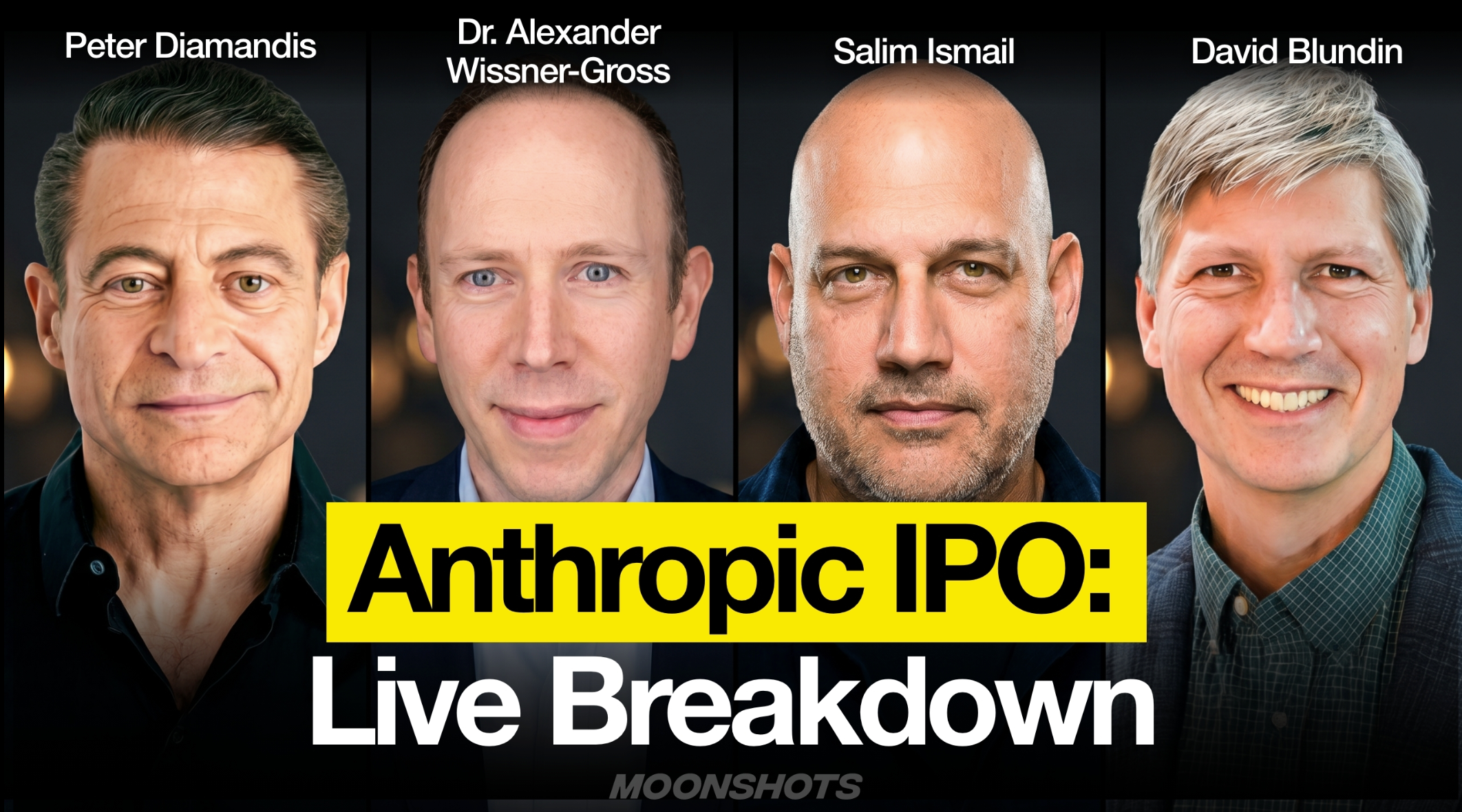
The episode covers (1) Anthropic’s planned $1.4T IPO and the resulting wealth concentration in San Francisco, (2) governance and succession turmoil at Nvidia after Jensen Huang’s resignation/board conflict, and (3) a cluster of recent U.S. infrastructure outages and cyber incidents (Microsoft/FAA/bank disruptions and an Optimizely supply-chain style attack), plus what this means for resilience and security.
The show is hosted by Peter Diamandis with recurring panelists: Dave Blunden (AI investing/physicist background implied by “resident physicist and genius” and “AI investing”), Salim Ismail (globetrotting leadership retreat; based in Bangkok during recording), and Alex (AI/tech market commentary). No additional guest bios are provided in the transcript.
Anthropic’s IPO is framed as a “biggest wealth event” for employees and a liquidity catalyst for more AI startups. Nvidia’s governance failure is attributed to lack of succession planning and board division; activist investors may intervene. Cyber risk is described as systemic: centralized legacy systems, vendor scripts, and an “offense-defense asymmetry” where AI accelerates attacks faster than humans can patch.
Anthropic: 825M shares priced $70–$78, ~$64B raised, ~5x demand, employee holdings cited as ~$72M (midpoint) and OpenAI insiders ~$126M. Nvidia: revenue $115.8B (+103% YoY), net income $65B; stock down ~1.5% post-earnings. Cyber: Microsoft Outlook/Exchange outage (74 countries, ~130k reports), FAA nationwide ground stop (~4 hours), bank disruptions (Chase/BofA/Wells Fargo), and Optimizely injected hostile JavaScript into 178 orgs (CNN, Zoom, HSBC, Equifax, Salesforce, IKEA).
Written by AI. May contain mistakes.
Discussion about recent political happenings, including Trump and Xi's meeting.
“So, guys, a lot happening in the last 24 hours, right?”
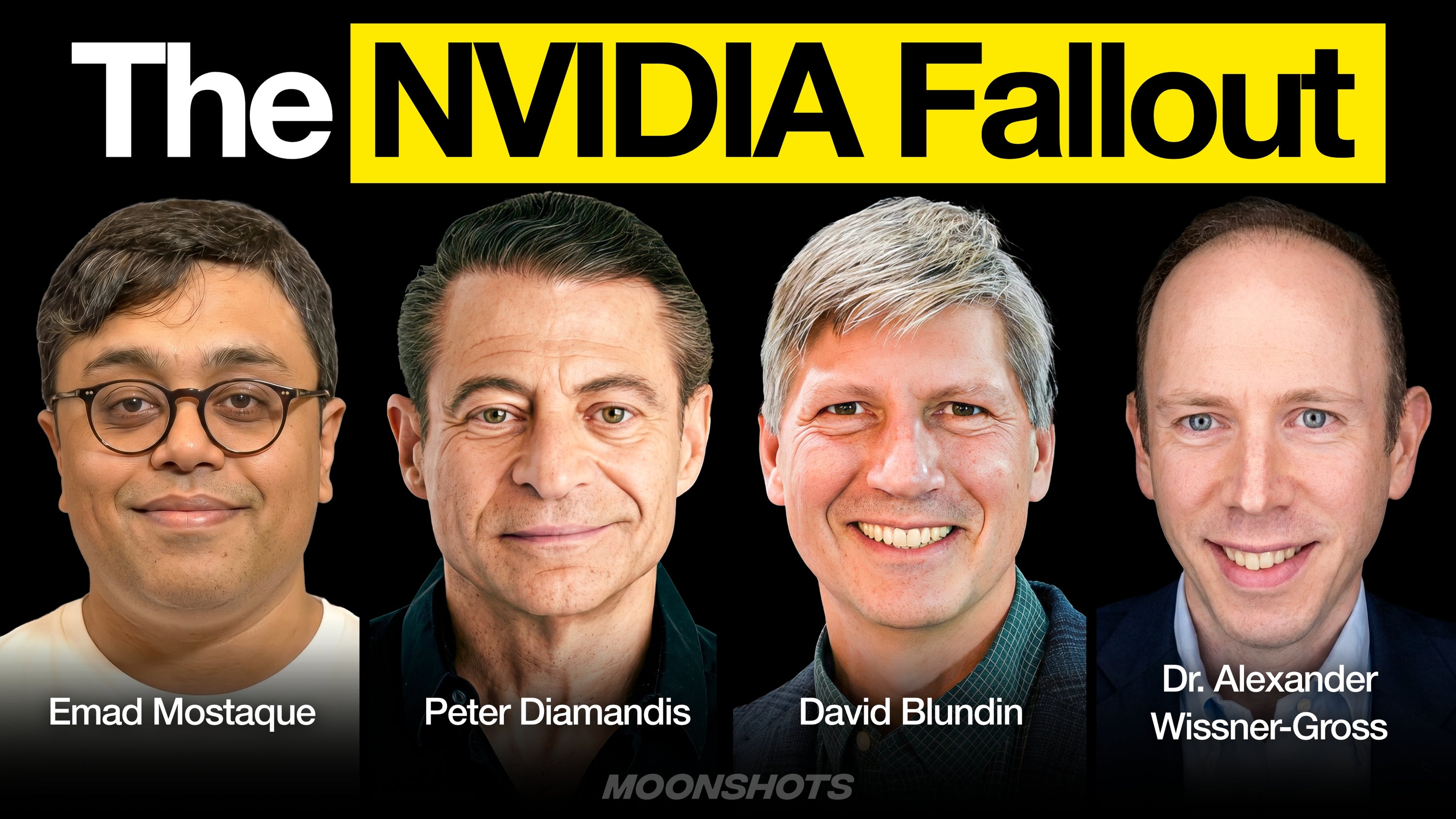
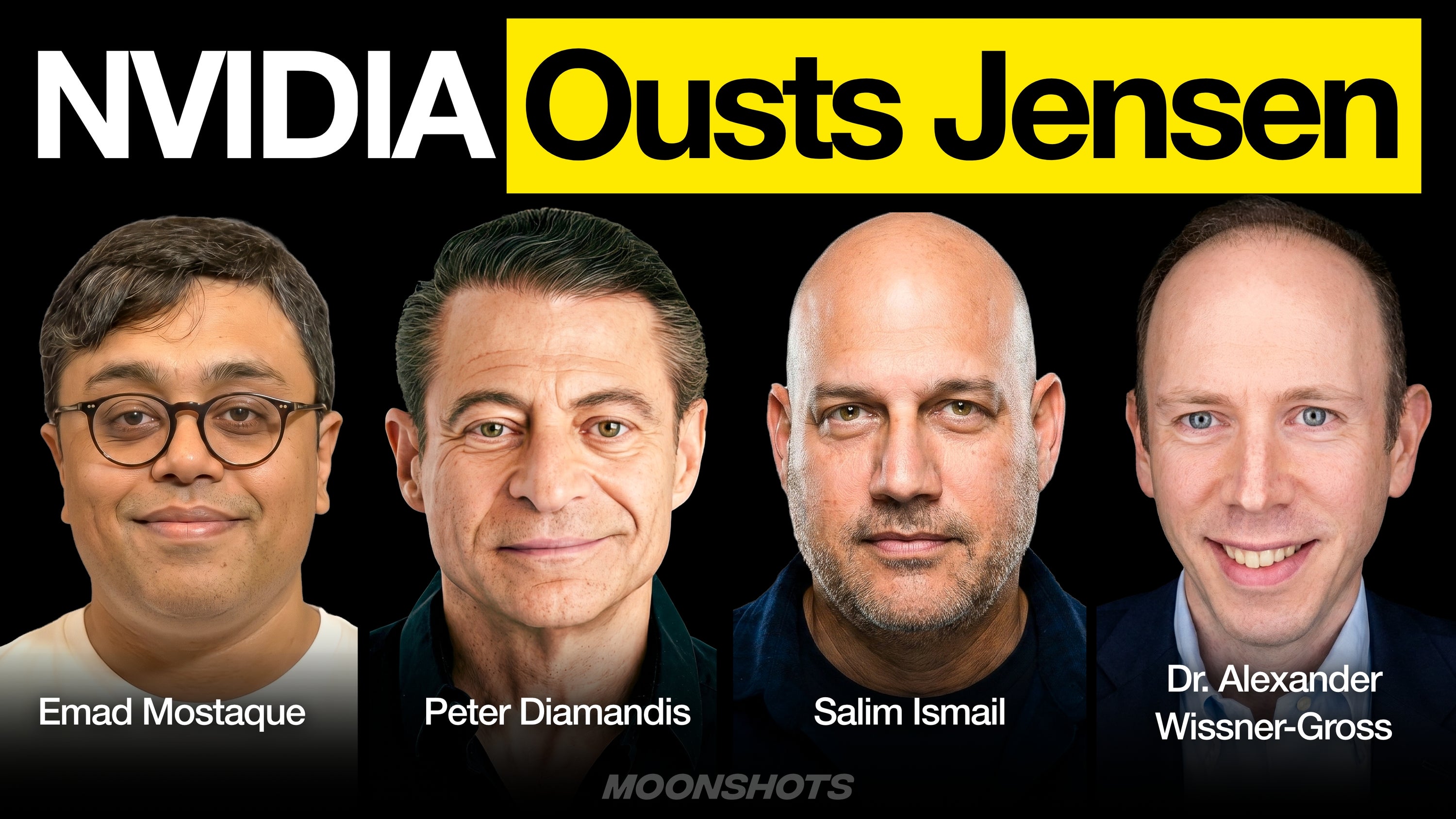
Analyzing NVIDIA's recent earnings and the implications of Jensen's resignation.
“Coming down on the other world leaders is always a good look.”
Exploring the governance challenges faced by NVIDIA's board and potential outcomes.
“Revenue was$115.8 billion, up 103 % from last year, 100 % growth year after year.”
Debating Jensen's potential return to NVIDIA and the company's future challenges.
“until recently, by market cap company is in the middle of such an absurd governance failure.”
Discussing how Jensen's departure may affect NVIDIA and the broader AI landscape.
“Now the great commodity is GPUs, 50 years later.”
Explore the competitive landscape of AI with insights on Google and NVIDIA's roles.
“And, you know, Elon immediately came out supportive of Jensen.”
Discuss the implications of Anthropic's IPO and wealth concentration in San Francisco.
“All right, let's jump into our first story.”
Delve into the massive wealth creation from the AI sector and its broader implications.
“Your thoughts on the IPO and on this concentration of wealth in San Francisco?”
Discusses the timeline and market reactions surrounding IPOs, especially Anthropic's.
“Arguably, real wealth comes from creating greater future freedom of action for humanity and not just from moving dollars around.”
Explores the dramatic acceleration of wealth creation for AI startups and founders.
“I went and looked at time between founding and reaching unicorn status.”
Examines the implications of capital influx on talent recruitment and business startups.
“So what happens is, you know, in the companies that are getting unicorn valuations out of the gate, it's dependent on the people they collect.”
Debates how a surge of IPOs will reshape San Francisco's appearance and culture.
“And so, okay, well, who's going to start the next wave of companies then?”
Introduces a discussion on recent cyber attacks and system failures affecting major services.
“We want Mecca to look like Starfleet Academy.”
Breaks down the recent series of failures in major systems and their implications.
“So, you know, let's go to our next story here.”
Discusses the necessity of updating aging technology infrastructure to meet modern demands.
Discussion on the vulnerabilities of modern tech infrastructure and cybersecurity risks.
“Did you get diverted or did you land in Boston?”
Conversation about the market opportunities in upgrading outdated systems and cybersecurity enhancements.
“We are going to see systems coming down.”
Celebration of the successful Starship Flight 15 and its implications for space travel.
“hardware and software that never succumbs to all of these upgrade itis issues.”
Discussion on the drastic cost reductions in space travel and its future accessibility.
“So on Saturday, McZilla caught a Starship for the very first time.”
Discussion on the cost reductions in space flight and milestones of rocket technology.
“and we're going to be doing a pod with Steve this coming week.”
Comparison of current space missions to historical advancements in network technology.
“I think this is, one can analogize this easily to so many important moments in human technological history.”
Exploration of reusable spacecraft technology and its implications for future missions.
“We're moving past the named space mission era to an era when a space mission is going to be composed of hundreds or thousands of individual packetized flights.”
Analysis of international policies concerning AI chip production and usage.
“I read a really cool analysis of, you know, to land the way that Elon is landing, you got to carry the fuel for the retro rocket.”
Explore the implications of decoupling tech stacks between the US and China.
“But I do think it's symptomatic of a broader issue.”
Learn about the significance of timing and competition in AI development.
“Yeah, I mean, there's, I think, an implicit tradeoff between short-term benefit versus long-term benefit of, call it, technical protectionism in the short term.”
Discuss how SpaceX achieves faster construction timelines than competitors.
“I'm going to go and edit the video so I come out better.”
Discover how AI transforms project management in construction and beyond.
“This is such a huge vector he's on where he can take any domain with hardware in it and just completely change the cycle time.”
Examine the developments of OpenAI's models and their implications for the future.
“Jacques, Peter, I think you're thinking too linearly.”
Discussion on the performance and pricing of AI models Opus 5.5 and Fable 5.2.
“And that is no longer at the top of the applicable math leaderboard.”
Exploration of the concept of seasteading and its potential implications.
“I'm going to move us to our final story, and it's a fun one.”
Discussion on the potential for ocean cities and the challenges they face.
“And now maybe if data centers are persona non grata, grata, excuse me, on land, keep my Latin correct, then maybe oceanic data centers will be the demand side killer app and we can finally get ocean colonization.”
Insights on how AI will transform business functions and organizational design.
“Let me make this bigger so I can read it.”
Learn about the vision of using education to shape mindsets and foster entrepreneurship.
“Stefan, you know, I've talked about this extensively, and it's my next chapter of my life, reinventing education here.”
Discover how AI can directly influence other AI systems and implications for future development.
“Could one AI directly adjust another AI's weights while teaching a robot a new skill?”
Explore how AI is making strides in combating viruses like HIV and COVID-19.
“but I think actually the better answer is much broader.”
Understand the unique advantages for AI entrepreneurs in India amidst local challenges.
“ai entrepreneur in india build when local infrastructure lags silicon valley and that's from current jane uh 091.”
Analyze how potential longevity breakthroughs could affect political power dynamics.
“And at the end of the speech, Charlie Chaplin's character delivers a pretty, I think, moving speech that includes the line, and so long as men die, liberty will never perish.”
Discuss the implications of startups trading control for access to advanced AI models.
“And Sam Altman is great as an entrepreneur who's turned into a Foundation Lab CEO.”
Learn how robotics could revolutionize recycling processes and address waste management issues.
Explore the potential of AI in improving recycling processes.
“into silver, into gold, into plastics, and basically take a waste dump and make it a resource refinement facility.”
Discuss listener feedback and the excitement around upcoming episodes.

Get the gist, explore an idea or ask about something said.
 Claude
On Moonshots with Peter Diamandis, what are the key points of this episode?
Searching your listeningAutomatic transcript. May contain errors.
0:00Really? Yeah.
0:03Dave Blundin: It sounds like a rodent on your microphone. Yeah, it just took a lot of noise.
0:09Peter Diamandis: I'm sure it's just a pending rant.
0:12Dave Blundin: If I do nothing, you're still hearing? No, it's gone now. No, it's when you're moving on. Okay. All right. It's when you're talking. Just don't talk. God damn it. Do you guys realize? There's an annoying hiss when you talk. What time is it? It's 1 a.m. here in Bangkok, right? I'm staying up again through the middle of the night. I'm tired. Whose fault is that? It's scheduling. You know, we did this 24 hours ago. Note I've got the same shirt on in the same hotel room. Holy crap. Same lighting. I'm tired. I'm hungry. I'm cranky. I'm jet lagged. And you guys are wanting to do this live with no editing possible.
0:55Hello. Yeah, I can tell already. It's like you're trying to hurt me. Oh, my God. I love you, Salim. Thank you for your dedication. Best episode ever. Oh, my God. So, guys, a lot happening in the last 24 hours, right? So, President Trump landed in China. President Xi met him on the tarmac with a handshake and a hug. A rare welcome for U.S. President. Besides President Xi and President Trump, Vladimir Putin is there. The trilateral meetings are going to be hot. I can't wait to see what comes out of that. And then the last 24 hours, what's that? What could go wrong? Hopefully, what could go right?
1:35Yeah, yeah. That's so funny.
1:37Dave Blundin: Did you see the stairway down from the airplane? And like the pomp and circumstance in China is insane. There must have been a thousand people there waving their little flags. But then Xi Jinping walks up to the bottom of the staircase. And I was like, it was just like this awkward moment where like, is Donald in the bathroom in the, in Air Force One or like, is he supposed to go up the stair? Like what's going to happen here? And finally, it's all positioning. It's all positioning. Yeah. Coming down on the other world leaders is always a good look.
2:05Peter Diamandis: Yeah. Did any of you have like 1984 flashing before your eyes? Remember in 1984, there were only three countries. There was Oceania, which was basically the Americas and the British Isles. There was Eurasia, which is basically Europe plus Russian landmass. And then there was East Asia, those three countries. Did any of you see, oh, my goodness, 1984 politics?
2:29Dave Blundin: Yeah, right now they're like, who gets Malaysia? Well, do you get Saleem if you get Malaysia? Does he come with that or not? I don't know. This is a great game of risk. So you're in Thailand. Where are you right now? Bangkok? Bangkok. And when President Xi landed and they met in Alaska, of course, President Trump had all of the jets flying overhead. Show of power. Show of power. China should launch one of those hypersonic missiles right over the meeting. No, no ideas. You're not head of state anymore, Dave. That idea, okay. And then NVIDIA just reported on earnings last night in the first quarter since Jensen resigned.
3:12The numbers were huge. Revenue was$115.8 billion, up 103 % from last year, 100 % growth year after year. Data center revenue was up$107 billion. Net income,$65 billion. These are incredible numbers. And the stock still went down about 1.5 % this morning. So interim CEO Colette Kress guided fourth quarter earnings at$130 billion. And then, of course, the whole Jensen soap opera is going on. So what do you guys think about this, right? So Jensen saying, I'd come back if you asked me. The board saying, no way. Everybody's weighing in. Thoughts?
3:56Dave Blundin: It's a disaster, man. It's a total disaster. I have a clear thought. So I did a little research. It turns out the board for 10 years has been trying to get him to do a succession plan, and he's not been doing it. And he surrounded himself. His kids are in the company. And at some point, the board kind of just went, we can't run a$5 trillion company this way. And there's no coming back from that. That's my thesis as to why this is happening in the way that it is. No question that there's going to be a massive issue. They had to take the pain sooner or later to deal with this. Yeah. And then all the comments in the peanut gallery, right?
4:29We've got Jeff Bezos and Sam Altman saying NVIDIA will do fine without him. Jeff saying, you know, bring back founder power. Elon saying, bring back the founder.
4:40Dave Blundin: It's a little different from the Sam Altman, you know, weekend of being fired in that Sam was fired, outright fired, blindsided by the board and then created an employee and shareholder uprising and got himself reinstated. And then he just quietly eviscerated the board. But Sam didn't want to go. So Jensen quit in a very emotional kind of state, judging from all the reports and what he was saying, you know, and, you know, because you've got the infidelity home life thing going on concurrently, but he quit, submitted a resignation. So that's a little bit of a different dynamic. Also, Sam's a very young guy with a lot of future in front of him.
5:18Dave Blundin: And Jensen's been running the company for three decades or more with no succession plan. So it puts the board in a really awkward spot. And I guess it's divided now, too. There's three people on the board that want him back. And I don't know, God knows how many. What's really weird to me is that it's apparently a handpicked, called in the press, pushover kind of board. But they're saying, majority of them are saying, no, don't come back. It's just kind of odd. Like you would think a handpicked pushover board wouldn't have that kind of spine. For each of you, what's your prediction? Is he coming back?
5:51Alex?
5:52Dave Blundin: Oh, God. It's exactly down the middle.
5:54Peter Diamandis: Watch for the activist investors. This would seem to be a ripe case where activist investors of the Bill Ackman genre should and probably, I would expect, will step in and attempt to overhaul the board. This is just, it smacks of terrible governance on so many different levels. And it's, I think, frankly, an embarrassment for America that are most valuable, at least until recently, by market cap company is in the middle of such an absurd governance failure. I expect the activist investors to circle and take aim and try to fix the situation. And do what? I'll take the other side of that because that would maybe work in a normal environment.
6:37But given all the espionage issues and leakage of chips to China and so on, I think that seals the deal. So you think there's no way he's coming back? I don't think he's coming back. Not that I don't want him to.
6:52Dave Blundin: I just don't think he's out. Sam is out for a weekend. He has Greg Brockman as a super loyal right-hand person. And you could come back quickly. Time is going to kill this thing. Like if you said, well, we'll figure it out in three weeks, four weeks, five weeks, the board is torn. Every week that goes by, whether or not he comes back becomes less relevant because it's very, very hard to come back and be empowered again after six weeks or whatever. Like getting it back to where it was a week ago is going to be damn near impossible if time goes by. So they better figure it out fast.
7:26Peter Diamandis: Steve Jobs came back to Apple after years through a reverse acquisition. I think there are all sorts of scenarios where Jensen comes back. But I think what...
7:35Dave Blundin: Well, hold on. Steve Jobs came back to a company that was borderline bankrupt. So if you follow your analogy along, sure. Jensen could wait three years for this thing to completely fall apart and then come back like a white knight. Yeah, that could happen. Actually, that may be why Polymarket... Polymarket doesn't think he's coming back for this year. But what's the Polymarket like? By the end of next year, 30 % chance, I think, is the last night.
8:00Peter Diamandis: things may have to fall apart a little bit before they want him back enough or before nvidia gets acquired maybe by spacex tesla you never know but i what what what struck me most in this is history tends to rhyme and i just i wasn't around for the 70s but i i read history and the the period of uh call it the 70s plus or minus a decade was a period during which the great powers were in many cases playing games in the Middle East for oil, because oil was the great commodity that made the world go round at the time. Now the great commodity is GPUs, 50 years later. And the commodity isn't coming from the Middle East anymore.
8:41Peter Diamandis: It's coming from here and Taiwan, largely. And I can't help but escape the idea that the great powers, including our great power, the United States government, is can't resist the temptation, including factions within the U.S. government, to play games with leadership for the 2020s version of oil. In the 1970s, it would be you'd launch a decapitation strike against the leader of a Middle Eastern country that wasn't maybe friendly toward U.S. oil consumption. Now it's a decapitation strike against the largest U.S. company that maybe isn't adhering to certain desirable policies regarding import-export of GPUs?
9:24Dave Blundin: Well, I'll tell you what I would do if I were Jensen. I would say, look, I'm a 3.5 % shareholder in this company. Board, I will go quietly if you go ahead and cash me out. I will take that many billions of dollars and I'll do something else for a year, year and a half. Because during this next year, CUDA is going to get obliterated by AI. The CUDA moat is absolutely going to get obliterated by AI. and all these competitive inference time chips, you know, from all these other companies, Positron and Xscale, and there's many of them now, they look really, really good. And so let that all bottom out and then come back like Steve Jobs, the way you said, Alex, you know, come back to turn it around because there's going to be a huge pile of cash no matter what.
10:10Peter Diamandis: Yeah, and maybe, David, to add to your comments, the hyperscalers and the Frontier Labs, They all have their own NVIDIA, CUDA, and just NVIDIA in general chip competitors. At this point, whether it's partnering with Broadcom or building what they're building internally or just using frontier models to design their chip architectures, in many cases, they may think they don't need NVIDIA's chip design prowess any longer. The AI has superseded however many PhDs NVIDIA has on staff doing their chip design. They may feel that at this point, they don't need NVIDIA's chip architecture anymore. Maybe they need indirectly the TSMC transistor supply, but they don't need NVIDIA per se.
10:56Peter Diamandis: And the argument would go, if you follow that to its logical conclusion, that the only thing keeping sort of the finger in the hole in the dam is NVIDIA's alleged circular financing to prop up neoclouds and startups to purchase NVIDIA particular architecture versus alternative architectures from the hyperscalers, neoclouds, and frontier labs. Jensen leaves. The circular financing scheme, as reported and or alleged, vanishes under the watchful gaze of a new interim CEO who's mindful of pressure not to engage in circular financing schemes. The thing collapses, not investment advice, but the scheme collapses.
11:39Peter Diamandis: In particular, the artificially, as reported, propped up demand for NVIDIA's chips collapses due to that circular financing collapsing. And there are many ways to collapse. I don't mean like literally overnight collapsing. There's a lot of demand, but over the longest term collapses. And then - They get displaced. Yeah. Right. And then Jensen can say, you know, I was displaced and the thing fell apart. Propter hoc, post hoc ergo propter hoc. so you know you should bring me back after after this slash that therefore because this right in other words thank you confusing confusing you you you forgot you forgot the open paren and close paren open paren close paren uh but the the point is a lot of people will be tempted to conflate causality or causation with correlation when in fact it might just have been the circular financing scheme that was propping everything up.
12:42Dave Blundin: I think there are a lot of posts saying this circular financing propped up. It sounds like a big Ponzi scheme, but I actually don't see it that way at all. I think they have massive amounts of cash piling up. They're going to end up doing a dividend, which is insane. Like for an AI company in hyper growth to do a dividend, because you can't figure out what to do with your money. That's nuts. But there, you know, I think Peter, you said $130 billion next year at 80 % or 75 % gross margin on that. There's never been a cash pile that big piling up that quickly before. And so building out your own ecosystem around you with that money is actually a very natural thing to do.
13:16Dave Blundin: I don't think it's fraudulent in any way, but I also completely agree without Jensen at the helm, the board and the CFO are not going to keep doing that anywhere nearly as aggressively as Jensen was doing it. And I really think he does need to act a lot or the company needs to act a lot like Elon in this moment to be relevant because there's no way you can sit on your existing GPU architecture and say, yeah, that's going to be around five years from now, seven years from now. That's so important. They need to build, you know, what Elon does extraordinarily well is build adjacent companies over and over again.
13:48He's going up and down the stack and NVIDIA needs to do, they started to do that with open source models. And I'm curious, you know, what Jensen's departure is going to do to the open source world.
13:58Dave Blundin: Oh, my God. I don't know if we have more time to talk about that, but I I cannot believe how big a deal this is and the balance of power between Google and everybody and the rest of the world. And, you know, Elon immediately came out supportive of Jensen. And I was like, well, I know he needs the Vera Rubin chips, but why is he so supportive? And then I realized like Elon is he started open AI purely to counterbalance Google, taking over the entire world. and then he lost control of open AI to Sam. And now he's trying to counterbalance the world with XAI instead. But Google has all the data, more data than any CIA or any other foreign government.
14:38Dave Blundin: They have more data than any government on the planet. And now the TPUs are starting to really take off. And so that's a vertical monopoly like the world has never seen that is on the cusp of total AI takeover. And you notice they're very quiet in the press. They don't, there's no drama type person. Have you seen the rumors about, you know, Google is going to pounce soon and sort of take the lead across everybody? There's a lot of expectation of what Google is going to do, given the power. Yeah, I saw a posting there. They've already released a bunch of new chips and so on. So they're going full out.
15:16Maybe it's a smart thing to do. Google should have pounced years ago.
15:19Peter Diamandis: They haven't been especially competent. And I say that with full editorial independence of any relationship Google may or may not have with this podcast. I think Google can and should have acted years ago to take the lead as a frontier lab. And they've flubbed it. Google's Gemini 4. Not over yet, Alex. They're going to come back. They're going to come back with vengeance. Gemini 4 Carbon is an improvement. Yes. I'd love to. And I have friends on the Gemini team. And friends on the TPU design team. I would love to see them actually pulling ahead and not just doing whatever they can to tread water as a number two or number three.
15:56Mark my words, Alex. They're going to be. We're going to see this, I don't know, next 90 days, 120 days, max. What happens in the next 90 or 120 days? Google comes out with a plan that sort of shakes the Frontier Lab infrastructure.
16:14Peter Diamandis: You have insider info on Google's 90 to 100? I have expectations of what Sundar can and will do. And what Sergei, Sergei is not going to sit back and let this be. I mean, he's way too silent. They're cooking. They're cooking in the background. Oh, my God, yeah.
16:30Dave Blundin: Yeah, the ultimate, if you want to go conspiracy theory on it, if you really wanted to sneak up and take over the entire world, you would not be on stage. Your models would not be, you know, constantly leapfrogging the other guy. They'd be just like one notch behind. you'd stay out of the limelight yes you would you would slow play your hand while you build out your tpus but if you look at the actual tpu compute the amount of compute that's getting cranked out now it's grown exponentially in just the last year and nobody talks about it's not in the news it's just sort of you know quietly ready to pounce on tsmc and take over this entire void that nvidia has left i mean you can argue who's the light side and dark side of the force here but the balance and the force is hugely different with NVIDIA not counterbalancing Google.
17:17Peter Diamandis: Yeah, if I had to make the bull case, the steel man case for how Google pulls, sort of pulls ahead from behind where they're so obviously number three right now among the frontier labs, I suspect it would be via some XAI cursor style acquisition or strategic partnership that surprises the market. It's difficult and not impossible to imagine them organically becoming number one or number two, just like GCP, still not number one or number two public cloud. They're still a solid number three. Yes, it's good for their business and everything, but they're not number one or number two, similarly for their frontier model status.
17:58Yeah.
17:59Peter Diamandis: I can't wait to send you a text. Called it. I can't wait. Look, Peter, I want the frontier to be competitive. Frontier liberation. Frontier we go. I want Google to leapfrog everyone else. I just haven't seen it happen yet. All right. All right. Well, let's get into the show. Welcome to Moonshots, everyone, your number one podcast on all things AI and exponential. Your front row seat to the hypersonic tsunami that we call the singularity. You know, it feels like the singularity. I mean, the rate at which stuff is happening is through the roof. Today, we've got the Fantastic Four, AWG, our resident physicist and genius, Dave Blunden, our impresario of AI investing.
18:40Salim Ismail, our globetrotter. So Salim, again, for the records, where on the planet are you and what time is it there? It is 1.25 a.m. I'm in Bangkok. I came here for a leadership retreat for a big company and I'm flying back in 10 hours. So how many hours on the ground are you there? You are a probability solution. Yeah, I've probably got the worst carbon footprint in the world right now. And I'm going to say it again for the record. I'm tired, hungry, cranky, jet lagged, and you guys are doing it live. Like, literally, I think you're trying to hurt me. My brain is trying to, like, crank. It's hard enough keeping track with all you guys.
19:23But late at night, and it's, you know, anyway, we'll see what we can do. All right. I'm going to rely on the comments from people to get clever ideas to talk about. Yes, and we are live streaming this on X just for fun and just to really help people get a sense of where things are going. So I'm Peter Diamandis, your host, your data-driven optimist. Our mission, help you understand what happened the last few days, what it means for you, your family, your company, and keep you abundance-minded as we're going through this hypersonic tsunami. Okay, the number for this week is 22 and a half hours. That's how long Ship 42 stayed up before the Mechazilla arms caught it back at Starbase.
20:04If you're new here, please hit subscribe. You know, our mission here is to get, you know, sort of the optimistic, abundance-minded news out to as many people as possible. We put this out twice a week. You're not going to get it via email notification. You're going to get it if you subscribe, so please do. Also, on X, our handle is at moonshots underscore pod. We have a clip channel there for the hottest takes, in particular what Alex's genius has put on the show. We cut it out and feed it to you. All right, let's jump into our first story. It's the Anthropic IPO and the growing wealth in San Francisco.
20:41So tomorrow morning, at the time we're recording this, Anthropic starts trading under the ticker ANT. Today, they're expected to set final price. The deal is for 825 million shares marketed somewhere between$70 to$78. There is massive demand, right? There's 5x demand for the shares they're selling. At the top of the range, the offering would raise about$64 billion, valuing Anthropik at$1.4 trillion, still below the$85.7 billion SpaceX raised back in June. Wall Street expects it to rise to about$80 a share. I'm curious if any of you are buyers, but we can talk about that afterwards. The filing shows third quarter revenues at$17 billion, up$1.4 billion from a year earlier, and an annualized run rate of about$81 billion as of October 31st.
21:31Seven companies, including Google, NVIDIA, AMD, and Microsoft, agreed to buy$26 billion of non-voting shares in the IPO. Reminder, the seven co-founders have pledged to donate 80 % of their personal equity, A huge amount of capital is going to be flowing in the philanthropic world out of OpenAI and Anthropic. This is the public market's first hard mark on the frontier AI labs to see how they dominate the stock market going forward. It's going to be the S &P, like, three between Anthropic, SpaceX, AI, and ultimately OpenAI. In a related story, Bloomberg Business says that in a seven-mile-wide city of San Francisco, barely 800 ,000 people, the AI boom has minted thousands of fortunes worth over$10 million.
22:23At the midpoint of Anthropik's IPO range, the average employee would own shares worth$72 million. So if you can go back in time, get a job at Anthropik. The average open AI insider take is worth almost$126 million. for their employees based on the firm's most recent valuation. With only 0.1 % of the world's population, San Francisco is now, by some counts, absorbing more than a third of the global venture capital marketplace. Dave, let's go to you first. Your thoughts on the IPO and on this concentration of wealth in San Francisco?
23:00Dave Blundin: Oh, my God. Those numbers, so 72 million, that was the average? Just take insider holdings divided by headcount? Yeah. Yeah. And then it's 126 million at their current estimated valuation. I mean, it's it's crazy. Yeah, I know. This is where, you know, people people don't generally they don't think a lot about trillion being that much different from billion. But then when you divide it out, it's like nothing the world has ever seen is of this scale. And I was looking at the data on the wealth in San Francisco, and it is so dwarfs any other event at any city in any point in human history. is just miles and miles and miles ahead.
23:39Dave Blundin: I think a lot of people also don't realize the SpaceX IPO, you kind of associate that with Texas now because Elon moved. But almost all of the shareholders and investors from the early days also come from San Francisco, Steve Jurvetson and a whole bunch of other friends of ours. And all that wealth already landed in San Francisco. So OpenAI is not liquid yet, but when you add it all together, it's so funny on that chart. The wealth from Anthropic is a big bubble. The wealth from OpenAI is a big bubble. All other companies combined is an equal-sized bubble. That's how big these are. So it's just a massive concentration of wealth.
24:18Dave Blundin: It definitely moves the financial capital of the entire world to SF. And New York can complain about it, but it's a mathematical fact. And also, when people look at global wealth, they usually look at all assets combined. Most of that is real estate. But if you go and ask somebody, hey, I want you to invest in my company. Can you give me your real estate? that that's not a conversation that ever flies but after this ipo if you go to somebody and say hey can you invest in my company with your new liquid cash that came from this ipo also all the slides and all the postings say this is paper wealth that's nonsense this is trading wealth that will be fully liquid right after the the lockup which is a very short lockup so this is real money against it yeah i mean what's interesting is all of the accelerants on the singularity right we about acceleration from uh from uh you know the gpu expansion on planet but we also have an acceleration from the fact that these thousands of employees will individually become angels and super angels seeding the next companies coming out of the bay air and the rest of the world so it's just it's it's a hyper acceleration that's going on we're not seeing an exponential we're seeing a hyper exponential alex your thoughts on this yeah i think it's disappointing that it took
25:30Peter Diamandis: this long to get to an Anthropoc IPO in the first place. Individual retail investors, certainly via exposure through index funds, had exposure via Google, for example, to Anthropoc and via maybe financial services institutions, but no direct exposure. And I think it's a travesty that it's so difficult to IPO in this country that frontier labs wait until they're worth almost$2 trillion to give retail direct exposure to them and the wealth creation. So yes, it's great that, in my mind, that Anthropic eventually got around to IPO-ing. It's not great that it took until$2 trillion to get here. And I would love to see real reform of the way IPOs are handled in this country to make it a true incentive for the next Anthropic to IPO at a much lower valuation at an earlier stage in their development to give retail investors direct indexed, close paren, there's no open paren there, exposure to that equity.
26:38Yeah. And when we start trading on digital exchanges, it's going to accelerate things. Yeah. I want to push back just a little bit on this, Alex. The company was formed in 2021 right it's barely five years old like you know i i know it would be great to have an ipo soon but you got to get it to some level of maturity and stability not that this is a stable environment but i i think i think this is kind of the most unbelievable wealth creation we've ever seen what i like about this is we're seeing uh intelligence become an asset class now and And that, I think, is a really good portent for the future.
27:20Peter Diamandis: I would maybe just comment the hypersonic, if you will, growth trajectory of Anthropic from a standing start from really a schism with OpenAI. Putting the schism aside, we want to see rapid growth for IPO-able companies. If anything, I would say— You do. So I would say, again, hopefully Anthropic fulfills their S1 vision of capturing$30 trillion. If so, there's a lot of delta left between where they are right now and saturating whatever their ultimate target market is. But on the off chance that they don't completely fulfill their vision, that is a lot of wealth creation. Maybe call it paper wealth creation.
28:06Peter Diamandis: Arguably, real wealth comes from creating greater future freedom of action for humanity and not just from moving dollars around. But that is at least a lot of paper wealth creation that retail investors missed out on that certain private investors captured. So even the fact, as you're pointing out, Salim, that it was just a few years from a standing start in schism to IPO, I would say, if anything, I want more for three to one year from start to IPO ability companies rather than saying this is an anomaly. Okay. So I've got a question for you guys. At some point, is the holding period three months or six months in this case?
28:48I think it's six months, right? Normal at six months, but I think they have an early release on some of it. So assume it's six months. At the six-month mark, do we see a flood of exits as people liquidate and go do their own thing? Or is it so exciting to be there that people are like, damn, I don't dare to leave this place? Which way does it go?
29:09Peter Diamandis: I think Anthropic, based on what I read, has what's perceived by markets as a relatively unusual schedule for employees taking their vested shares and liquidating them. This may not be business as usual as you would see with a conventional IPO.
29:26Dave Blundin: Yeah, and I think it's a huge amount of rotation on that day, but there'll be a ton of people taking probably half off the table. But the demand is so high, it depends what it's trading on, at what level it's trading that day, because it's not going to be anywhere near the IPO price. Yeah, usually it's either much higher or much lower six months later or three months later. But I don't think they'll have too much trouble rotating it out. So then that'll all be fully liquid and reinvestible. And like Peter is saying, it's all going to get reinvested back into AI startups and AI, you know, Series A's.
30:01Dave, check out this graphic I made. I went and looked at time between founding and reaching unicorn status. So in 2000, it was 21 years, dropped down to 11 years in 2010, four and a half years in 2020, and a year now, right? I mean, the rate of wealth creation is, you know, it's insane.
30:25Dave Blundin: It is insane. It's the best founder time I've ever seen by so wide of a margin. I can't even overstate how wide a margin it is. And I keep telling people, like, don't – AI could do anything. You know, two years or three years from today, you don't know what world we're going to be living in. But right here, right now, you know exactly what you should be doing. Sprint. Build your company and sprint in that direction. And this capital, you know, most of my life, the entire venture capital industry combined has been, you know,$20 to$40 billion. Now it's bigger than that. It's over$100,$150 billion plus now.
30:58Dave Blundin: This is$1.4 trillion in personal liquidity. So it's like a decade of the venture capital entire industry that's unleashed, all coming from people who made their money in AI. And so naturally they want to reinvest in their roots or what they know worked. I mean, just the scale of that reinvested capital, it's like nothing the world's ever seen.
31:21Peter Diamandis: It would be amusing if time from founding to unicorn status actually went negative. I could imagine crazy scenarios where it crosses the horizon.
31:31Dave Blundin: Backdate your options?
31:32Peter Diamandis: No, where the value exists before the company. Like where you've achieved. Yeah. Alex, you're absolutely right. So what happens is, you know, in the companies that are getting unicorn valuations out of the gate, it's dependent on the people they collect. So you've got some known founder who aggregates two or three other rock star founders. And just based on who they are, not even on their projections or their business plan, they're getting billion-dollar valuations out of the gate. That's right. We saw that already with some of the early folks leaving Anthropic and OpenAI. Sure. Sure. I mean, I see this all the time, actually.
32:15Peter Diamandis: Now that I'm forcing myself to think about it, we are in narrow cases. Call this spiky anticausal or acausal unicorns, where safes are being written to teams at unicorn valuations before the company exists all the time. So in a spiky sense, we're already there. Query whether we could see this more broadly in the market, where time to unicorn status goes broadly negative. So advice to entrepreneurs out there listening, your team matters more than anything else. Find some extraordinary people who have pulled it off before. Have a clear moonshot vision. That's the most important thing. When I'm investing, when Brett Adcock, we just released a podcast with Brett at Figure that Dave and I did.
33:03When Brett first came to me in the earliest days, I was an early investor through my fund, Bold. And, you know, what was amazing was his success having, you know, hit multiple exits, him putting his own money in. But the team he aggregated was through the roof. And it was like, if you can do that, we're going to we're going to write a check.
33:24Dave Blundin: Well, I'm telling all the teams to go to SF. You don't have to move there. In fact, if you're, you know, the schools and the ecosystems that are hugely untapped are, you know, Carnegie Mellon, Georgia Tech, you know, those areas, Villanova, Northwestern. Stay close to wherever you're recruiting from, but spend a ton of time in SF. And the difference is so noticeable, just walking down the streets and talking to people. It's like first world difference, you know. You'll see it immediately. And that's where you're going to want to do all of your idea generation and your capital raising, but not your recruiting.
34:02Dave Blundin: If you hang out in the schools, I don't want to get in trouble with schools that I really love. But if you hang out in the major universities in SF, there's a very, very noticeable talent void. You're like, where did everybody go? But then you look at the amount of money that is trapped in their vesting schedule at Anthropic and OpenAI. they're not going to walk away from an average of 75 million or 140 million that's still got two years of vesting in front of it. And if you look at Anthropic, you know, like Salim just said, it's only a couple of years old. So everybody's still early in their vesting cycle.
34:32Dave Blundin: So they can't leave. And so, okay, well, who's going to start the next wave of companies then? And it's like this huge void of talent with this massive surplus of capital. So what you want to do is recruit somewhere else, but go to SF and spend as much time as you can there networking and getting to meet people.
34:50Peter Diamandis: How many trillions of dollars of IPOs in SF do you guys think it takes before SF looks like it is a city that hosts trillions of dollars of IPOs? Like until recently, I walk around Union Square and I see people in the fentanyl fold. At least that's been somewhat cleaned up recently. But how many IPOs does it take before SF looks like a city befitting all this newly created wealth. Yeah, I would say, I would say cleaned up. Yes. And modernized, how long until it looks like the future that, that it's minting.
35:24Dave Blundin: I would say three years, I think because the, the, the liquidity has to happen first and that happens tomorrow. Uh, and then, you know, Mark and Dries and a bunch of people were trying to build a new city, like just in East Bay. And I don't know how that's going, but you know, it takes a while to build a brand new city from scratch. That takes a few years. But I think AI as a management tool is going to start to penetrate SF. You know, like if you look at Waymo as an example, it's like you could say three years ago, when am I going to see Waymo everywhere? Like what is taking so long? Now you're like, oh, wait, it's here.
35:57Dave Blundin: It just sort of happened. So that's not the lag. It's not in Cambridge. Just not in Cambridge or Boston.
36:03Peter Diamandis: It's awful. We're going to have optimists and figure robots walking around the streets of San Francisco go cleaning things up, taking people into the halfway house. Yeah, we're going to have a new Maybe that's the solution. It's not obvious to me. I mean, it's again, sort of a best of times, worst of times in SF, where on the one hand, you have super intelligence. In some ways, SF feels post-singularity. One can look at parts of it and imagine Starfleet Academy or Starfleet headquarters being built there at some point in the air-term future. And then you see people who were so obviously on fentanyl or other criminal problems that are just happening very visibly on the streets juxtaposed next to each other.
36:43Peter Diamandis: It's Blade Runner. Okay, so you're saying this is the cyberpunk future, aka high-tech low-life, but do we really want a high-tech low-life cyberpunk city being like our embassy to the future? I don't think so. We want Mecca to look like Starfleet Academy. We definitely do. We have predicted that we're going to be running all science fiction plots in real time. So we're seeing that happen. I did like Blade Runner. Okay. I'm going to move us on. So, you know, let's go to our next story here. So this week, you know, started out with a number of what we call cyber attacks and system failures on our email, our banks, the entire U.S.
37:29air system. making it all look fragile, all in six days. So four blows came close together. It's not a campaign, but let's talk through it because there's a lot of fear circulating throughout the public discourse. Last Thursday, Microsoft Outlook and Exchange went down. Down Decoder logged nearly 130 ,000 Outlook reports across 74 countries. It hit me. Yes, I'm switching over to Gmail. I have my Gmail. I just need to make it my number one email. Then on Friday afternoon, The FAA issued a nationwide... What? What's that? I just have just some memories of you hitting... You know, every time you landed on a flight, I would get 20 emails whacked into my inbox, and I'd go, oh, boy, Peter just landed.
38:12And you could see you've been in Outlook on the whole flight, tapping away. We were just begging you to move on, but when you're finally doing it, it took a global Microsoft hack to do it, but thank God. Those days were pre-Starlink on the airplanes, though. So, okay, let's continue. So then on Friday afternoon, the F.A. issued a nationwide ground stop for more than four hours, the longest nationwide ground stop in 25 years. Transportation Secretary Sean Duffy said about 3 ,500 planes that were ready in the sky were driven to land, making it, you know, he may use this as a plea for his$50 billion revitalization of this ancient system we call air traffic control.
38:53And as a pilot, believe me, it's an ancient system. You know, the fact that you're actually, you know, talking over a open channel to air traffic control. You're reading your comments to them. They're reading it back. You're writing it down. You're reconfirming it. Then you're entering into your flight control system. It's insane. About 12 ,462 flights were canceled. Homeland Security Secretary Mark Wayne Mullen said there was no indication of a cyber attack. Then on Monday, three major U.S. banks were facing reports of widespread service disruption, including Chase, Bank of America and Wells Fargo.
39:32J.P. Morgan called it a software bug, an on-premise hardware with no evidence it was a cyber-related attack. It was resolved that evening. And then also on Monday, there was a confirmed cyber attack. Attackers used a flaw in Optimizely's experimentation sign-up flow and injected hostile JavaScript into 178 organizations. Companies like CNN, Zoom, HSBC, Equifax, Salesforce, and IKEA. Apparently, the code tried to hijack crypto payments, skim cards, steal cookies, and screenshots, and load iPhone exploits. Optimizely says it closed the hole the same day. So the question is, should the public be concerned?
40:13So, you know, I think they should be concerned about centralized systems that are old equipment and, you know, and trusted vendor scripts that need to be rewritten. right this was not a coordinated mega hack for me to my eyes at least the ground stopped and optimizely were the worst of them the fixes are all boring essentially we got to rewrite legacy hand-built software and modernize legacy hardware and interfaces so uh i went to you alex on this and asked what's your opinion uh you said no big deal yeah it was a nothing i mean i unfortunately
40:47Peter Diamandis: I was not in the position, although sorry, Dave, I know you were in the air when this happened. I was not in the position where I needed to fly. So I don't want to write it off completely. It was terrible inconvenience for all concerned. But at the purely technical level, I think, is there some grand scheme here? Probably not. If you want to squint at this and tell some sort of story. In some cases, it's been reported that some of these outages were the results of attempting to produce patches for software. Sometimes patching software can be just as interruptive as vulnerabilities being exploited.
41:29Peter Diamandis: If I had to stitch together a conspiracy theory tying together all of the recent infra issues without reference to that, I think, pretty hilarious Saturday Night live spoof it would probably be something about how we have aging hardware aging software infra on the one hand on the other hand ai has now made vulnerabilities and cpes and exploits too cheap to meter and there's just going to have to be a great overhaul of all of our hardware telecoms software infra stack to recognize that there's now a new asymmetry between the both the needs of modern software and super intelligence to consume bandwidth and compute and also the capabilities of modern super intelligence to be able to discover flaws in the existing legacy stack and if you look as just another barometer at the linux kernel linus torvalds thinks now we're actually past the peak of number of patches to the Linux kernel that AI is discovering.
42:37Peter Diamandis: I don't know whether that will hold up or not, but to the extent that we're in some sense past the worst, in his view, of AI discovery of software issues, maybe this will just take a couple of years to percolate throughout the rest of the economy to some of the slower lanes before finally we have an upgraded stack.
42:57Dave Blundin: it's amazing how concentrated our risks are getting you know over time everything is built on a few platforms the entire u.s aviation system can go down from a single point of failure that that alone is remarkable but you know i was on a plane uh coming from sf back to boston and we were over minneapolis and then everybody's iphone at the same time gets the same news alert saying something's wrong all flights are grounded nobody knows why so there's immediate like you know, panic ripple goes across the entire plane. Did you get diverted or did you land in Boston? No, very few flights got diverted.
43:30Dave Blundin: It actually worked out fine for me, but what a shit show for everybody trying to leave. I couldn't believe when we, when we got into the airport, the, the line filled the entire, there's a big snake filled the entire terminal. I was estimating how many people are in this line and how quickly is the line moving from the back of the line was eight hours to the front of the line and more people were piling into it. And so, you know, everybody's Like I missed my connection and, you know, I can't see Saleem in Bangkok. And it was just it was just horrific for everybody outbound. And it was totally fine for flights coming inbound because they generally went to where they were originally destined to go.
44:08Dave Blundin: But, man, talk about like single points of failure pop up all over the place. And I think, you know, there's a cybersecurity issue that's percolating. But there's also a vaporware issue that's percolating where a lot of really kind of cheesy startups have popped into the world with vibe-coded front ends. Right. And when they pitch them to a government. Yeah, half-big software. You know, in the old days, like four years ago, if you built something that graphically looked like it worked and you click on the buttons and it worked, you must have done some coding. So there must be some confidence in your company.
44:46Dave Blundin: Now, if you're selling to the FAA, you could literally be totally fake and vibe code something using AI in about an hour. And from the FAA's point of view, it's like, wow, that looks like really good code. You guys must know what you're doing. And so I worry a lot about this vaporware window we're in right now where it's transitional because the AI is getting so good that it actually can build solid server-side code now too. but there's a whole window of time here where there's just so much garbage so much so much fake garbage flying around so i wonder to what degree you know some of these issues are not cyber security they're just they're just they're just vaporware yeah you know we've got we've got a whole we've got a whole civilization now that's so totally connected but not resilient and that's a dangerous combination yeah that's a good point you know i'm the eternal optimist but just to be clear, we are going to see major cyber attacks.
45:40We are going to see systems coming down. I don't know if it's next week or a couple of months from now, but I mean, people need to be prepared for that. And that will be a transition period until we go and, you know, and patch up all of the old C and C++ handwritten code that's still in existence and background. It's not just that, Peter. It's all of our cyber offense is now human out of the loop with agents attacking multiple vulnerabilities in parallel at scale. But cyber defense is still human in the loop, patching one port at a time. That asymmetry is going to be ugly until they reorganize the entire cyber department of every major company in the world and government.
46:26Dave Blundin: It's going to be a very brutal six, eight months. Every time I see a cyber disaster, I'm actually happy in a way that it's not a catastrophic nuclear meltdown type thing because we need an angry voter base to get the government moving. And there's so little motion and nothing. We talked to Eric Schmidt about this four times. Nothing is going to move the government until it affects votes. And so we need those votes to happen with as little tragedy as possible because we need a post AGI governance. You know, it's going to be totally different than pre AGI governance. but they haven't even started.
47:00Dave Blundin: If you look at what's even being proposed, it's so trivial compared to what needs to be done. So these, you know, like an FAA outage is actually a really good one because nobody died, but it was massively inconvenient. And that's probably enough to get voters to get active in the, you know, we need massive amounts of change and much faster reaction.
47:24Peter Diamandis: I would worry though, So it's such an opportunity to false flag, if there's an outage of some important system, point a finger at AI, point a finger at some politically expedient target, when in fact it could just be a bunch of copper wires that haven't been replaced with fiber optics. I worry in an era when AI, SI is getting so politicized that outages far from being prophylactic and encouraging cyber vulnerability patching will instead get weaponized against broader progress with superintelligence. That would be my worry.
48:03Dave Blundin: I totally worry about that constantly, too. It's the same point as that concern. How long before the systems are hardened, you think? How long before we have vulnerabilities still in our infrastructure?
48:13Peter Diamandis: Oh, gosh. I mean, I can see scenarios where humans will be visiting other star systems and there will be legacy code stuck in the Starship or whatever it is, and it's unpatched. I think there's a long tail, just like we were talking about earlier, with SF hosting multi-trillion dollar IPOs on the one hand and having a fentanyl epidemic on the other. I think we'll have interstellar humans riding on, and Werner Vingy dwelled on this just a little bit in his novel Deepness in the Sky, by riding on legacy code bases that still are unpatched. I think there is going to be like a, and we wrote about this a bit in Solve Everything.
48:56Peter Diamandis: I think there is, we're in the middle of a great patching moment, and it goes by a few different names, the great refactoring, the great factoring, when superintelligence is going to be broadly used to fix every vulnerability, the software equivalent of curing the top 5 ,000 diseases. But just because you've cured the top 5 ,000 diseases doesn't mean that it's been implemented in every possible patient. Same idea with software and especially embedded software that's just being used in the physical world without any plausible, convenient, ergonomic way to update it or patch it. Yeah. There's a great comment from one of the viewers here called Tiffany.
49:39Inconvenience is the best case scenario. Catastrophic failure is the worst. We need leaders who don't leverage the mindless insecurity and fear of the masses. We need folks who can lead for real. I think there's a leadership failure in some of this also. And also the inconvenience of replacing your 1990s hardware systems, all connected to the web, all sitting pretty for cyber hackers.
50:06Dave Blundin: There's a lot of embedded software out there. It's so much lower now, though. It's inexcusable to not upgrade ancient garbage, given how low the costs have become in just the last year. Like, if you're a year from today, if you haven't patched your 1990s software... It's inertia. It's inertia. People don't pay attention until it happens to them.
50:26Peter Diamandis: I do think it's a market opportunity at the same time. So maybe rather than just lamenting purported failures of leadership, let's all adopt our own purported moonshot mentality and call out to entrepreneurs, go build the next trillion dollar company solving all of these embedded hardware, software issues and make embedded hardware and software that never succumbs to all of these upgrade itis issues.
50:50Dave Blundin: especially if you're if you're semi-technical not you don't have to be super technical but you're semi-technical but you're very very articulate and you have good social skills one of the highest callings right now is go into jp morgan go into goldman sachs go into moderna go into you know some of these big very very profitable companies and and work on the where's the data problem how do i connect ai to it how can we do this securely you know a lot of that is just social engineering trying to figure out what is the legacy system and you know the people who wrote it are usually long gone. So you have to, there's a lot of sleuthing to do, but that's kind of the missing ingredient right now.
51:25Dave, go into SMEs. There are, you know, hundreds of thousands of small and medium-sized businesses that need, you know, need their systems overhauled, need someone to walk in and say, I'm going to redo your security. I'm going to rehaul your system. And any business owner who doesn't take advantage of that offering is, is waiting to be hacked.
51:46Dave Blundin: Yeah, that's right. And you'd be surprised how big that void is. You know, you'd think, well, hasn't somebody already tried and stepped in and had that conversation? But AI came up, came upon us so much more quickly than the internet that that community just hasn't developed, you know, quite yet. It just, it's just so laggy. But if you go to any random company that you happen to go to anybody who works, any friend of yours who works at some midsize company and say, has a credible entity come to you with an AI upgrade plan? And nine times out of 10, they'll say, not a single meeting yet. It's like, okay, that's your opportunity.
52:20Dave Blundin: Step in there and fill that void. All right, I'm going to move us to our next story. For me, the big story of this week, my personal opinion was the success of Starship Flight 15. So on Saturday, McZilla caught a Starship for the very first time. Ship 42 lifted off on Friday evening from Pad 2 at Starbase, reached orbit, deployed 26 Starlink V3 satellites. SpaceX said it made contact with every one of them. They're working. After a long coast, after 22 and a half hours, it deorbited, reentered, lit three Raptors on the landing flip and dropped into the tower's arms and made history. You know, forever since I've been in the space business for the last 40 years, fully reusable spacecraft have been the golden, you know, the target.
53:08It changes everything. This is a big deal. Let's watch an epic video. This is a video of Starship landing filmed from the Mechzilla Tower. All right, take a look-see.
54:00Oh, man, I wish I was there. I couldn't make it. But watching the crowd, just the roar of excitement, It was like, you know, the great believers of humanity's future were celebrating. The super heavy booster aborted the tower catch diverted to an offshore landing in the Gulf. Remember, on the first attempt of the super heavy capture, it worked. And also on the first attempt of the ship capture, it worked. On Sunday, Elon shared his vision for Starship V4, which he says is going to be 70 meters long, roughly 40 % increase in length and 60 % increase in propellant. Starship engine count will also increase to nine with three more high-thrust Raptor vacuum engines.
54:41I posted my own math of this on X. So if you look at a mature, reusable, refuel-and-go transport system, like a car, a ship, a plane, fuel typically represents only 25 % of the operating cost. So when Starship goes high volume, fully reusable, with propellant cost initially estimated$1 million to$2 million per launch, that implies a total cost of$4 to$8 million per flight, or$27 to$53 per kilogram. Just to remind you, the space shuttle was operating at about$54 ,000 per kilogram. This is a thousand-fold reduction in cost. What it means is that the average 150-pound American, which is how much I roughly weigh, can go to orbit for roughly$2 ,000 to$4 ,000.
55:32It's the same as a first-class airline ticket. It's epic. Hours later, Elon tightened the fuel number. He said propellant costs per flight will drop to$500 ,000 and payload will increase to 200 tons, which means a per person ticket price could drop to below$1 ,000 per person to orbit. I find that awesome. Let's take a look at a quick image of what Steve Jurvetson posted. and we're going to be doing a pod with Steve this coming week. So here you see the cost per kilogram on the left axis running from$100 to$51 ,000. And on the bottom, this is the time frame. And you can see, you know, the improvements in the old style systems, which were, you know, use once and throw away.
56:26They were basically ICBMs. You pull a warhead off the top and you fly them were pretty flat. Then you saw Falcon 1, Falcon 9, Falcon 9 Heavy, and now Starship, and we see this plummeting. And this is a curve that shows genius, and it's extraordinary. Alex, over to you.
56:46Peter Diamandis: Well, my first reaction, I wrote on X, the solar system is cooked. And I meant it. I think this is, one can analogize this easily to so many important moments in human technological history. But what I think strikes me the hardest is the transition that computer networks made from circuit switching to packet switching. Some of the folks here may remember circuit switch days when telephones and computer networks used to actually have a physical, require a physical circuit in order to pass data. And there were, at the time that this was happening in the 70s, 80s, and 90s, almost until 2000, there were wars over what the best way to packetize information would be so that information bits could be fully decoupled from atoms and you couldn't send one bit of information in a way that's agnostic to its physical carrier.
57:44Peter Diamandis: The first packet, first internet packet, or I should say the first ARPANET packet was sent in the late 1960s. Some would suggest that is when the singularity happened and not now. But I think this is the packet-switched moment for space in the sense that you remember how Jeff Bezos and Blue Origin were basically on paper laughing at Elon and SpaceX for requiring so many Starship flights in order to achieve a moon mission. versus more monolithic proposals. And I think the recovery, the successful recovery of the Starship upper stage, Starship with these tweezers, with these chopsticks and Mechazilla, but in a reusable way, this, I think, underlines that we're going to have a, this is an analogy, we're going to have a packet-switched solar system where just like with cargo containers, with standardized shipping containers, you can packetize matter and ship it all over the world.
58:51Peter Diamandis: The fact that it's now possible to do this with whatever you can cram into the current version of Starship or the next version of Starship, these are going to be individual packets, and we need to stop thinking about monolithic missions like the way we used to assign names to, say, the space shuttle back during the era when NASA dominated human spaceflight. We're moving past the named space mission era to an era when a space mission is going to be composed of hundreds or thousands of individual packetized flights. That's what it sounds to me the most here. That then self-assemble where they are to meet the mission.
59:32Peter Diamandis: Correct, that refuel on demand and the packets meet up in LEO and can refuel and they come and land and it's no longer about the individual craft or rocket or engine or vehicle anymore. It's about just they're interchangeable and they're all constantly going up and down and sideways. That's new. I think shipping containers is the perfect analogy. Yeah. Agreed. Salim or Dave, any thoughts?
59:56Dave Blundin: I think just so you can remember, it's a dollar a pound. If you say, hey, this weighs about a pound. I want to put this in orbit. How much fuel do I need to get this thing into orbit? It's a dollar a pound. There's actually a used clothing store outside here in Cambridge called dollar a pound. So you can remember it that way. Dollar a pound. That's where Yelan's going in that next bubble, which is only here from now. Salim. I think I literally get chills watching that thing come down and get caught. It's just unbelievable. I look forward to the day that it becomes so routine that I don't get the chills.
1:00:33Yeah. That will be a cool day. Yeah. Yeah. You know, the lore has it that when Elon sort of set out the Mechazilla strategy, because why are they doing that? So they can catch it, refuel it, remount it on a booster and go again, theoretically in hours. You know, people thought he was insane. But it's a beautiful architecture.
1:00:57Dave Blundin: It's a great example of the future is faster than you think, which is somewhere up here. Yeah. The convergence of technologies. There are a couple of good examples in that book, but now what we're actually living in should rewrite the book, actually. But if you think about the process of landing, the process of landing this massive thing and exactly this tiny little landing zone, the confluence of technologies, including GPS and everything else, the feedback and control. How many other things can we invent now that take advantage of that level of feedback and control precision, there must be thousands of things that we're not even thinking of right now that are suddenly possible.
1:01:37I had a conversation this morning with the head of moonshot thinking at Lila, Lila Biosciences, and we were talking about the fact that you really have to delve into the area of crazy to try and really focus on moonshots because, you know, the Mechazilla mechanism is kind of insane. And, you know, we talk about this all the time, the day before something is truly a breakthrough, it's a crazy idea. If it's not a crazy idea, it wouldn't be a breakthrough, it'd be an incremental improvement. So where inside your organization are you thinking about crazy ideas? And it's really hard. We're so landlocked in our belief of what we can do, what is possible, and there's self-imposed limitations.
1:02:17And during this period of superintelligence, we need to literally shatter those expectations. And one of the best ways to do that is, you know, brainstorm with your favorite LLM, like, okay, what's a crazy idea that would be 10 times bigger? And then go and pursue it. I read a really cool analysis of,
1:02:35Dave Blundin: you know, to land the way that Elon is landing, you got to carry the fuel for the retro rocket. It's not a tiny amount of mass that you have to carry. Why don't we land like the space shuttle did, you know, just glide in, and then you have to have this huge, you know, undercarriage weight, but you don't have to have all that retro fuel. And the answer is like, yeah, dude, we're going to be landing on other planets that don't have runways. I want to be going everywhere. Like, what about that? Like, oh, yeah.
1:03:03Peter Diamandis: But I mean, one can steel man this also. And if you squint at the grid fins on the most recent Starship version, one could easily imagine a multimodal Starship 567 that doubles as what the space shuttle should have eventually been that can do, maybe not necessarily even needing propulsive landings on Earth, but is able to do propulsive landings on the Moon or Mars where atmospheres are thinner or non-existent while still being able to do a glide. And I could imagine now that SpaceX has developed AI religion and is using AI design that we eventually do get sort of the perfect unified synthesis of the original space shuttle concept and the Starship.
1:03:44Yep.
1:03:45Peter Diamandis: Yep. I'm excited. I sort of consoled myself of not going to launch by saying we're going to be seeing thousands of these per year. So they're going to get old eventually. But man, oh man, what a beautiful moment. Congratulations to everyone at SpaceX. All right, let's move to... Somebody put Rick Chatz says, self-docking technology has come a long way since the Roomba.
1:04:18Well, well said.
1:04:20Peter Diamandis: It's better than the jet bridges on most airplanes. All right, I'm going to move us to the whole chips and China conversation. So let's weave three stories together on chips in China. One's diplomatic, one's regulatory, one's policy, all aimed at who gets access to build superintelligence. So on November 15th at the PAC Silica Founders Retreat in San Francisco, the U.S. and nine partners signed the San Francisco Declaration on the Secure Foundations of Enduring Prosperity. I love this name. It feels Asian in some way. I don't know why. The signatories are the U.S., Australia, India, Israel, Japan, the Republic of Korea, Qatar, Singapore, the UAE, and the UK.
1:05:06They are treating economic security as national security. And I think that's a really critical point. There are five working groups that have been stood up, covering policy, adoption, supply chain, safe harbor, and security. Then comes the hard edge. Politico reported on November 16th that Commerce Bureau of Industry and Standards has an interim final rule expected in the federal registry that would require licenses before selling or shipping advanced AI chips to Indonesia, Malaysia, Singapore, Thailand, and Brazil. These were gateway countries for China. The aim is the remote compute backdoor being closed so that China doesn't get access to these advanced chips.
1:05:53Politico said it would hit companies, including ByteDance and Alibaba. The third story, and this is one, Alex, that you flagged this morning, is out of the White House reporting that the Trump administration is weighing a rule that would make U.S. companies tell you when they're using Chinese AI. Reuters reported that the Treasury Department and the White House Office of Science and Technology Policy, this is Michael Kratos' gig, have discussed requiring companies to post their use of Chinese AI models on their websites. Airbnb, for example, uses Alibaba's Qen to power its AI customer service agent.
1:06:27The logic is simple. Chinese open-weight models like Kimi, DeepSeek, and Qen are cheap and good enough, and the three most used models on open router in October of this year. They were all Chinese. Hawks fear that this hooks U.S. companies on Chinese AI. Airbnb says that AI runs overwhelmingly on U.S. origin models, and Chinese models are used and run only through approved U.S. providers. So, I mean, my take is I'd rather see a label than a ban. You know, clear disclosure, I think, is important to have. We've heard conversations that, you know, people are stockpiling the open weight models because they're fearful they're going to be taken down.
1:07:13So, gents, Salim, you first. What do you think about this? I thought there was a couple of interesting things here. I thought that the way they've done the subgroups is very interesting because you've got these five working groups, which is a very interesting organizational design, right? It's like a network of countries trying to coordinate. I fear that it's a bit bolting the door after the horse is gone aspect to this. So there's not to thrash an old metaphor. But I think this seems a little bit too little too late. And I'm concerned that a blanket approach is going to risk kind of harming some of the ecosystems we want to build.
1:07:55I'm particularly interested in what's happening with India, where they're a signatory, but they desperately need compute. They have no compute of any kind. Indian startups are really, really struggling on this one. So it's going to be interesting to see how this plays out. Did you bring some GPUs in your suitcase to Thailand? Yeah, I've been carrying them along in my carry-on. Alex, you know, Paxilica, this potential ban on use of opiate models, thoughts?
1:08:25Peter Diamandis: The silicon curtain is descending, it would seem. So we see on the one hand the Paxilica and on the other hand the Paxsinica, which is in historiography the term for periods of relative stability in East Asia that are China-centric. These two could not be more visibly in opposition at this point. This is like Cold War 2.0 with two basically carving up the world, or at least attempting to carve up the world, into two different spheres of influence in the form of different chip stacks, different models, import-export restrictions. I'm even reminded the notion of labeling. it perhaps goes without saying that we label our physical goods in this country.
1:09:13Peter Diamandis: They're actually required under interpretation of 1930s era statutes, those like made in China, made in Vietnam labels. Those don't get applied at the moment to digital goods like models. So I don't think it's a terrible idea. Just like we would say, you know, pick up a plate and say you look under, it's made in China. You pick up a model, you look under and say this was trained in China. I don't think that's necessarily a terrible idea by itself. I'm also not sure it moves the needle that much. I'm not so convinced that enterprises or individuals, if they have to put up the equivalent of California's Prop 65 warnings, that, oh, we've used somewhere deep in our tech stack a Chinese-trained model, whether that will be any influence at all on consumption by users, I tend to doubt it.
1:10:03Peter Diamandis: But I do think it's symptomatic of a broader issue. It goes back to the Jensen debacle, which is battle lines are being carved right now. And there is a move to do the great decoupling between America and its allies on the one hand and China on the other. and to just encircle them in some sense with our tech stack versus their tech stack, at least for the moment. And all of these, the Jensen drama and the made or trained in China labels and the San Francisco declaration, all of these are just facets of the great game, which has been played throughout the centuries between all the great powers.
1:10:45Peter Diamandis: Right now, the great game is fixated on superintelligence, and it's being played between largely the US on the one hand and China on the other, and a whole bunch of bystanders and enterprises are getting caught in between. Dave, what do you think? Are we strengthening American leadership through these restrictions or incenting the rest of the world to develop alternative stacks? Of course we're incenting the world. This seems really dumb policy from my perspective, because the open source and open weight models are so good, now you're going to drive everybody to that model we did this in the aerospace industry and we put you know export restrictions on u.s satellites it just meant that the european and asian satellite manufacturers became more capable and competed with us it happens over and over again across
1:11:34Dave Blundin: the board i think the analogy though has a has a huge flaw in it i think it all comes down to hardware and not like the open source models don't matter a whit and i'll tell you why because you You can take one of these models and you can transfer learn from it. You can use the thought traces to create a new clone off of it. You can disassemble the layers now. We're doing a lot of research with that in our quantization group. It's just it's this really amorphous product that it just doesn't matter. What matters is where are the freaking chip fabs and what hardware is this all running on? That's the only thing you can measure, control, contain.
1:12:12Dave Blundin: Trying to do anything related to the software is just a joke. You know, it's like you can ban it if you want. It doesn't matter. You can retrain off it so quickly anyway. You know, the Chinese proved that if you take a foundation model, even if you don't have the weights, you can use it to bootstrap your new model for one-tenth the cost. If you do have the weights, it's more like one-one-hundredth the cost. And that's getting better. You know, with AI assistants helping with that, that's getting better and better by the day. So software is not containable in the age of AI. Hardware and data centers are the only thing that are containable.
1:12:45Dave Blundin: And then you have to be careful on the hardware side, too, because the computing substrates are going to start shifting very quickly now. New physics will be discovered very quickly. Photonic computing will come online. So you have to really race ahead of, like, where is it going next? Where is it going next? It's where I'm really, really excited about potentially talking to the White House about this. You know, what is the three-year view of photonic computing? Because it's all fine to ban the current GPU way late. Like you said, the horse is way out of the barn. Let's ban the current GPU, but the new computing substrates, well, what about them?
1:13:16Dave Blundin: This won't even matter in three years. What about the next thing? So what matters is regulation at the hardware level, not at the software level. Interesting. Alex, do you agree?
1:13:26Peter Diamandis: Yeah, I mean, there's, I think, an implicit tradeoff between short-term benefit versus long-term benefit of, call it, technical protectionism in the short term. If you think that we're in a race to, I mean, I think we're already in the singularity, but call it a max Q event of the singularity that could happen next year in 2027. then if that's your mentality, then it might actually make strategic sense to try to throw sand in the gears of China, even if it means in the long term, it just spurs Huawei to deploy more of their chips to Chinese frontier labs, even if it's not a long-term deterrent or a slowdown for them.
1:14:15Peter Diamandis: If we're only months away from a max Q moment of the singularity, then every minute might actually count in the strategic calculus. If on the other hand, you think this is like years or decades away, then it doesn't matter at all. It's just bad policy. Alex, to play this out for those listening, it's because if you, when you hit that max Q moment, any advantage you have is massively accelerated. Yeah. This is like, you know, two racers on a, I don't know, a marathon or something, pick your sports metaphor. And the finish line is potentially within sight. And now they're shoving each other, jostling, doing all sorts of things to throw each other off their game because the finish line is so close and every second counts.
1:14:58So what does that look like, by the way, in 27? What does it look like if we're, you know, is it hard takeoff as we've described it?
1:15:06Peter Diamandis: Surely you're not asking me to spoil the predictions episode that everyone's going to want to do for New Year's. That's going to be fun. as we do our predictions episode every year. And Alex is like 10 for 10, I think. This year, we should do a retrodiction though, judging ourselves on how, I will say like, I feel pretty good about my predictions for 2026 and I have some spicy ones for next year. I've missed Optimus on Mars big time. Anyway. I don't even remember what I said, so I would have to go back. We'll dig it up. I'm sure you guys have kept receipts somewhere. I'm going to go and edit the video so I come out better.
1:15:50All right, our next story. Well, Starship was making history at Starbase. The same company, SpaceX AI, and again, full disclosure, it's my largest holding, was breaking records on the ground in data centers. So Dodge Designer highlighted a semi-analysis report that SpaceX had finished Mini Hard, part of the Colossus II campus in the Memphis area, in about five months. A new site called Gun Range, just south of the Tennessee-Mississippi line, is targeted for a roughly four-month build. Semi-analysis says that most comparable projects are still fighting for an 8 - to 12-month timeline. So, I mean, one of the questions is, why is Elon able to build things, you know, two to three times faster than everybody else?
1:16:34He's got projects like MacroHard is the largest existing haul on Colossus 2, about 700 megawatts of requested power. Mini Hard is the new building next to it, about 450 megawatts. Macro Harder is the next expansion. You know, you've got to remember, Elon's a teenage kid when he names his projects his way. Jesus Christ with the naming, God help him. You know, the speed is not a one-off. Semi-analysis says Colossus 1 retrofit put 150 megawatts online in 122 days. And a later Colossus 2 retrofit put 210 megawatts online in 91 days. So this is extraordinary. So why so fast? Semi-analysis points to a dense hardware culture.
1:17:15Tesla builds modular electrical and cooling gear, so they're not stuck with vendor lines. This is Elon's playbook. Verticalize, own every component of your system. And then construction steps run in parallel. Those build times and the 2.4 gigawatt figure that are semi-analysis estimates, you know, end of the day, it's pretty extraordinary the speed that he's building. Salim, four-month Greenfield data center. If they hit it, it's a new tempo. What happens to everyone else when the build time, you know, is moving faster? I mean, you know, what's this kind of speed? Yeah, this kind of speed creates such a massive, like an exponential learning advantage, right?
1:18:03Because every time, every cycle, you're seeing things that other people aren't even getting to, and therefore, you're able to create learning loops around this. I mean, this is the organizational singularity made tangible, right? This competitive advantage is not from better technologies coming from the organizational velocity he's able to achieve, which is now into physical. And that's kind of amazing comment to make. This is such a huge vector he's on where he can take any domain with hardware in it and just completely change the cycle time. Alex, he builds the machines that builds the machines.
1:18:39And this is another argument for the SpaceX Tesla merger, isn't it?
1:18:44Peter Diamandis: It gets better. One of his data center sites is being named Spam, and it was the warehouse where Hormel was literally manufacturing spam products. We've come full circle in this economy from a warehouse. Yeah, from a spam factory to a spam factory.
1:19:04Dave Blundin: It's funny you say that because last night Rob Fisher texted and said, hey, we can get half a megawatt of power over at the Hood Yogurt Factory. They've abandoned that space. So I might grab that actually. We can put about, I guess, about 500 GPUs over there, but it would be the yogurt equivalent of the spam factory.
1:19:30When we first came from India to Canada, my mother gave me lunch of fried spam because she read somewhere it was really good. And I was like, what are you reading? It's terrible. What are you doing to your kids? What are you doing to your kids?
1:19:45Peter Diamandis: I want to say something about like beating swords into plowshares as applied to yogurt and spam it's an interesting set of rezonings that we're going through oh my god culture gpus oh my god um okay
1:20:05Dave Blundin: well i think i think one thing that's that's missing from the story here is that ai is the greatest management tool in the history of all management and one of the challenges actually i put in front of our team is for our interns when they come in, have them buy a piece of land somewhere in the country and build a house on it and then sell it for a profit. And we'll split the game 50-50 with them. And they go, these are like high school seniors. What do they know about building a house? I'm like, exactly. This will teach them to use AI. AI knows everything about how to build a house. And what happened historically is you go talk to a contractor, the contractor tells you a million things you can't do.
1:20:40Dave Blundin: Now you go to AI and you say, why can't I do this concurrently? Why can't the framing and the flooring be done at the same time? Why can't the foundation be done sooner? And the AI just gives you a straight answer. And you use that to manage the construction. Also, the other really underappreciated thing is video capture AI. If you're building something in the physical world, every action by everybody working on it can be very easily translated from video feed into event or action. Like, what is this person doing right now? And that is the greatest management tool in the world, usually underutilized.
1:21:14One of the coolest things I've seen is they're taking robots onto a building site and they're painting where the pillars and stuff would go from the drawing so that they have absolute millimeter precision as to where they're making their cuts and things. Incredible to see the progress that's happening around all that. And you're going to see this accelerate, I don't think 10x is going to be possible, but 2 or 3x when you put robots in the learning loop, right, where the AI is simply, you know, asking the robot to do the thing and the robot's giving feedback and it's just optimized in that fashion.
1:21:49Jacques, Peter, I think you're thinking too linearly. 10x should be minimum in what's going to come from this. Maybe. Because it's all the systemic compounding of everything. Yeah, we saw something on Altman talk about this, right, but in terms of robotics building next data centers. But I guess OpenAI also shut down their robotics lab, didn't they?
1:22:10Peter Diamandis: Well, they shut down their team dedicated to a dedicated robotics model because Astra, GPD6.x is such a good generalist model, passes Driving Bench. You don't need a specialist robotics team or model anymore. But I think they also shut down their humanoid robot effort. It will be interesting to see. I think it was actually their team focused on dedicated robotics. Now it's part of a generalist effort. And Anthropic has a generalist effort too. They're all competing against each other to see which of their mainline generalist models can do really well at all these robotic manipulation tasks. Speaking about generalist models, yesterday OpenAI released GPT 6.2 SOL and GPT 6.2 Astra.
1:22:53OpenAI says Astra is its first release model to meet the quote, high threshold for AI self-improvement. Altman posted quote, these models can do amazing things and are very token efficient. Frontier Lab is now formally rating its own product as a meaningful accelerant for AI research. Alex, over to you. What do you think of GPT 6.2?
1:23:18Peter Diamandis: Yeah, my preference is still Opus 5.5 and Fable 5.2. But I am very glad that OpenAI, at least according to Noam Brown from OpenAI, is now releasing at least one of the previously internal models responsible for their major progress, aka slop drop in math. That is a very good sign. There are a number of leaderboards out there that track AI for math capabilities until this new model, until the 6.2 series was publicly available. The number one model, Peter, this will make you and probably Google happy, was actually for a few days. It was Gemini for carbon, I think. And that is no longer at the top of the applicable math leaderboard.
1:24:09Peter Diamandis: It seems like progress for math. It seems like progress for the benchmarks that OpenAI cares about. We talked on the pod about LifeVal. It seems like progress for doing well at a given price point on the ARC AGI 3 challenge. On the other hand, there are a whole bunch of people complaining that the model just smells wrong, that it gets itself caught in doom loops if asked to perform certain activities. I would say anecdotally, and again, the model is newly out, so take this with a huge grain of salt, but anecdotally, my go-to is still Opus 5.5 and Fable 5.2 for their overall balance. It's incredible how long Opus 5.5 has held that crowning reign.
1:24:59It's been many months. It's been all of like, what, a month and a half now?
1:25:06Peter Diamandis: That's a long time. get bored so quickly my goodness it's ancient long in the tooth that is funny opus tv i mean alex
1:25:14Dave Blundin: sorry not opus alex do you uh the difference do you uh opus five five is about a quarter of the price of fable five two um is it better at anything though i've moved everything over to to fable five two but i'm paying through the nose but is this actually better at anything i mean it depends on
1:25:34Peter Diamandis: the task. So if you look at the broader leaderboards, then you'll conclude Fable 5.2 is marginally better than Opus 5.5 at a much higher price point. So if what you want is fast reactions, tight feedback loops, and or lower cost, at the moment, for everything that I care about, Opus 5.5 is just chef's kiss. It's an amazing, it's a good model, sir, as the popular expression goes. And it would take a meaningful step up from Opus 5.5 right now to get me to switch to something else. Interesting.
1:26:11Dave Blundin: Because with 5.2, you're right, it's slow as shit, but then you can put it in fast mode for only twice the price again. And then it's actually pretty responsive, but it's like, wow, this is getting to insane price points. Yeah.
1:26:26Peter Diamandis: There are upsides and downsides to each, and you can always pay, from time to time, I'll pay for the privilege of just using what according to the frontier charts, regardless of the horizontal axis, what according to the vertical axis is the best model. But in terms of overall balance of responsiveness and big model smell and capabilities across a broad range of tasks, Opus 5.5 right now for me is the utter sweet spot. It is an amazing model.
1:26:55Dave Blundin: And then Astra 6.2, they brought in at about half the price of office five five is that right yeah i haven't i haven't looked at the direct price
1:27:04Peter Diamandis: comparisons but they're both last i checked on the aai frontier chart they're both on the frontier it depends also on what reasoning effort you set for each and open ai has not been in my view hot take especially good about when they present their comparisons against anthropics models about making totally clear what reasoning level effort is being set.
1:27:31Dave Blundin: Well, we're going to need to get much more scientific about this topic soon, only because right now AI is so mind-blowingly capable and cheap. It's just like, this is just a miracle. Everybody's overjoyed with the miracle that it exists. But very soon people will want to deploy hundreds or thousands of concurrent agents. And then they'll say, oh, wait a minute. now i got to be thinking like if it's half the price but one notch lower is that a good buy or is that not a good buy and you know am i routing the tasks to the right models and all that complexity right now is just kind of a zoo like like a joke if if if only there were a company
1:28:06Peter Diamandis: let's call it hypothetically open router and if if only there were a popular way to route uh and benchmark on a price performance basis across a generic api surface if only if only okay all right I'm going to move us to our final story, and it's a fun one. This is part industrial moonshot, part floating city, in other words, seasteading. Yesterday, friend of the pod, Palmer Luckey, posted this render, showing in the slide right now, a massive concrete block in the open water with smokestacks, towers, and gardens on top. The seasteading company is called Slab, and it's designed with a thousand-year design life.
1:28:47Love it. The goal was to be cheaper than land and absent, quote, absent state and local laws that cripple critical American industries, including metal processing, medical research and treatment, desalination, oil refining and chemical engineering. He and a few friends, including Joe Lonsdale, wrote the check, cashed it up to a billion dollar valuation back in 2017. He says there's been significant progress, but there's a long way to go, reviving manifest destiny and westward expansion. I love that. Having new lands to go conquer has become difficult. You need an army, but building new lands is something that is now possible.
1:29:28He calls it a project designed to make America stronger, quote, a relief valve for ill-considered or outdated rules and regulations, not a way to escape the United States governance. He has not named a location yet, a size, a budget, a builder, or a date. Sitting outside state and local rules would not automatically put a platform outside of federal and maritime law. Seasteading is not new. Alex, you and I have talked about this. It's been something we both have written about and dreamed about. The Sea-Satting Institute was founded back in 2008 by Patrick Friedman and Wayne Gramlich, with early backing from, of course, Peter Thiel.
1:30:12So, gents, you know, a fun story, a thousand-year life. You know, I was flying back with Palmer on his plane from when he won the Wildfire X Prize, and he was telling me about this. There are many South Pacific plateaus where the water is only hundreds of feet deep. You can build pilings and you can stabilize this platform out there. Basically build it in the large ports in South and Central America or in the US, and then you float it out and then you stabilize it. And you've got a launch port or you've got a regulatory, I love this, longevity research facility where if you want, you're the wealthy or national leaders, you can go there and get access to experimental treatments that are not allowed in the U.S.
1:31:03yet. Alex, you've been tracking this for a while. Your thoughts?
1:31:06Peter Diamandis: Yeah. I was a big supporter of the Seasteading Institute back in the Pat Free Friedman early days. Joe Lonsdale was involved around that time as well, and then more recently under Joe Quirk. I think we made this point on the pod in the past. I think humanity thrives when we have frontiers. And I think we're starved of frontiers right now. The Internet, not so much a frontier these days. Superintelligence, arguably a frontier. Space, arguably still a frontier. The oceans could be a frontier if we get our act together and start building seasteads and ocean cities, which is why I'm generally in favor of it and doing what I can to support it.
1:31:44Peter Diamandis: But I think we need more frontiers. And I think there is an unlock now that we didn't have maybe in the early days of the Seasteading Institute, which is Starlink. We now have the ability to get high bandwidth to almost anywhere of interest on the Earth. That simply wasn't an early option in the early days of the Seasteading movement. It is now. There's another factor, which is data centers not seeming to be very popular terrestrially. So the same impetus that could and seems at least on a trajectory to drive data centers to orbit and build out our Dyson swarm could potentially also be the missing driver, the missing killer app for seasteading, namely ocean -borne data centers.
1:32:31Peter Diamandis: And those data centers could become the nuclei for ocean cities or seasteads. I think this is within the realm of possibility. So I would say there were, in summary, two missing factors for why now and why we didn't get the dream of ocean colonization decades ago. One was on the supply side, that you need a way to connect it up to the broader economy. Starlink solves that. And two was on the demand side. You need an actual economically valuable purpose for being out there other than just like oil drilling or something equivalent. And now maybe if data centers are persona non grata, grata, excuse me, on land, keep my Latin correct, then maybe oceanic data centers will be the demand side killer app and we can finally get ocean colonization.
1:33:22He makes the point in his in his ex post that this was pre data centers. That was not the driver here. It was simply, you know, his liberation. um salim your thoughts uh two things i think uh i love the moonshot i mean it's great to have more than just elon doing completely and utterly crazy things it's it's we need a thousand people like this thinking we're the only limit is your imagination right i think that's incredible it's great also it's been going on for a while uh but for me the interesting thing is not about putting like a factory in the ocean but you're you're trading an operating environment for industrial innovation that is the product like there's a whole foundation there really interesting futures and i think that's really cool um i so i'm really really looking forward to seeing what happens here i'm not really a big fan of seasteading uh i feel like we we evolved for billions of years to get out of the ocean, why the hell are we going back in?
1:34:25But industrial, industrial, industrial. You're not living in the ocean, Salim. You're living in the ocean. I know, I know. What do you have against the ocean, Salim? But if we're building stuff on the ocean, I'm a huge fan of ocean-based data centers and so on. The sea is just really corrosive and it's really hard to navigate. You know, all those world islands in the UAE never worked out. Erosion is a very tough model to beat there. But we've been running oil rigs for decades perfectly fine. So in theory, this should work fine. And there's an infinite amount of space. You want abundance. There you go.
1:35:00There you have it. Yeah. You know, I think if this works, we're going to see hundreds of these, not just one.
1:35:07Peter Diamandis: It's two-thirds of the Earth's surface, and we're just wasting it, right? And we haven't even properly mapped it, let alone colonized it. And it seems now is— It's a long way to go. Agree. Yeah, now is as good a time as any to speak of manifest destiny in the U.S., but there is a certain sense, I think, in which the oceans are at ocean level and subsurface, I should add, as well. The oceans are a final frontier that we really should be aggressively developing. They have energy. They have cooling. They have lots of different attributes we can use. They have space. They have mystery. There are many, many opportunities there, I think.
1:35:47For sure. All right, gentlemen, you up for some questions?
1:35:53Dave Blundin: Always. All right. Let's go to AMA with the mates. Okay. Let's see here. Salim, you get first choice. Oh, I got to go with number one there. Okay. Let me make this bigger so I can read it. When agents work for weeks, which business functions shift first from supervising tasks to supervising outcomes? And that's from Solly D7809. You know, I think there's going to be huge batches of business functions that shift. I think first would be customer service and customer operations. The outcomes are very measurable and it's bounded. So you could handle and deal with resolution rates and customer satisfaction.
1:36:44all sorts of retention measurements. And so there's a huge opportunity there, but the opportunity, the shift will go way past just customer service. And we, in this whole organizational singularity, we've been talking about coordination activities, which were typically done by human beings, now gets done by AI agents. And doing that, you could coordinate for a long time very effectively. By the way, just to put a placeholder here, we're just finishing up the pilot that we've been running for three, four months the results that are coming in are unbelievable one the first company we looked at to see where they ended up they took a process that took 20 days and now they're now doing it in 38 minutes and so i'm really i can't believe how excited i'm feeling about what's coming out of that so i'll report i hope you'll share that yeah we'll get i'll get much more data we're just aggregating it all right now this is incredibly exciting to see but i think the organizational redesign is a massive shift towards how we're going to use agents to run all of our organizations, our government departments, our impact projects, etc.
1:37:47And all the orchestration and harnesses are just about there for that. So super exciting. Nice. If you guys don't mind, I'm going to take number two. What should education look like in a world where preparing for a job is no longer its main purpose? And that's from at Stefan-SWE. Stefan, you know, I've talked about this extensively, and it's my next chapter of my life, reinventing education here. I think what it looks like is using education for a few main things. Number one, shaping your mindset, right? The way you see the world is critically important. You know, your mindset, the way your neural net works as a kid or as an adult is how you deal with opportunities and threats.
1:38:29What's your immediate reaction? How do you parse that information? Number two, helping, you know, somebody through educational process find a purpose in life, a passion they love that helps other people. Find a purpose because when you're given super capable superpowers from AI and robotics, where do you point it? What do you wake up every day with a hunger in your heart that you want to go after? Most kids and most adults don't know their purpose. My favorite quote from Mark Twain is, there are two important days in your life, the day you were born, the day you find out why. So helping that kid find their purpose is a massive unlock.
1:39:09Education should be about how to use the top AI tools and then learning entrepreneurship. And instead of getting a job, which is giving agency to someone else to give you a means of living, find your purpose, find something you want to solve, use entrepreneurial schools, use the latest AI models and build a solution, become an entrepreneur. And is entrepreneurship for everybody? Probably not for everybody, but it's for a much larger percentage of the population than currently are using it because it's become possible. So I think that's what education becomes, giving kids agency to control their own future.
1:39:46And the more entrepreneurs on the planet, an entrepreneur is someone who finds a problem and solves a problem, the better the world is. So that's my rant on the future of education. Sure, sure. Okay. Dave, over to you. All right, I get number three.
1:40:04Dave Blundin: Could one AI directly adjust another AI's weights while teaching a robot a new skill? From Frank Neif 2148. Yes, absolutely. I'm super excited about that. Thank you for asking. There's a new paper actually out of MIT CSAIL. It's called Weight Space Programming. So you're adjusting the parameters directly with a neural net. So one neural net is putting thoughts right into the brain of the other neural net. There are also a lot of stepping stones. It's a very hard thing to do, but there's a lot of stepping stones along the way. And so I might roll this into a prediction for next year, but the progress on this is going to be incredible.
1:40:37Dave Blundin: I know that already, actually, just from our internal work here. And you can do it the hard way by trying to adjust individual parameters, but you can also do it modularly by changing just the attention side or by adding entire new expert modules. And that actually is an easier stepping stone to what you're talking about here. but this is going to be a huge breakthrough for AI because what we've done historically in AI is retrain from scratch every single time, go back to bare metal, build the whole thing over again, and nobody ever cared about better ways to transfer knowledge until the training costs got really big.
1:41:13Dave Blundin: Now it's$100 million to train a frontier model from scratch, so all of a sudden it's worth recycling. And so there's going to be huge progress on this, but the short answer is yes, it's 100 % possible. Tons of research going on in that area right
1:41:26Peter Diamandis: now super exciting all right number four is for you alex number four asks where is ai making real progress against viruses from long covet to hiv and this is from trp c8 m i think is pretty obvious moderna and open ai announced a number of years ago that they were well the partnership has been in place uh for i think three years they announced more recently that it even existed It is, I think, borderline obvious at this point that all of the major frontier labs are training off of genomic, probably multiomic and proteomic data as well. There's quite a large body of evidence. Folks go into the frontier models from anthropic and open AI prompting them with genome sequences.
1:42:13Peter Diamandis: I wouldn't necessarily recommend prompting them with viral genome sequences, but prompting them with genome sequences and measuring their perplexity of the extrapolations. And it's the same mechanism that the authors and their guilds when they're suing the frontier labs, arguing that they've violated copyright laws for training off of their books. Same concept you prompt off of known text, in this case biological sequences, and you find that they're able to predict the remainder. They've been trained off of real biology. And so to the broader question of how is AI making real progress against viruses, I mean, I could flippantly cite a bunch of studies in the literature of particular point solutions to particular antivirals, but I think actually the better answer is much broader.
1:43:04Peter Diamandis: And so I'll open parentheses just for Saleem. Mechanize, which is a spinoff, quasi spinoff of Epic AI folks. When they first started up, they posted a really interesting essay arguing that for some problems, not necessarily specifically antivirals, but for some problems, including problems in medicine, it's almost easier for the broad capacity of civilization to increase versus narrow capability increases. And I do think that is likely to be in substantial part the case for AI progress against viruses. Yes, you can do point solutions for particular viruses, but I tend to think the solve everything mentality of increasing our civilizational capacity by training off of basically all biology, all biological sequences anywhere, building those into our generalist frontier models to the point where the models speak biology and think biology is actually where most of the net long-term progress against virus is going to come from.
1:44:13Peter Diamandis: In the short term, it's probably Moderna using chat GPT tools to speedline all of their regulatory approvals and other paperwork. There is, to give a quick citation, there is an AI discovered broad spectrum antiviral that's called MDL001 that looks strong in animal models right now. And so I think this will come, and Moderna is very much focused on this area as you so noted. All right, let's move on. Number five, six seven and eight salim over to you uh i think i've got to take number seven uh what should an ai entrepreneur in india build when local infrastructure lags silicon valley and that's from current jane uh 091.
1:45:05um so you know the obvious answer here is to you don't try and compete with silicon valley because you don't have the capital to build large foundational models and you've got huge expertise, dedicated researchers to do this. But what you can do is focus on applications and local problems where India has a massive advantage, right? So consider you help a small business operate, use a voice-only agent to operate in multiple Indian languages. You'll suddenly expand your business in the scope because people forget India has 20 different major languages with different scripts for each language. It's a complete patchwork of different cultures, et cetera, et cetera.
1:45:53It's more like Europe than the U.S. And so the opportunities to manage that complexity with AI are absolutely huge. So I would just as an example build a voice-first agent that would help businesses interface with different customers, different languages. That would create unbelievable economic value. there's already huge opportunities in taking very specialized workflows training with your hands and mapping that etc so I think there's incredible opportunities you don't need to copy silicon value you can build on it because the money is usually made in the application layer not the infrastructure layer or the model layer over time great Alex can I do number six I said you I was
1:46:38Peter Diamandis: going to grab that but go ahead good it's fine off-brand but I I can't resist so number six asks what happens to democracy if longevity breakthroughs let dictators stay in power for centuries and this is from William L Rams there so I'm sure you guys have all seen the Charlie Chaplin 1940 movie the great dictator where Charlie Chaplin is pretty bold for the time is basically it's a parody of Hitler. And at the end of the speech, Charlie Chaplin's character delivers a pretty, I think, moving speech that includes the line, and so long as men die, liberty will never perish. And this question, I think, speaks to that Charlie Chaplin line, which is, if people can live forever, then dictators, human dictators, can potentially live forever as well.
1:47:32Peter Diamandis: But I don't think actually that concern will stand the test of time, even though it was an inspiring line in the Charlie Chaplin movie. I don't think it will stand the test of time. Why? Because people as late as the early 1990s used to talk about software as immortal. And what actually happened is software itself, which doesn't have all of the necessarily biological frailties of human meat bodies, itself is very much not immortal. Software has vulnerabilities and bugs, and it operates in a complex ecosystem. And so software for it to survive has to be patched. It has to continue to evolve. Similarly with humans, I'm less concerned about a god emperor in the Frank Herbert style, maintaining power for centuries, because I think the actual real world universe that we live in is so complicated that living for centuries is probably going to necessitate transforming oneself, reinventing oneself, if you will, at every level of the stack in the same way as, say, if you wanted a piece of software to operate for decades successfully without falling over, that software is going to, ship of Theseus style, need to be patched beyond recognition.
1:48:54Peter Diamandis: Same too for any would-be dictators. You know, to steel man this, you know, I don't know if you guys remember the hot mic moment. I think it was last year when President Xi and Putin were discussing organ transplants and Xi saying, you know, some predict that they could live to 150 years old. So there's no question that these individuals are looking towards longevity to maintain themselves. But I think at the same time, you know, AI or SI is empowering the public. and you know dictators only stay in power so long as they're able to oppress their people and i i think the people are becoming more powerful than ever before uh dave you want to take uh number uh number five that looks like a good one for you
1:49:40Dave Blundin: uh sure i can take five could startups trade control of their businesses for access to a lab's most capable internal models and that's from wandering joy uh yeah and this is actually a frustration of mine. OpenAI already has a program for that. And Sam Altman is great as an entrepreneur who's turned into a Foundation Lab CEO. He gets it. So he's the only one I know of that has an active program. It's relatively new. But inevitably, this has to be done by all the labs. Rather than saying, everyone's going to lose their job, why don't you say, here's the roadmap of the future where everyone can contribute, and here are the rules.
1:50:18Dave Blundin: And that's exactly what this question is calling for. So I really hope Anthropic gets its act together and does a program like this where you know they're not going to give their best models to someone who could use it for an evil, nefarious purpose. But an application program where you're vetted and you're let under the hood and you don't have to give your control of your company to them, you just have to share the equity upside. I think that's an inevitably great outcome from the foundation models and then or labs but open ai is already there google is not as far as i know anthropic is not but they should be uh so yes i think that's a very likely outcome all right number eight can robotics finally make recycling work at the scale our waste problem demands and that's from at mj bitcoin and i think the answer is yes it's not just robotics it's exponential technologies i can't wait for robots to be cleaning up the beaches here in santa monica going along the 10 and the 405 freeway and picking up all the garbage i mean it's it's pretty incredible but you know one of the things we had an x prize for this years ago uh that uh never made it i still love the idea you know a uh a dump or a you know a waste management site filled with everybody's crap is resource refined elements and capabilities.
1:51:42So I always thought it'd be interesting to have a machine that basically goes into a dump, it grinds everything up into a slurry, it spits it out, and then an electron beam charges the particles as they come out, and it sorts it into organic matter, into copper, into silver, into gold, into plastics, and basically take a waste dump and make it a resource refinement facility. I think that is something which is very capable in the future and in some way for us to recycle the world that we are consuming and tossing out in our trash.
1:52:24Dave Blundin: It's funny, Peter, out in California where you are, everything is always three bins. All the restaurants and everything have three bins. You've got compost, recycling, and trash. And then you look into the bins and everything is in every bin. Like the compost, you could never possibly compost it. It's got plastic in it. It's got, it's just, you know, everything's everywhere. But it'd be so easy to build an AI capability that, that sorts after the fact anyway, now. So it's got to happen.
1:52:54Peter Diamandis: MIT does have that though, Dave, you know, walk around the MIT campus, MIT trash bins, the three stream recycling have little cameras with an AI attached to them that will offer you the option of looking with computer vision at whatever you have and recommending a stream yeah that's pretty cool or catching you if you if you put organic matter into the uh
1:53:14Dave Blundin: recycle bin big brother well you know if you make it social stigma that's no fun just just sort it after the fact but the microplastics issue is a major crisis actually i didn't realize how bad it was but a very good seven grams of plastic in your brain a credit card worth in the average human brain it is crazy jesus all right everybody please send us wait wait before you get there yeah please before you get there i've got two or three quick quotes i want to give from the comments yeah mr duckets 5818 says need ai to tell me why i'm so addicted to this show lol appreciate the work you put in fellas uh then b greer 4752 says i always feel fired up after an episode as do we mr greer oh this chris says i want i want peter to live longer he can steer human agency in space you got this thank you i'm working on it um so we're all working on it and by the way we have an epic episode coming out with david sinclair on the future of longevity so that's coming out in oh my god it's crazy uh it was so good it was so good all right please send us your outro videos.
1:54:27Here is one from our dear friend, CJ Trueheart. CJ, thank you for posting. Everybody else, please catch up. We want your outro videos. Send them to us. You can send them to media at diamandis.com. All right, everybody, enjoy.
1:54:56Peter Diamandis: You can't change what you don't see
1:55:00Dave Blundin: Can't become what you won't believe Which is why we're here to say the future starts today
1:55:11Keep When you figure out your So I'll take the shot put yourself on the spot wanna Then you gotta be moonshot Monday
1:55:36Dave Blundin: In due time it all comes to pass Nothing here on earth will forever come to last So what legacy will you craft? What impossibility will you make Your unique ability This is bigger than disruption, bigger than the next IPO This is human evolution, this is how far we can go When we aim beyond the ceiling, beyond what's been done before Every moonshot that we're taking opens up another door For the kid who's watching somewhere thinking dreams are just pretend We're the proof that crazy ideas are just where breakthroughs begin
1:56:22Keep your mind on the moment And your moonshot burning bright When you harness your gift You become the speed of light So go and take that shot Put in everything you've got Cause if you wanna change the world, mate You gotta be moonshot minded Moonshot minded We are moonshot minded We are moonshot minded Moonshot minded. Moonshot minded. From this moment forward, you're not the same as before. You've got a moonshot calling. What are you waiting for? The impossible is possible when minds like ours unite. All right, moonshot minded. Gentlemen, as always, a great one. Salim, safe travels home, pal.
1:57:15Thank you very much. I'm looking forward to getting out of this hotel room bubble that I'm in. Out of that shirt, dude. Are you going to work the whole way home or are you going to get a tweet? I'll probably do both. Because once you have internet on a flight with AI, you can kind of start doing all sorts of stuff over time. You know, you have time to kind of really get into it. So I'm looking forward to that. I've got a bunch of episodes of For All Mankind to catch up on. And the Rings of Power Season 3 dropped. so I want to track that out. I have no time to watch anything or read anything these days because I spend all my goddamn spare time researching these episodes or being with you, Lunatism.
1:57:58We love you for it. Alex, thank you for your genius as always. Grateful for you, Kyle. Happy to be here.
1:58:04Peter Diamandis: Thank you, Peter. And Dave, same, right back at you. All right, gentlemen. Until our next episode, it's going to be with Steve Jurvetson. That'll be a fun one. That will be awesome. Yeah. Yeah. I get to bring up my parallel universe question. And I'm going to talk to him about, is intellectual property still a thing? Should you file patents? He said no last time. This was like 10 years ago. Let's see what he believes today.
1:58:28Dave Blundin: All right. Until next time. All right. Take care.
The mates sit down live to discuss the latest developments in AI, technology, and innovation, from cybersecurity challenges and SpaceX breakthroughs to the global AI race and the future of industry.
Get access to metatrends 10+ years before anyone else - https://qr.diamandis.com/metatrends
Peter H. Diamandis, MD, is the Founder of XPRIZE, Singularity University, ZeroG, and A360
Salim Ismail is the founder of Open ExO, a GP at Exponential Venture Capital/The Organizational Singularity Fund and a sought after global speaker and thought leader.
Dave Blundin is the founder & GP of Link Ventures
Dr. Alexander Wissner-Gross is a computer scientist and founder of Reified
–
This episode is brought to you by:
Get the blueprint for generative media https://goo.gle/startupgenmedia
Go to Blitzy to book a free demo and start building today: https://qr.diamandis.com/blitzy
Your body is incredibly good at hiding disease. Schedule a call with Fountain Life to add healthy decades to your life, and to learn more about their Memberships: https://www.fountainlife.com/peter
_
Connect with Peter:
X
Substack
Website
Xprize
A360
Connect with Dave:
Web
X
TikTok
Connect with Salim:
X
Join Salim’s 10X Shift
Subscribe to Salim’s YouTube channel
Exponential Venture Capital
Connect with Alex
Website
X
Substack
Spotify
Threads
Listen to MOONSHOTS:
Apple
YouTube
Follow MOONSHOTS:
TikTok
X
Threads
–
*Recorded on November 18th, 2026
*The views expressed by me and all guests are personal opinions and do not constitute Financial, Medical, or Legal advice.
Learn more about your ad choices. Visit megaphone.fm/adchoices