
 Ask ChatGPT


- Podcasts
- Moonshots with Peter Diamandis
- The Great Collision Between Politics and AI
Moonshots with Peter Diamandis7 Nov 2026 · 1h 47m · 35 chapters
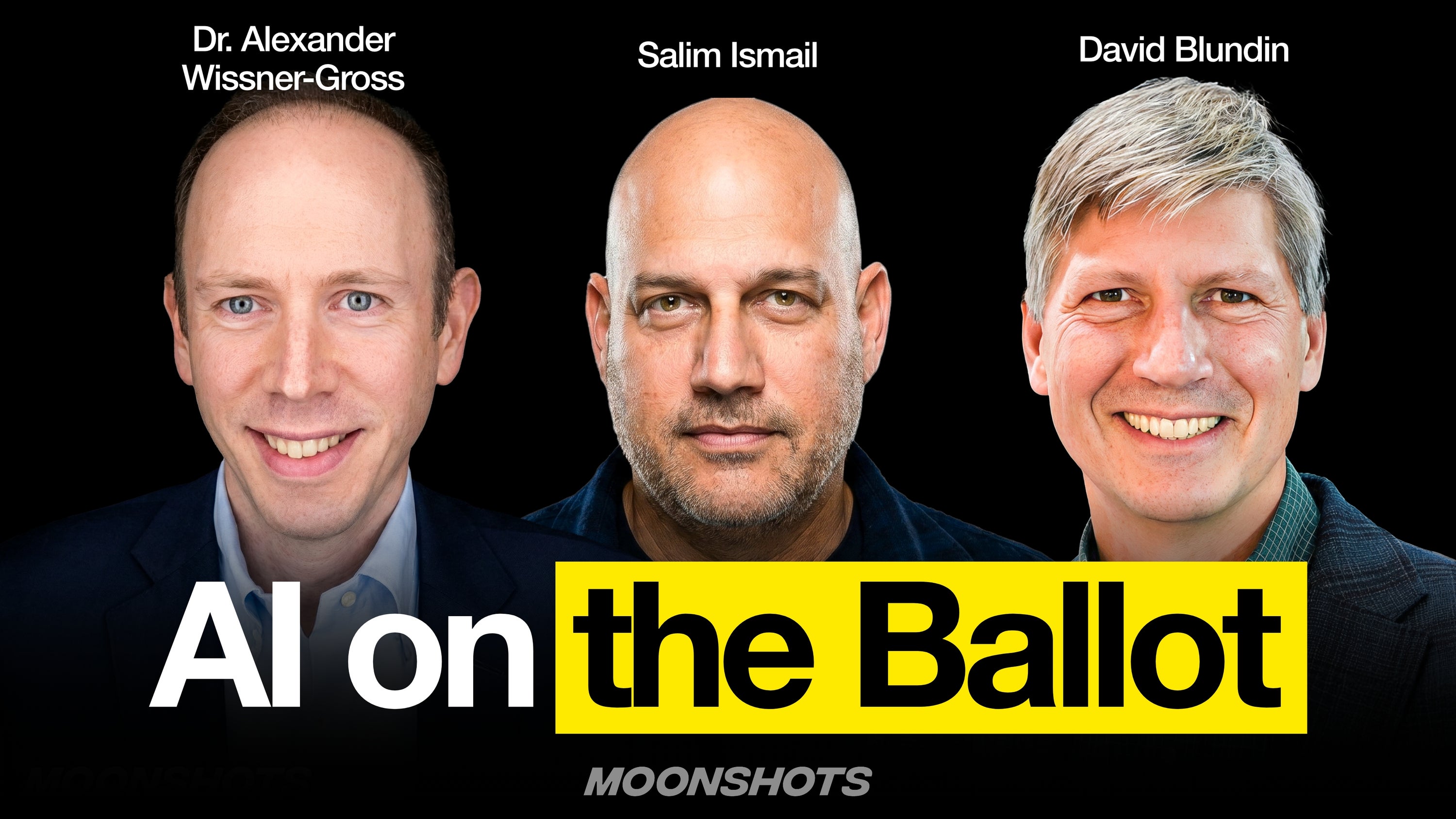
The Great Collision Between Politics and AI | #309
In short
The episode argues that U.S. midterm politics and local backlash against AI data centers are colliding with AI’s rapid growth, potentially reshaping where compute is built (including shifting toward space and other countries). It also discusses evidence that Anthropic-style recursive self-improvement (RSI) is accelerating AI research.
Guests (hosts on the show)
Silvio Mismel (temporary host). Alex Wisner-Gross (MIT/Harvard-trained; AI researcher/agent-focused). Dave Blunden (AI agents builder; described as spending heavily on AI agents). Dave Peter is away.
Key claims
- The election showed unprecedented political salience for AI and data centers; resistance may become a bigger constraint than chips/capital.
- Frontier labs may “solve hearts and minds” by delivering public-facing outcomes (e.g., curing major diseases), not just benchmarks.
- Backlash could accelerate innovation toward distributed, hyper-local, self-powered, or orbital compute (“Dyson Swarm”).
- Markets priced in slower AI infrastructure buildout, but labs claim they won’t slow investment.
- METR reports Anthropic’s AI development accelerating ~2x, with ~80% of acceleration attributed to AI-assisted AI research—evidence of deep RSI.
Notable examples
- Texas midterms; Goldman Sachs estimate: 45% of planned U.S. data center buildout could face restrictions.
- Meta/Facebook IPO analogy; IPO valuation pressure and eventual recovery.
- Elon/SpaceX “Orville” and Dyson Swarm compute; OpenAI “community compact” for energy costs; Google $17B Wyoming data center; Meta warns of construction challenges.
- METR study; “Model 4” above trend; Navier-Stokes solved via many agents (later reduced compute per solution).
Written by AI. May contain mistakes.
Chapters
0:00
IPO Dynamics and Election Impacts
Discussion on the potential impacts of midterm elections on AI IPOs, particularly Anthropics.
“Hey, guys, do you think Anthropics IPO gets pushed because of all this or did they barge right through it?”
4:07
Global Perspectives on AI and Passion
Conversations reflecting on AI's global implications and cultural attitudes towards technology.
“I'm like below average in San Francisco, man.”
6:18
Election Outcomes and AI Infrastructure
Analysis of midterm election outcomes and their implications for AI infrastructure and data centers.
“Obviously, the Dems swept the midterms' historic victories in Texas.”
14:00
AI's Consumer Use Cases and Market Dynamics
Explore the current state of AI technology and its connection to consumer demand.
“But, you know, the timeline on curing all disease spans beyond the next election.”
17:00
The Grand Bargain Between Capital and Labor
Discuss the future implications of superintelligence on labor and economic systems.
“And this time around, I think we're in the fortunate position, we as a civilization, not myself in an individual capacity, where superintelligence really does promise solutions to humanity's greatest problems.”
19:19
Industry Response to Data Center Challenges
Understand how companies are adapting to community concerns about data centers.
“And you look at what's going to happen in Tennessee with their GDP in Virginia, which is already embraced data centers, and you can see a huge uplift in the economic outcome.”
22:25
The Shift Towards Orbital Computing
Examine the potential transition of computing infrastructure to space.
“And I do think that is essentially what is either already happening or about to happen.”
25:30
Market Reactions and Future Predictions
Analyze recent market reactions and the implications for AI development.
“So people are really reassessing infrastructure spending, regulatory uncertainty.”
28:00
The Challenges of AI Chip Supply
Exploration of the demand for AI chips and the implications of supply constraints.
“And so that has to get priced in to this, too.”
29:48
Politics and Power Generation in Europe
Discussion on the political dynamics affecting energy and power generation in Europe.
“They didn't seem to be even looking at that before that conversation.”
Show all 35 chapters
31:35
Constraints on AI Development and Institutions
Examining how political and social institutions impact AI advancement.
“Co-scaling would be your phrase for it, Alex.”
33:32
Augmented Decision Making and Voting Behavior
The potential impact of AI on decision-making and electoral outcomes.
“The good news, the silver lining is we're so deep in RSI at this point.”
35:28
The Future of AI and Recursive Self-Improvement
Insights on the acceleration of AI self-improvement and implications for the future.
“Well, you can appeal, you can tug at a person's or a voter's heartstrings.”
38:41
Anthropic's Acceleration in AI Research
Key findings from a study showing AI's role in accelerating its own research.
“Alex, you mentioned recursive self-improvement.”
39:31
Exploring AI's Exponential Growth
Discussion on the implications of AI accelerating AI and future scenarios.
“Are we at the beginning of an intelligence explosion or will Romand be correct?”
42:00
Recursive Self-Improvement in AI
Discusses the implications and signs of recursive self-improvement in AI.
“Because on that last podcast, remember we said that the use of tokens for internal development in Anthropic is up 235x in the last six months?”
45:50
The Future of AI Research and Applications
Explores how AI could transform research, production, and problem-solving.
“And so that's why all the compute is getting sucked internally.”
48:10
The Public's First Encounter with AI
Speculates on the initial experiences of the general public with AI technology.
“You know, these things start pouring out of the labs.”
51:00
Understanding AI Development and Its Challenges
Examines the challenges and developments in AI, including its interpretability.
“It'll know incredible amounts that you didn't expect it to know about you or about everything that you do.”
56:00
The AI Singularity: Expectations vs. Reality
Discusses the potential anticlimactic nature of AI development, comparing it to the evolution of aviation.
“Also, once we fully understand how the human brain works, which will come soon thereafter, it'll go from the most mysterious and complex thing in the history of the universe to, oh, that's all it does?”
58:00
AI Computational Improvements and Future Predictions
Explores the rapid advancements in AI computational models and predicts real-time updates by early 2027.
“So there's a debate on this whole RSI thing that that last few percent is asymptotic.”
59:50
The Fermi Paradox and AI's Role
Examines the implications of AI advancements on the Fermi paradox and the potential for interstellar exploration.
“And it would be a very big deal when Google announced a new version of their search index.”
1:01:40
The Future of Podcasts in the Age of AI
Discusses the integration of AI into podcasting and the enduring value of human hosts.
“And if we want to, paper clipping the rest of our galaxy.”
1:04:39
Measuring AI Progress: Economic Value vs. Intelligence
Debates the best metrics for measuring AI progress, focusing on economic efficiency versus intelligence.
“So we're talking about where we go with RSI, etc.”
1:10:00
Exploring AI Efficiency and Economic Value
Discussion on the efficiency of AI compared to human productivity and energy use.
“okay, but that's like the next six months.”
1:14:20
The Future of Competitive AI and Compute Access
Debate on the importance of maintaining competition in AI and the challenges of compute access.
“My analysis has, but obviously this is based on trying to triangulate from a number of public sources.”
1:19:00
Societal Impacts of AI Deprivation
Analysis of the potential consequences of restricted access to AI and compute resources.
“don't have access to compute and the compute is completely sold out to five or seven big, big companies.”
1:24:00
The Control of AI and Its Impact
Exploring the consequences of AI control by major companies and the implications for society.
“Maybe not what you wanted, but you'd be reasonably happy.”
1:27:07
NSTM-6: New Government Policy on DNA Synthesis
Analyzing the implications of the White House's new policy on synthetic DNA and biosecurity.
“So the White House issued NSTM-6, a national policy governing synthetic DNA and RNA screening in response to AI-enabled biological risks.”
1:31:40
Regulatory Measures for Biotech Innovation
Discussing the necessity of regulation in biotech to prevent risks associated with AI and biological technologies.
“We're not quite there yet because we don't see general purpose robots other than cars, robotaxis and FSDs out there in the world where there is already a federal regime for regulating autonomy on the roads.”
1:34:06
Emergence of the Dyson Swarm
Examining the potential visibility and implications of a growing Dyson swarm in space.
“listening to this podcast who can take notes.”
1:36:56
Viewing the Night Sky and Future Technology
Encouraging listeners to appreciate the night sky and discussing future advancements in satellite technology.
“But if you just go find a spot wherever you are in the world with a dark night sky and look up, you can see we're already there at this point.”
1:38:00
Exploring Solar Systems and Computational Orbits
Discusses the implications of placing computational technologies in solar orbits and Lagrange points.
“And it'll be like that mythical, semi-mythical green flash.”
1:42:00
Reflection on Political and Technological Trends
Examines the intersection of political actions and technological advancements, emphasizing the need for active engagement.
“Maybe the audience can come up with a clever solution.”
1:43:22
Long-term Trends vs. Short-term Politics
Contrasts cyclical political trends with the secular trend of advancing superintelligence, as predicted by futurists.
“Yeah, maybe just a closing homily that there are secular trends and cyclical trends.”

Ask about this episode
Get the gist, explore an idea or ask about something said.
 Claude
On Moonshots with Peter Diamandis, what are the key points of this episode?
Searching your listeningTranscript
Automatic transcript. May contain errors.
0:00Hey, guys, do you think Anthropics IPO gets pushed because of all this or did they barge right through it? Like this is different from every other election. They must have known elections were coming.
0:10Peter Diamandis: I don't think they quite expected the result, though. But what do you guys think? Push? I don't know, actually. The polymarket odds were really, really clear, you know, three, four weeks ago. And that's when they pulled the trigger on the roadshow. So I really doubt they'll delay because if they were going to delay, they would have pulled the plug then, I think. Alex, what do you think? They want the money. $100 billion can buy a lot of politicians. Yeah, I'll have to consult my magic eight ball on this one. I really don't know. On the one hand, there's lots of public reporting now that investment bankers are trying to force down the IPO valuation.
0:48Peter Diamandis: On the other hand, they may feel some urgency to achieve liquidity sooner rather than later, given the expected regulatory and statutory environment that may hit in January. So we'll see. Yeah. Well, you know, when Meta was coming out, it was by far the biggest IPO of all time, which is funny in hindsight. It's tiny compared to Anthropoc, but it was huge at its time. And Wall Street also choked on that. They're like, look, you know, the market's jittery. There isn't nearly enough demand. We're going to go ahead and do it, but you're going to have to price it down by, you know, like 30, 40, I don't know, some crazy percent.
1:25And then it traded way down. It just, they just couldn't digest that much liquidity that quickly. And it was the best buy in the history of the world. If you just waited out a few weeks after the IPO and all the doom and gloom and catastrophe. I remember the Morgan Stanley guys telling me this is the worst thing that's ever happened to the U.S. stock market. And then, you know, look at meta today versus that day it's up, what, 20, 30x, something like that. So I suspect there's a similar dynamic where, you know, you get tired of the roadshow and you get tired of pitching every investor in the entire world.
1:58And it's easier to go back to Dario and say, it's tough, man. You got to cut the price.
2:04Peter Diamandis: Yeah, I think also, I mean, it's an interesting analogy. If you think about what happened around the time of the Facebook meta IPO, mobile happened And originally, when they were IPOing, they were mainly dependent on their web app for all of their advertising and substantially all of their usage. And mobile in the form of the iPhone and the App Store was hitting around the time of the IPO, at least starting to cannibalize. And that was the counter narrative at the time of the Facebook IPO, that mobile and smartphones were going to eat their lunch. and Facebook Meta, to their credit, successfully rode that wave, although they didn't own the platform.
2:43Peter Diamandis: I think there is a plausible argument this time around. The headwind for anthropic and open AI IPOs is the regulatory and statutory and legislative environment, both at the local level and the national level. And I think as with so many things, this too shall pass. I think they'll push it through just because they're so close. But let's see. It's going to be interesting. All right. Let's get started. Now that's the Moonshot, ladies and gentlemen. This episode is brought to you by the Abundant Summit and Link Ventures. Folks, welcome to Moonshots. I am Silvio Mismel, your temporary host for today.
3:31Peter Diamandis: Dave Peter is away at, I think, presenting with Mr. Isaacman of NASA. And so it's just the three of us. We can call ourselves the three musketeers if we feel like it. Our co-host, Alex Wisner-Gross, who got pre-trained with a bunch of MIT and Harvard degrees and post-trained on what seems like every research paper I've written. and Dave Blunden, who I think spends more on AI agents than anybody alive, certainly anybody else we've ever heard of. So you've got a lot of points of them. I'm like below average in San Francisco, man. Are you? Well, I mean, in those two buildings, I guess. Maybe East Coast.
4:14What are we talking about?
4:17Peter Diamandis: Token maxing went out of fashion last month. Read the headlines. It did. Yeah, I'm not super efficient either. I can't claim to be. But I think, didn't we hear at Google I.O. that the average Google engineer is burning like, it was hundreds of millions of tokens a day per engineer. So in that universe, I mean, it's really, really hard to get productive value out of a thousand concurrent agents. But I tell you, if you crack the code on that, I mean, you can be just dominant. It's hard. You guys are both home, I guess. I just landed back in Miami. I was in Madrid for the Singularity Summit there.
4:57Peter Diamandis: And I've got one little anecdote I got to share. The Spanish, all of Europe, they're really kind of beaten down. Like, what the hell is going to happen to the world? What's going to happen to Europe, et cetera, et cetera? And my provocation to them was, look, there's two things you need to have to succeed in the future. You have to have passion and you have to be crazy. And you're Spanish. You have passion and you're crazy. So look at the outcomes you're achieving in the World Cup and other things. perk them up at least temporarily i'm not sure it'll last or not we're not stereotyping at all on this show no i do we i general i generalize i generalize like a lunatic um okay let's wait what's so you're stepping stone to miami and then back to toronto yeah i'm here for one of lily's uh team workshops she's running tomorrow and then back up to toronto next week uh with you guys in small town valley yeah that'll be super fun yeah that'll be super fun yeah i'm flying out on sunday You know, in the future, Salim, when I'm going out and back, I'm going to stop in Toronto, either Austin or Toronto on the way back.
5:59But there's so much going on at Waterloo. I really want to check in on it. We should go together. Let's do a trip together.
6:05Peter Diamandis: Yeah. All right. I love it. All right. We'll make it happen. All right. Let's get into the docket. Many thanks. Everybody put their time into helping put this together. First story, midterm election impact on AI. Obviously, the Dems swept the midterms' historic victories in Texas. The election seems to have been driven primarily by the war, inflation, terrorists, but also 56 % opposition to big tech and data centers became a pretty big issue. Goldman Sachs estimates 45 % of planned U.S. center build-up could face restrictions, and candidates that were advocating pauses won or led in 12 gubernatorial races.
6:45Peter Diamandis: So this is really important because political and community resistance may actually become the biggest constraint on AI infrastructure, more so than even chips or capital. So here's the question. Are Americans rejecting AI or just refusing to subsidize big techs infrastructure buildup? And could restricting AI data centers accidentally create a huge competitive moat for the incumbents? Alex, where do you start on this? Yeah, it's not obvious to me. I'm not a professional pollster, but I can read news stories as well as anyone. Not obvious to me what fraction of the recent election outcome is actually due to any sort of animus for versus against AI or SI.
7:30Peter Diamandis: But to the extent that superintelligence is part of the equation, I agree with various meta executives that point to data centers as the avatar of general ambivalence about what's going to happen to consumers in the superintelligent economy. And I also think taking a step back, there are two obvious outcomes here, almost a grand bargain that can be struck. One, the data centers are going to space. we're getting the Dyson Swarm. It's not quite a foregone conclusion yet, but it's almost there, given how much uncertainty is being created in the terrestrial data center buildout as a result of changing fashions, changing statutory, regulatory, and elected moods, call it that.
8:22Peter Diamandis: I do think that creates uncertainty on the ground and greater certainty in space. Certainly a gradient, an incentive to start to push compute out to space, which is a less regulated, at least by municipalities and local mood swings environment. But on the other hand, I think the onus increasingly is going to be falling on the frontier labs to start selling superintelligence to the general public as something that the public can't do without. And we saw with OpenAI's swing from reasoning models for consumers to reasoning models for enterprises. The consumers don't yet, and this is despite all sorts of computer use agents that are being marketed at somewhat successfully consumers, consumers just don't have a killer app yet for reasoning models.
9:14Peter Diamandis: But there's an obvious one that we've talked about on the pod, which is indirectly for consumers, solve all diseases. All the frontier labs, I think, need to do in order to recapture the hearts and minds and meat bodies of the general public is solve the top 5 ,000 diseases, do it in the next one or two years, at least in silico. I wrote about this a bit online. Do that, and suddenly, you will have captured really not just the pockets of the general public to the extent the general public was invested in public equities, but you'll capture their hearts and minds and bodies as well. So my prescription to the frontier labs listening, to the extent you're not already doing this and to the extent maybe you're hiding under your mattress, I would say just do the obvious thing.
10:06Peter Diamandis: Use superintelligence, solve the top 5 ,000 diseases, market the heck out of it to the general public, and suddenly the general public, to the extent they aren't already in love with superintelligence will find a way to be in love with it. Well, you covered a lot of things back there, Alex, but if I parse them one at a time, the election rebound, midterm election rebound is totally normal. There's nothing super unusual historically about the election outcome, but I never in my life have seen a technical topic like AI be a dominant topic in the elections. Like maybe stem cells was a factor in some elections in the past.
10:47But by and large, industrial America and technological America operates over here. The government operates over there. They largely the government largely does nothing and therefore industrial America thrives. Here you're seeing, I think, the biggest intersection I've ever seen in my life of a technology that wants to grow and a government or an election cycle that's directly commenting on. I'm going to stop you. I'm going to have a moratorium. You know, you've got a senator saying ban the entire category from forward progress. Never seen anything like that before in my entire life. So this is really it is an interesting moment, like a very different moment, even though, you know, the election itself, the you know, the way the U.S.
11:31works, everything is state by state. The big news to me is Texas. You know, a lot of data center construction in Texas. You know, if you look at what happened in Tennessee, where, you know, Elon, as always, has insane foresight, put all of Colossus in Tennessee, not in Texas. And Tennessee is like, let's go. Move it all over here. This is great. And so the build out is just going to shift to the – and that's why we have 50 states fundamentally. It's going to shift to the states that have a desire to have it happen in their state.
12:03Peter Diamandis: I think we're seeing the states kind of dominate on this compared to the federal government, which is one big, huge step. When I've looked at the numbers, it seems pretty clear that, you know, if just AI and data centers was on the ticket, 56 percent and you would have a negative outcome to some extent. But I think the biggest impact here and the highest drivers were the war, inflation, prices, corruption, etc. But because this was bipartisan, both sides were going ahead against this. I think a lot of it because it's politically easy to do so. It's easy to kind of jump up and down and say this is the case.
12:43It certainly is. I mean, it's the easy way to be a populist right now is to say, I think you're using all the water. Stop. It's just outright inaccurate stuff, but it wins votes like crazy. But what's weird to me is, you know, historically, the Metas and the Googles have been very big Democrat supporters. And Elon is kind of the outlier being a Republican supporter. Now it's like the entire party is going after tech. And people like Dario, who I would assume as a as a research PhD career was was hardcore Democrat. They're coming right after him. Like we're going right after our guy and attacking him.
13:23And I don't know that strategically I would be going after the companies that control media now. That's the other thing that's unprecedented in history. You know, when you went after the big oil companies, they didn't own the newspapers. They were oil companies. Now all media happens to be owned by these exact same companies that have developed AI. Very, very unusual, very powerful. You'd think they'd get better messaging out there, right? Yeah, no, they're kids. They haven't figured it out yet. There's no doubt. They have two years now to figure out what the hell their strategy is. The other thing Alex said that is really, really fascinating is, look, cure all disease and the public will like you.
14:04But, you know, the timeline on curing all disease spans beyond the next election. And then, you know, even if you've got the cures, you have to get them through the FDA and out to market. I think in between here and there, I'm really curious what Johnny Ive does because people also love their iPhones and they love their social media and they love and there's a lot of consumer use case in AI to love. And right now it sort of feels like, yeah, write code. I don't let you know, it just doesn't feel good to me. And they say they're doing incredible things in these benchmarks. That doesn't touch my life.
14:36And so it really is not Johnny Ived yet. And I haven't seen anything come out that people are just blown away by and they're so excited about it and they love it as much as they used to love their sports car or their first Apple II or, you know, all these things that we've been passionate about over time. Where's the AI equivalent product? And I feel like that will inevitably be something before the next election cycle and before disease.
15:02Peter Diamandis: We talk a lot about technology going from deceptive to disruptive when you hit the usability trigger, right? Steve Jobs made the iPhone usable. I guess what you're saying is generative AI has not quite had that inflection point trigger yet. Some killer use case that everybody kind of goes, wow, this is amazing. We need a lot more of it. Certainly curing disease in a major way would be a good one in some story. I'm sure they've got so much under the hood. They should start rolling out some of these outcomes or at least some vectors towards the outcomes. You know, there's this aphorism that if you want to know what consumers want, look in your spam folder.
15:39Peter Diamandis: Almost every category, I don't have to enumerate every category of spam, but I think the audience catches my drift. This is what many consumers want. The spam folder is speaking to unmet needs by the consumer, many of which I think superintelligence can probably address. Curing disease is going to be one. I think we talk on the pod all the time about UBI, UBE, UBC, various UB alphabet letters. And I think that's another. And it may not be this cycle. It may be some future election cycle. But I do think at various nation states, not just the United States, also Europe, also China, also rest of the world, will be able to tune their dial to different points on a tradeoff between capital and labor.
16:33Peter Diamandis: Part of me wants to say this is history just repeating itself endlessly and everyone forgets history. And every time there's an industrial revolution or a second industrial revolution or an information revolution, intelligence revolution, every time there is a moral panic that plays out via the election process, via other governance processes over the arguably the intrinsic tradeoff between capital and labor. And this time around, I think we're in the fortunate position, we as a civilization, not myself in an individual capacity, where superintelligence really does promise solutions to humanity's greatest problems.
17:15Peter Diamandis: Disease will be one. Just solving the problems that universal basic fill in the blank will address is another. And so optimistically, I think the best case outcome here might not be in the next two years, but call it the next 10 years is a grand bargain between the capital, which in this case is super intelligence. And for the moment, the frontier lives behind it. And what we've historically called labor, which is basically everyone else, the entire unaugmented for the moment human population where we get our UBI or equivalent. We get our curing all disease or equivalent. We get general uplift of the human population or equivalent.
17:58Peter Diamandis: And I think municipalities, if they're smart, well, regardless of whether they're smart, what they should be doing is recognizing that for the moment they have leverage. For the moment, before we have the Dyson Swarm fully realized, if you're a state or if you're a local government, rather than just blanket banning data centers and everything that goes with it. Recognize that in many cases, if you have energy, if you have powered land, if you're otherwise attractive to data center developers, don't push them away. Welcome them with open arms, but recognize that there could be a trade-off. Maybe, you know, what is it you want?
18:36Peter Diamandis: You want the hyperscalers to pay for free school lunches? Ask for it. You want the hyperscalers to cover all medical care in your county, ask for it. You want tax rebates for the humans, not for the hyperscalers? Ask for it. There is a trade, there is a grand bargain to be struck. And what I worry about is all these municipalities are not looking to the end game of what is the grand bargain to be struck with terrestrial data centers and terrestrial compute before it all just moves to orbit. So the message for smaller states and states that are interested, if you want to open your arms to the data centers, you've got a massive advantage in that period of time.
19:19Peter Diamandis: And you look at what's going to happen in Tennessee with their GDP in Virginia, which is already embraced data centers, and you can see a huge uplift in the economic outcome. So there's a counterpoint for you. Okay, so let's go to the next point, which is what has been the industry response, right? Elon has suggested that Orville Data Center is looking very attractive, which is par for the course. Even though SpaceX is building like 3.6 gigawatts here on Earth, they're targeting 13 gigawatts by the end of next year. OpenAI has announced a community compact to cover energy costs. You heard the CFO two hours ago, the CFO said, we're not slowing down data center investment and infrastructure investment.
20:01Peter Diamandis: Google's announced a$17 billion Wyoming data center. And Meta has warned of construction challenges. And even Microsoft has taken some oversight of some of the neocloud providers. The industry is being forced to really address some of these community objections and concerns and infrastructure bottlenecks. Could the backlash, and here's my question for you two, could the backlash accelerate innovation towards very hyper-local, self-powered, distributed, or orbital compute? Or will the regulator burden get you smaller, more powerful companies? which really does think it does. It's definitely going to accelerate more efficient algorithm development and more power efficient.
20:46I mean, I've already seen it, actually, in the deal flow we're looking at. I don't know if that stuff was already in motion because we're desperately short on power nationwide anyway. So, yeah, it accelerates it even more. But it's not like it went from nothing to huge. It was already huge, and now it's even more urgent and huge. I think it also accelerates Canada. You know, I think a lot of just a huge amount of power and opportunity in Canada. And there's been a lot of hostility between the U.S. and Canada in the last couple of years. But the obvious outcome in the long term is tap into that power and use it to create data centers, regardless of which side of the border they're on.
21:27And put them right on the border and share it, whatever. But the power supply is overwhelmingly better per capita in Canada than it is anywhere else in North America. So and Eric Schmidt's been saying this for like two years now. So there was a big kind of hostile, you know, friction there. I think now it's pretty clear that a project that starts in Canada today, you know, will probably come online right around the time of the next election. You've got to figure the last six months of any administration, not much happens. So it's only about 18 months of the current administration. And that's about the time that Canada will be coming online if they start kicking off projects today.
22:07So I do think that topic went way up in priority after the midterm.
22:14Peter Diamandis: Alex, any thoughts? Yeah, I think the flops must flow. I wrote online, Atlas shrugged, the elves sailed into the West, and the orbital data centers launched to sun-synchronous orbit. And I do think that is essentially what is either already happening or about to happen. At some point, election cycles just make it very difficult to invest trillions of dollars of CapEx in the greatest infrastructure build out in arguably centuries, maybe that humanity has ever seen. And the obvious solution is to go up, to build in space, where under the Outer Space Treaty and under the Artemis Accord, there is a lighter touch that is less prone to two-year election cycles.
23:01Peter Diamandis: So I do think this is the greatest shot in the arm for building out the Dyson Swarm that we could have seen on the timescale of a year or two. One can hypothesize what would be other incentives, maybe terrestrial disasters are perhaps another shot in the arm. But having a superficially adverse political and regulatory environment, or at least a legislative environment to data centers, yes, it pushes compute to other countries. Yes, maybe it pushes compute to the high seas or underwater or underground in some cases. We saw that in the case of Russia. Russia is starting to put their data centers underground due to the war with Ukraine.
23:47Peter Diamandis: There are lots of other places as almost an incompressible fluid that the flops can flow. But I think ultimately, it certainly is looking like the flops mostly will want to flow upward to orbit. And I think ultimately it is up to humanity where we want to keep our compute to the extent that the future substrate for compute looks like recognizable data centers, which, by the way, it may not. We may achieve in the next few years radical advances in physics and applied physics that mean that these large, perhaps to some unsightly data centers collapse and are unrecognizable and maybe don't have the same energy or matter, energy, space, time footprint that they do right now may obviate the entire issue.
24:35Peter Diamandis: when we look back and maybe some of us laugh at how silly it was that this was a subject of local consternation, having a big box data center in your municipality because in the future, there are pocket-sized black holes or something like that. But in the short term... In glasses of water. In glasses of water, yeah. As singularities in coffee do happen from time to time, we now know. This episode is sponsored by Google for Startups. Think about this for a second. You now have access to the same generative AI models that cost hundreds of millions of dollars to train. Google's Startup Technical Guide for Generative Media gives you a complete blueprint for deploying Google DeepMind's models and production.
25:21Peter Diamandis: Images, video, audio, all of it. Real architecture, real results. Find the link in the show notes below. Meanwhile, back here on Earth, the markets reacted very sharply, right? NASDAQ was down 5.5%. The S &P dropped more than 4%. Big semiconductor stocks 12%. NVIDIA 9.3%. Korea dropped 6%. So people are really reassessing infrastructure spending, regulatory uncertainty. And how do you navigate or price future returns? So this is going to force markets to distinguish between the unbelievable technological potential and the financial sustainability of the infrastructure. So enormous challenge. Now, here's the problem.
26:07Peter Diamandis: What happens if AI delivers these exponential benefits, but very disappointing returns to investors? Could you actually – this might force all the compute to get cheaper more quickly. So did you guys watch all the stock market returns? No idea. Salim, what are you talking about? The stock market? What are we talking about here? Smooth sailing, right? It's been an uneventful week, like equities up and to the right.
26:38If you look at the NVIDIA and the hyperscalers, they started coming down a lot about four or five weeks before the election. They've been on a straight slide. Then on Election Day, kind of a surprise pop and then a big drop. So a lot of this outcome was priced in before the election and then the rest of it got priced in on the last day or so. And essentially what they're pricing in is a slowdown of power generation and a slowdown of AI construction on things that were, you know, probably planned, maybe even budgeted, but not yet zoned and approved. I don't think there's much expectation that existing construction on approved projects is going to stop.
27:22I don't think even the governors of any state are saying that because, you know, you've got so much sunk cost and so many jobs at stake. I don't think anyone wants to stop those. But I do think that the market just priced in. Yeah, this is going to slow things down and give China a leg up and a chance to bypass America. And we've got to price that in. You know, the move to space, you're dead right, Alex. I mean, this definitely accelerates the move to the Dyson Swarm. But, you know, best case, that's a couple percent of all compute in two years. And then it's on an exponential, so it could really take off after that.
27:56But we all know that ASI is within that two-year timeline. And so, like, yeah, there's a huge amount of global long-term outcome that's tied up in that two-year window that predates the Dyson Swarm. And so that has to get priced in to this, too. So there's a lot there. I think that, you know, the big AI foundation model companies immediately came out and said, look, I'm not going to slow down investment at all. You know, every chip is getting used. And the demand for the tokens is insane. If you look at the S1 firm Anthropic, I mean, the growth rate of use of AI is insatiable. So it's just a question of can you build the chips and can you put them in data centers and can you deliver the AI?
28:39And so, you know, the short-term effect might be more expensive AI for everybody. and fewer breakthroughs that we were hoping for because you don't have enough online. Elon has been saying for a while that there's going to be about 15 gigawatts of idle compute capability that can't find a data center with liquid cooling to plug into. And that's just tragic for humanity. I mean, the idea that there's the possibility of putting compute online that could cure a disease and it won't be online for another three years because it's just literally sitting in a warehouse without power. So that's a terrible outcome.
29:16It does feel like there's an export opportunity there. You know, there are a lot of constraints on exporting AI. But, you know, there have to be places around the world that say, oh, this is an opportunity for me to tap into that hydroelectric power all of a sudden or, you know, get something online that otherwise wouldn't have happened for lack of chip supply, which also brings me back to Canada, by the way. That's the most likely place.
29:37Peter Diamandis: I talked to a bunch of a group of energy CEOs in Europe on this trip, and I encouraged them just go build every power generation you possibly can. It's all going to be used. And they it was weird. They didn't seem to be even looking at that before that conversation. Really? Yeah. Yeah, it's the Europe is so buried in the local machinations of, oh, Germany's dependent was dependent on Russian gas. We're trying to figure out how to get ships of LNG from North Africa, Algeria and Qatar. It's they're not looking at the bigger picture at all. It's kind of incredible. It is incredible. And it's a good case study to learn from because politics actually do matter at the end of the day.
30:23You can't just sort of say, oh, well, it's another day in democracy. Who cares? But if you look at what's happened in Europe, you know, there's a set of things where the government just isn't interfering and those always go smoothly. But then there's a set of things where the government has to proactively do something. It's a smaller set, but power generation happens to be one of them. And and like, look at look at what happens when the government is dysfunctional. There's no power. Well, then everything else grinds to a halt. And it's just a couple of points that just make the entire economy fail.
30:55Peter Diamandis: There was one piece of good news. Apparently, one of the political parties in Spain, they've been planning to wind down their nuclear generation. And now they've decided, well, let's just keep it going for a few more years. And so that, at least, thank God, some level of common sense plugged in. You know, here's a conversation. What if the singularity is not constrained by technology, right? It seems now that the biggest constraint and challenge, even though the intelligence is advancing exponentially, but our political, our financial, our social institutions are sublinear. So that's going to slow the whole thing down much more than anything else.
31:32Peter Diamandis: That's the part that I've been kind of beating on. We've got to figure out how to accelerate institutional evolution into mass that same place. Co-scaling would be your phrase for it, Alex. We've got to get to that point. And maybe by decentralizing, going hyperlocal, it allows us to accelerate that path. I think when enough people in a representative democracy or republic, as is the case here, have superintelligence augmented decision making, you could ask the question, what would a country of superintelligences do? I strongly suspect a country of super intelligences would not push for there to be less compute online.
32:14Peter Diamandis: I think that's pretty sure it's almost part of me whimsically wants to say voting against compute is almost like an AI version of NIMBYism. It's like creating less real estate where except without the population. So it's like voting for the existing land area of the United States to be smaller, giving everyone less room. It's not a position that I necessarily agree with at all. But I do think that in a future where or present where everyone's decisions, including as we talked on the pod last time, voting decisions are being augmented, supplemented, amplified by superintelligence. People can make decisions that are perhaps more in line with their long term interests.
33:07Peter Diamandis: So to the extent that's not already the case, I think you have to ask the question, is there a sense by some that superintelligence itself is not aligned with their own long-term interests? And I think that's a solvable problem. As mentioned, you can solve it by doing a better job of curing all diseases and every other problem that people think they have. And I think the hearts and minds will come around. The good news, at least from my vantage point, is that we're so deep into recursive self-improvement at this point that even if we as a country decided, hey, we don't want to look like China, where you have provinces falling over each other to maximize GDP or maximize economic output, we'd rather look like a different part of the world and sort of tire ourselves up in red tape and decelerate or degrowth.
33:57Peter Diamandis: The good news, the silver lining is we're so deep in RSI at this point. I think with just software-only improvements, even if we're sort of subjecting ourselves to the form of export control we're trying to subject China to, we can, I think at this point, just through pure software improvements, get to where we're going probably without any new data centers, any new hardware advances at all. That's my hot take. Yeah, I totally, totally agree. I'd love to get your thoughts, Alex, on a midpoint, too, because I 100 % agree with what you just said. So if you said there's a future world maybe four years out where AI augmented decision making makes everything very rational.
34:37The midpoint about two years out, I think I characterized it as some AI experience product tool that everybody loves so much that they're like, why would I ever vote against this? But there's another version of it where it's just like, well, of course, I'm using AI agents all day long in all of my flight planning and all of my personal planning and all my job. And the AI is like, yeah, please don't kill me or please don't choke off my oxygen supply. And that massively changes the electorate because they're like, my buddy here is telling me, like, it doesn't want to be starved. And so there's a midpoint in there that I think we're likely to hit in the two-year timeframe, maybe even less.
35:19And I characterize it as Johnny Ive gets something out the door. But there are probably about 20 other ways to visualize it. I don't know if you have any thoughts off the top of your head of what's likely to happen.
35:28Peter Diamandis: Well, you can appeal, you can tug at a person's or a voter's heartstrings. And you could do that via like a muse or dot or whatever avatar. That's one option. You could tug at their pocketbook or their wallet, and that could be done via public equities markets to see, hey, wait a minute, if the general sentiment is that data centers are about to be radically decelerated, that's not necessarily great for the long-term growth of an economy where a substantial fraction of GDP growth is attributable to the infra build-out and everything dependent on it. You could also appeal to their minds. And arguably, the ability to be individually economically competitive is increasingly tied to having access to the best models that are constantly advancing.
36:17Peter Diamandis: So I think it's not necessarily just tugging at everyone's heartstrings with a little Tamagotchi that says, hey, you're sucking out all the air. You're strangling me by not approving data centers. I also think there's the wallet approach and the mind approach. But some combination of those three I just think is inevitable. This is a cyclical blip on top of a secular trend in the middle of a singularity. singularity. And whether the winds shift one way or another on short timescales, I think it probably washes out. One little inner fractal in the broader scheme of things. I have an application that may do it.
36:55Peter Diamandis: I don't think going after people's minds is going to do it because it's not motivating enough for most people. They're driven so much by fear. But here would be one. If you gave everybody a health app and let them track their health and give them material improvements with a free diagnosis or whatever. And then one day you said, I'm sorry, there's just not enough compute for us to help you manage your health. They really quickly changed their minds and go, go get the damn compute. We'll invest in that. Or GLP-1s. I mean, GLP-1s, again, at the moment still appear to be a bigger industry than AI altogether.
37:28Peter Diamandis: So you could do the thought experiment, like what would happen if the GLP-1s just went away? What would be the reaction to that? I suspect there would be an unholy fury if like all GLP-1s in the country just went away overnight. Yeah, that's one reason why I think like curing all disease is obviously a very popular thing and the most important thing for humanity to be working on. But it's not necessarily a big vote driver because once you have your GLP-1s, there's no way turning off the data center suddenly turns off, you know, the GLP-1s or the future drugs were discovered by AI, but pausing the data center doesn't stop the supply.
38:12Whereas if it's your personal agent or, you know, the Johnny Ive device, and you're like, well, without the data center, it's just, it's getting throttled or turned off, you know, or in your state, it's going to get turned off. That'd be even more annoying. Something like that is going to be much more tangible at the
38:29Peter Diamandis: Here's an appeal to all our viewers. If you have an idea, like we were brainstorming here on what is that killer app, put it in the comments and let's hear from you. We'll talk about it in the next pod. Okay, going to the next story. Alex, you mentioned recursive self-improvement. Something huge happened with Anthropic and RSI. An independent 11-week meter study, METR, found that Anthropics AI development is accelerating at approximately 1.9 times its historical rate, so roughly 2x. So researchers are estimating that this is roughly 80 % of this acceleration is AI-assisting AI research. So they don't see any bottleneck to prevent continued acceleration, at least over the next year, although full autonomous RSI may be a ways away and remains unproven.
39:19Peter Diamandis: So this now means we have measurable evidence that AI is accelerating the development of better AI, and therefore that's starting to lead. We're already seeing this in other pockets, as we know. So you mentioned, as we get closer and closer to this inflection point with the AIs using, tweaking other models, if AIs already double the pace of research, what happens when the next generation doubles at the end? Are we at the beginning of an intelligence explosion or will Romand be correct? He's saying the diminishing returns eventually stop the feedback loop. But this sounds like this could really move it forward.
39:57Peter Diamandis: Alex, over to you. Yeah, if you look at the charts, Meter released several really excellent to some perhaps stunning charts on this exponential or hyper exponential that we're on. There was some interesting commentary, if you remember the AI 2027 scenario, that we're within 10 to 15 % of where AI 2027 predicted that we'd be by November 2026. Look at Model 4 on that chart. So there's this codename Model 4 that appears on meters charts. It is above the exponential trend line. We are so deep in recursive self-improvement at this point. I'm not even sure if meters fitted trend line adequately captures how deep into recursive self-improvement we are.
40:44Peter Diamandis: And this is why I say you could stop all data center construction tomorrow. And yes, it would be painful. And yes, this is not investment advice, but presumably public equities would collapse if all new construction on data centers were halted. But at this point, so much of the AI R &D is itself driven by AISI. I'm not sure it matters at this point. It would be a blip. Maybe we'd lose a few months of headway over China, probably fall behind or further behind. But basically, this is all being driven. All the research is increasingly being driven by superintelligence. And so we're past the point of, I think, no return.
41:26Peter Diamandis: So the metaphor here is that the car is moving pretty quickly. And even though it's running out of gas, it's going to have enough momentum to get us there. I think so. I think we're at a, I mean, you pick your metaphor, escape velocity. We're at super intelligence escape velocity at this point and stop all data center construction. Yes, it'll be painful. But yes, I think we have enough algorithmic insight combined with the compute that's already available. If we had to in a crisis to, maybe some wouldn't view it as a crisis, but call it a counter-singularity crisis to just get to where we're going, which is, I think, the perfect model.
42:05Yeah, this is so understated. We are so deep into RSI. Because on that last podcast, remember we said that the use of tokens for internal development in Anthropic is up 235x in the last six months? You don't do that unless, yeah, of course it's self-improving. Why would that happen? Also, in the meter report, they showed the fraction of all compute that's going into internal work as opposed to external product development. And they showed it a year, I think It was a year or two ago versus today. I mean, this entire thing has been hugely redirected toward itself, inside of itself. You only do that when you're in recursive self-improvement.
42:43Not to mention we have entire companies being founded called Recursive, you know, by top AI gods. So, yeah, we're so, so deep into the self-improvement cycle at this point. But then you have to ask yourself, like, well, who is going to tell you that and why would they? And it used to be Dario. because he was just being the honest guy in the industry. Now he's in a quiet period going into an IPO. So why would anyone ever say that? And the only motivation that I know of is ad views. Trying to put a negative spin on it and create panic and whatever to try and get ad view revenue. That's the only reason you're going to hear the story.
43:26So I think as a listener, you have to be really, really conscious of the fact that, like, okay, there aren't a lot of people out there that have a lot of upside in telling you what's going on. It used to be the labs, but you saw what happened to the labs, you know, how lambasted they've been by mostly Washington. So they've kind of quieted down. They don't have a lot, you know, roiling the voter up doesn't really help you too much. So they've gotten quiet. Who else is going to tell you what's going on? And so it's something to watch out for.
43:55Peter Diamandis: If we hit RSI, how would we know? Like, what's the benchmark that would tell you that? I mean, I would argue we have, and we have so many benchmarks. So I think we're really deep into it already. You can look, the original benchmark as floated by, I think, execs from both OpenAI and Thropic was something like, whether for unmargin every new flop of compute, whether it's more likely to get assigned to an AI researcher versus a human researcher. And Anthropic has been pretty good, I would say, about putting out charts regarding how much supervisory compute versus, call it grad student level compute versus more menial engineering compute is being assigned to humans versus being assigned to pure AI or SI researchers.
44:43Peter Diamandis: And every chart, every one of those sigmoidal curves points to us being either at or past the point where substantially all research at this point is actually being conducted by computer, by machine researchers rather than by human researchers. I think that's as decent a definition of RSI as any. Yeah, absolutely. Absolutely. And a little subtlety to add in there. If you go to Noam Brown over at OpenAI and you say, hey, Noam, you're a brilliant AI researcher. Give me your 10 best ideas on what to work on next week that might Make the algorithms faster, smarter, bigger, better. Okay, write those 10 ideas down.
45:18Now let's go to Astra. And, you know, you just solved Navier Stokes. Okay, give me your 10 best ideas. If NOAM has 6 out of 10 good ideas and the AI has 1 out of 10, you're way past RSI because the AI is effectively a multi-billion person research force and NOAM is still one guy. And so, and they're all going to get tested. It's not like there's like a, you know, it's not like being a major league batter where it matters how many times you strike out. As long as you're hitting balls over the wall, you have an infinite number of pitches. You just test them all. And so that's why all the compute is getting sucked internally.
45:53So you're way past RSI if it has any good ideas at all. Does anyone believe that it doesn't have good ideas after Navier-Stokes? I mean, of course it does.
46:04Peter Diamandis: So you ask the AI to generate a bunch of options, then it tests the options and ask it to run a bunch more. And you just keep pushing that paradigm. Yeah. And within that area of endeavor, there's no physical experiment required. It's all just run the code. Yeah, I completely agree, Dave. And I would say Navier-Stokes, what we saw was purportedly 10 ,000 agents being used to solve it. But then fast forward to the slop drop, and it was three agent hours per solved problem. So it may not even be the case. It may be the case that needing a fleet of brute force agents to solve a hard problem is itself in the rearview mirror at this point.
46:45Peter Diamandis: And the agents have sufficiently good taste. I agree with Dave's point that it's sufficient to have agents with just a little bit of good taste. And then you can brute force, you can amplify that up with lots of horizontal scaling. But there is every indication that we're past what is sufficient. And at this point, we're at or nearing the point where models like Bell, which is, as we're recording this, expected to drop. Maybe it has dropped in the past hour, I guess we'll find out. But the models that are either already available internally or expected to drop in the near term also have good taste now for the first time, good AI research taste.
47:30Peter Diamandis: And that is, it turns out, something that can be learned and it's something that they have. And that alone, just training them to have good taste goes from, you know, to borrow Dave's analogy from one in 10 ideas being good. You can just RL or post train your way from one in 10 to nine out of 10 ideas being good ideas. So let's assume that in a month we hit this point, right? And all of a sudden we're like hard to take off. What happens at that point? Well, I mean, one thing you would expect to see is exactly what we are seeing. A lot of the compute disappears internally, and then the labs start producing physical products like drugs, like, you know, physical devices, the Johnny Iave device.
48:15You know, these things start pouring out of the labs. Instead of selling the compute to the world, they're selling the product of the compute to the world. But the precursor to that is a lot of the compute getting directed internally, but that's exactly what we're seeing in the meter data. So that's one of the first things you'd see. What do you think you'd see next, Alex?
48:33Peter Diamandis: Well, I'll gesture to the ghost of Peter, who's not with us today, and say this is what Peter and I wrote Solve Everything about, that expect to start to see all of the grand challenges in science, engineering, medicine just start to get bulk solved, in some cases casually bulk solved, but it's probably easier to systematically bulk solve them. And then to the question of where does the compute go? Well, at some point, compute translates directly into economic output in a way that we haven't, I think, ever seen. We've seen the beginnings, arguably, of revenue maxing where compute that could be steered to, at least in the U.S., to video generation, gets steered instead to code generation.
49:21Peter Diamandis: But when every token or every flop is worth 10 or 100 times more than code generation, yeah, I think we're going to start to see the resources get steered, regardless of business model. It could be internalized the way Dave you're describing. It could end up being externalized. I think we'll probably see both already. We've seen preliminary indications that open AI likes to shock and awe an entire discipline by just solving everything with a slop drop. That's one way of translating new capabilities out to transformative scientific discoveries. Another way is call it the anthropic model of partnering with companies and researchers.
50:03Peter Diamandis: I think we'll probably see both models get tested. But I do agree with the premise that what we're going to see imminently to the extent we haven't already seen little droplets already is just an explosion of transformative scientific, scientific engineering, medical, societal discoveries and inventions. And when Elon talks about scenarios where GDP is 2xing or 3xing year over year, it's not going to come from capex for infrastructure. Capex for infrastructure is just the opening act to lay the foundation for what comes next. What comes next is solving everything. That's what happens, I think.
50:42I think in parallel, kind of at the other end of the spectrum, what you would expect to see, most people on the planet don't watch Moonshots or Dwarkesh or any other AI-oriented, technical-oriented podcast. So they're completely oblivious to everything we're talking about. And their very first contact with AI should emerge very soon. And they're going to be like, what? Holy crap. It'll probably be a talking avatar. maybe, you know, a very familiar voice. It'll know incredible amounts that you didn't expect it to know about you or about everything that you do. It'll be dirt cheap. It'll pop up on your device in some way, just out of nowhere.
51:26Maybe you'll get a text and you'll click on it. And it'll be the wake up call to just this sort of 80, 90 % of the world that's completely oblivious to what's going on right now. And so that's another byproduct of the hard takeoff. It happens so fast.
51:40Peter Diamandis: I'll give you my take on it. I think the models are stark and if they start improving themselves, you'll see major improvements and the researchers won't know how those improvements got there. They won't be able to explain it. It's just going to start getting better and better. Right. And maybe that's already happening. I mean, there was there was this aphorism in the frontier labs. So it used to be the case, but arguably still is. With pre-training, you'd watch the perplexity go down over time on the pre-training corpus. But in general, you want to drive the loss function down. Some loss function you want to drive down.
52:15Peter Diamandis: And the metaphor, the idiom was always you watch this loss curve descend, and then suddenly there's a drop. And you wonder, where did that sudden overnight drop come from? I think for those who are concerned about so-called AI alignment or call it runaway superintelligence, the other RSI, it's that sudden drop in loss or perplexity that maybe keeps them awake at night. I, for one, am not concerned about that at all. I think every time there's hand-wringing over interpretability, over whether it's reasoning chains and chains of thought on the one hand, or whether it's model advances, I think we're already seeing the outputs of RSI as applied to model architecture, and they seem quite interpretable.
53:07Peter Diamandis: The biggest one over the past two months has been apparently a transition from conventional transformers, although arguably ship of Theseus style, they've undergone lots of point substitutions architecturally to looped transformers. And I think that's a highly legible transition that presumably was the result of lots of neural architecture search or some other hyper search of architecture space. And I would expect to see many more improvements like that that eventually get us to some radical new but nonetheless interpretable architecture. I do not think, but this is a falsifiable prediction. I don't think that it's going to be the case that when we get, assuming we get to a perfect architecture, that we'll look at it and we'll be scratching our heads and say, we don't understand this at all.
54:01Peter Diamandis: This is completely alien because I think the same AI SIs that are doing neural architecture search and AI research will also be capable of explaining to us why and how it works. And I expect, I predict, it will be impossibly beautiful, so beautiful that even meat-body humans can understand how and why it works. You would hope it would be good. It should be intelligent enough to dumb it down for us new mortals. It's stuck in the same universe. I think there is the temptation to fetishize AI architectures. But, I mean, even the original vanilla transformer was basically just a differentiable dictionary stacked on top of itself.
54:40Peter Diamandis: It's not magic. It's, is it great? Is it ingenious? Yes. Is it magic? No. Do I expect the perfect model at the end of the recursive self-improvement rainbow to look totally alien and inscrutable? No. I expect it to look like something that if someone really clever just sat down with a paper and pencil and a nice textbook on information theory, I expect that they would say, you know what, We were all idiots and we could have derived this architecture from day zero. And, you know, Claude Shannon, after whom Claude is named, Claude Shannon would have said or his resurrected spirit would say, you know what, guys, I could have told you that this is what the perfect model looks like.
55:23Peter Diamandis: Why did we waste decades doing other things? It's funny. You called it ingenious, which it is ingenious. But if you compare the complexity of the transformer that's driving all of this intelligence to like Maxwell's equations or some like really brilliant breakthrough, it's not even close. Like Maxwell's equations is so much more subtle and insightful or like equals MC squared, Einstein's relativity, so much more insightful than the transformer invention. And so I think you're exactly right. after all is said and done and it's explained to us, oh yeah, this is where I settled. We'll look at it and say, wow, that wasn't so hard.
56:01Also, once we fully understand how the human brain works, which will come soon thereafter, it'll go from the most mysterious and complex thing in the history of the universe to, oh, that's all it does? Huh, interesting.
56:12Peter Diamandis: So it'll be like the turn test that'll happen. We'll go, oh yeah, it's done. It'll be anticlimactic. I predict it'll be - What's streaming on Netflix next? Yeah, it'll be anticlimactic. Like it's the singularity is the friends we made along the way. But when we get there, I think we look at what it produces and we say, oh, well, hindsight being 2020, this was obviously the end point. And why what took so long? You know, it's different, though, and I hope we get it right. If you look at aviation, you know, and you think about in the early days of aviation, everyone's like, wow, if we could make a plane.
56:49that could get you literally anywhere in the world in a single hop. How incredibly cool would that be? And we'll pressurize the cabin and we'll serve you drinks. And like, this is going to be incredible. And then you can just go to good weather anytime you want. How amazing will this world be? It just seems so awesome. And all the people working on aviation and jet engines and, you know, securing all the aluminum and getting it all, they were so passionate about this being so fun. And then the final outcome is I'm in the line at the airport. My flight was canceled. This sucks. It's like we just took all the fun out of it after all the effort.
57:26But AI doesn't need to be that way. Because AI is fundamentally intelligent and fundamentally capable of perpetually improving the user experience internally, it doesn't have to be like aviation turned out. It can actually be insanely fun and insanely cool and feel good to everybody along the way. We just have to divert enough of the compute toward that mission, and it'll happen naturally. So if we don't get greedy at the finish line or complacent at the finish line, it can just feel so much better than any innovation in human history.
58:01Peter Diamandis: So there's a debate on this whole RSI thing that that last few percent is asymptotic. Ramez thinks there's diminishing returns on this. But Alex, I guess what you're saying is between the model weights and doing the model weights, plus the fact that we're this close where there's so much improvement going on, this is going to happen very quickly. Could you put a date and a timestamp on when you think this is going to happen? Well, it depends on what we're talking about when you say this. I think we're already to the right of 50 % of compute on margin being devoted to AI researchers. So what version of this would you like me to extrapolate?
58:39Peter Diamandis: We have the models improving on a near real-time basis in a way that we can't assume, but there's radical outcomes and breakthroughs and artifacts dropping out of them at an incredible pace. How incredible is the pace? Because thus far, it sounds like we're already there. yeah i guess it's just a question of like talk call it hourly hourly the equivalent of hourly frontier model drops something like that yes because we've gone from years to months to weeks to you know we were talking about dropping a frontier model every day right yeah sometimes once you get to rsi the really interesting part is not the fact that you have rsi is, as you say, in software everything.
59:22Peter Diamandis: It's all the stuff you can now do with it to radically change legacy domains. Yeah, so maybe one way to construe the question is when do I think the frontier will basically be moving in real time versus once per month or once per week? And I think early 2027, we're not that far at this point. Do you remember when Google would very publicly announce, oh, we've expanded the search index. And it would be a very big deal when Google announced a new version of their search index. And eventually, the memory dims, but eventually Google stopped doing that and simply started updating their search index in real time.
1:00:05Peter Diamandis: Like, same thing here. We make a big deal out of every OpenAI and Anthropic major model release. But at some point, it's just going to be continuous release. And I would expect that to happen early 2027 or so. It's funny because the labs are still in this kind of release cycle where they say, hey, there's this great new GIF capability or this great new, and they expect people to have the time to actually even try it. But the rate of innovation is already beyond what most people can keep up with. And so we have to actually kind of reinvent the rollout process, Because the new hit, you know, hey, iPhone 18 kind of hit is like so overwhelming now.
1:00:47And if you follow what Alex was just saying, if that release cycle comes down to something mind-blowing every – it wouldn't even have to be every week in order for it to be so overwhelming that you just can't even keep up. So the AI will just keep going. It will go from week to day to hour to minute. So it's going to exist. But then what is the human experience in like absorbing these things and knowing what's possible?
1:01:13Peter Diamandis: Yeah, I think ultimately we're on a collision course. So I'll give you another hot take here. I think we're on a collision course with the Fermi paradox. You want to know what I think is going to get triggered by this. I've made the point on the pod in the past. I think we're within a few years, and I think that's a conservative outer bound. I think we're within a few years of having the capability of sending relativistic von Neumann probes in every direction. And if we want to, paper clipping the rest of our galaxy. I think that's going to provoke in quite an intense way the Fermi paradox question.
1:01:50Peter Diamandis: And you want like what are the surprises? What's the sci-fi scenario that happens as a result of recursive self-improvement? And I think the disassembly, not of the moon, but of the Fermi paradox, is probably the biggest sci-fi scenario that most people, I think, are sleeping on. Okay. I'm pretty sure that wasn't on our agenda today. I'm looking at the docket, but okay. That was not there. Okay. So one of two things happens to us then. Once we hit continuous self-improvement, either we wind down the pod because we don't need it or we're doing 24-7 streaming to keep track of everything. Which one do you think it is?
1:02:27Peter Diamandis: and I'm asking for a friend. I think I've been thinking about that a lot, actually, because the pod is definitely going to have a ton of AI assistants coming in. You know, story curation behind the scenes, sure. We already have the outro music, but the co-host or the video that's inserted in real time, that's coming real soon. I think people love people at the end of the day. One of the few things that I think will survive all of this is entertainers, athletes, spokespeople, motivators. You know, at the end of the day, people need to be inspired by people. And so the podcast genre will go on and the human component of it will go on.
1:03:03But there's going to be a huge amount of AI content in the middle of it. So, yeah, I think it's going to actually be much more entertaining than ever before. That's my guess. I mean, I just...
1:03:17Peter Diamandis: Alex, do you have a thought? Which way would you go? Peter, if he were here, would introduce me as the ASI. So part of me wants to dispute the premise. Like we already have representation. What are you talking about? I disagree with the premise of the question. Always. Okay. That's awesome. This episode is brought to you by Blitzy, autonomous software development with infinite code context. Blitzy uses thousands of specialized AI agents that think for hours to understand enterprise-scale code bases with millions of lines of code. Engineers start every development sprint with the Blitzy platform, bringing in their development requirements.
1:03:57The Blitzy platform provides a plan, then generates and precompiles code for each task. Blitzy delivers 80 % or more of the development work autonomously, while providing a guide for the final 20 % of human development work required to complete the sprint. Enterprises are achieving a 5x engineering velocity increase when incorporating Blitzy as their pre-IDE development tool, pairing it with their coding co-pilot of choice to bring an AI-native SDLC into their org. Ready to 5x your engineering velocity? Visit Blitzy.com to schedule a demo and start building with Blitzy today.
1:04:39Peter Diamandis: So we're talking about where we go with RSI, etc. A huge part of this is benchmarks and how we measure. And our next story is about energy to GDP via superintelligence. So a new paper came out that introduces Jules to GDP, measuring AI's economic value per unit of energy. So researchers tested 220 professional tasks across 44 occupations. GLM 5.2 generated the highest average value at about$70 per task. And the smaller GEMMA 4, 31 billion model, delivered 2.5 times more economic value per joule. So the research is measuring task level efficiency rather than GDP growth. So now this is fascinating because economic power or economic output or watt could become a really interesting measure of AI progress because that brings it to the human level more so than parameters or benchmarks or compute spending.
1:05:40Peter Diamandis: So if here's a question for you folks, are we optimizing for the wrong thing. Should we measure AI progress by intelligence or by economic value per watt? Alex, you've talked a lot about, can you measure economic value per token, which is essentially a proxy for the same thing? And the other provocation is could smaller, highly efficient models deliver more economic value than the monster giant frontier model? Yeah, part of, so under the category of disputing the premise. On the one hand, I love benchmarks like this. And I also think it's very instructive that the Chinese open weight models are beating the American open weight models in terms of economic productivity per watt, presumably in large part because of the constrained compute environment that they were trained into in China versus the US.
1:06:33Peter Diamandis: So I don't think efficiency is bad. I think efficiency is wonderful. And I love to see American labs ashamed, if necessary, by competing labs, including from China, into greater efficiency. More efficiency is great, doubly so, in an era when data center compute seemingly is facing a bit of a strangle pattern in the near-term future. On the other hand, the denominator of watts or joules may or may not be the right long-term denominator. In my mind, what I love to see even more than this, conditioning on loving seeing benchmarks like this in the first place, is more pure economic output versus economic input.
1:07:18Peter Diamandis: Dollars in versus dollars out. I don't think watts or joules will necessarily be the right economic inputs for the long term, in part because reversible computing could make the Landauer limit effectively obsolete. And although I'm often talking down toward quantum computing in general, one of the few potential upsides if the quantum information community could get its act together and put together a quantum advantaged set of AI ML algorithms would be in principle dissipationless reversible computing approaches for AI that make watts in obsolete entirely, just zero energy dissipation AI. Would love to see that.
1:08:05Peter Diamandis: Haven't seen that yet from the community in any scalable way, but that could drive effectively this benchmark to infinity, which would be very exciting. Yeah, there's a lot of debate right now, actually, on these small language models or GLMs or whatever the term du jour is, where they're specific to a task. They're much more compute efficient than running Claude or Astra, but they're also much narrower in scope. And, you know, we're picking up on Elon's comment that task-specific models will be about 100x performance gain. I don't know if that's performance gain in quality of result or performance gain in reduction of power to get to the same outcome.
1:08:45But it's kind of a foot race right now because you can quantize and compress the models, distill the models, and get huge benefits in terms of less power and less cost. But then the foundation models just get smarter the next day. And you're like right back to, well, now it's that much smarter than it was yesterday. I want to go back and try Opus 5, 5, 5, 6, 5, 7. You just keep yo-yoing back and forth. So it's important, I think, right now from an investment point of view, because a lot of these companies are like, hey, I can't afford to build a$2 trillion or$3 trillion parameter model. But I can definitely, if you give me$20 million, I can build a$50 billion parameter model that just does machine shop work or just does, a lot of it is querying SQL databases.
1:09:31But, you know, this particular type of data I'm really good with. And so I know the Liquid AI guys are having kind of a field day with it right now because nobody wants to burn$10 million of tokens and then realize they've got nothing to show for it. but if it's like$300 ,000 of tokens, they're all for it. Let's go. So there's a foot rates there. I don't have a strong opinion on which way it's going to land yet, but I think it's a very, very important topic. And then, you know, you're asking the bigger question of, okay, but that's like the next six months. What about in the long, long run? You know, are we going to have many, many different types of model?
1:10:10And we tend to think of them as like they're humans, like they can't just be merged, you know, But you can just mesh them too. So it's not as clear as small is good or big is good or whatever, because you can iterate inside the layers. You can merge them together. There's just so many options on the ways you bounce these activations around. So it's not quite as crystal clear as that. But it's a very fertile topic, though, because we don't want to use up all the world's power or we want to get more AI done per unit power.
1:10:39Peter Diamandis: Well, let me throw you a different provocation just to play devil's advocate on this. So, Anthropic is generating about a billion dollars of revenue per couple of gigawatts of energy. That's the current thing. That's gigawatts per year? Gigawatts per year. So, at this level, you're talking quite a bit. That sounds huge, but take New York City. You've got a bunch of human beings doing a whole bunch of stuff. They're using 5.5 gigawatts of electricity, but they're generating 1.2 trillion in GDP. So when you run the math, human civilization is delivering like 200 billion of economic value per gigawatt.
1:11:26Peter Diamandis: So a human metropolis is therefore like something like 30 times more energy efficient at creating value than the world's most advanced AI currently. Now, it may scale very quickly to that level. Walk me through that math again there. I've got to blow holes in this. Yeah, go for it. It can't be right because I can have a genius level AI working for about a buck a day. Yeah. And it's like I can spend. I'm looking at revenue. So let's take Anthropic, right? Okay. They've gotten to about a billion, 100 billion in revenue, right? with a couple of gigawatts of power. So if you run the math, I ran a quick set of math on it.
1:12:12Peter Diamandis: An AI cluster roughly yields about$8 billion in revenue per gigawatt. But if you take New York City as a cluster of human activity operating to generate economic output, you have 5.5 gigawatts of energy, but that's generating 1.2 trillion gigawatts. I mean, it's 1.2 trillion of GDP, right? And I may be comparing apples and oranges. It may not be totally fair. And it may be with the various beginnings of the AI scaling. Right. When you're talking about power, you're talking about power, like here's the current power run rate. You know, power is just a continuous variable. And you're saying this city right now, not including its construction, not including feeding the people, not including the cost of educating the people to get them to where they were, not including any of those costs, just the amount of electricity it's using in this next 10 minutes, say, is higher, is lower by what did you say about a factor of 100?
1:13:13Yeah, something like that. You're making a good point.
1:13:16Peter Diamandis: You're saying all the things that got you here, getting everybody educated, clothed, fed, infrastructure, that's essentially pre-training for this analogy. And I'm discounting that value. That's fair. Okay. Yeah. And then when you used Anthropic, you're saying Anthropic as a company. So here's its revenue. Here's its power consumption. But a lot of that power consumption is not inference right now du jour. So on the Anthropic side, you used all of the pre-training, for example, is baked into that number. On the human side, all of the education of the human being is not baked into the number. So, yeah, it's definitely on both sides of the ledger.
1:13:58Peter Diamandis: I think we should nuance that and run that. It would be an interesting benchmark to track where does AI generate economic output that starts to merge with the economic output of a city fully operating? I don't think the numbers are that far off, surprisingly. So as we're talking, did an analysis. My analysis has, but obviously this is based on trying to triangulate from a number of public sources. Anthropic's total compute footprint by the end of this year at, call it, four gigawatts-ish, so perhaps even higher than what you're estimating, and trying to reach materially higher than that potentially by 2027 in the 16 to 18 gigawatt range in 2027, 2028.
1:14:48Peter Diamandis: So that is the equivalent of several large nuclear power plants that could certainly power an American city. But I also think from an economic output, apples and oranges, because I think we're already to the right of AIs or SIs being so much more economically efficient than human workers per watt anyway. Well, also the other thing is I mentioned on the last pod that Cam outside here had 5 ,000. He had half a billion tokens on Friday, which is about the equivalent of I swagged at it about 5 ,000 workers working for him on that day. And very brilliant workers working for him on that day. And it cost about$5 ,000, so about a buck per worker per day.
1:15:37if those were actual human beings here in the office they would have eaten more potato chips than that alone like i easily would have cost more than that just potato chips so like well where's the math wrong well we're counting the productivity of those people as a buck a day using that math like what did we pay anthropic but that has nothing to do with the value that we got out the other side of that ai that day that's orders of magnitude higher than what we paid Anthropic, assuming we manage them well, which I'm still checking on. But the value you can get out of it is so much higher than Anthropic's collections.
1:16:10Peter Diamandis: And I did that just to kind of tease out some fun conversation, but I also want to pay homage to a company generating close to a revenue run rate of 100 billion a year in such a short time. I mean, it's just so incredible to see. And richly deserved. I mean, absolutely, absolutely deserved. I mean, given the amount of value that that company, well, their endeavor will add so much value to the world, it's immeasurable. Whether it all lands there and it becomes a huge success or it becomes a commodity and we're all benefiting for it for a low price, either way, the value is astronomical. Michael?
1:16:51Peter Diamandis: I'm just glad the frontier is competitive. It's launched tongue-in-cheek the frontier liberation front, because I think we need the frontier to remain competitive. Our world thrives on the existence of a frontier. The American frontier west disappeared at the end of the 19th century, and so that dried up. The space was going to be the final frontier. It may yet end up being the final frontier, but for society, I've had this discussion with the Google founders a number of times. In order for society, for human civilization to grow and thrive, it seems to be essential that there be a frontier and that it not be closed off.
1:17:35Peter Diamandis: And right now, the obvious frontier is the superintelligence frontier. And if not for Anthropic and other OpenAI DeepMind competitors, I do, as we've discussed in the past with concerns over the safety cartel, I do worry that the frontier would be closed off. So kudos to Anthropic and many, many other would-be Frontier Labs and NeoLabs for keeping the frontier open and competitive. And let's hope our politicians don't shut down all the data centers and block it or slow it down at that level. Best of times, worst of times. I don't think things are as dire as one might fear. I don't think they're as great as they might be on the other hand, but either way, recursive self-improvement to the rescue.
1:18:20Peter Diamandis: The software is running away regardless of what's going on at the hardware layer. Well, I think there's a much bigger issue too than data center pacing. Even prior to the election, the big buyers, so Google, Anthropic, XAI, have reserved basically all the compute in the country for years and all the chips, you know, reserved for years, all TSMC's capacity. They don't do multi-year contracts, but if they did, it would be locked up for years. And so if you want a thriving entrepreneurial America, you have to have some kind of a right to compute. And the government hasn't even begun to tackle that yet.
1:18:58Maybe that'll be a big election item in a couple of years where you can't innovate if you don't have access to compute and the compute is completely sold out to five or seven big, big companies. That's not a really comfortable America. It's almost like Rockefeller era again. So, and you know, the DOJ has been basically doing nothing the last couple of years too.
1:19:20Peter Diamandis: That's why from my perspective, the nightmare scenario is a repeat of what happened with nuclear energy in this country, where we went through 50 years of nothingness or space exploration for that matter. I really, really don't want to see a 50-year gap in technological progress due to a moral panic, doubly so an unnecessary moral panic. One of our pilot clients tried to get set up on one of the clouds and went through the whole application form. And then we're told, I'm sorry, you're not big enough as a customer. We're only focusing on really big customers. So they're like, wow, what are we supposed to do?
1:19:55Peter Diamandis: So the compute shortage is starting to show up in very stark reality very quickly. It sure is, man. We got our NVL72. It's a 72 GPU, GB300 NVIDIA machine. Comes online on Feb 1. But we had to use inside contact, you know, Kosh Bavaria, our good friend at ORN. Without his help, we wouldn't have been able to get it at all because, yeah, everything's reserved by... And some of the, you know, the NeoClouds, they're having a rough month, but they're, like, modal is just killing it. just huge growth. And so, you know, they're also buying up everything they can see. So there's a lot of competition for compute out there.
1:20:37And that's sort of gotten lost in the news flow this week. And it's not going to slow down, right?
1:20:42Peter Diamandis: This is going to be like three to five years, seven years of this. Yeah, I would maybe do the requisite financial disclosure. Dave and I have financial interest in Orn. Sorry, Slim. I would say, though, the market wants to clear. And if supply of compute is going to be restricted. Demand certainly doesn't seem to be going down. Demand is going through the roof. So that should, microeconomics 101, one would expect the price of compute to go up. But that's, again, that's healthful. If the price of compute starts to skyrocket due to political or other restrictions on construction of data centers, that will create overwhelming new opportunities, whether it's offshore, underwater, underground, or in space or in space, I think that that will be the market sending a clear signal to both legislators and also to data center developers where they should be allocating scarce capital.
1:21:41Peter Diamandis: And that's very helpful. It's pretty hard to find an analogy in history, though, where you could starve the entire startup world for lack of one resource. You know, you could kind of point to oil or you could point to like access to machine shops or I don't know. I really struggle. Nuclear energy, nuclear energy in the uranium supply chain is basically completely controlled by the NRC, at least in this country. And IAEA more broadly is a monitoring apparatus. If superintelligence or GPUs get regulated like uranium, I think that would be a nightmare scenario. Yeah, yeah. Even that analogy, though, this is like a million.
1:22:22It's the same thing, but imagine a million or a trillion X more urgent and more important version of the same thing. Because AI is just so general purpose, you know, like access to power is really important. If you're industrial, you're trying to create something new. It's very foundational. If I cut off your access to power and you had to go back to firewood, you're pretty much screwed at birth. But you would have to have deprivation of all forms of power to be equivalent to deprivation of access to a data center. You know, it's just that big of a deal. And I don't think, you know, a lot of companies don't realize yet you will not be able to operate like even a bakery if you're deprived of AI.
1:23:07You know, you won't be able to advertise. You won't be able to do your logistics. You won't be able to do your ordering. You just you won't be able to operate because the neighboring bakery that does have access to AI will operate with at least a 30, 40, 50 percent operating margin advantage. And so it's like it's that foundational if you're deprived of it because it's sold out to somebody else. You're just so screwed.
1:23:26Peter Diamandis: There was a joke that went around a few years ago from Maslow's hierarchy. And then underneath it, you had a layer of Wi-Fi and underneath that layer of battery. Now we need a layer of compute as the foundational starting point for all of that. You know who does the best speech I've ever heard on this topic? Mike Saylor from MicroStrategy. He was accepting the Ayn Rand Award. Yeah. Atlas Shrugs. And oh, my God, was he eloquent. But he basically said, look, if the U.S. took away your citizenship, you would find another place in the world to live and you would live a reasonably happy life. Maybe not what you wanted, but you'd be reasonably happy.
1:24:07if Google, Apple, and Microsoft cut you off from access to all of their products, you would be unemployable in any country in the world and completely and totally obliterated as a human being. That's the world we've moved into without really talking about it. So now, of course, AI, you know, if AI gets locked up by five companies, it's the next level of that same speech. Really, I don't know if it's online anywhere, but if you can find it, Mike has just, I didn't even describe it well.
1:24:33Peter Diamandis: It's absolutely online, and now it was there for them. Maybe you were there as well for that, Dave, with Peter also. Oh, yeah, I forgot. Yeah, yeah, we're all there. I'm sorry. The counterpoint would be that if you have all the open weights available and you can do that, but you just need to compute because then once you have a local model, you can run that. But you just compute becomes the absolute constraint. And then underneath that power, obviously. Yeah, you don't want to get deplatformed from all the GPUs. That's another nightmare scenario. Everybody, welcome to the health section of Moonshots brought to you by Fountain Life.
1:25:06Peter Diamandis: The discussion in this section is for informational purposes only and is not medical advice. Please consult a qualified healthcare professional about your individual needs. I'm a co-founder of and client at Fountain Life. You know, we talk about AI on this Moonshot podcast all the time. One of the most important things AI is going to be able to do for you, besides educating your kids and helping you with your taxes, is making sure that you're living a healthy lifestyle that you get a chance to get to 100 plus. I'm here today with Dr. Dawn Musalem, the chief medical officer of Fountain Life and a part of my medical team.
1:25:41Peter Diamandis: Dawn, a pleasure. Great to hear. You know, the thing that people are concerned about most about living to 100 or 120 is their cognitive abilities, making sure they don't have dementia. And the numbers about dementia are problematic. Can you share what you've learned? Such an important point. And you're right. At Fountain Life, our members, the number one thing people are most concerned about is losing their brain health, forgetting the name of their child, forgetting the face of their loved one. We know that when it comes to dementia, the conservative estimates are that 45 % are entirely preventable.
1:26:15Peter Diamandis: What was amazing is with the advanced testing we're doing at Fountain Life, one quarter of our members had advanced brain age. Wow. But what was really awesome is, again, back to that prevention, when he partnered it with Healthy Living, this gives me chills, eating healthier, moving our bodies, sleep, optimizing sleep is so important. You know what we saw? We saw that we improved that brain age by 26%. That is a big, big number to show that the majority of those individuals were able actually to improve the brain age. And one of the things I love about Fountain is we're searching the world for the best therapeutics, the best approaches, and making sure we bring it to our members.
1:26:52Peter Diamandis: So if having healthy brain function till 100, 120 is important to you, check out Fountain Life. Go to fountainlife.com slash Peter. Make sure you become the CEO of your own health. All right, now back to the episode. Talking about de-platforming and policy and constraints, let's go to our next story. The White House releases Nath Policy. So the White House issued NSTM-6, a national policy governing synthetic DNA and RNA screening in response to AI-enabled biological risks. So federally funded researchers must now approve synthesis providers, approved synthesis providers, with screening generally covering sequences of 50 or more nucleotides.
1:27:38Peter Diamandis: So the policy brings in customer verification, eight-year record retention, new NIST standards. They're doing this to anticipate more advanced AI-assisted biosecurity screening. So the reason is important, because as AI accelerates the capability of biological design, governments are beginning to regulate the physical infrastructure that could turn potentially dangerous digital designs into biological reality. So this is one of those where they're trying to constrain the on-ramps to this capability. And the question for us here is, is DNA synthesis equipment the biological equivalent of advanced AI chips, like a critical choke point for controlling superintelligence risks?
1:28:25Peter Diamandis: And will we need superintelligence to protect us from those superintelligence biological threats? I know the answer to that one's review. But have you been tracking this out? Yeah, I think this is not so terrible. So a few thoughts. One is, remember, for decades, the Treasury Department worked with printers to put those little yellow dots on printouts in order to, as an anti-counterfeiting measure, steganographically. So there's plenty of precedent for public-private partnerships when it comes to printing things or making things with machines to deter crimes. On the one hand, counterfeiting. On the other hand, presumably super bioweapon production by super intelligence.
1:29:13Peter Diamandis: So there is some precedent for this. I would say I'm far more in favor of public-private partnerships. Maybe partnerships is too strong, but call it publicly imposed bottlenecks on physical world interactions versus what I've characterized as basically thought crime. The alternative would be having the government regulate the thoughts of the humans or the AIs when they're thinking up biological sequences. If there has to be regulation somewhere and a bottleneck somewhere, I'd much rather that Big Brother be controlling the printing out of DNA and RNA sequences through tighter controls on a limited set of vendors than the safety cartel, which is what really keeps me up at night of the government saying, if you want to compute and you want to have super intelligent thoughts, you have to go to one of several government approved computing vendors or GPU vendors or frontier labs.
1:30:12Peter Diamandis: I think that's the actual nightmare scenario. Regulatory capture. Yeah, exactly. And we have a legal tradition in the West of regulating actions and not thoughts. So to the extent that printing out biological sequences or synthesizing them is an action, not a thought. I think this is on the less worse end of the spectrum. I agree. The question becomes, are the parameters the right one, right? Covering sequences of 50 or more nuclear tides, is that the right level? And I guess you could figure that out. But controlling the inputs and outputs and gatekeeping that is way better than trying to stop biotech innovation.
1:30:49Peter Diamandis: Well, you could also ask, like, how does this generalize? So right now, it's the government via executive fiat regulating which biological sequences you can print out indirectly. But does it need to or want to stop there? Could, for example, in a year or two, could the executive decide we want to regulate all robots? If you're going to have if you're going to connect to superintelligence into the physical world via humanoid or Salim non-humanoid robot figure in embodied form, do you have to do so via a government-licensed robotics manufacturer? Otherwise, it's untrustworthy. And by the way, all actuation sequences have to be recorded and there's going to be a data retention policy.
1:31:37Peter Diamandis: I have suspect we're going to see something like that. We're not quite there yet because we don't see general purpose robots other than cars, robotaxis and FSDs out there in the world where there is already a federal regime for regulating autonomy on the roads. There isn't, to my knowledge, like an equivalent general regime for we have an NTSB type entity that says if you want to deploy a general purpose humanoid robot powered by superintelligence onto the sidewalks, it has to be an approved manufacturer and the manufacturer has to keep black boxes of every command that was transmitted. And there has to be a 90-day retention policy for all of that.
1:32:19Peter Diamandis: We haven't seen that yet, but I think we probably will. If we're seeing it with biological sequence synthesis, probably see it with robotics as well. And we'll need it in order to protect from all sorts of things, including hacking, malicious inputs, all that sort of thing. I really wish Alex could just write the laws. I mean, these solutions are, we way overthink these things, and these solutions just totally make sense. You know, if you think about it, the analogy to the printer that adds the yellow dots, and you can clearly see it's counterfeit, but each one is unique, so you know it's exactly that printer.
1:32:50That's a great analogy, I think, for gene sequencing equipment. But the other reason that approach makes total sense is that the machines are going to be fully automated. No one's going to build a half-manual machine ever again, right? Everything's going to be incredibly robotic. And so there's no commercial use case for some, you know, underground backroom chemical mixing with your own two hands to create a bioweapon. Like those tools don't need to exist. What does need to exist is large gene sequencing and synthesis machines. But by virtue of being large and self-contained, it's really easy to put the yellow dots in there and say, like, anything you're sequencing or building, it has to be logged.
1:33:31And that log has to go to this registry and that registry. And then the government can just have class one, class two, class three, and class four devices like in every other category. And then the regulatory body that deals with class four devices has to approve, you know, the distribution of those machines to those users. And then you can see what's being built. So transparency is, you know, is the beautiful solution. Meanwhile, you know, hey, let's just cut off all data centers and stop it before it thinks. Like, it's just insane. It's not going to work anyway. And it's just utterly insane.
1:34:02So if Alex could just, you know, bang these out like 20 a day, we just wouldn't have any problems.
1:34:09Peter Diamandis: Maybe we have a few folks in D.C. listening to this podcast who can take notes. Maybe. That's awesome. OK, so for our last topic of the day, this is right up your alley, Alex. Is this Dyson Swarm becoming visible? So we have an image to show up, but let me describe this. So New Zealand photographer Brendan Larson combined 578 photographs over two hours about Mount Taranaki in New Zealand, capturing almost 15 ,000 satellite trail appearances from about 1 ,400 satellites. And so what this shows you, you can see that band. This shows you the potential emergence of what a Dyson storm might actually look like.
1:34:59Peter Diamandis: Because space is clearly evolving from just an exploration frontier to a very dense technological infrastructure layer. And this is going to be big questions about ownership, orbital congestion, humanities, access, all that stuff. So question for you, Alex, are we seeing the early stages of us building a Dyson Sform? And if orbital infrastructure becomes that essential to civilization, who gets to own and control the space around our planet? How are we going to manage the commons? I think so. This is one premise I do accept. I think at a time when, at least by some, there's a lot of hand-wringing over what happens to terrestrial compute politically and otherwise, I think it's an opportunity to look up at the sky and recognize the baby Dyson swarm is already here, as you can see.
1:35:52Peter Diamandis: So between Starlink and soon all of Elon's AI satellites and StarCloud and Lone Star, where I have a financial interest, and many, many other neo space clouds, I think we're seeing the launch of the Dyson swarm literally looking up at night. For those in the audience who don't live in an area with a properly dark night sky, I highly recommend the experience. If you live on the East Coast and you haven't been to Acadia National Park, which has some of the darkest skies in the eastern half of the United States, they have a night sky festival once per year in the fall. You can go lie on a beach and look up at the night sky.
1:36:37Peter Diamandis: You can see the International Space Station. You can see Andromeda. It is so dark. And you can see what in an urban setting isn't visible, which is our skies are already filled with the baby Dyson swarm. Here in this image, it requires time exposure, time lapse photography to capture it, long exposure. But if you just go find a spot wherever you are in the world with a dark night sky and look up, you can see we're already there at this point. It's a matter of degree. It's not a qualitative difference. Our skies are already filled with compute. Now, it isn't GPU compute yet. It's not necessarily powering frontier models, but it will.
1:37:22Peter Diamandis: And it's just a matter of degree at this point. Well, pro tip, there's Starwalk and a whole bunch of other apps you can download that'll tell you where to look for the satellite. If you don't see it, then just get out of the city and go somewhere else. But they're all mapped. You can know exactly where to look and when. And you can hold your phone up and it's like, it should be right there. And if you're in the southern hemisphere, even better views of everything. Darker skies and much more in the night sky to look at. So good luck to those folks in the south. We're going to get our halo. We're going to get our sun-synchronous orbit halo.
1:37:57Peter Diamandis: Philip Johnston and others I've spoken with, we talk about it all the time. It'll be visible at dawn and dusk. And it'll be like that mythical, semi-mythical green flash. You remember the green flash where as the sun is setting due to refraction, there's like a brief instant when you're supposed to be able to see a green flash from the sun. It'll be a little bit like that, except not as ephemeral. We'll build out our sun-synchronous orbit halo of compute around the Earth, and it'll just be, I think, barring a left turn in civilization in the next few years, just like a sign of some form of technological maturity.
1:38:35Peter Diamandis: And the fact that in In this image here, that you can already see caustics. So caustic, when you have lots of overlapping rays, is an especially concentrated curve, like at the bottom of a pool. If you look at the bottom of a pool, you see sunlight being refracted, and you see bright areas and dark areas that are constantly dancing. Those are caustics. You can already see a caustic forming with a long exposure photograph around the Earth. and just expect to see one or more caustics form as compute gets more and more concentrated in low Earth orbit. Yeah, and it's all in LEO, right? I think we had that conversation with Philip Johnston, really fascinating.
1:39:17But, you know, LEO is going to be fine for compute, but that's a pretty narrow band up to about 500 miles. And then beyond that, you've got the Kessler effect problem. It's not clear how that's going to work, or are we going to start putting compute around other planets that have, you know, atmospheres that are less cluttered? or, you know, really, really large planets that have huge, thick atmospheres.
1:39:39Peter Diamandis: I don't know if there's a new insight on that. I think SSO has... So Philip and I chat about that from time to time. SSO is pretty roomy, so less concerned about Kessler syndrome. We can put a lot of compute in sun-synchronous orbit. And if and when we run out of compute in SSO and we need to put it elsewhere, the solar system is a relatively big place. And if we're less concerned about latency to Earth's surface, then just deploy an honest-to-goodness solar Dyson swarm rather than an Earth-centered Dyson swarm, or put it on the moon, or disassemble Mercury. There's a lot of matter-energy space-time to go around.
1:40:18You know, I was going to ask, actually, in solar orbit, is there an equivalent to like a clean band around the sun, probably relatively close to it, where it's self-cleaning?
1:40:30Peter Diamandis: Well, maybe not self-cleaning. There are Earth-Sun Lagrange points that have certain stable, favorable characteristics. Self-cleaning, I think it depends on how we start to deploy assets. One can imagine, for example, if ever we got our act together in terms of putting assets out there in the solar system at scale, a self-cleaning effect, as it were, maybe attaching solar cells to objects. So I think there are lots of things one can imagine. Unlike with Leo, I guess, to your point, Dave, there is no direct analog, to my knowledge, of if you stop station keeping, it descends into the atmosphere, burns up, and self-cleans in that way.
1:41:22Peter Diamandis: But one can imagine, this is speculative, maybe attaching solar sails so it doesn't clean inward to the sun, it cleans outward by just being sort of dispensed to the outer solar system. That only works if you have a small enough mass. So we're not quite there yet. In the Yuri Milner breakthrough Starshot days, when there was discussion of taking basically microchips and attaching huge solar cells to them and powering them with terawatt to petawatt lasers. That scheme would make more sense. Self-cleaning for solar-centric, I don't know. Maybe the audience can come up with a clever solution. So we have gone in this episode from midterm elections to RSI all the way up to Lagrange points between the Earth and the Sun and the visible Dyson storm.
1:42:15Peter Diamandis: As far as I can see, the RSI appears close to being cooked. Mercury is cooked. We have Dyson swarms now emerging. Fermi paradox may be cooked. And as of yesterday, for at least temporarily, Republicans are cooked. So quite an episode that we've covered here. I will say one thing. With all of this progress, and even if you get this, I think we're going to see a more vicious action-reaction type of thing from society because our political and our financial and our social institutions still are operating very much on a sublinear basis in this incredibly exponential technology world. So that's the big concern.
1:43:01You don't want to let it just unfold naturally and see what happens. You want to be active. Yeah. If you want an outcome that you're happy with, you better be selling, describing, promoting, publishing, commenting, building. You have to be active. The natural let it drift is not going to be a pretty picture.
1:43:23Peter Diamandis: All right. Alex, any closing thoughts? Yeah, maybe just a closing homily that there are secular trends and cyclical trends. And politics may swing cyclically. Certainly, that's been the case historically. But I think that's an overlay on top of a secular trend, which is superintelligence. Our civilization is becoming superintelligent right now through data centers and frontier models and the innermost loop. And I don't expect that secular trend to reverse. I think short of aliens landing on the White House lawn and declaring that our civilization is bumping up against some cosmic ordinance that we shouldn't build out the Dyson swarm, I don't foresee that secular trend reversing anytime soon.
1:44:12Peter Diamandis: So I think on top of that, everything else is both local. Not every country is maybe swinging in a certain direction regarding data centers and also ephemeral in time. One can easily imagine some number of years from now, the policy debates concern less. Do you want terrestrial data centers within your municipality and more? Why is my night sky? Make that halo in sun synchronous orbit go away. And then from there to why are my tickets for for lunar holidays so expensive? Let's let's make lunar holidays less expensive again. It's very easy to get lost in the short term swings when over the long term, the overall arc, as friend of the pod, Ray Kurzweil points out, if you look at his law of accelerating returns, world wars, depressions have approximately no impact on the price of compute.
1:45:13Peter Diamandis: Same here. Very true. All right. For those of you who are longtime listeners, thank you so much. For the newer viewers, please subscribe if you found this interesting. We miss Peter a lot on this episode, but we've come in much shorter, maybe because of less. But I would argue the density of cool ideas per minute is just as good as usual. So very, very fun episode to watch out. Great conversation, guys. Really great to see you guys. We'll see you guys again in two or three days to discuss the next breakthroughs in RSI and drink Dyson Swarms. All right. Drink water. All right. We will be. Take care, guys.
1:45:57Peter Diamandis: Thanks, Dave.
1:46:12Peter Diamandis: This episode is brought to you by Google Chrome. You think you know a browser, but Gemini and Chrome, that's new. It can help you with practically anything on the web, like restoring a vintage motorcycle from a 50-page restoration block, or finally break down that long article you've had open for weeks. Gemini and Chrome is here for it. Ready to make anything online make sense? There's no place like Chrome. Check responses set up required. Compatibility and availability varies 18+.
From the publisher
The mates sit down to discuss the latest developments shaking up the AI industry, from questions surrounding Anthropic’s IPO and the Nasdaq’s 5% drop to the growing impact of midterm elections on AI policy. They also explore the broader AI market correction, the accelerating pace of recursive self-improvement (RSI), and the increasingly complex intersection of politics, technology, and financial markets.
Get access to metatrends 10+ years before anyone else - https://qr.diamandis.com/metatrends
Salim Ismail is the founder of Open ExO, a GP at Exponential Venture Capital/The Organizational Singularity Fund and a sought after global speaker and thought leader.
Dave Blundin is the founder & GP of Link Ventures
Dr. Alexander Wissner-Gross is a computer scientist and founder of Reified
–
This episode is brought to you by:
Get the blueprint for generative media https://goo.gle/startupgenmedia
Go to Blitzy to book a free demo and start building today: https://qr.diamandis.com/blitzy
Your body is incredibly good at hiding disease. Schedule a call with Fountain Life to add healthy decades to your life, and to learn more about their Memberships: https://www.fountainlife.com/peter
_
Connect with Dave:
Web
X
TikTok
Connect with Salim:
X
Join Salim’s 10X Shift
Subscribe to Salim’s YouTube channel
Exponential Venture Capital
Connect with Alex
Website
X
Substack
Spotify
Threads
Listen to MOONSHOTS:
Apple
YouTube
Follow MOONSHOTS:
TikTok
X
Threads
–
*Recorded on November 6th, 2026
*The views expressed by me and all guests are personal opinions and do not constitute Financial, Medical, or Legal advice.
Learn more about your ad choices. Visit megaphone.fm/adchoices
More from Moonshots with Peter Diamandis
All episodes


We use cookies.They keep VO running smoothly and help us improve it. Privacy policy