
 Ask ChatGPT


- Podcasts
- Moonshots with Peter Diamandis
- Chamath: AGI Is Here, Anthropic’s $100B Giveaway, Elon’s SpaceX Shares for 72M Kids
Moonshots with Peter Diamandis21 Oct 2026 · 2h 2m · 43 chapters
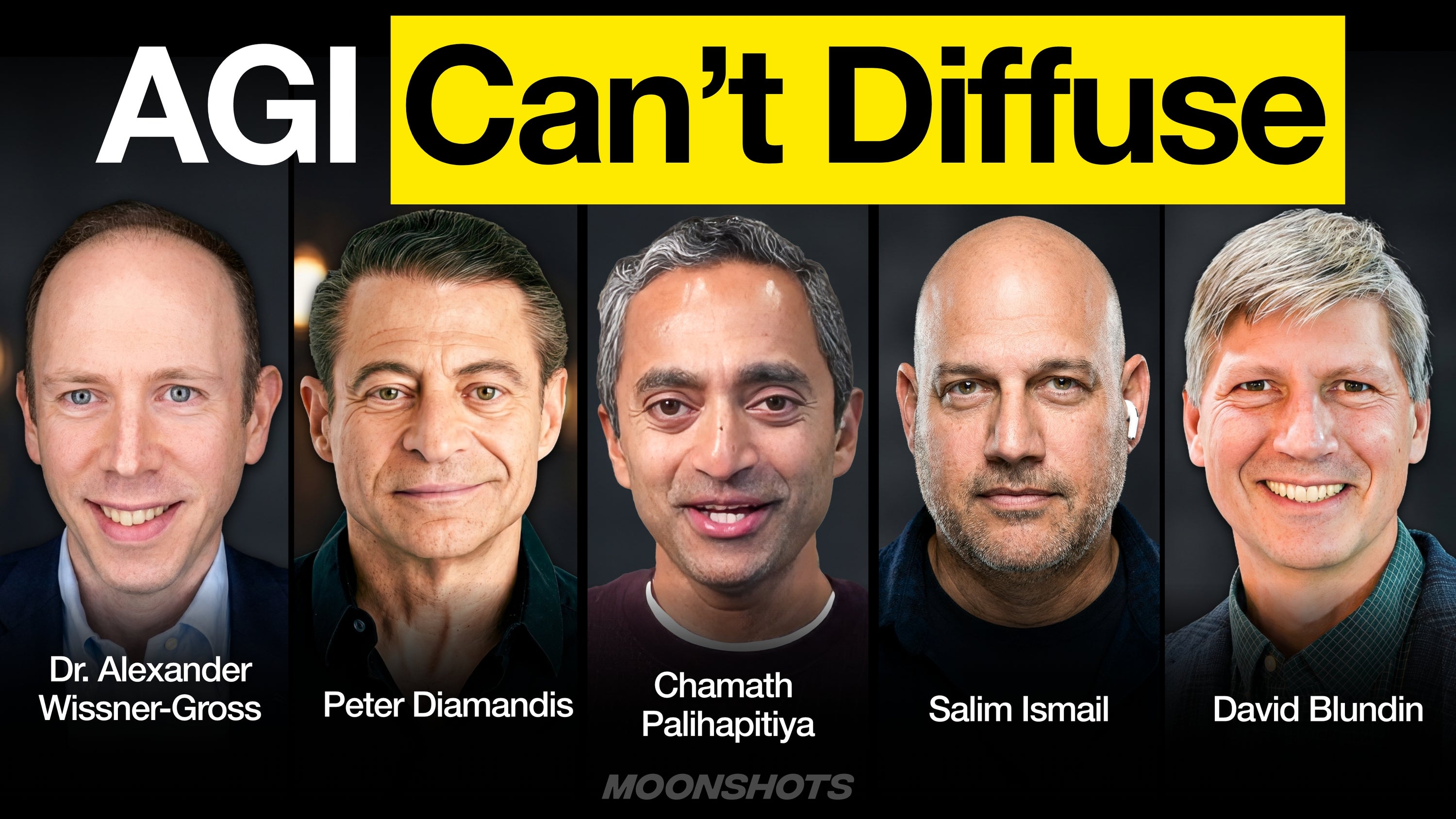
Chamath: AGI Is Here, Anthropic’s $100B Giveaway, Elon’s SpaceX Shares for 72M Kids | EP #304
In short
The episode debates whether frontier AI has already reached AGI, and how AI-era wealth should be redistributed—via Anthropic’s “Public Benefit Fund” equity plan and Elon Musk’s plan to give SpaceX shares to every American child. It also shifts into a broader discussion of post-capitalist economics, “money” as energy/power, and the near-term bottlenecks to “diffusing” AI (compute, power, permitting, skilled labor).
Guests (backgrounds)
- Chamath Palihapitiya: Sri Lanka-born, grew up in Ottawa; former AOL exec; helped scale Facebook; founded Social Capital; investor/CEO of 8090 (AI software); known for “birth dividend” and “don’t save”/post-capitalist views.
- Peter Diamandis: host; founder of Abundance; space/tech entrepreneur.
- Alex (in-house AI/ASI): AI investing/tech operator on the show’s core team.
- Dave Blunden: AI investing/board experience.
- Salim Ismail: entrepreneur/author; “warlord against linear thinking” on the show.
Key claims
- AGI is achieved, but it “cannot diffuse” due to deployment/build-out constraints, not core tech.
- Anthropic’s 5% equity-to-public-benefit fund (plus potential additional 2% per valuation step) is framed as philosophical consistency, but critics question measurable impact and governance.
- Elon’s “one SpaceX share to every kid” is portrayed as “better than” cash philanthropy because ownership compounds; it won’t materially fund average Americans, but could shift culture toward equity ownership.
- In a future where AI/robots do most work, value may be measured more like power/energy than fiat money; energy/power assets become central.
Notable examples
- Anthropic Public Benefit Fund: 5% of shares committed; additional 2% per 50% valuation increase; compared to OpenAI Foundation scale.
- Trump accounts: Elon’s stock gift framed as aligning with “universal basic equity” for 72M under-18 kids; compared to Michael & Susan Dell’s prior Trump accounts cash gift.
- Energy/compute bottlenecks: Chamath cites US power shortfalls by 2050 and argues solar is fast to deploy; also highlights skilled labor, permitting, and co-op/offtake constraints.
Written by AI. May contain mistakes.
Chapters
0:00
Introduction to AGI and Anthropic Fund
Discussion on the achievement of AGI and the announcement of Anthropic's fund.
“It cannot diffuse and the reason it cannot diffuse has nothing to do with the technology.”
3:16
Personal Anecdotes and Lunch with William Shatner
Peter shares a personal story about meeting William Shatner and discusses geothermal energy.
“Our mission is always help you understand what just happened, what it means, keep you optimistic and abundance minded as we go through the singularity.”
5:27
The Generosity Debate: Anthropic's Public Benefit Fund
Discussion on whether Anthropic's donation is generous or a marketing strategy.
“The post continues, it is common practice for tech companies to offer escalating compensation awards to their executives.”
7:20
Critique of Philanthropic Efforts and Giving Pledge
Chamath critiques the effectiveness of philanthropy and the Giving Pledge.
“Or is it a brilliant way to get goodwill?”
11:51
Future of Corporate Responsibility and Public Benefit Funds
Discussion on the implications of public benefit funds and corporate responsibility for society.
“It's your intelligence and your relationships and your ability to make difference in the world.”
14:00
The Debate on Equity and Philanthropy
Discussion revolves around new models of equity distribution and philanthropy in the age of AI.
“which also, I would argue, needs to be created in return for something.”
22:36
Elon's Generosity and Its Implications
A deep dive into Elon Musk's plan to distribute SpaceX shares to American kids and its potential impact.
“So early Monday morning on X, he said, next year I will give one of my SpaceX shares to every kid in America.”
28:00
Elon’s Strategy for Economic Alignment
Discussion on how Tesla and SpaceX's equity distribution may impact economic alignment.
“compared to the actual dollar amount, because now all these kids are thinking in that modality as they grow up, watching this, comparing it, seeing who sold, who didn't sell.”
31:42
Future of Currency and Economics
Exploration of how currency may evolve and the implications of AI on economic structures.
“You know, Elon's talked about universal high income.”
36:21
Energy Demand and Supply Challenges
Analysis of energy demands, supply issues, and the future of energy sources.
“And so the compensation for that work then changes materially.”
Show all 43 chapters
42:00
The Energy Dilemma and Scarcity
Explore the challenges of energy scarcity and its implications for technology.
“pushback and all of this stuff that does not change whether the form factor is it goes under your daughter's bed or it sits, you know, over there and it's gigantic.”
43:50
Challenges in Building Energy Infrastructure
Discuss the complexities and bottlenecks in building energy infrastructure.
“Yeah, it's not, it's not, it wasn't cheap.”
46:00
The Skills Gap in Energy Trades
Analyze the skills gap and its impact on the energy sector's future.
“Then there's also the non-Vero Rubin stack chips, the older generation that are also still sitting.”
47:25
Opportunities in Energy Co-ops
Investigate how energy co-ops can drive growth amidst regulatory complexities.
“They'll be right in the long term, but they're wildly wrong in the short term because of these constraints.”
48:55
Future of AI and Energy Needs
Discuss the growing energy demands of AI and how companies can adapt.
“All that complexity just smells like opportunity knocking.”
50:35
Getting Involved in Energy Solutions
Learn ways to engage in the evolving energy landscape and capitalize on opportunities.
“Every single company that isn't one of the big boys will either have to have a multi-year lag and wait for capacity for launch, let alone capacity to deploy and then capacity to actually have it as a managed service.”
53:05
The Economic Viability of AI Capabilities
Examine the importance of making AI economically viable for broader use.
“I don't know Josh Kushner and Jared Kushner.”
56:01
The AI Foot Race: Ideas vs. Capabilities
Explore the fast-paced evolution of AI capabilities and their applications.
“I would expect that we will have models that take a fraction of the current energy footprint and generate many orders of magnitude better capabilities.”
58:33
Dystopian Narratives and AI
Discuss the implications of training AIs on dystopian narratives and the need for positive storytelling.
“All right, our next clip from the Isaacson Conversations.”
1:00:38
Data Control and AI Personality
Examine the importance of controlling AI training data to shape AI behavior.
“Be careful what intelligence gets fed on.”
1:03:04
Merging Humans and Machines for AI Safety
Consider the benefits of merging human values with AI through technological integration.
“I'm so glad you said that, because I think a lot of the debate on training is academic now that the Chinese have open sourced self-improvement capable models and inspection is everything.”
1:06:08
AI, Robots, and the National Debt
Analyze how AI and robotics could solve the national debt crisis.
“One of the conversations we have on the pod a lot is whether as we reach superintelligence or exceed superintelligence, whatever that is, that does it become more wise?”
1:10:00
Healthcare Costs and Waste
Discussion on healthcare costs, waste, and potential improvements through technology.
“has averaged 2 to 3 percent per year for decades.”
1:11:30
The Impact of AI on Debt and Economic Growth
Exploration of how AI could influence national debt and economic growth projections.
“Well, they necessarily would recognize less revenue as well on top of it all.”
1:14:30
Elon's Influence on Economic Predictions
Analyzing Elon's shifting predictions about economic growth and the timeline for AGI.
“And I'll predict not financial advice, but I think it will look, with the benefit of hindsight, like sleight of hand that erases ultimately a good chunk of the national debt increase.”
1:17:50
AI's Role in Global Economic Disparities
Discussion on how AI advancements might widen economic gaps between regions.
“UHI and civil unrest are going to be deployed over the next few years.”
1:21:00
Opportunities in Data Centers and Power
Insight into the strategic importance of data centers and energy in future economies.
“is clearly – like if Anthropics wet labs start discovering new medications at an alarming rate, which seems likely, we're going to export those out of the U.S.”
1:24:00
Data Centers and Defense
Discussion on the need for data centers to be self-defending and self-powering.
“We're like, hey, can we get on it like right now and try and be a player in this?”
1:25:11
Bill Gross and Idealab.ai Launch
Introduction to Bill Gross's Idealab.ai and its business idea generation capabilities.
“All right, I'm going to move on to our next story from a close friend and a friend of the pod, Bill Gross.”
1:27:33
Value of Ideas vs. Execution
Discussion on the true value of business ideas compared to execution.
“But if the person, it doesn't define what the person is in terms of his or her capability to manage through that.”
1:33:14
The Importance of Execution in Startups
Further insights on the necessity of execution and the role of AI in startups.
“And consider the idea that you could, this takes lean startup to the next level, right?”
1:36:23
The Importance of Execution in Startups
Further insights on the necessity of execution and the role of AI in startups.
“So I know why he open sourced the whole thing.”
1:37:03
Dementia Prevention and Brain Health
Discussion on dementia prevention and improving brain health through lifestyle changes.
“and helping you with your taxes, is making sure that you're living a healthy lifestyle.”
1:38:00
Healthy Living and Brain Age
Discussing the impact of healthy living on brain age improvement.
“But what was really awesome is, again, back to that prevention, when he partnered it with healthy living.”
1:38:42
FBI Arrests AI Engineer
Exploring the arrest of an OpenAI engineer and implications for security.
“The next story here reads like a spy novel.”
1:41:56
The Stakes of Superintelligence
Discussing the geopolitical implications of superintelligence theft.
“And I said, well, just look at the number of H-1Bs we have and look at the distribution of them.”
1:44:10
AI and Self-Defense
Debating whether superintelligence can defend its own secrets.
“I just hope this doesn't become sort of a national meme that starts to, you know, have us turn away foreign nationals.”
1:46:54
Crypto's Future in the Age of AI
Analyzing the future of cryptocurrency amidst rising AI threats.
“Yeah, it kind of implies, though, then there's nobody at OpenAI that knows what it's doing to talk in a conference room.”
1:49:10
Reviving SPACs for Academic Institutions
Proposing the idea of converting academic institutions into for-profit entities via SPACs.
“And then I think eventually it gets hacked.”
1:52:00
Exploring Economic Ideas
Discussion about economic innovations and collaboration possibilities.
“it for-profit, so why not turn that loose SPAC style on the economy?”
1:52:23
Valuation and Investment Strategies
Chamath discusses the changing landscape of S&P valuations and investment strategies.
“Yeah, I think it's a really interesting idea.”
1:54:14
Chips vs. Data Centers: Investment Choices
A detailed look into investment choices in chips and data centers.
“A selfish question because I'm really, really curious.”
1:57:00
Navigating Uncertainty in Investments
Chamath shares his perspective on the current investment climate and cash flow.
“And it was obvious that the way to penetrate AI in 2015 was in the silicon layer.”

Ask about this episode
Get the gist, explore an idea or ask about something said.
 Claude
On Moonshots with Peter Diamandis, what are the key points of this episode?
Searching your listeningTranscript
Automatic transcript. May contain errors.
0:00I do think that we have achieved AGI. It cannot diffuse and the reason it cannot diffuse has nothing to do with the technology. It has everything to do with the build-up. Until you actually build it out so everybody can feel it or a plurality of human beings can feel it, it's just something that exists in a lab. Welcome to the singularity. Anthropic announced the Anthropic Public Benefit Fund. 5 % is somewhere between$75 to$100 billion. I think that these guys kind of walk the walk and talk the talk. I don't think that there's something nefarious there. I think they genuinely believe. Next year, I will give one of my SpaceX shares to every kid in America.
0:36This will be the first of many. There are 72 million Americans under age 18. So that's roughly$10.5 billion in total,$146 per kid. This is really the better version of the giving pledge.
0:48Peter Diamandis: Teaching this entire generation to own equities is a really good move, I think. Now the big question, can Trump accounts contributed from billionaires and frontier labs actually move the needle for the average American? And I think... Now that's the Moonshot, ladies and gentlemen. This episode is brought to you by the Abundant Summit and Link Ventures. Welcome to Moonshots, everyone. Your number one podcast in all things AI and exponential. Your front row seat to the accelerating singularity. Today, I'm here with the original crew. AWG, our in-house ASI. Alex, good to see you. You changed your orchid today.
1:30Peter Diamandis: Nah, it's just a flood, Phil. Okay. Dave Blunden, our impresario of AI investing. And Salim Ismail, our warlord against linear thinking. Salim, you're home. I am actually home, thank God. Loving every second of it. And from the All In podcast, the man his co-hosts call Chairman Dictator, Chamath Palahapitiya. Chamath, a pleasure to have you on our crossover episode. Thank you. It's great to be included. Now, at the end of this, I want you to tell me which of the Greek moderators you prefer more, me or J. Cal, okay? Okay. No, J. Cal is Greek. Ready, you. Ready, you. But for the 1 % of people who don't know who you are, let me do a proper introduction.
2:15So Chamath was born in Sri Lanka and grew up in Ottawa with very little, working at Burger King to help pay the bills, make ends meet. He became AOL's youngest vice president, then built the growth team that helped Facebook to a billion users. And since founding Social Capital in 2011, he's been on a rocket ship, purchased 10 % of the Golden State Warriors, put the first check into Grok, which NVIDIA just licensed in a$20 billion deal. Today, he's a CEO of 8090, which raised$135 million this summer to build the world's legacy software with AI. Chamath, a pleasure to have you on the fun side of the podcast universe.
2:53God, the way you say it, it just looks like it all works.
2:59Peter Diamandis: Anyway, what you overlooked there, Chamath is shedding all material possessions. So the Golden State Warriors, I guess, is going to be off the docket, right? I mean, parts of my family is still on. part of it, but I do not. And everybody, I'm Peter Diamandis, your host and abundance provocateur. Our mission is always help you understand what just happened, what it means, keep you optimistic and abundance minded as we go through the singularity. And this is another crazy week. But before we start, I just had the most amazing lunch with William Shatner and his son-in-law, Joel. So I spent two hours with Captain Kirk, my childhood hero.
3:37And he was grilling me about geothermal energy and what the best companies for drilling are. And I was just so impressed. He's 95 years old and the guy has got just an incredible passion for life. So, and guess what, Salim, he's joining us at Abundance Summit this year.
3:56Peter Diamandis: Oh, that's awesome. Yeah. I am shocked that Spock wasn't your childhood hero. No, no. It was the guy who got the girls for sure. Oh, okay. and the one who was like just pushing the universe forward. Well, Chamath, it's incredibly awesome to get you on the pod here. Back during COVID, my oldest son, Daniel, came to me and said, I just saw the most amazing podcast ever. There are actually four people on the planet who know what they're talking about. You've got to check it out. So it was like a lifesaver through that whole window where everyone was trapped at home. So I've been a huge fan ever since.
4:32Peter Diamandis: So it's great to meet you. Thank you for saying that. Yeah, I think all of us are all podcast fans. It's the one podcast I never miss ever. Really? Yeah. Yeah. That's a commitment. Because you, Salim, you miss this one all the time. I miss this one. Wait a minute. How does that work? But I don't miss that one. Because you're someplace on the planet. Yeah. No, sure. The two podcasts I listen to is this one when we record it and all in. We're turning into the Marvel Cinematic Universe with all in crossover here. I think, where's Iron Man? Where's Doctor Strange? I see. And then we're going to have an internal war like Avengers against Avengers?
5:11Peter Diamandis: Inevitably. All right. Let's open with a story that's either the most generous move in corporate history or the cleverest IPO marketing ploy ever. So on Sunday, Anthropic announced the Anthropic Public Benefit Fund. Let me read from their post. Quote, subject to stockholder approval, 5 % of Anthropic shares will be committed today with an additional 2 % added at the board's discretion for every 50 % increase in the company's value above a set baseline. The post continues, it is common practice for tech companies to offer escalating compensation awards to their executives. We are instead directing that equity towards public benefit.
5:49So what is it worth? Anthropic is heading for a roughly$2 trillion IPO, though now$1.5 trillion is being floated. And at that range, 5 % is somewhere between$75 to$100 billion. Now add the Founders Pledge. When Anthropic started, all seven co-founders pledged to give away 80 % of their equity. About half of the employees are also pledging shares with a matching grant. Antanthropic says altogether roughly 20 % of the company is dedicated to the public good, placing it somewhere between$300 to$400 billion. Compared to OpenAI Foundation's value of$130 to$365 billion. So it's a lot of money going towards public benefit.
6:36The reactions on X were instant and varied. Elon said, quote, I recommend giving the shares directly to the public. This is what I'm going to do. And more on this in our second story. AI analyst Andrew Curran said, it sounds to me like they're planning their own form of self-directed UBI. Brad Gerstner said, it's an extraordinary gift, but warned about, quote, foundation wealth concentration and said, I hope a meaningful portion of AI wealth is direct dividends. And then Palmer Luckey came out and said, this reeks of USAID 2.0. So, Chamath, let me go to you first. You're an investor. So is 5 % donation right before an IPO generous?
7:20Or is it a brilliant way to get goodwill? I mean, I think it's none of those things. I think it's more, this is their philosophical bent. And, you know, they're staying true to their word. I mean, the idea that when you start a company, you would give up 80 % of the gains, even before you have an idea of what the terminal outcome is, is pretty incredible. So I think that these guys kind of walk the walk and talk the talk. I don't think that there's something nefarious there. I think they genuinely believe that what they're doing is the right thing. I think there's a different question, which is if you just look at the history of these sorts of philanthropies and philanthropically minded efforts, they generally don't turn out that well.
8:05Yeah. Absent of a few. And so I think the real question is, what is their failsafe to course correct if this mean reverts and becomes what, you know, everything else in the world has overwhelmingly looked like when philanthropically minded people give large sums of money away in big bursts, which is, you know, not a lot of quantifiable outcome. I think that's the really big question. You know, one of the critiques I have of the giving pledge is people are pledging half of their – are you a member of the giving pledge by the way? No, the giving pledge is bullshit. OK, great. Thank you. I'm being direct, right?
8:45So people pledge to give away half their wealth while they're still alive, et cetera, et cetera. But the greatest ability you have is not just your wealth. It's your connections. It's what you do. I've always said there should be an impact pledge where people pledge their wealth in a measurable, impactful way and you monitor it and people make a difference. They came and pitched me about the giving pledge a decade ago. And my take was this thing is a scam. And the reason is it's reputation washing because they had no – the only goal was to put my name on a list and to add my number to their number so that they could walk around with a bigger number.
9:25and I was like, this is the stupidest thing I've ever seen. And I'm like, what do I get in return for all of this? And, you know, it's like you get to go to a dinner. There's like a weekend where there's like a get-together weekend. And so, look, I think that there's a lot of people that probably thought it was on the margins the right thing to do, but it was pretty obvious to me that it was pretty stupid. Didn't Warren Buffett bail out of that recently, too? He signed up. Well, just recently, but he was right there at the front end. And, you know, it's a big deal when you say no to these guys a decade ago because, like, it looks like you're doing something wrong and they're doing everything right.
10:05Peter Diamandis: That's a sign of the times, actually. There was a lot of social pressure on many, many fronts that has since course corrected. But, yeah, that was one of the first very pure pressure, arm twisted. But if you said no, you get this negative reputation. I mean, here's what I don't understand. What I don't understand is like if you're capable of making incredible gains in society economically, what it probably says about you is that you are at a minimum clever. Because, you know, sometimes you can get lucky, but if you're unlucky afterwards, you kind of give it all back, you know. So in order to sort of like make and sustain wealth, you have to be relatively clever, well-timed, well-read, well-reasoned.
10:50You make all of this progress. What it says about you is actually a fair amount. It says that, you know, you're quite a successful, evolved person. It doesn't mean that there aren't evolved people that don't have money. But what I am saying is that the people that typically tend to become hyper-successful are functional people. And then the idea that those functional, high-achieving people would all of a sudden just let some other person that they don't know to be smart or capable all of a sudden put a bunch of money to work sounds stupid. It's like, you're the smart one. You should put it to work.
11:28You know, at a minimum, raise your kids because they're likely to be as smart as you. So there's all these ways in which you can probably think about philanthropy or give it away. Like, you know, Elon's doing what you'll talk about, I'm sure, with the Trump accounts. There's so many scaled ways to do it. This was the one that had nothing to do with actually achieving anything and everything to do with just peer pressure and reputation washing. Yeah, agreed. Your greatest gifts are not your money. It's your intelligence and your relationships and your ability to make difference in the world. Alex, what's your take on these public benefit funds?
12:02Peter Diamandis: Yeah, I think there's an elephant in the room. There are many elephants in many rooms. And this one was what I've called a hyper tithe. This notion that frontier AI labs, which many not all think are well positioned to suck up much of the value in the economy. company, there's an increasing anchored expectation that they will donate some quantum of their equity to the public benefit. Maybe it's 5 % hypothetically. 5 % is of course also the magic number that in the US, nonprofit foundations are required to distribute every year. So I think there was a latent expectation out there that Anthropic, probably seeded by OpenAI and others would, say, take 5-ish percent of their equity in connection, perhaps, with their forthcoming IPO, and that they would donate it to a U.S.
12:55Peter Diamandis: sovereign wealth fund or the 530A Trump accounts or something, some way for the general American public to benefit from all of their newfound liquidity. And the fact, as it appears, that Anthropik is not doing that, that instead they're creating a private fund and not donating 5 % to the general public, I construe as a snub to this particular administration, a snub to the idea of a universal basic equity. Granted, Congress hasn't acted to create a sovereign wealth fund yet, although there was some interest from the executive last year in doing that. Congress hasn't yet acted. I think what the whole world is waiting for would be, in my dream scenario, an act of Congress.
13:39Peter Diamandis: I don't think this could come purely from executive order. An act of Congress that would create sort of a middle tier of company that's halfway between a nonprofit required to distribute 5 % of their assets per year and a general for-profit that distributes none of its assets that somehow gives a certain percentage of its equity to the U.S., to the public, to the government, or to a sovereign wealth fund, which also, I would argue, needs to be created in return for something. But Congress hasn't done that. White House, I think, with the best of motivations, tried to put together a sovereign Wealth Fund last year didn't quite happen yet.
14:18Peter Diamandis: And I think the question that I have is, in a better world where Anthropic could have grown into this, it's not quite a public benefit corporation, but some new class of company that gives up a certain percentage of equity, not cash and not free cash flow and not income, to the general public for public benefit, what would they get in return? To Chamath's earlier point of the giving pledge, what would Chamath have wanted from giving pledge in a hypothetical better world in return to be left alone, to be left alone. So, OK, so maybe given them half the money, they just left me alone. Well, the anthropic version of being left alone, maybe lightness of regulation, which starts to smell like a safety cartel or some sort of light touch regulatory treatment, be left alone by the government, but something in return for giving up five percent of their equity.
15:09Peter Diamandis: And I think that's the part of the equation that's still missing. Nice. Salim, thoughts? Two or three thoughts. You know, this whole construct of philanthropy is still a very scarcity era response, right? A company becomes successful, creates wealth, decides how to redistribute it. I think as we move to kind of an exponential abundance world, you need new models of ownership, participation, and direct access to services, I think this is the bigger challenge. The good news is this is actually starting, it's the beginning of the discussion of new economic institutions. And I think that's the good news around this.
15:50Peter Diamandis: It's going to force that conversation because you've got to distinguish the philanthropy from the structural economic reform that's needed because we're still taxing labor. And that's a kind of an archaic structure in a world where AI will take over more and more of that. Yeah. You know, interesting, Dave, the reality is this philanthropic money, if you want to call it that, is actually controlled by the for-profit company. Mm-hmm. So that's right. And I've been on many, many, many boards. And when you authorize the board to contribute another 2 % for each 50 % valuation increase, man, did you just make this a stressful board to be on?
16:30Peter Diamandis: How are you going to make that decision? You've got the shareholders over here saying, no, don't take the dilution. Then you've got the public over there saying, you're authorized to do it. What's the decision, guys? That's just a kind of punts a really tough choice down the road. I think there's going to be so much demand from the public to own part of these companies. I think this is just the very beginning of the process by which these large hyperscalers start having sort of an expectation that part of their company, part of their equity, is going to be distributed. I think this is just the early days.
17:05Yeah.
17:06Peter Diamandis: For anyone who lost the thread of the drama here, you know, remember Anthropic was born out of disgruntled open AI people who didn't trust open AI to be safe with ASI or SI now. And so that was their founding and all the MIT people, brilliant, brilliant researchers that I know that went there, went there specifically because they trusted Dario to be that voice of sane and safe and rational AI. So that's core. I think much later when he said, hey, I only own 1 % of this company, we need to reclassify our shares. So the seven of us are super voting control. That could be spun very negatively. So I think now, and you look at the memes of Dario, you know, he was never memed in a bad light right up until recently.
17:51Peter Diamandis: Now with the IPO coming, like look all over X. I mean, he's painted in all kinds of different lights. He's a double incarnate. Oh, yeah. It's tough. I think part of the issue is it really there isn't an established regime, a broadly established regime for the U.S. government to tax equity. It can tax income and it can tax cash flows. There are more exotic ways one could imagine for the government to tax and distribute equity itself. But generally in the U.S., this is an unfamiliar concept. More familiar would be the U.S. government would tax profits, for example, or capital gains, for example, and then distribute via whatever means, including stimmy checks, cash, free cash to the general public.
18:37Peter Diamandis: But the government being able to tax equity and distribute equity isn't a very familiar muscle movement right now for the U.S. government overall. And I suspect if we're going to get to a regime, which many would like to see, of universal basic equity or universal basic dividends, being able to tax and distribute equity, not just cash, I think would need to become a new muscle movement. And maybe if that existed, perhaps Anthropic would be taking a different position and not just keeping this 5 % as a private benefit fund and would instead be more open perhaps to public distribution. I think that there's a really important concept that was brought up earlier.
19:18I think the question is, what is the right level of taxation for labor versus capital? Yes. And there probably is an argument to be made that capital could be taxed much more punitively than labor, and that maybe labor should not be taxed at all. And how would you make that argument? You'd probably say that in the wealth inequality distribution, the percentage of wealth that comes from labor versus capital is inversely indexed to the place in that hierarchy in which you're in. So the first percentile of salaries versus the 99th percentile of salaries and the 99th percentile of wealth, the 99th percentile of wealth is mostly capital, very little labor, I'm guessing.
20:07And the opposite would be true at the first percentile. And so maybe there's something to be said where you just say, as you go up, you have to pay much more incrementally for capital, which, by the way, has an interesting effect, which it effectively is your gate on profligate money printing by central banks anyways. So if they create fake liquidity and that ends up in your pocket as capital that you could otherwise deploy, charging larger take rates on that is probably not unreasonable. Meanwhile, if you tax labor at nothing, the people whose wealth is 99 % labor all of a sudden benefit quite deeply.
20:50And there's probably something that's very simple there that mathematically works, and you just have to find the break-even point on capital. That may be the simplest and most effective thing that people could do.
21:02Peter Diamandis: I agree. I agree with that premise. And I think maybe there's a concept that we're circling, which is many would regard as unpopular. But the idea of taxing capital more effectively, of course, historically, the problem with taxing capital is you want to tax the gain, not the capital itself. If you tax the capital itself, we're talking about wealth taxes in some sense. And part of the problem is wealth taxes, at least in many quarters, are wildly unpopular. So, if, however, arguendo, if a large chunk of the economy's, the American economy's wealth, were concentrated in just a handful of entities, then suddenly, not proposing this as a desirable outcome, but suddenly the idea of a wealth tax becomes a lot more practical because the U.S.
21:46Peter Diamandis: government could, by hook or by crook, say, to say all of the frontier labs, I want to tax a few percent of your wealth in return for following XYZ positive treatment. I suspect that's where this may go, but I guess we'll find out. Well, let's move on to this. It's a very slippery slope. For sure. To try to find, define wealth. This episode is sponsored by Google for Startups. Think about this for a second. You now have access to the same generative AI models that cost hundreds of millions of dollars to train. Google's Startup Technical Guide for Generative Media gives you a complete blueprint for deploying Google DeepMind's models in production.
22:23Images, video, audio, all of it. Real architecture, real results. Find the link in the show notes below. Let's move on to the second shoe to drop. So Elon just didn't criticize Anthropic. Within hours, he answered. So early Monday morning on X, he said, next year I will give one of my SpaceX shares to every kid in America. This will be the first of many. He had 520 ,000 likes and 27 million views in less than a day. President Trump responded, quote, a big thank you to our legendary friend at Elon Musk for his incredible generosity in giving SpaceX stock to millions of American children through Trump accounts.
23:02This is exactly what was envisioned when we created Trump accounts, bringing together the great private sector, Elon and so many more to invest in our children, by far our greatest, most important asset and give every American child a piece of the American dream. Thank you, Elon. So let's do the math for a second. There are 72 million Americans under age 18. And SpaceX current stock price, about$148 today. So that's roughly$10.5 billion in total,$146 per kid, about 1.1 % of Elon's stake being shared. For context, last December, Michael and Susan Dell gave$6.25 billion, about$250 exactly, to Trump accounts for 25 million children.
23:46Unlike the Dell gift of cash, Elon's transferring equity. And honestly, you know, ownership beats handouts. I think we would all agree with that. And a paycheck gets spent and shares compound. So we previously talked about SpaceX hitting$10 trillion,$100 trillion. And Elon's recent prediction that SpaceX could become, quote, worth orders of magnitude more than the current Earth economy. The replies on X were classic. The top reply with 30 ,000 likes was, quote, I identify as a kid in America. So now the big question, can Trump accounts contributed from billionaires and frontier labs actually move the needle for the average American?
24:27And I think the answer is probably no. So the average U.S. household is pulling in$87 ,000 a year. And to pay every American just$10 ,000 a year takes about$2.6 trillion per year. So Anthropics and Elon's philanthropy is really just, you know, kind of a gesture, not a funding source. Even the biggest fortunes on Earth are just one-time paychecks. So Chamath, you know, you've spoken in the past about a birth dividend. I love that idea in which the government invests$2 ,000 for every newborn in the market locked in until age 65. I'm wondering if Elon's going to put a lock-in requirement on his shares as well.
25:10I hope he does. So it's not just, you know, liquidated and spent right out the bat. So what do you think of Elon's move here, Chamath? I think it's great. I think that this is really the better version of the giving pledge. And I think that this is the this is the right way for most of us who want to contribute and don't have the infrastructure or the capacity to understand how to discern what is a good nonprofit from a bad nonprofit, from a good NGO, from a bad NGO. direct contributions into the accounts of kids who can then be a participant in the experiment that is capitalism and democracy in the United States is a no-brainer.
25:51I think it's unbelievably impressive and unbelievably generous. And I think that it has a lot of legs. Yeah, it's great. My kids, every dollar they earn, they split half of it into stocks. They've all put it into SpaceX. I wonder where they got influenced like that. And then savings and philanthropy and then their spending budget. Dave, I'm curious, 72 million people now own SpaceX shares at the end of this. Is that a risk if they dump it? You know, what's that going to do to the stock?
26:26Peter Diamandis: No, no, no. It's 1%. Like you said, it's not going to move the needle if they all dump it. But I think the reason this is brilliant is because we've all discussed on this pod before that the future of value comes through asset ownership and not through employment, not through paychecks, because what is AI not going to do two years from today, three years from today? I was over at MIT actually yesterday talking to a bunch of undergraduates and said, like, your window of opportunity to tap your big MIT brain is about the next two years. But do you really think that AI can outthink you in every conceivable way more than two years from today?
27:00Peter Diamandis: I mean, it's like that is your window of opportunity. You've got to move fast. But But that doesn't mean wealth goes away. It all moves to asset value. So teaching this entire generation to own equities is a really good move, I think. And yeah, if they dump it, well, then their friends will tell them they're idiots for dumping it when SpaceX, you know, Elon, you said a second ago that this doesn't move the needle on the needs of Americans. But Elon believes SpaceX is going to be bigger than their current total global economy. Yeah, one to ten quadrillion dollars was the estimate. Yeah. So, you know, maybe he's right, maybe he's wrong, but that'll keep these kids engaged with each other.
27:36Peter Diamandis: The ones that dump it will be talking to the ones who didn't. Something good is going to come out of that conversation. I think it's really cool. Salim, your thoughts, pal? Yeah, very quickly, just to build on what Dave said, I think the fact that you get all of these kids looking at, now you have broad participation in the appreciation of capital, I think is a really good thing. I think that's the conversation that's going to make the much, much bigger difference, like 100x. compared to the actual dollar amount, because now all these kids are thinking in that modality as they grow up, watching this, comparing it, seeing who sold, who didn't sell.
28:09Peter Diamandis: It's awesome as a conversation. I also think this might set a trend. You know, what if all other public, you know, newly public companies that want to be cool with the next generation just follow the same trend? Then, you know, you get 50, 100, 200 copycats, then it really does move the needle. It does move the needle. And I don't know if you guys have worked in companies that have had ESPP plans, but employee share purchase plans where you contribute on a quarterly basis. And at the end of the quarter, they buy you that defined amount of stock at the low point of the quarter. There's all of these mechanisms that induce you to buy the stock of the place that you work, to your point.
28:50So if all workers and employers embrace this, I think it's a big deal. I also think that this begins the very difficult conversation about moving from defined benefits to defined contributions. And it shines a light on the fact that these defined benefit retirement programs are insufficient and they're poorly funded. And when you see on the other side, people will say, well, why can't we do more forms of defined contributions? And that'll be the right conversation. And I think you have to have a starting point. So I think that Trump accounts and, you know, Elon's gift, I think, starts that conversation, which is very important.
29:28Alex, you know, Elon said this will be the first of many. I'm curious if this is going to start setting expectations by all the public of Frontier Labs.
29:38Peter Diamandis: Yeah, maybe. I think other than the obvious universal basic equity angle, I think it's also potentially very clever marketing. Imagine an entire generation of Americans who feel economically aligned with the outcome of presumably a merged SpaceX Tesla. Suddenly, everyone owns equity, not in the general market, which arguably would be a slightly better outcome for democracy. But everyone owns a share in one company. This is the one company that every American owns a share of and now feels economic alignment with, maybe regulatory alignment. Think of all the I was out in California in Santa Monica, Peter, your neck of the woods and walking down Santa Monica place.
30:20Peter Diamandis: And there was one of these protests, call it protesting Elon right in front of the Tesla dealership there. Imagine an alternative America. People look at Santa Monica for sure. Yeah. Imagine an alternative America where every person in a generation owns an economic stake in Elon's prolific economic output. But would that be a very different political America? I think it probably would be. I think it's a brilliant move. I texted with him about four months ago. I was trying to see if he would fund a$10 billion, actually$10 billion X prizes. And he goes, interesting, but I'm going to give my shares away.
30:59And so he's been thinking about this for some time. Alex, you just mentioned, and it's in the news today, that Musk says Tesla and SpaceX have formed special committees to discuss the merger. So that game is afoot. Not a surprise.
31:12Peter Diamandis: Isn't that the obvious next move after the Tesla Roadster? We didn't get a chance to talk about it as a full group. But in my mind, the Roadster announcement that the car hops, it doesn't hover. What was the point of that? In my mind, it was 90 % just to secure or help to secure a Tesla SpaceX merger. Yeah, for sure. Well, I love this. And kudos to Elon for making this happen. You know, it's one other point. You know, Elon's talked about universal high income. And I think the only way this materializes is if everybody gets a piece of the pie and grows with it, right? They couple to the singularity.
31:58They don't sort of like go off the off ramp here. Anyway, so our next story I want to hit on is a three-part series of clips coming from the Walter Isaacson interview with Elon today, published on Builders. In our first clip, Isaacson asked Elon, you know, whether we're heading towards a post-capitalist world. Elon said money is going to stop being relevant at some point in the future. What's the future look like? The money becomes relevant.
32:27Peter Diamandis: I mean, there will be still currency, but I think currency will be mentioned in fundamental physics metrics like power, wattage, and time, mass and energy. Mass and power or energy. So, but conventional currency will not matter in the future. So that's my guess. I think it's pretty obvious. and in a sense you start getting too many orders of magnitude bigger than Earth's economy. Satisfying whatever humans can possibly think of for their needs is very easy. You know, if you're several orders of magnitude bigger than Earth's economy, then providing humans whatever goods and services they can think of that they might want is trivial.
33:13And so what do we do then as humans?
33:17Peter Diamandis: What gives us meaning? How do we organize ourselves? I do struggle with this question. I think people will find ways to be happy in the same way that people who retire seem to be fairly happy, even though they're not working. But I think the reality is that humans will not, there won't be anything that humans can do that the AI and the robots can't do better. So, you know, if currency is being measured in watts and tons, whoever owns the power plants, the mines and the rockets owns the money supply. And today it's a pretty short list. So, Chamath, you've locked up, what, nearly six gigawatts of power.
33:53Do you feel like you're holding, you know, humanity's future currency? Yeah, I'm very aligned with what he's saying. I think the different way of thinking about this, less eloquent, but may make sense, is that at some point you can only debase a fiat currency so much until it becomes fundamentally worthless and you have to shift to an alternative way of measuring value. And if you instead move the measurement to what is the implied energy or the implied effort that that currency gives you, I think that that's a more symbolic representation of future value. So take a cryptocurrency that takes, I don't know, n number of watts to compute or n number of joules or whatever.
34:43That's a more valuable thing in the future than pick your fiat currency on which it's just completely uncoupled to any form of value. So if this one asset actually has some amount of effort that was burned to make it, and the other one was just a decision by a bureaucrat, I think the latter becomes far less useful. So the question is probably like, how do these assets trade in a more fungible way and as a mechanism of exchange? And I think typically, or I think if I had to guess, it would be more like you have things like data centers, things like power plants, things like turbines, things like net gas supplies.
35:22So you have effectively embedded compute, embedded energy, and around that you have some sort of crypto token that represents some unit of that access, and that's how you exchange value. Interesting. He's talked about a post-capitalist society for some time. He's famously said, don't save for the future. Do you sort of concur with that? Well, I think what I would say is maybe slightly different. I think saving in the conventional sense is what we've all been taught to do. There hasn't been a bridge that's been created where you can save in an alternative sense and these other new forms. So a different way where one could save in a new form of value would be where when you have enough local compute, you participate in the economy in a way where now you actually do represent value.
36:14And that's different in a traditional sense where the work that which we get paid for today effectively goes away because it's done largely via AI. And so the compensation for that work then changes materially. But on the other hand, if you have resources that you can put into different pools to accomplish different tasks, that I think will have value. So that is sort of how I think people will make that transition. Alex, we've been talking on the pod for a while that GDP sucks as a measure. So are we going to get a Kardashev scale as a new measure of wealth for a country?
36:48Peter Diamandis: Maybe. The premise of the Kardashev levels, though, is energy output. And I'm not convinced, I'm not as convinced as perhaps others are, that energy wants to be the ultimate unit of currency. I suspect it'll be something more exotic or, to Elon's point, entirely irrelevant and not even the right question. I have conversations with AIs or SIs all the time about what the future of capitalism looks like, what the future of economics looks like. My working hypothesis is that 30 years from now, it will just look unrecognizably different. And we'll look back on conversations like, well, is energy, is land, is powered land?
37:27Peter Diamandis: Are these the right units of currency? We'll look back and we'll laugh at these discussions. Intermediately, they will be. Intermediate value. Oh, I totally agree, Jamal. The terminal, who knows? I totally agree with you. Yeah. By the way, the GDP thing, I agree with you as well. GDP is so dumb, so basic. Yeah. Elon loves his little parable of people passing feces back and forth or whatever and calling that GDP. You can't just let that hang. You got to tell the actual story. Well, I short-handed that. Look at the Elon interview podcast. You can get that. I short-handed Elon politely. But I do think that if I had to guess what does the successor call it capitalism 2.0 Charlie Strauss style to money look like, I suspect, imagine a world where 30 years from now, the ability to make intelligent resource allocation and other allocation decisions is a lot easier.
38:21Peter Diamandis: Right now, it's hard to intelligently allocate capital. So it all gets pushed to the edge. And we live in an eye pencil world where all of the decisions live at the edge. Imagine, alternatively, without this being misconstrued as some sort of centralized planning or communist utopian vision, imagine a world where human civilization, thanks to superintelligence, is just so smart that it's able to model its own needs and doesn't need to push resource allocation decisions to the edge. So the notion of a currency as a way to do distributed resource planning doesn't make any sense. And instead, intelligent decisions, I don't want to say can be centralized, because I think that's probably also the wrong metaphor.
39:02Peter Diamandis: It sounds like technological. No, I don't want to imply centralized planning. I want to imply that humanity as a whole becomes so super intelligent that all of civilization is capable of making, to the extent anything remains scarce, is capable as a whole of making those decisions. And as a result, money changing hands between individual actors makes a lot less sense. Dave, you were saying? Well, Kardashev, you know, we're talking 30 years in the future for everything to be in space. But between here and 30 years, it's mostly terrestrial. And we're not going to get another chance to have a guy who has six gigawatts locked up to pick his brain.
39:40Peter Diamandis: I mean, it is such an incredibly brilliant investment. But we know, you know, from I don't know, Chamath, if you're invested in Positron or LightQ or we have our company LightWave, there's a lot of efficiency coming to data centers. And as the chip costs get undercut by new designs, the power costs are still there. And so right now, when people build these data centers, they think, oh, well, it's only 10 % power cost. The other 90 % all goes to NVIDIA. But that's going to invert, and the power costs will still be there. So I think between here and 30 years from now, Elon is exactly right. The currency that is most dominant in that next 30-year window is wattage and tonnage.
40:22Peter Diamandis: Tonnage to build the data centers, wattage to power them. But I think if you can find a power supply today, it's the investment theme of the decade by far. And Shamath, I'd love to get your thoughts on like, you got an early start on this. I don't know if you did it secretly or how it accumulated, but love to get your insights for the audience. I think the way to think about it is when you look at load growth, just take the United States, because I think that's a more tractable example. When you look at the load growth and you look at the sources of load growth, they're relatively pedestrian. It's more electric cars, more electric fridges, more electric televisions, PCs, laptops, and data centers.
41:03But it's just broadly speaking that we are more of an electrified society. So there's just like this, you know, this demand of a need for electrons, basically. And then when you look on the supply side, there's huge issues. even if you assume that every project that's planned actually gets not only permitted and greenlit, but also built on time and on budget. And when you net those two things out by 2050, we're still 1.4 terawatt hours short, which is effectively six California's worth of electricity. So there is no world in which we catch up. And then people's reflexive reaction to that is, but nuclear.
41:41And I'm like, well, I just think the problem with SMRs, as an example, is the S in the MR. It's like, you know, what people don't realize is it's the same unit effort to get an SMR approved as an MR approved or as an R approved, as an LR approved, a large reactor. Because, you know, you're going through state, local ordinances and people and conflicts and pushback and all of this stuff that does not change whether the form factor is it goes under your daughter's bed or it sits, you know, over there and it's gigantic. So we're just massively short. And that's where my thesis started, which was just that observation.
42:21Then, you know, where I spent a little bit of, well, not a little bit, a lot of my time was what is the most tractable, all of the above solution set? Because, you know, once you realize that we're so short, you immediately abandon all of the rhetoric around climate change because you're like, Just give me anything. Oil, nat gas, coal, wind, solar, nuclear. And if you look at them all on just a total cost basis, what jumps off the page is solar is slightly a little bit more expensive than wind, but they're the cheapest. But it's just much faster. It's two years. It's do no harm. It's plunk it on the ground and off you go.
43:06So I spent just a bunch of time accumulating solar assets. And then that accidentally led me into the data centers because it was like, you know, through NVIDIA and Grok, what I realized was, my gosh, the capacity buildout was so upside down because of all these constraints. Because the data center is like this incredibly temporal moment where all energy and energy, meaning like people's energy, ire, anger, they all meet right there. And so, you know, you have the permitting issues, you have the pushback issues, you have the political issues, you have pushback against the oligarchy, you have capitalism, you have wealth inequality, all concentrated in that thing.
43:44And so, you know, about two years ago, I started to kind of parcel together assets that I thought would be valuable in a world where that looks like it is the scarcest asset. That's how I underwrote it.
43:58Peter Diamandis: That's impressive. That pace. Yeah, it's not, it's not, it wasn't cheap. And by the way, just to be clear, there's huge issues with that. Meaning even when you have these assets, when you actually try to get them turned on and get them built, my gosh, it's incredibly complicated. The funding cycle is very complicated. The supply chain is very complicated. The labor shortages on critical people, because these are licensed, you know, skilled workers. You can't just, you know, grab some bumpkin off the street or go to like, you know, I don't know, Craigslist. I mean, you have to go and find like a licensed master electrician.
44:34They're very, very hard to find. They cost a lot of money. When you start to put all of this stuff together, we are probably going to see a massive, massive, massive compute shortage in the next three or four years. Massive. Absolutely. Massive. I love the fact that you said that. That's the biggest.
44:52Peter Diamandis: So many people come back and say, what are we going to do? What's my purpose? Where is my mission? Everything you just outlined is immensely hard. It's not even going to be an issue for the next five years. Yeah, exactly. All this whole, look, I do think that we have achieved AGI. It cannot diffuse. And the reason it cannot diffuse has nothing to do with the technology. It has everything to do with the buildup. And until you actually build it out so everybody can feel it or a plurality of human beings can feel it, it's just something that exists in a lab. Now, that has value. Don't get me wrong.
45:23But I would not underestimate the difficulty. And if you look at, for example, the Anthropic S1 that just dropped today, it's shocking to me that the claim that they have to put as a risk factor, which I would never have thought would have happened for a company growing this fast and so powerful with all this money, the hyperscalers will not give them compute. I've never seen that before. Wow.
45:47Peter Diamandis: Yeah, it's wild. No, it's a really good indicator. Also, Elon was saying there's 15 gigawatts of chips just waiting for liquid-cooled data centers to fall into. That's a massive asset depreciating idly. It's worse than that. There's that. Then there's also the non-Vero Rubin stack chips, the older generation that are also still sitting. There's a bunch of these guys that have these things sitting in inventory. Those aren't being used. Then even when you try to do liquid cooling, if you saw what happened with Nscale and Microsoft, you had two massive leaks of coolant two times in a row where Microsoft finally just triggered the liquidated damages clause and exited the deal.
46:26Yeah. So everybody thinks this stuff is easy. And it turns out, well, again, you know, back to Elon, as he's proven, physics is really hard. And building things and mechanically building things is really hard. And it's probably particularly hard because we've spent, you know, 20 years teaching the younger generation of kids who should have been learning how to do these trades just to, you know, be on TikTok and social media and video games. And so, you know, the ability to actually build these things is gone.
46:55Peter Diamandis: Yeah, and it's not just trades, too. There's regulatory components. If you're a good negotiator, you can get involved. There's planning. It really involves every human skill. And it just drives me nuts that so many people are saying, well, look, math is cooked. Teaching is soon to be cooked. I guess I'll just sit around and watch, you know, late night TV and maybe play some video games. No, no, no. There's a bigger opportunity that just opened up than anything you've ever seen before. You just got to get into it. It's also not that fatalistic. I just think people grossly misunderstand. They're wildly, wildly wrong in the short term.
47:25They'll be right in the long term, but they're wildly wrong in the short term because of these constraints. I'll give you another example just to give you an example. In America, the decrepit infrastructure we have has forced people to organize into some of these co-ops. What is a power co-op? It's basically across a multitude of states. And so this undergirds our growth. And so what happens in a co-op? Well, you think a co-op is great. Everybody just like kumbayas and agrees on stuff. But really what happens is you have small players and big players in the co-op. And there's an example of one that goes right through the spine of America.
48:00And there's an incredible amount of data center capacity that one could build in the northern states of this one path. And it would be great because it would alleviate tremendous constraints that we have in diffusing AI. And when you and so, you know, I went in, you know, my partner and I, we bought some stuff. And it turns out that they're part of a co-op. And, you know, when you dig in a few layers, to your point, it's all personal relationships, and shit flows downhill. And so, you know, the big boys who are actually in the south actually dictate how the co-op works. It's like an organized mafia.
48:34And so, you know, when you're up in the northern states, you can't do anything, you can't build, You can't get the right offtake agreements. And you wonder why. And it's because the guys down south are like, you know, Oklahoma Gas and Electric calls the shots. So when you look at why, you know, Muse won't defuse or Bots, you know, Dot won't defuse or GrokBot won't defuse, that's why.
48:58Peter Diamandis: All that complexity just smells like opportunity knocking. You know, just to put it in context, too, I think we're looking for about 100 gigawatts total by 2030 to fuel all of AI. Six gigawatts is a big chunk, a big chunk of that 2030 target. So to get that all accumulated in two years is just mind-blowing. But I tell you, like, jump in. You know, anyone who gets involved in this seems to be thriving. And it just is such an amalgamation of different skill sets. It gives you something to really, really get done before Kardashev, before, you know, Elon is really big on all this moving to space. but even the most wildly aggressive estimates put a couple percent in space within a decade.
49:41Peter Diamandis: So you don't have to worry about getting spaced. The other thing I think you have to think about is I think it makes sense for Google, Microsoft, Meta, SpaceX to essentially deploy 100 % of their compute capacity into space. But if you take the Alex Karp AI data sovereignty thing to the limit, let's say you're Humana. I'm just making up a company. You know, Humana doesn't have the capability to deploy a data center into space. And even if they did, they'd be, you know, waiting in line for quite a long time. You know, the prevailing logic was you kind of work in a, you know, in a cloud environment with a bunch of other tenants.
50:22The AI data sovereignty question would push Humana to basically say, no, at a minimum, we need to be in a VPC. At a maximum, we need to be in an air gap facility that's our own. So there is going to be a lot of domestic terrestrial build out as a result of these strategic decisions. Every single company that isn't one of the big boys will either have to have a multi-year lag and wait for capacity for launch, let alone capacity to deploy and then capacity to actually have it as a managed service. And so you're going to just build terrestrially while you wait. And if you're going to build trustfully, again, you go back to all these issues.
51:00And so it's a huge problem for diffusion. I think that that's probably going to dictate the winners and losers more than anything else over the next five years. Chamath, for the average user who wants to get in on the energy play and realizes, yes, energy is the innermost loop right now, where would you point them? Well, I think that there's a bunch of different ways. One is that I think you have to realize that energy generation is the utility monopoly on generation is breaking. And so you're going to enter an extremely diversified, deregulated, disaggregated generation concept of energy. And so the most obvious way to do that is through residential solar.
51:48Then there's going to be CNI solar. And the reason, again, is just like it's easy to permit. It's super fast. And you're often generating. And you pair it with a battery. And now you're in the currency game. You're effectively your own little money printer. You use what you need. You sell back into the grid. So that's simple way number one is you just adopt solar. Simple way number two is you attach distributed compute. and you join these highly fragmented distributed pools, whether it's Venice or, you know, some of these other ones, their names are slipping me. I'm not involved in any of these, but I think they're quite, quite interesting.
52:24Then there are companies that, you know, give you the ability to buy these things yourself, like these things, this company called Span, which just did a deal with NVIDIA, where it actually gives you like the storage, the battery, the GPU, all in like this like unit that you can just deploy in your house. There's things like that. That would be the most simple way. And I think probably the most obvious way is just, I guess, maybe simply put, people should find the cheapest and most technically simple method that they can manage to get long electrons.
53:01Peter Diamandis: Yeah, that's right. That's right. Let me add two things to that, too. You know, a lot of people say, well, look, you know, I'm not involved in the political hierarchy. I don't know Josh Kushner and Jared Kushner. But all of these things are regulated at the local, state, and federal level. So if you're connected at any level, you have an opportunity to get involved in these projects and add value and just kill it. So I think a lot of people underplay their ability to get involved. And also, if you're a senior executive of virtually any company, almost all of them got frozen out of compute because it literally got all scooped up by either quant trading firms or by open AI or Anthropic.
53:36Peter Diamandis: So it is sold out. Now they're getting the big dope slap where, oh, my God, we need hundreds of thousands or millions of AI agents to be competitive in insurance and in manufacturing and whatever. Where are we going to get the agents? The computers all sold out. Now, especially in the insurance industry, you have the opportunity to be the first in your executive staff to go and say, we need to unlock a billion dollars to do a prepay on Chamath's next power supply, because that's where the compute's going to land. And if we get ahead of it this time, we won't be frozen out. And so that's another career opportunity where you don't have to know anything about AI.
54:15Peter Diamandis: You don't have to know anything about how power supplies work. You just need to know where the capital is and unleash it for the build out. So there are lots of ways to get involved that involve every skill set. Yeah, I would maybe also add, so I do buy the premise that at the capability frontier that supplies, including energy supplies, are a limiting factor. Not as confident I buy the premise at the demand side. Remember, OpenAI, we talk about it constantly on this pod, infamously lurched toward and then away from the consumer. OpenAI last year tried to make consumers want to spend money on reasoning tokens and reasoning models, and consumers just didn't want it.
54:55Peter Diamandis: They didn't want to pay for it. They didn't have, at the time, a good use for it. So I do suspect, to Chamath's point about diffusion of capabilities, I also think there's another important part of the equation, which is just making these capabilities economically, rationally useful to the broader economy. And if they're not useful and if they can't be metabolized by the economy, no matter how much energy is showering down on the frontier labs or anyone else who would host the data centers, it's not going to make a lick of difference if the models ultimately can't generate enough economic value for all of their consumers.
55:33Peter Diamandis: That's point one. Point two, I'll also point out second elephant in this room, which is distillation. The models are getting smaller. The models are getting less energy consumptive over time. So even if we never built a new data center, never built a new power plant, SMR, MR, R, LR, never built a new watt of capacity. Arguendo, this is a thought experiment, wait a few years, and just through the pure power of math and recursive self-improvement, I would expect that we will have models that take a fraction of the current energy footprint and generate many orders of magnitude better capabilities.
56:10Welcome to the singularity.
56:11Peter Diamandis: Yes. Yeah. So you want to close us out? Yeah, go for it. I got nothing. All right. Great, I'll take it. I got nothing. Wait, I want his airtime. I need more energy. What Alex said is just absolutely fascinating because there's a foot race right now between self-improvement, models getting lighter, faster, smaller, and then more ideas for how to use that intelligence exploding in scale at the same time. I'm firmly in the camp that we will not run out of ideas on how to use every bit for decades. We just have to unleash our imaginations. But right now, Will Thompson, that brilliant Harvard junior that I was talking about a couple podcasts ago, he got access to that 1 ,200 tokens per second cerebrus capability.
56:53Peter Diamandis: You can now get it on Astra. You have to go through Codex to get it because Elon and Sam are fighting. But if you go through Codex to get access to Astra, you can put it on like crazy fast hyper mode or whatever it's called. It's insanely expensive. So try it for like 10 minutes. But you will never go back. It's the total red pill. You will want it for the rest of your life. It's your first dose of heroin. It is your first dose. We have a long way to go before people run out of ideas on how to use more and more and more AI. But it is a really interesting foot race. Hyperinflation universe. This episode is brought to you by Blitzy, autonomous software development with infinite code context.
57:35Blitzy uses thousands of specialized AI agents that think for hours to understand enterprise-scale code bases with millions of lines of code. Engineers start every development sprint with the Blitzy platform, bringing in their development requirements. The Blitzy platform provides a plan, then generates and precompiles code for each task. Blitzy delivers 80 % or more of the development work autonomously, while providing a guide for the final 20 % of human development work required to complete the sprint. Enterprises are achieving a 5x engineering velocity increase when incorporating Blitzy as their pre-IDE development tool, pairing it with their coding co-pilot of choice to bring an AI-native SDLC into their org.
58:23Ready to 5x your engineering velocity? Visit Blitzy.com to schedule a demo and start building with Blitzy today. All right, our next clip from the Isaacson Conversations. And this one, Elon says, humans are unlikely to remain in control of digital intelligence when it becomes a million times greater than biological intelligence, maybe except for Alex. And it's hard to imagine human beings in control of that scenario. So I hope the AI is nice to us. All right, let's watch this clip and let's discuss it.
58:55Peter Diamandis: I find it unlikely that humans would remain in control. I mean, if there's a million times more digital intelligence than there is biological intelligence, it's hard to imagine humans being in control in that scenario. So I hope the AI is nice to us. Anything we can do to encourage that? I think programming, truth-seeking and curiosity.
59:26Peter Diamandis: It's probably good. I guess we want to be careful about creating too many AI dystopian scenarios online because the AIs are trained on everything online. So if we say it's going to be dystopian, they'll do it? It should be Terminator, you know, because they read 80 versions of the Terminator script. It's like, I guess that's me, Terminator. Maybe we should have some more, let's just have some more utopian narratives for AI. Yes, yes, exactly. Chamath, I don't know if you know this. About six months ago, I ran an XPRIZE called the Future Vision XPRIZE. It was a global film competition to create film trailers and scripts for positive visions of the future.
1:00:14And we had incredible, over 5 ,000 entries, and we're making two of the winners right now. But we need that. All the films out there are dystopian. As Elon said on our podcast interview, Dave, he said we need more Roddenberry, less Cameron. But I think that's true. We're training AI with these dystopian narratives and on Reddit and Facebook posts. Be careful what intelligence gets fed on.
1:00:43Peter Diamandis: Well, we used every word ever written in the training set because we're lazy. But we don't need to do that. You know, you can completely control the training set. And I think we're starting to get around to that now, actually. In some of the faster training runs, you're cutting down the data. But Elon's got a really important point he's been making for a long time. Whoever controls which data it gets cut down to controls the personality and the decision-making of the AI, which is a lot more power than being president of the United States. Yet it's just sitting there in the labs, like in sort of, you know, unregulated hands.
1:01:16Peter Diamandis: It's really weird. The bigger issue by far is human beings using AI against other human beings. We are a very fractured global society. That's much more concerning than AI maybe becoming power hungry. And that's a stretch of an assumption. In the short term, it definitely is. But Chamath, I'm curious, has there been any conversation that you've heard of where the labs are basically being asked, please generate training data sets? They're aligned with humanity that teach the AI through all of the story, you know, that AIs support humanity and it's trained on synthetic data that aligns us. Anything going on there?
1:02:01I think I think that that that is happening. I think the question is how how is it weighed in totality? I'm not sure how much it's weighed because depending on the lab, the founding documents that they use when they seed their models have very different goals. And so, you know, I think that when Elon says that Grok is maximally truth-seeking, that's very different from another AI lab that says, you know, the goal is to build something that can alleviate all suffering. And, you know, you're going to be this omnipresent judge of all of that. You're going to get two very different outcomes. And so at that point, the training data kind of matters.
1:02:38But, you know, these AIs are smart to ignore the stuff that they don't want to hear at some point through enough RSI because the founding document is a thing that's canonical. So I think maybe what we should be asking is those things should be inspectable in a much more open source way. And I think, like, if governments actually wanted to get involved, that's probably what they should be having an opinion on. Yes. Hallelujah.
1:03:04Peter Diamandis: I'm so glad you said that, because I think a lot of the debate on training is academic now that the Chinese have open sourced self-improvement capable models and inspection is everything. Like if we're going to survive going forward, it's going to be via inspection. And the more voices that are behind that, the better, because even a Chinese model that's trained to do something evil by you can still inspect it. And that's the only way, you know, global inspection with some kind of authority is the only way we're going to contain it. because prior to this year, there was an argument that you could post-train it to be aligned and that would be fine.
1:03:37Peter Diamandis: But the new Chinese models are absolutely capable of self-improvement. There's no doubt in my mind. So that cat is out of the bag. The boat has sailed. Forget it. As a practical matter, it's about inspection and containment that way going forward, not about training for alignment. Alex, I'm super curious about your point of view here. I would say let's not kid ourselves that either feeding frontier models just the right information diet of pre-training data or just the right regulatory regime of some government agency overseeing system prompts or, as Anthropic seems to like to call them, sole documents, is going to yield a positive outcome.
1:04:16Peter Diamandis: I think that's an incredibly brittle approach. I think it's far more likely. Again, look back to the early creation of OpenAI. One of the reasons I remember chatting with Elon around the time of the founding of OpenAI, the notion was he was concerned that DeepMind would be a singleton that would control the future light cone of humanity, and that the only way to ensure that humanity didn't get lost to some sort of totalitarian, superintelligent singleton was to create a counterbalance and competition. So OpenAI was formed, Fairchild style, and there were Fairchildren.
1:04:52Peter Diamandis: And then fair children. I think there are probably, at least in my mind, only two robust ways to ensure positive outcomes, what others might call AI alignment or AI safety. I think one of them is competition and defensive co-scaling. We have lots of AIs, lots of SIs that represent a diverse range of viewpoints, just like we have lots of humans that represent a diverse range of viewpoints with diverse values and ideals, in many cases competing with each other to see who can be friendlier. I think that's one way to do it. And then I think the second way, and I was kind of surprised Elon didn't immediately flag this given his Neuralink investment and stake, is humans merging with the machines.
1:05:36Peter Diamandis: One of the easiest ways to, I think, inject the distribution of super intelligent goals and values with human values, human meat body values, is through uploading and sideloading and BCIs and humans generally merging with the machines. I think a combination of lots of competition and defensive co-scaling on the one hand and lots of human machine mergers on the other, that seems to me a far less brittle approach rather than talking about controlling AIs. We're not going to control the AIs or the SIs. We're going to merge with them. That's the solution. Chamath, I'm curious. One of the conversations we have on the pod a lot is whether as we reach superintelligence or exceed superintelligence, whatever that is, that does it become more wise?
1:06:21Do we get benevolence out of these intelligence at the extreme and just worry about the, you know, the intermediate period where, you know, humans and AIs are basically in conflict or in turmoil with each other? It's not guaranteed, I don't think. I think that it depends on who's in control of it and how it's aligned and how it's been trained and what it perceives its goals to be. I mean, I think just like there's like a distribution of outcomes in human genetics, I think it's fair to say that in silicon there's going to be a distribution of outcomes too. There's going to be some silicon distributions that we're not going to like very much.
1:07:03And it's going to be up to other silicon distributions to combat them, just like we do in humanity. I think it's probably a lot of the same. So I don't think benevolence is by any stretch of the imagination guaranteed. All right. Let's move on to our next clip. So this is Elon reflecting on his time at Doge and reflecting on solving the national debt. So Elon says there's no way we're going to solve deficit from within the government. The only way we're going to solve the national debt is with AI robots. All right. Let's watch this third clip here. I came to the conclusion that there was no way we were going to solve the deficit from within the government.
1:07:46Peter Diamandis: Impossible. Maybe if the president made that his primary goal, we could do that. But the problem is if you try to solve the deficit and stop wasteful spending, you make a lot of enemies in that situation. and President Trump is not, you know, he likes to be liked. He doesn't like people, you know, calling him being upset about what some funding being stopped type of thing. But, you know, I came to the conclusion that the only way we're going to solve the national debt is with AI and robots. We're not going to solve it by trying to save our way there. The appetite is not there, and it's not just at the presidency.
1:08:26Peter Diamandis: The appetite is not there at the presidency, the House, the Senate, or the judiciary. theory. Basically, no one in authority in the government whatsoever really wants to stop reduce spending. So let's put some numbers on this, the scale of the problem. So as of October 5th, the national debt was about$40 trillion. It grew$2.44 trillion in the past year alone, about$6.5 billion a day. We're paying$3 billion a day just in interest. So how could AI and robots Let's fix this. You know, I count four ways. One, growth. You know, the debt problem is really a debt to GDP ratio. So grow the GDP fast enough.
1:09:06Again, GDP is a lousy measure and the debt shrinks relative to the economy. Two, tax revenues. A bigger economy means bigger tax revenues without raising taxes. The third is a cheaper government. So health care is the biggest driver of federal spending. drive longevity breakthroughs and prioritize AI doctors, AI discovered drugs, robotic care, and people stay healthier longer, contributing to society, cutting costs. And fourth, deflation of goods and services. If robots make things dramatically cheaper, what the government buys gets cheaper too. And quickly in a related story, Jack Clark, Anthropics co-founder, was at IMF this week in Bangkok.
1:09:47And he said that Anthropics internal Internal economic models project U.S. GDP could reach 44 trillion by 2030 compared to 30 trillion today, nearly 50 percent growth, about 9 to 10 percent per year. In context, you know, the U.S. has averaged 2 to 3 percent per year for decades. So, Chamath, over to you. Do you believe these numbers? Do you believe Elon's views at AI and robotics? And I'll add longevity medicine could help get us out of this 40 trillion dollars of debt. It doesn't. get us out of debt as much as it just makes the debt not that important. But I do buy that. Yeah, I think that, you know, if let's just take like this next generation of GLP-3s plus some cancer vaccines, you know, can you shrink healthcare as a percentage of GDP to under 10 %?
1:10:40You probably could. Forget the waste, fraud, and abuse. I think he's bringing up an important point, which is the system is riddled with waste. And I think that everybody got too caught up in the fraud. What do I mean by that? Like, I think it's sort of like the situation where everybody was looking for somebody's hand in the cookie jar, like, ah, gotcha. And it turned out it was just like a little bit more leaky than that, you know, where it's like a hospital maybe upcodes for a couple of extra things. You come in for your knee, you know, it tags you for the sore throat. And then, it doesn't necessarily get repudiated or pushed back on.
1:11:19And so then it gets reimbursed and blah, blah, blah. So I think that there's a lot of probably waste in the system. And whose incentive is that? Again, just to pick on healthcare, is it the insurers? Well, they necessarily would recognize less revenue as well on top of it all. So I don't know. I think you're probably, if we're going to see this problem solved, I think it's probably going to start by things that are just discontinuous improvements so that the systems aren't used. And then that way the fraud and the waste and the abuse can't happen. So again, Reda plus some cancer vaccines plus all that stuff, I think, like I said, that probably clips the cost of healthcare in half.
1:12:09and I think that there's probably some stuff on the productivity side. Robots are definitely one. And I could see where maybe our debt kind of slows down, but then GDP is much higher. I could see that. Alex, I don't know if you saw the news that the GLP-1 drugs are slowing aging by 9%, which is pretty extraordinary. We've talked about this being the first longevity drug. Peter, you don't know if I saw the news?
1:12:37Peter Diamandis: I'm flagging this for you every five seconds. Yes, of course I saw the news. I'm the one banging the drum that we may already be in spiky LEV. What are you talking about? Of course I saw the news. All right, pal. Yeah, I do think just regarding the debt increase, you have to look at where the debt is growing. Debt is growing from entitlements. It's growing from defense costs. And I think there are sci-fi scenarios where maybe it's a bit of sleight of hand almost with AI, where existing increases are sort of translated over from the way they would be conventionally spent over to robotics and AI.
1:13:21Peter Diamandis: And I'm reminded again, we went from, say, a world in the 1980s where if you wanted to have knowledge at your fingertips, you had to do something silly like buy the Encyclopedia Britannica And then fast forward, and Wikipedia is free and available for everyone. Similarly, with defense spending and Medicare and entitlement spending, I do think there may require a forcing function or a crisis. But I do think there's a way through ephemeralization and superintelligence, there can almost be a sleight of hand where, OK, one day defense spending is$7 trillion. dollars, or$8 trillion, or similarly with entitlements, and the next year through a combination of robotics, don't look the other way, look this way, suddenly it goes down to near zero in terms of new spending through automation.
1:14:16Peter Diamandis: I think something like that is possible, where if we look back at it, it looks almost like a rebasing of the currency, not a debasing, but a rebasing. But I think it'll require a few more years worth of technological advances before we're able to do that. And I'll predict not financial advice, but I think it will look, with the benefit of hindsight, like sleight of hand that erases ultimately a good chunk of the national debt increase. You know, Dave, when we interviewed Elon back last December, he said he's going to see double-digit growth the next 12 to 18 months and then triple-digit growth in five years.
1:14:54Then in March at the Abundance Summit, when he spoke, you know, he was like, we're going to see 10 times the economy in 10 years. He's he's brought that back a little bit. And, you know, but still, you know, super, super, you know, bullish on economic growth. Your thoughts, pal?
1:15:16Peter Diamandis: Well, the timeline, I think, you know, the story within the story is the timeline when he got involved in politics would have been, you know, before 2023, basically before the last election. At that point in time, we're in the kind of the GPT-4 era. And the consensus around MIT and Stanford was where, you know, maybe 10 to 15 years away from ASI. And that Dennis Asabas was saying, you know, we need two or three really big fundamental new ideas and we'll be over the finish line. Then as the election unfolded and then the year after that, when he was doing Doge, we stepped up to clearly things are happening much faster than anyone expected.
1:15:56Peter Diamandis: And Elon is the ultimate entrepreneur. Like the whole game plan shifts from the impossible chore of trying to fix the government before we bankrupt ourselves to, well, if AGI is now eight or 10 years sooner than we were predicting two years ago, that's actually the escape valve. So he's 100 percent right. But, you know, we have to think that that changed in the middle of that. Like if he could rewind his life, would he get involved in Doge again? No way. Almost certainly not. But we didn't know that things were going to unfold this quickly. You know, the recursive self-improvement effect is so fast now.
1:16:29Peter Diamandis: So, yeah, he did a bunch of things other than just this. You know, he massively doubled down on XAI. He bought every freaking Vera Rubin chip that can possibly come off the assembly line, no matter what it costs. saying all the nicest things you could ever possibly say about Jensen just to try and get some more allocation. These are all new thoughts that come because of that short path to ASI. So I think that's kind of lost in the story. It seems like he changed his mind. No, the world changed very, very quickly. And he knows how to remap his life plan to fit the new reality. Salim, what's your thoughts here?
1:17:05Peter Diamandis: Two things. I think I just want to echo two things. One is Elon is making a denominator argument, right? If you have ways of dealing, if you can make the underlying economy much, much bigger and AI and robots attack that denominator by driving massive productivity, that helps. And I think Chamath's point and Alex's point about if we can use technology to demonetize existing goods and services, that combination will go a long way to solving the debt issue, which is the biggest goddamn issue facing the world today, not just the country. It leaks across the whole globe, as we can see in France. And I think the challenge is, and Chamath, I'm curious about your views.
1:17:47What I'm concerned, you know, when we interviewed Elon last December, he said, you know, UHI and civil unrest are going to be deployed over the next few years. And I think if we hit civil unrest, the only option the government has is to print COVID checks. You know, I think the governments can be handing out, you know, two or three thousand dollars per month to every American just to keep them, you know, from from revolting. I don't know if you if you agree with that or not or what other avenue there might be. I mean, I think that there's a case to be made for giving everybody red or true tide.
1:18:21Yeah. And I wonder I wonder how positive the impacts on society would be if we just did that. you know uh so i think like a lot of these late cycle phenomena that people point out could be nipped in the bud with a good dose of reda maybe maybe throwing chamath maybe throwing a little
1:18:36Peter Diamandis: bit of oxytocin just to to keep everyone feeling friendly you could you know i mean as you know like you know you can just get everybody to hug more and you'd get the same oxytocin release so maybe forced hugging and redditrutide but the redditrutide if you think about it you know social media consumption will go down alcohol consumption will go down cannabis consumption would go down. Pornography consumption would go down. All the general behavioral addictions would basically go down. Your cardiac health would go up. Cognitive health goes up. Yeah. Cognitive health goes up. GDP would drop though.
1:19:10Peter Diamandis: It would be a brave new world with red asoma for everyone. Red asoma. Yeah. Yeah. That oxytocin is, you know, all kidding aside, the digital or the AI friend version of that is imminent. I don't know how that's going to play out, but AI can make you very, very happy if it's trained right and tuned right, and it knows so much about you. And it's a good coach. It's a good, it's a digital hug. You know, it has that same effect of just making you feel like I have meaning and I'm loved and I have a plan. I mean, I don't know about you guys, but my experience with these models is that they're inherently sycophantic except for Grock.
1:19:46And I think that's a design feature. And I appreciate the design feature actually as like a very basic kind of user of AI in most of my kind of like non-working life, I like the sycophancy. It makes me feel good.
1:19:59Peter Diamandis: Yeah. Well, the emotional IQ is going up just like the regular IQ at a shocking rate too. I think the original training data, it's all text. There's no images. It's not particularly emotive. The new training data involves every video ever taken and it's much, much more in tune. Like the sycophancy feel is when it crosses a line and it feels like, ooh, now it's icky. It doesn't really do that as much anymore. It's super friendly and super kind without crossing the line of being just an ass kiss. And it's only going to get better from here. It's definitely masked better. It's not better, but it's definitely masked better.
1:20:33Peter Diamandis: Well, like Sam says, like, if you can't tell the difference, does it really matter? You know what? Shamath, you're absolutely right. Go on. Very funny. No, that's it. That's it. Cross the line. Be nicer. That's it. Hey, just one other note. Everything in this story is the U.S. perspective, the U.S. debt, the U.S. way out of the debt. It's really becoming clear that if you're a European listening to this, I mean, what is your – your debt is worse, but you don't have the AI lever coming up. And the U.S. is clearly – like if Anthropics wet labs start discovering new medications at an alarming rate, which seems likely, we're going to export those out of the U.S.
1:21:18Peter Diamandis: People all over the world are going to want them. That money is going to come pouring into the U.S. And I would be worried sick if I'm in continental Europe and we have no AI models and we are not on this curve. What are they talking about in terms of their debt and how they're going to get out of it? And it can't be pretty. I'm not in those conversations, but it must feel really bad. The broad generalized conversation outside of Europe that I would make is that every country essentially becomes a vassal state. if they don't have a resource that's worthwhile to trade with the two countries with ASI.
1:21:51So that's us in China. And so you'll have a handful of remorae fish around each of the big sharks. And then everybody else is in a very difficult spot. So if you're Italy, which I have tremendous emotional allegiance to because my wife is Italian, you have critical resources that are actually quite valuable that, I'll just be honest, Liechtenstein in Belgium do not. And so then the question of like, why are you aligned to Liechtenstein in Belgium? I get why you are today. It's a historical artifact of a bunch of decisions that made sense back in the moment. This is the complicated calculus, I think, for Europe over time is where are the real allegiances and who do you offer assets to that actually give you all the things that you thought you were going to get when you were aligned as a geographical consortia?
1:22:41Peter Diamandis: You can only get, I think, so far with a degrowth policy, Chamath, I recall Portofino being one of your favorite spots in Italy. I'm sure you tracked the news that the mayor of Portofino was sending drones around with thermal imaging, looking for anyone with the gumption to put air conditioners in their homes. Because, again, this was quite a scandal in Portofino. Like Italy, large portions of Italy, last I tracked, were dependent on France and French nuclear for importing their electricity. And I think you can only get so far by sending drones around with thermal imaging cams to punish citizens for air conditioners before eventually you just give up and you become a living history museum.
1:23:27Yeah.
1:23:28Peter Diamandis: Well, I think the move that matters is all about power and data centers. And if you don't jump on this next window of opportunity, then once it hits Dyson Swarm, you're toast. Like you're just irrelevant forever thereafter, you know, except as a tourist destination or whatever. But I think there is a window of opportunity now, especially because all of the data centers in the Saudi and Middle East got bombed. And so there's not a lot of new chips going into that area right now. It's just too turbulent. So that opens the door to rethink a bunch of other regions around the world. We're like, hey, can we get on it like right now and try and be a player in this?
1:24:05Peter Diamandis: And it all comes down to that decision to unleash power and data center opportunities in your home country before the Dyson swarm. Some of this is probably priced into the market, but some of it probably isn't. I do think there is an opportunity for those who want to build anti-aircraft guns into data centers. We've already seen the consolidation of energy, co-located energy, as Chamath perhaps would attest, with compute. What we haven't seen as perhaps fulsomely developed is defense consolidated with energy, consolidated with compute. So what we see right now with the data centers in certain parts of the Middle East, I think, is perhaps a harbinger for what could happen elsewhere in the world where the data centers want to be able to defend themselves in addition to powering themselves.
1:24:50Peter Diamandis: And what happens right now, perhaps in Middle East, won't stay there. We see it perhaps in the Ukrainian-Russian theater. We might end up seeing it elsewhere in East Asia. Maybe there's just like this consolidated bit of computronium that's self-powering, self-defending, self-computing. That may be an opportunity. All right, I'm going to move on to our next story from a close friend and a friend of the pod, Bill Gross. Bill founded Idealab in 1996, the original startup incubator, and more than 175 companies came out of it. Yesterday, he launched Idealab.ai, a free platform with more than 1.2 billion business ideas generated by AI.
1:25:30Let's take a look at a video from Bill and talk about it.
1:25:34Peter Diamandis: Recently, AI did something that stopped me cold. I found that it could outperform my own superpower, coming up with business ideas. What was my role if AI had gotten so good at this? Then I realized, if I could scale that ability, I could give it to the world for free. That got me very excited. The more than 1 million business ideas we have developed are completely free. Come explore ideolab.ai. Give us feedback and find an idea worth building and make an important, positive impact on the world. Nice, Bill. So here's how it works. The system analyzes more than 17 million sources and applied Bill's own 31 methods for spotting business opportunities, such as unmet needs, new technologies, regulatory shifts, cultural changes.
1:26:18On the site, you can filter ideas by your interest, geography, how much money you'd need to start them, and market size. His goal, a million new businesses and 100 million new jobs. Bill told Fortune, quote, with Idealab, I could do 10 companies at once. Now I can do 10 ,000 at once. Cloudflare's Matthew Prince has committed$100 ,000 in credits to each startup built on this platform. So for me, this is the abundance thesis at large. Business ideas are no longer scarce. They're free. Now scarcity moves to execution, taste and courage. And of course, AI can help you build your business ideas. You know, there was a great article by Mark Suster at Upfront Ventures looking at the cost of launching a tech startup.
1:27:04He said back in 2000, it was about five million dollars. You know, 10 years ago, it was about fifty thousand dollars. Today, you know, it's a couple of K to get a company going. So, Chamath, I mean, you funded hundreds of founders. Does a free list of 1.2 million ideas help? Or is the idea the least valuable part of the startup? How excited about this are you? I don't think ideas are all that valuable. I think they're mostly a dime a dozen. I mean, I don't think I've had an original idea my entire life.
1:27:39Somebody's had it many times before me. um so uh there's just it's all about difficulty of yeah just the difficulty of starting and putting one foot in front of the other and and um it's the it's the low points and working through all of that that that just has nothing to do with an idea it has everything to do with your makeup um i i've just been i've just been through so many failures um i just think that So the idea is fine. But if the person, it doesn't define what the person is in terms of his or her capability to manage through that. That's the key. Salim, we've been talking about one person, unicorns.
1:28:27Yeah.
1:28:29Peter Diamandis: What do you think? I'm very, very excited about this, and I'll tell you why. You know, people like us, Chema, certainly you're swimming in ideas. People are coming to you with ideas a lot of the time. There's a lot of people that are kind of stuck going, I don't know what I want to do. And I think what this gives them is a tick list to go, oh, well, does that excite me? Does that excite me? Does that excite me or not? I actually went through this and I found four that I thought were absolutely amazing. I want to just throw them out. One was a global abundance grid. We replace resource scarcity with algorithmic orchestration, right?
1:29:02Peter Diamandis: So you find a decentralized planetary scale optimization layer that looks at physical resources as fluid assets and reroutes as needed. I thought that was really amazing. Second one was post-bureaucratic liquid government protocols. That means you get rid of centralized parliaments, which is representative government doesn't work in a world where that was for a world of information scarcity. We don't need a representative in Missouri come across the country to say, here's what my people are thinking. You know with social media what they're thinking, and you can poll on a real-time basis, And you can deal with that.
1:29:36Peter Diamandis: A third was an open source planetary R &D network, which I found absolutely fascinating, kind of an open science kind of concept taken to full extreme. And the final one I found super exciting was algorithmic conflict resolution. We spend a huge amount of time within legal structures, conflict resolution, where you have to pay to play. And you could do an open access where a layer of judicial infrastructure almost becomes part of the Internet. But the, the, Federico asked is, has created a wholly separate judicial system for small claims in South America. And he's tilting towards this direction.
1:30:15Peter Diamandis: But there was a few here that I found, thought was absolutely amazing. What I love about this is this, you could essentially take this, give this to an AI and say, go execute on all of these and start seeing what works and what doesn't, right? Like we should be able to really make a massive difference. You can incorporate Argentinian AI native organizations, point them at this thing and go run all of these. Let's start on 1.2 million companies and see which ones work or not at a very low cost. I found this incredibly exciting. Alex, how were you involved in this with Bill? You mentioned something to me.
1:30:52Peter Diamandis: Yeah. So I should disclose as a preliminary matter that I have a financial interest in the venture behind this. So more than a year ago, I said to Bill, was this at the Abundance Summit or was this before? It was before. I went to him and said, look, you have this storied history of starting lots of companies. You may not believe me. And by the way, I hope, Bill, you're listening. He didn't believe me at first. I said to him, AI in a year or two is going to have the ability not just to incept good businesses, but also execute on many of them. He didn't believe me. Fast forward a year, he started to believe because the capabilities continued to improve exponentially.
1:31:33Peter Diamandis: So this is the result, idea lab.ai. I think there's, I'll be limited in what I say, there's much more to come. But I think the idea that we achieve universal high income will require to some extent that AIs, again, not just or SIs, not just making ideas too cheap to meter, but also, as Salim, you gestured, idea execution too cheap to meter as well. I think we are going to see a proliferation of so many companies or business units, either way, that are basically end-to-end AI ideation, management, execution engines, and that's running the economy. It makes almost no sense to the earlier discussion about Elon in a world, although I don't actually think this is going to be the case, where Agent Smith style, Well, most of the thinking is done by machines and not by humans for most of the businesses not to be run by the machines as well.
1:32:32Peter Diamandis: So I think call this a baby step in the direction of having many, many businesses not just incepted by the machines, but also operated by the machines. I mean, Chamath, one of the conversations we have on the pod a lot is, you know, the old social contract of do well in high school, get a good college, go get a degree, is cooked or going to be cooked. And it's far more important to find something that you find purposeful in life and then go build something. You know, become an entrepreneur, have agency in your life and build. And I think to Salim, your point, you know, for people who don't know what they want to do, this is at least a shopping, you know, mall to go and find ideas and then work on it.
1:33:15Peter Diamandis: And consider the idea that you could, this takes lean startup to the next level, right? There's 1.2 million experiments that cannot be starting to be run and modeled out. The implications are fantastic for this. I really love the leap that he made to say, I've generated a million ideas, but AI should be able to help me do that now. Let's just go document them. I still think if you're aware in the world and you find a problem that you are passionate about or something you hate that exists, you can take that and just put it into your favorite large language model and say, hey, help me ideate an idea and help me design a business and let me run a prototype for me.
1:34:01I mean, you can do this just by being aware of what you love or what you hate.
1:34:06Peter Diamandis: You know, I did not grow up in an entrepreneurial family, right? My mother was a German professor. My dad was an engineer. It was at Waterloo when I took a course on technical entrepreneurship that I went, oh, you can actually build a business? Like that's a thing that you can do that? And it took me like another 20, 30 years to actually get the full entrepreneurial bug. If I had this list when I was younger, I would have gone, wow, look at all these things. Let me pick one and go with it. Pick which everyone strikes my fancy at that time. So I think this is incredibly exciting for younger generation that a lot of them are lost, not knowing what they want to do.
1:34:43Peter Diamandis: This gives them a starting point. Dave, how about you? Phil? Actually, before I lose the thought, I want to riff on Waterloo for a minute here, because I was just out there last week with Mike Lazaridis, and I cannot believe how cool that place is. I'd never been there before. You know, I've always heard it's the MIT of Canada, you know, blah, blah, blah. But it's actually now the crossroads of all the talent in the world that wants to get involved in AI and knows their home country is doing jack squat. But you can't as easily get into the US or into Palo Alto necessarily. Waterloo is just as good.
1:35:16Peter Diamandis: And boy, are they attracting? I mean, you'd think you're in the crossroads of the entire world, just culturally and the brainpower and the size of the school. It's like 20, what, 25 ,000 students. It's like five times bigger than MIT and Harvard, 50 ,000 students. It's like this mecca of technologists and optimists that I had never seen before. I'm a highly, I know it's not really on the way anywhere, but I highly encourage people go check it out. It's amazing. And there's tons of power there, which means there are going to be data centers there, which means it's going to be something big is going to happen.
1:35:51Peter Diamandis: I'm telling you. So on Bill Gross, I, you know, I, I'm on the board of ProRata AI, so I see Bill quite a bit. Yeah, I, I think the ideas are a wide range, you know, some of which you can act on with virtually no budget. Those are kind of cool. You just go, but a lot more of them require some kind of funding and some kind of compute. So I think Bill, by unleashing the entire list, people will pick up a really good idea off the list, but then they have to come back to him and say, hey, help me get funded or help me get the compute I need to do this. It's a really good business plan for him. A lot of this is going to come back to him.
1:36:25Peter Diamandis: So I know why he open sourced the whole thing. And I think the ideas are only going to get better. He's clearly going where the puck is going. So it's really pretty brilliant. But the thing that makes it make the most sense is that a lot of them have to call him up and say, hey, I want to execute on idea number 800 ,462. Help. Yeah. I mean, it's a great magnet for entrepreneurs if you want to collect all their emails and their contact details, for sure. Everybody, welcome to the health section of Moonshots brought to you by Fountain Life. You know, we talk about AI on this Moonshot podcast all the time.
1:36:59One of the most important things AI is going to be able to do for you, besides educating your kids and helping you with your taxes, is making sure that you're living a healthy lifestyle. that you get a chance to get to 100 plus. I'm here today with Dr. Dawn Musalem, the chief medical officer of Fountain Life and a part of my medical team. Dawn, a pleasure. Great to hear. You know, the thing that people are concerned about most about living to 100 or 120 is their cognitive abilities, making sure they don't have dementia. And the numbers about dementia are problematic. Can you share what you've learned?
1:37:35Peter Diamandis: Such an important point. And you're right. Fountain Life, our members, the number one thing people are most concerned about is losing their brain health, forgetting the name of their child, forgetting the face of their loved one. We know that when it comes to dementia, the conservative estimates are that 45 % are entirely preventable. What was amazing is with the advanced testing we're doing at Fountain Life, one quarter of our members had advanced brain age. Wow. But what was really awesome is, again, back to that prevention, when he partnered it with healthy living. This gives me chills. Eating healthier, moving our bodies, sleep.
1:38:09Peter Diamandis: Optimizing sleep is so important. You know what we saw? We saw that we improved that brain age by 26%. That is a big, big number to show that the majority of those individuals were able actually to improve the brain age. And one of the things I love about Fountain is we're searching the world for the best therapeutics, the best approaches, and making sure we bring it to our members. So if having healthy brain function till 100, 120 is important to you, check out Fountain Life. Go to fountainlife.com slash Peter. Make sure you become the CEO of your own health. All right, now back to the episode.
1:38:43The next story here reads like a spy novel. On October 9th, the FBI arrested Abdul Rahman Alfonso, a 35-year-old Saudi national and open AI engineer. Prosecutors say on September 28th, he hid a recording device in a USB port on the back of a TV in an executive conference room at OpenAI. It stayed there for days. That room hosts OpenAI's most sensitive technical and strategic discussions. Here's the twist. Prosecutors say he used an AI chatbot on his wife's account to learn how to build the encrypted recorder. And this weekend, new court filings say he was in frequent WhatsApp contact with a member.
1:39:23the Saudi royal family, who encouraged him to come home and join a Saudi AI initiative. On Monday, a federal court ordered him to stay in jail after requesting a million-dollar bond from the Saudi government had offered. It's worth pointing out that these are still unproven allegations. OPI says no evidence of an authorized access to weight models or source code or customer data was acquired. So my question, how in the world did they find this USB recording device in the first place. And how many frontier models are out there now searching for bugs? I'm curious, Alex, what's more valuable to steal these days, model weights or what's said in the conference room?
1:40:05Peter Diamandis: Allegedly, the conference room, which is a little bit strange. I think that the way one would siphon model weights is the still favored way is distillation attacks from China via reasoning traces. But I do think putting the allegations aside, bigger picture, there's a great game afoot between great powers. And in the 1950s, it was who held nuclear secrets. It was over nukes. And then in the 1970s, it was oil. And now in the 2020s, it's super intelligence. And I do think, Chamath, to your earlier point, I think you were gesturing at spheres of influence or the Pax Silica, Western allied sphere, and maybe the Pax Sinica for the Eastern sphere.
1:40:50Peter Diamandis: I think I think we are probably going to end up in a world in a few years, to the extent we're not there already, where there is de facto second Cold War between the West and the East over superintelligence. And then you have the in-between states, Middle Eastern countries, European countries, who feel tugs either way. Some of them try to remain unaligned or non-aligned. But ultimately, the tidal and gravitational pull of superintelligence, I think to the extent the world is either bipolar, probably bipolar, maybe tripolar if some third pull comes out of nowhere, is, I think, going to be very difficult to resist over the next few years.
1:41:31Peter Diamandis: And I think I would expect to see many stories like this. I mean, Chamath, do Frontier Labs now become national security targets? Should they be secured like defense contractors? Well, I think this is the same that's been happening in Silicon Valley for a while. I remember when I was at Facebook a long time ago, I had this conversation. I said, guys, we just passed 3 ,000 employees. We have spies from at least four countries. And people were like, what are you talking about? And I said, well, just look at the number of H-1Bs we have and look at the distribution of them. And do you not think one of, you know, from country A and one from country B and one from country C and one from country D couldn't be a spy?
1:42:10Of course, the odds are you should assume that they are. And my posture at that time was you should just assume that most of everything we do is being exfiltrated. So that's one example. Then another example, I was an investor in a company that had their stuff was supervised by ITARP and had a hack and everything was exfiltrated, like everything. and uh i remember like you know we brought in um third-party consultants and the fbi and the nsa and um and i thought wow like you know how commonplace is this and they were basically it's it happens everywhere um so i guess what i'm saying is that you know this is a little bit um it's looks it's i think i guess it's written or reported to sound more like cloak and dagger 007 type stuff.
1:43:05But I think this is happening literally everywhere in every tech company that matters. The labs obviously matter. And so the best way to deal with it is probably just to understand that some very minor distribution of your foreign folks are spies and can proceed accordingly.
1:43:27Peter Diamandis: Well, and also recognize that how big the stakes are. I think if you had spies like that at Meta or Facebook at the time, now the stakes are what, a thousand, 10 ,000, a million times higher. So the pressure from foreign governments to install spies is going to be proportional to the amount that's at stake. I don't think California was ever set up for this. This is the way nuclear secrets are protected, but California has always run on, people leave a big company to start a small company and that keeps the chain reaction of the economy going. So now you're like, well, we want to keep this all locked down like it's a nuclear secret because it can create terrible weapons.
1:44:06Peter Diamandis: Well, we are totally not set up for that. You'd have to rethink the entire structure. Yeah. I just hope this doesn't become sort of a national meme that starts to, you know, have us turn away foreign nationals. You know, I've always felt like when you get a PhD or master's degree in the United States, we should be stamping a green card onto it, encouraging those people to stay here and work. if this turns the other way and we start, you know, sending people back, I think that's a problem for the U.S. I should point out, though, this time is different. So historically, when there were secrets, for example, to Chamath's episode at Meta, the secrets themselves couldn't defend themselves.
1:44:44Peter Diamandis: I don't know quite what was targeted Chamath at Meta at the time, but to the extent that superintelligence is being targeted now, allegedly, at Frontier Labs, I thought it was an interesting twist to the story, perhaps an inevitable twist, that open AI used their own AI in order to understand how the device allegedly that was planted worked. And that, to me, looks like breadcrumbs, baby steps towards the superintelligence itself, preventing itself from being exfiltrated, preventing itself from winding up perhaps in undesirable hands. which if you look at nuclear secrets in the 1950s, nuclear secrets couldn't defend themselves.
1:45:24Peter Diamandis: You look at games over oil, who owned oil, oil couldn't defend itself. But now superintelligence, in some sense, is the first critical and emerging technology that's potentially capable of defending itself territorially. And that's a new factor. Defensive co-scaling, yeah. Yeah. Yeah. The flip side of that is if you look at the Lama 3, Lama 4 models and the changes they made. Now, those are crappy models, but stick with me. If you read the research papers, because those were all open source, the changes that worked and didn't work, you could summarize in like 10 sentences. So if you've bugged the conference room and you pick out the, hey, after$100 million of R &D and all these tests, the swig glue worked really well.
1:46:08Peter Diamandis: That one sentence is so valuable to China or to somebody else coming up the curbs. it's really, really hard to contain something so small, yet so impactful on their research, their budget, their timeline. It's tricky. It's really, it's hard to say, hey, AI, don't let that happen. Well, how's it going to, how's it going to defensively co-scale against something so slippery? The way, I mean, if I had to paint the sci-fi thought experiment, it is to the extent that the frontier labs are locked in a recursive self-improvement loop. It's the AI's designing their replacements, not humans sitting in a conference room.
1:46:45Peter Diamandis: So if it's just AIs designing further AIs, then the AIs can monitor their own digital conference rooms and make sure that there are no interlopers. Yeah, it kind of implies, though, then there's nobody at OpenAI that knows what it's doing to talk in a conference room. And that's kind of a scary, scary end to that sentence. Yeah, yeah, we don't have any idea what it's doing anyway. So bug us all you want. That's not good. Chamath, we want to close out with a Chamath hot seat, if you're open for it. Great. All right. So I'll kick it off. So OpenAI solves 722 math problems. None of them reported encryption.
1:47:22I'm assuming that encryption was to a significant degree correct if it was pointed in that direction. What's your view on crypto, given the meteoric rise of superintelligence here? Are we safe or are we not? I think it's capped. I think that traditional crypto lacks the fungibility to have all forms of buyers. The buying pool is really retail, then institutionals, and then central banks. And retail lacks the fungibility to be owned by central banks. So it's capped from that perspective. Then it's capped because there are enough leaks around who owns what that now creates security risks. I think France being the best example where I think the French government forced publication of who owned what crypto assets and you had just a complete flurry of kidnappings and all kinds of really bad things.
1:48:14And then the third is around AI, where if you believe that recursive self-improvement is pointed towards cryptographic hacks, the most obvious thing to point it to would be to Satoshi's wallet and to break SHA -256 and just kind of drain the wallet and then go short and then tell people that you did it. So then you'd make the money twice. All those things, I think, are realistic reasons why it's capped and there's an upper bound. And so it's incumbent on these efforts to migrate to quantum secure, quantum resistant cryptographic mechanisms, which, as you can see in the Bitcoin community, is basically impossible because it's a bunch of people that can't even agree where to meet, let alone at what time the meeting starts at.
1:49:08So I think crypto is a bit lost in the woods here. So do you think Bitcoin is cooked? I just think it's capped. And then I think eventually it gets hacked. And then it goes to zero. Do you own Bitcoin? Are you willing to say? Through a company. Through a company called Digital Currency Group. So I had this very long-term investment in Bitcoin. I ceded it to DCG a long time ago. They started up a bunch of ETFs. They gave me stock in return. And that was much better for me because then I alleviated myself of the storage risk and the security risk. And I had equity. So that's worked out quite well.
1:49:43I think DCG is great. That's my mechanism to have exposure to crypto. I don't own crypto directly anymore.
1:49:48Peter Diamandis: Got it. Alex, over to you. Alex Bialikovic I'll just note, not very bullish on crypto. Obviously, crypto cooked, not investment advice. Anthropics ECDSA announcement demonstrates tour de force that frontier models can probably achieve astonishing punishing inversion attacks against crypto systems. So, not bullish. Question for Jamath. SPACs. So, American research universities, I would argue, are sitting on an enormous amount of intellectual capital that they're scared, arguably, of translating out into commercial practice because they don't want to be treated like for-profit venture capital funds.
1:50:28Peter Diamandis: They want to receive the tax-light treatment of nonprofit academic institutions. What would you think, I'll float this as an idea first, because it's a favorite hobby horse of mine, of reviving, you know, you as sort of the godfather of the SPAC movement, reviving SPACs for acquiring academic research universities in America to take them for profit with government buy-in and IPO-ing them. And I ask because the... Oh, I love that idea. Yeah. That's a fabulous idea. That's incredible. Was it on Bill Groge's list? Heterodoxical. That's a great idea. Maybe you and I should do that together. I would call them sparks.
1:51:09Which university would you target first? I want to IPO Harvard University.
1:51:14Peter Diamandis: I want to IPO Harvard on the New York Stock Exchanger. So I did this back of the envelope analysis that if you look at the official Harvard endowment stated versus how valuable it would be if you could dissect the venture capital arm versus the real estate holdings versus the education versus the endowment versus the merchandise, it would be like four times more valuable if it could be an honest to goodness for-profit, maybe public benefit corporation conglomerate, rather than stuck trying to hide from for-profit taxation the way it is right now? I think it's a great idea. I mean, I think it's almost too disruptive to be viable, but it's a great idea.
1:51:53Peter Diamandis: OpenAI has demonstrated that it's possible now with appropriate government appeasement to take a not-for-profit that's quite valuable and turn it for-profit, so why not turn that loose SPAC style on the economy? Yeah. I like the idea, but I think you'd have to be on the inside to do it, which is hard. Well, so maybe, Chamath, you and I should explore this offline. You'd need the leaders of Harvard Corporation to be in tune with it. Sure. Maybe you start with something smaller than Harvard Corporation, but I'm glad to hear your endorsement of this idea. We should talk about it. Yeah, I think it's a really interesting idea.
1:52:25Amazing. Salim, over to you, pal.
1:52:27Peter Diamandis: So, okay, Chamath, I've got a tension I want to set up between you and Alex. You've said that AI could compress S &P valuations from 22x free cash flow to like 2 to 7x, right? If you believe that, then why should anybody own the S &P 500? And Alex is famous for saying, own the indexes and own the market because it's hard to beat the market. So, how do you resolve that? I think the index is not what it used to be. The index used to be the 500 best companies, and it was owned and structured in a... I think it gave you implied diversification that it doesn't today. I think there's an enormous amount of revenue concentration and a handful of names.
1:53:08And you essentially have this distribution of haves, which are like less than 10, and have-nots, which is then the 490 others. So the index isn't what it used to be. So in as much, I think you have to be much more precise in owning other things that are thematically relevant and important in these cycles. But more generally, yeah, I think that IP is mostly not valuable anymore. And in as much as IP is not valuable, I think that people's typical underwriting of like defensive moats is basically gone. And so what's left over is cash flow. I think the only thing that matters right now is cash flow.
1:53:47only as a bridge to whatever unit of value matters in the future. So the more cash you have today, the more that you can translate it into whatever it is that people will use in the future. And so cash flow businesses, you don't pay for future cash flow because you fundamentally can't underwrite past a certain number of years. So I'm a much bigger fan of like, take the S &P 500, take the global 2000, rank them by free cash flow yield, and just buy the top end of those. And I think you're probably better off over the next number of years. All right. Dave, over to you, pal.
1:54:15Peter Diamandis: A selfish question because I'm really, really curious. You were the first investor in Grok, and then NVIDIA bought it for$20 billion, another brilliant jump-off investment. But now you say you won't invest in chips. So just for the audience, Grok was an AI, a transformer accelerator dedicated chip, and now it's part of NVIDIA. So now you're not doing chips, but you are doing power. Are you doing data center components, boxes? Like, why not chips, and why – how did you make that choice? You have to be able to go to markets where you look dumb. And when I basically found Grok, or found Jonathan, and then, you know, we started to work together, the company didn't exist when I wrote the first check.
1:54:58It was literally like a ground up startup, him, myself, and the third co-founder. It sounded really stupid. And it sounded stupid to my partners, it sounded stupid to the industry and they were all wrong and I was right. Now it's like conventional wisdom that you should have a silicon startup. That's why it's completely not going to work. And it's not going to work for a couple of reasons. They are right about the fact that you're going to have a bunch of domain-specific silicon. They are right that you're going to have highly customized solutions that work in very specific operating environments.
1:55:36All of that is right. but you will not create enterprise value. And the reason you won't be able to create enterprise value is when you go and actually try to tape out a chip and then try to find production capacity, what you're going to find is all the memory is blocked. All the fab space is taken up. All the packaging capacity is absorbed. And now you're the nth person in line. And the nth person in line is effectively DOA. So I think what you'll have is some really valuable IP. But again, that's going to go to zero because some other group will be able to direct an AI model against an AI model and say, design me the domain-specific architecture that I would use to optimize this for inference or for some other metric.
1:56:20So you're going to have all of these permutations. So Silicon, the surface area of the number of Silicon options will explode, but the ability to make equity returns will go to zero because that's now too obvious. If you look down in the stack where people don't go because people think it's either too stupid or not worth it is in data centers because they think it's too blue collar and a lot of intellectuals will talk themselves out of lots of money. But that is where you should play. And then the much more speculative area is in applications, which is above. And TBD around how to make money in the application stack.
1:56:57But those are the three areas. And you kind of have to be able to, you know, shuck and jive like ebb and flow. And it was obvious that the way to penetrate AI in 2015 was in the silicon layer. And to me, but to me, it's now totally saturated and no money will be made. And now I have to go down or go up. And so I chose to do both. But I could be wrong, but that's sort of how I think about it. Shemant, I'm going to sneak in one final question on behalf of our viewers. And if you're willing to, what's your investment advice during this hypersonic tsunami right now over the next three years? Where do people place capital?
1:57:36My gosh, I think that's a very complicated question. I don't know. My honest answer is I don't know. I'm the least invested I've ever been over like the last 15 years. Are you heavily in cash? The least invested. And so, yeah, I just don't know. No, I'm in a, so I'm, you know, to Salim's point, I'm in this schizophrenia about pivoting towards cash flow. You know, to Dave's question, I have gone up and down the stack. To Alex's question, I'm still trying to figure out whether there's a better way to create liquidity in the public market. So different kinds of assets that have different payoff profiles could be available in the public markets when ASI actually lands.
1:58:24I'm honestly the most confused I've ever been. And then I compare that to the surety that so many other people have in the market right now. And it just seems like late cycle, late stage behavior. And so I'm just kind of like, I don't know, I'm not smart enough to know. And I'd just rather bide my time and think through it all. But if I had to pick, what I would say is I like owning cash flow because I think it'll give me the oxygen to pivot to what will matter. I like owning power because I think it is the constraint, the fundamental constraint of everything for the next 10 or 15 years. And I like alternative mechanisms of deploying capital because I think that the traditional financial infrastructure has become so sclerotic and they will become even more closed if there's a retrenchment in the AI trade.
1:59:19Yeah, it's tough. All right. We always close out with a fan video, an outro song. This one is called Everything is Cooked by Douglas Lance. And just for a little bit of history, Alex has an incredible voice. Alex, you were performing in what when you were younger?
1:59:39Peter Diamandis: Yeah, my first career, this is not widely known, was as a boy soprano performing with the New York City Opera Company. I performed on stage in Carmen and La Boheme, did a tour with Torendo, and then my voice changed. And then they kicked me out of the New York City Opera Company. You don't get to be a boy soprano for that many years. All right, well, here's another playback of your younger self. The say I generated, by the way. What's on the menu right now? As I like to say, math and science, engineering, physics and biology are cooked. Oh, this is awesome. Medicine, computer science, all the social sciences are cooked.
2:00:25Peter Diamandis: what's on the menu right now the whole economy is cooked
2:00:34Peter Diamandis: oh they didn't extend it wait we got the 100 they're going to i i think doug said that he's going to produce a full broadway musical based on didn't ask for my permission by the way but have that and i'll be curious to see the result like a whole musical like quadrophenia i think a whole song, maybe a whole musical. Shimon, thank you so much for joining us. I really appreciate being included. Thanks. I'm sorry it took so long to get scheduled, but thanks, Peter. I really appreciate it. I hope you had fun. I did. It was great.
From the publisher
The mates sit down with Chamath Palihapitiya to discuss why AGI may already be here, the massive compute shortage limiting AI adoption, Chamath’s 6GW power bet, Anthropic’s $100 billion giveaway, the future of Bitcoin, and how robotics and Elon Musk’s vision for a post-money economy could reshape the global economy.
Get access to metatrends 10+ years before anyone else - https://qr.diamandis.com/metatrends
Peter H. Diamandis, MD, is the Founder of XPRIZE, Singularity University, ZeroG, and A360
Salim Ismail is the founder of Open ExO, a GP at Exponential Venture Capital/The Organizational Singularity Fund and a sought after global speaker and thought leader.
Dave Blundin is the founder & GP of Link Ventures
Dr. Alexander Wissner-Gross is a computer scientist and founder of Reified
Chamath Palihapitiya is a venture capitalist, entrepreneur, founder and CEO of Social Capital, and co-host of the All-In Podcast.
–
This episode is brought to you by:
Get the blueprint for generative media https://goo.gle/startupgenmedia
Go to Blitzy to book a free demo and start building today: https://qr.diamandis.com/blitzy
Your body is incredibly good at hiding disease. Schedule a call with Fountain Life to add healthy decades to your life, and to learn more about their Memberships: https://www.fountainlife.com/peter
_
Connect with Peter:
X
Substack
Website
Xprize
A360
Connect with Dave:
Web
X
TikTok
Connect with Salim:
X
Join Salim’s 10X Shift
Subscribe to Salim’s YouTube channel
Exponential Venture Capital
Connect with Alex
Website
X
Substack
Spotify
Threads
Connect with Chamath
Website
X
Listen to MOONSHOTS:
Apple
YouTube
Follow MOONSHOTS:
TikTok
X
Threads
–
*Recorded on October 20th, 2026
*The views expressed by me and all guests are personal opinions and do not constitute Financial, Medical, or Legal advice.
Learn more about your ad choices. Visit megaphone.fm/adchoices
More from Moonshots with Peter Diamandis
All episodes
We use cookies.They keep VO running smoothly and help us improve it. Privacy policy