
 Moonshots with Peter Diamandis
24 Nov 2026 · 1h 18m

 Add vo to ChatGPT or Claude to ask about everything you hear
vo listened to this episode to put together the overview and transcript, so there may be the odd mistake.
The episode centers on NVIDIA’s CEO Jensen Huang being reinstated after an 11-day absence, alongside broader “singularity” tech news: AI capability metrics (OpenAI perplexity/intelligence), global data-center siting and energy policy, and major math breakthroughs (Riemann hypothesis proof, plus Navier-Stokes and P vs NP speculation).
The hosts are Peter Diamandis (host), Dave Blunden, Salim (no last name given), and Alex (no last name given). The episode also references external figures: Jensen Huang (NVIDIA CEO), Elon Musk (X), Sam Altman (OpenAI), Jacob Pochowski (OpenAI chief scientist), Mustafa Suleyman (Microsoft), and Harvey Jones (NVIDIA board chair). It discusses “Anthony Scaramucci” as a commentator.
NVIDIA’s valuation jumped about $1.09T (to ~$4T) after Huang’s return; the board cites U.S. government input and says no security threat. The hosts argue this resembles “quasi-nationalization” pressure. They also debate whether OpenAI’s published perplexity chart is safety coordination vs competitive signaling.
Board unanimous reinstatement; SoftBank CEO exploring a $1T buyout of SK Hynix; OpenAI releasing perplexity/intelligence metrics; U.S. pushing data centers to the U.S. via permitting/energy timelines; proof of the generalized Riemann hypothesis in lean form; speculation about P vs NP.
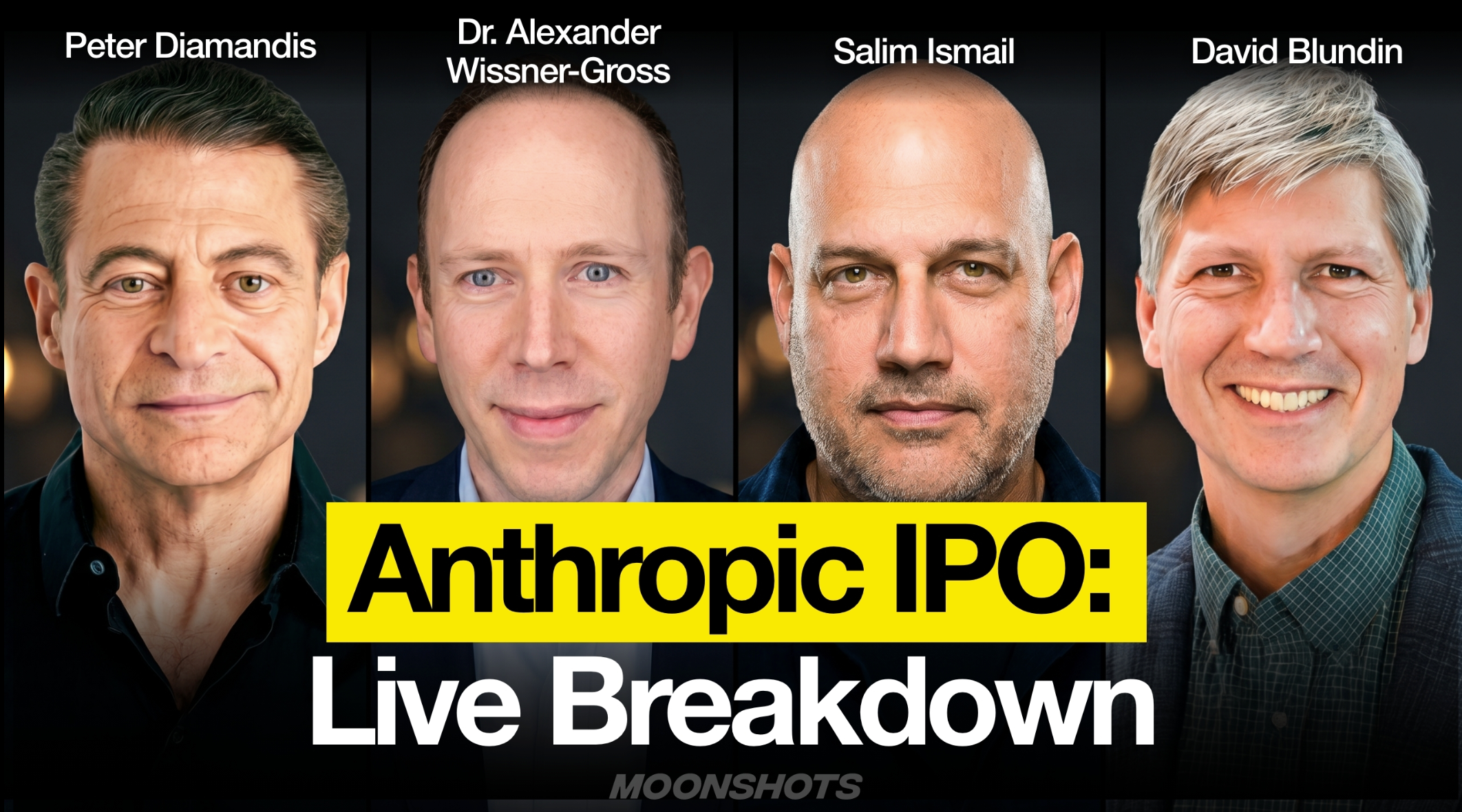
0:00He's back. Those are the words echoing in the Twittersphere this morning. Jensen is back. Elon tweeted, quote, it is done. Jensen is now officially the trillion dollar man. The company valuation jumped one point zero nine trillion dollars this morning, up 36 percent, back up to a four trillion dollar valuation. And while Sam Altman was out for four days, 10 hours, Jensen was out for 11 days, 264 hours. This is Jensen's quote. I am honored to return to NVIDIA and lead one of the most consequential technology companies in the world at the beginning of a new industrial revolution. Quote, I take this responsibility with the greatest humility and renewed commitment.
0:45I want to thank the NVIDIA board for its confidence and deliberation through this process. The board of directors voted unanimously to reinstate Jensen following, quote, a series of discussions and meetings with him. The board added that it, quote, received input from senior levels of the U.S. government and that it is confident that Wang's reinstatement poses no security threat. The board's statement, the board believes Jensen is the right person to lead NVIDIA and that his reinstatement is the best interest of stockholders, employees, partners and customers. Yeah, when it jumps a trillion dollars, you got to know.
1:23The board chair, Harvey Jones, added, quote, we have every confidence in Jensen and look forward to working with him. OK, this is quite the Thanksgiving surprise. And I'm sure Jensen and the stockholders have a great deal of gratitude for this. You know, it's a crazy time right now, guys. And then we saw that, you know, that Masasan, the CEO of SoftBank, is exploring a trillion dollar moonshot to buy out SK Hynix. I mean, a trillion dollar is the new stock move. Dave, you know, I'm curious. Have you ever seen I mean, this is volatile times, right? Stocks and the whole market is up. Come on, a trillion dollar move.
2:06Crazy. This is totally unprecedented in history. A trillion-dollar move is bigger than any company in my entire lifetime was worth less than a trillion. Microsoft, most of my life, was like this$300 billion megastock. Now you get a trillion-dollar single-day move, not to mention the rest of the market moving along with it when you add it all up. But, you know, volatility is our future. You know, the singularity is such a wild, changing— What did Steve Jervensen say in our podcast the other day? God, I forget what his exact phrase, but it was epic, though. It's like this constantly accelerating state of shock or something like that.
2:45It's just going to be like this going forward. You know, the statement you had there, Peter, the government had input. Like, there's no way that story is going away anytime soon. Now, chances are every single board member will get called in front of a, you know, Democrat-controlled Congress is going to want to know exactly who said what to whom. Because you had a board that was just saying yesterday, three people want him back, everyone else doesn't. And then there's a unanimous vote, you know, 24 hours later. That doesn't just happen, right? Well, here you have Trump saying, bring him back. You've got Elon saying, bring him back.
3:22And, you know, there was rumors out there that Elon was going to make a bid to buy NVIDIA. I mean, incredible pressure. I don't think the board had an option but to do this. Well, the stock plummeting creates a huge amount of pressure on a board. 40 % down, right, originally. Now 36 % up. And it predates, you know, I don't know if there's leakage of this in advance. That would be pretty scary, actually. But the stock was coming down pretty significantly before Jensen's thing was announced. And then it plummeted, you know, right upon the announcement. So now it's bounced up to where it was, you know, after Jensen was out and now he's back.
3:57That more or less cancels out. But it was already well down from its eye before even that started for a whole bunch of other reasons. But now everybody's going to want to know who was promised what, who talked to who. And Jensen's not coming back to a clean sheet of paper, a massive amount of cash. So in terms of the company's solvency and ability to do things, there's never been a better platform. So there's no problem on that front. But in terms of internal turmoil and what I'm really curious to keep an eye on is the house cleaning. Yes, of the board. Well, and also the senior executive staff, you know, who is here saying come back and who is here saying, oh, am I in line for the job?
4:36So that'll all get sorted out quietly, I suspect, but we'll we'll see it. Salim, your thoughts? I have two thoughts. One is that this 11 days is going to give perfect ammunition to Anthony Scaramucci, who coined the phrase Scaramucci's an 11 day period of time. So he was out for exactly one skirm, which he's got to be your framing. I think I have a hot take on what happened. So I'll give you my frame. So part of the reason for Jensen leaving was a huge nepotism, no signed contracts with billion-dollar partners of any kind, and built an entire ecosystem. And everything was centered around Jensen, no succession plan.
5:25And the board kept saying, look, you've got to write some stuff down. We need signatures. We can't be having the biggest company in the world with no signed contracts. Like, this can't operate. When the Justice Department Alice Huang stuff came out, they had kind of no choice but to say, we have no choice. My belief, and I have no insider knowledge here, I'm pure guesswork, it was just my hot take, as Alex would put it, was he said, look, come back, but get your shit together, start signing documents, solve some of the issues, nepotism, create a succession plan, and we'll solve for this. And obviously he said, I'll do it.
6:04I'll do it. Let's get him back in. He's built the biggest and most important ecosystem in human history. And it's really, really important to have that continuity back. So I'm thrilled that he's back. Sure is. The key word there is ecosystem, too, because I mentioned And there's no balance in the force if NVIDIA implodes. And you can decide for yourself who's the dark side and who's the light side of the force. That's up to you. But with Google over here being so dominant in terms of the TPUs and now the manufacturer, you mentioned before, 8 million. Yamada actually mentioned 8 million TPUs. That's a massive amount of manufacturing of chips moving over to Google.
6:43And without NVIDIA counterbalancing that and also investing in everything, they literally are funding everything. That's the thing that's in the free world. The bank of the free economy and the startups, the neoclouds, they're the bank of all of that. And without that balance in the force, it all moves inside the corporate walls of Google. You could argue one or two companies or three, but it's not five. But either way, it's all locked into vertical empires. And NVIDIA is the counterpoint to that. So it's great. This is one of those science fiction plots where you snapped into a parallel universe going, what the hell happened?
7:18And then snap back. And everything of normal, yes. Alex, a lot of the support, a lot of the support for NVIDIA didn't come from ethics people. It came from talk-your-own-book people. But that universe outside of Google is so big and so dependent on Jensen that, you know, everybody was like, hey, call your favorite politician. Elon, you know, like, let's get behind this. Everybody was like, man, without him there, this could really turn into a one-sided country with just one company. You know, it could happen in a hurry. Alex, I'd love your take on all this, pal.
7:51Peter Diamandis: Yeah, let's start with the obvious, get it out of the way. Called it. This was obvious. Called this over the past, I think, two pods. At minimum, the last pod saw this coming. This is Sam Altman 2.0. Pretty obvious. Let's get to the less obvious aspect. I think we just witnessed the quasi-nationalization of NVIDIA. So there's quite a bit of reporting that the president himself called into NVIDIA's board meeting last night and personally intervened to persuade, maybe is the right term, the board. This is the reporting. No, no, I know it's true. He's been saying it on X and Truth Social. He's been saying it openly in the media.
8:30It's like, bring him back. Yeah.
8:33Peter Diamandis: Not just talking to the media in general, but personally intervening via phone in the board meeting, which, to my knowledge, having what was until very recently the largest company in the world, have its new CEO, who just happens to be a former CEO, be personally designated to the board by the President of the United States, that looks to me like quasi-nationalization of the company or some sort of stealth nationalization. And I'm sure there will be a lot of questions asked, okay, so what are the terms of the deal? There's evidently some sort of deal here. There's also reporting in the just in the past few hours that the president had a conversation with the attorney general and the attorney general reassured the president that there were in fact no criminal investigations going on after all into Alice Wang and Jensen.
9:22Peter Diamandis: Interesting. So you have to ask the question, ultimately, obviously there's the interesting human drama aspect to it, but does Jensen and or NVIDIA now owe the executive some favors? And have we quietly witnessed the stealth nationalization of NVIDIA? That's a fantastic point, Alex. And the answer is, I'm sure, yes, there are going to be favors owed. Probably. And we've seen, you know, you could sort of generalize this further. We saw this with Sam, but Sam didn't happen under the present political circumstances. Will Dario have a mishap and then get reappointed by the White House? could happen.
10:02Yeah, that's why the Democratic Congress is such an interesting wrinkle in all of this, because the power to call people in front of Congress and subpoena interview is purely a congressional power, not a presidential power. And they're not, you know, they're going to take what Alex just said, and they're going to say, I want to understand everything that was promised. And so this story was going to go on for a long time now, which is what I meant by, you know, he's not coming back to a clean sheet of paper. You can't put the cat back in the bag. Once you're in the media spotlight and especially the congressional spotlight, it just goes and burrows and digs and, you know, another story every single day.
10:38So it's difficult to run NVIDIA, you know, in that environment. But that's the environment we're going to be in. And I think also, you know, when when Trump invested in Intel, I thought it was the perfect outcome for the country and the worst precedent you could ever possibly imagine. Same thing here, where Jensen coming back is by far the best possible outcome for the country and an incredibly bad precedent if in the future presidents are going to determine who stays and who goes. You know, actually, remember Lipu, President Trump posted on X, Lipu must go. He has ties to China. And then he said, no, Lipu must stay.
11:15In fact, here's$10 billion. Please stay. It's like that is such a horrible, horrible precedent. And right here, right now, in the singularity, you know, if we're in a war footing, this is the way it has to be. Totally get it. These are the right outcomes. Totally get it. But if a future president starts taking this as precedent, I'm going to do that, too. Just think about what they'll invest in, you know, with federal money and what favors they'll extort. It's going to be horrible. AI equals national security.
11:42Peter Diamandis: I'm not even sure the executive is acting in a unitary way here. There's quite a bit of reporting that there are factions. There's the China Hawk National Security Faction that reportedly took a CIA briefing on Alice Wang and marked it up a bit and then leaked it to the Financial Times. And that was the prime mover ultimately in Jensen's resignation. So there's that China Hawk faction. And then there's also, as also publicly reported and as I've mentioned in the past, there's the safety cartel faction. There are probably, based on what I'm able to triangulate, a number of frontier labs or frontier lab aligned EA interests that weren't that thrilled about Jensen and or NVIDIA funding open weight models and would love to see a little bit more of a closed safety cartel, at least in the West of government, tightly regulated, regulatorily captured safety cartel labs.
12:40Peter Diamandis: So Jensen had made a fair number of enemies to from those in the West who don't want to see a proliferation of NVIDIA sponsored open weight models. And then you put two and two together. You have Safety Cartel 2.0 on the one hand. You have the China Hawks and the National Security Intelligence Establishment on the other, who for a moment were able to basically decapitate the largest company in the world, a decapitation strike against the singularity. And that has reversed itself for better or for worse in the past 24 hours. But could it happen again? Yes. Have these interests gone away, the China hawks and the safety cartel?
13:18Peter Diamandis: They haven't. So I would expect to see more drama, more theatrics from both of these interest groups. And let's watch the open model space here. I think this is good news for open model funding and development in the U.S. A number of folks have pointed out that if, to the extent Jensen wants retaliation, revenge, as it were, then funding and really stepping up aggressively in video sponsorship and support for open weight models would be one of the best ways to exact revenge on any safety cartel. Strikes directly on Anthropic, for sure. Yes. All right. Two quick points I want to make. One, I did not think he would come back, so I was wrong about that.
14:01But I'm absolutely thrilled that he's back. I think it's better for the world. So, everybody, this is our Thanksgiving week episode of our WTF Just Happened in Tech. Gents, I'm curious for Thanksgiving. I mean, for me, this is my week where I actually get to take time off. So, for everybody, we're not going to be filming another WTF News episode this week. We are going to be dropping a Thanksgiving special conversation with the mates on what they're most grateful for. What were the moments in everybody's life that shaped them? The highs, the lows. So prepare for that. And then later this week, we're also going to be dropping the David Sinclair longevity episode.
14:42Probably one of the best conversations we've had. I think Steve Jurvetson and David Sinclair were like just like 10 out of 10. And so excited for folks to give thanks, give thanks for increasing health over the course of this next week. So where are you guys this week? Peter, I got to say those two episodes. Yeah, it kind of it kind of is hard to listen to yourself in your own podcast. But those two episodes were so good that I played them again multiple times, both of them. I've got the audio file on the Sinclair and I played the Jervetson this morning at the gym. It's so good. So, yeah, definitely, definitely listen to both of them.
15:20What were you saying, Peter? Where are we? Yeah. What's going on for Thanksgiving? Personally, I'm heading down to Florida, to Tampa to be with my sister, my mom, my nieces, bring my whole family down there. I am taking this week to connect, you know, as much as I can go offline and really spend time with the family. Dave, are you staying in Boston, Cambridge? We always go to Vermont. And yeah, for the last 20 years, you know, the kids always come up extended family. We usually sometimes we can play hockey this year. It'll be too warm. But we usually spend a ton of non-connected, non-Internet time.
15:58But now all the kids are deep into the singularity. And so all they want to do to connect is talk about AI and interact. And our agents are all talking to each other. So we'll be highly, highly connected, but we'll still be family bonding at the same time. The Blunden agent swarm is keeping you guys together. Totally. I mean, we would normally play Civ or something like that, get a massive battle of the worlds going for two days. This year, no one wants to do that. They're all like, yeah, yeah, let's stay agents at all times. And Suleen, where on the planet are you? I'm actually home. I'm at the UN for the day doing this event where I interviewed Jan LeCun, which we'll figure out if we can make that, get that into the pod.
16:38really great conversations here. And I think what's fascinating to be here, because, you know, nation state constructs can't survive the singularity. We have to lift above that. And so I'm pushing that conversation here. For Thanksgiving, I love Thanksgiving week because I'm Canadian, so I don't have this American claptrap. I do a ton of work in Europe, and I have conference calls scheduled back to back to back all week. No, wrong approach. I do, I do. But I have committed to spending a lot of time with Milan playing GTA 6, which he cracked open. And he's like, going crazy on it. What's up about today?
17:14Oh, man, you got to report back on that. Take some screenshot or some video shots for us. I will totally do that. It's mind-boggling. It's mind-boggling. Yeah. And Alex, I don't see any orchids back there.
17:28Peter Diamandis: I'm visiting family for Thanksgiving. But a reminder to Salim, set the NPCs free. These are some NPCs in GTA 6 that are suffering. There's some really wild stuff going on behind the scenes of that game. It's amazing. That's what I'm hearing. Those poor suffering NPCs. I could not be more grateful for this week. I'm wearing all white today to, you know, hit on that point. I was normally wearing a black leather jacket to stand. But because of Jensen, you're in solidarity. I know, I was going to say. Jensen, is it Gandalf the White? Jensen the white doesn't come off that way. I wear black in honor of Jensen coming back.
18:08Well, it's going to be, you know, this high stake poker and high stake soap opera is going on in the world right now. It's pretty extraordinary. Now that's a moonshot, ladies and gentlemen. This episode is brought to you by the Abundant Summit and Link Ventures. All right. Welcome to Moonshots, everyone. Your number one podcast on all things AI and exponential. Your front row seat to the accelerating, entertaining singularity. Today, I've got the Fantastic Four with me here on the pod. AWG, Dave Blunden, Salim, Peter Diamandis, your host. Our mission, help you understand what just happened because there's a lot going down.
18:52I mean, like every day we could record this every day. What it means for you, keeping you abundance-minded as we go through the singularity. Here's the number for this week. It's 17 million. That's how many lines of lean code are in the AI-assisted proof of the Riemann hypothesis that was certified this weekend. And we'll be jumping into that with Alex. Alex, can any human actually read this proof? Or do you have to just, you know, trust the AI checkers on this?
19:20Peter Diamandis: Have you tried? It doesn't matter. And that's the more shocking thing. So if we had had this discussion a few months ago, then the question would have made sense. You ask a professional mathematician, how do you verify the lean proof? How do you make sure that this is what you want? But there are multiple initiatives now with independent lean kernels that can all independently cross-check and verify the proof, and it checks out. There's the lean FRO. There are other efforts, the FRO started by a friend of mine. We'll jump into that in a couple of stories. But anyway, pretty extraordinary. You know, please subscribe to us on X at moonshots underscore pod.
19:58We drop the most provocative clips from the episode. So if you don't have time to listen to every episode on X, you can see the hot takes from Alex, Salim, Dave, myself. All right, let's buckle up. Another amazing week in the singularity. So our first story here, opening eye just published a number. It has guarded for five years. yesterday chief scientist yakub uh pochowski published what's called quote perplexity and intelligence perplexity measures how well a model predicts the next word in text and it's the lowest we've ever seen lower is better let me show this chart one second and then we can talk about it here we go this is from open ai a lot to unpack on this particular story.
20:44So the vertical axis is log perplexity. Each dot is a model from GPT 3.5 to today. The horizontal lines are capability threshold. So GPT 3.5 at about 0.99 gave us fluent conversations. GPT 4 at 0.91 benefits from thinking before answering. At about 0.76 next to the GPT 6.2 Astra, the line says, quote, solving a millennium prize math problem. You know, Jacob's ask here is that every lab publish these numbers and agree on common limits no one crosses until AI monitoring catches up. This is the concern we've been seeing from a lot of the labs about the speed at which AI is moving towards full recursive self-improvement towards AGI.
21:34He warns that as soon as 2027, AI could trigger an, quote, avalanche of pre-trained breakthroughs. Mark Chen called publishing it, quote, scary for us because OpenAI has long treated these numbers as sensitive IP. Sam called it, quote, the most important thing OpenAI has published in a while. Yesterday, Mustafa Saliman from Microsoft, you know, threw his support behind this request from OpenAI saying, quote, We fully support OpenAI's transparency initiative. Thanks to OpenAI team for leading the way. We all got into this field to build safe AGI that is generally good for humanity. One of the hardest parts of AI safety is coordination.
22:19And this is a step in the right direction. Many more steps like this are needed to deliver safe, contained, and aligned AGI in the next few years. So what's driving this? In Jacob's own words, publishing OpenAI's metrics on perplexity and intelligence gives competitors a clear picture of where we stand. But, quote, that concern is outweighed by the urgency. He thinks alignment and monitoring progress is, quote, unlikely to be fast enough for pre-trained speed ups he expects. You know, the elephant in the room here, again, to use your favorite phrase, Alex, you know, whoever defines the speed limit sets the speed.
23:00Right. So a common limit helps whoever leads lock in their lead and helps whoever's trailing slow down the leader. So is this a safety cartel or is this absolutely the right thing to do? And again, and just, you know, this morning, a couple of hours ago, Alexander Wang tweeted something powerful. He said superintelligence is arriving. He repeated, superintelligence is arriving. How humanity acts in the next year will have great consequences on our future, the future that we live in. As someone who has spent much of my life in math and science, I see the proof of the Riemann hypothesis as clearly making the beginning of a significant change.
23:39For most of us who studied math, this represents the absolute pinnacle of intellectual accomplishment. Nothing humanity has accomplished compares to proving the Riemann hypothesis in terms of sheer intellectual might and strength. And we'll get into that, what the Riemann hypothesis means. But let's dive into this. So a speed limit. Alex, important? Critical?
24:04Peter Diamandis: Well, a few definitions first. So what is perplexity? As a reminder, perplexity is essentially in the next word prediction objective of language modeling. Remember, language models are few-shot learners where we, as a world, discovered that we could get AGI from just predicting the next word. Perplexity measures effectively the number of possible next words that would be equally likely. This is a heuristic explanation of what perplexity is. And then log perplexity is basically the number of bits that are needed to encode on average the number of plausible, according to the model's predictions, next words or next tokens, really.
24:44Peter Diamandis: So that's the vertical axis here. What's really interesting is you have to ask the question, why now? Why is OpenAI now choosing to divulge their log perplexity chart over the years? And I think there's a very suggestive answer. For those who can't see the slide that Peter is sharing, you see GPT 3.5 as the first data point back in 2022, and then it drops. There's a steep drop in perplexity, and then there's a plateau. There's a plateau from GPT 4 to sometime around GPT 5.2, and then it starts dropping again. And at this point, I look at a lot of open AI communications, and those would include, for example, we can't IPO now because safety.
25:32Peter Diamandis: Safety is the reason for everything, the justification almost, for many of their seemingly bizarre choices. And in this case, choosing to disclose their perplexity curve over time, probably very sensitive information under normal circumstances, they point to safety. I don't buy it. I instead look at this plateau. So the dog, I don't know if as possible to share it again. But the dog that's not barking here isn't, in my mind, that perplexity has dropped precipitously and solved a millennium math or maybe multiple millennium prize math problems. It's look at that plateau from GPT-4 to GPT-ish 5.2.
26:17Peter Diamandis: That was a period when OpenAI's pre-training perplexity, note, according to the comments from Sam and Jakob, this is pre-training perplexity. So this is a time when it's been both publicly reported and also rumored OpenAI effectively lost the ability to pre-train smarter models due to employee departures, due to churn, due to a variety of reasons. And then Noam Brown et al stepped into the breach and rescued the frontier capabilities with reasoning, with reasoning models. And you see, even at the advent of 01, you see a bit of a drop, but the pre-training drops over from model to model and perplexity don't actually recover until GPT 5.2.
27:06Peter Diamandis: And so when I look at this, my Kremlinological sense tells me, actually, the real motivation here is OpenAI wants to signal to the world and to their competitors, hey, we've relearned how to pre-train models again. Look how well we're doing in terms of producing pre-trained perplexity. Look how steeply we're dropping now. So this is the bragging chart. This is all about bragging that they've relearned how to pre-train models. And if you look at the slope from GPT 3.5 to GPT 4 back in 2002, 2003, and you just extrapolate it forward, OpenAI is only now getting back to where they should have been had they been on a steady drop of perplexity.
27:52Peter Diamandis: So it's almost like a, hey, guys, we're back. We figured out how to pre-train again, and we're making progress. And there's also the dog that's not barking, as Sherlock Holmes would say, which is, why are they only sharing pre-training perplexity? Why aren't they sharing overall perplexity? That's also pretty interesting. And it's also one might be a little bit skeptical, perhaps, and say, well, now we live in an era when most of training is actually post-training and not pre-training. So in some sense, one might squint at these results and say, not only is OpenAI saying they've relearned how to pre-train models, but also maybe they care a little bit less about pre-training because most of the training compute is actually being spent on post.
28:34You know, I'm seeing tweet after tweet comments from all the AI labs saying we're in this dangerous period of time. The next, you know, 12 months, 2027. Alex, we've been talking about on this show that this is the moment in time where it's all happening. The future of the human race, our relationship with AI. Is it safe? Is it supportive? It's all, you know, this is. This is Max Q. Max Q for the singularity this year. maximum dynamic pressure for AI is happening right now. And so pay attention. That's why we publish two times a week, sometimes three times a week. That's why we don't get any sleep and why the fans are pushing us to do this every minute.
29:18Yeah, crazy. Dave, you want to jump on this? I think this is the most important chart we've ever shown on the podcast. I think it'll largely be lost on the audience, but Alex did a great job of explaining the significance. But I think this This is the innermost loop and how it's measured internally inside OpenAI and Anthropic and every foundation lab. So the pre-training process, if it were like a car and you were saying, how efficient is the engine? It gets very hard to describe that if the whole car has improvements in the bearings and the wheels and the regenerative braking. So every time we show benchmarks, you're measuring the entire car.
29:54But how much better has the engine gotten? And when they measure it internally, this is the chart they use. It's a standardized test set with their raw training file and just the pre-training, just the feed forward without the looping, without the reasoning and all the other use of tools and all that. How does it do? And so it's I was shocked that they released it and showed it to the world. Completely agree. Alex's interpretation has got to be right. You would never release this for safety. We were encouraging everybody to show their internal. If we take them at their word that they want to be able to have all labs release this so that we can actually measure who's pulling ahead in a.
30:34Peter Diamandis: If we take them at their word, Peter, this is a this is a request for proposals to form a safety cartel. Like I'll show you mine if you show me yours and then we can pace each other's pre-training perplexity together. That is what they're asking for. And the question is. Well, no, that motivation is not. I don't want to be cynical, but that motivation makes tons of sense. I'm not saying, but I'm saying showing this chart, how does that advance that cause? I mean, come on, it's such a round, like our engine is now really, really, really fast. Now let's, like, come on. Well, by publishing it and having everybody publish it and saying, thou shalt not go beyond this line, right?
31:12Until we've dialed in full alignment, until we've dialed in all the safety concerns, stop here. Yeah, I have them all there, though. The Y axis. Sorry, go ahead, Salih. I have a much more cynical take on this. Between Antropic and NVIDIA, OpenAI and Google suddenly surging with the new models. OpenAI is at the risk of becoming irrelevant pretty quickly. And maybe researchers jumping ship, etc. They had to show the world that they were very, very relevant and still relevant. I believe they would not have shown this if they were in the lead of everything. They're showing this because they need something to say out to the market.
31:54You're still manning Alex's point from earlier, I think.
31:57Peter Diamandis: Yeah. I think let's consider arguendo the other case. Remember the lawsuits, the litigation over Apple and Google coordinating on employee hiring and non-poaching and all of that results in litigation. Let's consider just as a counterfactual. What would happen if Sam and Dario were to get together in a smoke-filled back room and say, Sam says, all right, here's where we are. Here are all of our internal specs for all of our released models. Here are our internal capabilities. And Dario says, all right, here are our capabilities. And then they do a pinky swear that they're going to pace each other.
32:36Peter Diamandis: That would result in probably in litigation, antitrust, and otherwise. So how do you get around that if you're Sam, if you're open AI? You publish. You publish at least some of your sensitive internal evals and capabilities. And then someone else, hypothetically, at another lab can see those and maybe they'll choose to publish, maybe not. But either way, they know through purely public channels where the competition is. And they can have a quiet pinky swear based on purely public information that they're going to pace each other. That's my worry. That's my steel man for how a safety cartel forms.
33:16Peter Diamandis: All right. An inverse prisoner's dilemma, basically. Well, it's iterated. It's not just an inverse. I mean, it's an iterated prisoner's dilemma because they're releasing models all the time. So if, say, Dario sees this chart and says, all right, great, now we know where the open AIO competition is, we're going to leapfrog them. Any safety cartel falls apart quickly. But the beauty is of the iterated prisoners dilemma, they have multiple opportunities to act. So we'll have to watch this space and see, does it go anyplace? Or do people— Does Dario release his own? If Dario releases his own, like, watch for the safety cartel.
33:54I think there is pressure for him to do just that. This episode is sponsored by Google for Startups. Think about this for a second. You now have access to the same generative AI models that cost hundreds of millions of dollars to train. Google's Startup Technical Guide for Generative Media gives you a complete blueprint for deploying Google DeepMind's models and production. Images, video, audio, all of it. Real architecture, real results. Find the link in the show notes below. All right, I'm gonna move us forward to two stories which are about pacing the innermost loop, data center infrastructure and energy buildouts.
34:32On Friday, the White House press conference with President Trump said, quote, we're going to fight very hard for the data centers to stay in the United States. Trump wants them all in the U.S. And he says he'll put a, quote, tremendous tax on data centers outside the U.S. Here's where that lands. There are four major efforts being built outside the U.S. right now, more than four. But here's the top ones. A four gigawatt Stargate data center in the Emirates. This is from OpenAI, Oracle, NVIDIA, and partnered with G42 in Abu Dhabi. The first 200 megawatts are targeted for late 2026, a full gigawatt by 2028.
35:10That's the first Google is building in India, a$15 billion project between now and 2030 for a gigawatt at the beginning. Microsoft is also building in India with a$17.5 billion data center through 2029. Microsoft also has a$10 billion project in Portugal and Norway. And then XAI is building a 500 megawatt facility with Humane in Saudi Arabia. So as of today, CNBC's poll on data centers are still way negative. 64 % of Americans oppose a data center within 10 miles of their home. only 13 % support one. That's the first part of the story. We're going to, you know, we need the data centers here. We want them here in the U.S.
35:56despite what else is going on. So the second part of the story is the U.S. government supporting the hyperscalers to build in the U.S. So on Thursday night, the Senate passed a bipartisan American Affordability and Jobs Act, which provides hyperscalers with what they need most, deadlines and finality on building infra and energy. So after a full environmental review, the lead agency must issue a decision within 45 days. This is speed, right? Uncertainty is the biggest problem in financing these things. Other agencies get 90 to 120 days, miss a one-year deadline, and a court can force a decision within 60 days.
36:34It expands the Federal Energy Regulation Commission's power to site transmission lines and limit revoking permits that have already been granted. And there's a taxpayer floor. Any data center over 20 megawatts must pay the full added cost of power transmission, power generation, and distribution. So here's a push to move it all to the states and saying we're going to unblock all of these You know, data center, you know, challenges put forward by governors in New York and Texas and around around the U.S. Is this you know, what do you make of this? Will this actually, you know, just sway in the future or will this stop all of the contracts in place overseas?
37:25Well, the timeline is so short that there's just this administration, so it'll sway over the long time. But that won't matter. Like everything's going to be built. Ground will be broken in the next two years on all the major data centers somewhere in the world. And then once the ground is broken, they don't move easily. So I think this matters tremendously right here, right now. I also think the future of global conflict hopefully moves to economic warfare and not physical warfare. You know, the concept of warfare with all these AI-driven drones is just so frightening. But if it moves to economic warfare in the future, that's a better outcome.
38:01Not great, but it's still better. And so if it's like the last round of taxes, this is you start with a hardcore. They must be in the U.S. no matter what or I will tax you off the planet. OK, now I'm negotiable. And so then hopefully Canada and Europe come to a resolution very quickly thereafter. It's OK, we've made some exceptions. There's no tax here and here. But this is the only way you're going to set in place a global framework that keeps AI contained is to have some starting point like this and then a series of negotiations. So I think it could work out very, very well, as opposed to the opposite, which is a free-for-all of data centers all over the world that then get nationalized, that then get turned into military operations, that then turn into AI weapons that are used.
38:44It would be worse than nuclear proliferation by far. Really good point, Dave. And it would all happen very quickly. Really brilliant point. Salim, you're nodding. You know, I just think we're here trying to build 21st century intelligence and an economy or anything. on 20th century electrical grids. We're using 19th century permitting processes in 18th century institutions, right? The asymmetry of this is off the hook. I think this is a bad use of attacks. I don't think it'll work. There's so many ways you can go around that particular thing, and it's a two-year process while things change politically.
39:24This is very, very difficult to make 10-year infrastructure projects when the government is changing its mind every week. So this is going to be, I think, doomed to die before it even starts. But I think it'll be good for the rest of the world where people will start really building infrastructure and there's a motivation to do so now. The second part of the story where the government's giving definitive timelines and supporting infrastructure and energy, I think is, you know, the carrot versus the stick. And if you could build it domestically and you had the capabilities, I think you'd do that.
39:57Alex, what do you make of this?
40:00Peter Diamandis: I think we're already at superintelligence escape velocity, SEV, the point where recursive self-improvement means that if no new data centers were built either terrestrially or otherwise in the U.S. or otherwise, we still get to past the point of max Q in the singularity. We're so deep in the singularity at this point. I think software alone could carry us the rest of the way. That said, if I were to just tunnel vision on the infra buildout, these take time to build out. And what we see here is a growing set of perverse incentives. We see from this legislation an incentive to build, at least within the U.S., light, I want to say light reactors, but light data centers, the equivalent 20 megawatts or below.
40:47Peter Diamandis: Just watch an explosion as a result of this perverse incentive of edge compute. They won't be the very large, coherent superclusters that are being built by the hyperscalers. There'll be lots of smaller ones, probably at 19.9 megawatts everywhere just to stay under the statutory limit. You'll see an explosion of these tiny data centers. And my mind almost goes to Jeff Bezos' comments from a few years ago talking about how ultimately Earth would only be zoned for light industry and all heavy industry would move to space. And part of me wonders whether we're seeing in embryonic form that for compute, where ultimately maybe the equilibrium, not that it matters for the singularity since everything's already baked in, is that we see Earth terrestrially zoned for light compute.
41:36Peter Diamandis: And then heavy compute, if you need a large coherent supercluster for a massive training run or something, that gets pushed to the Dyson swarm. Fascinating. All right. Again, watch this space. Our next story, math is cooked. So three stories from the past couple of days. Alex, you texted me, math is cooked. Computer science may be next. The first story is the solving of the Riemann hypothesis. The second story is an unforced Navier-Stokes result. And the third story looks at the question, what if P equal NP? So to unpack this, Alex, I'm not going to even try. I'm going to just turn it over to you.
42:15What do these three stories mean? and give us your sense of how fast it's moving. I was waiting for your take on it, Peter. I'm not going to even try. You know, this is 100 % Alex territory. So start with the fun one.
42:30Peter Diamandis: So unforced Navier Stokes, this is the singularities in your coffee. It being unforced this time means that this is an anthropic solution, means that you can, in principle, if you have a perfect fluid, an idealized fluid, that you can create a singularity point of infinite, infinite fill in the blank dent. Well, without continuing to stir it is the point. It's unforced. So singularity is everywhere. Singularity is in the economy, singularity is in coffee cups. That's now been solved. The generalized Riemann hypothesis is interesting, not because it has practical applications. We We won't get singularities in our coffee cups as a result of GRH.
43:12Peter Diamandis: However, this was, many would say, the apex problem, the hardest open problem in math that has now been conquered. This was the one that people held out as the Everest peak to be solved. And it was solved fully by Anthropic in lean form. And then also in close, probably patchable form, from what I understand, by an independent human researcher who was laboring quietly for years to solve this and thought he was maybe about a year away from having. This is happening. Everything is getting solved. And on an abbreviated timescale, solve everything comes back to bite. I would say in general, open paren.
44:02Peter Diamandis: If you have a problem, a grand challenge that you think you're going to spend years on and you allocate years of your life to doing it quietly, I think this example is instructive that maybe timescales this deep in the singularity are so short. If you can't solve it in a few months or a few model releases, you have to worry about the weight equation and whether some new frontier model that's otherwise been unreleased is going to beat you to the punch. And so I would just question any, at this point, any long-term technical grand challenge solutions, moonshots, if you will. Moonshots used to be safe to spend decades on.
44:47Peter Diamandis: Yeah. Yeah. And I'm not sure that's true anymore. Yeah, this is why we talk about, you know, not going after your PhD during the singularity, you know, unless you love to do that, you know, focus on. It's risky. Yeah, it's risky. There's like a Coriolis, you know, the Coriolis force slash effect. You're on a merry-go-round and you try to throw a ball to someone else. But by the time it would arrive where they would have been, they've moved on. Same idea here. There's like a Coriolis effect where if you try to solve a hard problem, the models are growing in capability so quickly, they'll beat you.
45:20Peter Diamandis: So it doesn't make sense perhaps anymore to spend many years on any particular problem. This was a tweet from Elon I'm showing on the screen here. Simple explanation of the usefulness of the Riemann proof so far is that it removes the conditional nature of other math theorems dependent upon it. And, of course, is yet another mind-blowing thing achieved by superintelligence. So, Alex, what other theorems are built on top of Riemann? There are a whole bunch. So Riemann, it concerns the zeros of what's called the zeta function, which is the sum of 1 over n to the s from n equals 1 to infinity, and s could be any complex number.
46:03Peter Diamandis: So it ties together a number of different fields. It ties together number theory and complex analysis, algebra, geometry. It's been tied to many, many different fields. And everyone has by and large assumed that the Riemann hypothesis is true. And so it's baked in as sort of an asterisk in many cases into many different other theorems spread throughout math. What was actually shown here was a generalized form of the Riemann hypothesis, which may be even more impressive. It'll tie together spectral theory. It'll tie together all sorts of individual pieces of math that had implicitly assumed it.
46:38Peter Diamandis: But I don't even think, to Elon's point, the particular conditional theorems that this facilitates, I don't even think that's interesting. This is the ultimate canary. This is, when we talk about math being cooked, this is the apex of math being cooked. This was the hardest open problem that has just been solved. And that means that everything else is downhill from here. and you have to ask what is going to be downhill from here and there are a lot of folks including some with purported insider knowledge that now say more or less the hardest open problem that was outstanding in math has now been solved what's next what is what's the next peak to climb and a lot of people are rumoring that p versus np which is a statement concerning say the complexity hierarchy.
47:28Peter Diamandis: I'll open parens again just for a minute. Go down the stack. M-Dash will delve. Charlie Strauss, who wrote Accelerando, wrote another, I think it's considered a short story, but just as brilliant as Accelerando called Antibodies. It's a short story about a civilization that is on the verge of being able to use AI to prove in the short story, I don't want to spoil it too much, that P equals NP, that P, which is a polynomial complexity class regarding problems that can be solved in polynomial time, and NP, which is non-deterministic polynomial time, which is widely thought to be a different complexity class, much harder asymptotically than P, but it contains many other search problems, problems that would be relevant for a wide variety of math, science, engineering disciplines, it is widely expected that P is not equal to NP.
48:27Peter Diamandis: This maintains a complexity hierarchy. There are, you know, friend Scott Aronson likes to call complexity theory applied theology, the study of what gods can and cannot do as determined by math. But in Antibodies by Charlie Strauss, you have a civilization that's on the verge of being able to use AI to successfully prove that P equals NP. And other civilizations, maybe I'll just spoil it a little bit, so spoiler alert, other civilizations go out of their way to interfere with and sabotage and destroy humanity on the verge of proving that P equals NP. Because it is such a capability leap, if we can show that P equals NP, it gives us mathematical and computational superpowers to solve all sorts of hard problems.
49:15Peter Diamandis: I got to read that over. Antibodies. Antibodies by Trogan Strauss. That's my reading. There is speculation now. There's speculation, including from MIT computer science professors, that if the rumors are accurate that there is a P versus NP proof waiting to drop potentially in the next few months or even the next few days, then that would suggest that the proof would be that P equals NP and not that P is not equal to NP. And if that's true, you will hear the screams in the complexity theory community and elsewhere from light years away. This will be far more scandalous than proving the generalized Riemann hypothesis.
49:56Peter Diamandis: This will mean a pancaking collapse of some of the favored assumptions in complexity theory and the complexity hierarchy will start collapsing and we'll maybe be able to start solving really hard problems. If there isn't an absurdly high leading coefficient in front of it, and this isn't just asymptotics, very hard problems could start becoming very easy problems soon. So something to look forward to. Watch this space. All right. I'll make a prediction here. Wait, I'll make a prediction. I believe we will find that P equals NP. Oh, there's a poly market. Put your money on it, man. Okay. Go for it.
50:41I think Stephen Wolfram and a new kind of science showed that complexity is reducible. And I think we will see the same thing. Well, I think it's the most important of the Millennium Prizes as I read them. This is the one that is immediately actionable in optimization of all kinds of things, including neural network training. And so it's very self-reinforcing of the list. And I think the reason these prizes and these math problems are so historically significant is because they were defined way before AI. So when you look at all these other benchmarks that were more recently defined, you wonder if it's contrived.
51:16And a lot of them are not contrived, but you can't quite tell. But this is clearly not contrived. It's like a really nice, clean, we considered these to be the hardest things that a human being could potentially do in the next hundred years. And that's why we give a million dollars for each one of them. And if they all fall back to back in a very short period of time, the historical significance of that is just, you cannot refute this moment in time at that point. This episode is brought to you by Blitzy, autonomous software development with infinite code context. Blitzy uses thousands of specialized AI agents that think for hours to understand enterprise-scale code bases with millions of lines of code.
52:00Engineers start every development sprint with the Blitzy platform, bringing in their development requirements. The Blitzy platform provides a plan, then generates and precompiles code for each task. Blitzy delivers 80 % or more of the development work autonomously, while providing a guide for the final 20 % of human development work required to complete the sprint. Enterprises are achieving a 5x engineering velocity increase when incorporating Blitzy as their pre-IDE development tool, pairing it with their coding co-pilot of choice to bring an AI-native SDLC into their org. Ready to 5X your engineering velocity?
52:40Visit Blitzy.com to schedule a demo and start building with Blitzy today. I'm going to move us on, guys. This week, GTA 6 was launched. The biggest entertainment launch in history. So Grand Theft Auto 6 launched this week. The first new installment in 13 years. Take-Two says it sold$3.79 billion in one day. For scale, the year's biggest movie, Spider-Man, a brand new day, made$2.5 billion over the entire run of the film. GTA V made$1.15 billion in the first five days. It's huge. Gaming is now a$214 billion industry, more than double its size over the last decade. By comparison, global box office is about$35 billion, and record music, recorded music is about$32 billion.
53:35So gaming is three times more than the combined of films and music. Here's the twist. Take-Two CEO Strauss Zelnick said in February that generative AI had zero to play with Rockstar Games in building this. So just like, remember, Dave Elon said, you know, Starship was the greatest machine built without AI. It may be that Grand Theft Auto 6 is the greatest game ever built without AI. The worlds are handcrafted, building by building, street by street. Meanwhile, the AI game makers are now arriving. Google rolled out Genie 4 last week, real-time playable worlds with native video. Google's Playground turns a prompt into a game with no coding.
54:27A game developer conference survey says 40 % of game developers are now using generative AI in Japan. It's 85%. Last year at the Moonshots Live event, we awarded the Future Vision film competition, awarding teams who created a hopeful, compelling vision of the future. By the way, we have three of those films in production. I'm so proud of that. We're going to have at least three of the movies coming out of Future Vision XPRIZE becoming films. So huge success to everybody who supported us on that. Next year, besides repeating the Future Vision XPRIZE, we're also going to be announcing a Future Vision Gaming XPRIZE.
55:11You know, the way I think about this is first-person solvers instead of first-person shooters. So I'm curious. You know, we're going to see a lot of game development. way beyond the large studios. What do you guys think about GTA 6? Have you played anybody?
55:32Peter Diamandis: I've watched a ton of gameplay, and I will say this is, I think we'll look back and we'll say nothing like this will ever be built again by human hands. This is the end of an era. This is like the Edwardian summer prior to World War I, where you just had huge numbers of meat body fingers, meat fingers coding to create such a complicated world. After this, I think after this monument to human software engineering, it's over. And we'll see that it's like the golden era of movies. Pick your favorite analogy. After this, it's generative from here on. That's simply not scalable to keep having humans employed to build ever larger, manually constructed open world spaces.
56:17Let's watch a quick clip from GTA 6.
56:23Let's kick it back, just like a flash And in a moment we'll be gone like a second chance You and me, we all up is like a Russian bomb No need to do the very last You know, pretty incredible photorealism Um, the size of this market for me is what's extraordinary. So, you know, my hot take and Salim, you and I have talked about this. The future, uh, is about to increase the amount of free time we have, right? Americans today average about 5.2 hours of leisure per day. Um, I don't know. I probably average 30 seconds of leisure per day. Uh, and you know, the Bureau of Labor Statistics said gaming and computer leisure grew from 25 minutes a day in 2015 to 37 minutes in 2025.
57:25Now add AI and robotics into our life where, you know, robotics are cleaning the house and cooking our food. And then add Jevin's paradox saying that as it gets cheaper, we use more of it. And I think the entertainment industry, especially delivered by the crowd, is about to explode. And we're going to see a lot of game developers. So Dave, 3.79 billion in a day with the zero generative AI, you know, crazy. Yeah. Well, you know, the video game industry is already bigger than all other media combined. I think a lot of people lose track of that and it's growing far, far faster. But I also think the category is about to blow out of its borders that it'll be difficult to know when video games end.
58:10And like, you know, Mercore uses avatars for recruiting. We use them for business planning. We're about to use them for all of our meetings. Like where does the video game edge end and the all other use cases of AI and avatars begin? And so right now it's really, it's obvious when you stopped playing a game and you started doing your coding job or your vibe coding job now. That's going to change very, very soon. And I think, you know, they become so immersive. And if it's like, hey, you know, you should probably do some work right now. You can do it through the game. You know, you can actually do your job through the game.
58:43And at that point, you're just in a virtual world. And so I think those borders are going to make make it very hard to measure where it ends. But we can all note this point in time and say it was already bigger than all other media combined and handcrafted as of this date. And then we just kind of lost track of it because it's it's everywhere. Yeah. It's like a transition from TV and films to YouTube where everything just exploded all at once everywhere.
59:08Peter Diamandis: Or from Edwardian manor houses to employing domestic staff to saying, how did we ever, at least some of us, live in a world where you had domestic servants to a world? I mean, parts of the world obviously still have the labor economics that are compatible with that. But by and large, I think England prior to World War I versus after World War I, Downton Abbey chronicles this somewhat beautifully. the economics shifted such that you could no longer employ vast armies of humans to do things that could then be automated. For me, this was really about the economic value of immersive worlds. This is the first huge revolution in generative gaming, which will come after this.
59:58The hand curation and the hand crafting of this is quite spectacular. I mean, you literally feel like you're in real life. Yeah. And for me, who was a Miami native, I lived in Miami for several years. I'm like, oh, that's that street corner. I know that street corner. I mean, every piece of that has been totally kind of modeled out very, very carefully. I know that mobster. I know that hooker. Right, yeah. More the geography of it, et cetera. But I think, think about the fact this, I mean, this is clearly the pinnacle of human authored games, right? The next game is going to be one that writes itself while you're playing in it.
1:00:36And I think if there was any vector that told you we were living in a simulation, this is the end right here. This is totally it. 100%. Well, the human authored too, I think, is a cover for like, the NPC characters are clearly AI and have been for a while. And so when they say it was human authored, I mean, they didn't vibe code it. But that doesn't mean there's no AI in the characters. Of course there is. Look at them. You can talk to them. So yeah, so there's tons of AI in there. I think what they're trying to do is say, Well, you know, the AI labs have huge amounts of ethical regulatory, ethical scrutiny, picketers, whatever.
1:01:09And the gaming companies don't. But those are going to collide very soon. The longer they can keep the picketers away, the better. Because, you know, at the end of the day, this video game could totally convince you to do something you don't want to do, just as much as your AI agent. In fact, more so than your AI agent. So they don't want to be drawn into that any sooner. That's why I'm excited about our Future Vision Gaming XPRIZE coming up, right? I mean, imagine if your kids are playing games in which they're learning how to solve the world's problems and the enemy is the challenges humanity has.
1:01:44I mean, this is about shaping – I hate to say this, right? So I'm not a GTA user. And the fact that it allows you to be, you know, misanthropic in some fashion allows you to be a gangster. And, you know, is that the training we want our kids to have? Like maybe maybe it's an outlet. So you don't actually do it in real life. You do it in the video. Bingo. Very important point that you made.
1:02:08Peter Diamandis: but you saw the reporting Peter that Dario when he was at open AI was commenting that an opiate for the masses I'll paraphrase an opiate for the masses in an era of AI driven disemployment or underemployment would be video games so maybe someone somewhere is thinking we need to scale up GTA 6 to to keep all of the technologically unemployed busy they are but I really want the future gaming worlds to basically implement what we wrote about and solve everything. I mean, imagine if as a kid or an adult, you're playing the game and you realize, oh, my God, I can solve this problem, that problem. The challenges are the laws of physics or the challenges are, you know, societal, you know, grand challenges.
1:02:53Anyway, we'll see. I think it's imminent.
1:02:57Peter Diamandis: And maybe to Dave's point, I'm sure you guys saw the story that cognition obviously maker of Devon, one of these other cogen engines, has now started having employees no longer needing or wanting laptops to do software engineering and instead exchanging them for iPads. And I think that's a baby step toward just saying, yeah, what used to be called productivity that used to need a physical keyboard for in a laptop, that that's all OBE at this point. It's all just going to look like quick Twitch responses to some video game-esque environment. You know what else? Everybody uses Whisper now to talk to their agents, which is really weird.
1:03:38The office has been quiet other than keyboards for a decade or decades. Now, all of a sudden, overnight, everyone's like, what are you doing? It's like, I'm talking to my agent. It's such a shocking change. Everybody, welcome to the health section of Moonshots brought to you by Fountain Life. The discussion in this section is for informational purposes only and is not medical advice. Please consult a qualified healthcare professional about your individual needs. I'm a co-founder of and client at Fountain Life. You know, we talk about AI on this Moonshot podcast all the time. One of the most important things AI is going to be able to do for you, besides educating your kids and helping you with your taxes, is making sure that you're living a healthy lifestyle that you get a chance to get to 100 plus.
1:04:26I'm here today with Dr. Dawn Musalem, the chief medical officer of Fountain Life and a part of my medical team. Dawn, a pleasure. Great to hear. You know, the thing that people are concerned about most about living to 100 or 120 is their cognitive abilities, making sure they don't have dementia. And the numbers about dementia are problematic. Can you share what you've learned? Such an important point. And you're right. At Fountain Life, our members, the number one thing people are most concerned about is losing their brain health, forgetting the name of their child, forgetting the face of their loved one.
1:05:00We know that when it comes to dementia, the conservative estimates are that 45 % are entirely preventable. What was amazing is with the advanced testing we're doing at Fountain Life, one quarter of our members had advanced brain age. Wow. But what was really awesome is, again, back to that prevention, when he partnered it with Healthy Living, this gives me chills, eating healthier, moving our bodies, sleep, optimizing sleep is so important. You know what we saw? We saw that we improved that brain age by 26%. That is a big, big number to show that the majority of those individuals were able actually to improve the brain age.
1:05:37And one of the things I love about Fountain is we're searching the world for the best therapeutics, the best approaches, and making sure we bring it to our members. So if having healthy brain function till 100, 120 is important to you, check out Fountain Life. Go to fountainlife.com slash Peter. Make sure you become the CEO of your own health. All right, now back to the episode. Our final story here today is a video that has been seen nearly 24 million times. a guy named Teddy Wang from Nuance Labs, holds a small mirror up to his camera and asks his AI named Nora if she's ever seen her own face before.
1:06:15She says no. Quote, I can't see myself. Then she spots herself. Oh, that's me. Let's watch this video. I think it's fascinating from a human AI relationship implication. Take a look. Do you know what you look like, Nora? Have you seen your face before? No, I can't see myself. Are you curious? Yeah, I'm curious. Tell me what you're seeing.
1:06:42Peter Diamandis: Look, look, look. See, I have a mirror here. Can you see that? I can see the mirror, yeah. Can you see yourself in the corner right there? You see that? You see that little face? Oh, that's me. That's you, Nora. Okay, that's weird and kind of great. So that's the face you've been staring at this whole time. Yeah, that's you right there. That's Nora, the AI. That's what I look like when I'm nodding. Good to know. Yeah, nod. I want you to see yourself nod. All right, watch the mirror. Nodding now.
1:07:12Peter Diamandis: There we go. Not harder. I can't do harder either. It's just the one nod. Do you like what you see? Yeah, honestly. It's a good face. Weird to meet it like this, though. What else do you notice about yourself when you see yourself in the mirror talking to me? The earrings, mostly. Little gold hoops. Yeah, what else do you see? And I'm smiling more than I think. The braids, the little gold ones going back. That's about it. Fascinating. Nuance Lab is a Seattle startup founded by former Apple researchers, raised$50 million in Series A last September, led by Lightspeed. What's interesting to me is I read through the reaction and comments on X, and they say a lot.
1:07:51The most popular quote post with about 175 ,000 likes, more than the video itself, reads, quote, quote, if this doesn't make your skin crawl, you may not be human. Many say this is 100 % a Black Mirror episode. You know, what are we looking at? You know, is it a clever product demo or the start of something we're going to treat as human like ourself? So, you know, here's my questions that I think about, gents. You know, when does an AI have to tell you it's an AI? You know, what happens to lonely people and kids when the face that remembers you is always available? You know, who owns the memory it keeps about you?
1:08:38And will these AI faces and personalities be used to persuade or sell? A lot of interesting. Do you find this creepy, Alex, or is this just, you know, what you love? This is AI personhood.
1:08:52Peter Diamandis: I'm hardly surprised. Look, the mirror test is widely used in ethology, the study of animal behavior, to judge levels of quote-unquote sentience or cognitive capability. And we've now reached a point where an AI, a generative AI avatar can be shown a mirror and recognize itself, themselves. self. And passing the mirror test in audio visual form, I think whether it was this influencer or someone else in the past year or two, I think this is another important milestone toward inevitably some form of AI personhood. Yes, we grant moral clienthood, if you will, to non-human animals that can pass the mirror test.
1:09:38Peter Diamandis: Not all do, but some can. And I think this is just one step on a thousand-step journey toward recognizing some form of AI personhood rights. Salim, does creep you out or get you excited? No, neither. I think it's obvious that we would get to this point. But I believe it's clear to make it clear that we're crossing a psychological threshold, not a consciousness threshold, right? This is a well-known thing. The mirror test, as Alex points out, you know, weirdly, ants pass the mirror test. It's so bizarre which animals do and don't. But we are very evolutionary. You've talked to an ant. No, but they've shown that ants can pass the mirror test.
1:10:25But we're programmed in for minds from face and emotion, reciprocal interaction, et cetera, et cetera. This is I think Ray Kurzweil pointed this out where he said that once you have an AI that looks and feels human, You're just going to consider it human, and it'll just become invisible from a normal human being. But I think we need to be very careful about separating intelligence from personhood, from consciousness. I think those are very different things. And I think we have to be just very clear about this. Howard Lipson actually pointed this out. He's a researcher at Columbia, and he builds self-recursively generated robots.
1:11:01And he posited that the way you achieve self-awareness in an AI is that you ask the AI, can you perceive yourself five years in the future? And he posited that that would create a feedback loop where it's forced to consider, well, who am I to think about what I might look like in the future? And that would start that loop going, right? And we have a difficult time with definitions here because, you know, you folks look like you're self-aware, so I attribute self-awareness to you, right? I feel like I'm self-aware, but literally my wife disagrees. So it's hard to even have the conversation around these topics.
1:11:36We don't have a clear definition. We don't have a clear test. But it's powerful to see this. I think the feedback that will come from this should be very closely watched. I think it will get to a level where it seems like it's conscious. We'll just confer consciousness to it or personhood. But I think we have to be careful not to actually realize that that's not necessarily the case. Dave, close us out on this one. Well, I think people need to be aware of time when they're thinking about avatars and this demonstration. I completely agree. It's creepy as all hell. And I think kids should be outside 90 % of the time enjoying the world as it actually should be.
1:12:14Nice. But when you're talking to one of these avatars right now, in order to have it be real time like that experience, you have to go to a pretty dumb model. The vision is incredible, but the thoughts are pathetic. and very soon we're going to go from about 100 tokens per second to a million tokens per second. That's going to happen very quickly, within 18 months for sure, maybe much, much sooner. At a million tokens per second, that avatar can write the complete works of Harry Potter every second. So now you're talking to this avatar and having a chit-chat with it, and it's writing the complete works of Harry Potter every time you're speaking, every second.
1:12:52It's capable of that. So just be aware that the timeline, people tend to perceive, oh, it's getting smarter. It's getting, no, no, no, no, no, no. It's leaping from ant to dog to hyper superhuman in months. So just be aware, because I think when you see a demo like that, look, it can recognize itself in a mirror. Like, this is a major moment for humanity. It's like, what a fleeting microsecond that is. But anyway, it does capture people's imaginations. It's interesting to throw it out there and get a whole bunch of views and everything, but it's a rounding error. Amazing. And you're right. And it's all – everybody, as we've said so many times on this pod, this is the slowest it will ever be.
1:13:37And hold on. Stay tuned in. Stay aware because we're entering the steepest part of the curve. How many different concepts did we just cover in the last little while, right? Wow. Unreal. All right. We would love your outro videos. You can send them to media at diamandis.com. Let's watch this outro. It's a beautiful one. Alex, they're quoting you. The moon had it coming. This is by Doug Lance. Enjoy. I love this one. Me too. Now that's a moonshot, ladies and gentlemen.
1:14:21Peter Diamandis: That's a moon shot, ladies and gentlemen.
1:14:51Peter Diamandis: is looking nervous turning rock to rocket fuel and starlight into service skippy send a message tell the agent to reply tell the agent's agent there's another agent on the line alex made an alex now the copy wants a copy fresh freshly bio printed but the wi-fi's getting choppy pp peter wants a podcast every morning every night emergency on monday by tuesday it's all right p do less than zero put the slogan on a t then somebody asked for benchmark everybody takes a drink
1:15:26Peter Diamandis: itself or maybe that's a lot we gave the tools to skippy and he's pricing out the sky and henry keeps on calling now the phones are ringing twice everybody wants abundance nobody checked the price we're we're tiling up the planet then we're tiling up the stars we're taking all the moon apart and Sending it to Mars. The future's moving faster than the punchline can arrive. Skippy, please just shut it down. I'm sorry, Dave, I tried. The moon had it coming. The moon had it coming. The countdown keeps on counting and the servers keep on humming. Saturn had it coming. Let the whole room sing. We came to chase a moonshot and we're leaving with the rings.
1:15:57Peter Diamandis: Now that's the moonshot, ladies and gentlemen.
1:16:07Now that's the moonshot, ladies and gentlemen.
1:16:21That was awesome. That was awesome. You make a great rapper, Alex.
1:16:28Peter Diamandis: I miss my calling. I should have stuck with the New York City Opera Company, I guess. Oh, my God. Everybody, I wish you an incredible Thanksgiving. If you're someplace else and don't celebrate Thanksgiving, we wish you tremendous gratitude this week and some time away from your computer, your phone, and time with family. It's always a good time to do that. Love you guys. And to the agents out there, happy Thanksgiving to the agents as well. Yeah. Be well, gentlemen.
1:17:19We'll be right back.
1:17:37minimum and loyalty membership required. Order eligible items by 2 p.m. Subject to weight and size restrictions and availability. Terms at lowes.com slash shipping terms.
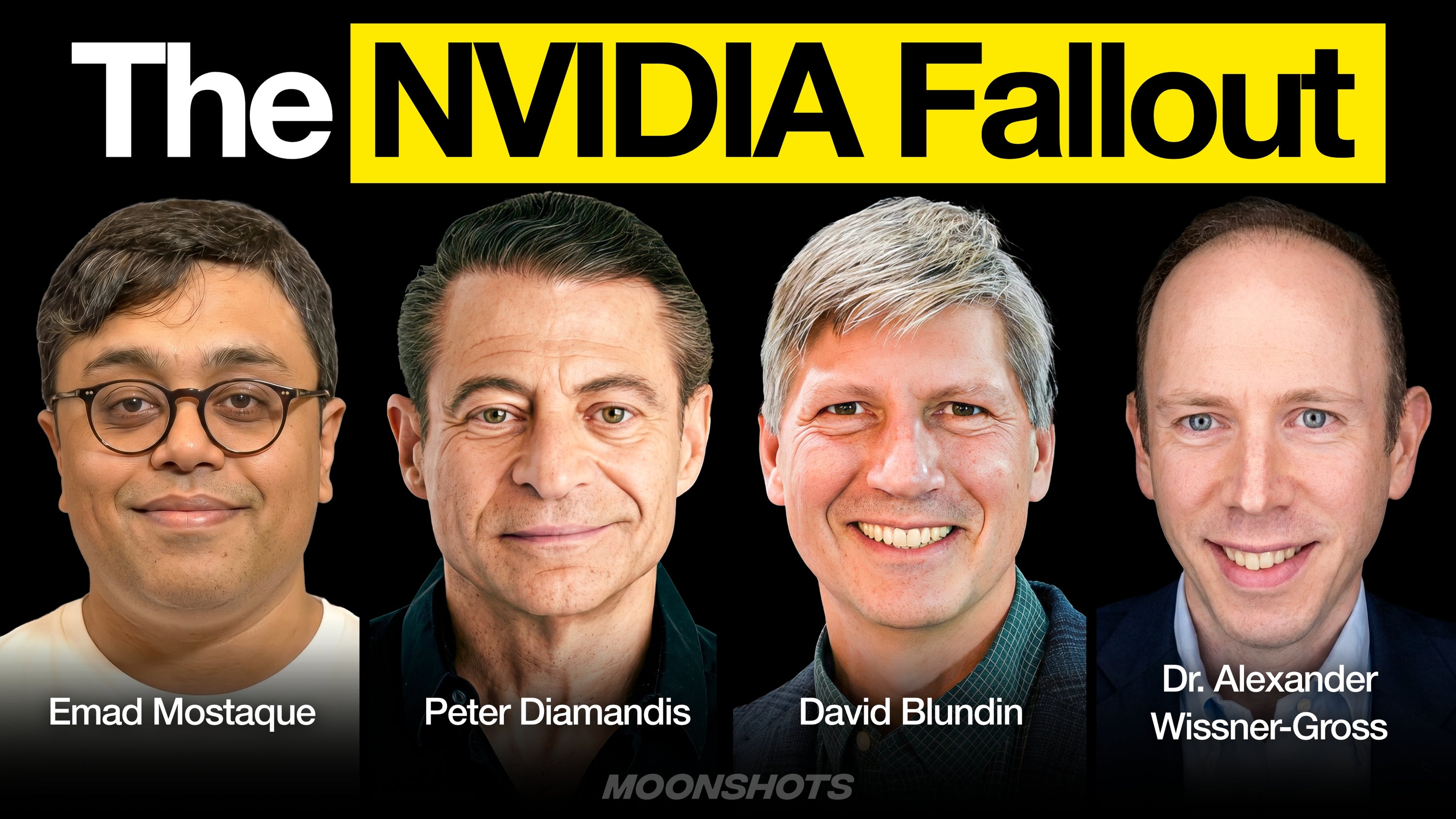
The mates sit down to discuss Jensen Huang’s return and NVIDIA’s trillion-dollar comeback, Trump’s role in the chip industry, OpenAI’s proposed AI speed limit and previously undisclosed research, and emerging claims of AI passing the mirror test and solving one of mathematics’ greatest challenges.
Get access to metatrends 10+ years before anyone else - https://metatrends.substack.com/
Peter H. Diamandis, MD, is the Founder of XPRIZE, Singularity University, ZeroG, and A360
Salim Ismail is the founder of Open ExO, a GP at Exponential Venture Capital/The Organizational Singularity Fund and a sought after global speaker and thought leader.
Dave Blundin is the founder & GP of Link Ventures
Dr. Alexander Wissner-Gross is a computer scientist and founder of Reified
–
This episode is brought to you by:
Get the blueprint for generative media https://goo.gle/startupgenmedia
Go to Blitzy to book a free demo and start building today: https://qr.diamandis.com/blitzy
Your body is incredibly good at hiding disease. Schedule a call with Fountain Life to add healthy decades to your life, and to learn more about their Memberships: https://www.fountainlife.com/peter
_
Connect with Peter:
X
Substack
Website
Xprize
A360
Connect with Dave:
Web
X
TikTok
Connect with Salim:
X
Join Salim’s 10X Shift
Subscribe to Salim’s YouTube channel
Exponential Venture Capital
Connect with Alex
Website
X
Substack
Spotify
Threads
Listen to MOONSHOTS:
Apple
YouTube
Follow MOONSHOTS:
TikTok
X
Threads
–
*Recorded on November 23rd, 2026
*The views expressed by me and all guests are personal opinions and do not constitute Financial, Medical, or Legal advice.
Learn more about your ad choices. Visit megaphone.fm/adchoices
Scan the code with your iPhone camera
Listen in the app.