Ask ChatGPT

 Newcomer Pod
2 Oct 2026 · 53m · 24 chapters
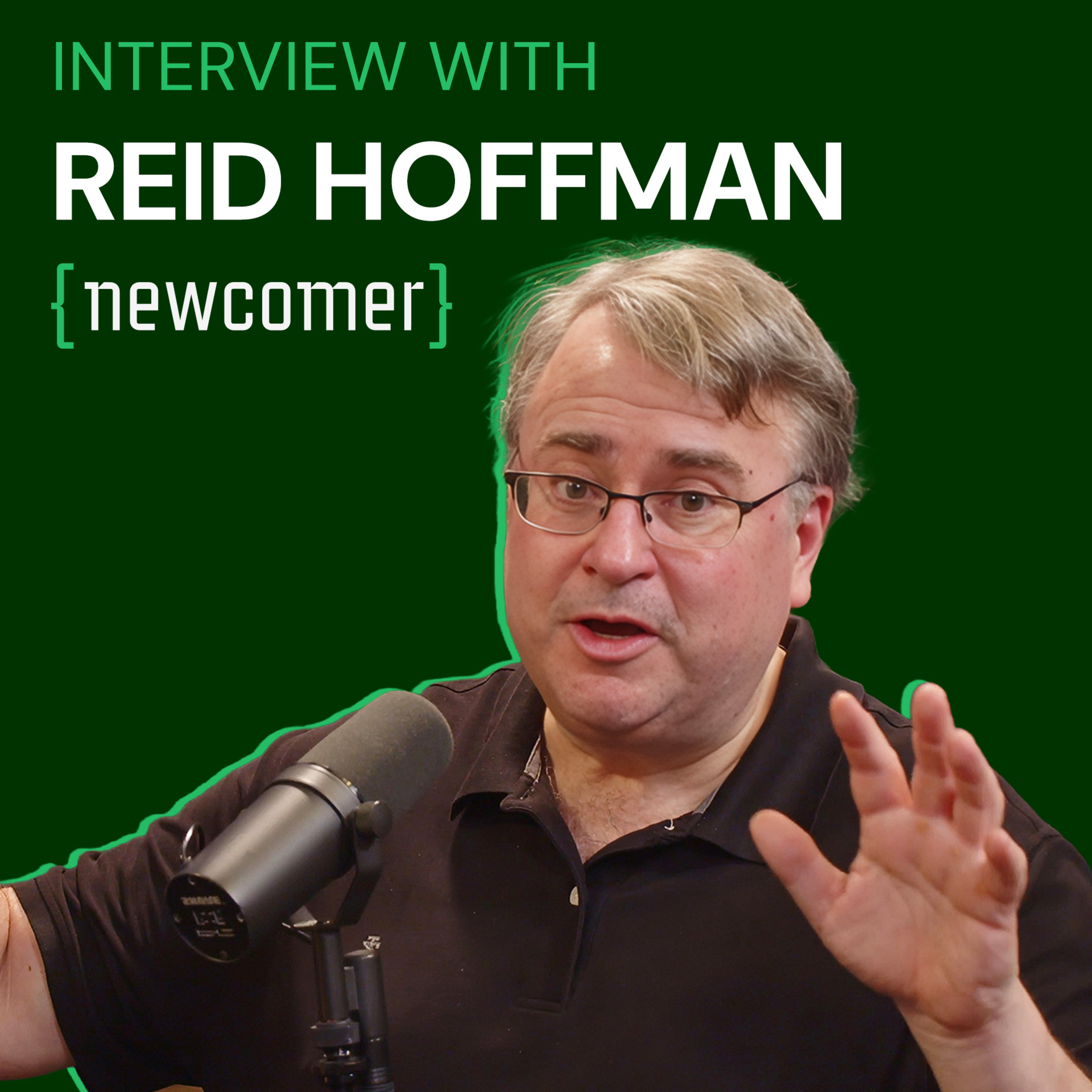
Reid Hoffman argues for “techno-humanism” and a “smart accelerationist” middle ground on AI: keep building and deploying, but steer toward human benefit with stronger monitoring, safer access, and better legal/medical frameworks. He says America must “win at AI” as the next industrial revolution, and that AI investment (especially data centers) is helping prevent recession and can support middle-class prosperity if communities benefit.
Reid Hoffman is a techno-humanist investor/entrepreneur (LinkedIn co-founder) and co-founded/backs AI and bio efforts (e.g., Monas AI with Siddhartha Mukherjee and Ujjal; involved with Chan Zuckerberg Initiative’s Biohub; board roles including Ark Institute).
nobody can predict AI’s job impact precisely; companies will adopt AI more slowly than technologists expect, while AI-native companies will compete faster. Government should help deploy AI as widely as medical/legal assistants, with liability “safe harbors.” Open-weight models need cybersecurity/bioweapon safeguards. Treat existential risk as a portfolio; don’t obsess over “P-doom.” Never connect AI/automation to nuclear systems or the internet.
three people saved by ChatGPT as a medical second opinion; “London surveillance” framed as beneficial emergency response; his “explain quantum mechanics like 12/18/professor” learning example; AI used to build his small business ticketing platform.
Written by AI. May contain mistakes.
Discussing personal experiences and the implications of AI on humanity.
“I personally know three people whose lives have been saved by ChatGBT.”
Exploring Hoffman's perspective on navigating AI's potential and risks.
“You're not claiming one of the monikers.”
Hoffman argues for America's need to succeed in AI and the socio-economic implications.
“You know, whether it's India, you know, China, a bunch of others is like, no, no, you actually have to do so.”
Discussing the nuances of developing and deploying AI technologies.
“So they don't tell you how to build weapons.”
Examining the balance of AI accessibility and safety in society.
“Like you want to keep using recursive self-improvement?”
Debating the need for legal frameworks around AI in legal and medical settings.
“So don't willy-nilly kind of just go, great, we made something super smart, and now we're just throwing it out.”
Discussion on the potential of AI to provide legal and medical advice and the associated liabilities.
“And actually, by the way, you might do, if you might say in that mode, like the model only talks legal.”
An example shared about how AI assisted in saving lives by providing second opinions.
“And it's like, well, just describe what the guidelines are for where you have to stay.”
Reid discusses how AI can help simplify complex topics like quantum mechanics.
“And it seems, I mean, it's clearly a good that you can, you know, put your medical documents into, just get a different opinion.”
A conversation about the importance of America leading in AI and the societal implications of failing to do so.
“You don't get to make the big decisions of the big global decisions.”
Discussion on how different political views affect perceptions and policies regarding AI.
“I hate to be the why doesn't the public appreciate tech more person.”
Insights on how AI will transform job markets and the need for new skills and entrepreneurship.
“But if that's what the words that you're being told are, then naturally you have a very negative verse reaction, even though probably the vast majority, like 99 % of college students use AI regularly.”
Explore how AI can empower small businesses and entrepreneurship.
“So how do we have AI be on the help side of the bar, which is totally doable?”
Understand the broader economic implications of AI and data centers on employment.
“You were saying before we came on, I don't think we've hit on this yet, just without sort of the AI sort of explosion, our economy would be in a pretty dark place.”
Discuss the community engagement necessary for data center success.
“So, and by the way, most of that capital doesn't go to the cities.”
Analyze the need for expanding the safety net as AI changes the job landscape.
“Make sure that electricity prices either stay the same or go down as a function of the provisioning of this.”
Learn about the relationship between AI profitability and societal investment.
“I think that as societies make progress, part of your progress society is you expand your human rights, you expand your safety net.”
Explore how communities can invest in cultural initiatives amid AI growth.
“But it's just like, or I think I'm reflecting Vinod at the moment, but it's like, where is the money coming for that?”
Delve into the challenges of managing national debt in the era of AI.
“of economics, well, then you say, okay, we have to tax them to have it, I think, broadly, you'd want to put it, I don't know, about cultural grants.”
Discuss the political landscape and strategies moving forward post-Trump.
“And we get to that debt through all kinds of things.”
Hoffman discusses the multifaceted nature of existential risks and the role of AI.
“And I think that everything from obviously Trump coin.”
Exploration of the potential for AI to extend human lifespan amidst inherent biological limits.
“So that's the reason why I tend to avoid the P-doom conversation because it's like, look, what you should really be doing is thinking about like, okay, so how does AI reduce bio-risk?”
Discussion on the challenges of cancer treatment and the potential of AI in finding solutions.
“Like in Silicon Valley, you listen to, we're turning off the death gene.”
Hoffman emphasizes the importance of using AI to support society and the need for inclusivity in innovation.
“Well, and that's, you know, we're very ambitious at Manus.”

Get the gist, explore an idea or ask about something said.
 Claude
On Newcomer Pod, what are the key points of this episode?
Searching your listeningAutomatic transcript. May contain errors.
0:00I personally know three people whose lives have been saved by ChatGBT.
0:04Eric Newcomer: It's amazing that this is an industry where we have to remind ourselves that this is for human beings. You should never connect AI or any automated system to nuclear stuff. And you should keep the nuclear stuff disconnected from the internet. Not just because of AI, but because of all the human beings. You're like, I'm a middle of the road kind of guy. Yes, I get hit by cars going both directions. I like weaving in the middle of the road. Reid Hoffman, welcome to the Newcomer Podcast. Thrilled to have you in person. You are fresh off a Substack post laying out a sort of middle ground on artificial intelligence.
0:38Eric Newcomer: And obviously there's lots to talk about there. I want to just give you a second to give the high level view. I feel like you resist. You're not claiming one of the monikers. Like I'm an EA, I'm an accelerant. Do you have a brand for this middle of the road take? Or what would at least give us sort of the argument? behind it? Well, maybe a smart accelerationist, a pro steering versus accelerating or deer accelerating. And generally speaking, I think I tend to think of myself as a techno humanist, which is how do you have technology enhance humanity, which is I think where we mostly orient towards most technology going and we just need to keep steering in that direction.
1:26Eric Newcomer: It's amazing that this is an industry where we have to remind ourselves that this is for human beings. It feels like that gets lost sometimes. And then there has to be sort of a corrective of, oh, who are we building this for? Not the machines themselves. What is the main thing you're calling for here? Because there's sort of like the data center piece of it. There's like access to AI. So the primary thing is kind of two things that need to go together. One, which is like, why is it important that societies, and let's talk about the US, America, needs to win at AI? Because it is the next industrial revolution.
2:05And industrial revolution is the thing that determines future prosperity, just like the previous industrial revolution did. So if you go, we want to opt out of the industrial revolution, that's what crushed a whole number of societies for centuries. You know, whether it's India, you know, China, a bunch of others is like, no, no, you actually have to do so. So succeeding at it really matters. But then simultaneously, and at the same time, more than 60 % of Americans are having a very difficult time, right? If, and you know, they, there's questions around like, okay, the enormous gas price rises, the cost of beef, you know, kind of like how many jobs you need to work.
2:46and it's the responsibility of the entire American society to try to make that because in a sense our ethos as a society is a middle class ethos to make that work better. And I think AI can. That doesn't mean there won't be, and this is part of the thing that was the backdrop of addressing in the essay, a lot of significant issues around work change and people are legitimately concerned about like, well, what can you tell me about that? When it's going to happen? How is it going to be? And by the way, no one actually, in fact, really knows. Neither of the people who go, oh my God, it's going to be huge in a year or two, or the people who are like, oh, no problem, nothing this year.
3:28Actually, nobody really knows. And most people in the nobody really knows get nervous about that. Although that's, I think the kind of the nobody really knows part of it means that it's like going down a road. It's like if you're planning a highway trip, do you know there's an accident on the road already? Do you know that there's not?
3:46Eric Newcomer: Usually, you know, you have the capability to navigate it. You set yourself up. This could come. This could come. I'll do that. Yes. But you don't just say, I need to know everything ahead of me or I will not drive anywhere. Exactly. So it's kind of like, so my, my thing is get on the road and drive and keep driving. And by the way, sometimes you hit a curve or traffic, you slow down a little bit for that, but it's, but it's a forward motion orientation. some people think we're at the curve now though i guess to ask that directly do you worry like should we be pacing should we be halting like or you think in terms of what you've seen keep driving so definitely keep driving but by the way this is the other nuance in the pacing and so forth is like for example there's a pacing of building and there's a pacing of deploying uh and actually i actually think when i look at like daria's call and you know sam and And then I'll say, well, I think you probably still need to be doing the building because, by the way, in order, the problems they're worried about is you have a curse of self-improvement and they've built up over the years a whole bunch of different techniques for, you know, I presume most of the people on your podcast know what alignment is, but I'll explain it very quickly, which is how do you have these things aligned to positive human outcomes?
5:00So they don't tell you how to build weapons. They, you know, generally speaking, provide you useful things in your life and not things that help you mess up other people's lives or your own. And the challenge in recursive self-improvement is you're essentially saying, OK, improve yourself. How do you keep that alignment as you improve yourself? And it's like, well, we don't really know how to do that. That's like, we have some ideas, but if you said, guarantee me you can keep your alignment, we can't guarantee it because we don't know what that pattern is. But the problem is we won't know what the pattern of recursive self-improvement is until we start doing it.
5:41So that's why development and deploy. So I tend to say, no, no, keep developing, but maybe slow down, deploy, have much higher monitoring on access to the internet and some other things. And by the way, be simultaneously building AIs for measuring what the states are of these complicated RSI models, because we need to be understanding them in order to say, oh, these patterns of alignment work. Or by the way, if we're discovering no patterns of alignment working, well, then at that time, a real slowdown can make a difference.
6:14Eric Newcomer: Is recursive self-improvement, sorry, development or deployment? Like you want to keep using recursive self-improvement? In development. Inside labs. Yes. But in deployment, like, okay, let's pace that. I mean, that gets to one of the issues that comes up in your essay, which is the more we say the answer to this is labs hold back what they have. Maybe there are a lot fewer people to get angry about it. Nobody's seen it, but it's fundamentally denying sort of those capabilities to the American public. Part of what you're talking about is make sure they get actual applications that they can use.
6:51Eric Newcomer: They can see the benefits of AI. I agree with that. But then there's also just the piece of a world where they're too tightly guarded is a world where corporations and maybe governments have this immense power that everybody else doesn't have access to. How do you balance those things? Well, so first in my Substack essay, one of the things that I think is critical for anyone who, and I think it's the right thing to try to help people have a positive understanding of AI. I think government should be actually helping with that. I think obviously companies desperately need to. And so it's like have a medical assistant.
7:27Like make a 24-7 medical assistant that's only available to the super wealthy right now, but could be available to everybody. Legal assistant. Most people can't hire a lawyer to say, I'm signing this rental agreement. Like, is this okay? Is it standard? Is it da-da-da? So have a legal assistant on a whole wide variety of things. Like, oh, what are my legal responsibilities if I'm driving the car? A tutor, right? So a tutor for your kids, tutor for yourself. Obviously, that has some play to what could have all of that stuff should be deployed aggressively. And to really deploy it well, government will have to change some liability law, like on medical.
8:08I desperately want this.
8:09Eric Newcomer: We could solve it. not to there's so many intertwined problems but we live in this like surveillance state potentially that AIs can get better at creating like you could have like a AI sort of bill of rights where it's you have legal protections you're allowed to use it you're yes there are cameras everywhere but this is where they're limited like there's a lot of issues that can be bundled into a productive conversation exactly and by the way the use of surveillance is frequently a sloganeering word, you know, like the, you know, like a great title called surveillance capitalism. And you're like, well, but it's not just bad.
8:43It's like, well, surveillance medicine is awesome. We do it all the time. Exactly.
8:47Eric Newcomer: And when, you know, when there is like a serial killer or a manhunt, usually people are like, how can they not find him right away? But then, you know, other times they hate sort of the dragnet. I mean, I don't think we like that we're being sort of lied to about maybe the extent of the dragnet. And also, by the way, It should be a highly understood environment that is legally bound to be on your side as a people. Right. And this is one of the things, like, for example, most people don't realize that London has an enormous amount of surveillance. And the Londoners are actually quite happy with it because it's like, oh, like when someone falls down with a heart attack, the ambulance arrives soon.
9:27That's good. Or when there is a crime, the police respond quicker. We like that because it's for us, not against us. And that's, I think, one of the really key things here. And so I think continuing to deploy carefully that I actually in my slowdown in deployment, it wasn't any of these apps. I actually even think kind of the work productivity and all the rest. I think that's part of the industrial revolution. You need to be doing it. It's more the question of, OK, so we're making a much more intelligent AI through RSI. Let's make sure we understand what that intelligence is, right? So don't willy-nilly kind of just go, great, we made something super smart, and now we're just throwing it out.
10:08You're like, make sure we have a good understanding that it's kind of aligned with human interest. And then, but for example - And there's also this risk you put it out.
10:17Eric Newcomer: It's so easy to distill the models. Yes. Then someone's going to rip it off, make it open source, ungated. Which we've seen a bunch of. And by the way, so one of the things on the open wait side, which is another frequent discussion here, look, I was on the board of Mozilla for 11 years. I'm a massively pro open source on all kinds of things. The open weights models, when it gets to AI, you really do have to have good answers to cybersecurity and hacking. You have to have good answers to creation of new biological materials because of use in terrorism. That's not a, oh, yeah, it's fine. Or, oh, you can discover those documents on Google.
10:52Because discovering the documents on Google is not the same thing of having a PhD co-collaborator that will do what you ask it to do. And it's like, okay, we should be a little bit more careful about that. Again, open is generally good, but it's an area to be careful about.
11:09Eric Newcomer: There's so many pieces of this that I don't want to drift from earlier things, but I'm also interested in that piece of it. I mean, like the lawyer, the medical sort of app, just to put it directly, like, do you think people should, you know, if I talk to ChatGPT or a legal specific app, I should be able to treat that as privileged, like a lawyer, like we should. Unprivilegedly. Right. And by the way, we're just fuzzy on it right now because, by the way, your email that's on the Google or Microsoft servers is privileged and it's still in that thing. It's being handled by software, et cetera. That's already there.
11:47there's no reason that a interaction with uh an agent should be treated any differently right from a privilege you know standpoint whether it's legal medical etc and it's really
12:00Eric Newcomer: just people's but if i write down i guess there's a there's one it's like i'm using as a tool to talk to lawyers yes but there's another where it's like obviously if i wrote a word document with like my confession and they found on my computer yes they'd use that against me yes but if i'm like in chat gbt and i'm asking it like i think i was speeding like what i don't know like do you think we should have protections there that it's like a therapist or as long as i'm not like actively saying i'm murdering that person yeah look i think broadly yes um although also maybe with um like one of the things i think it kind of gets down to kind of how you do a terms of service.
12:43I would ideally, I think, have a terms of service that if someone's speeding, et cetera, that should be within the personal. If it's like, how do I make a new biological terror weapon? No, not so much. So it's probably a question of where the boundary should be. But for example, because if you think about this is we're a far healthier society if everybody has the advice of of of some legal counsel and it's very difficult to to afford right having at least an ability to have a interaction for can you can you proxy legal counsel for me exactly is i think a very good feature to have that's that's what i was
13:27Eric Newcomer: essentially gesturing at earlier well you know to bring a lot it's like i i certainly don't support people attacking flock cameras but you can imagine a world today it's like the government has all these tools to come after somebody with flat cameras and who's like destroying them and somebody goes to chat gpt and says i've done this like what you know maybe it needs to be a legal specific app because the problem is lawyers can get in trouble if they give you advice of abetting a crime versus here's the legal advice i can give you around a potential crime or something but yeah do you do think like there needs to be some framework where we have talking to a model for legal advices as if it was talking to a lawyer.
14:06I think that's essentially correct. And actually, by the way, you might do, if you might say in that mode, like the model only talks legal. Like, so you can't go - You have to switch into it. You're not - Yes. And like, for example, it's like, well, I'd like to figure out how to break into this building and maybe the model can help me. Well, a lawyer won't do that. So if you're talking on a legal mode, it was like, no, my legal advice to you is don't break into the building.
14:35Eric Newcomer: Exactly, right. And on the medical front, do you think we need new policy in the same way? At the minimum from legal liability. One of the things that I've been trying to advocate for a number of years, and it's part of the reason I've been doing it to governments and a bunch of other folks, and now I'm just kind of thinking, okay, let me just start saying this. Just shout about it loudly enough and hope the culture takes it on. Yes, exactly. Because if we shift, part of the reason why most people are not aware that you can actually get pretty good medical advice from Chet, GBD, and Claude. And the reason is they don't advertise it and they lightly steer away from it to try to avoid medical liability.
15:12Eric Newcomer: Because if they shout, they say, we can do it, then they can get sued and they fail. Exactly. And what you want to do is say, okay, government should say, look, if you follow the following things, then you have essentially a kind of a safe harbor from medical liability so that, and by the way, so like the kind of things I think you would do is you'd say the app has to be free. The data has to be entirely the own individuals. You have to not sell the data to anybody. You have to fundamentally ask, do you have access to a doctor? Do you have access to, you know, kind of like medical facilities and so forth?
15:54And then when you're giving advice, you should say, look, it's still far better if you can consult a doctor but if you can't, you know, like timing, availability, et cetera, here's what I would think, right? You know, kind of thing. And if you had that, at least three companies would go provide that. It would cost the government nothing. And they would advertise that they would have it because it would be like, look, this is a really useful feature. And by the way, it is a really useful feature. And here's how useful the feature is today. I personally know three people whose lives have been saved by ChatGBT by using it as a second opinion, right?
16:33So like in a hospital and they go, I'm not sure. And they go, go to another hospital. And that got in that hospital. And it was like, well, if you'd arrived here about an hour and a half later, you'd be dead. Wow. You know, that kind of thing. And that's, we want that for everyone, right? And that's easy enough to do. Now, of course, lawyers will argue, no, no, no, no, no. We need to have medical tort. It's the only way to keep it. And it's like, well, just describe what the guidelines are for where you have to stay. And if you think, oh, that's a little borderline, then bring in the guideline a little bit.
17:06It's like only with it. Like part of a medical assistant could be the, I'm sorry, I'm not allowed to give advice on that topic. Right. You know, please find someone to consult with. If you want, I can pull up a list of public, you know, like potentially publicly available resources that you might be able to use.
17:23Eric Newcomer: It's a really interesting point on the why don't OpenAI, Anthropic, et cetera, do a better job of taking credit for the good things they can do. It's like, here's a case where maybe they're afraid that they'll get sued if they brag about it. They for sure will be. Interesting. Right. And it seems, I mean, it's clearly a good that you can, you know, put your medical documents into, just get a different opinion. Like if it disagrees with your doctor, sort of ask questions. Second opinion is great. And also, by the way, another thing is, literally for people who have high-end concierge doctors, they put their blood work into Chachibidi-Claude.
17:59And then you can talk to the agent for two hours about, well, what does this mean? And how many people have this? And does this mean that I have the following condition? What would be the probability? How else would I measure it? Should I take the blood test again? Doctors don't have time for that. AI has all the time in the world.
18:18Eric Newcomer: And sometimes they give simplistic answers, assuming you might not do take the medicine or you might not do X, Y, Z. And if you have someone actually taking the time to explain, it's like, oh, they're giving you that direct advice because it would take a lot of work to do the perfect solution or whatever. Yes. Can be helpful to have the time to get a real answer. Well, this is the thing where it's like going through in depth and understanding it. Like another thing that AI is used for, so say, for example, this is a couple of years ago. I was like, I want to understand quantum mechanics better.
18:48So I took a set of quantum mechanics challenges and I went, okay, explain this to me like I'm 12. Okay, I got that. Explain it to me like I'm 18. Okay, I got that. Explain it to me like I'm a physics college student. Okay, got that. Okay, explain to me like a professor.
19:03Eric Newcomer: Okay, I don't got that, but I now understand what the arc looks like. Yeah. We need to win in AI because it's the next industrial revolution. And if you don't win that type of revolution, you're sort of irrelevant as a society. You don't get to make the big decisions of the big global decisions. Your children are poor. It's sort of a dark world that we have to remind people of that in a certain way. It's like we still, as Americans, should think we should win. Like, obviously, we've made mistakes as a culture. We're not perfect. We need to fix it. But it is somewhat worrying that we're in a society today where it feels like we need to even make the case that it's like good to stay on top.
19:42Eric Newcomer: Yes. But do you feel like there's a substantial part of, I guess, the political system that doesn't believe that? And I guess a lot of people would say, it's clear, I'm Democratic line, you're a big Democratic donor. I think we're shared sympathies there. But the party most likely to say, oh, maybe we shouldn't be on top, it is the Democrats. And does that worry you? Well, it bothers me. And part of the reason I wrote the piece was to try to show Democrats how they can have a pro-AI vision. Because the answer is to say, look, part of, I think, what the Democrats most naturally identify with is the people who are disadvantaged in society.
20:22They may be poor. They may be racial biases. They may be other things. And they say, we're about trying to make sure the rich and the powerful elites don't grind them down. And that's a good sympathy because we should bring everyone along. And so they tend to think, ah, this is just you tech people saying how you want to get more wealthy and competing with people. And it's not about all these other people. And it's like, look, and by the way, that has happened at points in history, whether it's tech, oil, finance, et cetera. So it's a good voice to be saying, that's great. You're going to win in the industry.
20:57And that'll bring prosperity in the country. Make sure it's helping the country. And as an example that I use to try to wake up Democrats on this topic, say, well, would you like to have a return to manufacturing industry in this country? And the answer is yes, because I saw the middle class. AI and robotics is your only play, right? You should be leaning into that. So as opposed to saying AI bad, stop AI. It's like, well, hey, can you AI guys be making sure that our whole manufacturing industry is well provisioned with the stuff that's happening? Could you make sure you're investing in that? And if you're doing that, we will be more sympathetic.
21:32We still will be watching out for, hey, don't be doing, you know, like harming children and other kinds of things because it's really important. But like we'll be more sympathetic to, oh, we'll help you like figure out where you can find a community that should buy into your data center deal because like in building the data center for doing the community because you're helping the communities with manufacturing jobs, right? That kind of thing would be good. And that's the kind of thing to think of for them to think about. Now, it's absolutely right that because they tend to be the like we're on on the side of the of the of the disempowered person against the wealthy and powerful large companies, et cetera, et cetera.
22:13They tend to do that as a dynamic. But that's a destroy our future, destroy our children's future, et cetera. And it's like, don't do that.
22:22Eric Newcomer: I hate to be the why doesn't the public appreciate tech more person. But I mean, right now the deal with AI is that, you know, tech companies are way, they're burning through investors' capital very aggressively, spending tons of money building in America, like the capacity to do this, giving these apps away mostly for free and giving access to it. and yeah, Americans pull very negatively on AI, yet use it. I feel like something that's been coming up a lot, I guess on this podcast and in my work is this conflict between sort of tech industry sort of saying revealed preferences are who you are.
23:03Eric Newcomer: I was talking to like Simile, which is doing simulations of the future. And it's like, people are really what they do in some ways. And then there's sort of, I don't know, the media class world, which is like, people are what they say and they say negative things and they both to pollsters and you know wine online i don't know what what do you make of the disconnect between obviously what people are doing which is using these tools and embracing them versus what they appear to be saying well so there's a couple different sorts of using the tools so one is sometimes people using them don't realize they're using them right they don't know that's it yes exactly and then two is they're using it but They're kind of using it for, oh, like where is that cafe in Midtown that I wanted to find and so forth.
23:47And then they're simultaneously being told, oh, the people who are building this think there's an extinction risk in humanity or it's going to take out 25 % of white collar jobs in a couple of years. And like, well, why are you doing that? But like, like, are you crazy? And I think, well, you must not be crazy. Is it just because you're going to get really wealthy? Like, why are you like, and so, so they can simultaneously have this negative feel. It's a little bit like, I got asked by a friend of mine. He's like, well, why are the college students booing AI in commencement speeches? Because they're all using it a lot.
24:21It's like, look, here's the thing. Knowing your friends, they were probably drafting their commencement speech. You're like, how do I avoid this problem? Yes, exactly. And I was like, look, to your average college student, from what they're being told, they're like, okay, you gave me a homework helper and you took away my career. Take your homework helper back and give me my career back. And that's incorrect as a framing. But if that's what the words that you're being told are, then naturally you have a very negative verse reaction, even though probably the vast majority, like 99 % of college students use
25:00Eric Newcomer: AI regularly. Do you have a prediction on what sort of AI is going to mean for jobs over the next decade? Well, anyone who has a solid prediction is probably self-delusional. Because one of the things is a little bit like getting on the road and steering is there's a lot of different ways it can play out. And I've heard smart people argue everything from, you know, the Dario 25 % white collar bloodbath to there's going to be zero issue whatsoever. Right. Like it'll be the most empowering thing and people use it and so on. And smart people, like so the whole range is smart. So the way that I tend to think about it is what, here's kind of the more crisp thing.
25:42So one is the speed at which existing companies will change is not nearly as fast as a technologist think because how companies learn things, like for example, if you go to most companies now, I'm like, well, we're looking around to buy an AI class. And you're like, we got to train our employees. We got to buy an AI class. And you're like, no, you could just use AI for that. Ask AI how to use AI. That's the whole point.
26:04Eric Newcomer: Yes. You don't need to go. AI for dummies? No one should buy that book. Just like, don't do that. On the other hand, so those will be much slower than most of the, oh, my God, it's going to be here in a year or two. But what will happen is new kinds of companies will be created that are much more AI native, and those will be very strong competitors. And then that will start forcing the competition. And so that's the pattern that once we're in it, I think we can make predictions about, well, how will the major employment white-collar jobs, whether they're sales or customer service, other kinds of – what do those, how do those end up transforming?
26:51Eric Newcomer: How quickly are AI native companies out competing the old guard? Rather than the old guard being like, goodbye, everybody. We figured out how to use AI. Exactly. And by the way, that will then cause the old guard to start adjusting. And it will be, some of them will fail, some of them will succeed. And there'll be this kind of really kind of intense period on that. And in that job transformation, I think that will be hard. And I think one of the things that I've also been thinking about is how do we create the right AI tools to help everyone in society with that? How do you help them figure out what other kinds of work might be possible?
27:27Or how to adjust like, oh, well, this is what the new kind of salesperson looks like in an AI universe. How to learn that job, how to do that job, how to find that job, all of that stuff. This is one of the broad things that people really need to understand is you want your solution to have the same characteristics as the problem, namely in scale, cost, speed. You want to have an impedance match. And so a lot of the times people say, oh, we're going to have a jobs issue. We'll have community colleges do it. And you're like, that does not have an impedance match. Like, sure, do something. No harm in doing something.
28:04But it will not survive at that, right? So how do we have AI be on the help side of the bar, which is totally doable? That's the thing we should be pushing for. That's the thing that I was like when I talk to any government officials, not just Democrats.
28:21Eric Newcomer: It's help guide you towards a job. It's help teach people how to build businesses alongside of it. I'm a small business owner. We use it to build our ticketing platform. We're going to do an exciting report soon that we would have never been able to just sort of like format and build the website. and password protected the same way without AI. So I can see it, but is that the path? It's like everybody's a small business owner? Well, I think you'll have a lot of entrepreneurship. I think you'll have a lot of small business entrepreneurship. I think you'll have new entrepreneurship building new companies.
28:51And I think you'll have a, for example, like some of it is like, how would I pitch myself as a college student saying, why do you desperately need me at your company? It's like, I'm AI native. You need to be learning AI native. You need to hire people like me. And by the way, most businesses are like, oh yeah, Like we know that we need to. And if they're convinced, then sure, we have entry level hiring despite, you know, trade war and Iranian war and oil prices and all the rest, which is a lot of the reason why everyone's much more cautious in hiring and business.
29:21Eric Newcomer: You were saying before we came on, I don't think we've hit on this yet, just without sort of the AI sort of explosion, our economy would be in a pretty dark place. Can you paint a picture of that? And what are the political consequences of that as well? And so this is a particular one in which, call it progressive Democrats, really don't understand, which is our economy, we have serious problems with our economy. And it's not just because of massive deficit and debt that a huge amount of our taxes go to just literally pay the interest on the debt. It's like we've maxed out all of our credit cards, kind of national debt.
30:04but all of this capital infusion, people think, oh, that's just going to the tech companies. Like, no, like a massive, like, actually I should go try to measure the exact percentage, but a massive percentage of it is going towards data center construction, which means construction, electricians, carpenters, real estate development, you know, et cetera, et cetera, et cetera. You know, legal work around what's going on, community service engagement, Like just a ton of, and literally I've seen, you know, people who are texting going, hey, this AI thing is essential for me looking after my family and so forth.
30:41And so that capital is the only reason we're not in a recession, right? So, and by the way, most of that capital doesn't go to the cities. And, you know, there's a natural reason why capital tends to aggregate and the network affects the cities. Most of that's more distributed across the country. That's great.
30:58Eric Newcomer: on the data center freeze. How likely is it that there is one? Are you worried about that? And certainly you have the Bernie Sanders of the world. On the one hand, there's this bipartisan sort of support for it. On both ends of the spectrum, you see Republicans even sort of paying some lip service to it. On the other hand, it feels sort of implausible. It's so key to America's main business right now. It's good money. It doesn't have to come to your community can come to another. How much are you actually worried that there will be a freeze? Well, we're capable, given the broadsbed, you know, kind of like a lot of misinterpretation of AI and data centers.
31:42We're capable of doing - Humans are good at getting to panic.
31:45Eric Newcomer: Yes. We can talk ourselves into it if we want to do it. And so, for example, like everyone keeps saying water in data centers, even though that paper was retracted for its inaccuracies. And so I ultimately am enough of an optimist. I don't think we'll have the shoot ourselves in both legs, kind of like a national moratorium, et cetera. What I do think we should be doing, I think Josh Shapiro at Pennsylvania is doing a very good job of this, is to say, hey, make sure the local community's bought in. Make sure the local community is getting sustaining benefit from it. Make sure that like noise and environment and everything else as well take care of.
32:26Make sure that electricity prices either stay the same or go down as a function of the provisioning of this. And then allow the local community to say, I want it, I don't want it. And say, you know, like self-determination. It's one of the great things that we think about kind of American, you know, kind of the history of American culture, even back to, you know, the American Revolution. So allow the local communities to do that and then have like the state and federal involved just to make sure like the environmental stuff and make sure that there's no like, oh, they're bribing a local official or something.
33:01But it's actually it makes sense.
33:03Eric Newcomer: Let different communities decide what's right from them. Is there any way to make them more aesthetically appealing or is they're not the most beautiful seeming things? um it's probably that but you know given that economics is always about a question of limited i i spend the money on yeah i i would like make it like definitely make it not have sound noise issues because that can be very disruptive to a local community but if you said hey we've got a spare x dollars i'd rather spend the spare x dollars in creating local economy right and i'm saying make sure that that's invested in making the the community more prosperous right you know one thing that i feel like silicon valley used to be the leader on was this talk of like ubi universal basic income and and there's still some echoes of it which is you know there's gonna be so much ai abundance we have to give everyone some sort of like minimum protection on the other hand you know i i don't read as certainly sort of the conservatives in silicon Valley is supportive of like expand social security or, you know, that any sort of like practical expansion of the safety net given sort of imminent AI abundance.
34:13Eric Newcomer: I guess first question is just like, what do you actually believe? You've already brought up the deficit. Is it like, oh, we need to cut the deficit so we can't expand the safety net. There is some abundance coming. So we should expand it on that basis. Or what's your view on safety net expansion? So broadly speaking, I think that as societies make progress, part of your progress society is you expand your human rights, you expand your safety net. I think it's a good thing that you do as you progress as a society. Like, you'll say, well, you know, of course you should have, you know, kind of a lot of unemployment insurance.
34:49Like, well, but that was a relatively newish thing, right? Like, it's good to be doing this, to have a much more human society and a functional society. Now, that being said, I was never a huge fan of either UBI or the articulation of UBI, universal basic income, because one, you do the math. Right.
35:11Eric Newcomer: And that's why I sort of pivoted. I brought up UBI and I talked about Social Security. But you do the math and you're like, the math doesn't work. This isn't complicated math. It just doesn't work. You have to be so present with massive, massive abundance this year when you're paying the bills in order to do that. So it kind of like, it just doesn't make sense. And I think it's the crazy, the people who think, oh, the whole world will change next year. And you're like, yeah, it's not going to do that. So that kind of thing. So I think expanding safety. And I also think that the, in part, what I'd want to be doing is saying, hey, look, if we're going to be creating a whole bunch of massively profitable companies because AI helps make them profitable, we may need to make sure that the profitability of those companies is then reflected into the investment in society to make sure that we continue to have kind of our American way of life and so forth.
36:03And I don't think the way to do that, one of the reasons why a lot of Americans hated the UBI thing is they don't love the idea of, I'm going to put you out of work and I'm going to put you on welfare. Like, no, no, I work. I mean. So creating things that involve, I'm doing things that are meaningful. I'm participating, I'm contributing to the world, I'm providing for my family. That's where the money should be wrapping into. And I think there's a number of different ways to do that. But if we get very profitable companies, if they're American companies, we can then say, okay, we need to use this economics to help the rest of the folks.
36:34Eric Newcomer: Do you think it's fundamentally philanthropy or like when, you know, when do we get, again, I feel like the AI world can have this sort of like, everybody's going to be an artist or like even sort of right-coded people will say like, do something productive and like, that'll be good enough. But it's just like, or I think I'm reflecting Vinod at the moment, but it's like, where is the money coming for that? And are we about to see these are like violin grants or whatever? How do people actually get paid to be productive, but not in an economically productive way? So what we don't know is what is the AI productivity of companies mean?
37:10Now, say for example, one universe is there's a ton more small firms that are all operating at high function and the AI thing helps them high function, then it takes care of itself, right? So that's one kind of positive, positive outcome that you don't have to then go lean in a whole bunch of extra weight in order to make it happen. Say, for example, you say, well, there isn't a massive number of employment opportunities. There's a few, and the companies are mostly only using AI, and they're generating a whole bunch of economics, well, then you say, okay, we have to tax them to have it, I think, broadly, you'd want to put it, I don't know, about cultural grants.
37:56That's fine. I mean, we obviously have that work with science and arts and cultures and everything else, and maybe there's ways to improve that and do that. But I would kind of say invest in the local communities. Like, for example, people might say, hey, I've got an idea about things we should be doing in terms of community centers or events, that kind of stuff. And I want to be putting money into that. I want to be doing construction on that, et cetera. And like, there's all these kinds of things, ways to do. And so I think this is a little bit of the, how do we know this thing that's far down the road and on like pioneering where we've never, no one's ever gone.
38:29There's a lot of different possibilities. And what we need to be doing is driving down the road with the questions in our mind, but not cemented answers.
38:37Eric Newcomer: Right. On the, on the deficit, Are you somebody who thinks AI is about to increase GDP growth and change our productivity? Are you betting on a world where we sort of outrun our problems? Or you think something needs to be done to the debt or that shouldn't be a priority? Well, I generally think it's crazy the level of debt we have. And we get to that debt through all kinds of things. Like both Democrats and Republicans just keep increasing military spending. And it isn't just because of getting into needless, very destructive wars like you're on.
39:16The question around what should we do in order to have economic generativity is really important. I don't think we can austerity our way out of the debt. I think we have to grow. Now, that doesn't mean, oh, have as much debt as you like. You want to double the debt? It's terrible economics. Anyone who runs a business knows that doesn't really work. Once you say we don't care about costs, everything goes crazy. Yes, exactly. And that's one of the things that makes business such an important part of modern society everywhere in the world. Because, like, no, no, you're focused on cost to benefit.
39:52And you try to trim out bad costs and so on. And that's one of the reasons why, you know, governments which don't tend to have the same guidance, you know, kind of because they, you know, government in every country is a monopoly, tends to just take money. It's like, no, you need to be refactoring costs. And I think that's a very good thing. But the only way forward is to grow the economy. And so you got to like, like part of what I, you know, tell a lot of Democrats who may not understand this as well is growing the economy is the only way you achieve the social mission that you want to achieve.
40:28Eric Newcomer: Do you want the Democrats to spend a lot of time digging into correcting like the sort of illegal activity of this administration or, you know, if they're about to hopefully maybe gain power in the midterms or and then there's gonna be a presidential race. like i don't know you you know i think i'm more on the side of like man like trump coin all this stuff like one way to animate society around fighting corruption is to have this specific story of how trump abused you know office and was able to sort of enrich himself and if we go after those things that can also be paired with stuff to for for broader societal um corrections do you agree with that strategy or you think man we're gonna have to at some point look forward and try not to overly obsess on what Trump has done.
41:16Well, you definitely have to look forward fundamentally, right? Like we're trying to build a future for our children and so forth. And I do think some awareness of how much grift amongst the griftocracy there has been is worth understanding so that people understand that's an important issue for the health of society. It's terrible
41:36Eric Newcomer: for American business, right? I mean, if you create a culture where just being close to the president is self-enriching. I mean, it's very demotivating. Yeah. Well, and also it's precisely what makes a bunch of other, like it takes us to the bad excesses of South America. It's like, no, no, that's precisely why we've had prosperity is because we've had anti-corruption. We've had rule of law. We've had a pro-business environment. And I think that everything from obviously Trump coin. There's also, I think Trump's, um, has done more stock trading than the literally selling the ability to front run his tweets through social.
42:14Eric Newcomer: Yes. Like, and it just, it's, it's just literally anti-business, right? I mean, it's like, it's terrible. And so, uh, so I think that's important to correct. I do think that the, there'll be a lot of emotional, you know, kind of instinct to say we should go get belated justice on all fronts in this. And it's like, look, there's been so much you could spend years just trying to see justice for every single part of rampant corruption and abuse of power. You want to select some just to be well-known, and then you want to build the future. man we need to figure out a way to have the legal system move more quickly and i i don't know it's just it's so slow um that you know i yeah then it can jam up sort of everything else that's going on yeah and and by the way legal system working potentially more effectively ai can be good with that right exactly well yeah what what is i haven't asked you what is your p do Oh, funny.
43:22Does your audience know what PDOOM is? I think so.
43:26Eric Newcomer: PDOOM, we're talking like extinction level risk here. Right. I haven't quantified a number ever, really. And the reason is because I think that people tend to go, it tends to be an agitation, like my internal agitation, I give you a number off it. But let me tell you a little bit about kind of where I think people mistake existential risk. So they tend to go, like a very classic argument is, does the development of AI and potential killer robots add an existential risk? And you say, yes. And then it says, see, you should stop. You're adding an existential risk. It doesn't matter if your PDOOM is 0.0001 or it's 2 % or whatever.
44:08It doesn't matter because you're adding something and you should stop. It's like, well, the right way to look at human existential risk is a portfolio. It isn't just robots. It's bio and pandemics. It's asteroids. Right. And living in the status quo.
44:21Eric Newcomer: Oh, interesting. We have existing existential. So there's a whole portfolio. So then the question with AI becomes, does it increase or decrease the portfolio? The entire thing, right? And sure, there is an irreducible add of mistakenly or deliberately, you create some killer robots, that have an extinction-level impact. By the way, cyber attack robots aren't really that. People are like, oh, it's cyber, the hugging face thing, P-Doom. And you're like, that's not existential. Yes, it's a problem. But by the way, that hack could have been done by humans and is done by humans frequently. People don't realize how many cyber hacks are happening all the time with humans.
45:10Eric Newcomer: And obviously, in the worst-case scenario, like I get that cyber connects to like, you know, missile silos or whatever, but there's like, it feels like there's a little bit of like the internet could go offline or something. It's like, that is not existential. I mean, it is bad. And certainly it would wreck my business. It would be, it would be very hard. I'm not minimizing how important the internet is, but it is not. It's not existential. Yes. So that's the reason why I tend to avoid the P-doom conversation because it's like, look, what you should really be doing is thinking about like, okay, so how does AI reduce bio-risk?
45:40How does AI reduce asteroid risk? And by the way, you should never connect AI or any automated system to nuclear stuff. And you should keep the nuclear stuff disconnected from the internet, not just because of AI, but because of all the human beings. Yes, treat existential risk as a portfolio and be turning it down. But a natural pandemic could be an existential risk. So it isn't that human beings are the only ones. But by the way, of course, human beings doing things tend to be most of the existential risk. I know.
46:18Eric Newcomer: It's amazing to talk about this new existential risk. It's like we still have nukes around. And we're just sort of like, all right, we've got used to it. We're not so worried about it. But I certainly would risk like pure nukes outside of AI sending them as more risky, probably than AI development in my own calculus. list. We're getting towards the end, but one of the things that AI could create is the sort of abundance, abundant lifespans. Are you optimistic that we're going to significantly extend human life? And is that a priority for you? Or you think there will be just, we'll conclude there are sort of natural limits?
46:57So not surprising. You know me well. The answer is to some degree, both.
47:00Eric Newcomer: You're like, I'm a middle of the road kind of guy. Yes. I get hit by cars going both directions. I like weaving in the middle of the road. So we will be extending lifespan. And not just like a lot of the progress in the last few decades have been massive reduction of child mortality. And that is part of what drives up the average. But I think we will also be figuring out how to say, hey, getting to 100 in a fastable way is like an achievable thing as a kind of increasing the kind of average. And I think we'll do that. I think it's a good thing to do. On the other hand, like what most people don't realize is that our, like every single human being when they're born is dying of cancer, right?
47:44Like because we're this homeostatic balance system, which eventually gets out of balance. And so the ability to say, no, no, we'll be able to really massively rebalance it seems unlikely given the nature where we are. And it reminds me of like one of my kind of favorite Buddhism jokes is, you know, why did the Buddhist coroner get fired? And the answer is kept marking as cause of death birth. Right. So, you know, and it's like, look, it's good to live longer, more fruitful lives. It's a good effort. We've been doing it on a lot of things. Child mortality, you know, the Gates Foundation, very, very good thing to be continuing to focus on.
48:24But I think we will make progress. We just won't make progress. Like in Silicon Valley, you listen to, we're turning off the death gene. Oh, you mean the one that stops cancer?
48:34Eric Newcomer: Are there projects that you think are most likely to sort of make a difference in the near term? Is this an area you invest a lot in? I don't invest a lot in it. I mean, I obviously co-founded Monas AI here with Siddhartha Mukherjee and Ujjal saying to try to cure cancer because cancer is a killer. You spend a lot of time. So there is a bunch of stuff. And I helped stand up the biohub for CZI. I'm on the board of Ark Institute with the Collisons and Patrick and Savannah. So I try to do stuff for the kind of bio for humanity on this. So I put time and energy into it. Probably I've only done two or three investments of which Monus is the most significant.
49:12Eric Newcomer: And so do you have a sort of cancer elimination timeline? I know we always want. Well, AI is the best shot we've had in human history to do this. and a little bit of, you know, there's a bunch of variables you don't know of like, cause you try to tackle the major ones early. Uh, I doubt you'll ever fully get rid of cancer. And by the way, it's kind of this question of, well, you get rid of that one. Oh, and then this one will happen. So, so there's probably as you get rid of the major ones and get to more of a long tail, you then start having to do things because people don't realize there's thousands of cancers, right?
49:49It was lots and lots of different kinds of cancer.
49:50Eric Newcomer: You're one, you have time now to get everything else. Yes. But do you think, we haven't, I mean, we haven't had a first one yet. Do you think? No. Well, and that's, you know, we're very ambitious at Manus. We hope. We're discovering some really interesting chemistry. Right. I mean, if you had to sort of leave us with what you think sort of a realistic message for, you know, the Democrats and sort of, I don't know, the set of the AI world that really wants to feel like they're bringing every American along and not sort of like, oh, they need to sort of figure it out. It's like, you know, take advantage of this moment or miss out.
50:29Eric Newcomer: If, you know, you can extend sort of empathy to people who aren't necessarily going to easily sort of figure out how to play this huge innovation, like what is the message? So I think the message is, first, for everyone who is trying to help people be ideating and incenting and getting as much AI help for the majority of society, right? Whether it's medical assistant, legal assistant, tutor. You can also imagine government services working a whole lot easier. Say you didn't have to go down to DMV hell. I mean, most of the jokes in Hollywood are, you want to visit hell on earth, go to the DMV, all of this kind of stuff.
51:13You can imagine financial advice that would be very helpful. Just do all that. But by the way, that doesn't mean don't also try to help with jobs and work and so forth. And I've been thinking about like, okay, should I do another version of the startup review for entrepreneurs and the AI age? like so but the the short answer is uh uh give people as much knowledge and perspective and bridges to hope as you can and don't kind of be pollyannish i i don't like the oh it'll be fine it's like no no journeys can be difficult um but the journey is not only worth it to you it's also worth it your children it's worth it your community and you know i one of the things i love about America is we reinvent ourselves.
52:01And I think that this, like that, that gives us a very good position for kind of making this, you know, call it American intelligence out of artificial intelligence.
52:11Eric Newcomer: Great Hoffman. Thank you so much for coming on the Newcomer Podcast. That's our episode. This is the Newcomer Podcast. Thanks for listening. Please like, comment, subscribe, go find us on our sub stack at newcomer.co. If you're hungry for more podcasting, I also have a talk show called the Cerebral Valley Show. We love your comments. Thanks for all your support and see you next week.
Reid Hoffman on ChatGPT, the future of jobs, and why he believes the AI boom is keeping America out of a recession.
The LinkedIn co-founder joins Eric Newcomer to explain why America needs to keep building AI while being careful about how powerful new systems are released. He shares why nobody can confidently predict AI’s impact on employment, how AI-native startups could disrupt established businesses, and what it would take to help workers navigate that transition.
Hoffman also recounts knowing three people whose lives he says were saved by ChatGPT as a medical second opinion. He argues for making AI medical assistants, legal advice, and tutoring more widely accessible, with privacy protections and clear rules.
The conversation covers the backlash against AI, data center investment, the limits of universal basic income, and how AI-driven prosperity could benefit local communities. They also discuss government debt, political corruption, AI safety, longevity, and the potential for AI to advance cancer research.
Subscribe to Newcomer for conversations with the founders, investors, and technology leaders shaping Silicon Valley.