

 NVIDIA AI Podcast
24 Nov 2026 · 29m

 Add vo to ChatGPT or Claude to ask about everything you hear
vo listened to this episode to put together the overview and transcript, so there may be the odd mistake.
Why transparency and open-source practices matter for AI security, and how to secure AI agents via defense-in-depth (model guardrails, agent/harness confinement, policy governance, and hardware/software monitoring). It compares open-source adoption of Linux to today’s AI “open weights vs open source” debates, arguing that visibility enables faster vulnerability discovery and remediation.
Chris Wright, CTO of Red Hat; involved with Linux since the 1990s, helped build enterprise Linux and later distributed Linux, Kubernetes, automation, and AI-related work with NVIDIA.
“Sunlight is a disinfectant” (many eyes reduce security-through-obscurity); model uncertainty doesn’t eliminate security engineering—guardrails, evaluations, and sandboxing do; governance enables faster enterprise adoption.
OpenShell agent sandbox and out-of-band monitoring (Sentry on BlueField); OpenClaw/OpenClaw Enterprise evolution from early community experiments to enterprise-grade confinement; “credit card” and “plane ticket” agent tasks constrained by policy.
0:00This is not new. Open source is a term that many people might be hearing for the first time, but we've been not only building on top of open source, but also having it run in personal devices, in companies, and even in governments for decades now. And there's no better person to discuss that with than somebody who's been doing it for those decades. I'm here with Chris Wright, the CTO of Red Hat. So just to set the table a bit, I want you to take us back to Linux and the story of Red Hat and how you are able to not only make Linux something that people want to run, but also run in the most sensitive of environments.
0:39Yeah, right. Well, it's been a long journey. When you say decades, it makes you feel old. So personally, I've been involved with Linux since the 90s, and I got involved as a hobbyist. I was pretty interested in the technology. I wanted to learn more about what's under the hood, which is part of what you can do with open source. Red Hat was building a distribution of Linux and ultimately focused that energy on providing Linux to businesses, to the enterprise. As you said, today, it's everywhere. It's in your pocket. If you run certain phones, it's in the cloud. It's in the world's largest supercomputers.
1:18It's absolutely everywhere. In those early days, it wasn't quite the case. There was a lot of questions about how is this thing developed by collaborators across the Internet, you know, hobbyists, enthusiasts, so-called geeks in their basement. How could that be professionally respected and even secure? And so we put a lot of effort into building the technical capabilities to provide robustness, resilience, capabilities, including security. and then a lot of evangelism and advocacy. And then the technology always spoke for itself. So you fast forward to today, it's Red Hat's much more than Linux.
1:58We do distributed Linux with Kubernetes. We do automation. We do all of these things coming from open source communities, including AI, a lot of work that we do together with NVIDIA. And what's interesting is that every step of the way, I thought 20 years ago, I would be able to stop evangelizing for open source. And it turns out there's always a new cohort that you're onboarding into this world and explaining the benefits and explaining why it's safe to use. And in this new world of AI, we get to repeat a lot of the conversations, slightly different context. But I think we have a lot of lessons learned that we can apply directly to what we're doing in the AI space.
2:39And so it makes sense that the people who have been working on this problem of not only evangelizing open source, but making it in a way that is actually can be adopted by large companies, enterprises, and even governments is doing the same thing for AI. And I want to ask if there are anything different in terms of where you see the sort of public discourse around open source and AI today compared to when you were trying to convince those early large enterprises to adopt the open source operating system of Linux. Many, many parallels. So a lot of the same conversations. My friends in marketing tell me you have to repeat the same message, say, seven times before it really starts to sink in.
3:24So there's an element of that. There are some uniqueness, interesting ideas in the AI space, specifically models. There's even a discourse about open weights versus open source and what are the sort of subtle detail differences. is one concern that's unique in the AI space is the origin of the model. We have a complicated geopolitical landscape right now, and where models come from can imply security or lack thereof. And then in the open source space, one, you can see the source code, so you can understand how it works. to the deployment, it was very clear that choosing configurations would directly impact security.
4:16And people understood that. For example, no password and root access would be a bad idea, but maybe you could configure it that way if it was a mistake or you so chose. translating that into open weights models and the harnesses around that. Some of the ideas fold perfectly. Some of the ideas are just unique and different. So we're having a slightly different discourse. The sense of trepidation, I think, is similar. And the rationale of why collaborative development can actually improve security holds true. So, yeah, I think one that feels newer today is that there is this general sort of argument that we don't know how these things work.
5:02And then, therefore, we can't possibly secure them. There is obviously a probabilistic nature to these things as well. They can do things that we might not be able to predict. Or even if you tell them to do something, they might go and do something different. Can you comment on how you see the world of security for these AI agents? obviously they're more than just models. They're the harness around them, the runtime it goes in, knowledge and tools. And so when you think about, okay, to that person who says, well, you know, I hear that we don't even know how these things really work and they do things that I don't tell them to, that doesn't sound like an operating system.
5:36I mean, we have to admit humans are probabilistic, non-deterministic. We make mistakes. So I would say there's still some analogies that hold in that context of AI and this new world versus, say, applications and the traditional world. One of the things that we learned in that application space is it's really important to build defense in depth. Common terminology in the security world, there was a period of time where we did the kind of hard on the outside and soft in the middle, firewall, and everything inside is pretty much a free-for-all. We've discovered that even that is not a secure system, and especially with cloud and microservices and pulling bits of your application apart into different components and exposing those potentially publicly, we really had to change our security stance and think about defense in depth.
6:25That holds true perfectly well in this context of agents where there's a model. The model itself can have guardrails, so you can protect what goes in and what comes out of the model with your guardrails. Yes, it's true that it's a probabilistic machine. It's not always clear what inputs will to simulate what outputs, but creating those guardrails is a critical part of your security, as well as evaluations so that you can essentially think of it as testing. You can essentially test what kinds of outputs will this model provide. The model is just a part of the system. You have the harness, which is a little bit more like an application.
7:02It's making calls to the model, it's feeding it contacts, it's receiving tokens back, and that harness runs somewhere. somewhere. So when we think of it as an application, we know how to do application security confinement. Now, agents do things like act on behalf of users and have agency so they can call tools and retrieve data from within the enterprise. That data could be sensitive. You might not want it retrieved and then exfiltrated and posted on the internet. So building policy and constraints around how that agent works is another layer of this defense in depth. Most of those confinement tools, we already understand because like I said, an agent is largely an application, but we do need to have some specificity in how we sandbox an agent and how an agent can call a sub-agent and express fewer and fewer capabilities as you get deeper and deeper into the call chain.
8:02So it's only doing exactly what it should do. So you could get confident in asking it to do something because you've put all of these governance policies around it. At the model layer, at the harness layer, you can even take some of these supervisory capabilities and bring them out of software and bring them down into hardware. So you have a very secure system, stuff that we're working on together, super cool. So, you know, the defense in depth, well understood. the details of how we apply defense are new and even still leveraging some understood, well-tried-and-true technologies. Yeah, it sounds like you're describing, obviously, the open-shell reference architecture, which was announced at GTC Berlin with, we call it open-shell, the open-source sort of sandbox runtime that you can put that agent in and force strong policies, and then the additional out-of-bands monitoring from Sentry running on on Bluefield.
8:55I want to talk more about the sort of coalition that we are building. It's not just Red Hat and NVIDIA, it's hundreds now of partners. And when you think about the sort of brave new world that many people talk about we're in, how do you build that coalition? And how do you drive adoption of what is becoming rapidly new security standards? Yeah, I think one of the things we look for at Red Hat is building technology with the broadest possible community so that that technology becomes what I would call a de facto standard. Linux is a great example. Red Hat has a business interest in Linux. We work with some competitors in our community collaborative development environments, but we also work with people who are just in adjacent spaces that use Linux for entirely different things than what we're doing.
9:51That kind of bring the industry together to build technology together so that that layer provides support for the most diverse set of workloads, creates value across the entire industry. sort of the next layer up for me would be Kubernetes. So you take Linux as a single instance and you distribute that into a distributed system. Massive community around Kubernetes. You look at the Cloud Native Computing Foundation, an event will draw over 10 ,000 people and you've got hundreds and hundreds of different types of businesses represented in that environment. OpenShell is relatively young compared to Linux or Kubernetes, But it has that hallmark of pulling together a collaborative coalition of the willing, whose goal is to provide security for agents.
10:44And so you can think of this as building another de facto standard building block in this entire overall system. And it's really exciting here at GTC Berlin to walk around and see there's 109 different ecosystem partners that have adopted OpenShell as their kind of secure sandbox technology. And you think about the age of the project, that's remarkable. I mean, we've got hundreds of co-collaborators on the project itself, but these are the broader ecosystem, the community coming together, rallying around this core technology. I think it's amazing. Yeah, and we're donating it to the Linux Foundation as well to sort of be in the spirit of these other very large projects that have become de facto standards, which, put simply, means that nobody's forcing you to use any of these things, but it's in your own best interest and the ecosystem's best interest to sort of adopt this.
11:38Can you draw a parallel world where everybody from the operating system to workload scheduling like Kubernetes to agent security is everyone in their own silo and proprietary and tries to keep it to themselves as we see, obviously, attackers continuing to increase in their capabilities as well? Well, as we come together, we're leveraging each other's capabilities. We're learning from one another. We each have slightly different requirements or viewpoints. And to me, that's what builds that broad value across the entire industry, creates a platform that has capabilities that goes beyond the imagination of any one business or person or entity.
12:21And that, to me, is actually the fundamental part of building this sort of de facto standard technology or this de facto building block. As we flip it around and look at where the sort of cybersecurity landscape and the attacker side comes, that perspective comes from. Well, there you're unfettered. You just do whatever you want to do to get access to the systems that you're trying to get access to. And so having that breadth of interest across the collaborative community exposes us to all these different use cases that might not have been relevant in your own world, which builds the best protection mechanism across that cybersecurity landscape where, again, you've got attackers that are just going to use whatever tools they can think of to get to their end game, which is usually stealing information and turning that into their own value, which is something that we are trying to protect everyone against.
13:17Definitely. You're obviously speaking confidently about this. I speak confidently about this as well. We believe that this is really like a science, it's an engineering problem to solve. And I love when Jensen says that there are so many essentially smart, well-intentioned, good people working to solve this problem. And that gives him the confidence, again, looking at history to show that every time that there is this brave new world, the community can come together and actually solve this. Can you talk about that, how you feel about that in terms of being an engineering problem that we will work together to solve?
13:52Yeah, I think it's a great way to describe it because there's nothing... I mean, how does a model work? Yeah, there's some open research and understanding the internals of models. We understand the math of each sort of decode step, but we don't necessarily understand how these correlations draw and produce particular tokens. As we look at building the protections around that, it's really the iterative approach that has been tried and true forever. We had similar issues in the early days of the internet. Systems that weren't anticipated being connected, suddenly connected. When disconnected, they're secure.
14:32When connected, oh, we have new security issues. You introduce a whole set of viruses and malware in browsers in the early days. that's just an engineering problem to figure out how those work and then how you secure the system against those. So we're in that same kind of iterative process. I think of the early days of security, we talked a lot about buffer overflows and cross-site scripting. And, you know, occasionally those issues are still introduced, but we really understand them and we know how to protect against them. With prompt injection and context poisoning, you can kind of think of those is like across site scripting and buffer overflow.
15:10So we're in that early phase of the security discovery. But it doesn't mean we can't apply security engineering principles and build the right protections to protect ourselves against these new classes of vulnerabilities that we'll continue to discover. It's not a one and done. It's always an iterative process, but it isn't so mysterious that we should just throw up our hands and give up and be like, Like, okay, forget it. We can't do this. And obviously, because the value is also so real, this is something that can be super powerful in the right direction. And so, yeah, we have to solve it. And I have confidence that we will continue to solve it iteratively, as you said.
15:47Something that I find really interesting is just how quickly the space is moving. And I was an early user of OpenClaw, right? Jensen described it as either the Linux moment or the operating system of the agent. And at the time when it was just Peter, not dissimilar to Linus working on this, there were a bunch of people when the popularity exploded who pointed out that there were known security vulnerabilities. And many people still today probably have a somewhat calcified view of something like an open call and say, yeah, you know, if you want to be super insecure, go and run it and it can be powerful.
16:25but we've collaborated again and talked about open claw for enterprise. And you guys have actually done a number of work again at the, the workload scheduling, the identity management, so on and so forth. So how do you see that example of, of open claw and open claw for enterprise and what that can unlock for, for companies who choose to adopt it? It's a great example of that iterative process. So as you describe, Peter built something in the open source world we call scratching your own inch. He built something for himself. exposed it to the world. The world thought, this is amazing. Started doing things with it that he wasn't initially planning for.
17:01And then, okay, yeah, we saw some security issues, a lot of really wild experiments that were happening in the early days. The response from OpenClaw effectively going viral was a lot of community activity in the project. The project itself has continued to mature. And now we have, before we had OpenClaw Enterprise, we had the OpenClaw 2.0 architecture, which in part was aimed at addressing a bunch of the security architectural concerns that were exposed in the first phase. Then with OpenClaw Enterprise, we were looking at building OpenShell in this one world of container confinement, managing harnesses or agents.
17:41And then OpenClaw, as an example of a harness, we actually did co-engineering across these two communities to improve the architectural refinements of the OpenClaw project, as well as the OpenShell architecture. So they informed one another to build something that's even better. And if you look at launching an agent for yourself to do something interesting with your own inbox or shop on the internet, maybe you're not even bold enough to give it your credit card. That's one world. Bringing that into the enterprise, The enterprise may have mission-critical business infrastructure. It could be in a government agency that has really sensitive information.
18:25Very different view on what security requirements are. So Oakland Claw Enterprise is directly aimed at meeting those security requirements so that we can bring agents to everybody. not just toys for the hobbyists, but across the businesses and really changing how we operate as enterprises, as businesses with security right front and center as a forethought, not an afterthought. And that's what will make it pervasive. That's what will make it accessible. All the great value that you talked about. It's amazing. I mean, we've all used AI and had those aha, wow, mind-blowing experiences, bringing that into the enterprise in a safe and secure way so that it has access to data, it can operate, create change in the environment through leveraging tools.
19:11If that's not secure, it's not usable. So it's just one of the table stakes for bringing it into the enterprise. And it's a collaborative effort. It's really exciting to see it come to life so quickly. Yeah. It's one of the things that I think many people view security as not necessarily antithetical to progress, but being a hamper on it, right? Slowing it down. But I think that as you described it, the credit card example, I think is a great one of kind of understanding that when security is established, you actually, it almost is a frontier capability because of the new things you're able to give it.
19:45And when we talk about unlocking this immense amount of value that very clearly AI can bring to all enterprises, then you very quickly realize, oh, this is not only table stakes, it actually is a frontier capability that if we establish it, will help on the path of unlocking all of this value. I love that you said that. I totally agree. I've spent a lot of time in the security world. It's not always fun. I mean, okay, finding really clever vulnerabilities and working your way through that and mitigating that is a very exciting and fun engineering puzzle. But often your job as a security person is to say no.
20:27Nobody likes to hear no. So what do they do with security technology? Turn it off, make it go away because it's getting in the way. So shifting that around and saying it's an enabler of capabilities, it's actually amazing. And for me, it's a phenomenon that I'm experiencing right now, it's the first time I've heard many different customers say, our key to success started with governance. Governance is usually almost like a four-letter word. I mean, it feels like that's where things go to die. It's the bureaucratic process where nothing gets done. And in this case, it's actually quite the opposite.
21:08It's without the guardrails, without the understanding of how you deploy policy safely, you really can't leverage these technologies comfortably or within your risk profile. Providing governance in the foreground ahead of time, proactively with foresight, totally changes how people are willing to take this on within the business. And I've heard repeatedly, governance is what made us go faster, which feels like an ironic statement, but I think it paints exactly the picture that you're describing. I want to go back kind of to where we started about open source, because we discussed that we're doing this all in open source.
21:48And we both know that as the models increase in capabilities, both at the frontier and in the open source level, that the cyber capabilities are also increasing in time. And many people, when they are looking at something like development in the open source, they see the code being public as actually being a vulnerability. That it can learn exploits more than, say, a proprietary system that somebody builds that I trust that they are good engineers. Can you talk about how the sort of transparency, we use the term like shining sunlight on the dark parts in terms of being able to see the code actually can help make it more secure?
22:28Can you talk about how Red Hat views that in this modern world where models are getting really good at finding and exploiting vulnerabilities? Yeah. I mean, in the open source world forever, we've had this mantra, many eyes makes all bugs shallow. Said differently, sunlight is a disinfectant. You create transparency. You see what's going on. Okay, you can find where there's issues, but you have many people looking at that, and you can quickly remediate those issues. if you built a cryptographic algorithm and didn't tell anybody how it worked and said trust me it's safe every security CISO on the planet would say I do not trust you unless I understood exactly how this thing works so transparency is actually fundamental and important in the security context now models are trained on public information trained on the internet content from the internet open source is freely available on the internet.
23:24So the fact that models are exceptionally good at understanding open source code bases, including finding vulnerabilities, is entirely unsurprising. Applied as a security scanner to find vulnerabilities is actually a great gift. Now in the moment, it's stressful. We have hundreds of vulnerabilities being discovered every day, which is overwhelming. It's overwhelming any system. It's overwhelming engineers at Red Hat that are responding to all of these issues. But you kind of think of that as a temporary moment in time. The alternative of the source is not available. You can't see it. Well, that's security through obscurity.
24:05That's that cryptographic algorithm that's just running inside an opaque box. I would consider that not any more secure and likely less secure because it's had less review, less, fewer eyes on it. all of this scanning in the end is exposing vulnerabilities. Some are newer, some have been sitting there for quite some time. We're quick to respond in open source communities. In the end, we're really raising the bar for security. We're going to make the internet a safer place. We've put together something at Red Hat that does the scanning, patch remediation, and delivery of hundreds of thousands of different open source projects, well beyond what we would normally work with in our typical portfolio because it's pervasive.
24:47I think 96 % of all audited code bases contain open source, meaning it's everywhere. If you're auditing something, that already means it's important. So it means it's absolutely everywhere. It's not only the operating system and the distributed system layer. It's also direct dependencies and applications, which themselves may have been written in-house. Responding to all of that, discovering there are issues and responding to all of that is going to make the internet a more secure place. So I think it's actually a pain point. I wouldn't say anything else, but it's that pain that will make us stronger.
25:22It will make the broader internet a safer place. And as we're doing this remediation, we can also introduce inbounds code scanning capabilities using AI in the CI, CD gating systems of OpenStars projects so that new additions are being scanned before they're committed into the repository. So again, it's just making the world a better place. So I think it's shocking and we'll have a period of time where we got a lot to digest, but we'll get through that. We'll get out the other end and really look back at this as sort of a feedback is a gift. I think that's right. We're going to rapidly harden so many of the systems and in doing so, we'll obviously create more resilient systems.
26:08You know, we talked about open source and how we're actually able to use it to make us safer. We talked about how it's been around for a very long time and that this is an engineering problem that people like yourself and many, many partners in the industry are working to solve. And I want to finish by asking you, you know, I believe myself to be an optimist. I would assume you are as well. What are you excited about? Obviously, you just said we're currently in a pain point that we can imagine how everybody is using a credit card to buy something online today and book a ride on their phone and get to where they need to be.
26:46Things that maybe previously in the legacy security world we couldn't have imagined. Do you have anything in the looking glass that you think with your own personal agents that you'd like them to be able to do that you think we can get to? Much of it is already happening. The trivial examples that you see a lot in the Muse use case is unsubscribing from all the things you forgot you were subscribed to. I mean, what a great service. What a great capability. But broadly speaking, I use the credit card example a lot because it hits home for everybody. Um, being able to give an agent a task and have that agent do the task on your behalf with confidence that it's confined to do only that task within the kind of parameters that you've allowed is what will help us take on all these new awesome capabilities.
27:40The credit card example would be if I'm asking you to buy something, I, for whatever reason, use a pack of gum, I'm going to also not give you access to my entire credit limit. If I'm asking you to buy a plane ticket, we can do checks and balances to make sure that you're not coming back with a new car. So having that security framework and that policy gives you the capabilities to trust the system. And for me, I mean, I'm overloaded. I'm really a feeling like a busy person. I got a lot going on. So agents are a fantastic way to delegate tasks that are important, but I don't necessarily feel like I have the time to prioritize it.
28:23So I look forward to a world where I can do the research I want to do, find the things I want to do, whether it's in a personal context or in a work context with confidence, with trust. You know, we're already building those building blocks today. You can already do some of this. You just have to be engaged in the process. We need to make that turnkey and, you know, reclaim some of that time in your life and put your creative energy into the things that really energize you. And I think those are the use cases that are also going to help to really make the positive impacts of AI to help people really feel them.
29:00Chris, thanks so much. We could talk about this all day, but it makes me and hopefully makes everyone else feel a little bit safer that incredibly smart people are working on this problem tirelessly, it sounds like. and so many people in the ecosystem are working on it as well. So thanks so much. Yeah, thanks for having me.
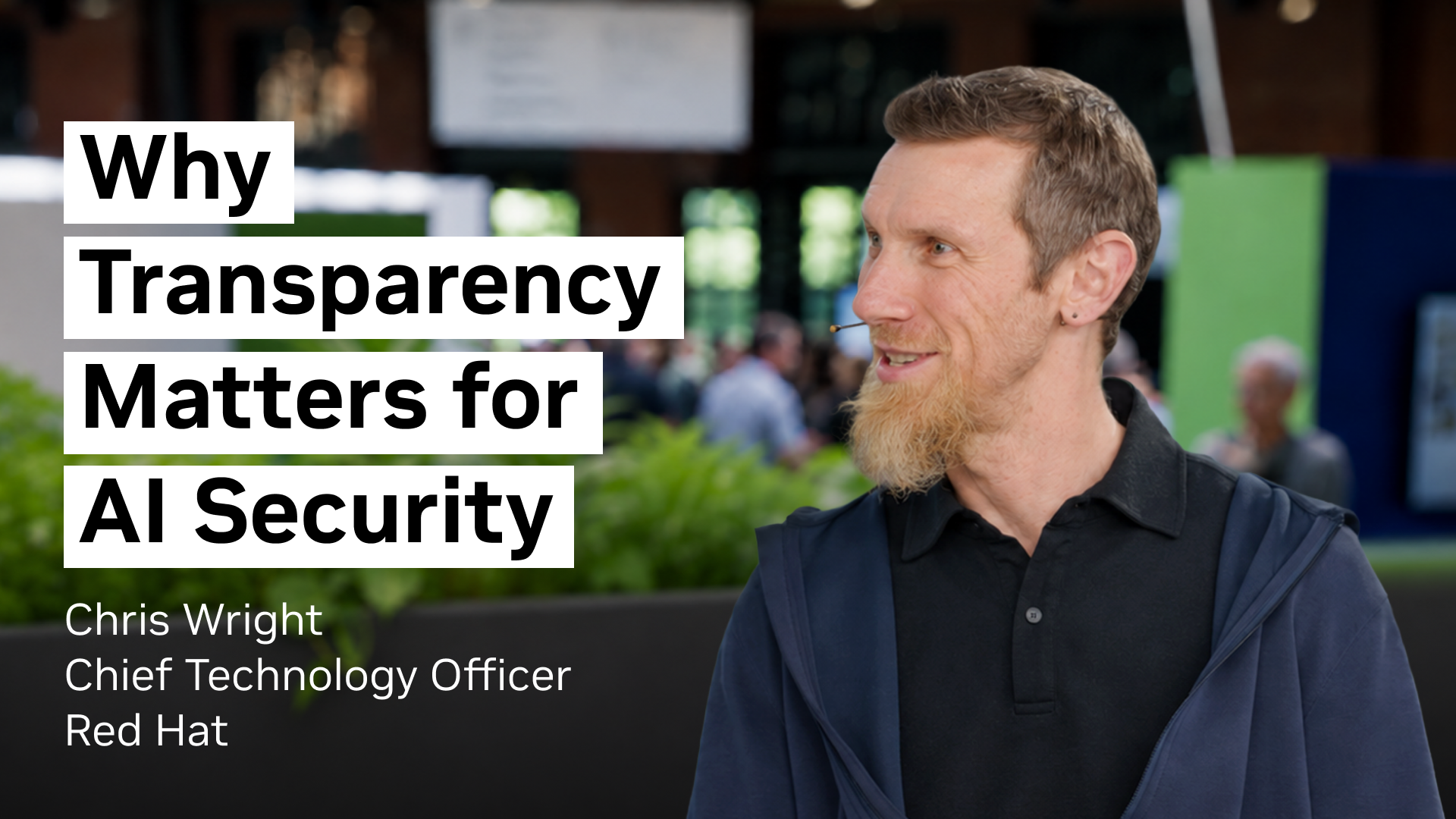
Red Hat CTO Chris Wright joins the NVIDIA AI Podcast at GTC Berlin to explain why open source is the foundation for secure AI agents. From Linux in the 1990s to agent security today, he shares what has changed, what hasn’t, and why “governance is what made us go faster.”
Guest: Chris Wright, CTO, Red Hat
CHAPTERS
00:00 Chris Wright and Linux's enterprise journey
02:19 Why open source still needs evangelizing
03:14 Open source in AI vs. Linux: what's the same, what's new
04:48 Defense in depth for AI agents
08:38 OpenShell and the open collaboration coalition
11:38 Why open standards beat silos
13:21 AI security as an engineering problem
15:52 From OpenClaw to OpenClaw Enterprise
19:23 How governance helps teams move faster
21:42 Why transparency matters for security
23:36 Using AI to find vulnerabilities
26:32 Giving agents clear limits
Follow on Apple Podcasts: https://podcasts.apple.com/us/podcast/nvidia-ai-podcast/id1186480811
Learn more: https://blogs.nvidia.com/blog/ai-security-agent-stack/?ncid=so-yout-497446



Scan the code with your iPhone camera
Listen in the app.