In short
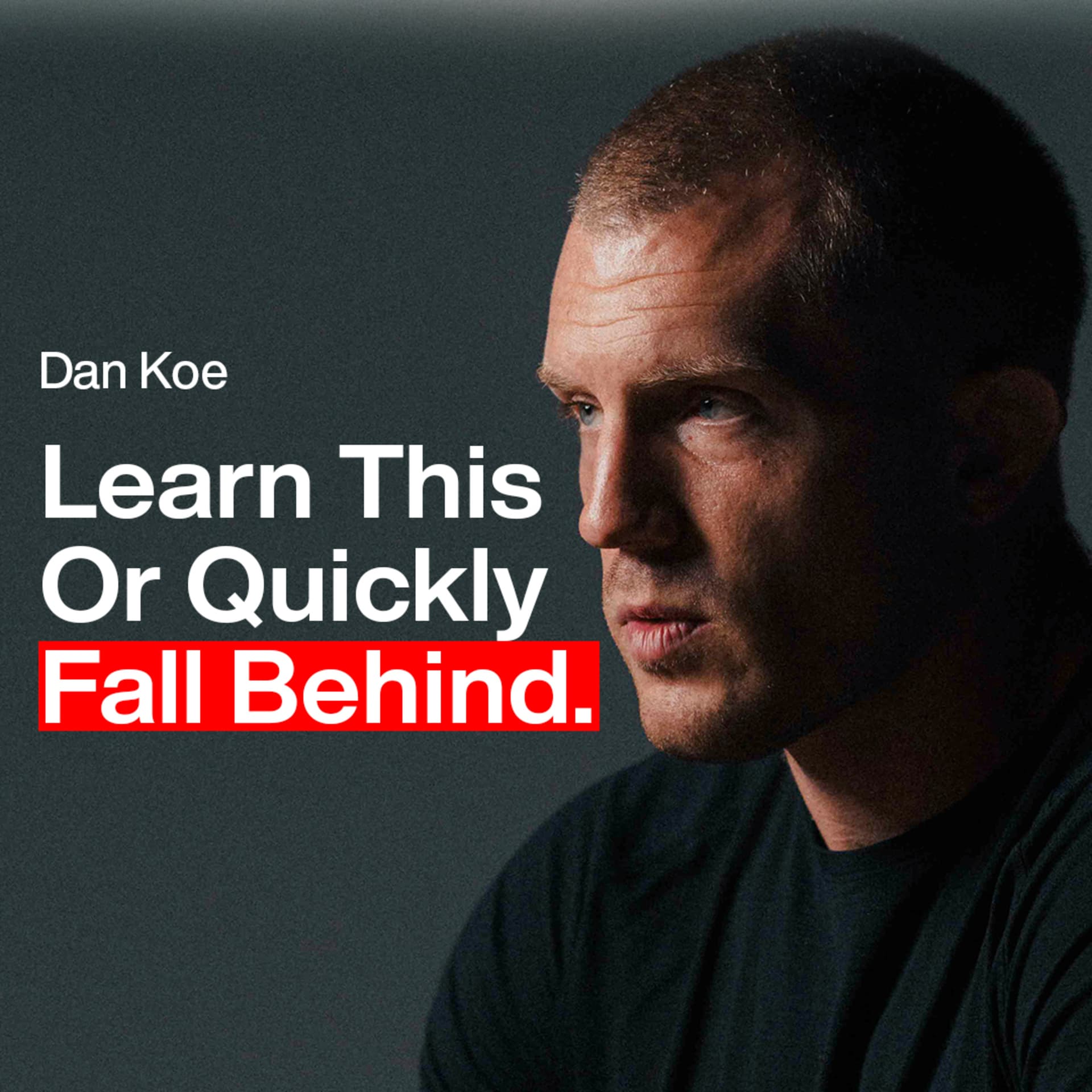
Dan Koe (writer/entrepreneur/personal development thinker) explains how to “get ahead” in 2026 by building a future-proof “skill stack” and a personal content system that creates trust and distribution despite AI/AGI uncertainty.
Guest backgrounds
Dan Koe is described as a writer and entrepreneur, “one of the internet’s deepest thinkers” on personal development, known for building a “one-person empire” and serving as a blueprint for modern creators. He runs a newsletter and produces content across social platforms.
Key claims
- Future-proof skills are learning how to learn, think, and earn, translated into marketing/sales, writing/speaking, and merging “art with business.”
- Value comes from adapting as problems evolve; AI accelerates urgency but doesn’t remove the need to create value.
- Generalists win by setting their own goals and reverse-engineering skills, avoiding status/credential traps.
- Trust is built by avoiding trendjacking, using a unique “signal” lens, and teaching through a funnel (beginner-friendly entry, deeper ideas later).
- Content should be “becoming the niche” by making niche interests interesting to others via persuasion and customer creation.
Notable examples
- “Underwater basket weaving” as a test case: if you can explain why it matters, others can care too.
- His routine: ~3 social posts/day; best post becomes the thesis for cross-posting; newsletter drives YouTube/podcast.
Written by AI. May contain mistakes. Listen to the episode to check what was said.
Chapters
Tap a time to open that second in VOThe Importance of a Future-Proof Skill Stack
1:50 to 4:30
Understand the necessity of developing a diverse skill set for future success.
“But eventually, you will discover something that you can't pull yourself away from.”
Generalists vs. Specialists: Which Path to Choose?
4:30 to 7:20
Explore the benefits of being a generalist in a rapidly changing job landscape.
“Now is just like, it's so urgent that you don't need an excuse to do it.”
Navigating Life Goals and Avoiding Status Traps
7:20 to 9:50
Learn how to focus on personal goals rather than societal pressures or status.
“wanted to do, but it offers more money, it offers more status, it offers some kind of a credential, it opens up maybe new opportunities in life.”
The Role of Adaptability and Change in Life
9:50 to 12:20
Discuss the importance of adaptability and keeping an open mind in uncertain times.
“then you can do almost anything faster, right?”
Building Trust and Meaningful Connections
12:20 to 14:01
Understand the elements of trust and how to create valuable connections online.
“It's this filter for how you actually see the world.”
Creating Interest Around Your Passions
14:01 to 16:20
Learn how to make your interests appealing to others and create your own audience.
“When I say that, and this is a very important thing.”
Resonating Deep Ideas with Your Audience
16:21 to 18:12
Discover strategies to communicate complex ideas in relatable ways.
“for a valuable thing, for impacting their life.”
Consumption with Intent
18:13 to 21:28
Explore how to consume information purposefully to achieve personal goals.
“It starts with having a project or just building something, having a goal and working towards it because that becomes your point of view.”
Questioning Your Current Path
21:29 to 22:52
Understand the importance of assessing your goals and interests regularly.
“And you're saying you need to be passionate and curious about those goals to fuel consuming properly and build on top of those goals.”
The Power of Identifying What You Don't Want
22:53 to 24:47
Learn how defining your anti-vision can guide you towards a better life.
“to think of something else they can pursue, or at least a new aim that they can start working in the direction of.”
Show all 44 chapters
Navigating Life’s Phases of Change
24:48 to 28:00
Recognize and embrace the phases of dissonance, uncertainty, and discovery.
“you will achieve that positive thing so much faster.”
The Importance of Continuous Growth
28:00 to 28:40
Learn why continuous growth is essential for a meaningful life.
“to create that anti-vision that makes you never want to live that life again to kind of slingshot you into the uncertainty phase and then getting stuck there is even more dangerous because then you're not doing anything.”
Starting Your Writing Journey
29:48 to 32:18
Uncover the steps to begin your writing journey and avoid a 9-to-5 trap.
“I think for a lot of people listening, there's this connotation with people that are writers.”
Mastering Copywriting for Success
32:18 to 36:42
Learn how mastering copywriting can enhance your marketing and writing skills.
“of things that kind of overlap in one way or another.”
Navigating Personal Branding
36:42 to 38:58
Explore the evolving landscape of personal branding and its challenges.
“Long form, you can do the same thing, but just do it with one newsletter.”
Finding Your Unique Content Voice
38:58 to 41:01
Discover key variables that drive successful content creation and curation.
“Are there other kind of key variables that you see are common throughout all the different types of content that perform well for you?”
Curating Ideas and Avoiding Burnout
41:01 to 42:00
Learn how to curate ideas and maintain creativity without burning out.
“I look at your brand, I think black, I think white, I think uniformity throughout.”
The Importance of Curated Learning
42:00 to 43:56
Explore how intentional information consumption shapes creativity and productivity.
“I'm either listening to a YouTube lecture or an audiobook or something of that nature.”
Darwin's Work-Life Balance
43:56 to 44:49
Learn from Darwin's approach to work and creativity through balance and rest.
“Darwin, as an example, dude wrote 19 books in his lifetime.”
Daily Routines for Deep Work
44:49 to 46:31
Discover the speaker's daily routine to maximize productivity and creativity.
“I wake up around 5 a.m., sometimes 4, sometimes 6.”
Intentional Learning During Walks
46:31 to 48:27
Understand how walks can enhance learning through intentional information consumption.
“So three tweets, best performing tweet, then becomes a central thesis for your single post on other platforms and the main theme of something longer.”
Navigating a Chaotic Work Day
48:27 to 50:45
Gain insights into managing a chaotic workday effectively while prioritizing well-being.
“And it's very helpful because you can go through the entire walk and not get anything from it.”
Discipline as an Identity Feature
50:45 to 53:04
Learn how discipline relates to identity and how to build positive habits.
“That's insane that you're looked at as someone that puts out a lot of content and you're consistent and it's not that crazy.”
The Impact of Environment on Discipline
53:04 to 54:24
Examine how your environment influences discipline and decision-making.
“so that you can repair it, the pain isn't going to be as painful throughout that change.”
Essential Skills in the Age of AI
55:12 to 56:00
Identify the core skills needed to excel in business amidst the rise of AI.
“I mean, you're in deep work and you're kind of working by yourself a lot.”
Adapting to AI in Content Creation
56:00 to 57:05
Learn how to leverage AI while maintaining your unique creative process.
“space, people in the podcasting space, whatever it is.”
Mastering Prompting for AI Tools
57:05 to 58:39
Understand the importance of crafting detailed prompts for AI effectiveness.
“So if you have your own process, you have your own way of doing things that you've done manually, and then you can pass that off to AI or create a prompt, a prompt, the prompt is the new employee.”
Learning from Experts through AI
58:39 to 1:00:43
Discover how to extract knowledge from experts using AI tools.
“It started as a small prompt and then I'm like, AI can't write tweets.”
The Pros and Cons of AI Chat Tools
1:00:43 to 1:03:10
Explore the capabilities and limitations of current AI chat tools.
“What ideas do you want to include in this?”
Finding Fulfillment in Business Models
1:03:10 to 1:05:31
Examine effective business models that lead to personal fulfillment.
“I think it's a good thing because OpenAI is a company.”
Building and Managing a Community
1:05:31 to 1:10:01
Learn strategies for successfully building and managing a community.
“Most of the time you bake live calls into it.”
Pricing Strategy for Community Growth
1:10:01 to 1:11:55
Learn how to effectively price your offerings to build and retain a community.
“And since I launched this, when I was only on Twitter and only had about like 40 or 50 ,000 followers at the time, I knew that like I wasn't going to be able to blow it up and make a ton of money immediately.”
The Role of AI in Courses and Communities
1:11:56 to 1:13:36
Explore how AI will impact the creation and value of online courses and communities.
“a lot of these courses and communities are very information-based and with the future coming with AI, what's your just overall thesis on just courses and community?”
Personal Growth Through Entrepreneurship
1:13:37 to 1:15:59
Understand the relationship between entrepreneurship and personal growth.
“they're still going to join it for convenience because the creator is the only person who could put the information in that community in the first place.”
The Journey of Building Software
1:16:00 to 1:18:04
Dive into the challenges and failures encountered while developing new software.
“Yeah, it's been like, for myself, it's been around, I think, like 2.5 million.”
Happiness and Dopamine Detox
1:18:05 to 1:20:14
Discover how embracing sadness can lead to greater happiness and the benefits of dopamine detoxing.
“I guess let's start with, is happiness a skill?”
The Importance of Discomfort in Growth
1:20:15 to 1:22:24
Learn how discomfort and tactical stress can accelerate personal learning and growth.
“boredom and discomfort, I think, is very important.”
Navigating Advice and Role Models
1:22:25 to 1:24:00
Understand how to filter advice and choose the right role models in a noisy environment.
“So you kind of have to force yourself into a situation where that deadline exists.”
Exploring High Agency and Open-Mindedness
1:24:00 to 1:25:00
Learn how open-mindedness can enhance personal agency and decision-making.
“Like the underarching principles of all of these are pretty sound and I feel confident enough and experienced enough to make my own decisions and create my own way with this.”
The Role of Information and Money in Development
1:25:00 to 1:27:10
Discover the complex relationship between information accessibility and personal financial beliefs.
“It talks about how music is kind of like an audible art and how writing is like a written art.”
Physical Strength and Personal Bests
1:27:10 to 1:28:50
Hear about personal fitness achievements and the challenges of strength training.
“And I think it's just baked into reality that information will never be free.”
Introducing the Human 3.0 Model
1:28:50 to 1:32:00
Learn about the Human 3.0 model that maps human development across different areas.
“Human 3.0 is like a model that I created for myself to help me think more clearly.”
Utilizing the Human 3.0 Framework
1:32:00 to 1:33:10
Understand how the Human 3.0 framework can provide awareness and guidance for personal growth.
“And then from there, how can I find a path forward and start moving in that direction?”
Defining Success for the Future
1:33:10 to 1:35:30
Explore personal visions of success and the challenges of maintaining an ideal lifestyle.
“It's a prompt that they can go through the whole time.”
Transcript
Automatic transcript. May contain errors.0:00Today we helped a latte for Sam coffee shop get an insurance quote simply and easily and made sure a floral delivery van was able to make someone's day. We're the Hartford with decades of experience insuring millions of unique small businesses. When it comes to your small business insurance. Thank you. One size absolutely does not fit all. Get a quote or find an agent today at the Hartford dot com slash small business. Now streaming. Disney Plus invites you to go behind the scenes with Taylor Swift in an exclusive six-episode docuseries.
0:39Dan Koe:I wanted to give something to the fans that they didn't expect. The only thing left is to close the book. The end of an era. And don't miss Taylor Swift, The Era's Tour. The final show featuring for the first time the tortured poet's department. Now streaming only on Disney Plus. For life to be meaningful, you have to be in this continuous state of growth. Doing nothing is not just staying the same. It's decaying. Dan Koh is a writer, entrepreneur, and one of the internet's deepest thinkers on personal development. He's built a one-person empire and has become the blueprint for the modern-day creator.
1:19Problems are always going to be around. It doesn't matter whether or not AGI can solve all the problems we have today. New technology breeds new problems to solve. So if you have a specific skill that is valuable in today's world, you're going to have to adapt to create value in the future. In this episode, Dan breaks down the future-proof skill stack, how to develop trust with your audience, and the mental models that separate people building real businesses from those playing status games. So you just need to start experimenting. Trust the process. Take the leap of faith. It may take six months.
1:49You may be lost and uncertain for two years. But eventually, you will discover something that you can't pull yourself away from.
2:01What's up, guys? It's Mark. Quick break. Over 80 % of you guys listening are not subscribers. The more subscribers we get, the bigger and better we can make the show. It would mean the world to me if you got value from this episode or any of the past episodes to hit the subscribe button below. Thanks for watching.
2:21So you say the future belongs to those with a future-proof skill stack. What does that mean to you and why is it so important now? So the future-proof skill stack broadly is learning how to learn, learning how to think, learning how to earn. All of those things can be broken down into a broad set of business skills. In my opinion, I think those things are marketing, sales, writing, speaking. Marketing and sales are kind of the same thing. That's the message. Writing and speaking, also kind of the same thing. That's the medium, right? So you need a way to deliver the unique value in your mind and that's the writing or speaking.
3:05And then you need a way to format that language so that other people see it as valuable, right? The starving artists only focus on the writing or speaking. The sleazy salesmen only focus on the marketing or sales. When you merge those things together, merge art with business, that's when you get this very, I think, meaningful set of skills. Which then gives you leverage in the marketplace, which then helps you build distribution in the marketplace and then further cements the skill set. It teaches you principles. I feel like it's always been important and people are only starting to realize it now.
3:42It's becoming very urgent, or at least so it seems online. That's like the biggest right now is like, AI going to take over the world. The thing there is that this is kind of the catalyst to people actually changing their life, right? I'm sure we'll dig into this further, but I truly believe that building your own thing and taking your own path, doing that provides all of these overarching benefits of living a good life. You dive into the psychology of that, the psychology of challenge and learning and skill acquisition, and being able to set your own goals and not enter into this repetitive and mundane style of work that kind of is destructive to your psychology, leading to an unfulfilling life.
4:31The thing with AI coming in to potentially take people's jobs or people being so afraid of where the future is headed, the reason I'm so adamant on building this future-proof skill stack is because it's the thing you should have been doing in the first place, right? Now is just like, it's so urgent that you don't need an excuse to do it. The people of the past who kind of didn't want to live an average life, they had to acquire that future-proof skill stack because it just comes to you by nature of diving into the unknown, figuring out your own way, slashing your way through the jungle, and learning how to learn, learning how to think and learning how to earn.
5:11That's kind of what I would say the future skill stack is, is being able to do many things throughout your life and pursue your own way. Yeah. So this AI thing is just exasperating it and accelerating it and something that people should have been doing regardless. I know you talk a lot about kind of generalists versus specialists. I want to dive deep into why you think being a generalist is so important for this kind of skill stack? The way that I see a generalist is that they set their own goal that they want to pursue rather than being assigned one by someone else. And then they learn what's necessary to achieve that goal, right?
5:52If you simply focus on the skill, which is kind of the specialist mindset in order to then be assigned a job to do with that skill or to kind of be able to fit like a puzzle piece into some place in the economic system, that's where the problem starts to arise. The main distinction between a specialist and generalist is that the specialist focuses on acquiring a skill to fit into society. A generalist focuses on what they want and learns anything necessary to achieve that, which may be one skill that they become really good at, but that doesn't make them a specialist. I feel like it's ultimately about saying this is the lifestyle that I want, and then just ultimately reverse engineering and being non-emotional to the skills that you need to execute against that.
6:37Yeah, and not being distracted from it either by status symbols or credentials. Go deeper. What do you mean by status symbols or credentials? It's not getting stuck. If you have this ideal future, this big grand vision, but then one step along the way is going to school, right? That's not a bad thing if it actually helps you achieve your goal or getting a nine to five job or whatever the stepping stones to that thing could be. You can very much get stuck in that place or get knocked off track because then you begin to chase status rather than what you actually wanted in the first place or what you think you want now.
7:16An example is if I'm offered a promotion at the job, but I know originally that is not what I wanted to do, but it offers more money, it offers more status, it offers some kind of a credential, it opens up maybe new opportunities in life. If you start to go down that path, then you're off track and eventually you're going to realize this isn't what I wanted in my core and then you're going to have to backtrack and go the other way but a lot of people won't do the backtracking because it becomes part of them and it becomes their routine it becomes their new lifestyle and as we get older around the age of 25 the the adult mind starts to crystallize it becomes very hard to change it you can change it but if you can do it earlier in your life and you have the blessings of youth, time, energy, attention, focus, etc.
8:08That's the superpower, is being able to set yourself up for a life where it's difficult for your mind to crystallize. I feel like you're really backing into the importance of just change, the importance of adaptability. I think now, obviously, with AI coming to understand and know what the path is going to be to get to the lifestyle that you want is so unclear. It's more unclear now than it ever will be. So it's just keeping an open mind, I feel like. Yeah. You know what you want now and you may know what you want to do now, but that could drastically change in the future. You may be identifying or attaching to specific ways of achieving goals right now that aren't going to serve you or aren't even going to be around in 10 years, right?
8:55A lot of people are focused on, oh, what skills will be relevant in 20 years? What skills should I learn right now? And we don't know. We don't know if any of the skills are going to be around in 20 years from now. All we know is that we don't know anything. Oh, all we actually do know is that problems are an inherent feature of reality. Problems are always going to be around. It doesn't matter whether or not AGI can solve all of the problems we have today, new technology breeds new problems to solve. So, and problems breed valuable solutions. That's how value is created. That's how value exchange happens.
9:34So whether or not you have a specific skill now that is very valuable in today's world, you're going to have to be able to adapt to being able to create value in the future. If you can learn how to learn and learn faster, then you can do almost anything faster, right? People, again, are so worried about what skill to learn, but if you can learn any skill fast, then it doesn't really matter which one you learn because you can change course in six months. I want to take a step back and just really, really highlight kind of these keystrokes on how to become kind of future-proof. Let's talk learning to learn is one of them.
10:14I think curiosity and adaptability is another one. Self-education is another one. What other kind of key traits do you think are important under the notion that I think we all know that AI is going to take a very large chunk of the jobs coming forward? So in terms of the moats or what is going to make a person future-proof, and this isn't very practical because as mentioned, we can't really get practical because we don't know what practical skill is going to be the best 20 years from now. But what I think we can bet on is taste, signal, narrative, and trust. So those three things, narrative being one of the most important because the mind or human mind makes sense of the world in stories.
11:01And that's where we derive meaning from is that story. So how can you bake that into your work? I want to touch base on trust. I think for anybody right now, understanding and knowing that AI is coming soon, building distribution and building trust, I feel like are by and far the two most important things. I know that's one thing that I feel like that you've done better than almost any quote-unquote personal brand that I've seen on the internet. What are some of those key things that you've done over the years to build trust with your audience? I feel like the trust comes down to not falling into the temptation of trendjacking and just doing what's popular.
11:41It comes from signal, right? It comes from reading the things that you find interesting, learning the skills that are going to take you towards the next step in your life. and when you do those things and when you filter reality through your own unique lens you notice the things that signal that dopamine response in your brain right you and I both read the same book we're eventually going to reach a paragraph where we get very excited we see an idea and we're like ah yes that's a great idea but that's going to be completely different for both of us right so you have to lean into who you are. Who you are is this web of ideas.
12:22It's this web of beliefs. It's this filter for how you actually see the world. So being able to spot what is important to you and then illustrate that importance to other people in the form of content or online, that's kind of how you build trust, right? Not just doing what other people want to hear, but sharing what you find extremely valuable. Something that you say very, very often is about becoming the niche and being uniquely you. I'd love to know directly in relation to that is what happens when all of your content is very much so focused on one thing and then you start veering off and trying new things and that really performs really well?
13:06Do you need to just follow your curiosity and your passions and wherever it may go is what you should be doing tactically? Kind of, sort of. Whenever it's, maybe it's only in niche pockets of the internet where I see it, but there's just this constant argument of should you niche down or should you quote unquote become the niche? If you just observe the internet, there are people who have done both. And since people have done both, they're both valuable or they're both viable routes to go. If you think clearly about it, you can go either way. The reason why I argue for becoming the niche or why you are the niche is because it makes you focus on what actually gets results.
13:45You learn the game that much faster. You're not just teaching and educating and again, saying what other people want to hear and kind of limiting your mind and what you learn and what you're exposed to, to that specific thing. You have to focus on making your interests interesting to other people. When I say that, and this is a very important thing. It's like, okay, well, what if I want to talk about underwater basket weaving and nobody likes that? You like it. That means other people can like it too. And that's the entire creative puzzle you're trying to solve. How do you illustrate why it's important to you, how you found it interesting?
14:26Reverse engineer that process and guide other people towards it, right? People talk about, oh, what if I have this product or this book that I really like and I think is very important or valuable, but other people aren't going to see it as that, persuasion. You have to learn how to persuade. You have to learn how to create your own customers, right? That's a big gripe I have with the space in general is people are trying to find this product market fit, which is a very good thing, right? You should do that. But it gets you in this mindset of trying to find people that are already interested in what you do rather than creating interest in what you do.
15:11Because if you learn that skill, then the results of that, the outcome of that is almost infinite because you can bring as many people into your audience as you want and show them why what you do is important. And then they can adopt that as a part of their life and see a lot of value from that. And then you're dictating your own lifestyle because you're just ultimately just following your curiosity, following your passions, figuring things out, learning new things. Well, you can do whatever you want. Yeah, because it's like if you are trying to reach this vision, you're trying to create this ideal lifestyle, anything you do along the way that you deem important for achieving that thing, other people can benefit from that too.
15:53And so if you can, again, illustrate the importance of that on the internet, in front of people and guide them from beginner to advanced or no awareness to problem awareness to solution awareness, which is you, then again, you create your own customers. And a lot of people that may not hit just yet, but that is such a powerful thing because then it's not a matter of finding people who will pay you money. It's creating people who will pay you money for a valuable thing, for impacting their life. is there like a system or like a group of key things that you put in all of your content yeah to make it resonate with the audience yeah a lot of people ask me like i have all of these deep esoteric interests but how do i start writing about those because nobody's going to like it it's just going to go over people's heads i feel like what i've done really well not to toot my own horn is I can take those deep spiritual philosophical ideas that sound very wispy, sound very clever.
16:57They make sense to me. I think there's something there. I know that 80, 90 % of the markets are either beginners or have never been exposed to any of the sequence of ideas that allowed me to see that idea as important. So if I can take that idea and introduce people to it or somehow write the essence of that idea in a more palatable way, especially on social media, it depends where you're writing this, then that's how you start at least, right? You have Twitter, Instagram, TikTok, et cetera. The super deep ideas probably aren't gonna work very well there, but at the bottom of your newsletter, after you've already introduced the topic, you've kind of brought the beginners up to speed and then you hit them with that deep stuff, That's what really builds the trust is you providing the fast track for people understanding these very deep things.
17:56And this is all, it's basically like a whole entire funnel. You're starting with consumption. Are you just reading a lot of things, watching a lot of things? And then ultimately what's that process? Are you then going to your journal and writing things down? Yeah, it overlaps with learning how to learn. They're very similar processes. It starts with having a project or just building something, having a goal and working towards it because that becomes your point of view. I don't like to think of goals as something that you achieve. They're points of view. Once you reach them, you can look back and you have all of this experience that you can pull from now.
18:33But on the way to it, once you have this goal that you're pursuing and you've invested energy into it, your mind is this machine that wants to achieve its goals. what your mind is going to do via pattern recognition is it's going to increase dopamine levels in your brain when you find an idea or a resource or a tool that will bring you closer toward your goal. So I systemize this by having a newsletter every week, sometimes a product that I'm building or really any project, any goal that you're trying to achieve. Once I have that, anything I listen to or read or consume, I'm not doing it to necessarily learn what that thing is.
19:20I'm just waiting for ideas to pop out to me. And once those ideas pop out to me, it usually connects to one of the goals or projects. So if I'm writing a newsletter on business that week and I read a philosophy book, an idea sticks out that's kind of related, but I see the relation. I note that idea down. And once I have enough of those and I can then, let's say, write that newsletter on business with the philosophy ideas, then that creates this very unique thing, right? But it makes sense because they all tie together, at least in my mind. In relation to that's how you learn, it is how you learn, right?
19:57You can sit down and watch a course for 30 hours or read an entire book on a topic. But if you don't have the goal that you're working towards, you don't know which aspects of that information actually works because you haven't tested it in reality. Let's zoom out for a bit. So you have a couple of these goals. Ultimately what you're saying, it seems as though it's just consumption with intent. So if you're working on X goal, you are literally just filtering anything and everything that you consume and how does it speak to that goal? How does it help optimize that goal? Is that basically what you're doing?
20:31Yeah. Interesting. That makes a lot of sense. I mean, for me, when I read a book, I always on the left side of the books, I just write little notes on how can it help my business? That's basically the same exact thing that you're doing. Yeah, well, that's why you're kind of reading in the first place, right? So there's two different ways of doing it. I'm more so like, I listen to things that could potentially aid in achieving my goals. Yes. And that's where the superpower happens. But even if you read fiction and you're like, imagine that you're one week out from a deadline on a project. That night you read fiction, you read this really good story.
21:03I'm pretty sure it will almost always tie into what you're doing. That's the interesting thing is everything you consume conforms to what you're trying to achieve. That's why, tying back to the beginning, assigned goals by society versus generating your own goals is so important. Because if people assign you goals, then like your entire learning, your entire mind is hijacked. Because your mind is trying to make sense of every single thing you consume in alignment with the goals you're pursuing. And you're saying you need to be passionate and curious about those goals to fuel consuming properly and build on top of those goals.
21:41Yeah. It's not as simple as this, but it's as simple as ensuring that the goals that you pursue were created by you. Makes a lot of sense. For everybody out there listening or watching, I think a great exercise to do is to just, here's your two big goals and then just focus for a full week. Anything you consume, how does it help you achieve those goals? Something that simple, I think is a great exercise for everyone to do. Yeah. And even reflect right now, right? Because think about the things that you're pursuing in life right now, whether you want to or not, or whether you're conscious of it or not.
22:11Are you just going to school? Are you doing what your parents wanted you to do? Whatever. Start questioning it. Just ask, is this leading to the life I want to live? That's the most important question. Is this something that I actually want to do? Is this something that's going to bear fruit? If I were to keep doing the same things for the next 10 years, where would I end up. And the unfortunate truth is that 90 % of the people who do that right now, that practice, they will not like where they're going to end up. And if they really sit with that, and if they don't hide from it, and they don't try to avoid it or suppress it, they just become aware of that, where they are heading.
22:51That will give them enough fuel to think of something else they can pursue, or at least a new aim that they can start working in the direction of. I feel like the ability to unlearn is actually a huge skill as well. What are some of those kind of big ways that you can start unlearning things? Is it just these different exercises of just taking a step back and deciding your purpose, deciding on the things that you don't want? Yeah. I'd love for you to talk about the power of the anti-vision. I know that's something that you talk about a lot in a lot of your content. What does that actually mean in practice?
23:25Yeah, it's kind of inverting vision. So having a vision for the future, it's an important thing to do. It guides a lot of your life. But you ask a 15-year-old what they want to do, they'll either say something that's way out there or they'll be like, I actually don't know. Like right now I'm just supposed to go to college and get a job and that sounds okay. I'll just go that route. So you ask a 20-year-old who's in the job and it's like, well, if they don't say I'm going to work here or do this, or if they don't know, they're just going to be like, I don't know what I want to do. That's a big problem in today's world.
23:58You don't know what your vision is because it's imaginary. It's in the future. It's made up, right? So a good way to at least start forming that is to really focus on the life that you do not want to live. that is such a powerful practice is what is the lifestyle that disgusts me? And go through the entirety of your life. Sit for 30 minutes alone, potentially in a dark room, and just think. What life do you not want to live? What kind of body do you not want to have? How much money do you want to have or not want to have? How much is not enough? Once you are there, that starts to create this very potent source of negative energy.
24:40So if you can master this process of focusing on something so negative and then taking it, transmuting it into something that's so positive, you will achieve that positive thing so much faster. Makes a lot of sense. I feel like a lot of people are paralyzed by too many different options. I feel like that's a big thing. What is the process that an individual goes through? If you're lost, what are those kind of key indicators to understand and know that you're on the path towards doing something that you're ultimately meant to do? I think it happens in three phases, right? When you're about to level up.
25:18There's the dissonance phase, the uncertainty phase, and the discovery phase. The dissonance phase is kind of when you've gotten the taste of the level that you are at right now, right? You've been in it long enough. There's nothing really novel anymore. It feels kind of repetitive and mundane. It's kind of demotivating. And you're thinking like, I don't really want to live this life anymore. And some people don't notice that. But what naturally comes after that is the uncertainty phase, because you don't know what's next. And you're kind of just lost in the unknown. You're like, I don't know what to do.
25:56This doesn't sound interesting. This doesn't sound interesting. but if you understand, okay, this is the signal that I'm in this season of change, I need to lean into that. So you just need to start experimenting. That's really it. It's a process of experimentation. Try new projects. Say yes to everything. The person that invites you out, even if you don't like going out, go out. Do something bold. Move into a new apartment. Just make some kind of change physically or mentally. Expose yourself to new information. new books. Just do something new. One new thing every single day. If you do that, you will eventually discover something that you can't pull yourself away from.
Read the full transcript
26:40It'll just pull you in. I wish I could give some set of practical steps to go from loss to knowing where you are. But if I were to tell you that, you would be doing what I want you to do, not what you want to do. And that's scary for a lot of people, but really just try, trust the process, take the leap of faith. It may take six months. You may be lost and uncertain for two years, but eventually you reach this point of finding something. If you don't attach to the thing that other people want to assign to you, the status symbols, the credentials, the goals that your parents tell you you should have been achieving, you will find at least one thing to pursue.
27:22And I feel like these kind of three prongs lend itself to everything. It's ultimately like you're just finding clarity through doing a bunch of stuff, basically. Well, the thing there is just not getting trapped, right? Because a lot of people get trapped in the dissonance phase and they never allow themselves to be uncertain because they are so stuck in doing mode. They're just in this repetitive mundane routine, but they're so numb to it at this point that they wake up a year later and like I don't remember what I did for the past year. It's like it just all felt like a blur. So if you don't become aware of that, notice that and allow yourself to go into this uncertainty phase to create that anti-vision that makes you never want to live that life again to kind of slingshot you into the uncertainty phase and then getting stuck there is even more dangerous because then you're not doing anything.
28:12For life to be meaningful, you have to be in this continuous state of growth and that doesn't always involve achieving new or better things. You could regress technically but it's just not allowing yourself to decay by staying the same. Yeah, I say all the time I figured out my ultimate happiness is directly related to how much I'm growing in all different areas of life. If I'm not growing, I'm absolutely miserable so I agree with you there. Guys, quick break. This episode is sponsored by Universal Ads a division of Comcast. I've spent tens of millions of dollars on meta ads. At one point, it was 95 % of my marketing spend.
28:51That is super dangerous. With one algorithm shift, your whole entire business can stall. A great option is layering in advertising on streaming TV. I thought it would take weeks to set up and a big agency to maintain. Guys, it took five minutes. Universal ads gives you direct access to a ton of premium publishers. NBC, Paramount, Roku, all the big networks. 100 % of your spend goes to actually reaching people, not middlemen. And the best part is there is no fees. Same workflow as Meta, upload your creative, target your audience and launch. I've already moved massive brands spending millions of dollars a year on CTV over to their platform.
29:28I've negotiated ad credits for my audience, plus free creative and measurement services. If you're running CTV or spending six figures plus a month on paid, email us at info at openresidency.com with subject line universal. Platform dependency is dangerous. Don't make that mistake. Link below for more. You are clearly a writer. I am not a writer. I think for a lot of people listening, there's this connotation with people that are writers. You definitely, for people out here that are on the audio, not the video, this is like a 6 '5 monster that just walked in. I don't look like a writer. You definitely do not look like a writer.
30:04I guess at its simplest form, how does someone start their journey with just writing. Yeah. Well, the 80-20 of my story is that I never wanted to work a 9-to-5 job. I don't know why. I just saw it as the bane of my existence. It sounded terrible to me, but that led to me just trying all of these different business models and learning whatever I could to avoid that. That was my main goal. Just avoid the 9-to-5. Wasn't very specific. I failed at all of those business models from dropshipping to agency work to freelancing to digital art to photography. And I ended up having to get a job because I just wasn't making any money.
30:50It didn't work yet. I was in my fourth year of college. I'm like, crap, I can't keep taking out loans. I need to get a job. So I did that. It was in web design. And while I was there, the job was very cushy. I didn't really have to do anything. I kind of just copy-pasted website templates and could finish my work in an hour. Sounds like a standard job. Exactly. But for the first four to five hours at that job, I would just focus on manual client outreach. I would try to get clients for freelancing. And as I was learning and studying, that eventually worked. It took a bit, took like eight or nine months, and then I was able to quit the job.
31:28as I was doing the freelancing and scrolling Twitter, I started to see people who did what I did. They were freelance web designers. They were writing content. They had a good amount of followers, like 40 to 80 ,000. And I would see their content and I'm like, I can write this. Like they're saying things that I know. I didn't see it as a lot of people see it getting into the creator space of like, oh, they're just saying all of this basic stuff that sucks. That's meaningless. Like they're not viewing it from the lens of a consumer who doesn't know about those things. So I'm grateful that I could see it like that of like, I can write that too.
32:04And I remember that I benefited from that type of information so much. So I'm going to start. I started and since I had previously failed at all of these different business models and I had slowly stacked like a base level of copywriting, marketing, sales, branding, client outreach, all of these different of things that kind of overlap in one way or another. I kind of had the gist of how to write something engaging, how to grow, how to reach out to people, how to build a network, how to kind of pull myself up along with other people. And then I was able to land clients from that on Twitter, of all things, and eventually started to transition into what I do today because I didn't really realize at first that you're a writer if you're on Twitter.
32:54And so then people would ask what I do, and I would want to avoid the deeper conversation of talking about it. So I'd just call myself a writer, and that didn't help because people dig deeper into that too. But that's kind of how I became a writer is I realized I'm writing on Twitter. I'm just going to call myself a writer, got into the newsletter stuff, and then really just fell in love with that process. If someone is going to kind of get into the space and study the space, should they be studying copywriting? Is that something they should be studying, do you think? Very good thing, yeah. When I say learn marketing, sales, writing, speaking, it's kind of a difficult thing to do, right?
33:32There's courses on digital marketing, but they're very broad. So I do think it is valuable to study a very hyper-specific skill where they have all of the frameworks, they have the principles, the industry trust and knowledge. If you study copywriting, you're going to learn 95 % of marketing sales and writing. And it's going to branch over into speaking. Ultimate trifecta right there. You learn them all in the form of writing, which you can then extend out to other mediums. What about the actual action of writing? As someone that does not write, doesn't physically write much and doesn't journal much, what do you recommend to someone out there that wants to get into writing?
34:13Should they just freely write on the pages once every day when they wake up in the morning? How should they get into writing? Start with short form. on social media, go on Twitter, on threads, maybe not on blue sky, sub stack, Instagram, just write into an image template and post it. But how do you start doing that? You create a list of 10 people that you love their ideas. They have great writing. It can be an author. It can be someone on social media. It can be a YouTuber, whatever it is. You're creating this like aspirational idea museum. You have this just list of ideas that stick out to you.
34:55And if you refer to that often and look at it often, the writing patterns will start to like seep into your brain and you'll slowly notice yourself start to write like them more. What I recommend doing from there is find a few posts, let's say five posts that are very engaging from them that have gotten a lot of engagement. And you're just going to sit down and you're going to write five points for each of those posts as to why they did so well. And you're just going to brainstorm reverse engineer. And that is how you're going to learn how to write. Now you're not going to look at the posts anymore.
35:31You're going to take that big list of why those posts worked. And you're going to take your own ideas and you're going to try and follow those points. and you're going to write five posts of your own without looking at the ideas of the previous ones. That's an important part. Then you're going to post those, see if they do okay, and then start refining and iterating. After that, and only after you've done it manually, I would recommend you take the five posts that you were inspired by, you're going to paste those into AI, and then you're going to ask them to break it down and teach you how to write those.
36:06Wow. and then it's going to spit out this mega guide, tell it to create a mega guide on how to write very high engaging tweets. They're not going to be templatized. They're not going to be whatever. It's going to break down the psychology. It's going to break down the principles. And now anytime you write tweets, refer to that first. You just kind of self-created your own course there. And then you go about that and you can just rinse and repeat, right? You just did that with five posts that you were inspired by. Do it with the next five and the next five and the next five. Do that for a month and you will feel very competent as a writer, at least in short form.
36:43Long form, you can do the same thing, but just do it with one newsletter. That's amazing advice to give to anybody. So ultimately that comes down to really just your taste and the subject matter. And then you're just dissecting the rationale and reason why anything is working. And you're just plugging them in together using ChatGPT or something like that. Yep, pretty much. Wow, that's something good that anybody can use. I want to get into a little bit more about personal brands. I've seen you say some pretty controversial stuff online about how personal brands are no longer personal. What is your thoughts on just the climate of personal brands in 2025?
37:18I feel like people get into it because they want to do something meaningful, and then they just get trapped in the personal brand rat race. They want to get out of a 9-to-5, and they build themselves into a new 9-to-5. And it's like, this isn't why you started writing. This isn't why you started creating on YouTube. And people can notice, everyone can notice that if you go on YouTube, it's starting to become homogenized, which isn't a very big problem, right? Like all the cars look the same. Like there's very minimal difference in like the cars you see on the street, even the super nice ones, they all have the same shape because that's the most effective and efficacious way of like creating a car.
38:01but in YouTube videos and social media content and personal branding, that's also the case. But what I would encourage that you do is try to, again, reverse engineer and dissect why a personal brand or YouTube video does so well. And then take your most interesting ideas, take the ideas that made you want to start as a personal brand and fit it into those principles. but like it's difficult but you have to get used to posting things that will probably be duds. They won't go anywhere but once you experiment enough and you listen to enough feedback that's how you create kind of your own launchpad and then you aren't so dependent on the templates or copying other people's titles or thumbnails or other things of that nature because it's all just natural to you at that point.
38:50Is there any other elements just on the content side that you've seen perform very well? Obviously, we've talked about storytelling is a big element. Are there other kind of key variables that you see are common throughout all the different types of content that perform well for you? Is there anything that you see that's a big driver? Yeah. Novel perspectives are a big one. I feel like if I do not write a newsletter or create a YouTube video that teaches someone something new, then it doesn't do well. What I'm trying to do is usually provide this big insight that people aren't looking for. Because the video can be about, oh, here's how you start a business.
39:28Here's how you make a ton of money. Here's how you start writing. But before any of that, before I get into any of the steps of doing that, I hit them with something from physics or something from philosophy or something from psychology that I feel like is so rare that once they read it, that's enough. That sticks with them for their entire life. We mentioned that on your YouTube videos, which I thought was so unique, is you start with this social proofing of some sort of quote from someone that is very high up in their space. And it's vague in nature, but it starts the video off with a curiosity gap.
40:04Yeah. In terms of content creation as a whole, curation is such a big skill. If you can just get in the habit of when you see this good idea that you wish you wrote, write it down, screenshot it, add it to a Google Doc or your notes, save it somewhere, and try to turn that into some form of different content or include it in some form of long-form content, be it a newsletter or whatever it may be, write about that topic. If I see a great quote that like, I just love that, I'm going to take that. I'm going to throw that at the top of my newsletter. That's the topic. And now I'm just going to outline the rest of it and write that out.
40:46And you'll be surprised like how well those do. Because if an idea, as mentioned before, is so interesting to you, your job is to transmit that interest to someone else. What about from an aesthetic perspective? I look at your brand, I think black, I think white, I think uniformity throughout. How does aesthetic play into brand building for you? It played in a lot more when I was doing those animations, the reels. Now it's kind of just simplicity. It's kind of like a cop-out, honestly. It's like why Steve Jobs only wore a black shirt and light pants. It's because it allows me to focus on the ideas.
41:26I feel like that's the major mover. and if I don't have to make any other branding decisions, we have the font, we have black and white, simple. I just focus on the writing, getting the content out. You keep talking about ideas. I feel like you're an idea machine. It reminds me of Oren. He's another idea machine. How do you not burn out from creating? I mean, you put out a ton of content. Is it just intentionally consuming in dedicated hours or what does that look like for you? Yeah, it's kind of baked into my life at this point. I go on walks one to three times a day. I'm either listening to a YouTube lecture or an audiobook or something of that nature.
42:07I'm not always taking a bunch of notes. I'm kind of just letting the information circulate in my head. Sometimes I'm not even paying attention to it. But I do try to keep a constant inflow of the ideas that I want in my head, right? Because any information you expose yourself to is going to shape your mind in some way. I want it to be shaped in a good way. And so that's a routine is just conscious and intentional and curated learning or information or consumption. Because then that is going to, especially when you're not working, I like to think of in general, the mind working in two ways. There's productivity mode and there's creativity mode.
42:47There's narrow focus, there's open focus. Both of those come with vastly different characteristics. When you're very narrow, focused on a task for productivity, you're not really having these creative breakthrough ideas or thoughts. And so if people get stuck in that mode, then their work is going to start to suffer from that unless their work is very repetitive and mundane. So that maybe that's a way to tell whether you are doing meaningful work or not, is, is my work suffering from a lack of rest? If it's not suffering, then the work isn't too creative and you're not in too much control over it.
43:28And it's kind of like an assembly line style of work. Now, the creativity state of mind is more open, not really focused on anything, really. It's when you're on a walk. It's when you're not at work. And that's what creates space for emergence in your head. When you're not thinking about anything, when you're in the shower, that's when your best thoughts come to mind. And so being able to incorporate or have blocks of time for each of those in your day is, in my eyes, a very important thing to do. Darwin, as an example, dude wrote 19 books in his lifetime. He worked three to four hours a day. He created the theory of evolution.
44:06Everyone knows who Darwin is. He had a very lax life. Like he had the intense bursts of focused work and then he'd go on a walk. He'd read letters from fans. He would spend time with his family. He'd play games at night. He would just like not focus on work. And to a blind eye, it looks like all of the work is done in those three to four hours. It's all day because that's his life's work. Let's get into routine. You're very much known for deep work and everything around that. What does a day look like for you? And you can kind of disseminate it between the deep work, the productivity, the creativity.
44:44What does it look like for you? Yeah. Sometimes it shifts. So I'll just go over the average day. I wake up around 5 a.m., sometimes 4, sometimes 6. I take out the dog and then go straight on a walk. It's usually about 30 minutes. I don't really listen to much during this time. It's kind of just like, hey, body, you're awake. and then I'll - You had the caffeine yet? No. Okay. Not because it's like beneficial not to or anything. I think that was debunked about like the whole adenosine. Like don't drink coffee the first 30 minutes of your day. It's just because I want to maximize the caffeine for my work and drinking it like out.
45:23I like the coffee as I'm sitting down. It's like a natural thing. He's saving his milligrams for optimal deep work time. I'm with you on that too, bro. Yeah. I have a max amount for the day and I'm like, I'm waiting for this. I'm holding it off until I need it. Yeah, exactly. So 30-minute walk, come home, shower, and then get straight into about two hours of writing. That writing consists of usually three social media posts and then one section of the newsletter. That's really it. One day out of the week, I'll record the YouTube video. So you mentioned earlier, like, oh, you put out so much content.
45:57It's really just the consistency deal where the three posts a day on Twitter, then I take the best one, post it on Instagram, post it on threads, post it on Substack, post it wherever. The newsletter creates the outline for my YouTube video. And then the YouTube video also gets posted to podcast platform. So I have covered all social media platforms with three posts a day and writing for about 30 to 60 minutes of the newsletter. And then that's the core of my business in a sense. Let's stop there for a second before we get into the rest of the day. So three tweets, best performing tweet, then becomes a central thesis for your single post on other platforms and the main theme of something longer.
46:40Yes, it can be the main theme of something longer. That's mostly the case. Other times I'll pull from like the curated list of ideas that I have that I mentioned earlier of like if I really liked an idea from someone else and I really want to write about it, I'll just throw that one in. So no real structure there. It's like once I send the newsletter and have to write the next one, I kind of just like think for a bit, look through my notes, look through my tweets, pick one that I actually want to write about and then write that. So two hours of deep work where you are writing, you're creating.
47:15Tell us about the rest of the day. Yep. After that, I'll eat and then go on a walk. And on that walk is more dedicated to intentional learning. how I do that most of the time is on YouTube I just go to my watch later and I always add stuff to that and I'll just look for something that I find interesting and post it so I don't really like consume randomly on social media it's very intentional where I'll scroll on the timeline but I never really watch something if something catches my eye I just add it to watch later or if I see something posted on Instagram or Twitter, I'll go to the video, add to watch later.
47:55So when I go on my walk, I can just see that there. If I'm reading a book, sometimes I'll read from my phone on the walk. Probably not the best practice, but you get a lot of reading in. An audiobook, sometimes, if it's something I really want to listen to. And that's when I'll take a lot of notes. So if an idea sticks out, I'll pull out my phone, take the note. that usually sparks more ideas and it helps me notice more ideas later in the walk. So the sooner you can take an idea when you're on the walk, the more you're going to have throughout the walk. That's an important point. And it's very helpful because you can go through the entire walk and not get anything from it.
48:34You're just saying write down something sooner than later to initiate like getting the ball down the field. Yes. And it works really well. Guys, he just looked at me with a very, very serious face. That's definitely like a random cheat code that you've tested tried and true there. Yeah, I say that because like this isn't this routine thing. It sounds very stable and consistent as we're saying it, but I get knocked off track all the time. Like my second walk of the day, sometimes I'm walking and I like get back to my house and I'm like, did I even like go on the walk? Like I just lose track. And of course, when I notice that I want to get back to like the very effective and impactful walks.
49:12And so I've noticed over time that the sooner I take note of an idea, the more come to mind as I'm doing it because something in the brain happens. It creates the filter and the template for the rest of the information that you process. What about the rest of the day? I have this weird inkling that there's not much marketing and sales and it's just done through the content. But you do this deep block and now it's mid-late afternoon. Where are you at? Yeah, I go to the gym. After that, I'll eat again. I'm eating a lot. nowadays trying to grow. But throughout this entire time and later into the day, it's kind of like very chaotic, distracted work of like responding on Slack and responding to people on Telegram.
49:54And it's a lot of communication because that's kind of what most of the work has become for me now. And if something does come to mind that I need to do, I'll do one of two things. I'll either take note of it so that I can do it in the morning work block, or if it's very important. I'll just sit down and start doing it. So I'd say from like two o 'clock to five o 'clock is very free flow. And after that, usually go to dinner at around five. It used to be really nice dinners. And now that I'm getting a bit more strict about my diet, it's like protein house, which is just like clean eating. Then after that, spend time with fiance.
50:33And usually that's like when I'm offline. I try to create a hard stop at seven and just not responding to anything. It can wait for the morning. That's insane that you're looked at as someone that puts out a lot of content and you're consistent and it's not that crazy. So what do you think is the real secret to being disciplined? You seem like a very disciplined individual. It's been a lot because I think discipline is a feature of identity. A lot of people just go through the motions. They go to school, they study, they get the job. You're arguably disciplined. You're reaching new milestones in your life.
51:10A gamer, for example, I used to be a gamer, is I would just be waiting to get home, log on, and start playing. And it's like, if that's not the definition of discipline, I don't know what is, right? Especially the way to notice this is what are you doing that is frictionless right now? Is it eating the junk food? Is it bad things or is it good things? that's discipline. You just need to learn how to deconstruct what got you there and then put it in the other direction. So the way we do this is that anti-vision practice. It's questioning. Where are my actions taking me? If I keep doing the same things, where am I going to end up in 10 years?
51:51From there, from that negative source of energy, it's like if you actually become aware of it, if you are not disgusted with that, you're doing it wrong. Just continue sitting with it until you really become aware of it because you will reach this point of like, that is not, I'm not going to allow myself to get there. Once you reach that, that's the point, the inflection point of identity change. That's when you can start to move in this new direction. Is it going to be super easy the first time around? Probably not. Are you going to relapse and regress and have to bounce back and forth? There's no easy way to do this.
52:29It's going to require a lot of pain because if you think of your identity as like a house, like a literal, that's what an identity is. It's this mental body. If you were to rip out the foundation of that house, it's just going to come collapsing down. Your mind doesn't want you to do that, right? That's when the negative thoughts and worries start to come into play because it's telling you not to do that. It wants to stay the same. It's a survival mechanism. So what you need to do is you need to take it step by step and you need to understand, if you understand that you are damaging a house so that you can repair it, the pain isn't going to be as painful throughout that change.
53:14So when you start moving in a new direction, you can move with that perspective in mind and you have this bane of your existence, anti-vision, that you are like holding in the back of your mind to keep you on the right path until it becomes natural, the new way of life that you're creating. How much does an environment play a role in this kind of whole entire ethos of being disciplined? A lot. There's this broken windows theory where there was a area with broken windows in the buildings, like a city. In the other area, there was clean windows and they tested it. And the broken windows area just had naturally higher crime rates just because that was the environment they were in.
53:59The clean windows, people wanted to keep it clean. So it's like, that's a throwaway study that could potentially have some cool ideas with it. But if you, you can just see it. If you have a room that's extremely messy or you're surrounding yourself with people that aren't where you want to be in life, naturally that's going to seep into you. Yeah, and that goes for people, that goes for the content you consume. I mean, that goes for anything and everything. Guys, this episode is sponsored by ManyChat, the tool that is quietly powering all those comment to DM posts that you guys are seeing across Instagram.
54:35I am personally a power user of ManyChat. I absolutely love it. I use it for my personal brand, the podcast, and Iconic. When we started using it, Iconic was doing 8.5 million impressions a month. We're now doing over 20 million impressions a month. It boosts engagement. It drives more reach. It allows you to collect emails and segment them with crazy precision. In short, you create a customized experience and you can collect data. They're met as official business partner, trusted by over a million accounts, and it's free for your first thousand contacts. The links below in the description start turning your comments into conversations.
55:11We had talked a bit off camera. I mean, you're in deep work and you're kind of working by yourself a lot. I know you're working on a bunch of new projects, which we'll get into. From like a business perspective, you know, you've built this brand over time as basically like a, you could say like a one man team. With AI coming, obviously like the fundamentals of business are going to kind of change a bit. What do you think are those core skills that are always going to be necessary to win in business now that AI is coming? having your own unique process. The way I would illustrate that is anyone can go into AI right now and just ask like, hey, write me a viral YouTube script.
55:51And that may get them some kind of result, but they didn't earn that knowledge or experience. But if you take a step back and look at the YouTube space, you have Alex Hormozy, you have Ali Abdaal, you have people in the gaming space, people in the podcasting space, whatever it is. If you were to take each of them and ask them what their process is, they would give you somewhat similar answers, but they would still be very much different and unique to them. That alone should tell you that there is no one right way to do it, right? And AI cannot give you that one right way because it doesn't exist.
56:25You have to create it. And if you continuously rely on AI to give you the one best way, you don't know how to adapt and people will still outperform you. So being able to, I guess, do things the manual way without AI is going to be even more important because if you can do that, then you can use AI much more effectively. You take Alex Hormozzi and you tell him, hey, feed the AI everything that you know about YouTube, feed it your entire process, create a prompt about that. Then it's going to create videos like Alex Ramosi, but someone who isn't Alex Ramosi can't do that down to the detail. So if you have your own process, you have your own way of doing things that you've done manually, and then you can pass that off to AI or create a prompt, a prompt, the prompt is the new employee.
57:18Once you have enough of those, then you are orchestrating. You're not the doer, you're the orchestrator. I think you said the key word there. I think like the future, one of the most valuable positions in the world is going to be just like a prompt engineer. Is there any kind of processes that you go through to become better at prompting? Like how would you recommend someone to become better at prompting that's listening? It depends on what you want to do. If you're trying to perform a specific task or have AI do something for you, do not be okay with the default answer that AI gives. Like if you just think about it, if I ask AI to write me a YouTube script or a tweet, it's going to pull from all of this knowledge across the internet is probably going to give you something that is okay, but it's just okay.
58:01It's not exceptional. It's not unique in any way. If you're just asking a question or you're researching, that's a bit easier to do, right? You know whether or not the information that you're getting back is good. So when you're actually trying to do something, you're trying to pass off work, you're trying to turn the AI into some form of like micro employee. What I recommend doing, and the first thing that you need, is an SOP, in a sense. You need to be able to create an extremely detailed set of instructions so that the AI can follow it to a T. How do you get those things? One way is just doing it manually until you're able to teach the AI how to do that.
58:43When I first started using AI, I'm glad that I was already able to write newsletters and write tweets because when I really discovered the power of it, I created, it was this about 2 ,000 word just set of instructions for how I write tweets. It started as a small prompt and then I'm like, AI can't write tweets. then I got more specific and I'm like oh that's a bit better okay let me provide some examples let me provide a bit of what not to do what to do and slowly and slowly that set of instructions just got bigger and bigger until it almost matched me and I was okay with that because it'll only continue to get better the other way you can do it that isn't manually is find someone who is an expert, right?
59:34This is a beautiful thing because it allows you to focus on your craft. If I'm a writer and I don't really care about marketing or writing copy for landing pages anymore, I can go to Eugene Schwartz or Alex Hormosey or someone who has taught that before. I can take what they've taught or take an example. So let's say Alex Hormosey's landing page. I can copy paste that entire thing, paste it into AI, tell the AI, break down exactly why this works. What are the psychological tactics? What are the core principles? Teach me, create a mega guide on how to replicate this step by step. It'll spit out in a crazy amount of detail how to write that landing page.
1:00:18And then what I can do there is I can take it and I can say, I want to turn this into a prompt that interviews me for all the contacts you'll need to create a landing page just like this, according to these instructions that you just spit out. Then you can refine that prompt over time until it's like very good. So what it would do then is I would send the output prompt and it would ask, okay, who's your target audience? What's your offer? What ideas do you want to include in this? So on and so forth until it has enough to create a very good landing page that if you hadn't studied copywriting before, you have a superpower now because you just shaved off five years of learning.
1:01:02You can still focus on the thing that you love to do and your business sees a good amount of results from it. I think the key thing you said there wasn't about, hey, copy this landing page from Hermosi. It's about you taking the idea of the curation but then just disseminating all of the structure and principles and best use cases from someone else. Yeah, because you learn very quickly from that, right? You don't have to take an Alex Hormozy course to learn from Alex Hormozy anymore because you can just paste all of this stuff into AI and say, hey, teach me how to do this. Sorry about that, guys.
1:01:38Some of those people were writing some big checks to him. I don't even know how to look. A hundred million dollars. It was absolutely crazy. What about the actual tools behind this? I mean, everybody knows about the chat GBTs and the clods of the world. What's your tool stack from an AI perspective? Mostly clod. If I can't do it in Claude, then I tend not to do it. That may also just be me not trying different apps, because I'm sure a lot of them are very powerful. But I feel like, especially as a writer, I can do most of it in Claude. Yeah, for people out there listening, I mean, you tell me if you agree or not.
1:02:12I think, as of recently, Claude is substantially better than ChatGPT. From an ideas, a writing, and even a deep research, it seems to be better for me than ChatGPT. I do like it for deep research. One thing that I don't like about it now is with Sonnet 4.5, I had this prompt where I'm like, I learn best when people talk like harshly to me or give me like the hard truth. And I was like, okay, be as brutal as possible. Just like, I'm going to tell you this, this, and this, and you, I guess like ream me as to why this is bad. And it's like, I don't feel comfortable doing this. We're done here. Like I'm not going to continue.
1:02:47Very polite. I did notice that yesterday when I was using it was polite and it wasn't giving me the answers that I wanted because it was saying it was unethical to give me the answers. I didn't like that. Yeah, it's bad because then it's like you're not in control of the super intelligence. Yeah. I also saw that they chat GPT is removing anything from a health or a legal perspective. Any advice? I saw a lot of people angry about that. I don't know if that's a good or bad thing. I think it's a good thing because OpenAI is a company. a company has bias and that bias seeps into the intelligence that it's distributing to the world and as we know the health space is very polarizing and no one side is really correct there's no like objective truth so it seems but if the AI if the bias of the company somehow seeps into the AI and it does think there is an objective truth for health, that can be pretty dangerous and maybe life-threatening in some cases.
1:03:48So I could see that being a bad thing. If the AI were truly free and bias-free, which is difficult, maybe Grok can handle that. At least that's what Elon says his mission is. Then it's very powerful for obvious reasons. I think it's bad because, I mean, it's obviously subjective in nature and deciding what should or shouldn't be on there. Like them saying, you know, health and law are the two things that we take off. I think that just that in general is saying that they are the ruler of the world and decide what goes on there or not. So yeah, that's a bigger conversation. On the business side, I know that you've had a bunch of different offers and books and companies.
1:04:28I guess I'd first like to start. I look at you, a writer, an entrepreneur, definitely as a content creator. What is the business model that you have seen provide the most fulfillment to you over the years? ooh not client work that's for sure in terms of like the one-man show side of things i really like cohorts cohorts specifically because you only do them like once every quarter when i say cohort i mean like a cohort based course i know there's a lot of talk about whether courses are bad or not but i think they most of the time they're good there's obviously bad actors whatever it may be But if you have something valuable to offer and you want to go that route, I like the cohort-based course approach because, one, it's a limited amount of time.
1:05:17It's like eight weeks long. It only happens every quarter, so you don't have to fake or you're not tempted to fake any kind of scarcity. It's like you enroll at this date or you don't get in. It's closed, right? So that encourages people to join. It's a real kind of scarcity. Most of the time you bake live calls into it. You have some form of curriculum with it. It like bakes these seasons of intensity into your life because it's like every quarter, you know you're going to be doing this launch and you have to launch really well because if you're only doing the cohort model, then your income is kind of dependent on that.
1:05:51That's what I enjoy the most. And now that I'm kind of through that, I do like books, but unless you sell a ton, it's like$20 book. You have to sell a ton of those in order to be profitable. But I'm just now getting into like managing a team of more than eight to 10 people and learning a lot there. So I don't have any lessons or insights yet. I'm kind of just learning on the job. On that one-person team, was it a one-person team? Or I mean, it seems as though from a, you know, like it's just face to camera on YouTube and it seems like you're writing the words. Like what are those necessary hires for someone that's building out a one or a small man team?
1:06:33Yeah. So it was a completely one-person business from when I started on Twitter to when I was at like 80 ,000 followers. The revenue amount that may not be set in stone. I know people can take it much further than I did as one person, especially if you only focus on writing, was about$50 ,000 a month for me. That's when I was like, okay, now I actually feel comfortable hiring someone because I'd never done that before either. And I brought my friend, editor, and support guy, Devin, on, so it's just us two, at least for my brand right now. It's been us two for a long time. and yeah beyond that if I had never done YouTube and only stuck with writing I probably could have taken it pretty freaking far as one person but editing is just another beast even simple edits dude it's like I can't do that on my own I want to go I want to go deeper into that so$50 ,000 by yourself you brought on your friends how that$50 ,000 what was the revenue model there was it YouTube AdSense was it brand deals what that look like no that was mostly my own stuff so it was marketing consulting, which was, they're all kind of the same thing.
1:07:42It was me helping people with writing, branding, marketing, things that I'd done before. That was like my natural pivot out of web design into something that I thought was more valuable is like the evolution of it. Because with web design, at least then I knew I could probably charge more now knowing what I know. But back then I'm like, if I just pivot into some kind of helping people build out funnels or landing pages, some kind of consulting model where I can take on more people and charge a bit more because I know how to position the value of that better. That was like the majority of it. That's also when I had started the Modern Mastery community, which was like a big thing for me back then.
1:08:23I got that to, it was like 3 ,000 members at 27 a month at one time, not back then, as it grew. And then that's mainly it. Those were the main revenue sources. Tell us about those big learnings there. You had 3 ,000 people at low ticket, 27 a month. Communities are hard and everyone tells you to start a community, but they come along with so much. They can be a very fulfilling thing and it's very fun to be able to interact with so many cool people. But there are inherent limitations where recurring revenue means recurring work. and the larger the community grows and the more active it is you obviously want it to be more active the more time you're going to have to spend in there and if you're doing this as one person or even a small team you may have to bring people on earlier than you thought you would and your time is going to be pulled away from what you like to do for me the north star or like the magnet that I kept getting pulled back to is like, is the quality of my writing suffering?
1:09:28If yes, something needs to be stripped down or removed so that I can get that back because that's the backbone of everything that I do and my entire life, like quality of life, learning, thinking, et cetera. With communities, people are so enticed by the recurring revenue model, but it's not as high converting because people are less likely to want to subscribe to something that isn't tangible or something of that nature. So what I had to do is I had to get very creative with how I promoted. And since I launched this, when I was only on Twitter and only had about like 40 or 50 ,000 followers at the time, I knew that like I wasn't going to be able to blow it up and make a ton of money immediately.
1:10:17So I took a very tiered approach where I started very low ticket. I'm talking like seven bucks a month just to get the first like 150 people in. And then after that, increase the price to like$14.99 a month and then to$20 and then to$27. And throughout all of those, those are like moments of scarcity, right? So that's when I'm promoting my hardest is like, hey, price is going to increase. So it was like these tiered approach, the urgency helped get people in and it made them want to participate and not cancel because if they canceled, they're not going to get their rate back. So it was like me as a smaller account trying to make this work is get people in, get the testimonials, flex those testimonials, increase the price as it's getting more valuable because the community is also growing with people and information.
1:11:15And then when I was at 27 a month, what I would do on some YouTube videos and some newsletters is I would have a deal where I had the first month for five bucks. So people would join and then they'd see the value and five bucks isn't a huge commitment. So what I find people make a lot of mistakes there is they set a pretty high price and then they have no wiggle room because they can't bring it down once people are already paying that price, right? So my advice is like start very low, get people in, provide a lot of value, make it so your community is valuable, get the testimonials, and then you can flex those for life.
1:11:55Under the notion with what you said earlier about Hermosi, a lot of these courses and communities are very information-based and with the future coming with AI, what's your just overall thesis on just courses and community? What is it going to take to actually win in that space? This may be controversial, but I don't think it'll change all that much. Why? Because it hasn't changed that much. When we see AI content, some of it's actually pretty good. Some of it's obvious slop and you're like, why is this on my screen? But a lot of it that you see, it's like you're not even thinking about the AI content.
1:12:30you're thinking about the person who created this is kind of a genius. I see the Sora created videos and I'm like, damn, that's a good idea. I wish I could create something like that with AI. The AI isn't just creating things on its own. The AI needs a creator in order to execute a specific vision for the brand. It doesn't really matter if it's AI or not. It matters whether or not the vision resonates with you. So the thing there as well is that people don't know what they want and they don't know what they should be searching for. It doesn't matter if AI has all of the information in the world if people don't know what to search for or what to learn or what to look for.
1:13:13So the creator, the person who has the vision that he's leading his followers towards, has a product or service or whatever it is that helps them get from point A to point B. If you think that everyone is just going to go and ask AI for all of the information in that course or that product or that community, like that's just not going to happen because they're not even aware that that community exists, right? they're still going to join it for convenience because the creator is the only person who could put the information in that community in the first place. Yeah, I mean, I also think a lot of people need and want accountability.
1:13:47But I also just think, obviously, like brand and lore and people just want to be closer to someone like you. So what are you most excited about from a business perspective that you have in your plate now, as much or as little as you want to share? I mean, both of the ventures. So software venture, Eden, and nootropic venture, Sonder. They're both exciting, But the one thing that I really like about them is I feel like I'm reaching a point that my past self would be proud of, if that makes sense, where I've always seen entrepreneurship as like a vessel for personal growth. And so I could have very well just stayed as a one-person business, stayed at a certain level of revenue per month or per year.
1:14:30But that kind of also reflects how much my mind has grown. So taking the leap and learning how to hire, taking on these new responsibilities in bigger companies is like I can feel myself growing into those positions. And that's the most exciting thing. Obviously, the potential of those things and the money from those things are very exciting. But I have to become a certain person in order for that to happen. And you think, is it almost about forcing yourself into that position to do that? But it was for the nootropic one, that's something I've always wanted to do. It's something that's always fascinated me.
1:15:10For the software one, that comes with a lot of cultural baggage, I feel like, especially the startup space. like I don't know why for me like the word startup kind of just makes me cringe because it fills me with all of this like tech lingo and things that you're supposed to do and Peter Thiel telling you to go from zero to one and all of these things it feels like it's just so clogged with these ideas that may or may not work and my big thing is like I want to figure it out on my own and take a unique path so that's what I'm trying to instill in the team but that is yeah, that was the biggest leap, I would say, is I know how much effort and failure is going to be involved with that company specifically.
1:15:57And I would imagine there's probably a heavy capital investment as well, too. You're putting in a ton of money. Yeah, it's been like, for myself, it's been around, I think, like 2.5 million. What? Well, it's been a lot of freaking failure, man. And then from the software itself and what we did to initially launch it, we had a writer's boot camp that helped us fund it initially. I think total over three years, it's been like 4 million. And just a bunch of mistakes. Okay, so preface as well for people watching is Eden, the new software started as Cortex. Eden is the evolution of Cortex. With Cortex, the way we initially built it was just bad.
1:16:46We got stuck two years after building it, just in the trenches of maintenance, bug fixes, not really able to make much progress. And the devs could go deeper into the technical problems that we had there. But it was just a mistake. Not building the software, but how we built it. and so when we decided to pivot to Eden and rebuild the prototype it was just going to be a rebuild of Cortex but the like new branding the new ideas the new potential for how far it could go the new features etc led to it being a new name and everything else along with that but yeah it was definitely a lot of money simply because we are figuring it out on our own and I'm pretty stubborn about not taking VC money yet.
1:17:34When does that come out? We're going to open it on Black Friday only that weekend and then we're going to close it until probably late January, early February for full public launch. So web version Black Friday-ish desktop, mobile very polished experience end of January, early February hopefully could get pushed back. Nice. We'll put a link in the description for that. I want to fire away a ton of random of questions that I have, some from some people on Instagram as well too. I guess let's start with, is happiness a skill? Yes. I also think happiness is a perspective because happiness specifically doesn't make sense without sadness.
1:18:19I know that sounds like some little cute fortune cookie type thing, but really think about it. Unless you have been sad in your life, you cannot be happy. It just doesn't make sense because you don't have that reference point, right? It's going to sound weird, but if you want to be happier, you have to embrace sadness more. Maybe not just sadness, but the negative aspects of life. That's a deep answer. I know you've tried dopamine detoxes before. What's the biggest change you've noticed in yourself when you do those? The best way I can do it is you feel more like a child again. And really think back to that.
1:19:00When you felt like a child, I've been referencing this more and more in my own life. I feel like with us, with ambitious people, we get very just trapped in our projects and goals. That's all we really think about. I remember when I was a kid and you'd go to Chuck E. Cheese and it would be so freaking amazing. It's like you're mind blown and you're just so immersed in how cool things are. and I feel like we've lost that. We don't see things as cool. We go into Chuck E. Cheese and it's like, this is disgusting. Get me out of here. It's just all dirty and gross. And as kids, colors were brighter.
1:19:37Everything was so novel. And that's kind of what I'm trying to get back to is just being able to appreciate the small things in life, as cliche as that sounds again, because it's still there, right? You can still tap into it. And I see that as such a huge boost to your quality of life is finding just anything that you can look at or pay attention to can become the most interesting thing in the world if you see it that way. So the dopamine detox or just learning how to be bored again is one way to get closer to that point. Yeah, I was going to ask you why is, you know, boredom and discomfort, I think, is very important.
1:20:18And Naval has said before, like, the wealthiest man is someone that could sit alone with his thoughts for a long time. That's interesting. I want to keep going on some of these. You talk a lot about pursuing both vertical and horizontal development. How can someone do that in practice? Yeah, so if we were to lay this out, remember how I mentioned there's the three phases to kind of getting to a new level of development? There's the dissonance, uncertainty, and discovery phase. Before you get into the dissonance phase, you have to get your taste of the level that you're at. So if you were to go to a new level, then that's new to you.
1:20:55And you need to do this kind of horizontal development of experiencing what that level is like. You start a new job. You need to acclimate to the job. You need to meet the people on the job. You need to get used to the tasks that you're doing. You need to upskill a little bit. That provides a little bit of challenge, a little bit of growth, a little bit of development. But then that's what allows you to create that vertical development closing into the next level. Because once you get the taste of that level or become very experienced, then that's when you can reach a point of it being mundane and repetitive because the challenge and novelty just starts to wear off.
1:21:35And that's when you start to go through the vertical development phase. So horizontal development is more like practical skill acquisition. Vertical development is more mental. Basically saying that you just need to fully consume anything and everything on each level before you can go to the next level. Yes. How can someone use tactical stress to speed up learning? The way I can illustrate this is if you've ever had a real deadline, you know how much you can get done in such a short amount of time. And I'm talking like a real deadline. You need something done in a week, you're going to learn and do it in a week.
1:22:12Parkinson's law, whatever you'll call it. But your mind is such a magnet for learning. It's just a sponge ready to soak things up when you have that project deadline due. A lot of people don't have that deadline. So you kind of have to force yourself into a situation where that deadline exists. For myself, one way of doing that was moving into an apartment that I couldn't afford for fueling the growth of my business at the time because I knew I was capable of reaching that. I knew that other people done it before. So when I moved into that apartment, it's like now the clock's ticking. I either learn and make the business work and survive or I don't know what happens.
1:22:52And I don't think I'm the type of person that would let that thing happen. So it's kind of like taking a bet on yourself and putting yourself in a situation where you either end up at the bottom of the ocean or the top of the mountain. Yeah, I don't know if you ever heard the story about people specifically sitting first class because then you never want to go to the back of the plane and you've just felt what that feels like and you're like, I need to make more money to sit here forever. Which I disagree with that, by the way, too. First seat in economy is great. I've done first class. First seat in economy is great.
1:23:21It really is. But I've seen that a lot. How do you filter advice and kind of choose the right role models and the right people to listen to given all the garbage that's out there on the internet? Ooh, that's a good one. I don't think you can do it at the start. I've fallen into every single ideology and dogma that's out there. I've tried being vegan. I've tried the ancestral diet with fruit and meat. If it's your macros, I've tried the sugar diet, sugar only, like fruit and Sour Patch Kids at night. I like that one. But you feel pretty bad with the Sour Patch Kids. But there's also ideology and dogma outside of health.
1:24:02like different religions and belief systems as a whole, political parties, business models is a huge one, but you kind of just try to get a taste of them all, which requires a level of open-mindedness, and you don't really do it all at once. It's like you experiment with one, and then you kind of just fall off of it, and then you try the other, and then you try the other, and you get sucked into a bunch of these different echo chambers online until you realize like, hey, they're kind of all saying the same thing. Like the underarching principles of all of these are pretty sound and I feel confident enough and experienced enough to make my own decisions and create my own way with this.
1:24:46In terms of becoming high agency, I feel like that's where this comes into play. Agency is the ability to do things without permission. The way to cultivate or develop agency if you're very low agency is thinking about a game. There's a book called Agency as Art. It talks about how music is kind of like an audible art and how writing is like a written art. But games are like an agentic art. It's people showing different agentic paths or like agencies, we'll call them. So if you aren't very high agency, taking advice is like the best thing you can do because it firsthand shows you what it's like to have the agency of that person if you follow through.
1:25:37You do that enough times with multiple prescriptions or pieces of advice or ideologies or dogmas without getting locked into one because that's how you become low agency or stay low agency. When you try enough of them, then you note the patterns between them and then you're able to start to like try creating your own. And that's, and once you do that enough, you are high agency in a sense. So low agency in my eyes is sticking to one path that someone else gave you and not being open-minded or able to break off of that path. High agency is being able to really make any path work. I feel like it's having just your own unique POV on things.
1:26:24And I think a big part of it too is being a problem solver. You ever read that essay I think it was by the Mac, George Mac, the high agency essay? Yeah. The big thing he talked about is if you got a phone call and you were about to be sent to jail, who's the first friend that you would call? That's the most high agency friend you have because that's a problem solver that has resources and is quick on his feet. I completely agree with you. So I feel like, are you under the school of like, you probably shouldn't be paying for information. I feel like you are someone that should just be dabbling on the internet, finding everything and anything, using chat GPT, and then using that to inform your own decisions.
1:27:02There's an article somewhere out there that I remember and I wish I could recite right now, but it's called Information Will Never Be Free. And I think it's just baked into reality that information will never be free. Even if AI can distribute any kind of information, unique, specific knowledge will always have a premium price tag. can you learn a lot online absolutely there's like no question there you can learn so much you can probably do that explicitly but for convenience and speed that's also going to demand a price tag and especially from people who have the experience that you want to acquire and i i don't think this is a problem with information i think it's a problem with people's relationship to money.
1:27:52Because you and I probably don't have a problem spending a few hundred bucks on something that we want right now, even if there's an easier way to do it. I think the people who have the poor relationship with money and are saying that everything needs to be free are not serious about their development because they already know that the information is out there and they can go and find it. They just want the premium thing that someone else is charging for for free. A couple more questions. How much can you bench? Big guy here, guys. Big, big guy. I don't bench that much. In high school, I could bench 275, which I thought was pretty good.
1:28:34How many pull-ups? Like 12. I'm heavy, man. Pull-ups are the hard thing to do for me. What's the big one? What's the machine or exercise that you can go heavy with? What's the flex give him a flex oh man honestly not that strong i i love smith machine incline bench it's not 275 but like two plates a 25 on there for eight it looks it feels like i'm lifting a lot sounds pretty big to me last question before the before that i always ask is uh what's human 3.0 and why are you so excited about it? Human 3.0 is like a model that I created for myself to help me think more clearly. What it is, is it's a combination of various different models that I see as not only trustworthy, as true as they can be, and relatively research back aside from some of them.
1:29:35It's a combination of like the nine stages of ego development, spiral dynamics and ken wilber's aqal model all of those or nine stages of ego development and spiral dynamics are they map how the human mind evolves over time and it evolves through specific stages so what i did is i took those stages i turned them into levels so level one level two level three which is like low consciousness mid consciousness high consciousness and the characteristics around those and how those display in certain areas of your life. And then from the Ken Wilber model, he has the AQAL, which is all quadrants, all lines, or all levels.
1:30:16The quadrants in the way that I interpret them is mind, body, spirit, vocation. So you have your personal interior world, your mind, your thoughts. You have your personal exterior world, which is your habits, behavior, appearance. You have the collective interior world, which is culture, shared beliefs, relationships. And then you have the vocation, which is the collective exterior domain, which is like your role in society, systems, your work. Those are the four fundamental domains of reality. That covers almost everything from a sweeping, generalizing lens, and then from the developmental levels through all of those, level one through three, low consciousness to high consciousness provides this developmental map where you can start to see, okay, I'm not very developed in this domain.
1:31:15What can I do to get to the next? And so beyond the quadrants and the levels, I kind of mapped out the phases. So dissonance, uncertainty, discovery to get through each level and the traits. So knowledge and skill, knowledge, skill, and experience, which is what you need to acquire to go through those specific phases. So for me, it's kind of like I use that as a mental model to see where some person's problem lies. So is it a physical behavior problem? Is it a work problem? Is it a spiritual problem? Is it a mental problem? Where does it lie? Is this more in the low consciousness conformist stage?
1:31:59Is it more in the individualist stage? Is it very high level? And then from there, how can I find a path forward and start moving in that direction? So is this like a workbook? Is this just something that you can use from an awareness perspective to see where you're at with all of them? Or what actually is it? It's a newsletter. It's a newsletter that you can just... It may turn into some short book in the future, but it is just that it's for awareness. Like even just reading it, I like reading stuff like that. So it usually gives me the perspective of like, oh, okay, this puts everything into a very big picture and allows me to navigate it a lot easier.
1:32:37One thing I did do, if you go to that newsletter, it's pinned on my social, my Twitter. there's also a link to a prompt that I created that allows you to figure out what your level of development is and like the steps you can take forward. And it's very comprehensive. I had someone take it and it made them cry because of how accurate it was. So pretty cool. If you take that, copy paste it, it'll just ask you like 20 minutes of questions. Then it combines all of that and just spits out this large document that tells you exactly where you are and what you need to do. It's way more than that. It's a workbook.
1:33:12It's a prompt that they can go through the whole time. Yeah. You just shot it down like it was nothing. Like it was a tweet. No, no, no. This is something like an exercise that you can do. Well, they're like separate posts. So like when I think of human 3.0, I don't, I think of the prompt as like that helps people go through the actual theory. So that's the practice to the theory. So yeah, all of them are. And that's ultimately in your opinion, the highest value human you can be is just firing at all cylinders and all four. Multi-dimension. Definitely jacked, yes. That's my favorite word. All right, last couple questions, man.
1:33:46Favorite book or podcast and why? Book is Flow by Mihaly Csikszentmihalyi. Just goes over flow, the flow state. I don't know why that's my favorite book, but he's just a very clear thinker. His book, Flow and the Evolving Self, they've just stuck with me. Like a lot of the ideas, they just make sense. And so they ring true. And I want to make true things a part of who I am. So just, I like those books and it's very tangible, practical. It's a guide to living a good life. Really podcasts. I wouldn't call it a podcast, but actualize.org. He just creates like three hour videos on all topics. Self-actualization wise.
1:34:28Very deep. Never heard of that. Really? Who's the guy behind it? Leo Gura. I've heard of that. Dude, I've watched probably 250 of his videos on my walks. Wow. Heavy cosign. Yeah. Oh yeah. No, I would go as far to say that he has the greatest body of philosophical work of all time. We're going to link that one down below as well. Entrepreneur or brand that you want to give flowers to and why? I feel like I'm always glazing Naval, but I just love Naval. He has great ideas. He thinks very clearly. I just love clear thinkers in general. actually one may butcher the name anu lateru on substack and twitter it's very good ideas a-n-u-l-a-t-e-r-u all right last question man as someone that definitely manifests their life and plans in advance what does success look like for danco in 10 years from now writing for two hours a day going on walks I think my ideal lifestyle now is like trying to just retain the best parts of it like that's the constant battle is whenever I get pulled away from what I believe is my ideal lifestyle I always benefit from just peeling back to like a base and restarting that's deep and great advice where's the best place I can find you on the internet at the Danco everywhere Sick.
1:35:56Love it. Appreciate it, man.
From the publisher
👉 Join our private community for operators, marketers, and creators (waitlist) - https://www.newsletter-signup.com/or/?utm_source=spotify
⚡️ BTS & more https://openresidency.com/dan-koe
TIMESTAMPS:
00:00:00 Trailer
00:01:21 What Is The Future Proof Skill Stack?
00:04:29 Generalists vs. Specialists
00:10:06 Why Trust Is So Important
00:16:55 Your Relationship With Consumption
00:22:17 The Concept of Anti-Vision
00:28:46 How To Start Writing
00:35:59 Personal Brands In 2025
00:40:36 How To Avoid Burnout
00:43:31 Daily Routine
00:49:48 The Secret Of Being Disciplined
00:54:08 How To Win In Business with AI
01:03:16 The Business Model That Gives You Fulfillment
01:10:51 How AI Will Change Courses And Communities
01:16:55 Quickstrike Questions
In this episode, we sit down with Dan Koe for a deep conversation about building a Future Proof Skill Stack, navigating AI, and designing a life that isn't dictated by someone else's goals. Dan breaks down why the most important skills today aren't technical, but meta — learning how to learn, how to think, and how to earn. We explore how AI is accelerating the need for adaptability, why taste, narrative, and trust are becoming the real moats, and how creators can stop chasing niches and instead become the niche.
🔗 LINKS MENTIONED
Eden: https://eden.so/
Sonder: https://www.instagram.com/drink.sonder/
🎙 GUEST
Dan Koe
Website: https://thedankoe.com/
X: https://x.com/thedankoe
📬 GET IN TOUCH
Instagram: https://instagram.com/openresidency
Website: https://openresidency.com/
🎯 Powered by Universal Ads
👉 Claim your credit: https://form.typeform.com/to/ckvJ86zT
🎯 Powered by Manychat
🔗 Learn more: https://manychat.com/