
In short
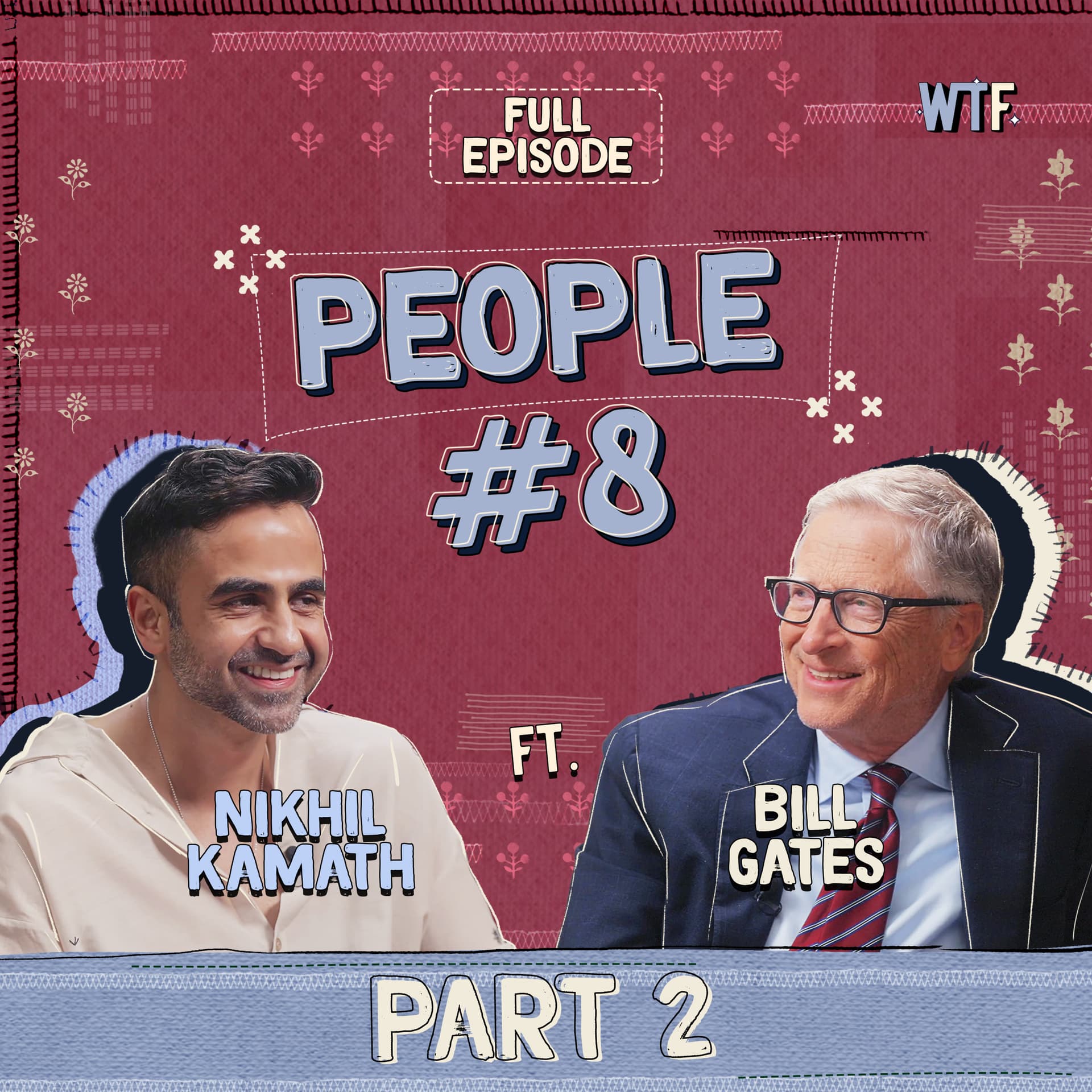
Podcast Episode Summary: Bill Gates x Nikhil Kamath Part 2 | People by WTF | Ep.8
Overview In this episode of People by WTF, Nikhil Kamath continues his conversation with Bill Gates, diving into various themes including childhood influences, success in capitalism, AI's impact on society, and personal motivations. The discussion is rich with insights drawn from Gates's experiences and his memoir, *Source Code*.
Key Topics Discussed
- Childhood and Family Dynamics
- Gates reflects on his upbringing, highlighting:
- His supportive childhood and family.
- The role of his parents in shaping his ambitions.
- Acknowledgment of hardships experienced by others that drive their success.
- Gates emphasizes that his motivation stems more from personal ambition rather than trauma.
- Success in Capitalism
- The conversation touches on whether adversity in childhood leads to success in a capitalistic society.
- Gates discusses examples like Steve Jobs and Elon Musk, noting that many high achievers have backgrounds filled with challenges.
- Gates contrasts his own positive childhood with the experiences of such figures.
- Motivation and Focus
- Gates shares insights on his ability to focus and work hard, suggesting:
- A genetic component enables deep concentration.
- Personal drive has shifted from fear of failure to a passion for learning and exploration.
- The idea of "vulnerability" as a new heroic trait is explored, reflecting on how tech moguls portray themselves.
- The Future of Work and AI
- Discussion around the potential impact of AI on the workforce:
- Gates predicts significant changes that could eliminate traditional job shortages.
- A societal shift towards rethinking the nature of work and how people spend time is anticipated.
- Questions about whether a large population will be beneficial or a burden in an AI-driven future are raised.
- Philanthropy vs. Capitalism
- Gates reflects on his philanthropic efforts, addressing how motivations can intertwine between earning money and giving it away.
- He acknowledges the personal satisfaction derived from altruistic actions.
- Connection with Youth
- Gates discusses his relationship with younger generations, noting differences in perspectives and expectations.
- His views on technology, especially AI, contrast with the current generation's understanding and anticipation of its implications.
- Personal Insights and Closing Thoughts
- Gates shares wisdom from his experiences with successful figures like Warren Buffett and emphasizes the importance of personal relationships.
- The conversation concludes with Kamath expressing a desire to engage with the AI landscape, seeking advice for exposure and learning opportunities.
Key Takeaways
- Childhood Influences: Positive upbringing can foster ambition without the need for adversity.
- Vulnerability as Strength: Modern leaders are portrayed as more relatable through their vulnerabilities.
- AI Revolution: Gates foresees a transformative future where AI could redefine the workforce and societal norms around work.
- Philanthropic Motivation: The intersection between making money and giving back can lead to complex motivations.
- Bridging Generational Gaps: The differences in worldviews between older and younger generations highlight the rapid pace of technological change.
Additional Notes
- Gates emphasizes the importance of continuous learning and adapting to new realities, particularly in the context of technological advancements.
- The conversation showcases a blend of personal anecdotes and broader societal reflections, providing a comprehensive look at Gates's mindset and philosophy.
By engaging in this insightful dialogue, listeners gain a deeper understanding of not just Bill Gates's life and motivations, but also of the larger questions facing humanity as technology evolves.
Written by AI. May contain mistakes. Listen to the episode to check what was said.
Transcript
Automatic transcript. May contain errors.0:28if i were to ask you to extrapolate in the world of tomorrow, 10 years from now, from a very capitalistic lens, is a huge population a boon or a boon?
0:58Can you sleep, Bill, if you drink coffee so late at night? It might delay my going to sleep a little bit, but it'll keep me energized. So I have a long flight, so I get the sleep is always complicated. You're always in a hurry when you're in India. It's so much nicer to spend time with you when you're not in India. Why is that? Well, I'll organize some of my trips where I take time off here. You know, next year we're talking about that I'll go up to Assam and they tell me that's pretty nice. So hopefully I'll schedule a couple days for just pure relaxation. But when I'm working, you know, it's great to see there's so many new innovators here.
1:45We did manage to pack the schedule. You know, there's a lot of ministries that we have partnerships with. I think I saw more ministers this time than ever before, but they were all great meetings. It's been a fun trip. We did a thing with Sauchin, I guess it's your production company or something that helped put together a very creative. So you played cricket first time? Well, we were on a tennis court. And so we were hitting balls with a cricket back and the tennis. We were kind of making fun of the two different sports. So that was relaxing. Yeah. So we met recently in Switzerland. And I asked you many things off camera.
2:28So I spent the last week reading source code. Oh, thanks. It took me a long time. I read much slower than you, I presume. It took me 14, 15 hours. So my time in the car, on my flight, in all my travel and before going to bed has been source code. So I know more about you now than I have ever. Fantastic.
2:55so a lot of what is in the book bill it's a great book i would recommend everybody read it but a lot of what is in the book is also something i might expect of bill gates like my childhood was very different in the sense that when you used to sneak out of home when your parents went to bed, you went to a computer laptop. Right? Yes. I was very lucky. I got to use computers a lot, even in high school. So what isn't in the book, Bill? You know, the book, I feel like I was pretty frank about the challenges my parents felt raising me and how how my, originally I was not a very good student. You know, at least I wasn't getting good grades.
3:52And then I eventually, it bugged me that people thought maybe I wasn't that smart. So I just said, okay, I guess I should get good grades. You know, I got in trouble at Harvard when I was doing, first using the computer. But you got into trouble almost for using the computer without the requisite permission from the administrator. But that's not really trouble. You know what I mean? I was at the time it felt like it might be, you know, because they were acting pretty tough. but you know I'm not somebody who had a traumatic childhood that explains my you know whatever energy or ambition I have I had a great childhood you know I had some conflict with my mother where she would try to get me to you know fit what she wanted and And, you know, in a sense, she succeeded in making me want to exceed even her expectations.
4:56So there's some energy that I got, you know, from trying to, you know, get my freedom or impress her. But I'd say the simple story is that it, you know, it's almost ideal. I wish everybody had the stability. And my dad was really, in terms of his values, he'd grown up in a very poor household. His father had only gone to sixth grade. And yet, he was very sophisticated, always calm about everything. It's nice having parents who are calm. So I rightly or wrongly have made this presumption of late that very successful, very many successful entrepreneurs do not necessarily come from well-rounded families.
5:53When I read the book, I could see that your mom, your mother was projecting Kennedy's almost the idealistic family. She was in charity. Your dad was in law. Also, very interestingly, you speak about your mom a lot when you're younger. Your dad shows up much later in life, at least in the writing, and your sisters even after that. Is that how you felt their importance at different points in your life? It was your mom when you were a kid, your dad when you were significantly older? Well, my dad worked very long hours. So he would leave even before we had breakfast. Most mornings he'd head off to work.
6:41When he came home, that was when we had dinner. My parents were out socializing in ways that were helpful to my dad's career, three or four nights a week. And so my dad, until later, wasn't interacting with me that much. I mean, I'm sure he would talk to my mom about what was going on. But, you know, the fact that he set a good example influenced me and the values that he had. But no, my mom was the key relationship. My sisters, I could have talked more about them. You know, I have one sister who's a bit older, and the other one's nine years behind me. So when I'm a senior, you know, which is the last time I'm at the house, you know, she's a third grader.
7:36So we had a fun relationship, but not, you know, more than just playful until we're both adults. So would I be wrong in my presumption that success in the capitalistic world of today is somehow bred by one form of adversity or another in childhood? Well, I think if you look at the Steve Jobs story, you know, he's adopted. You know, his parents kept his sister and they didn't keep him. And so he ends up with a pretty negative view towards his biological father. Elon Musk had a fairly complicated father who was apparently very tough on him. So often when you see people who are high achievers, there's something they're trying to prove.
8:38In my case, you really don't have that. I mean, the only negative thing that happens to me in my childhood is one of my friends, Kent Evans, died when I was 16 and he was 17. But, you know, I was already, you know, my energy and ambition, you know, had already been set. So I don't, you know, wouldn't say that was connected. So it is, I think some people are surprised, you know, where did I get this desire in my 20s to be, you know, compared to everybody else who was starting software companies. I mean, by my standards, they were quite lazy. Also, having known you a little bit and having read the book now, this one quality that you have where you're able to put your head down, focus and cram many hours of work at one go or be not cognizant to the things happening in the world around you but focused on one thing where does that come from i know in the last part of your book you spoke about how today you might be diagnosed as autistic and is it that or is that is it some kind of drive which is coming from somewhere else?
9:59I think there's a strong genetic component to that ability to focus. You know, particularly as people get older, their willingness to be very confused and just live with their confusion, you know, and until they really figure it out, they almost you know give yourself a hard time and you know think about why can't I understand this you know I think that's that's something I was lucky from nature you know
10:43my parents didn't push me to be that way and it was there you know pretty early on Even the thing where it was fascinating to me that my grandmother was so much better at cards than I was. And I had to think a long time to figure out, okay, she is running a state machine. She is remembering every card that goes by. And if you remember every card that goes by, okay, there is an impact on all these different card games because we played a lot. of different games. And she would never, you know, kind of give it away. She sort of forced me to think it through on my own. So that's an early sign that, yeah, I can go off and kind of ignore what's going on.
11:38And, you know, I'm very lucky, even at, you know, this age, if somebody hands me a new book about something, and I'll shut the door and four hours later, hopefully I've been able to get through it. Somebody really smart was telling me that to be a hero, you either need to be awe-inspiring or relatable. Do you think Silicon Valley or the tech moguls in the U.S. are using vulnerability to transition from awe-inspiring, but in a condescending, this might sound a little condescending, not that I mean it, robot-like behavior to more human-like personas. Like if you look at Mark Zuckerberg with him, you know, wearing his new clothes, his chain, his watch.
12:40is the world going that way where you don't want that clean cut or inspiring hero anymore you need something more relatable and people are showcasing their vulnerabilities to meet that end well i don't think you know i think mark sincerely likes extreme sports uh and you know he really does engage in that. I never found all that attractive. So I think he's being genuine. He's a great family person. He's still pretty young. He just turned 40, which nowadays I have to consider that a young person. You know, I think the people who get to know you are the people, either your family or the people who work with you very closely.
13:38And, you know, take, for example, Steve Jobs. He was tough on himself. He did have the most unbelievable sense of people, just in an intuitive way, and of good design. You know, so his skills and mine don't even overlap that much. He was not an engineer and I'm not a design person. I wish I was a design person and I don't know if he wished he was an engineer. He was good at picking engineers. And so Apple, you know, really distinguished itself. But it wasn't an act. He was a natural. I had to learn how to give speeches and all that. And, you know, even at my best, I'm not as much of a speech giver as he was.
14:31So he's pretty singular, I would say. You know, maybe Elon in a different way is kind of singular. I think of Mark as a pretty normal person, actually. You know, he's got a great wife, you know, very serious about his kids. You just said that Steve Jobs was maybe too hard on himself. Are you hard on yourself, Bill? Why are you running around so much, meeting all the politicians and everything? No, I think if you want to, you know, work hard and not fool yourself, you better be pretty hard on yourself. And Steve was tough on himself. And it makes you at first maybe not a very good manager because you tend to manage people like you manage yourself, where you're just so tough on them.
15:21And, you know, for me, that meant that in my early days, I could get a lot out of people who were like me. And, you know, so I probably missed some people who were very different than me that could have been, you know, part of the company. We were fairly homogeneous, very engineering oriented group. And it took a while before I realized, okay, somebody who's a good salesperson or a good manager, you know, may not be good at the way I think of IQ. IQ is much more varied. Talent is more varied than I realized. You know, I sort of thought, well, if you can do math, you can do anything. And if you can't do math, then you can't do anything.
16:01That's how simple that initial thing was. So I was, you know, it took me a lot of time to develop as a manager. You know, I think as I moved to the foundation, it was very important that I blend in people who like to work in the field in Africa with great scientists, with great people who work with government. So I, you know, I was able to take the mistakes I'd made and learnings from Microsoft and bring that to the foundation. But, you know, the why I chose to work so hard in my 20s, I mean, I love the work. I think 20s I get, Bill. The question is today. Oh, today, yeah. Well, it's optional.
16:51It is a lot of fun. I get to work with smart people. I'm learning all the time. You know, I get to travel the world. Haven't you traveled the world already? You know, in my Microsoft work, I went to Africa. I went to South Africa once and Egypt once. And so basically, you know, they don't buy much software in Africa. They buy some, but it's not. Now, you know, Africa's, you know, huge in what I do. So I've been exposed to different parts. So I certainly got to meet a lot of people that I'd never met at Microsoft. Yeah. If I were to ask you to extrapolate with no filters, since you know more about AI than I will ever, in the world of tomorrow, 10 years from now, from a very capitalistic lens, is a huge population a boon or a boon?
17:54The, let's say 20 years from now, AI will have changed things enough that, you know, just this pure capitalistic framework probably won't explain much. Because as AIs, both as sort of white-collar type work and as blue-collar workers, the robots will get good hands and are able to do the physical things that humans do, say, working in a factory or construction or cleaning a hotel room, which the hands have to be awfully good to do those things. We'll achieve that. And we'll have a lot of making the goods and services, which is always, we've always had a shortage, a shortage of doctors, of teachers, of people that work in the factories.
18:56Those shortages won't exist. And so it's a pretty profound change that will free up a lot of time. You know, you can retire early. You can work shorter work weeks. and it's going to require almost a philosophical rethink about, okay, how should time be spent? Because we don't need it to make enough food and make enough widgets and do enough medical diagnosis. We will have created free intelligence. In my day, it was about computing was expensive, it became free. Now it's intelligence like a doctor's intelligence is scarce. You know, India has more doctors than Africa, but still not nearly as many as it should.
19:43But AI will come in and provide, you know, medical IQ, and there won't be a shortage. And it's hard for those of us, you know, in my case, spending almost 70 years in a world of shortage, to even adjust my mind. Because, you know, what are markets about? Markets are about scarce resources and a price is okay. You know, you get the employee because you're willing to pay them more. And so, you know, I find myself trying to understand that future world, but it hasn't come into focus for me. And I enjoy engaging experts about, okay, what does the economy look like And how will we choose to use the freedom that will come?
20:41And even if I'm wrong, say it's 30 years, that's not a very long time. I mean, my kids and certainly my grandkids, a lot of their life will be in that very changed world. This economist, John Maynard Keynes, I think the American model is largely Keynesian, where they print money, the antithesis to Hayek almost. He said this many decades ago that the real question is what will the world do if one did not have to work? If you had to extrapolate one statement in 30, 40, 50, how many ever years, what do we do if we don't have to work? I don't have to work. And so I choose to work. Because? Yeah, because it's fun.
21:31You know, I take more vacation than I did when I was young, but it's still, you know, basically full-time work. And, but it's, if you had that your whole life, it's different than being able to retire early. I mean, at least we, you know, have a period of working and then, you know, if you said everybody could retire at 40, you know, how radical is that? Maybe not that radical. But if you said you never need to work, at least to me, what? That is so different. I think another very interesting question is if we all don't work, do we get the same? Humans inherently are competitive with their peer groups, I think.
22:24So if I don't work, say we are born tomorrow, me, you, him, him. we all don't work but we are bestowed upon with the same resources and same social position will that work for us no i i your your point's a good one we want to differentiate yeah uh you know whether it's for our own ego or to be attractive or it's so weird. We are so adapted to this world of shortage that, you know, maybe, you know, we'll create competitions and, you know, creativity or, you know, maybe we'll take some part of human activity. I mean, in extreme cases, we're not going to have robots play cricket. You know, that's boring.
23:21We'll reserve that just for the humans. Even if the robots could be, you know, way, way better, that's not interesting. And so what activities might a country say, no, we're reserving this, you know, nurses are going to be humans. or, you know, psychiatrists, you know, we're going to decide that. And so we might artificially ignore the fact that the machines can substitute for some of that. It'll really, you know, get down to the core of human instinct. Yeah. We will figure out a hierarchy. It may not be the current one, but another way to segregate ourselves. Yes, the idea of pure communism, that everybody is totally the same, that's a pretty unnatural behavior for humans.
24:26It needs a lot of trust of a model like that to work. And I think as the group gets larger, trust is often not there, inherently. You've been the richest man in the world for a very long time, Bill. You've probably had access to everybody for a long, long time. I'm talking world leaders, philosophers, people at the cutting edge of everything. What do you know that I don't? Like one thing, what have you learned by having lived in your shoes? I know a lot about science. You know, I've seen a lot of successful people and, you know, learn the habits that they have. I do think you develop instincts about, you know, who to hire, who to partner with, just from mistakes and, you know, pattern matching.
25:24You know, and I've been super lucky. People like Warren Buffett, who comes from a very different expertise than mine. You know, he and I have bonded over, you know, sharing ideas and kind of common view of how things work in the world. And he is, on a lot of things, just his wisdom has been a huge help to me. Not so much about business, but more about life. Well, it's certainly, you know, the decisions you make about your personal life probably affect your happiness. You know, I know super successful people who aren't that happy and, you know, didn't apply their, weren't able to map their incredible intelligence on to having a great relationship with their kids or, you know, their extended family.
26:26So it is, human capability is very strange that you can't, you know, like my friend Paul Allen, you know, he was wonderful. He was key to the success of Microsoft, but he actually didn't end up enjoying himself. You know, he felt like maybe people were going to take advantage of him. And that's, you know, this is a guy who had everything. And yet it didn't really create comfort or the happiness he deserved. When people ask me what drives me, I mean, I'm much less wise, experienced, all of those things. But in my own little bubble, some people do ask me what drives me. I used to stupidly say, whenever someone asked me how you got lucky or how you did well in life, my go-to answer used to be luck, which was never the truth.
27:35Because I think we all have, all humans, I think, have an inflated sense of self subconsciously, deep, deep down. Like if I were to put 100 people in a room and ask how many of you are smarter than the majority, I would presume 99 % or 89 % of the room say yes. Maybe that's a slight exaggeration, but I think the point holds. But when I were to think about what drives me deeply, in the beginning, I think it was just money. I feel like I didn't have money. I wanted money because my conditioning, my years growing up, looking at the people around me with money, they looked happy. I think money transitioned into relatively more power, jealousy, insecurity, seeking validation, different drivers for different parts of my life.
28:31And today I'm flirting with this notion, like I'm part of your pledge and I spend time with you every year on the offsite. and I don't know if you remember but last year I was asking these same questions because I genuinely do not know the answer. At times I might feel altruistic, at times I might feel like there is no point to more but at other times I will go back to the very relative nature of things and competition kicks in and I want more. What I wanted from our conversation today, it's more a question for me than it is for other people, is this concept of motivational pluralism in a way, where I can be motivated by different things at different points of time.
29:20I might also want to make money, but I might also want to give away money. I think you're at the forefront of that. Would you like to share your thoughts on that? How does it make sense to want to make money while you want to also give away money? Well, even giving away money can be very egotistical. There's certainly ego involved. There is a high. I mean, Ted Turner used to say that the Forbes list, which ranks people on their wealth, was a bad thing because people would hesitate to give away money because they wouldn't achieve some rank on the Forbes list. And I think he had a valid point there.
30:05You can never do anything that's totally pure. Because if it's really deeply moral, then a little bit you think, oh, people will praise that. And so, you know, is it ego or not? You know, in the end, the work, you know, like the work we've done with vaccines, you know, whether that was my ego or not, you know, it's a real thing that happened. You know, I remember when I left Microsoft thinking, gosh, if it gets messed up, it's going to screw up my mind. should I go back or not go back? And I'm so lucky that, you know, Steve did a very good job and now Satya is doing a very good job. So I haven't had to worry about that.
30:58It also helped that it made my Microsoft stock valuable enough that even though I've given away a lot, you know, I still, you know, I'm not nearly as rich as some, but I'm in the top 20. and that's great. You know, over the next 20 years, I'll be able to give a lot away. But even that doesn't get you out of the why do I do it. Yeah. I find, like, I don't feel altruistic. I feel like even when you quietly do something good in terms of giving away money, which does something for someone, it is almost more intoxicating than a capitalistic pursuit which is making money so they're both highs now if i don't know which high is more appealing to me at which point of time how do you switch between the two you know philanthropy isn't quite as competitive i mean And creating a company, you know that it's pretty stark because there might be some category that if you get scale, the other people just fall by the wayside.
32:21You know, it's not like you end up splitting. It's, you know, when we did Microsoft Office, there were quite a few companies that were in that space that literally we, they went away. And, you know, we competed with Google over the mobile phone operating system. And we fell behind. And, you know, today nobody remembers there was a Windows Mobile thing. It's just Android for non-Apple phones. It's basically all Android. That was a winner-take-all thing. And so when you get into one of those, you actually activate not only ego, but a little bit of fear. And, you know, certainly in my 20s and 30s, that was part of it, which is, wow, you know, I think I'm pretty good at this.
33:17But, you know, have I just made that up? Am I really good? Will I be revealed that I didn't do a good job? I've gotten past that now. I don't think I'm motivated by a fear. But it was fascinating to me that, you know, I would, when we would go on company retreats for Microsoft, it would bother me that the other leaders didn't think our survival was at risk. I was always coming up with, no, we have to worry about this, we have to worry about this, because it was my whole life. And I have to say, leaving and moving to the foundation made my life a little bit more sane, because I wasn't always conjuring up the, okay, it could all completely blow up.
34:17And so I engaged every emotion to drive myself in my 20s. So I was having lunch with my team today, Bill. They're all like, a bunch of them are 21, 23, 24. and even at 38, I'm so disconnected with how they think, their version of reality in a way. Whenever I've seen you for a meal, lunch, dinner, beat, whatever, there's always wine. They say that people are like the vintage of wine from the year that they're born in. So let's say you were born in year X and you're from that vintage. which, what assumption of the world today or the youth of the world today do you think that you have, which is not fully true?
35:10And how do you look at the world today, but it doesn't resonate for the youth of today? Well, it's nice to have your kids give you a hard time. You get a little bit of realizing, wow, there's a different way of looking at things. You know, some things like I'm very email-centric, which my youngest daughter thinks is so laughable. And, you know, when she sends me a text, I don't respond in five minutes. And she's like, what's wrong with you, Dad? And I'm not going to change it. I'm sorry. I'm kind of stuck in my email-centric ways. You know, so I'll just have to live with that. But, you know, I was very lucky.
36:00The insight that computing would become free, you know, for my generation, there were very few people who saw that. And so I, you know, I had an advantage because that implied a lot of things that Microsoft could get out in front of. Now, this current revolution, in a way, everybody kind of sees it coming. It's almost too wild to be true. But yes, it's not like there's only a small community that sees AI coming. And I'm not sure, do the young people have an anticipation of what it's going to be like better? I hope so because they're the ones who you know be in charge and have to deal with it I think it's a rate of change that's greater than most periods of history you know when we made in the US you know when we went from 50 % farmers to 2 % farmers you could still farm your whole generation it was your children that stopped being farmers because it happened over a 60-year period.
Read the full transcript
37:16We go from a very high percentage down. Here, even within a generation, certain skills aren't going to be as needed. So I think that's a pretty wild thing to be changing things. And it's nice to surround yourself with young people and have their insights. Of course, your customers aren't all young, so you have to stay in touch with what they're thinking as well. If I may pay you a compliment, Bill, after having spent time with you for a few years, I feel like you care lesser today about what people think about you. And that is making you increasingly more appealing to the youth. And I think that comes out in your book as well.
38:16No, I mean, if anybody can afford to not, you know, think about, you know, there are people who like me more than they should. There are people who hate me more than they should. I mean, it's a wild mix, including crazy conspiracies. And so I do think with age, your ego needs go down a bit. Your desire to help others succeed versus just yourself, you get a little bit, they call it more generative and sharing advice. Having kids helps with that a lot.
39:02and, you know, so I should have the luxury of not worrying about these things, you know. Ironically, I think that is the definition of cool for the youth today, not caring. Thank you, Bill. Thank you for doing this. And I think I'm seeing you next June. No, great to see you. And yes, you're coming to the Giving Pudge? Oh, perfect. No, it's always fun to see you there. and thanks. This was a blast. Thank you.
39:32Actually, I want to ask you some advice. So I'm feeling like I'm losing out on the whole AI world. So I want to go take a job somewhere in the U.S. or an internship, unpaid one. Where would you suggest it? How do I go about being in the forefront of that world just in terms of learning the implications, not so much the development? You know, with your business experience, maybe the OpenAI guys would have some role where you would be super valuable to them that you'd be getting that exposure. I mean, that's the most intense. Those guys, it's wild. And they're very good guys. Boy, are they surfing the wave.
40:14What's WTF? F***.
40:21You
From the publisher
I’ve always been curious to know why people are the way they are. After reading Bill’s memoir, Source Code, it felt more like peeling back layers than simply asking questions. Part 2 of our chat, I got to know him in a way I haven’t before.
In this episode of People by WTF, Bill talks about the drive and curiosity that keeps him active, playing ‘Crennis’ with Sachin Tendulkar, his childhood, how AI can reshape capitalism, and many more.
Is success in today’s capitalistic world bred by some form of adversity in childhood? Ten years from now, will a huge population be a boon or a bane from this capitalistic lens?
TIMESTAMPS:
00:00 - Introduction
01:12 - Bill’s frequent visits to India
02:22 - Bill’s memoir Source Code, childhood and family dynamics
07:51 - Success in today’s capitalistic world
09:28 - What's the secret to Bill’s focus?
11:58 - Is vulnerability the new heroic trait?
14:50 - How tough is Bill on himself?
17:33 - Huge population: burden or advantage with AI?
20:55 - What would we do if we didn't have to work?
24:35 - Insights from being the world’s richest
29:05 - Money: Motivation to make it v/s be Altruistic?
34:25 - How Bill relates to the youth
39:15 - Nikhil's attempt to pitch for a job in the A.I world (he's serious)
#NikhilKamath Co-founder of Zerodha and Gruhas Host of 'WTF is' & 'People By WTF' Podcast
Twitter: https://x.com/nikhilkamathcio/
Instagram: https://www.instagram.com/nikhilkamathcio/
LinkedIn: https://www.linkedin.com/in/nikhilkamathcio?utm_source=share&utm_campaign=share_via&utm_content=profile&utm_medium=ios_app
Facebook: https://www.facebook.com/nikhilkamathcio/
#BillGates Co-founder of Microsoft , Co-chair The Gates Foundation
Twitter : https://twitter.com/BillGates
Linkedin : https://www.linkedin.com/in/williamhgates/
Instagram : https://www.instagram.com/thisisbillgates/
Facebook : https://www.facebook.com/BillGates/
Youtube: https://www.youtube.com/@billgates
#PeopleByWTF #WTFiswithnikhilkamath #WTFOnline
