
 Ask ChatGPT

- Podcasts
- Political Currency
- EMQs America special: Best President there never was
Political Currency17 Aug 2026 · 31m · 8 chapters
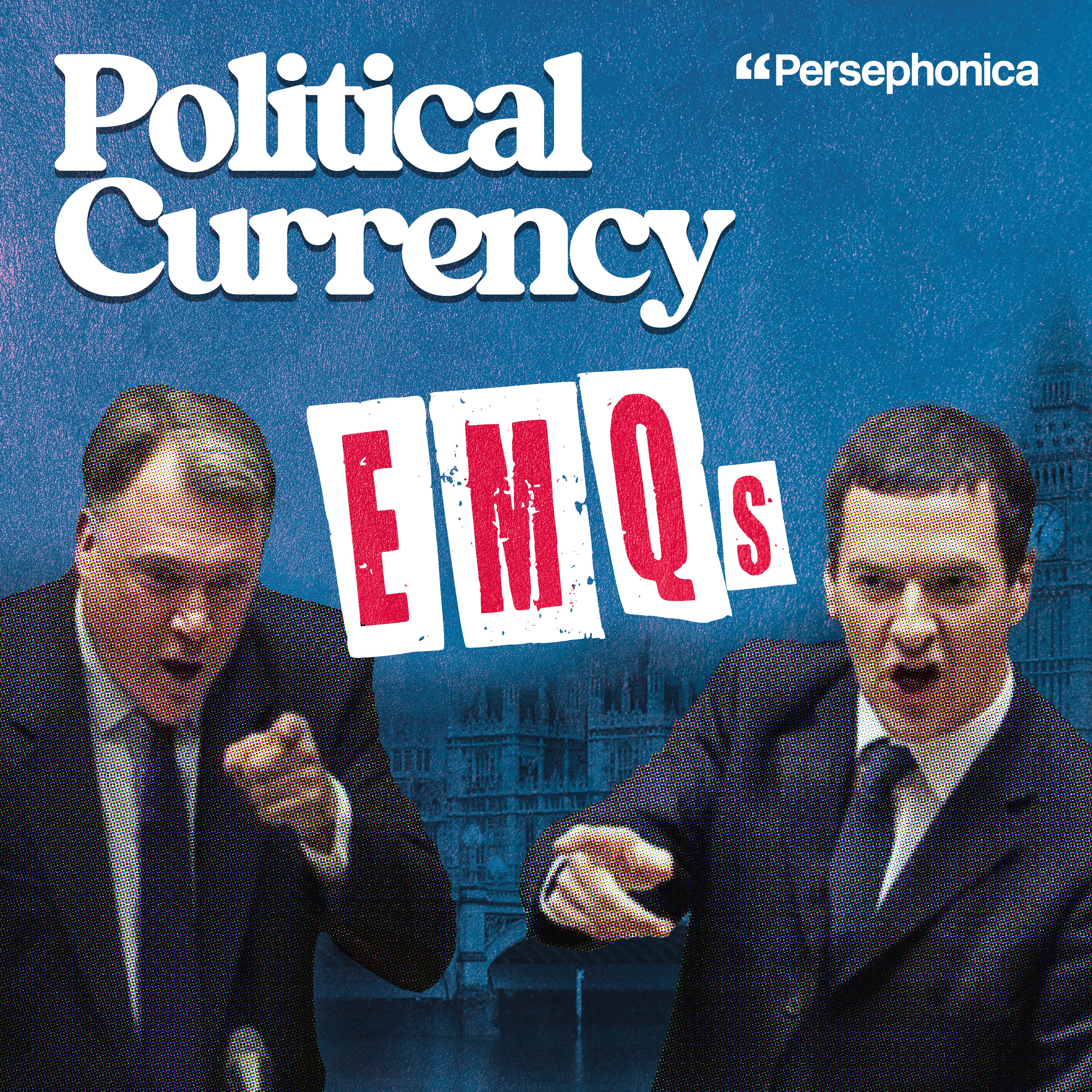
EMQs America special: Best President there never was
In short
“EMQs America special: Best President there never was” mixes US politics and policy questions with personal anecdotes from Ed Balls’ Civil War battlefield trip (Gettysburg rain, Gettysburg Address) and debate on NATO, labor vs capital, wealth/ownership schemes, and hypothetical US presidents.
Guests/backgrounds
Ed Balls and George Osborne are UK former senior ministers (Labour and Conservative respectively) hosting EMQs. They answer listener questions from Leo (LSE, Kiwi), Amol Rajan (BBC/Today interviewer; media ventures), and Liz (political researcher at Parliament).
Key claims
UK/EU foreign policy must plan for the current US administration even if future elections change things; NATO decisions ultimately rest with the US president. Labor-capital tensions are less about labor share decline than productivity stagnation; AI could worsen wage pressure. Child trust fund/“Trump accounts” style schemes may build saving habits but won’t fix wealth inequality.
Notable examples
Gettysburg Address; comparisons to Corbyn and Cameron after elections; Romney’s Massachusetts healthcare; FDR and Obama as hypothetical Trump challengers; Ted/Bobby Kennedy, Hillary Clinton, Mitt Romney, and “Hamilton” (duel with Aaron Burr).
Written by AI. May contain mistakes.
Chapters
1:51
Introduction to EMQs and Personal Experiences
Hosts introduce the EMQs format and share personal anecdotes about traveling in America.
“Getting a lesson from the Shadow Chancellor on how to balance the books is like getting a lesson from Dracula on how to look after a bloodbath.”
3:41
Civil War Battlefields and Gettysburg
Discussion on Civil War battlefields and a memorable visit to Gettysburg.
“the press secretary, and we'd go around these battles and usually get a park ranger, because they're national parks, to take you around and they'd explain what was going on in the battle.”
6:40
Political Dynamics and Future of US Foreign Policy
Analysis of how UK and EU officials should navigate US politics and foreign policy.
“My name's Leo, and I'm a Kiwi working at the LSE here in London.”
14:00
Economic Trends and Capital-Labor Dynamics
Explore the relationship between capital and labor in the context of economic trends and political implications.
“Now, our next question is from Amal Rajan, who is a we're a fan of his and he is a fan of ours.”
28:48
Discussion on Best Unheld Presidency
Exploration of who the best president America never had might be.
“Our final question is from Liz, and it overlaps a bit with our What If episode.”
30:16
Hypothetical Candidates Against Trump
Considering Mitt Romney and Al Gore as potential strong leaders against Trump.
“So, you know, Obama pretty successfully beat him despite the economic background being pretty tough for the incumbent.”
32:38
Evaluating Democratic Candidates
Analyzing who might be the best Democratic opponent to challenge Trump.
“No, again, I think she actually, once she came out from underneath her kind of hospital's shadow, inevitably, as first lady, you know, she was a pretty effective senator in New York.”
36:42
Closing Thoughts
Final reflections on the episode and upcoming content.

Ask about this episode
Get the gist, explore an idea or ask about something said.
 Claude
On Political Currency, what are the key points of this episode?
Searching your listeningTranscript
Automatic transcript. May contain errors.
0:00Hi, this is Kim and Penn Holderness from the Laugh Lines podcast. This episode is sponsored by Ollie, your wellness partner for back to school and beyond. Back to school season is here. Packed backpacks, packed lunches and packed schedules are officially back. Ollie Kids Sleep helps little dreamers wind down with a gentle blend of melatonin, L-theanine and botanicals for restful sleep. Translation, an easy way to put those school night negotiations to bed. And for the grownups, Ollie's sleep helps you fall asleep, stay asleep, and wake up feeling refreshed. Because as you know, the morning mayhem comes early.
0:35Visit Ollie.com and stock up on back-to-school must-haves today. That's O-L-L-Y dot com. These statements have not been evaluated by the Food and Drug Administration. This product is not intended to diagnose, treat, cure, or prevent any disease. Back to school is busy enough. The last thing you need is shopping that makes it harder. Whether you're moving into a dorm, your first apartment, or just getting organized for the semester, Wayfair makes it easy to get everything you need in one place. Furniture, bedding, storage, decor, study essentials, all at prices you'll love. With fast shipping before move-in day.
1:13Get everything you need for back-to-school season. Shop Wayfair.com today. Wayfair, every style, every home. There are moments that reveal who we are and who we're meant to become. For those born to lead, such moments call for a vehicle of equal distinction. Dynamic by design, uncompromising in execution, the Range Rover Sport was engineered for those rare individuals who demand the world and possess the conviction to claim it. When your time to lead arrives, you need a vehicle that rises to meet it. The Range Rover Sport. Exclusive offers available now. Explore further at rangerover.com.
1:51George Osborne: The Chancellor of the Exchequer. Getting a lesson from the Shadow Chancellor on how to balance the books is like getting a lesson from Dracula on how to look after a bloodbath.
2:00Ed Balls: Ed Balls. As steady as she goes budget. What kind of ship does he think he's on, the Titanic? They're married, Celeste.
2:08George Osborne: Welcome to EMQs from Political Currency with Ed Balls and George Osborne.
2:18Ed Balls: hello welcome to this special summer edition of emq's ex-minister's questions and i have to say with great sadness this year we're not on a holiday in america no i would say look this special episode is going to be themed around america and american politics but some of the greatest holidays of my life with our family camper vanning you know in north america and canada and vancouver uh seattle in yellowstone and out to um las vegas and new england i love
2:52George Osborne: going on a road trip in america when i was chancellor i used to go to the imf meetings twice a year and they're held in washington and uh essentially they would finish i think it was sort of like essentially like lunchtime saturday and then there was five or six hours before the flight home the brujero's flight home i got into this thing of i know i'm i'm going to go and visit civil war battlefields near washington i had never visited battlefields anyway including in england um but i thought i know this will be a thing i'll go and say a lot of the battlefields of the civil war are near washington because that was the fault line that was the kind of north south divide and you can go to Bull Run and Antietam and Harper's Ferry and Gettysburg.
3:36George Osborne: And I used to take my kind of treasury team with me, you know, the private secretary and the press secretary, and we'd go around these battles and usually get a park ranger, because they're national parks, to take you around and they'd explain what was going on in the battle. I once, we went to Gettysburg, which is a brilliant thing to go and visit if you're not done. And you don't really have to know, you know, you don't have to be a military historian or it's just an amazing kind of dramatic human story. But you knew where to find it. Yeah. So you had the Gettysburg Address. Ah. Did you like that?
4:08George Osborne: Very good. Thank you. Well, we got to, normally these were in, that was pretty good actually. Thank you. Normally, you know, it was lovely sort of weather. It was sort of autumn or spring. But we got to Gettysburg, it was pouring with rain. Absolutely kind of tropical rain like you sometimes get in the US. we got to the place where the kind of graveyard where Lincoln gives the Gettysburg Address now of course he gives the Gettysburg Address a couple of years after the Battle of Gettysburg and he does it to come back and essentially commemorate the memory of those who had fought in the battle but the Civil War is still raging we were in the car it was impossible to get out without being drenched but come on we've got to get out we're right here, we've got to go and see where the Gettysburg Address was delivered So I got everyone to get out of the car and we got absolutely, one of those things where you get, it's like being thrown into a swimming pool.
5:00George Osborne: We were so wet. But we did stand and, you know, four score and seven years ago, our fathers brought forth upon this continent. New nation conceived in liberty and dedicated the proposition that all men were created equal.
5:13Ed Balls: There are some fathers who just think that getting soaking wet in an empty battlefield is what it is to be on holiday.
5:20George Osborne: Yep.
5:21Ed Balls: But your kids hated it.
5:22George Osborne: Now we're engaged in a great civil war, testing whether this nation or any nation so conceived and so dedicated can long endure.
5:31Ed Balls: There was nothing my dad liked more than putting the gas stove on and making cuppa soup in the rain on the top of the hill.
5:36George Osborne: Government of the people, by the people, for the people shall not perish from this earth. I think, you know. The world will long remember what we said here, but they never forget what they did here.
5:48Ed Balls: On one of our podcasts, you talked about why politicians should never apologise. But maybe this is the moment where you should. To your kids.
5:55George Osborne: It wasn't my kids. This was the Treasury Civil Service. Treasury Service. Oh, and don't apologise for them.
6:01Ed Balls: That's fine. They were the ones that were a long time ago. No, I'm sorry. I was thinking we were in family holidays.
6:06George Osborne: No, no, I did not drag my kids around the battle. This was Treasury Civil Service to drag around.
6:10Ed Balls: I thought you were saying you were a proper father.
6:12George Osborne: Anyway, our first group. They would drag around various other. I bet they were.
6:17Ed Balls: Greek mythological sites. Yes, I had a few of those. I mean, or yachts, presumably. No. You didn't take your kids in the yachts?
6:24George Osborne: No.
6:25Ed Balls: That was one of the tragedies. That was just you and Peter. And, yes. Actually, let's move on from that. Our first question today comes from Leo. And this is going to be kind of an interesting thing, depending on how the midterms go this autumn. Hey, Ed and George. My name's Leo, and I'm a Kiwi working at the LSE here in London. And it should go without saying that I'm a huge fan of the pod. And now with that North Korean part of the note over, I'll move on to the question, which is, how should officials in the UK and EU foreign affairs plan to handle the USA in the short to medium term? Is it likely that a future democratic administration would completely unpick the signalling and policy changes on NATO membership and commitment to European security?
7:06Or is it likely that some of the mega worldview will remain baked in irrespective of what will happen in 2028?
7:12George Osborne: So this is a good question for me. I think the United States is so consequential in the world and so consequential to British foreign policy that inevitably, even if there are changes in administration every four or eight years, you have to deal with the administration you've got in front of you. And even if you know that things might change in the future, because take the Trump administration, you know, whatever it is now, two and a half years, it's still a long time in politics and world affairs before there might be a change. And of course, for a lot of administrations, not this one, you work on the assumption that a president is going to get reelected.
7:48George Osborne: So you're looking at an eight year period, which is a pretty long period. Will things be unpicked? It's a big question, isn't it?
7:56Ed Balls: Let me give you two British precedents.
7:58George Osborne: Yeah.
7:58Ed Balls: Both examples where, one, it looked like things were set. And then two, elections came along and changed it. So people said, Jeremy Corbyn, taken over the Labour Party. The Labour Party has changed. It's irrevocable. And then actually, 2019 election, that was the end of Corbyn hard left domination. Keir Starmer was able to kind of wrestle Labour back to the mainstream so much faster. David Cameron, people said, this is a modern Conservative Party, you know, kind of international kind of business, but global. And then the 2016 referendum result essentially did for that. Conservative Party. And I think in both cases, you could say it looked like it was set.
8:46Ed Balls: But then a big electoral catastrophe or vote catastrophe came along and shifted things. But in both cases, back then, the outcome of the election wasn't contested. It's quite possible that the Republicans do badly in 2028, that they lose the presidency, that they lose control of Congress. But compared even 10 years ago, what will happen is people will say they didn't really lose. It was a con. It was a conspiracy. So I wonder whether even defeat is enough to kill off the MAGA movement in the Republican Party or whether actually defeat supercharges its grip on the right in America.
9:30George Osborne: I saw when earlier this summer, Senator Lindsey Graham died and Donald Trump, he phoned various American news programs just out of the blue to essentially deliver a kind of eulogy or an obituary. And he said, you know, Senes Graham is one of my strongest supporters. I mean, I give him a 99 out of 100 because, you know, he didn't support me on the idea that the election was stolen in whatever it was, 2020. So, you know, Lindsay's only getting 99 out of 100. I think the kind of question here is what's going to endure, not just whether the MAGA movement will say, Oh, the election's illegitimate or been stolen or whatever.
10:08George Osborne: I mean, it's hard to imagine a future Democrat administration, because in some ways they're more protectionist than the Republicans, rowing back on some of the high levels of tariffs that have now been set by Donald Trump, despite some of the legal setbacks.
10:23Ed Balls: And how long does the Supreme Court stay Trump-Domberlake?
10:27George Osborne: Well, as long as they stay alive, right?
10:29Ed Balls: I mean, we're talking about many years after 2028.
10:32George Osborne: And NATO membership and all that. I mean, I think you've already had one dry run of this when the first Trump term ended and then Biden came in. And things snapped back a bit into a more predictable politics, a more predictable Washington. But I think that what Trump has done is exposed the question that was always there with NATO. It's just people didn't want it asked, which was, well, what exactly would an American president do if there was an attack on a NATO member? You know, we might have signed a treaty and we might have a load of NATO summits. But ultimately, it's always going to be a decision for the American president on the day.
11:07George Osborne: And that is life, the life of a superpower. Some of the job of the sort of longer term thinking in foreign policy is working out the longer term trajectory the United States is on, which is still one of being, you know, the most significant consequential nation on the planet. And certainly will be for the foreseeable future. And how you have to deal with that as a friend can be as complicated as dealing with it as a foe.
11:33Ed Balls: Thanks, Leo, for your question. We'll be back after this break.
12:02hold. IT desperately wants to automate this work, and that's why they need Serval. You just tell Serval what you want to automate in plain English, and it's built. No drag-and-drop workflows, no expensive consultants. Employees get unblocked, and IT teams go from drowning in tickets to building what actually matters. With Serval, IT becomes the AI engine powering the entire company. This is a new way to run IT. We guarantee you'll automate 50 % of all tickets, and we'll prove it to you in a free four-week pilot. Go to serval.com slash tickets. That's S-E-R-V-A-L dot com slash tickets.
12:47Your team just added its 67th AI tool and also your 67th security blind spot. The good news? The Vanta agent works like a GRC engineer in the background, finding every app your team uses, scoring the risk, and drafting fixes for you. Vanta is the platform used by over 16 ,000 fast-moving companies like Ramp, Cursor, and Harvey, who are shaping the future with AI and staying ahead of AI risk. Get started at vanta.com. Hi, this is Kim and Penn Holderness from the Laugh Lines podcast. This episode is sponsored by Oli, your wellness partner for back to school and beyond. Back to school season is here.
13:23Packed backpacks, packed lunches, and packed schedules are officially back. Ollie Kids Sleep helps little dreamers wind down with a gentle blend of melatonin, L-theanine, and botanicals for restful sleep. Translation, an easy way to put those school night negotiations to bed. And for the grown-ups, Ollie Sleep helps you fall asleep, stay asleep, and wake up feeling refreshed. Because as you know, the morning mayhem comes early. Visit Ollie.com and stock up on back-to-school must-haves today. That's O-L-L-Y.com. These statements have not been evaluated by the Food and Drug Administration. This product is not intended to diagnose, treat, cure or prevent any disease.
14:10George Osborne: Welcome back. Now, our next question is from Amal Rajan, who is a we're a fan of his and he is a fan of ours. It's great to hear from you, Amal. And I know you've got exciting new ventures ahead for the second half of this year. But here's a very good question from Amal. Hi, George. Hi, Ed. It's Amol here. Love the podcast. On the Today programme recently, I interviewed your mate, George, Steve Hilton, who is running to be governor of California. And I was impressed, actually, that within seconds, he went straight to one of the key economic trends, which is the declining share of capital going to labour.
14:46He argued that the 20th century deal between capital and labour had broken down and that work is no longer a route to wealth. And the danger, of course, is that AI could do for white collar jobs what globalization has done for blue collar jobs. I'd love to know your thoughts about this trend more broadly, but I also have a specific question for you both. If this trend strengthens the case for radically spreading ownership, do you think that Andy Burnham should introduce a UK version of Trump accounts, which give American kids$1 ,000 and tax-advantaged access to US equities.
15:23George Osborne: Andy's accounts, Burnham bonds, what do you reckon? Right, Ed, what do we think? This is back to your Karl Marx, isn't it? Das Kapital, gains to labour, gains to capital. This is the argument, isn't it? I'm all summing up an argument that Steve Hilton was making. It was a very effective interview from Steve, in the sense that it was a sort of proper interview with Steve Hilton. He was, you know, he was actually taking on Amal's questions and answering them and not just sort of delivering some line to take. But he said all the problems in Western democracies and all what people call populism and the disruption stems from the fact that people who work and work for a living, essentially the money that they attract, the income they get, has been a diminishing return compared to the money you get if you own capital, i.e.
16:13George Osborne: you own shares or your own business or your own bonds. So the capitalists are doing well and the workers are doing badly. And that's not true through all periods of history. I think for long periods after the Second World War, the gains were going to income more than capital.
16:29Ed Balls: Is that right? So thank you, Amol, for your question. And good luck with your kind of new media ventures. We're going to miss you on the Today programme. But we love the fact you're listening to our podcast. And you are right to raise marks. But I'm not sure if I…
16:43George Osborne: I raise marks, to be fair to Amol.
16:46Ed Balls: That's what I meant. Sorry. Sorry. Yes, George is right to raise marks. But I'm not sure if I fully subscribe to this view of the history. There's no doubt post-war that you saw a declining Labour share in overall GDP in the UK in the 50s and 60s into the 70s. And part of the inflation of the 70s is a fight about that. And this is, I think, if I was sitting with Nick McPherson, former permanent secretary of the Treasury, and we are talking about the economy to our Treasury students in our King's class on the Treasury, we would talk about the 70s inflation being in part. It was triggered by big inflation shocks.
17:27Ed Balls: But it is a struggle between labour and capital about that declining wage share and the strikes are part of that. And then the inflation was government attempting to square a circle by thinking, can we inflate our way to higher wages? And it didn't work. If you then go to the 90s into the 2000s until recently, actually, you haven't seen a declining labour share in the UK if you measure it right. And you have to measure it by looking at pension contributions as well as just wages. The combination of increased pension contributions for working people and the minimum wage and a tight labour market have not seen, in my understanding, a big decline in the labour share.
18:13Ed Balls: We might see a big decline in the labour share going forward if AI and technology kind of bites into work and wages. But the thing which has driven, I think, things in the UK in the last 20 years has less been that sort of fight over a declining labour share. It's just been that productivity has been stagnant and therefore wages and profits have not risen in the kind of way that we've seen in previous decades. And that means that from a capital point of view, we've had less attractive investment and less investment, which is a bad thing. But in terms of working people, you know, the median wage has not been rising.
18:51Ed Balls: And quite a lot of the anger and disgruntlement you see in the working age population is them paying more tax to support the older while not seeing their wages rising in the same way. I'm just not sure that's explained by the declining labour share if you measure it properly. I think Amel's right to worry about the way in which tension and populism has driven politics in our country. But I think it's much more about low productivity growth and therefore turning around productivity growth is vital. If productivity growth is turned around, but in a way which doesn't require workers in the same way, which is like one view of the AI story, that's when the issue of the declining wage share starts to count.
19:35Ed Balls: But I think that is perspective and speculative rather than the real story of the last 20 years. That's what I would say to Amel.
19:44George Osborne: I think there's more to what Amel's saying and by inference, the Steve Hilton argument. I mean, I think it's clearly the case that if you have had money that you've been able to invest in property or in shares. And remember that those investments can be international these days. They don't have to be, you know, you're not rooted to the performance of the UK economy. Lots of people who invest in things like ISAs use that money to bet on the US stock market rather than the UK stock market. I think it's fair to say that you have generally seen a stronger performance than rather flat income growth.
20:19George Osborne: And I agree with your prescription. The problem is on the kind of labor side, it's not that there's been outrageous gains to capital. If anything, certainly UK investments have not been strong enough. It's the labor end of the equation that's the problem. and the productivity end of the equation, which you have to try and fix.
20:36Ed Balls: I'm quoting an article in November 2024 for the Office of National Statistics, the ONS, trends in the UK labour share, 97 to 2023. Over the last two and a half decades, the share of total UK income going to workers has increased by just under six percentage points. This not only partly reverses the long-run decline of the labour share experience by most advanced countries, but sets the UK apart as a nation where the labour share has shown a marked increase. So actually, the ONS say, I think I'm right on the facts, but the politics is reflecting a different perception, as you said, of what's going on.
21:13Ed Balls: I think that is just like the underlying slow growth.
21:17George Osborne: Yeah. What about then, but that's very interesting. I mean, it's very interesting facts from the ONS there. What about then the kind of sharing, the shareholder democracy? This is a sort of shareholder, the popular capitalism. This is the second part of Amal's question, which is the Trump. I think the Trump savings account is basically an American child gets some money into an account and then you can. There are various tax advantages like with ISIS for the shares you buy. And he refers to the child trust funds which were set up under the Blair Brown government and which I abolished. Everyone got some money when they were born and they were sort of allocated to a savings account.
21:59George Osborne: um i guess you know there is there is there are cohorts of people who are now guessing like 20 years old who've got these um our daughter has one yeah and she's 22 um so it's probably a period of about what six seven years where people got them maybe that's true i was always quite skeptical
22:17Ed Balls: because amol says you were it was your idea but i don't think it wasn't my idea it came out of the institute for public policy research it was the treasury policy ruth kelly introduced it didn't I was actually quite, I was in favour of it, but I was always sceptical that it was going to achieve its declared aim. People said at the time that this, you know, that there's big problems of wealth inequality and that some young people are really disadvantaged. And therefore this will kind of give everyone a stake.
22:45George Osborne: Yeah. And teach them about saving, right?
22:48Ed Balls: The truth is that if you were from a family which had wealth, or alternatively, you went to university and got a good degree and learned loads of money, you were going to do well. And if you had neither of those advantages and you were going to do a relatively low wage, low skilled job, having 250 quid in the bank from the government wasn't going to make much difference. but the thing which i always felt was if you want to build a savings culture and you want to get people into the idea of saving and you want to support that and that you wanted people to be thinking about well am i saving enough for the future for my pension for a rainy day that actually getting everybody into the saving habit and allowing you know kids to get to 12 13 with a trust fund which had been set up by the government where their family might have contributed however much they could afford that that was a really good thing to try and do was it going to tackle wealth inequality probably not see i just think there was no you abolished it
23:42George Osborne: yeah because i don't think there was any evidence i know people say well maybe you didn't give it long enough but it had been running for quite a few years and there was no evidence people really were engaging with this money that was put into this account most people it was automatically allocated there'll be loads of people who don't even know they've got one even now even now and And I did do things which was, you know, I took the ISA limit up to£20 ,000 and tried to introduce a lifetime ISA and a child ISA. You know, I tried to work with something that was already the ISAs were introduced by Gordon Brown.
24:12George Osborne: But I thought this is a successful thing. Let's double down on that. So, but, you know, I definitely think.
24:18Ed Balls: What Amal's talking about, though, is whether this goes to the AI thing. if you had a big widening of the labor capital gap kind of earnings and the capital was getting all the money would one way to do this to have people with wealth pay a tax in order to have it's essentially a saving based basic savings it's like a basic income if you do every year but if it's one-off would be a basic but the question is what are you achieving by doing that do you do you really retell the playing field well of course the fundamental
24:51George Osborne: problem with taxing wealthy people is wealthy people have more options in life that's just like a factor of life because they're wealthy and they can move and you know there's things like the abolition of the non-dom regime has been vastly more damaging than the hMRC realizes because they haven't got accurate data yet on how many people left and if there's a wealth tax it won't get worse i think it is interesting i mean there's some interesting ideas in the u.s around you know should there be a national wealth fund that has a stake in the ai companies that is owned by the public so that you know in fact the company i work for open ai is actively suggested well maybe five percent of open ai shares should be held by the american public for example and those and that five percent could be gifted by the company so there's quite a lot of interesting thinking being done and the and i would say another interesting thing i met a republican senator in washington recently who was very interested in these thoughts and they're not a million miles away from where Bernie Sanders is also thinking on the radical left of American politics.
25:47George Osborne: There's a sort of coming together of conservatives who think people should have a stake in society and have, you know, see the benefits of ownership and property and equities. And people on the left saying it's, you know, radical wealth inequality, it's very unfair, and we've got to redistribute. And it's a really interesting debate, which we will continue to monitor. But neither of us are going to reintroduce the child trust funds, I'm afraid.
26:11Ed Balls: but thank you for your question amil good luck with your new ventures we'll be back after this
26:15George Osborne: break you're i think you're trying to go from being a um wage slave to a capitalist aren't you amil that's the general theory because he's setting up his own business and he is and just taking the um crumbs from the you know factory barons at the bbc that is um absolutely avoiding
26:33Ed Balls: the scrutiny thanks amil see you soon back after this break
26:46Hi, this is Kim and Penn Holderness from the Laugh Lines podcast. This episode is sponsored by Oli, your wellness partner for back to school and beyond. Back to school season is here. Packed backpacks, packed lunches and packed schedules are officially back. Oli Kids Sleep helps little dreamers wind down with a gentle blend of melatonin, L-theanine and botanicals for restful sleep. Translation, an easy way to put those school night negotiations to bed. And for the grownups, Ollie's Sleep helps you fall asleep, stay asleep, and wake up feeling refreshed. Because as you know, the morning mayhem comes early.
27:22Visit Ollie.com and stock up on back-to-school must-haves today. That's O-L-L-Y dot com. These statements have not been evaluated by the Food and Drug Administration. This product is not intended to diagnose, treat, cure, or prevent any disease. This message is brought to you by Coligard. If you recorded songs off the radio for a mixtape, it might be time to screen for colon cancer. The Cologuard test is non-invasive, requires no special prep or time off, and you start screening right from your home. It's just three simple steps. Set up, sample, and ship. If you're 45 or older and at average risk, ask your doctor about the Cologuard test.
27:59Available by prescription only. Learn more or request a prescription at Cologuard.com slash podcast. Hello, I'm Monica Reinagle, host of the Nutrition Diva podcast. Summer is here and with it, the hot and sticky weather. A morning working in the garden or maybe on the golf course can leave you more depleted than you realize. And plain water isn't always the most efficient way to restore the balance. That's where liquid IV comes in. Its science-backed formula is clinically proven to hydrate faster than water alone. Whether you're exercising, playing outside, or simply surviving a summer heat wave, it's an easy way to stay hydrated.
28:36Shop now at liquidiv.com. Liquid IV, hydration that goes wherever life takes you.
28:47Ed Balls: Welcome back. Our final question is from Liz, and it overlaps a bit with our What If episode. So if you enjoyed them, you'll enjoy Liz's question. Hi, Ed. Hi, George.
28:59George Osborne: It's Liz here, a political researcher at Parliament. Love the show. And I'd love to hear your opinion on who you think was the best president America has never had. And who would be the best democratic president from any period of history to take on Trump. Love listening to the show. Thanks. So first of all, George, if I was talking to my old friend Bob Shrum, the Doyen speechwriter, Democrat consultant,
29:27Ed Balls: i'm not sure which he would say of these two but i think he would say probably robert kennedy or ted kennedy i think probably probably robert the two kennedys who never got to the presidency but um might have done in robert's case came very close yeah i think they're in different
29:47George Osborne: categories on there because ted kennedy essentially well you know he can't get away from Chappaquiddick, which is the car crash where, you know, a young woman died and he was driving on Martha's Vineyard. Bobby Kennedy, you know, he's just won the California primary and he's assassinated. So it's, you know, quite a different category. One tried to become the president and failed under their own steam and the other was murdered.
30:10Ed Balls: Although Ted Kennedy was at his prime at the beginning of the Reagan period. And if it hadn't mean for reagan then you could ted kennedy have had a go in 84 yeah um maybe but walter mondale you know was a strong candidate at that point okay so i've got i've got two ideas for you one is
30:31George Osborne: someone i got to know personally after they'd failed to become president and i think would have been a really strong president for the united states and that was mitt romney now he was up against barack obama midterm midway through the obama presidency and he was a rather kind of wooden candidate. So, you know, Obama pretty successfully beat him despite the economic background being pretty tough for the incumbent. But I think, you know, what Romney had been governor of Massachusetts, and he'd been a very progressive Republican governor, that's not a contradiction in terms, in Massachusetts, he introduced a kind of healthcare and a version of healthcare, Obamacare, in Massachusetts, which later he had to try to disown because the Republicans didn't want any of it.
31:13George Osborne: But when he was actually governor, he'd done that. He was a very, very successful business leader he'd created bain capital um gone into politics and then he became a very he's become a very fierce critic of trump went into the u.s senate i think he would have been a very impressive president the united states now whether he would have had all the the kind of personal skills and the campaigning skills that you go with the job to explain to the public what you're doing but in terms of being a kind of chief executive but al gore in the same category yes although i think also our goal has had a kind of much stronger career after the event i'm gonna what about the the man from the musical my name is alexander hamilton and there's a million things i haven't done just you wait and one of them was he was never president because he was shot in a duel by the vice president aaron burr without giving away too much of the applause to
32:05Ed Balls: the musical although he was in the room where it happened yeah room where it happened we wanted to
32:11George Osborne: Be in the room where it happens. In the room where it happens. Yes. So those would be two. Well, what about, you know, some of our listeners will say we haven't mentioned the first female president of the United States. Hillary Clinton would have been. Would she have been a strong president?
32:28Ed Balls: I think she would have been historic as the first woman president. Yeah. I don't know. I mean, I don't know the answer to that. She was an effective secretary of state, wasn't she?
32:38George Osborne: Yes. No, again, I think she actually, once she came out from underneath her kind of hospital's shadow, inevitably, as first lady, you know, she was a pretty effective senator in New York.
32:47Ed Balls: So how about the answer to Liz's second question, which is who would be the best democratic president to take on Trump? I think this is really interesting. I think you have to distinguish between. From any period. From any period. You have to distinguish between the person before they become president and then the person after they became president. So if you think Bill Clinton in 1992, Bill Clinton would have been a great candidate to take on Trump today. I think that's true of Bill Clinton after he's been president. Go back to Barack Obama. When I was making the Trump...
33:23George Osborne: Harder to make the Epstein charge stick on Trump, isn't it?
33:27Ed Balls: When I was making the Trump-land documentaries for the BBC, often people would say, this is talking to Trump voters in the South. I voted for Obama in 2008, but then he didn't deliver. So then I voted for Trump in 2016. And that's quite a striking thing for people to say. But the reason was in 2008, Obama was the outsider. He wasn't part of the establishment. He wasn't of Washington. He was a young senator, but he was the challenger. And I think, again, a bit like Clinton in 92, Obama 2008 would have been a strong challenger. I think he could beat Trump. but Obama at the end of his time as president, much harder for him to do that.
34:09Ed Balls: So then who is a president who at the end of their period could still beat Trump? And I reckon FDR.
34:19George Osborne: Oh yeah, okay.
34:19Ed Balls: He was both the outsider challenger but the guy who managed to sustain that in office and a war leader but also a guy who persuaded the kind of disenfranchised of 30s America that he could do it and then did it. And again, I think that is there another Democrat president who's been in office who can beat FDR as the challenge?
34:48George Osborne: Well, there's someone who used sort of Trump-like methods at times and was pretty successful in advancing agenda. And that is Lyndon Johnson. I mean, Lyndon Johnson, you had her. win elections by whatever means necessary.
35:03Ed Balls: But the problem was Vietnam was such a burn to him. So I'm not sure Lyndon Johnson...
35:08George Osborne: But the Lyndon Johnson who's an operator who knows how to bring the votes in, you know, and deliver big social reforms, that's why.
35:15Ed Balls: But would he have beaten Trump at the beginning of his presidency or at the end of his presidency in terms of his standing in the public?
35:20George Osborne: I mean, the truth is that, you know, in 2020, Joe Biden was the perfect candidate to beat Trump. He was the sort of experienced, but sort of safe pair of hands. And he didn't allow the Democrat Party to kind of split into the and get diverted into the kind of the woke politics for sort of shorthand identity politics. I mean, that is still what is striking about America today is Trump's unpopular. I mean, he's not standing again. So it's a bit of a mute question here from Liz. But Trump's unpopular. But what's more unpopular? The Democrat Party leadership. I mean, they are not benefiting from this and they are still stuck in a rut of identity politics.
35:58George Osborne: So I was listening to something the other day where if you go on the website of the Democrat Party, they identify 17 groups they're fighting for in America, which are like women, people from, you know, the Hawaiian community, disabled people, people from black Americans. Anyway, they've just missed out one group, which is white men. and you know it's just like of the 17 groups there and they and it's just not on their website as a key kind of core constituency which of course was one of the reasons and by the way white men were a big big supporter of the democrat party in its heyday and non-university educated white women
36:35Ed Balls: the same supporting trump really good question liz that made us think and we enjoyed our american edition and if you are listening to this podcast while on an american road trip in a camper van sitting in a national park desperately hoping you're not going to be made to go look at the battlefield tomorrow but instead enjoying your barbecue around the fire we hope you enjoyed this week's EMQs
36:56George Osborne: Yes and we're going to be back on Thursday with a special interview
36:59Ed Balls: and we'll see you then
37:07George Osborne: Thanks for listening to Political Currency this has been a Persephoneca production
37:21This message is brought to you by Cologuard. If you recorded songs off the radio for a mixtape, it might be time to screen for colon cancer. The Cologuard test is non-invasive, requires no special prep or time off, and you start screening right from your home. It's just three simple steps. Set up, sample, and ship. If you're 45 or older and at average risk, ask your doctor about the Cologuard test, available by prescription only. Learn more or request a prescription at colaguard.com slash podcast.
38:15for back-to-school season. Shop Wayfair.com today. Hello, I'm Monica Reinagle, host of the Nutrition Diva podcast. Summer is here, and with it, the hot and sticky weather. A morning working in the garden, or maybe on the golf course, can leave you more depleted than you realize. And plain water isn't always the most efficient way to restore the balance. That's where Liquid IV comes in. Its science-backed formula is clinically proven to hydrate faster than water alone. Whether you're exercising, playing outside, or simply surviving a summer heat wave, it's an easy way to stay hydrated. Shop now at liquidiv.com.
38:53Liquid IV, hydration that goes wherever life takes you.
From the publisher
This week’s themed EMQs is all about America. Ed Balls and George Osborne reflect on their memories of the US from the Founding Fathers right through to Trump. They first consider whether the MAGA worldview is baked into American politics, particularly on an international level, and will affect things like NATO for decades to come.
Amol Rajan, from the Today Programme, then poses an idea for Andy Burnham to borrow from the sitting President: Trump Accounts. This harkens back to New Labour’s child trust funds, which George cut whilst chancellor. Could this idea work again in Britain? Or was there a reason it was disbanded under Cameron.
Finally, they delve into the What If realm: who is the best President there never was? From the Kennedys, to Gore, to Hamilton, the pair reflect on the people who could have made the best impact in the White House. They also reflect on which previous Democratic President would have had the best chance of beating Trump in an election.
We love hearing from you, so please don’t forget to send all your EMQs to questions@politicalcurrency and make sure to include a voice note of your question or send a question to our social media handles:
👉 X
👉 TikTok
Thanks for listening. To get episodes early and ad- free join Political Currency Gold or our Kitchen Cabinet. If you want even more perks including our exclusive newsletter, join our Kitchen Cabinet today:
👉 patreon.com/politicalcurrency
Please note: Kitchen Cabinet is only available via Patreon.
Credits:
Production: Sam Burton & Nasreen Arain
Producer: Caillin McDaid
Video Editor: Sam Gruet
Executive Producer: Henrietta Harrison
Political Currency is a Persephonica Production and is part of the Acast Creator Network.
Hosted on Acast. See acast.com/privacy for more information.
More from Political Currency
All episodes
We use cookies.They keep VO running smoothly and help us improve it. Privacy policy