
 Ask ChatGPT


- Podcasts
- Political Currency
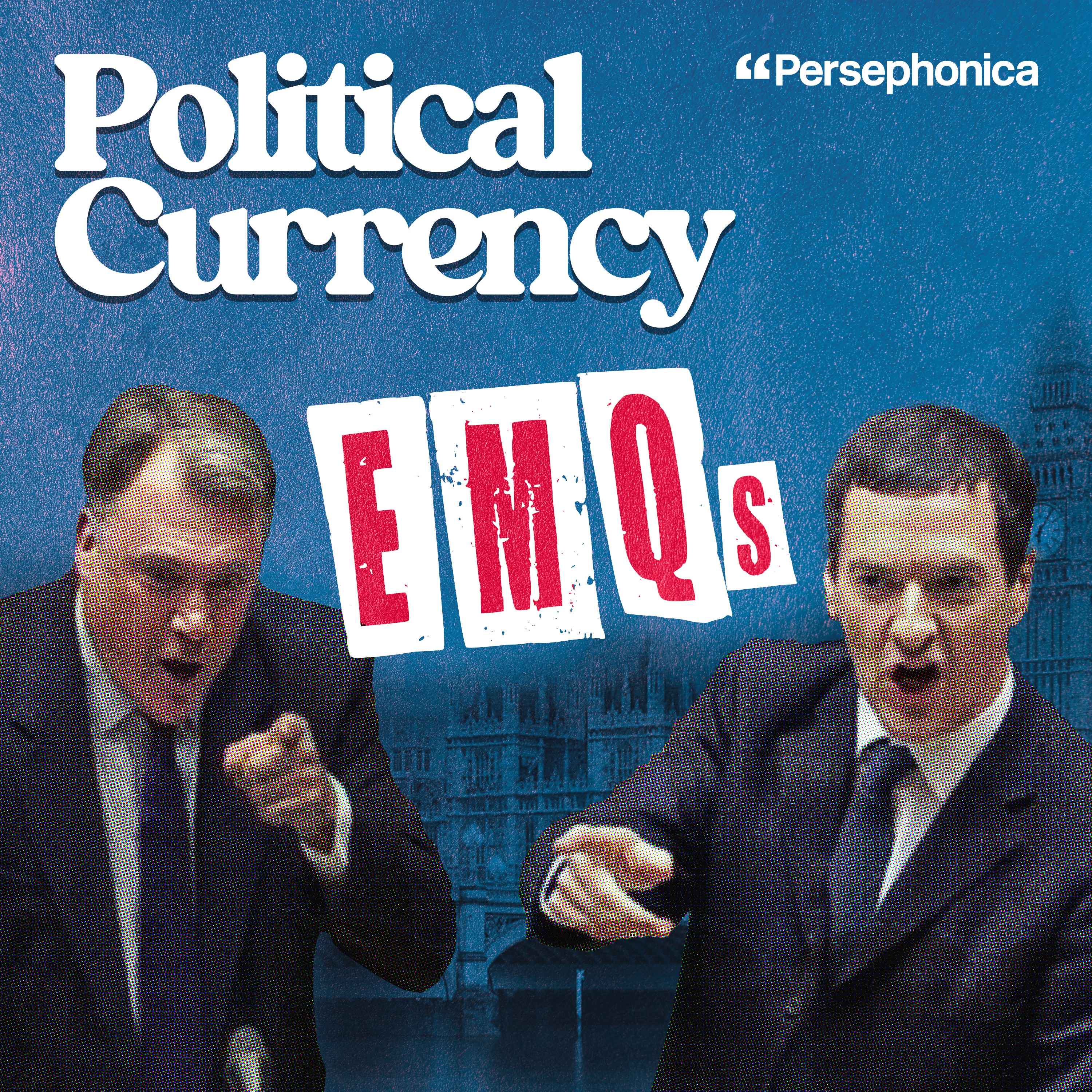
- EMQs: Are the Tories against welfare cuts?
In short
Ed Balls and George Osborne discuss (1) whether Labour should argue for rejoining the EU, focusing on how to persuade voters in former Leave areas like Ashfield; (2) why welfare reform is politically hard and what kind of “big” case is needed; (3) driving test backlog and government steps to reduce it; plus lighter Q&A about hymns.
Guests
No regular guests. Key “guests” mentioned include Gloria De Piero (reporter-turned-Labour MP), Craig Oliver and Matthew Elliott (campaign operators), Fraser Nelson (Times columnist), and Justin Madders (Minister for Roads). Also referenced: Andy Burnham, John Healey, Lou Haig, Annelise Midgley, Rachel Reeves, Keir Starmer.
Key claims
Rejoining the EU is a difficult sell in Leave-voting seats unless Labour addresses concerns (immigration, costs, security) and makes a winnable, long-term argument rather than re-litigating 2016. Welfare cuts face resistance; withdrawing future eligibility (e.g., freezing rates, ending future eligibility) is easier than taking cash from current claimants. Osborne argues welfare reform needs a mission about jobs/opportunity and a moral framing, not just deficit reduction.
Notable examples
EU debate tied to Ashfield/Mansfield/Leave 2016; welfare examples include two-child limit, bedroom tax, benefits cap, and sickness benefits; driving test reforms include recruiting instructors, overtime payments, banning “bots” that hoover up test slots, and reducing backlog.
Written by AI. May contain mistakes.
Chapters
2:27
The British Museum Ball Experience
Discussion about attending the British Museum ball and meeting notable figures.
“And if you are a Kitchen Cabinet member, you get a newsletter from us every week.”
4:09
Discussion on EU Relations
Exploring the implications of rejoining the EU and public sentiment.
“It was a bit like when I interviewed Amal Rajan and I didn't get any hint that he was about to be the first person ejected.”
5:44
Gloria Del Piero's Question
Addressing the challenges of advocating EU ties to constituents.
“The former Shadow Chancellor Ed Balls warned this week that he thought pursuing a second referendum would be fraught with danger for the new Prime Minister.”
8:16
Economic Arguments for Staying in the EU
Discussing the economic impact of Brexit and potential benefits of EU membership.
“And what is the argument which isn't going to work with them?”
12:24
Listening and Leading in Politics
The importance of addressing voter concerns while leading political discussions.
“So I would start with the real arguments and start with a strongly held belief of mine that Ashfield is worse off because we're outside of the EU.”
14:00
Debating Arguments on Free Movement
Exploration of public perception regarding free movement and its evolving arguments.
“one is, well, you know, or three big arguments, what is clear that we've lost out and that it's worse?”
15:20
Challenges for Labour on EU Policies
Discussion on Labour's potential campaign strategies related to EU policies and free movement.
“yes, we are going to pay a substantial multi-billion input into this European budget?”
18:50
Welfare Reform and Political Capital
Insight into the political costs of welfare reform and past government approaches.
“Talking about making long-term arguments, we've got a very good question next from Fraser Nelson, the Distinguished Times columnist.”
21:20
The Complexity of Welfare Cuts
Analysis of the challenges in implementing welfare cuts and the political dynamics involved.
“It was the right, you know, the biggest opponent, who opposed the benefits cap, which was the cap on the total number of benefits that only one family could receive?”
24:20
Reforming Welfare: A Big Argument
Proposing a big argument for welfare reform centered on jobs and opportunity.
Show all 14 chapters
28:03
Welfare Reform and Economic Challenges
Explore the arguments surrounding welfare reform and the economic implications of supporting welfare beneficiaries.
“Brown, when we were in the Treasury, we talked about welfare reform all the time.”
35:37
Driving Test Reform Discussion
Engage in a discussion about driving test reforms and the political implications of the current government’s approach.
“And so we actually have a question here from somebody who is undoubtedly well versed in these issues.”
42:00
Reflections on Political Regrets
Discussion about political regrets involving a former colleague.
“because she just ends up as a mayor in Lincolnshire.”
44:36
Engaging with Listener Questions
Responding to a listener's question about hymns and past experiences.
“Now, I think we should apologize, George, because if you are on social media, on Instagram or on X, or you listened to our podcast last week, you had to put up with quite a lot of our singing.”

Ask about this episode
Get the gist, explore an idea or ask about something said.
 Claude
On Political Currency, what are the key points of this episode?
Searching your listeningTranscript
Automatic transcript. May contain errors.
0:00Support comes from WISE, the smart way to manage the currencies you need around the globe. Fed up with losing out to hidden fees when you send money abroad with your everyday bank? Choose the smart way, WISE. You can count on the exchange rate you'd usually find on Google. No unwelcome surprises. Plus, ditch that where's my money feeling. Most transfers arrive in under 20 seconds. Join millions, saving billions, on hidden fees. Be smart. Get WISE. Download the WISE app today. T's and C's apply. This is Hannah Berner from Giggly Squad. O-Pill is the first over-the-counter daily birth control pill available in the U.S.
0:37Let's be real. Getting a birth control prescription is not always easy, and it's so much admin. In fact, about a third of women face barriers to access prescription birth control. Between scheduling appointments, missing work, class, or just trying to exist, it's a lot. But now O-Pill is putting birth control in our control. Opill is a daily birth control that's FDA approved, full prescription strength and estrogen free and 98 % effective when used as directed. Grab it online or at most major retailers, no prescription or doctor's appointment needed. So if you're thinking about birth control, check out Opill to see if it's right for you.
1:12Use code Giggly for 25 % off your first month of Opill at O-P-I-L-L dot com. That's code Giggly at O-P-I-L-L dot com. Birth control in your control. We love to see it. There are two types of business owners, those who are busy and those who want to be busy. Toast is designed for both, with tools to keep you humming and help turn grind into growth. That's how you turn busy into business. Toast, built for busy.
1:42Ed Balls: Welcome to EMQ's Ex-Minister's Questions with me, Ed Balls, and with George Osborne. We've got a great show this week, really meaty issues. Whether Andy Burnham can win the argument for rejoining the European Union and what you would say to voters on the doorstep. How do you go about delivering successful reform of welfare? What happened to the people we defeated along the way? If you want to send in a question to us, we always like a voice note on any subject. You can send it in by email, questions at politicalcurrency.co.uk, by other social media, or you can go to the comments here on YouTube and send us your question there.
2:26Ed Balls: So hello and welcome to EMQ's Ex-Minister's Questions. And if you are a Kitchen Cabinet member, you get a newsletter from us every week. And this week's newsletter had a picture of George with Traitor's Star, Maya Jama. And I wondered why.
2:46George Osborne: This was a highlight of the British Museum Ball, which Thea and I went to. And this, I mean, this is really amazing. I can say it's an amazing ball, although I'm chairman of the museum. I don't have much to do with actually organising the thing or putting it on. But the event was designed by someone called Es Devlin, who many of you will know. She's a kind of the kind of theatre designer and sort of show designer of our age. It's a very good exhibition of her work at the Design Museum. And we had an absolutely star-studded lineup of people speaking and turning. Mick Jagger literally was the warm-up act.
3:25George Osborne: How about that? Get the Rolling Stones for the warm-up act. And then I met Maya Jarma. And as we've discussed, thanks to you, I am a big fan of traitors. And they say never meet your heroes. I couldn't disagree more. I thought, you know, I've been admiring her on the show. She's like basically the only traitor who's got her act together and is trying to do the job properly. And she was terrific in real life. She was like really interesting, engaged, and didn't give any secrets away at what's going to happen on the show. But it was great to meet. So all of it was a thrill. And all the money goes to the great cause of keeping our museum going for the future.
4:08Ed Balls: And when you were talking to her, because obviously you were talking to her after the whole thing's been filmed, did you manage to discern?
4:18George Osborne: No. It was a bit like when I interviewed Amal Rajan and I didn't get any hint that he was about to be the first person ejected. She gave nothing away. She actually went like this. Sure, I can't say. So disciplined as well as ruthless. as we're seeing on the show itself at the moment. But, you know, it's interesting talking about BBC shows and so on. Our podcast has featured on the Today programme recently. We were discussing the decision to go back into the European Union. Wow, that's a bit of a... By the way, I should say... It's a decision. No, no, no, I was about to say. I should explain, first of all, I realise looking at the picture of myself here, I'm broadcasting from a kind of what looks like a corridor because it is a corridor in a Parisian hotel and we were discussing weren't we basically the Burnham's speculation that we could be rejoining the EU or get a closer relationship with the EU and I think you were quite skeptical And this set up this exchange on the Today programme.
5:33George Osborne: They played what you said. And then they did an interview between Craig Oliver and Matthew Elliott, who were the people who were kind of operationally running the rival campaigns. Here's the clip on the Today programme. The former Shadow Chancellor Ed Balls warned this week that he thought pursuing a second referendum would be fraught with danger for the new Prime Minister.
5:56Ed Balls: He was speaking on his political currency podcast. Do you really think that having an argument when the public finances and public services are under pressure about the scale of Britain's contribution to the EU budget is going to work for you politically? Well, that pretty much amounts to saying don't do it, I think, from Ed Balls. And this prompted a question from Gloria Del Piero, who was, of course, a TV political reporter, but then became a Labour member of Parliament and basically a Labour member of Parliament.
6:26George Osborne: I don't think this is too much of a characterisation. It's quite a sort of similar area to the one you represented in Parliament. That's right. Yeah, kind of East Midlands, former mining area. This was Gloria's question to us. How would you explain the benefits of closer ties with the European Union to your respective former constituents? And how do you think they'd respond?
6:54Ed Balls: That is such an interesting question. And I know Gloria really well. And I know what is behind that question. She was always someone who said you have to start by listening to the views of people and your constituents. So you need to be out there on the doorstep talking to people and listening and in hearing. And if you ignore people or pretend that you know their views without doing the hard yards or you assume, well, I know, but maybe they're wrong about this and we can just sort of tell them they're wrong. It'll all be OK. That is when politics backs fires. fires. And so what she's asking, I think, is rather a pointed question, which is, if you are out on the doorstep in the run-up to the next general election, telling people in our manifesto, we are going to be advocating a negotiation to return Britain to the European Union and to reverse the 2016 Brexit referendum, how is that going to go down?
7:55Ed Balls: And I think that will be, look, we had a huge response to that conversation last week. Lots of questions coming in, lots of comments on social media, on YouTube. I had lots of kind of messages as well to me saying that you're right to warn people. All of the commentators out there saying, you're wrong, you're out of date, the world is very different from 2016. And I think what Glory is saying, her starting point is, on the doorstep, what would you hear? And what is the argument which isn't going to work with them?
8:26George Osborne: Yeah, I mean, it's posed as a question, but it's really a warning, isn't it? But I'm going to try and answer it as a question. and I guess sort of this is also a challenge to you because I think you're very sceptical that Labour should be reopening this question because in seats like hers, which are kind of, I mean, they're not, I don't think you would classically call this red wall because I think the red wall tends to be, you think of as more like the northern seats, but, you know.
8:52Ed Balls: I actually think you could call this a red wall seat. And if you think about Mansfield, that's a red wall seat. Yeah, okay. It's not, it's former working class industrial mining, likely to have voted, as would have been the case in Glorious Seat, kind of clearly for leave in 2016, as was true in Morley, as was true in Makerfield, as was true in Mansfield, as was true in Rotherham, all those places.
9:17George Osborne: You know, I don't actually agree you should start with listening. I know that's going to sound like a bit of a pig-headed thing to say, but I think you should start, in politics, you've got to start with what you believe is true and right. And I fundamentally think the people in Ashfield would be better off that their prospects for the future, that their economic prospects would be better off if Britain had remained in the EU. because the areas that have been in some ways hardest hit by us leaving are precisely the ash fields of this world the places that were you know not as economically prosperous as like the southeast and the you know center of london or center of manchester or or you know center of birmingham the you know these are places which had a lot of small and medium-sized businesses That's the kind of future of these areas.
10:12George Osborne: And these are places that have where those businesses have seen their exports to the European continent collapse as a result of Brexit. And these are also areas dependent on public expenditure, where the public sector is an important player. And Brexit has made Britain poorer. You know, it is now generally acknowledged by economists around the world, and indeed in the official forecast for the British government by the OBR, and the Bank of England's work, that Brexit has made Britain something like 6-7 % of GDP poorer than it would otherwise be. And that creates less public, less tax receipts for public services.
10:57George Osborne: And so Ashfield is poorer as a result of being outside the EU and arguably more affected than Kensington or central Manchester or wherever. Right. And so I would start, Gloria, with that argument. I would start. I'm not saying you should just assume, you know, that if you don't see that you're stupid or, you know, that's the wrong. that's the worst kind of, you know, pro-European argument, which is you've got to be thick if you don't see the benefits of being in the EU. But I think you start with the real arguments that, you know, Britain's economic prosperity depends on our relations and interconnectedness with our near trading neighbours, that there are lots of businesses in this area that want to do business in Europe.
11:42George Osborne: And you can also make an argument that didn't really feature at all at the time of the referendum which is your security you'll start to notice in places like ashfield that we're having to spend more on defense that the threat to britain from external um you know enemies is growing and we need some collective security here and you can even make the argument on immigration which is often said these areas um which are in some ways is curious because they weren't they're not the most kind of multicultural areas of the country it's often the city centers that are more so But these areas had high concerns about immigration.
12:15You can say, well, we've also had a practical demonstration that being outside the EU has not led us to be able to control our borders, quite the reverse.
12:23George Osborne: So we have less control over immigration. Now we're outside the EU. So I would start with the real arguments and start with a strongly held belief of mine that Ashfield is worse off because we're outside of the EU. And if you believe that to be the case, then a good political argument made over a number of months and years, which is what this will take, could win over Ashfield to saying, let's get back into the EU.
12:52Ed Balls: it definitely could and and leadership is about winning arguments but i don't think it's right to say um that and i don't think you are saying this but i don't think there's a choice between listening and uh leading because i think if you want to win an argument you have to start by people's concerns and their worries and their understanding and then you have to persuade by showing people both how you address the things they're worried about and also point to the opportunities. And part of the problem in 2016, you knew that free movement and immigration was a big problem, but you didn't have an answer.
13:31Ed Balls: And so the tactical decision was made. If we don't talk about it, and we talk instead about economic risk, then we might succeed. And I think the lesson I take from 2016 is if people don't hear you talking about the things they're worried about, they close their ears and don't listen to what you want to say about the things that you want to talk about, which actually may be really quite persuasive. Now, if you look at the kind of comments we've had and commentators in the last week, since we talked about this, two big arguments, one is, well, you know, or three big arguments, what is clear that we've lost out and that it's worse?
14:11Ed Balls: I don't think that argument is won yet, because actually, people think it was pretty bad before and has it got worse or has it just stayed bad secondly they say free movement is no longer an issue in the opinion polls it's not a worry people aren't worried about free movement anymore now of course I mean that's partly because you had the Boris wave which was and then things have come down but it's mainly because we're not in the European Union we don't have free movement or they say the population is is is very different now a third of voters in 2035 in a referendum didn't vote in 2016 because they were too young and therefore the young people are going to change the debate Peter Kellner has this argument this week in the sub stack although we know politically the attitudes people have when they're 18 28 38 and 48 change and they evolve and so it's actually rather patronizing to assume the people who thought that when they were 15 are going to think that when they are 35 but most importantly this is where Gloria's right those commentators they've got to get on the doorstep and listen to people before they conclude they've got a winning argument.
15:15Ed Balls: Does Andy Burnham and Labour want at the next election to knock on doors saying, yes, we are going to pay a substantial multi-billion input into this European budget? Do they want to say, yes, free movement is good for you, and therefore let me tell you why re-embracing free movement is the best thing for Ashfield or for Morley or for Makerfield? Do you want to be saying to people, we are going to have to raise VAT on fuel, because what we did on VAT in the last parliament was because we're outside the European Union. And now we're going back in. We're going to have to raise it. I mean, those I think those are hard arguments, but you have to address them and talk to people about them and then make a bigger argument about prosperity, which is trumping.
16:01Ed Balls: it really worries me this idea when people say well free movement young people don't care free move is not a problem um it would be a huge challenge in a general election and then in the next referendum campaign and i don't think the european union has come to terms with managing migration flows and population flows and if you look at france and what's happening with le pen and you look at germany what's happening with afd at the extreme that is reflecting a wider concern which we know is in our country so that's why I've always thought look I want to get back to a close relationship with the European Union I voted remain I didn't think we should have left but I thought it was inevitable we were going to leave unless you found a way to deal with migration because I never thought free movement was going to be sustainable and I still don't think it does and I think if I was Gloria or Gloria's successor on the doorstep I would feel as though I need better arguments than you'll be better off really.
16:59Ed Balls: Because I don't think people believe it.
17:00George Osborne: If you're cynical, you know, you'd look at Ashfield and say, OK, well, they lost it to the Tories. It's actually one of the few seats that reform won at the general election. That's because Lee Anderson was the Tory MP who defected to reform. How are you going to beat Lee Anderson? Well, actually, you might want to take Lee Anderson on Europe and you might want to unite more of the left in Ashfield. So I think certainly in seats that aren't Ashfield, the more kind of middle class seats that Labour won, this kind of unite the left and split the right on the European issue is not a bad tactic, as we discussed.
17:45George Osborne: And it's a good plan B if you can't get your economy growing, which frankly are, you know, with the best win in the world, Andy Burnham and John Healy are only, you know, bit players in because of the global environment over the next couple of years. It's a plan B for your general election campaign.
18:00Ed Balls: But this is the question that Labour MPs will be asking themselves. Is this a clever piece of tactics? Or does Andy Burnham actually believe this is what he wants to go and do? And you're saying, you know, if it's not leadership, it's actually tactic and politics. Well, that's fine. We said that last week. Interesting on the Today programme, Craig Oliver, who was supposed to come on and defend the Romain rejoining position, came on and said, oh, no, it's not about that. It's actually a clever piece of pre-election tactics from Andy Burnham to do just what you said. That is fine. I don't mind a bit of that.
18:33George Osborne: But there's not a way to win the argument in Ashfield.
18:36Ed Balls: And especially in a referendum. That is the question. Is it vibes or is it actually a big argument that you can win? And I've just always been worried that if you try and re-litigate 2016 in 2030, 2035, on the same arguments to go back into the same, essentially, place we were in before, there isn't a good enough argument for the positive, as Gloria asks, to outweigh all the things which were big negatives last time around. And they're still there. Whereas if you make an argument for a new relationship, then you've got you know if you're if you're wants us that is a winnable argument i would much rather have a close economic and security relationship with our made trading partner and the people who we live with in europe but that doesn't mean having a second referendum is a good
19:29George Osborne: idea yeah no the lesson of the first referendum was if it's seen as a kind of essentially you know a piece of political maneuvering i.e cameron trying to see off the brexit you know the what were called the Eurosceptics, that rather than making a really long and sustained argument for membership of the European Union, which we weren't able to do in that referendum, then the result might end up being the same. Talking about making long-term arguments, we've got a very good question next from Fraser Nelson, the Distinguished Times columnist. As in George, it's Fraser Nelson here from the Times. You might have seen that the newspaper is doing a welfare inquiry.
20:05I'd like to ask you about the political currency aspect of this. Is it the case that welfare reform is always something that costs too much political capital? You'll both have been in cabinet meetings where you have discussed whether to do something about this massive problem. But is it the case that it always keeps being delayed because the political cost is too great and the political reward too small?
20:30George Osborne: Fraser, thank you. And yeah, I do, I think the Times investigation is actually really strong and they've done they've done sort of previous investigations like this on like the future of the NHS and so on I mean I'm gonna I'm gonna say two things first of all you can cut welfare I mean I did cut welfare you know as Chancellor and in that coalition government we made substantial savings to the welfare budget but there are two kind of lessons from that one is it's a lot easier to kind of withdraw future money that people haven't ever had in other words things like freezing benefit rates so benefits just don't go up and people you're not actually sort of taking money you are taking money away from people in the sense that you know their benefits aren't keeping pace with inflation but you're not physically taking like a pound off people or another example was the two child limit which i introduced that was for future larger families for example what's much harder is taking money actual cash away from people now and the most controversial things we did were things you know obviously we didn't call them this but they came to be known as things like the bedroom tax that was like uh you know if you had a lot if you were living in a house a council property you shouldn't be receiving kind of housing benefit for multiple um bedrooms that you weren't using because your family size was smaller and things like that but that that resulted in you know you were getting less money this year than you were getting last year and that's where we had the biggest fights so if you want to save welfare bill if you want to save money on welfare it's a lot easier to do things like freezes or or ending future eligibility rather than trying to withdraw money now and then the sec just the second point i make is the biggest trouble i had was and this is very sort of pertinent because fraser was editing the spectator at the time the problem i had the biggest problems i had were not with the left not with my political opponents like you where i was happy to have the fight you know which is a bit like the kind of echo the current fight around the welfare party and Kimmy Baden-Lock's messaging on that.
22:47George Osborne: It was the right, you know, the biggest opponent, who opposed the benefits cap, which was the cap on the total number of benefits that only one family could receive? Mayor of London, Boris Johnson, biggest opponent. Who was the biggest opponent when I tried to curb the sickness benefits bill, which is, you know, now the big talking point? Who resigned from the cabinet over it? Ian Duncan Smith, former Tory leader and who was the person who stopped me trying to cut um the generosity of tax credits uh nigel lawson great margaret thatcher chancellor right so these it was the tories who were against cutting welfare and i think one of the challenges for kemi badenot was she and i very much think she's on the right vein here when she's talking about welfare bills is the welfare bill exploded under the Tory government, under the Tory governments of Boris Johnson and then Rishi Sunak.
23:45George Osborne: And yeah, they'll say it's partly to do with COVID. Yeah, for sure that had a big impact. But let's be clear, the big rise in the number of young people getting onto benefits happened under Conservative governments. So, and by the way, you know, Fraser, the spectator was very supportive of lots of things I did, but the right-wing press was not particularly supportive of my welfare cuts at times. And so that's the challenge. You've got to try and assemble the coalition in your own side before you can win the argument with the other side. And that's why welfare benefit reform is so difficult. And were there to be a Conservative government, much as I think the list of things that Kimmy Bader-Kent wants to do seems to me pretty sensible, I think the first bunch of people she'd run into opposition from would be the Conservative Parliamentary Party and the Conservative press.
24:34Ed Balls: I'm going to give an answer to Fraser's question in a minute but just kind of on the things you've said and the the record I mean I guess as you're talking two things come to my mind first of all if you go back to 2010 and look at the evolution of welfare spend the biggest rise in welfare spend welfare state spending since 2010 has actually been support for pensioners yeah bigger than for working age people and that was things that you instituted that actually happened under you and david cameron so the biggest rise in welfare spending was things that you started and then
25:11George Osborne: secondly the second i would i would say in defense we also raised the pension age which was the biggest single saving in state expenditure and like more than british history yeah and past
25:21Ed Balls: labor governments um and that but that's back loaded you know that's that's going to save us tons of money in the decades i'm just pointing out if you look at the percentages and say what proportion of the rise in real terms welfare spending has gone to who since 2010 the biggest proportion goes to pensioners more than working age people and you know they were your decisions and then secondly you know to what extent it was what happened after 2016 within the conservative government because that is when the huge rise in working age and young people's benefits happened is is it the pandemic only or is it also that there was within the conservative party a
25:58George Osborne: backlash against what you've done well i think the brexiteers took control of the conservative party and the brexit vote came from large parts of the population that relied on welfare and there was a small number of brexiteers who thought voting for brexit was a vote for like you know a lightly regulated low-tax britain but it was really a vote for a high spending high-tax britain which is what we've got and that fed through into the kind of decisions of subsequent conservative governments.
26:23Ed Balls: So it might be that in the end, as Fraser says, the political cost of the reforms becomes too great, even for a Conservative government, if what you're doing is trying to win over those kind of voters. My answer to Fraser's question, which I don't think you can disagree with either, is that you have to have a big argument. And the problem Rachel Reeves got into with Keir Starmer in the first two years of the government was that they it sounded like they were saying we will have to cut disability benefits in order to cut the deficit and cut spending or even worse than that we've got to cut the deficit and spending why don't we cut disability benefits and you know the moment the dynamic has been set up that you're choosing a group which is more vulnerable but may have a less louder voice because somebody's got to suffer and there's got to be cuts and why don't we choose them if that's the narrative which establishes I don't think that was what was in Rachel Reeves or Keir Starf's mind but the reason why Lou Haig who is now Andy Burnham's right-hand person was able to drive with Annalise Midgley who's now the chief whip and the way they're able to drive that rebellion was saying why should this group be the people who get hit by a need for public spending cuts.
27:51Ed Balls: And I think the answer to Fraser's question is you have to start, and he's making this argument in his columns and also in the Times inquiry, you have to start with a bigger argument about opportunity. I mean, Tony Blair and Gordon Brown, when we were in the Treasury, we talked about welfare reform all the time. But there were two big arguments one is jobs and opportunity in order to get people back to work the new deal within which we said no fifth option just being on welfare and not getting a job but the big the big argument was jobs and opportunity and then it was also make work pay make work pay through the working families tax credit so that we can say work pays and therefore you can't choose to be on welfare and it shouldn't be in your interests.
28:41Ed Balls: And if you have a big argument about opportunity, I mean, the idea that we want 21-year-olds for the next 40 years to be languishing on sickness benefit is a catastrophe. So you have to put jobs and opportunity first. You have to make work pay. And then you say, and I'm sure Milburn's going to recommend this, but we're not going to let you stay on benefits because it's bad for you, bad for the economy, bad for the costs of welfare. But isn't the argument that if you go after narrow arguments about saving, especially if you're a Labour government, you've got no chance and you have to make a big argument?
29:18George Osborne: For sure. Although I think in practice, even if the Alan Milburn strategy is executed perfectly, here are going to be the problems. So which is, you know, too many young people on benefits, sickness benefits, and we're going to need to give them opportunities. And, you know, he makes the argument for every£25 we spend on someone's sickness benefit, we spend only£1 on their training. Fine. Okay. So the problem, if you're actually the government, is, first of all, you know, you've got to put the kind of cart before the horse. You've got to spend more money to save money. And if you're in the Treasury, that's like, oh, what?
29:52George Osborne: Now we've got a problem anyway with this bill. We've got to spend billions more. Presumably then there's got to be, you know, there's going to be a period of time while this sort of training program or whatever is implemented and people are given a chance. You're then going to run into all sorts of issues which we ran into with very, you know, one of the biggest sources of welfare saving came from these work capability assessments, which were kind of tough interviews to see whether you could work or not. But then, you know, you get all sorts of rows about people who fail those assessments and the private companies that conduct the assessments and all that kind of thing.
30:26Ed Balls: Introduced by the Labour government. You inherited them, didn't you? Yeah.
30:30George Osborne: And then became very controversial. And then you get, you know.
30:33Ed Balls: They were quite controversial when they were introduced, if I remember.
30:36George Osborne: And then you get the courts and then you get the courts coming in and court judgments saying, hold on, this person is mentally distressed or has a mental illness. You get the chat. There are tons of charities in this space. I mean, even a kind of political genius with a large parliamentary majority will find it very hard to get people who are on young people on those sickness benefits. I'm not doubting that. I think you could tomorrow cut the eligibility pretty dramatically for future claimants. but the current ones someone let's be honest someone who's now age 30 who's been on those sickness benefits for a few years i would be amazed if you get them off in their lifetime
31:18Ed Balls: and it's a tragedy but it's true i think that that is very pessimistic and very worrying but i so the
31:24George Osborne: counter argument you're right but i mean i'm not saying you have to agree 100 but you can see it's
31:28Ed Balls: going to be really hard no i understand that i understand that but but the um but even for the 30 year old existing claimant the thing which happened this week Andy Burnham said something and Fraser Nelson said yes yes yes Andy Burnham said what is happening to young people on incapacity benefit is a moral issue it's a moral scar it's a moral failing and Fraser says yes a promise to saying this is a moral failing is important and I guess that's the argument that I'm making. If the moral failing is a scrounging, skiving 30-year-old on benefits and it's their moral, they are being immoral, that is much harder to win.
32:12Ed Balls: But if you say the moral argument is young people are being let down and we will not let that happen because it's wrong for the nation and for them. And therefore the 30-year-old, even after 10 years on benefit, you don't deserve 30 more years languishing in a bad place, we've got a moral duty. If you can get a big moral argument, that means you can, underneath that, strengthen your capability assessment, push the courts into a different place. I think if you are a Tory Chancellor dealing with getting a budget deficit down, you can go after cuts. Although even you found that hard, as you said on the Working Families Tax Credit by 2016.
32:51Ed Balls: But if you are a Labour government, and I actually really think a long-term reforming government, you need the big mission.
32:58George Osborne: Yeah. And that's what Fraser, I think,
33:00Ed Balls: is trying to do in the Times to kind of set up that big mission.
33:03George Osborne: I'm just saying the results will probably be backloaded.
33:07Ed Balls: Well, look, I mean... But it doesn't make it less worth doing.
33:10George Osborne: I mean, it's just...
33:11Ed Balls: It's always harder to make savings on the incumbent. There is absolutely no doubt about that. Let's take a break and then we've got time for a couple more questions.
33:28500 orders a month was manageable. 5 ,000 is madness. Embrace intelligent order fulfillment with ShipStation, the only platform combining order management, warehouse workflows, inventory, returns, and analytics in one place. What used to take five separate tools, ShipStation does in one. Automate fulfillment and rate shopping to ship up to 15 times more with up to 90 % savings. Go to ShipStation.com and use code AUDIO to try ShipStation free for 60 days. Do you snore? Did somebody hand you a CPAP and did you quietly stop using it? The mask that never quite seals? The hose tugging at you every time you roll over?
34:10A machine sitting abandoned in a closet? Excite OSA works a different way. It treats a root cause instead of managing the noise, and you use it while you're awake. 20 minutes a day, while the coffee brews, while you set your fantasy lineup. An FDA-cleared prescription device for primary snoring and mild obstructive sleep apnea. Then you go to bed like a person. Nothing strapped on, nothing plugged in. In clinical studies, 90 % of patients saw a reduction in snoring. No sleep study required. Prescribed online, shipped to your door. Excite OSA at springsleep.com slash sleep20. Code sleep20 for 20 % off.
34:56Excite OSA is an FDA-cleared prescription-only device for primary snoring and mild obstructive sleep apnea. Not for everyone. Individual results vary. Risks and benefits at springsleep.com. Your 2027 business plan is only as strong as the numbers behind it. Are your books ready? Paro connects your business with accounting advisors and fractional CFOs to strengthen financial reporting, forecast cash flow, build next year's budget, and more. Get expert finance and accounting support for your year-end close and the decisions ahead. Visit paro.ai slash ready to learn more. That's paro.ai slash ready.
35:46Ed Balls: so welcome back um the discussion about small ideas last week martin lewis's new um charity and his new campaign we've talked about driving tests i then had a message in the week from um the the people in charge of driving test reform um saying you know they just want to kind of get they're roaring. And so we actually have a question here from somebody who is undoubtedly well versed in these issues. Hello Ed and George, it's Justin Madders, Minister for Roads here. I was listening to your EMQs episode earlier this week and I heard your chat about driving tests now. I thought I'd get in touch to provide a bit of context.
36:28The government totally understands the frustration people feel about this issue. It is probably one of the most frustrating things that we inherited from george's party however the transport secretary and i are now gripping the issue recruiting a record number of instructors over time payments to create more tests banning bots that hoover up test lots we have seen the backlog begin to come down i've ended with a question as well george may not remember that 21 years ago i was narrowly defeated by him in the 2005 general election when george took the seat of time for the conservatives having had that lucky escape from me.
37:05I wondered if either of you could say whether any of the other candidates you defeated had gone on to do some wonderful and unexpected things.
37:14George Osborne: Justin, it's good to hear from you. I think the last time we spoke, if you can count this as speaking, was the churches in Wilmslow who put on the election debate and the school in Nutsford where we did an election debate as well. And congratulations on your successful political career. And let's be honest, it wasn't a very narrow defeat. I think you're being a bit cheeky there. I was actually always very keen to get Labour into second place in Tatton because I thought the biggest risk to the seat was the Liberal Democrats coming second. And they were kind of evenly, like Labour and Liberals were pretty similar.
37:55George Osborne: And I'm really pleased you're gripping this. I mean, I'll take issue with your like, I agree with you that the problem started under the Conservatives. But we have had two years of a Labour government. And it's all very well saying the Transport Secretary is now gripping it. OK, but we've had like Labour Transport Secretaries for two years. And it is, you know, it's a real, real problem for people. They can't get a driving test. And for lots of people, if you can't get a driving test, that has a big impact on, you know, the jobs you're eligible for and where you can work and so on. um so hopefully you will grip it and sounds like you're taking those steps to your question though um um yeah it's a good question i did i mean i remember more the people who i either lost to or beat in the tory selections for seats um because um i'll stand corrected but i don't i don't remember other people I've sort of fought in the general elections, you know, going on to like prominent things in public life.
39:00George Osborne: But the, yeah, I mean, I remember my final selection to be the conservative candidate in Tatham, like the other three people in the final there in Nutsford High School, when we had the big meeting of the local Tories in just, I think it was like 1999. uh there was uh chris grayling uh went on to obviously be a tory mp and a tory cabinet minister and justice secretary and so on uh there was also someone called richard ashworth who became a member of the european parliament and there was peter fleet he actually had perhaps the most interesting thing because he um he was in the car industry and he ended up being like running Ford Motor Company in Asia, which probably had more impact on the world than being a British MP.
39:52George Osborne: But yeah, and I have a lot of fond memories of all those things and didn't really fall out with anyone. And actually I have fond memories of the general election campaigns in Tatton. All my political opponents were, we had a good, you know, we seemed to have pretty civilised debates.
40:08Ed Balls: Well, so thank you to Justin for the question. And, you know, I think George had set the record straight somewhat last week on driving tests. There was action happening. But, I mean, where better for us to hear it from than the Minister for Roads to get the detail of exactly what is going on? But on your question, I've just taken the opportunity to look this up while George was speaking. So, first of all, in 2005, I beat Andrew Percy, who went on to become the MP for Brigand Gould, and a government minister 2010 to 2024 so he went on to a great career after being defeated by me so I'm sort of very happy to have made that contribution then 2010 I defeated a guy called Anthony Calvert who is a Wakefield councillor and has had a career in sort of planning local government since then of course in 2015 I was defeated myself by Andrea Jenkins who is now a reform mayor but my greatest victory in terms of my subsequent contribution to public life was in 2010 where um in the labour leadership election in which i came third i i defeated uh this lad called burnham and he's now gone on to be he's now gone on to be prime minister so um there we are get defeated by me and where can you end up yeah Andy you're welcome Justin
41:39George Osborne: that is a great question and I'm glad you're listening congratulations on your career and um sort out the driving tests you'll be my hero if you do and um I don't know whether it'll
41:50Ed Balls: be Anthony Calvert or Andrew Persson who's going to be the next leader of the Conservative Party Prime Minister, but you know, it's the Burnham route, maybe. I mean, you know, Andrew Jenkins made a terrible mistake by beating me because she just ends up as a mayor in Lincolnshire.
42:06George Osborne: I think to be fair to her, she's the mayor of the whole of the... Anyway, and you know, she has a special place in my heart, always, Andrew. Yeah, I mean... We don't always agree on politics.
42:19Ed Balls: Yeah, yeah. I mean, one of the great regrets of your career must be having her introduce you in the 2015 Conservative Party conference because she then went on to, I mean, she could be one of the five on your book, Brexit Job, Why George Osborne Was Stopped Being Prime Minister. She could definitely be one of the five.
42:37George Osborne: I can tell you that was not one of the biggest mistakes of my political career. There were quite a few, but that was not one of them. Listen, we've got a final question which actually has an echo of Justin's question at the end of it from Richard.
42:48Ed Balls: But before we do, we'll take a break.
42:59Hey, it's Paige DeSorbo from Giggly Squad. Everyone is always looking for a new way to make some extra cash. But sometimes the easiest place to start is your own closet. With a little help from Depop. Think about how many clothes you have that you love, but you just don't wear anymore. On Depop, it's quick and easy to list those pieces. There's no selling fees. And suddenly those clothes have a chance to find someone who actually wants them. And the best part, you're making room for whatever you're into next. Make money on Depop with no selling fees and find what you want for less. This message is brought to you by Depop.
43:31Bad news travels fast and bad AI conversations can travel even faster because one mistake can happen again and again and again. Parloa Lens helps you spot those problems across every conversation. And Navigator helps you figure out why they're happening and what to do next. So your AI agents don't just handle more conversations, they get better at handling them. That's the power of Parloa. Find problems before they find your customers at Parloa. P-A-R-L-O-A dot com. When you're running a growing business, the right systems can unlock your full sales potential and make fulfilling every order effortless.
44:06Switch to ShipStation before peak season so you're prepped and ready before the rush hits. ShipStation connects Shopify, Amazon, TikTok Shop, and over 200 more marketplaces with one platform that does it all. You can manage orders, sync inventory, track returns, all automatically. Everything your operation needs, all in one place. Upgrade your shipping operations to stress-proof your biggest sales days and capture every bit of potential revenue. Go to ShipStation.com and use code AUDIO and get 30 days free.
44:35Ed Balls: Welcome back. Now, I think we should apologize, George, because if you are on social media, on Instagram or on X, or you listened to our podcast last week, you had to put up with quite a lot of our singing. And, you know, in the band Centrist Dad, I'm the drummer. I'm not the singer. And I don't think you're much of a singer either. But that's fine because we engage heartily and with enthusiasm. It's just not clear that we should be sharing this with the nation. However, we had a question from Richard who got in touch about hymns. And this question is voiced by one of our producers. Following your fascinating discussion last week about hymns, Would you not agree that one of the finest hymns is ye holy angels bright who wait at God's right hand?
45:22Written in 1681, this hymn is especially suitable for any programme hosted by Ed Balls and George Osborne, chiefly on account of its second verse, You blessed souls at rest, who ran this earthly race, and now from sin released, behold the Saviour's face. Incidentally, George, we once met back in 2001 when you paid a visit to the politics department of Manchester Grammar School. I was then a Ted of Politics while you were a young prospective Tory candidate for Tatton During the Q &A I recall you being verbally attacked by a bullish sick former called Alex Norris now Labour's Justice Secretary A further reminder that not all MPs from independent schools are found on the Tory benches How about that?
46:03George Osborne: Do you remember that? Do you remember the Alex Norris question? I do remember going to Manchester Grammar School you know which is a really impressive school and a lot of you know got a lot of people who lived in Tatton they sent their kids there uh their boys there um the um and i do remember a pretty lively i mean they were you know those political sixth forms are they're good they know what they they know what they're doing and they've got good questions um i don't remember alex specifically although uh yeah he's made it to the hopefully this is going to be you know i'm sure this had nothing to do with it but i hope he uh although he became a labor cabinet minister i hope there was a bit of um he saw me you know come there and he thought yeah i i can be in politics and um that's why i used to do those school visits i thought if you can just get one person listening to go like maybe a political career is for me or maybe getting him get you didn't know i'm not necessarily as an mb let alone a cabinet minister but just as a counselor or engaged in the local party and i was totally you know if it was i couldn't care i couldn't care less which party it was for i mean obviously.
47:10George Osborne: Of course. Yeah. So, um, that is great.
47:13Ed Balls: Have you done those speakers for schools visits, the charity Robert Peston, uh, set up? I have done.
47:19George Osborne: Yes. I mean, I've got speakers into comprehensive interstate schools. I did try. And I mean, I was, you know, we should go do one together. I didn't do many private school visits. I mean, I tended to try and stick to the, um, the state schools. Um, I'm going to New College, Sixth Form College in Pontefract in,
47:37Ed Balls: December. Do you want to come?
47:39George Osborne: Can we visit the Haribo factory at the same time?
47:42Ed Balls: Yeah, definitely. We could absolutely do that as well. We could do the podcast. That's why I love pod to
47:47George Osborne: practice.
47:49Ed Balls: The only problem is we'd have to get permission for the local MP to go to Haribo. She might say no.
47:53George Osborne: She's got, you know, potentially a tight election coming up with reform. I'm not sure I'll send you and me there. It's going to help. Can we return to the actual
48:01Ed Balls: question, though? Before we turn to the question. You go first. First of all, no, no, it's actually about the question. Before we turn to the question.
48:08George Osborne: The first one is a great hymn. It's a kind of old version of the Coldplay song, isn't it? I used to rule the world, see the fear in my enemy's eyes.
48:21Ed Balls: I thought we would decide if the singing was off. It's a bit like that.
48:30Ed Balls: Fundamentally, though, it's flawed, George. Let me tell you why. It's great, the idea that ex-sinners, earthly release, we can now have the peace and grace of our transition into a post-political lifestyle. But unfortunately, that's not how we think about it. We don't want to go to heaven. What we actually want is to get back into it. I mean, both of us are probably frustrated that we're not still in the thick of it.
48:56George Osborne: Yes. But I'll tell you also something that Richard's question reminds me of. You know, of course, these Labour MPs have to go around saying, I was educated in this state school. My life was so tough. I tell you, the most successful Labour politicians, privately educated. Clement Attlee, Halebury, private school. Tony Blair, Fettis, the ones who actually win the elections, privately educated. Keir Starmer, he went out of his way to try and say, no, no, no, my school just happened to become private while I was there. Labour primers do one election. Grieve, not so successful since. I think, didn't Ed Balls, wasn't he privately educated?
49:44Ed Balls: Nottingham High School. So that's on the other side of the ledger.
49:49George Osborne: The less successful one. No, Alex Norris is in a distinguished line of successful Labour politicians who were private.
49:57Ed Balls: He's definitely a rising star. He's one of the people who, when you interview him on the TV, is good. And that's great to see. I'm reminded by this of Gordon Brown. He always tells his story about his father, who was a Church of Scotland minister and always kept politics out of the pulpit because it's totally inappropriate if you are being a vicar. I mean, I'm not sure all vicars think like this, or better ministers, but he certainly did. But Gord always said that after general elections, he would always shape the hymn tune to reflect his view of the result. So if, you know, he was a Labour supporter, if Labour won in the general election the following Sunday, that Charles Wesley hymn, Rejoice, the Lord is King, would be his hymn choice.
50:49Ed Balls: Whereas if Labour lost and the Conservative won, it would be, dear Lord and Father of mankind, forgive our foolish ways. And so he was basically always a subliminal critical message. That was a great question.
51:07George Osborne: And it's wonderful that Alex Norris asked me a question all those years ago. Why didn't you ask us a question on AMQs? Yes. I think, as I say, that was probably the last time I was reading to Alex Morris. Would he send us a question?
51:24Ed Balls: He could ask us a question about early release from prisons and why the Conservatives failed to build so many prisons.
51:31George Osborne: He can ask us what our favourite Coldplay song is. The point is we don't shake the questions, Ed. We just respond. We listen. No, but I'm just giving him some thoughts.
51:41Ed Balls: Anyway, thank you, Richard. That's it for this episode of EMQs.
51:43George Osborne: Yeah, if you've got any other questions for us, email us at questions at politicalcurrency.co.uk or you can message us through our socials.
51:51Ed Balls: Tone, era, subject. We love variety. Get creative. Send us a voice note and we'll answer them.
51:59George Osborne: And very importantly, our next episode is going to be our budget special in the afternoon after the budget next Wednesday. And then we'll have our regular podcast on Thursday. But budget special Wednesday afternoon. See you then. Make sure you listen 3pm on Wednesday after the budget.
52:27This is Hannah Burner from Giggly Squad. O-Pill is the first over-the-counter daily birth control pill available in the US. Let's be real, getting a birth control prescription is not always easy and it's so much admin. In fact, about a third of women face barriers to access prescription birth control. Between scheduling appointments, missing work, class, or just trying to exist, it's a lot. But now Opill is putting birth control in our control. Opill is a daily birth control that's FDA-approved, full prescription strength, and estrogen-free, and 98 % effective when used as directed. Grab it online, or at most major retailers, no prescription or doctor's appointment needed.
53:06So if you're thinking about birth control, check out Opill to see if it's right for you. Use code Giggly for 25 % off your first month of OPILL at O-P-I-L-L dot com. That's code Giggly at O-P-I-L-L dot com. Birth control in your control. We love to see it. This is the story of the one. As a shipping manager, he's running the dock, stocking supplies, and making sure every order goes out on time. And Grainger helps him stay prepared. From shipping supplies to PPE to hand tools, he counts on Grainger to keep products moving and trucks rolling. So his operation runs smoothly no matter the shift. Call 1-800-GRAINGER, click grainger.com or just stop by Grainger for the ones who get it done.
53:52When you're running a growing business, the right systems can unlock your full sales potential and make fulfilling every order effortless. Switch to ShipStation before peak season so you're prepped and ready before the rush hits. ShipStation connects Shopify, Amazon, TikTok Shop, and over 200 more marketplaces with one platform that does it all. You can manage orders, sync inventory, track returns, all automatically. Everything your operation needs, all in one place. Upgrade your shipping operations to stress-proof your biggest sales days and capture every bit of potential revenue. Go to ShipStation.com and use code AUDIO and get 30 days free.
From the publisher
After the great response to Ed Balls’ scepticism on Burnham trying to rejoin the EU, former Labour MP Gloria De Piero got in touch. She asks Ed and George Osborne just how they would make the case for rejoining, to their former constituents. With Gloria’s seat now held by Lee Anderson, it’s clear that the case in some leave voting areas will be a hard one to make…
Then, Times writer and former Spectator editor Fraser Nelson asks if the political costs of welfare cuts outweigh their benefits. George explains how it was the right, not the left, who prevented him making greater cuts while in office. Ed cautions that for the Milburn reforms to work, a careful line will have to be taken by the government.
Roads minister Justin Madders then attempts to correct George on the situation surrounding driving tests and takes a trip down memory lane. He was the Labour candidate against George in 2005 and asks if any candidates the pair beat in elections went on to great or surprising things. Ed recalls he beat one Andy Burnham in the 2010 Labour leadership race…
Finally, off the back of their angelic renditions of hymns last week, a listener submits a favourite hymn of their own, and shares a story of a young George Osborne encountering a future Labour cabinet minister…
We love hearing from you, so please don’t forget to send all your EMQs to [email protected] and make sure to include a voice note of your question or send a question to our social media handles:
👉 X
👉 TikTok
Thanks for listening. To get episodes early and ad- free join Political Currency Gold or our Kitchen Cabinet. If you want even more perks including our exclusive newsletter, join our Kitchen Cabinet today:
👉 patreon.com/politicalcurrency
Please note: Kitchen Cabinet is only available via Patreon.
Credits:
Production: Sam Burton
Producer: Caillin McDaid
Video Editor: Louis Norris & Sam Gruet
Executive Producer: Henrietta Harrison
Political Currency is a Persephonica Production and is part of the Acast Creator Network.
Hosted on Acast. See acast.com/privacy for more information.
More from Political Currency
All episodes

We use cookies.They keep VO running smoothly and help us improve it. Privacy policy