
 Ask ChatGPT


- Podcasts
- Political Currency
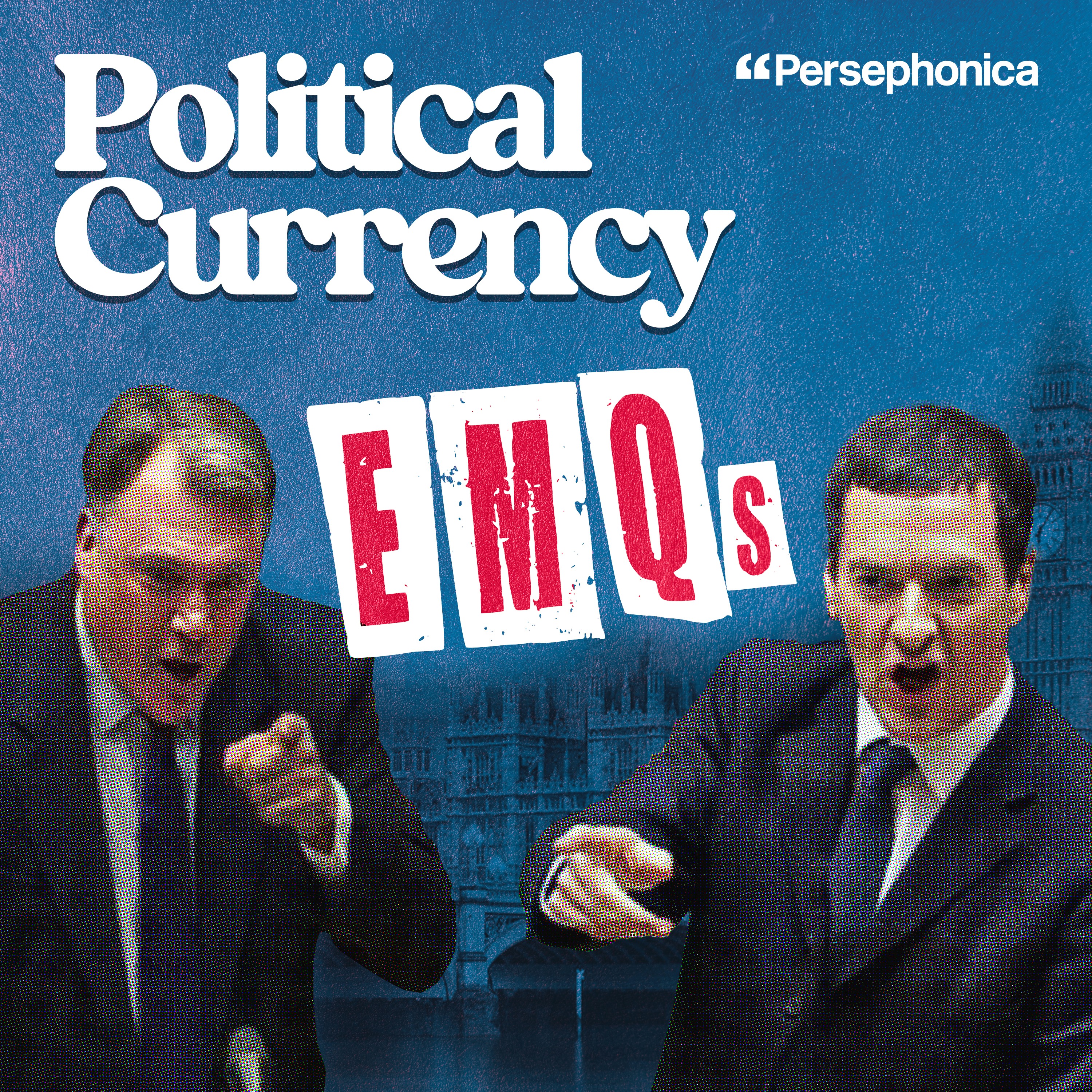
- EMQs: Are we influencers now?
In short
In this episode of Political Currency, hosts Ed Balls and George Osborne delve into the implications of a weak Prime Minister's potential resignation and its effects on opposition leaders. They discuss various political dynamics, including the possibility of non-MPs becoming Prime Ministers in the UK, and explore their unexpected influence within political circles. They conclude with a response from reporter Ben Bloch regarding issues of Prime Ministerial incapacity and the Labour Party's rules.
Written by AI. May contain mistakes.
Chapters
0:45
Centrist Dad Band and Fundraising Success
Discussion about a recent band performance and fundraising for charity, featuring various political figures.
“because I was away that your band Centristad played in Camden on Saturday with that legendary pop star Fluella Benjamin.”
2:32
Opposition Strategy and Leadership Dynamics
A detailed discussion on the strategies of opposition parties and the implications of leadership changes in the Labour Party.
“It speaks to a sort of bigger issue, which is I think opposition sometimes when there's a weak prime minister or a prime minister, they think they can beat in an election.”
6:25
Skills Funding and Management Training
Exploration of the importance of skills funding for management training and its impact on youth employment.
“Starmer because she's too left-wing, but it also might be that she could turn out to be a better politician than Keir Starmer and strengthens Labour in the polls and surprises and turns things around.”
14:00
Training Managers in the Private Sector
Exploring the need for better management training in the UK.
“They're adults who have already done several years of work.”
15:04
The Case of Mark Carney and Party Leadership
Discussing the eligibility of non-MPs for party leadership in the UK.
“Either way, given the popularity of someone like Andy Burnham with MPs and the public, do you think this could ever be a possibility in the future?”
18:58
Historical Perspectives on Prime Minister's Eligibility
Analyzing historical cases of Prime Ministers and their parliamentary status.
“campaigning for to allow himself to give up his peerage, which he won't previously.”
20:59
Modern Routes to Political Leadership
Examining contemporary paths for political leaders in the UK.
“you can kind of go into the House of Lords as a route into the House of Commons and becoming Prime Minister.”
22:36
Influence of the Podcast on Political Discourse
How the podcast shapes political conversations among MPs and civil servants.
“I continue to love the pod and really want to come and see you in the band, Ed.”
25:58
The Role of Commentary in Politics
Discussing the impact of political commentary on decision-makers.
“There's always been commentators, journalists, columnists who have been kind of analysing and thinking about politics in their columns.”
28:01
Reflecting on Gordon Brown's Insights
Explore the commentaries on Gordon Brown's recent interview and insights on political accountability.
“I thought it was very interesting hearing from him again.”
Show all 15 chapters
28:54
Betrayal in Politics
Discussion on the perceived betrayal among political colleagues during crises, focusing on historical events.
“live and i thought oh thank you amal here's the clip on his uh podcast political currency with George Osborne, your longtime friend and colleague, Ed Balls, said the following.”
29:48
Preventing Future Political Failures
Strategies and measures to prevent future political failures discussed by the hosts.
“can take to prevent this happening in future.”
30:31
Understanding Labour Party Rules
An in-depth analysis of the Labour Party's rulebook regarding leadership succession.
“It states that, quote, the Cabinet shall, in consultation with the NEC, appoint one of its members to serve as party leader until a ballot under these rules can be carried out, end quote.”
32:05
The Role of Acting Prime Ministers
Examining the powers and limitations of acting prime ministers during crises.
“It's a bit, we were touching on this earlier in the question session, weren't we, about premierships and what happens, how a prime minister could be outside parliament.”
33:46
Fluidity of Political Rules
Discussion on the adaptability of political rules and their reflection of reality in British politics.
“admit that I didn't know that the new Labour Party rulebook goes into this degree of detail.”

Ask about this episode
Get the gist, explore an idea or ask about something said.
 Claude
On Political Currency, what are the key points of this episode?
Searching your listeningTranscript
Automatic transcript. May contain errors.
0:00The Chancellor of the Exchequer. Getting a lesson from the Shadow Chancellor on how to balance the books is like getting a lesson from Dracula on how to look after a bloodbath. Ed Balls. A steady-as-she-goes budget. What kind of ship does he think he's on, the Titanic? They're married, Celeste. Welcome to EMQs from Political Currency with Ed Balls and George Osborne.
0:27Welcome to EMQs. and we're still remote because I'm abroad. You might hear some of my children in the background having breakfast next door. I can hear quite a noisy scene going on there, but maybe not as noisy as the gig I missed because I was away that your band Centristad played in Camden on Saturday with that legendary pop star Fluella Benjamin. I can't remember whether you were the warm-up act for her and Ken Follett's band or it was the other way around. It was a double bill. Yeah, but pop concerts don't have double bills, Ed. There's always the big act. There was a lot of chat, though, about where you were.
1:08I can't believe you're that popular at the moment for doing a podcast with me when you ought to be pulling your weight over breakfast. Don't worry, I'm about... You're about to get it in the neck. But also... No, I'm not at all. You know, I know Thea will be doing a brilliant job. Yes, she'll be doing a brilliant job single-handed. But we also had lots of political currency members there they were all saying where's george you know we've heard about the pogoing and it was so packed you had to dance up and down because there wasn't room to go side to side and you know the mayor of london was there and ed milliband came again he's one of our big fans actually the defense secretary john healy came because he's a good friend of ken follett who is in charge of the other band but they said you know we don't want other cabinet ministers what we want to know is where george osborne is so you're gonna have to come in the summer big success we raised 10 000 pounds for great ormond street my daughter came on stage and sang human league don't you love me baby which was really cool so um it was it was a great night and we'll be back again in the summer and i hope this time we can persuade you to come along we've got new merch um cap and a tea towel a centrist dad tea towel which i know a centrist tea towel which is i'm not quite sure you're taking the centrist dad theme to its limit basically the centrist dad tea towel is what you give your partner so they can do the drying up they then give it back to you and say if you're not going to look after the kids at breakfast you can do the drying up and so that's how it how it works out but and we missed you should we get on to our first question it's for max hi and george max from leeds here obligatory opening note to say that i love the podcast my question is as follows whilst i understand the need for opposition parties to scrutinize the government over peter mandelson's appointment and his links to jeffrey epstein is this in their best interest to push for starmer's resignation given that his likely successor angela rayner could lead a far more left-wing government which would be much worse for them politically.
2:56Thanks and keep up the great work. Well, it's a good question, Max. It speaks to a sort of bigger issue, which is I think opposition sometimes when there's a weak prime minister or a prime minister, they think they can beat in an election. There is definitely a discussion that I've been party to in the past, which is, do we want this prime minister to go? And by the way, this is also true, I think, for governments. Do they want a weak opposition leader to go? And do you therefore sort of pull your punches? I mean, Max, you're making a point which is it wouldn't be so good for the country, in your view, because you might have a more left-wing government.
3:30You probably have a more left-wing government who ever took over, given the nature of the Labour Party leadership contest and the issues in the Labour Party. But certainly an Angela Rayner-run government would probably be more left-wing. So that wouldn't be good for the country. I have to say none of these considerations really should enter the mind, in my view, of the other party, whether it's the governing party or the opposition party. Ultimately, it's not your decision who leads the Labour Party in this case. That's four Labour MPs. And the only way you can be in opposition is to do your absolute best to hold the Prime Minister to account, to hold the government to account.
4:06You can't pull your punches. I mean, we used to have this debate about whether, you know, we thought, you know, without having a long debate about it, whether wouldn't it be better to keep Gordon Brown as leader of the Labour Party in the 2009-2010 period, rather than, say a David Miliband taking over because that would be harder for us because it would be a fresh start for Labour and you know we thought Gordon was more beatable but we never thought therefore we're kind of going to back off I just don't think you can run an opposition like that and there are you know it'd be interesting to get your recollections on this but you know there was some talk I remember with Ian Duncan Smith's leadership that Tony Blair was sort of deliberately holding back that he was not kind of trying to kill him at prime minister's questions every week but i i just wonder whether that's really the case where that's been written about in some of the the memoirs of the kind of new labor years but obviously it didn't work anyway because he went so i know my view is it's not really your business who runs the other party you've just got to do your absolute best not just to hold them to account or oppose them but also to put your best case forward and put your best foot forward.
5:17I totally agree and you just can't overthink these things because you just don't know. I remember 95, 96, 97 there was this continual worry Gordon Brown, Tony Blair, Peter Manlesson always worrying what happens if John Major falls and Ken Clarke takes over would that be better for the Conservatives could they make a comeback but it was never going to happen. Ironically I think Gordon Brown deprived you of majority in 2010. I think we would have done less well if we'd changed the leader rather than better in that election. The Ian Duncan Smith point, I think, is important because the problem for us with Ian Duncan Smith, he was so weak and therefore so irrelevant that all the focus politically was on the Blair-Brown relationship and how things were going between the two of them.
6:03And actually having a stronger opposition leader, which allows you to make that the fight and the battle is in some ways better for the governing party rather than looking in on yourself. If you take the questions Max asks, it might be better to keep a weakened Keir Starmer in place for the Conservatives. It might be Angela Rayner takes over and that she would be less popular than Keir Starmer because she's too left-wing, but it also might be that she could turn out to be a better politician than Keir Starmer and strengthens Labour in the polls and surprises and turns things around. I think you can say categorically, independent of all of that, if Kemi Badenock is the Conservative leader who gets rid of not just Peter Mandelson, but then Keir Starmer, that is such a boost for her standing vis-a-vis Farage and reform, that she should go after that come what may.
7:01And if you overthink, I know, but what might the consequences be? you're missing the main point, which is your job is to be the opposition and to hound them out. And that should be their sole focus. So I think, Max, thanks for your advice. But our advice to Kemi would be not to think about it. Shall we move on to our next question? And this is from Anne. Anne Franke here, Chief Executive of the Chartered Management Institute. We exist to improve the quality of managers and leaders across the country, including in Westminster. My question's about skills funding. With the government's focus on youth employment and tackling the neat crisis, I'm worried they're going to start rationing skills funding for training managers and leaders across the economy, even though managers are the linchpins for helping those young people to stay and work.
7:45Businesses keep telling us that they need better trained managers in order to grow. So how important is serious investment in adult skills, including teaching managers how to support those young people in their first jobs and making sure that they and the jobs stick. So thank you, Anne. Fabulous to have a question from the Chartered Management Institute. And I think you raise a kind of really interesting question here about management and leadership training. My memory for my time in government was when we looked at this, we didn't think training lower skilled workers or higher skilled workers or leaders was more or less important to the economy.
8:26But the question for the government is always, where is the market failure? Where do you need public money to be spent? And I think we always took the view that, you know, it may be there's a cultural challenge with there not being enough leadership and management training in Britain, but it ought to be the case that companies or individuals see it as their interest to invest in their leadership by getting an MBA or whatever, and they will see the benefits of that in their subsequent earning for the company or for the individual and therefore they ought to do that and that's actually true for higher skills as well which was partly why we moved towards there being a fee for university education but when you talked about level two skills basic skills and level two skills there the benefit to the wider economy was much bigger than the benefit to the individual or the individual company could sort of get hold of partly because you know if you train in those level two skills it makes you more mobile and you can go on and work for somebody else and therefore the case for government spend was at the lower skill levels now i guess if you're the chief executive of the chartered management institute then you disagree with that because you probably are wanting there to be more public money in training leadership but i think probably that's about cultural change and leadership and the work that the Institute does rather than necessarily about government subsidy.
9:53And the other thing which occurred to me when I was thinking about your question, Anne, I don't know how much you think about public management rather than private management. I mean, when I was in education, we had a national college for school leaders, which we expanded to children's workforce. In the case of the police, there is a lot of leadership training. But do we do enough to train senior public sector leaders, not just dealing with the new personnel challenges of the modern age, but also the new kind of economic challenges, you know, AI, the way in which technology is transforming potential service delivery.
10:26Is that an area where actually there is a case for more leadership training, but public money to be spent? I'd love to know the answer to that. And I'm sure that the Chartered Management Institute knows more about it than me. No, it is an interesting question. It feels like quite a dry subject, but it goes to the heart of... Did it feel drier after my answer than before well um maybe a little bit it's uh but if you think about it actually sort of goes to the heart of the central challenge in britain which is getting the economy growing because you know britain does not have the productivity performance of some other western economies most notably the u.s and consistent studies of the british economy over the last 20 to 30 years have pointed to the weakness of our management skills in the private sector here i'm talking about.
11:11And there have been a number of initiatives by government over the decades to do something about that. So I remember my time in office, Charlie Mayfield, who was the boss of John Lewis, came in and he did some work on how we could improve management capabilities across industry. I think when Rishi Sunak became prime minister, he had done an MBA at Stanford Business School. He had an initiative around improving management skills in industry. The truth is, though, that the kind of government instruments to do this are very limited and the pots of money are very small, partly for the reasons you set out, which is in as much as there is money available for adult skills, it goes to the least skilled people in an attempt to improve their life prospects and job opportunities.
12:00And it's not really clear that a kind of government run or government funded a kind of program for senior managers in the industry you know whether that's an appropriate role for government frankly but government you know there are things you could do you could sort of promote best practice you as you say you could lead by example in the public sector with change management programs it's quite striking if you look at these really successful u.s companies i'm thinking here are the big tech companies they've sort of led the way and and the rest of like senior American businesses followed in really putting a big emphasis on management think of a company like Amazon where it was like a huge emphasis on training their senior leadership having consistent ways of approaching problems one sort of small example of that is you know I think it was the case that HR was regarded you know often in a company as a sort of secondary function the hr director would often not sit on the board in big american companies that function is now called the chief people officer the cpo and they are a very very important person in the firm the sort of managing the workforce is is regardless as critical because the workforce is for many of these industries you know the single biggest asset that the company has rather than some big physical plant somewhere so it's a really interesting issue it's just i wonder what kind of government can do except perhaps sort of point out good practice maybe there are sort of tax breaks for things you could do to help companies send their management off on leadership training courses and the like but i don't think government trying to do that job would improve the situation are you really going to make the case for tax breaks for managers no but i could imagine you know let's say you um wanted to pay i mean i'm a bit i should declare an interest as I teach at Stanford Business School.
13:51But it's quite striking in my classes there, and I'm about to teach the course again, actually, in a few weeks time. You know, I have 48 students. I say students, these are people in their late 20s, early 30s. They're adults who have already done several years of work. And quite often their company has basically seconded them or paid for them to go on this two-year MBA course. And it's very expensive you know the the course in these american uh business schools so you know this would be true there are great british business schools there's insead in france and so on you know it'd be interesting you know could you get a kind of national insurance tax break you know so that you could keep someone on the payroll but you don't have to be paying the taxes while they're training and learning and i don't know you know it's not i i should do my homework on what more you could do in this space but it'd be interesting to hear and i would think i would favor that approach rather than some kind of government funding maybe it's not necessary except that every report into the british economy says that this is a problem i think we're going to get lots of um people responding to this and some more questions maybe response from ann we're starting the debate today should we be doing more to train managers and leaders in the private sector and we look forward to that we'll be back shortly after the break
15:19welcome back our next question comes from george hi ed and george i contacted you around this time last year to ask how mark carney could run to become the liberal leader and the canadian prime minister when he wasn't an mp at the time your answer suggested that there was no constitutional reason why that wasn't possible in the uk therefore is it labor who have a rule in place to stop non-MPs running to become their leader and then subsequently becoming an MP like Carney. Either way, given the popularity of someone like Andy Burnham with MPs and the public, do you think this could ever be a possibility in the future?
15:56Thanks. I think the answer to George's question is that no, you would not be able to do a Mark Carney here in Britain. Both the parties have a clear rule that their party leader must be a member of parliament to become the party leader, which is the reason why Andy Burnham needed to get back into parliament. We don't do as some countries do, even in parliamentary democracies, where you can have a party leader who is outside parliament. But secondly, I think in our system, because the prime minister as leader of the cabinet, there because they have the support of the parliamentary party has the power it would be very hard for the party leader actually to be the leader if they weren't a parliamentarian and you know there are other countries who have party leaders who are much more administrative more like the general secretary of the Labour Party or the chief executive of the Conservative Party they wouldn't actually be the party leader it means that it's harder to get back into politics in Britain.
17:01You have to go through the party and being elected route. But that is the system that we have. I'm not sure even if you change the rules to allow a carny, our political culture, I think would make it very hard for somebody de facto to be the party leader, unless they were an elected MP. What about the case of Alec Douglas Hume, Ed? You haven't done your homework here. Well, Alex Douglas Hume was in the Lords and that prevented him being a prime minister unless he... No, you're getting this wrong. No, I thought he gave up his seat in the Lords and fought the Perth by-election. He actually came back into Parliament through the...
17:39The reason why this story is famous is because during the Perth by-election campaign, he's asked whether he will be buying a house in the constituency. And he replies, why would I do that? I've already got three houses already. But as I understood it, he went through the parliamentary... Was he the prime minister for a short period in the Lords before he became an MP? It's better than that. When he became prime minister, he was in the House of Lords. He was the 14th Earl of Hume, spelt home. He then becomes prime minister as an Earl. He then understands that he needs to actually be in the House of Commons.
18:13I mean, your point is broadly, of course, right, that it would be extremely hard to be a prime minister not in the House of Commons. Was he the party leader at the time? Did he become party leader to become prime minister? Good question, actually. He's the prime minister. I think he would have been the party leader, yes, because this comes... I mean, the whole thing was pretty controversial because Harold Macmillan had essentially in hospital told the Queen that he should choose Hume, not Rab Butler, who was the kind of younger, modernizing candidate. It led to actually a big revolution in the Conservative Party and the changes that led to MPs choosing their own leader and Ted Heath becoming the first example later.
18:53But at the time, Hume is in the House of Lords. He then resigns from the House of Lords, ironically, under legislation which Tony Benn had been campaigning for to allow himself to give up his peerage, which he won't previously. It is his hereditary peerage. But Hume is actually the first person who uses it. And there is a period when he's prime minister and he's not in the House of Lords and he's not in the House of Commons because he is fighting the Perth by-election. because some Tory MP had basically fallen on his sword and resigned in order to create the vacancy in the by-election. Do you think, like Mark Carney, that route in the 1960s would have been possible if he hadn't started in the Lords?
19:31Is there an example in history of a leader who starts off as Prime Minister without being in either House of Parliament? Oh, that's a good question. I bet there's not, but I don't know. Of course, you know, they were made peers, weren't they? But it's a good question. It's quite hard. I can't think of someone who's outside Parliament. Maybe there was somebody who sort of temporarily lost a seat and then kind of won another seat back, like a pit or something like that. Our mailbag is going to be full this week. We're going to get loads of voice notes and questions because we don't know the answer to that.
20:03My instinct is that you can't do a Mark Carney and never have been able to. And what you couldn't do is be made a peer in order to then fight a by-election to go into the Commons. And so, you know, that route isn't available now. I mean, it was really a decision in 1940 when Chamberlain left that the king at the time decided, and the view at the time was he had to be in the House of Commons because the choice he faced was the Earl of Halifax or Winston Churchill. Although the establishment was suspicious of Winston Churchill and the king was suspicious of Winston Churchill, he chose church for that reason because he had to command the Commons.
20:37But it's certainly the case. I think what has opened up recently a route that never previously existed. It used to be the case that if you took a peerage, you were kind of taking yourself out of the chance of coming back into the House of Commons. So if you took a life peerage, if you're an ex-Cabinet minister and you're awarded the peerage, you were sort of checking out. Whereas now, because you can resign your peerage, your life peerage, which previously you weren't allowed to do, and take a leave of absence from the Lords, you can kind of go into the House of Lords as a route into the House of Commons and becoming Prime Minister.
21:11So that would be the Carney route. You get appointed as a peer in order to become prime minister, and then you then fight the next election to go back into the Commons. It still means you can't do Prime Minister's questions. The problem is you've got to have a really safe... Oh, I thought of it. Sorry, I should... Of course, the Boris Johnson example is the really interesting one. In the 2019 election, there was quite a chance that Boris Johnson would lose Uxbridge, the CT he was standing for, as Prime Minister, he was already Prime Minister. And they did have an emergency plan. Which would have been a by-election.
21:44A by-election in the seat that Danny Kruger was the MP for, who had just been parachuted in. Danny Kruger, now a Reform MP, but back then was an aide to Boris Johnson in Downing Street. And was the view of the palace that he would be able to be the Prime Minister in those weeks? Yes. So Kruger would resign in Devises, which was the seat he'd just been elected to. Boris Johnson would still be the Prime Minister even though he hadn't been elected in Uxbridge and he would fight the by-election of course it would have been massively controversial and the risk is you lose the by-election of course but remember it's controversial except that at this point by definition won the general election you know and it's a bit like okay well the Prime has lost his seat but the risk is that you lose the by-election and then you finish very interesting thank you very much indeed George because that provoked a lot of thought and you know further research needed our next question is from Paul hi Ed and George just Paul from a rather gloomy and rainy Northumberland I've noticed over the last few months you've predicted correctly what's happening in our political world do you think in actual fact considering the number of MPs who listen to the pod including those in the cabinet so it seems that you remain in a position where can influence the political landscape without still being MPs.
22:59I continue to love the pod and really want to come and see you in the band, Ed. Have you ever thought about a tour, maybe Newcastle City Hall? Thanks a lot, Paul. So, George, would you describe yourself these days as an influencer?
23:18Well, I think the reason I do this podcast, I won't speak for you, But is, you know, I'm still very interested in politics and our public life. And even though I'm not in Parliament. And I guess before we did the podcast, quite often sort of I'd see a political situation and think about how would I respond to that or what how should this person currently in office do something? And I didn't really have an outlet for that after I stopped editing the Evening Standard. And so the podcast has become an outlet for me to sort of say what I think about the current situation. And I thought of the audience when we did it and we were discussing this podcast is really about people who were interested in politics, but didn't necessarily kind of understand how it really works at the kind of center.
24:05And you and I have both been, so to speak, in the room. And we're not, you know, I think we're both romantic in one sense about politics, which is we think it's a fine calling and it's a worthy thing for people to do. But we're also, you know, not UEI'd about it. when we know how hard it can be at the center. So it came as something of a surprise when we did the podcast. And as I say, it was aimed at people who were interested in politics, but who wanted to know how it was really operated. It became something of a surprise that, frankly, lots of members of parliament, lots of senior civil servants and other people high up in public life, as well as in the private sector, listen to our podcast regularly.
24:46And in that sense, you know, we do quite often get messages from people saying, oh, you know, you made a good point uh in the podcast and we're going to do it we referred you know half in jest in our regular podcast this week to wes streeting listening to our advice which was actually aimed at keir starmer which was publish all your mandelson messages as quickly as possible that's what wes did and as we were saying you were saying it was absolutely the right thing to do and keir starmer should be doing the same thing so yeah i didn't i don't think we started off thinking we wanted to influence like senior members of the government or the opposition.
25:21But if they listen, that's great. And we've had some great contributions from them in this EMQs. We've had lots of senior politicians sending questions. I want to do a quick plug here. In a very non-Aleicester Campbell way, there is a new podcast just starting called In The Room. Unlike our Inside The Room episodes, when we go back to history, it's called In The Room. Deputy Cabinet Secretary Helo McNamara, Cleo Watson and former political advisor Theresa May and Boris Johnson, They're going to be dissecting news and politics. And, you know, they've been not in the same rooms as us, but they were definitely in a room and probably in the room.
25:55So there's a new podcast coming out there. I guess the way I'd answer it is this. There's always been commentators, journalists, columnists who have been kind of analysing and thinking about politics in their columns. And if they say interesting things, that could influence the politicians, the decision makers. there are some journalists who are more campaigning they overtly set out to change the course of politics i don't think we've ever been campaigners i don't think we see this podcast as saying you know this is our cause do this and i don't think we set out to try and shape or to kind of push the chancellor or the prowess of one direction or the other what we set out to do which is our strength is to talk about what we saw when we were there and what history teaches us and to point out the historical examples but also the pitfalls to say look at this point this is your risk this is your danger this is what could happen this is what's happened before and if as a consequence people listen and think well in that case let's learn the lessons from history then that could change the course of events.
27:09I mean, it might be that even if they don't listen, they make the right call. And it might be if they don't listen, history turns around and bites them in the leg. And so, you know, we don't have to claim that we influence the course of events. But rather than trying to campaign or proselytise, I think if we say we've been here before, and this is what you've got to focus on, be aware of, here's the danger of the path you're going down. I definitely think that I want people to listen to that and think, well, you know, are they right? Are they wrong? If that helps, no, that's good. Although I think we both know in the end, the decision makers aren't the influencers.
27:49They are the elected politicians in the cabinet. They're the ones who make the calls. Did you hear when Gordon Brown was being interviewed on the Today programme, which we didn't actually have time to talk about on our regular podcast. I thought it was very interesting hearing from him again. And it was actually a reminder of why he was such a formidable opponent for me at the time he you know because it was a very strong interview and started with a proper like the proper apology that kia starmer can't deliver on mandelson and then goes into a very clear kind of and here's what we should do next that you know that he sort of pivots into and here's a plan which kia starmer has not set out at all you know where is kia starmer's like 10 point plan to clear up appointments in public life which would move the debate on to that anyway um amal rajan very kindly and i know he's a fan of this podcast and i'm certainly a fan of his and so amal rajan actually put to gordon something that you had said on this pod and uh in fact let's hear um amal's exchange with um gordon brown around our podcast and i was listening live and i thought oh thank you amal here's the clip on his uh podcast political currency with George Osborne, your longtime friend and colleague, Ed Balls, said the following.
29:05He conveyed a sense of betrayal. He said, we were thinking we were fighting the next election. We were trying to beat you, i.e. George Osborne. We were trying to deal with the aftermath of this global financial crisis. Peter was overtly planning the next stage of his career. Do you share that sense that that is what Peter Manson was doing while you were fighting the global financial crisis? Well, the emails show that. They show that he was talking about writing a book while he was supposed to be a government minister. He was talking about how he would get a job after the government was over and talking about what banks would employ him.
29:36All these things were happening at one and the same time. So it was a complete betrayal of his colleagues and of the job that he was carrying out. And of course, it was a betrayal of the country. Now, I do think there are measures we can take to prevent this happening in future. And I would like to talk about them. There's been a systems failure and we've got to rectify it. And I think it can be done. You'll be pleased to know, george that as well as amol gordon brown also listens because every now and then i'll get a message saying good comment in the podcast on the munich security conference or whatever so um we definitely have listeners on both sides of the debates in the today program thanks for your question paul we'll take a final break and then we've got one more question
30:31so welcome back our final question today is from ben hi ed and george ben block here gold subscriber big fan of the podcast and also political reporter for sky news i was intrigued by the question last week about prime ministerial incapacitation and i just wanted to throw one more thing into the mix, which is the Labour Party rulebook. It doesn't say anything about the short-term incapacitation of a Prime Minister, so I do agree with you that David Lamme would very likely take over, but it is very specific about what would happen in case of a leader being, quote, permanently unavailable. It states that, quote, the Cabinet shall, in consultation with the NEC, appoint one of its members to serve as party leader until a ballot under these rules can be carried out, end quote.
31:13So effectively, the cabinet and the NEC would decide together who would be the interim leader and prime minister until a leadership election concludes. Now, the rulebook also states that the acting leader could fill cabinet and ministerial vacancies, but they could not sack someone or conduct a reshuffle. So to take your example from last week, if there were a scandal surrounding Rachel Reeves, the acting leader wouldn't be able to get rid of her. So off the back of that, I was wondering if you think the UK needs a formal continuity of government system like in the United States, set out in primary legislation, which would be in case of a national emergency or prime ministerial incapacitation or something like that.
31:54And if so, what do you think that should look like? Ben, thank you. Thanks for being a gold subscriber and a fan of the podcast. And indeed, of course, congratulations on all the work you do on Sky News. I think it was really interesting. It's a bit, we were touching on this earlier in the question session, weren't we, about premierships and what happens, how a prime minister could be outside parliament. This is the conversation we had last week on what happens if a prime minister is incapacitated, who takes over the powers of the prime minister. And Ben has done the work that, frankly, you and I probably should have done before we answered that question and looked at the Labour Party rules, which do set out in quite clear detail, as you've just explained, what happens we we asked ourselves a question which is could an acting prime minister someone who's fulfilling the functions of the prime minister but the prime minister's you know maybe in hospital and expected to return could they fire someone and what happens if there's a scandal engulfing the chancellor and that's what you've come back on they said they can't sack someone they can't conduct a reshuffle but they can fill cabinet and ministerial vacancies i mean that still leaves the situation where someone's basically pushed out because remember almost always people claim they've resigned rather than been fired even in a kind of normal situation i guess it say the chancellor in this case you know is absolutely refusing to go even though the kind of cabinet is furious and i guess in that situation i i think the acting even though the labor party rules would say they can't do it i think in practice often in politics it's not what's written down it's it's the practice and in practice i think they would be able to push out the chancellor and fulfill that function of a prime minister in that case and finally to ben's but i don't think we need to formally write all this down i think it helps actually that it's a little bit uncertain what happens because i mean it's very adaptable to whatever the situation is look i'm going to admit that I didn't know that the new Labour Party rulebook goes into this degree of detail.
33:57So thank you, Ben, and for your research and for your insight. I think the interesting thing is that the answers we gave are actually pretty consistent with this rulebook. And that tells you the rulebook is really actually reflecting the political reality. So we said if there was an incapacitation which was short term the deputy prime minister in that moment would take over in which case it would be david lammy but if the incapacitation was becoming more permanent then the cabinet would decide so it wouldn't be um the deputy leader under the labour party rules the deputy leader would become the acting leader but they wouldn't become the prime minister i think i said last week lucy powell wouldn't become the prime minister and it turns out that's what the Labour rules also say that it would be for the cabinet consulting the NEC to decide and it wouldn't necessarily be the David Lammy figure.
34:52Then on this second point about not sacking, I think it is right de facto politically that if you had somebody who was a caretaker, they wouldn't have the authority to do a reshuffle. But the reality is if a cabinet minister turned out to have transgressed and there was like a scandal then they'd be sacked they would probably resign but i think the cabinet would tell them the game's up and they would go and whatever it says in the rules i think that is the reality of what would happen and then the rules also say here they would serve as the leader while a ballot for the leader is conducted but the reality is that if the election was a short time away and the person who was chosen by the cabinet as the acting leader was as the prime minister um was supported i don't think there would be a ballot quickly i think they would fight the general election and then what might happen after the general election is that you would have to kind of work out how you made the rules consistent with the reality which is that that person's just won the general election and is the prime minister And I'm not sure at that point you would start saying after the fact, let's now have a leadership contest.
36:06So even then, I think those rules are fluid. And I remember in the European Union, you know, whatever the treaty said, in the end, the treaties and the laws actually said what the council of ministers decided they said at any point in time. and there was always a way to interpret them to get the outcome that you wanted and even in a more written constitutional legal framework like that if the politics is important that tends to be reflected in the reality of the outcome and i think the same thing true is true in british political life it may be different in america where as you say it's more codified i don't think to answer Ben's point and to agree with you, the reason why we won't formally codify continuity is because that isn't the way in which our political system works.
36:58And so having a rules-based approach to this one issue when you don't do that more generally constitutionally won't happen. And the party rules are always subordinate to the reality of what's happening in Parliament. But thank you, Ben, for that, because I learned something from that, and that was really helpful. and that's all we've got time for this episode of enqs yeah remember to keep sending in your questions on all things politics or indeed otherwise to questions at politicalcurrency.co.uk do send a voice note of your question because we do love to hear from you directly and we'll be back on thursday with another episode of our main show let's see whether the events of this week are going to be as turbulent as the last week and the week before because you know however difficult it is for the governing of the country it makes doing this podcast absolutely fascinating so we'll see you thirsty see you then thanks for listening to political currency this has been a persifonica production
From the publisher
Is it in the best interest of opposition leaders to see weak Prime Ministers resign? In this week’s EMQs Ed and George debate whether it benefits the opposition to depose a vulnerable Prime Minister. What are the consequences if their successor is a better leader? What comes first for the Leader of the Opposition - the country, or the party?
And - can just anyone become Prime Minister? Do party leaders need to be MPs or might Britain see its own Mark Carney emerge? The pair discuss historical examples in favour of and against this notion and how it could happen again. They then weigh up an even bigger question: has the podcast turned them into influencers? With so many high profile people in the political world tuning in, are they taking notes on what Ed and George say?
Finally, Sky News political reporter Ben Bloch chimes in with a response to our question last week about what would happen in the event a PM was incapacitated. He consulted the Labour Party rule book, and it got him wondering if Britain should adopt a US style line of succession for government. Is it time to codify the unwritten rules?
We love hearing from you, so please don’t forget to send all your EMQs to questions@politicalcurrency and make sure to include a voice note of your question.
Thanks for listening. To get episodes early and ad- free join Political Currency Gold or our Kitchen Cabinet. If you want even more perks including our exclusive newsletter, join our Kitchen Cabinet today:
👉 patreon.com/politicalcurrency
Please note: Kitchen Cabinet is only available via Patreon.
Credits:
Research: Sam Burton
Production: Caillin McDaid, Caitlin Hanrahan & Eve Jones
Video Editor: Avi Asher
Executive Producer: Ellie Clifford
Political Currency is a Persephonica Production and is part of the Acast Creator Network.
Hosted on Acast. See acast.com/privacy for more information.
More from Political Currency
All episodes

We use cookies.They keep VO running smoothly and help us improve it. Privacy policy