
 Ask ChatGPT


- Podcasts
- Political Currency
- EMQs: Could David Miliband have defeated the Tories in 2015?
Political Currency1 Sep 2025 · 52m · 12 chapters
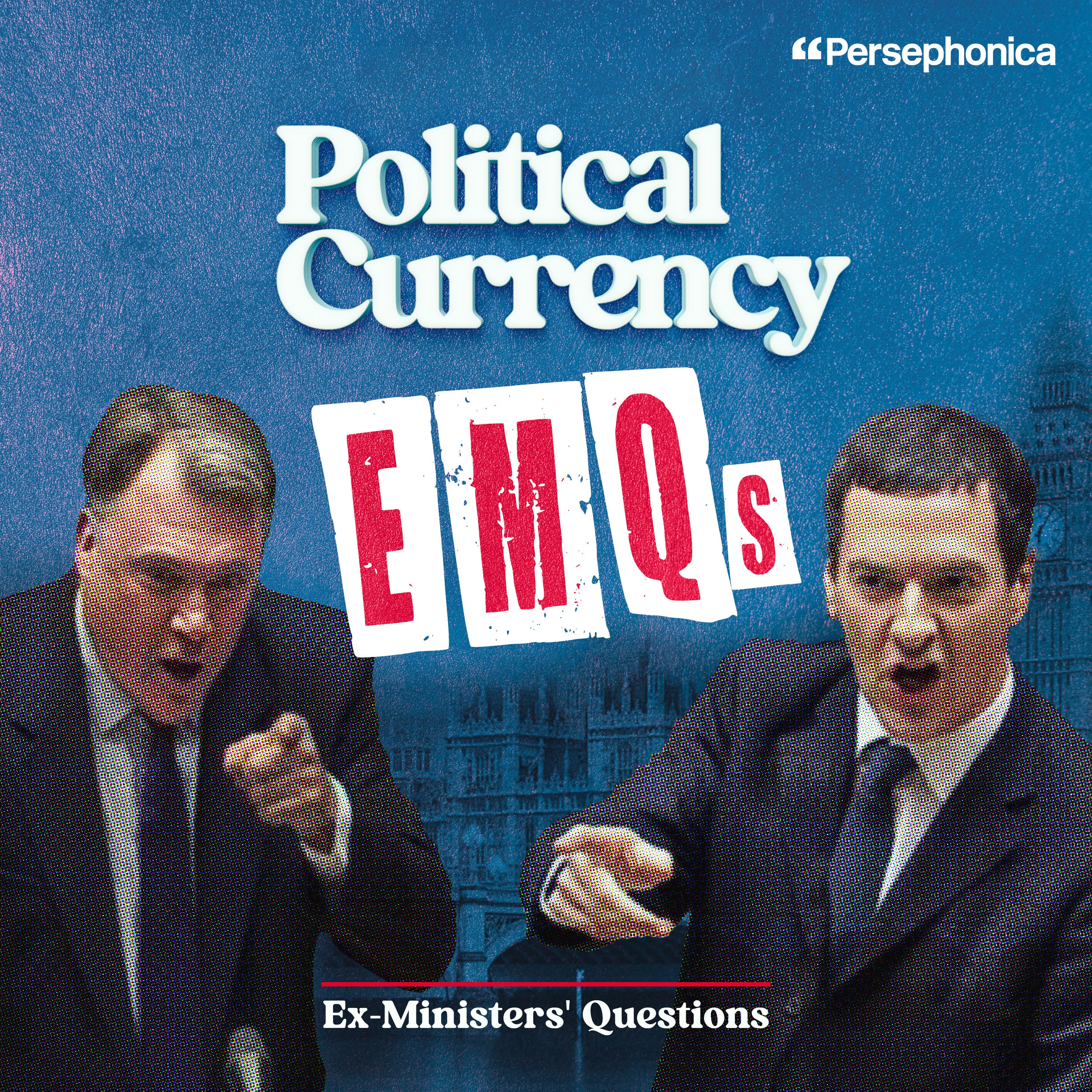
EMQs: Could David Miliband have defeated the Tories in 2015?
In short
“Sliding doors” political what-ifs, focused on: (1) what if Margaret Thatcher hadn’t been ousted in 1990; (2) what if Tony Blair hadn’t been forced out by the Gordon Brown coup in 2006-07; (3) what if Britain had joined the euro in 2005; (4) what if David Miliband had become Labour leader in 2010.
Guests/backgrounds
Ed Balls and George Osborne (former UK chancellors; hosts of EMQs). They discuss their own roles and views from inside government and Labour/Conservative politics.
Key claims
- Thatcher staying likely wouldn’t have helped Conservatives win in 1992; the “change” narrative and poll tax unpopularity still mattered.
- Blair’s removal wasn’t simply a “cabal” plot; it reflected parliamentary mood and Blair’s reneging on a planned transition; Labour would still likely lose 2010 due to the global financial crisis.
- Joining the euro would probably have made Britain leave the euro (and possibly the EU) during/after 2008, due to crisis-scale monetary decisions.
- David Miliband as Labour leader would not have improved Labour’s 2015 prospects; Ed Miliband’s campaign and perceived “human” connection mattered.
Notable examples
Poll tax riots and unpopularity; “Black Wednesday” and ERM; Labour’s 1992 “it’s time for change”; 2005 Iraq-war fallout and Blair’s Chequers Times interview; “Curry House Plot”/Midlands MPs resignations; euro “five tests” and Greece/Scotland currency fears; 2010 Miliband leadership dynamics and “Ed speaks human” branding.
Written by AI. May contain mistakes.
Chapters
1:07
Introduction to EMQs
Overview of the EMQs format and the themes for discussion.
“Getting a lesson from the Shadow Chancellor on how to balance the books is like getting a lesson from Dracula on how to look after a bloodbath.”
1:41
What-If Questions in British Politics
Discussion of significant political moments that could have changed history.
“Hello, welcome to this summer edition of Ex-Minister's Questions, EMQs.”
2:55
Katie's Question: Thatcher and the 1992 Election
Katie poses a question about Margaret Thatcher's potential impact on the 1992 election.
“I think, George, the first question is from one of your mates.”
3:21
Analyzing Thatcher's Leadership in 1990
Exploring how Thatcher's ousting might have influenced subsequent elections.
“Conservative MP for the Weald of Kent, that kind of lovely bit of Kentish countryside.”
10:47
Potential Outcomes of a Different 1992 Election
Speculation on the consequences of a Thatcher victory in 1992 and its implications.
“Maybe Blair might have become Neil Kinnock's successor many, many years later.”
14:00
The Legacy of Thatcher and Labour's Response
Explore the implications of Margaret Thatcher's legacy on British politics and Labour's adaptation to Thatcherism.
“It would be someone who ultimately lost and was not the undefeated Margaret Thatcher.”
28:00
Labour's Position Pre-2008
Discussion on Labour's political landscape leading up to the financial crisis.
“given what the polls were saying between 2005 and 2007, if Tony Blair had tried to stay on and then with a fractious parliamentary party, you then had a global financial crisis.”
29:20
Introduction to Euro Discussion
Transitioning to a listener’s question about the Euro and its implications.
“So our next question, I mean, having discussed the fall of Margaret Thatcher and the Blair-Brown transition.”
30:01
Joining the Euro: What If?
In-depth analysis of the potential impacts of the UK joining the Euro.
“What was your own view from within the Treasury at the time about whether we should join the single currency and did it differ from that of your boss?”
40:06
The Consequences of Joining the Euro
Debate on the long-term effects of the UK having joined the Euro during the financial crisis.
“First of all, the ECB would have been a different institution with the Bank of England involved.”
Show all 12 chapters
42:01
The Impact of Euro Membership on the UK
Discussion of the potential consequences for the UK had it adopted the euro.
“It still would have been a big decision for us either to be ejected from or to eject ourselves from the...”
46:28
David Miliband vs. Ed Miliband: A Leadership Debate
Exploration of how different leadership by David Miliband may have changed Labour's fate in 2015.
“Very much enjoying the pod and the variety of topics you cover.”

Ask about this episode
Get the gist, explore an idea or ask about something said.
 Claude
On Political Currency, what are the key points of this episode?
Searching your listeningTranscript
Automatic transcript. May contain errors.
0:00George Osborne: This week on Outrage and Optimism, we look at the remarkable summer we've been having in Western Europe with heatwave after heatwave that has now translated into wildfires in France, in Spain and even in Scotland. There has been a conspiracy of silence in the media that is preventing us from seeing what is really happening. This week on Outrage and Optimism, we cut through to understand what's going on and how our society can and should change to deal with these issues.
0:30George Osborne: Hey guys, it's Mary from Two Judgy Girls. This episode is sponsored by Aerie. If you're counting down the minutes until you take your bra off when you get home, it's probably the wrong bra. Or if the straps are digging into your shoulder or you're constantly adjusting throughout the day, it's definitely time to get a better fit. That's why we love Aerie. Their bras are designed to be the essential effortless first layer with soft fabrics, great fits, and up to 59 sizes. So you can find the one that's right for you. Your bra should be holding you in, not holding you back. Visit Aerie.com to find the right bra for you.
1:06George Osborne: That's A-E-R-I-E dot com.
1:12George Osborne: The Chancellor of the Exchequer. Getting a lesson from the Shadow Chancellor on how to balance the books is like getting a lesson from Dracula on how to look after a bloodbath.
1:21Ed Balls: Ed Balls. A steady as she goes budget. What kind of ship does he think he's on, the Titanic?
1:28George Osborne: Welcome to EMQs from Political Currency with Ed Balls and George Osborne.
1:41George Osborne: Hello, welcome to this summer edition of Ex-Minister's Questions, EMQs. For the month of August, we're going to be answering your questions around
1:49Ed Balls: under different central themes each week. And this week, we're going to do the political currency sliding doors. We're going to do the sliding doors moments that could have rewritten British politics if things had gone differently.
2:06George Osborne: Yeah, what if we'd joined the euro? Would we have left the EU? What if David Miliband had become a Labour leader? What if Margaret Thatcher hadn't been ousted in 1990? These are the great what-if questions of, I guess, our time in politics or at least our time as adults.
2:25Ed Balls: That's right. And what if we'd made different choices? Would we have ended up different careers, different departments, different leadership contests, different parties? Different podcast hosts. Different podcasts. What if I'd done a podcast with David Miliband? What if you'd done a podcast with Aster Campbell? will be taking your brilliant questions and sharing some behind the scenes insights on the alternative political timelines that never happened, but the impact they might have had. Let us get on with it. Our first question. I think, George, the first question is from one of your mates.
2:59George Osborne: Well, the first question is from Katie. I'll explain who Katie is after she's asked her question. Hi, I'm Katie. I live in a little village in the gorgeous Kentish countryside. and my what if is this. What if Margaret Thatcher hadn't been ousted in 1990 and had gone on to fight the 1992 election? What would have happened? So Katie is Katie Lamb and she is the new Conservative MP for the Weald of Kent, that kind of lovely bit of Kentish countryside. and I don't want to curse her career before it's even really started but she is talked of as a potential future leader of the Tory party she's definitely one of the big rising stars in the conservative movement and she's asked us this question hasn't she that's the end of her then well I think Margaret Thatcher was talked of as a big rising star when she entered parliament too as the youngest woman I think ever elected to parliament wasn't she Margaret Thatcher oh Well, certainly the youngest woman who took her seat because there was a Sinn Féin female MP who didn't take a seat.
4:07So Margaret Thatcher, if she hadn't been ousted in 1990.
4:11George Osborne: So I think let's set the context. Not everyone listening to this podcast will remember back then. And I think I was only 19 at the time. So Margaret Thatcher, she had won three general elections, totally dominated British politics for almost all of my childhood. And you get to 1990. She's coming up to an election she has to hold by 1990. Neil Kinnock is the leader of the Labour Party. And she is brought down in 1990 by the Conservative Parliamentary Party, who basically substitute her, get rid of her. And John Major wins the contest that happened subsequently. The contest is triggered by Michael Heseltine, who had been her defence secretary, but walked out of the cabinet many years earlier.
4:53George Osborne: And he essentially challenges her and she wins the vote amongst the MPs but not by enough really it's too many MPs vote against her even so she wins the contest in the vote in parliament but it's not by enough and she decides to resign after her cabinet all come and tell her that the game's up and I guess the question is what would have happened if she had won more convincingly because it was a really kind of, it was one of those things, the results said she didn't have to go, but when you knew enough about politics, that was the kind of conclusion the parliamentary party came to. Let's imagine that, you know, 20 Tory MPs had, in fact, voted for her.
5:35George Osborne: So she had much more convincingly won that leadership contest. She then would have been safe to the next general election. Would she have beaten Neil Kinnock, as John Major did in 1992, or would she have lost to Neil Kinnock?
5:50Ed Balls: So she had been dominant in 1983. In 87, the Conservatives win, even though they'd had a sort of wobbly period in advance. But Neil Kinnock has a good campaign, but loses. But as that parliament had gone on, the Conservative Party had become more divided over Europe, the ERM economic policy. Nigel Lawson, her chancellor, had stormed out a year before. And Margaret Thatcher had a reputation, I think, for becoming a bit more distant, a bit more aloof, less engaged with her party, her cabinet, her parliamentary party. But of course, you'd had the poll tax, which is very, very controversial. And the Conservatives were behind in the...
6:40George Osborne: We should explain the poll tax was a new form of local government taxation to replace something called rates. and um you know basically it you know everyone was faced with a high bill including people who
6:54Ed Balls: were quite poor and there were riots in central london the poll tax riots but um it wasn't simply a kind of you know a narrow rioting campaign there was a broad-based um deep unpopularity around the poll tax. And by the time you get to the election in 1992, and that was after a long recession, but before the ERM disaster of Black Wednesday that came after the election, the Labour slogan for that election was, it's time for a change. And they fought that election believing that was the public mood. And I think my answer to Katie's question is that that would have been a more powerful message had Margaret Thatcher stayed on with the poll tax through that recession.
7:46Ed Balls: But what had happened was John Major, I mean, not expected to win the leadership election, quite unknown, quite old fashioned in his style. But, you know, the boy from Brixton, he managed to create the image of himself as the outsider, the working class lad. And he managed to embody a sense of change. The economy was recovering.
8:11George Osborne: They had a post in there. What does the Conservative Party offer a boy from Brixton? They make him prime minister.
8:16Ed Balls: And he travelled around the country on his soapbox delivering speeches. and Labour came under great pressure because of, you know, was Neil Kinnock really somebody who you could trust to be Prime Minister? In 1987 he had fought the election on unilateral nuclear disarmament. He had then ditched unilateralism but did he really believe in it? Labour had made lots of pledges on spending which led to the shadow budget of the election campaign where John Smith had to set out the tax rises he would deliver to fund these spending commitments but But the polling showed that the tax bombshell, as John Major and Chris Patton, his campaign chief, called it, the tax bombshell persuaded very many people they wouldn't pay more tax.
9:03Ed Balls: And so Labour's vulnerabilities were exposed at a time when, because the economy had been under pressure, people were very worried about the economy and their public finances and their tax bills. But where John Major looked like a new kid on the block.
9:19George Osborne: So he was the change. You can't really say vote for change because we've just changed our prime minister.
9:25Ed Balls: What then happens, of course, after the election, you have Black Wednesday, complete catastrophe. The Conservative Party becomes even more divided on Europe. They have to have huge tax rises. So all the major prospectus in terms of change completely collapses around him. And by the time you get to 93, 94, it is time for change. By the time I moved from the Financial Times to work for Gordon Brown, before Tony Blair became the leader, I mean, I think people thought Labour were going to be the next government. There wasn't that sense in 91-92 in the same way. So I think the answer to Katie's question is that I don't know this is the case.
10:07Ed Balls: That's the nature of what if. We can't know what would have happened. and it may have been that the worries about Labour on the economy at that point would have still been overwhelming but I think that the change from John Major to John Major for Margaret Thatcher in that period answered the question of change which meant that Labour was asking for something which people weren't demanding change at the time and that's why Labour lost in 92. If Margaret Thatcher had stayed on I think she'd probably lost it.
10:40George Osborne: That begs a whole set of other what-ifs. So Neil Kinnock would have been the Prime Minister. There would have been no new Labour. Maybe Blair might have become Neil Kinnock's successor many, many years later.
10:52Ed Balls: Would Neil Kinnock have taken us out of the ERM or would have Labour crashed out and destroyed Labour's economic credibility for the next generation?
11:00George Osborne: Yes. We would have crashed out of the ERM, wouldn't we, probably under Kinnock.
11:03Ed Balls: Well, there is a view which I hear that people thought that Neil Kinnick would have been able to make the decisive move to take us out to do some kind of wide bands devalue. Although I think John Smith at the time, as Chancellor, as he would have been, was firmly against that. Or was he really? So my view is that an incoming Labour government in 64, Labour found it very hard to do what was needed, which was a devaluation. It was forced upon them in 1967. Dennis Healy fought very hard in difficult circumstances when he became Chancellor in 74. But, you know, it wasn't possible for him to turn things around.
11:46Ed Balls: I don't think that John Smith and Neil Kinnock would have found it easy. I don't think any politician would have found it. Don't forget back in 1989-90, Neil Koenig and John Smith were leading the charge to join the ERM as a symbol of Britain's modernisation moving into the European Union. So I think that what-if could have ended badly for Labour. No politician ever wants to lose an election. Sometimes people say, you know, but wasn't that the election to lose? I've never met a politician who agrees with that. However, I think 1992 as an election victory was a pretty poison chalice.
12:21George Osborne: So you could go on. Of course, once you kind of set the ball rolling, all sorts of subsequent things wouldn't have happened, wouldn't they, or wouldn't have happened differently. I'm going to focus on one thing. So back to Katie's question. I think if she had won in 1990, if she had more convincingly won, she did win the ballot, but she didn't win enough votes. If she had not then ditched the poll tax as a result of the leadership contest and a kind of near-run thing, she actually would have faced another leadership contest a year later they allowed a leadership contest every year in the autumn under the tory rules at the time and the thing about the poll tax was it was kind of electorally you know suicidal and the bills had come up way higher than anyone had expected partly because nigel lawson at the treasury had refused to kind of bail out the project and had always been against it but you had a new chancellor by then john major So if she had got rid of the poll tax as a result of the near-run leadership contest, I think she quite possibly would have won the 92 election because there still would have had that.
13:25George Osborne: You would have been by then in recession and the question, do you trust Labour on the economy?
13:30Ed Balls: But think of the housing market crash. I mean, she was prime minister when house prices rose.
13:34George Osborne: No, I know, but in a recession, people don't always vote Labour, do they?
13:37Ed Balls: But I think John Major could sort of almost distance himself from the conservative legacy, and he was the guy sorting it out. I think she would have found that harder.
13:45George Osborne: But I tell you something else that would have changed. If she had gone down to defeat in the election, a lot of the kind of blood that was let in the Tory party as a result of that leadership contest wouldn't have happened. She would have lost fair and square at the polls. And her legacy would be very different. It would be someone who ultimately lost and was not the undefeated Margaret Thatcher. And the fact that she was brought down, even when I kind of got involved in Conservative politics a decade later, well, actually, I went to work for the Conservative Party in 1993, so it was all very fresh then.
14:22George Osborne: But certainly by the time I became an MP, there was still like, how did you vote on the Margaret Thatcher ballot was a kind of question facing longer serving MPs. and you know people like ian duncan smith at the time back then were saying you know margaret thatcher had been betrayed that our most successful prime minister ever had been defeated and so the whole kind of a lot of the i wouldn't say the myth of margaret thatcher because a lot of what she achieved in office was remarkable but the kind of thatcherite legacy would have been so different if it had gone down to defeat in the general election rather than the kind of stab in the back mythology that then grew up inside the Tory movement.
15:04Ed Balls: So I'm saying, I think if she'd stayed, Labour would have won, although that could have been quite a bad outcome for Labour. Are you saying that it would have been better if she'd stayed and lost? Or are you saying if she'd stayed, she would have won? Well, I think if you're a Conservative and you believe in the kind of Thatcher reforms,
15:29George Osborne: privatizations and the like i think it's true that the john major government cemented a lot of those and you know i think the john major government did you know he completed the privatization of the utilities um and by doing things she wouldn't do and he basically she was completely against
15:48Ed Balls: privatizing rail yeah she was against privatizing water she always knew the limits to i think maybe Maybe she was burned by the poll tax.
15:54George Osborne: Maybe. But I think what the defeat in 92 forced the Labour Party to do was to come to terms with Thatcherism, i.e. ultimately Tony Blair five years later, and accept the kind of Thatcher settlement on privatization, on union reform, and the role of the state in the economy. If they'd won in 92, I think all of that might have unraveled. and certainly Labour at that time were not committed to the Thatcher legacy. So, oh, that's such a good question. My gosh, Katie, we did this entire show on this what if, but we've got another good what if coming up, which is a bit closer to home, isn't it? It's from David.
16:38George Osborne: Now, this question has been voiced by one of our producers.
16:41Ed Balls: Hi, Ed and George. After listening to your recent Inside the Room episodes about the non-election in 2007, I couldn't help but reflect on the coup that brought Gordon Brown to the premiership. How does Ed feel now about his part in the small cabal that plotted and succeeded in the overthrow of a democratically elected prime minister?
16:59George Osborne: So this is kind of, it's not framed as a what if, but it's basically saying, he's asking you about how you feel in all this. But, you know, if Gordon Brown or Gordon Brown's supporters had not overthrown Tony Blair in 2006-7, because all sorts of junior ministerial aides and the like associated with Gordon Brown, like Tom Watson, resigned. It was called the Curry House Plot, wasn't it? Because it was organized or allegedly organized in a curry house in Wolverhampton, I think it was. I actually visited once on a conservative kind of election tour years later. So could – so Blair had got to the 2010 election is the what if I'm throwing you.
17:49George Osborne: I'm going to ask you – also ask you to answer David's question about how you feel about the Brown takeover. But if Blair remained prime minister until 2010, Gordon Brown I assume would have stayed chancellor. So he would have been chancellor during the financial crash. Blair would have been prime minister during the financial crash. Come on, what's the answer to the what if?
18:10Ed Balls: And how do you feel about it all anyway? No, I think Labour was going to lose the 2010 election, whatever, because of the scale of the global financial crisis. And I think if anything, it would have been worse for Labour rather than better because if Tony Blair and Gordon Brown had been the Prime Minister Chancellor in that period. To go to David's question.
18:33George Osborne: Sorry, why do you think it would have been worse, the defeat in 20... I totally agree that when you have a big kind of crash, it's very hard for an incumbent party to win an election. But why would it have been worse?
18:43Ed Balls: I think you have to start earlier than 2007 to see how we get to 2007 and then 2010. The reality was in the 2005 election, Tony Blair was under huge pressure after the Iraq war. but also at that time Iraq was starting to become quite unpopular not only amongst people who were against the war but people who felt it had been a diversion from Labour's kind of purpose and what they ought to have been sorting out and in the 2005 election there were detailed conversations about whether Tony Blair should announce in the election campaign he was going to stand down in the next parliament Alistair Campbell and Philip Gould were proposing that at the time and that was something I think both Tony and Gordon were worried about because how could you fight an election with a Prime Minister who was announcing he was going to be a lame duck but the reality was he was that unpopular and if you think of the ice cream van moment Blair and Brown on the joint visit them coming together
19:46George Osborne: 2005 election the partnership
19:49Ed Balls: that partnership was a way of getting Labour through the election on the understanding Tony is going to go in the next parliament, but he's not going to announce it before the election. At the very first meeting of the Parliamentary Labour Party, Tony Blair says, you know, I know it's been tough. I am standing down. There will be a smooth and orderly transition. So he's announced to the Parliamentary Party he is going to go in this parliament. And that is because of political reality. And to go to David's point, Tony Blair was not a democratically elected prime minister. He was democratically elected as the MP for Sedgefield.
20:25Ed Balls: A prime minister is only the prime minister if they command the support of the parliamentary party in parliament. That was true of the Conservatives. They got rid of Boris Johnson and Liz Truss. The same thing was true of Labour. And Tony judged he couldn't, because of his unpopularity, get through that parliament. There had to be a transition. And what then happened was...
20:46George Osborne: Well, I think maybe another way of putting that argument is that, in fact, in the 2005 election, both Blair and Brown had been elected as a kind of joint ticket with an understanding that Brown would be taking over.
20:58Ed Balls: But that was implicit. That was never explicitly said, although it was discussed. Alistair and Philip thought maybe Tony should say that. I think, to be fair to Gordon, he and Tony were more worried about that. There is to be a transition. There were very many hours of conversations between Gordon and Tony, between his teams. I was in meetings in the number 11 dining room many times with Tony Blair, Gordon Brown, me, Ed Miliband, Alistair Campbell and Philip Gould discussing how to manage this transition. But this is before Blair makes the announcement. This is well before. This is in 2006 and 2007.
21:37Ed Balls: This is in 2005 and in 2006. so this is what happens then i think totally starts to be persuaded by other people maybe you shouldn't stand down it's a nice job isn't it being prime minister why am i involved these transitional talks and this whole thing happens which is tony keeps saying to gordon i need to know you will you know that you will carry on my legacy you know i want to discuss with you the manifesto you will fight any future election on it was all getting quite complicated then the The catalytic moment in September 2006 is Tony Blair does an interview from Chequers for The Times with Phil Webster in which he says, I will serve a full third term.
22:22Ed Balls: I'm not going. And that is seen as a major reneging on what everybody understood was happening. And this wasn't Gordon Brown only or Gordon Brown's people. This was the broad based parliamentary party who thought this change was happening. And it is true that there were a group, as you said, of those Midlands MPs who'd seen quite a lot of their colleagues who lost the election in 2005 because of the tensions Labour was facing, particularly in some of those constituencies. And they said, we're not having this. Gordon was always really worried about anything. Don't tell me. You didn't know. No, what I'm going to tell you is this.
23:00Ed Balls: Gordon was always really worried that if the transition was disorderly. If the transition was Michael Heseltine and Margaret Thatcher in 1990, because Michael Heseltine was seen to strike against Thatcher, in the end, he was denied the crown. And Gordon thought the party would divide. So Gordon thought that this was all very dangerous and destabilising. He was furious with Tony for the Times interview because he thought we were going through the smooth and orderly transition. So when David asks whether Tony Blair was overthrown, what was worrying everybody at the time was Tony Blair overthrowing what everybody thought had been agreed for the previous three years.
23:46George Osborne: But he was overthrown because ultimately a series of PPSs resigned and the threat is there are going to be more tomorrow and more tomorrow. That's right.
23:55Ed Balls: Which was a bad way to do things.
23:57George Osborne: But Gordon must have known.
23:58Ed Balls: at the time Gordon thought honestly Gordon thought it was a really bad idea
24:03George Osborne: but someone's doing it
24:05Ed Balls: he thought it was going to bust things up and divide the party
24:09George Osborne: but don't tell me all those brown loyalists would be operating without his or certainly they wouldn't they wouldn't have directly if he'd said stop it now none of you resigned
24:17Ed Balls: there were very many people in that group who are not brown loyalists it was much more broad than a brown cabal it was you know it was a wide group of people and I actually think that it was more reflecting the mood of the parliamentary party than any sort of instigated plot. And as I said... Yeah, a plot still needs an instigator. Was Gordon behind... Was directing the traffic, directing the overthrow? No.
24:45George Osborne: Was he allowing it to happen? Yeah, a bit. Could he have stopped it? Tom Watson went up to visit him in Kerr Coddy. And when Tom Watson was asked, this was about three weeks before it all unfolds, isn't it? And then later people say, well, what were you doing up in Kirkoddy? And Tom said, oh, I was watching Postman Pat videos with Gordon Brown. I remember because I was a shadow chancellor at the time. I said, that's presumably the episode of Postman Pat where they kill the postmaster, isn't it? I mean, that's...
25:17Ed Balls: So would Tom Watson, look, I wasn't there. Would Tom Watson and Gordon Brown have had a conversation about the transition? Yes. Did Tom Watson think Tony Blair should stand down? Yes. Did Gordon Brown think Tony Blair should stand down? Yes. Did they think it should happen sooner rather than later? Yes. Were both of them shocked by Tony Blair doing an interview saying he was going to stay on for the full parliament? Yes. Did Gordon tell Tom Watson to get a letter of West Midlands MPs to overthrow Tony Blair? No. Was he told it was going to happen and said nothing? I think he found out it was happening.
25:53Ed Balls: Tom would have gone there to say
25:55George Osborne: we're going to do this unless you tell us not to.
25:59Ed Balls: I genuinely do not think that's true. The first I knew that that was happening was an hour before it happened. Really. I think Tom is too smart to think he was going to implement Gordon. Did Tom think he was doing what Gordon would want? Yes. Did Tom think it was smart of him to tell Gordon what he's going to do? Who will rid me of this turbulent priest? That is politics. and um but so i think the answer to david's question it was always going to happen it could happen in a less good way or in a bad way the truth was i remember being in gordon's flat three days later um when tony rang on the way to a school visit um and in the morning this was and they spent half an hour on the phone together working out the language tony should use to announce he was standing down the next year in a way which would be best for tony best for the party and...
26:51Ed Balls: I guess Blair bought himself a year, didn't he?
26:53George Osborne: He did.
26:54Ed Balls: He bought himself a year.
26:55George Osborne: Because Brown couldn't really say, no, you need to go now.
26:57Ed Balls: No, but the thing which Gordon wanted more than anything... Was the smooth transition. The smooth transition. And what, you know, and I think too much in some ways, he then, when he became prime minister, was so focused on the unity of purpose... We discussed this, didn't we? ...that he'd lost the edge of the transition. I mean, it wasn't like John Major where he was a change. Yeah. It actually became almost too much about continuity in substance.
27:21George Osborne: John Major, who was... Was more ruthless. Much more ruthless, although he was not nearly as big a character as Chancellor as Gordon Brown was. Wow. Anyway, I think the real consequence of all of this is that I then went on a visit, a kind of, I guess, slightly mischievous visit as Chancellor to the curry house where this happened. And then was filmed in the kitchen making some naan bread and burnt my hand on the naan oven as a result. And that would never have happened. Never happened. If, you know, you'd start with the democratically elected Tony Blair.
27:57Ed Balls: But to go back to your what if, given what the position we were in pre-2005, given what the polls were saying between 2005 and 2007, if Tony Blair had tried to stay on and then with a fractious parliamentary party, you then had a global financial crisis. you know I don't think I think I don't think I don't think Labour would have been in a stronger position by the 20th century although maybe Brown would have
28:21George Osborne: been the Chancellor sorting the situation out rather than the guy overall
28:24Ed Balls: but Gordon de facto wanted to be the Chancellor sorting it out while he was Prime Minister that was the reality we should take a break and then we've got another question
28:43George Osborne: Hey guys, it's Mary from Two Judgy Girls. This episode is sponsored by Aerie. If you're counting down the minutes until you take your bra off when you get home, it's probably the wrong bra. Or if the straps are digging into your shoulder or you're constantly adjusting throughout the day, it's definitely time to get a better fit. That's why we love Aerie. Their bras are designed to be the essential effortless first layer with soft fabrics, great fits in up to 59 sizes so you can find the one that's right for you. Your bra should be holding you in, not holding you back. Visit Aerie.com to find the right bra for you.
29:19George Osborne: That's A-E-R-I-E.com.
29:29Ed Balls: Welcome back. So our next question, I mean, having discussed the fall of Margaret Thatcher and the Blair-Brown transition. I mean, we're doing all the big issues and we're going to move on to another big issue now with a question from Josh.
29:42George Osborne: Hi, Ed and George. This is Josh, long-time listener, first-time questioner. In past episodes, you've occasionally referenced the Labour cabinet discussions around 2003 about joining the euro. It's always seemed to me like a bit of a sliding doors moment in UK politics, given everything that came after and it raised a few questions. One for Ed. What was your own view from within the Treasury at the time about whether we should join the single currency and did it differ from that of your boss? One for George. Why do you think William Hague's election campaign based on saving the pound in 2001 failed to achieve much at the polls?
30:17George Osborne: And one to both of you. If we had joined the euro in, say, 2005, how would the two decades since have been different? Would we have been more closely wedded to Europe during the Eurozone crisis or would greater resentment at our European neighbours just have made Brexit even more inevitable? Thanks.
30:33Ed Balls: So thank you, Josh, for that question. And, you know, I teach at King's master's course with Nick McPherson, former permanent secretary, John Davis, called the Treasury and Economic Policy. This is 1945, where we study that. George, you've been to some of the classes, the institutions, the personalities, the policy in this whole period. So I've spent very, very many hours going through this period and the euro and who really wants to do what. So to answer your questions, Josh, first of all, number one, I was consistently and publicly from my Fabian pamphlet in 1992. Oh, who could forget that?
31:18Ed Balls: It's, well, I mean, clearly you have. I'm not sure I knew it existed. You did. The Fabian pamphlet, which said, don't join the euro, make the Bank of England independent.
31:28George Osborne: Yes, because that's why you, yeah. I thought Tony Blair came up with the idea of bank independence. That's what he puts around.
31:35Ed Balls: That's another what if. What if Tony Blair had? We didn't. I did a pamphlet in September 1992 saying that Labour should not join the euro because it would be a flawed economic and political project which Britain would not be able to deal with. And instead, we should make the Bank of England independent. So all I'm saying is I was on the record for a long time saying we shouldn't join the euro. and that was something that I undoubtedly said very clearly to Gordon Brown and to Tony Blair. And I think back at the time, pre-97, Gordon probably thought we should join the euro and Tony didn't. Really?
32:15Ed Balls: Yeah. If you think in the 97 election, Tony Blair writes this article in The Sun. My love for the pound. My love for the pound. At the time...
32:24George Osborne: Isn't he just trying to win? I mean, isn't he just doing whatever? The five tests... And he's got Murdoch on side, right, which is such a big deal for Labour at that point.
32:31Ed Balls: The five tests, you know. That comes out when they're in government, right? No, it comes out before the election in 97. It comes out in the spring of 97 pre-election in New York. You remember the New York taxi ride? It's before the election. And this is Gordon Brown trying to stop Tony Blair ruling out joining the euro on political grounds by saying it must be a decision made in the national economic interest.
32:55George Osborne: Isn't this all Charlie, what's his name? you know that what's the spin doctor called charlie wheelan right i thought charlie wheelan briefs in the red line that we're not joining the euro that was after the election yeah and then i thought the treasury comes up with these five tests on the hoof george i mean you know i'm
33:11Ed Balls: asking you can't you can't do what if history if you're not on top of the history the um the the the five tests were splashed in the financial times in an article written by robert peston in I think April 1997, about a month before the election, maybe it was March or April, Gordon Brown set them out following a speech to the EU-USA Association in New York. So it was all done pre-election, the five tests. And so then it's in our manifesto to have the five tests. And then when you get to the autumn, that is the first five test assessment. But the five tests is pre-election. So what about the Whelan spinning things in the red line?
33:50Ed Balls: Well, that was after Gordon Brown's done an interview in The Times saying, we're not going to join in the first parliament, essentially predicting what the five tests will say. Tony can't get hold of Gordon or Alistair Campbell, rings the switchboard and says, get me Charlie Whelan, who is in the red line. And Tony says, can it be stopped? And Charlie says, well, it's already the front page of The Sun and The Times. And it was approved by Alistair Campbell, which it was.
34:14George Osborne: So why has Brown switched his, why has Brown and Blair switched their views in the intervening year?
34:18Ed Balls: So I think what happens then is, so if you, at that first decision in October 1997, the Sun editorial where Gordon Brown says, we're not going to join the euro in this parliament, but we will have a changeover plan, prepare and decide. The Sun editorial is, will Tony Blair please get a grip of the europhile brown? I mean, the media mood at the time is Gordon Brown is going to bounce Tony Blair into joining the euro. What then happens over the next few years, on the one hand, Gordon, I think, likes bank independence, worries about how the euro will work. I persuade him it's not a great idea. Tony Blair, as prime minister, starts to see that his influence in the leaders will be diminished.
35:04George Osborne: Once the euro is up and running.
35:05Ed Balls: The euro is not up and running yet, is it? Yeah, but it's about to be up and running. It starts at the end of 99. it will be diminished if Britain doesn't join. Although I don't think Tony Blair ever thought us joining was a really good idea. We've discussed this. But what Tony Blair thought was him looking like he was against it would diminish his standing in the European Council. And therefore it was better for Gordon to be the hard man.
35:27George Osborne: Let me... We're starting to go off... Okay, but we've got to get to the what if questions. I'll deal very quickly with Josh's thing about William Hague's election campaign in 2001 and saving the pound. It was just not seen as relevant in that election campaign. And anyway, Labour weren't saying they were going to join. And the mood music from us was that we weren't going to join. And it was, you know, we had latched on to an issue that was kind of simple and authentic, but ultimately not, you know, at the heart of the election campaign. Let me come to the big what if, right? If Britain had joined the euro, would we have left the EU?
36:02George Osborne: Because...
36:03Ed Balls: Yes.
36:03George Osborne: Okay. Don't preempt. Let me just set the question. Unequivocally. Right. because the counter case is this. When you get to the Brexit campaign, ultimately the Remain campaign cannot find an issue that crystallizes for people the risk of leaving. They can say, look, the economy is going to be damaged. We're not going to do as much trade. But it's not a kind of simple to understand, clear-cut case. If you look at Greece, which at the time was either going to be kicked out of the euro or its government would choose to leave the euro. Within Greece, every time they got close to that moment, they would go, hold on, if we leave the euro, what currency are we going to use the next day?
36:47George Osborne: We're going to use drachma, and our drachma are going to be worth way less than euros. So I'm going to have taken out my mortgage in euros, and I'm going to be paid in drachma, and I'm going to be bankrupt. And of course, in the Scottish independence referendum, the central question the nationalists couldn't answer was, what currency are you going to use the next day? The pound in your pocket is not going to be worth the same, literally. Everything you say so far agreed with. So if you got to a referendum on leaving the EU, wouldn't it have been impossible really for people say we are now going to tear apart our currency we're going to return to the pound everything's going to be worth less you know i don't know what my mortgage is going to be denominated in i don't know what my small business loan is going to be denominated in you know i could go bankrupt i
37:38Ed Balls: think you're right right so project fear would have won right the reason why i think you're wrong about this is you know we aren't greece or even spain we were a much much bigger economy with a massively more sophisticated financial services sector and enormous banks. If we'd joined the euro in 2003-2004, it wouldn't have stopped the financial crisis. If anything, the build-up of the financial crisis, because we'd have had lower interest rates in the UK, a lot higher, euro interest rates were lower, you'd have had more of that kind of property cycle that you saw in Spain and Portugal and in the UK.
38:17Ed Balls: And by the time you get to the autumn, September 2008, The financial crisis is taking hold. It becomes clear that there are massive problems in the American and British, it turns out later, European banking systems as well. Huge overnight interventions from the Bank of England, which Mervyn King fought hard against to begin with. I think if we had been in the euro and tried to make those decisions collectively with the European Central Bank as our agent, I think we would have undoubtedly and unequivocally crashed out of the euro overnight in those days. I think Britain would have left the euro.
38:57Ed Balls: We may have destroyed the euro in the process. I think we would have left the European Union.
39:00George Osborne: Because we had to devalue.
39:03Ed Balls: Because the Bank of England had to do, you know, if you go forward four years and the fight Mario Draghi had as head of the ECB to say, you know, I will do what it takes. you'd have had to decide to go from nothing to do what it takes for Britain on a massive scale through the central banks in September 2008. I think the system would have broke because I don't think that it would have been possible for the finance ministers and the European central bank governors to allow what had to be done in Britain. And the timescales would have been so short that in the end, de facto, Britain would have had to do it through by retreating to a version of the pound.
39:41Ed Balls: I think the Bank of England would have to have taken back control of the creation of its own money. I think we'd have left the European Union as a consequence in those weeks. And if we hadn't left the European Union, we would have left it in a damaged and bloodied way with us absolutely out of the euro. So I just think that, you know, to get to your thought experiment, which I understand, you have to get through the financial crisis. And I think that is just, it's impossible to conceive of the scale of what happened in Britain being managed through the euro at that time without catastrophe.
40:15George Osborne: Okay, but counterpoints. First of all, the ECB would have been a different institution with the Bank of England involved. You might have had a British governor of the EU.
40:24Ed Balls: Possibly.
40:24George Osborne: You might have had a British president of the EU.
40:26Ed Balls: Yeah, but it moved so slowly in that period.
40:29George Osborne: All right, first point. But second point, I think I draw a distinction between the big interventions needed to rescue the banking system. The ECB actually had poorly developed financial services intervention tools at the time and competence. I mean, that only comes later during the euro crisis. They give the EU the competence to intervene in banks. It's still being handled by national regulators.
40:53Ed Balls: But the Bank of England have had to be creating massive euros without reference to the European Central Bank. who would have had the Bundesbank-style attitude saying, do not do this. They would have been saying, this is moral hazard on a massive scale.
41:06George Osborne: Okay. Now, the pound devalues 10%, I think, almost overnight. Well, certainly in a couple of weeks. So I can totally see you would have had a big kind of problem with your currency being overvalued.
41:19Ed Balls: We didn't have a currency, don't forget. We're in the euro on your snow. Yeah, yeah, sorry.
41:22George Osborne: I mean, okay.
41:23Ed Balls: De facto, a new currency is formed called the British euro, which shifts relative to the other euro, because there's money being created by the Bank of England.
41:30George Osborne: Well, you did have like the Greek euro and the Italian euro, didn't you? In terms of debt, about the credit risk on the debt. But wouldn't you just...
41:40Ed Balls: I think we were so big we'd have blown it up.
41:42George Osborne: Right. Or it would have been a more painful crash.
41:45Ed Balls: But don't forget...
41:46George Osborne: Because you couldn't devalue.
41:47Ed Balls: But don't forget, at that time, the Europeans thought this was an Anglo-Saxon crisis. They didn't even think, you know, they would be thinking, why are we having our economies and interest rates and credit? screwed up by these... They would have been saying,
42:01George Osborne: you... I mean, nothing to do with us. It still would have been a big decision for us either to be ejected from or to eject ourselves from the...
42:08Ed Balls: I think it would have happened overnight. I think it would have just been... NatWest was going to go bust and shut his cash machines. And you have to have...
42:17George Osborne: But the British government is not going to say, well, the cash machines aren't going to operate tomorrow.
42:20Ed Balls: Yeah, but they... So de facto, they have to...
42:22George Osborne: Because you can't take euros out anymore. There's going to be something called the pound we're going to have to print again.
42:26Ed Balls: No, what would have happened is you'd have basically... Stamped. You'd have been creating a new British euro, which would have an exchange rate with the actual euro, and that would have been your devaluation, and off you go.
42:37George Osborne: But your 50 euro note you all got in London.
42:40Ed Balls: I think you end up de facto with Britain having to withdraw.
42:45George Osborne: I don't know.
42:48Ed Balls: I think it's a massive event for Britain, but we are cauterised from it by being out of the euro. Think what Ireland and Spain and Greece went through. And they were tiny compared to us.
43:01George Osborne: Maybe it would have been. I mean, there's an argument, if you want the proper kind of creative destruction argument, which is maybe Britain should have gone through more of a kind of Irish or Spanish shock. You know, maybe the reason we've had the poor productivity is we didn't actually go through a big enough shock.
43:22Ed Balls: I understand that counter argument. It's amazing what the Greeks and the Spaniards and the Portuguese and the Irish put up with. But their collective political and popular desire to be European meant they were willing to pay that price. Were the British people willing to pay that price? Would they have accepted cuts in their pensions, cuts in public spending, cuts in minimum wages because we must stay in the euro? No way. No way. It would have been UKIP supercharged.
43:50George Osborne: I don't know. You might have been making the argument, look, the bad situation is going to be even worse. We're going to crash out of the currency and, you know, suddenly all your mortgages are going to be in euros and you're going to be paid in pounds.
44:01Ed Balls: Tory US scepticism would have gone wild. It wouldn't have been. Well, that's true, but they did.
44:04George Osborne: They did anyway.
44:06Ed Balls: But at a time when the government is plunging into a deep recession and the British government is sort of losing control and our European policies just collapsed.
44:15George Osborne: I remember Peter Mandelson giving a speech back then, didn't you, before the crash, saying that basically Britain had a choice, which is you either join the euro or you leave the EU. That that's fundamentally the choice you're facing. Because the euro project has become the central EU project.
44:34Ed Balls: We were at an international meeting. I'm not going to say what it was, but as it happens, it was Bilderberg. And you were on the panel and you made a version of that argument. And I from the floor disagreed with you. You said in the end, that is a truth. And I said it is not impossible for Britain to be in the European Union and outside the euro. But it's hard, but it can be done. But I think if you assume, I've always been euro cautious from a British point of view. I think if you say you can only be in the European Union by being in the euro, I think that ends up with us being out. So that's why I always wanted to believe it could be done.
45:12Ed Balls: And actually, to be fair, so did John Major, which is why he negotiated the Opt-out and the Maastricht Treaty. And so did Tony Blair, because his government agreed that we shouldn't join the Euro.
45:22George Osborne: But they were all proved wrong by the British people. Well, that is also true. Right. Let's take an ad break. And then we're going to have a final question from Isaac.
45:41George Osborne: Hey guys, it's Mary from Two Judgy Girls. This episode is sponsored by Aerie. If you're counting down the minutes until you take your bra off when you get home, it's probably the wrong bra. Or if the straps are digging into your shoulder or you're constantly adjusting throughout the day, it's definitely time to get a better fit. That's why we love Aerie. Their bras are designed to be the essential effortless first layer with soft fabrics, great fits, and up to 59 sizes. So you can find the one that's right for you. Your bra should be holding you in, not holding you back. Visit Aerie.com to find the right bra for you.
46:17George Osborne: That's A-E-R-I-E dot com.
46:27George Osborne: Welcome back. Here's our question from Isaac. Hi, Ed and George. It's Isaac from Bath. Very much enjoying the pod and the variety of topics you cover. So keep up the good work. Now, my question is around David Miliband and how different you think the Labour Party would be in terms of electoral fortunes and also culturally, had he been elected party leader instead of his brother Ed. OK, let's start with this straightforward one. And then I've got something I'm going to ask you after this. So if David Miliband had beat Ed Miliband in that Labour leadership contest in 2010, right? And it was really unbelievably close, wasn't it?
47:06George Osborne: I mean, Ed Miliband just edges it over his brother on the union block, doesn't he? And that helps him if you take in the Labour MPs and the constituency parties, because that's the way the Labour leadership contest works. That basically takes Ed Miliband over the line. So it's a very, very close result, which could easily have gone the other way. And I'm just going to just give you my context, but you were all heavily involved in this. So, you know, I was at Dorneywood because I think the result came out on a Saturday or Sunday, didn't it? And I was watching the TV. And when they announced that Ed Miliband had won, when Nick Robinson announced Ed Miliband had won, I jumped up and down like a frog, like a demented frog.
47:52George Osborne: I leapt up and down. I was absolutely thrilled. I was straight on the phone to David Cameron, Prime Minister. I said, we've won the next election. They've chosen Ed Miliband. I can't believe it. What an unbelievably lucky break. The person who disagreed strongly with us was William Haig, who said, actually, Ed Miliband is going to be much harder to beat than David Miliband. David Miliband is quite cold and unemotional. And I've shadowed him. And I think he's actually easier to beat than you think. So we had a bit of a disagreement amongst the leadership. But But I've got no doubt, and this is, you know, I actually go on pretty well with Ed and I know his wife.
48:29George Osborne: And so this is not, you know, I don't want this to be personal. But the truth is Ed Miliband could never convince the electorate he was an alternative prime minister. And I think David Miliband looked, for whatever reason, just looked like someone who could be the prime minister. So I'm pretty clear that we would have had a tougher election in 2015. might still have won or maybe won in a kind of coalition with the Liberal Democrats again if David Miliband had been the Labour leader.
49:00Ed Balls: It doesn't surprise me that you would say that because I think you would find David harder to lay a glove on. There would have been less differentiation between what you were posing and what David would have wanted in styles. I think there would have been closer. So a bit tougher for you. but I don't think it would have made any difference to the 2015 election I don't think David would have done better the reality was between 2007 and 2010 David hadn't persuaded people that he would be a better prime minister than Gordon Brown there was continual speculation of was he going to to strike but there was never a great upswell for him the polls never said there was there was never that feeling in the cabinet were in the parliamentary party and then when it came to the leadership election in 2010.
49:48Ed Balls: David didn't persuade, you know, after the early days and the first MP's nominations, he didn't persuade people that he was the better candidate than Ed. I think actually Ed fought a better campaign. In some ways, he was a much more political figure than David.
50:05George Osborne: They had those badges in there, Ed speaks human. Was that the badge?
50:08Ed Balls: It was badges and placards because the view at the time was that David didn't speak human and didn't connect. And so the idea that he had a better popular touch or connection with the British people, I mean, I think Ed won the leadership election broadly in Labour because he did better. I think David at the time was positioning himself to say we had to have cuts. We had to do a sort of Osborne agenda. and I think the reality is that after 13 years in power the kind of backlash you saw in the Labour Party with Jeremy Corbyn after 2015 would have happened earlier would happen in that parliament rather than afterwards Ed held that off and I think there was a clearer differentiation for Labour Labour voters in the run up to the 2015 election than there would have been with David but it wasn't enough because in the end we were carried too big a burden from the past in terms of the financial crisis and the aftermath and the coalition had worked for you.
51:14Ed Balls: But I think it's dead easy to say if David had won it would have been better. And I didn't nominate either and I was happy to work with both. Ed's people worked really hard to persuade the people who had nominated me to support them second and David didn't make the effort which he should have done david didn't want to reach out there are very many people who um at the time were saying to david reach out to ed balls have you as split the brownouts split the brownouts have you as the leader and ed is the shadow chancellor and when that would be the team but david just couldn't really cope with that um conversation and so you know i don't think it would have um you know in the end it comes down to would he have been able to deliver a better political connection with the public in those years despite the challenges Labour faced and you know and it's clear that Ed didn't in the end succeed in doing that but I'm not sure where the evidence is that David would have done that better and I can quite easily point to the reality that when tested he did it worse.
52:25George Osborne: Now here's my own what if. What if Ed Balls had won that leadership contest because you you ran in it i mean you were knocked out of the previous round but um if you had become the labour leader in 2010 do you think you could have won the 2015 election
52:42Ed Balls: um well of course um because in the end you you never go put yourself forward for these things unless you believe you can um but it would be really hard um i was um in ed and me and David were all burdened by being part of Blair and Brown and the previous 13 years. And I would never have escaped that in the way that Ed didn't, despite his best efforts to do so. And I wouldn't have done it in the same way as him. So we would have all carried that burden. And I think that the Labour Party was divided at the time. And I think it would have been hard for me to be the uniting person. and then that test as to, you know, whether you would have had a better connection through the camera to people.
53:30Ed Balls: I mean, who knows the answer to that? You put yourself forward because you think you can do it. But I think it would be silly for me to think that, you know, that I would have, you know, it would be silly for me to be confident I could have done. I'd like to believe I could have done, never had the chance. And honestly, I think Labour was going to lose the 2015 election.
53:50George Osborne: hmm god we've got to do more of these what if cathartic or what yeah that's great that's we're gonna have to go lie down yeah and think of some more what if questions we're gonna definitely do the what if questions again on emqs uh that's it for this episode of summer emqs do keep sending us your voice notes emails via questions at politicalcurrency.co.uk including some more what if questions and make sure you review the show as it helps us to reach more listeners and
54:16Ed Balls: And don't forget, you can hear the show early and ad-free if you are a Gold or Kitchen Cabinet member. And the links to subscribe are in the show notes. And have a happy summer.
54:32George Osborne: Thanks for listening to Political Currency. This has been a Persephoneca production.
54:46George Osborne: Hey guys, it's Mary from Two Judgy Girls. This episode is sponsored by Aerie. If you're counting down the minutes until you take your bra off when you get home, it's probably the wrong bra. Or if the straps are digging into your shoulder or you're constantly adjusting throughout the day, it's definitely time to get a better fit. That's why we love Aerie. Their bras are designed to be the essential effortless first layer with soft fabrics, great fits, and up to 59 sizes so you can find the one that's right for you. Your bra should be holding you in, not holding you back. Visit Aerie.com to find the right bra for you.
55:22George Osborne: That's A-E-R-I-E dot com.
From the publisher
What if the great 'what if' moments of recent British history had turned out differently? Ed Balls and George Osborne dive into the political sliding doors that could have rewritten the last three decades. They debate whether Margaret Thatcher would have won the 1992 election if she hadn't been ousted, and how her legacy would have been transformed.
Ed gives a behind-the-scenes account of the Blair-Brown transition and the so-called 'Curry House Plot', considering how Labour would have handled the 2008 financial crisis with Tony Blair still in No. 10. Then, the pair explore the huge question of whether Britain joining the Euro would have prevented Brexit, or simply led to a catastrophic economic crash.
Plus, George reveals why he jumped for joy when Ed Miliband beat his brother David for the Labour leadership, and they discuss whether the result of that contest sealed Labour's fate in 2015.
To get episodes early and ad-free, join Political Currency Gold or the Kitchen Cabinet:
👉 patreon.com/politicalcurrency
👉 Apple Podcasts
Please note: Kitchen Cabinet is only available via Patreon.
Credits:
Producer: Miriam Hall
Senior Producer: Silvia Maresca
Video Editor: Maha Albadrawi
Executive Producer: Ellie Clifford
Political Currency is a Persephonica Production and is part of the Acast Creator Network.
Hosted on Acast. See acast.com/privacy for more information.
More from Political Currency
All episodes

We use cookies.They keep VO running smoothly and help us improve it. Privacy policy