
 Ask ChatGPT


- Podcasts
- Political Currency
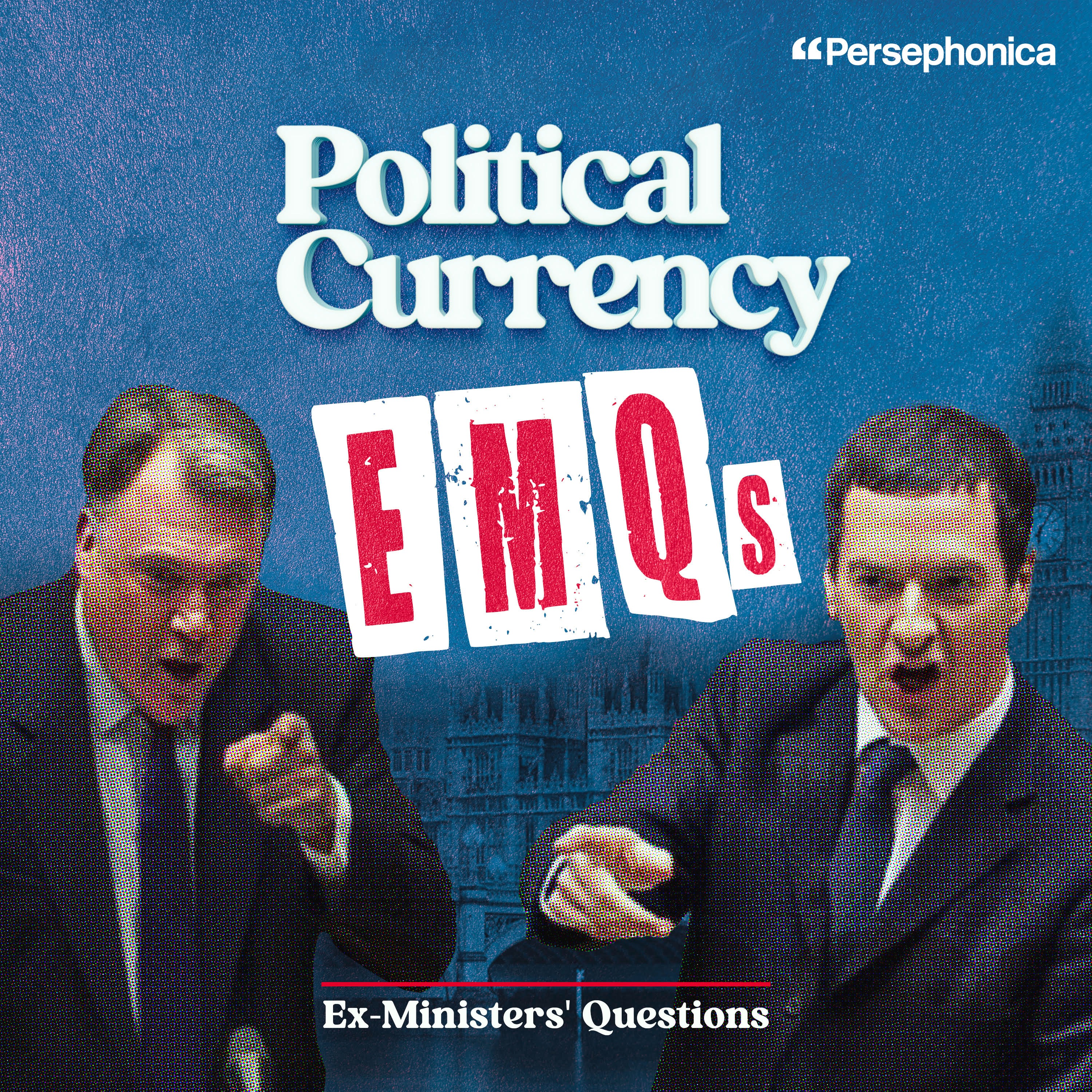
- EMQs: Could George Osborne still be a Tory MP?
In short
In this episode, Ed Balls and George Osborne delve into the current state of the Conservative Party, reflecting on whether it has moved away from the principles established during the Cameron-Osborne era. They discuss key political events, such as the Women's Rugby World Cup, the implications of Brexit on the ECHR, and the dynamics at recent political conferences.
Written by AI. May contain mistakes.

Ask about this episode
Get the gist, explore an idea or ask about something said.
 Claude
On Political Currency, what are the key points of this episode?
Searching your listeningTranscript
Automatic transcript. May contain errors.
0:00The Chancellor of the Exchequer. Getting a lesson from the Shadow Chancellor on how to balance the books is like getting a lesson from Dracula on how to look after a bloodbath. Ed Balls. A steady-as-she-goes budget. What kind of ship does he think he's on, the Titanic? Hello, Mary Celeste. Welcome to EMQs from Political Currency with Ed Balls and George Osborne.
0:27So hello and welcome to EMQs, Ex-Ministers Questions. and we have to start with a revelation which has rather surprised me from George this morning. He is not watching The Traitors. I mean, I would have thought you more than anybody after your terrible treatment in the hands of Theresa May, a faithful, treated like a traitor. I can't believe you're not watching it. Trouble is, I don't know enough about this. Does that make Theresa May Claudia Winkleman? No. Because of the two of them, you know, let me just say I really like Claudia Winkleman. Is that it? I do actually like Theresa May. I like Theresa May.
0:58Actually, I've warmed back to her. Claudia is on my, she's a trustee at the British Museum and gave an absolutely brilliant interview, of which, you know, I was only one of a panel to get that job. Now, I've heard nothing other than great things about this show. From what I can see of the cast list, it's got lots of great people, isn't it? Including my co-presenter, Kate Garraway. Right. I think she might win it. I'm backing Kate Garraway to win Traitors and Alex Kingston, X, ER and Doctor Who to win Strictly Come Dancing. You heard it here first. beginning of October. It's brave to punt, but I'm punting.
1:32It reminds me a bit of a game of Risk I once played. No, not Risk, Diplomacy. Do you remember Diplomacy, that game where you represented the various empires before the First War? I have to say I only did this once in my life, but I went to a whole afternoon where everyone was playing Diplomacy. I formed an unbreakable alliance with Michael Gove, who was another player and then about kind of halfway through our joint attack he suddenly attacked me and i was all very vulnerable i'd already committed my armies and navies to this foreign expedition and then he swept in and seized my homeland and i some people would say i should have um learned my lesson well look the idea of you and michael gove having an unbreakable alliance subsequent history didn't bear out that analysis no i've always been a bit you've asked me about things like strictly come dancing and things and um i feel you've owned that space but maybe celebrity traitors would be a fun thing to be on wouldn't it you've not combated or counted my alex kingston to win strictly punt who are you tipping he's got absolutely he didn't watch traitors or strictly come dancing goodness me i'm watching a very i'm actually watching a really good bbc crime thing called ludwig which is about a sort of year that was on last year yeah okay i'm Well, I mean, can I just say, George, catch up, catch up, including with the traitors.
2:58Catch up TV. If George has watched the traitors next week, we'll have a political analysis of it. In the meantime, our first question today is from Ed Davey. Hello, Ed and George. I'm glad to hear your podcast is going from strength to strength. On your last episode, you discussed whether Keir Starmer's speech was a repudiation of new labour. So reflecting back on the Conservative Party conference, I wondered how much George felt that was a repudiation of the Cameron Conservatives, leaving the ECHR, drastic cuts to foreign aid, giving up the Climate Change Act. That feels like the opposite sort of politics the Conservatives did when you ran the show, George.
3:37So would it be possible for you to stand for this Conservative Party, George? Do you worry that many people who used to vote for Cameron Conservatives would be now looking to vote for the Liberal Democrats? Well, good question. Let me take these in reverse order. I don't worry how people vote because people are entitled to vote. I'm not, you know, partisan anymore. And if people want to vote Liberal Democrat, you know, good luck to them. If I wanted to stand... By the way, I find that remark slightly baffling. But anyway, move on, move on. If I wanted to stand for the Conservative Party, I mean, I would give general advice to anyone standing for a political party that, of course, you can change it once you get there.
4:18You know, I got chosen and then elected as a member of parliament in 2001 at the second big Tony Blair landslide. The Conservative Party very shortly afterwards chose Ian Duncan Smith as its leader. And there were lots of things that the party did back then that I didn't agree with. For example, trying to get us all to vote in the division lobbies against gay people adopting children, where I rebelled. And I rebelled alongside a couple of other new members of my intake, David Cameron and Boris Johnson. Is that the first time you've ever mentioned that rebellion on this podcast? Well, it's the only rebellion I've ever had, so I have to come back to it.
4:55But I use it more as an illustration that you can change things. And so if there are people who at the moment are worried about some of the direction that the Conservative Party is undertaking and say it's no longer the kind of socially liberal, in touch with modern Britain party that I would like to support, I would just say get involved and change it. And then finally, is the kind of Baden-Ock conference offer a repudiation of Cameron conservatism? Well, I think it is in part, and in other parts it isn't. We Cameron conservatives have got used to being dumped on by all that came after us. So we've had like seven chancellors, six checkers since, and I can't remember, like four or five Tory prime ministers.
5:38And we just can't help noticing that all their governments weren't as good as ours and weren't very competent. So we take the criticism lightly. At the moment, you are failing to answer the middle question of his three, actually, which was, would it be impossible for you to stand for this Conservative Party? Well, I don't think it would be impossible to stand if I wanted to, which I've got no intention to do. Even if it meant you had to repudiate the ECHR and support me? Well, I think you would get in and you would try and change things, right? I mean, that would be... Kimmy Bailock said, unless you sign the pledge.
6:07I know, but, you know, it was a bit like Boris Johnson. And what you're saying is she may not be the leader by the time these selections happened. Yeah, she may not be the leader who takes us into the into government again. But who knows? I wish her well. I voted for her in the leadership contest. I mean, she did actually throw that endorsement back in my face, but I did vote for her. And I would say just actually half the conference was actually a big move back towards Cameron conservatism and some of the George Osborne chancellor language around reducing debt and deficit. So all of that made a reappearance after years of, you know, one of the big pledges at the Tory conference to reduce the size of the civil service to 2016.
6:47That was when I ceased being chancellor. You know, it was subsequent conservative prime ministers who allowed the civil service to just grow and grow and grow and the bureaucracies grow and the size of the state to grow. So in fact, there was a bit of a move back towards the economic program of Cameron Conservatives. Not on international aid. I seem to remember you raising stamp duty rather than cutting it. Well, I actually cut it for anyone who had a house under a million pounds. And I would suggest that might be where people need most help buying a home run houses worth more than a million. Did you see Kevin Hollingrich, the Conservative chair, suggesting that the Conservatives may be going to ditch Cameron Osborne's tree logo and return to the Torch of Liberty?
7:34which would be a repudiation of Cameron and actually kind of conservative liberal democrat cooperation because you know didn't you cooperate over trees? Well actually I think one of the issues we fell out over was forestry The privatisation of But so it's a bit of a sore subject but it is a it is an opportunity for me to thank Ed Davian one of the reasons I'm such a fan is that he voted for every clause of every one of my budgets. So without him, there could have been no age of austerity. So Ed, this is my opportunity to thank you publicly. And we're going to move on to our next question from Hayley.
8:13Hi Ed and George, Hayley from Surrey here. Love listening to the podcast every week. Thanks for your insights. Last weekend, our Red Roses lifted the Rugby World Cup to a packed out record-breaking Twickenham Stadium. It was interesting to see that Mark Carney was present to support the Canadians, but no one from the UK government or the Royal Family were present to support the Red Roses despite it being on home soil. And that made me think, how are decisions made in government about which events to attend and who attends them? Secondly, this tournament has been really well run and accessible for all with cheap prices, particularly for children's tickets.
8:48Do you think there's a place for national sporting organisations to utilise women's sport to make it accessible and inclusive for all with cheaper prices for those to attend, inspiring the next generation of young boys and girls into sport. Thanks for your insights. Great question there Hayley about how we use this energy from the women's football and rugby teams to inspire young people. Just on your first point though, I think this is slightly unfair. It is true to say that neither the King or the Prime Minister attended the Women's World Cup final at Twickenham but a little bit of Twitter searching by me, I found a tweet from Lisa Nandy, the cultural secretary, DCMS.
9:28Fantastic to be at Twickenham today with brilliant sports minister, Steph Peacock, and mayor of London, Sadiq Khan, to support the Red Roses rugby ahead of their match. And the photo of the three of them. So I'm afraid Lisa Nandy in the cabinet was there. And there's also... Yeah, but oh, come on. And there's also pictures of Zara Phillips and her husband, Mike Tyndale. Mike Tyndale, England rugby champion. Zara Phillips, daughter of Princess Anne. So the royal family were represented too. So we shouldn't run down. I mean, it's factually not correct to say no one from the UK government or the royal family were present because they were.
10:05Okay. Well, I'm going to stand up for our listener, Hayley. We're on the dump on over. Despite the fact that it's factually not correct. No. I've got to ask you this question, right? Right. If this had been the Rugby World Cup men's final at Twickenham, don't you think a more senior member of the government would have gone than the Secretary of State for Culture and Media Sport? I'm not saying that Lisa Nandy is not a good person and that's not an important job, but she goes to lots of sporting events as part of the brief. But it was unusual, isn't it, not to have the prime minister at an event like that?
10:38Unusual not to have a very senior member of the royal family. I mean, Zara Phillips, she may be one of the most popular members of the royal family, but she's not one of the most senior. It's a bit odd, isn't it? I think so. I totally agree. And which is why we've put this question in, because I think both points are good. It was a Saturday before the Labour Party conference, but that isn't an excuse. I think you are right. If the men's team were in the World Cup final at rugby or football, the prime minister and I think the king would be there. And therefore, they should have been there to see the women's team win.
11:08And they are going to go on to inspire many young girls and boys to play rugby, as the women's team have done winning in football, the Euros. And I think that Hayley does make a good point. We know there is a huge shortage of coaches, particularly in women's football and rugby. But it's true for boys as well and facilities. and despite the huge riches of the English Premier Rugby League and the Premier League Football League, that money does not get down to grassroots organisations enough. And so more should be done, not just around pricing, but around facilities. So I think Hayley makes a good point.
11:45And if the king or the prime minister had been there at the World Cup final, or the queen or the princess of Wales, or senior female members of the cabinet. Well, look, to be fair, Lisa Nandy was there. so you know no i mean she goes to all sports i mean that's what the culture secretary does it's just the big you know you roll out your even bigger guns for your big games i am agreeing with you and i'm agreeing with hayley on both points but it's just not fair to say that nobody from the government went because actually this nandy was there but mark carney did fly all the way across the atlantic to go i mean twickenham's only down the road where was kia where was kemi well we don't what's coming there we don't know we haven't done our research we don't anyway i just i did half the research yeah okay i didn't didn't realize i had to pick up the opposition people who were there anyway it's a good question yeah and it's a good point and we're going to have another question after the break
12:47welcome back the next question comes from reza hi and george love the podcast this is reza sending you a voice note from manchester i'm at conservative party conference for work it's not quite 1 30 a.m which is what you wanted but um certainly coming up towards midnight i'm interested in a story that I've seen on BBC News just now, Shabana Mahmood talking about curtailing repeat protests. I thought, and it may be something you've talked about in a previous podcast, that there was a convention where political parties don't make major announcements that clash with each other's conferences. Have I remembered that correctly?
13:27And if so, is this a change in direction now with Shabana's announcement? Thank you. It's not really a convention in the sense that it's kind of written in stone. It's just that attempts by the governing party, and it's usually this is really only the governing party this applies to, because an opposition party would be absolutely pointless them making announcements during the government's party conference. They wouldn't get any coverage anyway. But the government obviously announced real things that are going to happen. I would say that it's not so much a convention. It's just that attempts to break that convention have not worked.
14:05So, I mean, the most famous example, we actually touched on this in one of our Inside the Rooms on the election that didn't happen. Gordon Brown's visit to Iraq in the middle of the Tory party conference on the eve of what people expected to be a general election was seen as a political move that broke this convention that you're talking about. We heard how you didn't actually necessarily see it like that, Gordon Brown, but it was certainly interpreted like that. And the Conservatives made a big deal of it. Liam Fox did a very good job as Shadow Defence Secretary, making a meal out of it and causing embarrassment for the government.
14:37And so I think that's sort of a shied government's way. And also, I think it's probably the case that broadcasters, particularly the BBC, take a view that they should be showcasing an opposition conference, because that's the one time of the year when you can look at a conference. And even this year, that can be overshadowed by events like the horrific murders in Manchester, the synagogue there, the emerging peace deal in Gaza and so on. So it doesn't mean you're guaranteed coverage. I think there's a famous case in there of Alastair Campbell being absolutely furious with the BBC that Tony Blair's conference speech as opposition leader was going to be bumped by the O.J.
15:19Simpson trial verdict. And the BBC actually responded to his pressure, started with the Blair speech for about two minutes and then said, well, come back to that. We're going to go to the O.J. Simpson trial. So I think it's more that, you know, the broadcasters have sort of tended to not play that government game. But I would say it frays a bit in the early years of an opposition when governments tend to be stronger. got oppositions are further away from power. And I think in this specific case, there was something relevant that was, it wasn't just a confected announcement. These were the Palestine action protests and the arrest of a large number of people in central London and in other places around Britain.
16:01The Home Secretary there, Shabana Mahmood, was responding to a kind of genuinely unfolding event. If there is a convention, I'm question whether it is, it's more of just a sort of in practice what happens, it probably still holds. So I think I have a slightly different perspective on this. I mean, I thought there was a convention. And this week, I was on Good Morning Britain, Monday to Thursday. And every day, a government minister was offered to the programme with a story, three of the four days about domestic policy. And I don't remember that being how things were done in the past. And, you know, and Susanna and I both said to each other, this is surprising, we don't remember this.
16:43No, I stand corrected. That's very interesting. So we asked Anne Alexander, who is the kind of longstanding, hugely experienced political producer for GMB, just to go back and have a look at the last few years. She went back and checked in 2022 and in 2023, the Conservatives in government didn't put up ministers with a story. They certainly didn't appear on GMB on those days. The one exception was in October 23, the Defence Secretary Grant Shapps did appear from NATO. But that was at a time when there was a big international news event around Israel and also, I think, Ukraine. So I think Shabana Mahmood coming on the programme on Monday because of the aftermath of the Manchester terrorist attack.
17:27That's appropriate because the country doesn't stop. and the government has to respond and answer questions on the big events of the day, which Grant Shapps did. But I think it is different from my memory of the past for the government to be sending out ministers on stories about planning laws or grants to communities or whatever. Of course, it is the case that governments and oppositions politically have always gone after their opponents. So this week we had reform very effectively, challenging Kemi Badenok with the 20 Conservative Council defections to reform. But there was also the leak of the Robert Jenrick addressing the West Midlands to a Conservative association where he said he'd been in Hansworth and hadn't seen any white faces.
18:11That was recorded at a fundraising Conservative Party dinner. I don't know who leaked that to the media, but it wouldn't surprise me at all if that was a Labour Party operation. Of course, it could have been a Kemi-Badnock operation as well. Both of them have different reasons to want to go after Robert Jenrick. But that kind of political attack has always happened. But for the government to put up a minister on a government story during the opposition's party conference, I don't remember that happening. Do you think it was deliberate or just a lack of knowledge of how things are done in government?
18:46I wonder whether the combination of the pandemic and actually maybe this sort of breakdown in relations and norms during the Boris Johnson period is partly to explain it. But I would like to know, because I don't know the answer to that question. I think to me, looking at the facts of the last three years, there has been a break of a convention. But maybe there's somebody who can explain this to us from within the Labour or Conservative Party media operations. If somebody sent us a voicemail, we'd play it next week. I'd like to know. I think the convention has been broken. I think that Gordon Brown moment, Gordon wasn't seeking to make it a big publicity event.
19:22He was trying to get out there during a quiet time and was actually kind of rather destabilized by the way it all turned out. That's a shame. No, but I know I've not expected you to have any sympathy. But I think the reason why that was a big deal was because at that time there was a convention that you don't do that in opposition conferences and seek to draw away media attention and also the political editors to go on. That was the outrage from the Conservative Party was also directed to the broadcasters, which was that the political editors had left the Tory conference to go with the prime minister.
19:53Exactly. Well, I think Anne is right. And I think I'm right that there is a convention which is being broken here, but we'd like to be corrected. New communication supremos in number 10. Have you been playing fast and loose with the rules? We will wait to hear from you. The next question is from Olivia. Hi Ed and George, this is Olivia. First the obligatory Love the Podcast. One thing I particularly like about it is the way that you're both open to talking to and working with people from across the political spectrum. Other than Ed and Nick Clegg, what did he do to you? I think we deserve to know.
20:28I hate and am bored by tribalism. I find it very off-putting and think it's destructive and unhelpful. and this is the basis of my question. Kemi Badenoch's threatening to pull us out of the ECHR again and we keep hearing that staying in is non-negotiable for Starmer but everything I read suggests that every other country in Europe has issues with it as well. Why do we have to throw our toys out of the pram and leave? Why can't we work with our allies to reform it and make it work for the 21st century? We did exactly the same thing with Brexit. We ran away with it rather than leading from within and look where that got us.
21:00Why is politics so childish? Thanks very much. Bye. We kind of talked about this on the main podcast last week. And I think that Olivia is right to make that Brexit parallel with ECHR reform. I totally agree that reform is the right way to go, not leaving. But it is risky to say, we're going to reform, not leave. You've got to deliver. The even more risky thing is to say, I'm going to get reforms and then have a referendum. Because when you don't get the reforms and have the referendum anyway, it can all go wrong. Of course, it is the case, Olivia, that the grown up thing to do is to build alliances and to make reforms.
21:37But when politics is as febrile as it is at the moment, that can be a dangerous game. I think also, I mean, I would say to Olivia that, you know, there are genuine differences of opinion and view, not just among politicians. They, of course, reflect differences of opinion within the country. And the political argument tends to focus on those differences rather than the things that we agree with. I mean, even if you've got a bunch of Labour and Conservative politicians in a room and say, well, do you agree there should be a state pension? Yes. Do you agree there should be a welfare safety net for people who can't work or are disabled?
22:11Yes. Do you believe there should be an army? Yes. Do you think there should be a police force? Yes, etc. If you did all that, you'd actually agree on about 95 % of expenditure. And the argument in politics is around the remaining 5%. So there's a lot that the parties agree on, certainly the mainstream parties. It's just that the argument focuses on the differences and the disagreements. And here, even on Brexit, actually, all the parties ended up voting for the referendum on Brexit in Parliament, on having a referendum, even if, certainly speaking for myself, didn't like the outcome. On the question of the ECHR, it's interesting, if you were a sort of Kimi Badenock supporter or someone who wanted to leave the ECHI, you would say that unfortunately what you're suggesting, Olivia, is just not going to happen.
22:58That these countries, let alone parties inside one country, but different countries are just not going to be able to get their act together. They're not going to be able to reform this institution. Therefore, it's kind of wishful thinking that there is some easy, as you would put it, kind of adult way out where we kind of negotiate things. In practice, that can't happen. There are too many differences of opinion here, There are too many red lines, as you'd call them in negotiations between countries. As a result, you've got to pull out if you don't want the current ECHR to apply. It's not that politics is childish.
23:32It can often be presented as childish, but I think it often just focuses on where there are genuine disagreements between people about how the country or the world should be run. And those disagreements can be expressed very forcibly, but they are real. However, I think you have made a very good observation, which Ed passed over, which is, Ed, you know, you're all now chummy with people from across the political spectrum, of which I think the prime example. Why does Nick Clegg, why is he such a bee in your bonnet? Nick who? The former president of Meta, and indeed used to be deputy prime minister.
24:11Nick Clegg, oh yeah. I mean, you know, I think he was committed to public service.
24:19we're going to take a break and we'll be back with another question
24:32welcome back our final question is from jerome hi ed and george jerome here absolutely loving the podcast i recently got to meet gordon brown at work event so my company's fundraising for the multibank, which is Gordon Brown's charity, tackling poverty and waste by redistributing surplus goods, a really fantastic cause. Despite being out of frontline politics, Gordon still appears to be busier than ever. We actually only got 30 minutes of his time for the launch event, which was in Glasgow at 6.45am in the morning. I did manage to grab a quick photo of Gordon, but I didn't get the chance to ask a question, so I thought I'd ask Ed instead.
25:06So Ed, I'm currently reading Alice Campbell's diaries, where he writes that Gordon got great press for giving the Bank of Independence independence, but he felt there was too much of it was Ed Ball's idea going around. Ed, can you please explain from your point of view how the idea did come around and clarify your involvement? Thanks both. I think Alistair Campbell is completely wrong about this. I don't think I got anywhere near like enough credit for the importance of that reform. And you know, as Alistair knows, you always got to be careful about what you get the credit for when you are working as an advisor are in government.
25:41But I mean, you know. What did he get the credit for that sticks in your mind? I was just thinking about, you know, the dossier in the 45 minutes, you know, not necessarily something he wanted the credit for in retrospect. But there is a serious point here. What happens when you have these big announcements is that the story gets told in the Sunday newspapers or the next day's papers about, you know, how it happened. And I think Charlie Whelan, two days into the first Labour government for 18 years, was probably slightly kind of overactive in telling the story about how the Bank of England was made independent, which then appeared in The Guardian.
26:13And I do remember Alistair Campbell thinking that maybe Tony Blair and Gordon Brown should have got the credit rather than me. But he was wrong because it was your idea, right? Well, but there was a serious point to this, which was we were wanting to show this wasn't just plucked out of the air, something which had just been thought up at the last minute. It was something that Gordon and I had talked about for years, that Gordon had made a speech about in 1995 that I had written a pamphlet in 1992 saying that for Labour... So that's before 1995. So you're the father of the idea. Yeah. Yes, absolutely.
26:49And then Tony Blair at the last minute pops in in his autobiography years later and says, it was my idea. Come on, Tony. It was all our ideas. We worked on it together. We were a team. I remember, though, in 1992 when I was at the Financial Times... There's definitely a sort of Blairite argument I've heard from those former with blur is that it was more tony blair than gordon brown tony blair was keen on it gordon brown wasn't well i don't know where you hear this stuff but it's complete nonsense so i'll tell you the story 1992 i'm working at the financial times yeah the maastricht treaty has been published i'm thinking the erm is a disaster and britain cannot join the euro because this will not work for us so i write a pamphlet saying the solution for labor if they got into government would be to make the Bank of England independent.
27:35Martin Wolf said to me at the time, that was a really good pamphlet, but it's destroyed your chance of any political career. Labour won't support making the Bank of England independent. However, I never thought I love Martin's columns, but I never thought it was a very good predictor of what was going to happen next in the messy world of politics. Well, so then John Smith passes away. Tony Blair becomes the leader. We work on what the policy framework should be i wrote a paper for gordon and for tony which i presented at meeting which we had in early 95 saying we should go for bank independence i think that was the first time that tony had a conversation with anybody about bank independence we had to persuade him it was a good idea gordon was quite you didn't know what the bank of england was yeah he did absolutely did and um gordon gordon has a big smile on his face at this point he did he did gordon also had to be persuaded because he was kind of quite worried about losing power but we had long conversations about it which ended up in the summer of 95 Gordon doing a speech saying there was a case for moving further than a monetary policy committee and an inflation target and having independence but we would look at the track record of our reforms before deciding and it was not in the manifesto in 97 because both of them were very worried that you know people would take fright at the time eddie george was calling for higher interest rates than ken clark wanted a labor government would have meant a rise in your mortgage rates they didn't want to to go repeat the 92 election because that had been an effective tory attack against kinnock i think by the time you get the election campaign you know tony and gordon both think this is something we're going to do but gordon on the monday says to me if we're going to do this we have to do it immediately he had that conversation with tony blair gordon in scotland him in sedge field on the thursday and said we should go do this immediately i think tony was quite taken aback that we'd move so fast but said let's go for it so that's the story you're the father and i'm not the father of course not the father there was a very grandfather well it already happened in tony bear was the midwife it was in the maastricht treaty it already happened in new zealand america had independence independence for a long time there's a very important paper by Stan Fisher, DeBell and Fisher.
29:53DeBell went on to be the deputy governor, the governor of the Bank of Australia. He was a graduate student of Stan Fisher at MIT, arguing that you could make central banks independent without losing control over the objective. It was called operational independence. That's what we went for. Larry Summers had written a very influential paper with Alberto Alicina saying bank independence didn't cost you growth and jobs. So there was a big intellectual academic lineage, and I advocated doing it for Labour in Britain, I'm very pleased to say that Gordon Brown signed up and Tony Blair, as always, came into line.
30:27So it was your idea? Yes. I think in Labour politics, I think the answer is yes. And I'm proud of that because, as I said, in 1992, this was not a mainstream view. No, and Martin Wolf said it never happened. It never happened. Well, he said it would destroy me when I published it. No, it only helped you, didn't it? Sometimes the seeds of destruction are sown in the moments of greatest triumph. More importantly, George, it helped the nation. Yes. Actually, hold on. Maybe it elevated you as a kind of advisor from behind the scenes. You were too well known as an advisor. So when you actually became an MP, you weren't a kind of clean skin.
31:10You came with too much of a reputation. I think this is a good point. So Campbell's diary is written in 97 and I do eight more years of the treasury, get selected as a candidate and then end up in the cabinet. So it doesn't stop my career. But is it the case that if you don't come from nowhere and you are instead seen as somebody who's been around a long time, does that make it harder for you? I guess you and David Cameron were close as MPs to Michael Howard in 2005, didn't stop David becoming the leader. On the other hand, when he was an advisor to Norman Lamont, he probably has less profile in government than I would have had.
31:56I don't think anyone thought he was the guy making the big decision to come out of the RM. This is getting a bit egotistical, but I'm blaming Jerome for this. At some point, what about Mervyn King's role in all this? Because as deputy governor, didn't he work behind the scenes with you on how to make this all happen before the general election? I first spoke to Mervyn about the detail of how we're going to do it in the autumn of 96. So well before the election. Well before the election. But our policy to do it had been set out a year before that. So it was not the case. Mervyn was persuading us.
32:34It was much more, George, a meeting of minds. For those who know Ed, I think you would find that Alistair Campbell, Mervyn King and Nick Clegg are all in the same bit of the Venn diagram. Not Alistair Campbell, actually. I've always gotten really well with Alistair. And we tease Alistair because of his podcast. Does he have a podcast? In his diaries. He's one of the great fiction writers of the modern political era. I'm joking, Alistair. and Mervyn I was um important I mean I think in the 97 general election the only person guaranteed a job in the new Labour government was Mervyn King because we said that you know the new monetary policy committee was going to include the chief economist and Gordon could think to me I think you're being too nice to Mervyn King and then Nick Clegg you know I've never blamed him for his decision to go into the coalition I don't think he did it in the right way But we've discussed that before.
33:26We have. And we'll again, and by the way, you know, the thing I said about Nick Clegg. Thank God he did for what I'm concerned. The thing I said about Nick Clegg and tech a few weeks ago, I had rather a lot of tech saying, you're totally right about Nick Clegg. Anyway, there we are. Thanks for your question, Jerome. That was really good. That's all we have time for in this episode of EMQs. Yeah, please do keep sending us in your voice notes, your emails via questions at politicalcouncil.co.uk. Make sure you review the show, So, A, because as you can tell from that last question, Ed needs to be reminded of what a great person he is.
33:58But also it helps other people find us. And also to remind us what a great person Nick Clegg is and, you know, his commitment to public service. And, you know, he was a deputy prime minister for our country. We thank him. Yes. We thank him. We'll be back next week with another episode. See you then.
34:22Thanks for listening to Political Currency. This has been a Persephoneca production.
From the publisher
Is the modern Conservative Party a repudiation of the Cameron-Osborne years? George Osborne is challenged by Ed Davey, who asks him to consider whether Kemi Badenoch's leadership means there's no place for him in the party he once helped lead.
Then, Ed Balls sets the record straight on one of New Labour's defining policies, revealing the true story behind making the Bank of England independent and taking credit from both Gordon Brown and Tony Blair.
Also on the agenda: the breaking of unwritten rules during party conference season, the politics of attending the Women's Rugby World Cup final, and the Brexit parallels of trying to reform the ECHR.
To get episodes early and ad-free, join Political Currency Gold or the Kitchen Cabinet:
👉 patreon.com/politicalcurrency
👉 Apple Podcasts
Please note: Kitchen Cabinet is only available via Patreon.
Credits:
Assistant Producer: Caillin McDaid
Senior Producer: Silvia Maresca
Video Editor: Oliver Geraghty
Executive Producer: Ellie Clifford
Political Currency is a Persephonica Production and is part of the Acast Creator Network.
Hosted on Acast. See acast.com/privacy for more information.
More from Political Currency
All episodes

We use cookies.They keep VO running smoothly and help us improve it. Privacy policy