
 Ask ChatGPT


- Podcasts
- Political Currency
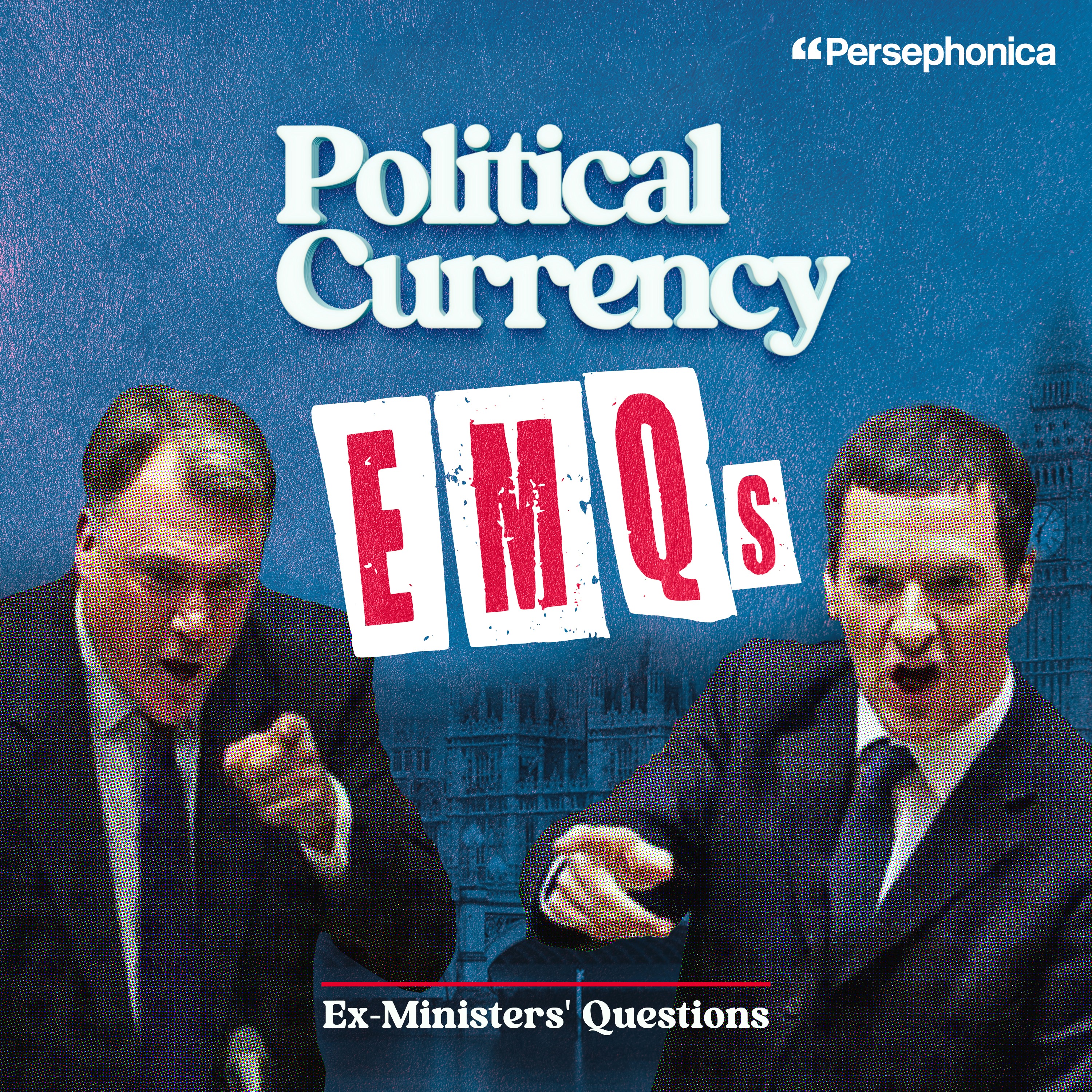
- EMQs: Could PMQs save America?
In short
EMQs (Ex-Minister’s Questions) episode focused on how soft power and public campaigns work, how UK government is run (including the red box), and what policy programs endure (Sure Start), plus a US/UK comparison question about keeping leaders accountable.
Guests
No separate guests; host Ed Balls and George Osborne answer listener questions. Mentioned figures include Tansley Stearns (Orsa Credit Union; Backbone Coalition leader) from a related “Believe in Banking” promo, and Jamie Oliver (celebrity campaigner).
Key claims
Soft power requires protected “inputs” like BBC World Service funding; campaigns succeed when they’re positive, non-partisan, and have a clear goal (sugar tax as example); Sure Start benefits outweigh costs but was weakened by removing ring-fencing and by early lack of quantified evidence; red boxes remain central because they manage workload and include secure/signature paperwork.
Notable examples
BBC World Service/UCL soft power report; sugar tax (announced in a budget; extended by later government); red box contents (policy briefs, diary, marginal handwritten decisions, letters to sign); Sure Start evidence (IFS: benefits about 2:1); US select committees and PMQs as accountability models.
Written by AI. May contain mistakes.
Chapters
2:41
Cultural Reflections and Political Books
Discussion on notable political books and reflections on their impact.
“So hello and welcome to EMQ's Ex-Minister's Questions and loads of questions to do.”
4:51
Responses to Sarah Vine's Book
Hosts discuss the contents and reactions to Sarah Vine's political book.
“And I don't think anybody else's tough times shined through the page.”
8:20
The Role of Soft Power in Politics
Exploration of soft power and its importance in UK politics.
“outputs abroad, for example, through initiatives like the Great Campaign?”
11:47
Audience Question on Effective Campaigns
Discussion about impactful political campaigns and their effectiveness.
“By the way, that is a Steve Hilton legacy that endures.”
14:01
Effective Campaigns in Politics
Learn about impactful political campaigns and their ingredients for success.
“is her question hi ed and george i was lucky enough to join you for political currency live at south by southwest last week and really enjoyed the discussion but unfortunately i didn't get a chance to ask my question.”
21:53
The Role of the Red Box in Government
Gain insights into the traditional paperwork handled by government ministers.
“and it's going to be voiced by one of our producers.”
28:00
The Function of Red Boxes in Government
Explore how red boxes are used in government communication and decision-making.
“And that was a way in which the private office could, the box would close on a Friday at five o 'clock.”
31:42
The Importance of Sure Start Programs
Discuss the significance and impact of the Sure Start initiative in public policy.
“Christine Farquharson from the Institute for Fiscal Studies.”
35:14
Funding Challenges in Early Childhood Programs
Analyze the budgetary decisions affecting early childhood programs and their implications.
“And I'm very open to, you know, evidence-based research on policy.”
43:46
Listener Question on PMQs and American Politics
Discussion about the implications of PMQs in American politics based on a listener's question.
“Availability and coverage vary by state and insurance plan.”
Show all 11 chapters
45:07
Comparing Political Practices: UK and US
Exploring practices from the US that could benefit the UK political system.
“PMQs is something which in American politics, William would love to have imported over.”

Ask about this episode
Get the gist, explore an idea or ask about something said.
 Claude
On Political Currency, what are the key points of this episode?
Searching your listeningTranscript
Automatic transcript. May contain errors.
0:00George Osborne: Too many credit unions are still the best-kept secret in their communities. Tansley Stearns, CEO of Orsa Credit Union and leader of the Backbone Coalition, is changing that. In Episode 86 of Believe in Banking, she shares how storytelling can build visibility and drive real growth. From Adrenaline, search Believe in Banking, Episode 86, and listen now.
0:30Ed Balls: Therapy's biggest impact doesn't show up in some dramatic breakthrough. It shows up in the smallest moments. You bite your tongue instead of escalating. You put your phone down instead of firing off that text. You say what you actually mean instead of what would hurt someone else the most. Nobody applauds those moments, but they quietly change your life. That's what growing feels like. And that's exactly what Grow Therapy is here for. Grow is therapy that works, covered by insurance. Sessions average$21 with insurance, and some pay as little as$0, depending on their plan. There are no subscriptions, no long-term commitments.
1:07Ed Balls: You just pay per session. Grow connects you with thousands of high-quality, licensed therapists across the U.S., offering both virtual and in-person sessions, nights and weekends. You can search by what matters, like insurance, specialty, identity, or availability. And you can book a therapy session in minutes and begin in as little as two days, not the national 48-day average. See if you could pay as little as$0 for therapy in seconds at growtherapy.com slash ACAST. That's growtherapy.com slash ACAST. growtherapy.com slash ACAST. Availability and coverage vary by state and insurance plan. Some days, getting the work done isn't the problem.
1:51Ed Balls: Staying locked in is. Alpha Brain is Onnit's daily nootropic formula for cognitive support, designed to support memory, focus, attention, and mental clarity. Its formula with science-driven ingredients include theanine and huperzine A to support focus and memory. And it's caffeine-free. So when you're deep in the work, Alpha Brain helps support enhanced productivity and tune out distractions. Get focused on what matters. Shop Alpha Brain now at onnit.com.
2:21George Osborne: The Chancellor of the Exchequer. Getting a lesson from the Shadow Chancellor on how to balance the books is like getting a lesson from Dracula on how to look after a bloodbath.
2:31Ed Balls: Ed Balls. A steady-as-she-goes budget. What kind of ship does he think he's on, the Titanic? Bemarie, Celeste.
2:39George Osborne: Welcome to EMQs from Political Currency with Ed Balls and George Osborne.
2:49Ed Balls: So hello and welcome to EMQ's Ex-Minister's Questions and loads of questions to do. But before we do, you know, George and I, we often have a bit of a cultural reflection. You know, you're tasting rap music, novels, and we're both kind of quite keen on political books. How Not to Be a Political Wife by Sarah Vine. Have you read it? Because you appeared it quite a lot.
3:13George Osborne: I haven't actually read it.
3:15Ed Balls: Have you read the extract?
3:16George Osborne: I haven't read the I've seen some of the extracts I haven't seen any reference to me yet
3:21Ed Balls: Do you want me to tell you your references?
3:23George Osborne: Go on
3:23Ed Balls: Well I think the key one is that Sarah and Michael are hugely under pressure financially
3:27George Osborne: and really struggling
3:29Ed Balls: and you say yeah but can't you just ask your father for money? That's what she says you said which I can't believe you would have said
3:35George Osborne: Yeah It's possible because I think she did have quite a wealthy father who was sort of you know a rather strange character I seem to remember Anyway so it's possible I did say that Yeah
3:46Ed Balls: are you not going to give me any view on this book have you read sasha swire's absolutely brilliant
3:52George Osborne: takedown of the book the thing that's um amusing the cameroon world is i knew you would if i gave you enough time i knew you'd reveal is less the um is less the uh sarah's book it's more um um sarah's book then the sasha swyer reaction to sarah's book and then nadine doris's attack on sasha swyer i've not seen that bit what does nadine say she goes full on against uh sasha swyer so it's um it's the kind of uh chain reaction i wouldn't say you know sarah or sasha or nadine are all like the massive fans of probably either me or certainly not David Cameron. But the fact they're all sort of turning on each other, I have to say, has been interesting to watch.
4:45Ed Balls: Everybody else thinks, you know, it was a tough few years, you know, 2010 to 2015. I mean, the bedroom tax, cuts in tax credits, you know, the austerity. But no one had it as hard as Sarah. I mean, much, much more difficult. And I don't think anybody else's tough times shined through the page.
5:08George Osborne: Yes, I do like Sarah. I still like Sarah. So I'm not going to be drawn. And I saw her at a party a couple of weeks ago, a friend's birthday party. And she told me this book was coming out. And she kindly and generously invited me to the book launch. But sadly, I couldn't make it.
5:26Ed Balls: Look, it's brutal. And it's honest. And it's revealing. and you know I have to say I've read all the extracts and I have growing sympathy for how tough it would have been for her kind of dealing with all of those situations and so you know I didn't feel negative about her but I didn't really feel as though I mean the context was narrow
5:48George Osborne: I think the um it reminds me a bit of the um Boris Johnson book which I was pretty insistent And those who are close to me and love me were insistent that we wouldn't buy a copy because we didn't want a single penny finding its way into the Johnson bank account. But at the same time, I did need to know roughly what he'd said about me. And so a close friend went and took a copy in Daunts and kind of photographed the references to me. The contents page. and WhatsApp them to me so that I at least could know what he was saying about me. We didn't actually have to spend any money on a Johnson book.
6:34Ed Balls: It's so good, this podcast, because we explode all the myths about politics and the idea that the most senior politicians turn first to the content page of political books to find out whether you've been mentioned and are probably more offended if they haven't been mentioned than if they have. It's all untrue. As your story suggests, they send somebody else to do it for them.
6:54George Osborne: I wasn't turning to the contest page because I was excited about being mentioned. I was, anyway. We should move on. He was, you know, in some spaces quite generous about me.
7:07Ed Balls: I could ask you to list them, but, you know, you probably have an encyclopedic memory of what he said. But, you know, we need to move on. And actually, our first question is from one of the players of that time. It's from Giles Wynn, who was a special advisor to the Treasury under Philip Hammond. Hi, George and Ed. Giles Wynn here.
7:26George Osborne: I run a soft power research agency called Creative Power. More importantly, though, I'm a gold subscriber and a big fan of the podcast. Two weeks ago, George said that when politicians are considering military spending, they often think about the inputs far more than the outputs. But when it comes to soft power, I wonder, do you think the opposite might be true? that we think about the outputs more than the inputs. This week, Creative Power has published a report on the soft power impact of the BBC World Service with UCL. We found that the World Service is far more than just a broadcaster, and it is in fact a significant strategic soft power asset for the UK.
8:07George Osborne: But it faces a future of managed decline unless it gets more urgent funding from the government. So when it comes to soft power, should we start thinking more about the inputs, i.e. what is needed to strengthen our soft power assets at home, rather than just promoting the outputs abroad, for example, through initiatives like the Great Campaign? Love the podcast. Thank you.
8:30Ed Balls: So we made a brief reference to this in the main podcast last week about what was happening with the foreign office, one of the big losers from the spending review. Back in my time in the Treasury. We used to ring fence the settlement for the BBC World Service and for the British Council. So the Foreign Office didn't have the ability to raid their budgets to spend on embassies and diplomats. It was actually, it was ring fenced. So they had to spend it. That's no longer the case. So there will be a big tussle going on in the coming weeks about whether the BBC World Service is going to get the funding it needs.
9:03Ed Balls: But to link it back to what we were just talking about, I do think, you know, I'm going to say something positive about Boris Johnson, because sometimes people say, you know, I'm only negative about him. I do think he did understand the importance of soft power. When he talked about global Britain, it wasn't just about hardware. It was about our influence on the international stage.
9:24George Osborne: But that was David Cameron who talked about global Britain. That was the Cameron slogan. Well, was it really?
9:30Ed Balls: I thought global Britain was, Boris Johnson said he was going to deliver once we had left the European Union. after Brexit, we were going to have, you know, a new global Britain.
9:40George Osborne: Right. OK, but it was actually Cameron who started talking about it.
9:43Ed Balls: Look, I'm not trying to get involved in internecine fights between you and David Cameron and Boris Johnson. OK, forget I said it. I wasn't being nice about Boris Johnson. Do you think that in the past, governments have been sufficiently focused on soft power? I wonder whether this Labour government talks enough about soft power. Do we talk enough about, I mean, in all the stuff around the Defence Review, lots of hardware but you know our influence abroad we've just cut the international development budget the government's in a fight with the premier league and the bbc world service funding hasn't been properly protected um the government likes to talk about the national health service and the bbc but do they talk about their their soft impact around the world i mean my experience
10:29George Osborne: with government is that there's quite a lot of conversations about soft power but it's quite a nebulous idea and what does it what does it consist of when it comes to hard numbers and the inputs which is what giles is asking us about um well the most expensive item of soft power is the aid budget if you regard it as soft power and of course that's quite itself controversial because the way diffid the old department was set up under claire short and the like well it wasn't supposed to promote british interests and be aligned in any way with our trade policy for example, let alone our foreign policy.
11:02George Osborne: It was just supposed to alleviate poverty. And it had an almost kind of dogmatic opposition to being too tied to British national objectives. That changed over time, but it still was a big thing. And we certainly felt in the Cameron government that, the coalition government, that increasing the aid budget to 0.7 % of national income was a demonstration of UK soft power. You've got other budgets like the BBC World Service, but that's now that was sort of taken on by the BBC in a settlement that I negotiated in 2010 as part of the overall BBC budget. There's then the Great Campaign. The Great Campaign, that costs money.
11:43George Osborne: That was a deliberate effort by the national government to sell the UK. I think that's been really successful. By the way, that is a Steve Hilton legacy that endures. He was important in putting that together. There's things like the British Council, which I feel probably has been cut back. Sorry, I know has been cut back. And they are drawn together. And so I would say to Giles, there was a conversation about that. I think what is probably true, but maybe I need to give it more thought, is that the world itself is becoming a more dangerous, tougher place with these big state rivalries and potential conflicts with Russia and China and so on.
12:23George Osborne: And so the conversation has moved away from a kind of pan-globalization era, which we were at the tail end of in the coalition government, where it was all about you could reduce the defense budget over time. The defense budget had been falling under all governments since the Cold War. But you could invest in Britain's influence abroad in other ways. It's now the kind of hard choices of where that extra pound goes. It's going into the killer drone rather than the, you know, Farsi language BBC World Service station. Whether that's a sensible use of money is interesting. And we've talked on a previous podcast, reducing the budget on things like conflict prevention might be a very foolish thing to do.
13:07George Osborne: And some top ex-soldiers have spoken up about that recently. But it is interesting. And maybe there's time for it. Ultimately, the soft power, you lead by example, isn't it? I mean, ultimately, Britain needs to be a country that people admire, people respect, people want to study in. There's a whole other aspect of soft power, which is visas and international students. And how good your economy is. I mean, are you a successful country? I mean, in the end, the soft power flows in part from whether you're seen as a great place to live and a country that's on the up. let's go to our next question which is from beth sidwell and she is a kitchen cabinet member and she was at our south by southwest live event last week in shoreditch we did say and we did promise we'd try and answer the questions that we didn't get around to answering then in the hall and this is her question hi ed and george i was lucky enough to join you for political currency live
14:06Ed Balls: at south by southwest last week and really enjoyed the discussion but unfortunately i didn't get a chance to ask my question. So here it is. I've worked in politics for 10 years with the last seven years spent in public affairs roles. I currently work for a trade body representing the recorded music industry. A few weeks ago on the podcast you both highlighted the campaigning that our industry and the wider creative industries have been doing in relation to copyright and artificial intelligence and George kindly said that the silent album created by the
14:39George Osborne: music industry was a brilliant campaigning stunt. So this made me wonder, from your time in
14:45Ed Balls: government, is there one campaign that stands out as being the most effective in securing a direct change to your positions? And why was it so impactful? Thanks again for the great podcast.
14:56George Osborne: Beth, thank you so much for coming to our event last week. It's a very good question. I've been thinking about this. I think probably the sugar tax campaign that Jamie Oliver spearheaded. And there were health charities involved as well, but he was very much the face fit and remains the face fit. And he hasn't walked away from the campaign in the years since. But he really argued in a kind of respectful and intelligent and informed way that government should introduce a tax on sugary drinks or ban sugary drinks. He had various options we could look at. And that this was not saying that Coca-Cola needed to be banned or Pepsi needed to be banned.
15:34George Osborne: It's just that they need to reduce the sugar content in it so it wasn't one of those campaigns where you listen you go well we're not about to do that it wasn't also sort of partisan i didn't i never felt like this is the you know a kind of ginger group for the labor party having a go at me on my policies this felt like a kind of genuine you know please which party is going to take up this cause and a lot of the internal kind of political conversation inside the government i've talked about this before was like really chancellor you want to start taxing coca-cola is that a isn't that going to be a big mistake but i had been persuaded by the campaign that i know this is going to sound very um kind of ridiculous but i kind of thought it would be really irresponsible of me to be doing this job i've read all this stuff and not to try and do something about it and it the politics might be hard but we can we can find a way through it and that that was also david cameron's view who backed me to the hilt so that would be a campaign that was very effective and then jeremy oliver on the day delivered when i announced it in the budget he went to college green that that piece of grass outside the houses of parliament and was brilliant in defending it and the big drinks companies had hired and went on to hire big lobby groups and pr firms to try and knock us off the perch but they failed they failed there were lots of tory prime ministers afterwards who kept saying they were going to get rid of it never did and i was actually very pleased to see that this labor government has extended the sugar tax and jamie oliver remains very active in that campaign
17:05Ed Balls: it's really interesting because we hadn't coordinated on this at all and when i was thinking of a good campaign i actually thought of jamie oliver and the campaign that he was involved in to um increase the quality of school meals and foods and food standards in the previous decade and again that was a campaign where there was a lot of worry did local authorities have the money did schools have the kitchens and the equipment and the staff but it was something which the government was persuaded of and i ended up implementing with the school food trust between 2007 2010 and what are the ingredients i mean i mean to best question it was it something you had
17:44George Osborne: when you started a job think oh i want to do something about school meals or it was brought to your attention because i certainly had never thought i was going to be the guy who introduced the sugar tax.
17:51Ed Balls: By the time I became Secretary of State, it was already kind of underway. So I was the implementer. I wasn't the one who was persuaded. That would have been Secretary of State before me. But there was undoubtedly a big shift in view in the government about whether this was a priority and whether it should be done. And if you think about the ingredients, I mean, in both our cases, there's a celebrity, Jamie Oliver, although you don't have to have a celebrity. We have lots of good campaigns on Good Morning Britain, which are about a compelling story from a family or an individual. They don't have to be a celebrity, but it does need to have a clear goal to be realistic, to be something which can persuade hearts and minds broadly that people can become engaged in this.
18:37Ed Balls: I think you're totally right that if you allow it to become partisan so that the opposition is the champion, makes it harder for the government to move. I think the other thing, and I've talked about this before, is I think for these kind of campaigns, it needs to be positive. It needs to be about working together, about what we can do together to make things better, to, as I would describe it, open up space for the government to move into. And a great campaign in my time, Make Poverty History, they were brilliant at campaigning about you've done good things, but there's more to be done. let us work with you and the campaigns which are negative at that time in the early 2000s the environmental NGOs were always so negative you know you failed it won't work what you're doing is insufficient and it sort of sucked the life out of government making progress there are times when a campaign has to be really negative but I'm not always sure that's the best way to to do things and you know think of the fuel dispute back in 2000 i mean that was a very negative nasty campaign but you know change happened field duty's been frozen ever since so sometimes sometimes negative can work but um but the sort of positive as you described it with the sugar touch and i described it with school food about sort of making the cakes winning hearts and minds and creating a space a non-partisan space for government to move into those best are the campaigns, which I think really make a difference.
20:07Ed Balls: We're going to take a break and then we've got another question from Harry.
20:35Ed Balls: customers off the phone. It's giving them a reason to stay. Parloa, AI agents, real conversations. Unhold your customers at Parloa. That's P-A-R-L-O-A dot com.
20:47George Osborne: This is the story of the one. As a shipping manager, he's running the dock, stocking supplies, and making sure every order goes out on time. And Grainger helps him stay prepared. From shipping supplies to PPE to hand tools, he counts on Grainger to keep products moving and trucks rolling, so his operation runs smoothly no matter the shift. Call 1-800-GRAINGER, click grainger.com, or just stop by Grainger for the ones who get it done.
21:18George Osborne: Dom Perignon spent his whole career trying to get rid of champagne's bubbles. And that famous line, I am tasting stars? He never said it. Somebody invented it for an ad 170 years after he was already dead. Every drink has a story like that. Distillate finds it and tells you the real one, not the label. Season 2 starts October 6th. Follow now and pay attention to what's in the glass.
21:52Ed Balls: Welcome back. Our next question is from Harry. and it's going to be voiced by one of our producers. Hi, Ed and George. Really enjoy the podcast and the fascinating discussions you both have. So firstly, thank you very much for that. I wanted to ask about an iconic symbol of becoming a government minister, the red box. In a world of digital technology where many institutions and businesses have gone paperless,
22:18George Osborne: the government red box has been a key part of the attire for government ministers, chancellor and prime minister. Could you provide some insight into what you would normally find when you opened your box in terms of types of paperwork, how often you have to complete paperwork from the boxes, and whether you think they will be phased out in future for more digital solutions like a tablet? Thanks a lot. It's a good question here, Ari. So the classic way in which a minister deals with their paperwork has probably not changed in 100 years. So the way it would work when I was...
22:53Ed Balls: Not changed, by the way, since the digital reforms or the innovations of the last 20 years. When we came in in 97, we didn't have email. When I was a minister, we didn't have iPads. But even in the sort of iPad world, I'm not sure it's changed that much.
23:09George Osborne: No, and there's always been talk of like e-red boxes. It hasn't really taken off. So to answer the sort of question of how does it actually work, and then we'll turn to what might happen next. so a minister will when they go home at the end of the evening take with them a red box a leather red box that is specially made for government ministers and that british government ministers have been using for 300 years uh they're rather sort of fine and remarkable things you by the way get to keep one at the end of your time as a minister as a kind of gift um and um you open the box with a special key when you get home and in it are a series of files sort of paper files and the paper files will contain a number of things they will contain policy your diary for the next day sometimes printed out on a small card that you can put in your pocket there will be then the kind of briefing for each of the meetings telling you what the meeting's about and who you're seeing and bios and so on there'll then be a series of policy decisions like we have to discuss a sugar tax, or you might have been deep now into the discussion of how you're going to introduce a sugar tax.
24:25George Osborne: So it might be a very specific set of papers on what level the sugar tax should be, or how to handle the political opposition to the sugar tax, or whether the tax should be levied on the manufacturers or the consumers. I'm just using that as an example, because we talked about in the previous question. So you have sort of quite detailed things on policies, which you can go through. And then ministers will then write in the margins, usually in their own handwriting, you know, let's have a meeting on this, or I agree with option A, or I don't like any of these options. Or, you know, sometimes I would take out a few sheets and write out in longhand what I want in some detail.
25:00George Osborne: And then there'll be letters to sign. Ministers sign a huge amount of letters to people who write in, but also to appoint people to things and the like. And then you might have in there also political notes from your special advisors, and indeed possibly some of your constituency work if you're coordinating with a constituency officer, like that is your signing as an MP. And you just go through that. You know, as Chancellor X Cheka, it's one of the heavier workloads in government. I would have several hours of red boxes and it doesn't mean you have to do them every night. But if you don't do one, you're behind.
25:30George Osborne: You're certainly playing catch up. Maybe you had a late night, you've gone to a dinner, spoken at a dinner or whatever it happens to be. Or maybe you had a night off, you know, it's like your birthday or something. Then you're definitely playing catch up and the weekends, there's a moment when there's a big catch up. I would say some ministers, I mean, most famously, Michael Heseltine, who was a very effective minister, he never had a red box. So they don't all have to play this game. He would insist on everything being done in the department. He wouldn't take a red box, as I understand it. And so it's not like this is the only way to do it, but it is the way that 95 % of ministers do it.
26:04George Osborne: And a lot of things are now done on email, WhatsApp and so on. But that tends to be kind of coordination between ministers. the formal work is still done through the red boxes.
26:14Ed Balls: A few sort of slight wrinkles on that. One, these days, red boxes can now have digital keys rather than physical keys.
26:22George Osborne: Of course, these pile up at home because of Yvette.
26:24Ed Balls: If you're travelling on a train, you might decide to take a black or a brown box rather than a red box to make it less obtrusive. It is the case that if you are a minister and there's a crisis, you will have stuff sent to you by email or by WhatsApp. We know about WhatsApp messages. But there is something particular about the red box and why it's not become digital. It's partly, as you said, because you're signing physical letters. It's partly because there'll be certain security papers which can be delivered in a secure way, in a secure box, which they won't send by email. But I think it's also about management in that what the private office is saying to you with your red box is, aside from all the things which are immediate and going on, which are things have to be dealt with now, which you might have had an email on or a message about, here is a bunch of things which we need you to go through.
27:21Ed Balls: Some immediate, but some more medium term, which if you don't do, you're going to get behind. The department can't function. And I think the physical box, it's not like an email inbox. It's a way of managing the department's workload. When I was a Secretary of State, I think I would do a box every night. And quite often for an hour between 11, 11.30 and half past 12, one in the morning, I used to set up quite late. and then on a Saturday morning the doorbell would ring at 8.30 in the morning in our house in Castleford where we live and where Yvette's and my constituencies were the post office would arrive with these enormous great sacks in which you would have under a padlock a red box or sometimes two red boxes each and then the doorbell would ring again on a Sunday at about midday and it was the post office back again to collect the red boxes back in the sack which would be taken down, put on a train would be back in the department before you got into work Monday morning at 8.30 in the morning.
28:24Ed Balls: And that was a way in which the private office could, the box would close on a Friday at five o 'clock. The whole department was getting things into the box. And if you hadn't delivered and gone through that box by Monday morning, you know, then you kind of hadn't done your job.
28:41George Osborne: Yeah, but you know, and I think sometimes ministers become a bit prisoners of the red box rather than getting the private office to do what they want. And that doesn't mean you're not using a red box, but you should be structuring what's going in it and not just being a...
28:54Ed Balls: That depends if your private office is any good. Because if they're giving you rubbish, then they're a rubbish private office. And if you then don't do it, well, you know, fine. So it depends upon... They have to know you and how you work and all those kind of things. Different people, as you said, Yvette used to do red boxes during the day when we had small children.
29:10George Osborne: Yeah, which is great. The final thing I say to Harry is it's not just ministers who have boxes. So quite often some of the top ambassadors, the leading ambassadors, have the equivalent of kind of their boxes. They can be different colors. They can be black or green. The king gets a red box and sees lots of things that the prime minister sees on intelligence and the like. And the Prince of Wales, I remember, the current king, used to have a kind of green box. I think the head of MI6C would get a box. So they feature elsewhere in the government system as well. But they're mainly now associated ministers.
29:49Ed Balls: When I was chief economic advisor, I had a box delivered.
29:52George Osborne: That's because you wanted to be a minister.
29:54Ed Balls: No, I didn't. No, I didn't, actually. You're more powerful than that. That's what you really want to say. Come on. I mean, actually. Go on, say it. I'm just going to use this moment. John Healy, Don Primarolo.
30:06George Osborne: Were they more or less powerful than head balls?
30:08Ed Balls: My predecessor is the MP for Normanton, Bill O 'Brien. Sir Bill O 'Brien passed away a couple of weeks ago. I thought he became Lord, were you? No, Sir Bill O 'Brien. He passed away a couple of weeks ago.
30:16George Osborne: I thought you ennobled him to create a vacancy in the seat.
30:21Ed Balls: This is the story. He was a fine local MP. I was proud to be his successor. I was the first ever...
30:27George Osborne: Even though you pushed him out.
30:29Ed Balls: No, the opposite. I was the first ever non-NUM coal miner member of parliament for Normanton. but with Bill he was called in to see the Chancellor of the Exchequer in the run up to the 2001 election normally as you say people get pushed out but Gordon and I met Sir Bill to say at the time he was Bill O 'Brien to say Bill we know that you think you're standing down but in the next parliament we need your expertise in local government we need your contribution in parliament and we persuaded Bill that he wanted to serve another term in parliament so it was the opposite of pushing him out. We kept him in because I was really keen to be his successor, but I didn't want to go in Because it was the neighbouring seat to Yvette
31:14George Osborne: So we kept Yvette
31:15Ed Balls: But I wanted to stay and do the budgets in particular. We were right in the issue about the euro at the time. So the opposite. Bill you think your time in public service has come to an end, but no. Tony and I, Gordon Brown, need you to serve another four years and he said I would be delighted to. Thank you, Sir Bill. Mr Bill at the beginning of the conversation, presumably. No comment. We're going to move on to our next question from a friend of the podcast, Christine Farquharson from the Institute for Fiscal Studies. Hi, George. Hi, Ed. Christine Farquharson from the Institute for Fiscal Studies here.
31:52Ed Balls: I'm a longtime listener and a big fan of the podcast. After a decade of research, the IFS has launched our final report on SureStart, showing long-lasting benefits in children's health, a boost in GCSE scores, and a wide range of other benefits too, We were lucky enough to have Ed join us for the launch event with a fascinating conversation on the politics of the rise of Sure Start, followed by steep cuts in council spending after the funding ring fence was lifted by the coalition. Obviously, the overarching policy aim at that time was to reduce public spending. But I'm curious about what this example can tell us about how and why some programs, like funded childcare, become embedded with cross-party support, while other programs don't make the same transition.
32:35Ed Balls: Were there conversations at the time about preserving the funding ring fence for SureStart? Would it have made a difference if we had then the evidence that we have today? And given that it always takes some time for the evidence to emerge, what lessons are there for a government wanting to embed a new policy for the long term? Thanks so much. So this is really interesting research from the Institute of Fiscal Studies, which shows that the benefits from Sure Start in terms of education and health and life chances of children who were part of it were not only outweighing the costs, but by a factor of two to one.
33:15Ed Balls: It's brilliant, very, very thoughtful, thorough international research. And I think to answer Christine's questions, one, because of course the ring fund fence was taken away after 2010 and therefore lots of local authorities spent a lot less on sheer start after 2010 than before. If we had known quite how quantified the benefits were compared to the cost, I think that would have made a huge difference. Secondly, ring fencing was unpopular. and the local government hated it. But I think the point about ring fencing is if you are doing something which is long-term and about preventing for future benefit and budgets are under pressure in the short term and local authority budgets were under pressure at that time, there's immediate things they have to spend on.
33:59Ed Balls: It's so easy to cut the long-term preventative spending and I think that was the consequence of removing the ring fence. But then thirdly, I've spoken to Michael Gove since. Michael Gove says to me in an event I was at that one of his biggest regrets is cutting back on those long-term anti-pulogy programs in 2010. He did it because he was returning to a narrow view of education. He wishes he hadn't done that, and rightly so. But isn't the truth that for Michael, but actually also for the Liberal Democrats, this was a Labour thing, new Labour's sure start? and actually the free child care which they expanded became a liberal democrat coalition thing and at that time david laws nick clegg delhi alexander they were quite keen to ditch labor things and do new things and sheer start was the casualty of that and we've talked in the past about things you ditch and things you keep and in retrospect should have kept sheer start first
35:05George Osborne: I appreciate the question from Christine, and I need to take a closer look at this IFS work. So I apologise that I have not done that.
35:13Ed Balls: You should. It's really good. Yeah.
35:14George Osborne: And I'm very open to, you know, evidence-based research on policy. I mean, I'll give you the background to this. So first of all, I think the Sure Start programme, as you touched on, was very new when we came in in 2010, or had been going for a few years under the Labour government.
35:30Ed Balls: Well, it had been going for 10 years. It actually was introduced in the 98 spending review. But the evidence was still being accumulated. It wasn't yet possible to see the benefits in quite the way we wanted.
35:41George Osborne: And I might be very, you know, this may have been a very unfair view at the time, but I'm telling you what people thought in not just the Liberal Democrat Party, but also the Conservative Party, that these were kind of very shiny buildings. There was a lot of money spent on the buildings looking great. And I remember there was one near I lived in London. And, you know, they were kind of new Labour projects to demonstrate, visible projects of Labour doing things for these communities. And it was not clear at the time that there were that, you know, there were real benefits to the people who went.
36:17George Osborne: So that's the first thing.
36:18Ed Balls: And the researchers acknowledged this in the paper, that actually at the time, because it's so long term. At the time, you couldn't quantify it.
36:26George Osborne: Couldn't prove to it. I think on the ring fencing, I'm going to take issue with you on what you just said. So oppositions often pick up, whether they're Conservative or Labour, unhappiness in the system with something a government's doing. And the Labour government was ring fencing more and more of local expenditure.
36:44Ed Balls: We were trying to do less, but we started ring fencing a lot.
36:48George Osborne: And ring fencing, if you think about it, you're saying to local government, you're in charge, you elect your local councillors. This is your community's local council. But we're going to tell the local council what they must spend their money on. We're going to ring fence it. We're going to say, you can have the money, but it's being spent on Surestar. And so there was a philosophical objection to rings fencing that emerged within local government, that the opposition, both the Liberal Democrats, who had a big local government presence at the time, and the Conservatives, who by the time we won in 2010, controlled much of local government as well, because Labour, before it was ejected from national office, had been doing badly locally.
37:24George Osborne: And there was a sort of philosophy, which is trust local councils to spend the money and be accountable to local people. So there was a sort of big philosophy as well of how you run government. And finally, on the kind of cuts end of things, we were cutting budgets to deal with a budget deficit and try and live within our means. And when it came to cutting local government, the kind of deal with local government was We're going to cut local government, but we're going to release you from all these ring fences.
37:50Ed Balls: Which meant they had to do the things they had to do and not the things which may have had long term benefits. In the end, that's the argument.
37:56George Osborne: But in terms of, yes, but who's it for national government? I would say, you know, if you'd wanted Sure Start to endure more than it did, A, there could have been more effort to make it a bypass initiative. You've often said things that, you know, are worth doing in politics. The ones that endure in politics are the ones that become... It was my biggest failure not to persuade Michael Goof. Right. So you could have, you know, there could have been more effort to make it a vice-partheid project rather than Labour's shortstop. And then second, I think the national government could have funded it and made it as a distinct program rather than ring fencing it through local government.
38:32George Osborne: And then it would have actually been more harder and more visible for the local for the it would have been harder and more visible for the coalition government to have cut it. but I would also say you know okay we've just done a spending review here under this Labour government, it's been in office for a year and you know where did the early years money go? It didn't go on a new round of Sure Start centres despite the work of the IFS. I don't think Sure Start has been mentioned since Labour got to office as far as I can recall the money went on free school meals, I'm not saying that's a bad initiative, in fact the coalition government started the path of free school meals again but um but it you know sure start has not endured to the point where people now say oh we've got a labour government again let's restart it i know look it'd be much easier
39:17Ed Balls: in my life if this research showed that there weren't benefits and it'd be much easier in my life if michael gove said i got rid of it and it was the right thing to do but the fact that the research is so powerfully strong and michael says to me now i wish i hadn't got rid of it that's like the galling thing because you think if only we could have won that argument in the way that we want it about the national minimum wage and central bank independence we didn't on sure start so you know that's something to kick oneself about or academy schools endured over several
39:44George Osborne: governments of different what about um but why hasn't this government uh launched sure start
39:49Ed Balls: again i think that the budgets have been under pressure and that's not the priority that they've they've chosen and um there isn't a children's department at the moment and it's not something I mean, there is.
40:02George Osborne: Here's something I'm going to propose to you, see if you agree. If you had three billion pounds to reverse two child cap. So the Treasury finds the three billion pounds and, you know, critics of the two child cap, which I introduced, say it is increasing child poverty. so if you had that three billion pound would the three billion pounds be better spent on removing the two child cap or three billion pounds a year on sure start centers would be an amazing program right it's a lot of money when it comes to show start programs that is a very
40:36Ed Balls: interesting challenge for you to lay down and last week at south by southwest we had a long discussion of the two child policy but for reasons of space it didn't make our emqs cut but as we said in our main podcast last week this is going to be a rolling issue from now to the budget so next week or the week after let's come back to two-char policy sure start what should be the priorities of the labour government and have that conversation because we haven't got time now to give it do it justice but it's a really good question no i'm i'm preparing preparing for a longer item and you're not honest to our listeners we will definitely come back to that also i'll
41:11George Osborne: I'll issue a challenge to listeners. It'd be great to hear your views on how you, and you're not allowed to say I'd spend the money on both. I'd find money for both. You know, in the real world of the chance of the exchequer, in the treasury, you'll find the three billion pounds and you can either spend it on shortstop or you can spend it on removing the two-charg cap. What do you think is a better use of the money? There you go.
41:33Ed Balls: We're going to take a break and we'll do one more question.
41:41Ed Balls: Bad news travels fast, and bad AI conversations can travel even faster. Because one mistake can happen again and again and again. Parloa Lens helps you spot those problems across every conversation. And Navigator helps you figure out why they're happening and what to do next. So your AI agents don't just handle more conversations, they get better at handling them. That's the power of Parloa. Find problems before they find your customers at Parloa. P-A-R-L-O-A dot com. Hello, this is Chris Winterbauer from What Went Wrong? TCM and Criterion joined forces for the plot thickens Stanley. This season's podcast traces Stanley Kubrick's journey from a curious Bronx teenager, first inspired by a camera gifted to him by his father, to a revolutionary filmmaker who rewrote the rules.
42:28Ed Balls: Featuring a never-before-heard audio interview with Kubrick himself, go behind the camera with some of Kubrick's closest friends and collaborators to examine his legacy, including Katarina Kubrick, Steven Spielberg, Sofia Coppola, Matthew Modine, and many more. Available starting now wherever you get your podcasts. Therapy's biggest impact doesn't show up in some dramatic breakthrough. It shows up in the smallest moments. You bite your tongue instead of escalating. You put your phone down instead of firing off that text. You say what you actually mean instead of what would hurt someone else the most.
43:01Ed Balls: Nobody applauds those moments, but they quietly change your life. That's what growing feels like. And that's exactly what Grow Therapy is here for. Grow is therapy that works, covered by insurance. Sessions average$21 with insurance, and some pay as little as$0, depending on their plan. There are no subscriptions, no long-term commitments. You just pay per session. Grow connects you with thousands of high-quality, licensed therapists across the U.S., offering both virtual and in-person sessions, nights and weekends. You can search by what matters, like insurance, specialty, identity, or availability.
43:38Ed Balls: And you can book a therapy session in minutes and begin in as little as two days, not the national 48-day average. See if you could pay as little as$0 for therapy in seconds at growtherapy.com slash ACAST. That's growtherapy.com slash ACAST. growtherapy.com slash ACAST. Availability and coverage vary by state and insurance plan.
44:09Ed Balls: so our final question is from another kitchen cabinet member and one of our american listeners and uh it's william and you can tell from his accent that he's international hi ed and george will here keep up the good work i love the podcast i recently finished jake tapper and
44:26George Osborne: alex thompson's book original sin which is a harrowing account of president biden's unfortunate decline in subsequent insulation from the media, his own party, and the public. In a book full of fresh reporting and scoops, one of the most shocking items is a quote from an unnamed Biden staffer who said that in a second term, Biden could be further distanced from the outside world, only appearing infrequently to show proof of life. It strikes me that this sort of isolation would be nearly impossible for a British prime minister who must survive PMQs each week. I think we could benefit from something similar here in America that forces presidents to stay on top of the detail and check in regularly with Congress.
45:06George Osborne: As keen observers of Anglosphere and European politics, are there any practices or customs that you would like to import to the UK? Thanks again, Will.
45:15Ed Balls: This is a really interesting question. PMQs is something which in American politics, William would love to have imported over. But what would we like to import over from the US back to the UK? The thing Gordon Brown always wanted was to have a State of the Union address, a moment where in Parliament, the prime minister set out the stall of the government. But isn't that the Queen's speech? Yeah. And Queen's speech debate? Because it's a debate. It's a different thing. It's not like a budget statement. Right. It's not like the State of the Union address. It's not something which you can kind of build up to and have documents around and have, you know, that sort of big message moment because it becomes, you know, more of a kind of bun fight over the legislation.
46:03Ed Balls: So, I mean, you know, the counter argument is doesn't the Queen's speech do it? I think he always felt it didn't. That is one. What do you think?
46:10George Osborne: I think the very powerful congressional committees are great. I mean, sometimes they overstep the mark of things. But fundamentally, they've been such a driver of kind of justice and investigation in the U.S. system. And our select committees, which the Thatcher government introduced, I mean, there have been sort of special committees ever since, you know, Parliament existed in the modern age. But she and her cabinet minister, Norman St. John Stevers, in 1979, introduced the select committees like the Treasury select committee, Foreign Affairs select committee. And they've become stronger. Right.
46:43Ed Balls: I mean, actually, Jeremy Corbyn was the person who actually probably ended up by mistake making them stronger because he pushed all of these senior former cabinet minister Labour figures into being select committee chairs.
46:52George Osborne: Well, I mean, you know, I can say you probably can't without looking too egregious. But Yvette Cooper did a fantastic job as chair of the Home Affairs Select Committee and was much more effective at holding the then Conservative government to account than the shadow Home Secretary at the time. Who was? I have no idea. Diane Abbott. Diane Abbott. Right. Well, there you go. although we all have a soft spot for Diane don't we but the um but maybe she's not the most effective scrutinizer of the Tory government another thing which has been talked about many
47:20Ed Balls: times and has never happened televised White House style press briefings I'm I yeah I think
47:28George Osborne: that would elevate the um well there was of course um Boris Johnson's press secretary who inadvertently had a press conference filmed, which kicked off Partygate, wasn't it?
47:41Ed Balls: Of course. Allegra Stratton.
47:43George Osborne: Yeah. I mean, we flirted with that in 2010 about introducing a more accountable public spokesperson. I don't know. I think they become the kind of story so quickly. Remember, in the American system, the executive authority flows from the person of the president. They and the vice president, the only elected people. So everyone else, including the cabinet members, are unelected. No, the select communities. What else were we in port from there? I've got another one. I mean, a bit more of the razzmatazz. I mean, American politics is a bit more kind of cool, isn't it, than British politics? That's a sort of general idea.
48:16George Osborne: What about all those little buttons? What about the buttons, the badges?
48:20Ed Balls: I think there's a danger William May. Badges instead of rosettes? There's a danger William May think we're not taking his question seriously. I've got a better one than that. In the United States, you have people of expertise and standing who move in and out of... Henry Kissinger, Larry Summers, Janet Yellen, Marty Feldstein, kind of big international figures. And when we set up the Monetary Policy Committee of the Bank of England, we set out to try through the external members to establish a cadre of people who move in and out of monetary policymaking. And I think that's been successful. There are people, Michael Saunders on the Today programme today, talking about the economy as a former member of the Monetary Policy Committee.
49:05Ed Balls: But more generally, in our system, you're either an elected politician or you are a civil servant. And you don't have people who can move in and out with expertise.
49:18George Osborne: Yeah, sort of technocrine. I mean, you do have people like David Cameron drafted back in as Foreign Secretary in the House of Lords. But you don't have kind of foreign policy experts. who's no that is true and it's interesting but maybe structural maybe not possible but i wish we could have more of that on the other hand the ambassadors i think we generally would think that career diplomats are better than being ambassadors than campaign donors uh although although lord mandelson is a pretty effective example i think at the moment of choosing a political person to do
49:45Ed Balls: that job absolutely so um a really interesting question william would love to know what you think we ought to import from America? Because you're obviously an international listener and an observer of the British as well as the American political system.
49:59George Osborne: I can tell you what every Prime Minister would like to import.
50:02Ed Balls: Air Force One, Marine One, Camp David,
50:05George Osborne: the beast, Camp David.
50:08Ed Balls: That is right. That is it for this episode of EMQs.
50:11George Osborne: Please do keep sending us your voice notes and emails. Questions at politicalcurrency.co.uk is the address. And make sure you review the show as it helps us reach more listeners.
50:20Ed Balls: And check out Political Currency on YouTube, where we now update full video versions of the podcast. And do join our gold or our kitchen cabinet subscription if you possibly can, because we love to have you part of our club. And just to give one little plug at the end, Sarah Vine, How Not to Be a Political Wife, published by, I don't know, probably HarperCollins. Don't you think? Almost certainly. Well, I don't know. Don't you know? I don't know, actually. I'll just look it up here.
50:46George Osborne: I've actually got a cracking story about Boris Johnson's memoirs, which I will tell on another occasion. You've reminded me.
50:53Ed Balls: I think you should tell it now. It's all that. HarperCollins Publishers,£20. There we are. I was right. How did I know? We will see you next week. See you then.
51:10George Osborne: Thanks for listening to Political Currency. This has been a Persephoneca production.
51:43Ed Balls: Thank you. and supports a calm, relaxed state. Less time managing your supplements, more support for your day and night. Shop Total Human now at onnit.com.
51:59George Osborne: Dom Perignon spent his whole career trying to get rid of champagne's bubbles. And that famous line, I am tasting stars, he never said it. Somebody invented it for an ad 170 years after he was already dead. Every drink has a story like that. Distillate finds it and tells you the real one, not the label. Season 2 starts October 6th. Follow now and pay attention to what's in the glass.
52:27Ed Balls: Press 1 to wait. Press 2 to hear that song again. Press 3 to wonder why customer service still works like this. Or don't. Parlo as AI agents talk with customers right when they need help. No waiting for someone to pick up. Just natural conversations that get them somewhere. Because the goal isn't getting customers off the phone. It's giving them a reason to stay. Parloa, AI agents, real conversations. Unhold your customers at Parloa. That's P-A-R-L-O-A dot com.
From the publisher
Could a weekly grilling like Prime Minister’s Questions fix US politics? In the wake of Original Sin - Jake Tapper and Alex Thompson’s damning account of Joe Biden’s final days in office - Ed Balls and George Osborne ask whether a PMQs-style showdown could bring more accountability to American democracy. And are there any American political customs they’d import to the UK in return?
The pair then flick open their ministerial boxes: what’s it like to carry one, what can one find inside and why has it never been replaced in the digital age for something more user-friendly? A red tablet perhaps? Speaking of opening up, George responds to Michael Gove’s ex-wife Sarah Vine’s claims in her recent memoir “How not to be a Political Wife” - did he really tell her to borrow some money from her father when she was in a financial bind?
Plus - Giles Winn, Special Advisor to the Treasury under Philip Hammond, asks about soft diplomacy in an era of ramped-up military spending. With UCL, he just released a report, The Soft Power impact of The BBC World Service’ - and he wants Ed and George to weigh in. And Christine Farquharson from the Institute for Fiscal Studies asks about the politics of the rise of Sure Start, which she recently evaluated alongside co-authors in this report.
To get episodes early and ad-free, join Political Currency Gold or the Kitchen Cabinet: 👉 patreon.com/politicalcurrency
👉 Apple Podcasts
Please note: Kitchen Cabinet is only available via Patreon
Producer: Miriam Hall
Senior Producer: Silvia Maresca
Video Editor: Danny Pape
Executive Producer: Ellie Clifford
Political Currency is a Persephonica Production and is part of the Acast Creator Network.
Hosted on Acast. See acast.com/privacy for more information.
More from Political Currency
All episodes

We use cookies.They keep VO running smoothly and help us improve it. Privacy policy