
 Ask ChatGPT


- Podcasts
- Political Currency
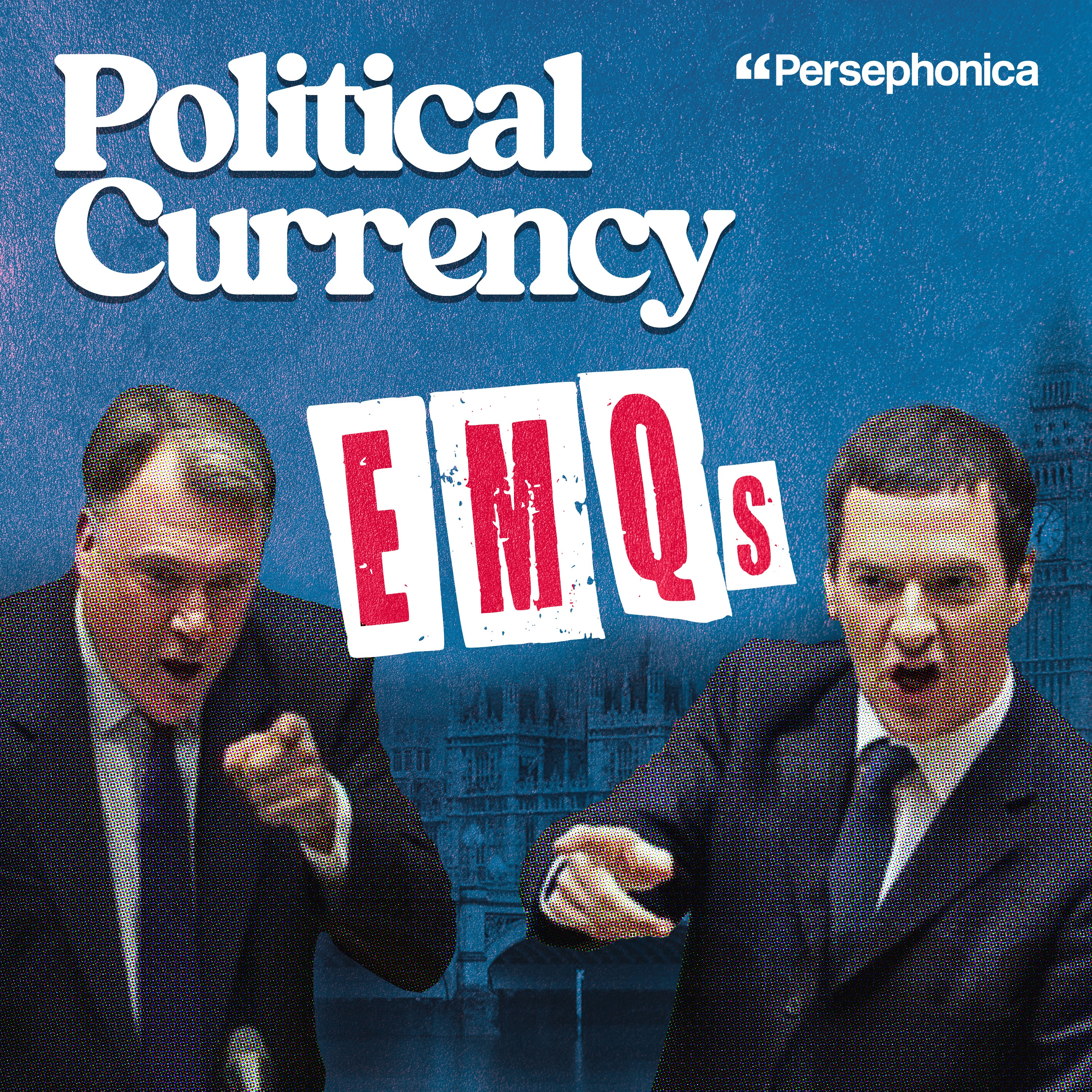
- EMQs: Do defections make the Tories electable?
In short
Hosts: Ed Balls and George Osborne
Description
The podcast dives into the economic decisions that shape political landscapes and personal finances, providing insights from experienced politicians who have been on opposing sides of the despatch box.
In this episode, Ed Balls and George Osborne analyze the implications of recent defections within the Conservative Party, specifically focusing on Robert Jenrick and Suella Braverman's departures. They discuss how these changes might affect Kemi Badenoch’s leadership potential and the party's viability with centrist voters, as well as exploring the possibility of adopting a US-style primary system in the UK.
Written by AI. May contain mistakes.
Chapters
0:45
Ed Balls' Netball Revelation
Ed shares a humorous story about a netball team named after him and their unique rule.
“But actually, something else happened, which I didn't tell you about, because George, you slipped off before me after the photos.”
3:41
The Impact of Party Defections
Discussion on whether recent Tory defections could make the party viable for centrist voters.
5:08
Navigating the Political Landscape
Analyzing the challenges and opportunities for the Conservative Party in the current political climate.
“With Robert Jenrick and Suella Braverman jumping ship and if more of the Tory hard right follow them, does this mean the Conservative Party could accidentally become a viable choice for more centuries voters once again?”
9:36
Differences in Candidate Selection
Exploration of how candidates are selected in the UK versus the US, highlighting differences in the primary process.
“has opened up in the British political landscape.”
14:00
Experiences in Political Primaries
Discusses personal experiences and the dynamics of political primaries.
“And we were kind of whittled down in a series of panel interviews with senior local party members.”
16:42
The Challenges of Open Primaries
Explores the complexities and pitfalls of open primaries in the UK.
“So you could say it was a fairly emphatic victory.”
21:26
Democracy in the UK: A Question of Definition
Analyzes whether the UK can be truly considered a democracy based on leadership elections.
“choke point which was a kind of including in the labor leadership contest which was you had to get a certain number of MPs to nominate you because that was supposed to stop crazy candidates.”
22:46
The Role of Party Leadership in Elections
Discusses how party leadership selections impact the democratic process in the UK.
“I wondered whether we can truly call Britain a democracy after the leadership elections we have had.”
27:26
The Power of Speech in Politics
Examines the importance of effective speeches in inspiring political change.
“was to take her from Keir Starmer to call a quick election but I don't think it's a question of they ought to that's where I think Danny is wrong and let's move on to our next question it's from Rob.”
28:00
The Power of Political Speeches
Explore how impactful speeches can inspire both the public and political insiders.
“Were I to be a Canadian, I would be truly inspired to hear him speak.”
Show all 14 chapters
29:40
The Importance of Authenticity in Speeches
Discussion on why politicians should craft their own speeches to ensure authenticity.
“You know, although I was a speechwriter to William Hague, the truth is, you know, he would write most of his own speeches and I would try and polish them.”
31:30
Risk and Reward in Great Speeches
Analyze the balance between taking risks in speeches and the potential for impactful communication.
“But to get to Rob's question, I mean, who could in Britain?”
34:10
The Nuances of Parliamentary Influence
Understanding the role of parliamentary round tables and time management in politics.
“And maybe that's the reason why Keir Starmer hasn't done it, not because he can't, but he's decided not to take that risk.”
36:10
Effective Diary Management for Politicians
Tips on how politicians can manage their time and commitments effectively.
“I always feel I should be doing more but I don't always end up fitting it all in.”

Ask about this episode
Get the gist, explore an idea or ask about something said.
 Claude
On Political Currency, what are the key points of this episode?
Searching your listeningTranscript
Automatic transcript. May contain errors.
0:00The Chancellor of the Exchequer. Getting a lesson from the Shadow Chancellor on how to balance the books is like getting a lesson from Dracula on how to look after a bloodbath. Ed Balls. A steady-as-she-goes budget. What kind of ship does he think he's on, the Titanic? The Mary Celeste. Welcome to EMQs from Political Currency with Ed Balls and George Osborne.
0:27So hello and welcome to EMQs, Ex-Ministers Questions. we are still basking in the glow of our political podcast awards victories. Ellie Clifford, producer of the year, and political currency, political podcast of the year. Very exciting evening. But actually, something else happened, which I didn't tell you about, because George, you slipped off before me after the photos. I think you went to one of those sort of ticket-only awards after parties, which, you know, only the Davos Global Elite are invited to. You didn't go to the Vanity Fair party that they had? Were you not invited? No, which is probably why I don't have a croaky voice.
1:05No, I went straight home precisely because I was losing my voice. But I had a fascinating revelation. A woman came up to me while we were doing the photos, just after you'd gone and said, can I have a photo with you? I said, of course you can. And she said, I have a reason for this. She said, it's going to save me£150. And I said, why is that? She said, for the last few years, she's been playing for a netball team, which plays in the London Women's Netball League based in Brixton. For 10 years, this team has been called Ed Balls. I mean, goodness knows why. Named after me. Apparently at half time, you know, when they're winning and they're second in the league at the moment, they're doing really well.
1:43They all say, come on, Ed Balls, which spurs them onto action in the second half. But they have a rule in this netball team that if anybody got a picture with me, they would be let off their£150 annual team subscription. and she said loads of others have tried nobody's succeeded i mean i knew nothing about this but she succeeded so i've saved you're so unapproachable they can't penetrate the security cordon that follows you around or i don't go to the after parties they go to so you know i've offered to go down and give them a half-time pep talk i'd take a bag of oranges and give them quarters suck on for the second half and you know if they're going to win you know the league this season you know i want to make sure i'm part of getting them there but of course this is a dilemma because if i go down have a photo with the whole team do they all get let off their 150 pound subscription in that case does ed balls go bankrupt i mean you know how would the team carry on so it's a dilemma you know i'll keep you updated now you've got experience of bankruptcy things didn't you because you bankrupted the country with your economic policies so uh don't do the same to the netball team george george look i know you've got a lot of jobs do you have a day named after you like St George and Martin Luther King a South London netball yes St George yeah but I think it's not named after you because it was before you and um quite a long time before you and he can ride a horse and I don't think you can ride a horse do you have a netball team not that I'm aware of but then you weren't aware of it last night I wasn't I wasn't there's almost certainly a you know a softball team or you know somebody competing in a scramble league called um George Osborne.
3:21I'm not sure what it would be. It's probably somebody who's involved in excessive drinking games who calls themselves the George Osborne team. I think there'd be some karate club or jiu-jitsu event or ultimate fighting club. I reckon it's late night champagne drinking. Anyway, so that was the second revelation after the exciting News of Our Podcast wins. Come on, Ed Balls. Shoot. He was gold attack. Did you ever play netball? Have you ever played netball? No, of course not. No. It's a nightmare game. I actually played when I was secretary of state children schools and families they had the annual dcsf sports day and we went out to some big sports place and i was asked whether i played a mixed netball team and i said i would you know but i'd never played before and they have two referees who are active the whole time and any time you move that's a civil service for you like two referees and they only need one but they've got two they only need one but they have two and every time you move you put your arm up with no contact they would blow up and say foul i said what do you mean foul and they'd say you can't do that in netball i said why they said because it's against the rules and i said i know but those rules are ridiculous and i'm the secretary of state and they said look we're really sorry you may be the secretary of state but these are the rules of netball and you know play by them will send you off it was very difficult so i'm quite respectful of netball the first and only game you ever played you wanted to tear up the rules of this i know it was non-contact but you couldn't even you were playing dodgeball probably you were probably chugging this ball unbelievably hard all these other players trying to hit them well look i found it quite frustrating however i'm going to go down to brixton if invited to cheer on ed balls the south london netball team doing well in the league and i'll report back please do we're all gripped let's get to our first question should we do that it's from pete hi chaps pete eastwood here from barclay in gloucestershire I consider myself a fairly moderate voter and in recent years have felt orphaned by the two main parties with their largely broad church approach, which seems to me they can't effectively govern with when so many of their own MPs are regularly fighting them.
5:27With Robert Jenrick and Suella Braverman jumping ship and if more of the Tory hard right follow them, does this mean the Conservative Party could accidentally become a viable choice for more centuries voters once again? So we talked about this in our main podcast, and I was saying that Kemi Badenock is being pulled in two different directions. And the question from Pete is, if you lose Robert Jenrick and Swella Braverman, does that make it easier for her to be a more centre-right conservative leader? Or does it put more pressure on her to lean towards the right to stop votes hemorrhaging with those defectors?
6:09And from Kemi Bainock's speech last week, the conclusion I draw is that Pete is not right, that while the Conservatives might accidentally become a more viable choice for centrist voters, Kemi Bainock is sort of fighting against that because she is wanting to claim that those more centrist voices aren't really proper Conservatives. Yeah, I think, Pete, you're right that there's an accidental element, which is that normally when you've lost a general election as heavily as the Conservatives lost the last election, and it was the worst result since the 1830s, you would expect to have a prolonged period in opposition.
6:45And you would expect the newly elected government with a massive majority, the Labour government, to be in office for at least two terms. And there's almost nothing you can do about it as an opposition to change that situation. It really wouldn't have made any difference if the William Hague opposition in the 1997 period had been utterly brilliant, got everything right. And we didn't. But say we had. There's nothing really that could have been done, I don't think, to have unseated Tony Blair in 2001. And the same is true of Labour probably in the 1979 to 83 period and so on. So there's just a moment when it's really hard for an opposition to get a hearing.
7:24However, the accident is, I mean, it may be not an accident, it's more self-inflicted accidents, is that the Labour government has opened up the opportunity. I mean, the Labour government has made a poor start to governing. Certainly in terms of its opinion poll rating, it's in the dumps. Keir Starmer's clearly got problems because people like Andy Burnham are trying to challenge him for the leadership just less than two years after he's won this big landslide. And that has created the gap for an opposition that would not normally be there, I would suggest. The question is, can the Conservative Party fill it?
7:58And I felt that Kimmy Baden-Ock's reaction to the Prosper UK launch, this is the group of moderate centre-right conservatives who held senior office, not just in Westminster, but around the UK. Ruth Davidson, who ran the Scottish Conservative Party and revived its fortunes. Andy Street, who was a very effective mayor of the West Midlands, as well as people like David Liddington and Amber Rudd and David Gort, you know, who were in Conservative cabinet. You know, what they're trying to do is say we should be looking at these center ground voters who perhaps voted Labour or Liberal Democrat last time.
8:35They've done some polling that suggests there's a big opportunity there. They're actually not proposing something that I think Kemi Beynot would find quite hard to do, which is, you know, a weaker stance, as she would see it, on immigration or staying in the European Convention on Human Rights, which she has said she wants to come out of. They're suggesting that we fight on the economic battleground as a party and that that's where the opportunity is and that's the gap that Labour has opened up. And I think it was a mistake to dismiss them out of hand and say the only conservatism I understand is my own conservatism.
9:10And that's never been the history of the Conservative Party in its entire long and distinguished history. So maybe she will begin to see that these people are actually allies in her plan to get back to office. They're certainly allies in wanting the Conservative Party to survive and thrive, rather than being taken over by reform. And if she, I think, had a bit of a more generous approach and a bit of a big tent approach, she might be able to exploit this accidental opportunity that has opened up in the British political landscape. I think my question to you, which in a way goes to Pete's question, I understand the argument you're making, and you've made this argument consistently.
9:46But the question he's asking is, do Robert Jenrick and Sweller Braverman jumping ship, and if more followed, do those defections make it easier for the Conservative Party to move to the centre ground? Well, I don't think so, because fundamentally, you don't want to be losing people, and you need to carry a broad spectrum of people. I mean, you know, I remember both Sweller and Rob when they became Conservative MPs. And actually, they were quite centrist. Certainly, Rob was. Sweller Bravman, you know, when she was first elected, she was exactly the kind of candidate we were trying to attract to the Conservative Party at that point.
10:23You know, I became an MP. It was, you know, a very male, very white party. And one of the stunning successes, I would say, of the Conservative Party during that period was to bring in not just many more women, but lots of people from ethnic minority backgrounds. So, you know, Sweller held very high office as someone who was not, you know, a white British male. And that was a bit of a turn up for the books in terms of the Conservative Party's history. So it was precisely because the tent was broader, we were able to get the Conservatives back into office. And, you know, I hear these arguments, I won't repeat them because we did them on the podcast, that you can win with a smaller share of the vote these days.
11:01I don't think what that should be your ambition three years out from a general election. So I think the answer to Pete's question is that we have consistently said that Kemi Badenok needs to move to take those centre-right voters, but the defection, even though she got plaudits for the way she handled the Robert Jenrick defection, actually the defections make it harder for her rather than easier. It's not an accidental opportunity. If anything, it's actually making it a tougher challenge. Thank you, Pete. Our next question is from Madison, and this question has been voiced by one of our producers.
11:38Hey George and Ed, a Texan fan of the podcast here. Politics is about to enter primary season right now when tens of millions of Americans will vote in thousands of party primary elections just to pick the nominees who will try to get elected to federal, state and local offices in the November midterms. To get elected to a congressional seat for the very first time means tens of thousands of people voted first just to make one a party nominee. British candidates are usually decided by small party selection committees. Question for you two is how many individuals contributed to making each of you the candidates in Tatton in 2001 and Normanton in 2005?
12:15In other words, how many votes did it take to put you on that ballot for the very first time? And what do you imagine British elections would be like if every candidate for parliament first made their case to public voters in American-style primaries? What would your intraparty campaigns be like? So, Tatton, 2001. I mean, I'm not sure Madison's quite right here. You wouldn't have been chosen by some backroom small committee, would you? And the Labour Party ditched that way of choosing leaders back in the 1980s and moved to a broader party membership process. Well, I think you're right, Madison, in your sort of the overall implication of your question.
13:00So to get yourself elected as a member of Congress in the United States, often the very biggest battle you have to fight is to get your party's nomination because there are so few swing districts now. and the gerrymandering of seats means that the real battle you have to win is the primary. Winning a primary campaign can cost you many millions of dollars and all eligible Republican or Democrat voters, self-identified, can vote in those primaries. Indeed, in some states, all people can vote in those primaries for candidates. And so, you know, you're essentially running two elections, the election to be the candidate and then the election to win the actual contest.
13:37In Britain, that is different, very different. Now, when I got selected, which was in the late 1990s in Tatton, I think it was still a world in which there were very large conservative associations, including my own in Tatton at that time, where I went through various selection rounds. Many hundreds of people applied to be the MP, including people who subsequently got seats elsewhere. And we were kind of whittled down in a series of panel interviews with senior local party members. But then it all came to a big meeting in Nutsford High School. And there must have been like six or 700 people in the room.
14:14So it's still not anything like a US primary, but it's more akin to a US caucus, like the Iowa caucuses, which have smaller groups of people, but still, you know, it's not just a stitch up. And, you know, I had to compete against three other candidates. And there was a vote at the end. And it was, you know, It was quite a big occasion. I was suddenly, you know, it was a really nerve-wracking occasion. I'd just missed out. I'd come second by, I think, one vote in a previous contest in Lemster about two weeks earlier on the Welsh border. So I was really keen to land Tatton. What's happened subsequently?
14:51Two things happened. One is parties have experimented, or certainly the Conservative Party has experimented, with primaries. We ran a proper primary in Devon, South Devon, and balloted everyone in that constituency. to help choose a Conservative candidate. So we did experiment with it, although it's expensive to do. And then you found if you had just sort of primaries where people just, anyone could turn up, the truth is it became quite easy to organize groups of supporters to turn up and essentially kind of swamp the meeting. And Conservative Party membership, like other political parties, has shrunk.
15:24And so these meetings are smaller than they once were. Whereas in America, it feels like it's going the other direction. The primaries are becoming more important. They're more and more expensive. And more and more, you know, I know more and more people participate in them, but certainly, you know, the effort required to win them is much greater. So I often joke with my American friends that what did it cost me to win my primary in Tatton? Well, it cost about£100, which was the cost of the return rail fare to Cheshire on that day. Although you probably went more than once, didn't you? Did you only go to Tatton the one time?
15:56No, I went for three different rounds. There was a first round sort of sifting around with a small panel, then a slightly bigger, the full executive of the local party, then the big meeting in which every Conservative member in the constituency was invited. So when I was selected in Normanton 2004, the party membership in Normanton was just over 300. And the actual vote on the day was 200, I think, turned out. And I won. There were only four candidates nominated. There's a process you have to go through to get wards and trade unions to nominate you. I got, of the 200 or so who came to vote, I got 195 in the first ballot.
16:37And then the person who came second got five. And then three. And then the person who came fourth got one. So you could say it was a fairly emphatic victory. But the truth was I had spent a lot of time preparing, like years for that moment. I had a membership list. And over the month or so before that meeting, I cold call visited every one of the 300 members. And I certainly saw 250 of them. You just arrive. And because if you try and rang up or write a letter, then they would say no. But you just turn up and have a chat with them in their home. And that was the way that selection process went.
17:11So it wasn't an open primary, but it wasn't either a small meeting. It was a small party selection committee. It was a big open public event. and I think they're probably usually a bit closer than that. Oh, come on. Didn't Gordon Brown put in a call to the local party saying, come on, get my boy Ed elected? Certainly not. But I was working for Gordon Brown for the eight years before and let's just say I regularly sent key party officials copies of important speeches to make sure that they were fully up to date and I wrote a column for the local newspaper for the couple of years before all about the Wakefield economy and what we need to do to succeed.
17:51So look, if you want to get selected, you've got to prepare the ground. Come on, how many tens of millions of pounds did we spend on Wakefield in order to get yourself... Look, it wasn't Johnson-style pork-barrel politics. Was there a new railway station, a new... Absolutely not. How many of the executive are in the House of Lords now? None of them. Although I did once take them on a tour of Downing Street. I was actually taking them round number 11. Before or after you were selected? Before I selected the senior dignitaries of Normanton. and Cherie Blair came in and said, what on earth are you doing here?
18:24And I said, well, this is number 11 Downing Street, which is the official residence of the Chelsea Exchequer and I'm the Chief Albuquerque Advisor and I'm taking a group of important councillors and dignitaries from Normanton round. And she looked at me like she didn't think I had any right to be there. Well, let's be honest, she didn't really think Gordon Brown had any right to be there either. So there we are, deep politics. We won't go into those deep waters. I think the thing that you say though, which is really, I think interesting, it's about political culture. if you have a culture which is based upon the open participation of people in choosing candidates it can work but it's really hard to introduce those cultures and therefore if you end up with a low turnout it's quite easy for those votes to be rigged or at least to be not really reflecting what you want i remember back in 2010 you had an open primary process and sarah wollaston local health GP.
19:15That's the one I'm referring to, yeah. Got selected and that caused quite a lot of problems because she wasn't really a Conservative at all. She didn't really want to stand on that ticket. Tessa Jowell was always persuaded. Although, just on that, before you move on, you know, I think without Sarah as the candidate and without the primary process we went through, we probably wouldn't have won that seat because it would have been caught up in the expenses scandal of the previous MP. And so it was also a device of basically relaunching the Conservative party in that area. But let's be honest, I don't think you and David Cameron thought that this was a good idea you wanted to repeat in future elections and selections because it was too random and too chaotic.
19:52I think we were actually, we were more optimistic that it could be a future path, but it ended up being very expensive. And then we went for these primaries where everyone was invited to a meeting. They didn't get sent a ballot paper, you know, every voter in a constituency. And we had quite a lot of selections like that, but they ended up being things you could quite easily rigged as i was saying i was going to say tessa jow former labour cabinet minister was always convinced that if you had people who didn't have to become party members but could become sort of you know friends or associates and maybe sign up or pay a small amount that that would draw the selection to the center ground and make it more representative and therefore make it more effective as a precursor to the actual election and then that argument was tried in 2015 when labour from my point of view just kind of you know mistakenly and you know bafflingly decided to allow people to sign up without becoming a party member to participate in the Labour leadership election and of course huge numbers of people not from the centre ground but from the left joined up as a consequence that helped to supercharge Jeremy Corbyn to the Labour leadership which turned out to be a disaster now I think even if you hadn't done that he probably would have still won the leadership election such was the politics in 2015 in our culture you don't get madison a broad-based participation it's so easy for it to be taken up by a particular cause or group that idea rapidly lost popularity in labor circles nobody would go back to that now yeah although we could have this conversation for the whole episode but um you know there was always a choke point which was a kind of including in the labor leadership contest which was you had to get a certain number of MPs to nominate you because that was supposed to stop crazy candidates.
21:40And yet, you know, you got people voting for Jeremy Corbyn's candidature. Like, I think Sadiq Khan voted for it as an MP, didn't he? And Frank Field voted for it. I mean, there were people who should have known better who basically let him in. Because, you know, even if you have a primary, I think you'd want to have some kind of check on who can stand in this primary. I think maybe inside the room on that couple of months would be quite interesting because you learn a lot about political errors in that period. And, you know, you could start with the election campaign. I'm sure we made some political errors as well, but the post-election process caused huge problems.
22:17Let's take a break and we're next going to have a question from Patrick.
22:32Welcome back. Our next question comes from Patrick. Hello, George. Hello, Ed. I love the podcast. I am a very keen listener and Kitchen Cabinet member. I wondered whether we can truly call Britain a democracy after the leadership elections we have had. It has been 51 years since a prime minister came into office after winning a general election and left office after losing an election. That was Edward Heath. So my question to you two is, can we justifiably call Britain a democracy? Thank you very much. So the answer, George, is, of course, the UK is a democracy. It's a parliamentary democracy.
23:22In a parliamentary democracy, the leader and the prime minister is the person who can command a majority of MPs in the House of Commons. And it doesn't take a general election to change that, as we saw with Boris Johnson's departure at the hands of his parliamentary colleagues. And so, you know, in some ways, I think Patrick is wrong about this, that actually our democracy has been working more effectively because of the evidence he sets out in his question. Yeah, I mean, I still think Patrick's highlighted an extraordinary fact, which I guess I knew if I'd sort of thought about it, but I've never conceived it in the way that he has put it.
23:59I mean, it is amazing that not since, you know, essentially, when I was born, has there been a prime minister who was elected at an election and then kicked out at an election? I mean, that is quite an amazing fact, isn't it? Don't you think? It is true. Because if you think Margaret Thatcher, not by the voters, John Major was elected and then kicked out. Not chosen as prime minister by the voters. He won the Tory leadership contest. That is true. Tony Blair, not kicked out by the voters. Kicked out by you. Gordon Brown, kicked out but not chosen by the voters. David Cameron, chosen but then not kicked out by the voters.
24:37I mean, you know, as you go through, there is the evidence before you. I have to say, so I am a big fan of Danny Finkelstein. He writes a column in The Times. I often feel as though I learn a lot from Danny's columns, even if I don't always agree with him politically. But he wrote a column this week, which was basically taking Patrick's side and saying that, you know, we're not a proper democracy the way we do things. It's called Want a Change of Leader? Call an Election. Parties can pick new PMs with minimal public input. If Starmer goes, he should take this unfair system with him. I mean, you know, I know he's a friend of yours.
25:09when Rishi Sunak was chosen as leader of the Conservative Party after Liz Truss, did Danny Finkelstein say, we must have a general election? Was he in the course of 2024 saying, good, Rishi Sunak has called this election, it should have happened earlier? Or was he agreeing with you that the election should happen later to give the Conservatives more chance of winning? I sort of feel as though Danny's article in the Times was slightly self-serving, politically motivated. I'm not sure if it was a constitutional contribution. Yeah. I mean, I think it's a different question, which is, should you call the general election very soon after getting chosen as a party?
25:49We did the whole inside the room on whether Gordon Brown should have called an election in the autumn of 2007 and could well have won it. Maybe Rishi Sunak actually would have had a better chance of winning or a shot at winning if he had called an election immediately after coming to office, he would look like the safe pair of hands, the economy was in a mess because of the trust budget. And Stalin hadn't quite found his feet yet. You know, he'd actually found things quite difficult. And so there's a different point, which is maybe it makes sense to call an election, but it still wouldn't really answer Patrick's point that you're still chosen as the prime minister or party leader by your party, isn't it?
26:26But Danny's not making a tactical argument. He's not saying that it would be better for Labour. He ends by saying, if they decide to remove him and replace his government with someone else's promises and reassurances, then they ought to ask us first. So he's making it a principal constitutional argument. And that is not the nature of a parliamentary democracy. It's important that parliaments can throw out bad prime ministers. You don't have to have an election in order to validate that. Yeah, that's a good point. I don't often disagree, Danny, but you push me into a corner where I do. which is presumably the whole point of us answering this question he thought this would be in music well the whole point of you bringing up the uh danny's column but yes maybe we should send uh a copy of erskine may to lord finkelstein well the truth is we've been seeking to answer patrick stephens's question for about three weeks and for whatever reason and then danny then popped up with this column i mean he must have known we were going to answer patrick's question so um he provided me with easy ammunition and you know as you say it might be the right thing tactically if somebody was to take her from Keir Starmer to call a quick election but I don't think it's a question of they ought to that's where I think Danny is wrong and let's move on to our next question it's from Rob.
27:41Hi Ellen George it's Rob Jane here from this morning in Kent my question relates to the extraordinary speech I just watched Mark Carney deliver at the World Economic Forum for my money a masterclass in public speaking, but also more critically, a masterclass in a demonstration of strength and true leadership. Were I to be a Canadian, I would be truly inspired to hear him speak. I'm not a Canadian, though. I'm British. And so my question brings us closer to home to ask you our preoccupation with reform and with the mainstream political parties, all of whom seem to be dancing around really sort of talking within five degrees of the same tune of themselves does little to inspire the people of this country politically but as we've seen from mark carney political speeches and political figures truly can inspire and so where do you think such inspiration is going to come from next in our country thanks very much so i you look like i'm I guess because I used to write speeches, I'm a great believer in the power of the speech, even in the age of TikTok and short-form media.
28:52And Mark Carney's speech has been a very good demonstration of it, that a well-crafted speech, well-delivered, that catches a moment and has a bit of a pervading wind. You have to have a bit of luck that people've noticed it, can still have a huge impact. And it serves two purposes. It serves a purpose of communication to your public and the world, but it also serves a really important purpose, these speeches, of internal communication, of telling your party, your government, your officials, in Marx's case, the diplomats who work for Canada, you know, what the policy of the country is. And the very act of writing a speech can actually force you to marshal your arguments, confront contradictions that you've not been prepared to confront before.
29:35I still think there's a huge art in and benefit to writing a speech. You know, although I was a speechwriter to William Hague, the truth is, you know, he would write most of his own speeches and I would try and polish them. But that was pretty hard to do. And some of the great speechwriters like Ronnie Miller, who wrote Margaret Thatcher's speeches, or Peggy Noonan, who wrote Ronald Reagan's speeches, they weren't putting words in the mouth of these people. They were finding words that articulated what these people originally thought. Talking about newspaper columns, I actually thought there was a very good newspaper column from Stephen Bush this week in the Financial Times saying it's such a mistake for politicians not to write their own speeches or at least the first drafts because Margaret Thatcher would sketch out what she wanted in a speech.
30:19Tony Blair would write out longhand his speeches. That was his approach throughout his premiership and I would always, I'm not comparing myself to them, I would always write the first draft of my budget speech myself even if then the team would come in and improve it because it's got to be you. And I think Stephen's argument in his article is that Mark Carney's speech was clearly Mark. Someone else may have helped write it, but that comes from Mark and he would have sat down and written it himself as a first draft. Actually, you know, you've told me stories before of how Gordon Brown would write the speech himself and sort of project it on a projector to his special advisors.
30:57And then you guys had to come with policies that supported the argument he wanted to make. And Stephen's making the argument, can you imagine, does Keir Starmer write his own speeches? Answer no, because the two kind of most notable speeches he gave last year, one of which was the Island of Strangers speech, he subsequently disowned and said, well, I didn't really know what I was reading out. And that rather misses the point, which is the speech isn't just something you read out. It's a way of you marshalling your own argument and then communicating it not just to your audience, but also to your supporters.
31:29So I thought Mark Carney's speech was a very important speech and it was good he made it. But to get to Rob's question, I mean, who could in Britain? I mean, there are loads of people who can make a great speech, but the question is, do you have the platform which allows you to make that great speech? And I think there's probably been loads of politicians in Britain who think, you know, I actually made a great and brave speech, but nobody noticed it. And the thing about being a prime minister is that you do have the platform. And therefore, Keir Starmer could make a great speech and he's got the platform to do so.
32:03But he is choosing not to take the opportunity that Mark Carney took the other week. But it is open to him. But I think there's another dimension to this, which is that normally the great speech is not just about inspiration and about direction, but it's normally about risk. Normally, the great speeches are the ones where you roll the dice, you do the unexpected and difficult thing. And the truth about Mark Carney's speech last week was it actually wasn't that risky. I mean, he has already shown over the last year and a half that challenging Donald Trump has worked to his political advantage. As you said last week, Canadian politics is on a knife edge.
32:43The thing he was most upset by last week was any suggestion in his phone call with Donald Trump, he was backing down. I mean, it is in his interest to do this. It wasn't that risky. I was thinking about say we're talking about Gordon Brown a Gordon Brown speech which was risky the speech he made the days before the 2014 Scottish referendum that was a risky speech because it could have gone wrong but I think back to your speeches I mean I was thinking what is a speech which is kind of had a lasting impact and took a risk it was actually your 2009 conference speech where you decided to double down on setting out the choice and although it may have cost you votes it gave you a mandate well i think about the speech which had the biggest impact which i made it was in the labour leadership election in 2010 it was called a bloomberg speech at the time where i broke from the arguments being made by david milliband ed milliband andy burnham actually and said that what you were setting out to do with austerity was the wrong thing to do economically and there is an alternative it was widely reported because nobody had done that at the time because the view was Labour can't afford to do that because the Tories and the Lib Dems are all supporting this agenda.
33:55So I think the question is, not only can you inspire and do you have a platform, I think the great speeches are the ones where you take a risk. It would be more risky for Keir Starmer to make the speech Mark Carney made than for Mark Carney to make the speech which Mark Carney made at Davos. And maybe that's the reason why Keir Starmer hasn't done it, not because he can't, but he's decided not to take that risk. I think you somewhat underplay the risk that Carney was running. Or put it this way, you could easily get up on that platform because there are loads of speeches that week by heads of government, loads of speeches by prime ministers and presidents at Davos.
34:31And most of them get up, and I've seen British prime ministers do that when they've gone in the past, and they say, here are all the great things we're doing in Britain or here are all the great things we're doing in France or Germany or Japan or wherever, and we're attracting inward investment, we're doing this, you know. and it's a sort of business pitch. It's quite another thing to get up on that stage with Donald Trump about to arrive and do essentially a sort of theoretical speech about foreign policy and how countries should align in the modern era. But don't get me wrong, I'm not seeking to talk down Mark Carney.
35:00I'm genuinely not trying to say, I think it was a really good speech and a very powerful speech and a very intellectually important speech. All I'm saying was that he had a great political interest in making that speech and Keir Starmer is not sure that he wants to roll the dice in that way. And I think other European leaders are more cautious than Mark Carney, maybe because they're slightly further away and they've got... No, I know you're not saying it was... But Mark saw that the best way to make his point was not a kind of tweet attacking Trump and Greenland, nor a sort of TV interview and then just do the routine boring speech on the Davos stage that no one reports.
35:37He said, I'm actually going to invest time in a 20-minute, well-constructed argument of what middle powers like Canada should do in this world. And if you're a listener to this podcast and you're interested in what's going on in the world, you should definitely read the Mark Carney speech. And we don't very often say that because it's not often the case that a speech really repairs that degree of study. Thank you, Rob. Let's take a break and then we've got one more question coming up.
36:16welcome back our final question today is from scott hi ed and george i have two pressing questions so i'm hoping you'll allow me as a member of your kitchen cabinet to ask both first up through my work i was invited to take part in a parliamentary round table before christmas i had a great time and it was great to share my knowledge but it made me wonder how influential or important these sessions are i don't have any parliamentary connections except for membership of your cabinet so I was surprised to be invited and wondered how I was. I also wondered if you'd ever hosted one yourselves and second listening to you both each week it always impresses me how much you fit into your week including time for reading and family so I wondered if you had any tips or advice on how you've learned to manage your time or how to structure your weeks.
36:56I always feel I should be doing more but I don't always end up fitting it all in. Thanks both, all the best for the year, Scott. We've talked about this before, the importance of diary management. By the way before we get there great Scott that you were invited to this parliamentary roundtable and often parliament can be used in order to open up new debates but also give people new voices when I was a backbench MP 2005 to 2006 I ran a series of what I call parliamentary hearings where we had families and experts talking about disabled children and their families had a big impact upon policy gave people voices they didn't have so parliament can be used in that way but your second question about diary management.
37:36George, you've often talked about this. You've said the most important thing about being a politician is you've got to control your diary and you've got to know when to say yes and when to say no. I always think one of the most important lessons I learned from being in politics is anytime you're ever invited to do anything, you always have to ask yourself the question, if this was tomorrow, would I want to do it? Because the number of times you get invited to do some lecture or speech or visit and it's in six months time and you say yeah that's fine sounds good i'll do that and you get to the week before and you think why on earth did i ever agree to do this and so the discipline of stopping yourself signing up to things you actually know you won't really want to do when you get there is very very important that is one tip scott if your diary is filled full of stuff you don't want to do it's probably because you should never have said yes in the first place no that that is a very good um that's a very good approach i think not any do you have to create time for your family and friends and all that and you do also have to create time just to sort of think about what you're trying to do with your job you know this is true in the corporate world as well you never sort of blizzard of meetings and you never find the space to say what am i trying to achieve this month or what am i trying to achieve this year or you kind of it gets inevitably kind of carved out of the evenings and then it can eat into the kind of family time so that is that is really hard and important and there is no simple way to do it I just think you have to be constantly on your diary and constantly checking it and checking them out next week and next month.
39:05And whether there are things, you know, I think that if you're lucky enough to be invited to do lots of interesting things, it's tempting to say yes to them all. And then it becomes a kind of blizzard and you get exhausted. But you can't devolve it really, can you? I think in the end, you have to be part of the diary conversation. Yeah. Maybe AI is going to give you that diary assistant before too long. I don't know. I'm not sure if AI can tell you whether to make the speech or not. Maybe I ought to write the speech for you. There's supposed to be the promise of it. But that's not the same as, should I go to Taunton in three weeks' time to speak to the Peel Society about Conservative Party direction?
39:40The idea is it will be, I'll tell you. You should certainly try the speech. I mean, I was quite amazed, actually. I had a go at doing it the other day of like, write me a speech, actually in the style of George Osborne, to an investment conference. And I was like, wow, that is actually not far off with the speech I'd write myself. Well, that's probably because it read your past speeches and regurgitated. Very interesting. Thank you, Scott, for that question. We always like to give a little bit of sort of micro advice to aspiring and current politicians, as well as macro geopolitical sweeping views.
40:13You're proposing to give micro advice to this netball team, even though you've made it clear you have no idea what the rules are. You've only played it once. But you know what I'm going to say? I'm going to say, come on. And you're going to hand out some oranges at heart. We can do it. Come on, play up. Like a sort of 1970s soccer match. I mean, I assume these players were not, it's not even that they weren't born in the 1970s. Their parents probably weren't born in the 1970s. Look, all of my language comes from reading the Mallory Towers and Sinclair's Enid Blyton books when I was, you know, 8, 9, 10, 11.
40:48And it would always be, come on, Daryl, shoot, shoot, shoot a goal. That was probably lacrosse. But netball's all the same, isn't it? Shoot, shoot a goal. Come on, Wilhelmina, but her friends call her Bill. That is all we've got time for in this episode of EMQs. I think we better track the success of this team, the Ed Balls team in South London. It might well be that this peaked now that they've alerted Ed to their existence. Maybe the George Osborne Tiddlywinks team is doing better. Do please keep sending us your voice notes and emails via questions at politicalcurrency.co.uk we love it when we have questions like scots which are different and quirky or funny or interesting big politics big policy but also all that micro detail love it yes uh we do and um we are going to we may be political podcast of the year 2026 but george still can never find that little bit of script we're going to be back next week with another episode is that really all you're going to say that was what's called taking a punt on the script yeah my voice has held out to this point but i think it's now about to collapse but we are going to be back next week we are see you then
42:10thanks for listening to political currency this has been a persephonica production
From the publisher
Are Robert Jenrick and Suella Braverman’s defections a blessing in disguise for Kemi Badenoch? In this week’s EMQs, Ed Balls and George Osborne explain the pros and cons of the Tories losing MPs from the right of the party, and how Badenoch can take advantage of Labour’s unpopularity.
Then, the pair consider whether the UK could adopt a US style primary system for candidates and explain how they got selected for their seats in parliament. They also confront the surprising fact that no prime minister has come to power and been ejected through a General Election since the 1970s and answer whether Britain is actually a democracy?
They then answer if any British politician is capable of inspiring people the way Mark Carney did at Davos. George and Ed use their past experiences writing and delivering speeches to debate whether Carney's speech was inspiring because of what was written, or how and where it was said.
We love hearing from you, so please don’t forget to send all your EMQs to questions@politicalcurrency and make sure to include a voice note of your question.
Thanks for listening. To get episodes early and ad- free join Political Currency Gold or our Kitchen Cabinet. If you want even more perks including our exclusive newsletter, join our Kitchen Cabinet today:
👉 patreon.com/politicalcurrency
Please note: Kitchen Cabinet is only available via Patreon.
Credits:
Research: Sam Burton
Production: Caillin McDaid
Video Editor: Avi Asher
Executive Producer: Ellie Clifford
Political Currency is a Persephonica Production and is part of the Acast Creator Network.
Hosted on Acast. See acast.com/privacy for more information.
More from Political Currency
All episodes

We use cookies.They keep VO running smoothly and help us improve it. Privacy policy