
 Ask ChatGPT


- Podcasts
- Political Currency
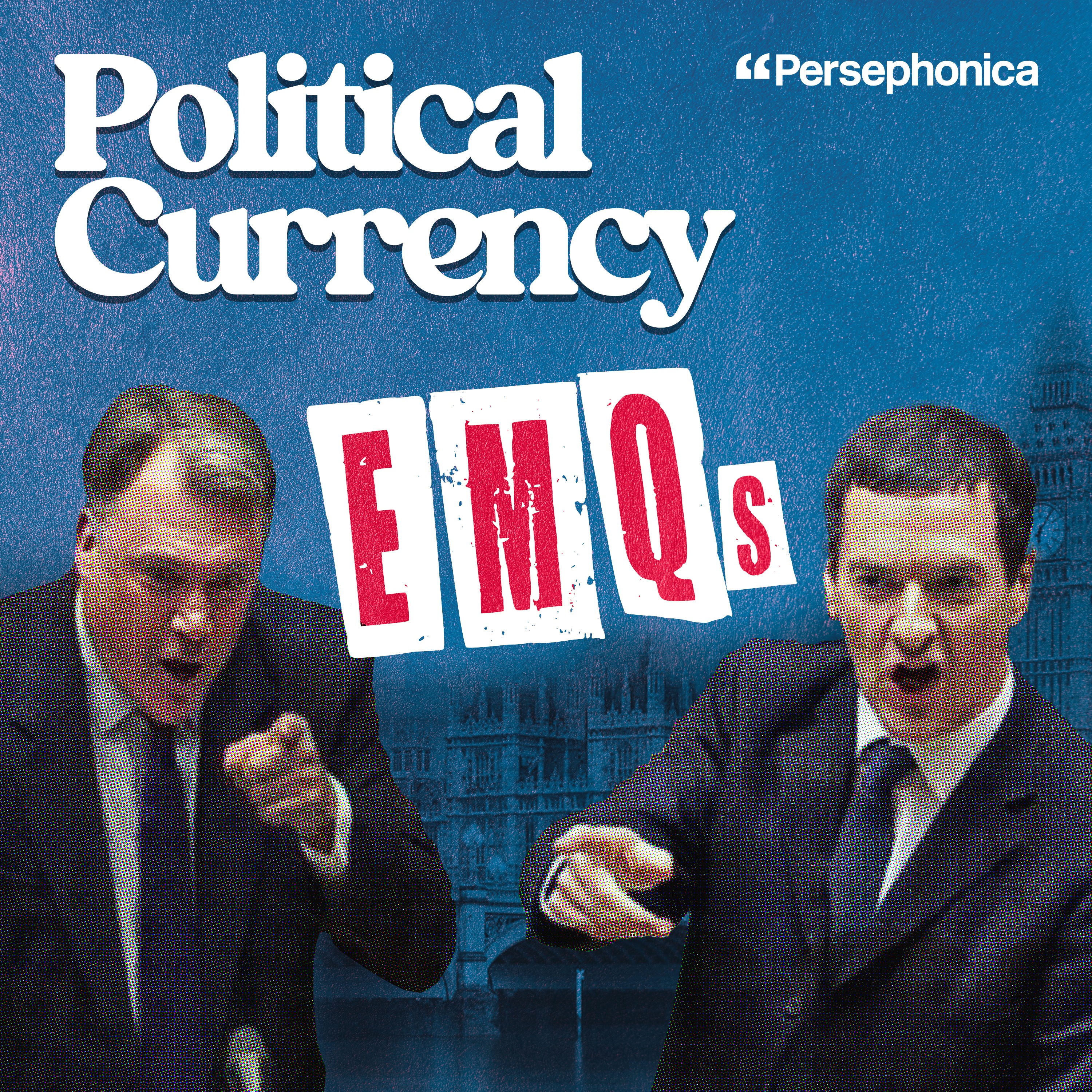
- EMQs: From Beatlemania to... K-pop?
In short
Hosts: Ed Balls and George Osborne
Theme
The episode addresses various political and cultural topics, including pollings, cultural exchanges, immigration policy, and crisis management. The hosts also take listener questions and provide insights based on their experiences in government.
- Listener Question: Beatrice Gove asks about polling that shows Labour and Reform as the most trusted by business, and its implications for Keir Starmer.
- Discussion Points:
- The Tory party's slump in business trust is concerning for their future.
- Reform UK’s rise among business executives suggests a shift in political loyalty.
- Implications for Labour: Starmer's Labour must reassure the business community to regain support.
Written by AI. May contain mistakes.
Chapters
2:05
Trump's Gift-Giving and Fashion Choices
Discussion on Donald Trump's unique approach to gifting shoes to cabinet members.
“And this is prompted by this rather bizarre thing happening in America, which is that Donald Trump has been buying and gifting the same dress shoes to his cabinet members.”
3:08
Political Gifts and Missteps
Exploring anecdotes about political gifts and their implications.
“I just wondered, have you ever had a similar problem with a political friend or colleague?”
4:01
Honorary Degrees and Academia
The hosts discuss the significance of honorary degrees in academia and their personal experiences.
“He always looked at about 15 going on 55.”
5:25
The Challenge of Recognition
The discussion around receiving honorary degrees and recognition in an academic context.
“So last night on the internet, were you looking at these videos, wondering why William Hague has not yet given you an honorary degree?”
6:41
Gove Family Dog Incident
The hosts recount a humorous story involving a dog and a chicken.
“Sorry, a totally different subject area.”
7:30
Polling Insights and Business Interests
Analyzing a recent poll of business executives on political preferences.
“That was before you broke the chicken snake.”
8:52
The Rise of Reform UK
Discussion on the growing influence of Reform UK among business leaders.
“I look forward to hearing your response.”
10:53
Corporate Britain and Political Shifts
Exploration of how corporate attitudes towards government are changing.
“insurance rise and all the questions about whether they've got an economic plan do you know what the business vote did on Brexit.”
14:09
Political Dynamics of the Green Party
Exploration of the Green Party's current political stance and its relationship with business.
“But there was definitely a kind of fair weather element to it.”
16:03
Cultural Exchanges: Historical Perspectives
Discussion on historical cultural exchanges and their impact on international relations.
“George it's Ant here from the British Museum.”
Show all 18 chapters
19:22
Exemplifying Cultural Diplomacy Through Events
Insights into various cultural events that foster diplomatic relationships, such as exhibitions.
“I didn't know, Anthony, you were going to send a question in.”
22:34
Impact of Cultural Diplomacy on National Identity
Analyzing how cultural diplomacy and significant exhibits influence national identity and perceptions.
“the plays into Chinese and to put on a tour in China.”
26:24
Debate on Citizenship Requirements in Care Work
A discussion about the fairness of citizenship contributions in the care sector.
“And that if you were a doctor, a nurse, or a high earner, then you'd be able to get that permanent status more quickly.”
28:00
Fairness in Immigration Policy
Explores the complexities of immigration laws and the perceived fairness in treatment of low and high earners.
“for people who don't think that is fair, because they will say, hang on a sec, what is it about high earners?”
35:16
Legislation and Fair Play
Discusses the implications of immigration legislation on community integration and fairness.
“Norwich, that entitles you to kind of bridge citizenship for the rest of your life.”
38:03
Repatriation Challenges in Crisis
Analyzes the difficulties governments face in repatriating citizens during crises, referencing recent global situations.
“By designing glasses in-house and selling directly to customers, they're able to offer prescription eyewear that's expertly crafted and unexpectedly affordable.”
42:05
Political Repatriation Challenges
Explore the complexities and sensitivities surrounding government repatriation efforts.
“under pressure for all the reasons I just said a moment ago.”
46:54
Ed Davey's Political Maneuvering
Discuss Ed Davey's recent political actions and the rise of the Green Party.
“Ed Davey, because he's your, you know, why?”

Ask about this episode
Get the gist, explore an idea or ask about something said.
 Claude
On Political Currency, what are the key points of this episode?
Searching your listeningTranscript
Automatic transcript. May contain errors.
0:00Pancetta mushroom tortellini. You can eat smart, still fit in your bikini. I ordered blue apron. I've been happy ever since. They sent pre-portioned meals. I don't make no measurements. Saute the pancetta. Then I add the mushrooms. Large skillet cause you can't have too much room. Garlic pesto. Tomato paste. Calabrian chili. Season to taste. Order blue apron today.
0:30A BetterHelp ad. Hold on. One second. I just need to...
0:41What if you had a room where no one interrupts? No notifications. No expectations. Just space to talk. With BetterHelp, therapy happens in a space that's yours. Visit betterhelp.com slash randompodcast for 10 % off your first month of online therapy. If your eyes are the windows to your soul and your glasses are the windows to your eyes, then it's pretty important to find your perfect frames. That's why at Warby Parker, we've made shopping for eyewear as easy and fun as can be. Peruse endless styles in our stores or use our app to virtually try on frames and get personalized recommendations. To find your next favorite pair of glasses, sunglasses, or contact lenses, or to locate your nearest Warby Parker store, head over to warbyparker.com.
1:29That's warbyparker.com.
1:51George Osborne: to EMQs from Political Currency with Ed Balls and George Osborne.
2:01Ed Balls: Hello and welcome to EMQs. And before we get into our questions, I'm going to start off with a bit of a sartorial question for George. And this is prompted by this rather bizarre thing happening in America, which is that Donald Trump has been buying and gifting the same dress shoes to his cabinet members. Apparently, the brand is Florshine,$145 a pair. Trump pays for them themselves, signs the box with a message. He's bought them for J.D. Vance, Marco Rubio, Peter Hesketh, Howard Lutnick, Sean Duffy, others. It became a bit of a joke because Marco Rubio was bought a pair. Apparently, Trump guesses the correct size.
2:45Ed Balls: And he got Rubio's wrong by about three sizes. So Rubio is pictured wearing this massive pair of shoes.
2:53George Osborne: It was a photo, wasn't it, of the whole cabinet all lined up wearing exactly the same shoes.
2:57Ed Balls: What is it about these big intellects, J.D. Vance, Marco Rubio, that they can't say to the president, actually, I don't want your shoes, or more importantly, clean up by the right size? I just wondered, have you ever had a similar problem with a political friend or colleague? In my case, Gordon Brown was always giving me red ties, wide and red, and very nice of him. He didn't mandate that I had to wear them, to be fair, but I've got quite a lot of red ties.
3:26George Osborne: I got a Haig baseball cap, which in its day was, you have to have long memories.
3:31Ed Balls: From William Haig?
3:32George Osborne: Yes.
3:33Ed Balls: Was that when you were out having 14 pints?
3:35George Osborne: No, do you remember he got kind of, when he could do no right and Tony Blair could do no wrong, but it was all connected with that. He went on a ride in Cornwall, I think it was, or anyway, somewhere in the West Country, wearing a baseball cap. It was supposed to demonstrate, you know, it was supposed to be like, he's a younger generation than the Tory leaders have come before. But as you soon discover in politics, when things aren't going right for you, everything is wrong and everything's a misstep.
4:00Ed Balls: Look, William Hague is a very nice man, but I'm not sure he even, at the age of 15, he was the younger generation. He always looked at about 15 going on 55.
4:10George Osborne: I came across some coverage on the internet last night of him awarding some honorary degrees in Oxford. That's the kind of thing that the algorithm throws to me. He was dressed in the most, he's the Chancellor of Oxford. I mean, big kind of in brackets. Can you imagine if Peter Mandelson had won that contest? That would have been a whole other saga. Anyway, my friend William Haig is the Chancellor of Oxford, and he was dressed in the most extraordinary and magnificent outfit, which I know William, and I know he would say, oh, I don't pay much attention to what I wear, but I absolutely know he would love wearing this.
4:45It's these sort of gold robes with a sort of mortarboard,
4:49George Osborne: you know, like a kind of classic academic mortarboard, and he's in this big ceremony, and he's giving all these honorary degrees to famous people. And I was just looking at it, and I was thinking, William you are absolutely loving this moment was that the punchline yeah I was trying to think
5:04Ed Balls: what I kind of I was waiting I was waiting for the the only thing I was thinking is where's my honorary degree have you got an honorary degree from Oxford no I have not but you went to Oxford I did go yeah and that's a good question I mean I've had an honorary degree from East Anglia where I was born Nottingham and Nottingham Trent where I grew up I mean I'm actually an honorary fellow at a college but what is William Hague doing he's asleep at the wheel when I stopped
5:30George Osborne: being chancellor and it was all pretty traumatic for me Manchester University said would you like to be a kind of honorary fellow in the politics and economics department and I was so touched it meant a huge amount to me actually and I thought my god you know to really kind of establish myself in the ecosystem of Manchester in this city you know not the city I was born in and certainly not city teaming with conservatives at the time.
5:56Ed Balls: So last night on the internet, were you looking at these videos, wondering why William Hague has not yet given you an honorary degree? No, I was not.
6:04George Osborne: But I've had not much contact with my university since I left. And when I did leave office, not only did Manchester give me the honorary fellowship, but all these American universities came out of the woodwork, like Harvard and Stanford, where I now teach. Kind of begs the question. Well, where's your honorary degree from Oxford?
6:21Ed Balls: I've not got one either. Maybe you're just using me as a proxy. I see what this... I'm not a close friend to the Chancellor.
6:28George Osborne: It would probably make it easier for him to give it to you.
6:30Ed Balls: I mean, in principle, you are right. In practice...
6:34George Osborne: I can't say we're not important enough to get one because I did notice that a rival... No, not a rival. Sorry, a totally different subject area. Another podcaster who does a very well-known history podcast was getting an honorary degree. So podcasters are eligible.
6:51Ed Balls: The thing which we can say now is it is totally impossible for us ever to get an honorary degree from Oxford. Have we talked ourselves out of it? We've reigned on that parade. We should get on with our questions. And I think you foreshadowed this one in our main podcast.
7:05George Osborne: Yes. We were talking about what happened when the Gove family dog jumped out of the car at Dorneywood and attacked one of the chickens, a chicken who happened to be called Gordon. and I was trying to recollect the events. We talked about it last week. I hadn't planned to bring it up, but it kind of suddenly came into my head. And then...
7:25Ed Balls: Was there an inquiry?
7:27George Osborne: There was a brief inquiry at the time held by me. Like, why the hell has this dog jumped out and attacked this chicken?
7:32Ed Balls: That was before you broke the chicken snake. Before I had to clean up the mess.
7:37George Osborne: We have had a question from someone who was actually there at the time.
7:42Ed Balls: An eyewitness.
7:43George Osborne: An eyewitness. And that is, and she was pretty smart then, and she's very smart now, Beatrice Gove. I used to call her B, so I'm not sure I'm allowed to call her B. But anyway, B, Beatrice, here is your question. Hi, I'd enjoyed. It's B here, the co-conspirator in the beheading of Gordon the Chicken. God rest his soul. Anyway, if anyone's wondering, the dog's name was Mars, as in the God of War, which feels very on the nose. But yeah, on a slightly less gory note, I was hoping to get your thoughts on some polling that we've just done at Bradshaw Advisory for our political risk report. We surveyed 500 business executives and asked how they'd vote if they were thinking purely in terms of their company's interests.
8:28The vote basically split between a Starmer-led Labour government and Reform UK, with the Conservatives trailing pretty far behind. The Tory slump isn't wildly shocking. I think that malaise has been both established and understood for quite a while now. But what I'm particularly interested in is your expert insight into how reform have managed to garner such a large portion of the vote share in the business community. Thank you so much. I look forward to hearing your response.
8:54Ed Balls: So hearing that the dog was called Mars for me, I mean, I immediately thought, you know, presuming the slogan is a chicken a day helps you work, rest and play if you are a dog.
9:05George Osborne: Well, it's only Mars' case. I don't think to be fair to Mars, he kind of knew what he'd done, really.
9:11Ed Balls: That is an interesting philosophical reflection on the nature of sentience in animals. And I agree with you, but there will be very many pet lovers and dog owners who will disagree with you and say, of course, the dog knew what he was doing. But, you know, if you studied Wittgenstein, you would know without language, you can't know what he's done.
9:29George Osborne: Oh, the private language theory. So what about reform?
9:35Ed Balls: Nigel Farage. Do you know, on Good Morning Britain this week, for the second week running, I managed to quote Derek Parfitt, Reasons and Persons, live on ITV Breakfast Television.
9:46George Osborne: You're still going to have a job in the third week.
9:48Ed Balls: I've still got a job. Interesting reflection on the nature of personhood and whether or not selves change through time. Parfitt's theory was that a person is a succession of past and future selves. And that yourself at any point in time is different from your earlier or later selves. but it's that continuity which allows you to sort of both evolve as a person and almost change as a person and yet still be the same person. Very interesting. I think the Good Morning Britain viewers were fascinated by it.
10:15George Osborne: And you're not physically the same person, are you? Because all of your cells, I think maybe with the exception of some stem cells, basically all of your cells are different from the cells you're born with. In terms of atoms, you're not the same. Anyway, this isn't a philosophy podcast.
10:30Ed Balls: Look, if you get Parfit and Wittgenstein into your first question, B, do you know what you've done?
10:34George Osborne: you have elevated our tone right anyway talking of elevating to bring the tone down let's talk about nigel farage so the survey shows two things one is that you know i think if you were labor and you were looking at a survey you would be pleased wouldn't you that you're continuing to hold the support of some in the business community so you haven't lost the support despite the national insurance rise and all the questions about whether they've got an economic plan do you know what the
11:00Ed Balls: business vote did on Brexit. How did the business vote split on Brexit? Was it 50-50?
11:07George Osborne: Well, I think corporate Britain voted to remain. I don't know about small business owners. I suspect it's probably depended a bit on the business. Although, you know, one of the biggest casualties of Brexit have been small and medium-sized business exports. Yeah.
11:22Ed Balls: I ask because I wonder whether this survey reflects also that divide between bigger or corporate business and smaller entrepreneurial business?
11:31George Osborne: I think the conservatives will be disappointed because I think, you know, almost all routes to a conservative revival lead through economic competence, support again of the business community. I mean, we put a huge amount of effort into when we were in opposition trying to reattach ourselves to the business community. And as for reform, I mean, what I don't know is to what degree that is. There's definitely a kind of kind of business person, you know, I spent much of my time in politics coming across who's the why don't they just get rid of government cut red tape you know you're crushing the wealth creators etc there's obviously there's some truth in all of that but that kind of business person can take it to an extreme and see no role for government at all and that you know that nigel farage he talks sense i can imagine that kind of you know type of person who i came across at conservative party events saying you know he he and he knows money.
12:27George Osborne: He was in the city. So I'm sure there are some of those people out, and it's a reflection, of course, of how reform has been doing better. I think that there's also going to be quite a lot of fair weather friends for reform. And there is no doubt. I'd be really interested in their party conference this autumn, because I thought it was surprising at the last party conference. They didn't do the full party conference that we do, the Conservatives or the Labour Party does, or the Liberal Democrats. I think they do a sort of weekend thing. But I was surprised that actually there weren't that many of the sort of big businesses and the business organizations at the event last year.
13:04George Osborne: From what I heard from the reports, I mean, I didn't go myself, so this is what I think that will change this year. I think the corporate Britain is definitely starting to hedge its bets with reform and will be turning up at their events. The corporate affairs departments of the big footsie companies will be booking stalls at the reform conference and seeking out meetings with reform politicians and so on, just to sort of make, you know, partly to do their job, which is to try and anticipate where things might go and prepare for different eventualities and just sort of hedge their bets a bit. And they'll be doing what they, you know, it's their job to do in the kind of corporate affairs, government affairs departments of these businesses and these business organizations.
13:47George Osborne: Of course, it has, however, a sort of self-fulfilling element to it, because the more you're taken seriously, the more serious you become. You know, the more people think you might be the next government, the more you actually become the next government. And certainly I remember in opposition when the kind of business community starts to get around you because they think you're going to win, as well as hopefully, you know, we were saying things that were going to attract them. But there was definitely a kind of fair weather element to it. And I think they'll start to really benefit from that in the next couple of years, and that will be self-reinforcing.
14:17Ed Balls: Although there's an asymmetry, isn't there, in that you wouldn't expect the same thing to happen, despite by-elections and opinion polls, to the Green Party conference. And does that tell you that the left attitude to business is different to the right attitude to business, or does it tell you that reform is trying to get electable and the Greens aren't?
14:36George Osborne: I think the Green Party at the moment is not really trying to present itself as an alternative government. I don't think it's trying to say we are going to be the government of the country. And of course, they have a very ambivalent attitude towards business. That can change. Of course, like the Green Party in Germany became very engaged with the business community there. And if you think of Labour, Labour under Corbyn, in fact, he got pretty close to office in 2017, wouldn't have been remotely interested really in the business community. Labour under Starmer, Rachel Reeves, they make a huge effort in opposition to attract the business community.
15:11George Osborne: because I think they see it as addressing the big kind of question mark always hangs over a Labour opposition which is can you be trusted with the money so I think it is different but if the Greens morph into something more akin to a kind of middle class more contemporary version of the Liberal Democrats I guess not contemporary is the wrong word but you know replacement for the Liberal Democrats then yeah they will start courting the business community.
15:33Ed Balls: So Bea your question is taking us through the sentience of dogs through philosophy of mind Keir Starmer of being pleased with where he is and can we be not under pressure via the nature of being taken seriously in politics to what is the Green Party strategy and I think we would like you to send us future questions because you know if your questions provoke such conversations then we'd like to have more of it but in the meantime we should move on and our next question is from Anthony. Hi Ed and George it's Ant here from the British Museum. Later this year we've got the Bayeux Tapestry coming to the museum.
16:09And in exchange, we are giving French galleries and museums in northern France some of the treasures from our museum collection.
16:17Ed Balls: This is obviously a big cultural moment for the UK and for France. But I wondered if you can think of any other moments in history where a cultural exchange like this has been used to advance relationship building between two countries. Thanks very much and keep up the great work on the pod. So that is a great question, Anthony. And I'll go first, because then we can hear from Mr. Chairman in a moment about what's happening at the British Museum. I mentioned Tutankhamen when we talked about this on the podcast as a similar cultural moment, but I'm not sure that that provoked a broader cultural moment between Britain and Egypt.
16:56Ed Balls: But around the same time, there was a similar thing happening, which was a bilateral cultural moment, which if you remember in 1974, following Nixon's trip to China, what began as China opened out to the world was a spate of panda diplomacy. In 1974, the Chinese gifted to London Zoo, Chia Chia and Qing Qing, a diplomatic gift from China to the UK as a symbol of reviving diplomatic relations. So that is an example of a cultural moment between two countries. I was thinking, you know, you can make the same argument, Anthony, about Eurovision. We've got the Eurovision Song Contest coming up in a few weeks' time.
17:42Ed Balls: And that has become something which isn't just about entertainment, but over the last 50 years, it's become more political. It's become moments where nations express solidarity between themselves through the active participation as well of people voting for different songs. and you see all of the kind of fascinating way in which different countries vote for other countries' songs. So that is an example of cultural, political diplomacy happening through this kind of exchange. And then the other thing I was thinking was, if you think about Beatle mania in the 1960s, that wasn't something the government sought to do.
18:16Ed Balls: But the Beatles going to America undoubtedly unleashed a sense of British cultural identity through the Beatles in America, which has probably had long-lasting effects. And the same thing is happening today and has done in recent years, not between Britain and America, but between Britain and South Korea. K-pop, Gangnam Style. We now have the huge hit, which is K-pop Demon Hunters. And that has undoubtedly raised awareness and understanding and interest in Britain and around the world in South Korean culture. Again, not something which was done by governments, probably not intended by any institution like the British Museum, but at the same time has had that kind of big cultural moment and advanced understanding anyway between countries.
19:08Ed Balls: And so this happens all the time in very many different ways. And I think the Bayeux Tapestry coming to London is going to be another example of something which is kind of deep in our shared cultural history.
19:20George Osborne: I certainly hope so. I mean, I think it's going to be a huge show. I didn't know, Anthony, you were going to send a question in. It's great that you have. Anthony's doing a brilliant job in the communications department at the British Museum. And we were both standing in a rather chilly Piccadilly Circus a couple of weeks ago as the digital billboards in Piccadilly Circus were advertising the Bayer Tapestry. It's a good question. You know, what are kind of parallel moments? I mean, I think there are kind of moments of cultural exchange, sometimes not nearly as collaborative as a tapestry exchange is.
19:56George Osborne: You know, if you think of like the British and French invasions of Egypt around the Napoleonic Wars and the Battle of Abaco Bay, it gave rise to a whole kind of trend for lots of Egyptian things in Paris and London. and you can see it reflected in the architecture and the furniture of the time and the jewelry of the time. So you get moments like that and you get a similar thing with kind of Indian objects and Indian language and sort of being integrated into Britain as a result of empire. So you get those sorts of exchanges, but they're not around one exhibition and they're often not consensual in the sense that they're born of invasion.
20:31George Osborne: I was trying to think of a kind of single show that I think did, too, kind of had quite an impact. And it's probably one that people won't remember so well, but it was at the British Museum. It was an exhibition on Germany when I was chancellor. So it was about 15 years ago. It was put on by Neil MacGregor, the great British Museum director at the time. And it was about the kind of history of Germany and what it means to be German because the borders of Germany have changed dramatically over the centuries. And for a long time, of course, it wasn't a country, but many individual states and kingdoms and cities and so on.
21:08George Osborne: It had a real impact. I mean, it was a brilliant exhibition, and it wasn't a classic British Museum exhibition because it was very contemporary. It wasn't just about the past. And what I remember at the time is that Angela Merkel, who was the German chancellor, was really struck by the exhibition. And she came a couple of times, first of all, in a more sort of public capacity because it was a big show about Germany and London. But then she came privately because she wanted to spend much longer at the exhibition. And she said at the time, you know, we couldn't put this show on in Germany. It asks some really fundamental questions about what it means to be German.
21:46And it raises issues which we, you know, find too sensitive to raise ourselves.
21:52George Osborne: I thought it was a really good example of something having, although the show was in Britain, it was having a potentially even bigger impact in Germany. that kind of springs to mind as a really successful exhibition on the other way around i mean i remember back when it was kind of okay to talk to the chinese and engage with china the thing that they were really interested in was shakespeare and i think when gordon brown was prime minister the chinese premier not the president but the premier wanted to go to stratford upon avon and that was kind of part of his visit to the uk that he went to stratford upon avon and when we were in government, we've actually paid and gave money to the Royal Shakespeare Company to translate the plays into Chinese and to put on a tour in China.
22:39George Osborne: And I think that kind of cultural diplomacy, only good can come of it. I mean, in terms of spreading your culture, getting your culture better understood on the other side of the world. Certainly when you, you know, conversations I've had with the RSC in the years since, they remember that as a kind of particularly, you know, of good thing that was done at the time.
22:59Ed Balls: George, can I just say, I don't think that you are taking my contribution hugely seriously. I mean, you didn't refer to either Chinese pandas or Eurovision or K-pop demon hunters. I sort of feel as though, did you think I was a bit too down market and lowbrow? Not at all.
23:15George Osborne: I thought Eurovision was totally off the topic, but I didn't I didn't intervene to say so. But pandas and, well, K-pop is a great example of, I think that's a bit like Beatlemania. It's kind of something, you know, South Korea is clearly a really interesting, exciting cultural place at the moment and probably totally unconnected with the South Korean government. Lots of things are happening. There is actually a big South Korean show, a Korean show coming up in the British Museum this autumn, which people should go and see. On the pandas, did you not notice that the Chinese have withdrawn the panda from Japan.
23:49George Osborne: That's part of the row at the moment with Japan. The new Japanese prime minister, this very powerful and effective and popular woman, their first female prime minister, but she said things about Taiwan, suggesting that Japan might come to the defense of Taiwan. And as a result, the Chinese, who never give away their pandas, they only lease their pandas, have withdrawn their panda from, I guess it must be Tokyo Zoo.
24:12Ed Balls: look i don't want to kind of um return to past warnings but let's just hope you don't damage that bay of tapestry when it's in transit from france to the uk because who knows what the um consequences might be you know it wouldn't just be the french withdrawing their pandas it could
24:30George Osborne: be a whole lot worse goodness knows it's in very good hands rest assured thank you anthony for your
24:35Ed Balls: question and we'll take a break we'll be back shortly
25:12Ed Balls: We'll see you next time. Quo free and get 20 % off your first six months at quo.com slash tech. That's q u o.com slash tech quo. No missed calls, no missed customers. A better help ad. Hold on. One second. I just need to.
25:35What if you had a room where no one interrupts? No notifications. No expectations. Just space to talk. With BetterHelp, therapy happens in a space that's yours. Visit betterhelp.com slash randompodcast for 10 % off your first month of online therapy. If your eyes are the windows to your soul and your glasses are the windows to your eyes, then it's pretty important to find your perfect frames. That's why at Warby Parker, we've made shopping for eyewear as easy and fun as can be. Peruse endless styles in our stores, or use our app to virtually try on frames and get personalized recommendations. To find your next favorite pair of glasses, sunglasses, or contact lenses, or to locate your nearest Warby Parker store, head over to WarbyParker.com.
26:23That's WarbyParker.com.
26:31Welcome back.
26:32George Osborne: Our next question is from Jennifer.
27:00for care workers this is not so likely given the conditions in those to that sector so the question is really about whether five years of care work is the appropriate level of contribution to be put on a path to citizenship why is this debate not being had in clearer terms and does ed think that if it were put in those terms some of the labor disquiet may go away ed would you explain just
27:22George Osborne: explain to people what's going on what's the argument here inside the labor movement and then will unpick it.
27:29Ed Balls: So I referred to Shabana Mahmood's article in The Guardian last week, in which she said that while they were going to increase the qualifying period for somebody to be in our country before they can finally get indefinite leave to remain, that would be sensitive to people's commitment. And that if you were a doctor, a nurse, or a high earner, then you'd be able to get that permanent status more quickly. And I was pointing out that that would cause difficulties for people who don't think that is fair, because they will say, hang on a sec, what is it about high earners? There are people who came here in the Boris Johnson, Rishi Sunak period on low wages to work in social care because we were short of people to work.
28:16Ed Balls: Why should they be penalised? Now, interesting argument back from Jennifer, where she looks at this from the point of view of migration and she says well hang on a sec the difference is a care worker could be here and then switch over to work in another occupation maybe a non-shortage occupation although I think you can make the same argument about somebody who comes to work here as a doctor or a nurse and then once they've been here for a period of time jumps over to work in the private sector rather than the public sector which would get a question whether they were making a contribution to our national health service.
28:51Ed Balls: There's also an argument which says that the care industry went out and found people who they could persuade to come and work here in the care sector. And actually, rather more people came than there were jobs. And it's easier to have that kind of immigration scam if you are in a lower wage, lower skilled sector where you have to show less professional contribution. But I think that the pushback to Jennifer is the argument I'm making is not about the mechanics of immigration. It's actually about that fairness argument, whether in the end, the wage is how people assess your contribution. And that may be an economist way to think about it.
29:29Ed Balls: But I think lots of people in the Labour side will think that that actually undervalues people who work hard on lower skills and make an important contribution in a way which is less monetised. And that's why if I were Shabana Mahmood, I'm not sure the high earners distinction is the best one. Doctors and nurses, fine, but actually important, vital occupations is a broader way to specify that. If I want to come and spend loads of money investing in a business, fine. But to say a low earner deserves less standing, I don't think that's an argument which she'll find easy to run. And as I said last week, in these debates, it's often not the big picture, but the detail which can cause you trouble in Parliament.
30:16George Osborne: That thing where you're saying is a very fair assessment of kind of where the row sits in the Labour Party. But doesn't this speak to a kind of broader problem that, of which I've been myself guilty of, so it's not kind of aimed specifically at Labour, but that approach, which is all people are of value and all work can be valued. And we shouldn't make a distinction between a neurosurgeon and a care worker, you know, leads you to an immigration policy where you basically let everyone in. And you could argue that's absolutely what happened with Boris Johnson's policy, right? So they ended up letting in hundreds of thousands of people from India and Nigeria to work in the care sector and get degrees in universities.
30:55George Osborne: And they could bring their families in, it turned out. And, you know, as a result, you know, a million people came in.
31:01Ed Balls: But the reason why that happened was there was an income level, but they gave visas to people on lower incomes because there was a shortage and they needed to fill a vital national gap. So it's not clear why you then penalise the person who came on that basis.
31:17George Osborne: It's not, they say, penalising them. First of all, I'm very suspicious of any way kind of the government and the state thinking it kind of can identify labour shortages. And, you know, I mean, I think that's all a bit too state planning. But they don't identify that you need like thousands of Uber drivers or whatever, because they don't, that doesn't feature on their kind of surveys and their rather old fashioned way of thinking about the economy.
31:40Ed Balls: But if you think about agriculture, we allow visas for lower wage workers because industry says we have a vital industrial need. And so you do have in the immigration system exceptions for particular occupations independent of their wage.
31:55George Osborne: I know, but I think that's quite an old-fashioned approach to think that kind of raspberry pickers in Kent, you know, can be identified because you speak to 10 raspberry farms, whereas sort of broader jobs in the economy, which might be just not properly represented in kind of ONS surveys, get neglected. You then, you know, if you're being, if you are controlling immigration for work visa purposes, there is a different route, which is to be utterly ruthless. You know, we are going to attract the highest paid, highest skilled people who've had the most money spent on their training and education, people in the world.
32:29George Osborne: I mean, that's what America does with its kind of high end visas into Silicon Valley. And, you know, every time that's tried in Britain, it sort of struggles a bit. And people complain that you can buy a visa and so on like that. There's a bit of kind of national ambition, which is let's go and hoover up the best talent in the world. And I think that is a kind of bit more realpolitik of the kind of modern economy. And otherwise, you just end up with either letting no one in because you don't want to have a row about numbers coming in. or you let everyone in because you don't want to say, look, the AI researcher who Silicon Valley is desperately trying to hire, we're going to get to the UK, is intrinsically someone we'd rather have here than a care worker.
33:12George Osborne: And of course, it's a really hard argument to make. And that's why Siobhan and Mahmood is, you know, there is this route in the Labour Party. But frankly, if a country really focused on its kind of key interests and trying to limit numbers of people coming into the country. Because of course, none of this really applied when we had free movement of labor within the European Union, because the European Union was a big enough pool of people to supply some of the lower skilled, albeit hardworking professions.
33:40Ed Balls: I don't have to be against the argument you've just made looking forward. Although the answer to it is, if you're going to attract through immigration people into higher wage sectors, and you've got a shortage of care workers in a low-wage sector, in that case, if you're not going to fill it with cheap labour from around the world, you've got to fill it by properly paying care workers in Britain to do those care jobs. And that is actually a better solution and consistent with the argument you just made. But the problem here is we're talking ex-post, we're talking about people who have already come.
34:14Ed Balls: So what Shaman and Moody will have is a system which says to people who came because we asked them to come, but they're in a low-wage sector, tougher rules than people who came because they earn more. And all I'm saying is, I don't think this is simply about a Labour argument. I think that people have an intrinsic sense of fairness and fair play. The same people who want our borders properly controlled also don't like seeing people within their communities who they've lived with and worked with and their kids have gone to school with suddenly being told, we're going to be tougher on you, or we're going to throw you out of the country, or we're going to penalise you because in this case you don't earn enough don't underestimate the importance of people's sense of fair play when it comes to the way in which the rules operate especially to people who are already here and already parts of our communities and i just think that's the dimension
35:04George Osborne: which jennifer didn't reflect in her question do you think it's reasonable if you come to work for a couple years let's stick on the care sector come to work for a couple years in a care home in Norwich, that entitles you to kind of bridge citizenship for the rest of your life.
35:20Ed Balls: I don't think that, no. I don't think that. But that's not where the fairness issue bites. We could say that you need to be here for, as it is now, five years. We could say you need to be here for seven years or for 10 years. The issue is, in the legislation, when you start to say, well it will be five years if you're high paid but 10 years if you're lower paid that is where the people's sense of fair play starts to bite i'm just saying i think that will be one of the issues which will cause difficulties for ministers another will be you know this sense that once you're here that you are being continually assessed as to whether or not you are still legitimate to stay if you've come as somebody who's been granted asylum.
36:09Ed Balls: Again, I think that will throw up lots of difficult fairness issues. And, you know, it's the individual cases, as you know from your time as Chancellor, which cause you the greatest difficulty when it feels not fair. It's always why you have to, anytime you make a change in inheritance tax or that kind of rules, you have to think, well, if you have the wife or husband of the service personnel, the armed service personnel who lost their life abroad, am I sure that I'm going to treat that widow fairly? If you get that wrong, you can scuple your whole policy. So you always have to worry about the detail.
36:44Ed Balls: And that's just one detail I pick up on from Shibana's arguments to worry about. Shall we take a break and do one more question?
37:01A BetterHelp ad. Hold on. One second. I just need to...
37:13What if you had a room where no one interrupts? No notifications, no expectations, just space to talk. With BetterHelp, therapy happens in a space that's yours. Visit betterhelp.com slash randompodcast for 10 % off your first month of online therapy. Hi, I'm Darina, co-founder of Quo. If you run a business, you know the team that responds first wins the customer. You've probably opened your phone to a bunch of missed calls and no voicemails. Those are missed opportunities and exactly why we built Quo. Quo is the business phone system that helps your team handle every call and text right away. Join over 90 ,000 businesses that win more customers with Quo.
37:56Try Quo for free at quo.com slash tech. That's Q-U-O dot com slash tech. Every idea starts with a problem. Warby Parker's was simple. Glasses are too expensive. So they set out to change that. By designing glasses in-house and selling directly to customers, they're able to offer prescription eyewear that's expertly crafted and unexpectedly affordable. Warby Parker glasses are made from premium materials like impact-resistant polycarbonate and custom acetate. And they start at just$95, including prescription lenses. Get glasses made from the good stuff. Stop by a Warby Parker store near you.
38:38George Osborne: Welcome back. We've got a very topical question from Ben now. Hi Ed and George. I'm currently in Dubai after travelling here for a short holiday. With drones and missiles passing overhead, the situation is extremely concerning and we've been unable to find a safe route back to the UK. Given your experience in government, could you share any insight into what may be happening behind the scenes? Communication to British nationals here has been very limited, with no clear plan for evacuation or repatriation. I was also disappointed by Ed Davies' comments in the Commons about tax evading expats. At a time when British nationals are fearful for their safety, the priority should be protecting and repatriating UK citizens.
39:14I look forward to hearing your thoughts on this. Thank you.
39:17Ed Balls: So this is really interesting. If you think of recent examples of these sort of mass repatriations, two examples come to my mind. One back in March 2020, at the beginning of the pandemic, when you had tourists around the world suddenly caught because airspace was closing and it was hard for them to get back home from trips or from holidays. And the government had to find a way to help people to come back. And then on a smaller scale, but in a more complicated scale, you had around the same time, Afghanistan, when you had British citizens, but also people who'd worked with the British in Kabul.
39:57Ed Balls: where they needed to be returned. But the difference there was, while it was in one place, rather than in a spread of countries, it was happening at a time when there was military action and when bombs were falling and security was hard. And the interesting thing about what's happening at the moment in Dubai, the UAE, and other places in the Middle East, it's the worst of both worlds. You both have huge numbers of people in lots and lots of different locations, So not concentrated, but dispersed, but also at a time when it's not just air spaces are closed, but you also have bombs, drones, risk problems around kind of insurance for private carriers.
40:41Ed Balls: So, you know, it's a very, very difficult situation. What you can't do as a government is just get hundreds of thousands of people back on planes. planes you need the um the private sector to do the bulk of the work but you need to know where everybody is and what their issues are because if there are people who are vulnerable because they are ill or they've got young children there's you know a wider health or financial vulnerability those are the people who have to be prioritized and that is the challenge i think the government's been facing over the last week then go to ben's question about ed mil about ed davie bit of a
41:20George Osborne: Freudian slip there. Ed Davey, Ed Miliband, both bleeding heart liberals.
41:25Ed Balls: They're both called Ed and, you know, are two Eds better than one? Not always. And you admire them both equally. Absolutely. When Ed Davey said this, we talked about this on Good Morning Britain. It was a couple of days after the first American incursion and you had kind of influences on Instagram and people who'd gone for tax reasons to buy saying, you know, we need to be helped. And Ed Davey said these rather negative things. I think they struck a chord at the time with quite a lot of people in the country. Why should we be jumping to the tune of tax exiles and influencers? But of course, what then transpires is it's huge numbers of people, a lot of them quite vulnerable, stuck under pressure for all the reasons I just said a moment ago.
42:08Ed Balls: I think one of the things in politics is saying something on day one may feel like the right thing to say. But over time, I think if Ben is right, it starts to look pretty insensitive. I think if Ed Davey was to look back, he would probably think that what he said about those British nationals being caught in UAE, Dubai, and more widely, I think he would probably think that in retrospect, it was a bit insensitive. I don't think he'd say the same thing again.
42:37George Osborne: Well, I'll come on to Ed Davey in a moment. I mean, I think, first of all, I think the repatriation flights are a bit complicated in this situation. I mean, they're an absolute nightmare for government to organize. I remember the start of the Libyan conflict. There was kind of huge pressure to charter planes and evacuate citizens. And there was a very strong case there because it was pretty hard to get out of Libya. And there was a kind of civil war waging in the streets, literally. This was even before the British and French engagement. And there was a kind of genuine risk to lives there. But it was still really hard to organize.
43:12George Osborne: And ever since then, I think the Foreign Office has spent years planning and doing exercises on how to evacuate people. And we've got close to having to do it at various points. I remember a kind of bizarre conversation where we were told the Fukushima nuclear reactor, which was already in serious trouble and had already kind of partly blown up as a result of the tsunami, was going to melt down. And we had to evacuate all the British citizens from Japan. There were like tens of thousands of them. So there weren't enough airplanes in the world to kind of get them all out. And it turned out the scientific advice was not accurate anyway.
43:48George Osborne: So in this situation, I'm not sure you need to lay on. I mean, I think you need, you know, potentially kind of consular support in getting people onto commercial airlines that are flying. Maybe help in, you know, in terms of relationships with the big airlines operating out of the Gulf to get people that you're talking about onto planes. I'm not sure you actually need to lay on kind of British paid charter flights. And I think there's a bit of the kind of wheels in motion of sort of pre-planned things just happening without really people thinking, is this necessary? I mean, on the Gulf states generally and the kind of relationship with people who live there, there are a lot of Brits who live there.
44:28George Osborne: And of course, some are living there for tax purposes. Indeed, there's this kind of, there are some people trying to get themselves to Abu Dhabi and Dubai at the moment rather than leave because they're going to be timed out on the number of days they're out of the country for tax purposes and all that kind of thing. So there is a bit of a traffic happening the other way of people trying to get back there so that they don't get hit by HMRC this year. So there's definitely a bit of that in those jurisdictions, of course, more than a bit. You know, it's their low tax jurisdictions. But there's also, you know, a pretty significant part of what Britain does is it has people who are, you know, well trained in things like the oil and gas industry.
45:09George Osborne: And, you know, these days not all of that happens in the North Sea, thanks in part to Ed Miliband. You know, they go around the world to places where there are oil fields and gas fields. And that's a really important British industry and a British expertise and a British specialism and so on. So there is real value in, I think, for our country having communities of British people living around the world because it spreads our influence and contributes to our national wealth, even if they're not contributing always to our national taxes, or at least at this point in their working lives, they're not.
45:38Ed Balls: I hesitate to remind you of Boris Johnson, Kerry Johnson and the animals stuck in Kabul in Afghanistan and the kind of grief that caused for the government at the time, only to remind you that, you know. Well, no, no, he did.
45:52George Osborne: He forced them all to be put on some plane. And presumably it was seats that otherwise or space on the aircraft that otherwise could have been used by human beings.
46:00Ed Balls: But he forced them onto it because there was an outcry and then his forcing then caused an outcry. I think in the end, all I'm saying is...
46:05George Osborne: He then also denied it all. He said, absolutely, no, not true. You know, even then the emails emerged that said it absolutely was true.
46:13Ed Balls: We've been there before with Boz Johnson. All I'm saying is I think that in the end, you want the private sector to do the bulk of the work. but there's things governments have to do for the most vulnerable and you have to engage.
46:23George Osborne: I know, but I'm just saying getting out of Kabul as the Taliban are closing in, whether a human being or indeed a dog, is somewhat different from the situation today in Dubai, Doha, Abu Dhabi. I mean, there are attacks underway, but for the bulk of the population, it's still a pretty safe environment.
46:40Ed Balls: Well, I think that that is said with the benefit of hindsight. I'm not necessarily sure that's how it would have felt on the Monday and Tuesday when Ed Davey made those comments, which is why it was in retrospect risky. But there we are.
46:54George Osborne: I just want to ask one question. Ed Davey, because he's your, you know, why? He's, you know, he's intervening on this. He's saying the king shouldn't go on the state visit to America. It feels like he's sort of grasping for quite kind of eye-catching, somewhat opportunistic things, which obviously you have to do in opposition. I'm not that naive. But there is a kind of big question. How has the Green Party, who we were talking about on our main podcast, kind of occupied this space of Labour's not left wing enough, Labour's not anti-war enough or anti-Trump enough? How has Ed Davey allowed the Green Party to fill a space that I think the Liberal Democrats filled back in 2003-04 at the time of the Iraq war?
47:36Ed Balls: Well, he was my politician of the year 2024, but then didn't win it in 2025. and I feel as though he's working hard to try and come back in 2026. I think you're saying too hard in some of his interventions, but at the same time, Gorton and Denton was a blow for Labour and a blow for the Conservatives. But actually, maybe the biggest blow was for the Liberal Democrats because that absolutely ought to have been the kind of by-election that the Liberal Democrats would have won in the past and the Greens displaced them. So I think that is a really, really big question. I think maybe in the main podcast, we should come back to what the rise of the Greens means for British politics, because I think that is about the Liberal Democrats and the Corbyn-Sultana party as much as it is for Labour.
48:23Ed Balls: I'd love to talk about that now, George, but we need to go because we're out of time. And thank you for your question, Ben.
48:28George Osborne: Yeah, of course. If you've got questions to send us, do send them in. Make sure you send it along with a voice note to questions at politicalcurrency.co.uk. and your question can be on anything domestic international economics history personal questions about how politicians operate or how we operate it says here our personal lives george i
48:47Ed Balls: mean are you wanting questions about your personal life in the last 15 years doesn't mean i'm going
48:53George Osborne: to answer them i'm very happy to talk about my happy personal life but um people might get bored of that they might tune out of our podcast can i be honest with you there's quite a lot of questions
49:04Ed Balls: we can ask, which you can try and answer before we get bored. And the gauntlet's been thrown down. And we'll be back on Thursday with another episode of our main show. See you then.
49:13George Osborne: We will see you then.
49:21George Osborne: Thanks for listening to Political Currency. This has been a Persephoneca production.
49:35Shipping, billing, admin, payroll, marketing. You're managing all the things. So why waste time sending important documents the old-fashioned way? Mail and ship when you want, how you want with Stamps.com. Print postage on demand 24-7 and schedule pickups from your office or home. Save up to 90 % with automated rate shopping. That's why over 1 million small businesses trust Stamps.com. Go to Stamps.com and use code PODCAST to try Stamps.com risk-free for 60 days. CULLEANOS, CESTI! ¡Feliz cumpleaños, Rafa! ¡Sopla, sopla!
50:13George Osborne: Traigan la manguera, que son 45. Cuando cumples 45, te toca soplar muchas velas y examinarte contra el cáncer de colon, ya que al detectarse temprano, es más tratable en 9 de cada 10 personas. Usa la prueba de Cologuard en la privacidad de tu casa y envíala de regreso para obtener tus resultados. The test is an option with a recital to detect the colon cancer in people of 45 years or more with average risk. The positive results can be followed by a colonoscopy. They can give results false positives and false negatives. The test is not replaced by colonoscopy patients with high risk risk. No use Cologard if you have an adenomas, if you have an inflammatory intestinal, or a certain disease of a personal or family of colon cancer.
50:57Pide la prueba de Cologuard a tu médico. Para más información en español, visita Cologuard.com diagonal prueba.
From the publisher
The saga of Gordon the chicken continues this week with Beatrice Gove, Michael’s daughter, sending in a question to tell us more about the incident. Ed Balls and George Osborne then answer her question about polling showing Labour and Reform out in front as the parties most trusted by business. Is this a concern for Keir Starmer? What does it mean when business starts gravitating towards opposition parties?
The pair then consider the great cultural exchanges across British history, in light of the Bayeux Tapestry coming to the British Museum this year. The examples range from Beatlemania all the way to K-Pop. Do these moments help strengthen bonds between countries? What impact do shared cultural experiences have on our diplomatic relations around the world?
They then debate the fairness of Shaban Mahmood’s proposed changes to indefinite leave to remain, and the potential consequences of being less stringent on high-earning workers as compared to low-earners.
Finally, a listener stuck in Dubai enquires about what goes on behind the scenes during crises and whether negative comments from the likes of Ed Davey in response to the ex-pats was misjudged. They cite past examples from Afghanistan to Libya, how governments handled those situations behind the scenes, and when the right time to make large scale interventions like that are necessary.
We love hearing from you, so please don’t forget to send all your EMQs to questions@politicalcurrency and make sure to include a voice note of your question.
This podcast is sponsored by Chip. Join 400,000 customers building long term wealth. Also Chip have agreed that just for our listeners, for your first £10,000 deposited into Chip before midnight 20 March 2026, they’ll give you a Fortnum & Mason hamper after holding it for 90 days - just head to getchip.uk/politicalcurrency.
T&Cs apply, you must be a new Chip customer, over 18, a UK tax resident, and it’s app only. Chip is a trading name of Chip Financial Limited. Savings products are provided by Clearbank and are protected up to the FSCS limit. When investing, your capital is at risk.
Thanks for listening. To get episodes early and ad- free join Political Currency Gold or our Kitchen Cabinet. If you want even more perks including our exclusive newsletter, join our Kitchen Cabinet today:
👉 patreon.com/politicalcurrency
Please note: Kitchen Cabinet is only available via Patreon.
Credits:
Research: Sam Burton
Production: Caillin McDaid, Caitlin Hanrahan & Eve Jones
Video Editor: Avi Asher
Executive Producer: Ellie Clifford
Political Currency is a Persephonica Production and is part of the Acast Creator Network.
Hosted on Acast. See acast.com/privacy for more information.
More from Political Currency
All episodes

We use cookies.They keep VO running smoothly and help us improve it. Privacy policy