
 Ask ChatGPT


- Podcasts
- Political Currency
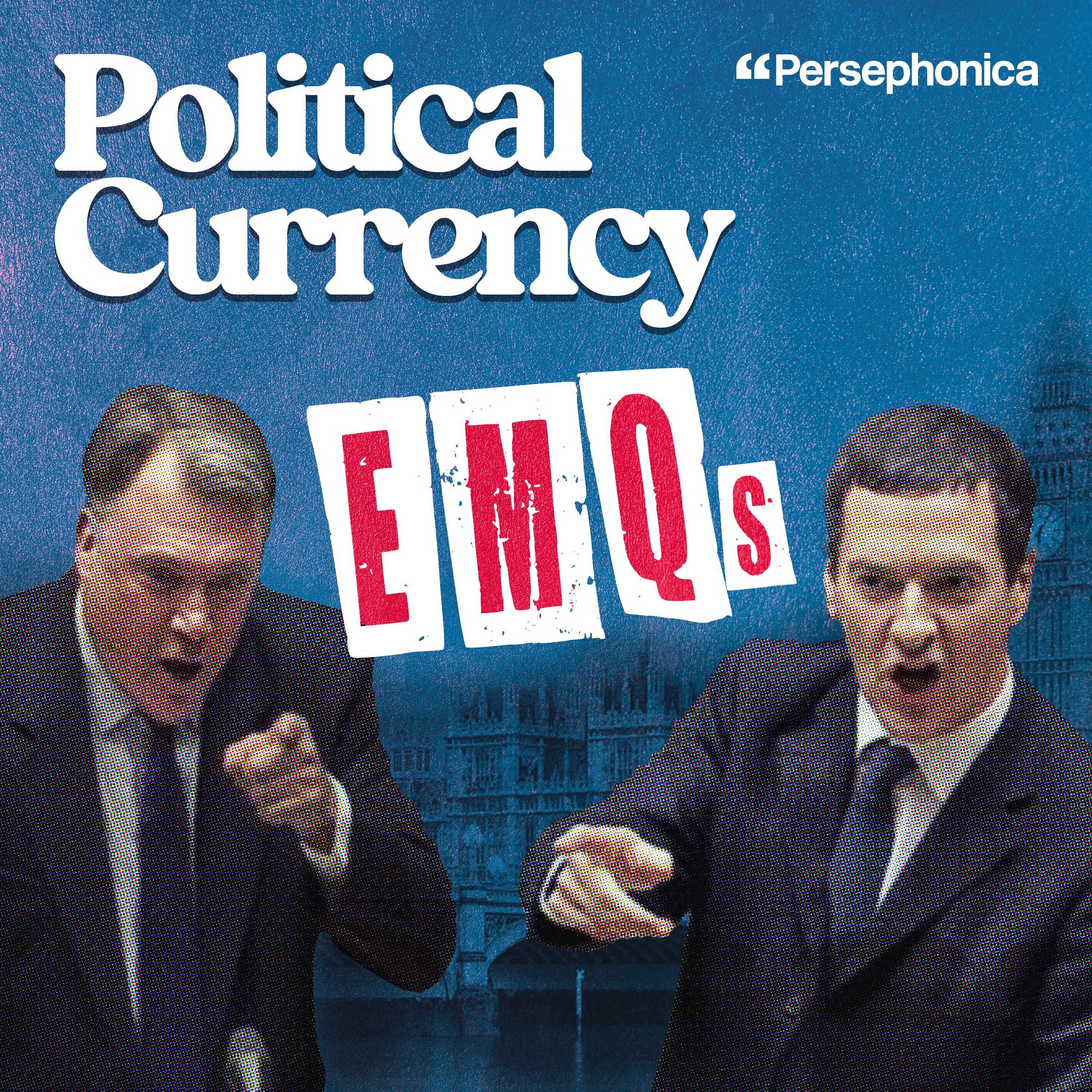
- EMQs: How much power do chancellors have?
In short
Main points
- Ed Balls
- George Osborne
In this episode, the hosts discuss the significant influence chancellors have on prime ministers, recounting historical instances where chancellors intervened to save their PMs from poor decisions. The conversation also touches on contemporary political dynamics, including budget responses and the implications of minimum wage increases.
Written by AI. May contain mistakes.

Ask about this episode
Get the gist, explore an idea or ask about something said.
 Claude
On Political Currency, what are the key points of this episode?
Searching your listeningTranscript
Automatic transcript. May contain errors.
0:00The Chancellor of the Exchequer. Getting a lesson from the Shadow Chancellor on how to balance the books is like getting a lesson from Dracula on how to look after a bloodbath. Ed Balls. A steady-as-she-goes budget. What kind of ship does he think he's on, the Titanic? Bemir, Celeste. Welcome to EMQs from Political Currency with Ed Balls and George Osborne.
0:26Welcome to Ex-Minister's Questions, EMQs. We are recording this the day after the budget. And later today, you and I are going to a fundraiser for the charity Sarcoma UK, which is in memory of Chris Martin, who was a Treasury official who we both worked with. He ended up being the Principal Private Secretary in Downing Street to David Cameron. and he very tragically died 10 years ago. And this is, I think you've been the compare of this event for many years. It's actually the first time I'm going. It's basically a gathering of the kind of Westminster and Whitehall great and good for a dinner that Chris's widow Zoe has so brilliantly organized, where everyone has a good time and raises money for Chris's charity.
1:12And basically it's a kind of quiz, isn't it? It's a sort of political quiz, isn't it? and you're the quiz master. But I'm joining you at least for one round of the quiz tonight, aren't I? That's right. They take it all very seriously. It's very fierce. There's also an auction. Raises tens and tens of thousands of pounds for Sarcoma UK. And Zoe Conway is kind of a brilliant driving force behind it, Chris's widow. And I will be there making sure that people enjoy the evening and making sure that people who are doing the quiz questions do it properly. And I think we should give them a preview, don't you?
1:45You and I, you would think, people always ask me how we prepare for this podcast. and we do talk to each other, believe it or not, and we WhatsApp each other about potential things we're going to talk about on the podcast. But the last few weeks, our WhatsApps have really been about putting together some questions for this quiz, haven't they? We've been like sending questions to each other. And since this goes out after the quiz, we're not screwing our own quiz. If we do a couple of the questions for our listeners, do you think we should give the answers? Maybe we should ask the questions and then next week we can give the answers on EMQs?
2:20I think that's a good idea. Okay. This is my first one, right? This is a question you're going to read out, but I don't think I'm revealing too much when I say I came up with this one because it's one of my favorite political questions. So I'm going to read out literally as you're going to say it tonight. Let's talk names, Gideon. Which is the odd one out from these four Labour prime ministers? Ramsey MacDonald, Harold Wilson, James Callaghan and Gordon Brown. If we were doing the quiz, we'd have to read it again for a second time for people who've missed it. But given that people can just kind of scroll back 15 seconds, we don't need to read it again.
3:00I'm sort of torn which one I'm going to do. I'm going to do one which I came up with, which is quite complicated. For one point, tell me what all these former members of Parliament have in common. Neville Chamberlain, Tony Benn, Michael Foote and Estelle Morris. And for a second point, aside from her gender, tell me why Estelle Morris is the odd one out. Gordon Brown asked the Bank of England to sell£2 billion of gold back in 1999. If they'd kept it, how much would it be worth today? To the nearest£5 billion. In that case, in the same spirit. It was your decision, actually. it's very unfair to blame Gordon Brown I thought you did that it was a collective decision Gus O'Donnell I know you've already fingered in for that decision in that case by what name did Barack Obama mistakenly call George when they met at the White House it wasn't actually at the White House it was at the G8 summit in Loch Earn in Northern Ireland yes it was actually rather mortifyingly in front of Vladimir Putin and Angela Merkel and the other then members of the G8.
4:12I'm glad we've read through these because at least we won't get it wrong when we actually read it out tonight. We should get on with our actual EMQs. I think, are we going to give the answers to these in next week's EMQs? I think we should, yeah. People can, by the way, if you're not allowed to look it up, you know, I mean, you're not allowed to just sort of Google it or chat GPT it. You know, if you have a go at answering these questions and then... How are we going to police that? Send... I don't know how we're going to police it tonight, by the way. I mean, to be honest, it's not in the... spirit of the quiz to look up.
4:40Didn't you see that good story about the pub quiz team that was cheating? It's been in the papers the last couple of weeks. I thought it was such a great British story because they were basically looking up the answers on their phone. They were kicked out of some pub quiz. You will not be kicked out of being a gold subscriber or a kitchen cabinet if you look on Google. But, you know, it would not be in line with the spirit of our kitchen cabinet manifesto. Our first question is from Harriet. Hi, Ed and George. My name is Harriet. I own and run two small restaurants in Dorset. I employ around 20 people.
5:10All but one of my team is paid above minimum wage. I remember last year Ed saying there was no evidence that increasing the minimum wage had any bearing on other wages. In the hospitality sector, that is not the case. As soon as the increase is announced, every member of staff from front of house to head chefs and managers will ask for the equivalent raise, which puts added pressure on already tight margins, which will lead to an inevitable price rise on my behalf. which however small will hurt my customers and I know I will be in my very small way fueling inflation. So my question is how do we make sure everyone can earn enough to have a happy life without everything having to cost more?
5:47Love the pod and the exchange of opposing views. Thank you. Look I have a lot of sympathy for what Harriet is saying here you know she is an employer she's got a small business she's got her two restaurants and you know she's basically talking about the fact that increases in the minimum wage are making it more and more expensive for her to run her businesses. And it's not just that she has to pay the new minimum wage, which by the way went up again in the budget, didn't it, by 4%. But everyone else's salary is based off what the lowest paid person in the restaurant is being paid. And so that squeezes the costs for her.
6:24And we actually discussed this in the main podcast. There are other things happening. The cost of employment has gone up because of the national insurance rise on employers in last year's budget, although it's only now just coming into effect. There's a big employment bill going through parliament that's going to give employees lots more rights. There's a bit of a sort of mayor culpa here. I mean, I introduced what I called the national living wage in 2016, which was a big kind of bump up in the minimum wage. And it has done a huge amount, if you look at charts from people like the Institute of Fiscal Studies and the like, to increase income of people towards the lower income deciles in our country.
7:02And in fact, I think the last decade has been one of the best relative periods for people on low incomes compared to middle incomes. But the process of announcing that national living wage did somewhat cut across the low-pay commission that had been established by the Blair government as a way of trying to assess what would be a sensible rise in the minimum wage and what the impact on employment would be. Now, when I introduced it, unemployment was very low. There was not an unemployment problem in the country. And indeed, I think there was a pretty good argument, certainly you heard on the left, that the low pay commission had been overly conservative with a small c in its increases in minimum wage.
7:49And the UK minimum wage was sort of below where a lot of European minimum wages were. I don't think that's the case anymore because the minimum wage has gone up and up and up. Conservative chancellors, since I made my announcement, have also jacked it up. Now the Labour chancellors done it. And now we've got one of the highest minimum wages in the world. And we've got an emerging unemployment problem, particularly youth unemployment. And I think it probably is a moment, if I was the Labour government, just sort of having made my announcements on the minimum wage, perhaps kind of reset the infrastructure for how the kind of institutional infrastructure for how the minimum wage is set and taking into account all these other impacts on the labour market?
8:27What do you think, Ed? I think the economics answer is it all depends, the impact of the minimum wage depends on what economists call elasticities and substitution effects and the macroeconomic impact. And let me just explain what that means. If you are the kind of business which can set the prices of your goods and you know people are going to pay for it anyway, if you're the kind of restaurant where people will come because it's£10 for a starter. And if you double it to£20, they'll still come because you've got that reputation and you're the only place around. But if the minimum wage goes up and the price of labour goes up, then you can just pass that all on to your consumers in higher prices.
9:07But if, as Harry is saying, that you're working in a very competitive business, in a restaurant which can't just raise its prices because it's lose its consumers, that in that situation, if you try and raise prices, then you lose business. And so therefore you end up having to try and reduce your labour or cut corners and people lose jobs. So first of all, it depends on how competitive the market is. And the second thing the government has done this week is they've increased the minimum wage, but doubled the rise in the youth minimum wage. They've committed to closing the gap. There's always been a lower minimum wage for 18 to 21 year olds, which was introduced at the beginning of the minimum wage, because there was a worry that young people would find it harder to get jobs if they had to be paid the same minimum wage as adults with more experience.
9:49And the government is saying they want to close that gap. But there, if it's easy to substitute workers, if you have to pay more for young people, does the restaurant decide, well, in that case, I'll employ people with a bit more experience, which I can still do on the minimum wage. And so therefore, it's young people who lose their jobs. The third thing is, if you have a rise in the minimum wage, which pushes up wages, not just for the lowest paid workers, but for all workers, because as Harriet says, everybody else wants their wages to go up as well. The danger is the Bank of England says, well, this is pushing up wage inflation, can push up inflation overall.
10:21We might need to have higher interest rates and the economy slows down. People have less money to spend and that hits the restaurant through lower demand. So the answer to Harriet's point is it all depends how much elasticity, how much substitution and how much you get these knock-on effects into wider inflation and to interest rates. I think what is true to say is that the conventional free market view that raising minimum wages always cost jobs, which was very much where we were 30 years ago, was disproven by the evidence. And that's why Labour and then you, George, as Conservatives, were able to raise minimum wages without a big impact on employment.
10:55But you always have to be mindful of the economic impact. And I take Harriet's points very seriously. And I think in particular, the issue around the youth minimum wage is something that the government will need to keep an eye on. There we are. We should take a break and we'll come back with a second question.
11:20welcome back our next question comes from alexander hi ed and george my name's alex and i'm from los angeles california i'm a gold subscriber and a big fan of the pod my question is for both of you men george previously it's been disclosed you're a finalist for the role of uk ambassador to the united states one of the country's most prestigious diplomatic positions So my question for both of you, man, is other than the keys to 10 Downing Street, what would have been your dream job? Both of you enjoyed a very successful career after leaving politics. But is there a particular job you would still love to do?
11:53And would it be in such a way that you would pull a David Cameron and actually come back into government? All the best. Cheers. Good question. Your dream job. Well, of course, my dream job was to be Chancellor's Exchequer and didn't get there. It was actually my dream job too. I absolutely loved doing it. I thought your dream job was to be prime minister. Well, I would have quite enjoyed doing it. I mean, I get that as well. You didn't get there either. The close run thing, I was chairman of Norwich City Football Club in the Premier League. The football club I've supported all my life. You know, my granddad worked on the turnstiles when he clocked off work on a Saturday lunchtime in the 1930s and 40s.
12:30Oh, where's the Hovis music? I'm just telling you what the truth is, George. Shouldn't we be playing that? You know, the New World Symphony you should be kicking in here. Don't talk down my Norwich City roots but when you actually get your dream job, chair of Norwich City, you find that it's really quite hard because it's not all about winning and cheering. What happens if you lose or what happens if the board's under pressure and what happens if you've just sat the manager or things go wrong with the chief executive and Norwich City currently languishing at 23rd in the championship. I look back to the glory days of my time as chair but let's be honest back then it wasn't it wasn't easy and straightforward we're not really answering this question what is your dream job i'd actually really like to be a primary school teacher although i think there's loads of primary school teachers screaming at their podcast set now whatever it is the radio or their phone saying has he any idea how hard it is being a primary school teacher but i think i'd really enjoy it i'd like to be a reception class teacher that's obviously someone still auditioning to be a politician that's the other can i kind of You are piling cynicism on cynicism in your response to my romantic and heartfelt, genuine views in response to Alexander's question.
13:38I always thought the kind of two jobs, which they're not remotely realistic, so they're not jobs I could do or be qualified for or whatever. But the two jobs I've always thought would be great fun are to be a kind of really top film director. I think to be one of those great film directors like a Stanley Kubrick or I was watching an old movie by a great British film director Alexander Corder. He was actually the first. He was an immigrant, but he was the first film director knighted in Britain. I think that's a wonderful thing to pull off a great movie, a great story. I like Christopher Nolan.
14:11I'm looking forward to his Odyssey, which is coming out. So a big film director, but I don't have the creative talent to do that. The other thing actually is to be a great architect. I think to be like a Norman Foster or Richard Rogers or David Chipperfield, you know, and you leave your mark. Or Lena Gottmer, who's the architect we've hired to do the British Museum. You know, I think they're great. You leave sort of buildings that can really enliven a city, make people who work in them feel great. I always think it's interesting. You think, you know, take a city like London. you think, well, what can I possibly build in this city which has got like Big Ben and, you know, Tower Bridge, House of Parliament?
14:54I mean, how could I possibly leave my mark? And yet, if you buy one of those kind of, you see them in tourist shops around Westminster, sort of cityscapes of London, you know, often in silhouette. Like two of the things in those cityscapes these days, the gherkin and the London Eye, have been built in the last 20 years, you know. So, yeah, but unfortunately, I'm not remotely. People might say, by the way, I wasn't qualified to do any of the jobs I've done. I was about to say, you took my punchline away. Don't talk yourself down. You became editor of the Evening Standard and an international banker.
15:25Why shouldn't you be a film director and an architect? I mean, you know, the idea that having aptitude or qualifications had anything to do with it. Thank you for that marvellous question, Alexander, which is George's fuming. We've got a question about the budget now from James Ledwood. Hi, Ed and George. Really loving the pod. My question relates to the budget and the response from the opposition. When the PM's away for PMQs, the questions are not asked by the leader of the opposition. An alternative member of the opposition stands in. This got me wondering, why is it that the leader of the opposition does provide the opposition's response for the budget instead of the shadow chancellor?
16:02Thanks very much. So thank you, James. I'm not totally sure, though, if I know the answer. You know, I don't know if you do. Why does the leader of the opposition respond to the budget rather than the shadow chancellor? I mean, it's obviously a massive moment, the budget. And if you're the leader of the opposition, then maybe you think it's hard for the king's speech to be your big moment as an opposition leader, because that's not how those debates work. So maybe you think that the budget response, in my experience, I think most leaders of the opposition probably think it's a bit of a nightmare having to respond to the budget.
16:35But where historically it came from, I don't know. Do you know? Well, the answer is I don't know. I hope you're not Googling. Having said that you're not allowed to go on Google to look up the answers to our quiz, George is now on his phone Googling the answer to the question, which he's then going to try and pretend he knew. That's shocking. That's against the spirit of the quiz. i'm totally busted it says the convention dates from the 19th century it says quite often the prime minister was also the chancellor in some governments that's true isn't it um was pit the younger his own chancellor i can't remember and so the response naturally came from the opposition leader and i think this is definitely i don't know if that's true actually but uh not wanting to challenge social media uh and so i'm going to say as a quiz master you only allowed one answer Right.
17:26So the role of the chancellor has been around for actually hundreds of years. It's one of the oldest posts. And people like Thomas Cromwell were chancellor's exchequer. But it only really emerged in the 19th century as the number two role in the government. You know, it was actually a more junior role in the Middle Ages and early modern period. But then it emerged in the 19th century as the big number two job. I think actually Pitt the Younger is one of the big reasons for that. And then Gladstone is the kind of big, you know, he is the person who really establishes the modern chancellorship. But the role of the shadow chancellor is a much more kind of recent.
18:03The formula of having a shadow cabinet and man marking or person marking, you might say these days, every person in the cabinet is a much more recent post-war thing. And so the kind of tradition of the leader of the opposition, which is a longstanding role in British politics, responding to the big government statement on the economy would have been established in the 19th century, and it's never really changed. And it's quite useful. It's kind of tough for the leader of the opposition, but actually, as Kemi Baden-Ock proved yesterday, it's pretty useful as well. If you get it right, she enhanced her reputation with her response.
18:36There are, in effect, two budgets here, because we'll see if Rachel Reeves changes this, but there's also, we used to have the autumn statement, and used under Gordon Brown have the pre-budget report. And that's when the shadow chancellor gets their outing. So it's not as if the shadow chancellor doesn't get an outing. But I think it's probably because, you know, as my quick look at my phone has shown, it started in the 19th century when the job of the shadow chancellor didn't really exist. I mean, there's no reason why, by the way, leaders of the opposition couldn't say, my shadow chancellor's going to respond to this.
19:08There's nothing that says they can't do that. The worst thing about being a quiz master or the compere, as I'm going to be this evening, is when it becomes clear that neither you nor the person who sent the quiz knows the answer. And you have to appeal to the room in the hope that somebody might. And I think we're in that position. So, although that was a valiant answer, George, and Google didn't bail you out, I think there's somebody out there who knows precisely when and why this tradition started. And I think they're going to send us a voice note to EMQs next week, and then we can use that to clarify the position.
19:36And it'd be fabulous if they did. There will be a historian of Parliament, probably somebody in the House of Commons Library who knows the answer to this question. and if they're listening, we really need to know the answer. We'll take a break and then we've got time for one more question.
19:55Welcome back. Now, our final question today is from somebody I think you know. Ed and George, Martin Stolliday here. Without wanting to embarrass you with praise, which I know you both hate, I'm a gold subscriber and think the podcast is essential listening. Ed, on our history of the chancellors and the Treasury module, which is part of the MA Government Studies at King's College London, you recently mentioned that a productive chancellor-prime minister relationship involves challenge and grit. You said that Gordon Brown stopped Tony Blair from making bad policy, and likewise, Tony Blair prevented Gordon from bad decisions.
20:29What, in your view, were the bad decisions that Tony Blair prevented Gordon Brown from making? And George, which bad decisions did you prevent David Cameron from making? Thanks. Thanks so much indeed for your question, Martin. Martin's a person who is the linchpin, the controlling mind, the power behind the throne, who runs the whole MA in government studies at King's College London, where I and Nick McPherson, Professor John Davis, have been teaching for the last 11 years. is we teach a class on the treasury and economic policy. And one of the things we talk about a lot is the relationship between prime ministers and chancellors.
21:00And what is a good relationship? What is the best kind of relationship? And the argument I make in a revisionist way to challenge the class is on the one hand, you don't want a relationship like Margaret Thatcher or Nigel Lawson, Boris Johnson and Sajid Javid, which ends up in conflict and collapse. But arguably on the other side of the ledger, you don't want them to be too close because there is a constitutional need for challenge and at times confrontation, but certainly disagreement. And we talked, George, about whether you should have challenged David Cameron more on the decision to go for the European referendum in the style and the manner he chose.
21:32In our Inside the Room, you and Michael Go both talked about you making representations to David Cameron not to go for that referendum that way. And I say that actually in the Brown-Blair relationship, although it was politically complicated, it worked when it worked, which was a lot of the time, because they were personally very close, but also there was a lot of challenge. and they both of them from time to time stop the other going ahead or making mistakes or doing the wrong kind of thing and martin's asking me first for some examples there and i've talked in the past about you know for example tony blair saying can't we abolish capital gains tax and inheritance tax and um gordon saying actually you know this would cost us billions that wouldn't be a good idea tony i'm trying to think what on the other side of the the ledger because often they agree on things like foundation hospitals or disputed policy, they often came together.
22:21One example, I think probably Gordon always wanted to find a way to get to a long-term settlement in the financing of the devolved administrations of Scotland and Wales. And of course, since the 1970s, the way in which Scotland was financed was through the Barnett formula, that the Treasury would kind of agree overall budgets for the UK. and Scotland and Wales, based on a formula which changed over time based on trends in populations, would give an allocation of the Barnett consequentials for Scotland. And Gordon always felt that this was kind of unstable and kind of caused complexity. And what you ought to do is move to a more needs-based analysis where you ask the question, you know, what did Scotland and Wales need relative to the rest of the United Kingdom?
23:06And could you come up with a new formula? And I've certainly been in the room where Tony Blair said to him, Gordon, you know, I know why you want to do this and I appreciate your desire to do it. But frankly, is it worth the candle? Why don't we just carry on with the Barnett formula? Because, you know, it's worked and it hasn't destabilised things too much and can't just leave it as it is. And, you know, we tried very often to see if there was some principled reform. But I think on that one, Tony Blair was probably right. So that is an example. In conversation, there being kind of challenge and leading to better policy outcomes.
23:35How about you? Well, I'm trying to think of something, a bad decision I prevented David Cameron from making. And to be honest. I mean, we know David Cameron prevented you having a mansion tax. Yeah. And prevented you abolishing the winter fuel allowance. No, I don't think I would have abolished. The winter fuel allowance, I was never that set on. Actually, I seem to remember Nick Clegg was the one who thought that should go. What about forests and the selling off of the forests? Was that your idea? Should David Cameron have stopped you? I think that was sort of from somewhere in the kind of death for a team in the Treasury.
24:05I think actually that kind of emerged. By the way, not that I'm ever going to... How about the Lansley reforms of the health service? Well, I definitely should have stopped that. I mean, I was very uneasy about that. Was David Cameron more inclined to go ahead than you? I think he had sort of thought, well, you know, Lansley seems to know what he's doing. And when I kind of realized what was going on, because it was right in the beginning of the coalition government, we were all really busy and I was focusing on the budget and some other big things we were doing. And when I kind of said, what on earth are we doing with this big health care reform?
24:35By then it was a bit late and I hadn't kind of stuck my oar in. There must have been something you prevented David Cameron from doing. Yeah, it doesn't really answer the question. And actually another kind of not very good example. David Cameron vetoed the kind of fiscal treaty of the EU, which was, I remember getting a call in the middle of the night. You know, he was in the middle of the Brussels negotiations, me and William Haig. The six pack summit. Yeah, and I think it probably set a precedent, an unrealistic precedent of what we might be able to achieve in a kind of renegotiation with the EU in advance of the EU referendum.
25:10So you should have stopped him and you didn't. Yeah. So, I mean, these aren't. Is that in the same category as the EU referendum? Well, I think that's, to be fair, the EU referendum is a bigger thing. but you know like i mean basically i went a lot of uh you know no i mean david had but you know if david wanted to do something he was the prime minister and um i tried to do everything i could to support him and i'm not sure gordon brown took that view tony blair i think primus inter powers you know it was his job constitutionally to challenge and to argue and persuade but yeah but we did but that's not this you can argue and persuade but that's not the same as blocking no but is it the same as deferring first of all you know we were in a coalition so there was in internal challenge from liberal Democrats.
25:51By acting as a team, I think we could advance more of what we wanted to do and indeed more of what we wanted to do inside the Conservative Party. People probably discount what I'm about to say. But in the same way that Tony Blair and Gordon Brown had grown up politically in the Margaret Thatcher era and learned a lot of lessons from that government, we grew up in the kind of Tony Blair, Gordon Brown era as the opposition politicians. And one of the things I always thought about Gordon Brown was that he did not appreciate sufficiently as chancellor what a different job the prime minister was, and how it was actually a much more senior job than the chancellor.
26:29And I personally, I think, as a result, even though he'd been chancellor for 10 years, was sort of strangely ill-suited or ill-prepared when he became prime minister. Now, he might dispute all that. But one kind of feature of all that was I was very respectful of the prime minister being the more senior person in the partnership. And if David wanted to do something, and I had a go at persuading him not to do it, but he had listened to my argument and rejected it, often for good reasons. He would often say to me, look, I understand you, George, but you'll understand when you become leader of the Conservative Party, there are a whole set of other considerations I've got to bear in mind.
27:04Now, that never happened to me, but I would always respect him. And then if we made a decision, I mean, I would argue on the EU referendum, it's not a bad example where I could have played the game of saying, hinting to everyone that I was actually pretty skeptical and Brexity, but I wasn't going to take part in the referendum properly because the Chancellor shouldn't get involved in these issues. I seem to remember there was a senior member of the cabinet who played that game and did quite well out of it as a result in the aftermath. But I didn't. I said he'd made the decision and now we're all in to kind of get it over the line.
27:37Not that that worked. Of course, the reason why this conversation is relevant is because if you're Keir Starmer and Rachel Reeves, or if you're Kimmy Badenock and her shadow chancellor, if they're going to win the election, the lessons you draw from history are important. It's pretty clear, isn't it, in the early months of this government, that Keir Starmer was very hands off in his engagement with the Treasury. Yes, and I think a prime minister's job is to offer political challenge to a chancellor who produces a treasury spreadsheet and says, well, this seems to work. And then they go, no, well, that's all very well, but that's actually not going to fly with the public or with the party or not consistent with our manifesto.
28:15Anyway, it's a good question. I mean, I feel I've let Martin down in my answer that I can't. I'll keep thinking about it. No, no, but actually, I think, George, just one other thing, because I think this is what you said is important. It is different if you have a large majority and if you're in a hung parliament. If you have a large majority in our system where actually the executive can get what it wants through parliament, and especially early in a parliament with a large majority where there's a lot of patronage, it's the cabinet's job to act as a cabinet. And that includes the chancellor.
28:47It's probably the most powerful person in the cabinet. So there has to be a challenge. It is different when you have a hung parliament where it's actually hard to get anything through and everything is a negotiation. And maybe for you, it was different with David Cameron because actually the challenge was coming from Danny Alexander and Nick Clegg rather than from you. And if it had been a large majority, it would have been a different world. Well, I think the kind of dynamics of the Tory factions would have been much louder. And when we were a single party government, they re-emerged. Actually, you know, someone, a photographer, a great friend of mine, Andrew Parson, sent me some photos this week of responding to the last Labour budget in 2010 in behind the scenes photos, which I posted on X and I think Political Currency have also posted.
29:31So you have a look at them. It's a different era. But what's striking if you look at the kind of team preparing to respond to Alistair Darling's last budget, you know, in the room, there's not just me and David Cameron. and there are these, and Oliver Letwin and Philip Hammond, and these young advisors like Oliver Dowden. It's interesting, John Redwood's in the room as part of a team with me getting ready to respond to the Labour budget. And Nick Timothy now, a Tory MP, is there, you know, alongside us helping. And it just reminds me that in 2010, the Tory family was a pretty happy united family, and everyone was pushing in the same direction.
30:09And that is not, of course, how it all ended up. That was a great question for Martin. In our class last week, we had Tom Scholar, the former Permanent Secretary, Catherine McLeod, advisor to Alistair Darling, myself and Nick McPherson, the former Permanent Secretary, all talking about both the financial crisis and then the coalition austerity years afterwards. And you can see from that question, the conversations which are about kind of institutions and politics and ideas and policy. It's a really good class. It's a very good MA in government studies. And so sign up if you fancy it. That is all for your questions.
30:46Though you say, say it yourself. Even if I say it, it's very good. I'm just I just turn up. I just turn up. Thank you for all your questions. That's all we have time for this episode of EMQs. We look forward to your answers to our Chancellor quiz questions next week. And as George says, don't follow his example and cheat on Google. No. Now, do keep sending us your voice notes and emails as well to questions at politicalcurrency.co.uk. Make sure you review our show as it does help us reach more listeners. We'll see you next week with our main episode and another EMQs. And we'll see you then. See you then.
31:27Thanks for listening to Political Currency. This has been a Persephoneca production.
From the publisher
How many times did Gordon Brown save Tony Blair from a calamitous decision? Ed Balls and George Osborne recount the times chancellors stepped in to save their PM from disaster. Does George wish he'd done it a bit more with David Cameron?
And why does the Opposition leader respond to the budget and not the shadow chancellor? Ed and George try to work it out, but are not quite sure themselves - please write in! They also delve into the minimum wage rise from the budget, and signal pressing issues Keir Starmer and Rachel Reeves must tackle down the line.
Finally, the pair share their dream jobs - other than Prime Minister, of course - with Ed’s being a suitably political answer and George’s being typically wide-ranging from his previous roles.
We love hearing from you, so please don’t forget to send all your EMQs to questions@politicalcurrency and make sure to include a voice note of your question.
Thanks for listening. To get episodes early and ad-free join Political Currency Gold. If you want even more perks including our exclusive newsletter, join our Kitchen Cabinet today:
👉 patreon.com/politicalcurrency
Please note: Kitchen Cabinet is only available via Patreon.
Credits:
Research: Sam Burton
Production: Caillin McDaid and Paige Reynolds
Video Editor: Maha Al-Badrawi
Executive Producer: Ellie Clifford
Political Currency is a Persephonica Production and is part of the Acast Creator Network.
Hosted on Acast. See acast.com/privacy for more information.
More from Political Currency
All episodes

We use cookies.They keep VO running smoothly and help us improve it. Privacy policy