
 Ask ChatGPT


- Podcasts
- Political Currency
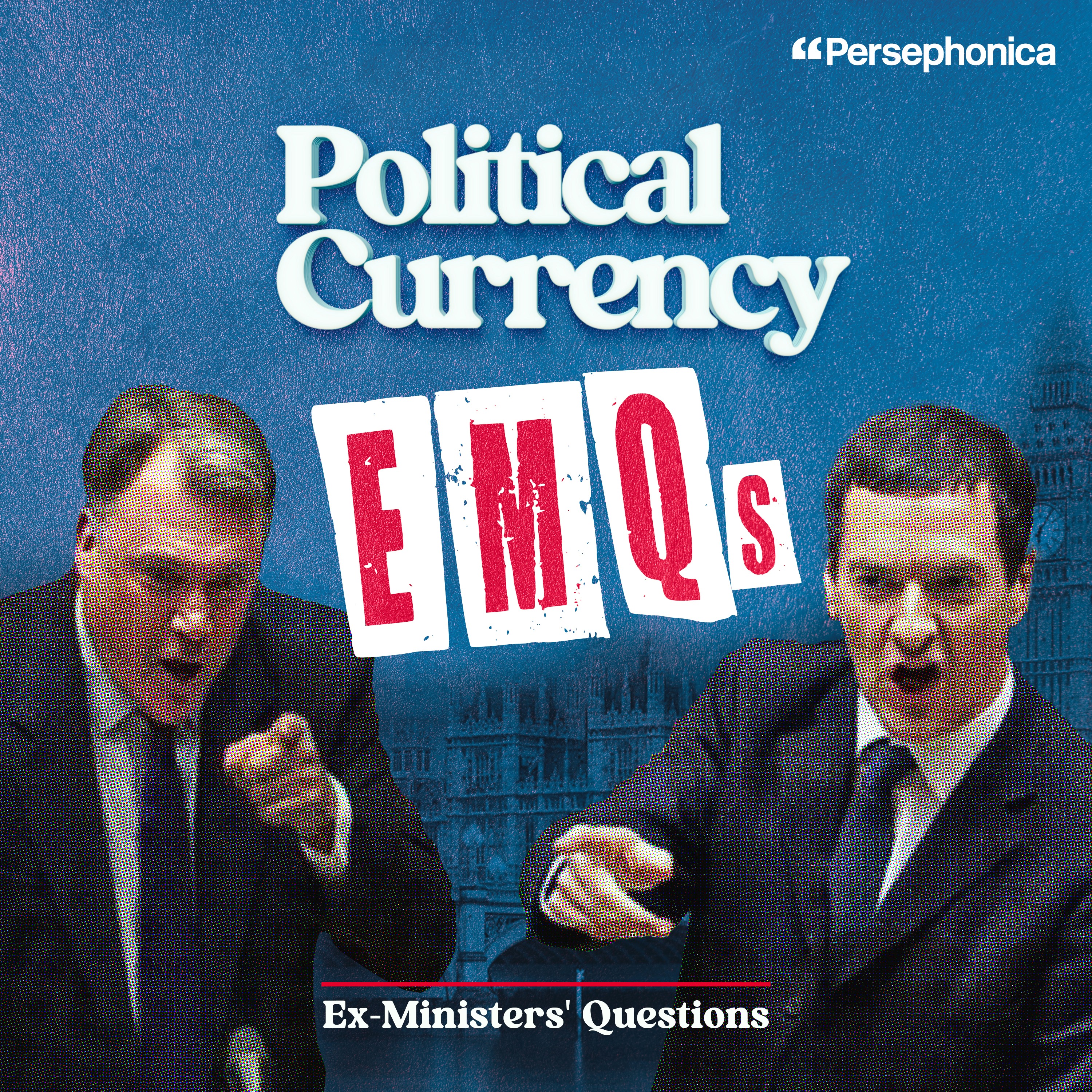
- EMQs: Is it time for a Tory/Labour truce?
In short
Main points
- Hosts: Ed Balls and George Osborne
- Episode Focus: Discussion on the potential for a coalition between the Conservative Party and Labour amidst rising radicalism in politics, the implications of recent budgets, and the importance of effective political communication.
Written by AI. May contain mistakes.

Ask about this episode
Get the gist, explore an idea or ask about something said.
 Claude
On Political Currency, what are the key points of this episode?
Searching your listeningTranscript
Automatic transcript. May contain errors.
0:00The Chancellor of the Exchequer. Getting a lesson from the Shadow Chancellor on how to balance the books is like getting a lesson from Dracula on how to look after a bloodbath. Ed Balls. A steady as she goes budget. What kind of ship does he think he's on, the Titanic? Hello Mary Celeste. Welcome to EMQs from Political Currency with Ed Balls and George Osborne.
0:26So hello and welcome to EMQs, Ex-Ministers Questions. We were talking in the main podcast about excessive heat in Tehran and the water shortage. But there's no excessive heat in London this week. It's so cold today. I mean, actually, there was a bit of snow around in the air yesterday as well. And it feels like winter's here. Yeah, winter is coming or has arrived. Yeah, I actually went to a play last night with my daughter. The Importance of Being Earnest, which I hadn't seen in 20 years, is brilliant. This production in the West End is, you know, is not a kind of old school production, but very camp.
1:00And who's the star? Well, it was kind of annoying because Stephen Fry is supposed to be Lady Bracknell. He wasn't on. He arrived. We told he's not performing tonight. But I have to say that initial disappointment was kind of melted away because the production was great. The Lady Bracknell they had was great. and someone called Olly Alexander the pop star plays Algernon Moncrief but the whole thing is hyper kind of camp He represented Britain in the Eurovision song contest Hyper camp, anyway coming home I thought it was great, really fun and then coming home it was bitterly, bitterly cold but I'll tell you one way to Can I just say, not a night to be caught short in the street waiting for an Uber things might freeze I was on the central line rather than waiting for an Uber.
1:49It enables us to make this segue we made on the main podcast to the bottle of champagne we are auctioning for sarcoma in memory of Chris Martin, a brilliant civil servant who died aged 42, 10 years ago. And there's a big fundraiser next week, which we're involved in. And there's this bottle of champagne signed by or will be signed by all the living prime ministers. Currently signed by eight. Boris Johnson is currently unavailable. Anyway, please, it's a great thing to own. And by the way, it's, you know, nice Gerard Boehm of Paul Roger. Wouldn't go amiss in anyone's home. And you can always keep the bottle, of course, after you drunk it and keep the signatures.
2:30What's your favourite champagne? Because Paul Roger was Winston Churchill's favourite champagne, wasn't it? Do you know, I'm sorry to disappoint you, but unlike Gordon Brown, I'm not a big champagne drinker. You're not a Bollinger Bolshevik? No, no. It's not really my drink of choice. I'd rather have white wine than sparkling white wine. A good Burgundy wine. Oh, you're white Burgundy, absolutely. A very traditional, just champagne. Don't you like a Ruin, like Blanc de Blanc? If it was me, I would buy Macor. I mean, I would buy the Wine Society White Burgundy, which is one of the great cheap white wines.
3:04But anything from around Bowden, and anything Pouligny Montrachet-ish, fabulous. but you know only on special occasions yeah who just thought i'd ever and not in tails standing on a table at four in the morning nah it's been a long time since i did that um waiting for your uber
3:26i mean what what will you do on that table anyway our first question today is from james hi and i'm george james here from london at a time when the british public are in a radical spirit on certain issues, immigration probably being the case in point. Might the established parties need to realise that the centre ground is in fact the political no-man's land for the foreseeable future? What do you think about my solution to the political crisis, namely to merge the two main parties, Tories and Labour, so those with the same views on most things, like George and Ed, can stop pretending to disagree?
4:01Look, I've got to call you out first of all, James. Two-child policy, inheritance tax, should Rachel Reeves be cutting public spending to get the deficit down, the approach to the referendum and the European argument. Quite hard to say that George and I have been agreeing or pretending to disagree on this podcast. I mean, I think we've been disagreeing quite strongly. Maybe James is right that these are just like disagreements at the margin. Well, John Major, the former prime minister, says this disagreement at the margin about the strategy for the European referendum and our subsequent departure is one of the great catastrophes of the 21st century.
4:36So it's not a trivial matter. I think both of us thought we shouldn't have a referendum. Oh, I see. It's just that you forgot to disagree with the prime minister. No, no, it all comes back. Listen, it's not actually as mad, James's question, as it might sound. in continental European democracies, where there have been like, since the Second World War, longstanding battles and rivalries between the center-right and the center-left party in German politics, the Christian Democrats against the SPD, the Social Democrat Party. You know, it would have been inconceivable if you'd said in the 1980s, you know, they're actually going to form governments together in the future.
5:16And they have. And in Germany, that's actually been going on now for a couple of decades. And in Dutch politics, you now get coalitions sometimes between the centre-right and centre-left. In France, quite often now, the presidential election has thrown up either a centre-right or centre-left candidate against a far-right candidate. And everyone's going to coalesce in the centre-ground around the more moderate candidate. So it is not totally impossible to imagine a situation. I'm going to say, let's have a, can you imagine a general election where you want to kind of keep reform out and the Labour Party maybe doesn't have enough votes to do it by itself and doesn't have enough votes with the Liberal Democrats.
5:55So it's still short. It's like, you know, 20 seats short parliament and it makes a big appeal to conservatives, moderate conservatives. What if you're a 19th century historian, you might say, well, I like Peelite conservatives to say, come on, join us and stop reform. Because I think at the moment it's true that the Conservative Party wouldn't go into alliance with the Labour Party. But trying to think of an environment where a Labour leader was also presented with a choice where they either had to go into kind of alliance with the Conservatives and the Conservatives wanted them to or let Farage in.
6:29I mean, in other words, you can start to think through some of the scenarios. Now, they feel pretty distant and the traditions are very different. But fundamentally, there are quite a lot of things now we've been talking about on our main podcast. OK, asylum and immigration policy. Actually, the official policy of the Labour Party is one that many Tory MPs would like to see successfully implemented and wouldn't really go much further on. General attitude to sort of internationalism. Look, there aren't many Conservative MPs left, but those who are left, I think a lot of them would basically agree with what Keir Starmer is doing on the international stage, being pragmatic and approaching those issues in a sensible way.
7:06You know, on the budget, it's interesting, but I would say here, somewhat in contradiction to what James is saying, we're having a bit of a return to the centre ground of kind of, we're not having kind of wacky right-wing plans to cut taxes without paying for them, or wacky left-wing plans to spend lots of money without paying for it. You know, we're actually back to kind of fiscal probity and the fiscal rules and, you know, all that kind of stuff. It feels unimaginable right now. But if you kind of stretch your imagination, you can definitely think if we get into a multi-party, genuinely multi-party democracy, where everyone's kind of competing in the kind of getting 20 to 30 % of the vote space, you could potentially have an alliance between the Conservative Party and Labour Party in the future, don't you think?
7:48Well, I think in a multi-party system, as we discussed last week, you definitely have tactical voting. People who may be a Liberal Democrat, but decide in their constituency, the best way to beat reform is to vote Labour or the other way around, to stop Labour. The best way to vote is to vote Conservative or to vote reform. That is not the same as there being pacts or new parties. I've definitely heard people talk about, you know, could there be a new centre-ground party? Could you have a coming together of Tony Blair and Nick Clegg and David Cameron to form some kind of centre group? I mean, who knows what you were talking with Peter mandelson about at that dinner i'm not going to speculate but i mean but you can imagine not that okay but you can imagine those kind of conversations happening but the reality is that kind of thing normally happens in a proportional representation system where you have smaller parties and elections formed by coalitions between the smaller parties which is what you've had in germany and you were referring to the german example in france there was a new party form which was bridging the center the Macron party.
8:56And some people have said, well, you know, is Tony Blair attracted to a Macron style new party? But of course, that only really works if you have proportional representation. And in the case of France, proportional representation around a multi-vote election for a single figure, the president. When you think about it in our system, where the coalitions don't happen between parties, they happen within parties. So can you hold together the Labour coalition or the Conservative coalition, in which values and history are the things you use to bind people together when there are differences and disagreements.
9:30Talking about overt pacts with the guys you've been fighting for the last hundred years, or even a forming of a new party which breaks from that past history is incredibly risky. I mean, in the end, the SDB tried it by breaking from Labour, and they tried to then form a coalition with the Liberal Democrats. But in the end, it was always unrooted. It couldn't appeal to the past. And in the end, the history of Labour turned about to be bigger than the SDP. And that is why in the end, Labour reformed and the SDP went by the wayside. So I think you have to get to proportional representation before you start talking about new centre-ground parties.
10:08Because you think without it, even if the seats in Parliament are widely distributed around different parties, say you, you know, say reform, Labour, Conservatives, and Liberal Democrats all get roughly the... So they all get, I'm making it up, but like 100 seats each or something like that. Then afterwards, as with you in 2010, you have to find ways in which you either form coalitions or come to agreements. But we're talking here about whether pre-election you make a pact or even form a new party. If you form a new party, you ditch all of your history and shared experience. And if you do the pact, the danger is if it doesn't work, the people who do it are then damned for, the next 10, 20 years.
10:48And the people who stood outside of it are the ones who inherit and can maintain the historical tradition. I think to kind of further this point, Nigel Farage was rather more keen on PR when he thought reform didn't have a chance of winning in a general election. But as he starts to think maybe we can displace the Conservatives rather than having to do a deal with them, in that circumstance, he doesn't want PR anymore. So I'm not sure how you get to proportional representation. And I'm not sure I... Well, you get it by the next election, Starmer needs the Liberal Democrats to stay in office. Well, but that is, yeah.
11:19I mean, that's not that unlikely a scenario. And that will be the price they extract. You'd have to have a referendum vote on it. Maybe. Well, not necessarily. Well, not necessarily. But I think it's quite hard to do that kind of constitutional reform. I think there would be huge pressure on Keir Starmer or whoever the Labour leader was not to agree to PR. Yeah, but then you let Farage in. Well. You have to get the left to choose between PR and Farage. I think the left would choose PR, wouldn't it? I'm not sure. Hmm. Gosh, good question, James. Our next question is from John. Hi, George and Ed.
11:47Great podcast, thanks. Could you both please explain what economic long-term effect Liz trusted short time as PM had? The bond markets reacted at the time, but the budget measures were fairly quickly reversed, were they not? So are we really still paying a price? Political reputation being a whole different subject. Thanks. Can I just start this answer by raising a totally separate issue, which actually... Of course you can, it's your podcast. Which John's question raises. And this goes back to a comment on Spotify on our most recent episode of EMQs. And it was from a guy, Neil Jackson 34, who asked this question, do you really need every question to have a sycophantic, ooh, you are really brilliant start?
12:33And John starts with, you know, hi Ed and George, great podcast. For some reason, which I don't fully understand, we started this thing a couple of years ago where we only said we could answer questions from people who said, I love the podcast. And now they all feel obliged to do it. And I slightly wonder whether, is it sycophantic? Has it had its day? It's a bit Trumpian. It's a bit Trumpian, isn't it? Although I don't think James... It's a beautiful podcast. It is, isn't it? And I don't think, you know... It's the best podcast ever. Can I say, you're from ABC, you're corrupt, and you're a terrible journalist.
13:04And whereas, you know, John, you're a really good questioner because you love our podcast. I just wonder whether... I mean, don't you think... I think we should just announce officially that you don't have to say you love our podcast in order to ask a question. Well, I think James's question, the one we just answered, I don't think he did say he loved our podcast. No, we cut that bit out because we didn't want to have it in every one. I said to the producers, honestly, we'd have to say that every time. I wonder whether Neil Jackson 34, whoever he is, makes a good point. I don't think it's a rule.
13:30Be careful what you wish for. People not being nice about our podcast. Yeah, but then we'd have to answer the questions. I just wonder whether, Has it not become a bit grating for you? No, no. I'm all in favour of orthodoxy, which actually helps me answer John's question. You just like people saying you're brilliant. Yeah, why not? Don't hear enough of it. You're brilliant. It's better than can I use your toilet? Anyway, you carry on. Well, I'm open to both. Listen, John's question, Liz Truss's impact. It has had a lasting impact on a number of levels. So the first is, you know, there has been a bit of a premium on the UK ever since.
14:08i.e. you have to pay a bit more for British government debt because it's British. That could have ended with the election of Labour government, but it's been continued because of the mistakes of this Labour government and the wobbles on attempting to control public expenditure, for example. You know, I don't think you would say anymore it's all down to Liz Truss. I'm afraid there's now kind of British premium because of what's happened with this government, but it certainly started under Liz Truss. Second, I think another effect, which we've discussed on this podcast before is that it has kind of, at least for the moment, entrenched the kind of treasury orthodoxy of how you do a budget.
14:44Not in terms of how you brief a budget, it has to be said, but in terms of, you know, there's an OBR forecast, you accept the OBR forecast, and you essentially have to make things pay for themselves. And I guess you say the final point, John, is that it's true that Jeremy Hunt reversed pretty much everything that Kwasi Kwashteng had announced just a couple of weeks earlier when he became the chancellor. But there was a lasting impact in two respects. One is, of course, he then went further and did various things like he, for example, reduced the threshold at which you start paying the 45 % tax rate.
15:16And of course, he didn't actually reverse her decision to reverse Rishi Sunak's increase in national insurance for employers and employees. So he did a big tax, which he called a health and social care charge. In other words, it was a one pence, I think it was, or a bit over one pence, wasn't it? It was like 1.25 % on employers and employees for national insurance to pay for the health service. Jeremy Hunt didn't feel he could reintroduce that. If that had been allowed to stand, maybe the kind of tax base would have been a bit stronger than it's been. And I guess Rachel Rees probably felt would not have been able to go back to national insurance for employers.
15:54So anyway, I guess not in the scheme of things that important, but it's one of the things that came to mind. Well, of course, the very beginning of this podcast was around the time when Rachel Reeves was opposing the National Insurance Rise, or she had opposed the National Insurance Rise on the grounds that it was a tax on working people, which is why when it was then not reversed, the getting rid of it, she couldn't really complain. I think it would have been better if the National Insurance Rise had gone through. So I definitely agree with you on that. In political terms, the impact of Black Wednesday in 1992 was people remembering a big spike in their mortgage rates.
16:32And the political impact of Liz Truss was that people saw their mortgage rates go up. People, if you remember, in that period who were renegotiating new fixed mortgage deals were renegotiating them at a higher level. And the shock of that and the worry of that has a lasting impact. Now, that might go into John's political reputation category, but it's actually the political reputation around the economic consequences for ordinary people of political or economic chaos. And I think that definitely gets remembered. But I think there is something more than that, which is that I think that it introduced an uncertainty and a worry about the UK.
17:12And you see that in long-term interest rates and the rise in our yields, our long-term interest rates compared to other countries, which happened in the LizTrust period and persisted. And I think there is a vulnerability, a worry in the markets about whether or not the UK could be going to do something Trussian again. I do think that's real. So it's right to say that what Liz Truss did was she entrenched the orthodoxy around central bank independence and fiscal rules. but I think she also left a lasting question mark in the minds of market participants of whether the UK stuck to its guns and would be sound in its approach to public finances and therefore when you look at the wobbles we've seen in financial markets over the last 18 months when Rachel Reeve says this is a trusty and hangover I think there's some truth in that interesting listen we will be back after the break with a question that we have received on social media
18:12welcome back now our next question is from a very well-known in whitehall and westminster circles former civil servant and a person involved in the institute for government and that is jill rutter and jill has sent us these two questions over x and you'll be glad to know she's not been sycophantic about our podcast. But despite that, we're going to let her ask her questions. Are you sure she's not been sycophantic? I'd be very surprised. I'm really thinking Jill would be a fan. Oh, actually, sorry. Have you read to the end? Oh, yeah, sorry. She says, BS, it really is my favourite pod. Maybe the new rule is you only say it after you've asked a question.
18:50Yeah, fine. I actually genuinely didn't see that. Okay. So her question is, I may be too late for next week's EMQs, but two questions to George Osborne. She's actually posted it while we're recording the show. You'd think she is too late, but she's not because we're going to do it anyway in real time. Because a bit like the budget, our plans are changing all the time. So I've got two questions, George Osborne Edmonds, for their political currency pod. One, if you were guaranteed no political fallout, what would be your preferred move or set of moves to get out of the hole that Rachel Reeves is in?
19:23And second, reintroduce the politics. How would you temper that, sell that to make it as politically acceptable as it needs to be? So first of all, the question one, dare I say, Jill, I think is maybe the better question, because the moment you're into the politics, you're back to the kind of all the things that are practically possible. But what if you know political fallout, you know, the Ed Balls dictatorship, what would you do today? I would rebuild the margins by which I was meeting the fiscal rules and fill the fiscal gap and enable myself to do more to spend on growth orientated local transport capital spending innovation r &d capital spending with a rise in a tax which is everybody's pays and say that we are all going to make our contribution and that would be income tax I wouldn't do national insurance this autumn because of the national insurance rise last autumn and because it would only be paid by working people I would do the income tax rise.
20:22So I think I actually would do what we thought Rachel Reeves was doing a week ago. The basic rate of income tax not the top rate or the higher rate. Basic rate of income tax. Okay. I think I would, I mean, in this environment, I would cut incapacity benefits by£20 billion, which is the hole that they've got, by reducing the criteria and doing actually lots of the things that the Labour government was trying to do earlier this year, which is reduce the payments for the kind of milder end of incapacity, which is really hard to do in the real world because of all the charities that come out and have a go at you.
20:57But clearly, it's unsustainable, I would say, to have our incapacity benefit bill going up and up and up. If I was going to do tax, I think I'd do VAT because the rate at 20 % is below the European rate, the average European rate, which is more like 22%, 23%. So I think personally VAT is a better tax than income tax. Even if it pushes up inflation and means interest rates come down more slowly? But the bank should be able to look through that because it's a temporary one-off increase. So James's first question on this podcast was about how we no longer have to pretend to disagree, but we are disagreeing.
21:28George would do it on spending cuts and I would do it on a tax rise but I think we should get to George's second question because that in a way kind of complicates matters what would you do to politically leaven it I would if I was politically leavening it I would not repeat the package on welfare reform from the the spring because I think that was too upfront cuts orientated and hit people who are vulnerable too hard but I would go for incapacity benefit and wider reform of sickness benefits which i think pat mcfadden will do in the budget and i think you need that reform as part of your package so that it's not only about tax rises but long-term savings and then i would also look to um the way in which i could also raise some taxes on people who are undertaxed on higher earnings and i would do a version of the higher council tax band on higher rate properties because i would want to say that everybody's making a contribution but we are asking those with the broader shoulders to make a bit more of a contribution.
22:24So, and I think... We're all in it together. You could stand under my slogan as part of our new party we're setting up. I have a feeling that you weren't the first person to use that phrase. But I think the bigger answer to Jill's question is you have to make a big forward-looking argument about what our country needs to succeed for the future and to deliver better growth, better living standards and better public services and ask everybody to sign up and be part of that effort unless you don't go out and try and win that argument and if the tax rise is simply about past failure i think everybody just feels angry and frustrated and like they're being clobbered to pay for somebody else's mistakes that is where i think in the end the politics of the last few weeks have been wrong because i think rachel reeve sounds like she's asking certain groups to pay for the past whereas actually politically you have to make this about winning the future do you think i think where we could agree is and i think was a missed opportunity in the first budget.
23:19I think it's probably too late now. You could have raised taxes because you're a Labour Chancellor rather than cut spending and use the money on a program of upgrading the British economy on infrastructure, science, research. And I think you would have taken a lot of people with you and you would have taken the business community with you. And they would have actually including things like the employer national insurance rights. And I think that, you know, if you look back to that budget, it was the decision to spend the money on the NHS, which I completely understand is a big political issue for the country and for Labour government.
23:51But it kind of got swallowed up. And by the way, it got swallowed up partly in pay awards, which didn't buy off the doctors who were on strike still. Whereas, you know, she could have created a new centre ground consensus of a more interventionist economic plan than a Conservative Chancellor might run of higher taxes, but more state involvement in enterprise in parts of the country where the market doesn't work. Andy Burnham was talking about a version of this that he's doing in Manchester at the moment. And you could call it investing in the Northern powers, George, which is a phrase which would have allowed there to be some agreement across the political aisle.
24:25Quick shout out for Jill Rutter, former Treasury civil servant for many years at the Institute for Government as well as at King's College London. At the IFG, I actually worked with her on a paper she wrote about how you learn the right lessons from how to do independent reviews in government. Very good piece of work. and George and I are actually off to the Institute for Government tomorrow morning with Nick McPherson, the former permanent secretary, to do a... Lord McPherson, do you? Lord McPherson. And I think he's probably also Sir Nick McPherson because unlike you and I, he got an eye out, as well as a big bath.
24:58And the three of us are doing... And I think his father's a baronet, isn't it? So maybe he'll also get one of those. And a led. And we are off to an hour and a half meeting with a group of principal private secretaries from across the civil service organised by the Institute for Government with Her Majesty's Government about how private officers and PPSs should work with ministers and advisors and to talk with them about our experience in doing that. And that's good work being done by the IFG. And that's good work that Jill Rutter, I know, is heavily involved in. Isn't it fabulous to have Jill Rutter asking us a question in real time?
25:32We don't often do things live like that. But next Wednesday, Budget Day, we are going to be doing a special live on YouTube budget reaction at three o 'clock in the afternoon. Please join us. Which we've done before. Yeah. I think we're doing it now and we're using YouTube more than we've used it in the past. So that's good. Please join us. And it will be on our podcast feed later in the day as well. But you can see it live on YouTube at three o 'clock. Thanks, Jill, very much. We're going to take a break now and we're going to be back with a question from Ed. Not this Ed, but another Ed. Ed West.
26:10Welcome back. Our next question is from Ed. Hi, Ed and George. Love the podcast. And I love the fact that you often disagree. So we hear two sides of the story, which is not all that common on other podcasts. So please keep up the great disagreeing work. My name is Ed West. I run a small communication coaching company called Fox West, which helps people enhance their presenting, pitching, public speaking skills. Now, Keir Starmer is often critiqued for his weakness in oratory skills, whereas people like Wes Streeting, Nigel Farage, are often praised for their skills in this area. How would you rank public speaking in terms of the skills required to be an effective political leader?
26:56Did you get any coaching? And do you think our leaders get enough support in this area, particularly when they're representing our country? Thank you, Ed. And thank you for disagreeing with James about whether we disagree on the podcast, because that sort of added to the texture of our episode. Really interesting question about public speaking and speech making and obviously something you're very professionally involved in. The truth is, the ability to do a big speech has always been massively important in politics. But what you have to do has changed over 30, 40, 50 years. In the post-war period, the ability to stand up in a public hall or in a market square and speak to the crowd was probably the most important oratorical skill for a politician.
27:44And that still is important. Not the House of Commons? Well, I think back then, much less the House of Commons, because it wasn't broadcast on television or on radio. So it would affect your reputation, but the public would never hear that. The House of Commons changed and became much more important when it was broadcast on radio and television. But of course, what changed really from the 70s, 80s was television becoming a much more broad-based medium. I mean, Margaret Thatcher would really only have done clips for the evening news and a very occasional big interview. once you move into rolling news and then into the modern social media world the ability to do a much more television-based spontaneous communication that's a different kind of communication from public speaking and i was thinking about the last week two cut through moments of political communication which we have actually talked about both these people on our podcast in the last week.
28:42One was Shabana Mahmood, where although she was doing a set piece statement in the House of Commons about asylum reform, it was her spontaneous response to a question from the Liberal Democrat about racism, which really meant that she soared in communication terms. Then here's another example. This is Wes Streeting on LBC last week, when he is asked a question by a junior doctor who is going on strike and says he doesn't want to go on strike, but he feels he has to go strike, even though he's doing it reluctantly. And this is West Street. I think this is a brilliant piece of communication. It's not a speech.
29:19It's clearly spontaneous, but it totally lands. When you say, I don't want to be out on strike today. Yes, you do, because you have made that choice. You have done so having had a 28.9 % pay rise, the highest in the public sector two years in a row. And on those things that you've just mentioned, you say they take time. Yes, they do, because it is complicated. So to hold patients to ransom and to be out on strike setting back the NHS because you don't think we're going fast enough and because the leadership of your union are not honest enough that some of this change takes time is extremely irresponsible.
30:00It is extremely unnecessary. and the other listeners to this show who have not had a 28.9 % pay rise, whose taxes are paying for our National Health Service and who are receiving a substandard service, not least because of the damage that these rounds of industrial action are doing, I think people would be shocked by the BMA's reprehensible behaviour. So don't tell me you don't want to be out on strike because that's exactly where you are. You made that choice, own it and own the damage it will do to your patients. passionate authentic unscripted coherent i mean that is not speech making that is not the kind of thing you would have heard from politicians in the 80s in the 90s even in the 2000s it's a different kind of communication but very important yeah i hadn't actually heard that before that is very effective well spotted by you and west treating is a natural and he's a natural communicator and not just in big speeches and so on, but in that kind of much more intimate interaction on a radio show, partly because he's brave.
31:04You know, he's taking on a doctor on the radio, which I think a lot of conservative health secretaries would have been quite nervous about doing. And he's a Labour health secretary. So I think there's also something, you know, it's not just how you deliver a speech, it's the content of the speech. And I think the speeches you really remember in British history, but it'd be true of other countries, are the ones where, you know, people say Neil Kinnock was a great orator, but the speech you remember is when he kind of stands up to militant at the Labour conference. So it's not just a piece of rhetoric, it's a piece of bravery.
31:34And actually, you know, I remember Tony Blair's speech on reforming clause four, I was in the hall for that, or the Margaret Thatcher, you know, you turn if you want to. These are moments of rhetoric, but they're also moments of political courage, or the great Winston Churchill's speeches during the war. You know, we now know it wasn't clear to the public at the time that Britain had considered coming to some kind of surrender with Hitler, which he had resisted in the war cabinet. So I think that, you know, it's not just about communication, it's about substance, but you can definitely improve your communication.
32:04So to kind of Ed West's question, I don't know a political leader, i.e. a leader of the Conservative Party who didn't at some point get speech training or get someone in to help them improve their speaking. So Certainly if they were not kind of naturally brilliant at it. And for example, there was a guy called Anthony Gordon-Lennox, who very, very tragically died in his 40s, a real brilliant guy, who would come in and help me and help David Cameron with speaking. And it wasn't all kind of fancy tricks. It was just things like learning how you breathe properly, learning how to kind of space out your sentences.
32:41There was a particular technique. I mean, William Hager was a kind of great natural orator. I was a speech writer. it wasn't that easy writing speeches for William Haig. But, you know, he also got in professional advice on how to kind of hold sentences in your head so you could kind of look up at the audience if you're not using an autocue. So I think people do use professionals. When I say professionals, people who essentially, you know, well, I guess professionals like you, Ed, who do it for a living and it's quite helpful also. Often the politician staff, you know, they're not necessarily the right People say you're getting it all wrong.
33:13You sometimes have to bring in an external person to say, look, this is the way it's done. There's another thing that politicians need to learn. It's not just how to speak, but it's what you were talking about earlier, isn't it, about how things are communicated. And, you know, I definitely received lots of help and advice when I was in the Treasury about how to get things on television. There's no point if you answer a question and you give a two-minute answer to a question from the BBC. So that's no good because they'll only take a clip of 19 seconds on the BBC news. They're never going to take a 40 second clip from you.
33:47So you do need to condense your argument into a kind of, you know, we used to time it like, is this 20 seconds long? Gordon Brown, actually, you know, he would often repeat exactly the same answer to different questions, which worked up until the point when suddenly they said, we're going to play all of these. You know, so you also need to learn about the technique of how things are communicated. And I certainly would say, you know, I'm no expert on this today. What works as a TikTok video? You know, what works as a YouTube clip? You know, what's the best length for it? How do you get people engaged?
34:19What's the kind of visuals attached to it? So, you know, the means of communication changes. But I would say a top politician needs to not just improve their delivery, but they also have to understand the means of delivery. That's right. And I think that West Streeting television radio clip, I mean, he may have anticipated that question and he may have thought about what he was going to say, but that doesn't stop him delivering it in a way which has a feeling of passion and spontaneity about it. And I think you can do the same thing in speech making as well. I agree with you that good coaching can make a difference, but the wrong kind of coaching can make things much worse.
34:54and fundamentally I think and you see this sometimes when you see people who aren't natural or regular speech makers making a speech which is unusual they've been coached to do so if you are coached to do it in a different way from how you naturally would or to say things which aren't really what you would authentically say and it becomes stiff and stilted and weird and the great speech-making coaches are finding your voice and allowing you to say what you want to say in a way liberating you as a speech maker rather than trying to imprison you and i would think if you are coaching people in business to make speeches there's a huge danger that you tell them this is what you should do to make a speech as opposed to helping them to find the way they want to make a speech i know in my own kind of life that it wasn't always helpful to me when i I had coaching, whether that was on media or TV times.
35:48But actually the thing which I discovered at a certain point was I had to go without a script. And actually it was incredibly liberating. And to realise most people don't communicate in perfect sentences and you don't need to on television or even in a speech. And actually that feeling of natural authenticity is the thing to aspire to. And actually you teach that by liberating people from structure rather than imposing structure upon them. So, you know, I think there's always a danger that coaching takes you away from the thing which actually works. Really interesting question, Ed. And we've talked about speech writing quite a lot on this podcast before, but good to get your question.
36:26I think we've got time for one final question. Hi, Ed and George. Gary here from Swindon. I'm not a Gold subscriber or Kitchen Cabinet member, but I'm a long term listener. I've been following some discussion on Reddit thread called UK Pulse Sim about a new political simulation video game, similar to the Football Manager series that aims to model the UK political system from membership secretary to local councillor all the way up to prime minister and I have been wondering what both of you might make of it. Do you think a game like this could genuinely help people understand how politics and policy making really work?
36:56The trade-offs, pressures and the behind-the-scenes deal-making or would it risk simplifying things too much? Could it be a useful way to educate students with the voting age due to be lower to 16 or engage people who might otherwise have tuned out of politics altogether. And for fun, if accuracy and realism were the goal, would either of you consider consulting on it or maybe giving it a go yourself on a long-haul flight instead of reading briefing notes or political memoirs? I'm not involved in the project, only curious to hear your views as people who have actually lived the simulation. Thank you for your time and for a podcast that makes policy chat consumable and interesting.
37:28Take care. Well, Gary, I'd definitely have a go at this game. Sounds right up my street. I mean, in some sense, it's hard to simplify and replicate all the kind of myriad decisions that go into politics. And there are so many different facets to it and there are so many different players in it. But on the other hand, sometimes it is useful to use a kind of role playing or a game to get down to the essentials and to focus people on what the really essential tradeoffs are, which in the real political world sometimes get lost. you know we've had a lot of speculation about the budget on this podcast and in the more broadly in the media but fundamentally there's a kind of trade-off which is do you risk borrowing more in the markets or do you put up taxes or cut spending and that how you do it is then a second order question and i think a kind of simulation game or role play can help i teach a class at stanford university in california once a year where i often take like a topic like this budget or you know immigration control or do you give Ukraine you know certain types of weapons and things like that and and then we do a role play in the class and of course it doesn't replicate the real life experience but it does get the students I say students are all in their kind of late 20s and early 30s very smart they're graduates but they you know it helps them kind of think through the kind of really essential decisions that are being made here um so yes is the short answer to your question.
38:55I did have a go actually yesterday. The FT had an online game, which was guess which chancellor said this. And I got eight out of 11, which was I was a little bit disappointed I didn't do better than that. But it wasn't quite what you're talking about. But it was it shows that I'm a bit of a sucker for online chancellor games. If you remember, you and I actually did one of these roleplay games together at Stanford and then at Harvard during the pandemic in 2020 it was a role play at the g20 when leaders came together and had to decide how to deal with global cooperation around lockdowns international flights and visas and then kind of vaccine exploration donald trump if you remember was the president and was causing quite a lot of trouble in this game but the students you joined on like it was great if it was like midnight asked you to join West Coast.
39:50And then you joined when we did it at Harvard as well. I mean, we also do a version of this at the King's class I teach, our History of the Treasury since 1945 every year. And this is one of my favourite ones. We do the 1976 cabinet meeting where they are debating the IMF programme and whether or not it should be agreed. And, you know, Jim Callaghan, as prime minister, did have a series of cabinet meetings to discuss this, which Dennis Healy, the Chancellor was proposing. And what we do is we divide this class of 40 or 50 into four groups. One group plays Callaghan, one plays Healy, one plays Tony Crossland and one plays Tony Benn.
40:27And then they talk for 20 minutes and then they act out the conversation. They pick a spokesperson. So Tony Benn says, we must not go along with this capitalist IMF. We need to increase public spending and have controls on our imports to stop the balance of payment crisis. Tony Crossland wrings his hands and says do we really need to do any of this can't we just persuade the imf that we don't have to have make difficult decisions dennis healy says you're not in the real world wake up and then jim gallaghan backs dennis healy we do the same thing about 1992 and the day of black wednesday i think it's interesting for students to see policy making from the perspective of different groups who come with a different interest and have to kind of work out what the common ground is.
41:09And I think if you're going to do this kind of game, Gary, I mean, you could do it in the way we've just talked about, which is different political actors coming together, but it might be in the population. If you're discussing the pension triple lock, if you simply do a game with people like you, and you are 21 or 71, you might have a consensus in your game about what's to be done. But if the game is about how do you find a way through, which gets the agreement of 21 year olds, 51 year olds and 71 year olds, and you have to find the argument and the compromise to bring different people together when they have a different narrow interest on that policy question.
41:47That is the hard and the challenging thing about politics and about communication. So I'd love to see this game established. As George says, there are a number of treasury budget ones, the triple lock or climate change policy or international development or asylum reform. I mean, these are all ripe for conflict and cooperation. I tell you, it reminds me of sitting next to Dominique Strauss-Kahn at an IMF meeting. This was when he was at the head of the IMF and had not yet fallen from grace and been disgraced. I was sort of wondering, I wonder what he's doing. He's looking at his phone and he's looking at his iPad and it's probably some complicated economic paper.
42:28He's looking at the middle of this IMF meeting. and I looked and he was playing the game Risk, which is a geopolitical game of building empires on his iPad. And I thought, oh, there we go. And there were future risks to come, is what I was going to say. Indeed. Maybe he could have been looking at other things online. But anyway, at the time, he was looking at Risk. That's a great question, Gary. Thank you very much. Do send us actually the details of this game or we can have a look at it ourselves. That's all we have time for in this episode of EMQs. do keep sending us your voice notes your emails via questions at politicalcurrency.co.uk and do make sure you review the show as it helps us to reach more listeners don't forget 3 p.m on wednesday after the budget live on youtube we'll give you a first verdict before our full episode on thursday as usual and you've got some more days to bid for sarcoma uk in the chris martin bollinger auction a bottle of champagne signed by nine it's a paul roger is it paul roger we don't I don't know my champagnes, but it's still open.
43:32And if you listen to EMQs, you've got a few days to bid and it's all for a really good cause. In the meantime, we will see you back soon with another episode. See you then.
43:48Thanks for listening to Political Currency. This has been a Persephoneca production.
From the publisher
With politics fraying and radical parties growing in strength, could the Tories and Labour come together and merge into a grand coalition of the centre? Surely George Osborne and Ed Balls have proven on this podcast that great things can happen when the two parties come together…
And, as budget week looms, former Treasury civil servant Jill Rutter asks how Ed and George would get themselves out of the hole Rachel Reeves is in IF there were no political repercussions? And they wonder whether we are still feeling the effects of the mini-budget or if it’s unfair for Rachel Reeves to continue blaming Liz Truss for the economic woes?
Plus, they explain why too much preparation ahead of a great speech can actually be a bad thing.
~
Do you want the opportunity to own a piece of British political history? In memory of the brilliant civil servant Chris Martin, a magnificent Jeroboam of Pol Roger, Winston Churchill's favourite champagne bearing the signatures of all nine living British Prime Ministers is being auctioned to raise money for Sarcoma UK. Place your bid here: https://astarauction.com/Chrismartinquiz
The link will remain open until 10:30pm on the 27th November.
~
Thanks for listening. To get episodes early and ad-free join Political Currency Gold. If you want even more perks including our exclusive newsletter, join our Kitchen Cabinet today:
👉 patreon.com/politicalcurrency
Credits:
Assistant Producer: Caillin McDaid
Senior Producer: Silvia Maresca
Video Editor: Maha Al-Badrawi
Executive Producer: Ellie Clifford
Political Currency is a Persephonica Production and is part of the Acast Creator Network.
Hosted on Acast. See acast.com/privacy for more information.
More from Political Currency
All episodes

We use cookies.They keep VO running smoothly and help us improve it. Privacy policy