
 Ask ChatGPT


- Podcasts
- Political Currency
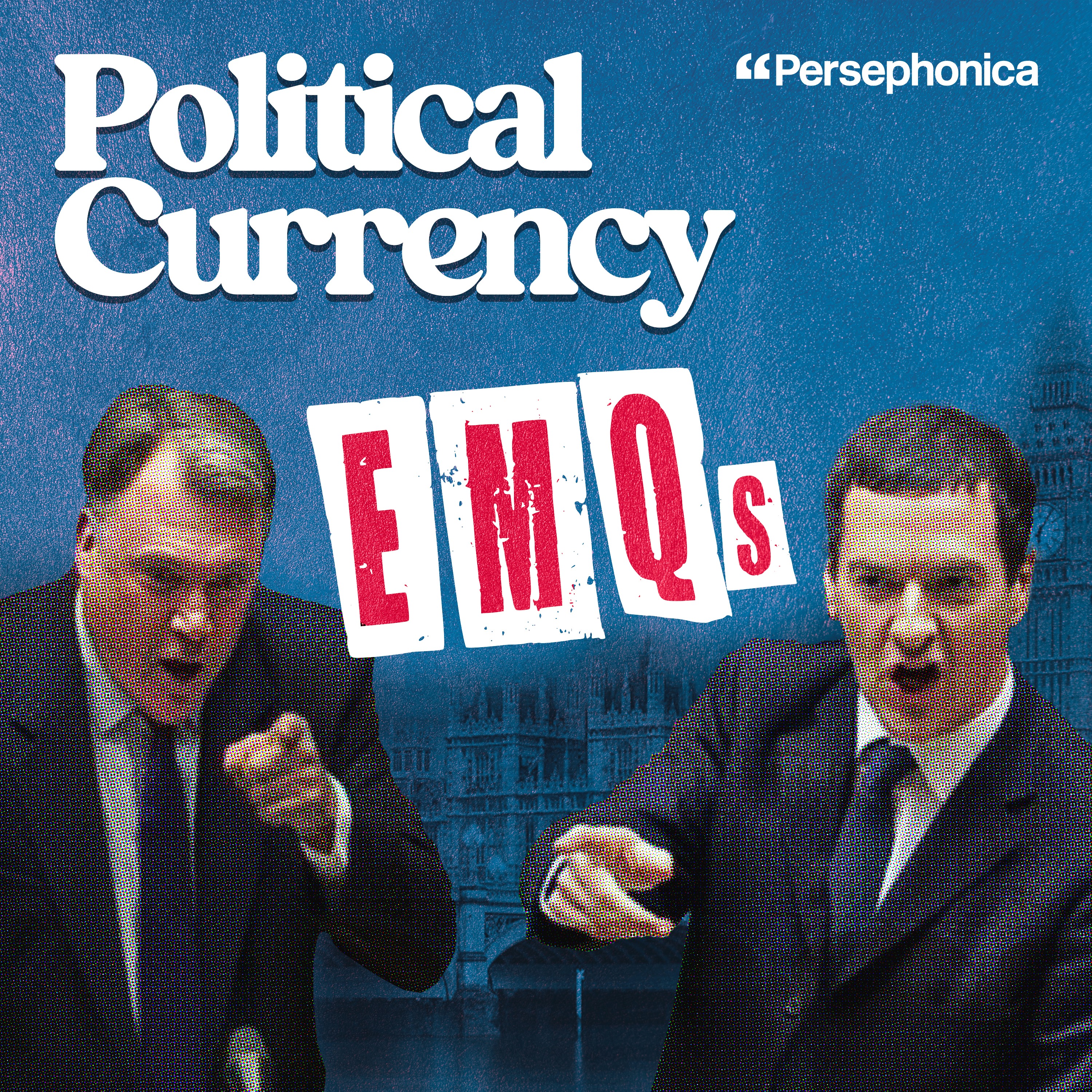
- EMQs: Is Makerfield the UK’s presidential election?
In short
EMQs (Ex-Ministers’ Questions) mixes political Q&A with cultural and legal/political trivia, focusing on the Makerfield by-election as a near “presidential” test of Labour’s leadership.
Guests/backgrounds
Hosts are Ed Balls and George Osborne. Callers include “Scott” (Labour backbench/leadership campaign history), “Madison the Texan” (US primary analogy), “Julie” (Nigel Farage donation/tax rules), “Thomas” (legal mechanics of MP resignation), “Edward” (Genesis/120-year life barrier), and “Seb” (culture recommendations).
Key claims
- Osborne denies wavering from David Davis in 2005; he stayed friendly with Andrew Mitchell but wouldn’t “ditch” Davis.
- Advice to Labour MPs: don’t sign up too early; leadership candidates must make calls themselves, not via proxies (citing the 2010 Miliband vs Miliband nomination mistake).
- Makerfield voters are effectively deciding whether Andy Burnham should be PM, akin to a US primary.
- Farage’s reported £5m is framed as likely a gift (no tax for Farage), but scrutiny is about election-year disclosure and donation purpose.
- Resignation mechanics: MPs resign via appointment to “offices of profit” (Chiltern Hundreds/Manor of Northstead); Balls says he could appoint without request (discusses Gerry Adams/Martin McGuinness).
- Cultural: recommends Grossman’s Life and Fate; discusses La Ligne.
Notable examples
- 2005 David Davis leadership contest; Cameron odds “25 to 1.”
- 2010 Labour leadership nominations and proxy failure.
- Boris Johnson resignation to avoid suspension/recall.
- Genesis 6:3 “120 years” debate.
- Film My Mother’s Wedding (Kristen Scott Thomas; Scarlett Johansson; Prince of Wales aircraft carrier crew).
Written by AI. May contain mistakes.
Chapters
1:16
Film Premiere Experience
Ed shares insights from attending the film premiere of 'My Mother's Wedding'.
“So hello and welcome to EMQs, Ex-Ministers' Questions.”
3:41
Country Fair Anecdote
George recounts a humorous story from a country fair with Scarlett Johansson.
“But I remember John telling me a story about taking Scarlett Johansson to the Rutland Game Fair.”
5:02
Cultural Recommendations
Discussion about the film's emotional impact and cultural significance.
“In cinemas from Friday, My Mother's Wedding, it's emotional and powerful and very, very kind of intimate and personal for Kristen.”
5:25
Question from Scott
Scott's question about the David Davis leadership campaign and George's involvement.
“Yeah, we've got a great first question, haven't we?”
6:41
Campaign Insights and Advice
George shares insights and advice on political campaigns and leadership contests.
“Were you really wavering and thinking of joining the David Davis campaign, telling Andrew Mitchell you might switch over?”
11:13
Lessons from Leadership Contests
Discussion on the importance of trust and direct support in leadership races.
“they split two to one for Ed Miliband versus David.”
14:00
Insights on Leadership Dynamics
Explore the complexities of political endorsements and leadership contests.
“But he minded people who had dicked him around.”
21:45
The Makerfield By-Election Explained
Understand the implications of the Makerfield by-election on UK politics.
“The one sense in which it's not a presidential election.”
23:25
Tax Implications of Political Donations
Gain insights into the potential tax liabilities related to political donations.
“I'm wondering if you could clarify something that's been quietly simmering, driving me mad.”
28:00
Farage and Political Accountability
Discussing Nigel Farage's political maneuvers and accountability in British politics.
“He was going to face a by-election locally, and so he resigned.”
Show all 16 chapters
29:30
Resigning as an MP: An Archaic Process
Explaining the unique process MPs must go through to resign in the UK.
“From one consequential by-election to potentially another consequential one.”
31:46
The Power to Remove MPs
Exploring the hypothetical scenario of a Chancellor firing an MP without consent.
“Now, they weren't MPs who took their seats in Parliament because they wouldn't swear an oath to the Crown.”
35:36
Religious Perspectives on Longevity
Discussing the biblical context of life expectancy and its implications.
“our next question is also provoked by what George said on our last EMQs, and it comes from Edward.”
37:53
Cultural Recommendations and Reflections
Sharing insights and recommendations for cultural works related to political themes.
“But I had one thought, though, George, which brings it back to your profession here.”
42:08
Cultural Recommendations and Discussions
The hosts discuss various cultural recommendations, including books and TV shows they enjoy.
“The line, in case you don't know what we're talking about, I recommended this.”
44:51
Listener Engagement and Wrap-Up
The hosts engage with listener questions and discuss how to reach out, before wrapping up the episode.
“And as you can see from this episode of EMQs, we're willing to cover Genesis and God's existence, Russian novels, Texas Senate primaries.”

Ask about this episode
Get the gist, explore an idea or ask about something said.
 Claude
On Political Currency, what are the key points of this episode?
Searching your listeningTranscript
Automatic transcript. May contain errors.
0:00Hello podcast listener. Hello you. It's me, Greg James. And me, Alice Levine. Now look, I know that you're very much enjoying this podcast that you're listening to. And we're sorry to interrupt. We really are. And it genuinely might not be our place to say, but is it time to try something new? We would like to steal you for our new podcast. It's called Bad Chat. And it sounds a bit like this. This one goes out to the walkers and the talkers and the late night. Stalkers. Maybe not that one. Alice is my best friend. I am not Alice's best friend. Do you know that horses' legs are their fingers? That is a bit of bad chat from me, Greg James and me, famously, Alice Levine.
0:40Listen wherever you get your podcasts.
0:48George Osborne: The Chancellor of the Exchequer. Getting a lesson from the Shadow Chancellor on how to balance the books is like getting a lesson from Dracula on how to look after a bloodbath.
0:57Ed Balls: Egg balls. A steady-as-she-goes budget. What kind of ship does he think he's on, the Titanic? They're married, Celeste.
1:05George Osborne: Welcome to EMQs from Political Currency with Ed Balls and George Osborne.
1:16Ed Balls: So hello and welcome to EMQs, Ex-Ministers' Questions. Now, on our main podcast, George kind of went on about being at the White House with Donald Trump and Kevin Walsh. And I felt as though Helvellyn didn't quite compete in terms of fancy environs.
1:35George Osborne: That's the hillock in the Lake District that you're about to scale or have scale. It's a mountain. But I was at a film premiere last night. I was.
1:46Ed Balls: In just above Piccadilly in a hotel. It's a new film. It's the directorial debut of Kristen Scott Thomas, of Four Weddings and a Funeral and Slow Horses fame. And she has not only directed in it and starred in it, but it's co-written with her husband, who we both know really well, John Nicklethwaite, who runs Bloomberg. They wrote it together. It's called My Mother's Wedding. Stars, listen to this, Scarlett Johansson, Sienna Miller, and Emily Beecham. And it's actually based upon Kristen's own life story. her father and her stepfather both died in service in the forces when she was a small child and this has obviously been kind of hugely shaping experience for all of her life and she's now written a film based upon that experience it's actually she plays the mother who's getting remarried later in life and her three 20 30 something daughters are at the wedding but also playing out the tensions and consequences of the deaths of those two fathers all those years ago.
3:02And one of them, the Scarlett Johansson figure, is in the film the first ever woman commander
3:10Ed Balls: of a British naval aircraft carrier. And it is filmed on the Prince of Wales in Portsmouth Harbour. and the film ends with her on deck with all of the sailors with their hats and smart uniforms and it's the actual crew of the Prince of Wales aircraft carrier who play themselves in the film. It's actually really good and I was there.
3:38George Osborne: That sounds great. I will definitely watch it. I remember, I mean, I know them both and they were telling me all about this movie and getting it made which was a big ordeal actually because I think they ran into the kind of writer's stripe in Hollywood when they were trying to do it. And so everything was put on pause. But I remember John telling me a story about taking Scarlett Johansson to the Rutland Game Fair. So for the people who've never been to a game in the countryside, they have these country fairs, game fairs, sometimes called country fairs, sometimes called game fairs. Game fairs reference to the old shooting and hunting and stuff.
4:16George Osborne: But they're real kind of eye-opener to the sort of British countryside. They're not at all posh, like they are the opposite of posh. John has a house up in Rutland. I think he grew up there. And he took Kristen and Scarlet, these two mega film stars, round the game fair and watched all the ferret racing. And, you know, you can go and get the kind of camouflage outfits of the country stores. And they have the foxhounds come into the central arena and there's pony trap racing and all this kind of stuff. Nolan, of course, in Rutland knew who these glamorous ladies were as they were on the game fair.
4:53George Osborne: Anyway, I just have this site. If anyone has ever been to one of these country fairs, just imagine Scarlett Johansson in the country fair. And it's quite a contrast.
5:02Ed Balls: In cinemas from Friday, My Mother's Wedding, it's emotional and powerful and very, very kind of intimate and personal for Kristen. And if you are a Kitchen Cabinet subscriber, but this is exactly the kind of cultural recommendation you get in our weekly newsletter, which I can now not do next week because I've done it on EMQs. But a little taster. Should we get on with it?
5:25George Osborne: Yeah, we've got a great first question, haven't we? We've got a question from Scott. Hi, Ed and George. So a question for you. Back in 2005, I found myself as a junior member of the David Davis leadership campaign. And during that campaign, I remember being in a team meeting where Andrew Mitchell, who was leading that campaign at the early stage, came into the room late, having encountered a young George Osborne on his way to the meeting. And he reported that George Osborne, who of course was running David Cameron's campaign at that point, had indicated or had given the impression to Andrew that he was at some point potentially willing to fold in with the DD campaign.
6:15main so my question to you george is twofold first of all is that true and do you remember it and the second question is what advice would you give to new backbench labour mps who will currently be getting calls from andy burnham's people west streetings people maybe even angela reign as people. I'd be very interested in your thoughts. So is this true?
6:42Ed Balls: Were you really wavering and thinking of joining the David Davis campaign, telling Andrew Mitchell you might switch over? I would have thought that you and David Cameron were all in this together from the very beginning. I mean, was he a bit naive to think you might be going to jump ship?
7:01George Osborne: I think one of the problems of the David Davis campaign was that they miscounted their support I seem to remember as a person helping to run the rival campaign. And that would definitely be the case here because I was not about to leave David in the lurch and join Andrew Mitchell. But I'll tell you two things about it. And it's good to hear from Scott. I hope you're doing well, Scott, who I know. And the first thing was in the middle of this campaign, and David Davis was the huge front runner. You know, everyone thought he had it sewn up and he had like, you know, a large number of the MPs. and david cameron's original mp support myself included was six people in fact the david davis campaign probably andrew mitchell himself went around saying they could all fit in a in a black taxi that was the they could all fit in the back of a cab but in the middle of it andrew invited me and a couple of the other members of the six to dinner at his hat and to spend the night at his house in Nottinghamshire, his constituency house in Nottinghamshire.
8:03George Osborne: So he's now an MP in Sutton Coalfield in Birmingham, but he was back then and had been an MP in Nottinghamshire, a lovely house in Nottinghamshire. We went to stay and I remember David Cameron saying, after David had won, you know, years later, I was really worried when you lot all went off for dinner and to stay the night with Andrew Mitchell. So I think in David's mind, he was always, I'm not sure this fraternising with the enemy is something i approve of although we were just trying to be like you know kind of big about it and gentlemanly about it and say we've got to you know all work together after this contest is over and then the second thing is you know the the odds were very much against cameron winning to begin with he was like 25 to 1 in the and the times newspaper famously also famously in my head
8:46Ed Balls: anyway so you were diversifying were you were you no no i'm sure i was i would have said like yeah
8:51George Osborne: well you know we can have a conversation if this doesn't work out were you running two horses here
8:54Ed Balls: than Rudy. I was not running two horses, but maybe I was thinking what happened if our horse didn't
9:00George Osborne: make it. But I would never have ditched David and I had 100 % confidence, as did David. David never for a second doubted he was going to win that contest. Not. But anyway, we did. And the rest is history, as someone once said in a podcast. But Scott, so that's the truth. No, I wasn't about to ditch David. But I did stay friendly with Andrew Mitchell and of course Andrew Mitchell became a core part of the Cameron team and ended up being the chief whip although that came to a sticky end not through any fault of Andrew's as we found out. So what's it
9:36Ed Balls: I mean we have some obligation to answer Scott's question though which is what advice would he give to backbench Labour MPs getting calls? I suppose the advice I thought was first actually I've got advice for the MP. You've actually been a candidate
9:50George Osborne: I've never done a candidate. I've only ever run leadership candidates. I've never actually been the front guy.
9:55Ed Balls: I think, look, the work you have to do as a candidate before the leadership contest has really got underway to get your supporters and get the nominations. I mean, in politics, you're normally part of a team and suddenly you're on your own. So it's tough, but you have to do it and you have to do it yourself. I think, so I've got two pieces of advice. For the backbench MPs, until there's a contest, wait and let them come to you. Don't start signing up too early because you don't know if that candidate is going to be in, let alone whether they're going to be ahead. And if you are one of the candidates yourself, you have to do the calls yourself.
10:35Ed Balls: You have to go out there and speak to all those backbench MPs. You can't do it through proxies. You can't do it by devolving it. You know, back in 2010, I've said this before, about West Streeting being worried about the David Miliband issue of not challenging in 2008 and 2009. But then when we got to 2010, Ed Miliband, like me, I think like Andy, was out, were out talking to all the backbench MPs, persuading them. And David handed that over to proxies. He had people doing it on his behalf. And it was such a mistake. Like if two, I had like 30, 40 MPs nominated me, they split two to one for Ed Miliband versus David.
11:21If two of them had voted for David rather than Ed,
11:25Ed Balls: that would have been enough to win David Miliband the leadership election. Ed Miliband spoke to all of my supporters to say, Ed's great. I know you're putting him first. Will you put me second? David didn't speak to them. He didn't actually go out and make the argument. He left it to others. And there were all these people who, if they'd had the call, they would have switched. So if you're a leadership candidate, you cannot hand over the hard work to people who are your representatives without seeming aloof and distant and not properly engaged and don't make the David Miliband mistake.
11:56George Osborne: And it's hard work. There are hundreds of Labour apiece. That's like a lot of conversations you've got to. No, I think, but the advice to an MP, I mean, I've voted in quite a few leadership campaigns as an MP. I would say the best, well, you've got to make one fundamental decision, which is, are you going to be early money? Are you going to go in early and back someone like I did with David? Because if you are a core part of the team and your candidate wins, then you are propelled to the very top of politics, you know, of your party. And I think if you've got a close friend, you should do that.
12:29George Osborne: That's, you know, the thing to do. But if you're not going to take that risk, the central piece of advice I give you is be a kind of plain dealer. Don't mess people around because you get a terrible reputation if you're an unreliable MP in a leadership contest. Just say who you're supporting. You know, say I'm supporting Ed Balls. You know what, Ed Miliband, David Miliband, I'll consider you next. They respect that. What they don't respect, you know, there was a, there was a, I mean, I'm going to keep these names anonymous and maybe, it depends how I feel over the next few months, I might reveal who some of them are.
13:03George Osborne: But, you know, there was one Tory MP who was known as Mr. Five Votes because he pledged his support to five different candidates. Right. Terrible for all of them, including the person he ultimately voted for because they thought you were totally unreliable and untrustworthy. There was another person I had around for dinner with David Cameron. It was a Tory MP and I, you know, he came around to be persuaded by David. It was a huge investment of David's time because he was having dinner with him. And at the end of the dinner, he said, actually, no, thank you, David, but I'm going to support someone else in the David Davis contest.
13:32George Osborne: And David Cameron was like, what a total waste of my time, you fucker, basically. And that guy never got, years later in reshuffles, like 10 years later, David was like, we're not promoting that guy. And so that's another thing, which is don't waste the candidate's time. Are you saying that David Cameron bears a grudge? But David Cameron remembered exactly who had voted for him. He didn't mind people who hadn't voted for him at all. And some of them became very prominent in his government. But he minded people who had dicked him around. And finally, there was a friend of his, a friend who had personally been pretty friendly with him in his 20s, who wrote a newspaper article saying, although David Cameron's a friend of mine, I don't think he's right for the leadership right now.
14:17George Osborne: And Cameron never forgave me. Which is my point. If you've got a friend, in many ways, that's the easiest option, at least in the first round of a leadership contest. You can just say, look, everyone knows I'm a friend of David's. I'm going to support him. So just be a plain dealer. That would be my main piece of advice.
14:35Ed Balls: There's one I remember. This isn't a backbencher. This was a senior cabinet member, who I'm not going to name, senior cabinet member in both the Tony Blair and the Gordon Brown cabinets. This person was kind of more on the Tony Blair side of things, came to the 2010 leadership nominations. And, you know, some people only nominated one. Some people nominated two, you know, Andy Burnham, Ed Balls, or David Miliband, Ed Balls, or even David Miliband, Ed Miliband. This person nominated five people, which they didn't have to do. And the nominations went, David Miliband first, Andy Burnham second, Ed Miliband third, Diane Abbott fourth, and me fifth.
15:16Ed Balls: I couldn't believe it I thought what? You bastard I mean talking about bearing a grudge dear me anyway nameless let's move on our next question is for Madison This is Madison the Texan who asked y 'all about American primaries and your own selections and I loved your responses I wanted to ask this about the Makerfield by-election what is the question that the voters there are being asked to answer is it who should be their MP or who should be your prime minister? Or perhaps it's which Labour politician should be your prime minister, which sounds like a primary? Or is it, do you even want Labour to stay in power?
15:56Also, do you two agree with me that this specific by-election is as close to a presidential election as the UK has ever had?
16:04George Osborne: So although that wasn't Madison's voice, that was a Texan's voice. We found a Texan to provide the voice.
16:11Ed Balls: And it's actually kind of really timely, timely. Great to have Madison back again. There has been a big Texan story this week because you've had the huge upset of the Texas Attorney General, Ken Paxton, hugely controversial, scandal-driven MAGA figure backed by Donald Trump, has unseated, has defeated in the Republican primary, the Senator John Cornyn. It's one of those moments where the MAGA Republicans love it And the Democrats are ecstatic because they think suddenly there's a real target. It makes this Texas Senate seat, you know, contestable in the midterms. And even if Paxton can win it, the Republicans will now have to throw loads of money at the seat to make sure that they don't lose it.
17:02Ed Balls: And painfully, all the Republican senior leadership in the last few days, including Ted Cruz, who was neutral throughout the whole campaign, have now reluctantly been coming forward to say that they will support the Republican candidate and that they will back the fundraising because they know if not, there's a danger that they'd lose Texas too. So what that tells you in a selection, you've always got to make sure that the candidate you're choosing is not only the one who will make the party feel good, but also the one who can actually win in the country. And I guess, Madison, that is one of the ways in which this by-election has a parallel to the US, because unusually people who are choosing him as the candidate for Labour, but then voting in this by-election, are not only voting for Andy Burnham as the MP for Makerfield, But they're also asking the question, is he the right person to be the prime minister?
18:02Ed Balls: And the Labour Party will be thinking, well, is he the person who can actually win a general election in two years time? So that is one parallel.
18:09George Osborne: Yes. Oh, we could talk about Texas Senate races forever. There's some great stories about the ones that Lyndon Johnson fought. But the Makefield election, get a little bit more for a second, close to home, is unique, isn't it? I mean, in British history, I don't think there has ever been a situation like this, which is why politics is endlessly fascinating. We've never had a situation where someone is essentially contesting to be the prime minister within months, possibly weeks. And we'll come on to that. I'll explain why it might be only a few weeks. He could easily be the prime minister by July.
18:47George Osborne: And Andy Burnham is standing in the by-election to become the prime minister. And although, you know, there have been lots of famous by-elections in the past and famous candidates in by-elections in the past, we've never had this situation where someone is explicitly coming in to immediately challenge inside his own party for the premiership and looks very likely to win it. And the reason why... I mean, presumably Boris Johnson is the closest parallel. Is that right? Well, Boris Johnson came back as an MP in a general election in 2015 when he was still the mayor of London and still had a year to go.
19:23And we had a debate inside the Cameron leadership.
19:26George Osborne: Do we allow him to stand? This was the debate Starmer had this year, which was, do we allow Andy Burnham to stand? Inside the Labour Party rules actually, I think, prohibited it, although they've obviously ditched those rules now to allow him to stand. But Boris was coming in in the general election, although there was little doubt that he would come not to immediately challenge Cameron because Cameron won that general election and looked like he was going to stay for several years, although he had made the mistake in the campaign of saying he wouldn't fight another election after that. In this case, though, if he loses, all bets are off.
20:00George Osborne: And maybe there's a route in which Starmer possibly survives. But if Burnham wins, I think he arrives. He proves that he can win where Labour hasn't been able to win. both in Makerfield in the local elections and in Manchester by-elections. And I think it's quite possible Wes Streeting says, I don't have the numbers. It's quite possible that Angela Rayner says, I don't have the numbers. No one else has the numbers, but Burnham does. And maybe he gets like a couple of hundred Labour MPs to nominate him. And Starmer resigns and he's Prime Minister almost immediately. So that is quite possible. And I think that is a unique situation.
20:37George Osborne: And so to answer Madison's question, I think people in Makerfield are deciding whether they want Andy Burnham to be the prime minister. And more than do they just want him to be the MP for Makerfield or indeed do they want someone out? If they don't want a Labour prime minister, if they don't want Burnham to be the prime minister, I guess, you know, if you wanted Starmer to be the prime minister, I can't imagine there are that many people in Makerfield to make that distinction. Then you would probably also vote against Burnham. Although I think you argue Starmer can't survive if he loses this by-election either because he's lost another by-election.
21:13George Osborne: But the simple choice, and I don't think Andy Burnham is pretending it's otherwise in his campaign videos, is I'm asking you to vote for me here to be your MP, but also to be someone who's going to change the Labour Party and change the country.
21:28Ed Balls: So you are totally right that it's very consequential. And the question is complicated, because it's not simply who do you want to be the MP for Makerfield? It's also, do you want Andy Burnham to be Prime Minister? Do you want Labour to be in power? You could vote against Burnham because you think that's the way to stop Labour being in power in the next general election. The one sense in which it's not a presidential election. Madison asks, is this specific by-election as close to a presidential election as the UK has ever had. The reason it's not like a presidential election is because Nigel Farage isn't running, and neither is Kemmy Badenock.
22:06Ed Balls: So Andy Burnham is running in this election. He's running against the parties. He's prefiguring the general election to come. But if he wins this and becomes prime minister, he's not actually running against the rivals for the job. But that's the one sense in which it's not a parallel.
22:25George Osborne: Of course, you know, it is pretty similar to how most people vote in most general elections. I mean, MPs get on their high horse about being local representatives and so on. But the vast majority, it obviously can't be the case that most MPs have an above average local support by definition. And so with the exception of some parts of the country where people tend to, you know, maybe they vote Scottish nationalist or they vote Lib Dem in parts of the West Country itself. But generally speaking, people, when they vote, are voting for who they want to be the prime minister and they want to be the government.
22:58George Osborne: And, you know, if you're a really strong local MP, you might get a little bit of local support. And certainly if you're a bad MP, that might work against you.
23:09Ed Balls: But those things are always overplayed.
23:10George Osborne: They're very, very marginal. So in some ways, you know, it's what happens in every constituency at a general election. But anyway, this is pretty, pretty unique in the sense that if he wins, he's the prime minister, in my view.
23:24Ed Balls: Thanks, Madison, for your question. We'll be back shortly after this break.
23:39Ed Balls: Welcome back. Here's a question from Julie. Hello George, hello Ed. I'm wondering if you could clarify something that's been quietly simmering, driving me mad. This Nigel Farage's five million, what was it now? A gift? A donation? I think maybe it was a bonus at one stage. Or maybe it's even a future deposit. Who knows? But my question is, surely there would be some tax due? I mean, maybe that's why they're being vague on the classification of it. But has he paid any tax? Has anybody checked? What is the situation? I haven't heard it said. I haven't read anything about it. And given the scrutiny that other individuals have found themselves under for far lesser amounts, I'd really like to understand the situation.
24:34Anyway, I hope you can help. Loving your work, gentlemen.
24:37Ed Balls: Now, I'm not kind of an expert on this at all. But as I understand it, this is the view of the tax expert Dan Needle, that there isn't a tax liability here for Nigel Farage. Because it's a gift.
24:55George Osborne: It's a gift. It's a gift.
24:56Ed Balls: Unless it was a payment for services. And so, of course, the question kind of arises, what was Nigel Farage giving in return? But if nothing, and I presume that there's no inheritance tax liability either, because this is a non-British taxpayer making the contribution?
25:15George Osborne: Yes, it's only an issue. It's an inheritance tax issue for the person who makes the gift. But not for Nigel Farage. By the way, people should get their own tax advice from relying on us. But if you die and you've made gifts to your children in recent years, then they are included within the inheritance tax net. That's to prevent people avoiding inheritance tax by essentially gifting everything away in the last couple of years before they die, which is why people do things like they give away their home many decades before they retire. So in this case, yes, the only tax liability falls on the person who gave the£5 million.
25:52George Osborne: And I think he lives in Thailand, doesn't he? So I don't know what the Thai inheritance tax laws are.
25:58Ed Balls: But of course, this is being investigated by the House of Commons now. But the investigation isn't about tax. It's about the fact that this appears to be a political donation in an election year which wasn't declared. And the challenge for Nigel Farage is what was the purpose of this donation? Where did the money come from? Where did it go? How was it used? that will be looked at because it's, I guess, because it happened so close to general election. And the challenge, I think, for Nigel Farage here is, you know, I presume at the time he received the money, he didn't know he was even going to be a general election candidate, let alone that he was going to then be the leader of the party ahead in the opinion polls.
26:46Ed Balls: And people would say, is he going to be the next prime minister? And then suddenly there'd be all of this scrutiny. And, you know, it feels as though Nigel Farage has kind of gone to ground because he's not sure what his answers to all these questions are, but he's going to have to answer them now.
27:00George Osborne: I guess there is some risk here for Farage. There's two risks. There's the actual procedural risk. So I don't think there's any tax issue. But I think, as you say, he appears on the surface anyway to be in breach of parliamentary disclosure rules, which is you're supposed to disclose significant gifts and donations to you before you get elected, in the year before you get elected, in your register. And if you're in breach of those rules, there's a commons committee that rules on that. Well, there's a standards commissioner, and then there's a committee of privileges, and you can be suspended from the House of Commons.
27:35George Osborne: This is what happened to Boris Johnson. Remember, he was going to be suspended for lying, and then he resigned his seat to avoid that. In the case of Farage, he doesn't have any... It's not like in these cases, usually you've got government whips and opposition whips trying to help you. He doesn't have the numbers at all in the House of Commons. So both the Conservatives and the Labour Party, we're happy to see the back of him. And I think there are rules whereby if you're suspended for a certain period of time, it does open up the prospect of a local recall petition, which is if people can assemble enough names locally, they can trigger a by-election, which is what Boris Johnson was trying to avoid.
28:14George Osborne: He was going to face a by-election locally, and so he resigned. So that is a kind of prospect for Farage, but I think he might feel like, well, I can win Clacton again in a by-election anyway, although it would throw a huge spotlight on this£5 million donation. And I guess the kind of bigger question behind the question from Julie is like, why are these rules? Why do the rules not apply to Farage? I mean, in the sense, not the actual rules, but the sort of political rules. You'd think a kind of five million pound donation to your personal finances from some offshore crypto king, you know, would bring down a politician.
28:54George Osborne: But they haven't in this case. And I think it's partly that Farage is someone who kind of, a bit like Boris Johnson sort of claims, well, I don't play by the rules anyway, so you can't hold me accountable to them. As I've said before, this man, as it happens, did give money to Boris Johnson as well, gave a million pounds to him personally, or to his, quote, office. And so it's quite hard for the Conservatives to lay into him. And the Labour Party has been completely distracted with their own leadership problems. So Farage has kind of escaped the scrutiny that you might get. For now. For now. But it's definitely one of those sort of loose threads in British politics.
29:29George Osborne: And it's good we've had a question on it because it's one of those things that you may well still unravel.
29:33Ed Balls: From one consequential by-election to potentially another consequential one. Thank you very much indeed. This next question is from Thomas. And come on the back of what you were saying about Josh Simon's resignation as the MP for Makerfield, George, and his elevation. Hi George and Ed, Thomas here, gold subscriber and big fan of the podcast. You mentioned on a recent episode that the only way for an MP to resign is to be appointed by the Chancellor to a paid office of the Crown. Could I ask a complete hypothetical? Would anything legally prevent a Chancellor from appointing an MP to one of those offices to remove them without their having requested it, in effect sacking an MP?
30:17Can the appointment be undone? Thanks.
30:20George Osborne: Yeah, this is a really interesting question from Thomas, and one I wrestled with as Chancellor. And I don't think anyone would know, including people who are very experienced in politics, that this is the case. It's something that I think at the time was unique. So to resign as an MP in Britain, we have a rather archaic procedure, which is you get appointed to an office of profit under the crown. Now, it's never been clear to me why being, I don't know, Chancellor's Exchequer is not office of profit underground how you get paid but for some reason the rules don't apply to ministerial appointments but you can't be an mp and you can't hold a crown office and the two crown offices which are held open are the um chiltern hundreds most famously and the manor of northstead these are sort of medieval offices they don't come with anything and they come with a kind of, I think, a sort of cursory payment.
31:14George Osborne: But the way for an MP to resign is to apply to that office. You write a letter to the Chancellor's Exchequer, and the Chancellor's Exchequer says, yes, I'm appointing you to the Chiltern Hundreds or the Manor of Northstead. And then you are automatically essentially invalidated as an MP, and that in effect is your resignation. So that's how it works. And I signed quite a lot of these letters, because for all sorts of reasons, scandals or people get better jobs or whatever. Anyway, they leave and so on and trigger by-elections. But I had the very specific case of Gerry Adams and Martin McGuinness, who were both MPs.
31:51Now, they weren't MPs who took their seats in Parliament because they wouldn't swear an oath to the Crown.
31:57George Osborne: But they both wanted to resign as MPs and they refused. I had no direct communication with them. but it was made clear to me that they would never write a letter to a British chancellor saying I wish to be in charge of the Chiltern hundreds or the manor in Norsted and so I was just sort of left with this situation well what do I do and I got some legal advice from the Treasury Council they said well you can just appoint them without them requesting it and I said but surely then I could appoint I think I literally said surely I could just appoint Ed balls to the children hundreds and suddenly he's lost his constituency or ed milliband you know
32:34Ed Balls: my political opponents at the time you weren't more worried about us than i realized well
32:40George Osborne: well you less so i mean that milliband he was pretty effective
32:46George Osborne: um no it was bizarre and and i asked the question the lawyer said yes you could chancellor i was like okay and i did worry that um there would be a legal challenge and you know i had to act you know i was acting in official capacity obviously and anyway so i took this i said look clearly jerry adams had written me a letter saying i want to resign or he'd written not to me but he just sent a letter to the government saying i want to resign so he hadn't kind of formally asked but he had we did have this letter and um i said well this is the means of the resignation so i'm going or appoint him. And I did.
33:24George Osborne: But it did emerge in the course of those discussions that I could have fired any MP I liked. Maybe I should have fired Boris Johnson on reflection rather than Ed Balls. That would have been a more sensible move. Although I think all this occurred before he got back into Parliament. Or even Michael Gove. Oh, we love Michael. He was never going to challenge me. Yeah, but... Comes back to that question of David Davis. I think he would have been one of my original sex who knows but then well cameron's uh big mistake with gove was to underestimate his
33:52Ed Balls: own political ambitions so we probably need more legal advice the only thing which that i wondered thinking about this question is if you were um i don't know carl turner and keir starmer tried to do rachel reeves have you removed as an mp or as you said you and boris johnson just explain why
34:13George Osborne: Like Carl Turner? Because he's a Labour MP for Lincoln, isn't he?
34:16Ed Balls: That's right, who is leading the rebellion against the David Lammy reforms to jury trials and generally being very outspoken and a bit of a thorn in the side of Keir Starmer's government. But if you were to, as the Chancellor, just decide to remove them, presumably there would be some way in which they could then appeal within the House of Commons. And in the case of Gerry Adams, he wouldn't be able to appeal because he wasn't a sitting MP. So therefore, you know, he wouldn't be willing to go to an appeals process in any case, unless he's taken a seat. How could he go? But if you were Carl Turner, presumably there would be some kind of natural justice.
34:58George Osborne: No, because the moment you sign the letter as chancellor, they're appointed. And at that moment, they cease to be an MP. They have no appeal against it. Well, I think in practice, they go to court.
35:07Ed Balls: Maybe the courts would say this is horrible. so they would judicially review it yeah but would parliament accept the court's jurisdiction as opposed to this is about there being an mp yeah i know but then you'd have to change the law that
35:18George Osborne: says you can't be an mp and hold an office of profit which you could do but it'll be after the moment when the person ceased to be an mp so we need legal advice on this one because i'd love
35:28Ed Balls: to know what the answer to that is whether you could appeal or whether you'd jr or what would happen. You learn something every day. Now, talking about learning and wider powers, our next question is also provoked by what George said on our last EMQs, and it comes from Edward. Hello, Ed and George. It's Ed here from Tynemouth. This is my second question for EMQs. You kindly read one about football and politics a couple of years ago from me. But this one is about last week's EMQs, where you were talking about longevity of life, assisted dying. But you're also talking about George wanted to go on a pilgrimage.
36:02You did request more religious questions as well. So I thought I'd combine all those things into one. George, you mentioned that we'd been super successful in raising life expectancy over the last hundred years, but we seem to reach this sort of inbuilt barrier of 120 years that we don't get past. Is this something like the speed of light that's built into the universe that we can never reach, never surpass, never go past? Well, as a religious person myself, I'm a Christian. and in the book of Genesis, right at the start of Genesis 6 verse 3, then the Lord said, my spirit will not contend with humans forever for they are mortal.
36:37Their days will be 120 years. So I just found it super interesting when I heard George himself say, there seems to be this barrier of 120 years. That verse popped up in my head and given you asked for religious questions, I just thought I had to share that with you.
36:52Ed Balls: I have to say, this time we don't need advice from lawyers. I think probably from bishops, maybe the Archbishop of Canterbury here. I mean, my reading of the scriptures was always that you shouldn't take Genesis.
37:07George Osborne: It's always a bad turn when the political podcast goes, my reading of the scriptures.
37:12Ed Balls: My reading of the scriptures is that you probably shouldn't take Genesis too literally.
37:16George Osborne: Right.
37:17Ed Balls: And it's all kind of for interpretation and to be seen in a sort of parable style way. And therefore, 120 years may not be literally 120 years, but that was at the time Genesis was written, seen as a very, very old age. But on the other hand, you know, Edward says this tells you that God wrote it into the first book of the Old Testament and things have never changed since.
37:45George Osborne: Yes.
37:45Ed Balls: Well, I'm not sure we should talk long about this one because I'm not sure where this goes, really.
37:51George Osborne: Yes. I, you know, to quote a fellow podcaster, I don't really do God.
37:56Ed Balls: But I had one thought, though, George, which brings it back to your profession here. If you think about AI, if AI was to either come up with cures for the most intractable illnesses or to find a way to enable humans to buck the aging process, wouldn't that be the biggest challenge to God that we've ever seen? Well, he would have anticipated it or he or she would have anticipated it because they're omniscient.
38:28George Osborne: Well, but maybe, I mean, the question is whether they're there.
38:33Ed Balls: If AI bucks the scripture, where does that leave us?
38:39George Osborne: Well, maybe we need a third book of the Bible. Yeah, the third testament, I should say.
38:46Ed Balls: I'm currently going on to Claude. Could you write, please, to chat GPT, please could you write the third book of the Bible on the following
38:56George Osborne: assumptions these waters are too deep in life of course does imitate art because one of my favorite stories last few weeks was the u.s defense secretary pete hegseth uh who quoted the bible but what he didn't realize was he wasn't quoting the bible he was actually quoting the verse from pulp fiction that samuel l jackson reads you remember when he's dressed in black with those with black tie and he's standing with a gun over someone who's about to shoot a drug dealer. And he says, he claims it's from Ezekiel 25, 17. And blessed is he who in the name of camaraderie and duty shepherd the lost through the valley of darkness for he is truly his brother's keeper and the finder of lost children.
39:42George Osborne: Anyway, it's not from the Bible. It's from Quentin tarantino and the u.s defense secretary quoted it as if it was from the bible and um yeah so that's why i'm steering i'm steering clear of uh genesis and and indeed all the subsequent books well um
40:00Ed Balls: edward who sent us his um the question he actually says he's quoting genesis 6 verse 3 um so then the lord said my spirit will not contend with humans forever for they are mortal their days will be 120 years now i think we're just gonna have to just go and check that was actually written in Genesis, not by Edward Quentin Tarantino.
40:20George Osborne: Now, which Bible are you going to use? Can I recommend one? The Gideon's Bible.
40:28Ed Balls: I mean, there are no limits to your ego. Thanks for your question, Edward. We'll be back after this break with one more question.
40:47Ed Balls: So our final question is from Seb, and it's been voiced by one of our producers. Hi, Ed and George. Ed, you indicated that you'd welcome cultural recommendations some months ago. You praised the French series La Ligne, Un Village Francais. I'd have not watched it without that recommendation, and it was a fantastic series, full of humanity and frailty and evil, and often muddled up in the same characters, which altered my understanding of France and its place in the Second World War. So thank you for that. A novel I cannot recommend highly enough and which has certain parallels with Leline in the sense that it also got under the skin of relationships and motivations, political and social, is Vasily Grossman's Life and Fate, about the life and work of a family of a Soviet physicist, Victor Strom, during World War II.
41:35Perhaps you've read it? I think anyone who was blown away by Leline will relish reading Life and Fate.
41:41Ed Balls: Now, I have to say, I've not read this novel by Vasily Graseman, Life and Fate, although I loved The Line, which is still available, I think, on ITVX. And so if, Seb, you think the line lovers should go and read Life and Fate about the family of Soviet physicist Victoria Shrum and his life during World War II, then I'm going to take you up on this recommendation. The line, in case you don't know what we're talking about, I recommended this. It's the story of a village in occupied France from the beginning of the German occupation all the way through to liberation. And Seb is right that that tension between humanity and frailty and evil happens within individual characters as well as between characters.
42:32Ed Balls: It's an utterly brilliant piece of drama. And I had the same reaction as Seb. You learn so much about the war and France and the human condition. So this is the kind of thing we discuss in this podcast and which we recommend in our kitchen cabinet briefings.
42:49George Osborne: I love a good Russian novel. So Vasily Grossman, he wrote the, I think his more famous book is about Stalingrad, which I have read, although many years ago. and i've just actually bought a book that i saw recommended a russian novel i hadn't um read called petersburg nobukov the guy wrote lito along other things he said this was one of the greatest books of all time i saw that reference somewhere i thought oh actually this is a book i haven't read it's called petersburg by andre belli i think you should pronounce it like b-e-l-y be me and uh anyway i've got i haven't read it yet which is with these russian novels you know step one is buying the book step two is having it lying around for a few years step three of reading it um but i'm quite excited about that but um maybe i will also get back into uh vasili grossman did you watch the line on itvx no why do i make these recommendations i read gorky park i do i do actually i'm just a bit slow in picking them up but i do i do actually follow your recommendations It's one of the best television dramas I've ever seen.
43:59George Osborne: I've just finished The Legends, which was the, I mentioned this before, the Netflix one with Steve Coogan about customs officers. And Theo and I, we were looking for recommendations. We need a new series to watch. So we'll take that on.
44:14Ed Balls: Do you know what I did? I watched the first series of The Pit, which is the new HBO. I watched. I'm halfway through that. so having watched it all I decided to go back to the beginning of ER and there are
44:29George Osborne: you're repeating yourself because you've told
44:30Ed Balls: 14 series and I'm halfway to the second one
44:33George Osborne: have I told you this before yes you're literally like you are a repeat on this story okay
44:39Ed Balls: well I'm watching a repeat on repeat repeatedly and repeating it thank you for your question Seb we really appreciate it and it's nice to discuss a bit of culture on this podcast that's all we've got time for in this episode of EMQs
44:53George Osborne: do keep sending us your emails as you can see you can ask us about absolutely anything doesn't mean you necessarily get very good replies but we do our best and uh you can email the questions to questions at politicalcurrency.co.uk or you can message us on your socials and remember if you're a gold subscriber you get this early and ad free if you're a kitchen cabinet member you get it early ad free plus you get our newsletter which we will be updating you know you on the political situation over the coming days.
45:23Ed Balls: And as you can see from this episode of EMQs, we're willing to cover Genesis and God's existence, Russian novels, Texas Senate primaries.
45:35George Osborne: Nothing's beyond us. Well, it's now lunchtime, so it's time for Exodus. Thank you very much.
45:40Ed Balls: Thanks for listening. We will be back on Thursday with our main show, and we'll see you then.
45:51George Osborne: Thanks for listening to Political Currency. This has been a Persephoneca production.
46:04George Osborne: Hey, Yetis. This is Nick and Jack from the Best One Yet podcast. Now, the last company we worked at, they used Paylocity and everything just worked. It wasn't until launching our own media business, this show, that we realized how rare that is. Because Paylocity is one delicious burrito of operational needs. They roll up HR, finance, and IT seamlessly into one delicious bite. When everything wraps together like that all at once, your workforce, your tech stack, your business, you don't need more tools. You don't even need cilantro. You need one solution. And that is why Paylocity built a single platform to connect HR, finance, and IT with AI-driven insights and automated workflows that simplify the complex and power what's next.
46:41Or as we call it, a delicious operational burrito. Yes, we do. Experience a one place for all your HCM needs, besties. So start now at paylossity.com slash one. Paylossity.com slash O-N-E.
47:19And it sounds a bit like this. This one goes out to the walkers and the talkers and the late night. Stalkers. Stalkers. Maybe not that one. Alice is my best friend. I am not Alice's best friend. Do you know that horses' legs are their fingers? That is a bit of bad chat. From me, Greg James. And me, famously, Alice Levine. Listen wherever you get your podcasts.
From the publisher
Was George Osborne about to abandon David Cameron in the 2005 Tory leadership race? That’s the first question on this week’s EMQs, where George recounts the mistakes made by the David Davis campaign that allowed Cameron to ascend. Ed Balls shares similar mistakes of David Miliband’s 2010 campaign, and the pair offer their own advice to all backbench MPs assessing the current Labour leadership contest.
Then they turn to the man who may win said contest: Andy Burnham. They ponder if Makerfield is the closest thing the UK has seen to a presidential election, with the voters knowing they may well elect our next PM.
From one political giant to another they then debate why the £5M donation to Nigel Farage hasn’t blown up, and how he could end up on the path of Boris Johnson should this go poorly for him.
Finally, George unveils an underdiscussed power of the chancellor that could see the government expel any of their political rivals. They also get into religion and culture…
We love hearing from you, so please don’t forget to send all your EMQs to questions@politicalcurrency and make sure to include a voice note of your question or send a question to our social media handles:
👉 X
👉 TikTok
Thanks for listening. To get episodes early and ad- free join Political Currency Gold or our Kitchen Cabinet. If you want even more perks including our exclusive newsletter, join our Kitchen Cabinet today:
👉 patreon.com/politicalcurrency
Please note: Kitchen Cabinet is only available via Patreon.
Credits:
Research: Sam Burton
Production: Caillin McDaid & Nasreen Arain
Video Editor: Avi Asher
Executive Producer: Ellie Clifford & Henrietta Harrison
Political Currency is a Persephonica Production and is part of the Acast Creator Network.
Hosted on Acast. See acast.com/privacy for more information.
More from Political Currency
All episodes

We use cookies.They keep VO running smoothly and help us improve it. Privacy policy