
 Ask ChatGPT


- Podcasts
- Political Currency
- EMQs: Is PMQs just 'political theatre'?
In short
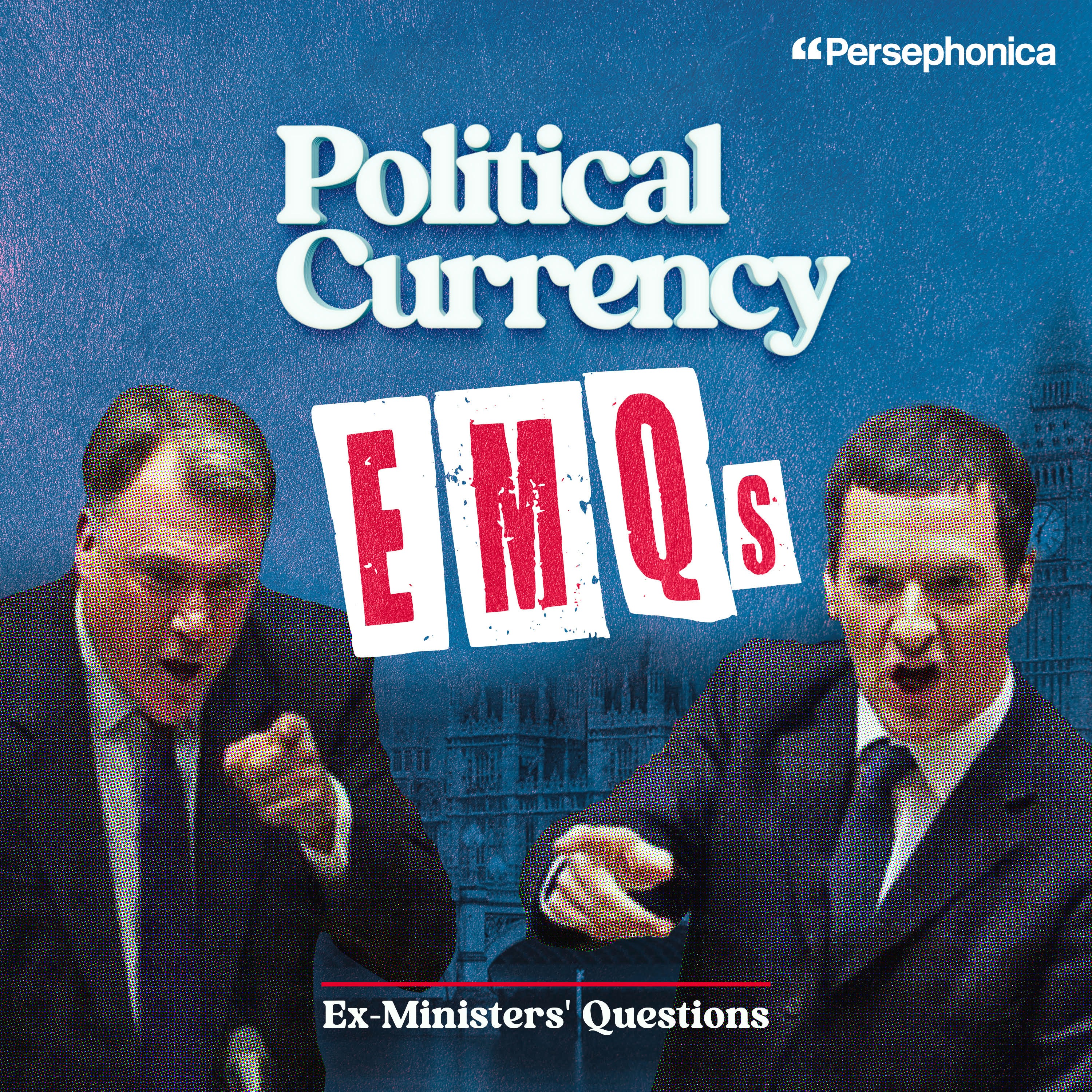
In this episode of Political Currency, hosts Ed Balls and George Osborne reflect on the nature of Prime Minister's Questions (PMQs), addressing the theatricality of political interactions, the state of cross-party collaboration, and contemporary issues such as foreign aid and EU relations. The discussion is framed around listener questions, providing insights into the machinery of politics and current economic realities.
Written by AI. May contain mistakes.

Ask about this episode
Get the gist, explore an idea or ask about something said.
 Claude
On Political Currency, what are the key points of this episode?
Searching your listeningTranscript
Automatic transcript. May contain errors.
0:00The Chancellor of the Exchequer. Getting a lesson from the Shadow Chancellor on how to balance the books is like getting a lesson from Dracula on how to look after a bloodbath. Ed Balls. A steady as she goes budget. What kind of ship does he think he's on, the Titanic? Hello Mary Celeste. Welcome to EMQs from Political Currency with Ed Balls and George Osborne.
0:27So hello, welcome to EMQs, Ex-Ministers Questions. and we are remote. I'm sitting opposite George. Normally at this point, you share with us some cultural gem from your kind of rich international life. No, I haven't been to see any plays or whatever this week, but I did get to the book launch of a book called The Seven Rules of Trust, co-written by my friend, Jimmy Wales, who's also the founder of Wikipedia. And it's all about how we establish trust in the world. And, you know, Jimmy is just a brilliant ideas guy. He's just endlessly restless with thoughts and ideas. And of course, Wikipedia is an incredible creation and powers on even as the digital world changes and morphs.
1:12And I think it's worth saying, unlike quite a lot of these other creations of the digital age, the Facebooks and the Googles, this has actually been always not for profit. And Jimmy, maybe there are moments where he regrets it, but he is not a multi-billionaire as a result of his creation. he's put it to good public use and now he's written about how the lessons he's learned from his life can be applied to a pretty divided and distrustful society. Well I'm going to do a bit of a cultural plug then given we're in that mode. I went to, it wasn't a book launch, it was a book celebration a couple of weeks ago organised by the family of Malcolm Bradbury.
1:48It was the 50th anniversary of the publication of The History Man by Malcolm Bradbury, the 25th year anniversary of Malcolm Bradbury's death and also a partnership they do around promoting literacy and reading for young children, which is fabulous. But I, as a consequence, re-read The History Man by Malcolm Bradbury, which is an early 70s novel all about an academic with loose morals, but who is a Marxist sociologist at a new university. It was famously a BBC adaptation with Anthony Sherr, I think in the early 1980s. But when you re-read this book, it is so sharp, and the satire is so with it.
2:30It doesn't feel 50 years old at all. It could have been written today. It's such a great book and a book of moral depravity and total political hypocrisy, but really good read. So if you fancy a novel and you want a bit of cultural history, The History Man is great. Someone could write, couldn't they, a satire about modern campuses, I imagine, modern campus life. The return of the Marxists to some of the teaching. You'd be surprised if you reread The History Man how much his saturn of campus life in the early 1970s feels like. Right. 2025. I mean, it is so brilliant. Anyway, let's get on to our first question from one of our gold subscribers called Elizabeth.
3:09And her question has been voiced by one of our producers. Hi, Ed and George. Elizabeth here, a gold subscriber from Bradford. I absolutely love the podcast. I listen to several political podcasts and yours is by far the best. I was infuriated by David Lammy's failure to answer questions at PMQs recently. Too often, the Prime Minister and others just don't answer. Should the Speaker have the power or even the duty to compel ministers to actually answer the question? And if an answer isn't given, should the Speaker be able to demand a written response or a select committee appearance? It feels like, when the government refuses to answer, democracy is on a slippery slope.
3:48Well, thanks, Elizabeth. I mean, I know about the PMQs you're referring to. That's when David Lammy was stepping in, wasn't he, for Keir Starmer who was abroad and he had a pretty ropey PMQs, I think would be a polite way of putting it. Although his conservative opposite number also forgot a number of questions out. So I think neither side had a brilliant outing. But your point is that, you know, he didn't answer the question, which was all about the accidental release of prisoners. I think this may disappoint you, and please don't counsel your gold membership as a result of what I'm about to say.
4:18But I think you misunderstand, and indeed many people misunderstand, what PMQs is really about. It's not just like, will the government answer questions? The clue is not in the title. It is not really Prime Minister's questions. It's a piece of theatre, political theatre, and it's a kind of contest principally between the Prime Minister and the leader of the opposition, although the leaders of the other political parties also get a look in. You need to see it more like that. You know, the questions aren't being asked because the person asking them really wants the answer. And this applies not just to Kemi Badenock or James Cartlidge in the case of this encounter you're talking about.
4:58Backbench MPs are not asking primaries questions because they don't know the answer to their own question, right? They are asking it either to promote a cause that they have in their own constituency or that they more broadly support, or to suck up to the prime minister and kind of give the prime minister a sort of low ball that he can knock back across the net, or to try and trip up the prime minister. You know, normally when you ask a question because you don't know the answer, in the case of PMQs, everyone knows the answer to the question they're asking. And so therefore it's a bit harsh to say the government's not answering the question, or the prime minister, or in this case the deputy prime minister, is not answering the question.
5:36It's how you respond to that piece of political theatre coming at you. Now, you can use the evasion and the apparent failure to answer a question to your benefit if you're the leader of the opposition. And indeed, as a prime minister, you can throw questions back to the leader of the opposition. Therefore, to your specific point, the speaker would be making a mistake if they were intervening to say the prime minister is not answering the question, because that's not really the job of the speaker at PMQs. Well, the job of the Speaker is to make sure people don't go on for too long, that the noise doesn't become so overwhelming that the Prime Minister or the Leader of Opposition can't be heard, but to allow enough noise that it remains a kind of lively, vibrant environment, which I seem to remember you were very happy to contribute to.
6:22And so, you know, I think a kind of gentle touch as a speaker is what's required to make the thing work. And to keep it what it is, which is a test of parliamentary wills and a test of strengths. And something that I think is a very good check in our own political system on how the government's doing, how the Prime Minister's doing, and making sure the Prime Minister's on top of things, which most other political systems don't have. I don't disagree with the bigger point you're making about the theatre of PMQs. But actually, I do think whether people answer questions at all and whether they answer them well, but also whether they make mistakes and give wrong answers.
6:59I mean, actually, those things can have quite a big political impact. So it's not just about the theatre. It's also about the detail. To defend David Lammy a little bit. And by the way, I think he had a catastrophic 24 hours. but in that moment in PMQs when he is asked by Mr Cartlidge, Cartlidge makes a mistake and he asks and then asserts the prisoner who has been released. He asserts that he's an asylum seeker and I think what happens in that moment is that David Lammy suddenly kind of worries. He thought he knew the facts. He's suddenly told over the dispatch box that it is an asylum seeker.
7:37That is not what he's been told. He is so worried about saying something wrong that he then doesn't answer the question and uses bluster. And of course, it turns out that it wasn't an asylum seeker. So actually, Cartridge was wrong. And the reason why David Lammy didn't answer the question was he worried that he was going to give a wrong answer to what turned out to be a mistaken question. The mistake, though, is as well as the bluster, is the Speaker then asks David Lammy or one of his ministers to come back and clarify the position that afternoon. And David Lammy refuses to do so, and then also doesn't do the morning medium round.
8:14And that is where he really loses standing. And so to go to Elizabeth's question, the Speaker has a lot of power, but it's not the Speaker's job to say whether that's a good answer or a bad answer, or whether you've answered the question at all. That is for parliamentarians to decide. And the moment the Speaker started to intervene and saying you've not really answered the question. That is so subjective and draws the speaker so much into politics that he can't do that. The speaker, though, can decide who speaks, how they speak, the language they use, the rules of the game, but also they have the power with procedure to call you back.
8:50So if the speaker says come back and clarify and you don't come, that is very bad for you. The speaker the next day can then order you to come back by granting an urgent question. I think speakers have quite a lot of procedural power to, in the end, force the government to be held to account. And in this case, the Speaker could have gone on to call the Deputy Prime Minister or his team back formally if they hadn't been willing to come back anyway, but too late the following day. So I think to answer Elizabeth's question, the Speaker has power and you're right to want proper answers. But I think the Speaker doing what you're suggesting and demanding an answer there and then in the House, that isn't the Speaker's job and I think that would actually be quite compromising for the Speaker, but procedure gives them a lot of power anyway.
9:39Right. Our next question is from a parliamentarian, from a member indeed of the Shadow Cabinet and that is Victoria Atkins. Hi George and Ed, it's Victoria Atkins here. Love the pod. With food prices climbing, record farm closures, plummeting business investment, two pubs or restaurants closing every day, and the tragic human costs of the family farm tax already being felt even before the tax has come into force. I think this is a food and farming emergency. And this is why before budget, I'm holding an emergency summit for farmers and food producers to tell me the urgent measures they need to survive the next 12 months.
10:22And then I'm going to do something different. I'm going to put party politics to one side and offer these measures to the government in order to save British farming. So my question to you is, when you were in Cabinet, did you ever put party politics aside and accept an offer from the opposition in the national interest? Many thanks. Bye. So I have to say, I mean, I'd laughed out loud listening to that question. I mean, brilliant from Victoria Atkins. You know, there's a food price emergency, this terrible family farm tax. She's calling a summit two weeks before the budget to demand action. And having done all of that, she's putting party politics aside in order to achieve a consensus.
11:09Utterly brilliant, Victoria. That was the most party political call for a cross-party consensus that I've ever heard and all power to your elbow. That's what you should be doing. But to take your question at face value, of course it is the case. There are sometimes moments when you can have a cross-party collaboration to deliver a change and also to solve difficult problems. In the case of the royal finances, George Osborne as Chancellor came to Ed Ball, Shadow Chancellor, and asked for a conversation. And I cooperated and we sorted out a problem together, I mean, based upon your decision-making and Treasury expertise, but we did it consensually, and that is an example of what you're talking about, Victoria.
11:51Why are we not members of the Royal Victorian Order as a result of sorting out the royal finances? I just assume that it's in the pipeline. Are you a knight? No, I'm not a knight. Just a plain old mister. Are you not Sir George Osborne? I'm a companion of honour. I know, but I don't care what you are. I'm talking about whether you're a knight. No, I'm not a knight. Did you say no? No, I didn't want it. I'm happy being... Well, sorry, a companion in honour is a great... I'm very lucky to be one of those. I don't mind if you're a companion in honour. I'm asking whether you're a knight. No. So we're still waiting for the reward.
12:24For those who don't know, by the way, the Victorian Order is for services to the royal family. That's the award that the royal family had. that. But I was going to say, you know, take another example, social care, total failure of British politics in the last 30 years to find consensual, lasting solutions. I've always felt that was one problem, which if it's done parliament to parliament in a party political way, you've got no chance. And I look back on the period, the Dilnot review, you as chancellor, be a shadow Chancellor, could we have done a better job at finding a way for there to be a consensual cross-party solution to this massive intractable problem in the way that Victoria suggests?
13:07Because I think it would have been in the public interest. So I think I regret that. That's a good point. We should probably come back, shouldn't we, and discuss why there hasn't been a consensus on social care. Fundamentally, because it's really complicated, you either have to kind of nationalise the care system or you have to seize people's homes and require them to sell them before they die and so on. To get back to kind of Victoria's question, I agree a bit with the way you've characterized the question, Ed. I mean, I wouldn't say it was the most unpartisan way of calling for a bypass sound approach.
13:37The segue was jarring. Victoria's all credit to her for promoting her summit on the show. I was thinking, you know, it's interesting cross-party consensus and agreement. I think there are sort of three different categories of it, which I was going to expound. So the first is when the government calls for cross-party consensus, and this can be a real bear trap for an opposition. And it can be really difficult for an opposition. I was thinking of three recent examples. COVID, you know, the Labour opposition finds itself having to kind of go along with these massive decisions of the government in 2020.
14:16And then, of course, it's really difficult to find the sort of moment when you need to sort of break free a bit and start criticising the government. And the government says, I thought we had a national consensus on how to deal with this crisis. There was something similar actually in the immediate aftermath of the Iraq war with the Conservative opposition had supported the Blair government. Michael Howard found it really hard as leader of the opposition to sort of break away as things started going wrong in Iraq itself after the conflict. And during the financial crisis, as shadow chancellor, like David Cameron, as leader of the officer, we had pledged our support to Gordon Brown and Alistair Darling.
14:48And then of course, you know as the opposition you find yourself sort of dragged along week after week and everyone's saying where's the opposition and why are you not saying anything and you're giving the government a blank check and and then when you try and kind of get yourself out of the bear hug it's it's really hard so this first thing is opposition seems to be really careful before walking into this sort of demand for cross-party approach to some national crisis but hard to avoid i often ask michael go for it and he always had none of it. Yeah. So then there's a second thing, which is in opposition, you can offer cross-party support.
15:22And that can often be used to say more about yourself than the government, because the government may not want it particularly and may not need it. But I was thinking of examples. So Tony Blair as leader of the opposition, I think was the first Labour leader to agree to the renewal of the Prevention of Terrorism Act, which the Thatcher government and then the major government had introduced and had to be renewed every year. These were like extraordinary powers to deal with IRA terrorism. And it was quite a big moment that the Labour opposition was indicating that it's serious about crime and security and terrorism.
15:56And during the Cameron opposition, we offered support to the Tony Blair government on the renewal of Trident. Well, I mean, that may be not such a, it's hard to think of how the Conservative opposition would have opposed that, but on Ruth Kelly's Education Act, which was all around setting up academy schools and David Cameron offered his support, but it was really about saying, you know, we're a grown up opposition, we don't always oppose everything. And it was also causing trouble for the Labour Parliamentary Party at the time. If I was Victoria or indeed the Shadow Cabinet, you need to think of something where you offer support for difficult decisions on tackling incapacity benefit, which is only just going to cause like trouble for the parliamentary Labour Party at the moment.
16:38So there are those sorts of things. And then the final group of things which are much more substantive and real and important are the ones you're referring to, where there is genuine cross-party effort. And I'm thinking of funding of university higher education, where there's been a cross-party consensus on that, broadly speaking, increase in the state pension age, where there's been a cross-party approach that, i.e. Labour commissioned report, the coalition government implemented it, and auto-enrollment in personal savings, pensions and labour report implemented by the government I was part of.
17:11Those are things where you get really big things done. And I think you've made the observation on this show before that what really matters in politics, what lasts rather in politics, what endures is when your political opponents, whether reluctantly or willingly, agree that what you've done is going to and not be removed when they get into office. So lots of things there. If I was Victoria in the shadow cabinet, it's more the second bucket you want to be looking at. I think our question was rather suggesting the second bucket. Yeah. Anyway, I hope your summit goes well. Very good question. Thank you, Victoria.
17:44And we're glad to know that you enjoyed the show. We'll take a break and then we'll be back with another question.
17:58Welcome back. Our next question comes from fellow podcasters Christiana Figueres and Tom Rivett-Carnock, hosts of Outrage and Optimism, one of our sister podcasts. They're in Brazil right now reporting from COP and they've sent us in this question. OK, so we're here in our studio in Belém and we're saying... Unusual that we're in a studio. And we're saying hi to Ed and George on Political Currency. Pretty cool. Hello. Hi, guys. And we have a question for you. One of the big disappointments here has been that the UK has not put money into the Tropical Forest Forever facility. And I have to say the Brazilian government are devastated that the UK didn't come through and support them at this critical moment.
18:38And we're just really curious to ask you whether a different political calculation could have been made. Ed Miliband said very clearly he thought that the people were in favour of more action on climate. Of course, the budget is coming up in a few weeks and there's huge fiscal pressure in the UK. But do we not think that a government that had more sense of purpose and direction and really tried to sell this to the people could have gotten that through and actually showed up for their Brazilian hosts here and provided more momentum for the COP? And as a subtitle to that, how could they have sold it better?
19:11What would they have done to sell it? Absolutely. So if you want to find out what's going on at COP in Brazil, you can listen to Inside COP. That comes from Outrage and Optimism, which is delivered every week by Christiano and Tom. So I totally agree with Christiano and Tom. I find it really depressing that the government didn't decide to engage on this. At the point when it was decided, I know there was some debate about it, whether Keir Starmer was going to go out to Colt. I assume that the decision for him to go was because he was going to be part of this multilateral commitment. And they then decided to not do it.
19:47They're not doing this. It looks like they're going to be reducing expenditure through the Global Fund for TB, Malaria, AIDS. The reality is, because the government has withdrawn so much funding for the aid budget and moved it over to defence spending, it means there is far less latitude for them to be involved with these kind of multilateral initiatives than there was in the past. I just find that quite depressing. When we were in government, when you were in government, not only was the aid budget high and rising, but the Treasury under Gordon Brown and under you was driving international efforts to solve global problems through the use of the aid budget.
20:26And we don't seem to be doing that anymore. There's echoes of our last question from Victoria, isn't there? I mean, there was a consensus that Britain would honour its UN commitment to have an aid budget that was equivalent to 0.7 % of gross national income. And it was announced under the Blair-Brown period, and the budget started to ramp up, and it reached 0.7 % under us. But it feels like there's been a consensus, not explicit, but implicit among the political parties to reduce the aid budget ever since. Because it started to fall under, I think it was Rishi Sunak's decision as chancellor to cut the aid budget from 0.7%, although originally it was going to be only for a temporary period.
21:07And then I think much to everyone's surprise, you know, you get the first Labour government in more than a decade. And what do they do? They slash the aid budget. It's certainly true of the Conservatives, but it was particularly true, I think, of the Labour body. There will be a price to be paid for that, not just in the kind of consequences for Britain's leadership in the world and its soft power in the world and its ability to influence these big international summits, but also, in fact, in terms of the base of these parties in our own country, because there are a lot of people who care deeply about these international aid issues who feel deserted by both the Labour Party and the Conservative Party at the moment.
21:39But I think specifically on this, this is very puzzling. And it's a good question from Christiana and Tom. And by the way, congratulations on your podcast. And it's great you're going to tackle these thorny issues head on. Because for those who don't know, this is basically a big initiative of the Brazilian presidency of the climate change talks. And it's a facility that is going to help preserve rainforests. And it's hard to think of anyone who thinks it's a good idea to cut down rainforests. forests, not just in the Amazon, but also in Africa and elsewhere. Lots of European countries have put money into this facility.
22:15It's all being announced at the moment at this summit. So Norway has put in$3 billion into it. That's a huge commitment from a relatively small country, although quite an oil-rich country. I'm sure climate activists will be a little bit conflicted on that. The French have said they might put in half a billion dollars. Some countries have put in small amounts, like the Netherlands have only put in$5 million. And it seems therefore odd, given that you could probably get away. If the kind of treasury number 10 concern was, the sums don't add up, we're cutting the aid budget, we can't afford this nice to have international initiative, but frankly, not essential for us right now politically.
22:53I'm surprised they didn't say, but we'll put in$50 million, let's say. Now, people on the show will say$50 million is a lot of money, but for a government, it's not that much. And coming out of an aid budget, even a reduced aid budget. It's not that much. So I find it a bit odd and it left Britain a bit naked at the negotiating table, didn't it, at COP, even though Kirstama went there and the Prince of Wales went there as well. I think he had a pretty successful visit. It left a pretty sour taste, particularly for a country that only a decade ago was, you know, the global leader on these issues.
23:24Although let's be honest about this COP summit. It's not just the consensus within the UK on action on climate change, which appears to be weakening. It's globally as well. I mean, there used to be a badge of pride to go to COP and make your contribution. These days, leaders weren't turning up. Of course, Donald Trump boycotting COP, having withdrawn from the whole Paris Agreement on climate change. There'd be a bunch of leaders thinking, well, you know, if Trump's not going and is disapproving, maybe it's better for our national interest not to turn up either. But that is just an excuse. Interesting piece by Dieter Helm in The Times on Saturday, a long piece, arguing that we are going backwards on climate change, pointing out how many countries, and by the way, according to Dieter's piece, this involves Brazil doubling down on investment in fossil fuels in the way that the Americans are loudly championing.
24:16But of course, we know China, big fossil fuel energy consumers as well. It doesn't feel as though either action on climate change and outcomes or political support is advancing it feels it's going backwards and the question we just had there from christiana and tom i mean i think this is a straw in a big and quite worrying wind but uh good for us to talk about it we'll come back to climate change again on the main podcast because why that consensus is crumbling and how dangerous this is and what that means for the world and also for british energy policy is something we should talk about again.
24:50Thank you. We've got another question for Matt. Hi Ed and George, Matt from Kent here. I really enjoy the podcast, so keep up the good work. The Labour government has set very ambitious targets for new housing, but we're seeing a clear downturn in the construction of new homes. Why do you think there is such a disconnect between one of the government's main priorities and the actual pace of house building? I work for a construction company and we're seeing many new housing schemes being paused, delayed or cancelled altogether, mostly because developers can't sell their existing stock and are reluctant to commit to new projects.
25:25What measures could Rachel Reeves announce in the budget on the 26th of November that will help get Britain building? So good question for Matt and it is true, I had a look at this, the numbers on housing starts and housing completions have been very poor this year and there is a tension between the government saying we're going to build 1.5 million homes and the numbers are feeling quite disappointing. And that is despite the big push the government is giving to planning reform, the bill going through Parliament, but also trying to put some more capacity into planning systems around the country.
26:01It is clear that the environment challenge we've discussed this before to getting houses built is still a big problem. There have been increases in building regulations for understandable reasons after Grenfell, which have led to a lot of new developments being set back. The planning system is still painfully slow, but I think the most important thing is what's been happening in the economy, the high interest rates here in the UK because of the inflation problem, a real challenge to viability, not of new planning applications, but people who have planning permission already, companies going ahead and building those houses.
26:37And there was a straw in the wind a few weeks ago, Sadiq Khan and the Housing Secretary Steve Reid announcing a reduction in the share of big housing developments which need to go into affordable homes because at the moment they say it's just not viable in the current economic climate. I asked Steve Reid about this on Good Morning Britain and he said well look a 35 % share being in affordable housing is all very well but a 35 % share of zero is zero. And if you want to get the houses built, you have to tackle that viability and affordability challenge. And let us hope as interest rates come down, which they will, into next year, this is going to ease the pressure.
27:19Yeah, I think all that is right. And I think that what you make about the percentage of developments that need to go to social housing, I think that's a kind of classic case of in opposition. The Labour Party said, let's get the developers to pay for more social housing. Then you get into government and you find, well, as a result, developers aren't going to develop anything because they can't make it economically and commercially viable. And so they just sit on land and don't develop it. So I thought actually that was a very realistic, sensible thing for Sadiq Khan and Steve Reid to do because it's like recognizing reality.
27:52And I would say, you know, more broadly to parliament, and this is not a left or right wing point. I think you have to ask yourself, like, what are you actually trying to achieve? Everyone says they want to have homes for people. Everyone says it's terrible that young people are being priced out of homes and so on. And yet Parliament, and this happened under the Tory government, as well as the Labour government, passes more and more requirements on developers around water quality, biodiversity. We had a question, didn't we, a week or two ago about spiders stopping Ebb Street Town Centre being built.
28:25If you require all these things, building standards, minimum sizes of bedrooms, all these things are very desirable in their own right. But you put them all together and you just make these things very hard to become kind of commercially viable. All that said, the elephant in the room is the state of the economy. In the end, unless the government is actually paying for social housing and saying, okay, you build the house, we'll pay for it. These houses have to be sold. There are a lot of people out there nervous about the economy, nervous about the direction of travel of the economy, and they don't want to make a big financial commitment and buy a house and nervous about future direction house prices.
29:04They also find it hard to afford housing, not just because they're expensive, but hard to afford the mortgages that enable you to afford housing. Mortgages are a good thing. They're a great way of moving money from one part of your life to another time of your life when you need it up front to buy a house. And I think post-financial crisis, and I was certainly putting my hand up and saying I was part of this, there was a kind of dramatic tightening of mortgage standards because of what had happened at Northern Rock and other HBOS and so on. But as a result, you know, it just made housing more and more unaffordable.
29:36And the help to buy scheme, which, you know, I'm not saying it was perfect, but that was my attempt to try and make housing more affordable. I don't know why it was. It was actually abolished by the SUNAT government, which I think is a bit mad and hasn't been revived in any particular form by this government. It's the macro uncertainty, isn't it? And that, you know, frankly, that's not housing policy as economic policy. It wouldn't be a bad thing for the housing secretary to sit down and ask from their officials all the requirements that are now on a developer, all the regulatory requirements that are placed on a developer and get the developers in the room and they'll explain to you why, you know, therefore it's hard to build houses.
30:12I think that's right. I was talking to people at the British Property Federation about this a few days ago. All those detailed things are important, but the most important thing at the moment is the macro and the uncertainty and the financial viability. But, you know, let us hope growth returns, interest rates come down, inflation is lower, and we can get moving. Yeah. Where's our magic wand to make all those things happen? Who knows? Thank you, Matt. We'll take a break and we've got time for one more question.
30:47welcome back our final question is from pierre and he listens to us in malta hello dan george it's pierre portelli from malta i listen regularly to your podcasts and I am one of those who is very disappointed that the UK has left the European Union. I think that besides the mistakes made during the campaign, the EU, all of us should have made it more possible for the UK to remain. But that's the past now. I keep hearing many, many, many of your listeners suggesting that there should be another referendum, that one of the main parties or even the others should start campaigning for the UK to rejoin the EU.
31:40But correct me if I'm wrong. If you had to decide to join the EU again, would the terms be the same that you had before? Because I think not. But I believe one of the things you would have to accept is the euro. I might be wrong, but I'll listen for your replies. Thank you very much. I think you're right, Pierre, in a kind of strict, literal interpretation of what the EU currently requires of new countries that want to join. So it requires that they commit in principle to join the euro, even if that is going to be a process that takes some time. So they don't have to join the euro immediately on becoming a new member state.
32:22I think the most recent new member state is Croatia. It is a member of the euro, but it didn't join, I think, immediately the euro. So you could say, well, that is a complete non-starter for the UK. Now, personally, I think that's something that you could negotiate away as part of these mythical accession talks, because I think both Ed and I would say there's not much prospect of Britain rejoining the EU anytime soon. and this is not the main obstacle to us rejoining. But I think, you know, if were this government to suddenly say, we want to rejoin the EU, I think the EU would set aside the requirement to join the euro.
32:59Much, much harder are the other requirements on joining the EU. So first of all, there's regulatory convergence. And although if you're Nigel Farage or whatever, you would say, Britain hasn't made the most of its Brexit freedoms, I would say, well, rubbish to that because it was never going to really. And in fact, there's a new report out, isn't there, that the total economic damage of Brexit to the British economy is now estimated to be at 6 % of GDP, which is like a huge amount. There are some areas where we've diverged on rules. So you'd have to kind of reconverge on that. But the really big two obstacles would be free movement of people, a core requirement of EU membership and hard to see the EU conceding to the UK in any particular way.
33:45I think we could probably get our opt-out back from Schengen, but that's more about border controls. But free movement people, the EU has not budged on that. And frankly, at the moment, the EU is the external immigration into the EU rather than the internal migration within the EU that is the kind of hot political subject in most of these member states. So I don't think we would negotiate a concessions that I wasn't against free movement of people and seems to me rather odd. We've switched. We had migration from Europe and we've switched it to having migration from the rest of the world. I'm not sure that's been particularly sensible for the UK, but I can't see at the moment winning that argument.
34:21And then this very thorny issue, which actually Keir Starmer is running up against now over some of the things he wants to do in terms of cooperation with the EU on things like the defence budget, defence procurement, is this issue of do you have to paid money into the EU. Because there's no doubt when Britain was a member of the EU, we made a net contribution, even with rebates and rows about budgets and the like. But we were, I think, from memory, contributing around£10 billion a year to the EU budget as a net contributor to the EU budget. And you can't really imagine British membership of the EU without some kind of substantial net contribution.
34:57And they may not give us the rebate back that Margaret Thatcher first secured. So I think it would come down to a row around money and immigration policy rather than Euro membership. I think that's right. And I think the way Pierre asked the question is really interesting. Because if you think about this in terms of the UK decides we want to join and asks to join, it's hard to see in the current political environment, our European partners not wanting to have tougher conditions on the UK, you know, a bigger financial contribution and in principle commitment about the euro, as well as, as you said, Schengen, VAT, all those different changes in regulation which have happened.
35:42But let's say for the thought experiment, which Pierre sets up, let's say that the EU came to Britain and said, we would like you to join. It would be good for you and us. And we offer you joining on exactly the same terms is when you left. That includes the Schengen opt-out, the Euro opt-out, let's say the same budget deal as at the point you left. I think that the stumbling block is free movement. I think it would be hard to win the argument that we should be making the same financial contribution. But if you decided we really wanted to rejoin and they were offering us the same terms, that's a fight you could have.
36:21By the way, it's cost us many billions of pounds more a year in terms of lost tax revenues and a weaker economy. So you could win that argument in a way we weren't able to at the referendum. On finance yet. But I think if the EU said you must rejoin on the same terms as regards free movement. And of course, that was the issue which David Cameron sought the renegotiation on in the first place. I think at the moment for the UK, that is very problematic. And, you know, I've always thought it was going to become increasingly problematic for other European countries as well. And let us see how German and French politics and Dutch politics continues to evolve.
37:00But at the moment, that free movement principle from the original Articles of Rome is still there. And I think for the UK, that is a huge problem. I just don't think you could win the argument, which is why I've always thought you've got to think about it as being a new relationship on new terms rather than an old relationship where we rejoin. Because I just don't think you can win the free movement argument now. Yeah, I mean, I'm being a bit devil's advocate here because I'm sure you're right. But do you think you could, given all that's happened since and the kind of Boris wave and, you know, hundreds of thousands of people coming from the Indian subcontinent, from West Africa, you know, you might say to people, look, actually, it wasn't such a bad thing.
37:37You had all these people coming from France and Italy and Poland and Hungary and whatever. And, you know, we're going to need immigration and let's take the immigration from our doorstep. The killing argument in the EU referendum from the Brexit side was take back control. For some people, that was about sovereignty in Parliament, but for other people, it's about the ability to manage our borders. And the fact that Boris Johnson then managed our borders badly and the fact that the British government still fights to control its borders, you know, practically doesn't take away the problem of free movement, free market, free for all, open borders.
38:12I just don't think a British government, Labour or Conservative, will agree to opening the borders to the European Union again after the politics of 2016. and understandably for this European Union that's probably an ask too far so when Pierre asks if the UK did decide to join the EU again would the terms be the same as those you had before and I think he's assuming that they would be worse and I'm saying even if they were the same I don't think it would now be enough well anyway all a bit hypothetical at the moment but thank you very much and I'm glad that we are listened to in Malta that is a great plucky Malta of course Malta got won the George Cross, didn't it, during the Second World War.
38:55The George Cross was awarded to the whole island for its bravery and defence. Well, thank you to Pierre and to all our international and UK listeners. And we love getting your questions from all around the world on any subject. Always enjoy doing EMQs. Do keep sending us your voice notes and emails to questions at politicalcurrency.co.uk. Also, if you ever have the chance to review our show, please do, because it helps us to get to more listeners. And we will be back next week with another episode. See you then.
39:31Thanks for listening to Political Currency. This has been a Persephoneca production.
From the publisher
What is the real purpose of Prime Minister's Questions? As an ‘infuriated’ listener asks why the Speaker can't force politicians to answer, George Osborne breaks down why PMQs is ‘political theatre’ and what most people misunderstand about it, while Ed Balls explains why David Lammy’s recent performance revealed the real procedural power the Speaker holds.
Then, prompted by a question from Shadow Cabinet minister Victoria Atkins, the pair break down when cross-party support actually works, and when it’s just a ‘bear trap’ for the opposition.
And, reporting from the COP summit in Brazil, the hosts of the Outrage & Optimism podcast ask why the UK failed to put money into the 'Tropical Forests Forever' facility, leading Ed and George to discuss the 'crumbled' political consensus on foreign aid.
Finally, the pair delve into the reality of rejoining the EU. Could the UK get the same deal as before? And what's the real obstacle to rejoining - could it be the Euro, the non-negotiable issue of free movement, or something else altogether?
Thanks for listening. To get episodes early and ad-free join Political Currency Gold. If you want even more perks including our exclusive newsletter, join our Kitchen Cabinet today:
👉 patreon.com/politicalcurrency
👉 Apple Podcasts
Please note: Kitchen Cabinet is only available via Patreon.
Credits:
Assistant Producer: Caillin McDaid
Senior Producer: Silvia Maresca
Video Editor: Maha Al-Badrawi
Executive Producer: Ellie Clifford
Political Currency is a Persephonica Production and is part of the Acast Creator Network.
Hosted on Acast. See acast.com/privacy for more information.
More from Political Currency
All episodes

We use cookies.They keep VO running smoothly and help us improve it. Privacy policy