
 Ask ChatGPT


- Podcasts
- Political Currency
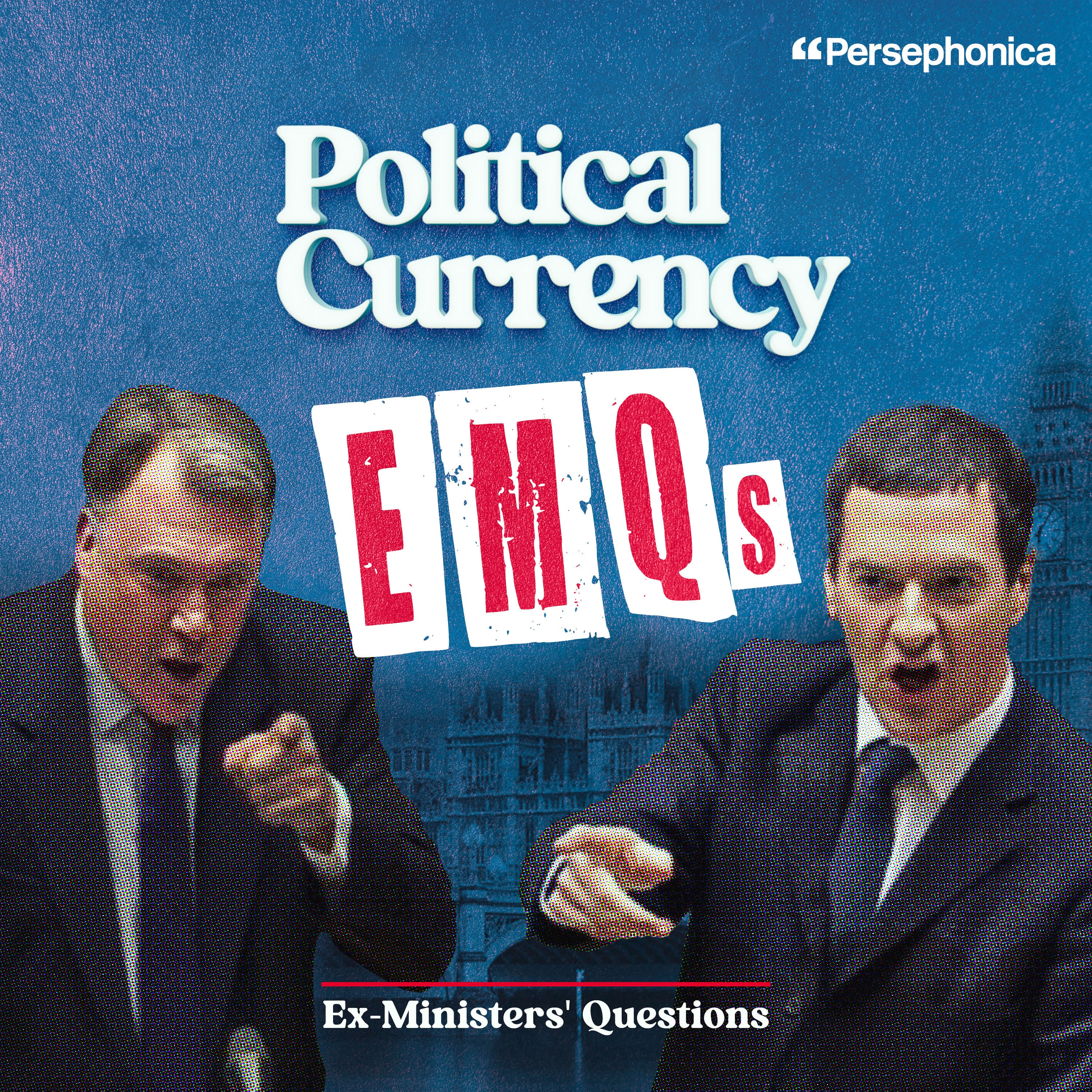
- EMQs: Is the political centre dead?
In short
In this episode of Political Currency, hosts Ed Balls and George Osborne delve into the state of the political centre in British politics, reflecting on the growing influence of populism and the emergence of alternative parties. They respond to listener questions, discuss peculiar planning challenges due to species protection, and share anecdotes from their political careers.
Written by AI. May contain mistakes.

Ask about this episode
Get the gist, explore an idea or ask about something said.
 Claude
On Political Currency, what are the key points of this episode?
Searching your listeningTranscript
Automatic transcript. May contain errors.
0:00The Chancellor of the Exchequer. Getting a lesson from the Shadow Chancellor on how to balance the books is like getting a lesson from Dracula on how to look after a bloodbath. Ed Balls. A steady-as-she-goes budget. What kind of ship does he think he's on, the Titanic? Bem-ary, Celeste. Welcome to EMQs from Political Currency with Ed Balls and George Osborne.
0:27So hello and welcome to EMQs, Ex-Ministers Questions. and George is doing EMQs from California, from San Francisco. But also I think there's a paleness to him. I think it might be a lingering hangover. I think it might be Saturday's British Museum high roller, expensive ticket, George got the only freebie ball. I think I've always had a pallor to me. It's my Hungarian blood. So it's not a big hangover which has lasted five days. It was a good night. It was a great night, actually. We had a big, big fundraiser at the British Museum. 900 people came. I am not going to claim credit for it at all because our excellent director, Nick Cullinan, and his co-host, Isha Ambani, organised it all with a great theme, pink, which was connected to the pink colour in our India exhibition.
1:20British High Society turned up and we raised lots of money for a museum which is free. It's free to enter. And so we've got to raise money. and we want to keep it free to enter. And we also want to spend money on things like the international partnerships we have, which is where the money from this ball is going to go. Including playing Voice of God, British Museum board member, Claudia Winkleman, which prompts me to ask, have you finally caught up on the traitors or are we still in a cultural void and vacuum? I did catch up on my flight to San Francisco. I binge watched all four episodes that were available.
2:00And thankfully, I somehow managed to avoid anyone telling me what's going on. So everything was a surprise. And I didn't, I'd never watched the original Traitors before. So I absolutely loved it. We should give nothing away. But Jonathan Ross, how's he doing it? Well, we're not giving anything away because the public knows he's a traitor, don't they? At this point. Well, it depends if they were waiting to watch it all in one go. Yeah, sorry. That's what I meant about spoiler alert. It's in the first episode. And it's pretty early on in the first episode. You're right. Okay, fine, fine, fine, fine.
2:33I like him. Yeah, I like them all, actually. I think the other traitor, Kat, she is lethal. She is. She'd definitely be on my assassin team if I was assembling one. She would have been one of George's PPSs in Parliament. Yeah. I'm very, very impressed by her. Anyway, I'm impressed by the whole show. I was messaging Claudia while I was on my airplane saying, this is absolutely fabulous. And she's brilliant as well. I mean, the whole thing is done. I'm sorry, I'm so out of touch because this, you know, everyone has already known this for several years. But it's a very, very, very good show. I think what's revealing, though, about what you just said, I mean, I don't do them that often, maybe kind of once or twice a year.
3:16But, you know, a really long-haul flight and you get on the airplane You can't use your mobile phone or get any internet for five, seven, ten hours. I mean, I love it. And I have never, ever used an aeroplane Wi-Fi, other than actually on the way back from France a couple of weeks ago because I wanted to see the Norwich game. I actually managed to watch the whole of Norwich Ipswich on an aeroplane above France on ITV on the Wi-Fi, which actually made me think, God, this Wi-Fi is amazing. But never on a long-haul flight. Do you actually kind of sit on a plane doing your emails? I mean, don't you want to escape?
3:53I think you can do both. It's quite a long flight to say. And a bit of sleeping as well. Anyway, congratulations to Claudia and everyone and to the British Museum board, which was a big, big, big success. Well, this is not going to be a British Museum themed EMQs, but we're going to start with a British Museum question. And it's from one of our gold subscribers, Chris, who actually sent us this question. with the help of his daughter Holly. Hi George and Ed, this is Chris from Penge, South London's hottest postcode per Time Out magazine. I'm just here in the car with my daughter Holly. Hello. Listening to the show.
4:28The question that we had is about national treasures. My wife Lynn and I, and some very close friends of ours, went to a silent disco at the British Museum a month or two ago and had the most fantastic time. So a huge thank you George for approving that. The question that we have for the two of you is whether there are other creative and innovative ways of using and showcasing some of the country's national treasures like the British Museum that we have as a country in the same way that the Silent Disco did. Thank you ever so much for the show. Keep up the amazing work. Thank you very much indeed, Holly.
5:00Good to know that you're a listener with your dad. It didn't sound like you were invited to the Silent Disco, but that was clearly an error of your parents, and they should next time. What I wonder, George, is do you do, because I know others do this, Do you do at the British Museum a night at the British Museum sleepover? Because maybe you could invite Holly to come to that with her dad. Yeah, we do. We do sleep in with the mummies, of course, especially with Halloween coming up. That's very popular. And then the Natural History Museum does its big sleep in with the dinosaurs. Is that like a Tory MP fetish where you get like, you know, jam roly-poly and weird things happen?
5:37Or is it for kids? Jam roly-poly. Where do you get that from? I don't know. I just have this idea of all these Tory MPs kind of wanting cream cakes thrown at them while having jam roly-poly, a night with mummy. Yeah. That was a bit of a public school caricature. I apologise for that. I think it was like oranges and plastic bags, wasn't it? Let's definitely not go there. Anyway, we're not going to go there. I think all of these British heritage attractions and museums are working hard to attract new visitors, find new ways to bring people in, frankly, generate additional income. So I took my kids, my little kids to the theater.
6:21We went to the Halloween Trail at Kenwood House, which was great the other day. And that's exactly the sort of thing people are doing. But it shouldn't really, you know, there is a big, crisis is too strong a word, but there is a massive squeeze on arts funding in this country. I think people were waiting for a Labour government for things to kind of get better, as they would see it, the arts lobby. And they've been rather sort of stunned and surprised that that hasn't happened. And if anything, the kind of DCMS budget has been further squeezed. And there's been quite a lot of talk of DCMS being abolished by Keir Starmer, as if he's sort of, you know, or number 10 don't sort of care so much about the sector.
6:59But I should say at the BM Ball, it was great to see Lisa Nandy came and had a good time, had a nice chat with her and Sadiq Khan. And I thought it was really important for the museum to have both the Secretary of State of Culture and the Mayor of London kind of really getting behind the museum. I'm still confused about this. I mean, but you told me I couldn't come because you have to be really, really rich. Yeah, or important. Oh, OK. OK, well, that's me put back in my place. I mean, I don't really know how to tell you this, but if Mrs. Balls had wanted to come. Then she'd have been in like a shot.
7:35Chris actually asked us to kind of come up with some other ideas. So how about abseiling from the Blackpool Tower? Have you done that? I actually did a sleepover outside for charity at the Oval Cricket Ground. Unbelievably cold and extremely painful. Really? I know, yeah. I mean, you know, talk about putting yourself through it. How about, but I think a Tower of London sleepover would be good in one of the dungeons. I don't know. Yeah, I think they're probably a bit nervous about the crown jewels these days because of what happened at the Louvre a couple of days ago. Exactly. Not that we should like that.
8:05That's a very, very serious. We're all reviewing our perimeter security, I think, in these museums as a result of that. Cricket in Kew Gardens. I think they banned ball games, but you could have an exception. I'm just being creative. You wouldn't know, but the ball's going to go whacking into the big glass house. It's why you have to have good feel. There's a lot of innovation going on. And, you know, it's like not easy at the moment. And if we maintain this free charging policy, which is not such an issue for the British Museum because we've always been free. But remember that most of these museums has only been relatively recent that they're free.
8:40And it's quite a bit, you know, if you go to any museum here in San Francisco or indeed in Paris or whatever, you pay. It's quite an unusual policy. Introduced by the Labour government in 1997. Yeah, you know, I remember when the Liberal Democrats during the kind of austerity budgets, They commissioned work from the Treasury and the Cabinet Office on, if we were to take away things that hit middle-class people, particularly upper-middle-class income brackets, what would they be? And the study came back and they said, well, there are two things that you could really do that would hit the upper-middle-income brackets.
9:16One was put the tuition fees up even more. I was like, oh, well, we don't really want to do that. And second, we could get rid of this free museum entry that the Blair government introduced. Everyone looked at each other and said, no, I don't think we want to do that either. I thought you could say VAT on private schools, which could also have gone into that. This was public expenditure that disproportionately benefits upper income brackets. I think actually free swimming lessons was another one. Anyway, certainly the British Museum will remain free. and thanks to all our donors and supporters and people who paid for tickets who came to our ball as a result.
9:52And thank you to Chris and to Holly. I mean, I would have been there, obviously, but I was actually watching Norwich lose their home to Bristol City. Aren't they about to be relegated? We're in the relegation zone. I mean, it's not started well. Never used to happen in your day when you were chairing it, right? Just saying. It certainly did not. Although quite a lot of the footballers could probably afford to come to your British Museum ball. The next question comes from Becky. Hi Ed and George, my name is Becky. As expected, I am a big fan of the podcast. I usually save your shows to listen to when I'm putting the clean washing away.
10:28Sorry, I know it's not exciting, but I'm a working mum to a toddler. My husband and I have recently bought a house and have submitted a planning application. As a part of the process, we require a preliminary roost assessment survey, which will cost upwards of£600. If the private company completing the survey deem there is even a slight potential for bats, to roost in our property our project will be significantly delayed. We would have to pay for further surveys and licensing which could take years and cost anything from£10 ,000 to£15 ,000. I have read several planning applications recently where devalue buildings can't be knocked down due to bats.
11:06why in a time when housing is hard to come by is building and development being held hostage by bats or the potential of bats i'll be interested to hear your thoughts thank you and happy halloween so george bats what do you think of this one i mean um i've always thought bats um were rodents really but it turns out that they are a very protected species and have a very important role in the environment. There's loads of conservationists and enthusiasts who are worrying about the bat population falling and they're important in terms of eating insects and being part of the ecosystem. Also actually, just to give you a little bit of philosophy, I did philosophy of mind when I was a student in my part of my degree and there was a very famous article by a philosopher called Thomas Nagel called What's It Like to Be a Bat?
11:56And it was all about how you understand consciousness and being a person and whether you can put yourself in the mind of somebody else to imagine things from their perspective the example was a bat you know on the grounds that bats don't see they use sonar although i did a bit of research before this podcast and it turns out that bats do see they see quite well in the dark so um it's completely untrue they don't use their eyes and but they do use sonar as well anyway a little bit of philosophy of mind thrown in bats what do you So what has that got to do with planning permissions? Absolutely nothing.
12:31Right. Well, I just think we've gone slightly bonkers on all this in Britain. We're not the only country. There's lots of debates about this in places like France and indeed in states like California where I'm living. We have wanted to protect habitats and biodiversity, but this has led to an entire industry around basically species protection for when you get planning permission. And it's a bit of a racket. frankly and very expensive for people like becky i mean you know tens of thousands of pounds right no no but becky's experience is exactly the experience i had when we were building an extension in our house in somerset so you have to have a bat survey these people come they kind of sit in armchairs in your garden in the in the dusk and count the bats flying around they then you know they have to come back at another time of the year for the sort of breeding season then they inspect all you know the house about where the bats might be living and then there's a bat mitigation but the whole thing ends up costing thousands and thousands and thousands of pounds on every single planning application like it that is a cost first of all it's you know there's a bit of us i felt there was always a bit of a sort of circular economy of the bat consultants advising the bat people at the council on the you know and everyone's basically uh not sure if bats have they do have claws don't they but anyway this is all like scratching each other's backs it's a circular thing and there's nothing you can do about it you're absolutely a prisoner if you're an individual just trying to do a home extension let alone a business trying to build a new factory or renovate a factory you're stuck all right and there's nothing you can do about it conservationists across britain are screaming at their podcast speaker yeah but they but but the result is you're losing you know lots of people in britain would like biodiversity but that's not the same thing as a kind of industry which has come off the back of this and leads to the absolute absurdity of a 100 million pound bat tunnel for HS2, which is where it ended up.
14:29Because naturally England came up with this ridiculous idea that not a single bat could be killed by a high-speed train. It wasn't that you could create new bat nesting areas and encourage new bats to be born elsewhere. It's that you have to avoid any... The dogma, and this was true of the house extension in some sense, is that not a single bat can die or have its nest removed as a process of a building. And it adds huge amounts of money to the planning system. And we discussed previously on this podcast, you know, the Ebb's fleet, new town. The government's just an allowance to load in new towns, right?
15:04I tried that. Ebb's fleet. We actually built everything but the town centre, but the transport links in. The reason why there's no town centre in Ebb's fleet is because there are spiders in the grass and none of the spiders can be damaged. And so there's no town centre. Or if you go to the old naval dockyards at Chatham, by the way, an industrial site, old naval dockyards, the grass has grown up and there are starlings nesting in the grass and therefore you can't renovate those docks. I mean, basically what is a very good public policy intention, which is to maintain biodiversity, has been translated by various NGOs and English nature into ludicrous decisions where hundreds of millions of pounds are at stake, of which a fraction could be spent better on promoting biodiversity.
15:48and you know there's a hotel top you know very um fancy hotel near where i live in somerset in uk we had a wedding reception there called the newt the hotel is called the newt because the owner had to spend so much money on looking after newts to when he was trying to renovate this house and create loads of jobs in the area that you know thankfully he was you know well enough off to do it. He ended up calling it the new as a bit of a memorial to what he had been through. Anyway, it's a big, big test to this Labour government because you can talk about reforming planning, talking about getting things built in Britain, you can talk about building data centres, you know, for AI and whatnot.
16:28They are very quickly going to come up against this lobby. And then the Tory government blinked and wouldn't take them on. And we'll see if the Labour government blinks again. So you, Becky, have definitely set George off on this one. And the interesting thing is if you do a search on Google, if you search Steve Reid, who was the Environment Minister, he's now the Communities and Housing Minister. So he's now responsible for building the 1.5 million homes. If you search Steve Reid, bats and newts, you will see that Steve Reid has a rather antagonistic approach to the protection of bats and newts.
17:05And so they're definitely giving it a go it's just really interesting question isn't it how the politics of this develops i mean if you are um building houses on the edge of towns on the edge of greenbelt it's tough it's a tough thing to argue politically and to win politically it takes a brave government to do that do you think that on this biodiversity issue keir starmer and rachel reeves and steve reed will be able to hold off the political backlash because there is going to be a backlash no because i think when it comes to the House of Commons, there'll be an amendment in the planning bill or whatever.
17:41The Liberal Democrats will say this is outrageous. There will be Labour MPs who get nervous or Labour MPs who have signed up to the biodiversity lobby, and then the government will back off. I'm afraid that is the most likely outcome. It does happen in other countries too, by the way. This is a debate that is rages in places like California, as I said. And in France, Nicolas Sarkozy, although he's just gone to prison hasn't he he actually gave a whole speech about the frog bridges on the French motorways that were specially built to stop the auto routes there, killing the national animal of France.
18:16Very good question from Becky, we're going to take a break now and then we're going to be back in a moment with a another question from one of our young listeners
18:33So welcome back. Our next question comes from Joe. Hi, I'm George. I'm a 15-year-old who really enjoys listening to the podcast on my way to school, and it's inspired me to take politics A-level next year. As do people who have been in centrally in governments, do you think that the centre is beginning to die? In recent polling, reform has come up with a 12-point lead over Labour, and the Conservatives seem to be moving further to the right with a harsh stance on immigration. Also, Zach Polanski's radical left Green Party has just overtaken the Tories in membership numbers, as well as levelling with the Lib Dems in the polls.
19:09Should we be worried for the political centre in the future of British politics? Thank you so much and keep up the great podcast. Good question from Joe. Is the centre ground under pressure? Clearly, Labour and the Conservatives are both under pressure from the Greens and reform. And in the case of the Conservatives, anyway, they're definitely leaning in a reform direction. Is Joe right to worry the political centre is being hollowed out? Yeah, I think he's right with his analysis. It feels like the centre's under pressure. And a lot of the kind of interest and action in politics is on the edges, if you like, on the traditional way of thinking about the political spectrum.
19:47And there's no doubt we've talked lots on our podcast about reform. But Zach Polanski has energized the Green Party and certainly given it a much higher profile. And you would traditionally put them on the kind of left fringe. That doesn't mean the center can't hold. It doesn't mean that still most of the country, what they want, sensible government, an economic plan that's going to get the economy growing, an NHS that works, a country that's defended and safe and streets that are safe. I mean, I just think the main parties are struggling to articulate that or indeed chasing the fringe down various rabbit holes.
20:20Developing our biodiversity theme here, you see? The rabbit holes. Very good, very good. I mean, I think it's interesting. I was going to ask you this. You see, so the Labour government is legislating for people to vote at 16. Joe is 15, so he will get to vote in the next election. I was very much in favour of it, and I am very much in favour of it. And most Tories were against. And the reason why most Tories were against, they said, if we allow people to vote at 16, they're all going to vote Labour, which I used to have these rows about. So that's hugely simplistic about how younger people will vote.
20:51And if anything, people at school between 16 and 18 might have more exposure through the school to what's going on in the general election than people who are 18 to 21. But do you think Labour MPs are now thinking, I don't know, these 16, 17 year olds are all going to vote green or they're all going to vote reform? Well, there's been a big rise in green membership. We'll see how they do in the elections. But of course, if you look at the AFD in Germany earlier in the year, if you look at Donald Trump's election, the striking thing was how in those cases, populist politics from the right was attracting many more young voters than in the past in Germany and in the US.
21:31On the other hand, if you look at reform, what is reform doing now? They have been, in some ways, moving towards the centre ground. Yes, good point. Nigel Farage is pulling back on some of his tax policies, which looked a bit wild, reconsidering the hardness of their deportation plans. We don't know how reform will sit by the time we get to the election time or how a reform government would operate. But I think I would say to Joe, when you're studying politics, politics is a dynamic game. Let's say that we have a reform government in Britain after the next election in the way we have a Donald Trump government at the moment.
22:10how will politics at the following election be shaped are people going to say to beat the reform we have to move you know to the hard left or are they going to say we need to see off reform from the center ground I think at the moment it's unlikely the democrats will win from the left what you'll see with a Rob Shapiro or Newsom from California if they're the presidential candidate that they'll want from the centre ground to be talking about uniting America and bringing people together, seeing off the extremism of the Trump period. So even if we're going through a period at the moment where the centre is under pressure, that doesn't mean that becomes self-perpetuating.
22:52It could be the other way around. The centre ground may be rehabilitated by a shift to the right. Well, so the centre ground moves. It's not a fixed thing, is it? I mean, I would say on immigration and border security, it's definitely moved rightwards. a lot in the last 10 years, hasn't it? I mean, I would say. And arguably on public expenditure, things have moved somewhat to the left. So George has got a big Silicon Valley meeting, which he's got to get to. So we're going to have to do these next two questions a bit faster than usual. So we'll have a question from Imogen. Hi, George and Ed. Absolutely love the podcast.
23:22A quick question about the Houses of Parliament. There are famously a number of bars. Is that really an integral part of our democracy? Or is it a bit of a hang up from a past age? It's difficult to see any other workplaces having one bar, let alone the multiple. It's not only the House of Commons, which has historically had bars on site. George won't remember this because I'm sure it wasn't the case in 2010. But when we arrived at the Treasury in 1997, there was a pub, a bar in the Treasury building called the Treasury Tap, which was open for the sale of drinks. You could go and have a pint and your lunch in the Treasury Tap.
24:02at lunchtime or at the end of the day. And people did. It was well used. That feels a bit kind of outdated now. It's gone from the Treasury. But I think for the House of Commons, to answer Imogen's questions, first of all, it's a place which has people working long into the evening, socialising. It's not a nine to five workplace. And people are often there for long periods of time. A lot of entertaining goes on. It's probably quite a good idea in politics to do some socialising, especially if you want to be successful as a politician. There's also thousands of people who work there. Hold on, Ed.
24:38Hold on. The police stations are open late at night and hospitals are open late at night. I'm being a bit devil's advocate here, but, you know, we don't have a pub in a police station, do we? There's also thousands of people who work in the House of Commons who at the moment can go and have a subsidised drink in the park at the end of the day. You remember the Sports and Social Club, which was there for staff. Subsidised by the taxpayer, by the listeners to this podcast. People who aren't being paid huge salaries, but kind of serve the public in Parliament. But of course, the other thing historically, the key thing is that if you were the whips and Parliament's going to be sitting all through the evening and in the old days to two or three in the morning, did you want your MPs slipping off while they waited for the debates to go on to Soho, to the bars and dive and exotic attractions?
25:25Or did you want to know where they were on the parliamentary estate, safe in the stranger's bar or in the member's dining room. And I think historically, the whips always thought keeping people on the estate, especially if they were down from living a long way away and leaving their families behind for a couple of nights on the Raz in London. I think there was a reason historically why there was always places to get a drink on the House of Commons estate. And I would think those days have not gone in the mind of the Chief Whip and the Shadow Chief Whip. It's a slightly ludicrous argument, which is we have to have bars in the House of Commons subsidised by listeners to this podcast, the taxpayer, because we so can't trust these MPs.
26:11They're going to come down to London from the far reaches of the UK. They're going to get bedazzled by the bright lights. They're going to be far away from their families. They're basically, you're implying, going to end up in the arms of some, you know, good time girl or boy in Soho. And so therefore, to stop all that happening, they're going to have some free booze at the House of Commons. Are you saying that I'm wrong? Well, I'm saying historically, that was absolutely a motivation. Okay, but also you'll find that quite a lot of things have happened in the bars at the House of Commons, which have also led to all sorts of problems.
26:48Which is a warning, which is a warning. Guess what would happen if they were off the estate? Anyway, look, it is all part of politics to have some socialising. It's fine for there to be a strangers bar in the House Commons and a terrace bar. Of course it is. No, I think they don't. And it's a shame the Treasury Bar was shut the time I arrived. There was, I think MI6 had a bar, didn't it, as well, if you read some of the Ben McIntyre books about Kim Philby and stuff. Didn't stop people from MI6 leaving their computers in wine bars and tapas bars off the estate. But there we are. We're going to take one more break and then we've got one more question.
27:29So welcome back. Our final question is from Sam. Hi both. Sam from Edinburgh here. Obligatory, love the podcast comment, although I do. My question is around George saying that he has only ever done one job in government. and if I remember he was appointed First Secretary of State at some point in the Cameron government and I wondered if he could say a little bit more about how that came about and what it was. Thanks a lot. Sam, this is a really straightforward question for me to answer. First of all, you're quite right in picking me up and saying I only had one job in government. I did have a second job as First Secretary of State And I took this on in 2015.
28:14William Hague had been First Secretary of State, and we'd had a Deputy Prime Minister in Nick Clegg. So they are different jobs. It wasn't a job, though, was it? It wasn't a job. Well, I tell you what it is. What did you do? Did you stand in for PMQs for David Cameron? Yes. So the unusual situation is to have a Deputy Prime Minister and a First Secretary of State, which was the case, I say, in the coalition. And that was because it was felt that if Cameron was away and the cabinet needed to meet, it was a majority Conservative cabinet, and William Hague should chair it. not Nick Clegg. So the first Secretary of State is actually the ranking member of the cabinet, even above a Deputy Prime Minister.
28:48Sometimes people have used first Secretary of State, sometimes Deputy Prime Minister, and occasionally both. I mean, what it really means is you are the ranking member of the cabinet, you stand in for the Prime Minister at Prime Minister's questions, you can chair the cabinet. And actually, there's a difference between a Chancellor and a Secretary of State. So a Chancellor can't sign things like warrants for wiretaps and things like that. They don't have that power. Any Secretary of State can, so a First Secretary can do that. What's slightly different is that in the national security arrangements, without going into them too much, there are alternates to the Prime Minister who can make important decisions in the absence of the Prime Minister.
29:25They are not necessarily the number two in the Cabinet. The Prime Minister separately chooses who are his, in the case of Starmer or Cameron, obviously her and the case of female prime ministers, they can choose who takes national security or military action in their absence and it doesn't necessarily follow a cabinet ranking. Final question to answer, why did I take it on? Well, because we'd just won the election and I wanted a bit of a reward. And there was a vacancy because Clegg was no longer Deputy Prime Minister. He left. William Hague had stepped down from Parliament. And so I said to my friend, well, how about it?
30:03The last person in the Labour government that I knew who really wanted this job was in 2009, Peter Mandelson. I know where you're going with this, yep. First Secretary. I think he also became Lord President of the Council, which caused huge offence. Nick Clegg was also that. So George Osborne said in 2015, I want to be like Peter Mandelson, didn't you? That is what happened. I would certainly agree that the 2015 to 2016 period was when things started to go wrong for the Osborne project and the Cameron project. That has no relationship to being first, second of state just while we're here, because while we're recording this, ballots will be about to close in the deputy leadership election.
30:43I don't think it is likely that either Bridget Philipson or Lucy Powell will be appointed as Keir Starmer first secretary. But Bridget Philipson says, like John Prescott or Angela Rayner, that she will be in the cabinet. Lucy Powell has made a point of saying if she becomes a deputy leader, and I think at the moment the expectation is that she will win, although it could turn out to be closer than people think, that she will not be in Keir Starmer's cabinet. I think not least because Keir Starmer sacked her from his cabinet a few weeks ago. But I wonder if that's wise. is it wise for Lucy Powell to say, unlike John Prescott or Angela Rayner, she's going to be representing backbenchers from the outside rather than demanding to be in the cabinet?
31:28I also wonder, if you're Keir Starmer, aren't you better off telling Lucy Powell that she will be in the cabinet? I mean, certainly... Yeah, but a bit embarrassing since he just fired her. Yeah, but I mean, if she's just been elected as deputy leader in a mandate, shouldn't she be the chair of the party at an attending cabinet meeting? We could discuss all this next week, can't we? The other thing which is interesting in this context is, do you know who is the chair of Labour's National Executive Committee? No, of course not. Shabana Mahmood. The Home Secretary double hats chairing the NEC, which must be incredibly time-consuming if you're also trying to be Home Secretary.
32:01The rise of Shabana. Maybe Lucy Powell should, she's elected Deputy Leader, maybe she should be chairing the NEC. I feel like you're staring things up. All the decisions for Keir Starmer to make in the coming period, depending upon the results. We will see. That is all. Thank you very much indeed to Sam for that last question. and to everybody who's sending us in questions. That's it for this episode of EMQs. Do keep sending in your questions and voice notes to questions at politicalcurrency.co.uk. We will see you next week. We'll be back next week. See you soon.
32:36Thanks for listening to Political Currency. This has been a Persephoneca production.
32:47Thank you.
From the publisher
Is the centre ground of British politics dead? A 15-year-old listener challenges George Osborne and Ed Balls on the surge of Reform and the Greens, forcing them to ask if the centre can truly fight back against populism.
And why are bats, newts, and even spiders causing such chaos for British planning? The pair dive into the costly industry of species protection, discussing hundred-million-pound bat tunnels, a town centre stopped by spiders, and historic dockyards left unrenovated due to nesting birds.
Plus, the real historical reason for Parliament's subsidised bars, ‘sleepovers with mummies’ at the British Museum and George sets the record straight on what he actually did in his second government job as First Secretary of State.
Thanks for listening. To get episodes early and ad-free join Political Currency Gold. If you want even more perks including our exclusive newsletter, join our Kitchen Cabinet today:
👉 patreon.com/politicalcurrency
👉 Apple Podcasts
Please note: Kitchen Cabinet is only available via Patreon.
Credits:
Assistant Producer: Caillin McDaid
Senior Producer: Silvia Maresca
Video Editor: Oliver Geraghty
Executive Producer: Ellie Clifford
Political Currency is a Persephonica Production and is part of the Acast Creator Network.
Hosted on Acast. See acast.com/privacy for more information.
More from Political Currency
All episodes

We use cookies.They keep VO running smoothly and help us improve it. Privacy policy