
 Ask ChatGPT


- Podcasts
- Political Currency
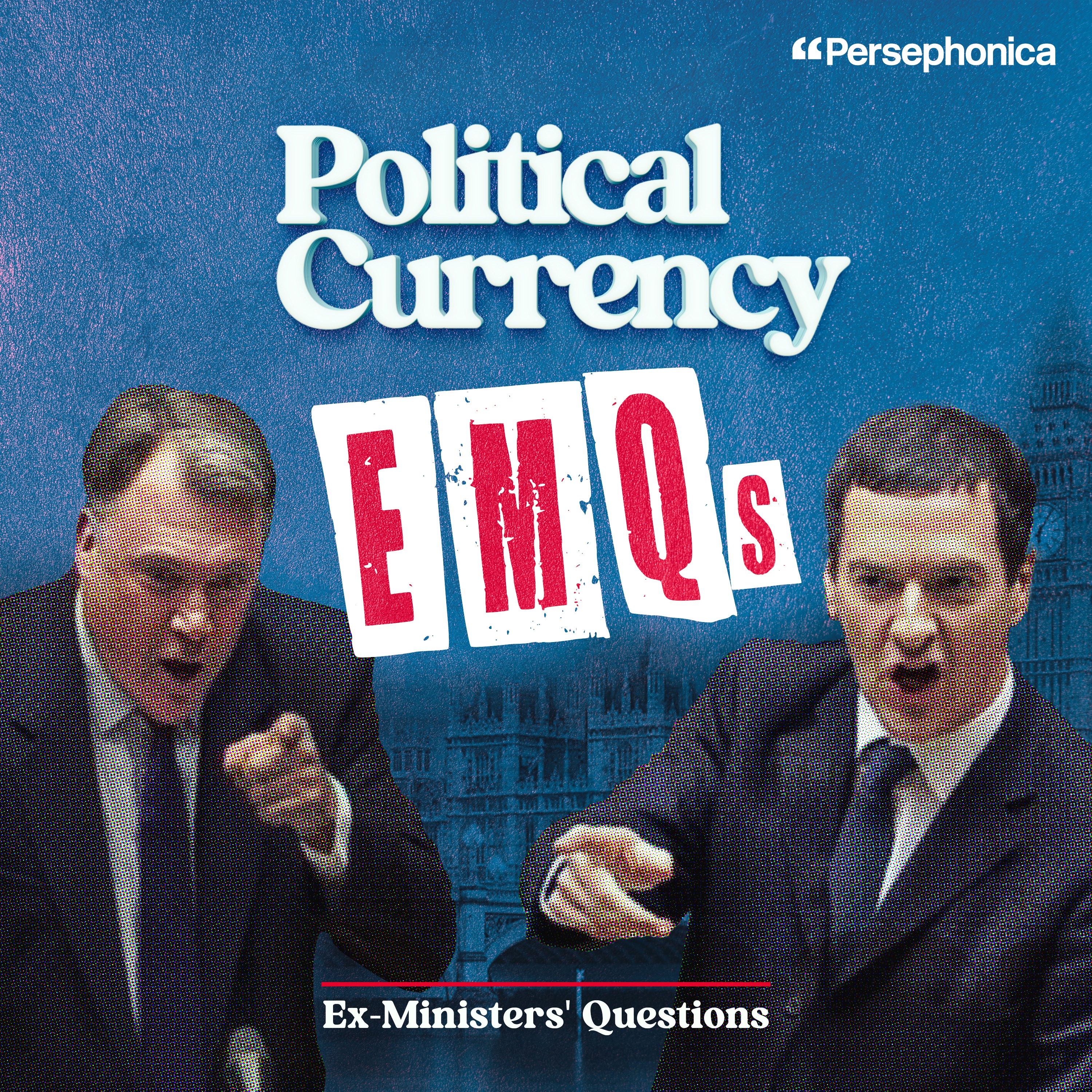
- EMQs: Nick Clegg as Chancellor?
In short
In this episode, hosts Ed Balls and George Osborne delve into the dynamics of the Conservative-Liberal Democrat coalition formed in 2010. They explore questions around the appointments of Nick Clegg and Ed Balls, the role of academics in policymaking, and the implications of government U-turns on political trust. Also discussed are the consequences of MPs defecting to other parties without triggering by-elections.
Written by AI. May contain mistakes.
Chapters
0:45
Discussing the Two Pizza Rule
Exploring the concept of team size in government and innovation.
“with, but I know that if we don't get this done in half an hour, then you're going to leave and I'm going to do the final question alone.”
2:49
Implementation Challenges in Policy
How policy implementation can be hindered by team size and expertise.
“if we had a team meeting with our brilliant production team, you and I would eat a pizza each and there might not be much left for that.”
4:32
The Role of Academics in Policy Making
Examining the relationship between academia and politics in policymaking.
“And I think sometimes if it's too small a meeting, you know, you lose that expertise.”
5:48
U-Turns in Government Policy
The consequences of government U-turns and their political impact.
“And that is the right way to be academic, I think, to both understand the theory and then be immersed in the reality.”
7:46
Historical Perspective on U-Turns
Analyzing historical U-turns and their significance in political contexts.
“I think, you know, there's many fine academics and more broadly, the sort of teaching community who absolutely can do.”
10:00
Lessons from Past Budgets
Reflections on past budgets and the implications of policy decisions.
“I guess we have sort of think tanks, which are kind of quasi academic institutions and lots of people come out of think tanks into politics and government.”
14:01
Understanding U-Turns in Government Policy
Learn about the significance of U-turns in government policy and their implications.
“would have been if they hadn't made that change.”
18:24
Listener Question on Coalition Government
Explore a listener's question regarding Nick Clegg's role in the coalition government.
“We're going to take a break and we'll be back in a moment.”
18:39
Clegg's Potential as Chancellor
Discuss the implications of Nick Clegg potentially becoming Chancellor and historical context.
“I've been listening back to some of your In The Room episodes.”
28:01
Reflections on Gordon Brown's Leadership
Exploration of the dynamics between Shadow Chancellor and Prime Minister Gordon Brown.
“and frankly, been much harder for me as Shadow Chancellor to deal with than Alistair Darling turned out to be.”
Show all 13 chapters
29:40
Understanding MP Defections and Their Implications
Discussion on the fairness of MPs switching parties without by-elections.
“I know George needs to get his plane, but bear with us.”
30:23
Historical Context of Party Representation in Politics
Examining the history of party representation and implications for current politics.
“they explicitly didn't include party names.”
34:50
Final Reflections and Audience Engagement
Wrap-up of the episode with listener engagement and remarks on future episodes.
“party line is not in the interest of your constituents, shouldn't you have the right, as somebody elected by them, to do that?”

Ask about this episode
Get the gist, explore an idea or ask about something said.
 Claude
On Political Currency, what are the key points of this episode?
Searching your listeningTranscript
Automatic transcript. May contain errors.
0:00The Chancellor of the Exchequer. Getting a lesson from the Shadow Chancellor on how to balance the books is like getting a lesson from Dracula on how to look after a bloodbath. Ed Balls. A steady as she goes budget. What kind of ship does he think he's on, the Titanic? The Mary Celeste. Welcome to EMQs from Political Currency with Ed Balls and George Osborne.
0:27So hello and welcome to EMQs. an hour. Donald Trump is in a helicopter flying out of Davos. And George, I think, has a series of private plane offers from world leaders. But the thing about world leaders, you can't keep them waiting on the tarmac with their little planes. And I don't know who you've chosen to get a lift with, but I know that if we don't get this done in half an hour, then you're going to leave and I'm going to do the final question alone. Am I right? Yeah, the answer to your question is I've chosen to get a lift with that world leader uber they're gonna drive me to to london no zurich airport oh i see are you going to schedule flight of course oh i'm not as grand as you ed oh i see i don't get to travel around on britain one or whatever you do now as you know chief spouse i've not been on um a uh private government plane since i was at the treasury not for a very very Oh, is that a violin I hear?
1:22It's not a violin. Can I just say one thing about our main episode? I was disappointed in all of the stuff about foreign policy and stuff. We didn't talk about Darren Jones, the chief secretary to the prime minister's speech on civil service reform, in which he said he was going to back within the civil service the doers, not the talkers. And he told me about that in an interview he was giving with me on Good Morning Britain, in which he was talking. but I don't think he wanted to get rid of it himself. He was talking about other people. But there was an interesting point in his speech where he talked about something I'd never heard about before called the two pizza rule.
1:58And the two pizza rule, he says, comes from America, which is that if you ever, when you're trying to kind of reform government or reform an organisation, if you ever have a team which is big enough to need more than two pizzas, then that tells you that you have got two bigger team i guess that means eight people i'm not sure what arsenal would think about that or man united because they've got 11 but i don't think he's talking about football he's talking about kind of leadership and kind of teams who change things and you know you can't be lean if you need three pizzas literally i wondered what you thought about the two pizza rule you literally can't be lean if you need three pizzas i've had to say george Josbourne, if I remember from the time when he used to do those post-budget photos, George probably wanted two pizzas for himself, let alone for anybody else in his team.
2:48So first of all, I think if we had a team meeting with our brilliant production team, you and I would eat a pizza each and there might not be much left for that. But they'd have the crust. So I'm not sure why you're settling for a quarter of a pizza in this rule. Innovation best thrives in small dynamic teams, not something we're used to in the civil service, said Darren. When Amazon was scaling, they apply the two pizza rule if you couldn't feed a team the two pizza it was too large more talking less doing if you have too large a team so this is my two pizza challenge to our listeners what we want to know is you know are there examples and if you work as a teacher at a secondary school presumably the teaching team is bigger than eight unless you get a very small slice of pizza we would like to know in your experience are there teams bigger than eight which succeed well i think the answer is yes because sometimes you do have complex problems where you need to draw in quite a lot of expertise.
3:39And the key thing is then how you chair the meeting or run the meeting. But obviously in politics, quite often, our cooking metaphors say there is a kitchen cabinet of a very small number of people. But he was talking about the civil service here, not about politics. He was talking about government and delivery. Yeah, but I think quite often, you know, governments make mistakes when they don't properly consider the implementation challenges of a policy. And sometimes that means, and it's certainly the case, you know, when I was Charlton, we made some mistakes where you just sort of, you know, you get a bunch of sort of policy high flyers who say, oh, this will be easy.
4:10I'm going to make this change to tax or this change to welfare. And no one actually has in the room the guy from or the woman from DWP who says, well, you know, that's actually going to be really hard to deliver through job centers to millions. I mean, sometimes you do need the operational people in the room to tell you whether this policy is deliverable on the ground. And I think sometimes if it's too small a meeting, you know, you lose that expertise. Now, it can become unwieldy. But again, that's all about the skill in sharing it and bringing in the right people at the right time. Darren referred to the Vaccine Task Force as a model in his speech.
4:47But do the Vaccine Task Force meetings ever have more than eight people? I don't know. We can find out. Why don't we get... The NASA control room, when they were kind of doing space landings, they probably added more than eight. We will one day try and rustle up a response from Matt Hancock, who was health secretary at the time. That is a good idea. The two pizza challenge I've laid down for our listeners today, and we'll get on to our first question from Piers. Hi, Ed and George. Piers from Northampton here. In the world of finance and business, it is often said that those who can't do teach.
5:17Is this the case with politics? What is your experience of working with academics to craft policy legislate. Many thanks. So I'm going to start with a story of a brilliant academic who made a massive difference to policy, Paul Gregg. And he worked at the National Institute and then went to become a professor at Bath University. And he was the person who we worked really closely with to design the New Deal jobs programme in 1997. And he worked kind of closely with us before and then in the treasury the famous story of paul gregor's he always had a sort of slightly odd sartorial approach to life he wore these big black boather boots tight jeans and a sort of denim jacket and the day after we went into the treasury in 1997 paul arrived at the treasury this is a true story and went to the security and said i've come to see the chancellor about the new deal jobs program for young people and the guy said um well i mean you're seeing the chancellor he said yes he said it's about the jobs program and the security guy said no he said no you've got it all wrong you have to go to the job center and sign on and then they'll get back to you and tell you the four options for you but there's not a fifth option of just getting your benefits and not working and paul said no no no he said i'm designing the jobs program but he was great and to be fair stuart wood an academic you came to work with similar people who both understand the theory and the ideas, but also the practice of policy and can locate it in the real world and empirically.
6:47The work I've done about regional policy, we've talked about it before, we do academic econometrics, empirical economics, but also we talk to lots of practitioners about the reality of policymaking to kind of inform our thinking. And that is the right way to be academic, I think, to both understand the theory and then be immersed in the reality. And if you can do those two things together and you're not just a boffin who is disconnected from what is going on to be honest the same thing is true of civil servants as well i mean you need civil servants to be as we were talking about just a moment ago to both be understand the theory but also understand the real world you're slightly wondering the last year whether the treasury if it had been slightly more immersed in the reality of the farming community or pub valuations might have made better policy and budgets yeah although i think that comes back to the point i was making earlier about implementation and having people in the room who know what they're talking about in terms of delivery on the ground.
7:43I think there's an issue. I mean, first of all, I don't think that it's very unfair, peers, to say, you know, those who can't teach. I think, you know, there's many fine academics and more broadly, the sort of teaching community who absolutely can do. And it's quite interesting that a lot of ex-politicians do end up teaching courses. I mean, I teach a course at Stanford, you teach at Harvard and at King's College London. David Cameron has just been teaching this month a course in Abu Dhabi at the New York University in Abu Dhabi. And Boris Johnson, I read, is teaching a course in the University of Miami.
8:17What is Boris Johnson's course on? Well, I don't know. I was reading about it today. And apparently, you know, he goes on for hours with lots of stories and anecdotes to these students. And they apparently like it, according to what I was reading this morning. I wonder whether he's too immersed in the real world and didn't ever check on the theory. Or maybe he just never left student politics and university. That was the problem. Can you imagine? Boris Johnson, lessons I've learned. I mean, you'd need more than a semester. I think to sort of make a serious point here, I do think there's a problem in Britain that the academic world is a bit remote from policymaking and quite impractical and quite theoretical.
8:59and you see it in the economics field. I found with appointments to the Monetary Policy Committee at the Bank of England, where you do, you know, appoint academic economists, as well as economists from industry and finance, there weren't that many British academic economists who were able to take a sort of slightly broader public policy view on interest rates and were very sort of narrow in their fields of specialism. And as a result, and this has been carried on by chancellors since, quite often American academics have been appointed to the Monetary Policy Committee, I think in American universities, it's striking that the examples I was giving about those British politicians, including ourselves, you know, with the exception of you at Kings, they're all American universities who teach these sort of public policy programs.
9:41And the public policy programs is where kind of academia fuses with government. And in British universities, I don't think there's much of a tradition of that anymore. And so I would say there were strikingly few academics who found their way into government policymaking in the UK compared to what I understand happens in the US. And I think that's a real loss. I guess we have sort of think tanks, which are kind of quasi academic institutions and lots of people come out of think tanks into politics and government. But straight out of university is quite rare. You know, I mean, Stuart Wood is a good example.
10:14I mean, I know Stuart well, but he was quite a rare example. There aren't that many people like him. There was a couple, I mean, we relied on Paul Collier, who's a very impressive academic quite a bit in the Cameron government. And of course, there are academics who become politicians like Nick Thomas Simons and Oliver Letwin. But I think it's a problem of British academia and therefore a British government that they're not closer and they don't rotate enough through government. Look, it was a conscious decision of ours in 97 and partly informed by my American experience with the Monetary Policy Committee to have these three or four day a week members, the independent members of the Monetary Policy Committee who did come from academia or business and would do a three year term and then go back to academia again.
11:01because what America has is people who move between teaching and research and then some time in government. And then when they go back, that then informs the approach they take to their next phase of their professional academic life. And there's less of that tradition, and that's a bad thing. And having people moving between the two, I would like to think that people who've spent some time on the MPC and then go back to academia bring a different perspective to their teaching. The next question comes from Sue. Hi, Ed and George. Sue here, gold subscriber and a big fan of the podcast. My question to you is that given the number of U-turns this government has made since coming to power, how many U-turns can any one government make before the voters punish them in the polls and the unhappy vultures within their own party follow suit, swooping down for the kill to unseat the incumbent prime minister with a leadership challenge?
11:52And just for the political history nerds amongst us, I'd be intrigued to know what is the maximum number of U-turns any government has made this century and either survived or in fact died. Look forward to hearing your thoughts. Thank you. So, Sue, I don't have a list of every U-turn. I think there's a reason for that. There are moments where the U-turn becomes the defining moment, the defining moment of failure or certainly of huge significance. So if you think about Margaret Thatcher and the poll tax, and there was a U-turn after she left, Eden and Sue's, you could say David Cameron's U-turn on the EU referendum to go from opposing the referendum to supporting it.
12:39Those were U-turns which then led to long-term political ramifications and their place in history. But on the other hand, you know, George had a few U-turns in the Omni Shambles budget, didn't define your chancellorship, didn't stop you winning the next election. We definitely had U-turns along the way. The 75p rise in pensions was something which we got wrong and had to change. The point is, Sue, we've said pretty regularly on this podcast in recent months, that what you ought to be trying to do is avoid the need for the U-turn in the first place by getting it right first time round. But secondly, the moment it becomes clear you need a U-turn, get on with it.
13:18The fast executed U-turn doesn't in the end cause you long-term damage because you get back on track. And you were just mentioning Boris Johnson, he was always doing U-turns, Garden Bridges, Boris Bridges. Those weren't the things which defined his failure as Prime Minister. It wasn't the U-turns which saw him removed from office. So it's not wrong to do a U-turn if you do it well, and if it's necessary and it gets you to a better place. The Labour government's just had a U-turn on the employment rights bill. They've backed off their manifesto commitment to have full rights from day one for unfair dismissal.
13:55That's a U-turn. I don't think that will cause the government major problems going forward. I think the bigger problem would have been if they hadn't made that change. So done well. And George, you know all about this. U-turns can strengthen you, not weaken you. I mean, obviously, they're best avoided, but definitely best avoided. There's no government that doesn't make mistakes and doesn't have to dig itself out of holes. And the mistakes can either come from, you know, not fully understanding the implications of a policy and then, you know, or its implementation goes wrong and the computer doesn't work on the ground, not anticipating the resistance that would emerge.
14:30So there are lots reasons why you can get a policy wrong. And I think in those cases, you know, generally, it's the case, get on with the U-turn, execute it swiftly, and climb out of the hole. You know, the classic, I think it was Dennis Healy, wasn't it? When you're in a hole, stop digging. The U-turns I did, which were principally around that one budget in 2012, I did eight budgets, and that was the one that, you know, it was a real mess. What's interesting is actually a lot of the main policies in that budget endure, like cutting the top rate of income tax from 50 B to 45B. And then the smaller ones that people, you know, even to this day remember, like pasties, but there were a couple of others as well around caravans and the like, it was all about sort of VAT treatment.
15:11So, you know, the truth was, they weren't very important to me as chancellor, because they weren't raising very large sums of money. But obviously, they were damaging, because I got something wrong, and they became very visible. And so what I tried to do then, I made a decision very quickly within about a week of the budget, that we had to get execute U-turns in, I think, three different cases. And we needed to just get on with it and find a U-turn that was plausibly, you know, not an entire U-turn, but, you know, we're moving to a sort of third party position. And it's funny about unpasties, which, you know, in the Treasury, it was all a discussion about taxing the new kind of rotisserie chicken counters in supermarkets.
15:54I couldn't help but notice that last week, one of the big supermarkets lost its case in the court against the revenue. And HMRC won, that VAT does apply as a result of that budget in 2012 to hot chickens. But all of those things, I wouldn't say were particularly significant. They were definitely damaging politically, but none of them were policies upon which the kind of reputation of the government rested. They were more kind of reputationally damaging to me personally. Where U-turns can be very damaging and fatal is when it's an absolutely critical core policy of the government. And about values, about something which defines your purpose.
16:32Yes. I mean, if you look at the kind of history of the last 40 years, 50 years, it's when a government ditches its overall economic approach that it's usually sunk. If you think of the John Major exit from the ERM, I'm not sure you would count that as a U-turn. But anyway, you know, having to explain why we're no longer in the ERM, If you think of the Labour devaluations in the late 60s, think of the Heath U-turn, you know, wages and prices policy. And then the Margaret Thatcher U-turn if you want to. The lady's not for turning. You know, she decides not to U-turn on the big economy. I think if you ditch the overall economic programme of the government or economic, you are in serious trouble and all that's it.
17:18Although the really interesting thing is sometimes the best U-turns are the ones which aren't noticed. Margaret Thatcher said, you turn if you want to, the lady's not for turning. The 1981 budget was a tightening budget, but inflation was well above target. The monetarist targets were all massively over. The aggregates were rising much faster than the target. And in that 81 budget, they cut interest rates. when they should have been raising them, it was actually a great U-turn. It was the ditching of rigid monetarism. Nobody noticed. And the economy started to grow in the months after. So if you get away with a U-turn, I mean, look, I remember very well, George, the point at which you decided not to keep trying to tighten fiscal policy.
18:01You just didn't tell anybody, but that was what was going on. And that probably worked to your advantage as well. So the great U-turns in economic policy are the ones people don't notice, which actually turn out to have good economic outcomes. It galls me because you listen to me, but you never gave me the credit. I know. And then I announced that infrastructure commission that you had dreamt of. That was really annoying. Oh my God. So you're raking it all up. We're going to take a break and we'll be back in a moment.
18:38Right. Welcome back. Our next question is from Sean. Hi there. Sean here. I've been listening back to some of your In The Room episodes. I actually listened to you to go to sleep, not because you're so horrific, but because you've become my comfort listening, I guess. I've been listening to the episodes about the formation of the coalition government and about Gordon Brown's election that never was. And I've got a question about appointments to the chancellorship in those two contexts. Why wasn't Nick Clegg made chancellor in the coalition government? and why didn't Gordon Brown make Ed Chancellor when he became Prime Minister?
19:15Sean, well, first of all, I'm glad that we go to sleep with you every evening. I hope there's room for us in the bed. But also to learn that we're not sopographic. Yeah. I have to say that's a new word on me. Now, listen, I think this is a really good one about Clegg as Chancellor. When we were forming the coalition, remember no one in Britain had formed a coalition since the Second World War. there was a debate of what job Nick Clegg should have as leader of the Liberal Democrats. And the initial thinking was you do the German model of coalitions, and the coalition partner, the minority partner, takes a couple of key positions in the cabinet, and then all the ministers in that department are from the minority party.
20:01So actually in Germany, often in coalition, the finance minister is from the other party. So you might have a Conservative Chancellor and then a Social Democrat finance minister. And we looked at, but when I say looked at, this all happened in the space of a couple of days. I mean, it was very, very quick thinking. Nick Clegg becoming Home Secretary, because there were a lot of sort of liberal policies in that space. And all the Home Office ministers would be Liberal Democrats. And then also taking like the Environment department and everyone in that department would be liberal democrats and nick decided and i think there's a lot of logic to this that if you're tied down to one portfolio if you're the leader of the party you are quite at risk of something a being kind of more narrowly confined to that policy space you're the home secretary you're not as we know with home secretaries with the very honorable exception of yvette you know they quite often run into a lot of trouble and get fired and uh in particular that job and you know you could you could be very vulnerable to something going wrong in your department that then forces you to fall and with with your falling falls the entire government because it's your coalition agreement and in the leadership contest that then follows in the minority party pulling out of the coalition might become quite an attractive policy for a candidate so that's why he didn't take a portfolio job but i did always think in 2015 if we had been backing coalition with the Liberal Democrats, what would happen if they asked for the Chancellor job?
21:28Not for Nick Clegg, but for Vince Cable, let's say. You'd have said no. Well, it's interesting, Ed. But they're the junior partner. The Chancellor is such a big, powerful job. Is it actually worth being Prime Minister if the Chancellor is not in your party? Well, the truth is this, isn't it? It's twofold. One is, if that is the choice of being in government and not being in government, that's one thing. And are you really going to say, no, I'd rather not be in government? Or, Or in practice, what would happen, surely, is the chancellor wouldn't have the power of a usual chancellor because you'd need the prime minister's support.
22:00And in fact, someone would emerge essentially as the sort of majority party or the larger party's finance spokesman. You know, the industry minister would become a kind of version of the chancellor. Or the chief secretary. Yes. Yeah, but I think in so doing, see, this is interesting. I think if Nick Clegg had said in 2010, because 2010 is more relevant because he had more leverage then, if in 2010 Nick Clegg had said, my price for the coalition is me being chancellor, I think you'd have called his bluff. hmm maybe but if he made it clear he wasn't bluffing i think we would have said yes and then kind of worked around it to be honest and had an odd unusual government that the chancellor was not doing the role that you know people come to understand because because you'd absolutely need the prime minister and the prime minister's team kind of double hatting on the economic policy so was that an error of his not to ask for that i think in 2015 i thought i mean it never materialized because we won an overall majority.
23:00And I never ever heard afterwards whether this was the case, but I always thought, I wonder if they're going to ask for the chancellorship as a price of a new coalition. So if you go to 2010 and Gordon Brown saying he would stand down looking to do a deal with the Liberal Democrats, if Nick Clegg had said to Gordon Brown, I will do this with you if I'm your chancellor, I don't think Gordon could have agreed to that because I think the rebellion in the cabinet would have been enormous. The honour, Ed. And wouldn't in 2010. What would the Conservatives have said to you making a Lib Dem Chancellor?
23:35The Conservative Party was quite happy with the, you know, once the coalition established itself as a stable governing force, which people had real doubts about early on. And also Gordon Brown is in a different position in 2010. You know, he's already been Prime Minister for several years. He's been Chancellor for 10 years. This is your big shot, you know. Put it this way, if Ed Miliband in 2015, if it had been hung parliament and Nick Clegg said, I will come into coalition with you, Ed Miliband, but, you know, Vince Cable's got to be the Chancellor of the Exchequer in this Labour-Liberal coalition, I think Ed Balls might have been hung out to dry at that point.
24:07Look, I mean, I'd spent quite a lot of the last five years being told that that was quite a likely outcome anyway, being hung out to dry, so it wouldn't have been a huge surprise, but I think it would have been a bad outcome for Ed Miliband. Now, come on, what about Sean's question? So I will put my cards on the table. I think it was a mistake of Gordon Brown that he didn't make you chancellor right from the beginning. Because he never had, I mean, Anastasia Darling had been part of his camp for years, but turned out to be quite an opponent of his inside the cabinet during the financial crisis.
24:38And Gordon never really had, you know, that really sort of strong partnership at the top, which Tony Blair had had and David Cameron had and so on. it would have been a much better premiership if you hadn't also been trying to do you know the education department you know basically morphing from the role you had had as his closest advisor to yes chance exchequer but also his kind of closest advisor in the cabinet in the way that i was with david cameron so i think gordon made a mistake and i think i guess his objections would have been like ed's too young or he's too part of my faction or you know it'll look like favorites All of those things, you know, you would have had like a couple of sarky columns on the first day in the newspapers.
25:23And then day two, you had the Chancellor's Checker getting on with it. Well, look, don't forget, I'd only been a Julian Minister for a year. I'd only been in Parliament for two years. I wanted to make life easy for Gordon. I did an interview, I think actually it was with the Daily Mail and Alex Brummer, about a month before the transition, saying that I wouldn't be Chancellor. I didn't think it was the right thing. I was looking forward to, you know, being promoted if Gordon promoted me. and then on the Saturday before he became Prime Minister the next Wednesday he pulled me into the kitchens in the Manchester arena where he'd just become the leader and told me he said I've decided to go for it I'm going to be bold I'm going to make David Miliband Foreign Secretary a new Chancellor and spend the next 24 hours thinking about who you want as Chief Secretary that's what I'm doing and then I didn't really hear from him for about 36 hours and then I was called in to see him on the Monday and he said I can't do it it's too difficult I've changed my mind and choose the job you want and I chose the children's job but it was a mistake I'm saying it's a mistake I mean come on what do you actually think you know I know it's hard to obviously detach your own you know we're talking about you but if you're in Gordon Brown's shoes given we know how we know that government played out given how we know relations with Alistair Darling collapsed what do you think I mean I think he should have gone for the young team and he should have set you and David Miliband who actually I saw here yesterday, up as the kind of rivals for the Crown in the future?
26:43Well, if you go back to that inside the room, which we did, where we talked about the build-up to the decision, the election that wasn't, and the debate I had with Deborah Matheson about Gordon in that period, the dilemma for Gordon was how much was he about change and how much was he about continuity? And I think he always believed that he himself embodied change. He was a change from Tony Blair. But when it came to policy and also to the cabinet, what he decided was that continuity with Tony Blair was more important. And if you look at the briefing around Alistair Darling in those days, once he decided to do it, it was safe pair of hands, Alistair Darling.
27:25It was continuity, Alistair Darling. That was the choice he made. I wanted him to be bolder on policy. I wasn't pushing, by the way, to be chancellor at that point. Of course, we didn't know we were about to have a financial crisis. And the reality was that, you know, I understood the Treasury in a different way to Alistair Darling, because I'd been there for so many years and so involved in it. Yeah, you would have had it work. Well, I mean, they have a lot of affection in the Treasury for Alistair Darling, but he was not nearly as, people take this the wrong way, but political as you would have been.
27:56you would have used the Treasury to help change the Labour argument, present a fresh face on what Labour was offering the country, and frankly, been much harder for me as Shadow Chancellor to deal with than Alistair Darling turned out to be. But it was also the case, I think, that the strength of Gordon Brown as a Chancellor and as a Prime Minister, but particularly as a Chancellor, he always wanted challenge. And I think he trusted that when I challenged him and disagreed with him, that was something that he could have listened to and engaged with and I actually think that I would have been challenging to him if I'd been the chancellor through that next period but I think he'd have found that easier to deal with than from Alistair and therefore I could have been in some ways tougher on him but look who knows this is the kind of counterfactual which is so hard to think through we like doing our what-ifs the reality was we then moved into a like a maelstrom period on the economy in which Gordon turned out to be a very dominant prime minister on the economic agenda and even if Alistair Darley and he disagreed on quite a lot of things they also I mean Alistair and he made some big decisions with the Treasury and got us through the most difficult times and so I agree with that of course I'm backing off the what if on this one I just sort of think I understood why he did it and I understand the politics behind it and I may not fully agreed with it but actually I think and did my job the one thing I wasn't going to do is be the shadow chancellor I don't think Alistair ever believed that but the one thing I refused to do was to kind of be the alternative chancellor in Gordon's office, reading the papers and telling him what he should do.
29:24And he always wanted that. And he ended up relying on Sriti Vidira to be that person, but not me. I always said no to that because I always felt that that was fatal for the government. But I think Alistair probably always thought that that was what I was doing. But in fact, I wasn't. Let's take a break. We've got time for one more question. I know George needs to get his plane, but bear with us.
29:55So welcome back. Our final question is from James. Hi Ed and George. When an MP defects to another party, they continue to represent their constituents without forcing a by-election. Why is this and how can that be fair? Most constituents vote for a party, not a specific person. So the fact that a different party to the one they voted for now represents them doesn't seem democratic. Thanks. This is really interesting, isn't it? I mean, I think I'm right in saying the interesting thing was that when ballot papers were first introduced back in the late 19th century, they explicitly didn't include party names.
30:31They were forbidden. And it was only in the late 60s, early 70s that parties actually started being allowed to include party names on ballots. And to begin with, it was all unregulated. It was only, I think, in the late 90s that there was a formal register of parties and then proper authorised party names on ballot papers. So the point is that this is not part of our centuries of parliament. It's only really in the last 50, 60 years that party names started to be introduced at all. You might well be right about it. I don't know, actually. There's certainly only been consistency on party labelling pretty recently.
31:07And it's actually interesting, even up until we were talking about Churchill earlier in this episode, actually in our main podcast, back in his day, if you became a government minister, you had to resign and stand for a by-election because the proposition was, you know, when people voted for you to be the local MP, they didn't know you were going to be in the government. But as for like defectors having by-elections, I mean, I guess the sort of theory of British politics is that people elect local representatives. They may come with party labels, but you're electing an individual. And so that individual doesn't need to have a by-election because they remain the MP.
31:46Of course, in practice, most people are voting for a party, not for an individual. Even a really well-established local MP is not making a massive difference to the vote. And most MPs probably aren't making any difference in terms of post-personal vote, or very little difference. And so it feels a bit treacherous to switch party and ditch the voters who put you there. But the reason why people don't have by-elections, quite frankly, is they then lose them. It's quite a practical thing. People say, well, I don't actually want to lose my seat having done my defection. Although, interestingly, I think Robert Jenrick will have been worried he would lose his seat at the next general election to reform in Newark, quite a tight seat.
32:30But the one thing that he could be more confident on is if he had to decide, call a by-election now, as the reform candidate, he probably would have won that by-election, given the current state of reform in the opinion polls. And so he's not done that, but I think he might have won. I mean, the last, I was just going to finish by saying, I think the last kind of historically interesting example is the SDP when it was created. Prominent Labour MPs then became members of the SDP. And some of them did hold by-elections. And the early ones went quite well. So Roy Jenkins, for example, held his seat in Glasgow Hillhead.
33:08But they then started losing by-elections as, you know, new people would come to their party, Conservative and Labour, and they'd have by-elections and then lose the by-elections. So I think really ever since then, that was the early 80s, it's generally not been the best idea to ditch your party. See, I don't think that there should be an automatic by-election if you change party. It wasn't what happened in the 1980s when lots of people moved from Labour to the SDP. And I reckon the same people who are saying there should be a by-election are also the kind of people who will say the problem with our politics is that the party whips are too powerful and people should be able to vote the way they want to work.
33:51And the truth is, the party system is important for our parliament to work. But one of the freedoms you have as a member of parliament, if the whips become so overbearing and the party line doesn't listen to backbench MPs, is at a certain point to say, I don't want to be part of this anymore and to actually change party. And if you're elected to be the representative of a constituency and in the end you decide that the party is imposing upon you things you don't want to do, you have the power to break from the party. And if that means you then lose your seat in a by-election as a consequence, well, you know, that's going to diminish that freedom.
34:33So I think of this as being a freedom for backbenchers to be able to, in extremis, break from the party line. And that is a democratic thing. Now, there's costs to doing that. But do you want to make it impossible? In the end, if you judge as an individual that the party line is not in the interest of your constituents, shouldn't you have the right, as somebody elected by them, to do that? Yeah, no, I agree. I'm not saying that people should by-elections when they defect. Anyway, that's a good question and quite topical this week because we've had some defections to reform, haven't we? Now, historically at this point, George scruggles around for his papers trying to find the three sentences we're supposed to read out at the end of our EMQs.
35:16But I'm going to say this to you, George. You've got a plane to catch. It's on the runway. There's some prime minister or dignitary who's keeping their private plane for you. But if it's actually an Uber to Zurich, you're under even more pressure. You go and I will do the final sign-off for our listeners. Is that okay? Yeah, they took so long to say that we could have done the sign-off by then. Well, thank you very much indeed to James for your question. That's all we've time for in this episode. George is still there. He's not left. Go on then, do the line. Oh no, I've lost it now. Please do keep sending us your voice notes and emails via questions at politicalcurrency.co.uk.
35:52If you review the show, make it a good one, help us reach more listeners. and we'll be back with another episode next week. And also we've got the Political Podcast Awards next week. So we'll see how we do. George is still there. See you soon. Yes, I'm off. Bye.
36:15Thanks for listening to Political Currency. This has been a Persephoneca production.
From the publisher
Why didn’t Nick Clegg become Chancellor of the Exchequer in the 2010 coalition government? Ed Balls and George Osborne take you inside the negotiations that formed the Conservative-Lib Dem coalition in this week’s EMQs. They also discuss why Gordon Brown didn’t make Ed chancellor, and whether it was the original sin of his premiership.
They also discuss the role of academics in policy making, and why American scholars end up more favored than their British counterparts. And, how many U-turns can a government sustain? Ed and George look at the impact of U-turn politics on trust and authority, and discuss how the coalition survived the omnishambles budget?
Finally, the pair consider whether MPs who defect - including recent high profile Tories like Robert Jenrick - should stand down to trigger by-elections. They explain where this has gone wrong historically, and the dangerous precedent it would set for future political rebellions in all major parties.
We love hearing from you, so please don’t forget to send all your EMQs to questions@politicalcurrency and make sure to include a voice note of your question.
Thanks for listening. To get episodes early and ad-free join Political Currency Gold or our Kitchen Cabinet. If you want even more perks including our exclusive newsletter, join our Kitchen Cabinet today:
👉 patreon.com/politicalcurrency
Please note: Kitchen Cabinet is only available via Patreon.
Credits:
Research: Sam Burton
Production: Caillin McDaid, Caitlin Hanrahan & Sam Psyk.
Video Editor: Avi Asher
Executive Producer: Ellie Clifford
Political Currency is a Persephonica Production and is part of the Acast Creator Network.
Hosted on Acast. See acast.com/privacy for more information.
More from Political Currency
All episodes

We use cookies.They keep VO running smoothly and help us improve it. Privacy policy