
 Ask ChatGPT


- Podcasts
- Political Currency
- EMQs: Our Keir Year, modern Machiavellis and fairness in politics
Political Currency7 Jul 2025 · 38m · 11 chapters
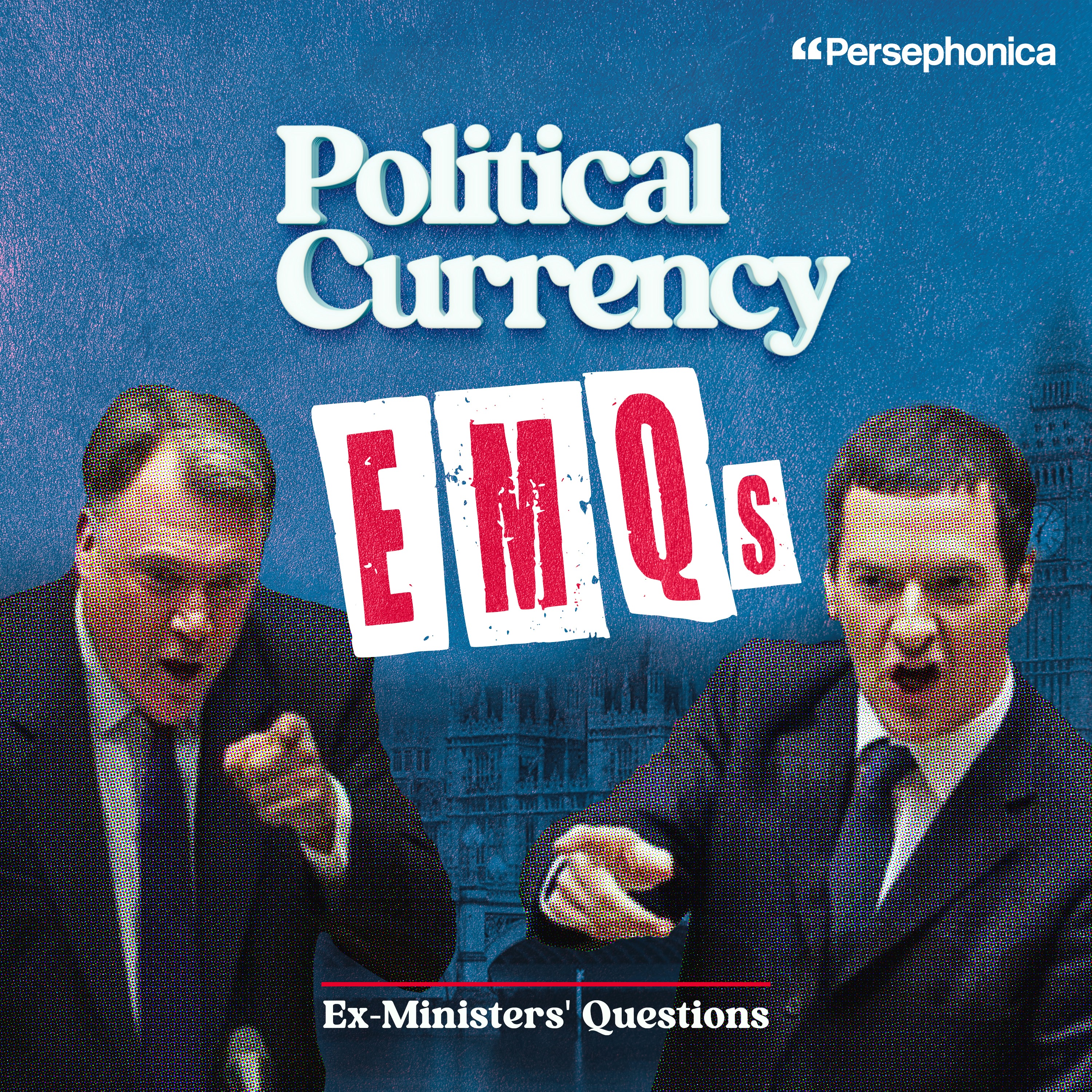
EMQs: Our Keir Year, modern Machiavellis and fairness in politics
In short
Fairness in UK welfare/tax policy; how academic economics should (and doesn’t) feed into Treasury/Bank of England decisions; Keir Starmer’s first-year leadership credibility (U-turns, ideology, focus groups); “modern Machiavellis” in politics.
Guests
Ed Balls (former UK Chancellor of the Exchequer; academic-economics background; co-host of EMQs) and George Osborne (former Chancellor of the Exchequer; co-host).
Key claims
Fairness has three strands—Rawls (maximise poorest), capability (equal chances despite disadvantages), and Nozick (reward effort/incentives)—and politics mixes them. Raising money can’t rely only on taxing billionaires; it likely requires broader taxes (VAT/NIC/income tax). British academia often produces theoretical work with limited policymaking relevance, and there’s a UK-US “revolving door” gap. Starmer must explain opinion changes transparently and lead with purpose, not focus-group directives. “Machiavellian” power is often behind-the-scenes influence, not public intrigue.
Notable examples
Joe’s “squeezed middle” (top 10% thresholds; child benefit removal); Labour welfare “sticks” abandoned; minimum wage research (David Card/Alan Krueger); MPC external-member design; Angela Rayner as “unsackable” cabinet figure; Gavin Williamson, Peter Mandelson, Michael Gove, Sheree Blair, Waheed Ali, Tom Baldwin; Boris Johnson as “main prize” strategist.
Written by AI. May contain mistakes.
Chapters
0:29
Summer Sports and Cricket Excitement
Discussion about summer sports events like Wimbledon and cricket.
“In a world where AI is changing every role in every industry, knowing who actually has deep expertise matters more than ever.”
2:32
Summer Sports and Cricket Excitement
Discussion about summer sports events like Wimbledon and cricket.
“How's your sporting summer coming along, Ed?”
4:28
Debating Fairness in Politics
A listener's question about fairness in taxation and welfare reform.
“Look, our first question is going to get us into these very issues, and it's from Joe.”
7:24
Exploring Welfare State and Taxation Issues
Discussion on the dynamics of wealth, taxation, and perceptions of fairness.
“Yeah, I mean, of course, the very idea that you are intervening in, you know, how things would be in a kind of in a state of nature is about trying to level the playing field a bit.”
13:17
Influence of Academic Economists
Listener Ray asks about the role of academic economists in UK policymaking.
“But therefore, there is going to be a growing drumbeat in British politics over the coming years of people who are sitting on out-of-work benefits who should be working.”
14:00
The Role of Academic Economics in Government Decisions
Explore how academic economics influences decision-making within the UK government.
“Thank you very much for your second question to our podcast.”
24:36
Keir Starmer's Leadership and Voter Sentiment
Discussing the challenges Keir Starmer faces in connecting with voters.
“Keir Starmer actively supported Jeremy Corbyn to be Prime Minister, then threw him out of the Labour Party, denying any friendship with him.”
28:00
Navigating Political Leadership: The Case of Keir Starmer
Explore the challenges faced by Keir Starmer in articulating a clear political agenda.
“So I think, you know, needs must when you're climbing the greasy pole.”
32:47
Navigating Political Leadership: The Case of Keir Starmer
Explore the challenges faced by Keir Starmer in articulating a clear political agenda.
“and then we've got time for one more question.”
34:40
Machiavelli and Modern Politics
Discuss the relevance of Machiavelli's ideas in today's political landscape.
“It's James here from Northumberland, really enjoying the podcast.”
Show all 11 chapters
42:02
Boris Johnson as a Modern Machiavelli
Explore the character of Boris Johnson and his political strategy.
“I wonder what other political figures you've met fit the bill.”

Ask about this episode
Get the gist, explore an idea or ask about something said.
 Claude
On Political Currency, what are the key points of this episode?
Searching your listeningTranscript
Automatic transcript. May contain errors.
0:00There are moments that reveal who we are and who we're meant to become. For those born to lead, such moments call for a vehicle of equal distinction. Dynamic by design, uncompromising in execution, the Range Rover Sport was engineered for those rare individuals who demand the world and possess the conviction to claim it. When your time to lead arrives, you need a vehicle that rises to meet it. The Range Rover Sport. Exclusive offers available now. Explore further at rangerover.com.
0:29Ed Balls: In a world where AI is changing every role in every industry, knowing who actually has deep expertise matters more than ever. Upwork connects you with the highly skilled freelance professionals with proven track records, so you can hire with confidence. Upwork gives your business fast access to highly skilled specialists with deep expertise, so you can fill critical skill gaps, launch projects faster, and scale support up or down without committing to full-time headcount. With Business Plus, you can access the top 1 % of talent on Upwork. AI-powered shortlisting delivers a curated shortlist of top freelancers matched to your goals in under six hours.
1:05No endless searching required. Thousands of growing businesses already trust Upwork to hire highly skilled freelance professionals for everything from one-off projects to ongoing support. It's free to sign up and posting a job is easy. Visit Upwork.com right now and post your job for free. That is Upwork.com to connect with top talent ready to help your business grow. That's U-P-W-O-R-K dot com. Upwork dot com. Hi, I'm Jack Ravici, Kramer host of The Best One Yet. At T-Boy, we're always talking about small decisions that can have an outsized impact. One of the simplest is staying hydrated. Whether I'm traveling, getting a workout in, or heading into a busy day, I keep Liquid IV on hand.
1:43It's clinically demonstrated to hydrate faster than water alone and contains three times the electrolytes of the leading sports drink, plus eight vitamins and nutrients. It's an easy addition to your daily routine and helps support hydration when you need it most. Shop now at liquidiv.com. Liquid IV hydration that goes wherever life takes you.
2:04The Chancellor of the Exchequer. Getting a lesson from the Shadow Chancellor on how to balance the books is like getting a lesson from Dracula on how to look after a blood bank.
2:14Ed Balls: Ed Balls. A steady-as-she-goes budget. What kind of ship does he think he's on, the Titanic? Welcome to EMQs from Political Currency with Ed Balls and George Osborne.
2:31Welcome to Ex-Minister's Questions, EMQs. How's your sporting summer coming along, Ed? You know, we're here, it's Wimbledon week, we've got cricket on. You like playing sport, don't you?
2:42Ed Balls: I like playing sport and I like watching sport and I like it when you have like a summer football tournament like the World Cup or the Euros. We've got the women's Euros about to start, which will be really exciting. But actually, this year is special because as well as a test series, England against India, probably the best test team of recent years, who England beat in the heading of the test. And as we're recording this, they're in day two at Edgbaston. And again, the game's on a knife edge. You're not going to the cricket. I'm going to the Lord's test. So am I. Which day are you going? Thursday.
3:15Ed Balls: What day is that? Thursday. Not always. I'm going on the Friday, which is day two. Oh, no. So, you know, you can give me an update. The other exciting thing is the Lions tour. I don't know whether you saw, because you can now get up on a Saturday and watch Lions rugby each weekend as we build up towards the Test Series against Australia. Last Saturday, Western 4-7, British and Irish Lions 54. They were really good. And having done badly against Argentina, suddenly you thought, maybe this is going to be a great Lions team. So I'm enjoying my Saturday mornings of rugby. Yeah, you see, I played in the number eight position at school in rugby, and I absolutely hated it.
3:56I really got over the trauma.
3:58Ed Balls: You didn't really have the physique for number eight. I have to say, it's not my favorite sport to watch. I'm not offending a load of listeners. Didn't you have to sort of lie on the floor and have people climb on you to go over a wall? Or was that a different school? That was a different school, yeah. Oh, okay, sorry. Okay. It's just a good old-fashioned, ordinary, bog-standard private school. Bog-standard, what was it called? St Paul's. St Paul's, bog-standard St Paul's. Oh, yes. Look, our first question is going to get us into these very issues, and it's from Joe. Hi both, it's Joe here, big fan of the show, long-time listener.
4:36Asked one of the first questions, in fact. I am a lifelong Labour supporter, sometimes member, always voter. and I definitely agree with Ed's assessment about the need to row back on the proposed changes to the welfare cuts and the need to find that money from more fair sources but I do think it's about time we started having a conversation about what fair actually means. In a classic kind of working class boy made good scenario I'm now at a point in my life where both I and my wife don't get any eligibility for things that other people consider universal like child care hours or benefits for having a child.
5:14We only have one. Also, we are disproportionately hit by taxes. And when people talk about targeting people who are deemed to be wealthy, often falls on people who are actually just working incredibly hard and really demanding jobs and making sacrifices. So isn't it time to look at people broader in the society and consider how the wider tax base should be targeted if we're going to be serious about funding the things that this country needs over the next five to ten years?
5:40Ed Balls: Very interesting question there from Joe and he says we need to debate about fairness and so to start off with a little bit of philosophy three different conceptions of fairness there's the Rawlsian conception which said that if you go behind the veil of ignorance you could be the poorest and surely the rational thing to do the right morally right thing to do is to make sure that you maximize the position of the poorest you don't let anybody be in destitution because it could be you and that it's just wrong that some people should kind of live in poverty there's a second view which is about capability some people have great strengths other people have challenges and that can be a disability or trouble with learning or what they inherit from their past in terms of their their family or wealth and that therefore Or to be fair, you've got to give everybody a fair chance by trying to counter some of those underlying unfairnesses and capability.
6:38Ed Balls: And then there's a third view of fairness, which is more Nozickian, which you're getting at here, Joe, which is surely people who work hard and do their best and make the effort and go the extra mile and earn money, they should be able to keep it and enjoy the rewards of that. And why should that be taken from them? it's unfair that they should be penalised for their effort and their hard work and their achievement and their success. And I think all of politics is about finding a way to touch fairness in all three elements. And the big difference in politics is if you are on the left, you might be slightly more Rawlsian and worrying about unfair capabilities.
7:13Ed Balls: And if you're on the right, you might be more worried about incentives and letting people keep what they earn. But probably all of us in the end are looking for some combination of fairness across all three. Yeah, I mean, of course, the very idea that you are intervening in, you know, how things would be in a kind of in a state of nature is about trying to level the playing field a bit. And I always think people, you know, come at it very influenced by how they would fare in a kind of state of nature. You know, the rule of the strongest, those who are athletic and strong and they're usually quite happy in that environment.
7:50or aristocracies are supported by people who inherit money. And meritocracies are often supported by people who are very bright and have a lot of drive and ambition and get on in life. But a meritocracy doesn't actually work for people who are born without those mental capabilities. So I agree that the modern Western society is often a confluence of all these different things. I think what Joe, coming to the specifics, I think Joe speaks to a very interesting kind of feature of British political life. which is a lot of the debate around the kind of struggling aspirational families, is somewhat detached from the data.
8:28So, you know, to be in the richest 10 % in our country at the moment, you know, which is, you know, obviously the top, you have to have a disposable income of around£64 ,000. Or if you've got children, it's like£89 ,000 on the latest numbers. Now,£89 ,000 is a lot of money. It's more than 90 % of the country has. But there are a lot of people who are on incomes of£89 ,000 as a family who are saying that is, you know, a massive struggle still, to pay rents or pay mortgages, to, you know, support our children. Of course, this gets you into the private school argument, to pay school fees and so on.
9:10And they don't really accept that they are the richest 10%, or rather that that is, as Joe says in his question, anything like the financial security or the wealth of a billionaire. And yet they're often sort of branded as part of the same group. And I think, you know, governments have often struggled to communicate just how low incomes most people in the country live on relative to that top 10 %. And so to Joe's point, you know, where I agree with him is this, that it's quite hard to raise all your money from billionaires. In fact, it's impossible. And to anyone who thinks the solution, I don't know, for example, to the hole in Labour's plans because of the welfare changes, can be just by like a tax on the very rich.
10:00That's not going to work. In fact, we've discussed on this podcast how Labour might have to U-turn on its non-dom tax, because a lot of these billionaires are literally leaving at the moment and have options, as Joe says. So then you go, well, what about the top 10 %? And here Joe's complaining, because he's saying, I'm in the top 10%. I don't really feel like that because I'm under, you know, I'm struggling and I've worked hard to get here. Not struggling financially, but, you know, it's like, you know, it's not straightforward making the sums that up. And you've already taken away from me, for example, my child benefit, which is what I did as chancellor.
10:27I took away child benefit from the richest 15 % of the country. And, you know, I got a lot of people saying, you know, it's actually really hard for us at the moment. And so then you are left, which I think he gets to the key point, and actually it will be a question which confronts this Labour government, which is if you really want to raise money from taxation, you have to go to the broader population. And you have to go to VAT or national insurance or income tax. And this Labour government has already done national insurance on business. And Rishi Sunak as Chancellor went to national insurance on business and individuals.
11:02And I went to VAT and Gordon Brown went to national insurance as well. No one's done income tax across the general population since like the 1970s. But those are where, you know, because of the structure of our society, because people on what you might regard as quite modest incomes are still the very high ends of the income deciles. To get the money, you do have to raise taxes across the broad population.
11:30Ed Balls: I think that is right, but you have to do that, to have an argument which is compelling and uniting about what you're using the money for and its purpose, something uniting. And I guess I think the thing which I worry about when I listen to Joe's question is that we've always relied upon people on middle incomes who saw their incomes rise and rejected extremism and wanted a sensible approach to running the economy and to working with business and working with other countries. But if you have a struggling squeeze middle of people who feel that they're not getting a fair deal and their incomes aren't rising and they're being asked to pay more tax, is there a danger that they suddenly start to think, well, why do I support all this centrist sanity?
12:19Ed Balls: And why can't I be drawn into voting for the people who say that they can rip it all up and make it better? And when they find out that AI may be about to take quite a lot of those middle-income jobs, does that supercharge that? And does populism and populism… Populism on the right, I would say, has often drawn its support historically, not just in this country, but from around the world, particularly in continental Europe, from the middle classes and the squeezed middle. You know, that was where the support came in Germany in the 1930s, from the middle-income people who had seen their savings wiped out by hyperinflation.
12:52And so it wasn't the poorest who supported the Nazis, and it wasn't the aristocrats and the richest industrialists who supported them either. So, I mean, that may be an extreme example of the Nazis. But I think, you know, if you look at where the French far right draws its support from, it's the petit bourgeoisie, as they would describe it in France. It's that same, which I would say, is a sort of description of the squeezed middle. And I do think, you know, a question of fairness on these welfare reforms. Okay, so they've been abandoned. But therefore, there is going to be a growing drumbeat in British politics over the coming years of people who are sitting on out-of-work benefits who should be working.
13:27And, you know, the conceptions of fairness of the welfare state also change. And you get to a point where people say, now it's unfair. Now people are taking the mickey. Even if there are some very vulnerable people being supported by this welfare state, I know too many people who are taking the piss, basically. And I suspect that is going to become quite a feature now. Now the government's abandoned all attempts to get people on, you know, all sticks. There are carrots there, but all sticks to try and get people out of, on out of work benefits back into work. That is going to be a growing issue.
14:00Interesting, Joe. Thank you very much for your second question to our podcast. Let's now have a question from Ray. Hi, Ed and George. My name's Ray. I'm a gold subscriber, big fan of the podcast. I work at a philanthropic foundation that funds academic research. I'm interested to understand from you what role that plays in decision making when you're a minister at the Treasury. Do you care what academic economists think? I notice in America quite a few prominent economists take positions in the administration, but that doesn't seem to happen so much in the UK. Thanks very much. I'm going to be very generous to my podcast host here.
14:36So I think what Ed does is quite unusual in Britain, which is you have a grounding in economics, an academic grounding in economics, but you apply it to the political economy. In other words, you took your academic understanding of economics and said, but how does it practically apply to decisions that the Treasury has to make or the Bank of England has to make? And you're not alone in this, but there are far fewer people like you here in Britain than there are proportionally in America. And in Britain, the economics profession, the academic economics profession has tended to be of the much more theoretical end with very complex theoretical models and very complex theoretical pieces of academic research that have almost no direct relevance for policymaking in the Treasury or the Bank of England or the other kind of economic parts of the state.
15:30and the most obvious example of where this is a problem is when we try and find people to fill the slots on the monetary policy committee at the bank of england which i had to do as chancellor and when i started as chancellor it was still relatively easy to find people who had that kind of practical application and wanted to take their economics knowledge and put it into practice because there were some people who for kind of reasons of you know ideology or personality the Labour government hadn't yet appointed. They'd appointed a load of people like that. We picked up the people they hadn't appointed.
16:05But once you'd done that, they were term limited on the MPC. You were left with a smaller and smaller pool. And increasingly, we had to go to the United States to find these people to serve on the MPC. And I would say as Chancellor, I would say compared to an American Treasury Secretary, you know, who I think would draw quite a lot on what's going on at Harvard or Stanford or, you know, one of the big American universities have people from there coming to work in the administration. I think there's a real disconnect between the British state and what's going on in the colleges and universities in the UK.
16:43Ed Balls: I think you are right. And part of our motivation for establishing the Monetary Policy Committee with these external members was to try to do something about that. Because in American academia, there are very many more people who have spent time working in the administration or in the Federal Reserve, the National Economic Council, the Council of Economic Advisors, and then go back to American universities, much less of a tradition of that in Britain. People were either civil servant economists in the Treasury of the Bank of England. There was this new group of people in the city who tended to come from the Treasury of the Bank of England, very little interplay between academia and government, the civil service.
17:22Ed Balls: The MPC was an attempt to tackle that. And the truth is there are very many more people now in British academia and in the city and in business who have had experience of governing in the Bank of England because they've been MPC members than was ever there before. But you are right, it's challenging to get the flow through. And the government itself, as opposed to the Bank of England, hasn't found a way to bring people in, I think, from academia in the same way as the Bank of England manages, partly because the Bank of England are the decision makers and the MPC, and that's different in government departments.
18:00But people say, isn't it, some people say that it's, you know, the fault lies in the universities and in the kind of structure of funding in universities, that you get funded at a PhD level for original research and how many papers you've published in academic journals and so on. And that drives you into ever more kind of obscure theoretical parts of the discipline, rather than, you know, just like, what should you know, how should a bank how to do how should the central bank set interest rates in the current environment? Or what should the welfare policy be? Or what should the tax policy be?
18:37Ed Balls: I think that's true. But I think it's also about the way government and academia accord status. And the truth is that there is a lot of status and respect for people in the United States who've been in government and then returned to academia, and who are in academia and therefore are asked to come into government. And I think there was just more distance in the UK. I mean, to answer Ray's question, I actually think, you know, when I think of the work done by David Card and Alan Kruger in the early 1990s on minimum wages, that had a huge influence on us. Also work around earned income tax credits and the working families tax credit, work done on climate change.
19:14Ed Balls: I mean, the academic input into the Euro 5 test assessment was huge. So there is a lot of academic thinking which influences, but that isn't the same as academics themselves spending periods of time in government as opposed to their papers being influential. There is a difference. I think we've talked in the past about reviews, which we've done, and having somebody to come and do a review, an independent review of a piece of work to help you push for the policy agenda. What you can't do is have somebody to be your independent reviewer who takes such an academic approach that they say, well, look, you know, there's no good answers, or I can't recommend anything here, or my academic purity asked me to recommend the thing which is totally unimplementable.
20:00Ed Balls: And to be good at this, you have to draw upon, as you said, both the theory and the empirical evidence and the political economy. And that has to be valued. And I'm not sure in British academia it's valued enough. And I'm not sure in the civil service it's valued enough. People who can stride between the two different worlds. But it is both worlds. You can't, I mean, pure academic economists are not going to cut it in the policy world. Yeah, but I think your King's course, King's College course is quite unusual in Britain in that it's very practical and you have treasury civil servants coming through it.
20:36But, you know, it would also reflect the fact that you and I teach at American universities. And, you know, we don't teach at our alma mater's. We haven't been asked by Oxford to go and kind of teach practical courses in, you know, politics and political economy. Not that we're asking for that invitation anymore.
20:54Ed Balls: But it's more, it's not part of the curriculum and the thinking. There isn't really, King's, the part I'm involved in is. But I think that's very unusual. I think it is. And I sort of, you know, I mean, there aren't really very many public policy schools in the UK. And to the extent they exist, they don't seem to have much to do with British public policy. It's frustrating. Let's take a break. And then we've got a couple of questions from Sue and Carol.
21:33of you.
21:33Ed Balls: In minutes, no camera or crew required. It's how real estate agents, financial advisors, attorneys, and creators show up consistently on every feed and build a brand that brings in clients without spending their whole week making content. Rated the number one AI video platform for small businesses on G2 with the most realistic AI avatars in the industry. Trusted by a community of over 30 million people and 85 % of the Fortune 100 and built to work in over 175 languages so So you can reach your audience in theirs. Here's the wild part. Record yourself for just 15 seconds and HeyGen builds an AI avatar that makes professional videos for you on demand.
22:08Ed Balls: So you can post everywhere your audience is. As yourself, without filming every time. Your first three videos are free at HeyGen.com slash pod. That's H-E-Y-G-E-N dot com slash P-O-D. Is there anything better than your team bringing home a W? How about a personal W for your health? If you're 45 or older and at average risk, it's time to screen for colon cancer. Now the number one cancer killer of people under 50 in the U.S. It's easy to put off when screening feels like a hassle, but Cologuard Plus makes it simple. It's non-invasive, requires no prep, can be completed at home in about 15 minutes, and is 95 % effective.
22:46Talk to your healthcare provider or request Cologuard Plus online, Rx only. There are moments that reveal who we are and who we're meant to become. For those born to lead, such moments call for a vehicle of equal distinction. Dynamic by design, uncompromising in execution, the Range Rover Sport was engineered for those rare individuals who demand the world and possess the conviction to claim it. When your time to lead arrives, you need a vehicle that rises to meet it. The Range Rover Sport. Exclusive offers available now. Explore further at Range Rover.com.
23:25Ed Balls: So welcome back. We've got two questions here from Sue and Carol, and we thought we'd play them together because they both follow on from the conversation in our main podcast about Keir Starmer's first year. And we thought it would allow us to dig a little bit deeper into the issues we raised. Hi, Ed and George. Sue here, a gold subscriber and a huge fan of the podcast. My question to you is twofold. Firstly, as someone who jumped ship for the first time in 50 years to vote Labour rather than Tory at the last election, quite frankly, if there were to be an election tomorrow, I honestly do not know who I would vote for, which is a very sorry state of affairs.
24:09Secondly, with Sir Keir Starmer's popularity rating plummeting in the polls, especially with regard to stuff on the home front rather than abroad, what can he do to inspire a now undecided and somewhat disappointed voter like me? Thank you. Hello, Ed and George. I listen to your podcast every day while walking my elderly dog. He doesn't walk much, just sniffs his surroundings, so your podcast makes a boring job much more enjoyable. Keir Starmer actively supported Jeremy Corbyn to be Prime Minister, then threw him out of the Labour Party, denying any friendship with him. Starmer said trans women were women and that is the law, until Tony Blair told him differently.
24:51He supported legal immigration on numerous occasions, but now says that Britain is becoming an island of strangers and wants to limit numbers arriving. Is it necessary for a PM to have an ideology or core set of beliefs to be a successful leader, or is an ability to change your opinions with events more helpful? Love to hear your thoughts. Kind regards, Carol Foreshaw from Bolton.
25:12Ed Balls: I think those are two really powerful questions. And if you are Keir Starmer at the Labour hierarchy, you'd be thinking very hard about those questions and how you answer. And I think the way I'm going to answer them is to say, to Carol, first of all, I mean, things do change and it's OK to change your mind, even if you are a political leader, when events change or the circumstances change. but you have to go out and explain when you're changing why and to be very open about what you thought before and how your mind has been changed by events or circumstance because if not it feels kind of inauthentic and tricky and I don't think there's been enough explanation about the changes you you explain there and you end up with Keir Starmer sometimes saying things like his island of strangers speeches and then going out to explain why he didn't really mean what he said when he made that change which also just confuses people in the end though it has to be about an underlying sense of purpose and so if if you voted and then a year on you you regret that something's gone wrong in that relationship between you and um the government you voted for and that's something the government has to think very hard about i mean if you voted that way it's because you were voting for a set of outcomes and a set of values and a sense of direction.
26:32Ed Balls: And if you don't feel that that sense of direction and those values are being respected, then that's a huge problem, not just for you, but for the government. So mission, purpose and explanation. I'm going to start with something which I don't know is whether it's true or not, but it was always attributed to something that Gordon Brown would say. So maybe you can help me with this. But I remember thinking about it a lot when I was shadowing him as shadow chancellor. It was always told to me that he said, in opposition, you have to move to the centre. And in government, you can move the centre.
27:06And certainly sounds like the kind of thing you might say.
27:10Ed Balls: George, I'm very pleased you've been studying my speeches and have reflected upon the wisdom of my words. Yeah, I didn't think he ever said it in a speech, but maybe he has since. To kind of Carroll's point, in a parliamentary system, you know, to get to the top, I am quite forgiving, I know lots of Labour politicians wouldn't be, of Keir Starmer serving in Jeremy Corbyn's shadow cabinet. And Tony Blair and Gordon Brown chose in the early 80s to stand for Parliament when Michael Foote was the Labour leader. And they did that because he had to get on. And you have to get on in the system that exists.
27:48unless you want to create an entirely parallel party and try and completely upset the political landscape, which, to be fair, some people do, like Emmanuel Macron did in France. But that's a presidential system. In some sense, it's easier. So I think, you know, needs must when you're climbing the greasy pole. But when you get to the top of the greasy pole, it's on you. You've got to, you know, if you're the prime minister, if you're leading a government, I think you have to know what you're there for rather than just to get there. And there are lots of prime ministers who find when they get to the top, they don't really know why they wanted to be prime minister other than they wanted to be the prime minister and they thought they'd be better at it than other people.
28:25And they struggle to construct an agenda. And I think that is the case with Keir Starmer. And I think he, you know, from what I understand of him, you know, he's not got a kind of rooted domestic agenda. And maybe he needs to reach back a bit more into what he really believes, because he's actually, from what you can see from his background, quite left wing, quite, you know, certainly a great believer in a kind of rules based, human rights based view of how you run societies. And we haven't seen enough of that domestically from him for it to feel like it's authentically Starmer. And obviously he comes from a kind of leftish tradition because his first name is the same as the first name of the founder of the Labour Party.
29:06So, you know, this is not, he's not a sort of new implant into the Labour movement. And I just don't think he's been able to articulate that in an authentic way, which is why you get these kind of U-turns on things like Island of Strangers. But it's hard. And lots of prime ministers struggle, all leaders in countries around the world struggle. I had an interesting conversation with someone who works in the British state recently who said, you know, whether you liked us or not, maybe it was just flattering me and David Cameron, you kind of knew where you guys were coming from. on any issue before we'd even spoken to you know we kind of knew what you were likely to be in favor of we were sort of small l liberal conservatives that on social issues we were likely to take a kind of liberal view and on economic fiscal issues we were going to be pretty conservative and that helped you as a civil servant let alone your parliamentary party and of course the complexity in our case is we were in alliance with the liberal democrats but but the kind of conservatives knew where the conservative leadership was coming from And I think that was certainly true also of the Gordon Brown leadership, and particularly when he was chancellor.
30:09And the Treasury. Yeah, it's when you are then trying to kind of move around because it's not quite working, or you're trying to locate the center of, I mean here, not in a centrist sense, but where enough votes are to win you an election. It's when you're kind of hunting that without just sort of trusting your own instincts, that those, the really strong political leaders are convinced that what they believe is ultimately what the country should believe, not the other way around. And are guided, yes, by opinion research, but not led by it. And I think that at the moment is what's missing.
30:46Ed Balls: I think that's a really important point at the risk of opening up a whole nother subject. I think that is very important thing about kind of depth of learning in politics. politics people who have less depth of learning in politics at a senior level i think they can often think that the purpose of focus groups where you know opinion pollsters get some people in a room and ask them lots of questions and hear their answers the focus groups are there to tell you what to do and i know that keir starmer went through a long period where every day they were doing focus groups and then the next day he was being told this is what the groups say and it was like well you know that's what we need to do then and that is a disastrous approach to political leadership.
31:25Ed Balls: That is very much not what focus groups are for. What focus groups are for is to tell you how people speak and how they understand things and what the impact of your communication is. But leadership is about persuading people of your argument. And sometimes that means you do things which are not, to begin with, popular with the focus groups, but you use the focus groups to find out how to win the argument. And if you are a reactive, blown-in-the-wind politician who thinks, well if that's what the groups say that's what i should say you end up looking rudderless and purposeless and um i do think i hope it's changed but i do think there was a period where you know the groups were very important in the starmer world and that is the wrong way to do politics very interesting obviously we will come back to these questions sue and carol maybe it'll be interesting to know as the parliament unfolds how sue is thinking about voting because she is if you were if you were putting together one of these focus groups she is absolutely the person you want in them the person who was a you know switched to labor from the tories last time and now doesn't know what to do i mean i probably see that british politics is all about the sues of the world at the moment sue the political currency focus group we're going to take a break and then we've got time for one more question.
33:17foundation. AT &T Business is built to work so you can spend less time troubleshooting and more time focusing on what actually matters. Powered by AT &T Business, built to work. Get today at business.att.com. Hi, this is Monica Reinagle of Nutrition Diva. Today's show is sponsored by Nature Raised Farms. Grocery shopping can be a little overwhelming, especially if you're reading labels. And in my opinion, chicken shouldn't be complicated, which is why I appreciate Nature Raised Farms. It's chicken that's just chicken and their lightly breaded chicken nuggets are free from gluten, dairy, and soy.
33:56Look for Nature Raised Farms on your next grocery trip and feel more confident about your choices. Hi, I'm Nick, co-host of The Best One Yet. You optimize your workouts, your portfolios, and that rando startup idea that hit you in the middle of the shower. But if you're not hydrated, you're already playing catch up. So we keep a stash of Liquid IV in our studio. One stick mixed into 16 ounces of water is clinically demonstrated to hydrate faster than water alone with three times the electrolytes of the leading sports drink, plus eight vitamins and nutrients. Whether you're traveling, exercising, or podcasting, the best business news ever, Liquid IV makes it easy to stay hydrated wherever life takes you.
34:30So shop now at liquidiv.com. Liquid IV hydration that goes wherever life takes you.
34:40Welcome back. Over to a question from James. Hi, Ed and George. It's James here from Northumberland, really enjoying the podcast. A few months ago, you described Gavin Williamson as a Machiavellian figure. As I've just read The Prince by Machiavelli, I'm wondering what other political figures you've met fit the bill. So, for example, I would have thought Boris Johnson would be one, but could you name any others that you've met?
35:03Ed Balls: Many thanks. Bye. Great question from James. But, you know, I wonder whether this question, and if we're not careful, our answers are going to do a disservice to Machiavelli and the prince. Because there is a caricature of what being Machiavellian is, which is being wily and plotting and kind of intrigue and mystique. But I think quite often people think of the Machiavellian politicians are the ones who are seen to be the ones who plot and are a bit mysterious and pulling the secret strings. And Gavin Williamson, who James refers to as a Machiavellian figure, sitting as the chief whip with his spider on his desk, he was a not so subtle person who was posed as a Machiavellian influencer.
35:58Ed Balls: And if you think on the Labour side, you know, clearly the most caricatured Machiavellian style politician was Peter Mandelson, who always was mysterious and nodding and knowing. I certainly wonder whether Michael Gove had a little bit of the Machiavelli about him. But that was a caricature, because in truth, the true Machiavellian is the person who is behind the scenes, who is making things happen without necessarily being revealed to be the real kind of power behind the throne. And the caricature is to think that you want to be seen as a Machiavellian politician, whereas in fact, the true Machiavellian isn't seen.
36:34Ed Balls: So who are the great actual Machiavellian politicians? So, you know, maybe in the Blair years, you could argue that Sheree Blair was, you know, a great Machiavellian figure, because I think she was very influential, but, you know, but not seen as such. And in our podcast, we often talk about foreign affairs. And you talk, George, about your time, the role you played in conversations with David Cameron about kind of international foreign affairs, Syria, Libya. I don't think that was ever so public at the time. I think in the Cameron years, you were far more influential and string pulling than you ever really let on.
37:10Ed Balls: So I think you are, in that sense, a true Machiavellian figure rather than a caricatured Machiavellian figure. And then if you think, you know, who are the Machiavellian figures of the Starmer period? Well, maybe Waheed Ali was a Machiavellian figure, but then he got exposed and that was a bit of a blow. I think Tom Baldwin may be more influential than people realise. Maybe he is Starmer's Machiavelli. I think the key thing is that once you are exposed as a Machiavellian figure, I think that then probably makes you less influential and less powerful and therefore less Machiavellian. What do you think?
37:45Well, I would take that as a massive compliment to me, but that's probably why I didn't get things 100 % right in politics. I think the key thing about Machiavelli, you know, and his book, is it's advice to a prince. It's not somebody who wants to be the prince. You know, he is the advisor, and he's utterly loyal to the prince in the book. He's giving the prince the very best advice, even though it's, And as a result, it's unvarnished. It's like, this is not going to work for you. Or, you know, there's no point being loved. You need to be feared. That's the kind of thing he says. Well, I think all leaders crave someone who's just going to give you straight advice.
38:27And then if you're a good leader, you listen. And if you're a bad leader, you don't like it. And you kick out the advisor.
38:33Ed Balls: But the worst leaders are the ones who don't have the people around them who can honestly speak truth to power. Because they don't want to hear the bad news. and they don't want the challenge. And, you know, that is the worst place to be. Yes, totally. So I think the problem with kind of Machiavellian figures who are politicians is that, as you say, once they're kind of exposed to such and once they want to be the prince, you know, the kind of parallel with Machiavelli falls apart. I mean, there's no doubt that I was, I certainly wanted to be a close advisor to David Cameron as well as a principal player as chancellor and give him my best advice on things.
39:11even if it wasn't necessarily my own direct self-interest or, you know, I thought it was going to be a difficult decision for him and he wasn't, you know, hearing it from other people. And I think that is a very valuable thing to have in politics. But the problem is once you want to step onto the main stage yourself, then you're no longer Machiavelli, are you? And you've got a whole set of other considerations. I think the person who I think is the most interesting figure at the moment to watch in the Labour government is Angela Rayner. because I think she was absolutely set up to fail in this government.
39:46You know, she arrives as the deputy leader of the late body, elected deputy leader of the late body. She becomes a deputy prime minister. She doesn't have a good relationship with Keir Starmer. There's a moment, actually, in opposition when she's been kind of cut out. She comes in with the Tories targeting her. She comes in with people saying, okay, she's got an interesting backstory. She's really going to handle government at the highest level. and yet a year on she's had no real problems in her own department she's handled all her legislation and her issues with a deaf touch she's had no kind of bad press of like oh she's not up to the top jobs in the last week on these welfare issues who have the government turned to to try and negotiate the settlement with the backbenchers you know Angela Rayner something Keir Starmer would never have done in opposition, relied on her.
40:39And has she made a big song and dance about it? Are you reading lots of kind of puff pieces about her? Not particularly. I don't think she's actively briefing that she's like, well, maybe she is a bit. But she's certainly not, you know, trying to grab the microphone at the moment.
40:54Ed Balls: She was on Lorraine this week, on Lorraine, under the radar, hugely influential program, but not being watched by all of the lobby in Westminster saying, of course she didn't want to be prime minister. What a kind of terribly difficult, stressful job. She was just happy to serve. Very smart interview. Right. So I would say a good test. And let's set aside the slight complication that she's the elected deputy leader of the Labour Party for a moment. I think the most unsackable member of the cabinet at the moment is Angela Rayner. There is no way Keir Starmer can fire Angela Rayner this week and not himself be brought down.
41:30Now, there are other people who are doing very well. I'm not just saying this, but Yvette is clearly doing extremely well as Home Secretary at the moment, and it's not speculation that she's on to even grander things in the future. But so I'm not saying there aren't other people. Wes Streeting's doing really well as well. For example, Shabana Mahmood, others. But Angela Rayner, all of those people you could imagine, Keir Starmer, if he needed to, firing. At the moment, he could not fire Angela Rayner.
41:58Ed Balls: And how about, to end with, James' idea that he says, I wonder what other political figures you've met fit the bill. So, for example, I would have thought Boris Johnson would be one. Boris Johnson as a Machiavelli? Well, I guess in the sense that he had an unerring eye for the main prize when everyone else was talking about it. While we were happily debating whether it would be a good idea for Britain to be in the European Union or not, and Michael Gove had all these theories about why we shouldn't, and David Cameron had all these theories, and I did, about why we should, there was one person who didn't really care about whether in the European Union or not, just as long as he was in number 10.
42:35And so in that sense, a kind of unerring eye on the main prize. But you're right, he's not so much the prince or the prince's advisor. Some people would say the court jester, but I wouldn't say that.
42:46Ed Balls: You just did say that? No, no, I didn't. I said some people and I wouldn't. Would you like to attribute your some people? Or were you just using that as a rhetorical device? Some would say he's a buffoon. I wouldn't, but some would say that. I'm sure there's a chapter of The Prince on how to say things without saying. That is it for this episode of EMQs. Yes. Thanks for all those great questions. Keep them coming. Send them in to questions at politicalcurrency.co.uk. As voice notes, please. And we'll be back next week with another episode of EMQs. And before then, our normal weekly podcast. See you then.
43:30Thanks for listening to Political Currency. This has been a Persephoneca production.
43:57isn't always the most efficient way to restore the balance. That's where Liquid IV comes in. Its science-backed formula is clinically proven to hydrate faster than water alone.
44:07Ed Balls: Whether you're exercising, playing outside, or simply surviving a summer heat wave, it's an easy way to stay hydrated. Shop now at liquidiv.com. Liquid IV, hydration that goes wherever life takes you. Who says Halloween only lasts one day? With Wayfair, one night of Halloween becomes a whole season at home. From larger than life yard decor and moody lighting to festive accents for every room in the house, Wayfair has what you need to make Halloween feel like magic all in one place. Because the best Halloween memories aren't made in just one night. They're made all season long. Shop Halloween decor now at Wayfair.com.
44:44That's W-A-Y-F-A-I-R dot com. Wayfair, every style, every home. 500 orders a month was manageable. 5 ,000 is madness. Embrace intelligent order fulfillment with ShipStation, the only platform combining order management, warehouse workflows, inventory, returns, and analytics in one place. What used to take five separate tools, ShipStation does in one. Automate fulfillment and rate shopping to ship up to 15 times more with up to 90 % savings. Go to ShipStation.com and use code AUDIO to try ShipStation free for 60 days.
From the publisher
What is a fair way to govern? In response to a long time listener who feels a victim of his own success – disproportionately hit by taxes and ineligible for certain benefits – Ed Balls explains three different philosophical concepts of ‘fairness’. George Osborne meanwhile dismisses wealth tax as a catch all solution, underlining how the Labour government must look to the broader population.
Listeners are reflecting on Keir Starmer a year into his premiership, with some wondering about his core set of beliefs (or lack thereof) and others questioning their decision to lend him their vote. What can the PM do to inspire these wavering voters?
Ed and George also note institutional differences in the role academics play in government. Why is an economic academic more likely to find a role in the US government or the Bank of England then in the UK cabinet?
And who are the UK’s Machiavelli-like politicians of recent times? Boris Johnson is dismissed as a candidate but Ed Balls nominates someone closer to home, suggesting that George Osborne may have pulled more strings in the Cameron government than we appreciated.
To get episodes early and ad-free, join Political Currency Gold or the Kitchen Cabinet:
👉 patreon.com/politicalcurrency
👉 Apple Podcasts
Please note: Kitchen Cabinet is only available via Patreon.
Producers: Miriam Hall and Jarek Zaba
Video Editor: Danny Pape
Executive Producer: Ellie Clifford
Hosted on Acast. See acast.com/privacy for more information.
More from Political Currency
All episodes

We use cookies.They keep VO running smoothly and help us improve it. Privacy policy